The Watchtower, November 1, 1965
Download: PDF — The Watchtower, November 1, 1965
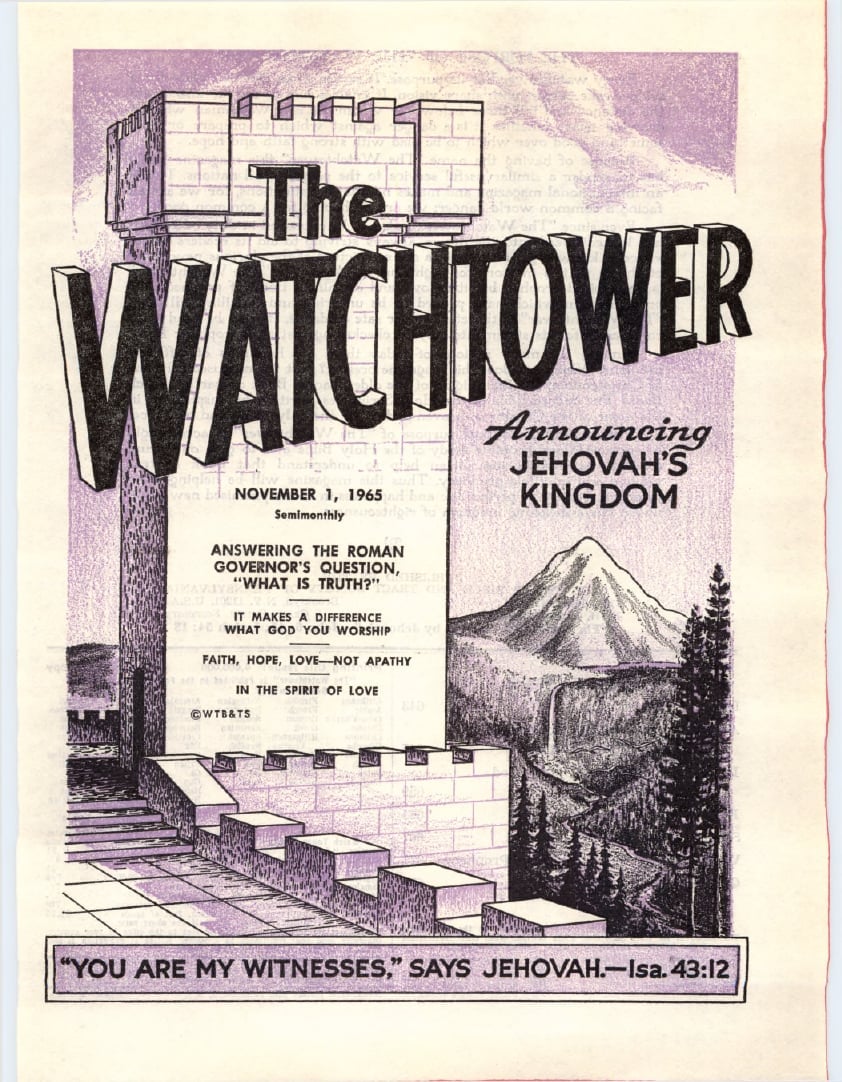
WATCHTOWER
NOVEMBER 1, 1965 Semimonthly
ANSWERING THE ROMAN GOVERNOR'S QUESTION, "WHAT IS TRUTH?"
IT MAKES A DIFFERENCE
WHAT GOD YOU WORSHIP
Announcing JEHOVAH'S KINGDOM
FAITH, HOPE, LOVE—NOT APATHY
IN THE SPIRIT OF LOVE
@WTB&TS
"YOU ARE MY WITNESSES," SAYS JEHOVAH.—Isa. 43:12
THE PURPOSE OF "THE WATCHTOWER"
Every watchtower has its purpose. It serves as an elevated place for a wide-awake person with sharp vision. It enables him to see far ahead into the distance and tell those below for whom he is a watchman what is drawing near, whether it is a danger against which to prepare or it is something good over which to be glad with strong faith and hope.
Because of having the name "The Watchtower" this magazine justly has to render a similar useful service to the people of all nations. This is an international magazine and makes no racial distinctions, for we are all facing a common world danger; we are all hoping for a common good.
Ever since "The Watchtower" began to be published in July of 1879 it has looked ahead into the future, always striving to aid its readers to advance in knowledge and to gain a clearer picture of the glorious new order of things that is in store for righteous mankind. No, "The Watchtower" is no inspired prophet, but it follows and explains a Book of prophecy the predictions in which have proved to be unerring and unfailing till now. "The Watchtower" is therefore under safe guidance. It may be read with confidence, for its statements may be checked against that prophetic Book.
Among the many nations of today there are hundreds of differing religions. Which one does this magazine present? Not the confused religions of Christendom, but the religion of the oldest sacred Book on earth. Which Book? The Sacred Bible of the Holy Scriptures, written by inspiration in the name of the Creator of heaven and earth, the only living and true God.
The sacred, nonpolitical purpose of "The Watightower" is accordingly to encourage and promote study of the Holy Bible and to give our many readers the needed unsectarian help to understand that Book of true religion and infallible prophecy. Thus this magazine will be helping them to prove worthy of perfect life and happiness in God's promised new order under His everlasting kingdom of righteousness.
PUBLISHED BY THE
WATCH TOWER BIBLE AND TRACT SOCIETY OF PENNYSVILANIA
117 Adams Street Brooklyn, N.Y. 11201, U.S.A.
N. H. KROHN, Prehmani
"They will all be taught by Jehovah."—John 6: 45; Isaiah 54: 13
CONTENTS
In the Spirit of Love
Answering the Roman Governor's Question, "What Is Truth?" 645
It Makes a Difference What God You Worship 659
Faith, Hope, Love-Not Apathy 664
Searching for and Finding God 667
Questions from Readers 672
Printing this issue: 4,600,000
Five cents a copy
“The Watchtower” is Published in the Following 70 languages
Summarily
Mostly
Arkansas
Armenian
Arabie
Bengali
Bahrain
Portuguese
Bahrain
Bengali
Chilean
Bolivian
Chilean
Bolivian
Chihuahua
Croatian
Chihuahua
Malagasy
Chihuahua
Malagasy
Chihuahua
Malagasy
Bandish
Pakistan
DO YOU have a suggestion to offer? counsel to give? reproof, correction or discipline to administer? Then why not do it in the spirit of love? That is the best way to do it; it makes for good relations with your neighbor and is most likely to
get results. By "love" here is meant, not the romantic eros based on sex attraction, but the love based on principle, the love that is unselfish and that is commanded in God's Word the Bible.—Mark 12:30, 31.
One reason why love is so effective is that "love is . . . kind." (1 Cor. 13:4) Kindness goes a long way, for it is an obvious expression of love; and we all have a basic hunger for love, even as we have for food. Since by inheritance mankind is prone to be selfish, many persons are inclined to be suspicious and on the defensive. Your speaking and acting in a kind manner will disarm them and help them to be friendlier. The simple word "please" has a kind connotation, and it is worthy of note how often this word is used by Bible characters, as shown in the New World Translation.—Gen. 13:8; Ex. 5:3; Num. 10:31; Deut. 3:25.
Another reason why the best way of doing things is in the spirit of love is that
"love is long-suffering," patient, willing to put up with things; it is not quick to give up. In the spirit of love try various ways to get your point across, especially when dealing with the failings of others. The situation may try you, cause you annoyance, but
by patiently bearing it or putting up with it you will more likely succeed, in the meantime making it so much easier for the other person.—I Cor. 13:4.
Then again, you may want to help someone who appears to be struggling with some difficulty or you may wish to make a suggestion at your place of employment or worship but fear you may meet with rebuff. True, you may, but you can lessen that risk if you proceed in the spirit of love. Why? Because, as the Bible further tells us, "love . . . does not brag," it "does not get puffed up." It does not offer help with the attitude of, "Let me show you!" but does so with due modesty, with humility. That makes it easier for the other person to accept your offer of help or your suggestion.
Using the spirit of love is also the best way to proceed because love "does not become provoked." Do you have a correction to make, a reproof to give? Then do not administer it in a provoked manner, as did the mother in the United States supermarket who was heard to screech at the top of her voice: "You shut up or I'll break your head!"
That was done in anything but the spirit of love!—1 Cor. 13:5.
In striking contrast to that mother was the father (in another true-life incident) who had kindly but firmly told his daughter not to be running around in the Christian meeting place after the program for worship had ended and who warned her she would get a spanking if she did. Before long, though, she was running around again and so her father required her to sit still on a chair until the time came for them to go home. Upon arriving at home the father took her upon his lap and kindly asked her if she remembered what he had told her would happen if she kept acting disorderly. Yes, she did, but begged off being punished, promising she would not do it again. But her father asked her, "What would you think of a person who made promises but did not keep them, and would you want your daddy to be like that?" She saw he had no alternative but to give her the spanking, which he did. But right after her tears had dried she came over to where her daddy was sitting and, putting her arms around him, said, "Daddy, I love you!" No question about it, administering punishment in the spirit of love, without anger or getting provoked, is the best way.
In particular is it important for marriage mates in dealing with each other to recognize the need of saying and doing things in love, being kind and patient, exercising self-control. People are prone to overlook the importance of how things are said, but that means so much to others, and rightly so. The Bible counsels husbands, for instance, to show consideration and to give wives added honor as to a weaker vessel, a
more delicate, more fragile vessel, as it were. You appreciate your wife's being kind and showing love to you and the children, so show love to her by being kind and gentle.—1 Pet. 3:7.
Many more examples could be given, showing the wisdom of doing things in the spirit of love, but perhaps in no sphere of activity is it more important than in the Christian ministry. Without doubt the apostle Paul was one of the most effective of all followers of Jesus Christ in making disciples of people, and he did so in the spirit of love. As he himself tells it, he 'became gentle to those to whom he ministered, giving of his own self to them, as when a nursing mother cherishes her own children.' He had tender affection for those to whom he ministered. No wonder he was able to start one Christian congregation after another.—1 Thess. 2:7, 8.
Quite likely here is one explanation for the fact that at times the most fruitful minister is not the one intellectually superior to the rest but the one displaying most unselfishness and, like the apostle Paul, having tender affection toward those to whom he ministers and gives of himself.
Helping you in this regard is empathy, that is, putting yourself in the shoes of the other person. How would you want another to come to you with a suggestion? How would you want another to point out a mistake you had made? Harshly, bluntly, intemperately, proudly? Of course not! Here again the Bible gives good advice: "Brothers, even though a man takes some false step before he is aware of it, you who have spiritual qualifications try to restore such a man in a spirit of mildness, as you each keep an eye on yourself, for fear you also may be tempted." We cannot improve on Bible principles. The best way to proceed in such matters is in the spirit of love.—Gal. 6:1.
THE ASKER of the question was the governor or procurator of the Roman provinces of Judea, Samaria and Idumea in the Middle East during the years of 20 to 36 of our Common Era. His capital was in the city of Caesarea on the Mediterranean Sea; but he put his question to a man on trial before him in the governor's palace in Jerusalem during the celebration of the Passover festival. Seemingly, in order to forestall any trouble in Jerusalem that day, the city's religious leaders handed over to the Roman governor a man whom they called a wrongdoer, to be tried and punished according to secular Roman law. During the private examination that followed, the governor as judge put the question to the man accused of wrongdoing. He was sentenced as the governor went in his interest in the truth. Three years later he was summoned to Rome to answer for misconduct in office. According to the historian Eusebius, he was banished to Vienna (Vienna) in the Roman province of Gaul and later he committed suicide. He died without getting the answer to his question.
THE Roman governor was Pontius Pilate. The man to whom he put his famous question was Jesus Christ. The historicalness of the meeting of these two men on this momentous occasion is supported, not only by Jewish witnesses, but also by the noted Roman historian of our first century, Publius Cornelius Tacitus. When writing about the name "Christian," this non-Jewish historian says: a "The author of that name, Christ, was afflicted with punishment [was put to death] by the procurator Pontius Pilate, Tiberius acting as emperor."
But the man who reported on the details of this encounter between Jesus Christ and Pontius Pilate was the most loved earthly friend of Jesus Christ, namely, John the son of Zebedee. (John 18:28-38) John's report had a strong background of truthfulness, for more than any other Bible writer he wrote about truth and truthfulness, in a field of interest that is of the greatest importance to all of us.
2 Apparently the Roman governor Pontius Pilate let the question, "What is truth?" die with him, unanswered. Really, though, did the question die with him? Has the question remained unanswered down to this day? Though Jesus Christ did not verbally answer Pilate's question to him himself, did he really leave the question unanswered to others, yes, to us? We are obliged to reply No! Pilate's question has been answered, and the answer can be given to the honest seekers and lovers of "the truth."
3 Truth means "conformity to fact." There are all kinds of things about which we have to establish the actual facts in order to know the truth about them. When we know a thing just as it actually is, our knowledge of the thing is formally true or is true in form. To be true, our knowledge of a thing must conform to what that thing is in reality. Now, when Jesus Christ was on trial before Pontius Pilate, the governor's interest was in learning certain facts about this accused man. His interest was not in truth in general; his assigned duties and his responsibilities did not allow for such a broad investigation. The man before him under accusation was the one that brought up the
subject of the truth. So it was the truth in this regard concerning which Pilate asked: "What is truth?" What, then, was the truth that here came under focus? Let us see.
PROBING FOR THE ANSWER
"The report made by John the son of Zebedee reads: "So Pilate entered into the governor's palace again and called Jesus and said to him: 'Are you the king of the Jews?' Jesus answered: 'Is it of your own originality that you say this, or did others tell you about me?' Pilate answered: 'I am not a Jew, am I? Your own nation and the chief priests delivered you up to me. What did you do?' Jesus answered: 'My kingdom is no part of this world. If my kingdom were part of this world, my attendants would have fought that I should not be delivered up to the Jews. But, as it is, my kingdom is not from this source.' Therefore Pilate said to him: 'Well, then, are you a king?' Jesus answered: 'You yourself are saying that I am a king. For this I have been born, and for this I have come into the world, that I should bear witness to the truth. Everyone that is on the side of the truth listens to my voice.' Pilate said to him: 'What is truth?'" —John 18:33-38; Matt. 27:11-14.
On this decisive occasion Jesus was true to the mission on which he came into the world. Fear of death did not influence him to deny the facts of the case. When his captors handed him over to Pilate, they accused him, saying: "This man we found subverting our nation and forbidding the paying of taxes to Caesar and saying he himself is Christ a king." (Luke 23:1-3) So when he was asked point blank whether he was a king, he did not deny. In answer to Pilate, he spoke of "my kingdom," but he explained that it was no part of this world.
From this explanation Pilate concluded that Jesus was a king. This induced him to ask a second time concerning Jesus' kingship, saying: "Well, then, are you a king?" That is, even if your kingdom is no part of this world. Jesus answered that Pilate had drawn the right conclusion, by saying: "You yourself are saying that I am a king." Otherwise, Pilate would not have asked a second time whether he was a king.
Jesus let Pilate's judicial conclusion stand as the true one. Jesus was on the witness stand and he could not now deny the truth. As he then told Pilate, he had been born for this very purpose and had come into the world for this very purpose, to bear witness to the truth of his kingship. And everyone that is on the side of the truth would accept Jesus' testimony as the truth. He had been born to bear witness to the truth. At thirty years of age he had been baptized and had come into the world to bear witness to the truth. So now at the climax of his earthly life he would not miss the purpose of his human birth and of his public entry upon the world stage. He would be faithful to the truth, even if it cost his life. If the point at issue were not the truth, he certainly would not be willing to die for it; he would not die for a lie.
7 Jesus was willing to die for the truth. Are we convinced by the courage and faithfulness of his course that his testimony, not only before the Roman governor, but before all the nation, was the truth? If we are convinced, what does it mean? If we listen to his voice by accepting what he says, then we accept him as king. By doing so, we prove we are "on the side of the
truth." That means we are also on Jesus' side, which is where we want to be.
It must be very important truth, if a person is born for the very purpose of bearing witness to it. It must be truth worthy of devoting one's whole life to it, if a person comes into this world for the very purpose of bearing witness to it. Actually it was just that important. So, if there is any truth on which to inform ourselves, it should be this truth. Yet, in Jesus' case, truth was not just a matter of what he said; it was also a matter of what he did, how he lived and how he died. It was a case of living to make the truth realize itself or come to reality. There were many things wrapped up in Jesus as a man that were of universal importance, yes, of importance to heaven and earth; and he had to live and act in fulfillment of those things. He himself must be the truth.
*It was not just an extravagance of words or exaggerated language when Jesus' beloved disciple John wrote of his coming from heaven to earth to be born as a perfect man and said: "So the Word became flesh and resided among us, and we had a view of his glory, a glory such as belongs to an only-begotten son from a father; and he was full of undeserved kindness and truth. For we all received from out of his fullness, even undeserved kindness upon undeserved kindness. Because the Law was given through Moses, the undeserved kindness and the truth came to be through Jesus Christ."—John 1:14, 16, 17.
HOW "THE TRUTH CAME TO BE"
10 Well, then, how was Jesus "full of . . .
truth"? How was he the one through whom "the truth came to be"? Why does the apostle John contrast Jesus with Moses? Did not the prophet Moses bring the truth in his days, more than fourteen centuries before Christ? Was not the Law that God gave to Moses for the Jewish nation the truth? Yes. Centuries after the giving of the Law through Moses, the inspired psalmist said to God the Lawgiver: "Those in pursuit of loose conduct have come near; they have got far away from your own law. You are near, O Jehovah, and all your commandments are truth." (Ps. 119:150, 151) The very fact that the Law as given through Moses condemned his own people as simmers proves that this Law was true to righteousness and holiness. Because of its perfection, that Law condemned the Jews to death. So, in defense of the goodness of God's law, the apostle Paul writes:
11 "And the commandment which was to life, this I found to be to death. For sin, receiving an inducement through the commandment, seduced me and killed me through it [that is, through the commandment that condemned sinners to death]. Wherefore, on its part, the law is holy, and the commandment is holy and righteous and good."—Rom. 7:10-12.
12 So the Law given through Moses was not erroneous. Rather, it pointed out what error was. The Law given through Moses was not a mistake. The Ten Commandments that were a part of that Law were no mistake. The Law required perfect obedience on the part of the Jews in order for them to gain everlasting life by keeping it. But none of the Jews of ordinary birth could keep the Law perfectly and
gain everlasting life by the works of the Law. Yet that Law served its purpose, for it identified or pointed out the Perfect One who did keep the Law flawlessly, the One who thus escaped condemnation by the Law and who was therefore pronounced completely righteous and deserving of everlasting life because of his unblemished righteousness. That the Law given through Moses did not miss its purpose and that it was no erroneous attempt or failure, the Jewish Christian apostle Paul made clear with these words:
14 "Before the [Christian] faith arrived, we were being guarded under law, being delivered up together into custody, looking to the faith that was destined to be revealed. Consequently the Law has become our tutor leading to Christ, that we might be declared righteous due to faith. But now that the faith has arrived, we are no longer under a tutor [the Law]." -Gal. 3:23-25.
14 The Law given through Moses was more than just a legal code, more than a systematized set of laws for human conduct. In many ways it was prophetic. It commanded many things that were prophetic of good things to come. For instance, the Law set up a priesthood for the Jewish nation in the family of Aaron, the older brother of Moses. This was prophetic of how Jehovah God would set up a High Priest who would offer sacrifice for the lasting benefit of all mankind. This spiritual, heavenly High Priest would also have underpriests, these being taken from among men and being able to sympathize with men in their sinful estate and imperfection.
15 The Law ordered that every year a national atonement day should be held on the tenth day of the seventh lunar month of the Jews. On that day atonement was to be made for both the priesthood and all the rest of the Jewish nation by means of the sacrifice of an unblemished bull and goat, the blood of which was sprinkled in the Most Holy of the sanctuary.
Also, their sins were to be carried away into oblivion by a scapegoat. All that was prophetic of how God's great High Priest would offer up a sacrifice to atone for mankind's sin and would serve as a real Sin Bearer to carry away mankind's sin into oblivion. All this provision would be an expression of loving-kindness on God's part.
16 Thus there was much more to the Law given through Moses than merely commandments to point out what sin was and to tell the Jews what was the pure, right, holy and unselfish thing to do, to keep them walking in harmony with God. Besides that, the Law commanded certain meaningful ceremonies to be carried out regularly in order to draw prophetic outlines that give a true picture of grand things to come according to God's purpose. The inspired writer calls these prophetic outlines 'shadows,' saying: "There being men who offer the gifts according to the Law, but which men are rendering sacred service in a typical representation and a shadow of the heavenly things; just as Moses, when about to make the tent in completion, was given the divine command: For says he: 'See that you make all things after their pattern that was shown to you in the mountain [of Sinai].'"—Heb. 8:4, 5.
17 Again the same writer mentions 'shadows' when reasoning on the need for a perfect human body to be presented in sacrifice to God, saying: "Since the Law has a shadow of the good things to come, and not the very substance of the things, men can never with the same sacrifices
from year to year which they offer continually make those who approach perfect. Otherwise, would the sacrifices not have stopped being offered, because those rendering sacred service who had been cleansed once for all time would have no consciousness of sins any more? To the contrary, by these sacrifices there is a reminding of sins from year to year, for it is not possible for the blood of bulls and of goats to take sins away. Hence when he comes into the world he says: 'Sacrifice and offering you did not want, but you prepared a body for me.'"—Heb. 10:1-5.
18 Many other things that were commanded in the Law, such as the passover supper, the festival of weeks or Pentecost, the weekly sabbath day, the Jubilee year, the festival first day of each month or new moon, particularly the seventh new moon of each year, all these were 'shadows.' They were true in themselves, giving a true outline or small picture of greater things to come. However, they were only 'shadows.' A shadow is a dark image or design that is cast upon some surface by some solid, untransparent substance that gets in the way of the light. The shadow is not substantial; it is not the real thing. The substance or body that the shadow outlines or images is the real thing. If the substance or body is in front of the light, then its shadow extends ahead of the substance or body. For that reason it is a common saying: "Coming events cast their shadows before them." In God's purpose, the shadow came first, to give a small-scale idea of the grand things that he had in mind for the future of mankind. Those shadows aroused true expectations in people who obediently kept God's law. Because the 'shadows' were true, these people would not be disappointed in their expectations.
19 The shadow is truthful but is not the full truth on the matter. Only when the substance that was foreshadowed arrives does the truth arrive. Then the truth is realized. The substance or body is the truth. As the Mosaic law contained only the shadows, it had to give way to the coming of the real thing, the substance or body that the Law foreshadowed. Hence the rules laid down in the Mosaic law concerning eating, drinking, observing of ceremonies and keeping of holy days had to pass away like pictures or shadows. They did so, for the apostle Paul writes to the Christian congregation in Colossae, Asia Minor: "Therefore let no man judge you in eating and drinking or in respect of a festival or of an observance of the new moon or of a sabbath; for those things are a shadow of the things to come, but the reality belongs to the Christ." (Col. 2:16, 17) It was therefore in full harmony with the historical facts that the apostle John should say: "The Law was given through Moses, the undeserved kindness and the truth came to be through Jesus Christ." —John 1:17.
20 To make this statement true in its fullest sense, it required more on the part of Jesus Christ than mere talking, preaching, teaching. It required this Son of God to shed his spiritual glory in heaven and to be born as a perfect human child in order to be able to fulfill the truth of the Atonement Day sacrifices that figuratively took away the sins of all the Jewish nation. It required him to present himself at the age of thirty years as a suitable human victim for an acceptable sacrifice to God in order for him to be appointed as God's High Priest, to atone for the sins of all mankind. (Heb. 5:1-5; 7:27; 8:1-4) This
he did when he presented himself for immersion in the Jordan River by John the Baptist, his body being buried out of sight momentarily in the water. Thus he did 'come into the world' with the sacrificial human body that God had prepared for him.—Heb. 10:5-10; Ps. 40:6-8; John 18:37.
21 At his death three and a half years later he, as Jehovah's High Priest, did make an offering of his human sacrifice "once for all time." That he might present the value of his perfect human sacrifice to God in heaven, he had to be resurrected from the dead. This occurred on the third day from his death. Then, like the Jewish high priest passing beyond the inner veil of the temple into the Most Holy or innermost room, Jesus Christ rose from the dead into the spirit realm and in due time appeared in the literal presence of God to present the life value of his sacrifice.
22 All this proved the truthfulness of the shadows that had been contained in the Law given through Moses. It established the high priesthood of Jesus Christ as a real truth, as being successfully executed. From this fact the most precious blessings are to flow to mankind. All these things were part of Jesus' bearing witness to the truth, his putting the things that were foretold and foreshadowed by the law of Moses into the realm of actual truth.
KINGDOM TRUTH
23 However, is truth with regard to priestly service and the making of propitiatory sacrifice for the sins of the world all the truth that is of importance and concern to us? No! For when Jesus was under questioning by Governor Pontius Pilate, the matter of royal government came foremost to view.
The enemies who had handed him over for Roman trial charged him with claiming to be "Christ a king." (Luke 23:1, 2) In reality, at that very time there was much truth to be established with regard to the matter of government, not just the local government of the Jews but the government of all the world of mankind. O ever so much depended upon Jesus Christ at that time, and he appreciated this fact and was wholly determined to be faithful. Not unexpectedly, things in the Law of Moses that had to do with the coming government of God's people needed to be proved to be correct prophecies, correct 'shadows' that would conform to future facts. How were they proved so?
24 At the time that the Law was given through Moses at Mount Sinai there was no visible human king over Israel. Moses was not Israel's king but was serving as mediator between Jehovah God and the nation of Israel. Moses' older brother was Aaron, the firstborn son of Amram the Levite. In Aaron's family Jehovah God set up the priesthood over Israel. Why did God not also set up a human king over Israel? Or why did he not make Aaron a king-priest? It was because Jehovah God, though invisible, was the law-giving King over Israel. He could not also be the Priest of Israel. Matters in Israel were just as Moses sang of them alongside the Red Sea, about three months before the Law was given through Moses: "Jehovah will rule as king to time indefinite, even forever. When Pharaoh's horses with his war chariots and his cavalrymen went into the sea, then Jehovah brought back the waters of the sea upon them, while the sons of Israel walked on dry land through the midst of the sea." (Ex. 15:18, 19) So Jehovah did not put himself out of office as King.
25 In the Mosaic law Jehovah God did suggest that the time might come when the Israelites would want to be like the theocratic pagan nations and have a visible king over them. Then, said Jehovah, "you should without fall set over yourself a king whom Jehovah your God will choose. From among your brothers you should set a king over yourself. You will not be allowed to put over yourself a foreigner who is not your brother . . . when he takes his seat on the throne of his kingdom, he must write in a book for himself a copy of this law from that which is in the charge of the priests, the Levites." (Deut. 17:14-18) Later Moses warned that if the Israelites did not carry out their solemn contract or covenant with God, then "Jehovah will march you and your king whom you will set up over you to a nation whom you have not known, neither you nor your forefathers; and there you will have to serve other gods, of wood and of stone." (Deut. 28:35, 36) Over three hundred and fifty years later the whole nation of Israel did ask for such a king, and God gave them Saul the son of Kish.—1 Sam. 8:4 to 12:5.
28 King Saul was of the tribe of Benjamin. But long before the Law was given through Moses, Jehovah God inspired the patriarch Jacob or Israel to prophesy that the royal power in Israel would come into the hand of the tribe of Judah and that the scepter and the commander's staff would never depart from that tribe. Someone called Shiloh (meaning "The One Whose It Is") would come in that tribe, "and to him the obedience of the peoples will belong."
27 This prophecy concerning kingship was written in the Bible's first book, in Genesis 49:8-10.
However, the book of Genesis was written by Moses. What are now the first five books of the Bible were at first just one book written by Moses. In the days of Jesus Christ, when Jews spoke of the big divisions of the books of the Hebrew Scriptures, the first five Bible books written by Moses were called the Law or "Torah," so that the book of Genesis came under the heading of "the Law," the Torah. After being resurrected from the dead Jesus said to his disciples: "These are my words which I spoke to you while I was yet with you [in the flesh], that all the things written in [1] the law of Moses and in [2] the Prophets and [3] Psalms about me must be fulfilled." (Luke 24:44) For that reason the expression "the Law" could include the things written in the book of Genesis, including this prophecy by the patriarch Jacob concerning the kingship in the tribe of Judah.
28 In order to "bear witness to the truth" concerning God's kingdom Jesus was born in the tribe of Judah. (Heb. 7:14) But in order for him fully to "bear witness to the truth," Jesus' birth could not be in any unparticular family in the tribe of Judah. His birth had to be in the family line of David of Bethlehem; and it was. (Rom. 1:1-4) Why was this? It was because David of the tribe of Judah was made king of Israel, to succeed King Saul and his son Ish-bosheth, and then Jehovah God made a solemn contract or covenant with King David for the kingship of God's people to stay in David's royal family line forever. That meant that at last David would have a permanent heir to the kingdom. (2 Sam. 7:11-16; 1 Chron. 17:11-15) Jehovah God not only made this promise to faithful King David but bound himself more strongly to
this promise by swearing to it. In thus swearing, God was really swearing in behalf of his own kingdom, for King David himself acknowledged that the kingdom over Israel really belonged to Jehovah and that the throne on which he sat in Jerusalem was really "Jehovah's throne." (1 Chron. 29:10, 11, 23) Concerning this sworn oath which was to confirm the covenant with David for an everlasting kingdom, we read:
"I have concluded a covenant toward my chosen one; I have sworn to David my servant, 'Even to time indefinite I shall firmly establish your seed, and I will build your throne to generation after generation. . . . I shall not profane my covenant, and the expression out of my lips I shall not change. Once I have sworn in my holiness, to David I will not tell lies. His seed itself will prove to be even to time indefinite, and his throne as the sun in front of me. As the moon it will be firmly established for time indefinite, and be a faithful witness in the skies."—Ps. 89:3, 4, 34-37; Acts 2:30.
30 This kingdom covenant and all its features were what God's Word calls the "loving-kindnesses to David," and God's swearing to it added to the faithfulness and trustworthiness of it. Hence in a time of persecution God's people who depend upon him to carry out this kingdom covenant can well take up the words of the psalmist, not in any doubt about the covenant, but in an appeal to God concerning it, and say: "Where are your former acts of loving-kindness, O Jehovah, about which you swore to David in your faithfulness?" (Ps. 89:49) Considerately God assures his people of his faithfulness to the covenant, saying: "I shall readily conclude with you people an indefinitely lasting covenant respecting the loving-kindnesses to David that are faithful."
(Isa. 55:3) Jesus Christ in particular could take consolation from this divine promise.
31 So, to the end of making the kingdom covenant an everlasting truth, Jesus was born in the royal family line of David, to become David's Permanent Heir. Thus Jehovah did not prove untrue to King David and did not draw back from giving to that anointed king a permanent heir. Jehovah answered the prayer made to him in Psalm 132:1-18: "On account of David your servant, do not turn back the face of your anointed one. Jehovah has sworn to David, truly he will not draw back from it: 'Of the fruiture of your belly I shall set on your throne. . . . There I shall cause the horn of David to grow, I have set in order a lamp for my anointed one. His enemies I shall clothe with shame; but upon him his diadem will flourish.'"
32 The apostle Peter was one who bore witness to the truth of all that. On the day of the festival of Pentecost, fifty days after Jesus Christ was resurrected from the dead, Peter explained the outpouring of God's holy spirit upon Christ's disciples there in Jerusalem and said:
Brothers, it is allowable to speak with freeness of speech to you concerning the family head David, that he both deceased and was buried and his tomb is among us to this day. Therefore, because he was a prophet and knew that God had sworn to him with an oath that he would seat one from the fruitage of his loins upon his throne, he saw beforehand and spoke concerning the resurrection of the Christ, that neither was he forsaken in Ha'des nor did his flesh see corruption. This Jesus God resurrected, of which fact we are all witnesses. Therefore because he was exalted to the right hand of God and received the promised holy spirit from the Father, he has poured out this which you see and hear. Actually David did not ascend to the heavens, but he himself says, 'Jehovah said to my Lord: "Sit at my right hand, until I place your enemies as a stool for your feet."' Therefore let all the house of Israel know for a certainty that God made him both Lord and Christ, this Jesus whom you impaled."—Acts 2:29-36.
"LORD" OF KING DAVID
Here the apostle Peter, under inspiration of the outpoured holy spirit, declared the exalted Jesus Christ to be the Lord of King David, that is, higher than King David. The throne of King David had been merely an earthly one called "Jehovah's throne"; but the position of Jesus Christ in a throne was a heavenly one, at God's own right hand. He was to be a deathless, everlasting heavenly king. In the approaching future, when David is resurrected from the dead, he will learn of his descendant, Jesus Christ, and will acknowledge this exalted one as his Lord, the true Christ or Anointed One. In Psalm 110 King David foretold the lordship of Jesus Christ. The apostle Peter quoted the first verse of this psalm and applied it to Jesus Christ, as being fulfilled in him. Thus, in effect, the inspired Peter applied the entire psalm to Jesus Christ. The apostle Paul also applies it to him.
35 This psalm of David reports Jehovah as swearing again, but this time not to King David, but to David's Lord at God's right hand in the heavens. Addressing itself to him, verse four of Psalm 110 announces: "Jehovah has sworn (and he will feel no regret): 'You are a priest to time indefinite according to the manner of Melchizedek!'
" Hence Jehovah thus swore to his Son, Jesus Christ.
39 Who was this Melchizedek whose "manner" was to be imitated in David's Lord, Jesus Christ? The Law given through Moses, as including the book of Genesis, informs us. Melchizedek was not only a priest but also a king. According to Genesis 14:17-20, he went out from his royal city to meet the patriarch Abraham when returning victorious from battle. We read: "Melchizedek king of Salem brought out bread and wine, and he was priest of the Most High God. Then he blessed him and said: 'Blessed be Abram of the Most High God, Producer of heaven and earth; and blessed be the Most High God, who has delivered your oppressors into your hand! At that Abram gave him a tenth of everything." Melchizedek was thus higher than Abram.
37 In Hebrews 6:20 to 7:17 the sworn statement of Psalm 110:4 is applied to Jesus Christ. The "manner" in which he is like King-Priest Melchizedek is explained point by point. Melchizedek as a king-priest had no successor on earth. Jesus Christ did not inherit either priesthood or kingdom from Melchizedek. He became the Permanent Heir of King David according to the kingdom covenant, but he did not inherit his priesthood from High Priest Aaron of the tribe of Levi. Jesus was not born in the tribe of Levi, for he had to be David's descendant. How did Jesus get his priesthood forever? It was by means of Jehovah's sworn oath as given in Psalm 110:4.
38 Since ancient Melchizedek was to show
the "manner" of a future King-Priest, Melchizedek was a prophetic historical figure and prefigured the greater King-Priest, Jesus Christ. What Melchizedek prefigured came true in Jesus Christ. Melchizedek's name means "King of Righteousness"; and as king of Salem, which name means "Peace," he was also "king of peace." However, Jesus Christ was the real Melchizedek whom God had in mind long previously; he was the true "King of righteousness," the true "King of peace." He is the true King-Priest who makes everlasting atonement for all mankind and who will reign peacefully over all the earth. Jehovah God will never feel regret over having sworn to make him King-Priest.
THE PERSONIFIED TRUTH
39 From all this it is manifest that Jesus Christ is the Truth. He is the realization of the truth to which the shadows of the Mosaic law as well as the prophecies of the Hebrew Scriptures were pointing forward. All those things of a prophetic kind were focused on him. For this he was born and for this he came into the world that he might bear witness to the truth of those things by fulfilling them. He was the living Truth of those revelations of God's purpose, the things to which God had sworn.
40 When on earth as a man, Jesus was determined to bear witness to the truth of God's recorded word in the Hebrew Scriptures. On the night of falling into the hands of his enemies he said to his faithful apostles: "I am the way and the truth and the life. No one comes to the Father except through me." (John 14:6) Was he not correct in saying this? Yes, for he was indeed the Truth. He was no shadow Messiah or Christ. He was the real one promised.
He was no shadow king-priest. He was substantially the true one that had been prefigured. As such, he benefits not only the circumcised Jews but also all the non-Jewish nations. Hence the apostle Paul says:
41 "I say that Christ actually became a minister of those who are circumcised in behalf of God's truthfulness, so as to verify the promises He made to their forefathers, and that the nations might glorify God for his mercy. Just as it is written: 'That is why I will openly acknowledge you among the nations and to your name I will make melody.' And again he says: 'Be glad, you nations, with his people.' And again: 'Praise Jehovah, all you nations, and let all the peoples praise him.' And again Isaiah says: 'There will be the root of Jesse [father of King David], and there will be one arising to rule nations; on him nations will rest their hope.'"—Rom. 15:8:12; Ps. 18:49; 117:1; Deut. 32:43; Isa. 11:10.
42 Once when he encountered a Phoenician woman, Jesus Christ said: "I was not sent forth to any but to the lost sheep of the house of Israel." When sending out his twelve apostles to preach the kingdom of the heavens, Jesus said to them: "Do not go off into the road of the nations, and do not enter into a Samaritan city; but, instead, go continually to the lost sheep of the house of Israel." (Matt. 15:24; 10:5, 6) Thus, because he was born and circumcised as a Jew under the Mosaic law, Jesus "actually became a minister of those who are circumcised." This ministry of Jesus Christ to the circumcised Jews was rendered "in behalf of God's truthfulness," because Jehovah God had said to the patriarchs Abraham, Isaac and Jacob that all the nations of the earth would bless themselves by means of their seed. Naturally, by human
birth, their "seed" would be Israelites or Jews, Hebrews. (Gen. 22:18; 26:4; 28:14) Hence according to the natural order of things it was necessary for Jesus Christ to establish "God's truthfulness" as regards those promises made to the three Hebrew patriarchs; how? By offering first to Jews the opportunity to receive the Abrahamic blessing and become the spiritual seed of Abraham. It was absolutely obligatory upon Jesus to respect the sworn oath of Jehovah God, because God had sworn with an oath that his promises to the patriarchs were truthful, and Jesus had to "verify" those promises.
33 To the circumcised descendants of the patriarchs, Moses said: "It was because of Jehovah's loving you, and because of his keeping the sworn statement that he had sworn to your forefathers, that Jehovah brought you out . . . from the hand of Pharaoh the king of Egypt." (Deut. 7:8) God's swearing to the patriarchs is further mentioned in Psalm 105:7-11.* which says: "He is Jehovah our God. His judicial decisions are in all the earth. He has remembered his covenant even to time indefinite, the word that he commanded, to a thousand generations, which covenant he concluded with Abraham, and his sworn statement to Isaac, and which statement he kept standing as a regulation even to Jacob, as an indefinitely lasting covenant even to Israel, saying: 'To you I shall give the land of Canaan as the allotment of your inheritance.'
"—See also Genesis 24:6, 7; 50:24; Exodus 6:8; Jeremiah 11:4, 5.
44 Jehovah God respects his own oath and never proves false to it. Likewise Jesus Christ, when on earth, respected Jehovah's oath and sought to prove its truthfulness.
45 So it is that in Jesus Christ we find fulfilled God's oath in affirmation of the covenant that he made with David for an everlasting kingdom, and God's oath supporting his appointment of a priest forever after the manner of Melchizedek. With Jesus' being born on earth, his coming into the world at the time of his baptism in water, his three and a half years of public service in behalf of God's kingdom, his death in faithfulness to God, his resurrection from the dead and his exaltation to heaven, with all these historical events the truth arrived, God's truth arrived. The whole career of Jesus Christ was thus a bearing witness to the truth.
AT LAST THE ANSWER!
46 How, then, shall we answer the question that the Roman Governor Pontius Pilate put to Jesus, namely, "What is truth?" Under the circumstances under which the question was raised, the Bible's answer must be: The "truth" is God's kingdom with Jesus Christ the "Son of David" serving as King-Priest in the throne.
47 Is it any wonder, then, that God's kingdom by Christ is the leading doctrine or teaching of the Holy Bible? From its first book, Genesis, which tells of the prophetic figure, Melchizedek, down to its last book, Revelation, which describes the birth
of the Kingdom and its rule for a thousand years, the Bible holds to the theme of God's Messianic kingdom. Harmoniously with that, in the last written book of the ancient Hebrew Scriptures God calls attention to his own kingship, saying: "I am a great King,' Jehovah of armies has said, 'and my name will be fear-inspiring among the nations."" (Mal. 1:14) And, according to the first book of the Christian Greek Scriptures, when Jesus the Son of God came into the world to begin his Messianic service to God, he was preceded by a forerunner, John the Baptist, proclaiming to the circumcised Jews: "Repent, for the kingdom of the heavens has drawn near."—Matt. 3:1, 2.
48 When Jesus Christ followed up John the Baptist, he also said: "The appointed time has been fulfilled, and the kingdom of God has drawn near. Be repentant, you people, and have faith in the good news." (Mark 1:14, 15) Finally, when Jesus Christ foretold the preaching that would mark his return and second presence and the conclusion of the system of things, which Bible doctrine in particular did he say would be preached by his disciples? His words recorded in Matthew 24:14 give the answer: "This good news of the kingdom will be preached in all the inhabited earth for a witness to all the nations; and then the end will come."—Matt. 24:3, 14.
49 Today there is good reason for that Bible doctrine to be preached foremost. Why? Because this "conclusion of the system of things" was to be the time for God's Messianic kingdom to be born in the heavens, as prophetically pictured in the last book of the Bible, Revelation. At this event many voices in heaven would join in announcing: "The kingdom of the world has become the kingdom of our Lord and of his Christ, and he will rule as king forever and ever."
Also, to the Lord God, who is the real Power behind the Messianic kingdom, thanksgiving was to be offered in these words: "We thank you, Jehovah God, the Almighty, the one who is and who was, because you have taken your great power and begun ruling as king. But the nations became wrathful, and your own wrath came." (Rev. 11:15-18) Moreover, after Satan the chief resister of the heavenly kingdom is hurled out of heaven and down to the earth, the announcement was to be made loudly throughout heaven:
50 "Now have come to pass the salvation and the power and the kingdom of our God and the authority of his Christ, because the accuser of our brothers has been hurled down, who accuses them day and night before our God!"—Rev. 12:5-10.
THE "WORD OF TRUTH"
51 God's Messianic kingdom is the "truth," to bear witness to which Jesus was born and came into the world. Since the Holy Bible supplies us fully the details about this kingdom, the Holy Bible is rightly spoken of as "the word of truth." The men who took part in writing the Bible under inspiration were seekers of the truth. For example, King Solomon referred to himself as the congregator of God's people and wrote: "The congregator sought to find the delightful words and the writing of correct words of truth." (Eccl. 12: 10) The angel that was sent to tell the prophet Daniel much vital information concerning the "time of the end," in which we are living today, said: "I shall tell you the things noted down in the writing of truth . . . And now what is truth I shall tell to you." (Dan. 10:21; 11:2; 12:4) The
apostle Paul, an outstanding contributor to the Bible, wrote to fellow Christians: "We should serve for the praise of his glory, we who have been first to hope in the Christ. But you also hoped in him after you heard the word of truth, the good news about your salvation."—Eph. 1:12, 13.
52 In order that the Bible may serve as the instrument for our preaching and teaching the truth, it must be handled in the right way. So, when the apostle Paul told an overseer of a Christian congregation to pay constant attention to himself and to his teaching, he said: "Do your utmost to present yourself approved to God, a workman with nothing to be ashamed of, handling the word of the truth aright." (2 Tim. 2:15; 1 Tim. 4:16) Today Christendom boasts of over 900,000,000 members and has had the Bible in writing or in print for many centuries. Has she handled this "word of the truth" aright? No; for she teaches religion in a thousand different ways, as represented in her hundreds of religious sects, Christendom, as a representation of Christianity, is a lie. To the contrary, Christianity, which is based on the Holy Bible and which handles the Bible aright, is the truth. The true Christians must follow the Bible if they are to walk in the truth.
53 That is what Christians did in the first century, in the purity of their faith. Testifying to this fact, the apostle John wrote to a fellow believer named Gaius and said: "I rejoiced very much when brothers came and bore witness to the truth you hold, just as you go on walking in the truth. No greater cause for thankfulness do I have than these things, that I should be hearing that my children go on walking in the truth."—3 John 3, 4.
Back there a person could not become a true Christian, begotten as a spiritual son of God, unless he heard and studied and believed the truth. The disciple James calls attention to this need of the truth when he writes: "Do not be misled, my beloved brothers. Every good gift and every perfect present is from above, for it comes down from the Father of the celestial
lights, and with him there is not a variation of the turning of the shadow. Because he willed it, he brought us forth by the word of truth, for us to be a certain
and be in the truth, and not be an antichrist. If we do not believe that he was born in the flesh and came into the world to be God's chief witness bearer to "the truth," then we are in error and we originate with the world and we are not true Christians.—1 John 4:1-6.
50 By means of the Holy Bible, God's "word of truth," we know the answer to
COMING IN THE NEXT ISSUE
"Let God Be Found True."
The Truhteller Steps In with an Oath.
Do Bible Principles Govern Your Choice of Entertainment?
first fruits of his creatures." (Jas. 1:16-18) A real Christian can spring only from the truth. The apostle John, who loved to write about the truth, wrote to Christians who were dear to him: "Little children, let us love, neither in word nor with the tongue, but in deed and truth. By this we shall know that we originate with the truth, and we shall assure our hearts before him." (1 John 3:18, 19) So if we desire to assure our hearts before God that we are genuine Christians, we must originate with the truth that is brought to us and we must have brotherly love. If we originate with the world, we shall be in error.—1 John 4:4-7.
The Story of the German Bible.
55 In view of the fact that Jesus Christ is "the truth," as he himself said in John 14:6, we must have the correct belief about him if we are to originate with the truth
the question, "What is truth?" We desire also to associate with God's visible organization of the truth. He used Jesus Christ his glorified Son to found this organization on the day of Pentecost fifty days after his resurrection. According to the inspired words of 1 Timothy 3:14, 15, this organization is "God's household, which is the congregation of the living God, a pillar and support of the truth." Yes, indeed, this is what we want to associate with, the "pillar and support of the truth."
57 So, instead of trying to tear down the truth—an impossible thing—we will do our part to uphold the Kingdom truth, raising it on high for all to see. To all the nations we will deliver the Bible answer to the question, "What is truth?" We will share with the "congregation of the living God" in preaching the truth, "this good news of the kingdom," doing so in all the inhabited earth for a witness to all the nations before the end comes. (Matt. 24:14) Everyone that is of the truth will listen to our voice as we serve as substitutes for Christ. —John 18:37; 2 Cor. 5:20.
It Makes a DIFFERENCE WHAT GOD YOU WORSHIP
SENTIMENTS we often hear expressed from the pulpit, in the newspapers, on billboards and from individuals are, "It does not matter which God you worship, just so long as you worship." "Go to the church of your choice," or, "Each one has to find God and worship him in his own way." Most of the people making these statements have accepted the religion they practice because they believe it will bring them life. This means that much hinges on religion, for, if one does not have life, what can he have? So be careful what viewpoint you adopt about religion.
Let us compare the above words with what the Son of God said. When talking to a woman of the Samaritan religion he told her: "Believe me, woman, The hour is coming when neither in this mountain nor in Jerusalem will you people worship the Father. God is a Spirit, and those worshiping him must worship with spirit and truth." (John 4:21, 24) As to what is truth, Jesus said when speaking to his heavenly Father: "Your word is truth." (John 17:17) The truth is, therefore, that which is in harmony with the actual state of things and with the Word of God, the true guide. Jesus as the Son of God was the One most intimate with his Father and said that he himself was devoted to doing his Father's will. (John 4:34) From this
we would be compelled to conclude that the wrong god or the wrong way of worship would not meet with success.
IGNORANCE NO EXCUSE
Moreover, that even ignorance would not excuse one was clearly shown by Jesus' statement to his disciples about the Pharisees: "Let them be. Blind guides is what they are. If, then, a blind man guides a blind man, both will fall into a pit." (Matt. 15:14) That ignorance can cause one to
fall into a terrible snare of his own undoing, Paul made plain: "We speak God's wisdom . . . This wisdom not one of the rulers of this system of things came to know, for if they had known it they would not have impaled the glorious Lord." (1 Cor. 2:7, 8) So the greatest crime in history was committed by men misled because of ignorance.
Those who look at the religions of the world today and say that all religions are good are trying to hold to and save that which God has doomed to absolute desolation. For they are trying to hold on to Babylon the Great, the world empire of false religion, concerning which God warns: "Get out of her, my people, if you do not want to share with her in her sins, and if you do not want to receive part of her plagues." God decrees: "Thus with a swift pitch will Babylon the great city be hurled down, and she will never be found again." (Rev. 18:4, 21) Do these statements sound too strong? If you think so you should be very, very careful, for you may run afoul of the commands and decrees of God to your own ruin. Take for incontrovertible proof of this the history of the decline and desolation of the ancient city of Babylon.
WRONG WORSHIP RUINS BABYLON
Never was there a more religious city than Babylon. She was very devoted to the worship of her gods, but did they save her? No; rather, her worship of gods other than Jehovah led to her ruin, and what absolute ruin! When Babylon fell in 539 B.C.E. she did not immediately go into ruin for some centuries, even into the era of the early
volted. Darius I defeated him and afterward killed him at Babylon. Babylon again revolted in 521 B.C.E. under the Armenian Araka, who took the name of Nebuchadnezzar IV. Darius defeated him, taking the city by storm and entering the city as conqueror. Darius thereby broke the old tradition, namely, that Bel was the one to confer on a man the right to rule that part
Christian congregation. But God's decree would nevertheless be carried against her. After her fall to the Persians in 539 B.C.E. she lost her hold over God's people and began to decline.
Thereafter the Bible does not have overly much to say about this ancient city. The inspired Hebrew Scriptures do not bring us
so very far beyond the fall of Babylon, for they deal with the history of the Jewish nation only as far as Governor Nehemiah, who wrote the book bearing his name
of the earth, Darius ceased to acknowledge such a false claim. What a blow to Bel or Marduk! This time, after the Persians took the city, they did not deal with it leniently, as Cyrus had done. Says The History of Herodotus, Book 3, chapter 159:
Thus was Babylon taken for the second time. Darius, having become master of the
place, destroyed the wall,
and tore down the gates;
he took Babylon.
So, while Jerusalem was being built up, Babylon
about 443 B.C.E. The last book in the canon of the Hebrew Scriptures was written by a Jew named Malachi. The book of Malachi was probably written
about the year 442 B.C.E., during the reign of King Artaxerxes Longimanus. The Hebrew Scriptures close during the rule of the Persian Empire, the Fourth World Power, and the reason is very likely because the Persian Empire began with the reign of Cyrus the Great, who brought about the fall of Babylon as a world power
steadily declined, as described by The Encyclopedia Britannica (1910), Volume 3, page 106b:
On this occasion, after its capture by the Per-
slans, the walls were partly destroyed. E-Sagila, the great temple of Bel, however, still continued to be kept in repair and to be a centre of Babylonian patriotism, until at last the foundation of Seleucia [after 311 B.C.E.] diverted the population to the new capital of Babylonia and the ruins of the old city became a quarry for the builders of the new seat of government.
about the fall of Babylon as a world power and who liberated Jehovah's people. He, therefore, was a type or prophetic picture of the promised Messiah or Christ. His empire stood undefeated as the inspired Hebrew Scriptures closed about 442 B.C.E.
In the days of Darius I (in 522 B.C.E.) Babylon tried to stage a comeback when her local ruler (Nidintu-Bel), who had taken the name of Nebuchadnezzar III, re-
As to how Babylon was left like a mere quarry, we read from M'Clintock and Strong's Cyclopedia, Volume I, page 597:
From the fallen towers of Babylon have arisen not only all the present cities in its vicinity but others which, like itself, have long since gone down into the dust. Since the days of Alexander, four capitals, at least, have been rebuilt out of its remains: Seleucia, by the Greeks; Ctesiphon, by the Phthians; Al-Maidan, by the Per-
sians; and Kufa, by the caliphs, with towns, villages, and caravansaries without number.
The necessary fragments and materials were transported along the rivers and the canals.
BABYLON SUCCESSIVELY TRAMPLED DOWN
Just as Babylon had trampled Jerusalem underfoot and desolated her, she herself progressively became desolated as she was trampled underfoot by succeeding world powers. Daniel had foretold the fall of Persia to the Macedonian world power, at Daniel 11:3: "And a mighty king will certainly stand up and rule with extensive dominion and do according to his will." Babylon came under the domination of Alexander the Great in 331 B.C.E. after Alexander had established himself as the ruler of the Fifth World Power by his defeat of the last king of Persia, Darius III, at Gaugamela, not far from the former capital Nineveh. Flushed with his victory at Gaugamela, he rested his troops at Babylon and went on to subdue the rest of the Persian domain to the east as far as India, establishing an empire greater than any that preceded his own. From here he returned to Babylon seven years after he had left it.
…