The Watchtower, June 15, 1965
Download: PDF — The Watchtower, June 15, 1965
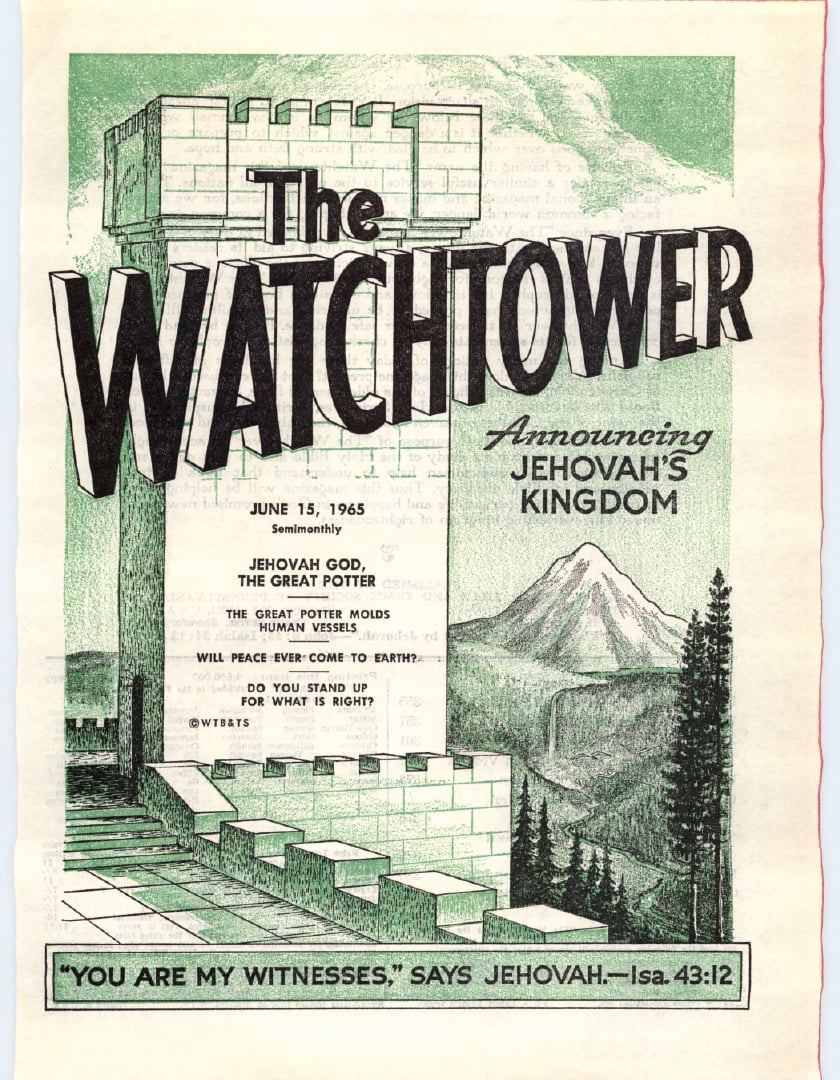
"YOU ARE MY WITNESSES," SAYS JEHOVAH.—Isa. 43:12
THE PURPOSE OF "THE WATCHTOWER"
Every watchtower has its purpose. It serves as an elevated place for a wide-awake person with sharp vision. It enables him to see far ahead into the distance and tell those below for whom he is a watchman what is drawing near, whether it is a danger against which to prepare or it is something good over which to be glad with strong faith and hope.
Because of having the name "The Watchtower" this magazine justly has to render a similar useful service to the people of all nations. This is an international magazine and makes no racial distinctions, for we are all facing a common world danger; we are all hoping for a common good.
Ever since "The Watchtower" began to be published in July of 1879 it has looked ahead into the future, always striving to aid its readers to advance in knowledge and to gain a clearer picture of the glorious new order of things that is in store for righteous mankind. No, "The Watchtower" is no inspired prophet, but it follows and explains a Book of prophecy the predictions in which have proved to be unerring and unfailing till now. "The Watchtower" is therefore under safe guidance. It may be read with confidence, for its statements may be checked against that prophetic Book.
Among the many nations of today there are hundreds of differing religions. Which one does this magazine present? Not the confused religions of Christendom, but the religion of the oldest sacred Book on earth. Which Book? The Sacred Bible of the Holy Scriptures, written by inspiration in the name of the Creator of heaven and earth, the only living and true God.
The sacred, nonpolitical purpose of "The Watchtower" is accordingly to encourage and promote study of the Holy Bible and to give our many readers the needed unsectarian help to understand that Book of true religion and infallible prophecy. Thus this magazine will be helping them to prove worthy of perfect life and happiness in God's promised new order under His everlasting kingdom of righteousness.
க
PUBLISHED BY THE
WATCH TOWER BIBLE AND TRACT SOCIETY OF PENNSYLVANIA
117 Adams Street
N. H. KNONE, President
"They will be taught by Jehovah."—John 6: 45; Isaiah 54: 13
Do You Stand Up for What Is Right?
Will Peace Ever Come to Earth?
Jehovah God, the Great Potter
The Great Potter Molds Human Vessels
Infants Not Too Young to Learn
God's Symbolic Woman Wins Her Legal Case
'Beautiful Services' but They Need God's Word
My Part in Advancing Right Worship
Questions from Readers
The Bible translation used in “The Watcher's” is the New World Translation of the Holy Scriptures, 1961, which other translations and editions of the Bible have been published.
AS - American Standard Version
Le - James Lacey's version
AT - American Translation
Mo - James McFarlane's version
DV - Christian Bible Version (1911)
RV - Retired Standard Version
DV - Catholic Bible Version
RS - Retired Standard Version
JP - Jewish Publication Scc.
YG - Robert Young's version
Printing this issue: 4,550,000
five cents a copy
“The Watchdog” is Published in the Following CS Languages
Seminars
Means
Africanus
Montreal
Arabie
French
Arabie
Norwegian
Arabie
Portuguese
German
Bengali
Greek
Kanarese
Chinese
Burmese
Chinese
Burmese
Chinese
Burmese
Chinese
Croatian
Chenba
Marshall
Chenba
Melanchol
Chenba
Melanchol
Bandh
Esk
Bandh
Esk
Bandh
Filjan
Bandh
Motu
Bandh
Tamil
English
Xhena
English
Oen
English
Paraguay
DO YOU STAND UP "We rather FOR What Is Right?
ON EVERY hand there are pressures on God-fearing persons to do what they know is wrong. For instance, it may be the common business practice to cheat one's customers by misrepresenting the products one sells, or to promise certain services and then fall to give what is promised. If you are in business, do you have the courage and integrity to deal honestly, even though it may not be as profitable financially?
"We must obey God as ruler rather than men." (Acts 5:
Youths know that it is wrong to cheat in school, but despite knowing this many of them do cheat. In fact, in a recent survey in which 5,000 students from ninety-nine colleges were questioned, nearly half admitted that they had engaged in some form of cheating. As a student, do you have the fortitude to stand up against pressures to such wrongdoing?
A Christian realizes that he owes worship and allegiance to God, regardless of what others may require. "It is Jehovah your God you must worship, and it is to him alone you must render sacred service." Jesus Christ said. (Matt. 4:10) The apostles of Jesus appreciated the importance of obeying this command to worship God, and so on one occasion told a Jewish court:
29) Do you, too, have the courage to put the worship of God first even in the face
of bitter persecution?
What would you do if the authorities commanded you, as they did early Christians, not "to make any utterance or to teach upon the basis of the name of Jesus"? Would you stand up for what you knew to be right? The apostles Peter and John did. They fearlessly replied: "Whether it is righteous in the sight of God to listen to you rather than to God, judge for yourselves. But as for us, we cannot stop speaking about the things we have seen and heard." (Acts 4:18-20) Would you have had the courage to say the same?
Right down through history men and women have been faced with the challenge of whether they would stand up for what was right, or would succumb to pressures designed to break down their integrity. In the days of the aged prophet Daniel, for instance, a law was passed making it a crime to 'petition any god or man except Darius the Persian king.' (Dan. 6:7) The penalty for disobedience was death at the mouths of the lions. What would Daniel do when he heard about this law? What would you have done?
The Bible record says: "But Daniel, as soon as he knew that the writing had been signed, entered into his house, and .
. . three times in a day he was kneeling on his knees and praying and offering praise before his God, as he had been regularly doing prior to this." Daniel knew it was right and proper to pray to his Creator, and he had the courage to stand up for what he believed!—Dan. 6:10-28.
Such examples of faithfulness are not confined to times past. Many servants of God have also stood up for what is right in our day. For example, in Nazi Germany where citizens were required to heil Hitler and give unquestioning allegiance to the State. A well-planned propaganda scheme duped the majority of the nation into believing that it was right to be obedient to such requirements. But how could true Christians give worshipful honors to a man? How could they give their lives in support of the State's quest for domination? They could not do so and at the same time worship God properly. This resulted in a severe test for them.
Consider the case of young Herbert Walter, who lived with his family on a large farm in Schlesien, then a part of eastern Germany. He had become an earnest student of the Scriptures, and looked forward to the blessings God's kingdom would bring to earth. His father, on the other hand, was a proud patriotic German, who, along with his other children, was an ardent supporter of Hitler. In time Herbert's father disowned him, saying: "I have no son who does not show interest in his fatherland." So Herbert and his wife were forced to leave the farm.
Then, in 1939, the blitzkrieg, or lightning war, overran Poland, and in the early part of 1941 Herbert was ordered to report to the Luebeck, Germany, training center. There, amid patriotic ceremonies, trainees marched forward, put their hand on the flag, and swore to give their life for fatherland and führer. The moment had come.
Herbert knew that it would. What would he do? His family and friends had time and again urged him to give up his "crazy religion." Would their requests now sway him? When demanded the reason for his refusal to swear allegiance, he replied: "My life belongs to Jehovah God, and it is not mine to give to another. My allegiance I have already pledged to God's king, Christ Jesus, who is my Lord."
Action was immediately taken. A quick trial was held, and a death sentence given. Waiting in his cell on May 8, 1941, Herbert spent his last moments writing to those he was leaving behind. Briefly, he told them that he would be beheaded before sunup, and endeavored to explain to them why he had to stand up for what he believed. Afterward, public announcement of the execution was made in his home community.
"How did you feel about your brother's being beheaded?" Herbert's sister was recently asked. "I and my family were deeply ashamed. It was a disgrace that he was convicted as a traitor to his country," she replied. "But how do you feel now?" "I am very proud of him. I am so happy that he did the right thing and did not compromise." These were Herbert's sister's words to a Christian audience in the midwestern United States, where she had moved with her family. After all these years she had accepted a Bible study, and, following the example of her now beloved brother, at this assembly was being baptized in symbol of her dedication to serve Jehovah God, the One who rewards those who earnestly seek him, even raising them from the dead.
It is not always easy to stand up for what is right. It may even occur that you will be threatened with torture and death. Keep in mind God's promise of a resurrection. Take courage! You can stand up for what is right.
The world moves from one crisis to another. Will there ever be a release from the grip of fear?
PEACE was what the girl wanted, but she was afraid. She noted the ominous trend of world events and wondered about her very existence. Writing to the editor of a large newspaper, she said:
I am one of the 16-year-old girls who sit and watch their world slipping into the void of death.
Every day I listen, hoping not to hear the pounding of men's feet in their movement toward the end of a world, a world I have just begun to touch, and hear and see.
I wait for the sign telling me that I will one day be able to breathe and see without the smog of fear filling my throat and stinging my eyes.
I know that when the time comes there will be no escape, either from the bomb of merciful swiftness or from the slow agony of pitiless radiation. . . .
I wait for the people who hold my world's fate to tell me that I have the right to grow up, to marry and to have children who will not live in such a place, who will not be afraid of losing even this nightmare world before they have known it.—New York Times, September 18, 1961.
This girl's letter was written in 1961. Has her desire for peace come closer to realization in the time that has elapsed since that year? Is freedom from fear closer to being a reality?
In the year 1965, on the same page of the same newspaper where this girl's item appeared years before, an editorial tells us the following:
It is a frightening but inescapable thought that the world has drifted apart and become more fragmented since April 1963, when Pope John made his notable appeal for 'a
community of peoples based on truth, justice, love and freedom.' This is a time that would have tried even his wonderful gift of optimism and his faith in humankind.
Throughout history different elements operated at different times to provide an anchor, an amalgam, a source of unity for societies. There were family bonds, great monarchs, great empires, the world's great religions and, in modern times, political ideologies. Today none of these factors seems strong enough to hold societies in check or to unite nations and peoples in peace.
This is an era that has lost its bearings, that wanders in a wilderness crying with rage and striking out in its pain.—New York Times, February 18, 1965.
So nations and individuals become more antagonistic, and the world drifts ever closer toward a catastrophic nuclear war. The frightful consequence of such a war was made clear by the United States Secretary of Defense recently. He estimated that in the event of a Soviet missile attack on United States cities the death toll would be 149 million! A retaliatory blow against the Soviet Union, he said, would take a toll of about 100 million lives and would destroy an estimated 80 percent of that nation's industrial capacity!
Nor is that the entire threat to peace today. Other countries, including Communist China, now possess nuclear weapons. In addition, within a decade or two many of the smaller nations could easily possess atomic capabilities. With no central control, minor national issues could escalate into global nuclear holocaust.
Truly the world seems to be going mad! Not only is peace farther off than ever, but it seems totally unrealistic to expect it to come, in view of the rising differences between nations, blocs of nations, societies and racial groups.
IS THERE AN ANSWER?
Mankind's history has not been a peaceful one. Instead, it has been filled with conflict and bloodshed. Over and over again, nations have risen to power, gone on a rampage against their neighbors and plunged part of the inhabited earth into darkness and pain. As science contributed deadly weapons of destruction, the hurt intensified and the area widened until it became global. Today the threat to peace has reached a new peak. The very survival of the entire human family is at issue!
Why has all of this been so? Why has the earth been drenched in blood, much of it innocent, time and again? Will total peace ever come to earth? Are there truthful and satisfying answers to such questions? Yes, there are. But these answers cannot be found in the histories or philosophies of men. If they could have been, then the many proposed and tried remedies for the world's ills should have worked by this time. But they have not. They have all failed.
The answers must come from One who not only sees the brutality of man against man but knows why it happens, what the future holds, and what the ultimate remedy is. That One can only be the Creator of man, Jehovah God. As the originator of a machine is in the best position to tell what will happen if it is not used correctly, and what to do when it does not function properly, so too with man's Originator or Creator, God. Having made man, he knows what this creature must do to function properly in human society. He knows why such human society is breaking down, and
why it gets progressively worse. He can tell us why peace is far from groaning mankind. More than that, he can tell us what the future holds and what the remedy is. Yes, the Almighty God, Jehovah, can answer the question, Will peace ever come to earth?
WHY IS PEACE GONE?
The human family's start could not have been better. Created perfect, man and woman were placed in a paradise of total peace, given pleasant work to do, and were to begin the extension of these desirable conditions throughout the length and breadth of the earth. The earth itself would produce bountifully for humankind, and even the animals would be peaceful. The sum of the matter was: "God saw everything he had made and, look! it was very good."—Gen. 1:31.
Nothing would work to mar this peace, provided the key to human behavior, the mind, functioned as it should. This would happen as long as man filled his mind with healthful thoughts by listening to the voice of his Creator and staying within the bounds allotted him. What bounds? Why, the bounds of obedience to God's laws. As long as man obeyed God's righteous requirements, he would prosper. If he violated them, he would not. We can compare this to laws that preserve peace today. A person cannot violate the law without coming under punishment of the civil authorities. This works for the benefit of all society. God's laws are the same. They work for the benefit of law-abiding men. However, if man rebelled against divine law, he was told, he would "positively die."—Gen. 2:17.
The sad record, preserved for us in the only reliable history of those ancient times, the Bible, shows that Adam and Eve, father and mother of the entire human family, broke the bounds set for them.
They wanted what they were not entitled to. They desired total independence from God and his laws, demonstrating this by breaking the law. As a result, the penalty was executed—they would die in due course of time. No longer would their bodies be maintained in perfection, but they would begin to degenerate, until death overtook them. Their minds would also degenerate. Not being guided by God and his ways, they would come into conflict with others, with the animal realm, and even with their own bodies. Casting off God, they began man's downward plunge as surely as a stone moves downward when thrown from a high place.—Gen. 3:17-19.
Not only did degeneration and death now enter the human family, but so did peace breaking. Men began to contend with men. Hatred and suspicion, violence and bloodshed engulfed human society, until, more than 1,600 years later, the condition was as the Bible describes: "The earth came to be ruined in the sight of the true God and the earth became filled with violence. So God saw the earth and, look! it was ruined, because all flesh had ruined its way on the earth."—Gen. 6:11, 12.
A peaceful world turned quickly into an unpeaceful one. But none of this could be blamed on God. It resulted when man sought independence from God. And since God made man a free moral agent, He would permit man this experiment, temporarily. Observe the results! Would you say that the human experience over the last 6,000 years has been a peaceful, happy, successful one? Of course not! Pain, misery, sadness, tears and death have been man's lot down through the centuries, until today thinking persons wonder about the very survival of humanity as a whole!
WILL PEACE RETURN?
God has tolerated man's rebellious course, but only for a temporary season.
As a loving God, he could not permit his earth and creatures on it to be abused forever. That is why wickedness will not go on much longer. God, through his prophets and his written Word, has repeatedly warned that the disobedience of men and nations would come to an end. —2 Thess. 1:8; Heb. 5:9.
The insane plunge of nations toward nuclear annihilation will be cut short by God. He has promised: "Evildoers themselves will be cut off . . . And just a little while longer, and the wicked one will be no more; and you will certainly give attention to his place, and he will not be. But the meek ones themselves will possess the earth, and they will indeed find their exquisite delight in the abundance of peace."
—Ps. 37:9-11.
God has tolerated man's experiment in independence from Him long enough so that no one can accuse God of not having given men the chance to work out their own solutions. They have had that chance. They have failed miserably. Therefore, as Bible prophecy clearly shows, it is now time for God to step in, squash wickedness and take over complete control of men's affairs. Jesus Christ himself, as did the apostle Paul, foretold that the distress of nations will evident today would be an evidence that we are indeed in the "last days" of this world. (Matt. 24:3-14; 2 Tim. 3:1-5) Hence, God's anger against this chaotic world will be expressed soon, as his favor will be extended to those who love him. As it is written concerning our day: "Your own wrath came, and the appointed time for the dead to be judged, and to give their reward to your slaves the prophets and to the holy ones and to those fearing your name, the small and the great, and to bring to ruin those ruining the earth."—Rev. 11:18.
PEACE TO RETURN
The end of this present evil system of things means that the peace God originally purposed for earth will return to it. No more will it be a place filled with hatred and violence. Also, God's right to rule will be definitely established. That question will be settled for all time and men will never again be allowed total independence to mar peace with their divisive experiments and ideas.
Survivors of this world's end will be blessed with peace, for, as the psalmist
said of God: "He is making wars to cease to the extremity of the earth. The bow he breaks apart and does cut the spear in pieces; the wagons he burns in the fire."
(Rev. 21:3, 4) All of this means that the peaceful conditions promised for that time will endure, since all things and all persons breaking peace will be eliminated.
Does this sound too good to be true? God himself dispels doubt by saying: "Write, because these words are faithful and true." (Rev. 21:5) With confidence, then, you can look forward to the fulfillment of God's promise of peace in a righteous new order.
For a certainty, peace will be there. But
COMING IN THE NEXT ISSUE
WILL YOU ENJOY THAT PEACE?
Plaguing the Modern "Egyptians" with Truth.
The Tenth Plague—Firstborn Slain.
(Ps. 46:9) "To peace there will be no end." —Isa. 9:7.
What Is Required to Understand the Bible?
Death of a Dynasty.
Nor will humans live only three score and ten years, just to be cut down in death. In God's new order, His curative power will be turned toward mankind. They will be gradually lifted up to human perfection, which is why Jesus could speak of that time as the "re-creation." (Matt. 19:28) Even many of the dead will benefit, for those God chooses will come forth in the resurrection.—John 5:28, 29.
Be Willing to Serve with What You Have.
With perfection of mind and body restored, sickness and death due to Adam will be things of the past. That is why the psalmist could say: "The righteous themselves will possess the earth, and they will reside forever upon it." (Ps. 37:29) Adding to this grand picture of things to come, the apostle John stated under inspiration: "God himself will be with them. And he will wipe out every tear from their eyes, and death will be no more, neither will mourning nor outcry nor pain be any more. The former things have passed away."
will you be there?
Will you be alive to enjoy its realization?
If you want to participate in the blessings of a paradise restored, then you will want to learn what
God's purposes and requirements are, for only those who do what God wants will he bless with peace.
To learn about God you must go to the place wherein he reveals himself. That place is his Word, the Bible. Read what it says about your obligations to your Creator. Learn what things you need to do to survive the end of this wicked system of things. Then do them. Also, search out God's people who are doing the same and associate with them. They will help you to learn the obedience to God that your forefather Adam forgot.
By learning to depend on God and by doing his will you can prepare yourself for the coming time of peace, now so near. And even though living in a disintegrating world, you will be able to face the future confidently, happy in the knowledge that you may share in the realization of God's promises because you do his will, for "the world is passing away and so is its desire, but he that does the will of God remains forever."—1 John 2:17.
JEHOVAH GOD
JEHOVAH God is the Almighty One. He is the Most High over all the earth. And he is also the Universal Sovereign Lord.—Ex. 6:3; Ps. 83:18; Jer. 50:25.
Among the many ways in which Jehovah God proves himself to be all such is by his molding his creatures as a potter molds clay in his hands. His role as the Great Potter magnifies his omnipotence, his omniscience and his sovereignty. None of his creatures can successfully resist his will. Whatever Jehovah purposes he accomplishes: "So my word that goes forth from my mouth
will prove to be. It will not return to me without results, but it will certainly do that in which I have delighted, and it will have certain success in that for which I have sent it."—Isa. 55:11.
*It is of the greatest importance that each one of God's creatures recognize His universal sovereignty and deport himself in accord therewith. Those who do are blessed. This role of Jehovah as the Great Potter is noted by the apostle Paul at Romans chapter nine, where he says, among other things, the following:
"It depends, not upon on the one wishing nor upon the one running, but upon God, who has mercy. For the Scripture says to Pharaoh: 'For this very cause I have let you remain, that in connection with you I may show my power, and that my name may be declared in all the earth.' So, then, upon whom he wishes he has mercy, but whom he wishes he lets become obstinate. You will therefore say to me: 'Why does he yet find fault? For who has withstood his express will?' O man, who, then, really are you to be answering back to God? Shall the thing molded say to him that molded it, 'Why did you make me this way?' What? Does not the potter have authority over the clay to make from the same lump one vessel for an honorable use, another for a dishonorable use?"—Rom. 9:16-21.
5Not that the Great Potter arbitrarily determines the eternal destiny of his creatures long before they are born, as the Calvinistic teaching of predestination would have it.
Not at all! His creatures determine their own destiny by the course of action they take. But the Great Potter can
and does, for his own wise, just and loving reasons, choose the time, manner and circumstances for rewarding the righteous and punishing the wicked.
*Note how clear this point is made at Jeremiah 18:6-8: "Look! As the clay in the hand of the potter, so you are in my hand, O house of Israel. At any moment that I may speak against a nation and against a kingdom to uproot it and to pull it down and to destroy it, and that nation actually turns back from its badness against which I spoke, I will also feel regret over the calamity that I had thought to execute upon it."
To illustrate: All of Jehovah's creatures might be likened to clay vessels in a potter's workshop whom Jehovah God, as the Potter, can and does mold as he pleases. But it is up to the individual piece of clay as a free moral agent and an intelligent creature to choose how he wants to react to Jehovah's patterns and pressures, either submitting to Jehovah and righteousness, or resisting Jehovah and hardening himself in wickedness. But once the creature has manifested his attitude, Jehovah may, can and does at times mold that one further and further, either toward honorable service or toward dishonorable use, as suits Jehovah's sovereign will and purposes.
8 Thus we read that a "bad spirit" from Jehovah came upon King Saul, but this was only after Saul's heart had gone bad, to the point of no return then, and after
Jehovah had finally rejected Saul. (1 Sam. 18:10) Likewise we read of a "deceptive spirit" as being sent from Jehovah upon the four hundred prophets of Israel who
were raise to begin with, so that then deceptive prophesying prevailed upon King Ahab and he went to his death. (2 Chron. 18:5-27) Similarly Jesus told Judas: "What you are doing get done more quickly." (John 13:27) Jesus was not putting the idea of betraying him into the mind of Judas, but Judas had gone to the point of no return. Had not Jesus exposed Judas as the one that would betray
his Master, and had not Judas failed to deny it or to protest his innocence? Judas did not repent or change his course of action, and so we read that then Satan the Devil entered him, and it was only after this that Jesus said to him: "What you are doing get done more quickly." And so also with ancient Pharaoh of Egypt in Moses' day. Jehovah God did not coerce him or arbitrarily harden Pharaoh's heart or cause him to act against his better judgment, but God simply chose a method of dealing with Pharaoh that allowed him to seek his own further advantage and so harden his heart ever more.
Well did the apostle Paul refer to Jehovah's molding the wicked proud Pharaoh of old, for, without a doubt, that is the most striking instance recorded in the Scriptures in which Jehovah God asserted his authority and power in dealing with his earthly creatures as a potter handles clay. The Great Potter had commanded his people, the Israelites, to go into the wilderness for three days with all their little ones and their flocks to worship him, and Pharaoh had refused to let God's people go. Haughty Pharaoh taunted and sneered: "Who is Jehovah, so that I should obey his voice to send Israel away?
I do not know Jehovah at all and, what is more, I am not going to send Israel away." The means that Jehovah God used to make Pharaoh know who Jehovah really is and to make him let God's people go were ten plagues, which plagues are full of prophetic significance for our time.—Ex. 5:2.
AUTHENTICITY
10 The authenticity of the inspired record of these ten plagues is questioned by higher critics who do not believe that Jehovah God is the Great Potter, able and willing to maneuver the affairs of men according to His own sovereign will, and who do not appreciate the issue of universal sovereignty that was involved in these plagues. They would have us believe that all the accounts of these plagues are based on myths, even as they claim that the accounts of Creation and the Flood are based on myths. "There have been many efforts to rationalize these fantastic stories," is the way one modernist authority puts it. —The Interpreter's Bible, Vol. 2, page 839.
11 But theologians who object to the Bible's record of miracles are thereby merely betraying their own bias and ignorance. Science can no longer object to miracles. As one university professor put it: "A scientist is no longer able to say honestly something is impossible. He can only say it is improbable. But he may be able to say something is impossible to explain in terms of our present knowledge. Science cannot say that all properties of matter and all forms of energy are known. What do we need to add to miracles to translate them into something possible to account for? Nothing we can do can make a miracle a probable event, but it may be possible to add some information to it to make it possible. One thing that needs to be added is a source of energy unknown to us in our biological and physiological sciences. In our Scriptures this source of energy is identified as the power of God."
12 More than that, we cannot discredit this part of God's Word in the book of Exodus without discrediting the many other references to it in the rest of the Scriptures. If these miracles of the ten plagues are nothing but fantastic stories, why did Joshua, Samuel, two psalmists, Jeremiah, Stephen and the apostle Paul refer to them as historical? Thus 1 Samuel 6:6 tells about the Philistine priests and diviners who warned their people, saying, some four hundred years after Israel left Egypt: "Why should you make your heart unresponsive just the way Egypt and Pharaoh made their heart unresponsive?"—See also 1 Samuel 4:8.
18 The record of the ten plagues is also given in detail at Psalms 78 and 105. And Jeremiah, some nine hundred years after the plagues took place, treats them, not as fantastic stories, but as facts: "You who set signs and miracles in the land of Egypt ... that you might make a name for your own self." Stephen referred to Moses as "doing portents and signs in Egypt." And as has already been noted, the apostle Paul referred to the plagues as historical.—Jer. 32:20; Acts 7:36.
14 Others in Christendom grant that the plagues actually took place but try to attribute them to natural causes. In this way they would rob the Great Potter of his right to interfere directly in the affairs of men. True, the Nile does look red at times; but the record tells us that the water of the Nile was not merely blood-red in color, as when infested by certain tiny organisms or because of the color of the mud, but that the Nile water actually became blood, so that the fish and other living creatures in the Nile died and the people were unable to drink the water.—Ex. 7:19-21.
13 The same is true of the other plagues. It will do no good to try to explain away their miraculous nature merely because they might find counterparts in the history of Egypt. Why did these plagues come just when Moses said they would and leave only when Moses commanded them to leave? And why, after the third plague, were the Israelites in the land of Goshen no longer affected by them?—Ex. 8:22, 23.
10 The tenth plague in particular cannot be accounted for along natural lines. What plague would kill only the firstborn of both man and beast? What plague would bypass the homes upon whose doorposts and lintels blood had been spattered? These things cannot be explained away nor accounted for by natural means. To try to do so creates more problems than it solves; it betrays a lack of faith, an unwillingness to submit to the will of the Great Potter and a desire to please men without faith.
17 But if we understand why Jehovah sent these plagues, namely, to make known to Pharaoh and to the Egyptians Jehovah's name and great power and to have Jehovah's name declared throughout all the earth, to harden some and to soften others, then we see abundant reason for Jehovah's resorting to supernatural means in sending these plagues upon Egypt. In fact, it was absolutely imperative that these plagues be unequivocally miraculous, supernatural, for them to carry the impact God meant for them to carry. Otherwise, there would not have been any clear-cut issue and the plagues would not have served to magnify Jehovah's name, this being especially true of the last eight
plagues. (Ex. 8:16-19) For an example of this principle see 1 Samuel 6:7-12.
THE VESSEL MOSES
38 The outstanding human vessel that the Great Potter Jehovah God formed for this occasion and the one that he also chose to mold to his purpose was the man of God Moses. He was born after the Pharaoh of that time had issued his genocidal decree that every newborn son must be thrown into the river Nile. (Ex. 1:22) Jehovah saw to it that Moses was spared as an infant, that he was found by Pharaoh's daughter and then that he was reared by his own parents "in the discipline and authoritative advice of Jehovah." His parents had faith in Jehovah, even as the writer of the book of Hebrews assures us: "By faith Moses was hid for three months by his parents after his birth, because they saw the young child was beautiful and they did not fear the order of the king."—Eph. 6:4; Heb. 11:23.
So faithfully did Moses' parents discharge their duties toward him that, although afterward he was taught in all the wisdom and learning of the Egyptians, he remained loyal to Jehovah, to his people and to Jehovah's righteous principles. Proof of this he gave when he killed the Egyptian taskmaster who had been oppressing one of his brothers. However, Moses' people did not appreciate his efforts on their behalf, and so Moses found it expedient to flee to the land of Midian.—Ex. 2:11-15; Acts 7:23-29.
20 Moses had associated himself with the right cause, Jehovah's cause: "By faith Moses, when grown up, refused to be called the son of the daughter of Pharaoh, choosing to be ill-treated with the people of God rather than to have the temporary enjoyment of sin, because he esteemed the reproach of" being God's anointed servant "as riches greater than the treasures of Egypt."
But this was not the right time nor obviously the right manner for the Great Potter to deliver his people. And neither, let it be noted, was this earnest, loyal, eager, impulsive would-be deliverer of his people ready for this assignment. So Jehovah kept molding the vessel Moses for his delivering role by letting him spend the next forty years as a peaceful shepherd in the land of Midian. How often Moses' thoughts must have gone out to his brothers in bondage in Egypt during those long years!—Heb. 11:24-27.
21 At the end of those forty years Moses had become molded into a mellowed, mild-tempered, patient, long-suffering vessel, fully qualified to be the overseer of millions of God's sheep, "by far the meekest of all the men who were on the surface of the ground." (Num. 12:3) In fact, so meek did he become that he expressed the greatest diffidence and reluctance to accept the commission from Jehovah to deliver his people, something he had attempted by himself forty years before. Even after Jehovah assured Moses that He would be with him and had empowered Moses to perform three miracles to prove the divine nature of his commission, Moses still demurred. Although this caused Jehovah to become angry with Moses and to give him a stinging rebuke, nevertheless, in his compassion, he provided Moses with Aaron to serve as his mouthpiece.—Ex. 3:11 to 4:31.
EGYPT AND PHARAOH IN MOSES' DAY
22 It would be difficult to conceive of a greater contrast than that of Moses, the meekest of all men on earth, and Egypt's Pharaoh, one of the haughtiest rulers of
all time. Nor a greater contrast in religion than between the worship of Jehovah God as practiced by the faithful Israelites and the religion of the Egyptians. Thus we are told that "Egyptian worship was a complete contrast to Hebrew worship in particular . . . The cult of the great gods [of Egypt] followed one general pattern, the god being treated just like an earthly king. He was awakened from sleep each morning with a hymn, was washed and dressed (i.e. his image), and breakfasted. . . The contrast could hardly be greater between the ever-vigilant, self-sufficient God of Israel . . . and those earthly Egyptian deities of nature."*
25 At this time not only was Egypt the dominant world power, especially strong from an economic standpoint, but, more than all other nations, she was devoted to Devil religion. She worshiped the powers of visible creation, in particular the sun, heat, light and the lower animals. Egypt had scores of deities, and no other ancient nation was more devout and constant in the service of its gods than were the extremely superstitious Egyptians under the autocratic rule of their priests. Their chief teaching was reincarnation or the transmigration of souls, which promised rewards in the future life depending upon their conduct in the present life and which teaching gave the priests a powerful hold on the people.
24 The priests were very numerous, were exempt from taxation and were held in the highest esteem among the people. They clothed themselves in white linen and bathed twice a day. Even the most ordinary tasks could not be performed without reference to some priestly regulation. The Egyptians had more religious festivals than any other people, their land being covered with temples; and each town had its guardian god and temple, to which some animal was sacred, and which temple supported a large body of priests.
According to the historian John Lord, the hold the priests had on the people was similar to that of the priests of Christendom during the Dark Ages.*
25 The most repulsive and degrading thing about the religion of these Egyptians was their animal worship. A cat, any stray alley cat, was prized more highly than a human. A foreigner, who accidentally had killed a cat, was literally torn to pieces by an infuriated mob. The Apis bulls were worshiped as gods themselves, because gods were believed actually to dwell in them. These bulls were kept in lavish temples and at death were buried in gigantic costly coffins while all Egypt mourned. Among other animals held sacred were the crocodile, the oxyrhyncus fish and the ichneumon fly. Of some animals, such as the cat, all were held sacred; of others, only certain ones, such as bulls having certain markings.
20 Looming up prominently in Egypt's religion was also her ruler Pharaoh. Concerning him we are told:* "Pharaoh himself was one of the gods, and a central figure in his subjects' lives. Each reigning king was at once the incarnate Horus, falcon sky-god, and Horus . . . the rightful heir upon the throne of his father Osiris. Egypt's well-being was directly associated with that of the king. . . Each king was the successor to the whole line of royal ancestors, stretching back beyond the historic human dynasties . . . to the dynasties of the gods themselves upon earth, and at
death each king joined that august company," in the minds of the Egyptians!
27 This, then, was the Egypt that held Israel in bondage and to which Moses was being sent. It truly consisted of "vessels of wrath made fit for destruction." (Rom. 9: 17-22) Yet the Great Potter permitted it to continue as a great world power. Why? For the sake of his great name. Besides, had he not foretold that Abraham's seed would be afflicted four hundred years? So until that time was up, Egypt was permitted to oppress God's chosen people.—Gen. 15:13.
28 As we examine the record, we find that it features the Great Potter's dealings with one man, Pharaoh. Since this is so, it may well be asked, why should an entire nation suffer on account of one man? Why? For more than one good reason. For one thing, Pharaoh alone could not have oppressed the nation of Israel nor defied Jehovah. That took a mighty organization; and so all who supported Pharaoh in his God-defying and oppressive measures became parties to his crimes. More than that, did not a "vast mixed company" of non-Israelites leave Egypt and march to freedom with the Israelites? (Ex. 12:38) Surely. So none may ascribe injustice to the Great Potter, Jehovah God.
More than that, the Scriptures show that there is such a thing as community responsibility. Thus in ancient Israel the older men of a city had to take certain action to absolve their city from bloodguilt in the case of an unsolved murder, for the entire city was held responsible. (Deut. 21: 1-9) For the same reason the entire tribe of Benjamin was adjudged guilty for refusing to surrender the good-for-nothing men of Gibeah who had abused to the death a certain Levite's concubine.
(Judg. 20:8-48) In fact, such responsibility is recognized even in modern times; an example being the way West Germany, though now democratic, has voluntarily chosen to indemnify the Jews and other victims of Nazi persecution.
50 The Scriptural account of how the Great Potter dealt with his vessels back there in the days of Moses is of the greatest interest and importance to us today. A consideration of it will increase our appreciation of the wisdom, justice, power and love of the Great Potter, Jehovah God. It will also drive home to us the importance
of being submissive to Him, of letting ourselves be guided by his Word, his holy spirit and by his visible instrument, his earthly channel of communication. For who can withstand his express will?
31 And further, it will help to strengthen our faith greatly, for we will find that these events have a parallel in our day. Finally, it will help all Christian ministers to get an increased appreciation of their own preaching commission, for theirs is the privilege to have a share in pouring out the modern plagues upon modern Egypt, including Babylon the Great. Surely, these reasons should cause us to want to pursue this subject further with the keenest interest!
"I am Jehovah, and there is no one else. Forming light and creating darkness, making peace and creating calamity, I, Jehovah, am doing all these things." —Isa. 45: 6, 7.
EHOVAH God as the Great Potter has the right to deal with his creatures according to his sovereign will. As he sees fit, he forms light and makes peace and creates darkness and calamity, even as we read at Isaiah 45:7. For the righteous he appoints light and peace, even as we read: "Light itself has flashed up for the righteous one." "Abundant peace belongs to those loving your law." But for the wicked, Jehovah creates darkness and calamity: "The way of the wicked ones is like the gloom." "He will rain down upon the wicked ones traps, fire and sulphur."—Ps. 97: 11; 119:165; Prov. 4:19; Ps. 11:6.
2 The Great Potter gave a striking example of doing these things in the ten plagues he sent upon ancient Egypt in the days of Moses, in particular the last seven plagues. However, just as Jehovah sends the sunshine and the rain upon the wicked as well as the good, so, conversely, at times it has served His sovereign purpose to send calamity or evil upon his own people, when disobedient, as well as upon his foes, and so we find that back there his people Israel also suffered from the first three plagues.—Matt. 5:45.
3 The effect that these plagues had upon various ones further underscores Jehovah's sovereign role as the Great Potter.
Those plagues served His purpose in that they revealed the heart condition of those affected by them. The lifting of the plagues certainly hardened the heart of Pharaoh and those of his people having his spirit. But the fact that the first three plagues also came upon Israel did not make Moses and his people complain. In fact, there was a "vast mixed company" of aliens who learned the lesson from all the plagues that came upon them or else they would not have left Egypt with the Israelites on that memorable night of Nisan 14.—Ex. 12:38.
As previously noted, the record of the ten plagues upon Egypt is of more than mere historical interest to Christians today. It is part of "all the things that were written aforetime . . . for our instruction, that through our endurance and through the comfort from the Scriptures we might have hope." Among the ways in which God's Word serves this purpose is by furnishing prophetic patterns in which certain persons, places and events find a counterpart in our day.—Rom. 15:4.
PROPHETIC PATTERNS
5 Prophetic patterns generally do not present truths peculiar to themselves but rather corroborate and elucidate truths stated explicitly elsewhere. Thus the prophetic patterns noted at Hebrews 7:26 to 10:22 serve primarily to corroborate what is stated more clearly in the rest of the Christian Greek Scriptures, regarding the role of Jesus as high priest. And while it would not be wise to be dogmatic regarding prophetic patterns not applied in the Scriptures themselves, it appears that these things have been made understandable by reason of God's holy spirit, in keeping with Proverbs 4:18, that "the path of
the righteous ones is like the bright light that is getting lighter and lighter until the day is firmly established."
In the record of the ten plagues, which serves as a prophetic drama, we see Jehovah God, Moses, Aaron and the nation of Israel opposed to Satan the Devil, Pharaoh, his religious counselors and the rest of the nation of Egypt. Whom does Moses picture? In that he was the great deliverer of his people, he would well picture Jesus Christ, the great Savior and Deliverer. In fact, Moses himself foretold that a prophet like him would appear: "A prophet from your own midst, from your brothers, like me, is what Jehovah your God will raise up for you—to him you people should listen." (Deut. 18:15) That he foretold the coming of Jesus Christ, the apostle Peter shows at Acts 3:22, 23, where he quotes from this prophecy and applies it to Jesus Christ.
7 In this particular drama Moses pictures Jesus Christ himself, but at times Jesus Christ may be represented in the members of his congregation, more particularly the remnant of Kingdom heirs living on earth at the time of the fulfillment of this prophetic drama. This of itself should not seem strange, for do we not have a similar instance at Psalm 69? Yes, we do, for there David speaks prophetically in the person of Jesus Christ, as when he said: "For sheer zeal for your house has eaten me up, and the very reproaches of those reproaching you have fallen upon me." Yet in other parts of this same psalm David says: "You yourself have come to know my foolishness, and from you my own guiltiness has not been hidden," which words could apply only to Christ's representatives, his congregation, on earth.
8 Aaron, the brother of Moses, well pictures the spiritual brothers of the greater Moses, in particular the remnant now on earth. Aaron served as a mouthpiece for Moses. This was because Moses possibly had a speech impediment, he was "uncircumcised in lips," as he put it; meaning that his lips had, as it were, a foreskin over them and therefore were too thick and long to utter speech with ease. (Ex. 6:12, 1953 Edition, footnote) This pictures how Jesus Christ, by reason of his being in heaven and having a glorious divine nature, has an impediment, as it were, in regard to delivering personally God's message to human creatures upon earth and so has the remnant of his spiritual brothers, as a modern-day Aaron, speak for him. The nation of Israel pictures all God's people oppressed by Satan the Devil and his organization.
9 Pharaoh, king of Egypt, the haughty defier of Jehovah God and the cruel oppressor of God's people, obviously pictures none other than Satan himself. Egypt as a world power pictures Satan's worldwide visible organization, even as noted at Revelation 11:8: "The great city which is in a spiritual sense called . . . Egypt, where their Lord was also impaled." Pharaoh's magic-practicing priests and their associates picture the religious leaders and rulers throughout the world, who try to counteract the message that God's servants bring. The common people of Egypt, who, as Pharaoh's willing supporters, had a community responsibility, picture those of humankind today who willingly support Satan's visible organization.
SIMILARITIES AND DIFFERENCES 10 Before proceeding with a detailed consideration of the plagues of Egypt, it seems well to note the ways in which these plagues are similar and in which they differ from the plagues described at Revelation chapter 16. (See The Watchtower, December 15, 1963.) They are similar in being in numbers denoting completeness, seven in Revelation and ten in Exodus. They are also similar in that they represent judgment messages that plague Satan's visible organization, especially Christendom and the religious leaders in particular. In both sets of plagues God's people perform active parts, delivering these plaguing messages, and both series of plagues find their fulfillment from 1919 on to the battle of Armageddon.
11 As to the differences: The plagues of Revelation are explicit prophecies, solely recorded for the purpose of such, whereas the prophetical nature of the ten plagues of Egypt as having a modern fulfillment is based on inferences drawn from inspired or divinely guided history. Certainly the tenth plague, involving the passover, was prophetic. Secondly, none of the seven plagues of Revelation afflict God's people, but the first three plagues of Egypt did affect the Israelites back there. So it is reasonable to conclude that in their prophetic application they would also affect God's people now. Thirdly, there is nothing to indicate that Satan's representatives are able to imitate any of the seven plagues of Revelation; but the magic-practicing priests of Egypt at least appeared to imitate the first two plagues, and the same would be true in the fulfillment of these. And fourthly, while there is only one fulfillment of the plagues of Revelation, it appears that there was a miniature fulfillment of the plagues upon Egypt, symbolically, at the first coming of Christ or in the days of Christ and his apostles, even as Joel's prophecy regarding the locust plague had a miniature fulfillment then.
See The Watchtower, December 1, 1961.
12 As regards the plagues that came upon Egypt, it seems well to note two further characteristics, which will aid in the understanding of their prophetic significance. First, even as back there we see a designating of things that were affected by the plagues, so today. Thus back there the pestilence, the fifth plague, affected only the lower animals; the locusts, only the vegetation; but both man and beast suffered from the gnats, from the boils and blisters and from the death of the first-born, while all three, man, beast and vegetation, were hurt by the hail, the seventh plague.
13 Secondly, it is of interest that in the listing of the ten plagues at Psalms 78 and 105 they do not appear in the original order. This would allow for the conclusion that in their fulfillment we need not expect these plagues to follow in their original chronological order. Apparently their order did not seem important to the inspired writers who later had occasion to enumerate them.
FIRST PLAGUE-NILE'S WATER BECOMES BLOOD
14 From the time that Jehovah first appeared to Moses at the burning thornbush, at the end of Moses' forty-year wilderness stay as a shepherd, until Jehovah gave Moses the command to bring upon Egypt the first of the ten plagues, a number of significant events occurred. Among these were Moses' being empowered to perform three miracles before his people so as to prove to them that Jehovah, the God of their forefathers, had indeed appeared to him. These were, (1) causing his rod to
become a serpent and then a rod again,
hand and then disappear, and (3) the
changing of water into blood. No wonder
we read that, when the people saw these,
they believed.—Ex. 3:1-4:31.
15 At Moses' first appearance before Pharaoh with the request to let Israel go into the wilderness for three days to worship Jehovah, Pharaoh retorted: "Who is Jehovah, so that I should obey his voice to send Israel away? I do not know Jehovah at all and, what is more, I am not going to send Israel away." Not content with this refusal, Pharaoh increased the burdens of Israel by making them get their own straw for making bricks.—Ex. 5:1-23.
18 At Moses' second appearance before Pharaoh, Moses performed the miracle of causing his rod to become a serpent, and, further, to swallow up the serpents that Pharaoh's magicians appeared to produce in imitation of Moses' miracle. * This miracle failing to cause Pharaoh to yield, God commanded Moses to meet Pharaoh at the edge of the Nile and to perform the first plague, that of changing the waters of the Nile into blood, and that regardless of where they happened to be, in the Nile itself, in the Nile canals, in reedy pools or in stone or wooden vessels.
17 This plague was truly a calamity upon Egypt. It robbed her of her water supply for man, beast and vegetation. At the same time it made the river unfit for commerce because of its stench. And further, it poured contempt upon Egypt's religion in that the Nile was considered a most sacred river. This plague, which lasted for seven days and affected both the Egyptians and
At Moses' direction, Aaron strikes Nile water, which turns to blood
the Israelites, appeared to be imitated by Pharaoh's magic-practicing priests, who, however, were unable to stop it.—Ex. 7: 17-25.
18 What is pictured by this plague? The Nile, being Egypt's economic lifeline, would well picture commerce or commercialism, which is the lifeline of modern "Egypt." Even as Satan claimed the Nile for himself, so he uses commercialism to keep the people in subjection. The Nile's waters being turned into blood pictures how the message published by Jehovah's people regarding commercialism shows it to be selfish, greedy, oppressive and death-dealing.—Rev. 11:8; Ezek. 29:3.
19 As early as January 1, 1921, The Watchtower had shown greedy commercialism to be an integral part of Satan's organization. Among other publications of the Watch Tower Bible & Tract Society that have exposed the oppressiveness of commercialism and its snare of materialism have been the books Deliverance,
Government, Vindication II, and the magazines The Watchtower and Awake! together with the latter's predecessors. It might be said that the disciple James uttered such a message in the fifth chapter of his letter, and so did Jesus in pronouncing woe
upon the rich.—Jas. 5:1-5; Luke 6:24.
20 By exposing the greedy, oppressive and cruel nature of commercialism, it even being willing to foment wars for selfish gain, as well as the deceptiveness of its materialism, such Watch Tower publications have served to plague modern Egypt. And how has this "plague" seemingly been imitated by the magicians of modern Egypt, the religious leaders? By their speaking out against commercialism as a part of what they call
their "Social Gospel." Actually, they have only appeared to do so in that the clergy are dependent upon the moneyed interests for support. In fact, there is all the difference in the world between the message Jehovah's people bring and that of the clergy, both as to its purpose and its results. Only the exposure of commercialism by God's true servants has highlighted the need of God's kingdom, and only it has served to soften those of honest heart and to harden those who are selfish, as with the plagues back there in Egypt.
21 The fact that this plague affected the Israelites as well as the Egyptians shows that this message against commercialism and materialism is a warning to God's people today. They have had brought home to them the fact that "the love of money is a root of all sorts of injurious things," and that "those who are determined to be rich fall into temptation and a snare and many senseless and hurtful desires, which plunge men into destruction and ruin."
This plague, as also the others, will continue until Armageddon—1 Tim. 6:9, 10.
SECOND PLAGUE-FROGS
22 The second plague was that of frogs coming up from all the rivers and other bodies of water, literally covering the land
and even getting into the ovens, the kneading troughs and the palace of Pharaoh. The frog was an object of worship, since one of Egypt's deities, the goddess Heqt, had the head of a frog. By causing that which was being worshiped to become a noisome pest, this plague also poured contempt upon Egypt's religion. While Pharaoh's magicians appeared to imitate this plague, this was of little comfort as they were unable to stop it. Pharaoh begged Moses to stop it, and Moses assured him that it would be stopped "in order that you may know that there is no one else like Jehovah our God."—Ex. 8: 1-15.
This plague of frogs on Egypt would therefore well picture the exposé made by Jehovah's people of the world's moral uncleanness or corruption. Especially beginning with The Golden Age and continuing in the magazines Consolation and Awake! this plague has come upon modern Egypt, a recent striking example being the special
23 What is the prophetic meaning of this plague? The Scriptural reference to frogs at Revelation 16:13, the only other mention of frogs in the Scriptures aside from that in connection with the plague of frogs upon Egypt, throws light on this plague. Note is there taken of the uncleanness of the "inspired expressions that looked like frogs." Not only are frogs unclean animals according to the Mosiac Law, but they inhabit unclean places, are ugly, have ugly voices, making only croaking sounds, and some froglike creatures, toads, even emit poison from their skin. In Revelation 16: 13 the frogs come out of mouths, denoting unclean propaganda. But in Exodus 8:5, 6, the frogs come out of the waters of Egypt.
issue of Awake! of October 8,1964, entitled "The Moral Breakdown." In the English language alone upward of 3,750,000 copies were printed for distribution, and that information is now being printed in twenty-five other languages to the number of over 2,450,000 copies. As the frogs back there got into everything; so this plague regarding the moral corruption in all parts of Satan's organization gets into all sorts of places through the publications dealing with such corruption, especially the Awake! magazine, an example being one of its lengthy articles being published in its entirety in the United States Congressional Record, in the summer of 1964.* Thus the modern-day Egyptians are plagued by this exposé of their uncleanness morally and spiritually.
24 How do the modern magic-practicing priests, the clergy, appear to imitate this plague? In that they also speak out against moral and spiritual decay. But not only do they fail to come to grips with the problem, as can be seen by the moral condition in their own churches, but they themselves are often found to be as bad as the rest. Only the messages that Jehovah's people bring reveal the situation as it really is and serve to plague modern Egypt, as if by frogs.
25 And how has this plague also affected God's people? In two respects. First, in that these messages have reproved those of Jehovah's servants whose conduct may not have been altogether what it should have been. A recent striking example was the article in The Watchtower, "Beware of Toying with Sexual Immorality." And secondly, some of Jehovah's people have been annoyed at the plain language used in exposing these conditions. The fact that there were some 3,000 disfellowshipships in the United States alone during the 1964 service year shows how necessary this message against uncleanness is even for God's people.
…