Awake!, November 22, 1962
Download: PDF — Awake!, November 22, 1962
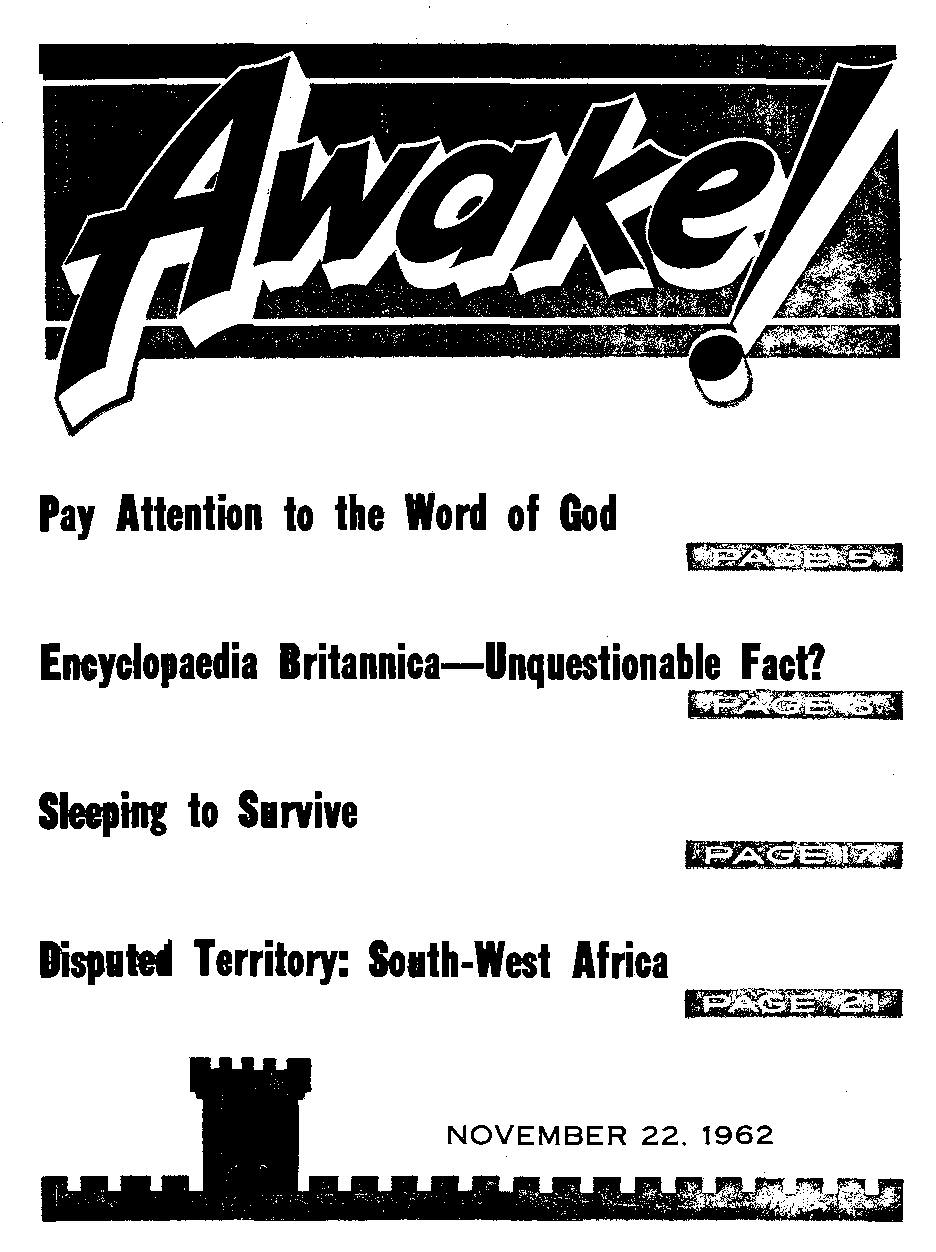
Pay Attention to the Word of God
Encyclopaedia Britannica—Unquestionable Fact?
Sleeping to Survive
Disputed Territory: South-West Africa
THE MISSION OF THIS JOURNAL
New* source* that are able to keep you awake to the vital Issues'’or our times must be unfettered by censorship and selfish Interests. "Awake!" has no fetters. It recognizes facts, faces facts, is free to publish facts. It Is not bound by political ambition* or obligations/ it is unhampered by advertisers whose toes must not be trodden on; it is unprejudiced by traditional creeds. This journal keeps itself free that it may speak freely to you. But it doe* not abuse its freedom. It maintains integrity to truth.
“Awake!" uses the regular news channels, but is not dependent on them. Its own correspondents are on all continents, in scores of nations. From the four corners of the earth their uncensored, on-the-scenes reports come to you through these columns. This journal's viewpoint is not narrow, but is international. It is read in many nations, in many languages, by persons of all ages. Through its pages many fields of knowledge pass in review—government, commerce, religion, history, geography, science, social conditions, natural wonders—why, its cover* age is as broad as the earth and as high as the heavens.
“Awake!" pledges itself to righteous principles, to exposing hidden foes and subtle dangers, to championing freedom far all, to comforting mourners and strengthening those disheartened by the failures of a delinquent world, reflecting sure hope for the establishment of a righteous New World.
Get acquainted with "Awake!" Keep awake by reading "Awake!"
Published Simultaneously in the United States by the
WATCHTOWER BIBLE AND TRACT SOCIETY OF NEW YORK, INC. 117 Adams Street Brooklyn 1, N. Y., U. S, A,
and in England by WATCH TOWER BIBLE AND TRACT SOCIETY Watch Tower House, The Ridgeway London N.W. 7, England
N, H. Knohr, President Grant Suiter, Secretary
Printing this haue: 3,600,000 +d “AwiU!” I* jtbllihed fa the fDliwfag
Semlgigjitkly—Afrikaans Cfnysuja. Danish, Dutch, English. HnniBh, French, German, Greek, Iulian, Japanese, Portuguese, Spanish, Swedish, Tagalog, Zulu.
■anthly—Cebu-Vieayan, Chinese, Ilocano, Korean, Malayalam, Polish, Tamil, Ukrainian.
Yearly subscription ratas
(Miku for semimonthly editions
America, U.t. 117 Adanw St , Brooklyn 1. N.Y, $1
Australia, 11 Beresford Rd., Strathfleld, N S W.
Canada, 150 Brldgoland Aye., Toronto 19, Ont.
'England. Watch Tower House, The Ridgeway, London N.W. 7
NeW ZaalaU, 621 New North Rd., Auckland, S.W. 1
SMth Afrlta, Private Bag, IJandsfontein. Tri. 70c Monthly editions cost halt the abore rates.
copy (Amiralla, Ed; South Africa, 3/ec) Rerilttaniei far aihufiptlons should be tent to the effiet In your country. Otherwise send your remittance to London. Notice of expiration la sent at least two Issues before subscription expires.
CHANGES OF ADDRESS should reach os thirty days before your moving date- Give is your old and new address (If possible, your old address label), write Watch Tower, Watch Tower House. The Ridgeway, London N.W. 7, England,
Entered as second-class matter at Brooklyn,, N.Y. Printed In England
The &lble translatloa seed In “Awake!” Is the New World Traftilatlon of the Holy Borlpturu, 1961 edition, When other translations ere used the following symbols will aigear behind the citations;
AS - American Standard Version AT - An American Translation A/ - Authorized Version (1611) Da - J. N. Darhy'a version
Dy - Catholic Douay renlon I'D - The Emphatic Di&glott JP - Jewish Publication Soc. Le “ Inode Leeeer'n teratoo
Mo — James Moffatt's Terakrn Ro — J, B. Rotherham s version RS — Revised Standard Verrion Y(7 - Robert Young’* Torsion
CONTENTS
Idleness Can Be Dangerous
Pay Attention to the Word of God
The Encyclopaedia Britannica—
Unquestionable Fact?
The Dishonorable Blood Sausage
Land of the Vallecaucano
Financing Crime
Sleeping to Survive
Aerial Invader Downed
Disputed Territory: South-West Africa 21
Canada's Confusing Election
New Branch Building In the Philippines 26 "Your Word Is Truth"
Christian View of Those Who Oppose 27
Watching the World
Volume X1—III London, England, November 2S, 1962 Number 22
eanMMNGCROUS of the dry-rot in men is a tendency to lurk and lounge; to be at street corners without intelligible reason;,., to do nothing tangible but to have an intention of performing a number of tangible duties tomorrow or the day after." Another noted author, Francis
THERE is sweet refreshment in the idle hours of a vacation or in the periods of rest after a day or week of work. Such periods of idleness from labors can be stimulating. But when idleness becomes a way of life, a daily thing, it ceases to be refreshing and becomes dangerous.
There is danger to a community where young people have nothing to occupy their minds and hands. As they lounge about street comers or elsewhere day after day, their idle minds turn to mischief, seeking ways to fill with thrills the time that hangs heavy upon their hands. Some youngsters have the initiative to find constructive things to keep themselves busy, but many others lack that initiative. Idleness among youths cahjead to their becoming involved in acts of vandalism, rowdyism and crime. Then the community suffers. In countries such as Switzerland where youngsters must do their share of work in a family juvenile delinquency is not the problem that it is in countries where parents do not insist upon their children keeping busy with constructive work. 1
The famous writer Charles Dickens once observed; “The first external revelations Quarles, said; “Idleness is the Dead Sea that swallows all the virtues and is the self-made sepulcher of a living man." Too many young people today have allowed idleness to swallow their virtues, causing them to descend into the pit of delinquency and crime. The mischief that results from their idleness can ruin their lives by burying whst could have been for them a bright future.
Good cannot be expected to come from a perpetually idle mind. It is like a stagnant pool that breeds scum, disease and filth. Evil thoughts intrude upon the idle mind and are nourished there, building up wrong desires that eventually express themselves in bad actions. This can happen to adults as well as to children. Idleness is the breeding ground of trouble. It was one of the major factors contributing to the decay of the Roman Empire.
Under the decadent influence of indolent nobles who avidly pursued money and pleasure, the people of the Roman Empire sank into the lowest imaginable depths of debauchery. With most of the labor in the empire being done by about sixty million slaves, approximately one-half of the whole population, idleness became the way of life for the Romans. It created an attitude that was dangerous to the continued existence of the empire.
Speaking of the pernicious influence of protracted idleness among the Romans, John Lord states, in Beacon Lights of History: “Even in the time of Cicero, it was computed that there were only two thousand citizens possessed of independent property. These two thousand persons owned the world; the rest were dependent and powerless, and would have perished but for largesses. Monthly distributions of corn were converted into daily allowance for bread. The people wXre amused with games and festivals, fed like slaves, and of course lost at last even the semblance of manliness and independence. They loitered in the public streets, and dissipated in gaming their miserable pittance; they spent the hours of the night in the lowest resorts of crime and misery, . . . What are we to think of a state of society where all classes had continual leisure for these [Roman amusements]! Habits of industry were destroyed and all respect for employments that required labor.”
The people of Jerusalem succumbed to idleness and suffered moral decay as Rome later did. They were so decadent that Ezekiel measured them up with Sodom, the name of a city that was infamous in Abraham’s day for moral corruption. Ezekiel said to the people of Jerusalem: “This was your sister Sodom’s crime: she and her daughters lived in pride, in plenty, and in careless ease; she never lent a hand to the weak and wretched.” (Ezek, 16:49, Mo) Like the Romans, these people were proud, selfish and idle. They brought upon themselves the condemnation of God for their wickedness.
The part idleness played in contributing to the moral decay of ancient peoples should not be ignored today. Its insidious influence can be just as damaging now as it was then. Prolonged idleness deteriorates a man, destroying his ambition and his creative ability. The less he does, the less he wants to do. His unwillingness to work makes him useless to himself as well as to the community.
Because there are wealthy persons who live lives of ease and pleasure, doing nothing constructive, some persons think that this should be their goal in life. They want to be on what they call “easy street.” It is this desire that lures many persons into crime. For a person to seek a life of constant ease is utter folly. Man was not made to do nothing. He was made to work. Work is good for him, mentally and physically. It gives him a sense of accomplishment that makes life interesting and worthwhile. There is satisfaction in the life of one who works, doing things for his fellowman. Comparing the life of the worker with that of the rich man who no longer labors, the Bible says: “Sweet is the sleep of the one serving, regardless of whether it is little or much that he eats; but the plenty belonging to the rich one is not permitting him to sleep.”—Eccl. 5:12.
Making idleness a way of life is dangerous to a person’s well-being, his mental attitude, his moral behavior and his joy in life. It can cause him to become dangerous to the community by leading him along paths of crime in a pursuit for easy money. In the case of youths, it leads to delinquency. Do not despise honest work, no matter how tiring it may be. Recognize your need for it, remembering that work, not idleness, is the way of life that God purposed for man.
to lament, “Oh, I Wish I had paid closer attention!’’ Such persons may hawg lost t heir way because of not getting directions
straight, or lost their job because of not paying attention to the boss. But,it can be much more serious. Failing to pay close attention to the instructions of a doctor, the orders of a police officer, or the warnings of a lifeguard may lead to one’s losing one’s very life.-. Since it is for,a person’s welfare to heed such human authorities, how much more important it is to pay careful attention to the Scriptures, the infallible Word of the Supreme Authority, Jehovah God!
The apostle Peter made this point when he wrote; “You are doing well in paying attention to it [ God’s prophetic Wordj. as to a lamp shining in a dark place. . . . For you know this first, that no prophecy of Scripture springs from any private interpretation. For prophecy was at no time brought by man’s will, but men spoke from God as they were borne along by holy spirit.’’—2 Pet. 1:19-21.
\ Mt yaw paying attetv J tion? Why is it so important to do so?
Bible writers to re-
You have good reason to pay attention to the Scriptures, Peter argued, for they are inspired of God. Yes, God actually directed those cord the information that we need to build up our faith and to direct our lives. Just as a lamp illuminates a dark, unfamiliar path, making safe travel possible, so the Word of God can light up life’s roadway and dispel the darkness concealing the pit-
fal’s and rough spots. Every day decisions K. m be made, problems dealt with and difficulties faced. Only by paying close attention to the inspired Word of God can wise decisions be made, problems be solved satisfactorily and difficulties overcome. The psalmist knew God’s Word to be such an invaluable guide, fur he wrote: "Your word is a lamp to my foot, and a light to my roadway.”—Ps. 119:105.
'Dir iuu Pay Attention ?
Today few persons really pay attention to the Word of God. Oh, they may go to a religious service once or more a week and hear portions of the Bible read. But do they ponder over the Scriptures, ascertaining how they can be applied to themselves, or to circumstances that may eventually arise in their lives? Are their hopes and desires centered in the promises of God’s Word? Do they become absorbed in the Scriptures, taking in all the information and knowledge that they can? Do you find yourself paying such close attention to the Word of God ?
It is important that we make an appraisal of ourselves from time to time, because it is on the basis of our knowledge of God that we devote ourselves to serving him. Such godly devotion should be the primary concern of our lives, for, as the apostle Paul explained to the young man Timothy, "it holds promise of the life now and that which is to come."—1 Tim. 4:8.
Yes, paying attention to God's Word so that we can worship him properly is a life or death matter! That is why Paul went on to counsel Timothy: “Continue applying yourself to public reading, to exhortation, to teaching. . . . Ponder over these things; be absorbed in them, that your advancement may be manifest to all persons. Pay constant attention to yourself and to your teaching. Stay by these things, for by doing this you will save both yourself and those who listen to you.”—1 Tim. 4: If IG.
From this it is evident that more -ian superficial reading of the Scriptures is needed. Just as physical food needs to be chewed to break it down into small particles so it can be digested and absorbed by the body, similarly, the spiritual food contained in God’s Word must be mulled over, broken down, and looked at and examined from different angles. Only then can it be digested so it will stay with us to supply the necessary spiritual strength. And just as one will become weak physically if he fails to eat two or three times a day, so one must “pay constant attention” to the Word of God, day by day. The apostle Paul explained why it is important to do so: “That is why it is necessary for us to pay more than the usual attention to the things heard by us, that we may never drift away."—Heb. 2:1.
Jesus also emphasized the importance of paying special attention so that we do not lose a tight mental grip on the Word of God. Once, after telling an illustration wherein he likened the Word of God to seed sown on various types of soil, he said: “Pay attention to how you listen.” “Pay attention to what you are hearing.” Jesus knew that, if the people were to get the valuable instruction irom me illustration, they needed to think about it, ponder on its meaning, mull it over in their mind and, most importantly, apply the instruction in their own lives. Jesus said that if one failed to do this, he would not get the sense of the word, and the wicked one would snatch away the seed that had been sown.—Luke 8’.5-18; Mark 4:3-24; Matt. 13:18-23.
Examining Ourselves
Since our life is dependent upon an accurate knowledge of God’s Word, it would be wise to examine ourselves as to how we pay attention to the Scriptures. Do not let fear of what you may discover keep you from doing this. If the results are disappointing, be glad you are aware of your deficiency in knowledge, and take steps to correct it by paying closer attention in the future.
A minister of a large church in California decided to make such an examination one Sunday morning. He asked his congregation to answer ten questions that normally required only a word or two by way of reply. The results were described as “staggering.” On marking the papers the minister found that nearly 25 percent of his congregation could not identify the place where Jesus was impaled, more than a third did not know the name of the town where he was reared and only a little more than half could name the Gospels.
If people are unable to answer such simple questions about the Bible, is it not unlikely that they apply its teachings in their lives? But we should not feel smug if we can answer these questions, or even more difficult ones, such as, What were the names of the twelve tribes of Israel? the twelve apostles? Who was the last king of Israel? Whereas it is desirable to have a knowledge of such things, it is even more important to have instilled within our mmas and neartg information that we can use to direct our lives in a way that will be pleasing to God.
For example, if you were considering marriage, could you locate information in the Bible that would assist you to make a proper choice of a mate? If you were experiencing some friqtion in married life, would you know where to turn in the BiBle to find counsel as to your Scriptural role in the marriage arrangement? Do you know where in the Bible information is given on raising children? Where would you go in the Scriptures to find counsel on the procedure to take if you were not getting along with one of your associates? If you had to decide whether to take part in some nationalistic ceremony, could you turn to an example in the Bible, or to principles that would dictate what you should do? If you were involved in a serious accident and the doctor thought it necessitated a blood transfusion, would you know where to locate scriptures that discuss God’s law on blood? Although few, if any, of these decisions or problems may now face you, you may have to deal with them in the future.
Remember too, Christians are admonished: Always be “ready to make a defense before everyone that demands of you a reason for the hope in you.” If one of your associates asked you any of these questions, as a Christian, you ought to be able to give him a Scriptural answer. Or he might want to know what all the present world trouble is leading to. Could you open up the Bible and show how these unparalleled world events were foretold to mark the last days? Could you thus prove from the Scriptures that the end of this wicked system of things is near and that God’s new world is close at hand?—1 Pet. 3:15.
What your answers are to such questions is a good indication as to how well yuU nave neeueu Uie aposioiic command to pay attention to the Word of God. Be honest with yourself. ‘Keep testing whether you are in the faith, keep proving what you yourself are.’ Perhaps you have drifted a little. Maybe the examination revealed that your grasp on the Word of life was not as tight as it should be. Consider, then, how we might pay better attention. —2 Cor. 13:5; Phil. 2:16.
How to Pay Attention
First, we will want to include in our daily schedule a time for the reading of the Scriptures, either privately or with other members of the family. We will also want to attend regularly the congregational meetings, where God’s Word is considered. And when reading the Bible at home or hearing it discussed at the meetings, we will want to concentrate on what is being said. This means we will continually ask ourselves questions: How does this affect my life? Does this call on me to make any adjustments to bring my attitude or actions into harmony with this expression of the divine will? How can I use this information in the ministry?
This involves thinking while we read or listen—trying to figure out how we can use the information and apply it to our lives. We should be thinking not only while we are listening but also immediately afterward. This is important, for the points are still fresh in the mind, and by mulling them over and pondering upon them they will be fixed there.
This is paying more than usual attention, and that is what the apostle said we must do if we are to keep from drifting away. This is what it means to “ponder,” “be absorbed,” “pay constant attention” and “stay by these things." But the.happy result will be that “you will save both yourself and those who listen to you.” —Heb. 2:1; 1 Tim. 4:15, 16.
££TT IS the truth. It is un-I questionable fact. And it is the beginning, the support and the constant touchstone of education.”1 Thus The Encyclopaedia Britannica is advertised by its publishers, who like to refer to it as the E.B.
Yes, by such publicity its publishers have succeeded in building up such an image regarding the E.B. that even one of its severest critics recently was obliged to say: “It is an institution. Over the years it has come to represent the visible embodiment of scholarship, and for the general public has become the last court of appeal in settling factual questions.”2
Bearing this out is the fact that the Watch Tower Society, publishers of Bibles and Biblestudy aids, keeps receiving inquiries from sincere persons who are disturbed because the E.B. at times contradicts the Bible, Among the subjects concerning which inquiry is made are evolution, the dates of the Egyptian dynasties as compared with the Bible, date of the flood of Noah’s day, and many of the better-known Bible characters.
Is there reason for such persons to be disturbed ? Not at all. The evidences in favor of the Bible’s authenticity, among which must be mentioned its accurate history as proved a thousand times over bymodem archaeological findings, its trueness to human nature, its frankness and candor, its great laws and wise principles, and in particular the fulfillment of many of its prophecies, all justify our accepting it for being what it claims to be, a divine revelation, the inspired Word of the Creator, Jehovah God.
Consistent with the Bible’s claim to be the inspired Word of God is the fact that it has influenced mankind for good more than any other book ever written. Well has it been termed the torch of civilization and of liberty. And consistent also with its claim to have been provided by the Creator for all mankind we find that this book has the widest circulation of any book ever written and that in by far the most languages, 1,181 thus far.3
Incomplete State of
Man’s Knowledge
Of course, the editors of the E.B. cannot lay claim to inspiration or even to divine guidance. They are prone to make the same mistakes that all other imperfect humans do, partly due to the incomplete state of man’s knowledge and partly due to human frailty and selfishness. Besides, as the Bible shows, “faith is not a possession of all people,” and so it should not surprise us to find a lack of faith manifest on the part of the editors of E.B. —2 Thess. 3:2.
Since man is ever learning, he repeated-, ly finds himself obliged to discard what yesterday appeared to him to be truth for what appears to be- truth today, and the E.B. is no exception. For example: For ever so many years E.B. published the story that Galileo proved that objects of unequal weight fall to the earth at the same velocity, this being based on what one Vivani reported. However, modern research has revealed that “what Vivani did not know was that a friend of Galileo and not Galileo himself dropped the weights from the Leaning Tower [of Pisa] and discovered that they did not fall to the ground in the same time.”2 Tfhus all these years E.B. contained a glaring scientific error, and so was not “unquestionable fact,”
Here is an example involving the Bible: The 9th edition of E.B. took a very dim view of what the Bible had to say about the Hittites: “The lists of [Hittite] pre-Israelitish populations cannot be taken as strictly historical documents. ... It is obvious [these Biblical] narratives written . . . so long after the events referred to cannot be taken as of equal authority with Egyptian and Assyrian inscriptions . . . No less favorable to the accuracy of the Old Testament references to the Hittites is the evidence deducible from proper names. . . . Is it unnatural to infer that these three names are not less fictitious than the Semitic names ascribed in the Old Testament to the non-Semitic Philistines?’1 —Vol. 12, page 28.
But current editions of E.B. adopt an entirely different tone toward the Bible record: “The Hittite race, ‘the sons of Heth/ . , . was known to the writers of the Old Testament, ... In confirmation and'amplification of these Old Testament accounts, Egyptian evidence shows,” and so forth. Due to archaeological discoveries E.B. was obliged to do an entire about-face as to the value of the Bible record regarding the Hittites.—1959 edition, Vol. 11, pages 598-B, 599.
In view of the foregoing it is not surprising that the dates E.B. gives for certain Egyptian dynasties do not agree with the Bible, Among the various dates E.B. has given for the beginning of the first Egyptian dynasty are 5,005, 3,892, 3,350 and 3,200 B.C.4, 8 Might it not be that more complete knowledge will give a yet lower date for this dynasty, assuming that it came after the Flood, 2,369 B.C.? Especially is this a reasonable deduction in view of archaeologist Albright’s observation that modem archaeological discoveries have required Egyptian dates to be progressive.. lowered.6
Yielding to Popular Opinion
Th</ E.B., being strictly a commercia venture,1 of course feels compelled to cater to popular opinions, which likewise causes it repeatedly to fail to measure up to its claim to be the “constant touchstone of education.” A noteworthy example is its treatment of the evolution theory. It presents evolution “as a fact.”8 But the French Academy thought so little of Darwin’s ‘Tacts” that it denied him membership on the basis of his evolution theory. Said one of its members in explanation: “What has closed the doors of the Academy to Mr. Darwin is that the science of those books which have made his chief title to fame— the Origin of Species and still more the Descent of Man—is not science, but a mass of assertions and absolutely gratuitous hypotheses often evidently fallacious. This kind of publication and these theories are a bad example, which a body that respects itself cannot encourage.”—Les Mondes.9
In discussing mutations E.B. tells only one side of the story. It fails to tell of the vain results of thousands of experiments made with mutations by the University of Washington under the direction of L. R, Donaldson. According to him no useful mutations appeared and none were anticipated. “So far as we know we’re not getting any good characteristics. You can’t add when you’re subtracting,”10
Nor does E.B., in considering this subject, take note of Virchow, whose cellular concept has been termed “the central fact of modem biology,” According to him such specimens as the Neanderthal man were pathological, that is, diseased, abnormal, and he held it folly to “try to establish new prehistoric races on the basis of one single specimen.”2 He also kept insisting that evolution should not be considered anything more than an interesting hypothesis, since proofs for It were lacking.
Jean L. R. Agassiz disposed of the evolution theory with the words: “A scientific mistake, untrue in its facts, unscientific in its method, and mischievous in its tendency.”11 And who is this Agassiz? Says E,B.} “As a teacher of science he was extraordinarily skillful, certainly the ablest America has ever known . . . The result of his instruction at Harvard was a complete revolution in natural history study in America,” because he insisted on going directly to the book of nature instead of to schoolbooks for his facts, “Every notable teacher of natural history in the United States for the second half of the 19th century was at some time a pupil of Agassiz or of one of his students.” His summer school was “the school of all schools which has had the greatest influence on science teaching in America,” And to sum up, “Agassiz was beyond question one of the ablest, wisest and best informed biologists of his day,” E.B. tries to account for his “cold and unsympathetic . . . attitude toward Darwinism," but the fact remains that for Agassiz “each species of animal or plant was in itself ‘a thought of God.’ ”M
Higher Criticism
Another way in which E.B, has sacrificed truth to popular opinion is in its adopting “higher criticism," which is destructive of faith in the Bible, in dealing with Bible subjects. It portrays Aaron as a rival of Moses and speaks of “a tradition of hostility between Moses and Aaron,” and says that “the process by which tradition changed Aaron from being a possible rival to Moses to his ecclesiastical counterpart has never been satisfactorily explained.”1’ That this of itself should throw doubt on the tradition of hostility between Moses and Aaron never occurred to these “higher critics.”
Regarding Abel, earlier editions of E.B. were content with what the Bible had to say about him, but current editions try to discredit the Bible record by observing that “possibly Abel originally was a South Judean demigod or hero.”14
There is a similar difference between what earlier and later editions of E.B. say about Enoch. The earlier ones recognize that four persons by this name are mentioned in the Bible and state that to base a mythical interpretation on his life because his years are the same as the number of days in a year “seems more ingenious than sound.”1’ But current editions confuse the various Enochs mentioned in the Bible and state that "the brief notice in Gen. 5:21-24 is certainly a fragment of an Enoch myth.,,. The fact that his years are given as 365 suggests that he was a solar hero.”10
Regarding Samson the E.B. currently, among other things, states: “It has, indeed, been argued that the entire Samson story is a solar myth; but it is apparently much more highly probable that In this case the story of a popular hero has been expanded and decorated by mythological motifs. Why does a story so lacking in religious interest appear in the book? . . , There is some evidence that the story was not included in an earlier form of Judges, and that a later editor was constrained by its popularity to insert it.”17
Does not the E.B.. by publishing such theories of higher criticism, go counter to its claim to be the repository of "unquestionable fact”? Surely all this higher criticism Is mere speculation that often not only is contradictory but also has repeatedly been proved wrong by archaeological discoveries. Would it not be more consistent simply to summarize what the Bible has to say about its characters and then present it as just that? Surely.
Truth versus “Tolerance”
The E.B. has further failed to live up to its claim as the "constant touchstone of education” by yielding to religious pressure or, in the interests of “tolerance," wanting to avoid offending anyone. The apostle Paul asked the Christians at Galatia: "Have I become your enemy because I tell you the truth?” (Gal. 4:16) But the E.B. takes no chances on making enemies by telling the truth. Not that this was always its policy. Its most famed as well as most scholarly edition, the 11th, spoke plainly regarding the shortcomings of Christendom, because of which it received a storm of abuse from Catholic groups, although certain leading Catholic scholars fully exonerated the E.B3 Nevertheless, it yielded to religious pressure, as can be noted from the following representative examples.
Under the heading "Eunuchs,” current editions of E.B., among other things, state: "The Italian practice of castrating boys in order to train them as adult soprano singers ended with the accession of Leo XIII.”1'
But what are the facts? They are as stated in the 11th edition: “Even more vile, as being practiced among a civilized European nation, has been the Italian practice of castrating boys to prevent the natural development of the voice, in order to train them as adult soprano singers, such as might till lately be heard in the Sistine Chapel. Though such mutilation is a crime punishable with severity, the supply of such ‘soprani’ never failed so long as their musical powers were in demand in high quarters. Driven long ago from the Italian stage by public opinion, they remained the musical glory and the moral shame of the papal choir till the accession of the present pope (Leo XIII) one of whose first acts was to get rid of them.”10 So, instead of the Vatican bringing to an end the7 use of eunuch sopranos in Italy, it was the last to stop using them! Was not the truth here sacrificed?
A similar example is found under the heading of "celibacy.” For some fifty years the writer of the E.B, article on the subject had been a professor of English at Oxford University. He gave an objective presentation of the subject and was also used by E.B. to write on other historical matters. For more extensive information he recommended the History of Sacerdotal Celibacy, by the American historian Henry C. Lea, "by far the fullest and best work on the subject.”20
But in recent editions of E.B. another article appears, one that is slanted In favor of clerical celibacy. It refers the reader to various German and French works and, for English readers, The Catholic Encyclopedia. It also mentions Lea but states that he is charged with superficial and biased scholarship.21 What are the facts?
In the first place it may well be asked, How could one expect to obtain an impartial view of such a controversial institution as clerical celibacy by consulting a Roman Catholic encyclopedia? And as for the merits of Henry C. Lea, American scholars agree that he was “the first and greatest of American scientific historians.” His history of the Spanish Inquisition is the “most extensive, the most profound, and the most thorough of the inquisition which we possess.”4 He never wrote “with any other purpose of bias save that of eliciting the facts.”22 His work was stamped with “love of truth, interest in science,” and no one could tell by his works what was his religion. He received degrees from leading European and American universities; in fact, he was even more esteemed and appreciated in Europe than in the United States.23
But who is the writer of the current article on celibacy in E.B. that casts slurs on this noted historian Henry C. Lea? And what are his qualifications? He is H.R.W., with no other qualifications given save that of being a Jesuit priest in Japan and who wrote nothing else in E.B, save the article on celibacy.24 Why replace an Oxford English professor with a literary unknown in Japan? An interesting question that allows for more than one answer.
The subject of heresy furnishes another noteworthy example. The famed 11th edition told that persecution for heresy had been practiced by pagans, Moslems, Catholics and Protestants, honestly telling the facts, showing neither fear nor favor. Socrates had been “indicted as an irreligious man, a corrupter of youth, and an innovator of worship.” Persecution of sects within Mohammedanism was also shown to be common. Regarding Christendom itstated:
“As long as the Christian Church was itself persecuted by the pagan empire, it advocated freedom of conscience, and insisted that religion could be promoted only by instruction and persuasion (Justyn Martyr, Tertullian, Lactanius); but almost immediately after Christianity was adopted as the religion of the Roman empire the persecution of men for religious opinions began . . . Arianism, when favored by the reigning emperor, showed itself even more intolerant than Catholic Orthodoxy [had been of it] . . . In the middle ages the church showed no hesitation about persecuting unto death all who dared contradict her doctrine, or challenge her practice, or question her authority ... In the Albigensian Crusade (A.D. 1209-1229) thousands were slaughtered.”25
Further, this 11th edition told how Luther at first claimed that “heresy is a spiritual thing which one cannot hew with any iron, bum with any fire, drown with any water. The Word of God alone is there to do it," yet later he became party to an agreement where the ruler decided the religion of his subjects and those who disagreed could emigrate but could not practice their religion in the dominion of such a ruler. Calvin’s consenting to the death of Servetus for denying the trinity is also noted, as well as the fact that in times past Protestants quite approved of the execution of heretics.20
All this wealth of telling testimony regarding heresy has now disappeared. There is reference to the minor heresies of early Christendom, a glossing passing reference to Catholic and Protestant persecution of heresy and a discussion of “scientific” heresy.Thus the truth is thrown out the window so as to avoid offending anyone: pagan Greek, Moslem, Catholic, Protestant
So what? Does this mean that such authorities as E.B. should not be consulted? Not at all! Without doubt, it and works like it serve a good purpose and, in fact, should be consulted even more than they are.
But the foregoing should suffice to show that “truth” as presented by man is a relative thing. It may be incomplete due to imperfect knowledge, or it may be distorted or slanted, partial or circumscribed because of human frailty; and this is especially true of matters touching the Bible, since, as has been noted, “faith is not a possession of all people.”—2 Thess. 3:2.
It all calls to mind what the Scriptures have to say about the governments of this world. They serve a useful purpose and are to be obeyed; even dedicated Christian ministers are to be in subjection to them —but only relatively, that is, so long as these governments do not go contrary to God’s will. Caesar may/never ask what belongs to God. (Mark ±2:17) So with such literary authorities as E.B. They may be accepted, in the absence of something better, or so long as they do not conflict with God's Word, the Bible, which alone is infallible truth,—John 17:17.
REFERENCES
1 Look, March 14, 1961.
2 The Columbia [University] Forum, Winter, Spring, 1960.
3 American Bible Society.
4 E.B., 9th Ed., Vol. 7, p. 633.
c E.B. (1959), Vol. 5, P. 654.
a Archaeology of Palestine, Albright, p. 220.
t Science, July 14, December 22, 1961.
a E.B. (1959), Vol. 8, p. 921.
e Jtfan, a Special CreationDewar.
io Life, November 11. 1949.
ii American Journal of Science, Vol. XXX, p. 154.
12 E.B. (1959), Vol, 1, pp. 339-341.
is Id. (1959), Vol. 1, p. 4.
14 Id. (1959), Vol. 1, p. 32.
is Id. (9th), Vol. 8, p. 400.
ic Id. (1959), Vol. 8, p. 615.
17 Id. (1959), Vol. 19, p. 924.
18 Id. (1959), Vol. 8. p. 814.
19 Id. (11th), Vol. 9, p. 891.
so Id. (1946), Vol. 5, pp. 94-96.
21 Id. (1959), Vol. 5, pp. 96-98.
22 Pennsylvania Magazine of History and Biography, October, 1956.
23 . Dictionary of American Biography, Vol. 1.
24 E.B, (1959), p. lx.
as /J./(11th), Vol. 13. pp. 358-362.
26 Id. (1959). Vol. 11. pp. 498-500.
THE Dishonorable BLOOD MU5BGE
• Under this headline a Viennese weekly paper (EXPRESS am Wochenende, November 26, 1960) had this to say about an edict of days gone by:
“Even the ancient Greeks and Remaps enjoyed sausages thoroughly, the main ingredient of which was in fact garlic. The use of animal blood in preparing sausages apparently came up in the time of the East-Roman emperor Leo VI (A,D. 886-911). He, who was called the wise man or the scholar, issued an edict by which the preparation and taking of blood sausage was forbidden. In his prohibition he quoted the older prohibition concerning the eating of blood in the Old and New Testament, and complained that people, partly because of profit, partly because of being lickerish, have become so extravagant as to convert blood into an eatable food. Then the edict says:
" 'It has gotten to our ears that blood is being wrapped up in intestines like in skirts, and is thus being sent to the stomach as a dish. Our Imperial Majesty can no longer tolerate and permit this disgrace to be brought upon the honor of our state by such a wicked invention of people only greedy after gluttony. Who therefore converts blood into food, or merely buys or sells it, his property shall be confiscated, he himself scourged severely, as a sign of his dishonorableness he shall be sheared to the skin, and forever banned from the empire. Also, the authorities, because of having not been more vigilant in their office, and having allowed such an outrage to take place, shall make amends by paying ten pounds of gold.' ’’
“But the edict was considered as just so much ‘sausage’ by the subjects. Blood sausage continued to hold its own,” even as today unrighteous persons ignore the edicts in God’s own Word that forbid the eating of blood. —Gen. 9:4; Acts 15:28, 29.
WHAT the Creator has done for the Cauca Valley of Colombia is marvelous indeed. By locating it just three degrees north of the equator and raising it 3,000 feet above the surface of the Pacific, He endowed it with perennial summertime. To prevent it from being lashed with violent winds and tempestuous rains, He hemmed it in on the west and on the east by majestic ranges of the Andes. Then atop the flat valley floor He rolled out a twenty-mlle-wide carpet of rich volcanic soil capable of producing two or three harvests of crops each year.
Abundant rainfall in the mountains keeps numerous streams and small rivers flowing across green fields to join the leisurely Cauca, which meanders aimlessly, serpentlike, throughout the length of this ISO-mile stretch of subtropical fertility, before entering a deep and heavily forested gorge to begin its northward quest for the salt waters of the Caribbean.
An abundance of bright sunny days; refreshing scattered showers, punctuated with gorgeous rainbows; pleasant midafternoon breezes descending from the mountain slopes; a flood of brilliant sunlight casting long shadows across fruitful
fields just before the late afternoon sun drops behind the western cordillera; an occasional glimpse of distant snowcapped peaks glistening radiantly in the rays of the setting sun, followed by incomparably lovely nights with a caressing warmth that could inspire a song—all of these were added to complete God’s gift to Colombia’s Valle del Cauca. When the Spaniard arrived in the early sixteenth century, it was love at first sight. His search was over. Here is where he would settle down for the remainder of his days. He sent back home for his horses and cattle, donkeys and goats, chickens and pigs. His religion he brought along too, and he began to build churches and missions and to convert the natives to Catholicism.
In the nineteenth century he fought for independence and embarked on the turbulent, often violent, river of political contention and strife. He launched steamboats on the leisurely Cauca, drained swamplands and set great herds of cattle out to graze. His sugarcane and coffee began to find their way out into the markets of the world.
It is only since World War II that the four-and-a-quarter-century-old Santiago de Cali, the Valley’s capital, has begun to shake itself from the dreams of the past to take on the air of a modern industrial metropolis. Old buildings, proudly reminiscent of gallant cdballeroe and sophisticated ladies, have had to surrender to the inexorable force of the wrecking bar and the bulldozer blade.
Much of the Old Spanish "Cavallera”
While much of the old colonial atmosphere is still there, modernistic homes built around bright sunny patios have multiplied and grown into attractive residential barrios with palm-lined boulevards and well-kept parks. Here is where the wealthy descendants of old Spanish colonists and the aspiring members of a newly emerging middle class live in contentment and ease.
And just what is this Vallecaucano like today? He may be a banker or a businessman, a doctor, a lawyer or an architect, an accountant, a salesman or a professor. He is educated, intelligent and surprisingly well informed about the world in which he lives. There is still much of the old Spanish caballero in him, as evidenced by his cultured poise and his precise correctness of manners. He likes his club, the restaurant and his midmorning demitasse of Unto, the coffee upon which the Colombian economy rests. His gracious wife and daughters, dedicated to stylish dress, elegant coiffures and carefully manicured nails, admirably fulfill their assigned role of pleasing the dominant male of the Valley, while still finding considerable time for social activities, the movies and going to church.
Not particularly religious himself, he frequently attends church just to please his wife, though his early religious training permeates his thinking far more than he realizes. His politics and economics he does take seriously. He worries about communism, nuclear war and the price of coffee on the world market
Believes in God, But . . ;
But, then, the Vallecaucano may also be a farmer or a shoemaker, a carpenter, a cowboy or a mechanic. Before the morning sun peeks over the Cordillera Central you may see him riding his bicycle down the dark highway with scores of others on their way to a long day’s work in a sugar mill. Or in a modern factory he operates a machine forty-eight hours a week. His home, humble in itself, has been made attractive with potted plants and colorful flowers. He, too, is courteous and polite, and his family a model of hospitality.
Despite his lack of formal schooling, he is alert and interested in life. He reads the newspaper each day and likes to converse about Khrushchev and Kennedy, atomic tests and space flights. Communism does not terrify him the way it does his more affluent brothers. He works with some Communists, has listened to their arguments and has read their literature; but he is not overly impressed with their talk of a Communist workers’ paradise. He has had enough of dictatorships and does not favor any government that leans too far to the left or to the right.
Ask him about religion and he will probably say: “I am Catholic, I believe in God, but I don't like the priests.” To him the church has always been the solicitous friend of a feudalists, conservative society, favoring the privileged few and seldom going out of the way to help the common man.
Strange though it may seem, however, he does not spend his time brooding over the high salaries, country clubs, fine homes and shiny automobiles of his more affluent brothers. He rather accepts that as an unalterable fact of life. But when he taXes a bus ride out through the valley and views the expansive plantations of sugarcane, cotton and rice, he is forcefully reminded that the majority of these lush green fields are the property of comparatively few men and their families. Then as the bus speeds into one of the many old towns that dot the Valley at regular intervals, slowing down to pass through narrow streets of humble houses jammed one against the other, with an incredible number of families and children crowded into one block,, he cannot quite understand why, with so much good land here in the Valley, things have to be this way.
The Coming of Violence
The Vallecaucano likes to reminisce about the good old days before 1948, when everything was tranquil® throughout all the Valley. A person was safe out walking alone any hour of the day or night. Then violence came to the Valley.
At first it was political. The Conservatives, who were in power, drove the Liberals off their land; then the Liberals organized guerrilla bands to fight back, both sides massacring whole families ruthlessly, including women and children of all ages. It was virtual civil war. Few persons outside Colombia realize the extent of the slaughter. Discussing the matter, Time magazine of February 23,1962, said in its Latin-American edition:
“Senseless violence in Colombia’s back-lands has killed more than 300,000 Colombians in the past 14 years—a figure greater than the battle deaths of all U.S. forces in World War II. . . , After years of fighting most of the marauders now pay only lip service to politics. The killing is largely for killing’s sake., . . The main battlefield is in the small, heavily settled department of Valle (pop. 1,596,650) west of Bogota, where, on the average, three people are murdered each day.”
Thus great numbers of Colombians have learned to live only by violence. This legacy has helped keep thousands of bandits going; the bandit gangs are often made up of eight to ten youths who ate viciously sadistic. These gangs have wiped out whole families in the rurals, usually beheading their human victims with machetes and then doing the same to dogs, pigs and chickens.
With such brutal violence and so many killings, what hope does the Vallecaucano have for the future? His first hope is that the government will soon put an end to the violence and bring back tranquillity. He appreciates the progress that has been made. But, while he listens to what men project for the future, he is apprehensive in view of the violence of the past.
To have the tranquillity he desires, he realizes that there has to be a change in the outlook and values of the people. Political parties can impose new legislation oh the people, but they cannot change what man is inside. The church does not bring the change because it simply adopts the standards of the society around it. It is evident that the church has not been an effective force to prevent fourteen years of bloodshed, though the majority of disputants have grown up in its faith. The Vallecaucano who realizes this but who has not lost his faith in God is finding cause for confidence in his study of the Bible. He has cause for confidence. He can see what God has already done for his valley. He can see the change Bible principles make in one’s life. He can read about the hope the Bible holds forth of a peaceful new world. It is evident to him from the daily provisions that make bfe possible that God has not forsaken man.
FI > a. > CING C1UME
"The American people are spending more on gambling than on medical care or education; ... in so doing, they are putting up the money for the corruption of public officials and the vicious activities of the dope peddlers, Ioan sharks, bootleggers, white-slave traders and slick confidence men."—U.S. Attorney General Robert F. Kennedy.
mals such as the woodchuck are altered so they can sleep for six or seven months without food and drink. One thing is certain, however; these animals did not get their strange ability by their own efforts. The One who designed their little bodies gave it to
WHEN the first gentle fall of fluffy snowflakes carpets northern lands with a white blanket, a strange^ transformation will already have taken place among some of the wild animals. Unlike the creatures that migrate to warmer places before the coming of winter, these animals stay where they are. They survive through months of freezing temperatures and scarcity of food by sleeping. The woodchuck is one of these unusual animals.
Well below the frostline, the woodchuck, curled up into a furry ball, quietly sleeps the winter months away. He is snuggled at the end of a burrow that is from ten to twenty-five feet long with sloping side tunnels for drainage. Completely oblivious to the icy winds of winter and the piling up of many feet of snow on the ground four to five feet above him, he sleeps on, waiting for spring, when, in some mysterious way, he will be awakened to renew his active life. Even if the temperature in his burrow should drop to a few degrees above freezing, he will not be disturbed, for his sleep is no ordinary sleep. It is the strange winter sleep of hibernation.
Although scientists have been studying hibernation for many years, it is still a mystery to them. They are not certain as to what actually triggers it, and they do not know how the bodily functions of ani-them so they might be able to survive the rigors of winter. He caused it to be an automatic thing that would be triggered in the fall of the year and then terminated at the proper time in the spring. When it begins, the functions of their bodies automatically slow down.
Change in Body Functions
The change from normal activity to winter sleep is gradual, involving drastic changes in a hibernator’s body. From three to thirty days is required for the woodchuck to reach full dormancy. It does it in steps of increasingly longer drowsy periods followed by periods of wakefulness. Some animals descend into it smoothly without interruption. During this time the animal’s heartbeat, respiration and temperature gradually decline.
In normal activity the heart of the woodchuck beats at a rate of 80 beats a minute, which is unusually low for a warm-blooded animal of its size. A ground squirrel has a normal heartbeat of 360 a minute; the hamster has one of about 270 a minute, and the bat has one of 180 a minute. During hibernation the heartbeats of these creatures is phenomenally low. The heart of the woodchuck slows to around four or five beats a minute; the squirrel’s drops to three a minute, the hamstar’s to about four, and the bat's to two or three. Despite this slow heartbeat, the blood pressure remains near normal.
Although blood circulation la slow, the cells of the hibemator’s body are not starved for oxygen. This is surprising, especially in view of the fact that Its rate of respiration Is also greatly reduced. Normally, the woodchuck breathes at least twenty-five to thirty times a minute, but during hibernation it takes one breath a minute and sometimes one in every five minutes. The thirteen-lined ground squirrel drops its respiration from a rate of 100-200 breaths a minute to a rate of from one-half to four a minute. Breathing in hibernators is commonly irregular.
Because the rate of chemical changes, or metabolism, in the body of the dormant woodchuck is greatly slowed down, its cells do not require much oxygen. A certain amount of oxygen is left in the blood notwithstanding the animal’s slow respiration. Gradually the blood becomes saturated with oxygen. This is evident in the paws of the ground squirrel. Their normal color is gray, but during hibernation they take on a pink color because of the reddish color of Its oxygen-rich blood.
The body temperature of hibernators undergoes a startling reduction during their descent into winter sleep. A bat’s temperature drops precipitously from about 100° F. to around 40° F., or the approximate temperature of its den. The temperature of the woodchuck slides from 96. 8° F. to about 37° F., or to a few degrees above its surroundings. The same is true of the hamster, whose body temperature will stay about one degree above that of its environment, even when the temperature of its environment Is down to freezing.
The automatic temperature regulator given these little animals by the Creator prevents them from freezing. When the surrounding temperature drops below treezmg, their metaoolism automatically increases threefold or more. Should freezing still threaten them, It will wake them up. Strangely enough, low temperatures never cause a hibernating animal to become frostbitten.
The Creator designed these little creatures to have heart and muscle tissues that are a little different from those of non-hibernating animals. The human heart, for example, could not stand the drastic temperature reduction that the heart of the woodchuck endures. It reacts badly when body temperature is lowered to between 70 and 80° F. by beating irregularly. The woodchuck’s heart, on the other hand, is designed to work smoothly when the body temperature is only one degree above freezing.
Food
Even with an astoundingly low rate of metabolism, a hibernating animal needs a certain amount of nourishment. Usually this Is obtained from the large quantities of fat stored in its body. Weeks before hibernation begins for a woodchuck—usually in September—it greatly increases its food intake. By the time it begins its winter sleep it will weigh as much as four times its usual weight and will have thick layers of fat on its body. From about the middle of September until about the middle of March its body draws upon this stored fat, which is its only source of energy. The woodchuck’s sleep is not unbroken, however, for it wakes up about every three weeks to relieve itself.
Unlike the woodchuck and bat that usually eat nothing during their period of sleep, the ground squirrel wakes up periodically to eat some of its stored food. This and its body fat keep it nourished. The amount of food needed by a hibemator is very small. A hamster uses only one-thirtieth to one-fiftieth of its normal energy during moernation. It too wakes up occasionally to nibble on some food, but the behavior of hibernating animals varies even within the same animal kind.
Winter Sleepers
Among mammals, reptiles and insects a number of creatures can be found that spend either a portion or the greater part of winter sleeping, but few are true hiber-nators. A hibernator is technically considered to be a creature that experiences a greatly reduced body temperature, heartbeat and rate of respiration during winter sleep. Upon this basis a bear could not be classed as a hibernator. It is instead a deep sleeper.
A bear’s metabolism does not slow down to the extent common in woodchucks, hamsters, ground squirrels, bats, and so forth. Instead of the bear’s temperature dropping to a few degrees above freezing, it remains only a few degrees below normal. Respiration also remains relatively normal. During winter it may wake up occasionally and spend a whole day outside if there is a warm spell. At such times it will eat if food can be found. While sleeping it draws energy from its stored fat. The common black bear puts on about a four-inch layer of fat before beginning its winter sleep.
A male bear of some species will sometimes keep active for most of the winter if it can find enough to eat, but the female will seek out a den in a hollow tree trunk, a cave or upturned roots and will go to sleep there. During her winter sleep she gives birth to tiny cubs that weigh only eight to twelve ounces. They are smaller in proportion to her weight than the young of almost any other mammal. This is a wise provision of the Creator, since her principal source of energy for several months is only her stored fat. Her sleep is not so sound that she is not conscious of her young. If they make any sound of discomfort, she will shift her position.
Since a bear’s winter sleep is not true hibernation, it wakes from it much more quickly and easily than does a woodchuck. Two or three hours arc needed for a woodchuck to return to normal activity. As it comes out of hibernation its bodily functions speed up at an exaggerated rate. Its heartbeat leaps up to 200 a minute, more than twice its normal beat of eighty. Its breathing likewise exceeds its normal rate. At the end of two or three hours its body is functioning as usual.
For a long time birds were not considered as having any hibernators among them, but in the 1940’s an American scientist discovered, by chance, a poorwill that was hibernating in a California gorge. It is of the same family as the whippoorwill. For eighty-eight days it remained in a torpor, not even waking when a sleet storm buffeted its back, which was exposed from its shallow hole. Its body temperature registered a low of 64.4° F., which is a sizable drop from its normal 106° F. Its breathing and heartbeat were imperceptible. Repeated weighings during its hibernation revealed fractional losses in body weight. At the end of its lengthy sleep it slowly woke up and flew away. The bird was closely observed for four seasons.
Because of their lowered rate of metabolism, it has been suggested that hibernating animals do not age while dormant, but recent evidence seems to prove otherwise. Some growth continues during this period, notwithstanding extremely low body temperatures. This became evident in a female tortoise during its twenty-three-week period of hibernation. While sleeping, it regenerated part of its lower jaw that had been missing. Hibernation does, however, seem to affect the life-span of animals. It appears that hibernators usually live much longer than non-hibemators their size.
Water turtles sleep away the winter buried in the mud at the bottom of their watery world. During that time their need for oxygen is so small that they can stay there without breathing for three months or more. Some turtles have special bladders for taking oxygen from water. Land turtles burrow about two feet into soft ground and hibernate there.
Like other cold-blooded creatures, the temperature of turtles and snakes is always close to that of their surroundings. Their survival, therefore, through cold winter months is made possible by their ability to hibernate. Snakes frequently hibernate in clusters with their bodies intertwined. They choose holes in the ground that take them below the frostline.
…