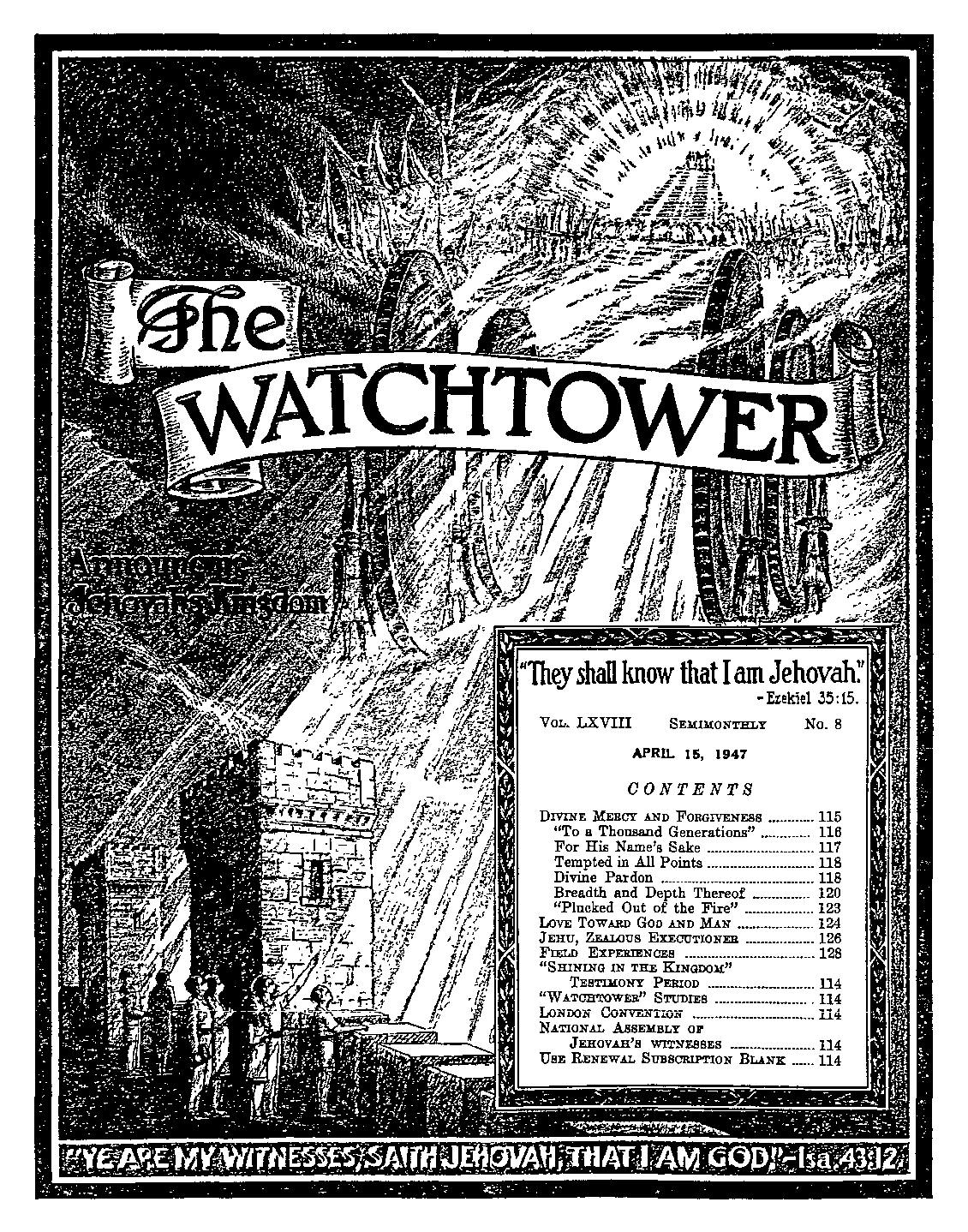
The Watchtower, April 15, 1947
Download: PDF — The Watchtower, April 15, 1947
National Assembly of
Jehovah’s witnesses
Use Renewal Subscription Blank
B
“They shall know that I am Jehovah.
-Ezekiel 35:15.
Vol. LXVIII
Semimonthly
APRIL 15, 1947
CONTENTS
Divine Mercy and Forgiveness “To a Thousand Generations” . For His Name’s Sake ...............
Tempted in All Points...............
Divine Pardon ...........................
Breadth and Depth Thereof ... “Plucked Out of the Fire” .....
Love Toward God and Man.......
Jehu, Zealous Executioner ..... Field Experiences .....................
“Shining in the Kingdom”
Testimony Period ...............
“Watchtower” Studies.............
No. 8
115 116
.. 114 .114
^HeWATCHTOWER.
Published Semimonthly By
WATCH TOWER BIBLE & TRACT SOCIETY 117 Adams Street • • Brooklyn. 1, N.Y., U.SA.
Officers
N. H. Knobb, President Grant Suiter, Secretary
"And all thy children shall be taught of Jehovah; and great shall be the peace of thy children.” - Isaiah 54:13.
THE BIBLE CLEARLY TEACHES
THAT JEHOVAH is the only true God, from everlasting to everlasting, and is the Maker of heaven and earth and Giver of life to his creatures; that the Word or Logos was the beginning of his creation and his active agent in creating all other things', and that the creature Lucifer rebelled against Jehovah and raised the issue of His universal sovereignty;
THAT GOD created the earth for man, made perfect man for the earth and placed him upon it; that man yielded to unfaithful Lucifer, or Satan, and willfully disobeyed God’s law and was sentenced to death; that by reason of Adam’s wrong act all men are born sinners and without the right to life;
THAT THE LOGOS was made human as the man Jesus and suffered death in order to produce the ransom or redemptive price for obedient men; that God raised up Christ Jesus divine and exalted him to heaven above every other creature and clothed him with all power and authority as head of God's new capital organization;
THAT GOD’S CAPITAL ORGANIZATION is a Theocracy called Zion, and that Christ Jesus Is the Chief Officer thereof and Is the rightful King of the new world; that the faithful anointed followers of Christ Jesus are Zion’s children, members of Jehovah’s organization, and are His witnesses whose duty and privilege It is to testify to Jehovah’s supremacy and declare his purposes toward mankind as expressed in the Bible;
THAT THE OLD WORLD, or Satan’s uninterrupted rule, ended AD. 1914, and Christ Jesus has been placed by Jehovah upon the throne, has ousted Satan from heaven, and now proceeds, to vindicate His name and establish the “new earth”;
THAT THE RELIEF and blessings of the peoples can come only by Jehovah’s kingdom under Christ, which has begun; that His next great act is to destroy Satan’s organization and establish righteousness completely in the earth; and that under the Kingdom the people of good-will surviving Armageddon will carry out the divine mandate to “fill the earth” with righteous offspring, and that the human dead in the graves will be raised to opportunities of life on earth.
ITS MISSION
THIS journal Is published for the purpose of enabling the people to know Jehovah God and his purposes as expressed in the Bible. It publishes Bible instruction specifically designed to aid Jehovah’s witnesses and all people of good-wilL It arranges systematic Bible study for Its readers and the Society supplies other literature to aid in such studies. It publishes suitable material for radio broadcasting and for other means of public instruction in the Scriptures.
It adheres strictly to the Bible as authority for Its utterances. It is entirely free and separate from all religion, parties, sects or other worldly organizations. It is wholly and without reservation for the kingdom of Jehovah God under Christ his beloved King. It is not dogmatic, but Invites careful and critical examination of its contents in the light of the Scriptures. It does not indulge in controversy, and its columns are not open to personalities.
Notice to Subscribers: Remittances should be sent to office In your country in compliance with regulations to guarantee sate delivery ot money. Remittances are accepted at Brooklyn from countries where no office is located, by international money order only. Subscription rates in different countries are stated below in local currency. Notice of expiration (with renewal blank) is sent at least two issues before subscription expires. Change of address when sent to our office may be expected effective within one month. Send your old as well as new address.
Please address the Watch Tower Society in every case.
Offices Yearly Subscription Rate
America (U.S.), 117 Adams St., Brooklyn 1, N.Y.
Australia, 7 Beresford Rd., Strathfieldi N. S. W.
British West Indies, 21 Taylor St., Port of Spain, Trinidad
Canada, 40 Irwin Ave., Toronto 5, Ontario
England, 34 Craven Terrace, London, W. 2
India, 167 Love Lane, Bombay 27 Us. 3/6
Jamaica, 15t King SL, Kingston
New Zealand, G. P. O. Box 3<L WSBlngton. S. 1
Philippine Islands, 2621 Int. 2 Henan, Santa Ana, 'Manila
South Africa, 623 Boston House, Cape Town Ba
Translations of this journal appear In many languages.
ALL SINCERE-STUDENTS OP THE BIBLE who by reason of infirmity, poverty or adversity are unable to pay the subscription price may have The Watchtower free upon written application to the publishers, made once each year, stating ths reason for so requesting It. We are glad to thus aid the needy, but the written application once each year Is required by the postal regulations.
Printed In the United States of America
Entered as second-class matter ad the post office at Brooklyn, If. Y., under the Act of March 3, 1879.
“SHINING IN THE KINGDOM” TESTIMONY PERIOD
April, set aside as “Shining in the Kingdom” Testimony Period, will close the four-month-long subscription campaign for the magazines The Watchtower and Awake! Seeing that both these magazines are published in many languages, those of many nations wanting to let shine the light of God’s kingdom as reflected on the pages of said magazines will be able to offer them both together along with two premium books published by our Society. They will continue to make this joint offer at the regular subscription rate of $2.00. New ones desiring to participate, write for information.
“WATCHTOWER” STUDIES
Week of May 18; “Divine Mercy and Forgiveness,” fl JL-19 inclusive, The Watchtower April 15, 1947.
Week of May 25: "Divine Mercy and Forgiveness," fl 20-40 inclusive, The Watchtower April 15, 1947.
LONDON CONVENTION
Earls Court, London, has been booked for the national convention from July 3 to 6, at which the Society’s president, N. H. Knorr, and other official representatives from America will serve on the program. Announcement of this is here made in brief in order that the British brethren and foreign brethren may make the earliest arrangements to be in attendance. Further information will be published in due course.
NATIONAL ASSEMBLY OF JEHOVAH’S WITNESSES
At the Cleveland assembly, the president of the Society, N. H. Knorr, told the brethren of the plans for a convention in California in 1947, following his world tour. We are now pleased to say that this win be held in California, with assembly in Wrigley Field, August 13 to 17, inclusive, Los Angeles being the city. Brethren making plans to go should arrange their vacations accordingly. Later announcement will be made as to rooming and other information. This notice now will aid those who plan to attend the California assembly to make their arrangements well in advance.
USE RENEWAL SUBSCRIPTION BLANK
The renewal blank sent you prior to the expiration of your Watchtower subscription should be filled out and returned to the Brooklyn office or to the Brandi office in the country where you reside. Servants in the companion and individuals, when sending in renewals far The Watchtower, should always use these blanks. By filling in these-renewal blanks you are assured of the continuation of ynnr Watchtower from the time of expiration, and without delay. It will also be a great help if you sign your name uniformly, and note any recent change of address, on the renewal slip.
ANNOUNCING JEHOVAH’S KINGDOM
Vol. LXVHI
April 15, 1947
No. 8
DIVINE MERCY AND FORGIVENESS
"But the mercy of the Lord is from everlasting to everlasting upon them that fear him, and his righteousness unto children’s children; who forgiveth all thine iniquities."—Ps. 103:17,3.
JEHOVAH is matchless in the expressing of mercy and the forgiving of sins. Mercifulness cannot he viewed as a sign of weakness on his part. It is no sentimental softness unbecoming to a God of allpower. It is the expression of wonderful love, the outflow of his perfect unselfishness, but it operates with all due respect for his justice. He exercises it with the utmost of wisdom, and hence in the final outcome it will show itself to have been the right thing to exercise in full vindication of Jehovah’s name. Its exercise is something that discloses him as different from just a cold, heartless, all-conquering force in the universe. Mercy is a quality that has acted as a mighty check upon his all-might which might otherwise have been used to blot out all humankind completely. This quality differentiates Jehovah from the devil gods of the pagans and makes him an adorable God, to whom mankind in their wealmess and imperfectness can approach with confidence and an assurance of being understood and considered. Divine mercy is consistent with the sublime fact that Jehovah God is love.
2 At every turn Jehovah has had to show mercy toward humankind. Every feature of his arrangements for us is marked by it. But it is mercy granted according to right principles and for a definite purpose. Satan the Devil does not like for God to show mercy to mankind, because its exercise is defeating his own wicked purpose. He misrepresents Jehovah God and strives by means of many religions to keep men in ignorance of this winsome quality of God. In contrast with the false religious teachings that try to frighten men to God, Jehovah says to the objects of his mercy: '‘Yea, I have loved thee with an everlasting love: therefore with loving-kindness have I drawn thee.” (Jer. 31:3) The wise and wholesome purpose of God in extending mercy to sin-stricken men is to develop integrity in them and to prove that integrity to be unbreakable. Thus far his mercy to men and the forgiving of their sins has resulted in producing many men and women of
1. What is Jehovah’s mercy, and how is it exercised?
2. What is the purpose of his mercy, and so what has it produced? integrity. Each and every one of these stands forth in justification of Jehovah’s loving-kindness and in condemnation of Satan the Devil as being a false god who lied when he blatantly declared before all the universe that God could not bring forth such persons of unbreakable integrity on earth as long as wickedness was around loose. If it had not been for God’s mercy in not at once killing Adam and Eve for sin but letting them live to produce children, none of our sinful race would have had the chance to develop and demonstrate integrity toward God.
s Jehovah God’s first purpose in vindication of his name is to create an entire nation of persons of integrity under his Messiah or Christ. Then, by His kingdom ruled by that nation, Jehovah will produce a whole race of humankind that will keep its integrity under a full and final test by Satan the Devil. Christendom has existed for more than sixteen centuries but to date has failed to produce such a kind of Christian nation. But God’s purpose has not failed, for she is not His organization for producing his holy nation. The nation of integrity is a new nation, but composed nonetheless of persons that once were imperfect and condemned descendants of the sinner Adam, the common parent of all humankind.
‘ Just as Christendom has failed to bring forth such a nation of integrity to God’s glory and vindication, Jewry also has failed to produce it. The Jewish nation, from the time of its organization at Mount Sinai in Arabia, was given the opportunity to develop into such a holy nation. Sad to relate, it failed of this wonderful privilege. In 1513 B.C. the Lord God delivered the Jewish nation from slavish bondage to the mighty power of Egypt. Under Moses’ leadership God brought them to his holy mountain to inaugurate a covenant of law with them there. The Lord God, using the prophet Moses as his mediator in making the covenant, said to these Israelites: ‘Ye have seen what I did unto the Egyp-
3. What, then, is his first purpose, and has It failed because of Christendom ?
4. When and how was the chance to produce this nation set before an ancient people, and with what result? tians, and how I bare you on eagles’ wings, and brought you unto myself. Now therefore, if ye will obey my voice indeed, and keep my covenant, then ye shall be a peculiar treasure unto me above all people: for all the earth is mine: and ye shall be unto me a kingdom of priests, and an holy nation. These are the words which thou shalt speak unto the children of •Israel.” (Ex. 19:4-6) The nation of Israel, however, did not live up to this rare opportunity, and lost a great privilege.
5 Jehovah proceeded to inaugurate his covenant of law with the Israelites by first giving to them his code of the Teh Commandments. The first section of these commandments shows that the primary requirement was that of keeping integrity toward God by faithfully keeping the covenant with him. It shows also that he is a merciful God and would deal graciously with them, but at the same time he would make no bargain with willful wickedness but insisted upon righteousness. Accordingly the first and second of the Ten Commandments read as follows: “I am Jehovah thy God, who brought thee out of the land of Egypt, out of the house of bondage. Thou shalt have no other gods before me. Thou shalt not make unto thee a graven image, nor any likeness of any thing that is in heaven above, or that is in the earth beneath, or that is in the water under the earth: thou shalt not bow down thyself unto them, nor serve them; for I Jehovah thy God am a jealous God, visiting the iniquity of the fathers upon the children, upon the third and upon the fourth generation of them that hate me, and showing lovingkindness [mercy] unto thousands of them that love me and keep my commandments.”—Ex. 20: 2-6, Am. Stan. Ver.
“TO A THOUSAND GENERATIONS”
6 No one knows better than Jehovah the imperfection of mankind with whom he deals. So he is long-suffering with them if they are sincere toward him. But although he is a God without equal in his loving-kindness, no one should presume upon him as being an easy mark and not firm for righteousness. No one should think that he will overplay his forbearance, loving-kindness and mercy where a person is hypocritical and tries to take advantage of God’s graciousness in order to keep on indulging a love of sin and unrighteousness. If a man loves righteousness, he will love Jehovah God, who is the sum of all righteousness. If he loves sin, which is the transgression of God’s law, then he does not love God, but hates him. The Second Commandment shows that haters of God cannot trifle with him. It says he brings down the full effects of their iniquity upon them, so that even their offspring to the third and fourth genera-
5. What did the first section of the Ten Commandments show regarding God and his requirements?
6. To whom does God show continual mercy? and to whom not? tion are affected thereby. But those who try to prove their love of God by keeping his commandments are favored with mercy, in order for them to try again and again in all sincerity to do what is right. To such ones he shows mercy “to a thousand generations”, or, “to the thousandth generation.” That means he is forever merciful to them.—Ex. 20: 6, Am. Stan. Ver., margin; An Amer. Trans.
' Within forty days after the giving of the Ten Commandments the Israelites came under a severe test of integrity to God. Moses was absent from their midst for many days, having gone up to the top of Sinai to confer with God; and then the Devil, author of false worship, stirred up many Israelites to clamor for a visible idol-god to worship. A golden calf-image resulted, and thousands of Israelites worshiped around it in a heathenish way, in violation of the Second Commandment. The tribe of Levi, to which Moses belonged, declared itself on the side of Jehovah and was used to execute God’s judgment against the thousands of idolaters. Nevertheless, at the time, the whole nation had connived more or less at what was going on in violation of their covenant with God, and consequently the relationship of all the nation with God was hurt. Moses, as mediator, felt obliged to try to make atonement for their sin, even to offering himself as a sacrifice and being blotted out of God’s book of life. “And Moses returned unto the Lord, and said, Oh, this people have sinned a great sin, and have made them gods of gold. Yet now, if thou wilt forgive their sin—; and if not, blot me, I pray thee, out of thy book which thou hast written. And the Lord said unto Moses, Whosoever hath sinned against me, him will I blot out of my book. Therefore now go, lead the people unto the place of which I have spoken unto thee: behold, mine Angel shall go before thee: nevertheless in the day when I visit I will visit their sin upon them. And the Lord plagued the people, because they made the calf, which Aaron made.” —Ex. 32:31-35.
’ Shortly afterward, when Moses returned to the summit of Mount Sinai, to get a reproduction of the Ten Commandments upon stone, God made a restatement in explanation of what kind of God he is. We read: “And Jehovah descended in the cloud, and stood with him there, and proclaimed the name of Jehovah. And Jehovah passed by before him, and proclaimed, Jehovah, Jehovah, a God merciful and gracious, slow to anger, and abundant in loving-kindness and truth; keeping lovingkindness for thousands [or, to the thousandth generation], forgiving iniquity and transgression and sin; and that will by no means clear the guilty, visiting the iniquity
7. How did God show this fact at Mount Sinai in connection with the worship of the golden calf?
8. How did Jehovah make a restatement of what he is to Moses? and why is it Important to remember this description of himself?
of the fathers upon the children, and upon the children’s children, upon the third and upon the fourth generation.” (Ex. 34:5-7, Am. Stan. Ver.; An Amer. Trans.) It is important to remember this description by Jehovah of himself and what his name stands for, because he is an unchangeable God. He once said to the Israelites to whom he extended mercy and long-suffering: “For I, Jehovah, change not; therefore ye, 0 sons of Jacob, are not consumed.”—Mal. 3: 6, Am. Stan. Ver.
FOR HIS NAME’S SAKE
9 It is not because of anything justly due to sinladen men, but primarily for his own name’s sake that the Lord God forgives the sins of those who enter into relationship with him as consecrated worshipers of him. King David was a leading member of God’s covenant people of old and was sincerely interested in keeping God’s name above reproach by His enemies. King David was not addicted to sin. He had no real love for it. Therefore he did not want the sins he committed due to his human frailty to bring any reproach upon God’s name from the lips of God’s enemies. So, confessing his sins with all meekness, but showing a heart’s desire to live in harmony with God’s covenant, David wrote: “Remember not the sins of my youth, nor my transgressions: according to thy mercy remember thou me for thy goodness’ sake, 0 Lord. All the paths of the Lord are mercy and truth unto such as keep his covenant and his testimonies. For thy name’s sake, 0 Lord, pardon mine iniquity; for it is great. Consider mine enemies; for they are many; and they hate me with cruel hatred. 0 keep my soul, and deliver me: let me not be ashamed; for, I put my trust in thee. Let integrity and uprightness preserve me; for I wait on thee. Redeem Israel, 0 God, out of all his troubles.” —Ps. 25: 7,10,11,19-22.
10 Because Jesus Christ, the Messiah, had not till then died as a ransom for mankind, King David could not ask for the pardoning of his iniquity and the blotting out of his sins in the name of the Redeemer Jesus Christ. He asked, therefore, for such forgiveness solely for Jehovah’s name’s sake. In due time, for His name’s sake, Jehovah provided Jesus Christ his beloved Son to be the Ransomer of mankind, and Jesus constantly declared that he came in his Father’s name. The name of Jehovah would benefit very little from the forgiving of the sinner David’s iniquities unless David tried afterward to keep his integrity and his uprightness toward God. If David had merely sought mental peace through asking and receiving forgiveness from God and did not really try to avoid committing those sins over
9. Primarily for the sake of what does God forgive sins? and for what reason therefore did David seek pardon for his sins?
10. Why did David pray* for forgiveness for just Jehovah’s name’s sake ? and why was not forgiveness wasted upon David ? again, the, divine forgiveness would have been just wasted upon him. Without a real effort at integrity and uprightness after he was forgiven, David would have been subject to no’ further mercy and loving-kindness. Proving he was not selfishly trying to abuse those divine expressions, David honestly strove to keep integrity and uprightness and thus avoid bringing any reproach upon God’s name. He sincerely desired to vindicate God’s name by avoiding sin and holding true to God. In this, David was a man after God’s own heart and is an example to Christians of today.
11 David’s people, the Israelites, were descendants of Adam and hence condemned, imperfect sinners. God knew that. So he realized that they would become guilty of sins against his covenant with them. Therefore he provided a priesthood to offer typical sacrifices by which their sins could be typically cleansed away and thus they could remain in an acceptable condition in God’s sight. Because no other one was available, Jehovah took an imperfect man for high priest, namely, Aaron, the elder brother of Moses. For underpriests he took the sons of Aaron. Having one of their own number as high priest, the Israelites could feel certain they had a representative that could understand them and sympathize with them and feel merciful to them, gladly willing to offer sacrifice in their behalf.
“ This priestly arrangement, and the choice of an imperfect, sinful Israelite, proved God’s mercy to his chosen nation; and all who felt the need of divine mercy were drawn to Jehovah God. That this was the object God had in mind is nicely explained by the apostle, at Hebrews 5:1-4, in these words: “Every high priest who is chosen from among men is appointed to represent his fellow-men in their relations with God, and to offer gifts and sin-offerings. He can sympathize with the ignorant and misguided because he is himself subject to weakness, and on this account he is obliged to offer sacrifices for sin, not only for the people but for himself as well. And ilo one takes the office upon himself, but men assume it only when called to it by God, as Aaron was.” —An Amer. Trans.
13 Aaron, the Jewish high priest, had merciful qualities. He was inclined to be merciful because he himself was flesh and an Israelite. In this he was a prophetic type of Jesus Christ, whose mercifulness far exceeds that of Aaron and is far more effective. The apostle goes on to explain this, saying to Christians as spiritual Israelites: “Seeing then that we have a great high priest, that is passed into the heavens, Jesus the Son of God, let us hold fast our
11. Why did Jehovah provide the Israelites with a priesthood, and from where?
12. As explained by the apostle Paul, why was an Imperfect Israelite put in the office of high priest?
13. Ot whom was high priest Aaron a type? and why was the providing of him a greater mercy than the providing of Aaron? profession. For we have not an high priest which cannot be touched with the feeling of our infirmities; but was in all points tempted like as we are, yet without sin. Let us therefore come boldly unto the throne of grace, that we may obtain mercy, and find grace to help in time of need. . . . Christ glorified not himself to be made an high priest; but he that said unto him, Thou art my Son, to day have I begotten thee. As he saith also in another place, Thou art a priest for ever after the order of Melchisedec. Who in the days of his flesh, . . . though he were a Son, yet learned he obedience by the things which he suffered; and being made perfect, he became the author of eternal salvation unto all them that obey him.” (Heb. 4:14-16; 5: 5-9) The providing of Jesus Christ was a mercy far exceeding that revealed in appointing the Jewish high priest, because Jesus was and is God’s only begotten Son.
14 The fact that Jesus as a man was above sin and untainted with it did not make him haughty and unfeeling toward sinful mankind. His very becoming a man and answering God’s call to the Melchize-dekian order of priesthood spelled mercy toward human sinners, because his being high priest required sacrifice and, in this case, that sacrifice must be his very own self. This made him the most suitable person for high priest, and particularly so since he has been raised up as an immortal spirit out of his sacrificial death as a man. He was thus granted access into the heavenly presence of God, where he can act as high priest of God without interruption in behalf of earthly sinners. All these are strong points that the apostle underscores when he writes: “But he continues forever, and so his priesthood is untransferable. Therefore, he is able to save forever all who come to God through him, because he lives and intercedes for them forever. Such a high priest we needed,—godly, blameless, unstained, removed from sinful men and raised above the very heavens; who does not need, as the old high priests did, to offer sacrifices every day, first for his own sins and then for those of the people—for this last he has done once for all, in offering up himself. For the Law [of Moses] appoints to the high priesthood men full of imperfection; but this utterance about the making of the oath [concerning the high priest after Melchizedek’s order], which came long after the Law, appoints a son-, fully qualified to be high priest forever.”—Heb. 7: 24-28, An Amer. Trans.
TEMPTED IN ALL POINTS
15 Jesus, being the Son of God from heaven, was perfect as a man and sinless. All the same, Jehovah
14. Why was Jesus most suitable as a high priest for us?
15. Why can Jesus be a merciful high priest, and help us to keep our integrity? let him be exposed to the Devil’s approaches and attacks and to be surrounded by the Devil’s world. On this account Jesus the perfect high priest was first subjected to the same temptations as come to all who follow him. In order to vindicate God’s name and word, and in order to continue acceptable as a ransom sacrifice and high priest for mankind, it was absolutely necessary for Jesus Christ to maintain perfect integrity toward God in every point. He is the foretold “Seed of Abraham”, in whom “shall all the nations of the earth be blessed”. As such Seed of Abraham he associates with himself all his devoted followers; and thus through him they spiritually become parts of Abraham’s seed. Jesus seeks, first of all, to help them, especially because they are imperfect, sin-infected human creatures. Having been once flesh himself and exposed to all the temptations and trials to which they are exposed, he as high priest can understand their position and can be a merciful high priest for their sakes. Because he kept his integrity, he can help them to do so. Hence we read:
18 “Since then the children are sharers in flesh and blood, he also himself in like manner partook of the same; that through death he might bring to nought him that had the power of death, that is, the devil; and might deliver all them who through fear of death were all their lifetime subject to bondage. For verily not to angels doth he give help, but he giveth help to the seed of Abraham. Wherefore it behooved him in all things to be made like unto his brethren, that he might become a merciful and faithful high priest in things pertaining to God, to make propitiation for the sins of the people. For in that he himself hath suffered being tempted, he is able to succor them that are tempted.”—Heb. 2:14-18, A.S.V.
DIVINE PARDON
1T Jehovah God wants his mercy to be of beneficial effect to as many of mankind as possible. Since he has made such extraordinary provisions of mercy through Jesus Christ, his will is that the knowledge of it should be spread to mankind of all nations, peoples, and tongues. Aaron and his successors were high priests for only the nation of Israel; but Jesus Christ, who was not of Aaron’s house but who was a perfect man like Adam in Eden, is Jehovah’s high priest in behalf of humankind in general. Through this Son of God comes the divine pardon of human sins. When commanded to withhold this information from men, “then Peter and the other apostles answered [the Jewish judges of the Sanhedrin] and said, We ought to obey God rather than men. The God of our fathers raised up Jesus, whom ye slew
16. How does Paul explain this at Hebrews 2:14-18 ?
17. In behalf of whom la Jesua a high priest? and to whom therefore must knowledge of the pardon of sins be spread? and hanged on a tree. Him hath God exalted with his right hand to be a Prince and a Saviour, for to give repentance to Israel, and forgiveness of sins. And we are his witnesses of these things.” (Acts 5: 29-32) The apostle Paul, with Gentiles as well as Jews listening to him, also said: “Be it known unto you therefore, men and brethren, that through this man is preached unto you the forgiveness of sins: and by him all that believe are justified from all things, from which ye could not be justified by the law of Moses.” (Acts 13:38,39) So, then, a person does not have to be a natural Jew and under Moses’ law in order to gain the divine pardon for his sins. All, as many as have ears to hear with appreciation, may avail themselves of this mercy from God through Christ.
18 The ancient priesthood of Israel was established in the house of Aaron according to the law covenant through Moses. Legally, then, the bringing in of a new high priest not of Aaron’s family and for all humankind meant the bringing in of a new covenant with different arrangements, provisions and .obligations. Long ago this "new covenant” Jehovah foretold through his prophet Jeremiah. This better covenant is upon better foundations because of a better priesthood. It was made through Jesus Christ first with the faithful Jewish remnant. One of the excellent points about this new covenant was stated to be this: "And they shall teach no more every man his neighbor, and every man his brother, saying, Know Jehovah; for they shall all know me, from the least of them unto the greatest of them, saith Jehovah: for I will forgive their iniquity, and their sin will I remember no more.”—Jer. 31:34, Am. Stan. Ver.
19 Such forgiveness of iniquity and remembrance of sin no more means real justification for Christ’s followers who are brought into this new covenant. It is these faithful ones whom God brings into the new covenant through Christ that are made His new nation of integrity. The law covenant through Moses failed to bring into existence such an entire nation of integrity to God; and, after its failure over a sufficient period of time, that covenant was abolished at the death of the new high priest, Jesus Christ, on the accursed tree. The new covenant, however, will not fail to produce God’s desired new nation of integrity under Jesus Christ.
20 Mankind as a whole are guilty of all manner of sins and iniquities, the “works of the flesh”, as the apostle calls them. Should any member of the human family feel he is so heavily guilty of sin that it is useless to consider the gospel message? Should he
18. Along with this new high priesthood what must also be brought In, and what was one of its excellent points?
19. What does such forgiveness mean for Christ’s followers? and what will this new covenant succeed in producing?
20. Should anyone discourage himself from applying for divine mercy because of his sinful condition ? and what is first required of him ? feel that its promise of divine forgiveness is for someone else but cannot cover or apply to his sin, and no justification from such sin could be possible through Christ’s sacrifice? No person should discourage himself to that extent. Yes, he should feel a consciousness of sin due to the reproofs of the gospel message of God and of his Christ; he should have a heart longing to be released from the burden of such sin. That is good, because as long as the gospel can stir up a. repentance in the sinner receiving the message, God’s mercy can embrace that one and hold out to him the forgiveness of sins through Christ. The repentance of the sinner is the hopeful sign for such sinner and is the initial thing that is required. So Jesus said to those to whose ears the Kingdom gospel was preached: “Repent: for the kingdom of heaven is at hand.” “The time is fulfilled, and the kingdom of God is at hand: repent ye, and believe the gospel.” (Matt. 4:17; Mark 1:15) Repenting meant experiencing a change of mind toward sin and sincerely feeling grief at being a sinner and desiring God’s way of relief from it.
21 Believing the gospel of God’s kingdom after repenting means making oneself submissive to that gospel of salvation and its requirements. It means conversion or a turning away from sin and from the world which serves sin and acting upon the good news of the gospel and putting oneself on the side of God’s kingdom and its righteousness. So, when Peter had preached his Pentecostal sermon to the multitude gathered in Jerusalem, he said to those who were disturbed at heart and who made sincere inquiry: “Repent ye, and be baptized every one of you in the name of Jesus Christ unto the remission of your sins; and ye shall receive the gift of the holy spirit.” Peter named the same first step toward harmony with God when he said, some days later, to the Jews at the temple: "And now, brethren, I know that in ignorance ye did it, as did also your rulers. Repent ye therefore, and turn again, that your sins may be blotted out, that so there may come seasons of refreshing from the presence of the Lord.” (Acts 2:38; 3:17,19; Am. Stan. Ver.) This repentance was not to remain the exclusive privilege of the Jews, but in due time God recognized it among the Gentiles also. God revealed his mind upon this at the time of the conversion of the Italian centurion Cornelius to Christianity, God anointing Cornelius and his fellow Gentile believers with the holy spirit.
22 Peter reported this to the Jews at Jerusalem; and, as we read at Acts 11:18, "when they heard these things, they held their peace, and glorified God, saying, Then hath God also to the Gentiles granted repentance unto life.” In full harmony with this fact
21. (a) What does believing the gospel after repenting mean? (b) Whose privilege la repentance?
22. (a) Why does God require repentance of all alike now? (b) What la also required of those who receive the ‘‘sure mercies of David” ? Paul preached to the Gentile Greeks at Athens who were superstitious or “extremely devoted to the worship of demons”, and he said to them: “The times of this ignorance God winked at; but now com-mandeth all men every where to repent: because he hath appointed a day, in the which he will judge the world in righteousness, by that man whom he hath ordained; whereof he hath given assurance unto all men, in that he hath raised him from the dead.” (Acts 17:22, 30, 31; The Emphatic Diaglott) Repentance is required of all alike, both Jew and Gentile, before approaching Jehovah God through Jesus Christ. Such repentance must be followed by conversion or a sincere and determined turning away from the sin of this world, because God and this world are at opposites. To Christians to whom he holds out the “sure mercies of David” God puts the prior requirement of conversion, saying: “Seek ye Jehovah while he may be found; call ye upon him while he is near: let the wicked forsake his way, and the unrighteous man his thoughts; and let him return unto Jehovah, and he will have mercy upon him; and to our God, for he will abundantly pardon.”—Isa. 55: 3, 6,7, Am. Stan. Ver.
BREADTH AND DEPTH THEREOF
” By his law covenant through Moses God specifically stated what sin is and by it he brought the Jews to the knowledge of what sin is. When he sent his Son to this earth to become the sin-atoning High Priest in behalf of mankind, and when he sent forth his message of the forgiveness of sins through this High Priest, God was fully aware of the sins of which mankind were guilty. Each one thereof, regardless of his kind of sin, was guilty of sinning against the same God as anybody else was. So none was innocent in God’s sight. All needed to repent and become converted from the service of sin over to the service of God’s righteousness. Whoever, then, accepted the Kingdom gospel with faith and repentance was taken up by the “Father of mercies” just as he was. God forgave him through Christ.
2‘ For example: Here is a Greek that has been guilty of violating God’s commandment against idolworship by doing acts of worship to man-made images. When such Greek has the Kingdom gospel presented to him and sees that image-worship is out of harmony with God and repents and accepts the gospel, is his sin too great for God’s mercy to include him and forgive him through Christ! And here is a Roman that has fought in Caesar’s army and broken God’s law against manslaughter. Is there any hope
23. Against whom was each and every one guilty of sinning? and bow did God receive each repentant one?
24. Ot various examples of sinners given was one class pardonable and another not? and why so? of forgiveness for him when the gospel comes his way and it appeals to him and he repents and wants to follow the gospel! And there is that adulterous Samaritan woman to whom Jesus talked at the well near Sychar in Samaria. .She had at least six husbands, all living. Of what avail was it for Jesus to preach to her! Could anyone like her on hearing the gospel and repenting expect God’s loving-kindness to dip down as low as she was in the social scale and to pardon her sins and give her a new start in the direction of Kingdom righteousness! And what about the thieves, the drunkards, the liars, the blasphemers, the persecutors of Christians, and various other kinds of sinners! Was one class of these pardonable if repenting and accepting the gospel, but another class not so! No; God classifies them all as sinners, that he might have mercy upon all. “For whosoever shall keep the whole law, and yet stumble in one point, he is become guilty of all. For he that said, Do not commit adultery, said also, Do not kill. Now if thou dost not commit adultery, but killest, thou art become a transgressor of the law.”—Jas. 2:10,11, Am. Stan. Ver.
” By staying in such a sinful state and not repenting and converting to righteousness a person could, of course, never gain a place in God’s kingdom or attain to life in His new world. But if persons guilty of the above-named sins do repent and submit themselves to the gospel provision, they may have the full confidence that God has pardoned them through Christ and remembers their sins no more. His own Bible gives cases of such forgiveness toward the members of the church of God there at the notorious city of Corinth, Greece. Paul said to them: “Know ye not that the unrighteous shall not inherit the kingdom of God! Be not deceived: neither fornicators, nor idolaters, nor adulterers, nor effeminate, nor abusers of themselves with mankind, nor thieves, nor covetous, nor drunkards, nor revilers, nor extortioners, shall inherit the kingdom of God. And such were some of you.” Nevertheless, the mercy of God was broad enough to take in all of them when they repented and tried to live up to the gospel, for Paul added: “But ye are washed, but ye are sanctified, but ye are justified in the name of the Lord Jesus, and by the spirit of our God.”—1 Cor. 6: 9-11.
“ The tender quality of divine mercy was appealingly illustrated in Jesus’ parable of the prodigal son. According to this parable the younger son got possession of his part of the inheritance before his father’s death and departed far from his father’s godly house into a far country, that is, into the depths of this world. There he prodigally squan-
25. If repenting and submitting to the gospel, of what may such sinners be confident? and how does Paul show this practically?
26, 27. (a) How was the tender quality of divine mercy shown In the prodigal-son parable? (b) What repentant ones today may take heart from this, and with what assurance? dered what his father gave him in riotous living, which doubtless included intoxication and overeating as well as ‘diving with harlots”, fornication. Such misspending of his money, time and talents, together with the coming of a dire famine upon the land, reduced him to sore straits. To survive he was forced to take a degraded job as a swineherd.
27 Now the boy came to himself, especially on getting news from his father’s house of the prosperous condition there, even among the hired servants. He repented of his course and decided to convert to a life of service of his forsaken father, throwing himself upon his father’s mercy. Had the boy sinned too far for his father to forgive? Did the father repulse him? Ah, behold the tenderness of the heavenly Father Jehovah toward the repentant, converted sinner when the parable says: “But while he was yet afar off, his father saw him, and was moved with compassion, and ran, and fell on his neck, and kissed him.” He accepted his returned son’s confession and forgave him with joy. Then he gave him a son’s position once again in his household. (Luke 15:11-32, Am. Stan. Ver.) This prodigal son pictures the persons of good-will today, who are the great Shepherd’s “other sheep”. Mindful of this parable, they may take heart in repentantly abandoning this world and seeking Jehovah’s face through Christ Jesus. The parable gives assurance that, regardless of their worldly past, the heavenly Father will forgive them through Christ and will give them a blessed part in the present service of His kingdom, as his prospective earthly children of the new world of righteousness.—See The Watchtower November 1 and 15, 1943, in complete explanation of the parable of the prodigal son.
28 This shows we can place no limit upon God’s mercy nor think that because of the fallen condition in which the truth finds a person it is useless to present the Kingdom gospel to such and the person is beyond repenting and being converted or that the person’s repentance will have no recognition in God’s sight. Repentance and conversion and calling upon God in the name of the Lord Jesus, and asking for his spirit of righteousness, was effective in the cases of the Corinthians to whom Paul wrote. Why, then, should not such a course be pleasing to God in the case of modern-day sinners and avail with him? It should,, because God is no respecter of persons. Paul said he himself was an unusual sample of God’s mercy because of his sinning in ignorance. (1 Tim. 1:13-16) Therefore, when going from house to house and presenting the Kingdom message at the doors and business places it is not our obligation first to inquire into a person’s private history and his moral standards, slips and delinquencies before
28. What line of thinking, therefore, should we not take? and what Inquiries should we not make before presenting the gospel? deciding to present the message. The message itself will do the testing of the individual, either to awake a response in him or not.
22 The course of the person before thus receiving the Kingdom message was one of religious ignorance regarding God’s standards of righteousness and his Kingdom truth and purposes. And while, in the typical nation of Israel, God did not excuse sins of ignorance, yet he did arrange a way whereby such sins might be atoned for to bring the sinner back into his favor and under his mercy. Thus the sinner that discerns his former sin in the light of the truth afterward received may have confidence in drawing near to God. “Ye shall have one law for him that sinneth through ignorance, both for him that is born among the children of Israel, and for the [non-Israelite] stranger.” (Num. 15:24-29; Lev. 4:20-35) In the case of the person today that becomes a Christian member of the church of God or becomes a consecrated person of good-will, the sins of ignorance must be confessed with repentance as in the Israelite type, and the sacrifice that must be resorted to for divine forgiveness and cleansing is that of Jehovah’s great High Priest, Jesus Christ. (Prov. 28:13) In the case of the nations to whom God’s message was preached in order for him to take out of them a people for his name, God winked at their past ignorance and the- sins to which such ignorance led. Now, however, he commands all men everywhere to repent because of the coming day of judgment conducted by his Judge Jesus Christ. By means of his Word that is preached to them God commands them to repent.
30 The apostle Paul, when writing the Corinthians, did not mention the legal tangles in which the repentant brethren may have been. But in the preceding verses of chapter six he did uncover the fact that some of the Corinthian Christians were airing their matters before the law of the land, in the Roman courts of Greece. (1 Cor. 6:1-8) However, some of the sins that the Christians there once did could get a person into jail at any time. Paul did not mention any case of a person in prison for a term of years or for life who got hold of the truth and devoted himself to God through Christ. Evidently, though, such a prisoner’s becoming a Christian and being washed, sanctified and justified in Jesus’ name and by God’s spirit would not loosen the grip of the law of the land upon him. It did not acquit him from his prison sentence or authorize him to make a jail-break for liberty. He had to render to Caesar what was Caesar’s in this regard, but also rejoice to render to God what things were God’s. So Paul did not tell slaves that became Christians that
29. How were sins of ignorance dealt with in Israel? and how must they be dealt with now?
30. If a person in prison becomes a Christian by God’s mercy, what are his position and obligation* respecting the law of the land? they should run away from their masters to become fugitive freemen.
31 Likewise there may have been some men or women divorced from former marriage mates according to the law of the land but not according to the Scriptural grounds for divorce; and these may have remarried before getting the knowledge of the Kingdom truth and consecrating themselves to God through Christ. Some such may have been included among the Corinthians, because Paul tells them bluntly that some of them were fornicators, adulterers, abusers of themselves with mankind and sensually effeminate. Evidently, then, such persons had to proceed as Christians according to the legal standing when the truth found them. The law of the land declared the former marriage annulled and pronounced the second marriage proper and valid and recognized them in this latter marriage as man and wife. Also the law of the land did not require them to dissolve this latter marriage. As for what they did ignorantly before coming into the truth and consecrating, that was covered by the blood of Jesus Christ and thenceforth they must follow God’s law.
32 God’s servant Paul was not alone showing how marvelous God’s mercy is. There was another powerful reason for him to call attention to the fact that onetime fornicators, idolaters, adulterers, thieves, covetous, drunkards, etc., were now washed, sanctified, justified and given the lord’s spirit. What was this hard-hitting reason? It was this, that they should not return to such things and try to impose, upon God’s forbearance and merciful goodness. If they did, then they would be fully responsible fornicators, idolaters, sensual effeminates, sodomites, etc., not excusable for ignorance. Paul therefore says: “Know ye not that your bodies are the members of Christ? shall I then take the members of Christ, and make them the members of an harlot? God forbid! What? know ye not that he which is joined to an harlot.is one body? for two, saith he, shall be one flesh. But he that is joined unto the Lord is one spirit. Flee fornication. Every [other] sin that a man doeth is without the body [or, outside his body]; but he that committeth fornication sin-neth against his own body,” by tying his body to a sinner and making himself one flesh with such sinner.—1 Cor. 6:15-18.
3a What becomes very manifest from Paul’s argument is this: The purpose of God’s extending mercy to persons who were ignorantly guilty of specific sins before being reproved by the truth brought to them is not that they could continue repeating such sins in intentional self-indulgence and think God’s
31. What about those divorced and remarried before Retting the truth? 32. Besides pointing to God’s mercy, what other reason was there tor Paul to call attention to what sinners brethren had been?
33. What, then, does Paul's argument show is the purpose of mercy? mercy easily available for relief. Not at all! God’s mercy is an incentive to righteousness, a spur to an honest endeavor to live above sin and free from its service. His mercy is given in order to put the consecrated person on his integrity thenceforth, and such integrity he must keep by not returning to the filth and service of sin, like the sow that goes back to wallowing in the mire or the dog that laps up its own vomit. The issue of integrity is set before the receiver of God’s loving compassion. He now has the opportunity to vindicate God’s dealings with him. How? By proving the Devil a liar in saying that God cannot by his mercy lift humankind out of sin and have them ever thereafter hold fast to his righteousness.
33 For that reason Paul called upon the Corinthian church to purge out the fornicator that did not appreciate this point. This man committed fornication with the wife of his own father, and now Paul called upon the church to uphold and safeguard its own integrity by putting this offensive, spiritually dangerous person from their midst. His conduct was not the fruit of God’s spirit, and the church must seek to preserve the spirit of the Lord within it by ‘putting away from among themselves that wickedperson’ and ‘keeping no company with him’.—1 Cor. 5:1-13.
35 This action, it appears, had a wholesome effect upon the professed Christian guilty of this vile conduct. It brought him to his senses. It made him realize keenly the enormity of his sin and the greatness of the grievance he had committed against the good name of God and of Christ and against the purity of God’s organization under Christ. It also made the congregation rally to the cause of God’s righteousness and thus clear itself of any appearance of conniving at the man’s fornication and indifferently approving of it. If this man is the one Paul referred to at 2 Corinthians 2:1-11, then he repented and turned with great grief to Jehovah God for mercy through Christ. Then Paul, who had himself tasted of unspeakable mercy from God, exhibited mercy to this repentant and disfellowshiped man. He called upon the Corinthian congregation, all of whom had become Christians through God’s mercy, to show mercy to the repentant man and welcome him back reformed to their midst. “For that individual, this censure by the majority of you is punishment enough, and so you must now turn around and forgive and comfort him, or he may be overwhelmed by his remorse. So I beg you to restore him to his place in your affections. For that is why I wrote you—to find out how you would stand the test, and see if you would obey me absolutely. When you forgive a
34. What did Paul call upon the Corinthians to do with the fornicator among them, and why?
35. What effect did obedience to Paul’s call have upon the fornicator and the congregation? and what did Paul then recommend? man, I forgive him too. For anything I had to forgive has been forgiven on your account, and as in the very presence of Christ, to keep Satan from getting the better of us. For we know what he is after.”—An Amer. Trans.
“PLUCKED OUT OF THE FIRE”
”In 537 B.C. God restored a Jewish remnant from captivity in idolatrous Babylon. He spoke of it as a “brand plucked out of the fire”. (Zech. 3:2) He might have destroyed them along with all the Jewish nation, because the nation broke his covenant repeatedly. But God was gracious enough to look upon some persons of integrity and for that reason he did not cast the entire nation away. He preserved the faithful remnant for himself. That was true back in the prophet Daniel’s day, and also in the days of Jesus and his apostles. (Rom. 11: 5) It is true also in these days since the setting up of Jehovah’s kingdom by Christ A.D. 1914. That year marked the beginning of World War I. At its close in 1918 there came forth only a remnant of devoted Christians who offered themselves as Jehovah’s witnesses and took their stand wholly for his kingdom and began preaching it to all nations as the one and only hope for all men of good-will. During the first World War those of this remnant had been guilty of considerable religious folly and had therefore failed of their duty in a serious way. But God read the hearts of this faithful remnant and had mercy upon them and spared them. In 1919 he freed them from captivity and bondage to this world that they might serve as his Kingdom witnesses on earth, in absolute separateness from this world. Thus, figuratively speaking, he restored them to their land or rightful place on earth. Psalm 85:1-13 beautifully describes it in this language:
" “Lord, thou hast been favourable unto thy land: thou hast brought back the captivity of Jacob. Thou hast forgiven the iniquity of thy people, thou hast covered all their sin.... Shew us thy mercy, 0 Lord, and grant us thy salvation. I will hear what God the Lord will speak: for he will speak peace unto his people, and to his saints: but let them not turn again to folly. Surely his salvation is nigh them that fear him; that glory may dwell in our land. Mercy and truth are met together; righteousness and peace have kissed each other. Truth shall spring out of the earth; and righteousness shall look down from heaven. Yea, the Lord shall give that which is good; and our land shall yield her increase. Right-3G. How did God have mercy upon a remnant Ln ancient time and also since A.D. 1919? „
37. How did Psalm 85 beautifully describe this? eousness shall go before him; and shall set us in the way of his steps.’*
” Besides mercy, Jehovah God showed his remnant glorious truths about his Kingdom now functioning through Christ. Why! That they might thereafter prove themselves to be faithful servants of integrity to God and to his kingdom of universal sovereignty. That is why Psalm 85 warns those to whom he has restored his peace, “Let them not turn again to folly.” The peace of his approval and blessing will abide with his forgiven and restored remnant only so long as they do not turn back to religious and worldly folly.
” Now we are in the postwar period following World War H. The faithful remnant have survived also this war under God’s marvelous protection. But as to those associated with or identified with the remnant a heart-searching question arises: Have any of these come through this second World War spotted and stained -with folly engaged in during the stress and pressure of a total war that regimented the vast majority of the people! Despite all the revelation of truth and counsel that were given in between World War I and World War II, did any yield to the worldly organization at war and conform themselves to this world and turn aside from the God-given commission to preach and serve God’s kingdom! Doubtless some did. If so, then it is time for such to confess to having put forth their hand to iniquity and seek Jehovah’s forgiveness through Christ and turn from such folly and now set themselves determinedly to pursue the righteousness of His kingdom. Faithful Daniel confessed the sin of his people in hope of an early restoration of them to God’s favor. He did not act self-righteous so as not to include himself with the guilty nation of Israel. (Dan. 9:1-19) In this course he is a faithful example for all the humble ones of God’s remnant and their good-will companions to follow in this time of mercy.
<0 Jehovah God will give that which is good to all who repent and confess and convert to His ways in these perilous times before Armageddon. He will make even yet plainer what is the righteous standard of his kingdom and of his new world before us, and this righteousness will be a sure and safe guide for us in the way of his steps. The way of his steps is one of faithful integrity toward the righteousness of His kingdom by Christ
38 Why did God also show his remnant glorious truths? and why warn them not to tarn again to folly?
39. In this period following World War II why is it time for some to confess and turn from folly?
40. What will Jehovah God do to those confessing and converting to his ways?-
Delight thyself also in Jehovah; and he will give thee the desires of thy heart. Commit thy way unto Jehovah; trust, also in him, and he will bring it to pass.—Psalm 37: 4, 5, X.S.P.
TO TEST Jesus of Nazareth on the supreme Law, a Jerusalem lawyer approached him and put to him this question: “Master, which is the great commandment in the law?” meaning the law of Moses the mediator between God and the nation of Israel. (Matt. 22: 35, 36) As we listen for the answer, let us have in mind that God’s law as embodied in this great commandment does not change, and therefore the answer of Jesus to this question relates itself to every creature of the human race that hopes to get everlasting life, be it life in heaven or life on earth. “Jesus said unto him, Thou shalt love the Lord thy God with all thy heart, and with all thy soul, and with all thy mind. This is the first and great commandment.” (Matt. 22:37, 38) Jesus’ words here show that God’s commandment just stated is of first importance and is the greatest commandment given, first in time and first to be observed in order to please Jehovah God. What, then, is meant by this term “love”?
Surely “love” could not mean sentimentality. According to the Scriptures it means an unselfish devotion to Jehovah. It is the very opposite of selfishness. At 1 John 4:8, 16 it is written, “God is love,” because with God all things are performed unselfishly. Since he is the One that gives life to all creation, it is absolutely necessary for living creatures to be in harmony with God and therefore to be unselfishly devoted to God. As respects such creatures God must be first in everything. There is no such thing as “degrees of love” toward him. The one who loves God must be wholly devoted to him, otherwise that one is of a divided heart.
In distinction from the mind, the “heart” symbolically stands for the seat of affections as well as of motive. Therefore to love God with all the heart the creature’s affections must be set upon God the Creator and there can be no division of affections between the Creator and some creature. If any question arises that would tend to divide the affections between the Creator and the creature, then the person who pleases God must instantly decide in favor of Jehovah God. Heart devotion must be to God above all.
…