The Watchtower, December 15, 1942
Download: PDF — The Watchtower, December 15, 1942
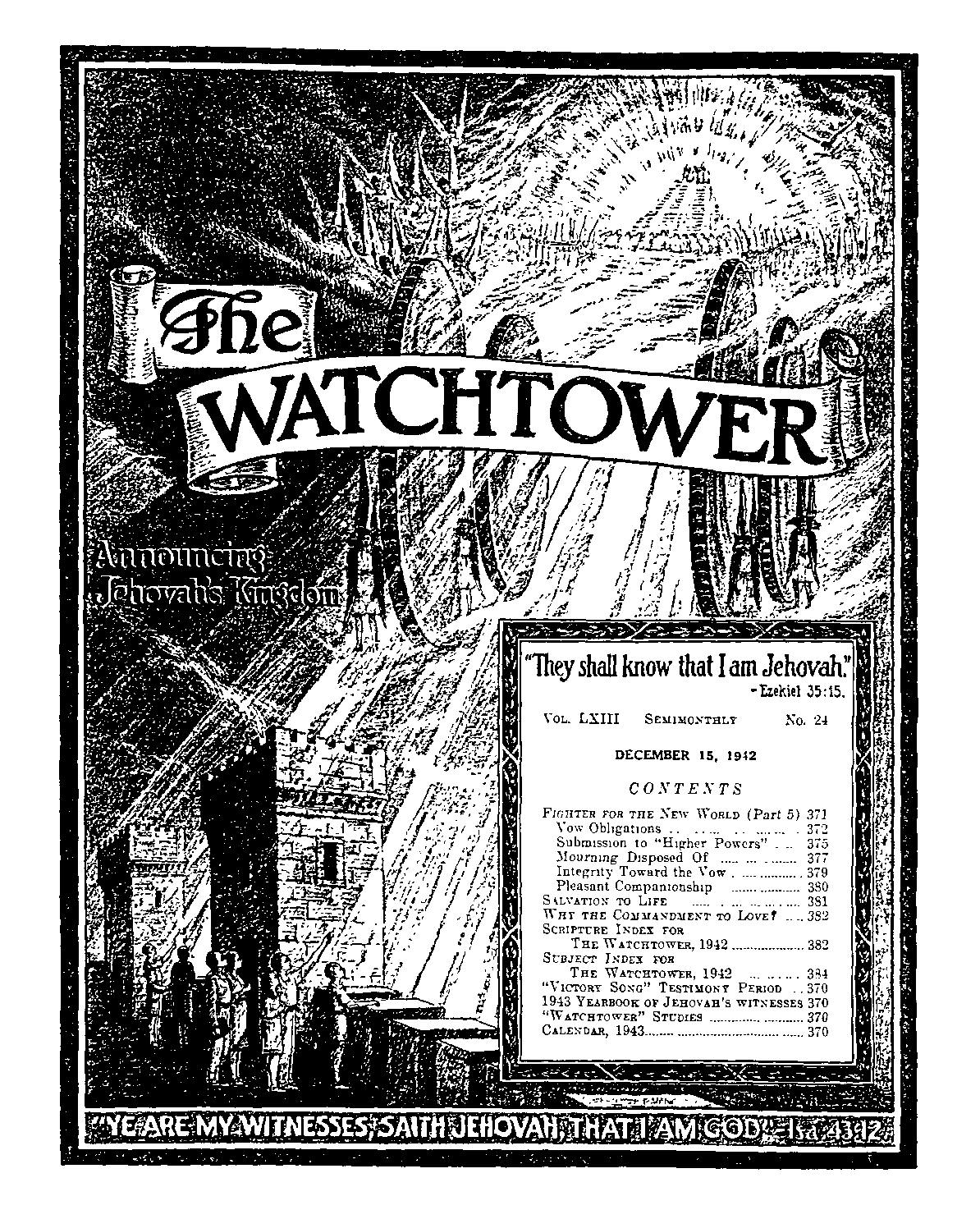
“VICTORY SONG” TESTIMONY PERIOD
December is the month that brings to a close the calendar year of the old world. It is with joy that the servants of Jehovah sing the Victory Song after a long battle, but they look forward to further battles and victories. The faithful do say with gladness of heart that they have remained “blameless in the day of our Lord” and will continue to do so. by the Lord’s grace. During the “Victory Song” Testimony Period the song of the new world will be sung. To do this the publishers of The Theocracy will offer to the people the publication The New World and the booklet Peace—Can It Last? on a contribution of 25c. If you wish to join in the “Victory Song” Testimony Period during the month of December, make arrangements now with your local company servant. If you are not associated with a company, write direct to the Society for further information.
1943 YEARBOOK OF JEHOVAH'S WITNESSES
The year 1942 has been a most eventful and thrilling year in the experiences and activities of Jehovah's witnesses. You may now get a world view of such exploits and their lasting benefit to men of good-will by reading the annual report as prepared by the president of the Watchtower Society. This is published in the 1943 Yearbook of Jehovah’s witnesses, now off the press. Also contained therein are the yeartext for 1943 and explanatory comment thereon, together with a stirring text and comment for each day of the year.
As to the courage, strength, joy and vision to be derived therefrom, and also as to the need and usefulness of such throughout the year by Christians, there is hardly any need of comment Due to the limited edition a contribution of 50c is asked per copy of the 1943 Yearbook of Jehovah's witnesses. Companies should combine individual orders and forward same to us with remittance, to expedite the handling thereof and to make for postage savings.
“WATCHTOWER” STUDIES
Week of January 17: “Fighter for the New World” (Part 5), 1-15 inclusive, The Watchtower December 15, 1942.
Week of January 24: “Fighter for the New World” (Part 5), 16-29 inclusive, The Watchtower December 15, 1942
Week of January 31: “Fighter for the New World” (Part 5), 30-44 inclusive, The Watchtower December 15, 1942.
CALENDAR, 1943
The yeartext for 1943 is “More than conquerors through him that loved us”. (Romans 8:37) All Christians bent on keeping integrity toward God will be strengthened by having that text daily before them during 1943. The Watchtower calendar, now released, will enable you to do that. The theme picture in artistic colorwork under the yeartext brings into sharp relief the situation facing-humankind and in which faithful Christians must overcome. The calendar pad names the new year's Testimony periods, and also the special objectives of the intervening months This service calendar is yours at 25c a copy, or five copies mailed to one address on a contribution of $1 00 Companies should please combine orders and send through the company servant
Vol. LXIII
December 15, 1942
No. 24
FIGHTER FOR THE NEW WORLD
PART 5
"Jesus answered, My kingdom is not of this world: if my kingdom were of this world, then would my servants fight.” — John 18:36.
JEHOVAH'S Fighter for the new world of righteousness is his beloved Son, who has been equipped J for the fight with all power in heaven and in earth. This makes the righteous new world a sure thing. Since A. D. 1914 we have been in the period the Scriptures call “the day of Jehovah'’. Therefore we know that the fight is near, because it is the ‘Tattle of that great day of God Almighty” and the demon forces are exercising an irresistible power upon the nations to gather them to the condition that provokes the fight. (Rev. 16:14-16) When on earth Jehovah's Son did not resist being killed by his religious enemies and would not permit his followers to fight with carnal weapons in his defense, because his Government was and is no part of this world, which is Satan's organization. Now that the “day of Jehovah” has begun, his Son has been enthroned as King and the time is at hand for the establishment of the world of righteousness to which his kingdom belongs. Therefore in the coming battle of Armageddon Jehovah's royal Son will this time fight against the old world and with violence such as all creation has never yet witnessed. (Matt. 24: 21, 22) The old world and all organizations and men who are a part of it shall be destroyed for ever.
2 The new world of righteousness shall be established so firmly that it can never be moved. Those followers of the new world's King who finished their earthly course faithful unto death and who have been resurrected to life in the spirit to “reign with him" shall share in the Armageddon fight with the Warrior-King. (Rev. 19:11-16) His remnant of faithful followers yet on earth and their earthly companions will witness the fight for the new world, but will not take part in it with violence to the enemies. They are hated of all nations for his name's sake, but as they faithfully proclaim God’s kingdom the divine instruction is given them: “Fear not ye, neither be dismayed by reason of this great multitude; for the battle is not yours, but God’s. Ye shall not need to fight in this battle: set yourselves, stand ye still, and see the salvation of Jehovah with you." (2 Chron. 20:15,17, Am. Rev. Ver.) The fight for the new world will be won without man’s help.— Ex. 14: 13, 14.
1 (a) Who is Jehovah’s fighter for the new world, and due to the presence of what day do we know that the fight therefor is near? (b) Why did he not put up any fighting resistance against being killed when on earth and what will be bis course with respect to the battle of Armageddon?
2 What part in the Armageddon fight will be had by Christs faithful footstep followers who have finished their earthly course and by the remnant yet on earth?
3 Jehovah requires willing obedience, self-sacrificing devotion, and faithfulness with joyfulness on the part of all who will have his protection during Armageddon and enter into life on earth under the New World conditions. Besides the remnant of Christ's body of followers, there is an unnumbered multitude of persons of good-will now manifesting themselves that will survive with the remnant through earth’s greatest tribulation. These were foreshadowed by Noah's family that passed with him alive through the destruction of the “world that then was", “the world of the ungodly.” (2 Pet. 2: 5: 3: 5, 6; Gen. S: 15-22) These also prove their goodwill toward Jehovah God and his kingdom by accepting the Kingdom message at the hands of His witnesses. Then they forsake this “present evil world and consecrate their lives to him and the service of his Righteous Government for evermore.
4 This blessed multitude will never go to heaven, but will inhabit the earth in peace and happiness, being regenerated unto human perfection. Continuing faithful and obedient to the heavenly Kingdom, they shall never die. (John 8: 51; 11: 26) God's mandate to the family of Noah after the Flood, that they should multiply and fill the cleansed earth, foreshadowed that this favored multitude will after Armageddon receive a like divine mandate. In joyful obedience thereto they will intermarry, and bring forth children in righteousness, and thereby fill the face of the earth with righteous inhabitants to God's honor. Paradise shall glorify the earth. — Gen. 9:1,7; Matt. 24:37.
3 What does Jehovah require of those he preserves during Armageddon, and what does the Flood picture of Noah’s day show as to any surviving Armageddon besides the remnant?
4 What does that prophetic Mood picture further show as to the destiny of that blessed multitude after Armageddon?
5 The formation of this multitude of companions of Christ's remnant and their joyous acclamations to Jehovah God on his heavenly throne and to his Beloved One, the Lamb slain in behalf of the new world, is pictured and expressed at Revelation 7: 9-12 in symbolic speech. After the vision of the triumphant members of the body of Christ, the beholder of the visions says: "After this I beheld, and, lo, a great multitude, which no man could number, of all nations, and kindreds, and people, and tongues, stood before the throne, and before the Lamb, clothed with white robes, and palms in their hands; and cried with a loud voice, saying, Salvation to our God which sitteth upon the throne, and unto the Lamb. And all the angels stood round about the throne, and about the elders and the four beasts, and fell before the throne on their faces, and worshipped God, saying, Amen: Blessing, and glory, and wisdom, and thanksgiving, and honour, and power, and might, be unto our God for ever and ever. Amen.” The scene there reminds one of when Christ Jesus rode into Jerusalem, ‘‘the city of the great King,” and presented himself as Jehovah’s anointed King. Then multitudes of the people, including young children, but not the religious clergymen and the commercial men at the temple, hailed him with palms and with outbursts of praise and salvation and glory to Jehovah God. (John 12:12-16: Matt. 21: S-14) The joy and expressions of devotion on the part of those who will form the “great multitude” surviving Armageddon were also foreshadowed by the joyful welcome that Jephthah’s daughter gave him on his homecoming from a successful campaign against the enemy Ammonites.
VOW OBLIGATIONS
6 As Jephthah returned home from defeating and driving out the invaders of the Theocratic nation of Israel, his heart must have been in harmony with the expression of the psalmist, who pictures Christ Jesus: “'What shall I render unto Jehovah for all his benefits toward me? I will take the cup of salvation, and call upon the name of Jehovah. I will pay my vows unto Jehovah, yea, in the presence of all his people.” (Ps. 116:12-14, Am. Rev. Ver.) Before entering into the campaign for the free worship of Jehovah in the Theocratic land without interference and encroachments by the Ammonites Jephthah uttered a vow to the Lord God. He confessed that he could not of himself gain the victory over the demonized aggressors, but if Jehovah would deliver over the Ammonites to defeat before him, then he would offer as a burnt offering to Jehovah whatsoever first came forth from the house to meet him on arrival home. Jephthah was a mighty man of the land of Gilead east of the Jordan river, and his home was in the city of Mizpah, or “'Watchtower”, as the name means. The victory over the Ammonite assured him the place of visible "head” over all those of the Lord's typical Theocracy in Israel. That was the agreement between himself and the inhabitants of Gilead at the time he accepted the command of the war against the Ammonites. (Judg. 10: 18; 11: 8-11) Since the inspired statement at 1 Corinthians 10.11 leaves no doubt that these events were types or prophetic patterns, Jephthah was a prophetic figure. He pictured Jehovah’s chosen visible organization of spiritual Israelites today, and which organization or Society is Theocratic and under the headship of Christ Jesus, the Greater Jephthah. The part which the Watch Tower Society has played and plays in this connection is historically and Scripturally established. Let us note this further in the remaining part of the prophetic drama.
5 (a) How are the formation and acclamations of that multitude symbolically shown in the book of Revelation? (b) Of what does such hailing of the King remind one in the experiences of Jesus on earth and how was it foreshadowed in Jephthah’s experience?
6 (a) What must have been Jephthah’s state of heart on returning home victorious from battle, and what vow was now due to be fulfilled? (b) What position did the God-given victory assure to Jephthah in Israel, and whom today did he picture?
7 “And Jephthah came to Mizpeh [‘Watchtower"] unto his house, and, behold, his daughter came out to meet him with timbrels and with dances; and she was his only child: beside her he had neither son nor daughter. And it came to pass, when he saw her, that he rent his clothes, and said, Alas, my daughter! thou hast brought me very low, and thou art one of them that trouble me; for I have opened my mouth unto the Lord, and I cannot go back.” (Judg. 11:34,35) Her being his only child and daughter was the troublesome point in the matter. For him to devote her to Jehovah in fulfillment of the vow would mean that his family and his name would be without anyone to carry them on in God's typical Theocracy and hence both family and name would perish.
8 The like is true at present. The remnant of the Theocratic organization under Christ Jesus the Head declare this Scriptural fact: That Jehovah's Theocratic Government under Christ the King is limited to just 144,000 members under him, and that the remnant are the last members thereof on earth and their number is decreasing as the members thereof finish each one in due time his course in the flesh “faithful unto death”. (Rev. 7:4-8; 14:1,3) Having fought a good fight and finished their course and kept the faith unto the end, such ones are at death given an instantaneous resurrection and changed to life in the spirit and see their glorious heavenly Head as he is and are made like him. (2 Tim. 4: 7, 8; 1 Cor. 15: 50-54; 1 John 3: 2) Hence the remaining ones of the remnant are no more carrying on their witness work and Bible educational campaign in behalf of a spiritual company with a heavenly destiny. Those who are now being led to the Lord as a result of his “strange work’’ through the remnant are his “other sheep’’, who shall form the “great multitude” and abide on earth permanently under The Theocratic Government and perform the divine mandate.
7. What was Jephthah’s exclamation at meeting his daughter, and what was the troublesome point in the matter?
8 How is the like situation true today with respect to continuing the existence of the spiritual company of Christians on earth?
9 These “other sheep” are therefore not being brought into the fold to increase or to continue further on earth the number to be incorporated in The Theocratic Government, because the Lord does not call such "other sheep” to the high calling of the heavenly Kingdom. When, in the Lord’s due time, the last ones of the remnant complete the Lord’s work for them among those companions or “other sheep', then the remnant will cease to exist and the “body of Christ” will be fully made up in the invisible heavens. Those then left on the earth as the visible representatives of the divine Theocracy under Christ will be those men whom the King-Father will “make princes in all the earth”, namely, the faithful men of old, including Jephthah himself, shortly to be raised from the dead in a ‘better resurrection”. Hence, to use the words of John the Baptist in a relative comparison of numbers of the “other sheep” and the remnant, ‘the former must increase, but the latter must decrease.' (John 3:30) The thought of eventually parting bodily does not of itself give pleasure, for the companionship between the remnant and the “other sheep” is very pleasant and refreshing, like that between David and Jonathan. — 2 Sam. 1:17-27.
10 Young's translation of Jephthah’s words reads: "Alas, my daughter, thou hast caused me greatly to bend, and thou hast been among those troubling me; and I—I have opened my mouth unto Jehovah, and I am not able to turn back." Jephthah’s daughter was in herself innocent in the matter. She had merely come forth first from her home in genuine celebration of Jehovah's vindication by victory over the Ammonites, which victory meant the preservation of the Theocratic organization and the worship of Jehovah among his covenant people. What righteous person who loves God would hold back from rejoicing thereat? Who could be blamed for it? A failure to thus rejoice would betray something wrong concerning the love and devotion for the Most High and his Theocracy. Certainly, then, Jephthah was not blaming his beloved child nor finding fault because she spontaneously and publicly expressed her jubilation at God's victory through him and took the lead in the celebrating. How, therefore, shall we read Jephthah’s words? To this effect: That there are times when there is need to readjust conditions which bear upon one's love for Jehovah and his Theocracy and also upon one's love for an earthly creature, and this readjusting does put a strain upon anyone devoted to Jehovah’s Theocratic service. Study of the following facts discloses this.
9 As time goes on how do the numbers of the remnant and of the Lords, “other sheep” compare, and how does the thought of finishing their companionship on earth affect them?
10 Why was Jephthah’s daughter not to be blamed for coming forth first, and how, therefore, shall we read his words speaking of her as among those troubling him?
11 For many years the subject of the “great multitude” described in Revelation 7 has been a perplexing one, and it still troubles some professed Christians. It must be admitted that the Lord's “other sheep” are not in themselves troublemakers. Their consecration to the Lord, and their joyful and enthusiastic devotion to Him as displayed in their field activities for The Theocracy, are hugely appreciated by the spiritual remnant and all favoring The Theocracy. However, up till the year 1935 the question of the “great multitude” and their identity and destiny had all Christians guessing. Were they to be finally a spiritual company in heaven or remain human on the earth under the Kingdom’ When would be the time of their appearing and being gathered? What should be their privileges of service in company with the remnant ? That is, were they to be witnesses for Jehovah, engaging in the house-to- house educational campaign, and could they serve over others as servants of organized companies? Were they also required to offer the same degree of faithfulness to Jehovah God and his Righteous Government as must the remnant, and could they partake of the memorial emblems at the Lord's supper?
12 These proper questions were a source of “trouble", debate and discussion, especially so from the quarter of the “evil servant" class. This unfaithful spiritual class justify their rebellious cour.-e against the Lord's Theocratic organization and its appointed work. They maintain that the “great multitude" are a spiritual company, spirit-begotten and not yet manifest, and that they are only partially faithful to God and hence get merely a secondary position in heaven as Levite servants of the wholly faithful “little flock”.
13 Jephthah’s words “among them troubling me" refer to this “evil servant” crowd who stand off independent from the Theocratic organization of the Society under Christ and who, the same as the religious clergy, cause trouble for God’s faithful remnant. Aside from these troublers, however, the fact that there was to be a '‘great multitude" was foretold in Scripture, but just what to do with and about them needed clearing up. In 1923 the Lord at the temple revealed that the "sheep" who do good to his brethren and who are separated from the “goats" and gathered to the King's right hand are an earthly class that is being divided from the “goats" at present. (Matt. 25:31-46) Their present fellowship with the remnant in the witness work, however, was not understood. Years passed. In 1931 at the great international convention at Columbus, Ohio, the Lord revealed to his faithful remnant their “new name", to wit, “Jehovah's witnesses.” There he also disclosed this, to wit. that those whom the ‘man clothed in linen and with inkhorn by his side' marks in the forehead to be spared from execution at Armageddon by Jehovah's Executioner are an earthly class and identical with the “other sheep". (Ezek. 9: 4) In 1932 still more! Then the Lord opened the remnant's understanding to see that Jonadab, who got into King Jehu's chariot and went with him to the slaughter of the religious demon-worshipers, also pictured the “other sheep” or persons of good-will. Hence these “other sheep" are called “Jonadabs". (2 Ki. 10: 15-23) But the full light was yet to come.
11 Are the Lord's “other sheep” viewed as troublemakers, and prior to 1935 what questions concerning the “great multitude” and their identity, destiny and service had all Christians guessing?
12 Who especially make these questions a matter of trouble and debate, and why or because of what views?
13 Who, then, are meant by the words “them troubling me”, and what revelations of truth of the Lord in 1923, 1931, and 1932, prepared for clearing up the questions at issue?
14 It was at Washington. D. C. in 1935. at the convention the chief feature of which was the public address entitled “Government”. Then God graciously identified the “great multitude'’ as an earthly class, which shall be composed of the “other sheep", and that they are in large numbers already manifest in company with the remnant. The same degree of loyalty, obedience, devotion and faithfulness to Jehovah and his Righteous Government is required of this earthly class as of the remnant of the “little flock". Shortly thereafter, in August of 1935, the Watchtower magazine published the explanation of the Scriptural facts at Revelation 7:9-17. — See the book Riches, published in 1936, and its chapter VIII, under the title “Great Multitude’’.
15 Next Jehovah unfolded another typical picture of the “other sheep” who shall form the “great multitude”. Long ago they had been foreshadowed by the Gibeonites, who peaceably came over onto the side of Israel’s typical Theocracy. Joshua spared them from execution and made them wood choppers and drawers of water for the worship of Jehovah at his sacred tabernacle. As to putting the antitypical Gibeonites to work alongside the remnant The Watchtower said, as of May 1, 1937, under the heading “Company Servant", the following: “Proclamation of the kingdom message is all-important now. It is the duty of the anointed to vote as to who shall be company servant; but ‘hewers of wood and drawers of water’ may serve. (Josh. 9:21-27: Deut. 16:12-15; 29:11) When there are none [of the remnant] in the company capable of filling the places of company servants or service committees and there are Jonadabs who have the ability and zeal, let the Jonadabs be placed on the service committee and give them opportunity to serve. The work should not drag because some of the company have lack of zeal. The gospel must now be proclaimed. — Matt. 24: 14.
14 When thereafter was the “great multitude” identified and their requirements explained, and what did the revelation show as to such?
15 What people in Joshua’s dealings with the Canaanites also pictured the “other sheep”, and what did The Watchtower publish in 1937 concerning the service positions of such “other sheep” in connection with the remnant?
16 When the Greater Jephthah, Christ Jesus, the Head of the Theocratic organization, introduced its rule and operation among Jehovah’s witnesses in October, 1938, he emphasized anew God's will as to the place, opportunities and obligations for the “other sheep", whom Jephthah’s daughter prefigured. Through his visible organization and its official publication The Watchtower he caused to be published as of December 15, 1938, this: “The same rule of the Lord God requires likewise that all those who will compose the ‘great multitude’ (Rev. 7: 9-17) must believe on the Lord Jesus Christ, that he is the Savior of obedient men. that by his own precious blood he furnished the price for the purchase of men and all their rights as men, including the right to perfect life, and then they must prove that belief by consecrating themselves to do what God's Word requires and must set themselves to the task of faithfully performing the will of God as agreed upon. The Jonadabs must now have this information and follow it. They must learn that consecration and sanctification are required of each one who shall become a part of the great multitude and live on earth and carry into effect the divine mandate to multiply and fill the earth with a righteous people. . . . (Mark 10: 44, 45) While this text was addressed specifically to those whose hopes are heavenly, the same rule applies to those who get life on earth and shows that the ransom inures to the benefit, not of everyone, but to those who comply with the rules.”— Paragraphs 16 and 17.
17 The Watchtower Society under Christ cannot go back on such words, because they are the truth of the Word of Jehovah. Later that same year (1938) of the revelation of the Theocratic organization, and on the occasion of the world-wide convention of 47 cities with Royal Albert Hall, London, England, as the key assembly place, the Greater Jephthah revealed that the divine mandate will be issued and go into force toward the “other sheep” of the “great multitude" after the battle of Armageddon. Hence marriage now was no part of fulfilling the divine mandate and was inadvisable according to the Scriptures. This was in effect saying that the Lord's “other sheep” who shall form the “great multitude” after Armageddon must now remain a “virgin” company in order that they might be wholly devoted, without earthly distraction, to the Lord’s business now in hand, which is to declare Jehovah’s name throughout all the earth before he fights and shows his power over Satan’s old world at Armageddon. (Ex. 9:16) The preaching of “this gospel of the kingdom", as commanded, was the work for this “other sheep” class as well as for the remnant, and not the building up of any earthly house or organization at present. (Matt. 24: 14) The Lord will take care of that after Armageddon.
16 When was Theocratic rule put in operation among Jehovah’s witnesses, and what did The Watchtower thereafter publish concerning the Lord’s requirements upon the "great multitude” respecting the steps unto life and service?
17 Why cannot the Watchtower Society go back on such words, and what further was said at the 1938 Theocratic convention from London as to the “great multitude” and their privileges concerning marriage and the Lords service?
18 Here, then, in essence, was the expression of the vow of the Greater Jephthah concerning the “other sheep", and coming just when the Theocratic organization was installed on earth and the fight against totalitarian-religious encroachments began as an aftermath of the 193S Munich conference between the Nazi fuehrer and the British prime minister and his appeasement policy. If now Jehovah God would grant victory to his covenant people or remnant as against the totalitarian encroachments on worship and service of Jehovah, then whatsoever would first appear as the fruit of such victory in the way of an ingathering, even such would be wholly dedicated to the Lord's “strange work”, which is the work of his temple class. There would be no selfish exploitation of such “other sheep” by the remnant, such as the Roman Catholic Hierarchy make of the “Catholic population”.
SUBMISSION TO “HIGHER POWERS”
19 How the “other sheep” since 1938 responded to this was marvelously enacted in true life by Jephthah's daughter. “And she said unto him. My father, if thou hast opened thy mouth unto the Lord, do to me according to that which hath proceeded out of thy mouth; forasmuch as the Lord hath taken vengeance for thee of thine enemies, even of the children of Ammon.” (Judg. 11: 36) Her father made his vow without consulting her, and properly so. Now out of his parental love for her he expressed grief at the separation it would mean. All this put a great test upon the girl. Would she rebel? or would she recognize the Theocratic rule, inasmuch as her father was the “head” of his household and God’s victory had confirmed him as “head and captain” over the typical Theocracy of Israel? Would she submit to the will of the Supreme Power and trust in Him who had maneuvered this or permitted it to be so? What does her response show?
18 What, therefore, in effect, was the vow of the Greater Jephthah then facing the fight against totalitarian encroachments?
19 In reply to Jephthah’s tender expression, what questions were put as a test upon his daughter to answer?
20 Her expression “my father” showed she did not think her father had been rash and arbitrary. He was the one that had the right to dispose of his unmarried child according to the rule of Jehovah's typical people, not, of course, to any wrong use. His Theocratic law, at Leviticus 19: 29, to fathers, reads: “Do not prostitute thy daughter, to cause her to be a whore; lest the land fall to whoredom, and the land become full of wickedness.” As to the Lord’s recognized rule concerning the control of the father over the daughter, note the action of Laban in substituting his older daughter Leah for Rachel to be the wife of Jacob for his seven years of service. (Gen. 29:16-30) Note also King Saul’s offer of his eldest daughter in marriage to whosoever would fight and kill the Philistine giant Goliath. (1 Sam. 17: 25; 18: 17) Note also faithful Caleb's offer of his daughter Achsah to whoever first smote the Canaanite city of Kirjath-sepher and conquered God's enemies there. (Josh. 15:16,17; Judg. 1:12,13) Further showing the father’s guiding control over his daughter, Numbers 30: 16 refers to a girl's vows made without her father’s approval and says: “These are the statutes which the Lord conunanded Moses between a man and his wife; between the father and his daughter, being yet in her youth in her father’s house.” This same authority resides in the Greater Jephthah, Christ Jesus, who becomes “the Everlasting Father” to the subjects of his Kingdom. (Isa. 9:6) The “other sheep” must receive life through him as their King-Father, and be regenerated. (Matt. 19: 28) He is God's appointed Head of The Theocracy, and these “other sheep” must put themselves under the Theocratic organization, even as Jephthah’s daughter did.
21 The Authorized Version Bible inserts the word “if” into her speech, but the American Revised Version and the Young's translation read: "My father, thou hast opened thy mouth unto Jehovah; do unto me according to that which hath proceeded out of thy mouth, forasmuch as Jehovah hath taken vengeance for thee on thine enemies, even on the children of Ammon.” Hereby she recognized the Theocratic arrangement as in force and also the binding power of vows under that arrangement, as stated at Numbers 30: 2: “If a man vow a vow unto the Lord, or swear an oath to bind his soul with a bond; he shall not break his word, he shall do according to all that proceedeth out of his mouth.” Jephthah’s daughter would not rob God by causing anything to be held back that was promised him. She stood for faithfulness to vows, no matter how it affected her, all because she looked up to Jehovah as the Supreme Power and recognized his Theocracy and its rules.
20 (a) What did her use of the words “my father’’ show, and what was God’s rule concerning a father’s control over bis daughter? (b) Why does like authority reside in Christ Jesus respecting his “other sheep”?
21 What stand does the reply of Jephthah’s daughter show she took toward the arrangement in force in Israel and toward vows unto God?
22 “When thou vowest a vow unto God, defer not to pay it; for he hath no pleasure in fools: pay that which thou hast vowed. Better is it that thou shouldest not vow, than that thou shouldest vow and not pay. Suffer not thy mouth to cause thy flesh to sin; neither say thou before the angel that it was an error: wherefore should God be angry at thy voice, and destroy the work of thine hands ?” Those words of Ecclesiastes 5: 4-6 were written long after Jephthah’s daughter, but she believed in the faithful line of action they expressed. Her father’s vow which unexpectedly took hold on her could not harm her and her relationship to the Theocracy, because the vow was made to Jehovah. Her spirit of submission with devotion and trust in God was as well expressed in the following quotation: “The entire organization of Jehovah is honorable and blessed, and happy is the creature that has any place therein. Some have selfishly craved to be in heaven and help run the universe. Others have said: ‘Whatever my position given me by the Lord, I shall be glad.’ The latter is the proper attitude. The picture here [at Revelation 7: 9-12, quoted above] shows the host of angels and the saints all in full accord, and likewise the great multitude [the class pictured by Jephthah’s daughter] in full accord with them, and all together singing praises to the name of Jehovah.”—From The Watchtower August 15. 1935, p. 4.
23 The Greater Jephthah, Christ Jesus, while yet on earth gave his word as to the disposal of the “other sheep” that Jehovah would give him. (John 10: 16; Matt. 25:32-40, 46) Also after his ascension to heaven, this mighty Warrior for the new world gave to the apostle John the Revelation concerning things to come, including the disposing of the “great multitude". But all such was not understood until the time for the modern reproduction of the Jephthah drama. Particularly since the revealment of the Jonadab picture in 1932, and still more so since 1935, when the “great multitude" mystery was solved, Christ Jesus has caused the understanding of the prophetic dramas and pictures to be made clear and set forth in the Watch Tower publications. Those gathered in as “other sheep” read and study those things which have “proceeded out of the mouth” of the Greater Jephthah through his visible organization. Such “sheep” in the spirit of their consecration to God say, “Thy will be done,” and are thoroughly in harmony with all such prophetic pictures showing their part. They rejoice at God's gracious provision for them and are willing that whatever was pictured in miniature should be enacted completely toward themselves.
22 What warning concerning vows as stated in Ecclesiastes 5 did Jephthah’s daughter believe and why did she not need to fear submitting to the terms of her father's vow as affecting her and her position? 23 (a) When did the Greater Jephthah give his word as to the disposal of the “other sheep” of the “great multitude", but when was all such first understood? (b) On coming to an understanding thereof, what spirit and attitude do those “other sheep” show?
24 Jephthah's daughter saw her father ‘put his life in his hands’ for the vindication of Jehovah's name, and was her life any more precious? The “other sheep" of today have witnessed such endangering of the life and property of those of the Watch Tower organization under Christ Jesus the Head, just to keep God’s commandments and have part in vindicating His name. The “other sheep” have seen Jehovah giving victory over the religious-totalitarian "Ammonites”, and have observed the work by his witnesses who keep on going under his protection and preservation, outsmarting and outmaneuvering the enemies of liberty and free worship. Like Jephthah’s only child these “other sheep” cannot refrain from acting as companions and falling right in step with the program of activities against the treacherous “Ammonites”. “Let them shout for joy, and be glad, that favor my righteous cause: yea, let them say continually, Jehovah be magnified, who hath pleasure in the prosperity of his servant.” (Ps. 35:27, Am. Rev. Ver.) “The humble [meek] shall see this, and be glad: and your heart shall live that seek God." — Ps. 69:32, margin.
25 The “other sheep” imitate the Greater Jephthah “as dear children”. (Eph. 5: 1, 2) They echo him in the solemn declaration that it is worth anything and everything to have God’s name victoriously upheld in his "strange work” against the aggressive totalitarian Ammonites. The prophetic dramas of old forecast the part the Lord's "other sheep" would play toward vindicating God’s name. Hence Christ Jesus, who always does his Father's will, vows to see to it that the prophetic pictures shall be faithfully fulfilled in all details concerning his “other sheep He cannot take into consideration whether individual persons of good-will may or may not like what the prophetic dramas show is their part to play in God’s service. However, those of like mind with Jephthah’s daughter see that the vindication of the name of the Most High by his Theocratic organization under Christ Jesus is the thing of supreme importance. The disposal that is made of themselves and the requirements placed upon them are only secondary and are even then a privilege to perform. The cost is worth it to see divine vengeance dealt to the totalitarian-religious crowd and their idol, “the abomination of desolation,” or religious “new order”.—Ps. 92:11.
24 What risk did Jephthah’s daughter witness him take and what course do the “other sheep" see those under the Greater Jephthah take, and how do they themselves then act?
25 What does the Greater Jephthah now to do as to the fulfilling of the prophetic pictures, and how do the “other sheep” imitate him as to the disposal of themselves for the sake of the vindication of God's name?
MOURNING DISPOSED OF
26 Jephthah’s vow had specified no definite time concerning exactly when he must offer up his symbolical “burnt offering”. (Judg. 11:30,31) An instantaneous offering thereof immediately after the victim's appearance at Jephthah’s homecoming had not been promised. Reasonably there must be a preparatory period for the human victim, as in the case of the boy Samuel. His mother Hannah vowed to devote her first man child to God if he granted her motherhood, but she did not turn her boy Samuel over to the tabernacle and its priests and Levites as soon as the babe was born. Properly she waited “until she weaned him. And when she had weaned him, she took him up with her" and turned him over to the high priest, to keep her vow. (1 Sam. 1:11,19-28) Likewise in the case of Jephthah’s marriageable daughter. “And she said unto her father, Let this thing be done for me: let me alone two months, that I may go up and down upon the mountains, and bewail my virginity, I and my fellows [my companions (Am. Rev. Rer.)].” (Judg. 11:37) That is, Do not yet for two months turn me over to the tabernacle at Shiloh, and God’s future service for me there.—Judg. 18: 31.
27 The girl asked nothing contrary to her obligations to the Theocratic rule, nor to provide a loophole to escape paying to Jehovah that which is due and owing to him. She designated two months’ grace, evidently one month as for her father, because his name and the extension of his family would be cut off in the sacrifice of her; and the other month as for herself, because she would be denied motherhood and would die childless with no one to carry forward a family from her. The request of such stay of time was reasonable, when taking into consideration her great-grandfather's case, Jacob’s: “The Egyptians mourned for him threescore and ten [70] days.” (Gen. 50: 3) In the case of Moses’ brother Aaron, “they mourned for Aaron thirty days, even all the house of Israel.” (Num. 20:29) In the case of Moses, “the children of Israel wept for Moses in the plains of Moab thirty days: so the days of weeping and mourning for Moses were ended.” (Deut. 34: S) In view of the dying out of her father's house and lineage by reason of fulfilling his vow upon her, Jephthah’s daughter asked for just two moons, or about 59 days, to do what was fitting. Compare this with how the Israelites wept at the seeming danger that one of the twelve tribes, Benjamin, might possibly be cut off by childlessness and die out: “And the people came to the house of God, and abode there till even before God, and lifted up their voices, and wept sore; and said, O Lord God of Israel, why is this come to pass in Israel, that there should be to day one tribe lacking in Israel?" “And they said, There must be an inheritance for them that be escaped of Benjamin, that a tribe be not destroyed out of Israel.” — Judg. 21: 2, 3,17.
26 Was an immediate offering up of Jephthah’s daughter on the spot required or specified, and in view thereof what request did she make of him?
27 Why did Jephthah’s daughter ask that the months of mourning be two and why was this reasonable, in view of the mourning over Jacob and Aaron and Moses and the tribe of Benjamin?
28 In Jephthah’s daughter the Roman Catholic “buck nuns” and female nuns find no example or precedent for their parading around in public in gloomy black to arouse sympathy and superstitious awe in beholders. She had the spirit of Jesus, who said: “Moreover, when ye fast, be not, as the hypocrites, of a sad countenance: for they disfigure their faces, that they may appear unto men to fast. Verily I say unto you, They have their reward. But thou, when thou fastest, anoint thine head, and wash thy face; that thou appear not unto men to fast, but unto thy Father which is in secret: and thy Father, which seeth in secret, shall reward thee openly.” (Matt. 6: 16-1S) Jephthah’s daughter did not propose to hang around the home and bewail and mourn there to be seen of men and to depress the lives of others thereabout. That would cause them to fix their minds and attention more on her and her case than on the vindication of God’s name by his vengeance expressed through her father upon the devil worshipers. She would not divert the attention of God’s covenant people away from the Creator down to the creature, herself. It was a time for Israel to rejoice, and never would she give it a sour note by her presence and appearance of mourning.—Contrast Zechariah 7: 3 and 8: 19.
29 The request to “go up and down upon the mountains” bewailing her virginity calls to attention that her homeland, the territory of Gilead, was very mountainous. Hence it was as a whole called “mount Gilead". (Gen. 31: 21. 23, 25) The “high places" were accustomed places to weep, in solitude, as noted, for example, in Isaiah 15:2: “He is gone up to Bajith, and to Dibon, the high places, to weep.” In the isolated mountains Jehovah God, who sees in secret, could discern her self-effacing course, and he would reward her openly; which He did. She would bewail her case before, and not after, entering into the Lord's exclusive service at his tabernacle at Shiloh. Her mourning being then for ever accomplished by the two months of roaming on the mountains of Gilead, she would ever thereafter serve the Lord with gladness at his holy house. Is it not so today? The Lord's “other sheep” do not intrude any note of personal sorrowfulness upon the company of Jehovah’s witnesses to mar their rejoicing at His acts of vindication by his Theocracy during the “strange work". Only in secret, for a time, do they mourn to the Lord over any sacrifices that are made whereby the reproach of the enemy comes upon them. Thus they get it over with, so that thereafter they ever serve Jehovah joyfully in union with his temple company. They rejoice that they are “counted worthy to suffer shame for his name”. — Acts 5:41
28 (a) How did the request of Jephthah’s daughter contrast with the public showy manner of religious nuns but harmonize with Jesus' words concerning self-denial? (b) Why did she desire to mourn in isolation away from home?
29 Why were the mountains a suitable place for mourning before her entry into service at the tabernacle, and how is this picture of mourning fulfilled in the case of the “other sheep" today?
30 The faith and devotion of Jephthah and his daughter to the Theocratic rule over Israel can be appreciated. She being his only child, her virginity being made perpetual cut off her father’s name as well as her own opportunity for marriage. This proves that her share in the vindication of God’s name which followed the vow of her father was at real personal cost, a denial that touched her sore, even as it did her parent. It was a reproach to be unmarried and childless in Israel. It was like being a fruit tree that was barren of fruitage and hence cut down as unnecessary expense, especially as fruit trees were taxed in the orient by the government. (Luke 13: 6-9; Jer. 17: 7. 8) Jephthah was by faithfulness to his vow rendered as childless, and his daughter must now remain virgin, and so childless. This in God's typical Theocracy was really something to lament and bewail.
31 This dramatic situation shows that the Lord’s “other sheep" must count the cost and be thoroughly tested to prove their love and agreeableness to forego all for Jehovah and the vindication of his name by his glorious Government. They must choose to become the companions of the faithful remnant of Christ’s body, who bear the reproaches such as came upon the Head Christ Jesus and also upon his Father, Jehovah, the great Creator of The Theocracy. Their sorrow, if any at all, for bearing such reproaches, they take out to the mountains under the vision of Him whose eyes “run to and fro through the earth’’. When before and in the company of Jehovah's witnesses they share the rejoicing in the triumphs of his truth and “strange work” over the constant encroachments by the demonized “Ammonites” in all nations. They get the sorrowing over with once and for all, and then rejoice henceforth in Jehovah and his conquests by The Theocracy. "For the Lamb, which is in the midst of the throne, shall feed them, and shall lead them unto living fountains of waters: and God shall wipe away all tears from their eyes."—Rev. 7: 17.
32 The “fellows”, or “companions”, that went with Jephthah’s daughter to the lonely mountains would be virgins like herself, with no family responsibilities. These companions volunteered to share reproach with her and to bewail with her. All these virgins together picture the Lord’s “other sheep” who shall form the “great multitude”. This means to say that the “other sheep” do not remain alone in this state of complete devotion to the Lord, but they declare God’s requirements for life in the new world to others. They help others thereby to become “companions” of themselves and of Jehovah's remnant and thus to share in suffering those reproaches that come on all who uphold the banner of The Theocracy. They picture the same ones as the virgin associates of the bride of Christ, concerning which Psalm 45: 14,15 speaks: “The virgins her companions that follow her shall be brought unto thee. With gladness and rejoicing shall they be brought: they shall enter into the King’s palace.”
30 On the points of name and offspring, how can the faith and devotion of Jephthah and his daughter to Theocratic rule be appreciated?
31 In what respects does this situation show the Lord's "other sheep” must count the cost and be tested, and bow far do they continue any sorrowing?
32 Who were pictured by the "fellows” of Jephthah’s daughter, and what does her arranging for these to join her in the mourning mean to say for this time?
33 The spirit of Jehovah God was upon Jephthah. He was resolved to turn neither to the right hand nor to the left, but to be true to his vow. He knew that to break his vow would be a reproach upon God’s name and a damaging example to God’s covenant people and would be to his own destruction as a covenant-breaker. (Rom. 1: 31, 32) “And he said. Go. And he sent her away for two months: and she went with her companions [(Am. Rev. Ver.) and she departed, she and her companions], and bewailed her virginity upon the mountains.” (Judg. 11:38) So doing, Jephthah deprived himself of her presence and companionship in the home. Home, he realized sanely, was not the place for mourning when Jehovah’s victory was the big event making all personal matters fade away and taking away all creature sorrow. Personal costs for the sake of God’s vindication must not be noised about to the neighborhood nor paraded before others who should rejoice in Jehovah. — 1 Thess. 5:16.
34 There should be no confusion of thought at this point. Jephthah’s daughter bewailing her virginity and thereafter remaining childless is a distinctly different picture from that of Noah and his family when coming forth from the ark and hearing the divine mandate to fill the earth restated to them. The drama of Jephthah is a prophecy of events preceding the “battle of that great day of God Almighty”. Hence it must not be mistaken to picture that the “great multitude” after Armageddon will not have the divine mandate issued to them to be this time really carried out to a finality under the righteous overlord, The Theocracy. The requirement of virginity pictures that before Armageddon’s fight the Lord’s “other sheep” must serve Jehovah at his temple in singleness of devotion to him.
33 Why did Jephthah grant his daughter's request, and at what cost to himself?
34 Why does the childlessness of Jephthah’s daughter not contradict the fulfillment of the divine mandate by the “great multitude" and what does the requirement of her virginity picture?
INTEGRITY TOWARD THE VOW
35 “And it came to pass, at the end of two months, that she returned unto her father, who did with her according to his vow which he had vowed: and she knew no man. And it was a custom [(margin) an ordinance] in Israel.” (Judg. 11: 39) The girl showed up at the time appointed, as true to her word as her father was to his. What prompted her to keep promise and come back and hand herself up for her parent to perform his vow was her appreciation and devotion toward the Theocratic rule. It was a joyful task because it was coupled with God’s vindication and preservation of free worship in Israel by her father’s whipping the demonized invaders just two months previous. The weeping and bewailing were all now things definitely of the past and no more to be bothered with. From now on only the joyful service of God Jehovah for her! Equally so, the "other sheep" put sorrowing aside and yield themselves up to the Greater Jephthah, Christ Jesus, “the Everlasting Father” and Head of The Theocratic Government. He is also the Head over all those who put themselves under that Theocratic Government for refuge and protection, to do unto them and to do for them all that his word of promise foretold as recorded in the Bible.
36 In fulfillment of the vow Jephthah’s daughter must “surely be the Lord’s” and he must “offer [her] up for a burnt offering”. (Judg. 11: 30, 31) Hence he could not give her in marriage to another Israelite with a view to future descendants for himself. He must turn her over to Jehovah God at his tabernacle in Shiloh, across the Jordan river, where God's priests and Levites under their high priest ministered to the Great Theocrat. The girl was a thing devoted exclusively to Jehovah, and no one could touch her for selfish purposes. As the daughter of the victorious “head and captain” in Gilead she might have been married off to the highest and best in the land. But now as a devoted creature she was reduced to the standing of the Gibeonites at the tabernacle, whom Joshua spared from death and dedicated for ever to the service at Jehovah's temple or tabernacle. Concerning the Gibeonites the princes of Israel who had given their word before God said: “We have sworn unto them by the Lord God of Israel: now, therefore, we may not touch them. This we will do to them; we will even let them live; lest wrath be upon us, because of the oath which we sware unto them.” “And Joshua made them that day hewers of wood and drawers of water for the congregation, and for the altar of the Lord, even unto this day, in the place which he should choose.” (Josh. 9:19, 20, 27) That devoted women also assembled at the tabernacle, at the door thereof, note Exodus 38: 8. At the battle of Shiloh those who violated any of those women were destroved. — 1 Sam. 2: 22, 34; 4:10-21.
35 What prompted Jephthah’s daughter to return at the end of the two months, and how do the “other sheep” now do likewise, with the same attitude toward the future service?
36 (a) In what way must Jephthah’s daughter henceforth “surely be the Lord's”? (b) To the standing of what other devoted persona at the tabernacle was she now reduced?
37 At the tabernacle Jephthah’s daughter, as the companion of the Gibeonites, would be assigned duties of service suitable for her to do and of aid to the priests and Levites. The position of servant of the Most High God is made honorable by Christ Jesus, Jehovah’s Elect Servant. Titles, as “director", “manager,” and the like, have been dropped and find no place in Jehovah’s Theocratic organization, and all having special assignments of work are designated “servants”; which they are. (See Informant, July, 1936.) How appropriate, therefore, that Jephthah’s daughter as a servant at the temple should foreshadow the same class as the Gibeonites, namely, the “other sheep” who shall make up the "great multitude". “These are they which came out of great tribulation, and have washed their robes, and made them white in the blood of the Lamb. Therefore are they before the throne of God, and serve him day and night in his temple: and he that sitteth on the throne shall dwell among them.” (Rev. 7:14, 15) Centuries after the Lord Jesus gave John this vision he made it understandable to the John class, and thus the Greater Jephthah has given his word of promise or vow. Now since 193S especially he does to his “other sheep” everything “according to his vow which he had vowed”. Thus he pleases the great Theocrat who has made all this possible by giving victory over totalitarian opposition in order that His “strange work” may yet go on. The Jonadabs, or “other sheep”, now outnumber the remnant and are more and more taking their place in the service organization and in the field work. By God's grace, they are doing a good job!
38 Of Jephthah’s daughter it is testified: “And she had not known man” (Eng. Rev. Ver.); “and she knew not a man.” (Young’s) This virgin state she maintained at the tabernacle, as her father’s vow debarred her serving a husband and family. She served God without abstraction of family cares. Concerning such condition 1 Corinthians 7:32-35 reads: “But I would have you without carefulness. He that is unmarried careth for the things that belong to the Lord, how he may please the Lord. . . . There is difference also between a wife and a virgin. The unmarried woman careth for the things of the Lord, that she may be holy both in body and in spirit: but she that is married careth for the things of the world, how she may please her husband. And this I speak for your own profit; not that I may cast a snare upon you, but for that which is comely, and that ye may attend upon the Lord without distraction.” Although those words were not directly written to the ‘‘other sheep”, but to the “little flock” including the remnant, here is a timely suggestion for the "Jephthah's daughter” class, namely, to wait till after Armageddon and till Jehovah sends forth in unmistakable definiteness the divine mandate. Such as give heed can more fully attend upon the temple service in company with the remnant of Christ's body. (See the book Salvation, page 325, and Children, pages 312, 366.) The virginity of Jephthah's daughter at the tabernacle unerringly illustrates the undivided devotion of the “other sheep” class in serving God at his temple "day and night”. Theirs is the course of the apostle: “This one thing I do." — Phil. 3: 13.
37 (a) What position at the tabernacle did Jephthah’s daughter occupy, and how is it shown whether this is dishonorable in Jehovah's Theocratic organization or temple? (b) How is the Greater Jephthah now fullfiling the word of his vow concerning the “other sheep” who will form the 'great multitude’?
38 (a) What did Jephthah’s daughter’s virginity allow for at the tabernacle and how is such condition in harmony with the apostles discussion of virginity at 1 Corinthians 7? (b) What timely suggestion is there in this for these days before Armageddon?
PLEASANT COMPANIONSHIP
39 The record in the Authorized Version Bible reads: “And it was a custom in Israel, that the daughters of Israel went yearly [from year to year] to lament the daughter of Jephthah the Gileadite four days in a year.” (Judg. 11:39, 40) In the Hebrew text there is a soph pasuk or “end of the verse” sign after "custom in Israel", which suggests that here should come a period, rather than a comma and the inserting of a that in italics to tie it in with verse 40. Young'.- translation reads: “And it was a statute in Israel." That is, it was an “ordinance" or a "statute" in God s typical Theocracy to faithfully perform a vow to God. as Jephthah did in faith, regardless of what it required. Hence Jephthah's "burnt offering" was proper.
40 In the Theocratic organization today the vow to Jehovah God must be carried out. Christ Jesus, the Head of that organization, must perform and fulfill the things promised to God. which things are set forth for him in the prophetic dramas and also in the direct prophecies foretelling the “other sheep”. That is Jehovah’s will or “statute". His Greater Jephthah will not fail to carry it out in spiritual Israel. What took place, therefore, on “Children's Day” at the St. Louis Theocratic Assembly, August 10, 1941, after the public speech “Children of the King”, namely, the presentation of the book Children to the 15,000 children between 5 and 18 years of age who publicly declared their devotion to the Lord, was in absolute harmony with the action of the Greater Jephthah. That Jephthah’s action and that of his great Counterpart correspond to a "‘burnt offering" note Psalm 69: 30-32: “I will praise the name of God with a song, and will magnify him with thanksgiving. This also shall please the Lord better than an ox or bullock that hath horns and hoofs. The humble shall see this, and be glad: and your heart shall live that seek God.” Jephthah's faithful act marked him as a man of faith. Therefore he was given honorable mention as one of the ancient Jehovah’s witnesses, at Hebrews 11: 32, and shall shortly have a “better resurrection” to be made one of the “princes in all the earth”.—Heb. 11: 35; Ps. 45 : 16.
39. In Jephthah’s time, what was it that “was a custom in Israel”? 40 (a) How must that “statute’’ be now earned out by the Greater Jephthah in spiritual Israel? (b) How does such action correspond with offering up a burnt offering, and what classification Is Jephthah given in Scripture due to his faithful act?
41 The “daughters of Israel” who visited the devoted girl at the tabernacle yearly were virgins who appreciated her course and associated themselves with her to strengthen and encourage her. Not to lament and mourn did they go. Other translations of the record read: “The daughters of Israel went yearly to celebrate” (Am. Rev. Ver.) ; “From time to time the daughters of Israel go to talk to the daughter of Jephthah the Gileadite.” (Young's) The Hebrew expression here (tahnah) occurs in only one other place, at Judges 5:11: “In the places of drawing water, there shall they rehearse [tahnah] the righteous acts of the Lord.” These yearly meetings were not to glorify Jephthah’s daughter, but were service meetings, going over the reason for her being there in tabernacle service, namely, the vindication of God’s name by his Theocratic organization over which Jephthah was then the visible God- appointed “head”. Thus they strengthened her to faithfulness, what though she could not possibly be a mother in the royal ancestry of the promised Messiah or mother of the Messiah himself.
42 Jephthah's daughter had done her lamenting in the past, for two months before her entry into tabernacle service. Lamentation was behind her, and she was “forgetting those things which are behind"; hence she would join in no weep-fest with others over herself. She would not now lament as though Jehovah God had permitted a specially severe, unusual and discriminating fate to come upon her. Before her now the performance of God’s service faithfully and to the vindication of His name was the chief thing, and this must be done by maintaining her integrity under the vow for Theocratic victory. It is exactly the same with her modern counterpart today, the Lord’s “other sheep”.
…