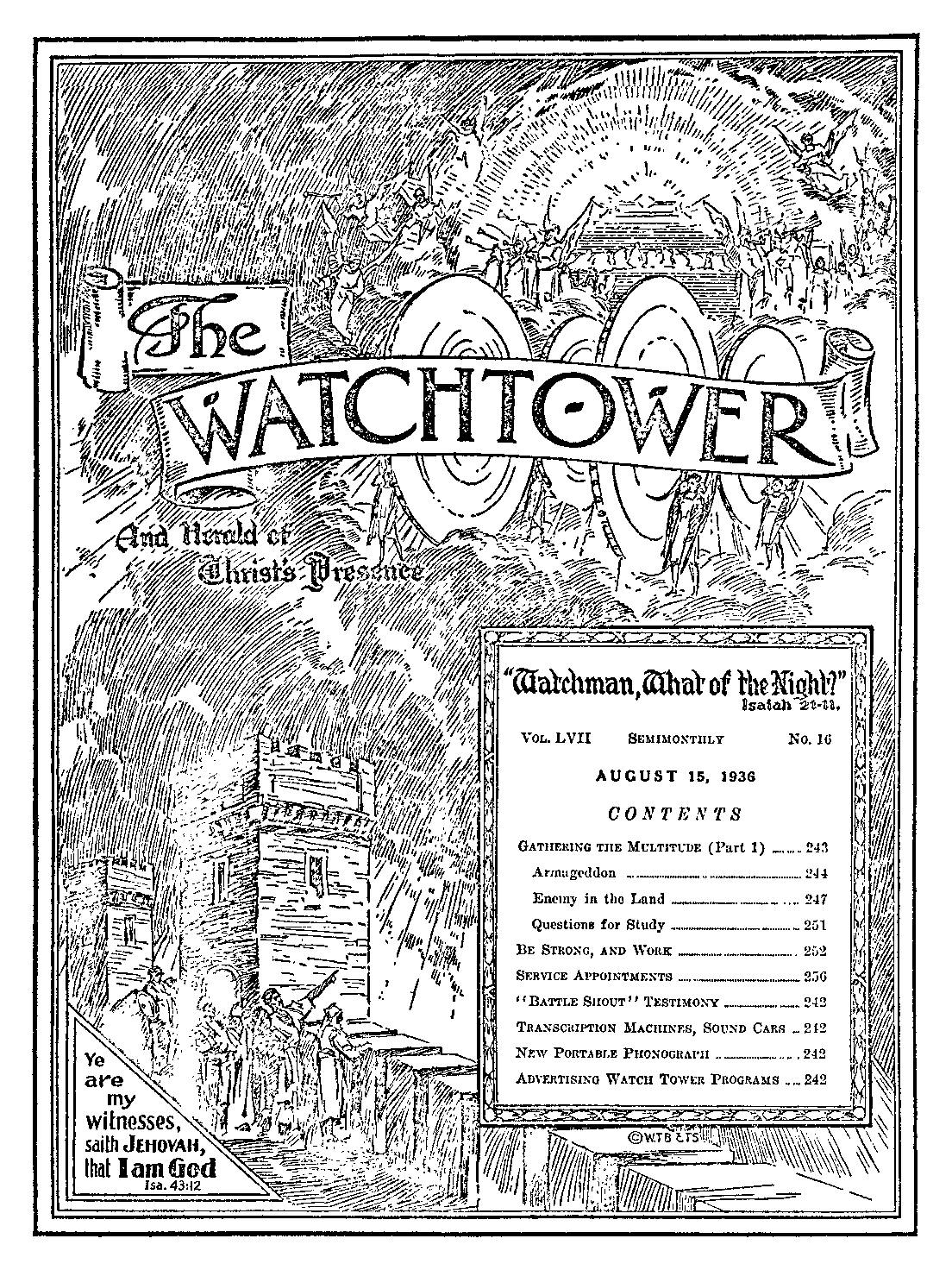
The Watchtower, August 15, 1936
Download: PDF — The Watchtower, August 15, 1936
“BATTLE SHOUT" TESTIMONY
Prepare now for the “ Battle Shout” Testimony and be ready for the period beginning October 3 and continuing until October 11. The book Riches, containing a comforting message for those of good will, is now published in many languages, and this will be presented to the people on a uniform contribution of twenty-five cents to aid in the publication and further distribution of the kingdom message. Detailed instructions will appear in the Informant. Make all your arrangements in advance. Have your territory, your supplies, sound equipment, and everything else, ready. At the end of the period report the results to the Society’s office.
TRANSCRIPTION MACHINES AND SOUND CARS
The Society constructs and assembles portable transcription machines at our own factory at 117 Adams St., Brooklyn, N. Y. These machines are spring-wound, and operated from a 6 volt wet-cell battery. Every machine is furnished complete with the battery and a battery charger, so that it can be kept up to its full strength. This machine can be offered at $100, complete, to brethren in the United States.
The sound car equipment includes the above and, additionally, a power amplifier and a horn with mountings for the top of your car. The entire sound ear equipment with microphone attachment can be had for $175. Write to the Society for details.
NEW PORTABLE PHONOGRAPH
The Society now manufactures and has to offer a light-weight phonograph of new design, which is 11 by 13 by 5 inches in size, and covered with blown cloth and having rounded corners. It weighs 9 pounds 13 ounces, which is 5 1/2 pounds lighter than the previous model manufactured by the Society. With the three phonograph discs which can be carried in it, it weighs 12 pounds 6 ounces. The volume of sound is just as strong as that of the previous model, and the tone is of the best quality As shipped out from our factory, the phonograph is timed properly, at 78 r.p.m., and should be cheeked from time to time. This new model, including three discs, is offered on a contribution of $10.00; without the throe discs, $8.00. Remittance should accompany orders. Also specify the particular discs wanted.
ADVERTISING WATCH TOWER PROGRAMS
Witnessing parties and all individuals engaging in the field service should mention the radio station in their vicinity which carries the Watchtower programs This magnifies to the people called upon the message which Jehovah’s witnesses introduce, and often results in interest in the printed message on the part of the radio listener. This is one of the chief purposes of sending out the message over the radio, to encourage the people to read the literature. In this behalf the Society supplies imho folders, and all workers should make constant use of them in house-to-house calling, leaving one of them, if nothing else.
Vol. LVII
August 15, 1936
No. 16
GATHERING THE MULTITUDE
PART 1
“And other sheep I have, which are not of this fold: them also I must bring, and they shall hear my voice; and there shall be one fold, and one shepherd.”—John 10:16.
JEHOVAH gathers unto himself all to whom he gives life everlasting. He does such gathering by his anointed One, Christ Jesus the Beloved. He does not gather unto himself any who oppose him, but does gather only those who seek him and comply with his requirements. He gathers unto himself first those who have made a covenant by sacrifice and who keep that covenant faithfully. “Gather my saints together unto me; those that have made a covenant with me by sacrifice.” “Whoso offereth praise glorifieth me; and to him that ordereth his conversation aright will I shew the salvation of God.”—Ps. 50: 5, 23.
2 Jehovah is not in a contest with Satan to determine which one may get the greater number. God has fixed his rules by which men may get life, and only those who comply with those fixed rules ever gain everlasting life. The Lord Jesus at the command of his Father testified in his Father’s name: “For I came down from heaven, not to do mine own will, but the will of him that sent me. And this is the will of him that sent me, that every one which seeth the Son, and believeth on him, may have everlasting life; and I will raise him up at the last day.” (John 6:38,40) He gathers first the saints to the temple, and these form the royal house, otherwise called by him the “little flock”. Then he gathers others, and concerning these he says: “And other sheep I have, which are not of this fold; them also I must bring, and they shall hear my voice; and there shall be one fold, and one shepherd.” (John 10:16) This latter-named class are those who constitute the “sheep” that are placed on the right hand of Christ Jesus, and are gathered into that favorable position during the time of the temple judgment by the Lord Jesus.—Matt. 25: 31-46.
3 The subtle enemy Satan attempts in every possible way to deceive God’s people; and among the things that wily foe now attempts is to induce the faithful remnant to believe that they will gather the great multitude, and that the work which the remnant is now engaged in doing amounts to little or nothing compared with what they shall do after what is called “the first phase of Armageddon”. The claim is that then the little flock, the remnant, will do much more and hence that they should not be so much concerned now about doing the witness work. The purpose of what is here published is to offset the strategical move of that wily foe Satan and those whom he may use, and to enable the remnant to see from the Scriptures what is their real duty and work at the present time.
4 Jesus sounded the warning that the enemy would, if possible, deceive the very elect; but the faithful elect will not suffer themselves to be deceived. Their safeguard in this respect is to study carefully the Word of God and to follow his commandments, and if this is done earnestly, honestly and faithfully the Lord will guide them in the right way and keep them in safety. (Prov. 3:5,6) “The meek will he guide in judgment, and the meek will he teach his way.” (Ps. 25: 9) The faithful remnant fear the Lord, and thus they manifest wisdom and are continued in wisdom, and such have the promise of Jehovah that he will show them his purpose.
5 The remnant now on earth, that is to say, Jehovah’s witnesses, do not gather the great multitude, but the Lord assigns to them a work to do while he gathers that multitude. The Lord gathers the remnant to the temple and anoints them and instructs them, and then sends them forth with his message, which is now due to be proclaimed, and that message of the kingdom they proclaim while the Lord does the judging and the separating of the people and gathering unto himself those whom he approves. The “great multitude” is made up of those who seek the Lord, find him and obey him. They hear the voice of the Lord and believe and give heed thereto. “For whosoever shall call upon the name of the Lord shall be saved. How then shall they call on him in whom they have not believed? and how shall they believe in him of whom they have not heard ? and how shall they hear without a preacher? And how shall they preach, except they be sent? as it is written, How beautiful are the feet of them that preach the gospel of peace, and bring glad tidings of good things!” (Rom. 10:13-15) It is the privilege and obligation given to the remnant to serve as proclaimed of the Word of God to the end that those who will form the great multitude may hear the truth and seek the way to Jehovah’s organization, of which Christ Jesus is the Head and where they may find the place of safety.
ARMAGEDDON
6 The question is propounded by some who appear to be confused, to wit: “Will not the chief work of the remnant in connection with the great multitude be done after the ‘first phase of Armageddon’?’’ There is no Scriptural reason for such a conclusion, but the Scriptures are squarely to the contrary. Another asks: “Is it not stated in the February 1 (1936) Watchtower that there will be two phases of Armageddon?’’ No, The Watchtower makes no such statement, and certainly the Scriptures do not warrant such a statement. What The Watchtower did say is this: It seems there will be "two distinctive parts of Armageddon: (1) That which accomplishes the destruction of hypocritical religionists; and (2) that which accomplishes the complete destruction of all of Satan’s organization’’. (The Watchtower, 1936, page 43) The battle of Armageddon is the great battle of the great day of God Almighty, which battle is fought by the great Field Marshal Christ Jesus and his heavenly hosts. It is written, in Revelation 17:16: “And the ten horns which thou sawest upon the beast, these shall hate the whore, and shall make her desolate and naked, and shall cat her flesh, and burn her with tire.’’ This appears to apply specifically to the destroying of the religious systems or organizations which the Devil uses to deceive the people, (Light, Book Two, page 113) The religionists then seek to hide their identity. (See Zechariah 13:6; Preparation, page 252.) The clergy or religionists are a part of Satan's organization and are the shepherds that suffer destruction at the hand of the Lord. (Jer. 25:35) There are, as it clearly appears, three elements of Satan’s visible organization, to wit: religionists, commercial traffickers, and political rulers. The nineteenth chapter of Revelation describes the Lord Jesus Christ on his war mount leading his invincible forces to war against the enemy. The statement made in The Watchtower of February 1, 1936, page 43, is not dogmatic, but it seems reasonable and Scriptural that the hypocritical religionists will be the first destroyed at Armageddon and then follows the destruction of the “beast’’ and the “false prophet’’ and then Satan himself.—Rev. 19:18-21; 20:1-3.
7 All of the enemy must know at or immediately preceding their destruction that Jehovah is the Supreme One and that he is bringing about their destruction. When the religious organizations and the religionists themselves are destroyed, that will appear to the survivors in Satan’s organization as a very strange act, because they have been led to believe that the religionists were and are the representatives of the Lord. To be sure, we cannot now determine just how and the order in which the Lord will bring the destruction of the enemy, and that is not so important for us to know. That which is of greatest importance to the remnant in this connection is to obey God’s commandment and do now what he has directed shall be done and to do it with energy and zeal. It is certain that when the battle of the great day of God Almighty, led by Christ Jesus, is on, the work of the remnant in proclaiming the testimony to those who will form the great multitude will have been finished.—Ezek. 9:4-11; Matt. 24:14, 21.
8 Let this be kept in mind, that the religion-mongers have long been the principal ones among men who have defamed the name of Jehovah. The Devil has used the Roman Catholic Hierarchy in particular, and later the other clergy in general, who have joined hands with the Hierarchy, to bring great reproach upon the name of Jehovah, and it appears to be both reasonable and Scriptural that the Lord will bring the clergy into disgrace and then at the battle of Armageddon will destroy them and in that same battle the other elements of Satan’s organization, visible and invisible, will be destroyed. What The Watchtower meant, therefore, in saying "two parts” is that the religious element will first be destroyed and then will follow the destruction of the other parts of Satan’s organization.
9 What is now here published is for the purpose of proving beyond all doubt that the remnant must now be diligent and very active in doing the work which the Lord has assigned to them to do and that such work must be completed, so far as the great multitude is concerned, before the battle of Armageddon begins. Here again attention is called to the rising up of Jehovah, as set forth by him through his prophet, to wit: "For Jehovah will rise up as in mount Perazim, he will be wroth as in the valley of Gibeon; that he may do his work, his strange work, and bring to pass his act, his strange act.”—Isa. 28:21, A.R.V.
10 By his prophet Obadiah, heretofore considered in The Watchtower, Jehovah calls upon his faithful witnesses, the remnant, to "rise up against her [organized religion, and particularly the Roman Catholic Hierarchy and allied clergy] in battle”. This action by the remnant, taken at the command of Jehovah, precedes the battle of the great day of God Almighty, that is, Armageddon. The prophecy at Isaiah 28:21 concerning the great and final battle fought by Christ, Jesus for Jehovah, and which is therefore Jehovah’s fight, draws special attention to the city of Gibeon. In the same chapter, and immediately preceding this statement that Jehovah will be wroth as in the valley of Gibeon, the Lord tells of the "hail” that "shall sweep away the refuge of lies” (verse 17) and "a tempest of hail”. (Verse 2) These words of description concerning "hail” appear to be set forth there to call attention specifically to what took place at Gibeon, to the end that it may be seen that Gibeon and the battle fought there wore prophetic.
11 There were two battles fought at Gibeon, at different times, and the fact that the record is made of each one of those battles shows what came to pass at Gibeon foreshadows something to come to pass thereafter. The Lord fought the first battle at Gibeon, with Joshua as the visible leader of the Lord’s forces. (Joshua, tenth chapter) At the second battle at Gibeon the Lord put King David forward as leader in the army visible to human eyes. (2 Sam. 5:19-25) That both of those battles were typical of Armageddon, and that both are to be considered in looking at the antitype, there cannot be any reasonable doubt. At the first battle of Gibeon the Lord caused great hailstones to fall down from heaven upon the enemy and those hailstones slew more than were killed otherwise, and that is made there prominent in the Scriptural record. When David fought the Philistines, the enemies of God, and chased them to Gibeon, there is no mention made in the record of hail. At the battle of Mount Perazim, fought by David against the Philistines, the enemies of God, and which battle preceded David’s battle of Gibeon, David spoke using these words: “The Lord hath broken forth upon mine enemies before me, as the breach of waters.” (2 Sam. 5:20) The prophecy of Isaiah, written in connection with Jehovah’s ‘‘strange act”, makes mention of ‘‘a tempest of hail” and ‘‘a destroying storm, as a flood of mighty waters”. (Isa. 28:2) The same prophet also says: ‘‘Hail shall sweep away the refuge of lies, and the waters shall overflow the hiding place. And . . . the overflowing scourge shall pass through.”— Verses 17,18.
12 That which was involved in the first battle of Gibeon was typical of the kingdom of Jehovah God involved in the battle of Armageddon. That which was involved in the second battle of Gibeon, fought by King David, was the kingdom of Jehovah God, and which is involved at Armageddon. Joshua, the leader of the first battle of Gibeon, was a type of Christ Jesus. His name ‘‘Joshua” is the same. ‘‘Jesus” is the Grecian name for the Hebrew name ‘‘Joshua”. The name ‘‘Joshua”, or ‘‘Jesus”, means ‘‘Jehovah the Saviour”. David, whose name means ‘‘Beloved”, was also a type of the beloved Son of Jehovah God, Christ Jesus. As David was king of natural Israel, so the beloved Son of God is King of spiritual Israel and of all who get life everlasting. At Hebrews 4: 8, A.R.V., it is written: ‘‘For if Joshua had given them rest, he would not have spoken afterward of another day.” In the Authorized Version it reads: ‘‘For if Jesus had given them rest.” It is written concerning spiritual Israel: ‘‘David [meaning ‘Beloved’] my servant shall be king over them.” (Ezek. 37:24) This latter text undoubtedly refers to the Lord Jesus Christ, the King, and who is the head of Jehovah’s capital organization. Then says the Lord’s prophet: ‘‘He shall be wroth as in the valley of Gibeon.” (Isa. 28: 21) The wrath of God was expressed against his enemies at both battles of Gibeon; therefore undoubtedly this scripture refers prophetically to the expression of God’s wrath ‘‘in the day of Jehovah”, which is now, and which shall be expressed emphatically at Armageddon.
13 Just a few months before Gibeon is first mentioned in the Scriptures as coming into view, the scripture record shows, the covenant of obedience and faithfulness was made by Jehovah with the Israelites under Moses and when assembled on the plains of Moab. That covenant foreshadowed the covenant of faithfulness for the kingdom which the Lord God has made with spiritual Israel. (Deut. 1:3; 29:1) In connection with the covenant of faithfulness Jehovah named Joshua as successor to Moses. The covenant of faithfulness made in Moab foreshadows the covenant of faithfulness for the kingdom of God, which covenant the Lord makes with the temple class by and through the Greater Moses. (See book Jehovah, pages 312-315.) It was just two and one-half months after the covenant made in Moab and at the Passover time that Joshua led the Israelites across the river Jordan and began the conquest of the land of Canaan, which God had given to Abraham. Jehovah was then ‘‘king in Israel” (Dent. 33: 5); and now Jehovah has begun his reign by placing his beloved Son, Christ Jesus, upon the throne and commanding him to rule amidst his enemies and over the land which Jehovah gave to the ‘‘seed of Abraham”. – Gen. 13:14-17; 15:18; Ps. 110:2.
14 The Canaanites offered stubborn and bitter resistance to the establishment of and the increase of the typical kingdom of God in the Land of Promise, just as the Philistines resisted and tried to overthrow Jehovah’s typical people under King David. All of these were the enemies of God. Because of that opposition a battle at Gibeon was fought in each instance, first by Joshua and long afterwards by David. Now Jehovah has set his beloved Son upon his throne in establishing his everlasting kingdom, while the enemy is still in the land as the Canaanites were in Palestine, and the enemy makes stubborn and bitter resistance now to the establishment and increase of God's kingdom. And the battle of the great day of God Almighty is now imminent for the purpose of clearing the enemy completely out of the land. Surely the prophetic record concerning both battles at Gibeon was written aforetime for the special comfort and hope of the remnant, and it now seems due time for the remnant to be given a clearer view of the meaning of the two battles at Gibeon, which two battles foreshadowed the battle of the great day of God Almighty. For this reason the events which immediately preceded those battles may be considered with profit.
15 The Israelites were assembled on the cast side of the Jordan river and under the command of Joshua, who spoke to the Israelites as commanded. ‘‘And Joshua said, Hereby ye shall know that the living God is among you, and that he will without fail drive out from before you the Canaanites, and the Hittites, and the Hivites, and the Perizzites, and the Girgashites, and the Amorites, and the Jebusites.”—Josh. 3:10.
16 The advance of God’s chosen people against the enemies occupying the promised land was about to begin and the first important thing was that the Israelites should know that Jehovah is the true and only God. Jehovah, in performing a miracle, led the Israelites across the Jordan river by causing the waters of that river at a certain point to be held back or dried up so that the whole host of Israel passed over on dry land and in safety. When the Israelites got on the west side the fight did begin against the enemy. Why Jehovah did this is stated in these words: "That all the people of the earth might know the hand of the Lord, that it is mighty; that ye might fear the Lord your God for ever.” (Josh. 4:24) God was there showing that the most important thing is the vindication of his name, that all the people may know that he is the Almighty.
17 Today Jehovah, by his Greater Joshua, Christ Jesus, has led the faithful antitypical Israelites, that is, Israel in the spirit, into the "land” or place which Jehovah has assigned to them, and now the war is on between the enemies, and particularly the religionists who are fighting against the remnant at the instance of the Devil. (Rev. 12:17) The purpose of the war now in progress is to magnify the name of Jehovah and to make known to the people that Jehovah is supreme. In this way both the enemy and those who desire to do right are informed and warned. Without doubt this is one of the reasons why God has permitted the Devil to remain and to continue his wicked work; as it is written: "That my name may be declared throughout all the earth.” And this declaration of Jehovah’s name must be done and performed before Jehovah exhibits his great power in the destruction of Satan’s organization at Armageddon. (Ex. 9:16) It is the testimony delivered by Jehovah’s witnesses that causes the enemies to make war upon them, and which war precedes the battle of the great day of God Almighty. It is the name of Jehovah that is involved, and his kingdom which is now advancing, and his name shall now be exalted and vindicated and his kingdom rule the whole earth.
18 That we may have a clearer view of the gathering of the great multitude now, consideration is given to what preceded the first battle at Gibeon, that is, what led up to that battle and what occurred at the battle. "And it came to pass, when all the kings which were on this side Jordan [the west side of Jordan], in the hills, and in the valleys, and in all the coasts of the great sea [the Mediterranean sea, the coast of which was held by the Philistines] over against [Mount] Lebanon, the Hittite, and the Amorite, the Canaanite, the Perizzite, the Hivite, and the Jebusite, heard thereof [that is, heard that the Israelites had crossed the Jordan in safety by reason of a miracle performed by Jehovah, and of the battle that followed in which the cities of Jericho and Ai were destroyed], that they gathered themselves together, to fight with Joshua and with Israel, with one accord. ’’—Josh. 9:1,2.
19 Hearing of these great things performed by Jehovah and how he had used his people, the enemy immediately formed a conspiracy to make war against the people of God. That foreshadowed what came to pass with the coming of the Greater Joshua, Christ Jesus. Antitypically it was in 1914 that Jehovah took to himself his great power and began his reign by then and there placing upon the throne his beloved Son Christ Jesus to rule in the midst of his enemies. (Rev. 11:17,18; Pss. 110: 2; 2: 6) Then followed the ousting of Satan and his hosts from heaven, and the casting of them down to earth. Satan then began to assemble all his forces, invisible and visible, in preparation for the battle that must follow, and he has been doing so since. For this purpose Satan draws all his forces into a confederacy to fight against Christ Jesus, the Greater Joshua and Greater David.—Rev. 12:10-17; Isa. 8:9-13.
20 Among the peoples who occupied the Land of Promise there must have been some of good will and who desired righteousness, and who therefore would foreshadow those of good will at the present day, and who have been for a long while under the control of Satan’s organization. There were some in the land of Palestine that saw the favor of Jehovah upon his people, and they took notice thereof; and those people resided at Gibeon: "And when the inhabitants of Gibeon heard what Joshua had done unto Jericho and to Ai, they did work wilily, and went and made as if they had been ambassadors; and took old sacks upon their asses, and wine bottles, old, and rent, and bound up; and old shoes and clouted upon their feet, and old garments upon them; and all the bread of their provision was dry and mouldy. And they went to Joshua unto the camp at Gilgal, and said unto him, and to the men of Israel, We be come from a far country: now therefore make ye a league with us.”— Josh. 9:3-6.
21 Tin Gibeonites began to look out for themselves, and the Scriptures tell of what they did. This is the first mention of Gibeon in the Scriptures. The name means “hill” or “hilly city”. It was situated on a high place. (1 Ki. 3: 4; 2 Chron. 1:13) The Gibeonites were Hivites. (Josh. 9:7) The name Hivites means “villagers ”, that is, those who live in a village. The Hivites were descendants of Noah’s son Ham, through Canaan the son of Ham. (Gen. 10:0,15-17) The Hivites were under Noah’s curse pronounced upon Ham because of Ham's sin: “And Noah awoke from his wine, and knew what his younger son had done unto him: and he said, Cursed be Canaan; a servant of servants shall he be unto his brethren. And he said, Blessed be the Lord God of Shem; and Canaan shall be his servant.” (Gen. 9: 24-20) That curse was fulfilled literally upon the Gibeonites, who, being Hivites, were Canaanites and who became the servants of the Israelites, the descendants of Shem. The Gibeonites included the inhabitants of three other towns or communities, to wit: Chephirah, meaning ‘the village (enclosed by walls)’; and Beeroth, meaning “wells”; and Kirjath-jearim, meaning “city (or place) of forests”; and thus their names indicated the place of residence and surrounding conditions.
22 The Gibeonites would therefore well typify the condition of the entire human race, in this, that all the race came under the curse by reason of the sin of Adam. Christ Jesus’ sacrifice is the purchase price of all under the curse, and his blood and his name the only means of salvation and life. “Christ hath redeemed us from the curse of the law, being made a curse for us; for it. is written, Cursed is every one that hangeth on a tree.” (Gal. 3:13) The Gibeonites, particularly being Canaanites, which latter name means “humiliated”, picture those who were debased and brought low by inherited sin.—Horn. 5:18.
ENEMY IN THE LAND
23 The Lord has set forth many details in his record written of old, the understanding of which details now enables the prophetic student to have a better understanding and appreciation of what is taking place at the present time and preceding Armageddon. There were seven nations settled in the land of Canaan, and among there seven nations was the tribe of Hivites. Before Israel reached that land God informed them of the strength of the enemy: “When the Lord thy God shall bring thee into the land whither thou goest to possess it, and hath east out many nations before thee, the Hittites, and the Girgashites, and the Amorites, and the Canaanites, and the Perizzites, and the Hivites, and the Jebusites, seven nations greater and mightier than thou.” (Deut. 7:1) The Israelites, therefore, were informed and knew that when they entered the land it meant war with the enemy. Likewise Jehovah has informed his people now on earth of the combined forces of the enemy. This information is given to the remnant in advance, and hence they are informed and know of the combined forces of the enemy and they must expect to fight, and hence now the remnant are engaged in the fight and they know the reason why.
24 The enemies in Canaan formed a conspiracy against the people of God, and likewise now the Devil and his gang, invisible and visible, have formed a conspiracy against the people of God. The Hivites of Gibeon and neighboring towns appear not to have joined that conspiracy of the other Canaanites, and therefore were the exception. They showed fear of God and his hosts, and they sought a way of obtaining God’s favor. Whether the action of the Hivites was sagacious or deceitful to begin with does not alter the fact that they were used to make a part of the great prophetic picture here being considered. That the Gibeonites had fear of God’s chosen people is certain, and this appears to be the reason why they took the course of action as shown by the record. “They did work wilily, and went and made as if they had been ambassadors; and took old sacks upon their asses, and wine bottles, old, and rent, and bound up; and old shoes and clouted upon their feet, and old garments upon them; and all the bread of their provision was dry and mouldy. And they went to Joshua unto the camp at Gilgal, and said unto him, and to the men of Israel, We be come from a far country; now therefore make ye a league with us.”—Josh. 9: 4-6.
25 The fear of the Gibeonites foreshadowed a class of people that have now fear of God, which marks “the beginning of wisdom”. The word “wilily”, used in this text, also means “with prudence, discretion and wisdom”. Gibeon was seeking a way whereby the lives of that people might be spared at the hand of Jehovah’s executioners led by Joshua. The main purpose of almost all men at the beginning in turning to the Lord is to selfishly seek life and safety. They grow in love or unselfishness after they have gained some knowledge of God’s purpose. Life is dearer to creatures than anything else, because without life man could not. enjoy anything. The point to be stressed here is that the people of Gibeon sought a way of good for themselves. Necessarily they would act with prudence and discretion, because they were not certain how Joshua would receive them, and for this reason, as the text says, “they did work wilily.” They showed themselves dependent upon Joshua and they moved with caution to see what they should best do. Likewise all men who seek the way to safety and life come to know that they are entirely dependent upon Christ Jesus our Lord, because his is the only name by and through which Jehovah God grants salvation. (Acts 4:12) Men therefore act with caution in ascertaining whether or not it is the truth presented to them, in order that they may take the right course. All that come to Christ, to begin with, are mere babes. They grow into the full stature of a man in Christ Jesus when they have advanced in knowledge and appreciation of the goodness of God. There is no reason, therefore, why it should be said of the Gibeonites that they were lying and trying to “put one over” on Joshua. They were merely acting in a discreet and sagacious manner in harmony with what Jesus later said to his disciples, to ‘be as sagacious as the serpent and harmless as doves’. They were not seeking to do injury to Joshua and his men. They were seeking to find out exactly what was their own position.
26 All the other nations of Canaan were in a conspiracy to fight and, if possible, to destroy the Israelites; and for the Hivites or Gibeonites to stand aloof from that conspiracy, and in the face of it to seek favor at the hands of the one leading the fight against the conspirators, required some real faith on the part of the Gibeonites. Likewise today all of Satan’s organization and there under his organization, with but one exception, are bound together in a conspiracy to fight against and, if possible, to destroy Jehovah’s chosen and anointed people. That one exception is the class that forms the “great multitude’’.
27 The Gibeonites in this prophetic drama played the part foreshadowing the great multitude, and a careful consideration of what follows from here on with the Gibeonites enables us to see what the Lord is doing toward the great multitude.
28 Joshua and his army proceeded with caution, as they should. They had in mind the instructions given by Jehovah to the Israelites long before that people reached the land of promise, and in which Jehovah said to them: “Observe thou that which I command thee this day: behold, I drive out before thee the Amorite, and the Canaanite, and the Hittite, and the Perizzite, and the Hivite, and the Jebusite. Take heed to thyself, lest thou make a covenant with the inhabitants of the land whither thou goest, lest it be for a snare in the midst of thee.’’—Ex. 34:11,12.
29 The Israelites were definitely informed by the Lord that they must meet allied and vicious enemies in the land, and heeding that advice the Israelites would proceed with due caution. When approached by others they must first determine whether or not it was a trick being practiced to draw them into a snare; and this explains why Joshua was careful. The Israelites had been informed that, if they would obey the Lord, their tight against the enemy would result in victory: “But ye shall destroy their altars, break their images, and cut down their groves.” (Ex. 34:13) Consequently when the Gibeonites approached the men of Israel as though they were ambassadors, the Gibeonites were received by the Israelites with due reserve: “And the men of Israel said unto the Hivites, Peradventure ye dwell among us; and how shall we make a league with you?” (Josh. 9:7) Here is wisdom expressed for the benefit of Jehovah’s witnesses. The Gibeonites told Joshua they had come from a far country, and it was proper that Joshua be certain they were friends, and not foes. The Lord’s anointed know that they are among the enemy, and they are cautious to consider one who approaches them and to first ascertain whether the one approaching is a friend or a foe. The instructions given by Jehovah to his anointed people are to refuse absolutely to make a covenant or have anything in common with any part of the condemned Devil’s organization. Jehovah’s people know there are those in the world who are not in accord with the Devil’s spirit, but they act with due care to make no covenant with anyone until they first see some evidence that the others are sincerely seeking the way of the Lord. The question of Joshua and his men was in exact accord with the instructions which Jehovah has given to the followers of Christ Jesus, the Greater Joshua: “And what agreement hath the temple of God with idols? for ye are the temple of the living God; as God hath said, I will dwell in them, and walk in them; and I will be their God, and they shall be my people. Wherefore come out from among them, and be ye separate, saith the Lord, and touch not the unclean thing; and I will receive you, and will be a Father unto you, and ye shall be my sons and daughters, saith the Lord Almighty.”—2 Cor. 6:16-18.
30 Those who come to the Lord’s people now, sincerely seeking to know the truth, recognize that the ones serving Jehovah are in a position of favor with the Lord; and likewise the Gibeonites saw that Joshua and his army were in the favor of the Almighty God. They were for that reason willing to put themselves under Joshua’s command: “And they [as Gibeonites] said unto Joshua, We are thy servants. And Joshua said unto them, Who are ye? and from whence come ye?” (Josh. 9:8) Their words were a proper acknowledgment on the part of the Gibeonites that Jehovah, the God of the Israelites, is the Supreme One and that Jehovah and his chosen general, Joshua, constitute the higher powers. Likewise the people of good will now seeking the way to God’s organization recognize Jehovah as the Supreme One and Christ Jesus the Greater Joshua as the “higher powers”. The Gibeonites willingly submitted themselves to Joshua without battle, and this they did by saying to Joshua: “We are thy servants.” They thus expressed their desire to serve the God of Joshua rather than perish or take the chances of a battle with Joshua's men. That was a petition on the part of the Gibeonites for a friendship treaty or covenant with Joshua. To the petition of the Gibeonites Joshua replied: “Who are ye? and from whence come ye?” How well the course of the Gibeonites fits the condition upon which the great multitude seek God’s organization. In the first place they must have a good will toward God and toward his kingdom and the King Christ Jesus, the Greater Joshua. As Joshua required the Gibeonites to identify themselves, so the Greater Joshua requires those coming to him to identify themselves and to confess whether they are on the Devil’s side or not, or are on the side of God and Christ and his people: “For with the heart man believeth unto righteousness; and with the mouth confession is made unto salvation. For the scripture saith, Whosoever believeth on him shall not be ashamed. For there is no difference between the Jew and the Greek: for the same Lord over all is rich unto all that call upon him.” —Rom. 10:10-13.
31 Those who form the great multitude must believe that Jehovah is the only true and almighty God and that Christ Jesus is the Savior of man and the only way to life ; and having such belief or faith, then each one must take his stand openly on the side of the Lord by confessing his belief in God and in Christ and by his agreement to do the will of God. Such is the way of salvation, and there is no other way. Salvation cannot come to man from any earthly creature or organization or by bowing down to some symbol or image that stands for any creature or thing. The line is so clearly drawn that there cannot be any doubt about this.
32 The Gibeonites did not stand aloof and watch for the decisive battle that was later fought at Gibeon. They would take no chances, but would make themselves known and declare where they stood before that battle. Likewise the great multitude cannot now wait until the final battle of Armageddon, foreshadowed by that at Gibeon, until they make themselves known and take their clear and unequivocal stand. Had the Gibeonites waited until the battle came, no consideration would have been shown them by the Lord. If the great multitude wait until Armageddon to make their identity known, no consideration will be given to them. When Joshua propounded the question, the Gibeonites promptly replied; “and they said unto him, From a very far country thy servants are come, because of the name of the Lord thy God: for we have heard the fame of him, and all that he did in Egypt.” (Josh. 9:9) The statement of the Gibeonites that they came from a very far country simply represents that the great multitude are not of this world but are looking for a kingdom. Their statement to Joshua that they were his servants was not merely a polite expression, but an expression of complete willingness to do what they were told.
33 Continuing their answer to Joshua, the spokesman of the Gibeonites said of the Lord God that they had heard what he had done, “and all that he did to the two kings of the Amorites that were beyond Jordan, to Sihon king of Heshbon, and to Og king of Bashan, which was at Ashtaroth.” (Josh. 9:10) The other Canaanites had heard the same thing, but they showed that they were a foolish people, and, like foolish people of the present day who follow their leaders, the Roman Catholic Hierarchy, they were not at all impressed or moved to seek the favor of Joshua. The Hierarchy today has a great portion of the people so completely cowed that they will not give heed to the Word of the Lord. The exception, however, are those of good will.
34 The Gibeonites showed and acknowledged that they had some knowledge of God, and they began also to show that they had some wisdom. Likewise those who form the great multitude in this day of Jehovah must and do hear of Jehovah and his King, and this message of truth they receive at the hands of the witnesses whom the Lord has sent forth into the land to give that testimony. This is the day in which Jehovah by Christ Jesus makes his name to be known and when he is using that people taken out of the world for his name’s sake to advertise his King and kingdom. Those who hear and give heed begin to have some wisdom as expressed by the psalmist: “The fear of the Lord is the beginning of wisdom: a good understanding have all they that do his commandments: his praise endureth for ever.”—Ps. 111:10.
35 Jehovah’s witnesses have known for a long while that there is but one way to come to God and that is through Christ Jesus, and that there is no other way of salvation. Now they sec more clearly than ever that those who form the great multitude also must hear the message of Jehovah and his kingdom and must know the only way to salvation and must take their stand on the side of God by confessing with their mouth and showing by their course of action their faith in God and in Christ Jesus. By giving the remnant this information the Lord is clearly pointing out the duty and obligation that is laid upon the remnant, to wit, the necessity of bearing the fruits of the kingdom before those who may desire to seek the way of salvation. But what would be the result if the Devil could now induce Jehovah's witnesses to believe and to rely upon the statements that ‘it is not so important now to seek the great multitude’; that ‘the great work to be done for and in behalf of the great multitude is after Armageddon begins’? The result would be wholly disastrous to the remnant so believing and acting, and also disastrous to those who might desire salvation and who might be of the great multitude. This is made clearly to appear by Jehovah’s instruction to his watchman set forth at the mouth of his prophet. (Ezek. 3:17-20; 33:3-13) Those who feed upon God’s Word and follow his instruction will not be deceived by the guesses of men, but will be diligent to carry out the Lord’s instructions now.
36 In this day of Jehovah he makes clear the issue, so that every man must be either on the side of the Devil or on the side of God and his King. This is also clearly foreshadowed by what the Gibeonites did and said: “Wherefore our elders and all the inhabitants of our country spake to us, saying, Take victuals with you for the journey, and go to meet them, and say unto them, We are your servants: therefore now make ye a league with us.”—Josh. 9:11.
37 Mark this, that the Gibeonites made no mention of a king over them and of their allegiance to such a ruler, but they mentioned “our elders [or counselors] and all the inhabitants of our country”, from the least to the greatest of them. No doubt there had been an assembly of the Gibeonites and they had selected a delegation that now stood before Joshua and his army. And so they said to Joshua for themselves and for all their people, “We are thy servants.” In other words, ‘We are not your enemies, deserving death at your hands, but we are entirely willing to serve you ; therefore make ye a league with us: enter into a peace treaty or agreement with us by which we may serve you.’
38 No doubt Jesus had in mind this very picture, which Jehovah had caused to be made by the Gibeonites and Joshua, when he declared God’s rule concerning those who seek to join themselves to Christ Jesus and his organization. Note that Jesus was speaking to the great multitude when he said: “And there went great multitudes with him: and he turned, and said unto them, If any man come to me, and hate not his father, and mother, and wife, and children, and brethren, and sisters, yea, and his own life also, he cannot be my disciple.” ‘‘Or what king, going to make war against another king, sitteth not down first, and consulteth whether he be able with ten thousand to meet him that cometh against him with twenty thousand? Or else, while the other is yet a great way off, he sendeth an ambassage, and desireth conditions of peace. So likewise, whosoever he be of you that forsaketh not all that he hath, he cannot be my disciple.”—Luke 14: 25, 26, 31-33.
39 Those who compose the great multitude cannot stand idle today and watch for the fall of Satan’s organization before obeying the Lord. They must know of Jehovah and his kingdom, must declare themselves on the side of Jehovah and his King, and must learn righteousness and meekness as a condition precedent to being shielded at Armageddon. They must be able to withstand the. test which of necessity must come upon each one who receives God’s favor. If those of the great multitude would escape the, sword of Jehovah’s Executioner, the Greater Joshua, they must act quickly and not wait until Armageddon is begun before they declare themselves. The Lord has given warning and is continuing to give warning now to the people of good will that Armageddon is approaching and is near at hand, and if they would find salvation the great multitude must now ‘‘flee into the mountains” and offer themselves as the servants of Jehovah and Christ Jesus, the Greater Joshua, before Armageddon begins. The Lord specifically warns all such not to wait and not to begin their flight in the wintertime.—Matt. 24:15-20.
40 The Lord Jesus says: ‘‘When you see Jerusalem surrounded by encampments, then know that its desolation has approached. Then let those who are in Judea flee to the mountains.” (Luke 21:20,21, Diaglott) Ancient Jerusalem pictured the present-day hypocritical religious organization on earth, which claims to represent God and Christ Jesus. God used certain earthly agencies to destroy ancient Jerusalem. God has now given to his anointed remnant, and to those who associate themselves with the remnant, namely the Jonadabs, a vision of his purpose to destroy modern, hypocritical Jerusalem, that is to say, the religious element of Satan’s organization which now encumbers the earth. The meaning of the words of Jesus above quoted seems to be this: That when the people of good will toward God have a mental vision of the coming destruction of the present-day hypocritical Jerusalem, that is, the religious element of Satan’s organization, then it is their duty to flee to God’s organization, because it is then certain that the destruction of ‘‘Christendom” is nigh at hand. For one to now be negligent and stubborn, and to hold out for a deathbed repentance or a more favorable season to flee to God’s organization, means to that one destruction, even as the Lord foretold.—Dent. 20:16,17.
41 The spokesman for the Gibeonites continued to present their plea before Joshua that they might save themselves, and that Joshua would make a treaty insuring their safety, and therefore they said: ‘‘This our bread we took hot for our provision out of our houses on the day we came forth to go unto you; but now, behold, it is dry, and it is mouldy: and these bottles of wine, which we filled, were new; and, behold, they be rent: and these our garments and our shoes are become old by reason of the very long journey.”—Josh. 9:12,13.
42 Some may say the Gibeonites were speaking and acting out a lie. But not so. A statement is a lie only when it is told for the purpose of deceiving and working injury to another and when injury would naturally result from the statement told or withheld. The Gibeonites were not seeking to do injury to the Israelites, nor were they attempting to interfere with the conquest of the land by the Israelites; but the Gibeonites were seeking their own safety and were acting and speaking with caution and sagacity. Furthermore, and this is the important thing, God was here having a picture made foreshadowing something of far greater importance to come to pass in the future, the fulfillment of which prophetic, picture is for the instruction of the remnant in particular, and which may Jesuit likewise in instruction for those who form the great multitude.
43 When the Gibeonites cooked their bread it was hot and fresh. When they presented it before Joshua it was dry and moldy, and therefore a food such as a menial servant would eat. In other phrase, this moldy food in symbol said: ‘‘We. who have this food are a class of servants, poor and needy, and that come to you that we may receive help in this time of need ” This exactly fits the condition of persons of good will who seek the Greater Joshua, the Lord Jesus Christ. The old bottles of wine, rent and torn, and their old garments and old shoes, likewise spoke in silene language and said: ‘‘We are a menial class of servants, who have these things.” The reason assigned for this undesirable condition of their food and raiment was that they had come a long journey. That was not true literally, but it was a reason assigned which did not work injury to anyone. It symbolized that they were from a country far removed from God's people. What they had and presented before Joshua pictured a class of humble people who desired better thing; than what things they possessed. The Gibeonites sought aid of Joshua that they might, obtain those desirable things. Likewise the greet multitude sock aid at the hand of Christ Jesus that they might find the desirable things. Critics of God’s Word have been too much inclined to find some excuse to make themselves appear as of a very high standard and thus receive a good report from other men. They have been willing to criticize what is in God’s Word for the purpose of impressing others with their own intrinsic value. Such a course is not in keeping with God’s way. He knows each man’s heart, that is, his secret motives.
44 The Gibeonites standing before Joshua in their unpleasant appearance, with bad food and soiled garments, well pictured those who seek the Lord and who have on themselves filthy garments, badly soiled by association with Satan’s agents and representatives. They come to the Lord with food which they have received at the hands of the professed servants of God, the clergy, and which food is old and musty and fit only for dogs to cat. They come to the Greater Joshua, Christ Jesus, as the only means of salvation and help, and by this means they ‘wash their robes [garments] and make them white in the blood of the Lamb’. They cast away the old, musty and decayed food and receive at the Lord’s hands refreshing and life-giving, life-sustaining food; and hence, as it is written, “they shall hunger no more.’’ (Rev. 7:14-16) The description of the Gibeonites here exactly fits the condition of those who form the great multitude class, as described by the foregoing scripture texts. Those who form the great multitude do make a long journey from Satan’s organization to Zion, because the two are far removed from each other.
45 It is now of great comfort to the remnant to see how wonderfully the Lord had in mind both the remnant and the great multitude when making this prophetic picture, showing the remnant and the duties that devolve upon them, and showing the great multitude what course they must take if they would receive favor at the hands of the Greater Joshua.
46 The men of Israel under Joshua saw standing before them a motley-looking crowd, a crowd in bedraggled garments, and carrying food not fit for human creatures to eat. The Gibeonites appeared to be a simple people, and so those of the Israelites who examined their food evidently considered them such. They asked no questions: “And the men took of their victuals, and asked not counsel at the mouth of the Lord.” (Josh. 9:14) They examined their clothing and took their food and tasted that, and in doing this the Israelites showed that they asked no counsel of the mouth of the Lord. To be sure, Jehovah was fully aware of what was going on and could have informed Joshua what all this matter meant, but that was not necessary, because Jehovah was here having a picture made for future use; and we may therefore be assured that the acts performed by the various players were exactly in accord with his will. To the Greater Joshua Jehovah has committed all power and authority concerning those of the great multitude. These come seeking the way to Zion, and Christ Jesus the Greater Joshua deals with them. He sends forth from his temple his servants with instructions as to how they are to deal with those who are seeking the way to the kingdom. These witnesses see the soiled garments of the persons of good will and they sec the unwholesome provender which has been handed to these people to feed upon, and which they have received at the hands of the clergy; and the remnant having received their instruction concerning the servants of the Lord, they then endeavor to show such honest-hearted ones the way to the kingdom by exhibiting to them the fruits of the kingdom, the life-giving food that proceeds from the Lord.
47 These faithful witnesses, whom the Lord instructs and sends forth from the temple as representatives of the kingdom, sound the warning of the Lord before the rulers and before the common people: ‘‘ Serve the Lord with fear, and rejoice with trembling. Kiss the Son, lest he be angry, and ye perish from the way, when his wrath is kindled but a little. Blessed are all they that put their trust in him.”—Ps. 2:11,12.
48 The Roman Catholic Hierarchy and allied clergymen make mouths of derision and scorn concerning this warning and mock the faithful witnesses who bring the warning; they hold Jehovah’s witnesses in derision and denounce the message they bring. For a long while these scornful and deceitful men have ruled the gullible and credulous people in a harsh manner and have induced the kings of the earth to push aside the Word of God and listen to the filthy things brought forth by the clergy. But the Lord shows that there are those men of good will toward God, and who have long been under the domination of these scornful rulers, and he points out that his witnesses must bear the truth to them. He shows the remnant their duty and obligation and privilege to examine into the conditions and the food that these people have, and then to tell them the way to seek the Lord and find the way to life. It is the teachable class, the meek ones, that turn to God and the Greater Joshua, and put their trust in the Lord and receive his favor; as it is written: “Blessed are all they that put their trust in him.” The Lord declares concerning the Roman Catholic Hierarchy and their allied clergy: “Ye scornful men, that rule this people . . . When the overflowing scourge shall pass through, then [that will mark the time] ye shall be trodden down by it.” (Isa. 28:14-18) But to those who previous to the coming of God’s wrath seek righteousness and seek meekness, the Lord gives his word to them that ‘they may be hid’. Is not this further proof of the absolute necessity for the great multitude to be instructed and to take their stand firmly on the side of Jehovah and his kingdom before Armageddon? Those of God’s elect will act accordingly and give diligence in bearing the fruits of the kingdom before them.
(To be continued)
QUESTIONS FOK STUDY
1, 2. Whom does Jehovah gather unto himself? and how and when is this done?
3, 4. Satan now makes what attempt to hinder the gathering of the great multitude? How will the faithful safeguard themselves in this respect?
5. What work in relation to gathering the great multitude is assigned to Jehovah's witnesses?
6-8. Of what, as apparent from the Scriptures, does the battle of Armageddon consist? Explain whether it is reasonable to conclude that the chief work of the remnant in connection with the great multitude will be done after the ‘first part of Armageddon’. What is of greatest importance for the remnant to have in mind, and do, in this connection? Why?
9. What is the purpose of what is now here published ? Why is this now so important?
10. How is the action commanded at Obadiah 1 related to the tempest of “hail” foretold in Isaiah’s prophecy (28:2,17)?
11,12. Describe the two battles of Gibeon as to leadership and how they were fought, and point out the significance thereof as prophecy.
13,14. What prominently important matters took place on the plains of Moab? Show that they were prophetic.
15-17. “Hereby ye shall know.” To what evidence did Joshua here refer? Know what? Why was this so important? Why did Jehovah per form this miracle? How does this prophetic picture find fulfillment?
18,19. What led up to the first battle of Gibeon? What was foreshadowed therein?
20-22. Who were the Gibeonites? How were they a typical people?
23-27. Show that the information (concerning the nations already occupying the land of Canaan) given beforehand by Jehovah to the Israelites, and the conspiracy against his people upon his ‘bringing them into the land to possess it’, were prophetic, flow did the Gibeonites there, in the face of that conspiracy, distinguish themselves as a prophetic people? They played what part in this prophetic drama?
28, 29. With scriptures, account for the caution exercised by Joshua and his army. Compare the situation with that of Jehovah's covenant people now.
30-34. Explain Joshua 9:8 as a prophecy. What is requited of those who form the great multitude? What instruction for and concerning the great multitude is seen in the Gibeonites’ wise course of action so promptly taken? What was expressed, then and prophetically, in the Gibeonites’ reply to Joshua (verse 9)? As indicated by verse 10, how did they further, there and prophetically, distinguish themselves from the other Canaanites?
35. Why has Jehovah informed the remnant concerning the great multitude? This knowledge is attended by what duty and obligation? Why does the Devil at this time try to blind Jehovah’s witnesses to the great urgency of seeking the great multitude now?
36-38. Explain the position of the Gibeonites, there and in the prophetic sense, which enabled them to come to Joshua and immediately declare, “We are thy servants.”
39,40. What must the great multitude know and do? When, and why? What does Jesus’ instruction at Luke 21: 20,21 mean for the remnant and for the great multitude?
41-43. Justify the Gibeonites’ statement of verses 12 and 13, both as for that time and as fittingly prophetic.
44,45. Apply the prophetic picture presented by the Gibeonites standing before Joshua with their pool food and in their soiled garments. What purpose is solved by this prophetic picture?
46. Apply verse 14.
47. What is the warning now sounded by the faithful witnesses whom the Lord instructs and sends forth from the temple? Before whom is this warning sounded, and why? How is it received by them?
48. The remnant, then, have what privilege, duty and obligation in relation to the people of good will? When must these be so instructed, and why? Who will do that work?
BE STRONG AND WORK
JEHOVAH will got his work done. Each part thereof he sets going in his own appointed time, and he gets it finished on time. He calls attention of his faithful servants on earth to this dependable fact, saying: “Ye are my witnesses, saith the Lord, and my servant whom I have chosen; . . . I will work, and who shall let it?’’ (Isa. 43:10-13) The wise witness takes this to heart and responds: “I said in mine heart, God shall judge the righteous and the wicked: for there is a time there for every purpose, and for every work.’’ (Eccl. 3:17) Such one shows the faith in his heart by his action: action at God’s time for his purpose and work. Thus doing he is counted among the number who are “labourers together with God’’ and at one with Him —1 Cor. 3: 9.
The Devil would like to halt the work of God, at least to slow it down. This he seeks to do by slowing down the activities of these “labourers together with God’’. He uses various methods to do this. He raises up opposition and constantly thereafter increases it against the laborers. He tries to rouse up fears that will weaken their hearts and their arms. He tries to persuade them that they are moving too fast, because the time is not due. He used these very tactics against the first remnant of the Lord, which forsook Babylon and returned to Jerusalem for a specific purpose, to build his typical earthly temple and to serve Jehovah there in holiness of devotion. Permitting themselves to be affected by Satan’s wily efforts, the remnant weakened in faith and zeal, and the work on the temple lagged for years. They excused themselves, saying: “The time is not come, the time that the Lord's house should be built.’’ Then the Lord showed them that they were wrong in this conclusion, and he set them to work again. That they should not be discouraged by small visible beginnings, Jehovah by his prophet said unto them: “Yet now be strong, O Zerubbabel, saith the Lord; and be strong, O Joshua son of Josedech, the high priest; and be strong, all ye people of the land [of Israel], saith the Lord, and work: for I am with you, saith the Lord of hosts.” (Hag. 1:2; 2:4) It was Jehovah of the holy armies, the great Warrior of Righteousness, that was with them and for them. Hence he could be expected to fight for them and defend them, that his temple work might duly be finished as an evidence of victory over the enemy.
…