The Watchtower, January 15, 1931
Download: PDF — The Watchtower, January 15, 1931
SERVICE CONVENTIONS
(In each instance, the class service director's name and address appear.)
Chattanooga, Tenn.
Jan. 16-18
R. M. Smith, 516 National Av.
Colored: Wm. Kyle, 1810 Citico Av.
Jacksonville, Fla.
Jan. 23-25
Fred L. Boyer, 1929 Pearl St.
Colored: A. W. Perry, 1018 Jefferson St.
Indianapolis, Ind.
Jan. 23-25
O. H. Hackenmeyer, 4219 Carrollton Av.
Colored: Benjamin Bonner, 551 Hiawatha St.
Hungarian: Charles Kerekesh, 723 Concord St.
Miami, Fla.
Jan. 30-Feb. 1
P. M. Perfect, 766 S. W. 2nd St.
Louisville, Ky.
Jan. 30-Feb. 1
Emil Hammerschmidt, 117 State St.
Colored: Humphrey Smith, 2330 Green Alley
Tampa, Fla.
John C. Foster, 216 Cass St., Ste. 6
Kansas City, Mo.
F. T. Hoeck, 4510 Pennsylvania Av.
New Orleans, La.
Feb. 6-8
Joseph L. Gundermann, 317 S. Telemachus St.
Colored: Jas. Faw, 1603 Joliet St.
Houston, Tex.
Feb. 6-8
J. A. McElvy, 1518 Stanford St.
Colored: J. W. Hall, 2101 Loraine St.
Spanish: Jose Renteria, 1807 Congress Av.
San Antonio, Tex.
Feb. 27-Mar. 1
Dr. W. H. Dunn, 3012 Broadway
Colored: N. H. Keller, 222 Douglass Way
Spanish: P. C. Moreyra, 1713 Guadalupe St.
MIDWINTER SERVICE WEEK JANUARY 31-FEBRUARY 8
The Lord has been pleased to reveal to his people that a witness must be given regarding his purpose to vindicate his name and establish a kingdom of righteousness upon the earth and that this must be done speedily.
In accordance with this expressed will of Jehovah the Society has arranged the midwinter service week commencing January 31 and ending February 8. We know that all the anointed will rejoice in this privilege of honoring the name of Jehovah. By that time the new 1931 prices will be in effect; and with the substantial reduction made in all the bound books, many homes will be able to take the message in that form that could not do so before. The new watchtower radio programs will have been on the air over a month and will have covered large sections of the country which were never covered before by the watchtower program. The Lord showed his approval on this branch of the service by enabling his people to have 152 stations participate in its inauguration. Undoubtedly the Lord’s object in this was to prepare the field for the workers. Let each one recognize, therefore, that the Lord is going on before and that this midwinter drive will be a wonderful opportunity to ‘‘speed’’ the work of magnifying the name of Jehovah.
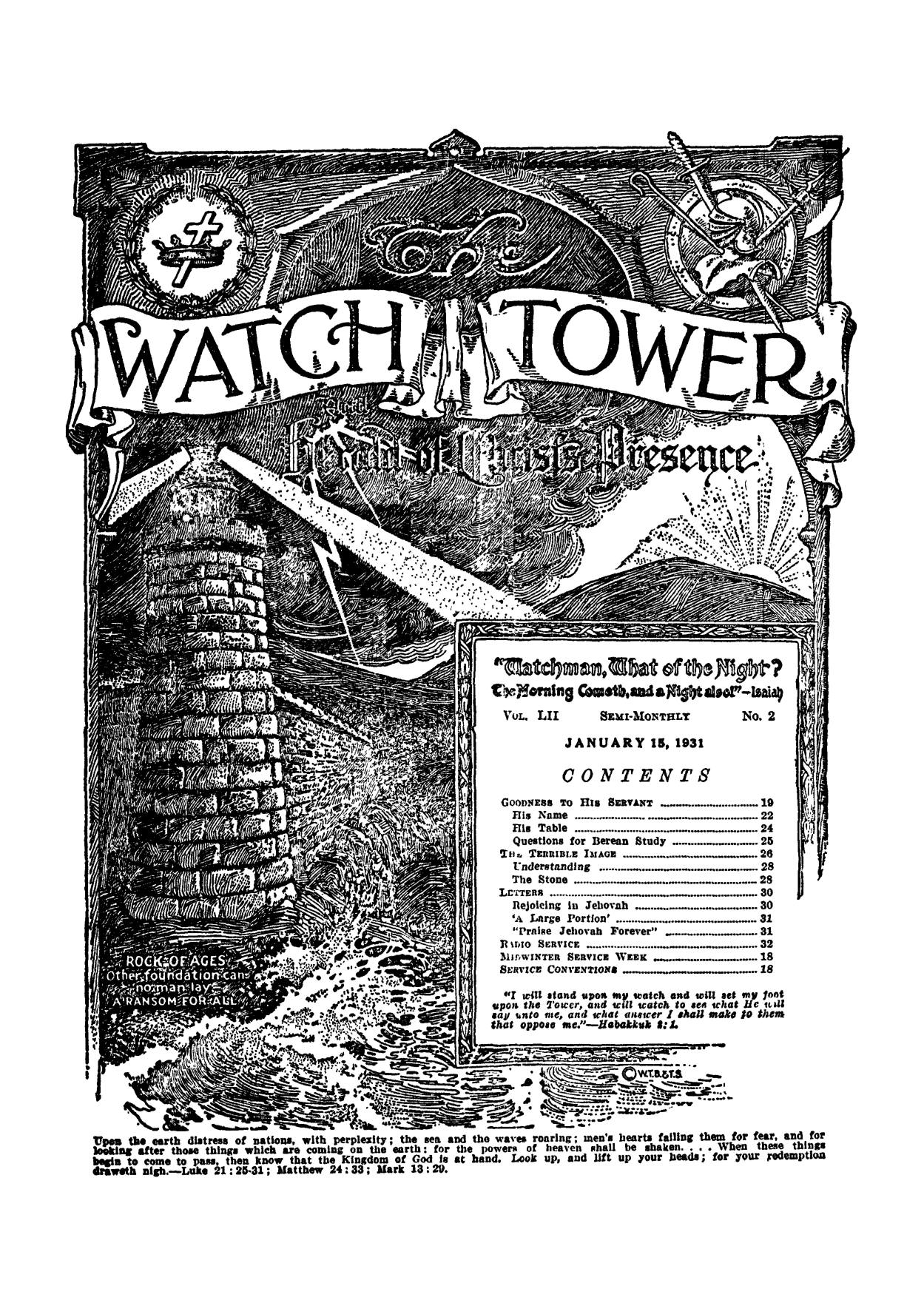
Vol. LII
January 15, 1931
No. 2
GOODNESS TO HIS SERVANT
“Surely goodness and mercy shall follow me all the days of my life; and I will dwell in the house of the Lord for ever.” – Ps. 23:6.
JEHOVAH’S goodness bestowed upon those who love him is always in evidence. It establishes the full confidence of the son in his everlasting Father. A sweet relationship between the Father and his creature is disclosed that can be enjoyed only by those who are fully devoted to God. The new creature is in the covenant with the Creator, and upon that covenant he can and does confidently depend. His complete trust in and reliance upon Jehovah, and his certainty that he has Jehovah’s love, lift the servant above the opposing influence that would otherwise bring upon him despair. To know that one is the constant recipient of Jehovah’s goodness makes him strong in the Lord and in the power of his might.
2 The twenty-third Psalm is said to be a song of David expressing his complete confidence in Jehovah and acknowledging that he is the constant recipient of God’s favor. The Psalm is probably the best known chapter of the Bible. It has been a comfort to the people of God throughout the days of the new creation. Many a person in distress has repeated this Psalm with consolation to his soul. Surely the Lord is not displeased to have any of his creatures seek him for good and acknowledge his goodness, whether they have done so with a knowledge of his provision for them or not. Sober-minded persons in the various walks of life repeat this Psalm with some satisfaction, but there are some among the creatures of the great God who receive special consolation therefrom. Having the assurance from his Word that whatsoever things were written aforetime in the Bible were written for the comfort of those who are in the covenant with Jehovah at the end of the world, we may expect to find some special help for these in this Psalm at the present time.
3 It seems certain that Jehovah selected David from amongst the sons of Israel for a special purpose and used him in a prophetic way. He was called from the sheepfold to become king over God’s chosen people. His selection was not by chance, but was designedly made. Other tribes of the nation God passed by and laid his hand of favor upon the head of the shepherd boy. Asaph, a Levitc, was one of the leaders of David’s choir, and a composer of music. He was also a seer, or one permitted to see and write down the will and purpose of Jehovah God. – 1 Chron. 6:39; 2 Chron. 29: 30.
4 It is said that the seventy-eighth Psalm was composed by Asaph, the sweet singer, and therein it is written concerning God’s selection of David. “Moreover, he refused the tabernacle of Joseph, and chose not the tribe of Ephraim; but chose the tribe of Judah, the mount Zion, which he loved. And he built his sanctuary like high palaces, like the earth which he hath established for ever. He chose David also his servant, and took him from the sheepfolds: from following the ewes great with young, he brought him to feed Jacob his people, and Israel his inheritance. So he fed them according to the integrity of his heart, and guided them by the skilfulness of his hands.” – Ps. 78:67-72.
5 The lad David was tending his father’s sheep in the field when he was sent for and brought before Samuel the prophet, who then anointed him king over Israel. In his youth there must have been planted in his mind by the hand of the Lord ‘germs’ of ideas and ideals which in later days resulted in producing that which made David a fitting type of the great King to whom God would give the kingdom of the world. Even then the goodness of God began to appear towards some who were not on the earth then but who are on the earth at this very day. Jehovah had such in his mind and purpose and made provision for them.
6 The experiences which men have had with evil or wickedness have not taught them profitable lessons. Evil things corrupt the creature rather than teach good lessons. The experiences that men have had with the good things, however, have taught them valuable lessons. All knowledge of God’s goodness and loving-kindness, and all experiences one passes through in connection therewith, result in profitable lessons to every one who has a right condition of heart. The Scriptures and the physical facts concur in proving that evil experiences do not result in teaching profitable lessons, but that good experiences, with a knowledge of the Giver of goodness in connection therewith, do result in good. This conclusion is in harmony with the statement of Jesus that a knowledge of God leads into the paths of everlasting life.
7 It is clear from the Scriptures that it was never God’s purpose to teach men profitable lessons by experience with evil things, but that he does teach them by giving them a knowledge and a demonstration of his goodness and loving-kindness toward his creatures. Had the word, name and goodness of God been magnified at all times by professed teachers of the Bible, the race would have been in a far better condition today. The fact that God has been held up as the Mighty One who permits and connives at evil to teach lessons to men has turned millions away from him. The people must come to a knowledge of the truth and of the goodness and glory of God in order to receive profitable lessons and everlasting blessings. Experience without a knowledge of God would teach nothing, but it is a knowledge of God and his goodness in connection with the experience that results in good. In harmony with this it is written: ‘This is the will of God, that all men shall be saved and brought to a knowledge of the truth.’ (1 Tim. 2: 3, 4) It is the truth that sanctifies, and that means the truth concerning Jehovah God. – John 17:17.
8 David lived out in the open, and his eyes feasted upon the creation of the Almighty God and his gracious provision for all creatures. He saw the birds instinctively led by the Creator to build their houses high in the trees of the forest, while the wild beasts made themselves secure in the rocks of the hills. He beheld that God in his goodness had provided all things necessary for these; and God having done that for the lower animals, he learned surely that God would always make provision for those that love and serve him. This led him to give tender care to the sheep that were in his charge. His day’s work done and his sheep brought to the place of rest, David, alone in the wide fields and under the canopy of the stars, would doubtless muse upon the goodness of the Almighty Creator and sing songs to his praise. He made a record of some such experiences, and this record now serves to a good purpose to God’s people on the earth who learn of and concerning the same. Concerning some of these blessed experiences he wrote these words: “O Lord, how manifold are thy works! in wisdom hast thou made them all: the earth is full of thy riches. The glory of the Lord shall endure for ever: the Lord shall rejoice in his works. I will sing unto the Lord as long as I live; I will sing praise to my God while I have my being. My meditation of him shall be sweet: I will be glad in the Lord.” (Ps. 104:24,31,33,34) The man who lives close to and in communion with God and who silently meditates upon God’s Word and his goodness may recount his own experiences of that nature with profit to himself and to others.
9 The shepherd boy in the hills of Judea thought of and cared for the sheep which had been placed in his charge and which belonged to Jesse his father. This would suggest to his mind that the whole nation of Israel were the sheep of Jehovah’s pasture and now David was appointed and anointed over them to have charge of and care for them. The giving of proper consideration for the flock of sheep would suggest to his mind the care that God has for his own. These conditions lifted his mind to greater things than the sheep of the field, and yet his care over the sheep helped him to see and appreciate his own great responsibility toward God and his people.
10 David owed a simple duty to Jesse his father to safeguard the interest of the flock he was minding. When a lion and a bear came to destroy the sheep he made bold to attack these wild beasts in order to save the flock. He realized that he had a responsibility to his father, and he would give a good account of the trust reposed in him. If possible he would prevent the lion from taking even one of that flock of sheep. He was determined that the bear should not break in and carry away that which his father had committed into his hands. It was his fidelity to his father that gave him courage to risk his own life for the flock. David’s faithfulness in the performance of duty to his father Jesse led him to realize what is due to Jehovah. David knew that the Israelites were the covenant people of God, and he would reason that since this flock of sheep that he was tending belonged to an Israelite, and that God had declared himself to be the shield and the caretaker of the Israelites people, then God would give strength to him to perform his assigned duty. Such faith in God would be a greater inspiration even than fidelity to Jesse his father for David to protect the flock. His knowledge of God, and his experience in connection therewith, would therefore lead him to trust God in small matters as well as in larger ones.
11 The divine record does not disclose the time that David wrote the twenty-third Psalm, but it must have been sometime after he became king and after the Lord had delivered him from many trying situations. He would then look back upon his boyhood experiences with the sheep in the fields and remember how Jehovah had shown his goodness to him at that time. As the sheep depended upon David to protect and lead them, so now he would see himself and the peoples of Israel under the care and protection of the great Shepherd, Jehovah God, and would look to Jehovah for protection and blessing. As the visible ruler and caretaker of the most important nation then on earth, David would carry the burdens incident to his high office; and to carry these burdens he would trust in the Lord for strength. Beset on every side by his enemies, and appreciating the need for help, David would remember his boyhood days, when he was the shepherd, and how he had cared for the flock; and this would turn his mind to Jehovah and give him complete confidence in the Most High. This led David to say: “Jehovah is my shepherd; I shall not want.” He was certain that the Lord would always safeguard him and provide for his every need.
12 During the day David’s flock would feed upon the green pastures, and at eventide the sheep would rest in a quiet place, beside still waters. Doubtless many times, observing these habits of the sheep under his care, David was led to think, and later wrote: “He [Jehovah] maketh me to lie down in green pastures; he leadeth me beside the still waters.” Sheep are foolish animals, doing many foolish things, and following their natural inclinations some of them would wander away amongst the rocks and into places of peril. The plaintive bleat of the straying sheep would reach David’s ears and he would go to its rescue and bear this foolish sheep safely back to the fold. Looking back to these experiences he would be reminded of what God had done for him when his soul was weary almost unto death. He would cry unto Jehovah, the great Shepherd, and his plaintive cry would be heard and God would restore David to his favor and bring comfort to his heart.
13 The picture given in the Psalm is so simple and so beautiful that it becomes a sweet and comforting one to the Christian now dwelling upon the earth.
14 The twenty-third Psalm, however, must take its place amongst prophecy written by the man who was devoted to God and who wrote as the spirit of God moved upon his mind, as he so stated on another occasion. Those who are now in close tune with the Lord by reason of being in the temple can readily see that now the prophecy of this Psalm has been only partially fulfilled. Jesus, the beloved One of God, being sinless and harmless, the words of the Psalm apply to him; but there is no other one person to whom it applies. It is true that many followers of Christ have often repeated the words of this Psalm and applied the same to themselves individually, such being possible, however, only because the words of the psalmist seemed to suit their case, and not because the prophecy had really been fulfilled by them or in anything they had experienced. It must be kept in mind that no scripture is of private interpretation, nor is the scripture written for any special individual. No man should take himself so seriously as to conclude that God has caused a prophecy to be written just to fit his particular case. Many have so thought, but they did not think soberly. Aside from the Lord Jesus the twenty-third Psalm applies to no individual.
15 Of and concerning whom is the twenty-third Psalm written ? How may we know that the Psalm is given of God? and for whom? The inspired writer answers, by “comparing spiritual things with spiritual”. (1 Cor. 2:13) Surely these words of the apostle mean that the truth is ascertained as set forth in God’s Word by those who have the spirit of God and who then compare one part of God’s Word with other parts. That which is written in the Word of God is consistent, and only those who have the spirit of God can know and appreciate the true meaning thereof. (1 Cor. 2:10, 11) Employing this divinely-given rule the irresistible conclusion is that the antitype of David is not any individual except Christ Jesus, and those represented in Christ. Its application is to the “servant” of Jehovah, to Christ Jesus first, and secondarily to all who are privileged to be of the “servant” class when considered collectively. Its application is to the same one about whom the psalmist often speaks, namely, Jehovah’s “servant”. The first Psalm introduces the “servant” with these words: “Blessed is the man that walketh not in the counsel of the ungodly, nor standeth in the way of sinners, nor sitteth in the seat of the scornful. But his delight is in the law of the Lord.” These words were not written for individuals aside from Jesus, but were written for God’s approved “servant”. How clear these words have become to the remnant as applying to those who are collectively in the covenant with and wholly devoted to Jehovah God!
16 It is proper to say that the words of the twenty-third Psalm apply to Jesus and also to the church in the days of the apostles when there was unity amongst the anointed ones of God. But when the apostles passed from the stage of action, and for this reason their supervision over the congregations ceased, there could be no further application of the twenty-third Psalm to the followers of Christ, because of the lack of unity. When the followers of Christ could be spoken of as a unit then the “servant” as a unit could properly claim the promises of this Psalm. When the Lord came to his temple and gathered together unto himself his true and faithful followers, and brought them under the robe of righteousness, then the words of this Psalm apply to the visible members of the “servant” because of their unity in Christ. Looking at the prophetic words of the Psalm from this viewpoint, and applying these words as they should be to the “servant” collectively, let us now observe how beautifully the Lord used David to picture the “servant” class at the present time. If we do so find, then the “servant” should take much courage and consolation therefrom; and this is the very reason why the Scriptures were written.
17 When Jesus was with his disciples he said of himself and in the presence and hearing of them, and others: “ I am the good shepherd, and know my sheep, and am known of mine. As the Father knoweth me, even so know I the Father: and I lay down my life for the sheep.” (John 10:14,15) The words of Jesus thus spoken, however, do not contradict the fact that Jehovah is the “great Shepherd”. Jesus was and is the shepherd over the sheep which God has given to him, and Jehovah is the great Shepherd over all them that are his. Jesus also said: “Thine they were, and thou gavest them me.” (John 17:6) Prior to his coming to the temple of God and gathering his own unto himself Jesus occupied the place of shepherd to the flock of God. It is not unreasonable to say that since that time Jesus and his flock are more closely united as the joint “servant” and therefore the “servant” is spoken of as the flock of Jehovah. Only such could speak of Jehovah as his Shepherd. No one could say, “Jehovah is my shepherd,” unless he is in Christ and a part of the “servant”. Concerning these the prophet of the Lord says that such are in the shadow of Jehovah’s hand. (Isa. 49:2) The “servant” is also described as being ‘in the secret place of the Most High, abiding under the shadow of the Almighty’. (Ps. 91:1) The “servant” as a whole enjoys a different relationship to Jehovah from that which it is possible for any individual member thereof to have, and one which the remnant could not have prior to 1918.
18 There can be no question as to the standing of the “servant” and his relationship with Jehovah now. Being in Jehovah’s secret place and under the shadow of his wing the “servant” now with full confidence says: “Jehovah is my shepherd; I shall not want.” Henceforth there would never be any shortage of food for God’s sheep, the “servant” class. Jehovah, the great Shepherd, feeds his people upon food that is convenient for them, and they are satisfied and made fat thereon. (Prov. 30: 8) The “servant” rests in the Lord and continues to feed upon the precious things provided, and the prophet long ago wrote these words as being spoken by the ‘‘servant”, to wit: “He maketh me to lie down [and to rest] in pastures of tender grass.’’ — Margin.
19 Let the “servant” class now look back to God’s gracious provision for his people following 1918, and particularly from and after 1922. God’s covenant people have always realized that good food was provided for them, but the prophetic expression “pastures of tender grass” more particularly describes what God has given the “servant” since 1922. From then till now the truth, like tender grass, has sprung up continually, and this always fresh and appetizing. No longer are God’s devoted people left in doubt as to where they are. The chronology was good at the time, but it always left some doubt in the mind of a careful student. When the prophecies of the Bible were opened to the view of the “servant” class, and continued to open like a beautiful flower, spreading sweet fragrance all about, there was no longer reason or room for doubt concerning God’s provision for his own. Still or quiet waters are deep. God is now revealing to his “servant” the deeper things of his prophetic word. The “servant” therefore now says of Jehovah: “He leadeth me beside the still waters [or waters of quietness].” The storms without beat against God’s people, and the wrath of the enemy greatly increases against them, but the “servant” is in a sheltered place, feeding upon the refreshing and life-sustaining food.
20 One can have a mental vision of David seeking out and restoring some wayward, crippled and hungry sheep to the fold. Some of them would be caught in the storm and would be found amongst the thorns or in some rugged place, discouraged and almost in despair, and now behold David the shepherd holding in his arms and bearing these sheep back to the fold. How like the great Shepherd, who restores his people of a contrite heart. In 1917 the storms began and raged against the people of God, and continued to increase in fury in the year following. It was in 1919 that the great Shepherd Jehovah by and through the Head of the “servant” began to bring back and restore his people to himself and to the fold. Those of the “servant” then, like David, said of Jehovah: “He restoreth my soul.’’ Isaiah had a vision of God’s people in distress and almost in despair because of fear that God was angry with them. This depressed and lonely condition had caused even the faithful to become inactive and greatly discouraged. The prophet then sees the “servant” revived and his lips cleansed with the fire of zeal from the altar of God. (Isa. 6:6,7) The “servant”, collectively, then begins to realize his restoration to God’s favor; and the prophet describes the “servant”, meaning all the faithful, collectively, saying: “And in that day thou shalt say, 0 Lord, I will praise thee; though thou wast angry with me, thine anger is turned away, and thou comfortedst me. Behold, God is my salvation; I will trust, and not be afraid: for the Lord JEHOVAH is my strength and my song; he also is become my salvation. Therefore with joy shall ye draw water out of the wells of salvation.’’ — Isa. 12:1-3.
21 The faithful then, once revived, see that God has something for them to do, and this is shown by the words of the prophet put in their mouths: “And in that day shall ye say, Praise the Lord, call upon his name, declare his doings among the people, make mention that his name is exalted.” — Isa. 12:4.
HIS NAME
22 A weakness on the part of God’s people has been to take themselves too seriously. The manner in which the twenty-third Psalm has been received and used by them is one of the best evidences of this. The general rule has been to consider this Psalm as a special provision God has made for those individuals who were supposed to be “developing a sweet character” that would qualify such to have a place in heaven. With this thought in mind these said, in substance: ‘The Lord secs how superior I am to others, and therefore he selects me to take me to heaven to aid him in operating the universe; and this he shows me by these words he speaks to me through the psalmist. I know that I shall be one who will rule the world. Jehovah is doing this for me, and therefore he must see that I am more holy than others, and hence he leads me in paths of righteousness and I am righteous.’ The real purpose of the great Shepherd in leading his sheep was not seen by those in the state of mind above described. If ever seen it was entirely overlooked. The words of the Prophet David are: “He leadeth me in the paths of righteousness for his name’s sake.” The latter part of the sentence was entirely ignored.
23 Until after the Lord had gathered together his people into the temple of God, how many of the consecrated saw that the primary purpose of God in selecting and leading the church is “for his name’s sake”? How many saw that the great issue involved in the outworking of God’s expressed purpose is the honor of his name? Is it not true that the followers of Christ have looked upon the Bible as a textbook that shows them how to be saved and get to heaven and that God’s primary purpose, as expressed therein, is the salvation of men? Most of those who were fortunate enough to get a knowledge of the truth took it to mean that they were better fitted than others to reign with Christ, while a lesser number humbly walked before the Lord, anxious to do what they could to serve him unselfishly. Since the coming of the Lord to his temple those who have been brought thereinto and illuminated have seen and appreciated the fact that the favored flock of God has not been chosen because of any special value m themselves, but that the primary purpose of calling and choosing them has been for the sake of Jehovah’s great name. This purpose is clearly stated in the Scriptures, but was not seen and appreciated until the Lord illuminated his people in his own due time; and this was when they were gathered into the temple.
24 The things pertaining to Israel illustrate God’s purpose concerning the “servant”, and this shows why the Lord has selected the “servant”. To Israel Jehovah said: “But I had pity for mine holy name, which the house of Israel had profaned among the heathen [nations], whither they went. Therefore say unto the house of Israel, Thus saith the Lord God, I do not this for your sakes, O house of Israel, but for mine holy name’s sake, which ye have profaned among the heathen [nations], whither ye went. And I will sanctify my great name, which was profaned among the heathen [nations], which ye have profaned in the midst of them; and the heathen [nations] shall know that I am the Lord, saith the Lord God, when I shall be sanctified in you before their eyes.” (Ezek. 36:21-23) Jehovah’s name is of far greater importance than the life of any creature.
25 Jehovah’s great name is at issue because his word has been challenged by the enemy. With defiance the enemy has said that Jehovah cannot put men on the earth who will maintain their integrity and that he cannot establish a righteous government. That issue must be decided in favor of Jehovah. He will demonstrate that he can and will put men on earth who will maintain their integrity and, furthermore, that he will establish his righteous government. That will afford a way for all in a right condition of heart to return to him and to maintain their integrity. Knowing the end from the beginning, he proceeded to “take out a people for his name”. (Acts 15:14-18) The faithful ones thus taken out maintained their integrity while on the earth, and this for his name’s sake. They are called to show forth God’s praises for his name’s sake. (1 Pet. 2: 9, 10) Like David, these sometimes do wrong, and then cry unto the Lord for help, and ‘for his name’s sake he hears and forgives them’. (Ps. 79:9) These scriptures convince the teachable ones that they are not so important, but God’s name is all-important.
26 Now to the “servant” plainly appears the secret of the Psalm and the reason for the appearing of these precious words of the twenty-third Psalm, to wit, “he leadeth me in the paths of righteousness, for his name’s sake.” The time has now come when Jehovah will vindicate his name. He places his King upon his throne and sends him forth to rule amongst the enemies. With joy the King proceeds to his work. He comes to his own and invites those found faithful to “enter into the joy of thy lord”, and share in the vindication of Jehovah’s name. These he gathers together into the temple and under the robe of righteousness, and therefore he leads the sheep, composing the remnant, and forming a part of the “servant”, into paths of righteousness, and this he does that they may have the privilege of participating in the vindication of Jehovah’s name. The paths of righteousness are those wherein the “servant” walks while covered with the robe of righteousness, which symbolizes God’s approval. This corresponds with the “path of the just” upon which the light of God continues to shine with increased brilliancy. (Prov. 4:18). Those who love God with a complete and unselfish devotion walk in these paths. For his name’s sake the great Shepherd leads them there. No longer can they take themselves seriously, but humbly and joyfully walk before the Lord.
27 The “servant” of the Lord in the temple continues to proclaim his praises, and the light of God illuminates his mind and rejoices his heart. To those of the temple Jehovah now says: “Behold, the former things are come to pass, and new things do I declare; before they spring forth I tell you of them. [Therefore] sing unto the Lord a new song.” (Isa. 42: 9, 10) Jehovah God has now opened to his people The Revelation which he gave to Jesus Christ. In awe and wonder these look upon what has come to pass and they worship God for his goodness bestowed upon them. By the grace of God the “servant” is now also permitted to see what must be done speedily and what is to come to pass shortly, and then joyfully engages in the service and continues to sing forth the praises of Jehovah.
28 The “servant” now sees that there is a strenuous time just ahead for him because it is the privilege of the servant to be a witness to the name of Jehovah. Because the remnant faithfully gives this witness the enemy is exceedingly mad and seeks his destruction. Doubtless it was necessary at times for David to lead his sheep through dark valleys even in time of storm and that the sheep would be inclined to be frightened; but, they relying upon their shepherd, their fears would be stilled and they went on. Now the sheep of God’s pasture see that what is just ahead is fraught with much danger, but the love of the “servant” is set upon Jehovah and his full confidence and trust is in Jehovah. The “servant” hears and relies upon the sure promise: “Jehovah preserveth all them who love him.” Therefore with complete confidence the “servant” says: “Yea, though I walk through the valley of the shadow of death, I will fear no evil; for thou art with me; thy rod and thy staff they comfort me.’’ — Ps. 23:4.
29 The rod of the great Shepherd will drive back the wicked enemy and shield the “servant” from his assaults, and the great Shepherd’s staff will be a constant reminder of his care for the “servant”. Knowing that he loves Jehovah the “servant” remembers the Shepherd’s promise to him: “He shall call upon me, and I will answer him: I will be with him in trouble; I will deliver him, and honour him.” (Ps. 91:15) This gives him complete confidence, and on he goes on his way, singing to the praise of Jehovah, even though he walks in the valley of death.
HIS TABLE
30 Jehovah will never permit his “servant” to want or to go hungry. On another occasion the prophet said: “I have been young, and now am old; yet have I not seen the righteous forsaken, nor his seed begging bread.” (Ps. 37:25) The anointed “servant” can now take this literally and symbolically, or spiritually. God will make all necessary provisions for his own because the “servant” loves and serves him.
31 The year just past has been a striking example of the goodness of God to his people. While many of the world have been sore oppressed for necessary food, God’s “servant” has been graciously provided with all things needful. This is exactly in harmony with the words of Jesus concerning those who seek the kingdom: “But seek ye first the kingdom of God, and his righteousness; and all these things shall be added unto you.’’ — Matt. 6: 33.
32 The “servant” now says to Jehovah: “Thou preparest a table before me in the presence of mine enemies.” (Vs. 5) The numerous letters written by members of the remnant and received at this office bear testimony to the fact that never before has God so abundantly provided for them the spiritual food as during the past few years. All of these rejoice that this provision has been made for them by the Lord and they gladly give all honor to the Lord, where it is due. Only the foolish give honor to creatures for the precious things provided for the anointed.
33 There are those who once associated with the Lord’s “servant” and were in the covenant by sacrifice who would now like to see Jehovah’s sheep starve to death. They not only try to hinder the Lord’s sheep from feeding upon the convenient food he has so graciously provided for them, but join efforts to devour the sheep. While this is going on Jehovah reveals to his “servant” class “the man of sin”, which instrument is now to be used as Satan’s most subtle tool.
34 The “evil servant” class rejects present truth and at the same time slyly employs “good words and fair speeches” in order to deceive as many as possible amongst the weaker ones. (Rom. 16:18; 2 Thess. 2:1-9) These claim to be feeding upon food which God provided prior to 1917, and they claim that no food has been furnished since that date. While God did give that food prior to 1917, the “evil servant” class give honor therefor to a creature rather than to the Creator, but, in truth, their honor to a creature is another subterfuge put forward under the influence of Satan to insure their destruction, and under such they fall. Honoring the creature, contrary to the Word of God, and disregarding Jehovah’s purpose to vindicate his name, puts them in jeopardy, and God permits these to have an energy of delusion, and many to believe the lie rather than the truth. (Job 32:22; 2 Thess. 2:11) No effort is made by them to honor Jehovah’s name, but they busy themselves in a conspiracy to destroy the “servant”. In the presence of these enemies Jehovah spreads a bountiful table for the benefit of the “servant”, and the “servant” sees it and feeds bountifully and rejoices.
35 Take note here of some of the precious and succulent food God has placed upon his table for his own. Opening the temple in heaven he permitted the “servant” to get a glimpse of heavenly things. He revealed the enemy’s powerful and subtle organization and showed the “servant” God’s universal organization and the royal house thereof.
36 He has made known the birth or beginning of his kingdom and shown the “servant” his great privilege of having some part in giving testimony concerning that kingdom and, above all, of testifying to the great name of Jehovah.
37 He has shown the “servant” what is the real and paramount issue, to wit, the vindication of God’s word and name, and has permitted the “servant” to enter into the joy of the Lord by having some part therein. During the past ten years Jehovah has been using the remnant of his people on earth in fulfilling some parts of prophecy which he caused to be written centuries ago for their benefit and encouragement. The Lord in his temple has sent his angels and through them directed the remnant in the work of fulfilling prophecy, and that without the knowledge of the remnant at the time. And now the Lord has graciously made known to the remnant the meaning of Revelation and thereby is shown where the anointed really stand.
38 The abundance of food upon his table shows the remnant that God is giving his “servant” his favor and using him to his glory. He has shown his “servant” what a great and wonderful privilege is now his to have a part in giving testimony to the world that Jehovah is God and that the kingdom has come. He has made clear that when this witness work is done then Armageddon will follow and then the “servant” will be permitted to see the wicked organization of the enemy swept out and Jehovah’s organization put in control and the name of the Most High for ever glorified. He has permitted his “servant” to look into the temple and see some of the glories of God. The “servant” now hears the voice of Jehovah and Christ Jesus saying to those who desire to know the truth, “Come,” and the “servant” is moved to action and is permitted to have a part in joining in that gracious invitation to ‘come and take of the water of life freely’.
39 Thus the “servant” beholds the table of the Lord laden with precious and sustaining food of which he is permitted to partake continually, and this even in the very presence of his enemies. Why should not he rejoice and be glad?
40 The goodness of God manifest toward his “servant” is so marvelous that the “servant” lifts up his heart in devotion to Jehovah and says: ‘‘Thou anointest my head with oil; my cup runneth over.” This beautiful poetic phrase signifies that the “servant” is approved by Jehovah and is assigned to a place in his organization. The running over of his cup indicates the abundance of provision God has made for his own, and the “servant” joyfully partakes of this provision made.
41 The “servant” now sees that he is in the covenant with Jehovah for the kingdom. He knows that Jehovah is and always will be faithful to his part of the covenant, and so he depends absolutely upon Jehovah for his continued favors, blessings and life. The “servant” resolves to remain firm and steadfast on the side of Jehovah forever. He has an abiding confidence that God will hold him there. He has desired that he may dwell in the house of the Lord all his days while on the earth and that he may continue to behold the glory of God and learn of him. He feels assured that this blessing will now be granted to him, and with full assurance he exclaims: ‘‘Surely goodness and mercy shall follow me all the days of my life; and I will dwell in the house of the Lord for ever.” (Vs. 6) The “servant” knows that the house of the Lord is a permanent establishment, for it is the beginning of that great work which is to continue until the kingdom work on earth is done, and that then through endless ages those of the temple will be favored with service to Jehovah and will be the recipients of his everlasting grace.
42 The twenty-third Psalm is therefore seen by the “servant” to be a precious and sacred song long ago written at the dictation of Jehovah and for the comfort and encouragement of those on the earth in the last days and who are unselfishly devoted to the Most High. It is one stanza of the new song which those who now stand upon Mount Zion with Christ Jesus their Lord and King are singing to the glory of God and to the honor of his name. Together the “servant” class sings: ‘I will mention thy loving-kindnesses, O Jehovah, and the praises of Jehovah according to all that Jehovah has bestowed upon us.’—Isa. 63: 7.
43 Seeing these things, it would now be impossible for the “servant” to remain quiet and inactive. In the temple all are praising Jehovah’s name. Let all of the remnant be of good courage and continue to give forth expressions of loving devotion to our God.
QUESTIONS FOR BEREAN STUDY
1. Describe the relationship and position which lifts Jehovah’s servant above opposing influence and makes him “strong in the Lord and in the power of his might”.
2-4. With what measure of favor has this Psalm been regarded, and why? Point out the fitness of its having been written by David. How does the 78th Psalm show Jehovah’s direction in the anointing of David as king of Israel?
5. What was it that made David a fitting type of the world’s great King?
6, 7. Explain how profitable lessons may be learned through experience.
8-10. Point out the fidelity manifest in David’s experiences as shepherd of his father’s flock, which contributed to qualify him for his duties as king of God’s covenant people.
11-13. Describe corresponding experiences as shepherd boy and as king of Israel which would lead to David’s words recorded as verses 1 and 2 of this Psalm.
14-17. What do the Scriptures show as to the nature and application of this Psalm?
18, 19. How have verses 2 and 3 been having their fulfilment to God’s “servant”?
20, 21. Describe Jehovah’s provision and care in which were fulfilled the words, “He restoreth my soul.”
22-27. Point out the importance of a correct understanding and true appreciation of the meaning of ‘‘for his name’s sake’’, in verse 3. What are the ‘‘paths of righteousness’’ in which Jehovah leads his “servant”? How does he thus lead?
28, 29. Describe circumstances of sheep and shepherd, and the situation of God’s “servant”, to show how appropriate are the words of verse 4.
30, 31. Quote scriptures which give full assurance that God will graciously provide his people with all things needful.
32. Prove the fulfilment of the prophetic words, “Thou preparest a table before me in the presence of mine enemies.” 33, 34. Point out the error, in regard to truth and the source of truth, which contributed so particularly to the development of the “evil servant”.
35-39. Mention some of the precious and sustaining food which God has placed on his table for his people. What privilege attends their partaking thereof?
40. Apply the words, “Thou anointest my head with oil; my cup runneth over.’’
41, 42. What is the basis for the expression of confidence with which this Psalm closes? What, then, does the “servant” now see as to the nature and purpose of Psalm 23? What is the “servant’s” response to Jehovah’s loving-kindness bestowed?
THE TERRIBLE IMAGE
JEHOVAH caused prophecy to be written in hidden phrase and purposed that it should be understood at the end of the world, where we now are. The Israelites were God’s covenant people, and prophecy relating to that people comes clearly within the announced rule. In 1 Corinthians 10:11 it is written: ‘Now all these things happened unto them for types [examples]: and they are written for the admonition of those upon whom the end of the world has come.’ “Babylon” is a name given to Satan’s organization. The world power of Babylon was Satan’s organization. Because of their unfaithfulness God permitted his covenant people, the Israelites, to be carried away captive to Babylon. There he caused some types to be made and recorded which foreshadowed like things of far greater importance to come to pass at the end of the world. ‘ ‘ Christendom, ’ ’ so called, which means the nations that call themselves “Christian”, claims to be the people of God. “Christendom” is really a part of Satan’s organization, and the word Babylon properly applies to it. Among those of God’s people in ancient Babylon was Daniel, the faithful prophet of Jehovah. He foreshadowed a particular class of people on the earth at the end of the world which people are wholly devoted to God and his righteous cause and who are in the world called “Babylon” but not of it.
The ruler of ancient Babylon, Nebuchadnezzar, had a dream which gave him much trouble. He forgot the dream, and of course its meaning was unknown to him. Because his wise men could not tell him his dream he ordered all of them to be killed, and this included Daniel the prophet. Daniel prayed to Jehovah for help, and God gave him a knowledge of the dream and so much interpretation thereof as was due to be understood then. That dream, as stated by Daniel, was a prophecy; and that prophecy foretells what is immediately about to fall upon the world, and therefore it is now due to be understood. Since it relates to the vengeance of Jehovah God upon Satan’s organization, and the setting up of God’s kingdom, the Scriptures clearly prove that the due time is now here when the attention of the people must be brought to this matter. That the fulfilment of this prophecy applies at the present time is further supported by the language of the prophet, who said, when he stood before Nebuchadnezzar: ‘The God of heaven revealeth secrets and maketh known what shall be in the last days.’ We are now in the last days. Let those who hear give careful consideration to this prophecy, because its complete fulfilment is in the very near future.
Standing in the presence of the mighty potentate of the world, Daniel, the prophet of God, said: “Thou, O king, sawest, and behold a great image. This great image, whose brightness was excellent, stood before thee; and the form thereof was terrible. This image’s head was of fine gold, his breast and his arms of silver, his belly and his thighs of brass, his legs of iron, his feet part of iron and part of clay. Thou sawest till that a stone was cut out without hands, which smote the image upon his feet that were of iron and clay, and brake them to pieces. Then was the iron, the clay, the brass, the silver, and the gold, broken to pieces together, and became like the chaff of the summer threshingfloors; and the wind carried them away, that no place was found for them; and the stone that smote the image became a great mountain, and filled the whole earth.’’ — Dan. 2: 31-35.
Daniel then proceeded to tell the interpretation of the dream, and that interpretation was also a prophecy, the complete fulfilment of which is now at hand. On this occasion there is time only to give a brief explanation. You are referred to the books Light, which give a detailed explanation thereof.
The image as it appeared in the dream was in the form of a man, and terrible, and therefore must represent something that is wicked and cruel. The head of the image was of fine gold, the breast and arms of silver, the belly and thighs of copper, the legs of iron, and the feet part iron and part clay. That terrible image pictured or represented Satan’s organization, both that which is invisible and that which is visible to man and which for sixty centuries has oppressed the human race. It has been wicked, harsh, cruel and terrible. In brief the proof is here submitted.
In Jehovah’s universal organization, Lucifer, one of his “morning stars”, was the head of a division or part thereof. This proof is found in Ezekiel 28, verse 14, in which Jehovah says to Lucifer: “Thou art the anointed [meaning the duly commissioned] cherub that covereth [meaning officer or overlord]; and I have set thee so: thou wast upon the holy mountain [organization] of God.” Lucifer was made the head or chief one in a certain division of Jehovah’s organization, and under Lucifer there were many other creatures, including angels, perfect man and the beasts of the field.
Gold is used in the Scriptures as a symbol of things divine or that which emanates from Jehovah God, The terrible image had a head of fine gold, and thus represents that Lucifer was appointed to his high office of overlord by Jehovah God. Lucifer defied Jehovah, rebelled against him and turned his organization against the Most High. While Jehovah could have killed Lucifer at once-, his perfect wisdom dictated otherwise. God permitted Lucifer to retain his position of authority, but changed his name, and thereafter he has been known as Dragon, Satan, Serpent and Devil.
From the beginning that part of God’s universal organization, over which Lucifer presided, was in several divisions. His first officers and subordinates are described in the Scriptures as “princes”, who are mighty spirit creatures, and in this terrible image are represented under the symbol of silver. Silver is a noble metal, but of less importance than gold. The Scriptures also show that those princes are more powerful than the angels.
Copper is next mentioned as forming a part of the terrible image. In the Scriptures it is mistranslated “brass”. Copper is inferior to silver, and symbolizes the angelic division of Satan's organization. The Scriptures plainly state that Satan had a host of angels under him from the beginning, and that these followed him into rebellion. Daniel’s prophecy speaks of that portion of the image, or organization, symbolized by the brass as “bearing rule over all the earth”. At once this suggests that the wicked angels have had direct communication with and influence over the rulers of the earth, and this explains why the rulers of the earth, such as the czar of Russia, have frequently consulted spirit mediums and thereby received information from the wicked angels. When Jesus was on the earth he made it plain that there was then a host of wicked angels having to do with the affairs of the world. In this image the gold, silver and copper therefore picture the invisible part of Satan’s powerful organization.
The legs of the man-like image were of iron. The head and all other parts of the body are above the legs, of course, and the legs bear up and support the body and are controlled by the head. Iron is used in the Scriptures to symbolize military rule. Daniel’s prophecy says: ‘The legs were of iron, and as iron breaketh shall it break in pieces and bruise. ’ The legs of iron picture the world powers that, beginning with ancient Egypt, have ruled the earth and that have existed from then till now. All of these world powers have kept the people in subjection and ruled by military authority.
The feet of the image, forming a part of the legs, to be sure, were part of iron and part of clay. The financial and military elements of the rulers have provided for and employed the military, which is symbolized by the iron, in all the world powers. Clay looks like stone, but is not stone. A stone is used in the Scriptures to represent Christ. Clay is a camouflage, and therefore a means of practicing hypocrisy by making it appear that a thing is stone when it is not. The clay of the image therefore fitly and exactly represents the religious elements of the world powers, which have been employed for the practicing of hypocrisy in the name of Christ and for the purpose of keeping the people in blindness and in subjection to the rulers.
In every world power religion has been employed to induce people to believe that the rulers act under divine arrangement and authority. Today the religion of the leading nations of earth is called ‘‘Christian’’, and it has been used and is used as the greatest means of hypocrisy ever employed amongst men. Leading the list of these important nations is Great Britain, and America, claiming to be Christian and to rule by divine right, and in which the three elements, commerce, politics, and religion join hands to control the people.
The entire image therefore represents Satan’s organization, both that which is invisible and that which is visible, to human eyes. That Satan is the god of this present wicked world there cannot be the slightest doubt. Jesus on a number of occasions spoke of him as the ruler of this world and the author of crime and wickedness. In 2 Corinthians 4 it is stated in plain phrase that Satan is the god or invisible ruler of this world and that he blinds the people to the truth. The ruling factors of this world are of the three named and of and concerning which Daniel wrote: “And whereas thou sawest iron mixed with miry elay, they shall mingle themselves with the seed of men; but they shall not cleave one to another, even as iron is not mixed with clay.’’ — Dan. 2:43.
The chief objective of the enemy Satan is to turn the people away from Jehovah and keep them under the wicked one’s control. He uses the commercial and political elements that operate and control the military to coerce the people, and uses the religious element to hoodwink and deceive them. The three elements mingle themselves with the seed of men, and with high-sounding words claim to be the saviors of men, and insist that the people must support their organization if they would live. There are ten toes to the feet, and these symbolically represent all the nations of Christendom in the conspiracy under their father and head, Satan, to keep the people in subjection and under control.
The pious religious frauds are made prominent in the feet and toes by the miry clay that attempts to cover up the wickedness of their unholy allies. There is no real cleavage between iron and clay, and this shows that there is really nothing that sincerely binds the commercial and political elements to their religious frauds. They are carried like barnacles to support a devilish scheme. “They shall not cleave one to another,” because God has decreed it so. Already the people of Russia have broken away, and the people of good will throughout all the nations now are seeing that the religious leaders are the greatest hypocrites that have ever walked the earth.
Subsequently Daniel had a dream and a vision in which the visible part of Satan’s organization is pictured under the symbol of wild beasts, whereas the terrible image of Nebuchadnezzar shows a picture of the entire satanic organization, both invisible and visible. It should hardly be expected that the Lord would disclose the real meaning of this image until the time of its destruction should arrive. God did not interrupt the rule and operations of this devilish organization until he set his King upon his throne.
The seventeenth chapter of Revelation and other scriptures strongly support the conclusion that within a very short time the commercial and political leaders will rid themselves of these religious hypocrites and boldly expose them and their hypocrisy to all mankind. Already such is beginning to be manifested in America. The commercial and political leaders are clearly seeing that they have been inveigled by the religionists into enacting and trying to enforce certain laws which have afforded hypocrisy an opportunity to flourish and have caused great suffering amongst the people.
UNDERSTANDING
It was impossible for man to understand the meaning of this prophecy until God’s due time, and that at the end of the world. That time of the end of the world dates from 1914, when God placed Jesus Christ upon his throne. It was three and one-half years thereafter, to wit, in 1918, when the Lord came to his temple, and the heavenly temple was then opened and these prophetic things began to be understood. It was about 1925 that Satan’s organization as distinguished from God’s organization, was first discerned by Christians. No man is entitled to any credit for the unfolding of these prophecies and the understanding thereof. It is God’s truth, and he chooses his own time to make such things plain.
According to the Scriptural proof, the great battle of Armageddon will soon be fought. This terrible image of Daniel briefly discloses the wicked powers that have ruled the world for centuries and shows what will be the fate of that wicked organization at Armageddon and what Jehovah will employ to destroy that organization and bring relief and blessings to the people.
THE STONE
The prophecy of Daniel says: ‘A stone was cut out of the mountain without hands and smote the image.’ Understanding the meaning of “The Stone” is really the key to an understanding of this prophecy. A stone symbolically represents God’s great Priest and chief executive officer Christ, who is made the Chief One in Jehovah’s great organization. From the time of the rebellion God declared his purpose to bring forth a seed, the offspring of his universal organization, that would destroy Satan and his works. This promised seed is The Christ, earth’s rightful King and God’s chief executive officer.
What is meant by the statement, “The stone was cut out of the mountain without hands”? “The mountain” is God’s universal organization. To “cut out” means to bring forth or produce something new. That would mean to bring out from his universal organization that which is pictured by “The Stone”; and in doing so no hands are employed. It is all done by the will of God. Jehovah having purposed it, it must be done and the accomplishment of his purpose is absolutely certain. Satan not only reproached Jehovah, but defied him. He insisted that any and all creatures would forsake Jehovah under certain conditions and that therefore Jehovah could not put a man on the earth who would maintain his integrity and remain true and faithful to God. Satan claimed to be able to cause all men to curse God. The Bible account of Job is proof of this.
God accepted the challenge of Satan and purposed to completely vindicate his word and name before all creation, and he proceeded in his own good way to prepare to do so. He chose the people of Israel and organized them into a nation to foreshadow his purposes and the manner of accomplishment of the same. With a few exceptions the people of that nation fell away to Satan and came under his wicked control. When God removed his protecting hand and permitted the Israelites to fall under the control of Satan, the Devil there became the god of the entire world. At the same time God announced that in his own due time he would send the One whose right it is to rule and he would rule in righteousness.
Then Jehovah sent his beloved Son Jesus to the earth. Jesus left everything in heaven that he possessed, including all his power and glory. He took upon himself a bondman’s form, that is to say, of a man in bondage. As a perfect man he denied himself everything that he could rightfully have had. He was subjected to the most severe test that could possibly be put upon him by Satan the enemy. Jesus had no rulership, surely, at the time that Satan offered to give the kingdoms of the world to him upon condition that he would worship Satan. Jesus refused every offer and resisted every temptation of Satan and maintained his integrity under the most severe of all tests. Because of his faithfulness even unto the most ignominious death God raised him up and made him to be above all, that in all things he should have the preeminence. — Col. 1:18, 19.
God has now expressed his purpose to ‘take away from him [Satan] that which he hath and give unto him [Christ] who had had nothing’. Jesus announced this as the rule applying to all to whom is committed responsibility and who fail or refuse to perform the duties imposed upon them. (Matt. 25:29) Jesus went into death with nothing, not even a place to lay his head. Because of his faithfulness God raised him up out of death and then announced that all the angels of heaven should worship him and that every knee to him shall bow and every tongue shall confess that he is Jehovah’s anointed One, and the high officer of the Most High. — Phil. 2:11.
“The Stone,” therefore, is God’s anointed King. He is the world’s rightful Ruler. (Ezek. 21:27) He appears under other symbols, such as ‘the man child, who is to rule all nations’. (Rev. 12:5) The Stone is cut out of “the mountain”, God’s universal organization, in this, that it is ‘the man child, born by Zion’. (Isa. 66:7) He is the one to whom the prophet refers when he says: “Thou shalt break them with a rod of iron; thou shalt dash them in pieces like a potter’s vessel.” (Ps. 2:9) Jehovah God carried out his expressed purpose and has prepared for his beloved Son a city, or organization, of which Christ Jesus is made the Head, and which new organization is the capital city, or chief part, of the universal organization of Jehovah. It is symbolized by the name “the holy Jerusalem”.
It is God’s new creation. It is the very pinnacle of his creation. God made Lucifer the golden head of an organization, which organization Lucifer turned against Jehovah and made every part thereof to be the enemy of God. Jehovah would now have it known that he has made his beloved Son the Head of the new organization and clothed him with divine authority for ever, and this he symbolizes by the crown of pure gold. This new organization shall destroy the enemies of God and be forever to his glory; therefore it is written: “For thou preventest him with the blessings of goodness: thou settest a crown of pure gold on his head. His glory is great in thy salvation: honour and majesty hast thou laid upon him. For thou hast made him most blessed for ever: thou hast made him exceeding glad with thy countenance. For the king trusteth in the Lord, and through the mercy of the Most High, he shall not be moved. Thine hand shall find out all thine enemies: thy right hand shall find out those that hate thee. Thou shalt make them as a fiery oven in the time of thine anger: the Lord shall swallow them up in his wrath, and the fire shall devour them.”—Ps. 21:3,5-9.
…