The Watchtower, June 1, 1927
Download: PDF — The Watchtower, June 1, 1927
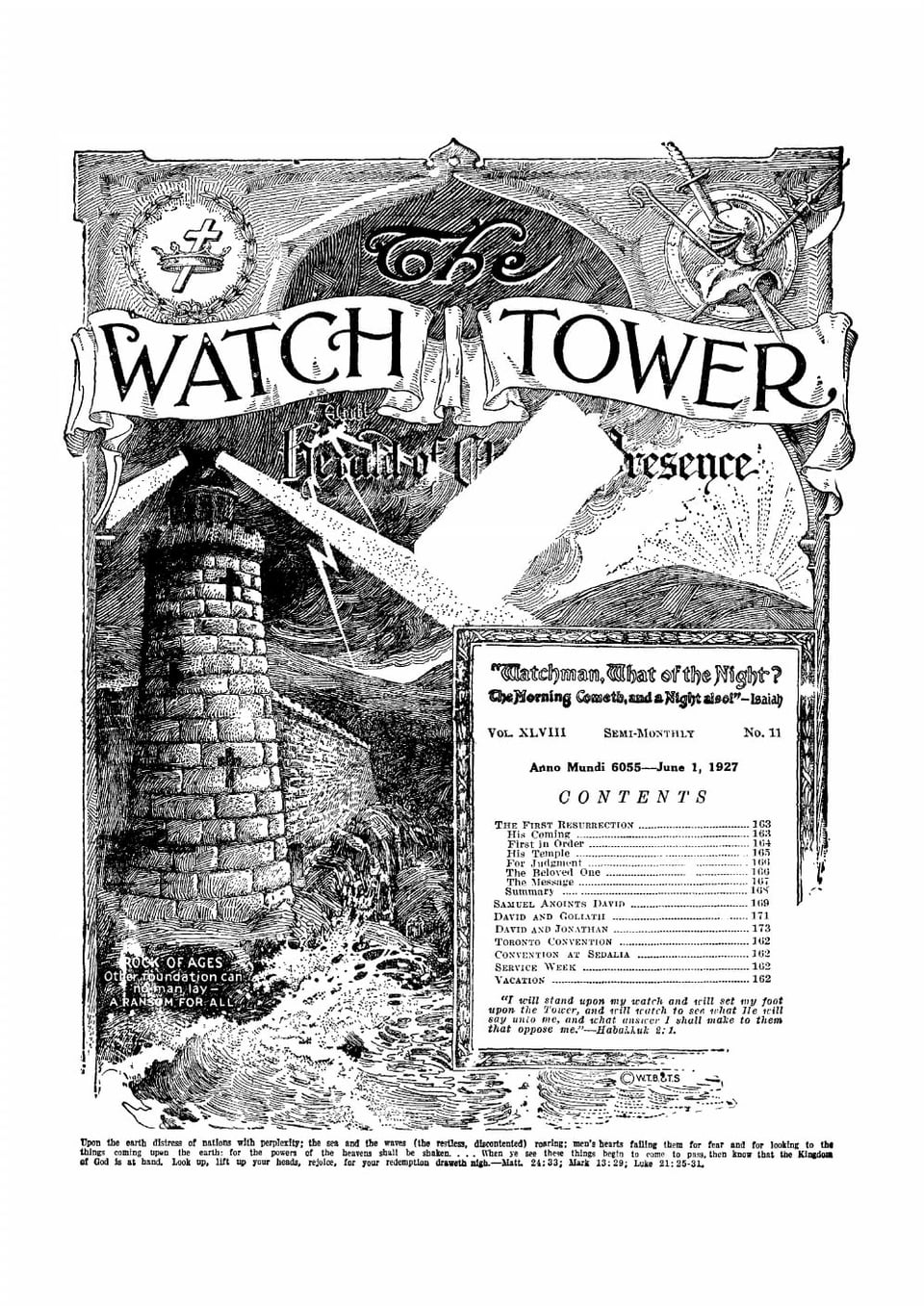
THE WATCH TOWER
"Watchman, What of the Night?
The Morning Cometh, and a Night also!"—Isaiah
VOL. XLVIII SEMI-MONTHLY No. 11
Anno Mundi 6055—June 1, 1927
CONTENTS
THE FIRST RESURRECTION .................................................. 163
His Coming ............................................................................. 163
First in Order ......................................................................... 164
His Temple ............................................................................. 165
For Judgment ......................................................................... 166
The Beloved One .................................................................... 166
The Message ........................................................................... 167
Summary ................................................................................ 168
SAMUEL ANOINTS DAVID ..................................................... 169
DAVID AND GOLIATH .......................................................... 171
DAVID AND JONATHAN ....................................................... 173
TORONTO CONVENTION ..................................................... 162
CONVENTION AT SEDALIA .................................................. 162
SERVICE WEEK ....................................................................... 162
VACATION ............................................................................... 162
"I will stand upon my watch and will set my foot upon the Tower, and will watch to see what He will say unto me, and what He will answer concerning my complaint. And it shall be, when He cometh and speaketh unto me, I shall make to them that oppose me."—Habakkuk 2:1.
Upon the earth distress of nations with perplexity; the sea and the waves (the restless, discontented) roaring; men's hearts falling them for fear and for looking to the things coming upon the earth: for the powers of the heavens shall be shaken. ... When ye see these things begin to come to pass, then know that the Kingdom of God is at hand. Look up, lift up your heads, rejoice, for your redemption draweth nigh.—Matt. 24:30; Mark 13:29; Luke 21:25-31.
THIS JOURNAL AND ITS SACRED MISSION
This journal is published by the WATCH TOWER BIBLE AND TRACT SOCIETY for the purpose of aiding the people to understand the divine plan. It provides systematic Bible study in which all its readers may regularly engage. It gives announcement of the visits made to Bible classes by traveling speakers, announces conventions, and gives the reports thereof. The International Sunday School lessons are treated in harmony with the Scriptures.
It adheres strictly to the Bible as God's revealed Word of Truth. It stands firmly upon the great ransom sacrifice as the fundamental doctrine by which all doctrines are measured. It is free from parties, sects, and creeds of men. It does not assume a dogmatic attitude, but confidently invites a careful examination of its utterances in the light of the infallible Word of God. It does not indulge in controversies, and its columns are not open to personalities.
TO US THE SCRIPTURES CLEARLY TEACH
THAT JEHOVAH is the only true God, the Maker of heaven and earth, and is from everlasting to everlasting; that the Logos was the beginning of his creation; that the Logos became a man; that he is now the Lord Jesus Christ in glory, clothed with all power in heaven and earth.
THAT GOD created the earth for man, created perfect man for the earth and placed him upon it; that man willfully disobeyed God's law and was sentenced to death; that by reason of Adam's wrongful act all men are born sinners and without the right to life.
THAT JESUS was made a human being in order that he might become the Redeemer of man; that he gave his life a sacrifice for man and thereby produced the ransom price; that Jesus the divine son came from the dead, ascended into heaven, and presented the value of his human sacrifice as the redemptive price for man.
THAT for many centuries God, through Christ, has been selecting from amongst men the members of his church, which constitutes the body of Christ; that the mission of the church is to follow in the footsteps of her Lord Christ Jesus, grow in his likeness, give testimony to the name and plan of Jehovah God, and ultimately be glorified with Christ Jesus in his heavenly kingdom; that Christ Head and body, constitutes the "seed of Abraham" through which all the families of the earth shall be blessed.
THAT THE WORLD HAS ENDED; that the Lord Jesus has returned and is now present; that Jehovah has placed Christ Jesus upon his throne and now commands all nations and peoples to hear and obey him.
THAT THE HOPE of the peoples of earth is restoration to human perfection during the reign of Christ; that the reign of Christ will afford opportunity to every man to have a fair trial for life and those who obey will live on earth for ever in a state of happiness.
PUBLISHED BY
117 ADAMS STREET . . . BROOKLYN, N.Y. U.S.A.
OFFICERS
J. F. RUTHERFORD President
W. E. VAN AMBURGH Secy & Treas.
YEARLY SUBSCRIPTION PRICE: UNITED STATES, 1.00; CANADA AND MEXICO,1.25; BRITISH ISLANDS, AUSTRALIA, NEW ZEALAND, SOUTH AFRICA, &c., American remittances should be made by Express or Postal Money Orders, or by Bank Draft, Canadian, British, South African, Australian, New Zealand, or Mexican. Remittances to Branch offices only. Remittances from scattered foreign territory may be made to the Brooklyn office, but by International Postal Money Orders only.
(Foreign translations of this journal appear in several languages.)
TERMS TO THE LORD'S POOR: All Bible Students who, by reason of old age or other infirmity or adversity, are unable to pay for this journal, will be supplied free if they send a postal card each May stating their case and requesting such provision. We are not only anxious that the poor shall all be on our list continually and in touch with the Berean studies.
Notice to Subscribers: We do not, as a rule, send a card of acknowledgment for a renewal or for a new subscription. A renewal blank (carrying notice of expiration) will be sent with the journal monthly, and the address label changed, when requested, may be expected to appear on address label within one month.
Entered as Second Class Mail Matter at Brooklyn, N. Y. Postoffice. Act of March 3rd, 1879.
TORONTO CONVENTION
If the Lord opens the way for you to attend the convention this year, do so. It will be a blessing to you. (Hebrews 10:25) To go may entail upon you some financial burden, but the Lord will make it up to you in some other way.
The brethren are coming from many parts of the earth. You will be glad to see and encourage one another. You will be better equipped for the service in the days that are to follow. There will not be many more conventions on earth. Each one further prepares the anointed for the general assembly of the first-born. Arrange your vacations suitable to attend the Toronto convention July 18th to 26th.
For rooming accommodations address the Convention Committee, 38-40 Irwin Ave., Toronto 5, Ontario, Canada.
EDITORIAL COMMITTEE
J. F. RUTHERFORD
W. E. VAN AMBURGH J. HEMERY R. H. BARBER E. J. COWARD
FOREIGN OFFICES: British: 34 Craven Terrace, Lancaster Gate, London W. 2; Canadian: 38-40 Irwin Avenue, Toronto, Ontario; Australasian: 495 Collins St, Melbourne, Australia; South Africa: 6 Lele St, Cape Town, South Africa. Please address the Society in every case.
VACATION
The Society, following its usual custom of giving a two weeks vacation to all the office and factory force, has arranged for the vacation for this year to begin July 16th and end July 30th. During that period of time will be the International Convention at Toronto. During the convention the office, factory and home will be closed, only a guard being left in charge. In ordering books and literature please have in mind the convention period, during which the office will be closed.
SERVICE WEEK
The Lord heretofore has blessed the efforts put forth by the friends annually, in engaging in one week of special service. August 28th to September 5th is set aside this year for Service Week. Notice is given now that the classes everywhere may make their arrangements so that they can devote as much time as possible during that week to service. Service directors will please make special arrangements for the service activities during that week. The Service Week as observed this year will close on Labor Day; and that should be made a special drive day, concluding with a testimony meeting on the evening of September 5th. This matter should be kept before the Lord that we may have his blessing.
CONVENTION AT SEDALIA
The Missouri State Fair will be in session at Sedalia, Mo., August 21st to 28th. This being an opportune time for a convention of the Bible Students, arrangements have been made to hold such a convention there August 21st to 24th. Brother Macmillan will be the chief speaker and will address the public, and there will be other visiting pilgrims. All the surrounding classes are invited to cooperate with Sedalia in arranging for this convention, especially for the Service Day.
The WATCH TOWER
AND HERALD OF CHRIST'S PRESENCE
Vol. XLVIII
JUNE 1,1927
№ 11
THE FIRST RESURRECTION
"Behold, I shew you a mystery: We shall not all sleep, but we shall all be changed, in a moment, in the twinkling of an eye, at the last trump: for the trumpet shall sound, and the dead shall be raised incorruptible, and we shall be changed."—1 Corinthians 15:51, 52.
IN THIS text the apostle discussed the first resurrection. In Revelation 20:6 it is called "the first resurrection" because it is the resurrection of The Christ, both Head and body members thereof. None other will ever receive immortality and be immune from the second death. This resurrection therefore is the first in that it is of primary importance, and first in that it is the earliest in time.
2 No one can have a part in that first resurrection except Christ Jesus and his body members. Hence every one else must be excluded from consideration. The great company class of course has no part in it, because not a part of The Christ. The inspired apostle limits that resurrection to The Christ when he says: "This mortal must put on immortality." (1 Corinthians 15:54) The reference is to that class of Christians who patiently continue in well doing, seeking for glory, honor and immortality, and who are faithful even unto death.—Romans 2:7; Revelation 2:10.
3 Not all the members of the body of Christ will be resurrected at the same time. That conclusion is warranted by the words of the apostle when he says: "Behold, I shew you a secret: We shall not all sleep, but we shall all be changed." This language shows two separate divisions of the same class; that is to say, one part of those who participate in the first resurrection sleep and are awakened out of the sleep of death, and another part or division of those who have part in the first resurrection do not sleep in death but are changed instantly from human to divine nature.
4 In our text the apostle indicates that those who have slept in death shall be raised first, and that thereafter comes the change of those who are on the earth at the time of the Lord's presence. In this same epistle he has shown that the resurrection of the sleeping saints does not take place until the coming of the Lord. The word "coming" here used means at or during his presence. To here consider some texts relating to the second coming of the Lord may throw some light upon the time of the resurrection.
HIS COMING
5 The presence of the Lord has been difficult to explain and to clearly understand. Many have labored under the impression that the Lord Jesus must be bodily in the very vicinity of the earth in order to be present. Such a conclusion is unreasonable. Distance is no hindrance to the Lord. He could be in the Pleiades and at the same time direct the affairs of earth as well as he could if he were on the immediate surface of the earth.
6 We understand that the presence of the Lord began to be made manifest about 1874, that he took his great power and began his reign in 1914, and that he came to his temple in 1918. Some one in his confusion has inquired: "Did the Lord come to the earth in 1874 and then go back and come again in 1914, and then go back to heaven and come again in 1918, and then go back to heaven to come again at the final overthrow of Satan's organization?" Surely not. There would be no necessity for such a procedure.
7 The Scriptures bear out the following conclusion, to wit: that Jesus Christ, when he had finished his sacrifice and ascended on high, sat down on the right hand of Jehovah God, and from that time forward waited until the time when the enemy should be made his footstool. (Hebrews 10:12, 13; Psalm 110:1) From the time of his resurrection the world belonged to the Lord Jesus Christ, but the time for him to take possession was a long time in the future. He must wait until God's due time, and that due time would be at the end of the Gentile Times or "end of the world".
8 Prior thereto it was the will of God that Jesus Christ should do a work of preparation. That work included gathering together the saints on earth who had made a covenant with Jehovah by sacrifice and restoring to them the fundamental truths which had long been hid from them. That marked the beginning of the time of restitution. (Psalm 50:5; Matthew 17:11) Now the Scriptures show that our Lord's presence began about 1874. That was when he began to give his attention to preparing the saints and restoring to them the truth, and also preparing to oust the Devil.
While doing this work the Lord Jesus is still at the right hand of Jehovah God, and at the same time he is present in the earth, because directing the things of his church on earth as above stated.
9 From the time shortly following 1874 forward the truly consecrated, begotten and anointed ones, could discern the presence of the Lord. The word translated "coming", from the Greek word parousia, means presence. His presence when once begun continues without interruption. It means that from that time forward he is giving his attention to things pertaining to his church and kingdom, as these things have to do with the saints on the earth.
10 The question which Jesus' disciples propounded to him was: "What shall be the sign of thy presence, and of the end of the world?" (Matthew 24:3) The end of the world came in 1914. Jesus was then present and had been present since 1874. The anointed had discerned his presence for several years prior to 1914, but with 1914 there began to transpire such things as manifested his presence to others aside from the anointed. The World War and attending circumstances enabled all who read the Scriptures and believed them to see the presence of the Lord. That time is represented by the Greek word epiphanian, which is properly translated in the Scriptures "appearing". Thus from 1914 forward another and different class of people were able to understand his presence who had not previously, and who could not previously, understand.
11 Stated in another way: Jesus was present but unobserved by all except the spiritually minded from 1874 forward. Later, to wit, 1914, his presence began to be made known or manifest, by the physical facts, to all who gave attention to prophecy, but not to scoffers and unbelievers. Then the outward manifestation of his presence continued to increase or progress, and will continue until the complete uncovering [apokalupsis], when all shall see him. That uncovering or complete revelation of his presence will take place during the great time of trouble.
12 The title of the Book of Revelation is translated from the Greek apokalupsis, which means to reveal; and this revelation of the Lord to all mankind takes place in the great time of trouble, as it is written: "Behold, he cometh with clouds; and every eye shall see him, and they also which pierced him: and all kindreds of the earth shall wail because of him."—Revelation 1:7.
13 It is during the presence [parousia], and during a wider manifestation of his presence or appearing [epiphanian], that a greater number discern the Lord's presence; and it is during his parousia and epiphanian that the Devil's organization is to be destroyed in the great time of trouble. This is clearly shown by the words of the apostle: "Then shall that Wicked [Devil's organization] be revealed, whom the Lord shall consume with the spirit of his mouth, and shall destroy with the brightness [epiphanian or shining forth] of his coming [parousia or presence]." (2 Thessalonians 2:8) There are not three phases of the Lord's presence, as some have erroneously stated; but the presence of the Lord, beginning at a time certain, continues to be made known to other classes of people until all shall know it; and these progressive steps are as follows: parousia, epiphanian and apokalupsis. It would not be necessary for the Lord to be actually near the earth during any of these manifestations.
14 Other scriptures heretofore examined on this subject show that the resurrection of the sleeping saints must take place during the presence of the Lord and after the Lord has taken his power and therefore during the time of his appearing [epiphanian], or wider manifestation of his presence. This latter period began with the World War in 1914. It follows then that 1914 marks the beginning of the period of time which the Apostle Paul mentions as "that day". It does not mark, however, the end of that day. The Apostle Paul said: "There is laid up for me a crown of righteousness, which the Lord, the righteous judge, shall give to me at that day; and not to me only, but unto all them also that love his appearing." (2 Timothy 4:8) While "that day" began in 1914, it does not at all follow that the resurrection of the sleeping saints took place at the beginning or even during 1914.
FIRST IN ORDER
15 The Scriptures leave no doubt concerning the order of the resurrection. During the presence of the Lord some of the saints are asleep in Christ Jesus, while others remain alive on the earth. The sleeping or dead ones must be resurrected first, and then thereafter those who remain on the earth will be changed instantly into the likeness of the Lord. The apostle's words make it clear that this is the order of the resurrection, when he wrote: "For this we say unto you by the word of the Lord, that we which are alive, and remain unto the coming of the Lord, shall not prevent them which are asleep. For the Lord himself shall descend from heaven with a shout, with the voice of the archangel, and with the trumpet of God: and the dead in Christ shall rise first: then we which are alive and remain, shall be caught up together with them in the clouds, to meet the Lord in the air: and so shall we ever be with the Lord."—1 Thessalonians 4:15-17.
16 In the above text the word "descend" would not necessarily mean that Christ Jesus must take a flight from heaven to earth. The word, as shown by lexicographers, is often used in a figurative sense; and it appears to be used figuratively here. It can therefore properly be understood as meaning that at this particular time mentioned the Lord specially directs his actions to things on the earth, which is below heaven, and at the same time he himself may remain in heaven. This scripture says that he comes with a shout, which word according to the weight of authority means "a command", such as is given by a general or marshal of an army.
We should understand this then to mean a command of the great General of Jehovah God, in command of the hosts of Jehovah.
17 The Scriptures show that Jesus must remain at the right hand of Jehovah, inactive as against Satan's organization until a time certain. Then he goes forth at Jehovah's direction. This makes it certain that the Lord Jesus Christ would not give the "shout" or command mentioned by the Apostle Paul until the time when he is sent forth at the end of the period of waiting. (Psalm 110: 1, 2) The end of that period of waiting was at "the end of the world", in 1914.
18 It is also reasonable that this military command concerning things pertaining to the earth would be given when the fight between Christ and the Devil had ended, and after the Devil was expelled from heaven. Concerning this fight in which Satan was cast out of heaven it is written in Revelation: "And I heard a loud voice saying in heaven, Now is come salvation, and strength, and the kingdom of our God, and the power of his Christ." (Revelation 12: 10) This would seem to fix the time when the shout or the command is given by the Lord. It is the voice or command of the archangel, which shows therefore that it is the command of him who is now in supreme authority.
19 The words used by St. Paul, namely, "shout," "archangel," and "trump of God", show that the command is given by him who is in absolute authority and who is in action as the Executive Officer of the great Jehovah God; and therefore the text locates the time of the beginning of his active authority in 1914, at the end of the world. The apostle says that this shout or command first takes place, and thereafter the dead shall rise. It follows therefore that the resurrection of the sleeping saints took place some time after 1914.
20 The statement of the inspired witness is that later "the remnant", or those who remain alive after the resurrection of the sleeping saints, will be caught up together with those who have been previously resurrected and who are with the Lord. The words "caught up together" prove that a number of the saints constituting the remnant will be changed at one and the same time. But at what time?
21 The Diaglott rendering of this text is that the remnant, or those who remain over, "shall be caught away in the clouds." Clouds are symbols of trouble; and since other scriptures show that some of the remnant while in the flesh will see at least the beginning of Armageddon, that would indicate that the completion of the first resurrection will take place during the battle of Armageddon or the great time of trouble. That will be the time when the glorious Lord will be leading the hosts of Jehovah in the final assault upon the Devil's organization. In this trouble, represented by "the clouds", the remnant will be caught up to meet the Lord; so shall they be for ever with him.
22 Rotherham's rendering of this text supports the foregoing conclusions. It reads: "Because the Lord himself, with a word of command, with a chief-messenger's voice and with a trumpet of God shall descend from heaven,—and the dead in Christ shall rise first, after that we the living who are left together with them shall be caught away in clouds to meet the Lord in the air;—and thus evermore with the Lord shall we be!" (1 Thessalonians 4: 16, 17) This shout, command or trumpet call evidently followed the victory of Christ over the Devil, when the Devil was cast onto the earth.
23 Without a question of a doubt there is a lapse of time between the event of the resurrection of the sleeping saints and the change of those who remain on the earth and who constitute the remnant. That period of time begins with the authoritative shout or command from heaven given by the Lord, and ends with Armageddon. It must be borne in mind, however, that within that period of time, to wit, after the resurrection of the sleeping saints and until the completion of the first resurrection, all who die faithful experience their change from mortality to immortality "in a moment" and do not sleep in death. This is the mystery or secret about which the apostle speaks when he says: "We shall not all sleep, but we shall all be changed."—1 Corinthians 15: 51, 52.
24 What could be the purpose of the Lord in awakening the sleeping saints and then some time thereafter giving the remnant their resurrection change? Manifestly one purpose is that during the time that elapses between the awakening of the sleeping saints and the change of the remnant God would have a special witness given to his name amongst the nations of the earth, and the remnant must give that witness. This latter work or witness is the Elisha work of the church.
HIS TEMPLE
25 The anointed and faithful ones constitute the temple of God. (1 Corinthians 3: 16, 17; 2 Corinthians 6: 16; Ephesians 2: 18-23; 1 Peter 2: 5) Such of course include both the sleeping saints and the faithful ones who afterwards have their instantaneous change. When Jesus was about to be taken away he said to his disciples: "And if I go and prepare a place for you, I will come again, and receive you unto myself; that where I am, there ye may be also."—John 14: 3.
26 Jesus went to heaven to prepare a place for his saints. It would seem reasonable that the Lord would complete such preparation before he would come for those who would make up the temple class. The sleeping saints are a part of the temple class. Surely the preparation promised would include the clearing of the Devil out from heaven, since Christ begins his reign by taking possession of heaven and ousting the Devil. In view of the language of the Master and his disciples, it would hardly seem that he would awaken the sleeping saints until this preparatory work was completed.
27 If that reasoning is correct then the resurrection of the sleeping saints would not take place until after the Devil is expelled from heaven. Through his holy prophet God declared that his beloved One should do a preparatory work, and that then he shall suddenly come to his temple. (Malachi 3:1) If this preparatory work spoken of includes the expelling of Satan from heaven, then it would be reasonable to conclude also that the next step would be to awaken the sleeping saints in order that the temple of God might be established.
28 The WATCH TOWER of August 1st, 1926, submits Scriptural proof showing that the Lord came to his temple in 1918. This fact, however, was not known to the saints on earth until some time thereafter. Seeing now that the temple of the Lord is made up of the saints, including those who slept and those who do not sleep, and that the Lord came to his temple in 1918, would not the fact of his coming to the temple at that date fix approximately the time of the resurrection of the sleeping saints? The Lord comes to his temple before the great witness to Jehovah's name is given. It follows then that the temple of God was brought together in 1918, and that that marks the time of the resurrection of the sleeping saints. It is written: "When the Lord shall build up Zion, he shall appear in his glory."—Psalm 102:16.
29 The building up of Zion undoubtedly means the Lord's coming to his temple. That marks the time of his glorious appearing. In this connection let us consider the words of the apostle: "Looking for that blessed hope, and the glorious appearing of the great God and our Saviour Jesus Christ." (Titus 2:13) Neither Jehovah nor Jesus is on the earth, yet the apostle says that he is looking for their glorious appearing. The word "appearing" here is from epiphanía, which means the glorious shining forth or manifestation of the Lord's presence. The blessed hope of the apostle was that he might have a part in the first resurrection, because he so says. (Philippians 3:11) In his statement in the epistle to Titus he seems to fix the time when that hope would be realized; to wit, at the glorious appearing of the Lord, which takes place at the time the Lord comes to his temple in 1918.—Psalm 50:2.
FOR JUDGMENT
30 The Scriptural authority is conclusive that the Lord comes to his temple for the purpose of judgment. (Malachi 3:1-3; Matthew 25:19, 21) Such judgment must begin at the house of God. (1 Peter 4:17) It is after the time when "the nations were angry" that the time comes for "the dead, that they should be judged". (Revelation 11:18) With this thought in mind note the words of the Apostle Paul: "[He] shall judge the living and the dead at his appearing." (2 Timothy 4:1) The word here rendered "appearing" does not mean his coming; but it means that while the Lord is present, and at the time of his shining forth or clearer manifestation of his presence, that judgment begins.
31 The sleeping saints must be first raised. Their raising up constitutes their final judgment, because it is the awarding to them of the prize for which the apostle declared he was running. It is the time of the realization of the blessed hope spoken of by the Apostle Paul, because it marks the time when the sleeping saints come into their everlasting portion. If the Lord came to his temple in 1918, and came for the purpose of judgment, and began the judgment of the saints first, that would be a strong and persuasive argument that the awakening of the sleeping saints took place in 1918 or thereabouts.
THE BLESSED ONES
32 Another text bearing upon the time of the resurrection reads: "And I heard a voice from heaven, saying unto me, Write, Blessed are the dead which die in the Lord from henceforth: yea, saith the Spirit, that they may rest from their labours; and their works do follow them." (Revelation 14:13) This scripture says: "Blessed are the dead which die." How is it possible for one who is dead to die?
33 For example, and to aid in the answering of the question, we shall name one Faithful. When Faithful learned of God's provision for salvation through Christ he made a full and complete consecration to do the will of God. Then God justified him. That justification gave Faithful the right to live as a man. God justified him in order to make him acceptable, and then accepted him as a part of the sacrifice of his beloved Son. At the same time Jehovah begot him to the divine nature. From the time that Faithful was justified he had the right to live as a man; but when he was accepted as a part of the sacrifice of Jesus, and begotten to the divine nature, his right to live as a man ceased; therefore as a man he was dead. Concerning this it is written: "For ye are dead, and your life is hid with Christ in God."—Colossians 3:3.
34 Faithful is now a new creature, but he must actually go into death in order to have part in the first resurrection. Then the instantaneous change will constitute the death of the human and the immediate life of the divine. As a new creature Faithful is in Christ, and if he continues loyal and obedient unto death he dies in Christ. All faithful Christians who die between the time of Pentecost and the beginning of the resurrection during the presence of the Lord must sleep in death. But the Scriptures, in Revelation 14:13, state that a time would come when some saints who die in the Lord would be blessed. When that time is reached then would be true the saying: From henceforth "blessed are the dead who die in the Lord". The reason why they are called "blessed" is that they do not sleep in death but receive their change instantaneously, "in the twinkling of an eye."
35 All the faithful ones at that time will be working, and will continue to work until the time of their glorious change. That change, being instantaneous, will not stop them from working; but their work will no longer be laborious. While in the flesh the true saints doing service in the name of the Lord work and become fatigued and grow weary. But when changed to glorious beings, never more could they again know fatigue or weariness. As they work, their work is a constant and everlasting joy.
36 What marks the beginning of that blessed time? That time could not begin until the sleeping saints are resurrected; and since the evidence shows that the Lord came to his temple in 1918, and that the resurrection of the sleeping saints took place approximately at that time, it follows that from and after that time those who die in the Lord will be blessed, because they would have an instantaneous change from mortality to immortality.
37 When the Lord came to his temple and found some faithful ones he said to them: "You have been faithful over a few things, I will make you ruler over many. Enter into the joy of your Lord." (Matthew 25: 21) These faithful ones here receive the evidence that they were identified with the saved ones; and this is figuratively represented by their being clothed with the garments of salvation and brought under the robe of righteousness; and this brings to them great rejoicing.—Isaiah 61: 10.
38 It follows then that at the time the Lord came to his temple in 1918 those whom he approved at that time, and who thereafter continued faithful unto death, received the crown of life; and since this would be by an instantaneous change from mortality to immortality the scripture would apply to such which says: "Blessed are the dead which die in the Lord from henceforth." (Revelation 14: 13) From that time forward the faithful saints entered instantly into their glorious reward. The context gives a description of those who belong to this blessed class when the Lord comes to his temple, and who continue thus thereafter.
39 We read: "And they sung as it were a new song before the throne, and before the four beasts, and the elders: and no man could learn that song but the hundred and forty and four thousand, which were redeemed from the earth. These are they which were not defiled with women [that is, they have no relationship whatsoever with ecclesiastical systems and denominations or organizations]; for they are virgins [that is to say, they are pure, because wholly devoted to the Lord]. These are they which follow the Lamb whithersoever he goeth [meaning that they hear and understand his commands and joyfully obey them]. These were redeemed from among men, being the firstfruits unto God and to the Lamb [meaning that being approved when the Lord came to his temple, and being brought under the robe of righteousness, they are considered a part of the firstfruits of the resurrection, and that if faithful to the end they are certain to receive the glorious reward. They are not seeking the approval of others but seeking only the approval of the Lord]. And in their mouth was found no guile: for they are without fault before the throne of God."—Revelation 14: 3-5.
THE MESSAGE
40 An angel is a messenger. The faithful remnant, approved when the Lord came to his temple, became the messengers of God, because these are of The Servant; and to such faithful class is committed all the goods of the Lord or interests of the kingdom. (Matthew 24: 46, 47) These constitute "the feet of him", the great Servant or Messenger of God; and in harmony they proclaim his message.
41 The words of the Revelator continue: "And I saw another angel fly in the midst of heaven, having the everlasting gospel to preach unto them that dwell on the earth, and to every nation, and kindred, and tongue, and people." (Revelation 14: 6) Mark that this class proclaim a message "in the midst of heaven". It was after 1918, to wit, in the beginning of 1923, that the message of the Lord's kingdom began to be broadcast regularly by radio. Being broadcast this message flew through the air, which is sometimes spoken of as the heaven.
42 What was and is that message? The everlasting good news to the people who are dwelling on the earth concerning God and his kingdom, which message must go to all the nations of the earth. (Matthew 24: 14) This message is indicated by verse seven: "Fear God, and give glory to him: for the hour of his judgment is come: and worship him that made heaven, and earth, and the sea, and the fountains of waters."—Rev. 14: 7.
43 That which is spoken fearlessly is spoken loudly. A human voice, perfectly trained, is the most harmonious sound ever heard on earth. This indicates that the message given forth by the messengers from that time forward would be a sweet, harmonious message. Since the Lord came to his temple, and since the faithful ones had their minds illuminated and knew that fact, they have joined in one grand, harmonious message, proclaiming the truth. They have not called upon any one to give glory to man or to any other creature, but to give honor and glory to Jehovah God, the Creator of heaven and earth, and from whom comes every good and perfect thing. These have been doing exactly what is described here in Revelation.
44 It must be the temple class this side the veil who are mentioned as the "angel" or Servant or Messenger, in Revelation 14:6. Be it noted that the message delivered is an "everlasting gospel" or good news unto them that dwell on the earth, and to every nation and kindred and tongue and people. This exactly corresponds with the command of the Lord Jesus in Matthew 24: 14, which states: "This gospel of the kingdom shall be preached in all the world for a witness unto all nations; and then shall the end come."
It is generally agreed by Bible Students that the scripture last above quoted did not begin to apply until after the World War, which ended in 1918, and therefore not until the Lord came to his temple. Then it was that the temple class must deliver the message.
45 The sleeping saints were first resurrected and, with those remaining on earth being brought under the robe of righteousness, constituted the temple class. The resurrected saints must have something to do beyond the veil. We are more concerned, however, about what the temple class this side the veil must do. It is manifest that this class must give a special witness; and that witness is to tell every nation, kindred, tongue and people on the earth the good news that Jehovah has set his King upon his throne and that the time for the kingdom and deliverance is at hand. This class must now call upon the people to honor Jehovah God and give him glory, because the time for his judgment upon the nations is come. All the temple class will be able to see and appreciate this marvelous time in which we are living, and will lift up their heads and rejoice and sing.
46 This same class is described by the Prophet Isaiah, in the 52nd chapter, verses seven and eight. Here the prophet speaks of them as the "feet of him"; showing that they are part of The Servant, therefore part of the temple class; and that they bring good news and publish peace and salvation, and that together they lift up the voice and sing. Undoubtedly the "voice" here is a symbol of the message referred to in Revelation fourteen, and it means the message of the kingdom.
47 The prophet here furthermore encourages this class to break forth into joy and sing together, and to call even upon those in the Babylonish systems to hear the message and pass it on to their brethren. Then the prophet (Isaiah 52:10) indicates that the Lord will reveal himself to all the nations, and that all the ends of the earth shall see the salvation of God. The context shows that before this takes place, however, the temple class must give the witness, while the saints on the other side are performing the duties assigned to them. What a blessed and marvelous combination, and what a sweet relationship! Those on this side the veil having on the garments of salvation, under the robe of righteousness, are working together with their resurrected brethren, knowing that their individual dissolution means an immediate transfer from earth to heaven. It means the glorious change into the likeness of our Lord and to be for ever with him.
48 How wonderfully the physical facts show the fulfilment of this prophecy since 1923! Since that time more than twenty-seven million volumes of books carrying the message of God's kingdom have gone into the hands of the people. In addition thereto the message in the form of free tracts, resolutions, proclamations, etc., numbering many millions, have been distributed throughout the earth. The radio has carried the message of the kingdom from Holland, Spain and other parts of Europe; more than a dozen radio stations in the United States and Canada are now regularly broadcasting the message of the kingdom of God. Two stations are being built in Australia for broadcasting the truth, while other methods are employed for telling the glad tidings. Never have the saints on earth been so joyful. They know now that death means to them a blessed change if they are faithful unto the end. Therefore they fear neither man nor Devil, but delight to represent the Lord. There is much to be done, and happy are they who have a part in it.
SUMMARY
49 What then is the sum of these scriptures here examined as they appear? The presence of the Lord began in 1874. He was there at the right hand of Jehovah God; yet, in harmony with God's will, he there began a special work with and in behalf of his saints on earth, to wit, gathering them together and restoring to them the truth, and making preparation to overthrow Satan's rule and to receive the saints unto himself. His presence continued uninterrupted. In 1914 it was manifest to a larger class of people when he stood up, took his power and cast out Satan; and these events were made manifest by physical facts discernible by all watchers. That marked the beginning of his "appearing", the epiphania of his presence.
50His presence continues uninterrupted, and in 1918 the resurrection of the sleeping saints takes place and the Lord brings together his temple. There the judgment of his saints begins. The evidence manifesting his presence continues and increases, and an increased number of people discern it while his saints on earth begin a world-wide proclamation of the message of the kingdom; and this proclamation must continue until his presence is known by all. The complete uncovering of the Lord's presence is his apokatastasis. Now the evil-minded will not hear nor understand; but his presence will be completely made known even to them, in the great time of trouble. "And then shall they see the Son of man coming in a cloud with power and great glory." (Luke 21:27) Then the Devil's organization, made manifest to all, will be destroyed by the brightness of his presence.—2 Thessalonians 2:8.
51 Let no one slack his hand now. Let his joy abound. It must be that unto the faithful class at this stage particularly the Master addressed his words when he said: "When these things begin to come to pass, then look up, and lift up your heads; for your redemption draweth nigh." (Luke 21:28) The resurrection of the sleeping saints took place in 1918. The remnant is under the robe of righteousness and have the garments of salvation. Those who continue faithful to the end will be finally of the "remnant". Before their change and before the battle of Armageddon the nations of the earth must have the witness. Blessed is the man who has a part therein. Let every one who loves the Lord put everything else in the background and press on in the fight, and joyfully sing that sweet and blessed song which God provided should be understood and sung only by those specially redeemed from the earth and brought into his holy temple.—Revelation 14:3.
QUESTIONS FOR BEREAN STUDY
What is the first resurrection, and why is it so called? Will the great company share therein? Will all the body members of Christ be raised at the same time? Quote a scripture in support of the answer. ¶ 1-3.
When was the resurrection of The Christ to take place? Of what does the Lord's second presence consist? When did it begin? When did Christ Jesus begin his reign? When did he come to his temple? Does this indicate three comings? ¶ 4-6.
From what time did the world belong to our Lord? When was he to take possession of it? What was he to do in the interim? ¶ 7, 8.
Explain the Lord's parousia, epiphania and apokalupsis. When will the Devil's organization be destroyed? ¶ 9-13.
When did "that day" of 2 Timothy 4:18 begin? Explain 1 Thessalonians 4:15-17. How does our Lord "descend", and what is meant by the "shout", the "voice of the archangel" and "the trump of God"? When did these occur? ¶ 14-19.
Who will be "caught up together" to meet him, and when? When will the first resurrection end? What are the Diazalet and the Rotherham renderings of 1 Thessalonians 4:16,17, and wherein do they differ from the Common Version? ¶ 20-22.
Will there be a lapse of time between the awakening of the sleeping saints and the glorification of the remnant, and if so why? ¶ 23, 24.
Who comprise the temple class? What is meant by the statement, "I go to prepare a place for you"; and when would that preparatory work be completed? ¶ 25, 26.
Is it reasonable that the sleeping saints would be awakened before the Devil is expelled from heaven? In view of this, why added force is given to the coming of the Lord to his temple in 1918, and to P-salm 1:2; 16? ¶ 27-29.
Why does the Lord come to his temple? Where was judgment to begin, and how? When were the nations "angry", and what was to occur thereafter? (Rev. 11:18) Explain 2 Timothy 4:1 in this connection. ¶ 31, 33.
Read Revelation 14:13 and exp. in why it is said that the dead die? Why are they called "blessed"? Do their works stop when they die? What marks the beginning of that blessed time? ¶ 32-37.
Explain Revelation 14:3, 4. ¶ 38, 39.
Who is the "angel" of Revelation 14:6? Explain this verse and its setting. How does this text agree with Isaiah 52:7, 8, 10? ¶ 40-47.
What are the physical facts in corroboration? Summarize the Biblical facts reviewed in this lesson. In view of these things, what should be our present attitude as members of the "remnant"? ¶ 48-51.
SAMUEL ANOINTS DAVID
"Let no man despise thy youth; but be thou an ensample to them that believe, in word, in manner of life, in love, in faith, in purity."—1 Timothy 4:12, R. V.
WE HAVE already said that when Samuel spoke his farewell to Israel his work for them was not finished. He had accomplished the task set for him; the people were settled in such fashion as would enable them to enjoy the blessings of God as a family in the land of their promise, and in the new system of judicature he had provided a national bond which was suited to their need. Since their entrance into Canaan Israel had never been so well fixed as then.
2 Now that Israel had asked for and had been given a king, Samuel was no longer responsible for the welfare of the people. But he was still the servant of Jehovah, and as God's representative it became his unhappy task of conveying to King Saul God's final message of his rejection from the throne of Israel. Saul himself was not to be de-throned by any direct action on God's part, but his house was cut off; his son was not to rule after him. Also, it was Samuel's office to anoint another to be king in place of Saul.
3 It is evident that Saul did not keep his balance long. Soon after he had begun his reign the Philistines again crowded in upon Israel, oppressing them; indeed their pressure had never been fully removed since Samson's day. Saul took measures to oppose the Philistines; and encouraged by a successful raid by Jonathan his son, he sent a trumpet call to all Israel to gather to Gilgal, where Samuel would meet them. Meanwhile the Philistines gathered in great force, and with horsemen and chariots; and Saul's men became fearful and began to desert him. Even Samuel seemed to delay. Perhaps Samuel was testing Saul, by not appearing early on the day appointed.
4 Instead of waiting for the priest, Saul, who knew he had no authority to offer a sacrifice, took upon himself to do this. He was impatient, and was without faith in God. His action was sinful in itself, and showed him to be presumptuous before God. Samuel was much moved, and said, "Thou hast done foolishly: thou hast not kept the commandment of the Lord thy God, which he commanded thee: for now would the Lord have established thy kingdom upon Israel for ever. But now thy kingdom shall not continue: the Lord hath sought him a man after his own heart, and the Lord hath commanded him to be captain over his people, because thou hast not kept that which the Lord commanded thee."—1 Samuel 13:13-14.
5 By a daring act on the part of Jonathan and his armor-bearer, stimulated by faith in God, it came about that the Philistines' army was put to flight.
Saul had the privilege of leading his men in the running fight which followed the confusion and flight of the Philistines; but it was not his victory, it was Jonathan's day.
6 When Saul was established in the kingdom God gave him an important commission, one for which time had long been waiting. In pursuance of his purpose to smite the Amalekites, as declared when that people attempted to stop Israel in their journey to Canaan (See Exodus 17: 8-14.), Saul was now commanded to do this work. (1 Samuel 15: 2, 3) The story of how he acted the hypocrite in this matter is so well known that it has become a typical instance of glaring hypocrisy. Commanded to destroy, he chose to disobey, acting as if he had a right to exercise his own judgment as to how God's command should be carried out. Yet he made profession to Samuel, whom God sent to inquire as to the work done, that he had done everything that he had been told to do. Explicitly he said he had fulfilled the command. Samuel said, "What meaneth then this bleating of the sheep in mine ears, and the lowing of the oxen which I hear?" (1 Samuel 15: 14) Then Saul began to make excuses, and his hypocrisy was manifest.
7 It is conceivably possible that Saul might have retrieved himself from the position in which he was involved by his presumption in offering the sacrifices at Gilgal if he had been faithful in this commission to destroy the Amalekites—Samuel's words of remembrance and counsel seem to indicate this—but the wilfulness of Gilgal had now developed to persistent hypocrisy. Samuel then showed Saul that the kingdom was rent from him. Yet this was hidden from the people, for they needed a leader; and the one whom God had in view was not yet ready for this work, nor the people ready to understand Saul's rebellion. Thus Saul had put himself into the terrible position of being accepted by the people as a God-appointed leader, while at the same time he well knew that God had cast him off. Yet as he was God's king he still could have help from God until the time came for his office to be taken from him.
8 Samuel was now told by the Lord to go to Bethlehem to the house of Jesse of the line of Judah, from whose sons God would choose a king; but owing to Saul's wilfulness even Samuel was fearful of going to Bethlehem on this commission. But God gave him assurance. Samuel was told to go to sacrifice and to call Jesse and his sons. Jesse brought seven of his sons before Samuel, evidently a company of fine young men. Samuel was so moved by the eldest as he came before him that he thought surely this was the one whom the Lord had sent him to anoint.
9 But the Lord held Samuel back, and showed him that none of the seven was his choice. On being questioned Jesse said that his youngest son, yet a boy, was in the fields minding sheep. When he was brought before Samuel the prophet was told by Jehovah that this was the one for whom he had been directed to visit Bethlehem; and then over the head of David the shepherd boy was poured the anointing oil, which meant that some day he would be king in Israel.
10 Samuel must have contrasted this experience with his first, when he anointed Saul. Saul was head and shoulders above Samuel, and had to bow his head while the prophet had poured the oil upon him; now Samuel must stoop and anoint a ruddy-faced little boy. God, nevertheless, gave his aged servant a consolation of heart; for Samuel had loved Saul and clung to him, almost pleading to God for Saul. (1 Samuel 16: 1) That his heart now warmed to the boy David is manifest, and it became easy for him to acquiesce in the will of God.
11 Perhaps the chief lesson of this incident is in Jehovah's word to Samuel when Eliab came before him. When Samuel, seeing that Eliab was a well-built, well-favored young man, had said, "Surely the Lord's anointed is before him," Samuel was told, "Look not on his countenance, or on the height of his stature; because I have refused him: for the Lord seeth not as man seeth; for man looketh on the outward appearance, but the Lord looketh on the heart." (1 Samuel 16: 7) It appears as if Samuel still retained the idea which had been foremost in the minds of the people when Saul was chosen king; namely, that a king should be one who outwardly looks as if he would make a leader of men. Samuel, left to his own judgment, would willingly have anointed Eliab.
12 It is not easy even for God's servants, though faithful to him as Samuel was, to keep from judging outwardly; God's people need the help of the holy spirit to discern true values. The calamity of Saul's wilfulness now forced home the lesson that that which God finds most useful to him is heart obedience. Later it was demonstrated that at heart Eliab was of a jealous and small mind, not such a one to whom God could intrust the interests of his peoples; but that the boy David was ever desirous of seeking the will of Jehovah was abundantly demonstrated. No two men could give more pointed illustrations of differences of heart than the first two kings of Israel, though they were alike in some phases of temperament; for on occasion both were as impetuous as a river in flood or a mountain stream in spate.
13 The boy David might be conceived of as having every temptation to develop pride; but after his anointing he was just as willing as before to go back to the fields to mind his father's sheep. Even from those earliest days David always kept in mind that the king of Israel was the anointed of the Lord, and that Jehovah was really King in Israel. There is no evidence that as a boy he began to think what he would do for himself when he became king, nor any such evidence later; but there is much to show that in the days of his youth, even in the fields of Ephratah, he thought of what he would do for the glory of God when he became king in Israel.—Psalm 132: 6.
14 When Samuel told Saul that God had put him away from the kingdom the prophet said that God had chosen a man after his own heart. Saul, the wilful man, had developed into a self-seeker. David's life proved that he too was a man of strong will and purpose, but he ever used that strength of will for the good of the people and for the glory of the God of Israel. As a young man Saul had shown little evidence of being high-minded, but now he had allowed himself to be overcome by his position. The young boy David had evidently already submitted himself to righteousness, as his boyish humility shows.
15 There is no evidence that God needed to change the heart of the boy David; his young mind was already set upon right ways. In this he was like Samuel, who anointed him; and the old man's heart must have gone out to the lad as Samuel remembered how his own mother had given him to God in childhood. These two learned to love one another; and Samuel was comforted in his heart for the loss of Saul, whom he had placed there and whom he had learned to love in the earlier days of Saul's sincerity.
16 The ruler whom God now chose was of the tribe of Judah. This was according to Jacob's patriarchal blessing on his sons; for he had said that the future ruler of the tribes should come out of Judah (Genesis 49:10), even though that favor might seem to have belonged to Joseph, because he held the birthright. (1 Chronicles 5:1) Joseph's son Ephraim, however, forfeited his chance through self-will and lack of faith. (See Psalm 78:9, 67, 68.) Now God had tried Benjamin, and that tribe also had failed—for it supported Saul in his ways. The way for God to give the rulership to Judah was therefore clear, without any manifestation of favoritism on his part.
17 There is a pictorial significance which this story carries, in common with its fellows. The anointing of David many years before he could be king represents God's preparation at this present time, when he would lead all who would hear out of the unfortunate position in which they have been placed by those unfaithful servants, the clergy class who, like Saul, have misused their privileges. These are now cast off, and God has others to do his work.
18 The time when the kingdom of heaven was due to be set up in authority was when the Gentile times ended in the year 1914 A. D. Forty years before that date God began to give the light of truth; and there were some who, like David, began to serve the Lord by it. A company was prepared for the time when they would be called to serve, when God would bring them out openly as his chosen instrument. For this great and honored service Jehovah would have those who were not self-servers, but who would seek his interests and the interests of his people.
QUESTIONS FOR BEREAN STUDY
What had Samuel accomplished for Israel prior to and following the anointing of Saul? What two unhappy tasks now fell to his lot? ¶ 1, 2.
Why did Saul summon all Israel to Gilgal? What presumptuous sin did he there commit, and how did Samuel rebuke him? ¶ 3, 4.
Who was the hero of the battle with the Philistines on this occasion? What divine command had been given to Saul, and how did he disobey it? What final message did Samuel now deliver unto him? ¶ 5-7.
What commission now came to Samuel, and what were the incidents in this connection? What great lesson may we learn therefrom? ¶ 8-12.
What were the similarities and contrasts between Israel's first two kings? ¶ 13-15.
Of what tribes were Saul and David respectively? What was Jacob's ancient prophecy in this regard? What did the casting off of Saul, and the anointing of David several years prior to his induction into office, aptly illustrate? ¶ 16-18.
DAVID AND GOLIATH
—JULY 24—1 SAMUEL 17—
"Jehovah is the strength of my life; of whom shall I be afraid?"—Psalm 27:1.
THE graphic story of the giant Goliath and the youth David, and how David killed the boasting giant, might have been written for youth. It certainly has inspired many a young man to deeds that have appeared to be above his strength, trusting in the help of God; and it has stirred the heart of many besides those of young years. But the story was not written to stir the heart of youth, nor merely to give to us a historic account of an unusual event. It is part of those sacred writings which are intended to spiritually instruct the man of God.—Romans 15:4.
2 The event had a great effect on the life of David; indeed, it marked a turning point in his life. Through it he was changed from youthhood to manhood, from a shepherd to a man of affairs at court. It took him from the sheepfolds of Bethlehem to prominence in the eyes of the people.
3 The Philistines who at that time continued to distress Israel do not appear to have disturbed Bethlehem in their raids. Generally they took a more northern course, or kept to the western side of the ridge of hills which runs north and south across the country. They were Israel's hereditary enemies; and they crowded upon the chosen people even as in later days the Devil has tried to distress the disciples of Jesus, and would rob them of their peace.
4About the time David was anointed, a giant, evidently related to the stock which now and again "sported" these monstrosities, was growing up amongst the Philistines in Gath. He was Goliath of Gath. The Philistines had invaded Israel, and Saul had gathered his army. But instead of either army attacking the other—perhaps neither felt strong enough to take the offensive—the Philistines put forward this Goliath as their champion as against any champion of Israel, with the professed agreement that if Israel's champion won the single combat the Philistines would be the Israelites' servants; while if the Philistines won the combat, then Israel was to submit to the Philistine domination.
5 The Philistines were wise in their suggestion; for the giant fighting in ordinary battle, with other soldiers on his right and left, would have been little more than merely an unusually big soldier; and his size might have even prevented him from being of special service to his army. On Israel's side King Saul was the only one who could be compared with Goliath in height. But Saul was not the kind of man to undertake such a combat. Head and shoulders taller than any of the men of his army, yet he made no move; and the sneers of Goliath were borne for forty days.
…