The Watchtower, March 15, 1924
Download: PDF — The Watchtower, March 15, 1924
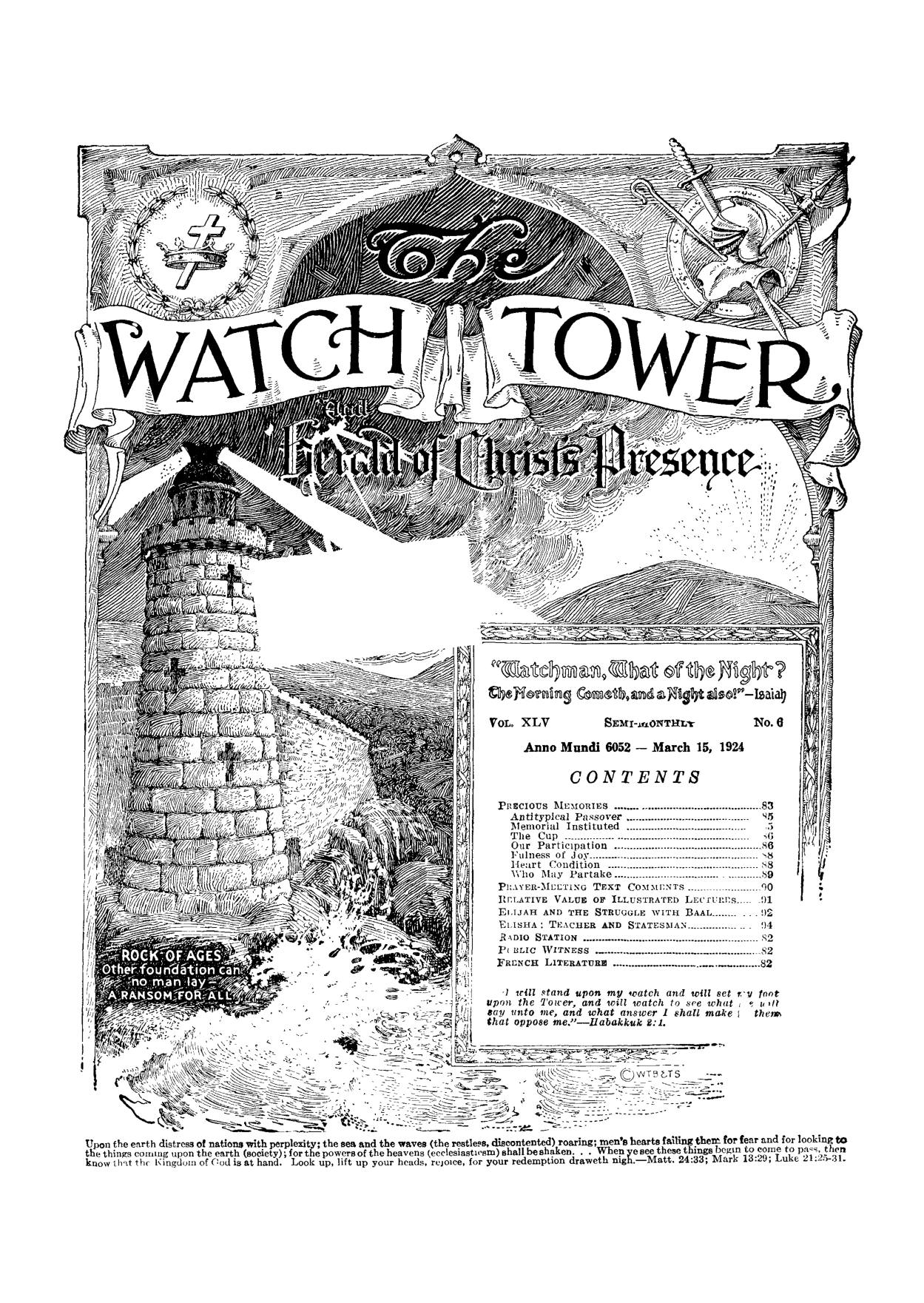
Elijah and the Struggle with Baal.. Elisha : Teacher and Statesman..........
.Radio Station .......-..................................
pi blic Witness —________________________________
French Literature ___________________________.....
No.6
.. 82
...82
-82
...86
.. s8
.. 88
...89
...90
.83
Upon the earth distress of nations with perplexity; the sea and the waves (the restless, discontented) roaring; men s hearts failing them for fear and for look ng to the things coming upon the earth (society); for the powers of the heavens (ecclesiasticsm) shall be shaken. . . Whenyesee these_things begin to come to Jncn know that the Kingdom of Cod is at hand. Look up, lift up your heads, rejoice, for your redemption draweth nigh.—Matt. 24:33; Mark lo.JJ, Luke 2 . ■■>31.
"ROCK OF AGES Other fo u riel at i on can*
ARANSOM'FOR
WJferamg amd a!s@S”-Iaaial)
Vol. XLV
SEMI-iaONTHtt-
Anno Mundi 6052 — March 15, 1924
CONTENTS
Precious Memories ...............
Antitypical Passover............
Memorial Instituted ............
The Cup ...............................
Our Participation ................
Fulness of Joy........................
Heart Condition ..................
Who May Partake................
Prayer-Meeting Text Comme
Relative Value of Illustrated Lectures..... .91
•7 will stand upon my watch and will set t, v foot upon the Tower, and will watch to see what , * util gay unto me, and what answer I shall make 1 then* that oppose me”—Habakkuk 2:1,
THIS JOURNAL AND ITS SACRED MISSION
THIS Journal Is one of the prime factors or instruments in the system of Bible instruction, or “Seminary Extension”, now being presented in all parts of the civilized world by the Watch Tower Bible & Tract Society, chartered A. D. 1884, “For the Promotion of Christian Knowledge”. It not only serves as a class room where Bible students may meet in the study of the divine Word but also as a channel of communication through which they may be reached with announcements of the Society’s conventions and of the coming of its traveling representatives, styled “Pilgrims”, and refreshed with reports of its conventions.
Our “Berean Lessons” are topical rehearsals or reviews of our Society’s published Studies most entertainingly arranged, and very helpful to all who would merit the only honorary degree which the Society accords, viz., Verbi Dei Minister (V. D. M.)» which translated into English is Minister of God’s "Word. Our treatment of the International Sunday School Lessons is specially for the older Bible students and teachers. By some this feature is considered indispensable.
This journal stands firmly for the defense of the only true foundation of the Christian’s hope now being so generally repudiated —redemption through the precious blood of “the man Christ Jesus, who gave himself a ransom [a corresponding price, a substitute] for all”. (1 Peter 1 :19 ; 1 Timothy 2 : G) Building up on this sure foundation the gold, silver and precious stones (1 Corinthians 3: 11* 15; 2 Peter 1:5-11) of the Word of God, its further mission is to “make all see what is the fellowship of the mystery which. , .has been hid in God, ... to the intent that now might be made known by the church the manifold wisdom of God”—“which in other ages was not made known unto the sons of men as it is now revealed”.—Ephesians 3 : 5-9,10.
It stands free from all parties, sects and creeds of men, while it seeks more and more to bring its every utterance Into fullest subjection to the will of God in Christ, as expressed in the holy Scriptures. It is thus free to declare boldly whatsoever the Lord hath spoken—according to the divine wisdom granted unto us to understand his utterances. Its attitude is not dogmatic, but confident; for we know whereof we affirm, treading with implicit faith upon the sure promises of God. It is held as a trust, to be used only in his service; hence our decisions relative to what may and what may not appear in its columns must be according to our judgment of his good pleasure, the teaching of his Word, for the upbuilding of his people in grace and knowledge. And we not only invite but urge ou< readers to prove all its utterances by the infallible Word to which reference is constantly made to facilitate such {rating,
TO US THE SCRIPTURES CLEARLY TEACH
Chat the church is “the temple of the living God”, peculiarly “his workmanship” ; that its construction has been in progress throughout the gospel age—ever since Christ became the world’s Redeemer and the Chief Corner Stone of his temple, through which, when finished, God’s blessing shall come “to all people”, and they find access to him.—1 Corinthians 3:16, 17; Ephesians 2 :20-22; Genesis 28:14; Galatians 3 : 29.
That meantime the chiseling, shaping, and polishing of consecrated believers in Christ’s atonement for sin, progresses ; and when thg last of these “living stones”, “elect and precious,” shall have been made ready, the great Master Workman will bring all together in the first resurrection; and the temple shall be filled with his glory, and be the meeting place between God and men throughout the Millennium.—Revelation 15 : 5-8.
That the basis of hope, for the church and the world, lies hi the fact that “Jesus Christ, by the grace of God, tasted death for every man,” “a ransom for all,” and will be “the true light which lighteth every man that cometh into the world”, “in due time”.— Hebrews 2:9; John 1: 9 ; 1 Timothy 2:5, 6.
That the hope of the church is that she may be like her Lord, “see him as he is,” be 4 partaker of the divine nature ,* and share his glory as his joint-heir.—1 John 3:2; John 17:24; Romans 8:17; 2 I’eter 1:4.
That the present mission of the church is the perfecting of the saints for the future work of service: to develop in herself every grace; to be God’s witness to the world; and to prepare to be kings and priests in the next age.—Ephesians 4 : 12; Matthew 24 ; 14 ; Revelation 1:6; 20 ; 6.
That the hope for the world lies in the blessings of knowledge and opportunity to be brought to all by Christ’s Millennial kingdom, the restitution of all that was lost in Adam, to all the willing and obedient, at the hands of their Redeemer and his glorified church, when all the wilfully wicked will be destroyed.—Acts 3:19-23; Isaiah 35.
4PUBM9HHD ey
WATCHTOWER BIBLE Gr TRACT society
18 CONOORD STREET O O BROOKLYN, NV. U-S A
Foreign Offices ; British: 34 Craven Terrace, Lancaster Gate, London W. 2; Canadian: 38-40 Irwin Avenue, Toronto, Ontario; Australasian: 495 Collins St., Melbourne, Australia; South Africant 6 Lelie St., Cape Town, South Africa.
Please Address the Society in Every Cask.
YEARLY SUBSCRIPTION PRICE: United States, 81-00 ; Canada and Miscellaneous Foreign, $1.50 ; Great Britain, Australasia, and South Africa, 7s. American remittances should be made by Express or Postal Money Orders, or by Bank Draft. Canadian, British, South African, and Australasian remittances should be made to branch offices only. Remittances from scattered foreign territory may be made to the Brooklyn office, but by International Postal Money Orders only. (Foreign translations of this journal appear in several languages)
Editorial Committee: This journal is published under the supervision of an editorial committee, at least three of whom have read and approved as truth each and every article appearing In these columns. The names of the editorial committee are: J. F. Rutherford, W. E. Van Amburgh, J. Hbmery,R. H. Barber. Terms to the Lotd's Poor: All Bible students who, by reason of old age or other infirmity or adversity, are unable to pay for this journal, will be supplied free if they send a postal card each May stating their case and requesting such provision. We are not only willing, but anxious, that all such be on our list continually and In touch with the Berean studies.________________________________
Notice to Subscribers: We do not, as a rule, send a card of acknowledgment for a renewal or for a new subscription. Receipt and entry of renewal are indicated within a month by change in expiration date, as shown on wrapper label.
BETHEL HYMNS FOR APRIL
Sunday
6 229
13 122
20 275
27 325
Monday
7 254
14 168
21 9
28 19
Tuesday
1 184 8 125
15 308
22 224
29 120
Wednesday
2 60 9 29
16 133
23 70
30 236
Thursday
3 216 10 95
17 90
24 192
Friday
4 238 11 317
18 231
25 93
Saturday
5 181 12 2
19 278
26 220
PUBLIC WITNESS
It should be remembered that one of the chief commissions to the Church at this time is to give a witness to the kingdom. Pilgrims are sent out for this purpose. We earnestly urge upon the classes that with each Pilgrim visit they make an effort for one public witness. A good hall should be taken, and the meeting well advertised. Remember that it is the witness that is to be given. Do not leave the public witness to local brethren to the exclusion of the Pilgrim brethren. Unless an effort is made to have a well-advertised public meeting when a Pilgrim brother visits a class we think a mistake is made. We hope the classes will proceed in accordance with this, and cooperate fully. When the meeting is on Sunday, a special effort should be made to have it in a well-located hall and thoroughly advertised.
FRENCH LITERATURE
The Society’s office at Brooklyn is supplied with all the French literature of present truth, and our French friend? in America desiring to have any of this literature will please communicate with us. Address Watch Tower Bible & Tract Society, French Department, 18 Concord Street, Brooklyn, New York.
RADIO STATION
The Society’s radio station began broadcasting Sunday evening, February 24. The call letters are WBBR, operating on a 244-meter wave length. The program proceeds daily. Our friends will please tune in their radio receiving sets for this wave length. Kindly report by letter or post card to the Society at 124 Columbia Heights as to the distinctness with which the program is heard.
In order that the friends may not misunderstand, the Society in no way is manufacturing or selling radio sets. We have merely tried to get some information to help the friends buy a cheaper set, but we are not recommending any special set. It will be more satisfactory If each one decides that for himself.
AND HERALD OF CHRISTS PRESENCE
Vol. XLV
Mabch 15, 1924
No. 6
PRECIOUS MEMORIES
"This do in remembrance of me.”—Luke 22:19.
CERTAIN events in the development of the divine plan are specially marked by Jehovah. This seems to have been done for the particular benefit of the new creation. To the new creature in Christ these events are held in precious memory. The great pivotal event, from which radiates the light upon all Jehovah’s plan concerning man, is the sacrificial death of our Lord. This feature of the divine plan particularly makes manifest the love of Jehovah and the love of our Lord Jesus toward the Church and toward all mankind.
2As we keep in memory the death of our Lord we should also keep in memory the great love of the Father, Jehovah, which provided the unspeakable gift that we might have life and have it more abundantly. The better understanding we have of the love of God the more he becomes our exceeding joy. As our Lord leads us more into the light of his truth the more keenly we can appreciate the words of our prototype David, who wrote: “0 send out thy light and thy truth: let them lead me; let them bring me unto thy holy hill, and to thy tabernacles. Then will I go unto the altar of God, unto God my exceeding joy: yea, upon the harp will I praise thee, 0 God, my God.”—Psalm 43: 3, 4.
3The immeasurable love of God for us was made manifest in providing redemption for us. “But God commendeth his love toward us, in that, while we were yet sinners, Christ died for us.” (Romans 5: 8; 1 John 4:10) This wras the great unselfish sacrifice for us. Our Father would have us keep it in memory. It is a precious memory.
4It was the unselfish love of Jesus to do the Faiher’s will and to deliver us, that led him to the cross for us and for all men. Jehovah would have us keep this in memory. It is a precious memory.
'‘Long centuries ago Jehovah made pictures of the great sacrifice to enable us now more keenly to appreciate the reality. Having fulfilled the picture Jesus instituted a memorial of that fulfilment.
6It is his expressed will that we should keep this in memory. It is a precious memory to us, and becomes more so as we appreciate its significance. As we celebrate the Memorial on the anniversary date the proper time this year is after six o’clock the evening of Friday, April 18.
7 A thing that is precious in our memory we love to talk over together. It is sacred to us. As we approach the Memorial season the events leading up to and foreshadowing the death of our Lord crowd in upon the mind, and we love to recount them. Hence The Watch Tower delights to speak each year of things precious to our memory. These are not new in fact, but so beautifully sweet that they seem new every morning and fresh every evening.
THE PICTURE
8At the death of Jacob the Israelites became the people of God, chosen for a purpose. That purpose was to foreshadow the development of the new creation. The Israelites were domiciled in Egypt, serving under the iron and despotic rule of Pharaoh. That tyrannical ruler was a type of Satan, and his supporters typified all the visible and invisible agencies used by Satan. The Israelites in general pictured the people of earth, who are in bondage, and who in God’s due time will come out therefrom. The first-born of Israel, made prominent on the night of the Passover, pictured the Church of the first-born whose names are written in heaven.
9The cruel lash of the Egyptian masters fell heavily upon the backs of the enslaved Israelites, and the cries of the latter ascended and were heard by the God of heaven. Responding to their groans and weepings, Jehovah in the exercise of his loving-kindness sent his servant Moses to testify against Satan and his representatives and to deliver the Israelites into freedom. Moses here pictured Christ, the great Deliverer, who in obedience to the Father’s will comes to deliver mankind from the iron hand of the great oppressor.
10Nine times had Moses appeared before Pharaoh the king and served notice upon him that he should let God’s people go. Each time Moses had received a promise that the Israelites might go, and as many times did the king break his own word. Each time Pharaoh increased the burdens upon the people. The tenth time God caused Moses to appear before Pharaoh. God now instructed Moses that he intended to make such a manifestation of his power that the Egyptians would be anxious to have the Israelites go and would even thrust them out. Moses announced God’s decree that at midnight on the 14th of Nisan all the first-born in Egypt should die, from Pharaoh’s son to the humblest servant. This decree was fulfilled.
"By the law of succession the first-born son was always the heir. Pharaoh’s first-born son was heir apparent to the throne. The first-born expected to carry into futurity the father’s institutions. The first-borns of Egypt would therefore picture the visible representatives of Satan on earth who compose the ruling factors, otherwise designated by the Prophet as “the shepherds and the principal of the flock,” and who expect to perpetuate the unrighteous reign of their father Satan through some combination or arrangement which they will keep in force.
"The first-borns of Israel pictured the promised heirs of the kingdom of God, who have hope of sharing the throne with Christ Jesus in his great Millennial reign.
"God made provision whereby the first-born of Israel might be saved from death; that is to say, a lamb should be slain upon the evening of the 14th day of Nisan, and its blood sprinkled upon the door posts and lintels of the family residence. The family should go inside and remain there. The lamb should be roasted whole and then eaten, together with unleavened bread and hitter herbs. In every household that observed this law of God the first-born was passed over and spared alive. Ever thereafter the event is known as the Passover. God commanded that the Jews should observe this once each year. Hence it was incumbent upon Jesus to celebrate the Passover.
"At the given hour the death angel passed through Egypt, and every first-born of man and beast died. There was a great mourning amongst the people. They crowded into the palace of the king, bearing their dead. A messenger bore before Pharaoh the lifeless body of his first-born. Pharaoh mourned for some time the loss of his son, thus giving ample time for the Israelites to march on their journey to the Red Sea. This delay pictures the period of time that Satan will be bound. Arousing himself to what had taken place Pharaoh summoned all of his military force and hurried on after the Israelites with the avowed determination of destroying them, thus picturing how Satan will go up and down the earth and gather together his adherents, who will seek to destroy the people who have turned to Jehovah through the Lord Jesus, the great antitypical Moses. When the hosts of Pharaoh approached the Israelites on the shore of the Red Sea God manifested his love to them by causing a pillar of fire to stand between the Israelites and Satan’s forces. Then Jehovah opened the waters and led the Israelites across the sea on dry ground. Quickly they were followed by Pharaoh and his hosts, all of whom were destroyed in the sea, thus picturing how Satan and all of his followers at the end of the Millennium will be completely wiped out.
"The death of the first-borns of Egypt seems clearly to represent Satan’s agencies now in the earth. Jesus plainly pointed out that these are the offspring of Satan. (John 8:44) Now the ruling factors, made up of shepherds and the principal of the flock, rule the world and hope to perpetuate Satan’s wicked institutions. The death of the first-born in Egypt pictured that with the great trouble now impending these wicked institutions on earth will be forever and completely destroyed.
"The great antitypical Moses now present is leading his people on to certain and complete victory. The wicked systems that dominate and control the world, the offspring of Satan and therefore the first-born, shall die; and for them there shall be no resurrection. Satan himself will go into the abyss and there await the time of his own destruction at the end of the Millennial age.
AMPLIFIED PICTURE
"The foregoing is a general picture, but there is one given more in detail, in which we are more particularly interested. It is a shadow of instructions enabling the people of God to prepare themselves for the kingdom. We cannot learn it too well.
"The lamb for the Passover must be a male without blemish. The lamb represented the One who must be slain to provide the great redemptive price and sin-offering for the first-borns and for the whole world. —John 1: 29.
"The head of each Jewish household must select the lamb. It therefore became incumbent upon the great heavenly Father to select the antitypical Lamb. Herein again we see the love of God marvelously manifested. As imperfect human beings, if it would be necessary for us to sacrifice one of our flock we might select the least desirable one with a view of saving the better. Could not God have selected one of the lesser heavenly creatures, made of him a man and used him to redeem the human race? Why did God not do that? It seems certain that the chief reason in selecting his beloved Son to provide this great ransom sacrifice was to make manifest his unselfish love. (John 3: 16) God cannot deny himself. When he' came to select from his heavenly creatures the one for this great sacrifice, he selected the dearest treasure of his heart. He chose the only one of his direct creation, his dearly beloved and only begotten Son as a sacrifice, that man might live. He chose that one whom it would cause him the greatest amount of suffering to see die. Thereby was made possible the greatest manifestation of his own love. There could be no greater manifestation of love than this. “In this was manifest the love of God toward us, because that God sent his only begotten Son into the world, that we might live through him. Herein is love, not that we loved God, but that he loved us, and sent his Son to be the propitiation for our sins.”—1 John 4: 9,10.
20Call to mind the sorrow in a family where some pet animal is killed or dies; or the far greater sorrow that conies to a household where the one much beloved, or pet of that household, dies. Thus doing we can have some small appreciation of the great suffering that the heavenly Father had in providing his dearest beloved One to die as man’s ransom. Not only this, but his death must be reached through a course of great suffering. Again another manifestation of Jehovah’s love.
21The blood sprinkled upon the door-posts and lintels of the house was a complete guarantee that the firstborn in that Jewish house should not die. The blood of the antitypical Lamb is a guarantee to all who have, by reason of consecration, justification and spirit-begetting, received the benefits of the antitypical Lamb, that if they remain within Christ or under the protection of that blood they shall be saved from second death.
22The roasting of the lamb by fire required a far greater heat than its boiling would. This foreshadowed the great degree of Jesus’ suffering. The roasting sealed the strength of the meat within itself, whereas boiling extracts the strength. Hence God’s command in the type that the lamb should be roasted and not boiled. The eating of the roasted flesh was intended to give the Israelites strength for a strenuous ordeal. The bitter herbs stimulated their appetite. The staff in hand and sandals on the feet were a notice to move at any moment.
23The strength of the Christian results from partaking of Christ. The bitter trials that come, pictured by the bitter herbs, increase the desire for Christ and for sweet fellowship with him. In other words, they create a greater appetite for the Lamb.
24The unleavened bread suggests to us the mental and heart appreciation of the truth, so that our heart affections may feed upon the love manifested toward us by the Father and the beloved Son; and that from this source we receive strength for help in every time of need.
ANTITYPICAL PASSOVER
2SThe Passover type was fulfilled by Jesus. The Memorial was instituted to commemorate that fact and in memory of a new thing. The Passover pointed forward to the death of Jesus, the Lamb of God. The Memorial pointed backward to the great event of his death and its significance. Jesus became the Passover Lamb of the Church of the first-borns. Hence St. Paul says: “For even Christ our passover is sacrificed for us: therefore let us keep the feast.” (1 Corinthians 5: 7, 8) It was incumbent upon Jesus to fulfil the Law. Therefore it was necessary for him to partake of the Passover supper, and on the same day be slain as the antitypical Lamb to provide the great redemptive price of mankind. God does everything exactly on time.
26At the time of the celebration of the Passover Jesus instituted a new ceremony for the purpose of memorializing his death, which at the same time shows the importance of his great sacrifice. He was about to go away from his disciples and they would not again see him in the flesh. He knew that his body members would have a long, tedious journey in preparation for their hea\enly inheritance. It was the desire of our Lord that these should have in mind that he, by his death, fulfilled the type of the Passover lamb; and that they have in mind the meaning of his death and the privilege of his followers in participating therein. To this end we find the record.—Matthew 26 : 26-29.
MEMORIAL INSTITUTED
2TThere were two particular elements used in instituting this Memorial: One, the bread which Jesus said represented his body, that is to say, his humanity; the other, the wine which he said represented his blood for the remission of sins and by which the New Covenant was to be sealed. It seems quite probable that Jesus took the entire loaf of bread, broke it, and said to his disciples: ‘This represents my body broken for you, and 1 invite you to eat it.’ The loaf of bread was made of grains of wheat, wheat being a seed which when planted will bring forth its own kind in many fold, demonstrating that it has life in itself, but must be broken in order to produce life for others. So it was with Jesus. He possessed life and the right to life. He had the powers of procreation. He might have filled the earth with a race of people. This was not the Father’s will. Jesus submitted to the breaking of his humanity in order that he might bring back Adam and his race to a condition of life. Thus his own human life and the possibility of a race springing from him were given up. Wheat contains all of the elements needed to supply the various organs and tissues of the human body. Thus a loaf of bread made from wheat very beautifully represents the perfection of Jesus sufficient to provide life for all mankind.
28To eat means to appropriate to ourselves. Therefore, eating or appropriating to ourselves by faith the perfect sacrifice of our Lord is a basis for our justification. The world of mankind during the Millennial age, accepting Jesus as the great Redeemer and being obedient to him, shall receive the sustenance of life and be restored to life. Jesus did not refer to himself as eating of the loaf, nor was such necessary. He was always just; therefore perfect. It is needful, however, for his body members to be justified; and their justification must come in partaking of Christ’s great sacrifice.
29On another occasion Jesus said: “I am that bread of life. Your fathers did eat manna in the wilderness, and are dead. This is the bread which cometh down from heaven, that a man may eat thereof, and not die. I am the living bread, which came down from heaven: if any man eat of this bread, he shall live for ever: and the bread that I will give is my flesh, which I will give for the life of the world.” (John 6: 48-51) It was the humanity of Jesus, pictured by the bread, which he gave up and which will provide life for the whole world.
It provides life on the human plane for the Church first; that is to say, God counts the members of the Church perfect as human beings in order that they may participate in the Lord’s sacrifice. Those who compose the Church receive instantaneously at justification a similar thing to that which will be received by the world at the end of the Millennial age, to wit, perfect human life. This is counted to them by Jehovah. For this reason we can see that justification by faith in the precious blood of Jesus has been granted by Jehovah during the Gospel age for the very purpose of making it possible for those thus justified to be joint-sacrificers with Christ Jesus. Each one must partake of the loaf before he can be made an acceptable sacrifice; that is to say, each one by faith must accept Jesus Christ as the great Redeemer, and make manifest this faith by a full consecration of himself to do God’s holy will.
THE CUP
30“And he took the cup, and gave thanks, and gave it to them, saying, Drink ye all of it; for this is my blood of the new testament, which is shed for many for the remission of sins.”—Matthew 26: 27, 28.
81The heavenly Father had prepared the cup for his beloved Son Jesus. Jesus understood that he must drink that cup. He did so. “The cup which my Father hath given me, shall I not drink it?” (John 18:11) It seems quite clear, therefore, that the cup represented the potion provided by the heavenly Father for his beloved Son. The cup was emblematic of the conditions which the Son must meet in order to become the world’s Redeemer. The three primary things which the cup seems to bespeak as a potion for our Lord were: (1) That he must pour out his life blood; (2) that in doing so he must undergo suffering; and (3) that the meeting of those conditions would lead to boundless joy.
32The life is in the blood stream. If the blood is poured out, it means that the creature has ceased to live. No human being can live unless the blood is circulating through the body. The plan of God was that the ransom sacrifice must be provided, and could be provided, only by the pouring out of the life of the perfect man. God foretold this through the words of his prophet concerning Jesus, saying, “He hath poured out his soul unto death.” (Isaiah 53:12) The pouring out of his life blood, that is to say the giving up of life as a human being, provided the ransom price. “The Son of man came not to be ministered unto, but to minister, and to give his life a ransom for many.”—Matt. 20: 28.
3S0ur Lord’s life as a human being was poured out, but his right to that human life still existed. The right to life could be extinguished only by his own wrongful act. Since he was always in harmony with the Father that right to life as a human being continued. The laying down of that human life, the pouring out of his soul, was the process of reducing his life to a purchasing value which we term merit and which is valuable for the purchasing of mankind. The value of that perfect human life God provided should be used as a sin-offering to be presented to divine justice for the redemption and release of man. This blood, or valuable merit, will be used to seal the New Covenant through the terms of which the obedient ones of mankind must get life. In no other way could sins be remitted and man brought back into harmony with God. Hence Jesus said: 'This wine represents my blood. My blood is for the purpose of sealing the New Covenant and for the remission of sins.’—Matthew 26 : 28.
340ur Lord’s life could have been poured out instantaneously, and without any particular degree of suffering could have provided the ransom price. But that was not the Father’s plan. The great Redeemer must become a sympathetic high priest. He must be touched with a feeling sympathetically of the infirmities of others. (Hebrews 4:15) He must learn full obedience to the Father’s will under the most adverse circumstances. This could be attained unto only by and through suffering. The heavenly Father, in giving his only beloved Son to die, must have suffered much, thereby exhibiting his great and boundless love for mankind. His beloved Son, by suffering, was afforded the opportunity of exhibiting that like boundless love.
35The Father has great joy and delight in his Son because his Son proved loyal to him under the greatest test. (Isaiah 42:1) Jesus, the beloved Son, by being fully obedient to the Father’s will was rewarded by boundless joy. Hence the crowning feature pictured by the cup was love and joy attained unto only through suffering and death. Jesus evidently understood that the cup pictured both sorrow and joy. On one occasion he prayed to God that if possible the cup might pass from him, evidently meaning the most sorrowful part of it. Concerning the crowning feature thereof it is written of him: “Who for the joy that was set before him endured the cross, despising the shame, and is set down at the right hand of the throne of God.” (Hebrews 12:2) The pathway that led to divine life was through sufferings ending in a fulness of joy with Jehovah. Hence the Psalmist, speaking as the mouthpiece of Jesus, said: “Thou wilt shew me the path of life: in thy presence is fulness of joy; at thy right hand are pleasures for evermore.”—Psalm 16:11.
OUR PARTICIPATION
’’Jehovah in preparing his loving plan provided that Jesus should have associated with him in the glories of his kingdom 144,000 joint-heirs who should also be kings and priests and reign with him. These, together with Christ Jesus, the Scriptures designate as the new creation. All the body members must follow the same course taken by the beloved Son. These must literally follow in his steps. (1 Peter 2: 21) Hence the cup would represent to each member of the body the same things that it represented to our Lord. With this evident thought in mind Jesus said to his disciples: “Are ye able to drink of the cup that I shall drink of?” Being assured that they were, then Jesus added: “Ye shall drink indeed of my cup.” (Matthew 20: 22, 23) This proves conclusively that the cup must mean the same thing to the followers of Jesus that it meant to him.
37When our Lord was about to take his departure from them ho desired that they should have in mind in due time the significance of the cup. Therefore, at the time of instituting the Memorial he handed to them a cup of wine and said, in substance: 'You have signified your willingness to drink of my cup, now I offer you the privilege of doing so. Take it and drink ye all of it.’ To each one, then, who will attain unto the great prize of joint-heirship with our Lord in his kingdom the cup means: (1) The pouring out of a justified life unto death; (2) the undergoing of sufferings like unto those to which the Lord was subjected; and (3) the doing of this leads to boundless joy in the kingdom.
38The appropriation of the humanity of our Lord is pictured in eating the loaf of bread. That is the basis of the Christian’s justification, which justification results in the right to life as a human being. God counts this right to life through the merit of Christ in order that such might be an acceptable sacrifice. Such life now must be poured out in death. It must be a sacrificial death. “It is a faithful saying: For if we be dead with him, we shall also live with him.”—2 Timothy 2:11.
S0Death itself is not sufficient. One might be justified and spirit-begotten and die instantly, but that would not meet the divine requirements. Each one must suffer as the Lord suffered, and thereby be afforded the opportunity to be developed into his character likeness and particularly the attribute of love. The suffering must not bring bitterness; but realizing that our Father suffered in the exhibition of his love toward us, and that our beloved Lord exhibited his wonderful love for us by suffering, therefore, our suffering as a Christian must develop in us a greater measure of unselfish love. The Apostle says: “Because to you it was graciously given on behalf of Christ, not only to believe into him, but also to suffer on his account.” (Philippians 1: 29, Dia-glott) And again: “Heirs of God, and joint-heirs with Christ; if so be that we suffer with him, that we may be also glorified together.” (Romans 8:17) Suffering with Christ is a condition precedent to sharing his joy and his glory. “If we suffer [with him], we shall also reign with him.” (2 Timothy 2:12) St. Paul appreciated this fact when he said: “Who now rejoice in my sufferings for you, and fill up that which is behind of the afflictions of Christ in my flesh for his body’s sake, which is the church.”—Colossians 1: 24.
‘“Passing through these trying and fiery experiences as Christians is proof that we have the spirit of God resting upon us. It is one of the witnesses of the holy spirit. Concerning this St Peter says: “But rejoice, inasmuch as ye are partakers of Christ’s sufferings; that, when his glory shall be revealed, ye may be glad also with exceeding joy. If ye be reproached for the name of Christ, happy are ye; for the spirit of glory and of God resteth upon you: on their part he is evil spoken of, but on your part he is glorified.”—1 Peter 4:13.14.
41 The chief purpose of this suffering is to develop and exhibit the godlike attribute of love. This is proven to be true by the argument of St. John in which he says: “In this was manifested the love of God toward us, because that God sent his only begotten Son into the world, that we might live through him.” Jesus laid down his life for us, and “we ought to lay down our lives for the brethren.” If God so loved us, and the Lord Jesus so loved us. “we ought also to love one another.”—1 John 4:9; 3 : 16.
42The highest degree of love can be exhibited only by reason of sacrifice. We exhibit our love for the brethren by making sacrifices in their behalf, and our love for the peoples of earth is likewise manifested. If we appreciate the love of God exhibited for us, and the love of Jesus manifested for us, then we shall appreciate the privilege of drinking of the cup of the Lord Jesus, which means: (1) Death; (2) which is accompanied by suffering; and (3) which leads to endless joy.
43The Christian who discerns the body of Christ, and appreciates his privilege and hope of being a part thereof, can likewise appreciate the words of the Apostle : “For our light affliction, which is but for a moment, worketh for us a far more exceeding and eternal weight of glory.”—2 Corinthians 4:17.
MUST PARTICIPATE
44Jesus laid down the inflexible rule when he said: “Except ye eat of the flesh of the Son of man and drink his blood ye have no life in you.” Inherent life, that is to say, immortality, is the result only of first partaking of the humanity of Jesus, which leads to justification to life, and the pouring out of that life in sacrificial death. The reward for this is the crown of life. To such Jesus says: “Be thou faithful unto death, and I will give thee a crown of life.” The faithfulness here includes the joyful participation in the sufferings of Christ even unto the end.
PARTNERSHIP
46St. Paul, writing to the Church concerning the bread and the cup, said: “The cup of blessing which we bless, is it not the communion of the blood of Christ? The bread which we break, is it not the communion of the body of Christ ? For we being many are one bread, and one body: for we are all partakers of that one bread.” (1 Corinthians 10:16,17) The word “communion” as used in this text means common union or partnership in. Paraphrasing the Apostle’s words, then, we understand them to mean: The body of Christ is made up of many members just as a loaf of bread is made up of many grains of wheat. The members of that body must first partake of that one loaf. The breaking of this loaf of bread pictures how that each one of those who compose the loaf must be broken; that is to say, they must have partnership with the Lord in the breaking of their humanity.
46The cup of blessing which we bless pictures our common union with the Lord or our partnership with the Lord in his sufferings.
4TTo recapitulate: In our participation with the I/ord in his cup we see this: Jehovah, by sacrificing the dearest treasure of his heart, exhibited his love for us; and now he bestows his love upon us by calling us his sons. Jesus manifested his great love for us in laying down his life for us. We have the opportunity of manifesting our love for God and of showing our appreciation of his love for us by joyfully meeting the requirements that he has laid upon us, and of showing our love for the brethren by joyfully laying down our lives for them.
48The Memorial season then brings to us sweet memories of what the Lord Jehovah and the Lord Jesus have done for us, and sweet memories of the precious experiences through which we have passed since first we knew the Lord. All the suffering through which we have passed in our devotion to the Lord, and which was pictured in the cup our Lord graciously offered us, we rejoice in; for it is the way that leads to participating in the boundless joys of our Lord.
FULNESS OF JOY
49After the Master handed the cup to the disciples he said to them: “I will not drink henceforth of this fruit of the vine, until that day when I drink it new with you in my Father’s kingdom.” In the words here used by the Master he seems to have particularly in mind that potion contained in the cup which represented good cheer and joy. He was about to reach the supreme moment of his sufferings; he was about to take his departure from his disciples; and he said to them: “In the world ye shall have tribulation: but be of good cheer; I have overcome the world.” (John 16:33) He knew the Church would pass through great tribulation. He had foreshadowed in the parable of the Virgins that the bride would greatly rejoice in receiving the Bridegroom. He had pictured the joy that would come to the Church when the time arrived for him to come to his temple to examine and prove those who are in the temple condition. We understand that the Lord took unto himself his power in 1914, and that in 1918 he came to his temple and began the judgment of his house. To those who had been faithful he said: “Enter [now] into the joy of thy Lord.”
5ONow our Lord’s followers, who appreciate the fact that he is present setting up his kingdom and that he has come unto his temple, can be said to be participating now in the good cheer and joy of the Lord in the Father’s kingdom. Otherwise stated, the joy has already begun. So surely as he has taken unto himself his power to reign, then he has begun the establishment of his Father’s kingdom; and with those who are in full heart harmony with him he has begun to share the good cheer of the kingdom. This joy, or good cheer, will reach the superlative degree when all the members have passed beyond the vail and stand approved before Jehovah with the great Captain of their salvation, their Head and Bridegroom, Christ Jesus. Then they will experience fulness of joy and pleasures forevermore.
51There must still be some suffering for those who are this side the vail, but with the suffering comes a keener appreciation of the divine provision which is accom-pa lied with much joy. True Christians appreciate the fact that the Lord Jesus, the glorified One, is now present setting up his kingdom which shall accomplish the divine purpose of bringing the human race back into harmony with the Father. These enter now into the joy of the Lord, in this, that the time has come for the overthrow of Satan’s empire, and the establishment of the government of righteousness.
52This is a great incentive to press on for the remaining way of the battle, looking to that happy time when the last member shall enter into the full and complete joy, sharing with the Lord in the glories of the kingdom.
HEART CONDITION
53The Memorial season is a time for a careful search^ ing of the heart, to each one who comes to participate. No one could be pleasing to the Lord and participate in the Memorial with the wrong condition of heart. No one is pleasing to the Lord who participates not discerning the body of Christ. The Apostle says that we are members one of another, “for the body is not one member but many.” “Now ye are the body of Christ, and members in particular.” (1 Corinthians 12:14, 27) Each one, therefore, who is pleasing to the Lord must appreciate the fact that each member of the body is a part of every other member, that all are one in Christ Jesus and that they have a mutual interest in each other.
54The Apostle tells us the proper condition of heart one should be in when partaking of the Memorial, saying, “For even Christ our passover is sacrificed for us: Therefore, let us keep the feast, not with old leaven, neither with the leaven of malice and wickedness; but with the unleavened bread of sincerity and truth.” (1 Corinthians 5:7,8) And again: “Let all bitterness, and wrath, and anger, and clamor, and evil speaking, be put away from you, with all malice. And be ye kind one to another, tenderhearted, forgiving one another, even as God for Christ’s sake hath forgiven you.” (Ephesians 4:31,32) Malice means a bad condition of heart regardless of duty and obligations to another. Leaven is a symbol of sin. The Apostle, therefore, says in substance: Purify your hearts to see that there is no wrong feeling toward anyone, and especially toward any members of the body of Christ, and put aside all gin. See to it that no bitterness or wrath or anger is in your heart, and thus be in a proper condition to appreciate the fact that our covenant to be dead with Christ means also a covenant to be dead with each other, and to die with and for each other; to lay down our lives for the brethren.
55Approaching the Memorial season is an appropriate time for us to examine ourselves and see to it that we are in the right condition of heart, having joyful fellowship with the Lord at this time.
WHO MAY PARTAKE
B6Some may be inclined to think, upon self-examination, that they are unworthy to partake of the Memorial emblems and therefore remain away. We think that this is the wrong conclusion. The self-examination is for the very purpose of sending us to the Lord that we might be freed from spot, or wrinkle, or any such thing. If we have wronged anyone we should try to right it; if we have done wrong before the Lord then we should confess our wrong and ask the Lord’s forgiveness. We should ask in faith, remembering that the Apostle has said: “If any man sin, we have an advocate with the Father, Jesus Christ the righteous,” and, “If we confess our sins, he is faithful and just to forgive us our sins.” For this reason, “let us therefore come boldly unto the throne of grace, that we may obtain mercy, and find grace to help in time of need.”—1 John 2:1, 2; 1:9; Hebrews 4:16.
5TThe Memorial should be celebrated by all who have fully consecrated themselves to the Lord, and who are striving to walk in the narrow way. All such should expect trials and tribulations, nor should they be discouraged when these come but rather rejoice therein, knowing that these tribulations are working experience and these experiences are preparing us for the reward. All of those who have the witness of the holy spirit that they are the Lord’s will be anxious to meet together with others that they may participate in the sweet memories of the things which our Father and our Lord Jesus have provided for us.
68We may be hated of the world, and shall be if we are faithful to the Lord. Instead of being disturbed by this we should rejoice: “Marvel not, my brethren, if the world hate you.” If we are of the Lord we will love the brethren and want to assemble with them and keep in memory our Elder Brother and all his great love exhibited for us. “We know we have passed from death unto life, because we love the brethren.” (1 John 3: 13, 14) By this we shall know that we are of the Lord. All that have the spirit of the Lord will be anxious to participate in this Memorial.
“’May that sweet reciprocal love exist between all the members of the Church that is becoming to the house of God; and may this blessed bond draw together the little companies in various parts of the earth on this day to recount and keep in memory God’s wonderful provision for the salvation of man, and particularly for the Church; and to rejoice in the privileges that are now ours, and to look forward to that happy time when our joy shall be boundless, when we stand approved at the right hand of our Lord before the throne of our heavenly Father.
QUESTIONS FOR BEREAN STUDY
What is the pivotal event in the plan of God? What is thereby made manifest? 1 1.
What prompted Jesus to deliver us from death? What should we keep in memory? 5 2-4.
What was it that Jesus instituted? What is the date of its observance ? 5 5, 6.
How may we know that the Memorial is precious to the memory? 17.
How did God foreshadow the new creation? Of whom are Pharaoh and his supporters types? And the first-born of Israel? 18.
Whom did God send to deliver Israel? How was it done? 19,10.
Who were typified by the first-borns of Egypt and of Israel? 1 11, 12.
What arrangement did God make to save Israel’s first-born on the night of the Passover? 113.
What do the death of the first-borns of Egypt, Pharaoh’s waiting, and the vanquishing of the Egyptian hosts in the Red Sea typify? 114-16.
What is the more important lesson? 117.
Whom does the lamb represent? What remarkable thing did God do to manifest his unselfish love for the world? 118,19.
Did the sacrifice of Jesus cause the heavenly Father any heartaches ? 1 20.
What does the blood of the antitypical Lamb guarantee? 1 21.
What did the roasting of the lamb do? What was thereby pictured? 1 22.
What did the bitter herbs and unleavened bread represent, and why? 123,24.
The Passover points forward, and the Memorial points backward, to what event? The Memorial is what? 125.
What was the desire of Jesus respecting his disciples in the Memorial? 5 26.
What were the emblems used? What does each represent? What of the appropriateness of the wheat? 1 27.
Eating means what? Did Jesus need to eat the emblematic bread? 1 28.
What did Jesus declare the bread represented? To whom is it first applied, and for what purpose? 1 29.
What does the wine represent? The cup? 130,31.
What does the scripture mean which says of Jesus: He “poured out his soul unto death” ? 1 32, 33.
Could Jesus have died instantly as the ransom-price? If so, why the suffering? 134.
What was the crowning feature of the cup, and why? 135.
What is the Father’s plan concerning the Church? Does the cup mean the same to Jesus’ followers as to himself? 1 36.
What does the cup signify to Jesus' disciples? 137.
What is the basis of the Christian’s justification? In what does justification result? 1 38.
Is it necessary for each member of the Church to suffer for righteousness’ sake? 1 39.
What is the proof of discipleship? What is the chief purpose of suffering? 140,41.
How is the highest degree of love exhibited? How should we esteem suffering ? 1 42, 43.
What is the only way to gain immortality ? 1 44.
Is it true that we have participation with Jesus in his sufferings? 1 45, 46.
The participation in the cup leads to what ? 1 47, 48.
How did Jesus refer to the fulness of joy that would come at the end of the suffering epoch? And have we measurably entered into that joy now? 149.
Who are they who can truly have great joy even now? 150-52.
Is the Memorial season pre-eminently the time for searching out flic lea\en in our own hearts? 1 53-55. s
v> is the purpose of self-examination of those who have tha holv spirit? 1 56,57. c
Should we be disturbed by hatred from the world? What Is the supreme test of our relationship to the Lord ? 1 58, 59.
"And so beside thy sacrifice,
I would lay down my little all. 'Tis lean and poor, I must confess;
I would that It were not so small.
“But then I know thou dost accept My grateful off’ring unto thee;
For, Lord, ’tis love that doth it prompt, And love Is Incense sweet to thee.”
PRAYER-MEETING TEXT COMMENTS
TEXT FOR APRIL 16
'God hath chosen the rich in faith, heirs of the kingdom.’—James 2: 5.
RICHES means to possess a thing in abundance; to have a copious supply. Material riches are almost always a hindrance to one faithfully following the Lord’s footsteps. Jesus said: ‘Tor where your treasure is, there will your heart be also.” (Matthew 6: 21) A man’s treasure is sometimes in his reputation amongst men. He enjoys this for a season; and maybe within a day he becomes the object of ridicule, and is in disgrace. His treasure may be in houses and land. A calamity befalls him, and these are swept away. If he has these material things in abundance his affections are set thereon. He has no time for meditation about how his condition may be bettered.
On the contrary, the man who possesses little of this earth’s material wealth, who is pinched with poverty, subjected to trials and hardships, often turns his heart to the Lord. Particularly is this true if he has a reverential mind. Hence the Apostle says: “Hath not God chosen the poor of this world rich in faith, and heirs of the kingdom?” It does not mean that a man needs to be poor in order to be chosen, but he must possess something else. He must be rich in another way. He must possess the riches of faith. In order to have faith he must have a reverential mind; for “the reverence of the Lord is the beginning of wisdom,” and “the secret of the Lord is with them that reverence him,” and to them he will show his plan. Possessing such a reverential mind, not having his affections set on earthly things, the natural course will be to seek a knowledge of the Lord.
Faith means to know God through his Word, to believe that he is the great Giver of every good and perfect gift, and then to rely confidently upon his Word. As a man with a reverential mind increases in a knowledge of the Lord’s Word, he will increase in confidence in it; and thus will his faith grow. When he has an abundance of faith, a copious supply, he may be said to be rich in faith. If he becomes an heir of the kingdom these riches of faith must increase. These will increase because he continues to feed his mind upon the Word of God, confidently relies upon the Lord’s Word, and strives to conform his course in life thereto.
His treasure, then, is in doing the Lord’s will, and in this he delights. There is where his affections are. He consecrates himself entirely to the Lord, strives to grow in the likeness of his Master and looks forward with gladness to the time when he may be the recipient of an abundant entrance into his kingdom. He appreciates the fact that Christ Jesus is heir of all things. He has faith and confidence that he has been called according to God’s purpose, and that he has the promise of being a joint-heir with Christ in the kingdom upon condition that he endures patiently the trials that come to Christians. He appreciates the words of the Apostle that if he suffers as a Christian he may have confidence that the spirit of God that leads to glory rests upon him. Having his heart’s affections set upon heavenly things he delights, then, to lay up treasure in heaven, where neither moth nor rust doth corrupt, where thieves cannot break through and steal or carry away. As his riches of faith increase, his joy in the Lord increases; and with confidence he looks forward to the time when he shall dwell forever in the house of the Lord, beholding his beauty and inquiring in his temple.
At this season we are reminded how graciously the Lord has provided that we, as his followers, may fill up some of the sufferings left behind and afterwards share his glory. He privileges us to be broken with him and to pour out our lives with him. If our faith abounds, and we continue joyfully to be broken with him and to pour out our lives with him, we shall share the abundance of the riches of his kingdom as heirs of God and joint-heirs with Christ Jesus. Hence the Apostle says: “If so be that we suffer with him, that we may be also glorified together.” (Romans 8:16,17) As we celebrate the Memorial of our Lord’s death we look forward with great anticipation to the time when we shall drink anew in the kingdom the wine of good cheer with him, where there is fulness of joy and pleasures forevermore.
TEXT FOR APRIL 23
"It is your Father’s good pleasure to give you the kingdom."—Luke 12:32.
IMPERFECT man, with his limited vision and powers of appreciation, cannot fathom the goodness of Jehovah God. He cannot even approximate what real goodness means. Selfish men, at times, bestow favors upon others with the hope that such favors will result beneficially to themselves. This is said to be doing good. Jehovah bestows his goodness upon his creatures with no possibility or even thought of receiving any beneficial thing in return. The Psalmist beautifully expresses it thus: “Oh how great is thy goodness, which thou hast laid up for them that fear thee; which thou hast wrought for them that trust in thee before the sons of men!” (Psalm 31:19) Again the Psalmist, describing God’s dealings with his human creatures at different periods in the development of his plan, says: “Oh that men would praise the Lord for his goodness, and for his wonderful works to the children of men!” —Psalm 107:8.
Five times within this one Psalm these words are used. Each time, however, as observed from the original, the expression applies to a different class. In verse eight it refers to the Church; in verse fifteen to the great company; in verse twenty-one to Israel after the flesh, and in verse thirty-one to the world of mankind restored. The apostle Paul, concerning the goodness of God towards the Church, which he desires to have, says: “Wherefore also we pray always for you, that our God would count you worthy of this calling, and fulfil all the good pleasure of his goodness, and the work of faith with power.”—2 Thessalonians 1:11.
God began to bestow his goodness upon the world without man’s knowledge. As the supreme sacrifice to himself he gave his only begotten Son that whosoever will believe on him might live. It was his goodness and loving-kindness that permitted this. Then it pleased him to draw to Jesus those who had a desire for righteousness and to show them the way, through Jesus, back into harmony with himself. These he justified, begat to the divine nature, and anointed to membership in the kingdom. He began many centuries ago to prepare the royal family of heaven, the new creation, the highest of all his creation. He prepared the plan and developed it that in his own due time he might have a kingdom that would restore the human race, establish human society upon the basis of complete righteousness, and give to the people a desirable and everlasting government of equity.
Instructing those who have the promise of being heirs of the kingdom and joint-heirs of Christ Jesus in his reign of glory, Jesus, as the spokesman of the heavenly Father, says: ‘It is your Father’s good pleasure to give you this wonderful kingdom.’ Good pleasure means that the heavenly Father takes a delight in bestowing this marvelous favor upon the children of men. He digs them from the pit and from the miry clay, prepares and shapes them for his own use, transforms them into the likeness of his beloved Son and then sets them upon the throne of glory with Christ Jesus the Head, to rule and bless and uplift mankind. Truly the saints should always sing: “Great and marvelous are thy works, Lord God Almighty; just and true are thy ways, thou King of saints.”—Revelation 15: 3.
Seeing then the goodness of our Father bestowed upon us, what an incentive to develop his likeness and extend our goodness to others for the real delight and pleasure of doing good! This means that such must possess pure hearts. Concerning them Jesus said: “Blessed are the pure in heart: for they shall see God.” (Matthew 5: 8) That means an unselfish desire to do good unto all, as we have opportunity, and to put that desire into operation, even at a sacrifice to ourselves, in order that others might reap the benefit of it. Such ones are willing to endure persecution at the hands of the evil one in order that they might develop the patient long-suffering and loving characteristics of our Father, and will delight to hear the words of the Master saying, “Blessed are they which are persecuted for righteousness’ sake: for theirs is the kingdom of heaven.” (Matthew 5:10) It is a delight to the soul of the Christian as he contemplates participating in the heavenly glories and knows that this is granted to him, not because of any worth of his own, but out of the great goodness of the Eternal Father. Surely the Christian then may say at all times: “Bless the Lord, 0 my soul, and forget not all his benefits.”—Psalm 103: 2.
RELATIVE VALUE OF ILLUSTRATED LECTURES
Deab Brother Rutherford :
During the Chicago Convention a discussion arose as to the merits of using pictures to illustrate Bible lectures. For several years some of the brethren at Chicago have been using lantern slides and moving pictures to illustrate their talks, and the brethren in this vicinity felt that many had become interested in the truth as a result of these lectures.
My thought was that pictures are very entertaining, but not at all instructive. However, this view7 was not generally accepted.
During the testimony meeting a canvass was made to learn how the different friends got started in the truth. The result, as follows, was quite interesting to me, and no doubt will be to you:
156 of those present became interested In the truth through personal conversation;
52 by purchasing books from colporteurs;
52 by receiving tracts distributed from house to house;
52 by hearing lectures of pilgrims and elders, without slides;
35 by the influence of consecrated parents; and
2 through lectures illustrated with pictures.
…