The Watchtower, November 15, 1922
Download: PDF — The Watchtower, November 15, 1922
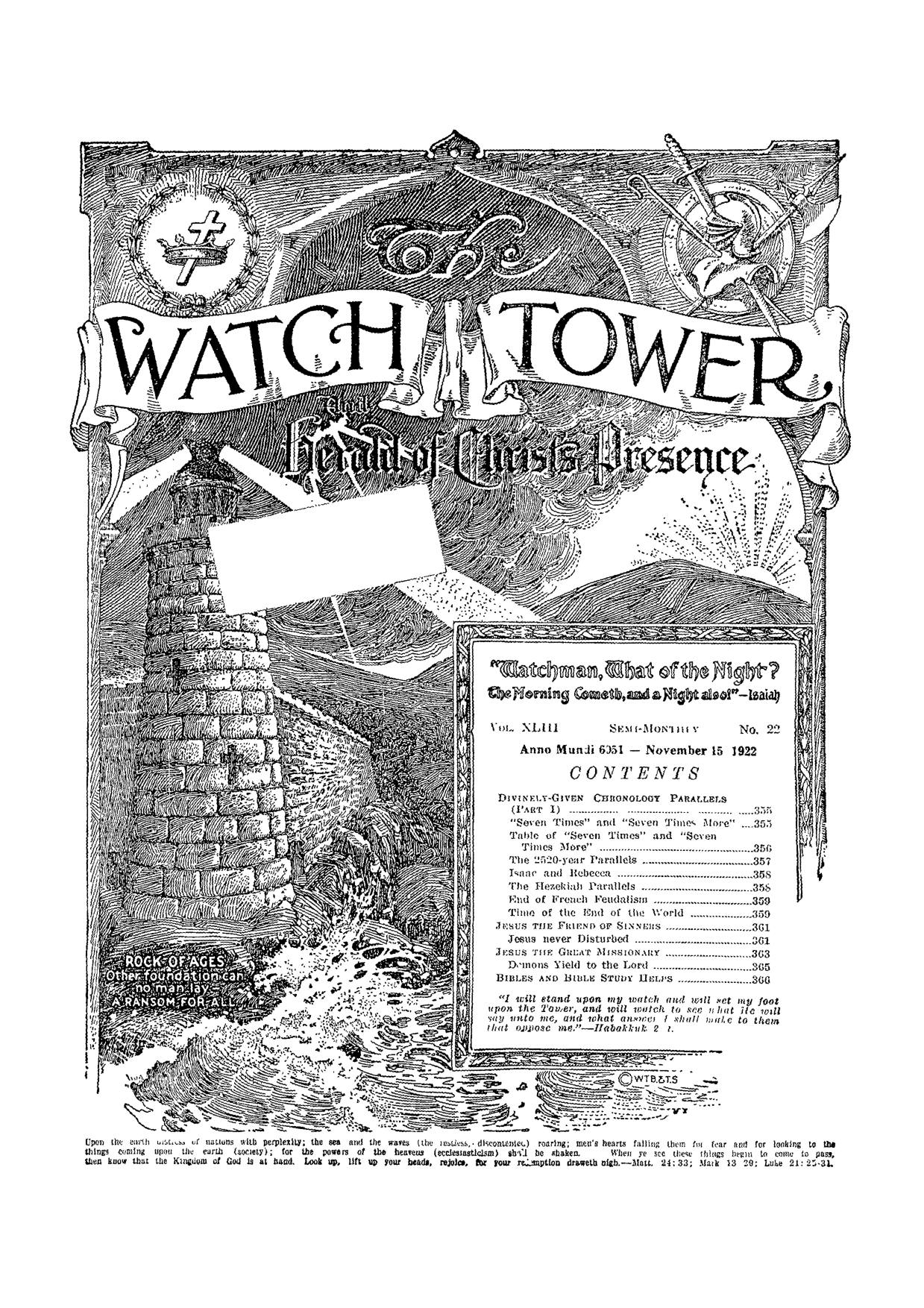
.<• J)
a. >
"I will stand upon my watch and will set upon the Tower, and will watch to see uliat say unto me, and what answui f shall unite that ojwose me.’’—Tlabalckuk 2 t.
Jesus the PniBNn of Sinneiis ..
Jesus never Disturbed ............
Jesus the Gihiat Missionary ......
Demons Yield to the Lord ..........
Bibles ano Bible Study Helps ..
No. 22
....355
Upon
>>iy fool Ite Will to them
. the earth uist»vi» of nations with perplexity; the sea and the warn (the • disconuntec) roaring; men's hearts falling them fm fear and for looking to the things coming upon the earth (society); for the powers at the heavens (ecdesiastlclsni) gb<l be shaken. When ye sec these things begin to come to pass, then know that the Kingdom of God Is at band. Look up, lift up your beads, rejoice, fw your redemption draweth oigb.—Jlatt. 24:33; Maik 13 29; Luke 21:22-31,
I^RAtJSQM;— -•
Vol. XL 111
Semi-Monihi v
Anno Mundi 6351 — November 15 1922
CONTENTS
Divinely-Given Chronology Parallels (l’ABT 1) -............... ................. ...........
"Seven Times” and "Seven Times More” Table of "Seven Times” and "Seven
Times More” ............................................
The ‘2520-year Parallels ..............................
Isaac and Hebeeea ......................................
The Hezekiah Parallels ..............................
End of French Feudalism ..........................
Timo of the End of the World ..............
.356 .357 .358 .35$ .359 .359 .361 .361 .363 .365 .366
THIS JOURNAL AND ITS SACRED MISSION
THIS journal Is one of the prime factors or instruments in the system of Bible instruction, or “Seminary Extension”, now being presented in all parts of the chilized world by the Watch Tower Bible & Tract Society, chartered A. D. 1884, “For the Promotion of Christian Knowledge". It not only serves as a class room where Bible students may meet in the study of the divine Word but also as a channel of communication through which they may be reached with announcements of the Society’s conventions and of the coming of its traveling representatives, styled “Pilgrims’’, and refreshed with reports of its conventions.
Our ‘T.ercan Lessons” are topical rehearsals or reviews of our Society’s published Studies most entertainingly arranged, and very helpful 1o all who would merit the only honorary degree which the Society accords, viz., Perbi Dei Minister (V. D. M.), which translated into English H Minister of G'od’s "Word. Our treatment of the International Sunday School Lessons is specially for the older Bible students and teachers. By some this feature is considered indispensable.
This journal stands firmly for the defense of the only true foundation of the Christian’s hope now being so generally repudiated —redemption through the precious blood of “the man Christ Jesus, who gave himself a ransom [a corresponding price, a substitute] for all". (1 Peter 1:19; 1 Timothy 2:6) Building up on this sure foundation the gold, silver and precious stones (1 Corinthians 3: 1115; 2 Peter 1:5-11) of the Word of God, its further mission is to “make all see what is the fellowship of the mystery which. . .has been hid in God, ... to the intent that now might be made' known by the church the manifold wisdom of God"—“which in other ages was not made known unto the sons of men as it is now revealed".—Ephesians 3:5-9,10.
It stands free from all parties, sects and creeds of men while it seeks more and more to bring its every utterance into fullest subjection to the will of God in Christ, as expressed in the holy Scriptures. It is thus free to declare boldly whatsoever the Lord bath spoken—according to the divine wisdom granted unto us to understand his utterances. Its attitude is not dogmatic, but confident; for. we kno.w whereof we affirm, treading with implicit faith upon the sure promises of God. It is held as a trust, to be used only in his service; hence our decisions relative to what may and what may not appear in its columns must be according to our judgment of his good pleasure, the teaching of his Word, for the upbuilding of his people in grace and knowledge. And we not only invite but urge our readers to prove all its utterances by the infallible Word to which reference is constantly made to facilitate such testing.
TO US THE SCRIPTURES CLEARLY TEACH
That the church Is “the temple of the living God", peculiarly “his workmanship" ; that its construction has been in progress throughout the gospel age—ever since Christ became the world’s Redeemer and the Chief Corner Stone of his temple, through which, when finished, God’s blessing shall come “to all people", and they find access to him.—1 Corinthians 3:1G, 17; Ephesians 2:20-22; Genesis 28:14; Galatians 3 : 29.
That meantime the chiseling, shaping, and polishing of consecrated believers in Christ’s atonement for sin, progresses ; and when the last of these “living stones", “elect and precious,” shall have been made ready, the great Master Workman w ill bring all together In the first resurrection ; and the temple shall be filled with his glory, and be the meeting place between God and men throughout the Millennium.—Revelation 15 : 5-8.
That the basis of hope, for the church and the world, lies in the fact that "Jesus Christ, by the grace of God, tasted death for every man," “a ransom for all," and will be “the true light which lighteth every man that conieth into the world", “in due time".— Hebrews 2:9; John 1: 9 ; 1 Timothy 2 : 5, 6.
That the hope of the church is that she may bo like her Lord, “see him as he is," be partaker of the divine nature,’ and share big glory as his joint-heir.—1 John 3:2; John 17:24; Romans 8 : li ; 2 Peter 1:4.
That the present mission of the church is the perfecting of the saints for the future work of service: to develop in herself every grace; to be God's witness to the world ; and to prepare to be kings and priests in the next age.—Ephesians 4:12; Matthew 24: 1-1 ; Revelation 1 : G ; 20 : 6.
That the hope for the world lies in the blessings of knowledge and opportunity to be brought to all by Christ’s Millennial kingdom, the restitution of all that was lost in Adam, to all the willing and obedient, at the hands of their Redeemer and his glorified church* when all the wilfully wicked will be destroyed.—Acts 3:1’9-23; Isaiah 35.
Published b*
WATCH tower.bible G-TRACT SOCIETY
18 CONCORD STREET O O BROOKLYN, NY USA
Foreign Offices : British: 34 Craven Terrace, Lancaster Gate, London W. 2 ; Canadian: 270 Dundas St., W., Toronto, Ontario ; Australasian: 495 Collins St., Melbourne. Australia; South African: 123 Plein St., Cape Town, South Africa.
Please Address the Society in Invert Case.
YEARLY SUBSCRIPTION PRICE; United States, $1.00; Canada and Miscellaneous Foreign. $150: Great Britain, Aust raijksia, and South Africa, Ss. tinerican remittances should be made by Express or Postal Money Orders, or by Bank Draft. Canadian, British, South African, and Australasian remittances should be made to branch offices only. Remittances from scattered foreign territory may be mmle to the Brooklyn office, but by International Postal Money Orders only.
(Foreign translations of this journal appear in several languages)
Editorial Committee: This journal is published under the supervision of an editorial committee, at least three of whom have read and approved as truth each and every article appearing in these columns. The names of the editorial committee are: J. F. Rutherford. W. E. Van Amrurgii, J. Hemery, G. H. Fisher.___
Terms to the Lord's Poor: All Bible students who, by reason of old age or other infirmity or adversity, are unable to pay for this journal, will be supplied free if they send a postal card each May stating their case and requesting such provision. We are not only willing, but anxious, that all such be on our list continually and in touch with the Bcrean studies.
Nntiee to Subjtt'rihe*r/f do not, as a rule, send a card of acknowledgment for a renewal or notice io nuuscriocrs. {fir o now»8ubKriptfcn. >ec<.ipt ami entry of renewal are Indicated within a month by change In expiration date, as shown on wrapper label.
Entered as Second Class i fatter at Brooklyn. N.Y., Poetoffice under ths Aoi of March Srd, lift.
IN RE WARNINGS
For sonic years it has been the policy of Tre Watch Tower to warn its readers against impostors. Sometimes a mistake is made in this regard, and a brother is reflected upon who should not be subjected to such criticism. Our attention has been called to a letter published in The Watch Tower, of October 1, 1922, about Brother Chas. A. Eldridge, in which the brother seems to have been misrepresented. Wo are sorrv for this.
In the future we shall publish no letters with reference to warnings. The brethren have developed sufficiently, it seems to us, to he able to discern who are imposters and who are not; and we do not wish the columns of The Watch Tower to be used for criticism.
“HARP” PRICE REDUCED
The Society takes pleasure in announcing that on December lOtli next the retail price of “The Harp of God” (large size) will be reduced to 35c per volume, or three volumes for $1.00. This edition is the same size as the de luxe edition. We advise the classes and colporteurs to dispose of their present stock and order sufficient stock to begin the canvass for I lie world-wide drive on the above date. Special price list will be furnished classes and colporteurs on application.
1923—CALENDAR—1923
The Society is preparing a very attractive calendar for 1023. The year text and weekly texts relate to the holy spirit. The calendar is in colors of a beautiful design, requiring six printings. It is so arranged that the sheets are turned over each week and the entire number are preserved. Orders may be sent now. Single copy, 35c; three for $1.00. In quantities of 50 or more, 30c each, charges collect.
CANADIAN CONVENTIONS
Edmonton. Alta., Noteniher 10-12,
Geo. A. Ware. 12321 Stony Plain lid., Edmonton, Alta. Vancouver, B. C., November 17-i‘>:
M. Sibley, 1687 Fifth Ave. \V„ Vancouver, B. C. Cranurook, B. C.. December 2. 3;
Geo. Holmes, Box 19, Cranbrook, B. C. Reoina, Sask., December 8-10;
M. T. Catton. 1835 Connaught St., Regina, Sask.
SAN FRANCISCO CONVENTION
The International Bible Students will hold a convention at San Francisco Saturday .and Sunday, November. 18 and 19. The President Of the Association will be present at the cnnveiftlon. For further particulars iwrlte J. L Scery, Com ention Secretary, 701 Post Street. San Finncisro. California
CONVENTIONS TO BE ADDRESSED BY BROTHEB RUTHERFORD
San Francisco. Calht.. Nov. 19; Ray Crawford.-4S3-A Linden St. Los Angei.es, Calht., Nov. 26; ......Oscar Harris...3848 Bovce Ate.
Cleveland. O., Dec. 10 ; Hyatt W. Mathews, 752-1 Harvard Ave , S.R. Boston, Mass., Dec. 17 : Alexander Ogston, 48 Wyllis Ave., Everett. Brooklyn, N. Y., Dec. 24;
T. M. Bedwin, 8118 Chichester Ave., Woodhaven, L. I. Dayton, O., Dec. 31; _________________________P. D. Pottle, 36-4 E. 4th St.
AND HERALD OF CHRISTS PRESENCE
Vol. XLIII
November 15, 1922
No. 22
DIVINELY-GIVEN CHRONOLOGICAL PARALLELISMS (PARTI)
"But the God'of dll grace, who hath called us unto his eternal glory by Christ Jesus, after that ye have suffered a while, make you perfect, stdblish, strengthen, settle you.’"—1 Peter 5:10!
IT HAS been shown in a preceding article that the parallel dates of present-truth chronology are proof of divine foreknowledge, and that they demonstrate that the system is of divine origin. Man invents a machine, but discovers the law of gravitation. The one is man-made, the other is of God. So presenttruth chronology is not an invention, but a discovery. It is of no small moment to the new creature to see clearly how his faith in the truth is divinely confirmed. Few other things can so lift up the fainting spirit, and so strengthen and stablish the heart, and render more effectual the defence by the shield of faith. Knowing of a certainty that he possesses the approbation of Almighty God in being kept thus far in the narrow way, the Christian renews his consecration, and with unwonted power goes forth to meet the enemies of Jehovah and in divinely-imparted strength to overcome them.
To one who is assuredly on the side of the Eternal, what matters it that there come trials and tribulations 1 Not even death can separate such an one from the God whom he trusts and loves with all his heart and mind and soul and strength. To the wholly consecrated, in these, the days of the presence of the Son of Man, death is the portal to the heavenly kingdom of God.
Since by many infallible proofs we discern that these things are of God and that we who hold them as a precious treasure are the people of God, what manner of men ought we to be! What holy lives we should live! How attentively we should follow the example of our Savior! How circumspectly so to walk as to gladden the heart of our Father!—2 Corinthians 7:11; Ephesians 5:15-17; 2 Peter 3:11,14; Psalm 116:15.
Not all of the consecrated are familiar with the entire chronological system of present truth. For this reason, and because it is edifying and inspiring to all new creatures in Christ Jesus to have the things of God brought to remembrance, we present in this article a few of the divinely-given chronological parallelisms. Much of the research by which these were discovered was carried on bv the late Brother Dr. John Edgar and by Brother Morton Edgar, of Glasgow, Scotland, and published in their book, “Great Pyramid Passages, Volume 2.” The foundation was laid by Pastor Russell in the first three volumes of Studies in the Scriptures.
“SEVEN TIMES” AND "SEVEN TIMES MORE”
Much of the study of times and seasons is necessarily given to the minutise of evidence. It is refreshing, therefore, to behold how the All-wise One has displayed his abounding foreknowledge and' unsearchable wisdom in chronological pictures which, in a bold sweep, take in the entire stretch of the seven thousand years of sin and redemption. It is evident in such vast affairs that Jehovah knew the end from the beginning—nay, that before he brought forth the things that are, he conceived the entire plan of the ages. It is manifest that throughout the extended interval of six thousand years of sin, darkness and degradation, he has been silently working out his grand purposes, which now at the end of the world he has for the first time unfolded to the vision of the consecrated.
When Jehovah foretold to the Hebrews the punishments destined to come upon them, if they wickedly and grossly disobeyed the law which he gave them at Sinai, and which they solemnly covenanted to keep, ho informed them that he would punish them “seven times'” for their sins. Four times in one chapter is this warning repeated, each time in a manner to indicate increasing severity. (Leviticus 26:18, 21, 24, 28) In symbolical language seven is a symbol of divine completeness, and the expression “seven times” conveys the idea of a divinely thorough, lasting, and terrible chastisement. At the same time it conveys an idea of the length of time during which the Hebrews should suffer national discipline; and this predicted period is distinctly shown in the fulfillment of the prophecy, now a matter of historic record.
The symbolic prophetic year was one of twelve months of thirty days each. Seven “times”, or years, are 2,520 days, which, interpreted on the principle of a day for a year, make 2,520 years. The complete punishment was to endure for seven times, the same interval as that of the gentile dominion foretold through the prophet Daniel (Daniel 4:16, 23, 25, 32); for the national penalty upon the Jews consisted in the afflictions put upon them by the gentile kingdoms ruling over them pitilessly for 2.520 years. This started in 606 B C. end began to end m 1914 A.D., vhen through the World War the first great step was divinely instituted toward the oust-
ing of the gentiles from their long and cruel dominion. This is the celebrated “seven times” of punishment of the Jewish people, with which Bible students are familiar.
In the first prediction of this chastisement for “seven times” an expression was employed by Jehovah which implied a previous “seven times” of some kind: “And if ye will not for all this hearken unto me, then I will punish you seven times more for your sins.”(Leviticus 26:18) On its face this utterance speaks of a final and complete disciplining, additional to the other castigations predicted in Leviticus 26:14-17 while they remained an independent nation. The divinely employed use of the word “more,” however, suggests a preceding “seven times”; and the reverent student of the Bible will not ignore such a hint proceeding from the great Time-Keeper. When the intimation is heeded, and the chronological periods arc explored prior to 606 B.C., when the “seven times more” began, a marvelous view of Bible chronology is obtained, which at a glance covers the entire 7000-ycar seventh rest-day of God, with the addition of a final judgment period of forty years, or 7,040 years in all.
The previous interval before the “seven times more” is examined as follows: Going back from 606 B.C. and counting 2,520 years, the date obtained is 3126 B.C. This is not seen to be anything unusual until 1,000 years are counted back from it, when the date is found to be 4126 B.C., which reverential discernment recognizes as the date of the fall of Adam and the beginning of the 6,000 years of sin. Then, going forward from 606 B.C. for 2,520 years, the date 1914 A.D. is reached. This is the date when the Second Adam, Jesus Christ, as King of earth, and Lord of lords, began to exercise his mighty power against the kingdoms of Satan’s empire, this present evil world. After 1914 A.D. will be the 1000-year day of the Second Adam, reaching to 2914 A.D. in which the Lord will reign in might. “Then cometh the end, when he shall have delivered up the kingdom to God, even the Father; when he shall have put down all rule and all authority and power. For he must reign, till he hath put all enemies under his feet.”—1 Corinthians 15 : 24, 25.
Thus the “seven times more” of punishment upon the Jewish nation are seen to have been preceded by a prior “seven times.” The first seven times, or 2,520 years, were preceded by the 1000-ycar day of the first Adam (Genesis 2:17); and the 2,520 years “more” are to be followed by the 1000-year day of Christ, the Second Adam.—Zechariah 14:9; Matthew 12:8; Luke 17: 24; John 8: 56; 1 Corinthians 15 : 45.
The harmonious succession of these chronological periods may be illustrated in the following manner:
1000 years: 2520 years: : 2520 years: 1000 years --------------Total, 7040 Years--------------
Arranging the periods in the parallel-column form, with the dates, this grand panorama of human history appears thus:
TABLE OF “SEVEN
TIMES” AND “seven TIMES more”
4126 B.C. Beginning of the 1000-year day of the first Adam.
3126 B.C. End of the 1000-year day of the first Adam.
3126 B.C. Beginning of the first“seven times,” or 2,520 years.
606 B.C. End of the first “seven times,” or 2.520 years.
606 B.C. Beginning of the “seven times more,” or 2 520 years more.
1914 A.D. End of the “seven times more,” or 2,520 years more.
1914 A.D. Bt ginning of the 1000-ycar day o£ Ilie Second Adam.
2914 A.D. End of the 1000-year day of the Second Adam.
The first of these long ages of 2,520 years was less fallen, far more desirable for humankind tha.. the “seven times more.” Human governments were less depraved at first; there were less pride and insane lawlessness among those in authority, and the poor and lowly were much better off. During the first “seven Lines” the governments, so to speak, had a man’s heart, a measure of humanity. But concerning the alt 'red heart of the ruling power in the second 2,520 years it is written: “Let his heart he changed from man's, anil let a beast’s heart be given unto him. . . . The Most High. . . set-teth up over it [the dominion the .basest of men.” (Daniel 4: 16,17) The annals of earth’s kingdoms for the “'seven times more,” just ended in 1914 i\.D., have not been records of kingliness, kindness, and of love of man for man, but—under a diabolical alliance of religion, business, and state — a chronicle of beastly rapine, exploitation of the helpless, lust, abandoned wickedness, and depraved viciousness, even on to this very day.
It is noteworthy that the date 606 B.C. is exactly half way between the fall of Adam and the end of the fortyyear judgment after the Millennium—between Paradise Lost and Paradise Restored.
An interval of “seven times,” when divided in two, makes two periods of three-and-a-half times, or 1,260 years, each. Seven symbolizes divine completeness. Half of seven represents incompleteness, evil, trial, suffering. For example, the 1,260 years preceding the beginning of the Time of the End (1799 A. D.), are characterized by the Lord as follows: “The same horn made war with the saints and prevailed against them”; “A king of fierce countenance . . . shall destroy wonderfully. . . and shall cause craft [diplomacy, Jesuitical deceit] to prosper in his hand”; “Shall take away the daily sacrifice, and place [set up in power] the abomination that maketh desolate [the mass]”; “Shall speak great words against the Most High, and wear out the saints of the Most High”—truly a forecast of the dominion of iniquity and of the sufferings of the righteous during the “time, times and the dividing of a timed’—Daniel 7: 21; 8: 23-25; 11: 31; 7:25.
Thus the two “seven times” may be seen to be divisible into four periods of 1,260 years each, in an ever mounting tide of wickedness, distress, and misery, until the thousand-year day of Christ is reached, with its release from the thralldom of evil into the perfect freedom of the kingdom of God. “For the creation itself also shall be delivered from the bondage of corruption into the glorious liberty of the children of God.”—Romans 8:21. '
In these marvelous discoveries in chronology and in those yet to be described, four things are disclosed:
First, that so symmetrical and exact an arrangement of stupendous ages betokens foreknowledge of all features from the beginning to the end;
Second, that the overruling of these great times and seasons was by none other than Him who alone has foreknowledge, Almighty God;
Third, that a chronological system which is knit together in so amazing a fashion has the internal evidence that it is of God and is the correct chronology; and
Fourth, that this system reveals the foundation for the true science and philosophy of history, which must ultimately be taught everywhere and to everyone.
THE 2520-YEAR PARALLELS
The far-seeing prescience of the Creator is impressively exhibited by parallel dates within the two “seven times.” These correspondencies clearly demonstrate Jehovah’s foreknowledge, and cause the truth that this chronology is divinely shaped to beam forth brightly. The ascertainment of these things by Pastor Russell and Brother Edgar is one of the important discoveries of the concluding days of the age just ended.
By parallel dates are denoted in this instance dates 2,520 years apart, at the same time in each age, and of corresponding character.
For example, as exhibited in the ensuing table, two of these appointed times are 999 B.C. and 1521 A.D. The first is the cleaving of the Hebrews into two kingdoms: Israel the larger and more corrupt, and Judah the smaller and less depraved. The second and parallel date is the separation of Christians into two religio-political dominions; Romanism the more numerous and vicious, and Protestantism the less so.
The time between 999 B. C. and 1521 A. D. is 2,520; so these events took place at the same times in the two ages. The occurrences arc momentous and of the same sort; so these are parallel dates.
Both events were foreknown; for they were foretold. The prophecy of the coming division of the Hebrews was:
“Wherefore the Lord said unto Solomon, Forasmuch as this is done of thee, and thou hast not kept my covenant and my statutes, which I have commanded thee, I will surely rend the kingdom from thee, and will give it to thy servant [Jeroboam, who was not Solomon’s son]. Notwithstanding in thy days I will not do it for David thy father’s sake; but I will rend it out of the hand of thy son. Howbeit I will not rend away all the kingdom; but will give one tribe to thy son for David my servant’s sake, and for Jerusalem’s sake which I have chosen.”—1 Kings 11: 11-13.
This was accomplished in the year of Solomon’s death, 999 B.C. in the severance of the Hebrew tribes into two kingdoms, that of the ten tribes in the larger northern realm of Israel, and that of the two tribes in the smaller southern nation of Judah, the tribe of Levi being scattered among the others.
The Protestant Reformation, which split professing Christians into two hostile parts, was foretold through the prophet Daniel in these words: “Now when they [true Christians of the dark ages] shall fall, they shall be holden with a little help: but many [professedly Protestant rulers and others] shall cleave to them with flatteries. And some of them [Protestant leaders] of understanding shall fall, to try them [the true ones], and to purge them [of the evil ones], and to make them white, even to the time of the end [1799].”—Daniel 11: 34, 35.
The regenerative work of Luther was also outlined by the glorified Lord in his Revelation: “The first [Reformation] angel [Luther] sounded [his trumpet message of truth], and there followed hail [sharp, cutting, hard truth] and fire [destructive judgments upon papacy] mingled with blood [truth mingled with death-dealing error], and they were cast upon the earth: and the third part of the trees [prominent men] was burnt up, and all green grass [Luther’s teaching had the effect of transforming many of the order-loving German people into anarchists.”—[G146-8]—Revelation 8: 7.
Divine foreknowledge is displayed in the striking parallelisms, as shown in the following dates in the two “seven times”: Each second date follows the first by exactly 2,520 years. Could this be accidental? Nay, verily !
TABLE OF 2520-YEAR PARALLELS
Events in the First “Seven Times"
312G B.C. Beginning of the first seven times, or 2,520 years.
1981 B.C. Marriane of Isaac and Rebecca, typical of the coming union of Christ and his bride, the true church.
999 B.C. Division of the nominal Hebrews into two religio-political kingdoms; Israel the larger and more corrupt, and Judah the smaller and less corrupt.
Events in the “Seven Times More”
606 B.C. Beginning of the “seven times more", or 2,520 years.
539 A.D. Counterfeit fulfillment in the marriage of the pagan state with the apostate church of Rome, the “whore.”
1521 A.D. Division of nominal Christians into two religio-political dominions; Romanism the larger and more corrupt, and Protestantism the smaller and icss corrupt.
731 B.C. Sickness unto death of Hezekiah, the Jewish church-state ruler, from a boil.
721 B.C. End of ten years after Hezekiah’s sickness; the date is a chronological marker characterized by no event, but designed to point totheparallel.
716 B.C. End of the!5years’ added life; death of Hezekiah, the Jewish religio-political ruler.
606 B.C. The end of the first “seven times,” or 2,520 years. Overthrow of the kingdom of nominal fleshly Israel. Beginning of the period of gentile dominion.
1789 A.D. Sickness unto death of Era nee and of Christendom’s church-state ruling powers, from the French revolution social eruption.
1799 A.D. End of ten years after the beginning of the French revolution, and beginning of the Time of the End of the present evil order of things.
1804 A.D. End of 15 years’ added duration to the ancient religio-political order in France, marked by the establishment of the Napoleonic Empire and the abolition of the medieval order.
1914 A.D. End of the “seven times more,”or 2,520 years. Beginning of the overthrow of nominal spiritual Israel. Beginning of Christ’s reign over the earth.
ISAAC AND REBECCA
Isaac, as the child of promise, was often representative of Jesus Christ; and Rebecca, as Isaac’s bride, was a type of the true church. Their wedlock was a type of the coming union of Christ and his bride, to take place before the full inauguration of all features of the Millennial reign of the Lord.
Many are the counterfeits which have been made by the evil one, both of the truth and of the details of the divine plan—false gods, false messiahs, false saviors, false churches, and counterfeit so-called “Christian” governments. In every instance the pure and true of the things of Jehovah have been obscured by the vile and bogus things of the devil and his demons, which have been palmed off on the credulous and unsophisticated as though from God, when actually from the vainglorious enemy of God, the devil. Before the institution of the spurious Papal millennium (799-1799 A.D), the demons, through their tools, the ecclesiastics and lower clergy, worked out a sham similitude of the marriage of Christ and the church. This was the unhallowed union of the apostate church of Rome—the “whore” (Revelation 17:1)—with the government of the ten-toe decaying Roman Empire. This took place in 539A.D., lust 2,520 years after the nuptials of Isaaac and Rebecca in 1981 B. C.
Even this counterfeit was foreknown and foretold. Concerning the unholy union of church and state, and the imitation queen of heaven, the Revelator says: “I will shew thee . . . the great whore . . . with whom the kings of the earth have committed fornication. . . . She saith in her heart, I sit a queen.” (Revelation 17: 1, 2; 18:7) This iniquitous sham was also pictured in the misalliance of the abandoned pagan, Queen Jezebel, with Ahab the king of Israel (1 Kings 16: 26-33), and doubtless in the divinely condemned union of the princess of Egypt with Solomon, the king of the Lord’s holy people.—1 Kings 11: 1-4; Exodus 34:14-16.
This ascertainment of the 2520-year parallelism of the Isaac-Rebecca type, and the Roman-Empire-Papal caricature of the approaching nuptials of Christ and his bride, is a notable verification of the heavenly source of present-truth chronology.
THE HEZEKIAH PARALLELS
In the two accounts of Hezekiah’s reign, in 2 Kings 18-20 and Isaiah 36-39, Judah and Jerusalem had been seriously threatened with desolation and captivity at the hand of the Assyrians, but had been delivered. Shortly afterward King Hezekiah was sick unto death. The inspired account runs: “And the prophet Isaiah. . . said unto him, Set thine house in order; for thou shalt die, and not live.” (2 Kings 20:1) This was in the year 731 B. C. Then in answer to the king’s desperate prayer, Jehovah sent the word: “I have heard thy prayer . . . behold I will heal thee . . . And I will add unto thy days fifteen years.” (2 Kings 20:5,6) The death of Hezekiah took place fifteen years later, in 716 B. C.
When the king was sick God also gave him a sign that he would recover and have the promised fifteen years of life. This token was literal for him but also symbolic for the admonition of the church at the end of the world (1 Corinthians 10:11): “And Hezekiah said unto Isaiah, What shall be the sign that the Lord will heal me? . . . And Isaiah said, This sign shalt thou have of the Lord, that the Lord will do the thing that he hath spoken: Shall the shadow go forward ten degrees, or go back ten degrees? And Hezekiah answered, It is a light thing for the shadow to go down ten degrees: nay, but let the shadow return backward ten degrees. And Isaiah the prophet cried unto the Lord: and he brought the shadow ten degrees backward, by which it had gone clown in the dial of Ahaz.” (2 Kings 20:8-11) The ten degrees signify ten years, and the ten years expired in 721 B.Ci
This gives the three dates: 731 B.C., Hezekiah’s sickness; 721 B.C., the end of the ten years; and 716 B.C., the end of the fifteen years and of the king’s life.
The antitype, or parallel, of the Jewish ruler’s sickness is seen in that extraordinary outburst of outraged and tormented humanity in the French Revolution, which shook to its foundations the religio-political order of things in France, and finally eventuated in the termination of that order and its supersession by an empire wholly different in character and personnel. Hot merely France, but all Europe and the entire ancient order of the world, was mortally sickened—dismayed at the shadow of approaching dissolution—through the trouble in France. Medieval France besought God for healing, and for the time was delivered, but ultimately came to its end—the shadow' of the nearing end was set back for ten years, from 1789 to 1799.
France was prophetically called the tenth part of the city—of the then ruling powers of civilization. A tenth part pictorially represents the whole; for as ten symbolizes the whole, so does a tenth. Thus the tithe of the Hebrew pictured the dedication of his all, and typified the entire consecration of all by the antitypical spiritual Jew, the true Christian.
The Lord foretold the French Revolution in these words: “And the same hour there was a great earthquake [shaking of. the social order, revolution], and the tenth part [France] of the city [the religio-political world] fell.” (Revelation 11: 13) The sickly dismay of the entire Papal-Protestant-business-political alliance of that day is portrayed in the remainder of the utterance from the. lips of the Rcvclator: “The remnant were affrighted.” (Revelation 11:13) As put by Brother Russell, “Their [the revolutionists’] God-dishonoring and heaven-defying work filled France with such scenes of blood, carnage, and horror, as made even the infidels themselves tremble, and stand aghast.”—G 179.
Just as Hezekiah had cried unto God for succor (2 Kings 20:3), so the Rcvclator prophesied what the nominal Christian rulers would do: “The remnant. . . gave glory to the God of heaven.” (Revelation 11: 13) An identifying phrase is added to the passage, fixing it upon the event: “.And by the earthquake [revolution] were destroyed seven thousand names of men.” (Revelation 11:13, Diaglott) In fulfiUment, in that distracted country, “France made war, in her revolution, ... on all titles of nobility. It is said by those who have examine;! French records, that just seven thousand titles of men were abolished in that revolution.—Smith.” —G 179.
The French Revolution began July 14, 1789, with the storming of the dreadful royal dungeon, the Bastile, in which for centuries had languished and died many true lovers of liberty and many true Christians. On October 6, 1789, the king and the queen of France were brought prisoners to Paris. “On this occasion,” says “The Americana” in its article on France, “as on the taking of the Bastile, the ferocity and bloodthirstiness .of the more lawless portion of the mob began to be fearfully manifested.” This was the “sickness” of France, and of the Papal-Protestant Europe. It is an outstanding event in history; and the date, 1789, is exactly 2,520 years after the sickness of King Hezekiah, in 731 B. C. Thus 731 B. C. and 1789 A. D. meet all the conditions, and are parallel dates.
While King Hezekiah was a worshiper of Jehovah and measurably faithful, for a king, he was not an overcomer like the prophets of God, who endured such great things for the Lord’s name’s sake. He was typical, not of the true church in this matter, but rather of th( nominal regnant powers of Europe. That he was king of Judah—which sometimes typifies Protestantism—does not detract from the thought that he represented th, Papal-Protestant-royalty alliance, rather than Protestautism alone; for as a rule Judah symbolizes Protestantism alone, when Judah and Israel are mentioned is the same connection. Moreover, at this time the kingdom of Israel had been overthrown and taken captive by the Assyrians—in 739 B. C.—and no longer wai in existence.
THE END OF FRENCH FEUDALISM
Fifteen years after the deadly sickness of the European church-state civilization (1789 A. D.), there came the end of this medieval order of things in France In 1804, fifteen years after 1789, Napoleon abruptly terminated the power of the hitherto ruling feudal aristocracy and of the lordly Papal ecclesiasticism. Ho established the Napoleonic Empire in its place, and in ;hat year, as recorded in “The Americana”:
“The [French] legislative bodies were now completely subservient to Napoleon, and the conspiracy of Cadoucal was made a pretext for offering him the empire, in order to assure the permanence of the government by giving it a hereditary head. The senate addressed him by a deputation and, on being invited to express their opinion, voted the hereditary empire.. .. The ‘senates consultum’ for the regulation of the empire, drawn up by Napoleon himself, was passed May IS, 1804. The empire was confirmed by a popular vote of 3,572,329 against 2,569. The empire was made hereditary In the male issue of Napoleon and his adopted sons. .-..A new aristocracy, not yet hereditary, was created. After the emperor came the grand dignitaries of the empire. The senate, besides eighty members elected by itself, was to comprise the six grand dignitaries of the empire, and the princes of the blood after eighteen years of age.. .. The Pope was invited to the coronation of Napoleon, which took place at Notre Dame on December 2, 1804. The Emperor, after receiving the sacred unction from the Pope, crowned himself, and afterward the empress.”
Thus was blazoned to the world the fact that the dominion had departed from the medieval church-state conspiracy against the common people, which for centuries of darkness and cruelty had violently domineered over the populace. In France the death of the ancient regime was definitely marked, in 1804, just 2,520 years after the death of King Hezekiah in 716 B. C.
THE TIME OF THE END OF THE WORLD
King Hezekiah, while sick, had been given the singular sign of the ten-degree recession of the sun’s shadow on the dial, the Scriptural account of which has been recited.
The ten degrees signify ten years. On the date 721 B. C., ten years after Hezekiah’s sickness, there was no event; the date was a mere marker, because the momentous occurrence to which it pointed in antitype came ten years after 1789 A. D.—in 1799 A. D., 2.520 years after 721 B. C.
It appeared in 1789 as though the sanguinary Revolution in France was the beginning of the end of the old world; but not so, for the commencement of the Time of the End of the old order of things was postponed ten years, until 1799 A. D.; and then began the Time of the End of the world which came to its end 115 years later, in 1914.
'Those ten years, however, did an important work. During the revolution the utmost hatred was manifested for the Christian religion as exemplified in the apostate Romanist and Protestant churches, but especially the former. Prudent priests and ecclesiastics, foreseeing the evil, hid themselves (Proverbs 22:3) by fleeing the country those that remained were tortured, and slaughtered whcrccver found They were tied back to back and thrown alive into rivers; they were tried— in many cases, very possibly, equitably enough as concerns their attitude toward the new government—for sedition, spying and treason, and executed. It is written of the clergy that prior to the bloody outburst “they had attempted to reform France without first reforming themselves”—as may be said of the American clergy today. In just retribution for their iniquities, divine vengeance operated against them through the instrumentality of a maddened populace. So fierce was the wrath against ecclesiasticism that it seemed as thoimb 1789 would signalize the complete end of the Papacy; but the beginning of this end was put off for ten years.
Concerning the year 1799, Pastor Russell writes in “Thy Kingdom Come,” pages 49, 50:
“If we are correct in placing the beginning of the Time of the End at 1700, we should expect that there the falling into error of church and stale union would measurably cease, though it might require long years for the full recovery out of that snare of the devil. Looking back, we find that facts exactly correspond with this. Since that date there have been separations between empires and churches, but no new unions. Really, this date marks a new reformation on a more substantial basis. The influence of Papacy over the kingdoms of Europe had previously been so great that its curses were dreaded by the nations as a withering blight, and its blessing desired for national prosperity. When Protestants separated from Papacy, they were received by the world as being merely a less corrupt substitute for the Papacy; and their favor, advice or sanction was often very similarly sought. But when Napoleon boldly ignored both the blessings and the curses of Papacy, and yet prospered phenomenally, his course not only greatly weakened the Papal influence over civil governments, but also weakened the influence of the various Protestant systems, in matters civil and political—which influence had grown very strong in two and a half centuries.
“The new reformation, which dated from Napoleon’s day, was no less thorough than the reformation brought about by Luther and his colleagues, though it was not a religious movement, nor in any way animated by religious zeal; nor were the actors in it aware of the fact that they were accomplishing a work marked out for them in prophecy centuries before. . . .
“Napoleon’s work, together with the French Revolution, broke the spell of religious superstition, humbled the pride of the self-exalted religious lords, awakened the world to a fuller sense of the powers and prerogatives of manhood, and broke the Papal dominion against which the religious Reformation had previously struck a death-blow, but which its after-course had healed. (Revelation 13:3) The era closing with A. D. 1799, marked by Napoleon’s Egyptian campaign, sealed and defined the limit of Papal dominion over the nations. There, the time appointed (12G0 years of power) having expired, the predicted judgment against that system began, which must finally ‘consume and destroy it unto the end.’—Dan. 7: 26.
“This date also clearly marks the beginning of the new era of liberty of thought, and the realization of individual rights and privileges and has already been distinguished by its rapid strides of progress toward the full accomplishment of the work mapped out for this Time of the End. As a single illustration, notice the rise and work of the various Bible Societies—‘pestiferous Bible Societies’ Rome calls them, though it cannot now hinder them. And the sacred volume which once, she confined in chains, kept covered in dead languages, and forbade her deluded subjects to read, is now scattered by the million in excry nation and language. The British and Foreign Bible Society was established in 1803; the New York Bible Society in 1804; tile Berlin-Prussian Bible Society in 1 ; the Philadelphia
Bible Society in 1808; and the American Bible Society in 1ST 7.”
How long was the time of the end destined to be? “The Time of the End,” says Pastor Russell, “is a period of one hundred and fifteen years from A. D. 1799 to A. D. 1914."'’ (“Thy Kingdom Come,” p. 23) In 1914 came the definite end of the anemnt order of things. When, on August 1, 1914. the crack of the first rifle-shot inaugurated the World War. old tilings passed away, and the dispossess proceedings of Jehovah were made effective against the kings of the kingdom of darkness. On that date the King of kings assumed his throne over the earth, and there were realized the “great voices in heaven,”' which said: “The kingdoms of this world arc become the kingdoms of our Lord, and of his Christ, and he shall reign for ever and ever.”— Revelation 11:15.
Since 1914 the message of the true church has been, in part, that “the world has ended,” that the kings of earth have had their day, and that as national kings fell in 1914, soon will have fallen all the kings of the empires of finance, politics, and ecclesiasticism.
In a memorable manner the year 1914 signalized the end of the “seven times more” of gentile dominion. It was the 2520-year parallel date for 606 B. C., when ended the first “seven times.”
With exactness, in 606 B. C., the close of the first seven times was distinguished by the fall of the Hebrew religio-political polity; and with like divine precision in 1914 there ended the sway of the church-state combination of Christendom, and the beginning of the process of its extinction. As 606 B. C. began the age-long interval of the world-wide reign of the most mighty and merciless of the kings and emperors of this evil world, so 1914 inaugurated the eternal period of the sway of Christ the Lord, and his kindly and benignant kings, of whom it is written, “He shall reign for ever and ever”; and “They shall reign for ever and ever.”— Revelation 11:15; 22: 5.
In a succeeding article the 1845-year parallelisms will be taken up.
DIVINELY-GIVEN CHRONOLOGICAL PARALLELS (PART I)
1. Why is it important to know that present-truth chronology is not an invention but a discovery? 1] 1-4.
2. How,doos Hie parallelism of the two “seven times" show divine foreknowledge? U 5.
3: What Iwo ideas are conveyed in the prediction of seven times of punishment ? K G, 7.
4. What is implied bv the word "more;’ in “sev.cn times more?" U 8.
5. Explain the Chronological symmetry in the two seven times.’’ 1 9—12.
6. Why were th$ first "seven times'" better for mankind than the second? 1| 3d.
7. What date ik midway between the fall of Adam ami the end of the Millennial judgment? If 14.
8. What live things are disclosed by the parallelisms? U 17-21.
8a.How do the parallelisms snow that present truth .chronology is of -divine oiigui? If 22
b. Define parallel dates. U 23
10. Give illustration of the parallel dates of the division of the Jews and the Christians. U 24-26.
11. How were the dnisions of Jews and Christians prophesied and fulfilled? 1) 27-30
3 2.. Explain the table .or. 2520-jear parallels. Table after K 31.
33. Explain the parallel dates of the marriage of Isaac and Rebecca. If 32-35
14. What were the three important events and dates in Hezekiah’s life9 U 3G-38.
15. V, h it \<as the j mallei of Hozekiali’s sickness? 1f 39.-10.
16. Iio,;.' were Kra me and Europe sick unto death from the French 11c ml- tioiP If -:\43
17 OJ whom was 1 ■ o.;e".<ili twdcal? 1[ 44.
1 '. Wliat.vzps the pai.al’j| of the death of Hezekiah? 1| 45.
19 How 'ditl Napoleon bring French feudalism to its end? t| 46,47.
2l. si .mhed by the ten-(.egiee going-back of the sun
dial U 48,49.
2L Vb.it.v.as the parallel of the recession of the sun-dial? 11 50.
22 How did it seem as though the old religious order of things was to end in the French Revolution U 51.
23. How does 1799 mark the beginning of the end of veligio-political dominion H 52-56
24. What was the lengtih of the time of the end? U 57.
25 What things were marked by 1914? U 5S-60.
JESUS THE FRIEND OF SINNERS
--November 19 — Luke 7--
A READY HELPER-AT EASE TN SERVICE-LORD OF LIFT,-JOHN ENCOURAGED-THE SINFUL WOMAN--CONTEMPT FBOAT THE RICH.
“Faithful is the saying, and worth.]) of all acceptation, that Jesus Christ came into the world to save sinners,’’
—1 Timothy 1:15.
TODAY’S study is “Jesus the friend of sinners,’’ but chapter seien takes us with Jesus amongst the sorrow-fin and with the niour; er. it tells o .nsus' iii.oirj of John the Baptist, of Jimis with the Pharisees, and of his compassion for the uotnan who was a sinner. Friend of sinners is a true title for Jesus, men .though it came from the , arisies. : .id as a term of derision and contempt; and lie did not r< pudiate it.
’Ll is elmpter shows him as a friend of the publicans and sinners, but in the truest sense, a ready helper. It was because God loved the world of sinners that Jesus was found in it; and therefore his appearance amongst men signifies tliat Cod also is the friend of sinners. We praise him for this, mid our hearts go out to him in gratitude, because we who have heard his message of grace through Jesus have realized his friendship, ami because we know lie intends to make his friendliness known to all men that all may enter into this sweet relationship.
When Jesus presented himself to his people, the Jews, the leaders stood aloof, just as they had done from John the Baptist. If they did come near, it was Hint they might look with curious eyes upon what was being done, and to see how much these movements of John and Jesus affected their position; and to pour contempt upon these innovations and, if possible, to hinder the work. But the common people, who had no such interests to conserve as their leaders had, reeehed Jesus more gladly, and were very willing to receive the benefits lie had to give.
But those who reeehed Ills words and person most gladly, and who as a class came nearest to him, were the publicans and sinners. These, when they were moved, sought Jesus for himself rather than lor what they could get from him; and his own testimony was “that the publicans and harlots go into the kingdom of God before you”—the chief priests and elders. (Matthew 21: 23-31) There was absolutely noticing in our Lord’s life which would give the slightest thought tliat lie condoned sin, or looseness of conduct, and it is apparent that however friendly our Lord was to these fallen, he was never familiar with them, nor they with him. The fact is that they were the sick ones who realized it; whereas the people generally, and their leaders in particular, did not realize their sickness, and did not call for any physician's help.
As it was then, so is it now. The world does not realize that it is sick. It knows indeed that it has much trouble, but it will not admit that its sickness is because i( is away from God; and it persists in hoping that the mommies it app.ies io i.s condition will in some way result in dispersing its evil circumstances. It will not be until men have icalized their soui-sickness that the blessings of God can come upon them. The troubles which are now upon the world are intended to make men See that all evil in themselves is the result of sin, and that health can come only as man acknowledges his wrongness and seeks harmony uitli his Creator. And when men accept the righteous law of the new order "calamities” in nature will cease.—Isaiah 11:9.
JESUS NEVER DISTURBED
Our Lord's ministry was varied; indeed, it was ever changing, depending greatly upon the demands made upon him. There was a general purpose in his ministry, and without doubt he was working according to a general plan, but it is very clear that he held his life at the disposal of those who would put a claim upon him. He was always ready to turn round to meet a call from whatever quarter it came.
In this he was never “disturbed.” It might be that the roof would be taken from the house where lie was preaching, and a sick man let down at his feet while in the midst of a discourse; or tliat Jairus might come, and, with an urgent call, interrupt our Lord in an address; but lie allowed none of these things to disturb either his innei or outward calm. He was always the master. Full ol service he was ever at ease in it; and as the needs of the people were many, and his compassion was unbounded, there was always much for him to do.
After our Lord’s preaching, as recorded in chapter six, he went again to Capernaum. As soon as lie reached there a Roman centurion sent a request to him by the elders of the synagogue, beseeching him to come and heal his servant. The elders said, in presenting the centurion’s request, that lie was a lover of their nation, and had built them a synagogue. It was probably out of humility tliat the centurion took this course of approach to Jesus; and, perhaps, because of having an urgent request, he took this means as presenting some advantage to him. But before Jesus could arrive, the centurion sent some of his friends to meet him, saying that lie was not worthy that the Master should enter his house; and suggested that the Lord should speak the word of healing; for, said he, “I also atn a man under authority, and say unto one, Go, and he goeth.”—Luke 7 : 8.
Here was an acknowledgement of the true position of Jesus such as had not been accorded by any in Israel. Au outsider, a gentile, perceived the truth more quickly than Jesus’ own people. Jesus was taken by surprise. Luke says that he marveled. The Incident made Jesus turn round and say to the people who followed him: “I say unto you, I have not found so great faith, no, not in Israel." (Luke 7:9) And Matthew adds here: “And I say unto jou, That many shall come from the east and west, and shall sit down with, Abraham, and Isaac, and Jacob, in the kingdom of heaven..” (Matthew 8:11) Jesus did not proceed to the house; but the servant was healed, and the centurion got his reward. Did they afterwards meet? We think the suggestion that this centurion and Cornelius are one and the same may be a good one. That this was a good man is certain; for only a good man would have been so considerate for a servant; and Luke says the servant was “dear unto him.”—Luke 7:2.
RAISING THE WIDOW’S SON
Leaving Capernaum, Jesus next day visited Nain. As Nain was a long distance from Capernaum, we may suppose that he rook an early sail down the lake in order to get there. Going up to Nain a considerable company followed him. As they approached the gate of the city, a funeral procession was coming out. The two processions must meet. It seems almost like a challenge! Mere is Jesus, the one who is to be the Lord of Life; and here also is a symbol of the power of death.
The funeral was that of a young man, the only son of a widowed mother. Her sorrowful condition had drawn the sympathy of the town's people, and a great number of them were with her going to the grave-side. As the two processions met, Jesus did not move aside, but stopped the funeral, and going to the mother bade her stay her wiping. Then, without regard to ceremonial law, he touched the coffin, and said: “Young man, I say unto thee, Arise.” (Luke 7: 14) And the dead sat up and began to talk; and Jesus delivered him to his mother.
Yes; Jesus is the friend of sinners, whether of those who are caught In sin and who show contrition of heart, or of those who are the victims of the power of sin, as these were; and in his own due time he will speak the word which will bring life and resurrection and freedom for all sin’s captives.
When the young man and his mother met he had no tales to tell her of either the bliss of heaven or the pains of hell: he had fallen asleep, and now was awakened. And so will it be with all earth’s millions who have been victims of death. They are asleep, waiting awakening by their Redeemer. Great fear came upon all the people who saw' this wonderful thing, and they glorified God and said: “God hath visited his people.” (Luke 7:16) This was the end of Jesus’ desire; he always sought the glory of his Father. It is interesting to note that In each of the miracles of resurrection wrought by Jesus the dead w’ere given back to their loved ones. Surely this is confirmatory of the suggestion that in the resurrection the dead will be brought back in answer to prayer, and will be given again to loving hearts.
JOHN THE BAPTIST AND JESUS
The rumor of this miracle went through the whole land: It reached Judea, and John’s disciples told him of it. John had then been some time in prison. Evidently he was somewhat puzzled about Jesus’ ministry; and now on hearing more particularly of Jesus’ doings, he sent two of his disciples to Jesus, asking, “Art thou he that should come? or look we for another?” (Luke 7:19) He had no doubt about his own mission, but Jesus’ course caused some questioning about him. Jesus’ answer was' by action. He kept John’s disciples near him, and that same hour worked many miracles. (Luke 7:21,22) John had expected the kingdom to be set up in power, and that Jesus would take steps to that end ; but Jesus, enlightened by the holy spirit, knew that there was a ministry Qf the kingdom to be accomplished before the kingdom could come in power. So Jesus worked miracles that same hour in order that John's disciples might see them and report to him what they- had seen and heard.
The important point to note is that the ministry of Isaiah 61:1, 2 was in process of fulfillment. John did not know this; he had not understood the ministry of the suffering servant, the Christ. This new view and opening of the Scriptures would satisfy him; for there is no assurance for the Lord’s people like that which comes from seeing the fulfillment of Scripture prophecy This ministry of our Lord, continued through ins church, is in preparation for their exaltation in kingdom power and glory. This ministry is a true, integral part of the kingdom of God.
Jesus’ ministry of heavenly blessings was a proof that the kingdom in its incipient stage was present with them. (Luke .11:20) The kingdom must first be presented and entered into while yet it was but in an embryonic condition. The Royal Majesty of the heavens had appeared. (Matthew 4:17, JJi(tfjlott) The Jews rejected Jesus as king; but that does not mean, as some say, that all he said about the kingdom of heaven in his parables and general sayings had to be held up till such a time as the kingdom should come in power. His words and teachings respecting the kingdom have been and are meat and drink to those who have by faith entered into and lived in that kingdom.—C'olossians 1:13.
Jesus witnessed to John’s fidelity, and declared that there had been no greater prophet than he. Nevertheless, he added: “He that is least in the kingdom of God is greater than he.”(Luke 7:28) Luke says that the people and the publicans justified God, accepting John’s baptism; but the Pharisees and the lawyers rejected the counsel of God, being not baptized.
Then our Lord said that the men of that generation were like children calling one to another and saying, “We have piped unto you, and ye have not danced; we have mourned to you, and ye have not wept.” (Luke 7:32) The same words can be said of the religious world today. We who have a message for them have piped unto them; we have told them of the joys of the kingdom ; but they would not dance to the music. We have mourned to them, telling them of the time of trouble and of the calamity coming upon Christendom; but they refuse to weep. The truth is either too narrow or too broad, and it can again be said : “Wisdom is justified of all her children.” (Luke 7 : 35) The few take the message and are made happy by It; the vast majority “pass on and are punished.”—Proverbs 22:3.
THE WOMAN WHO WAS A SINNER
At this time one of the Pharisees asked Jesus to eat with him, and he accepted the invitation, which was to the house of Simon, the Pharisee. This invitation introduces us to one of the sweetest incidents of our Lord’s life. There are two anointings mentioned In the gospels, and some have thought that these accounts are of the same incident ; but the time, place, circumstance, and persons differ.
Luke takes us to the table. A woman of the city, a sinner, heard of .Testis being in the Pharisee’s house. Evidently she had been touched by something that Jesus had said; and now an uninvited guest, but using the liberty which open houses of the East often afford, she stole into the room. She was unusually moved; it was a time of stress of mind and of much emotion. She brought with her an alabaster box of ointment which, without doubt, she had intended for her own person. She would anoint the Lord with it. Stealing behind him as he reclined, her tears began to flow; they fell fast and on his feet. She bent down and wiped them with her hair; then she kissed his feet, and poured the precious ointment on them.
Jesus did not move, but let her continue; for compassion and tenderness accepted the penitent’s gift. Simon watched the woman; her actions riveted his gaze. He watched Jesus, too. He thought: "Why does Jesus allow this? He surely docs not know the character of the woman, or he would send her away from him immediately; and if he does not know, he is no prophet. Jesus was watching Simon watch the woman, and ho spoke. He said : “Simon, I have somewhat to say unto thee.” (Luke 7:40) Then our Lord gave a parable of two debtors: one owed much the other but little, and both of them were frankly forgiven their debt. Jesus said : ‘Tell me which of them will love most?’ Simon answered: ‘I suppose he to whom much was forgiven.’ Jesus said: “Thou has rightly judged.”—Luke 7: 41-43.
…