The Watchtower, April 1, 1920
Download: PDF — The Watchtower, April 1, 1920
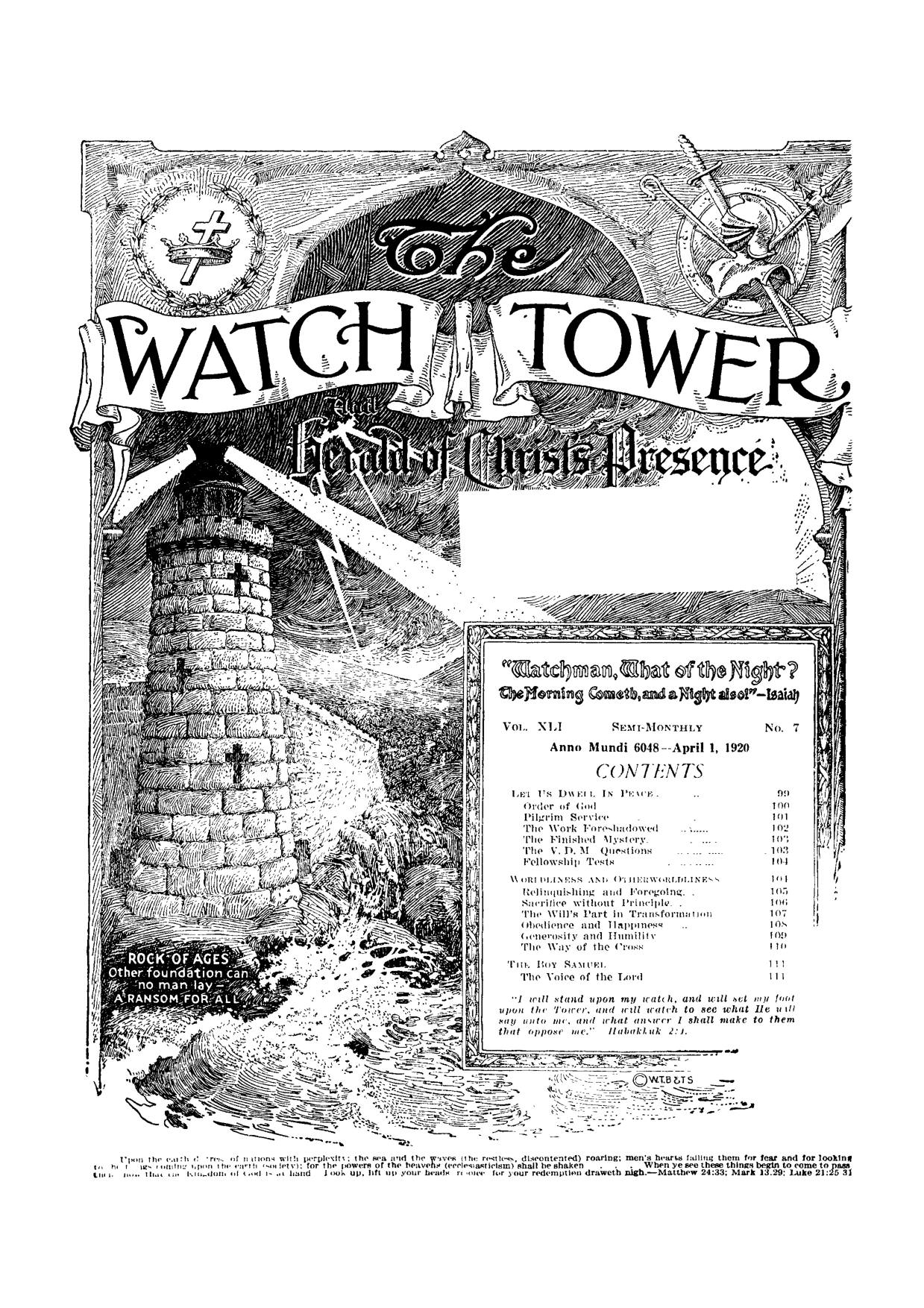
Upon the cai-h *r<^. of n itionn with perplexity; the M*a and the waves (the restless, discontented) roaring; men's hearts failing them for fear and for looking h< t ilt" r unit nt' upon i tn- c:rt ti <mm letv): for the powers of the heavens (ecelesiastictsm) shall be shaken . . . When ye see these things begin to come to pass
i. B<i.. iIi.h in. Kiti_«j<nb «>f <•»><! I- .>i bund J ook up, lift up your heads n ><uw for jour redemption draweth nigh.-—Matthew 24:33; Mark 13.29: Luke 21:25 31
THIS JOURNAL AND ITS SACKED MISSION
THIS journal is one of the prime factors or instruments ih the. system of Bffilfi- ias-tmction, or 'Utenritatry Extension”, now being presented in till parts of the civilized world by the WATCH Tower. Bible & Tract Society, «nw. tered A.I). 1884, “For the Promotion ot Christian Knowledge". It not only serves as a elms room whar.0-Bible sttudtent* may meet m. tlle study of the divine Word but also as a channel of communication through which they may. be reached'witig announcements of HStt* Society's- conventions and of the coming of its traveling representatives, styled “Pilgrims’, and refreshed with. rijQontM off its convent Mm,
Our “Berean Lessons" are topical rehearsals or reviews of our Si-citity’S puhBebeil Stuiwes most: •entertainingly arranged, and:very helpful to all who would merit the only honorary degree which the Society aceocdh,. vix. VerH Ih-i JtyHater (V. D. M.), which, translated' into English is Minister of God's Woid. Our treatment otj tile International Sunday School Lessow,, is. specially for the older Bible students and teachers. By sonic this feature is considered indispensable.
This journal stands firmly for the defense of the only true foandlition all clue (liristian’s hopw-now being so generally repudiated — redemption through the precious blood of "the man Christ Jesus, who, gave himself a ransom [a ski-responding price, a substitute] fol all". (1 Peter 1:19: 1 Timothy 2 : <11 Building up on this sure foundation the. gold, silver and J rawmus sHones (I Coriuhiiins 3: 11 15; 2 Peter 1:5-11) of the Word of God, its further mission is to “make alt see what is the feUuiyslli'p oi the mystery which. . .lias, been iiid in God, ... to the intent that now might be made know o: by the church, the manifold vdildoui of God”—“which, in other ages, was not made known unto the sons of men as it is now revenlotf*:— llpluvsmns il;5-l>. 10.
It stands free from all parties, sects and creeds of men. while- it' seeks more and more to 'Iii-iig its every utterance, into fullest: subjection to the will of God in Christ, as expressed in the holy Script lies. It Is thus free to, deetanr bohlly whatsoever the Lord hath spoken—according to the divine wisdom granted unto us to undeistand, hrs utterances. Its,latitude is not dogmatic, but confident;-lor we know whereof we aflirm, treading with implicit faith upon the sure promises of God. It. ifrheldi as a trust, to l« used only in his service; hence our decisions relative to what iirnjr and what may not ai*peac in its columns niiir& be- u»twr<8ng to our judgment of hist good pleasure, the teaching of his Word, for the upbuilding <'*i his p-opte- in grace and knowledmt: Atufl we not only invito but undo our readers to prove all its utterances by the infallible Word to which reference is constantly 'Biipdir ta facilitate sucj testing.
TO US THE SCRIPTURES CLEARLY TEACH
That the church is “the temple of the living God", peculiarly "his workmanship” ; that its tsumtiwUen teis been ifj, progress, thpoug.bo.ut the gospel age—ever since Christ became the world’s Redeemer and the Chief Corner Swnie- olf hi# temple, through which, when finished, God’s blessing shall come “to all people”, and they find access to him.—1 toafatNans 3:16, IT; Ephesians 2 ; 20-22; Genesis 28:14; Galaginn.s 3 : 29. '
That meantime the chiseling, shaping, and polishing of consecrated believers in Christ's ijM-wement Tor sin, progresses; and; when the last of these “living stones", “elect and precious,” shall have been made ready, the great Master Workman will bring all together in the first resurrection ; and the temple shall be filled with his glory, and be the meeting pta/e between, God and men throughout the Millennium.—Revelation 15:5-8.
That the basis of hope, for the church and tlio world, lies in the fact that “Jesus ChrS-s-t, by the grace ot God, tasted death for every man,” “a ransom for all,” and will be “the true light which lighteth every mm that eoitcth intes the world”, “in due time".— Hebrews 2:0; John 1:9; 1 Timothy 2:5, <i.
That the hope of the church is that she may be like her Lord, “see him as he K" be “partakers of the divine nature',’ and share bls glory as his joint-heir.—1 John 3:2; John 17:21; Romans 8:17; 2 Peter 1:4.
That the present mission of the church is the perfecting of the saints for the future work of service; to develop in herself every grace; to be God’s witness to the world ; and to prepare to be kings and priests in the next age.—Ephesians 4 :12 ; Matthew 24 ; 14; Revelation 1:6; 20:6.
That the hope for the world lies in the blessings of knowledge and opportunity to be brought to all by Christ’s Millennial kingdom, the restitution of all that was lost in Adam, to all the willing and obedient, at the bauds Of their Redeemer and his glorified chwh, when all the wilfully wicked will be destroyed.—Acts 3 :19-23 ; Isaiah 35.
pUBLtSHE.0 By
WATCH TOWER. BIBLE 6-TRACT SOCIETY 124 COLUMBIA HEIGHTS n a BROOKLYN, NY,U SA Foreign Offices: British: 34 Craven Terrace, Lancaster Gate, London W. 2; Australasian: 495 Collins St., Melbourne, Australia; Routh African: 123 Plein St., Cape Town, South Africa.
Please Address the Society in Every Case.
ANNUAL SUBSCRIPTION PRICE $1.00 IN ADVANCE
CANADIAN AND FOREIGN SUBSCRIPTION PRICE $1.50
SEND MONEY BY EXPRESS OR POSTAL ORDER, OR BY BANK DRAFT
FROM FOREIGN COUNTRIES BY INTERNATIONAL POSTAL ORDERS ONLY (Foreign translations of this journal appear in several languages)
Editorial Committee: This journal is published under the supervision of an editorial committee, at least three of whom have read and approved as truth each and every article appearing in these columns. The names of the editorial committee are: J. F. Ri’theiipobd, W. E. Van Axiburgit, F. II. Robison, G. IT. Fisher. W. E Page.
Terms to the Lord’s Poor: All Bible students who, by reason of old age or other In-l.rmiiy or a-lver-itv, are unable to pay for tl-iv journal, will be supplu-l free if they send a postal car I each May stating the,r ca-»e and req”esting such provision. We tre not only willing, but anxious, that all such be on our list continually and in touch with the Berean studies.
Notice to Subscribers! d° not> ° r”1e. Rend q card of acknowledgment for r renewal or for a new subscription. Receipt nr’1 tntry of tenewal arc indicated within a month by change fn expiration date, as shown on wrapper labc 1.
Entartd a» Second Clan Matter at lirnokhtn, M Y . PotrtofPee vndcr the Act of March 3rd, 1878.
REMITTANCES BY CURRENCY
Despite our frequent warnings it not infrequently occurs that friends make remittances to us by silver or paper currency, instead •f by Postal or Express Money Order or Bank Draft, which are the safest and most satisfactory methods of forwarding money when they are at all procurable. When currency is sent it is not infrequently lost, due sometimes to dishonesty in postal employes, but more often to Insufficient wrapping or inadequate envelope.
VOLUMES AND SCENARIOS
After considerable delay we are able to announce a full stock of the first six volumes of Studies in the Scriptures and of cloth de luxe, cloth red edge, and paper bound Scenarios of the PhotoDrama of Creation.
WATCH TOWER REPRINTS
Many and extended delays have been encountered in the binding and shipping of the Watch Tower Reprint Volumes, much to our disappointment and chagrin. We hesitate to make any new promises, except to say that we are doing all the urging within our power to have the work done expeditiously. We remind you that we are now some six years in the time of trouble, which was long foretold as being unique. We are finding it even so.
SOME LOCAL CONVENTIONS
Guelph. Ont., April 2-4: For local particulars address George A. Humphries, 19 Elizabeth street, Guelph, Ont.
Dayton, Ohio, April 3, 4 : The friends announce an interesting program. Programs and other details furnished upon request address A. P. Pottle, 423 Quitman street, Dayton, Ohio.
STUDIES IN THE SCRIPTURES
These Studies are recommended to students as veritable Bible keys, discussing topically every vital doctrine of the Bible. More than eleven million copies are in circulation, in nineteen languages Prices are net, postpaid, and barely cover cost of production and handling. Two sizes are issued (in English only) : the regular maroon cloth, gold stamped edition on dull finish paper (size 5"x 7j“), and the maroon cloth pocket edition on thin paper (size 4" x fli") ; both sizes are printed from the same plates, the difference being in the margins ; both sizes are provided with an appendix of eatechlstic questions for convenient class use. Prices for both editions are uniform. The leather bound and fine India paper editions formerly issued are permanently out of 5t»ck.
Series I, “The Divine Plan of the Ages,’’ giving outline of the divine plan revealed in the Bible, relating to man’s redemption and restitution : 350 pages, plus indexes and appendixes. 75c. Magazine edition 15c. Also procurable in Arabic, Armenian, Dano-Norwegian, Finnish, French, German, Greek, Hollandish, Hungarian, Italian, polish, Roumanian, Slovak, Spanish, Swedish, and Ukrainian; regular cloth style, price uniform with English.
Series II, “The Time is at Hand,’’ treats of the manner and time of the Lord’s second coming, considering the Bible testimony on this subject: 366 pages, 75c. Obtainable In Dano-Norwegian. Finnish, German, Polish, and Swedish.
Series III, “Thy Kingdom Come,’’ considers prophecies which mark events connected with “the time of the end”, the glorification of the church and the establishment of the Millennial kingdom ; it also contains a chapter on the Great Pyramid of Egypt, showing its corroboration of certain Bible teachings: 380 pages, 75c. Furnished also in Dano-Norwegian, Finnish, German, Polish, and Swedish.
Series IV, “The Battle of Armageddon,’’ shows that the dissolution of the present order of things is in progress and that all of the human panaceas offered are valueless to avert the end predicted by the Bible. It contains a special and extended treatise on our Lord’s great prophecy of Matthew 24 and also that of Zechariah 14 :1-9 : 656 pages, S5c. Also in Dano-Norwegian, Finnish, Greek, German, and Swedish. , , .
Series V, “The Atonement Between God and Man," treats an all important subject, the center around which all features of divine grace revolve. This topic deserves the most careful consideration on the part of all true Christians: 618 pages, 85e. Procurable likewise in Dano-Norwegian, Finnish, German, Greek, and Swedish.
Series VI, “The New Creation,” deals with the creative week (Genesis 1,2), and with the ehurch, God’s new creation. It examines the personnel, organization, rites, ceremonies, obligations, and hopes appertaining to those called and accepted as members of the body of Christ: 730 pages, 85c. Supplied also in Dano-Norwegian, Finnish, German, and Swedish.
Vo foreign editions in the pocket site.
AMI) HERALD OF CHRISTS PRESENCE
Vol. XIA Avru. 1, 1920 No.
LET US DWELL IN PEACE
“Rehold, how good and how pleasant it n for brethren to dwell together in unity " Psalm 133'1
W?\R between the beast and the Lamb is now on and the faithful followers of the Lamb of necessity are engaged 111 the conflict. One of the methods of warfare on the part of the adversary is to stir up strife in tin; ranks of the Lord’s followers. During the past three years the experiences have been quite fiery; but no Christian is surprised at this. “Beloved, be not surprised at the fire among you, occurring to you for a trial, as though some strange thing was befalling you.” (1 Peter 4 : 12. Diaglott) Different brethren viewing questions with different minds have had some misunderstandings; and such were to be expected. We feel sure, however, that every one possessing the spirit of the Lord, and whose chief purpose is to please the Lord and gain the prize of the high calling, is willing to forget the things that are behind, restate, agree upon and follow the divine rules laid down for the governing of the church, to dwell together in unity and proceed as one harmonious body
It seems there never has been a time so important to the saints that they should dwell together in peace and unity. Loyalty is one of the divine requirements and loyalty to the Lord means to be loyal to the members of his body. Suspicion is an enemy. Suspicion leads to distrust; and distrust may lead to disloyalty. If the adversary can drive a wedge between the Lord's people, causing strife, then to that extent the adversary succeeds in the conflict. The journey of the church is nearing a conclusion Timely is the admonition to ‘look to ourselves, that we lose not those things which we have wrought, but that we receive a full reward’.—2 John 8.
Some time ago brethren 111 Great Britain, having a desire to bring about a greater spirit of unity and cooperation, constituted a committee to discuss points of difference and addressed a letter to the President of the Society asking what could be done to this end. Letters were exchanged, and the committee reported to the Society’s President that lus letter was very satisfactory and a request was made that it. or the substance of it, be published in The Watch Tower. The same points are therefore restated here, for the benefit of our brethren in Great Britain and for the brethren throughout the world.
SOME PROPOSITIONS
The points of difference seem to be with reference to the relationship of the Watch Tower Bible and Tract Society to the. various ecclesias and to the church as a body, the V. I). M. questions, and “The Finished Mystery” as the seventh volume of Sttutes in the Scriptures. It has been claimed by some that these poinita are made conditions of fellowship. We first make a brief statement of the points and then deal with tlhe matter more in detail.
(1) Our understanding is that the Watch Tower Bible and Tract Society, as a body corporate, is the servaint of the church and does not exercise control and authori ty over the Lord’s people.
(2) The basis for fellowship and unity in the church is our relationship to God through Jesus Christ and our harmony with the divine arrangement.
(3) There should be full liberty of conscience, with :no attempt to coerce the views of one by another.
(4) Church government should be maintained according to the word of the Master and the Apostles, and all should be willing to be governed by the majority. This principle applies to separate ecclesias and to the whole body of the church.
(5) The Society provides Pilgrim service for the ecclesias that request it.
(6) The Society has no authority to determine the qualification of officers of the various ecclesias; but it has authority to determine the qualification of those who shall constitute its (the Society’s) officers or servants, and the sole authority to determine who shall constitute its officers and representatives.
(7) The motive governing all actions in the church, or between the individual members, should be love.
THE CHANNEL
Some of the brethren have held that the Watch Tower Bible and Tract Society is the channel used by the Lord for dispensing or transmitting the message of present truth to the household of faith. Others have taken exception to this statement and have insisted that the Society is assuming a position that is un-Scriptural and contrary to the divine arrangement. We think the difference of opinion has been due entirely to a misunderstanding. Hence we here consider the question with a hope of clarifying it.
A channel is properly defined as “that through which anything passes ; means of passing, conveying or transmitting ; as. The news was conveyed to us by different channels” .--Webster. In other words, it is a vehicle or means of transmitting truth. The channel itself does not originate the truth, but it is merely used as a mean to an end.
In order to understand the divine arrangement and whether or not the Lord, in the harvest period, has had a channel or vehicle for transmitting his message to the church, let us first determine the following questions:
(1) Do we believe that Jesus Christ is present and has been for the past forty years, or more, directing the work of setting up his kingdom?
(8) Do we believe that the Lord chose as an earthly representative to serve the household of faith one wise and faithful servant whom he made ruler over the household, and that the person so chosen was Charles Taze Russell ?
(3) Do we believe that the Lord directed Brother Russell during the time of his service in what he did with reference to carrying on his (the Lord’s) work?
PURPOSE OF SOCIETY
We assume that every one in present truth, realizing that his knowledge of present truth came from the Lord through the ministration of his servant, will answer the foregoing questions in the affirmative; and answering them in the affirmative, we have a basis from which to consider the question as to whether or not the Society is the channel used by the Lord as above suggested.
No one in present truth for a moment doubts that Brother Russell filled the office of the “faithful and wise servant, whom his Lord hath made ruler over his household, to give them meat in due season”. (Matthew 24:45) He organized the Society shortly after he began his work, but not until 1884 was it incorporated. Without a doubt he saw there was a probability of the work being carried on after his change. While he was on earth he personally directed everything concerning the harvest work; but preparing for a future contingency, he wrote and published in The Watch Tower in October, 1884:
"... though It [the Society] has already done a great work, and in the hand of God has been a power in publishing the truth, the influence of which is being felt already on both sides of the Atlantic, [it] has never yet had legal incorporation. Nor was such incorporation considered necessary by its friends, it having already all the powers necessary for the present work and similar to that of nine-tenths of other small societies.
“But a new phase of the question has arisen. It seems tolerably certain that some of the saints will be in the flesh during a great part at least of the ‘time of trouble’, and if so, there will be need of printed matter, tracts, etc., as much then, perhaps, as now, and possibly will be more heeded, for when the judgments of the Lord are ‘in the earth the Inhabitants of the world will learn righteousness' (Isaiah 26:9) Should those at present prominently identified with the work not be the last to be ‘changed’, some interruption of the work might result; but this may be obviated by having a legal standing, granted by a State Charter.
"... it was deemed best to apply for a charter; and this has been done. We expect that it will be granted without delay.”
On December 13, 1884, the charter was granted, a notice of which was published in The Watch Tower for January, 1885.
It is manifest from the language used by Brother Russell that he expected the Society to constitute his successor to carry on the work after he had finished that which was committed to him personally.
“THAT SERVANT”
In the October 1, 1909, issue of The Watch Yowbb he published an article dealing with “that servant”, and among other things there said:
"Our opponents are ready to admit that the Lord has used the Watch Tower Bible and Tract Society as his channel or servant in forwarding the harvest message in a most remarkable degree—in a manner and to an extent hardly to be believed and never equaled—in many tongue* and at the hands of many ‘fellow-servants’, Colporteurs, Pilgrims, Volunteers, etc. They admit that there is no question that a remarkable service has been rendered, and hence that it is Indisputable by any who believe that there is a harvest work in progress and that the Society has been a servant of the harvest message in a most profound and peculiar sense, even if they dispute that it has fulfilled Matthew 24 : 45, as being ‘that servant’.”
He furthermore stated in that same article (page 293):
"Our friends reply that it is with the Lord and with no one else to determine who and when and what shall be provided for the ‘household of faith': and for him equally to decide whether he will send that spiritual food through one channel or through many channels. They urge that all who are hungering and thirsting after truth, all who are looking to the Lord for their supply, all who are in a proper attitude of mind, meek and teachable, will be ready to say, ‘Lord, thy will be done in thy way I To thee we ar* indebted for every blessing, every mercy, every ray of light, and we prefer to receive it as thou dost prefer to dispense it! We have no wish or will tn express! Our prayer is. Thy will be done’.' They further urge that the opponent* consider that the harvest message has been going forth for thirty-five years, and that if the Lord should change ht* program and his channel of sending the truth at this late day, it would be very remarkable—less reasonable to suppose than that he would continue to use ‘that servant’. They urge, furthermore, that all who cut loose from th* Society and its work, instead of prospering themselves or upbuilding others in the faith and in the graces of the spirit, seemingly do the reverse—attempt injury to the cause they once served, and, with more or less noise, gradually sink into oblivion, harming only, themselves and others possessed of a similarly contentious spirit.”
ORDER OF GOD
Order is a divine arrangement. (1 Corinthians 14: 40) Do we believe that there is any work for the saints to do after the change of Brother Russell? To this question doubtless all the saints will answer in the affirmative. Then would it not logically follow that the Lord would carry on his work in an orderly manner? If he had ever constituted the Society a channel, servant, vehicle, or means of transmitting the truth, is there any reason, Scriptural or otherwise, to conclude that he has adopted and organized a separate or different channel; and if so, what is it? The mere fact that he would continue to use the Society as his channel would not mean that others not in harmony with the Society have no truth. They may haw much truth. The whole question is, Are all those in the truth working together in harmony? We would have no quarrel with any one who wants to seek truth through other channels. We would not refuse to treat one as a brother because he did not believe the Society is the Lord’s channel. Appropriate to this point, Brother Russell wrote and published (Z ’09 - 293):
“From the first we have urged that this subject b« not allowed to produce contention or bitterness of spirit. L*t •uch reach his own conclusions and act accordingly. If some think that tliey can get as good or better provender at oilier tables, or that tliey can produce as good or better tl emselves—let these take their course. All who feel dissatisfied with the spiritual food which our great Master has privileged us to send broadcast to every nation should certainly be looking anywhere and everywhere for eomething better. Our wish for them is that they might find something better. If we were dissatisfied ourselves, or if we knew where something better could be obtained, we certainly at any cost would seek it."
SOME QUESTIONS ASKED
Brother Russell finished his work in 1916. According to the order provided, an election was held in January, 1917, and officers of the Society elected. In October, 1917, a referendum vote was taken of the entire church for the purpose of determining who should constitute the servants or officers of the Society for the ensuing year. On January 5, 1918, the shareholders, duly constituted to cast the legal vote, convened, and in harmony with and in obedience to the referendum vote elected] officers and servants of the Society. Opposition can11:dates were nominated and before the vote was taken three questions were asked each one thus nominated, and tl;e\ were required to answer publicly before the shareholders voted. These questions were:
( I) Are you in harmony w if h the Watch 'Power Bible and Tract Society and its work, as provided by its charter and Brother Russell’s will ?
(2) Have you answered the V. I). M. questions?
13) Do you accept “The Finished Mystery” as the seventh volume of Studies in the Scriptures, as published by the Society?
'I’lie shareholders had a right to know whether or not the officers or servants whom they were about to elect would carry out their wishes, and therefore with propriety propounded the above questions. Almost unanimously the vote was cast for the officers elected, who answered these questions in the affirmative. The Society, in regular session, by an overwhelming majority vote, expressed its will in substance thus: Brother Russell filled the office of “that servant” and has finished his work. While here, acting under the supervision of the Lord, he organized the Society and left it as his successor to continue the work yet to be done, and that its officers, to bo elected, will be its duly constituted representatives and must be in harmony with the expressed will of the Society and so state before they are placed in that responsible position.
Such action was taken, that the work might be done “decently and in order”; and was therefore entirely proper and Scriptural. In other phrase, the overwhelming majority said: We believe the Society thus constituted bv Brother Russell under the supervision of the Lord has a commission from the Lord, which commission or authority the Lord lias never taken away from it, and it therefore has a work to do; and the duty and obligation devolves upon it to do that work and to do it “ decently and in order”.
A small minority who love the Lord might hold a different view, hut the majority would not feel disposed to elect its officers and servants from such, because there could not be harmonious action. If some did not care to work in harmony with the Society thus constituted, that would be their privilege; yet that would not mean that there should be any ill feeling, nor that such should be disfellowshipped. If the Lord started a work through a duly constituted organization or society, and that work increased and upon it the Lord’s blessing was made manifest, then it would seem that those who wanted to be in harmony with the Lord would wish to cooperate in his arrangement. If others see it in a different way, that is their privilege. There should be full liberty of conscience.
Applying the same rule to the several ecclesias composing the entire body, suppose one ecclesia is composed of a hundred persons, sixty of whom say, We are not in harmony with the Society and its work; therefore we will elect as our elders and servants those from among the majority who hold our views. Certainly no fair-minded person would deny that they had the privilege thus to do. If they felt that the Lord would be better pleased with them and their action to follow that course, then it is their privilege to take it. On the other hand, suppose that sixty or even a larger majority said, We are in full harmony with the Society and the work it is trying to do. We believe that it has a commission from the Lord and that it is in accordance with his will that we should work harmoniously in the proclamation of his message; therefore we will elect as our elders and servants only those who hold similar views and who will work in harmony with us. Would not that privilege be theirs? Surely no one can deny that fact. But what about the minority? Should they be disfellowshipped? Certainly not. They should be treated kindly, treated as brethren, in harmony with the Scriptural admonition that we should do good unto all, especially unto those of the household of faith. Should they be greeted as brethren? To be sure. Why should any one be treated unkindly because he could not see just as we see? Let each one exercise the spirit of love, the spirit of Christ, toward the brethren, because “if any man have not the spirit of Christ he is none of his”.
PILGRIM SERVICE
Will the Society provide Pilgrim service to classes which have not elected elders in full harmony and sympathy with the Society and its work? Yes, if the class requests such service and will give respectful hearing to the Pilgrims who are sent. Such action will be taken on the theory that it is the desire to help any one, specially those who show the spirit of the Master. The Society, through its duly constituted officers, will determine when and when not it would be in harmony with the Lord’s will to provide such service.
Tias the Society the authority to direct various ecclesias to propound to those who stand for office the question: “Are you in harmony with the Society and its work?” No, certainly not, because the Society does not elect such elders or servants. Has the local ecclesia the right to propound such questions? Yes, indeed, the local ecclesia chooses its servants and teachers. Its members have a right to say (if that is their true heart sentiment) : We believe that Brother Russell organized the Society with the Lord’s approval and that it was left as his successor to do the work after he had finished his, and we want our teachers to be in harmony with us that we may have peace and that we may work in harmony with the Lord’s arrangement, doing things decently and in order.
It is a privilege to serve an ecclesia as an elder or servant; and it is the exclusive privilege of the ecclesia to determine who shall be its elders or servants. Such is the Scriptural, or divine, order of things. No individual has the privilege or right to demand that an ecclesia elect him to any position; and if he is not elected no one has occasion to be offended. There is a wide distinction between electing to office and fellowship. One might be in full fellowship and yet the class not feel justified in electing him to office.
THE WORK FORESHADOWED
Practically all in present truth, if not all, we believe, concur in the thought that the “man . . . clothed with linen, with a writer’s inkhorn by his side” (Ezekiel 9:2) foreshadowed Brother Russell; that Brother Russell had a commission from the Lord to do certain work; and that he finished that work and reported the same. (Ezekiel 9:11) It is another picture of “that servant”. It will be observed from this Scripture that six other men are involved. “And, behold, six men came from the way of the higher gate, which lieth toward the north, and every man a slaughter weapon in his hand; and one man among them [making the seventh] was clothed with linen, with a writer’s inkhorn by his side: and they went in, and stood beside the brazen altar.” Coming from the north to perform a work shows that these men had a commission from God. They went in and stood beside the brazen altar, the place of sacrifice, picturing that they were sacrifices of the priestly order to perform a work in the name of the Lord. If the one man with the writer’s inkhorn held a divine commission, the other six held a divine commission. We believe it in harmony with Biblical construction to say that the six symbolized all the members of the body remaining this side the vail after the death of Brother Russell, who, submissive to the Lord’s will, zealously endeavor to do his work. Brother Russell’s work peculiarly was that outlined by this commission; viz., to deliver to those seeking for truth an intellectual understanding of the Word of God concerning the. fall of man, his redemption, the sacrificial work of the Christ, head and body, particularly leading them to consecration. In every discourse delivered by him he mentioned consecration. He was once requested to deliver a discourse dealing exclusively with restitution; but this he declined.
REMAINING WORK
Clearly, then, those remaining to do the work after he was gone have a commission also from the Lord. And how could this better be represented than in an organized harmonious body, working together for the proclamation of the message concerning the Lord’s kingdom? These were commissioned to “slay utterly old and young, both maids, and little children, and women; but come not near any man upon whom is the mark; and begin at my sanctuary”. (Ezekiel 9; fl) Plainly, the slaying here means to slay with the sword of the spirit, the Word of truth. They begin with the “ancient men”, i. e., the clergy class, and are directed to set forth the message of truth clearly and emphatically, marking the distinction between merely nominal Christians and those who worship God in truth and i» spirit. There is the commission to declare the day of God’s vengeance and to comfort those that mourn by pointing them to the fact that the kingdom of heaven is at hand and restitution blessings will soon begin.
It must be particularly observed that the commission states: “But come not near any man upon whom is the mark,” which we understand to mean tliat in the case of any one who has a knowledge of present truth there should be no attempt made to change him. So surely, then, as Brother Russell had a commission to do a distinct work, so those of the church remaining have a commission to do a distinct work; and it seems clear that it was the will of God and the Lord Jesus that this work should be done in an orderly manner through the Society, and that Brother Russell had such a thought when he wrote: “It seems tolerably certain that some of the saints will be in the flesh during a great part at least of the 'time of trouble’, and if so, there will be need of printed matter, tracts, etc., as much then, perhaps, as now, and possibly will be more heeded. . . . Should those at present prominently identified with the work [evidently meaning himself] not be the last to be ‘changed*, some interruption of the work might result; but this may be obviated by having a legal standing, granted by a State Charter.” He left a work to be dene and it was the Lord’s will that the Society do it; and if we are correct in this conclusion, then it would seem that the Lord has not authorized others, no matter how honest, to go aside and organize some other movement io carry on his work; and that those who oppose the work of the Society would not seem to be doing a work i» harmony with the divinely given commission. We are not judging any one. Every one is privileged to take his own position. But we believe it in the interest of every one who loves the Lord and his cause to state the matter kindly, yet plainly.
THE SOCIETY AS PUBLISHER
Another point worthy of consideration: The Society published all the writings of Brother Russell. He was an editor, not a publisher. He transferred legally all of his right, title and interest in and to all of his works to the Society. The Society controlled the publications, arranged for the manufacture of the books and other publications, and put them out. The Society still owns and exclusively controls all the writings of Brother Russell, including Volume VII. If the Society was the channel for the beginning of these publications, is there any evidence indicating that the Lord has since chosen another and different channel? If the Society is not the channel for the transmission of this message of truth to the people, then why has the Lord permitted it to have the exclusive control of the publications? This includes The Watch Tower, which has at all times been recognized as the official organ of the Society.
Lt is the coiadliusion, therefore, of the Editorial Conm imittee—and in ithis itte officersof the Society concur— : that the Society is thceehannel tic’ Lord is using to carry .on his work; that it .has a divine.commission, a work to .perform, and which it is endeavoring, by the Lords .grace, to perform. ’If sthers have a different view, let ithem enjoy that view, but let us dwell together in peace. There is no oeeawon for (Controversy. We have no quarrel with anv one who holds a different view.
'.While we may admit (that there are many others who have truth and transmit it .and who are not working in harmony with the ■Society, yet with frankness, but with all reverence and love, we must say that we believe the Society is the Lord’s .channel through which he is carrying on Ins specific, work and thsi there’ is no other channel for ;the Lord’s specific work. Therefor* the Society does not recognize competition and has no controversy with any ..Die who takes a position different fiwin this stated. 11 merely states its position and grants’ the privilege to each and every one to take his own course. If any other body of Christians feel that they have a commission from the Lord to do a certain work, then with zeal they Jimild press forward in that work. We are not, therefore, chargeable with the original thought that the Society is the channel, because, as shown by the above quotations from Brother Russell’s pen, lh.lt was his thought long years ago; that he organized the Society with that thought in mind, and we are concurring in his conclusion.
THE FINISHED MYSTERY
It was the thought of Brother Russell to have the Studies in the Sckiptukes issued in seven volumes and in 1886 he announced this fact. Following his death the Society caused to be prepared and published Volume V11. “The Finished Mystery,” as one of the series of seven previously announced by Brother Russell. The doctrines therein set forth are in exact harmony with those announced in the other six. That it contains some mistakes is freely admitted. Even the Bible contains some. By mistake we mean a misunderstanding or misapplication. It does not contain any erroneous doctrines. It does attempt to carry and, we will be pardoned for saying, succeed-- in a measure at least the message which -win- to be contemplated by the commission given to the -ix described m Ezekiel 9. The Society m its animal official meeting adopted it as Volume VI1 of the mri. s of Studies in the Sckiptukes when, by an overwhelming majority, it required each officer to bi- elected to state that he accepted it as Volume V1T : It was therefore in exact harmony with this that any e< cle<ia subsequently would ask its prospective elders and officers: ‘‘Do you accept the Seventh Volume and are you willing to teach it?” If be said. No. he was not disfellowshipped ; no burden was put upon him. But he was told in kindness. We prefer to have some one to teach us who is in harmony with the Society and its work. This was no excuse or justification for any brother, elder or servant, to take offense and withdraw from the class. The proper course would have been and is to remain and strive to dwell together in peace in the studv of God’s Word.
.By way of illustration^ there are yet a number in the clasw’s in various places who do not understand the vital dixitrine of justification and consecration and who cannot properly apply the doctrine. There are many who are .-unable to give the clear distinction between the ransom and the sin-offering; and yet no one would think of disffcllowshipping them because they are unable to do these things. On the same line of reasoning, it would be wholly improper to disfellowship one because he could .iw>t accept everything stated in the Seventh Volume. Let Icve be the controlling force, directing the actions of each one. It i.« readily to be seen that should a clas» elect one as elder who is out of harmony a ith the Society and opposed to the Seventh Volume such would at once create disorder instead of establishing order, unity and peace: and this of itself is conclusive proof that such a course would not be pleasing to the Lord. Our getting into the kingdom does not depend upon a clear vision of all the teachings of the divine plan ; but it manifestly does depend upon the pure condition of heart of each one. God ha- promised to exercise his power in behalf of none other except the pure in heart. (2 Chronicles 16:!*) Our conclusion is, therefore, that where the majority of the class accepts “The Finished Mystery” a« the Seventh Volume it should be entitled to elect its elders in harmony with it; and that is a question for the ecclesiu alone to determine and not for the Society, nor the minority.
THE V. D. M. QUESTIONS
Some hare taken offen«e because those who stood for office have been asked the question : “Have you answered the A’. I). AI. questions and have yon passed that examination?” No one in present truth has occasion to take offense at any other person for the asking of these questions. Brother Russell established the V. D. AI. questions and express)} stated that he did so in order to ascertain who had the qualifications to teach : that he expected a time to come when there would be a great demand for teachers of the divine plan and then “we will want to know where we can lay our hands on them” was his language.
Thu Scriptural qualifii at ion.- set forth for elders (1 Timothy 3:1-1: Titus 1:6- 9) among other things provide that an elder must be “apt to teach”. How could an eeclesia better determine the, qualification of a teacher than to submit to him questions such as the V. f). AI.? Since the eeclesia is the exclusive body to determine who shall be its elders, it is entirely proper that this qiic-tion be propounded to aid the members of the ecclesia to determine whether or not its elders are qualified to teach. Any one standing for office who would refuse to answer the question would show, it <eems to us, an improper disposition and an unwillingness to aid the class.
It has been charged by those who oppose that the Society ha« made those questions tests of fellowship. This charge is wholly without foundation. We quote from The Watch Tower of 1918. page 70, relating to this subject: “This doos not mean that such persons who would not answer the foregoing questions in the affirmative should be disfellowshipped. On the contrary, they should be encouraged to study the Lord’s Word and grow in knowledge and the fruits and graces of the spirit”.
FELLOWSHIP TESTS
The Society, therefore, has no desire to put a test upon any of the brethren, nor any purpose of putting a test upon any one except those who are offered for election as officers and servants of the Society; and this was clearly within its province when, in meeting officially, it put a test upon such, as heretofore set out. It has no purpose or desire and does not countenance the putting of specific tests upon any brethren relative to fellowship except that which is designated by the Scriptures. It has not made the acceptance of the Society as the channel a test of fellowship, nor the Seventh Volume, nor the V. D. M. questions. Where, however, some withdraw themselves and violently oppose the Society and resort to inflammatory speech and vituperative language, fault-finding, severe criticism, etc., then responsibility rests with them. We have neither time nor inclination to indulge in such. Our purpose is to strive humbly to preach the message of the kingdom, and those who have a different view’ are at perfect liberty to take their course. For this reason The Watch Tower does not and will not attempt to answer the many untruthful charges that have been published concerning its officers, the manner of conducting its work, the Seventh Volume, etc. The Lord is our judge.
It may be asked. Would any ecclesia or members thereof have the right to demand that the Society reinstate any person in an official position as the Society”'.* representative? This question must be answered in the negative, for the reason that the whole body elects the official members of the Society and it devolves upon the executive, by virtue of the authority conferred, to determine who shall be the other representatives and the tenure of office of such representatives. The time of service, whether long or short, should not be viewed as a reflection upon any one. Conditions might arise that would make necessary a change; nor could it be considered a teat of fellowship as to whether or not one was actively a representative of the Society. Every one should regard it as a privilege to serve in any capacity in which he is placed, either as an officer of the Society, an officer or servant of any ecclesia, or anywhere else in the Lord’s service. We ought to have faith in the statement of the Apostle, that God hath set the members in the body as it pleaseth him, and in his own good way he will arrange the whole matter.
IN SUMMING UP
In summing up, then, we say that in our judgment Brother Russell was the Lord’s chosen servant; that he organized the Society to do the work after his death as his successor; that the Society is the servant of the church; that it has no authority or jurisdiction over the local ecclesias as to whom they shall or shall not elect as elders or servants; that it has jurisdiction and authority to determine what are the qualifications of those who stand for officers or servants of the Society ; that the majority should rule, both in local ecclesias and in the whole body ; that there should be freedom of conscience and no attempt to put a test of fellowship upon another aside from the Scriptural requirement; that Volume VII. Studies ix the Scriptures, and the V. D. M questions have never been made a test of fellowship and should not be; that the basis of fellowship and unity in the church is and should be the relationship of the members to Jehovah through Christ, and harmony with the divine arrangement, and that this means that all who believe in the Lord Jesus Christ as their Redeemer, who have consecrated their lives to do his will, and who are striving to walk in his footsteps, manifesting the fruits and graces of the spirit, should be received in full fellowship : that where there is a difference of opinion as to the construction of the Scriptures, such differences should be stated in a kind, loving manner; that all should “follow peace and holiness”, as admonished by the Apostle. “Ye are all one in Christ Jesus.” (Galatians 3:28) Hence there should not be, and. in fact, cannot be. anv permanent division in the body of Christ
WORLDLINESS AND OTHERWORLDLINESS
“Be not conformed to this world, but be ye transformed by the renewing of your mind.”—Romans 122
IT IS not possible to force the standards and ideals of the world into likeness with those of the Bible, or those of the Bible into harmony with the standards of the world. The two are different; and the sooner we recognize this fact, and the more thoroughly we act upon our knowledge, the wiser we are.
“Love not the world, neither the things that are in the world.” “Know ye not that friendship with the world is enmity with God?” “Ye are not of the world, even as I am not of the world.” “Not as the world giveth, give I unto you.” These texts all show that a marked distinction was intended by the Master to exist between the children of the kingdom and the children of the world. Failure to appreciate, or failure to observe these facts, has caused much, if not most, of the trouble in Christ’s church during her checkered course of eighteen centuries. It is because she disdained and disregarded her Master’s word on the subject of separateness from the world that the virginal simplicity of the early church was lost—viewing the Christian church en masse
SEPARATENESS NOT MONASTICISM
But it was not the thought that Jesus’ followers should hide themselves from contact with the world and lead a monastic existence. No, we are to follow in the Master’s footsteps, to “walk even as he walked”. (1 John 1: 17) He is our exemplar on this point as well as in other matters, and our Lord did not habitually seclude himself from other beings. Sometimes he did seek the quiet of the mountain in prayer, sometimes the dark shadows of the garden; but he did not eke out his existence in a monastery or a convent. He was dealing with the people nearly all of the time; yet he said of himself: “I am not of the world”. His separateness from the world was one which involved not so much his person as his affections and ideals, his aims and endeavors.
The Apostle warned the church that there would be a great falling away from the almost severe separateness of the church (2 Thessalonians 2:3); and this falling away made possible the development of the Man of Sin, for had believers clung close to the Lord and his Word there would have been no worldly influence enter and 4ominate the church.
“The Church and the World walked far apart Ort the changing shores of time;
'Die World was singing u giddy song, And the Church a hymn sublime.
‘Come, give me your hand,’ said the merry World, ’And walk witli me this way’;
But the good Church hid her snowy hands And solemnly answered ‘Nay,
1 will not give you my hand at all. And I will not walk with you ;
Tour way is the way that leads to death ;
To my Lord I must be true’.”
CHURCH CAPITULATES TO WORLD
But, now by flattery, notv by threatenings, the church was induced to stoop and take the advice of the world «nd to enter into its competition for popularity and power and—pelf.
But while the church, viewed as a whole, has been unfaithful and prostitute and careless and lukewarm, this has not been the experience of all believers. There has always been a remnant which was faithful to the Ijord and which esteemed the sufferings of this present time as not worthy to be compared with the glory that is to follow. As the spirit of the faithful Christian is traceable to his Lord, so the spirit of the world is traceable to the “god of this world”, to Satan, who “worketh in the hearts of the children of disobedience”.
The influences which led to Satan’s deflection and fall contribute very largely to the experiences of the world; for the spirit of worldiness is one of self, of self-confidence, self-exaltation, and, above all, self-love, over and above reverence for God—these are the distinguishing features back of earth’s ambition and strife. Not all of these qualities are bad in themselves; at least one of them is measurably necessary in our intercourse with fellow men, but when self-love opposes Jehovah’s will, or when it leads the individual to launch out on some scheme or project without consulting or even regarding the principles of the divine government, nothing but unhappiness can entail.
SIN AND SELF
The entrance of self-will, or selfishness, into the world was by the misdeed of our first parents. Sorrow was not always here; earth did not always resound with the echoes of man’s woe. In Eden all was peace and happiness because of harmony with and conformity to Jehovah’s law. Then heavenly and earthly minds communed in happiness together. No discordant note sounded in all creation; no suffering, no anguish bowed the human heart or bent the human frame.
Now we are not in Paradise, but in a world where death and tears, sweat of face and broken-heartedness belong quite casually to the order of the day. If we inquire what transformed that Paradise into a field of death, full of sighs and groanings, the answer is the one word, sin; and sin means self.
Some minds seek to accuse the Lord by saying that had he not forbidden, man had not transgressed. But such fail to appreciate the onetime honor and majesty of man. A man who would stay sinless as a matter of course, because it is impossible for him to sin; a man who would honor God merely as the nightingale sings, because the song was once put there, would not be a man worthy of fellowship with Jehovah, and could be no proper child of his.
RELINQUISHING AND FOREGOING
God did not demand that man relinquish something that he had. God did not demand that he perform some irksome and laborious work; not bidden but forbidden, was man. Everything that was there he could have and enjoy. There was just one thing which he must forego; to take that meant death. He was merely to forego something that vas not his own; forego one good thing which he never possessed. Could that be ealled a temptation, a trial, a testing?
Ah! to forego that which we do not have and still desire is the hardest thing of all. The hardest struggle and the bitterest toil wherein we strain our every power of mind and body to the utmost is easy compared with quiet, selfless resignation. Things possessed are not half so happifying to the natural man as that which is denied him. Yea, more willingly would he give of that in his hands than that he demurely fold his hands and say: I forego, my God, because it is thy will.
By the road of harmless self-denial Adam was to be led to the full stature of a perfect man. Self-will and self-denial; on those two things hung the happiness and woe of twenty billion souls.
“SIN ENTERED INTO THE WORLD”
“And when the woman saw that the tree was good for food, and that it was pleasant to the eyes, and a tree to be desired to make one wise, she took of the fruit thereof, and did eat, and gave also unto her husband with her; and he did eat.”- Genesis 3: 6.
So it happened, the dreadful thing, sin. It was not merely the eating of an apple, but much more. Man flagrantly sundered the bond of love and confidence which held him to Jehovah; it was a blow in the face of his Father and his God—because he, in Eve, listened to the voice of the serpent, because he believed God to be a liar, because he believed that the Father of every good envied him his blessings and wished to set bounds thereto.
In man reposed a longing to make a mighty plunge forward, to mount higher, to look deeper into the cause of things. God himself had planted this trait in his bosom. God himself was also doubtless ready to lead him to this goal by holy paths. His eyes were doubtless intended to open wider and more widely to the truth of what was good and evil. After sin man became "like God” in one thing, namely, that he acted independently, like God; but on that very account he became unlike him in all other things. Then his eyes were opened to know what holiness and sin, life and death, liberty and bondage, are.
Eve first sank slowly into sin, like one who contested and struggled with herself. She sinned, but tremblingly. She stood and listened until her conscience grew confused. She started out by parleying with the wicked one; she entered into discussion and argument.—All gentleness, all courtesy and leniency toward sin leads to defeat.—We ean imagine the scene:
She stands there. She not only answers the tempter, but lends her ear to his flattering voice. Ever sweeter sounds that voice, and ever sharper and more strident clangs the voice of God. His lovely and most gracious countenance transforms itself before her mind into the face of a cold and envious tyrant. She looks at the fruit, the forbidden fruit; and lovelier and more fragrant and more to be desired and ever more to be desired and more indispensable becomes that fruit—every drop of blood within her seethes and glows. Impossible, she can not refrain—there, it is done! And angels hide their faces.
BEFORE AND AFTER SIN
Before and after sin, what a difference in the human heart. Before, sin seemed so sweet; it would surely bring pleasure and repose; it would surely enrich the perceptions and faculties. Then afterwards, ah afterwards. Unrest seized on the heart; fevered, downcast, man would doubtless have given all to undo what he had done of his own free choice.
Man, the sinner, despised himself because he had sinned. He hunted for fig leaves to hide himself from himself. lie who by one fell swoop of sin sought to mount so high, lost respect for himself after the sin.
How sin mars and shatters every social tie on earth 1 Witness that, too, in this first transgression. The man should have been the lord and head of the woman, and instead he subjects himself to her rebellious will and sins at her behest. The woman should have been the serving helpmeet of the man, and she becomes the temptress who draws him away into death. Everything is upside down. She gave, he took, he ate, just as though it could not have been otherwise.
SACRIFICE WITHOUT PRINCIPLE
Adam relinquished the eternal for the sake of the temporal, the divine fellowship for the human. He thought to make a kind of sacrifice of God’s companionship to retain that of his wife, but like any sacrifice which disregards principle it. was not fruitful of even that unity which he selfishly sought to retain at any cost. Sin breaks every noble band, because it makes its victims cold and self-seeking. No matter how they struggled to retain their harmony, as soon as it became a question of who should bear the blame, then each sought to clear himself at the expense of the other. Note the chilly tone of Adam: “The woman that thou gavest me to be with me gave me of the tree and I did eat”.
Here is the germ of the first marital spat. How different does this utterance sound from the joyful greeting with which he first received her. Coldly he trundles-the blame onto the woman. She could look out for herself ; he would do his best to shift the responsibility. The-same sin by which they sought to maintain their unity, that sin throttled the gentle breath of love. Sin distorts-and tears asunder every human tie, the tenderest and the strongest. Cain, the first son, murdered his brother, and soon the whole world was filled with hate, with strife and bloodshed. The blissful dreams of Paradise were soon drowned in human blood.
SHIFTING AND LIFTING BLAME
The beginning of strife among the sinner race lay i» this effort to shift the blame. The end of all dissention will be found in the Prince of Peace, who, though holy and blameless, willingly takes the blame of the unholy upon his shoulders.
“And the Lord God said unto the woman, What is this that thou hast done? And the woman said, The serpent beguiled me and I did eat.” In this entrance of' the spirit of selfishness into the world the thing which we notice most is the stubbornness of Adam who, though he was ashamed, still would not admit the responsibility for his sin. God’s dealings with them were doubtless with a view to bringing them face to face with the real situation. Therefore he asked them: Where are you? Why did you do as you have done?
But, like so many of their posterity, they seemed to be willing to do anything else than humbly confess: I, it was I; I did it; I alone. Relationships, circumstances, companions, natural impulses, the devil, ignorance, temperament, these all have to suffer, if only one’s darling self can go free. Adam said he hid himself because he heard God’s voice. But that same voice had been the sound of all most dear to him. What had caused the change ? Oh, it was not pleasant to talk on that point.
Furthermore, since he could not deny the fact that he had eaten, he put the blame on Eve, yes, on God himself. Thou gavest me the woman. The woman gave me the fruit. And I? I. he should have said, I should have flung it from mo and trodden it under foot. I, the man, the lord, the head, am the sinner, have mercy on me, O Father. But no, he had no such feeling; he had learned so much of wisdom from the serpent that he knew how to make excuses. His eyes were now opened. “And I did eat." Quite as a matter of course. How could you expect anything else under the circumstances?
LIKE FATHER LIKE CHILD
We nos'd not look further for the spirit of the world; it all showed itself in Eden. There has been nothing original since that time. But it is noteworthy that while no book in the world contains so thorough an exposure of human faults and vices as the Bible, no book ever speaks of them with less bitterness and contempt.
The essence of the spirit of the world then, is to love self supremely, to seek self and self-will above the Lord’s will, and to make self in one shape or another the center to which all one’s thoughts, cares, and pursuits constantly tend.
…