The Watchtower, March 1, 1920
Download: PDF — The Watchtower, March 1, 1920
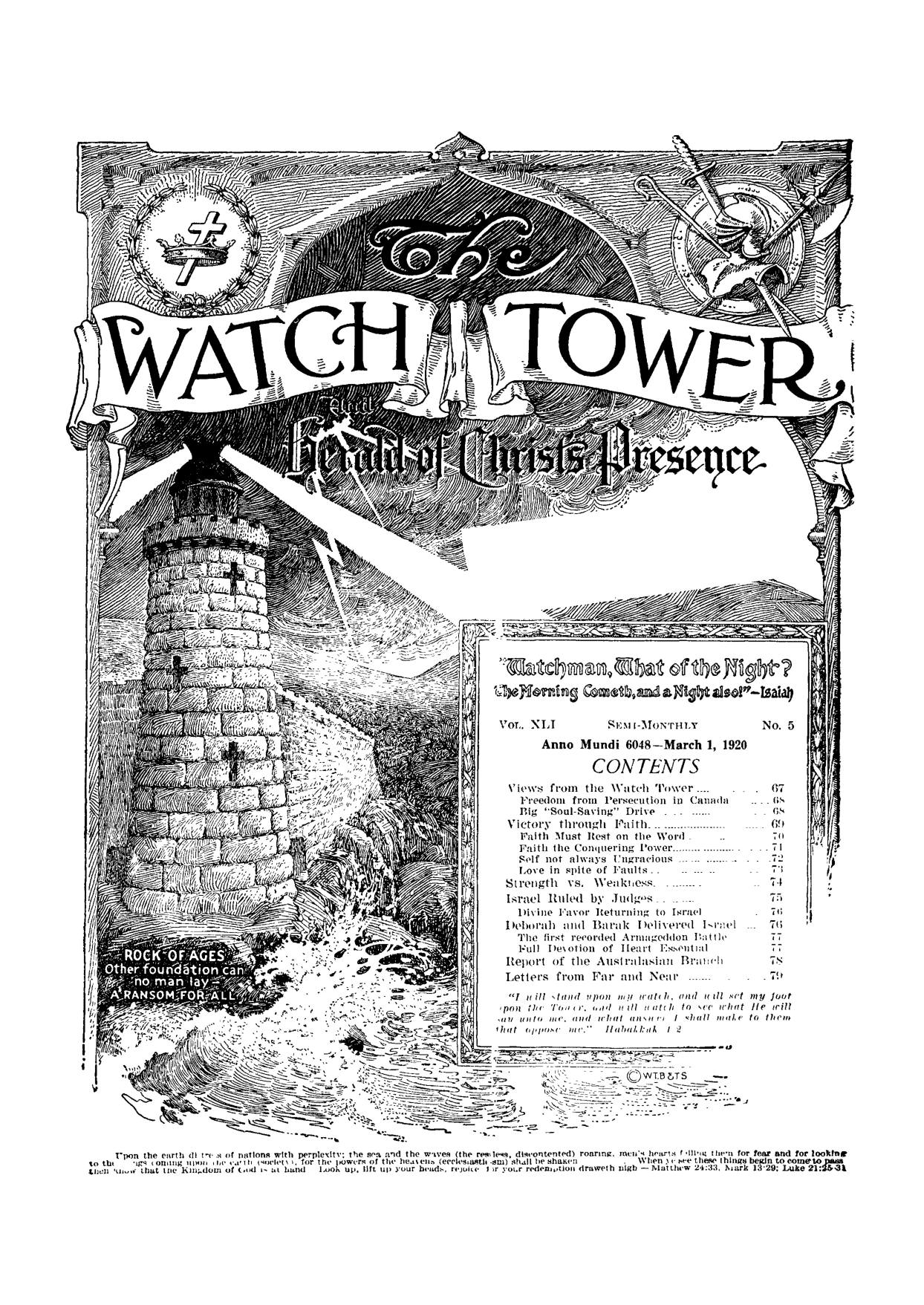
Vnon the earth <11 fe s of nations with perplexity; the sea and the waves (the res'less, discontented) roaring. men's hearts f •in»i« them for fear and for looking to th» 'ixr* < onnng upon । be ea’t h (sorlett for the powers of the heaieits (ecelesiastii -am) shall be shaKen . When e we these things begin to come to paas
then \i»~rf that me Kingdom of (.<»d i- ui bund Look up. lift up your bends, rejuke t >r your redemption draweth Dlgb —Matthew 24:33. Mark 13'29; Luke 21:35”31
THIS JOURNAL AND ITS SACRED MISSION
THIS journal is one of the prime factors or instruments in the system of Bible instruction, or “Seminary Extension’’, now being presented in all parts of the civilized world by the Watch Tower Bible & Tract Society, chartered A. D. 1884, “For the Promotion of Christian Knowledge”. It not only serves as a class room where Bible students may meet in the study of the divine Word but also as a channel of communication through which they may be reached with announcements of the Society’s conventions and of the doming of its traveling representatives, styled “Pilgrims”, and refreshed with reports of its conventions.
Our “Berean Lessons” are topical rehearsals or reviews of our Society’s published Studies most entertainingly arranged, and very helpful to all who would merit the only honorary degree which the Society accords, viz., Vcibi Dei Minister (V. I). M.), which translated into English is Minister 0/ Cod's Word. Our treatment of the International Sunday School Lessons is specially for the older Bible students and teachers. By some this feature is considered indispensable.
This journal stands firmly for the defense of the only true foundation of the Christian’s hope now being so generally repudiated - > edemption through the precious blood of “the man Christ Jesus, who gave himself a ransom [a corresponding price, a substitute] for .•ill". <1 Peter 1:19; 1 Timothy 2:G) Building up on this sure foundation the gold, silver and precious stones (1 Corinthians 3: 11-I5- 2 Peter 1 : 5-11) of the Word of God, its further mission is to “make all see what is the fellowship of the mystery which. . .has i»e. 1. in.] in God, ... to the intent that now might be made known by the church the manifold wisdom of God”—“which in other ages M.ts not made known unto the sons of men as it is now revealed”.—Ephesians 3:5-9,10.
It stands free from all parties, sects and creeds of men. while it seeks more and more to bring its every utterance into fullest •subjection to the will of God in Christ, as expressed in the Iwly Scriptures. It is thus free to declare boldly whatsoever the Lord hath spoken—according to the divine wisdom granted unto us to understand his utterances. Its attitude is not dogmatic, but confident; for we know whereof we affirm, trending with implicit faith upon the sure promises of God. It is held as a trust, to be used only in his service: hence our decisions relative to what may and what may not appear in its columns must be according to our judgment of his good'pleasure, the teaching of his Word, for the upbuilding of his people in grace and knowledge. And we not only invite hut urge our readers to prove all its utterances by the infallible Word to which reference is constantly made to facilitate such testing.
TO US THE SCRIPTURES CLEARLY TEACH
That the church is “the temple of the living God", peculiarly “his workmanship”; that its construction has been in progress throughout the gospel age—ever since Christ became the world’s Redeemer and the Chief Corner Stone of his temple, through which, when finished, God’s blessing shall come “to all people", and they find access to him.- 1 Corinthians 3:1G, 17; Ephesians 2:20-22; Genesis 28 : 14 ; Galatians 3 : 29.
That meantime the chiseling, shaping, and polishing of consecrated believers in Christ’s atonement for sin, progresses; and when the last of these “living stones”, “elect and precious,” shall have been made ready, the great Master Workman will bring all together in the first resurrection; and the temple shall be filled with his glory, and be the meeting place between God and men throughout the Millennium.—Revelation 15:5-8.
That the basis of hope, for the church and the world, lies in the fact that “Jesus Christ, by the grace of-God, tasted death for every man,” “a ransom for all,” and will be "the true light which lighteth ever.y man that cometh into the world”, “in due time”.— Hebrews 2:9; John 1:9; 1 Timothy 2 : 5, (».
That the hope of the church is that she may be like her Lord, “see him as he is,” be “partakers of the divine nature’,’ and share his glory as his joint-heir.—1 John 3 :2 ; John 17 : 24 ; Romans 8 :17 ; 2 Peter 1 : 4.
That the present mission of the church is the perfecting of the saints for the future work of service: to develop in herself every grace ; to be God’s witness to the world ; and to prepare to be kings and priests in the next age.—Ephesians 4:12: Matthew 24 ; 14 ; Revelation 1: G ; 20 : G.
That the hope for the world lies in the blessings of knowledge and opportunity to be brought to all by Christ’s Millennial kingdom, the restitution of all that was lost in Adam, to all the willing and obedient, at the hands of their Redeemer and his glorified church, when all the wilfully wicked will be destroyed.—Acts 3:19-23; Isaiah 35.
pUBLlSHE-D 0y
WATCH TOWER. BIBLE &-TRACT SOCIETY
124 COLUMBIA HEIGHTS n o BROOKLYN, NY, USA
Foreign offices : British Bianchi 34 Craven Terrace, Lancaster Gate, London W. 2 ; A ti'-ii alatifin, Branch : 495 Collins St., Melbourne, Australia; South African Branch: 123 Flein St., Cape Town, South Africa.
Please Address 7111: Sccifty tn Every Case
ANNUAL SUBSCRIPTION PRICE $1.00 IN ADVANCE
CANADIAN AND FOREIGN SUBSCRIPTION PRICE $1.50 SEND MONEY BY EXPRESS OR POSTAL ORDER, OR BY BANK DRAFT FROM FOREIGN COUNTRIES BY' INTERNATIONAL POSTAL ORDERS ONLY (Foreign translations of this journal appear in several languages)
Editorial Committee: This journal is published under the supervision of an editorial committee, at least three of whom have read and approved as truth each and every article appearing in these columns. The names of the editorial committee are: J. F. Rutherford, W. E. Van Amburgh, F. II. Robison. G. H. Fisher, W. E. Page.
to the Lord’s Poor: All Bible students who, by reason of old age or other in-firraity or adversity, are unable to pay for this journal, will be supplied free if they send • postal card each May stating their case and requesting such provision. We are not «niy willing,; but anxious, that all such be on our list continually and in touch with the Berean studies.
fiatice to Subscriber*: do not. m a rule, send a card of acknowledgment for a renewal or
for a new subscription. Receipt and entry of renewal are indicated within a month by change in expiration date, as shown on wrapper label.
Filtered oe Seerntd Cliut Matter at Prnnklvn, NY , Pontnfflec under the Act of March 8rd, tt7i.
CONVENTION AT BOSTON
The Boston friends have completed arrangements for a three-day convention in connection with Brother Rutherford’s visit there. March 14. The convention will open on Friday the 12th. All meetings will be held in Convention Hall on St. Botolph Street except the meeting for the public Sunday at 3 :00 p. in., which will be in the Waldorf Theater, 533 Tremont Street. Those desiring accommodations and further information may address John R. Jones, 9 Langinaid Avenue, Somerville, Mass.
MEMORIAL CONVENTION -NEW YORK CITY
This Throe-day convention April 2. 3 and 4. will be held in the v.;’,rd Street Music Hall, formerly the New York City Temple, where The I'horo-Drama of Creation had its premiere. Brother Rutherford sind several Pilgrim brethren will be present and will address the mwiitfon. The convention auditorium will be open nt 9 a m. ITi ’nv. April 2. All visiting friends will come direct to the Temple. ■wlu»n> the.' uid receive* assignment of rooms. Memorial service will ’lie hd<! on Friday evening at the usual hour. The Sunday afternoon nneotin" will be for the* public. All correspondence regarding the <*onvo! lion should be addressed to the Convention Committee, T. M Podwin. Secy. 124 Columbia Heights, Brooklyn, N.Y.
N B I’rdher Rutherford will address a public meeting in the New York Hinpodronie on March 21 I>o not confuse this meeting with the Memorial Con\i*n*lon
STUDIES IN THE SCRIPTURES
These Studies are recommended to students as veritable Bible keys, discussing topically every vital doctrine o£ the Bible. More than eleven million copies are in circulation, in nineteen languages. Prices are net, postpaid, and barely cover cost of production and handling. Two sizes are issued (in English only) : the regular maroon cloth, gold stamped edition on dull finish paper (size 5"x 71"), and the maroon cloth pocket edition on thin paper (size 4" x Gi") ; botli sizes are printed from the same plates, the difference being in the margins ; both sizes are provided with an appendix of catechistic questions for convenient class use. Trices for botli editions are uniform. The leather bound and fine India paper editions formerly, issued are permanently out of stock.
Series I, “The Divine Plan of the Agee,” giving outline of the divine plan revealed in the Bible, relating to man's redemption and restitution : 350 pages, plus indexes and appendixes. 75c. Magazine edition 15c. Also procurable in Arabic, Armenian, Dano-Norwegian, Finnish, French, German, Greek, Hollandish, Hungarian, Italian, Polish, Roumanian, Slovak, Spanish, Swedish, and Ukrainian; regular cloth style, price uniform with English.
Series II, “The Time is at Hand,” treats of the manner and time of the Lord’s second coming, considering the Bible testimony on this subject: 366 pages, 75c. Obtainable in Dano-Norwegian, Finnish, German, Polish, and Swedish.
Series III, “Thy Kingdom Come,” considers prophecies which mark events connected with “the time of the end”, the glorification of the church and the establishment of the Millennial kingdom; it also contains a chapter on the Great Pyramid of Egypt, showing Its corroboration of certain Bible teachings: 380 pages, 75c. Furnished also in Dano-Norwegian, Finnish, German, Polish, and Swedish.
Series IV, “The Bottle of Armageddon,” shows that the dissolution of the present order of things is in progress and that all of the human panaceas offered are valueless to avert the end predicted by the Bible. It contains a special and extended treatise on our Lord's great prophecy of Matthew 24 and also that of Zechariah 14 :1-9: 656 pages, S5c. Also in Dano-Norwegian, Finnish, Greek, German, and Swedish.
Series V, “The Atonement Between God and Man,” treats an all important subject, the center around which all features of divine grace revolve. This topic deserves the most careful consideration on the part of all true Christians : 618 pages, 85c. Procurable likewise in Dano-Norwegian, Finnish, German, Greek, and Swedish.
Series VI, “The New Creation," deals with the creative week (Genesis 1,2), and with the church, God's new creation. It examines the personnel, organization, rites, ceremonies, obligations, and hopes appertaining to those called and accepted as members of the body of Christ: 730 pages, 85c. Supplied also in Dano-Norwegian, Finnish, German, and Swedish.
.Vo foreign editions In the pocket site.
AMD HERALD OF CHRISTS PRESENCE
V i >1
Maki it 1, 11)20
No. 5
VIEWS FROM THE WATCH TOWER
IF THE church members eared much for their ministers, they would pay such salaries that preacher.-, would not need to go around with hands out fol charity. If a I’arim r eared as much for his minister as he does foi his |in> stock, ho would set' that the minister was hi pt m .i~ good condition as the herds. The Bible authoiizes the minist'-r who semes the people in religious things to have his livelihood supplied bv those he serves. (1 Corinthians 11:13) Mendicancy among the clergy doubtless sprang up in the dark ages, when it was considered a virtue for a man to become a monk and spend his time carrying the basket around the charitably inclined neighborhood. The incessant begging •of the clergy is one of the chief factors in lowering the respect in which they are held.
In the days of primitive Christianity the ministers did not insist upon the Seri pt u rally ordained arrangement for support bv the faithlul. Such a thing as a modern clergyman was unknown; but the local elders, or presbyters, as they were quite commonly called, usually worked at some ociupation the same other people and were sulhcientlv devoted to the service of Cod to bo willing gladly to give as much of then time as possible to the preaching of the gospel and to pastoral work among Christian people. Even the traveling ministers like the apostles and Timothy and Silas were wont to eke out a living at ‘'tent-making". In pursuance of this independence-creating custom the genuine modern Bible student does not expect Io 'live off the altar’ but takes care of his own living expenses, except in the' case ■of those that devote all their time to the work, and they receive a mere subsistence. It would be far better for the clergy to earn their own living than to be placed in a position of dependence upon, and of control by, the very wealthy, as when millions of dollars are devoted by a Baptist bil 1 lonaire to the care of indigent Baptist ministers. The world is noticing matters of this kind and does not hesitate to comment upon them. We quote from the Cleveland News:
CLERGYMEN’S FINANCIAL DIFFICULTIES
"You wonder why men who are preaching Christianity have to depend upon charity Over in New Jersey one minister reported to Ins conference that nil lie got for expounding the gospel for twelve months was $200.00. That would be about a dollar apiece for the regular services he conducted and nothing extra for funerals. It is stated, with a basis of authority, that the average ministerial income throughout the country is little above $500.
"Now the preacher’s dollar is no larger than any other dollar. The fact that he earned it in a calling followed in answer to divine command has no superhuman effect on the purchase power of his salary Nor is the minister in a position to mail; up the price of his services. Thore are too many people who insist on Ilie free feature of salvation.
"There seems io be hut one conclusion: that the average man Ims ceased to interested in religion sufficiently to pay anythin;: to hear it expounded or discussed. Who is to lilame for this condition? Is it the man himself or is it the church? It is a notable fact that comparatively few men go to church. They indorse the attendance of the feminine portion of the family ami think it a good idea for the children, hut as for themselves- they have ‘important business' elsewhere
"If l he present tendency coni Innes, what is to become of the churches and Ilie preachers? Will the world become essentially heathen and what will happen when that comes about? The charitable support of ministers from the ample pocket of JIr. Rockefeller does not hit at the basis of the dillicitlty. If the church is a desirable institution, anil no one will deny Hint it is. something belter than charity will have to hi1 devised for iIs revival in interest. What shall it be?”
CATHOLIC CHURCH TAKES UP THE TRUMPET
In advancing its political interests the Catholic church has been making ever increasing me of the public press, and lias controlled the press by having the positions of editor--, and esp"<-ia 11 v citv editors, and the management of the press agencies held by Jesuits or other zealous Itoman Catholics. In line with the pronouncements of the American hierarchy, the church has thrown oft' the vail of secrecy and is openly taking up the publicity trumpet. As a statement of the bolder front of the church, we quote from an article by John B. Kennedy in the Scranton (Pa.) Tinies of February 2, entitled “Catholic Church ’lakes up the Trumpet’’. One interesting item in this statement is that the “good name of the church as a social force” would have been lost but for the fortunate (for the church) circumstances of the war.
NATION WIDE PRESS BUREAU
"The must ancient of the Christian clmrcbes—the Catholic eliurch--vvith characteristic application of the grand maxim, •Tcmpora mutantur ct non miitaniur in Ulis’ [times change and we change in them], has taken up the tried and true tool culled publicity as a means of accomplishing its work in the world. The pioneers in largely organized Catholic publicity are the Knights of Columbus. They have been the pioneers in practically till modern American Catholic movements. They raised the first great fund to promote Catholic higher education: they were the first to recognize the necessity of providing homes and clubs for their co-religionists att< ruling state universities. And everybody knows that they stepped into the breach when there was a crying need for organized effort in Catholic war relief, although everybody does not know that it is an opinion generally expressed among the Catholic hierarchy that the Knights of Columbus saved the good name of the church as a social force when they plunged into war work
"Joseph C. Pelletier, of Boston, supreme advocate of the Knights of Columbus, had the inspiration for a nation-wide press bureau—the first of its kind under Catholic auspices. This was In the summer of 1918, when the war was at its height. The Knights of Columbus war news service was formed, and the operations of this bureau have demonstrated two things—that the editors of the country were glad to receive authentic information from a Catholic source (a fact which thousands of well-informed Catholics had doubted), and that this information could be disseminated by the most approved modern methods at a cost singularly small when compared with the costs of operation of other organizations.”
Among the statements that follow in this article is the following:
“In conducting propaganda the Catholics have not in mind the ‘conversion’ of America, or the forceful imposition of specifically Catholic ideas on the non-Catholic public.”
But this statement may be compared with the following quotation from The Catholic World:
“The Roman Catholic is to wield his vote for the purpose of securing Catholic ascendency in this country. All legislation must be governed by the will of God unerringly indicated by the pope. Education must be controlled by the Catholic authority, and under education the opinions of the individuals and the utterances of the press are included. Many opinions are to be forbidden by the secular arm, under the authority of the church, even to war and bloodshed.”
FREEDOM FROM PERSECUTION IN CANADA
One of the vital traditions of the Anglo-Saxon is adherence to the principle of liberty of person, property, speech, press, and the exercise of religion. Every American and Canadian looks back with thankfulness to Magna Charta, when the first great start was made in the world-famed Anglo-Saxon freedom. When war is on and there is a life-and-death struggle for a nation, the people willingly forego some of their liberties, but they are jealous of them and insist upon their prompt return as soon as the crisis is over and actual hostilities cease. For centuries this has been true.
In Canada, when the country returned to a peace basis at New Year’s, many of the common people had become indignant at the continuance of arrests under war measures after the armistice, and especially so at the interference with the free exercise of religion. During the war many interests took advantage of war laws to work out private grudges; and one class that did this was the Canadian clergy, who incited the persecution of Bible students both during the war and long after the armistice. This has been noted by liberty-loving Canadians and, according to the following from the Grain Growers’ Guide, as reported in the Edmonton Bulletin of January 24, the persons who incited the persecutions and other outrages may be called to account:
“The people of Canada will not be true to their instincts, their traditions,and their just rights as a free,self-governing people, if they do not demand, and insist upon getting, an explanation from Ottawa in regard to the arbitrary proceedings that have taken place recently, months after the cessation of hostilities, in the invasion of private houses, colleges and libraries, under the provisions of an order-In-council framed explicitly for wartime conditions, the seizure of books and papers, and the sentencing of individuals to terms of imprisonment for having in their possession literature under the wartime ban of censorship.
"In Alberta and in Ontario these searches, arrests, confiscations, and punishments have been carried out in a manner which would have been more in keeping with the old methods of the old autocratic regime in Russia than with the Institutions of government in this free country.
“It is a fundamental maxim of democracy and freedom that the citizen who is truly loyal to his responsibilities of citizenship will not consent to arbitrary measures. The price of liberty and of justice is unceasing vigilance. It is the duty of the elected representatives of the people in parliament to bring this matter up for full and free discussion, and to compel the government to declare itself plainly and without equivocation. Such bureaucratic methods of absolutism can have no right place on Canadian soil. The whole situation is one that must be cleared up at the earliest possible moment.”
BIG “SOUL-SAVING” DRIVE
Many hundreds of delegates from some twenty-eight Protestant denominations met only recently in Atlantic City and laid plans for home and foreign mission work by which they hope to effect the evangelization of the world. The task is expected to require five hundred million dollars. The Atlantic City Daily Press, of January 8, reports as follows:
“More than a thousand delegates and others directly interested, leaders in twenty-eight Protestant denominations, here this afternoon formally launched the great Survey Conference of the Interchurch Movement of North America from which the churches represented expect to project the most far-reaching soul-saving drive the world has ever witnessed. The budget called for is $500,000,000. The initial session, held on the Steel I’ier and presided over by John R. Mott, general secretary of the Y. M. C. A., who took the place of Robert Lansing, Secretary of State, as chairman of the Executive Committee, was given over to the presentation of facts based upon the survey of the world religious and social needs."
A somewhat larger sum was mentioned as being necessary for the work of the next five years, according to the Baltimore American, of January 10:
“The budget of the Interchurch World Movement to be used in coordinating the energies of the Protestant denominations for the evangelization of the world, was approved today at the conference of 1400 church leaders here. The budget calls for the expenditure of $1,330,000,000 in the next five years. It provides for evangelistic work in America and the foreign field, proper financing of hospitals and 1/imes, liberal awards to struggling colleges, for the fighting of social and industrial unrest, and better wages to both ministers and missionaries. It is specified that no part of the budget shall be changed by a board of review to be appointed with equal representation of all denominations, without the consent of the denominational board directly affected."
STARTLING INCREASE OF CRIME
The Pathfinder gives us the following data on crime in the United States, claiming that this country leads the world in criminal acts :
“Crime statistics show that in thirty years crime has increased 500 percent in the United States, four times the increase in population. There were as many murders In Omaha last year as in London, with its five million people. Kansas City, with a 300,000 population, had more murders than the English capital. Murders in Kansas average one every other day. Authorities often fail to get the crimlnaHs, and many are acquitted even when witnesses of the crime are found.”
VICTORY THROUGH FAITH
This is the victory that overcometh the world, even our faith."—1 John '>. }
EVEN the word victory has an inspiring ring to the ear. As used in the world it conveys the picture of the victorious army returning from war and greeted with the huzzahs of an admiring multitude. But such victories as this are not the portion of the Lord’s people now. When the Apostle says that faith is the \ ictory, we are not to understand him to mean that nothing else remains to be done, after we have merely believed. Rather the thought must be that faith is the conquering power with which we are able to push aside the things which are seen, and to direct our course in life in harmony with things which are not seen, but which none the less are realities to us, because we can lay hold upon them with our minds.
Columbus was a man of faith when he believed, and acted upon the belief, that a western route could be taken for eastern ports. He had never gone far west and to the average mind the western waters were merely the lair of the hobgoblin and ogre. Every view previously held on the subject, everything, in fact, seemed to be against his theory of finding India by a western passage, except his own faith in the project. Now his faith, be it noted, was not a mere arbitrary decision on the subject apart from all known facts, but it was a rational conclusion arrived at after thoughtful consideration of other points already known. So the Christian's faith is not a conclusion reached out of the abundance of his imagination, but it is a conviction arrived at after the consideration of competent evidence from an authoritative or reliable source.
FAITH OF BASIC IMPORTANCE
The Christian’s voyage has never been experienced by him before. The devil, as the great hobgoblin, seeks to discourage him from undertaking the journey, telling him that he had better remain where he is safe, on firm and known ground. He is confronted with the alluring suggestion that the way of the world must be the proper one, because every one has been going that way. Who would think of gaining anything worth while by selfdenial ; is self-denial not sailing directly away from success and happiness? Self-assertion is the only road to success, the world tells us.
True, Columbus might have made erroneous deductions with his imperfect human brain. And so might we if we were not helped. This contingency is provided for in that definite basic promises are made in God’s Word as to what the reward of a life of faith shall be. It is important then to see that our faith is a correct faith; for if the faith be built on erroneous theories, inspiring false and delusive hopes, it will eventuate for its victim in shipwreck on the rocks.
It is because of this importance of faith, either for good or for evil, that the Apostle Paul was so solicitous for the continuance, of the brethren in the proper faith (Colossians 1: 23) “the faith once delivered unto the saints”. (Jude 3) He urged all to examine and to prove themselves to make sure they were in the faith, grounded and settled and not moved away from the hope of the gospel, but rooted and built up in Christ and established in him. (Colossians 2:7) He was also deeply concerned that the faith of the church should not stand in the wisdom of men but in the power of God. (1 Corinthians 2: 5) He knew how vital a thing the matter of faith is, for it had been long time written: “The just shall live by his faith”. (Habakkuk 2 : 4) The sentiment of this text had been voiced by Moses of old in almost the last words of that venerable patriarch when, reviewing the faith of Israel, he said: “It is not a vam thing for you, because it is your life". (Deuteronomy 32:47) Yes, our lives, our eternal destinies, have been made dependent upon our loyalty in respect to the walk of faith which we have voluntarily emernd upon as footstep followers of the Master.
It is well to see that we have the faith of Christ, the faith well founded in the Word of God, a faith examined and proved, deeply rooted in the heart as well as in the head, and, therefore, established as the conquering power of life. Faith to be a conquering power in us must go deeper than the head: it must go into the heart and permeate and energize the whole being, bringing not only the outward conduct but every thought into subjection to Christ.
“Faith,” the Apostle tells us, “cometh by hearing and hearing by the word of God.” That is, the Word of God contains certain information respecting, first, our natural state of imperfection, then, further information as to what would be our proper relationship to him. The truthfulness of such information convinces us when once we have examined the facts given. The first step in faith, then, is a satisfied reason. That, however, of which we are convinced we cannot help having confidence in. The disposition of mental satisfaction passes, unless impeded by selfish and temporal interests, into a heart satisfaction, or trust. If we have confidence in the truth of God’s good promises of blessing, we wrill expect those promises to be fulfilled; and since God’s promises augur only good for the righteous of heart, good infinitely greater than anything we have ever known, how can we help desiring the fulfillment of those promises? What we expect and desire we are hoping for. And hope gives the color to our Christian lives.
Hope lifts the mind and heart and enables us to appreciate and measurably to enjoy perfections yet actually unexperienced. (Hebrews 6 : 19, 20) It helps to inspire love, and love, in turn, inspires more faith (Galatians 5:6); and so the three are mutually inspiring and interdependent and develop together.
BLENDINGS AND MIXTURES OF GRACES
Faith, hope, and love, like the three primary colors in nature, may be combined in varying proportions to produce any other desired hue or tone of character. The color between blue and yellow, for instance, is green. Green has a restful effect on the system and has been designed by a beneficent Providence for that purpose. Likewise, the effect produced upon the life by the presence of faith and hope is peace. When we are justified bv faith we have peace with God. (Romans 5: 1) Our doubts, fears and misgivings have given place to tranquillity of mind and heart on those' points about which we have received information through the Bible, God’s Word. The hope engendered by confidence in the fulfillment of those promises takes the keenness from our 09
Buffering, because we see that our suffering is not in vain and that there is to be a cessation of pain and tears.
Yellow and red combine to form orange, the warmest of colors. It is suggestive of a state of development and ripeness; the vivid autumn foliage, the golden grain, the luscious fruit all tell that nature has done her best. So too, when hope and love are strongly present in the heart, joy is the fruitage. We rejoice preeminently in hope. Romans 12:12.
Red and blue make violet, the \arying tones of which add glory to the sunset and beauty to the modest flower. Likewise, when faith and love work together a noble, rare, and royal likeness of the Lord ensues. Love without faith di predates into independable sentimentality.
Man's power to lune faith lies in that he, made originally in the image of God, was given the ability to perceive the* evidences of the invisible God. Some of that power of discernment remains in imperfect man. But faith includes the thought of dependence upon the veracity of God, confidence in his integrity. Thus trust is a part of faith, because it relies upon the truth of a promise: and one is said to "keep faith” with another when he performs a promise which that other relies on. Accordingly, faith in God is a firm assent of the mind to the things told us through divine revelation.
“FAITH WORKETH BY LOVE”
There is a primary degree of faith which is seldom passed by the majority of those who learn about the message of the Gospel. It is a speculative knowledge of and a bare assent to the truths revealed in the sacred Scriptures. Of this kind of faith the Apostle James speaks: “Faith, if it have not works, is dead”. “Ye see, then, how that by works a man is justified, and not by faith only.” (James 2:17,24) That is to say, a successful faith does not consist merely of a profession of faith, or a bare assent to the truth, without good works proceeding from faith, showing it to be of the right kind. This mere intellectual belief the devils themselves have. “Thou bdievest that there is one God;... the devils also believe and tremble.” (James 2:19) They are fully persuaded that there is a God, and that Christ is the Son of God, and shall be their Judge, as they acknowledged.—Matthew 8: 29.
Effective, faith, however, receives Jesus as he is revealed in the Gospel. To such a one the life, words, works, suffering, death, and resurrection of Christ mean not merely an array of historical facts, but much more: they mean so much to the true believer that they inspire trust in and reliance upon Christ Jesus and his righteousness alone for justification as the basis for our salvation. Such a faith begets a sincere obedience in the life and conversation. It is not. therefore, an idle, unactive and inoperative grace, but shows itself by producing in us love for God and for our neighbor.
Let faith compare to the drive wheel of a locomotive; let love be the steam, or motive power, and hope the power of sight on the part of the engineer, looking ever forward toward the goal. As the drive wheel is really worked by the steam, so love ia really behind faith. Were it not for the love of God and for righteousness which was first planted in Adam, and which has not entirely died out, there would be no hope of appealing to any heart by the message of the Gospel. There would be no attractive power, because God’s Word draws only toward the good. But while the steam gives the first impetus to the drive wheel, the machinery of the engine in turn controls the flow of steam so that it makes possible a continued motion. More than this the steam is exhausted into the draft flues and thus fans the flame that generates more steam, more force against the drive wheel, more motion, more progress and incidentally more heat, more steam, etc. So with love: the more love we have, the more the holy new Mill directs its power to the inspiring of our faith, and the more the sacred flame is fanned that energizes the water of the truth m us, converting it into r-till more of the motive power of love. As steam and water are different manifestations of the s-ame thing so love and truth are similar in essence. God is love (L John *1:8). and Christ is truth.--John 11: G.
In certain types of engine there is danger of a “dead” or absolute* center. That is. there is a certain position of the drive wheel in which it cannot be started merely by the power of steam. It requires the application of an outside force to give the wheel a start. Something like this is the trouble vv ith the poor world now. They arc dead; and centered in self; their faculties are deadened so that when the power of love, divine love, disinterested love is brought to bear on them through the message of the Gospel, it docs not move them. It finds little or no responsive chord in their hearts, or at all events not a sufficient response to become a motive power in their lives. Bad, indeed, is it for us, who have once started on the way, if love fails to move us. At very least we would fail to make progress, and in time we would rust and be of no value whatever. As for the world, outside force will be brought to bear on them in the instructions and regulations of the Millennial kingdom, which will give them a start in the right direction and, if a love for righteousness is developed, they too will be able to make progress up the highway of holiness, the new road to life which will then be opened up.
The drive wheel is the immediate means of helping the engine to got over the ground; so faith is the direct agency which enables us to overcome and to leave behind scenes of former failures, ever pressing along the line toward the heavenly station, the Union Station of rest and perfect fellowship with God and with those w’ho have gone before.
FAITH MUST REST ON THE WORD
To be efficacious the drive wheel must be in its proper position on the track. If the wheel leaves the track, extremely serious difficulty ensues, if indeed not a total wreck. And if our faith depart from the pure Word of God, and from the promises which point us to progress in the straight and narrow way, we may by stupendous effort get back, or wc may abandon the Word so completely as to suffer wreck. There will be nothing to keep us from being conformed to the world; we shall of our own weight sink down into the earth, into the world and its ways.—Romans 12: 2,3.
If the track is in good condition we can make fairly good progress, even though the way be up-hill, but if the joints are loose or the rails spread it would be unsafe to go with much speed. The doctrinal features of God’s Word, being faith's most tangible object and support, are the track along which we may proceed. So these doctrines, the only really accurate source of information respecting Jehovah and his character which we have in our present imperfect state, must be firmly established and properly adjusted or we can go but very slowly, if indeed at all.---? Timothy 2; 15, 111.
We must light against that spirit of hauteur and worldly wisdom which spurns a careful inspection of the trails, of the doctrines of God's Word, which alone can show v.hither we are going, and how. and why. The engineer lllint keep one eye ever on the track : the fa-tei one is going, the more can fid -should the watch be. To be .-nrc. he may i-alch a casual glimpse of the beautful hill.- lie pas-.es; a gorgioii- -un.-ot may attract, but mu-t not hold his vi-ion. No, the\ are not for him. He has a wink to do. a goal to icach and. nature-lover though lie be, he cannot now halt, to di ink them b->autuin.
Another thing is needful to an eiiyin.' on a 'tei p grade, and that is sand Without it the w heel. may spin around and still not make progress; the -pinning will merely wear both track and wheels. The sand is no part of the wheel and no pait of the tuiek, Ind it constitutes a medium whereby the contact between those objects is maintained at the highest possible pitch. Such a medium to us is prayer. Without it, owing to the steepness of the road, we are not safe. Our faith, though intact m our understanding, will not work effectively without this help. Even though love may be prompting us with a desire to gain the prize, if our faith is in poor contact with the promises and with the conditions on which the prize may be obtained we will not go ahead. Prayer, possibly importunate prayer, is the need. Without it faith will be going around in the same old grind, and we shall be getting nowhere and accomplishing nothing except to wear out our own confidence. Add persistent, earnest prayer and see if we do not begin making progress from that very hour. Erstwhile dry and uninteresting things will take on a new meaning and a forward impetus is experienced
On a steep grade a locomotive may even slip back wards without sand. So we too. without prayer, may slip entirely back to wreck and rum. The steam phis the drive wheel plus vision will not lake the engine on without proper contact. Love of righteousness, plus faith, plus hope, without praver, if we could imagine such a condition, would still place us in a pi'cca riou-position. Braver enables u< to make progress
FAITH THE CONQUERING POWER
Eaith is (he conquering power that overcomes the world. Overcoming is suggestive of warfare, of conflict ; and we should have clearly in mind for whom we are fighting and also ai/ainxt whom we are to direct our efforts.- John 1 (i: 33.
We are fighting for ourselves in the sense of striving for our own eternal welfare. God needs not our puny efforts, but he allows us to enlist on his side. Jehovah, however, is fighting for us in the sense that he is assisting and encouraging us to fight the good fight of faith on our own behalf. Some seem to have the idea that they are almost doing God a favor by enlisting on his side and thus lending the weight (?) of their influence to what might otherwise be a losing cause. But it is our lives which are at stake, not God’s. He has nothing to lose and little, if anything, to gain; we have everything to gain, anil we are to benefit in the victory.
Our text implies that the conquering power of faith is to be directed against the world- not against the inhabitants thereof, not against fellow creatures, but against the spirit of this present evil order of things, its disposition, the mind <d the world, the motive.- which actuate the v.oild. fbe pride ol life and (lie deceit! illness <d riches; m spoil, against sin and. mdirec.tlv. against Satan, whom >w aie to rcs|,L steadfast in the faith.
isalan i.~ rep11 -entcd a- the god or might v rul< i of this wolld ami bi- two powerful allie- ai< the world and the Hc.-h. Sum ,■ the tL-h in it- pi o-ert .-fate pa i lakes of the -amc spirit and bmdencie- a- the world, w <■ may describe it a - the w ol Id within u.- The pon ci i id tendency of the lle-h i- towaid cv d. It i>- a jumhlc of blinding milu-peivertcd taste.-, dc.-ire.-. ambition-, hope- and hives, and mostly ignoiance
Satan'- triple alliance (him.-ell. the world, and the flesh of the new creature) i- ai rayed against faith, hope and love. On the -ide of the new creature faith niar--hillls file force-; hence it is tailed the fight ol faith. On Satan’s side the world is the most manifest ami mo.-t easily recognized of the three; it stands in the vanguard. -o to speak, of the hosts of evil; hence it is quite properlv -poken of a- a fight of faith against the it'Orld.
ENEMY HIDDEN IN AMBUSH
Now the spirit of the world manifests itself in many litth mannerisms and practices which may not at first be recognized by the new creature, so cleverly are they hidden in ambush. Pride, vain-glory, self-preferment, are some of the mo-t commonly encountered manifestations of the spirit of the world. The world within us, the tlesh, loves these things and uses every means to justify itself in seeking them. But faith, here too. is the conquering power to gain the victory. Just such a victory has already been gained when by faith we agreed to lose our lives to find them. When we considered the Ma-tvr'- call; “If any man will come after me. let him deny lumselt, and take up hi- cross, and follow me"’ (Matthew 16: 2 1). our faith trusted in the truthfulness of God's piomi-e that such a course would not spell final loss to us, but would really work gain. Like Columbus, we started traveling over a way we had never gone before, Imt were convinced that its end would be glorious.
When we made our consecration war was declared on self. It now remains to be seen whether the matter will be carried out or whether faith will capitulate before the overture- of pride and self-advancement. A tost of our faith comes when we find that through ignorance or weakness we have been unjust to another. Self-pride would not acknowledge it; first, because it hurts, and secondly because, we argue, it will do no good. But we look to the instructions of the Master: “Confess thy fault” (Matthew' 5: 23,24) ; and our confidence, in the integrity of his character prompts us to humiliate ourselves, believing that he would give no command that would not be for our best. No matter if the offended one does not appreciate our conduct and our spirit in the matter (and he often will not) : it is all the better for us that he does not. If we were sure to be always appreciated in such efforts, we might go with a measure of sham, partly to secure the commendation, mental or oral, of the offended. If one’s apology is not appreciated, one is humiliated all the more and will next time be doubly careful. The thought should not be merely to reinstate one’s self in the favor of the offended, but, by virtue of faith in God’s commands, to gain the victory over the worldly pride residing in our flesh. If every day we are thus a victor, we shall unquestionably be a victor in the end.—2 Timothy 4:6-8.
SELF NOT ALWAYS UNGRACIOUS
Our selfish preferences may not always have an ungracious tinge. Sometimes they are very genteel. Sometimes the flesh has a desire for the maintenance of a peaceful, serene, and respectable life, when service for the Lord would call us more directly into the current of annoying duties. The flesh would be very willing to serve the Lord if it could do so respectably and in comfort. It yearns:
Lord, let me tread the quiet paths. Through woodland, dale and hill:
Yea, let me rove on heath and fen ;
Or by the bick’ring rill To dream of thee.
I’ll build my shrine in storinless vale.
So tranquil, not a sigh Shall mar my incense-laden lay Of love to thee. Aye, There let me be.
But if we follow the Lord faithfully we are very likely to find ourselves in the city’s grime and noise, where some of the Lord’s work is in need of being done.
Sometimes, the flesh argues, it would be easier to maintain a spirit of devotion if we had more quiet and time for meditation. Yet, faith answers, if duty calls to toil, amid commotion, is not that duty a voice telling us that perhaps something else is more necessary to be learned just at that time than meditation in quietness; or telling us that devotion must be put to the test to see how well it will last when the circumstances are anything but favorable? Victory over self in this connection often means for us to be associated with those whom we would not choose by nature, and not to be associated with those whom we would naturally select.
Even in the service of the Lord the flesh has the desire to be able to talk with ease or to prepare and deliver discourses which would stir their hearers to the very depths. But thoughts which stir are wrought only on the anvil of experience, and an idea expressed yet never experienced lacks that force which would make it a source of help to others. Faith thus tells us that, even if our present desires to help remain unfulfilled, we, by our puny efforts, are being prepared for a work of noblest future ministry, in which our every experience will doubtless be of use.
Faith thus overcomes the tendencies which the world has wrought in us; and while not condemning all of them as evil, it counsels us merely to disregard or push aside those which we cannot use in the narrow way. Worldly pride on the other hand bids us keep everything which would put self forward and advises us not to be too sure of the things which we cannot see. If such hints are hearkened to, doubt is bred and indifference ensues; discouragement, despondency and despair follow in its wake. We must remember: “Greater is he that is in you, than he that is in the world”.—1 John 4: 4.
There is another attack from the flesh against our faith which is more subtle than almost any other: it is the suggestion that the Lord’s work in the world is in special need of our advice or knowledge or experience. It is one of the most difficult things to believe, not merely that God is good and that he has benevolent intentions and designs toward us, but to believe that work undertaken in the name of the Lord and in harmony with his Word will have his guidance, his approval, and his blessing. Indeed, some of the hottest battles in the bivouac of faith are fought on this very point, and, sad to say, the battles are not always won by faith.
FAITH VS. THE PARTISAN SPIRIT
There is another spirit of the world which faith can, must, and will overcome, and that is the partisan spirit, the disposition to be more loyal to persons than to principles. This party feeling, closely akin to tribal affection, is an affinity which holds one to those with whom he happens to be associated, often irrespective of their virtues or worthlessness. It may or may not be used for good. At any rate faith bids us to have our closest association with the Lord so that everything else will be subservient; we would not love people merely because we happen to be associated with them but rather from principle, because of certain lovable qualities or possibilities in them. We are helped in this direction, in the case of the Lord’s people, because they have the Father’s stamp of approval in the shape of his begetting spirit. Frequently our preference for family or for a circle of friends or acquaintances arises merely from the fact that they are tolerant of our weaknesses and failures, because they have the same or similar ones to ours. Our proper pride and modesty alike should forbid the encouragement of such attachments as tend toward failure.
The party spirit may easily merge into pride or glory in the “movement” with which we happen to be connected. We should remember that the very same influences are at work against us as have been against all other upward religious movements in the past. Certainly none would claim for a moment that we as individuals are better than they. Who can say that if we were to continue here for twenty-five years more, we, or those following us, would not be as thoroughly dyed-in-the-wool sectarianists as ever trod the globe ? Who can boast? We, just as well as others, have to fight against these things; fight, not with fists, but with faith, faith that God will perform his own purposes, sometimes with and sometimes irrespective of our cooperation. Are we of Paul, or of Apollos, or of Cephas—or of Christ?
The spirit of the world comes out, too, in the spirit of criticism, or of unkind and often unjust censure of the conduct of others. Habitual criticism of men and things is a sign not of superior faculties and finer sensibilities, as the flesh suggests to us, but of actual moral and spiritual decrepitude, which, while seeking to justify itself by the thought of opposing the evil, really gloats over the unlovely traits thus held before the mind. ‘Tove”, on the contrary, “rejoiceth not in iniquity, but rejoiceth with the truth,” with the spirit of righteousness, which abhors the thoughts of evil and does not even consider them, when possible to escape. Faith in God’s word that “none [is] righteous, no, not one,” should teach us not to expect perfection in any, nor even consistency of conduct, since that would imply perfection. It takes great faith to start out on a mental hunt for commendable points in a person whom we have been in the habit of looking on as the embodiment of undesirable traits.
LOVE IN SPITE OF FAULTS
Perhaps a brother seems harsh or unkind in his manner or utterances, uncouth or crude in his ways; perhaps he docs not appeal to us. Faith would still tell us that there must be some lesson for us to learn there. Perhaps this is only the Lord’s way of calling our attention to unloveliness in ourselves. But what about that brother? Never mind too much about that brother. The Lord will attend to him in his own way. Perhaps that brother does not need exactly the same lessons that we need; or maybe he will get them later; or maybe he has had them in the past and is carrying the scars from a •field where we would have been vanquished.
It is true we could not admire any one because of Ins imperfections, but we can admire him in spite of his imperfections, that is, for other qualities which he doubtless has. Thus faith, believing that God will deal with others in a righteous and suitable way without our attempting to hand out punishment, and believing that he will also teach us aright, gives us contentment even under galling circumstances—not contentment with imperfect qualities, in either ourselves or others, but contentment with the Lord’s general providences which permit us to be in contact with others as imperfect as ourselves. Those who command our admiration in every particular appeal only to the gentler side of our character, and if our experiences were wholly with such we might not develop enough fibie and sinew. Then too, we often discover that our poor selves grate on others in much the same way that they do on us. It is no test of love when we admire a person or his doings. Wait until almost his every action seems perverse, or inconsistent, or even wrong, then see how much love is left.
The tendency to criticism on the part of our flesh may extend even to the manner used in preaching the Gospel. ■Of course, no one should think that he may not form mental opinions respecting the desirability or undesirability of a thing or act. That we, as rational creatures, are bound to do. But to criticise merely as a habit is what does us harm, if it does harm to none other. The sound of the gospel may or may not be pleasing to the flesh, depending on the language in which it is couched. It may be delivered in a rambling way and pain our sense of rhetoric or logic. Our fleshly judgment suggests the thought that such an exposition of the truth could never do any one any good. But wonder of wonders! some heart gives evidence of being comforted and helped. The Lord is not now teaching us logic and philosophy in the pure form, but is teaching us faith, and is seeking to inspire and to feed a devotional spirit in us that will draw us closer and closer to him and away from the spirit of the world. Whoever is rich in love toward God and toward the brethren is rich indeed and if he be faithful unto death he will have Christ, “in whom are hid all the treasures of wisdom and knowledge”.— Colossians 2:3; Revelation 2 : 10.
How subtle is the mind of the flesh! It seeks to judge and to decide everything according to the natural observation. When the natural observation suggests a thought which is contrary to love, love, if active, will repel that thought and faith will come forward and say: I believe there is some sterling quality in that brother, whether I can see it or not: I believe God made no mistake when he set his love there. “Faith” thus “worketh by love”. (Galatians 5: 6) Love prompts faith to gain the victory against injustice and unkindness.
FAITH AND OUR GREAT CHANGE
Should it be deemed a wonderful thing to believe in a change of nature, when the nature of our very temporal existence is problematic? Look, under the highest power microscope, at human flesh and instead of being solid matter, it is really composed of little particles which do not even touch each other but are, in proportion to their size, widely separate. If even our present life is a mystery and a miracle should we think it a strange thing to believe in the veracity of Jehovah when he says that he will give us a new life? If wc really believe that he will give us the things promised, we will certainly conform ourselves to the conditions; there can be no question about that. The things promised are so wonderful and so grand that, if we truly believe, we must desire them.
Even man, with merely high earthly ambitions, has been able to accomplish wonders in a short space of time by applying himself fully to the subject in hand. It is told of the world-famed naturalist, Audubon, that when he was twenty-four years old, he observed a small fleck of blood on his handkerchief and knew he had but a few years to live. He determined to make the best of them and to do something that would be of public good. Accordingly he set about it and in the brief space of six years he accomplished the colossal task of classifying all the birds of the world. That was a great work and he did it single-handed; but we have all the power in the universe that is necessary to help us accomplish the great work before us. According to our faith is the only rule measuring the amount of power on which we can draw. Let us give ourselves wholly to it!
We need not be entirely discouraged if unlovable and unlovely qualities show themselves under stress. The refining work does this. The intended effect of the fire is to do this very thing — to show up the dross that it may be skimmed off as rapidly as seen. Our faithfulness is marked by the assiduity with which we submit ourselves to the refining and not merely by the outward graciousness of our conduct, desirable though that be.
The Father promises to give us of his heavenly wisdom, if we ask in faith, never wavering. (James 1:6) Heavenly wisdom in sufficient measure would certainly enable us to direct all our affairs to the Lord’s glory and thus to be faithful ambassadors. Also he gives us the holy spirit on the same condition. Who can doubt that the holy spirit in rich measure will work out such fruits of the spirit as will guarantee us an abundant entrance into the kingdom of our Txvrd and Savior Jesus Christ?
The wisdom then is sufficient for all the exigencies of our present trial time and the holy spirit prepares us for the future. What more could be done for us ? And all securable in proportion to our faith!
FIGHT THE GOOD FIGHT
We are in the rear guard of a noble train of victors -Jesus, Paul, Peter, John, and many, many others. If God’s Word was mighty to spur them on to victory; if it, and nothing else, was able to inspire in them a victorious faith, why may it not be so with us? The Lord will do his part. Will we do ours? The Lord’s people should he ashamed to catch themselves at anything small or commonplace in thought. “What manner of persons ought we to be in all holy conversation and godliness!’’ (3 Peter 3:11) The disposition to show ourselves worthy ambassadors is the germ of victory; victory over smallness, victory over self, victory over the world in our ilesh; and it can be sustained only by faith.
“Unanswered yet! Faith cannot be unanswered;
Iler feet are firmly planted on the rock:
Amid the wildest storms she stands undaunted, Nor quails before the loudest thunder-shock.
She knows Omnipotence hath heard her prayer, And cries, It shall be done, sometime, somewhere.”
STRENGTH VS. WEAKNESS
‘When I am weak, then I am strong.”—2 Corinthians 12:10.
WE AKE not to understand the Apostle to mean that the Lord will give physical strength to his people, in some remarkable way, because they belong to him; for if he did, his people would be the most powerful people in the world; and we know that this is not the case. The strength which the Lord gives is a strength of mind, a mental and moral courage which more than makes up for any lack of physical strength. Some of the Lord’s children have very little bodily strength; and yet they have a courage, a strength of heart, far superior to that of many who possess much greater physical vigor.
The Apostle Paul exultingly exclaims: “When I am weak, then am I strong!” So by the exercise of proper faith and trust in the Lord we who belong to him may be far stronger than we could be under any other circumstances and conditions. We may, however, feel sure that the Lord will give special physical strength to his people if otherwise they would be unable to accomplish whatever he wishes them to do. We have seen this demonstrated. We have known Christians who were not naturally strong to be granted a very special strength at times when there was a particular and important work to be done for God. Perceiving their confidence and faith, the Lord is pleased to grant them special strength, so that they may endure what others who were physically stronger might not be able to bear up under.
PEACE BORN OF FAITH
“The Lord will bless his people with peace.” This is not true in an outward sense. It was not true thus of our Master; and his special associates, the apostles, were buffeted and afflicted as all of the Lord’s followers have been throughout the gospel age. The adversary does everything in his power to make our lives unpleasant and unhappy. We must contend with fightings without and fightings within. It is not all peace without and all calmness within.
We must battle with our own flesh; for there is where we are to gain an important part of the victory. We are to “fight a good fight,” a conquering fight. We are to put forth earnest effort in fighting against the world, against our own fallen nature, and against the adversary and all the things that he would put into our mind and heart. We are to get the better of these things. The Lord blesses his people with strength to overcome these adverse influences and difficulties, and gives them peace of heart even in the midst of their difficulties.
…