The Bible Gods word or mans (1989)
Download: PDF — The Bible Gods word or mans (1989)
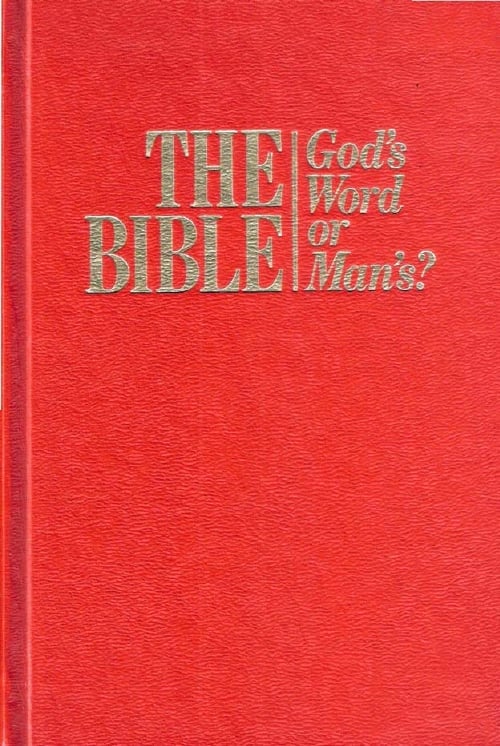
THE BIBLE God's Word or Man's?
©1989
WATCH TOWER BIBLE AND TRACT SOCIETY OF PENNSYLVANIA
All rights reserved
Publishers
WATCHTOWER BIBLE AND TRACT SOCIETY OF NEW YORK, INC.
INTERNATIONAL BIBLE STUDENTS ASSOCIATION
Brooklyn, New York, U.S.A.
Firstтриптинг in English:
3,000,000 Copies
Unless otherwise indicated.
Scripture quotations are from the modern-language
New World Translation of the Holy Scriptures—With References,
1984 Edition
The Bible—God's Word or Man's?
English (gm-E)
Made in the United States of America Contents
| Chapter | Page |
| :--- | :--- |
| 1. Why Read the Bible?... 5 |
| 2. The Bible's Fight to Live... 12 |
| 3. The Bible's False Friend... 25 |
| 4. How Believable Is the “Old Testament”?... 37 |
| 5. The “New Testament”—History or Myth?... 55 |
| 6. The Miracles—Did They Really Happen?... 71 |
| 7. Does the Bible Contradict Itself?... 87 |
| 8. Science: Has It Proved the Bible Wrong?... 98 |
| 9. Prophecies That Came True... 117 |
| 10. A Bible Prophecy You Have Seen Fulfilled.. 134 |
| 11. The Overall Harmony of the Bible... 149 |
| 12. A Higher Source of Wisdom... 162 |
| 13. “The Word of God Is Alive”... 175 |
| 14. The Bible and You... 184 |
Picture Credits
Listed by page
Page 9, Edition Lozeng, Werner Pinkert. Page 15, Courtesy of the British Museum *
Page 16, Musical Capitol. Page 21, Department of Antiquities and
Collections, Musical Capitol. Page 23, Gottesman Center for Biblical Manuscripts. Page 23, Musical Capitol. Page 26,
The Metropolitan Museum of Art, Museum of Antiquities and
Collections, Musical Capitol. Page 26
Why Read the Bible?
We are living in a world with too many problems and far too few answers. Many millions regularly go hungry. Increasing numbers are addicted to drugs. More and more families are breaking up. Incest and family violence are constantly in the news. The air we breathe and the water we drink are slowly being poisoned. Meanwhile, more and more of us are victimized by crime. Do you think problems like these will ever be solved?
IN ADDITION, we live in an age of hard choices. Many, for example, are implacably opposed to abortion, calling it murder of the unborn. Others feel just as strongly that women have authority over their own bodies and should decide such a matter for themselves. Many view homosexuality, adultery, and premarital sex as rank immorality. Others believe these practices are a matter of personal choice. Who is to say who is right and who is wrong?
2 The Bible offers guidance in matters of morality, and it describes effective solutions to the problems of crime, hunger, and pollution. The trouble is, most people no longer view the Bible as an authority in such matters. At one time, it was
listened to with respect—at least in the West. Although the Bible was written down by humans, in the past the majority in Christendom accepted it as the Word of God and believed that God himself had inspired its contents.
3 Today, however, it is fashionable to be skeptical about everything: customs, ideas, morals, even the existence of God. Especially, people doubt the value of the Bible. Most seem to consider it out of date and irrelevant. Few modern intellectuals view it as the Word of God. Most people would rather agree with scholar James Barr, who wrote: "My account of the formation of the biblical tradition is an account of a human work. It is man's statement of his beliefs."1
4 Is this your opinion? Do you think the Bible is God's word, or man's? However you answer that question, consider this point: If the Bible is merely man's word, then logically there is no clear answer to mankind's problems.
Humans will just have to muddle through as best they can, hoping somehow to avoid poisoning themselves out of existence or blowing themselves up in a nuclear war. But if the Bible is the Word of God, it is the very thing we need to get us through this difficult time.
5 This publication will present evidence that the Bible really is God's Word. And the publishers hope that after you have considered the evidence, you will realize that the Bible contains the only valid answers to mankind's problems. First, though, we would like to draw to your attention some facts that, in themselves, make the Bible worthy of your consideration.
An All-Time Best-Seller
6 To begin with, it is a best-seller, the most widely circulated book in all history. According to the 1988 edition of the Guinness Book of World Records, an estimated 2,500,000,000 copies were printed between 1815 and 1975. That is an enormous figure. No other book in history has come even close to the Bible in circulation figures.
7 Besides that, no other book has been translated into so many languages. The Bible can now be read, in its entirety or in part, in more than 1,800 different tongues. The American Bible Society reports that it is now accessible to 98 percent of the population of our planet. Imagine the huge effort involved in producing so many translations! What other book has received such attention?
A Book With Influence
8 The New Encyclopedia Britannica calls the Bible "probably the most influential collection of books in human history."12 The 19th-century German poet Heinrich Heine confessed: "I owe my enlightenment quite simply to the reading of a book . . . the Bible. It is quite rightly called Holy Scriptures. He who has lost his God can rediscover Him in this book."3 During that same century, antislavery activist William H. Seward proclaimed: "The whole hope of human progress is suspended on the ever-growing influence of the Bible."4
9 Abraham Lincoln, the 16th president of the United States, called the Bible "the best gift God has ever given to man . . . But for it we could not know right from wrong."15 British jurist Sir William Blackstone highlighted the influence of the Bible when he said: "Upon these two foundations, the law of nature and the law of revelation [the Bible], depend all human laws, that is to say, no human laws should be suffered to contradict these."16
Hated and Loved
10 At the same time, we have to note that no other book has been the target of so much vicious opposition and even hatred throughout history. Bibles have been burned on public bonfires, from the Middle Ages down to our 20th century. And reading or distributing the Bible has been punished with fines and imprisonment even in modern times. In past centuries, such "crimes" often led to torture and death.
11 Parallel with this has been the devotion that the Bible has inspired. Many have persevered in reading it despite relentless persecution. Consider William Tyndale, a 16th-century Englishman who was educated at Oxford University and became a respected instructor at Cambridge University.
12 Tyndale loved the Bible. But in his days, the religious authorities insisted on keeping it in Latin, a dead language. So, in order to make it accessible to his fellow countrymen, Tyndale determined to translate the Bible into English. Since this was against the law, Tyndale had to give up his comfortable academic career and flee to the Continent. He lived the difficult life of a fugitive long enough to translate the Greek Scriptures (the "New Testament") and some of the Hebrew Scriptures (the "Old Testament") into his native tongue; but he was finally arrested, convicted of heresy, and strangled, and his body was burned.
13 Tyndale is only one of a great number of people who have sacrificed everything in order to read
12. How did Tyndale demonstrate his love of the Bible?
What is one thing that makes the Bible truly unique?
As this 15th-century woodcut illustrates, an angel burned alive for the "crime" of reading the Bible
the Bible or make it available to others.
No other book has inspired so many ordinary men and women to rise to such heights of courage. In this respect, the Bible is truly without equal.
Claim That It Is God's Word
14 The Bible is also unique because of the claim made by many of its writers. Some 40 individuals, including kings, shepherds, fishermen, civil servants, priests, at least one general, and a physician, had a hand in writing the different parts of the Bible. But time and again, the writers made the same claim: that they were writing not their own thoughts but God's.
15 Thus, in the Bible we often read expressions such as: "The spirit of Jehovah it was that spoke by me, and his word was upon my tongue" or, "This is what the Sovereign Lord, Jehovah of armies, has said." (2 Samuel 23:2; Isaiah 22:15) In a letter sent to a fellow evangelizer, the apostle Paul wrote: "All Scripture is inspired of God and beneficial for teaching, for reproving, for setting things straight, for disciplining in righteousness, that the man of God may be fully competent, completely equipped for every good work."—2 Timothy 3:16, 17.
16 In harmony with the claim that it is God's word, not man's, the Bible answers questions that only God can answer. It explains, for example, why human governments have not been able to bring lasting peace, how humans can find the deepest satisfaction in life, and what the future holds for Bible writers claimed to be inspired by God
the earth and mankind upon it. Now, as a thinking person, you must have wondered about these and similar questions many times. Why not at least consider the possibility that the Bible is God's Word and thus uniquely able to give authoritative answers?
17 We encourage you to examine carefully the evidence presented in this book. Some of its chapters will discuss often-heard criticisms of the Bible. Is the Bible unscientific? Does it contradict itself? Does it contain real history or just myth? Did the miracles recorded in the Bible really happen? Logical evidence is presented to answer these questions. After this, powerful demonstrations of the Bible's divine inspiration are discussed: its prophecies, its deep wisdom, and the remarkable effect it has on people's lives. Finally, we will see what effect the Bible can have on your life.
18 First, though, we will discuss how we got the Bible. Even the history of this amazing book gives proof that it has more than merely a human origin.
The Bible's Fight to Live
There are many strands of evidence proving that the Bible really is God's Word. Each strand is strong, but when all are taken together, they are unbreakable. In this chapter and the one following, we will discuss just one strand of evidence: the history of the Bible as a book. The truth is, it is nothing short of a miracle that this remarkable book has survived until today. Consider the facts for yourself.
THE Bible is more than just a book. It is a rich library of 66 books, some short and some quite long, containing law, prophecy, history, poetry, counsel, and much more. Centuries before the birth of Christ, the first 39 of these books were written—mostly in the Hebrew language—by faithful Jews, or Israelites. This part is often called the Old Testament. The last 27 books were written in Greek by Christians and are widely known as the New Testament. According to internal evidence and the most ancient traditions, these 66 books were written over a period of about 1,600 years, beginning when Egypt was a dominant power and ending when Rome was mistress of the world.
Only the Bible Survived
2 More than 3,000 years ago, when the writing of the Bible got started, Israel was just one small nation among many in the Middle East. Jehovah was their God, while the surrounding nations had a bewildering variety of gods and goddesses. During that period of time, the Israelites were not the only ones to produce religious literature. Other nations too produced written works that reflected their religion and their national values. For example, the Akkadian legend of Gilgamesh from Mesopotamia and the Ras Shamra epics, written in Ugaritic (a language spoken in what is now northern Syria), were doubtless very popular. The vast literature of that era also included works such as The Admonitions of Ipu-wer and The Prophecy of Nefer-rohu in the Egyptian language, hymns to different divinities in Sumerian, and prophetic works in Akkadian.1
Before the advent of printing, the Scriptures were copied by hand
3 All these Middle Eastern works, however, met a common fate. They were forgotten, and even the languages they were written in became extinct. It was only in recent years that archaeologists and philologists learned of their existence and discovered how to read them. On the other hand, the first written books of the Hebrew Bible have survived right up to our own time and are still widely read. Sometimes scholars claim that the Hebrew books in the Bible were derived in some way from those ancient literary works. But the fact that so much of that literature was forgotten while the Hebrew Bible survived marks the Bible as significantly different.
The Guardians of the Word
4 Make no mistake, from a human standpoint the survival of the Bible was not a foregone conclusion. The communities that produced it suffered such difficult trials and bitter oppression that its survival to our day is truly remarkable. In the years before Christ, the Jews who produced the Hebrew Scriptures (the "Old Testament") were a relatively small nation.
They dwelt precariously amid powerful political states that were jostling with one another for supremacy. Israel had to fight for its life against a succession of nations, such as the Philistines, the Moabites, the Ammonites, and the Edomites. During a period when the Hebrews were divided into two kingdoms, the cruel Assyrian Empire virtually wiped out the northern kingdom, while the Babylonians destroyed the southern kingdom, taking the people into an exile from which only a remnant returned 70 years later.
5 There are even reports of attempted genocide against the Israelites. Back in the days of Moses, Pharaoh ordered the murder of all their newborn baby boys. If his order had been observed, the Hebrew people would have been annihilated. (Exodus 1:15-22) Much later, when the Jews came under Persian rule, their enemies plotted to get a law passed intended to exterminate them. (Esther 3:1-15) The failure of this scheme is still celebrated in the Jewish Festival of Purim.
6 Later still, when the Jews were subject to Syria, King Antiochus IV tried very hard to Hellenize the nation, forcing it to follow Greek customs and worship Greek gods. He too failed. Instead of being wiped out or assimilated, the Jews survived while, one after the other, most of the national groups around them disappeared from the world scene. And the Hebrew Scriptures of the Bible survived with them.
Nero made being a Christian a capital offense
7 The Christians, who produced the second part of the Bible (the "New Testament"), were also an oppressed group. Their leader, Jesus, was killed like a common criminal. In the early days after his death, Jewish authorities in Palestine tried to suppress them. When Christianity spread to other lands, the Jews hounded them, trying to hinder their missionary work.—Acts 5:27, 28; 7:58-60; 11:19-21; 13:45; 14:19; 18:5, 6.
8 In the time of Nero, the initially tolerant attitude of the Roman authorities changed. Tacitus boasted of the "exquisite tortures" inflicted on Christians by that vicious emperor, and from his time on, being a Christian was a capital offense.2 In 303 C.E., Emperor Diocletian acted directly against the Bible.* In an effort to stamp out Christianity, he ordered that all Christian Bibles should be burned.3
9 These campaigns of oppression and genocide were a real threat to the Bible's survival. If the Jews had gone the way of the Philistines and the Moabites or if the efforts of first the Jewish and then the Roman authorities to stamp out Christianity had succeeded, who would have written and preserved the Bible?
Happily, the guardians of the Bible-first the Jews and then the Christians—were not wiped out, and the Bible survived. There was, however, another serious threat if not to the survival at least to the integrity of the Bible.
Fallible Copies
10 Many of the aforementioned ancient works that were subsequently forgotten had been engraved in stone or stamped on durable clay tablets. Not so the Bible. This was originally written on papyrus or on parchment—much more perishable materials. Thus, the manuscripts produced by the original writers disappeared long, long ago. How, then, was the Bible preserved? Countless thousands of copies were laboriously written out by hand. This was the normal way to reproduce a book before the advent of printing.
11 There is, however, a danger in copying by hand. Sir Frederic Kenyon, the famous archaeologist and librarian of the British Museum, explained: "The human hand and brain have not yet been created which could copy the whole of a long work absolutely without error. . . . Mistakes were certain to creep in."14 When a mistake crept into a manuscript, it was repeated when that manuscript became the basis for future copies.
When many copies were made over a long period of time, numerous human errors crept in.
12 In view of the many thousands of copies of the Bible that were made, how do we know that this reproduction process did not change it beyond all recognition? Well, take the case of the Hebrew Bible, the "Old Testament." In the second half of the sixth century B.C.E., when the Jews returned from their Babylonian exile, a group of Hebrew scholars known as Sopherim, "scribes," became the custodians of the Hebrew Bible text, and it was their responsibility to copy those Scriptures for use in public and private worship. They were highly motivated, professional men, and their work was of the highest quality.
13 From the seventh century to the tenth century of our Common Era, the heirs of the Sopherim were the Masoretes. Their name comes from a Hebrew word meaning "tradition," and essentially they too were scribes charged with the task of preserving the traditional Hebrew text. The Masoretes were meticulous. For example, the scribe had to use a properly authenticated copy as his master text, and he was not allowed to write anything from memory. He had to check each letter before writing it.5 Professor Norman K. Gottwald reports: "Something of the care with which they discharged their duties is indicated in the rabbinic The Bible's Well-Established Text
To appreciate how well established the text of the Bible is, we have only to compare it with another body of literature that has come to us from antiquity: the classical writings of Greece and Rome. In fact, most of this literature was written after the Hebrew Scriptures were completed. There were no recorded genocide attempts against the Greeks or the Romans, and their literature was not preserved in the face of persecution. Yet, notice the comments of Professor F. F. Bruce:
"For Cesar's Gallic War (composed between 58 and 50 B.C.) there are several extant MSS, but only nine or ten are good, and the oldest is some 900 years later than Cesar's day.
"Of the 142 books of the Roman history of Livy (59 B.C.-A.D. 17), only 35 survive; these are known to us from not more than twenty MSS of any consequence, only one of which, and that containing fragments of Books III-VI, is as old as the fourth century.
"Of the fourteen books of the Histories of Tacitus (c. A.D. 100) only four and a half survive; of the sixteen books of his Annales, ten survive in full and two in part. The text of these extant portions of his two great historical works depends entirely on two MSS, one of the ninth century and one of the eleventh. . . .
The Bible's Fight to Live
"The History of Thucydides (c. 460-400 B.C.) is known to us from eight MSS, the earliest belonging to c. A.D. 900, and a few papyrus scraps, belonging to about the beginning of the Christian era.
"The same is true of the History of Herodotus (c. 488-428 B.C.). Yet no classical scholar would listen to an argument that the authenticity of Herodotus or Thucydides is in doubt because the earliest MSS of their works which are of any use to us are over 1,300 years later than the originals." The Books and the Parchments, page 180.
Compare this with the fact that there are thousands of manuscripts of various parts of the Bible. And manuscripts of the Christian Greek Scriptures go back to within a hundred years of the time of the writing of the original books.
requirement that all new manuscripts were to be proofread and defective copies discarded at once."6
14 How accurate was the transmission of the text by the Sopherim and the Masoretes? Until 1947 it was difficult to answer that question, since the earliest available complete Hebrew manuscripts were from the tenth century of our Common Era. In 1947, however, some very ancient manuscript fragments were found in caves in the vicinity of the Dead Sea, including parts of books of the Hebrew Bible. A number of fragments dated to before the time of Christ. Scholars compared these with existing Hebrew manuscripts to confirm the accuracy of the transmission of the text. What was the result of this comparison?
15 One of the oldest works discovered was the complete book of Isaiah, and the closeness of its text to that of the Masoretic Bible we have today is amazing. Professor Millar Burrows writes: "Many of the differences between the [recently discovered] St. Mark's Isaiah scroll and the Masoretic text can be explained as mistakes in copying. Apart from these, there is a remarkable agreement, on the whole, with the text found in the medieval manuscripts. Such agreement in a manuscript so much older gives reassuring testimony to the general accuracy of the traditional text." BurA study of the Dead Sea scroll of Isaiah proved that this book was written practically unchanged over a period of 1,000 years
rows adds: "It is a matter for wonder that through something like a thousand years the text underwent so little alteration."*
16 In the case of the part of the Bible written in Greek by Christians, the so-called New Testament, the copyists were more like gifted amateurs than like the highly trained professional Sopherim. But working as they did under the threat of punishment by the authorities, they took their work seriously.
And two things assure us that we today have a text essentially the same as that penned by the original writers. First, we have manuscripts dated much closer to the time of writing than is the case with the Hebrew part of the Bible. Indeed, one fragment of the Gospel of John is from the first half of the second century, less than 50 years from the date when John probably wrote his Gospel. Second, the sheer number of manuscripts that have survived provides a formidable demonstration of the soundness of the text.
17 On this point, Sir Frederic Kenyon testified: "It cannot be too strongly asserted that in substance the text of the Bible is certain. Especially is this the case with the New Testament. The number of manuscripts of the New Testament, of early translations from it, and of quotations from it in the oldest writers of the Church, is so large that it is practically certain that the true reading of every doubtful passage is preserved in some one or other of these ancient authorities. This can be said of no other ancient book in the world."10
The People and Their Languages
18 The original languages in which the Bible was written were also, in the long run, an obstacle to its survival. The first 39 books were mostly written in Hebrew, the tongue of the Israelites. But Hebrew has never been widely known. If the Bible had stayed in that language, it would never have had any influence beyond the Jewish nation and the
few foreigners who could read it. However, in the third century B.C.E., for the benefit of Hebrews living in Alexandria, Egypt, translation of the Hebrew part of the Bible into Greek began. Greek was then an international language. Thus, the Hebrew Bible became easily accessible to non-Jews.
19 When the time came for the second part of the Bible to be written, Greek was still very widely spoken, so the final 27 books of the Bible were written in that tongue. But not everybody could understand Greek. Hence, translations of both the Hebrew and the Greek parts of the Bible soon began to appear in the everyday languages of those early centuries, such as Syriac, Coptic, Armenian, Georgian, Gothic, and Ethiopic. The official language of the Roman Empire was Latin, and Latin translations were made in such numbers that an "authorized version" had to be commissioned. This was completed about 405 C.E. and came to be known as the Vulgate (meaning "popular" or "common").
20 Thus, it was in spite of many obstacles that the Bible survived down to the early centuries of our Common Era. Those who produced it were despised and persecuted minorities living a difficult existence in a hostile world.
It could easily have been badly distorted in the process of copying, but it was not. Moreover, it escaped the danger of being available only to people who spoke certain languages.
21 Why was it so difficult for the Bible to survive? The Bible itself says: "The whole world is lying in the power of the wicked one." (1 John 5:19) In view of this, we would expect the world to be hostile to published truth, and this has proved to be the case. Why, then, did the Bible survive when so many other pieces of literature that did not face the same difficulties were forgotten? The Bible answers this too. It says: "The saying of Jehovah endures forever." (1 Peter 1:25) If the Bible really is the Word of God, no human power can destroy it. And right up into this 20th century, this has been true.
22 However, in the fourth century of our Common Era, something happened that eventually resulted in new attacks on the Bible and profoundly affected the course of European history. Just ten years after Diocletian tried to destroy all copies of the Bible, imperial policy changed and "Christianity" was legalized. Twelve years later, in 325 C.E., a Roman emperor presided over the "Christian" Council of Nicaea. Why would such a seemingly favorable development prove to be hazardous for the Bible? We will see the answer in the following chapter.
The Bible's False Friend
In this chapter, we discuss the major reason why many from non-Christian lands refuse to accept the Bible as the Word of God. Historically, Christendom has claimed to believe in the Bible and to be its guardian. But the religious organizations of Christendom have been associated with some of the most appalling horrors of history, from the Crusades and pogroms of the Middle Ages to the Holocaust of our own time. Is the conduct of Christendom a good reason to reject the Bible? The truth is, Christendom has proved to be a false friend of the Bible. Indeed, when Christendom emerged in the fourth century C.E., the Bible's fight to survive was by no means over.
BY THE end of the first century, the writing of all the books of the Bible was completed. From then on, Christians were in the forefront of copying and distributing the complete Bible. At the same time, they were busy translating it into the most common languages of the day. While the Christian congregation was busy with this
The history of Christendom really began when Constantine legalized the "Christianity" of his day
admirable work, however, something was beginning to take shape that would prove very dangerous to the survival of the Bible.
2 This development was foretold by the Bible itself. Jesus once told a parable of a man who sowed his field with good quality seeds of wheat. But while he slept, an enemy sowed seeds that would produce weeds. Both types of seeds sprouted, and for a while the weeds hid the wheat from view. By this parable, Jesus showed that the fruitage of his work would be true Christians but that after his death, false Christians would infiltrate the congregation. Eventually, it would be difficult to distinguish the genuine from the false. —Matthew 13:24-30, 36-43.
3 The apostle Peter frankly warned of the effect of these weedlike "Christians" on the way people would view Christianity and the Bible. He warned: "There will also be false teachers among you. These very ones will quietly bring in destructive sects and will disown even the owner that bought them, bringing speedy destruction upon themselves. Furthermore, many will follow their acts of loose conduct, and on account of these the way of the truth will be spoken of abusively."—2 Peter 2: 1, 2.
4 Even during the first century, the prophecies of Jesus and Peter were being fulfilled. Ambitious men infiltrated the Christian congregation and sowed dissension. (2 Timothy 2:16-18; 2 Peter 2: 21, 22; 3 John 9, 10) During the following two centuries, the purity of Bible truth was corrupted by Greek philosophy, and many mistakenly came to accept pagan doctrines as Bible truth.
5 In the fourth century, the Roman emperor Constantine adopted "Christianity" as the official religion of the Roman Empire. But the "Christianity" he knew was very different from the religion preached by Jesus. By now, the "weeds" were flourishing, just as Jesus had foretold. Nevertheless, we can be sure that during all that time, there were some who represented true Christianity and labored to follow the Bible as the inspired Word of God.—Matthew 28:19, 20.
Bible Translation Opposed
6 It was in Constantine's time that Christendom as we know it today began to take shape. From then on, the degenerate form of Christianity that had taken root was no longer just a religious organization. It was a part of the state, and its leaders played an important role in politics. Eventually, the apostate church used its political power in a way that was completely opposed to Bible Christianity, introducing another dangerous threat to the Bible.
How?
7 When Latin died out as an everyday tongue, new translations of the Bible were needed. But the Catholic Church no longer favored this. In 1079 Vratislaus, who later became king of Bohemia, asked the permission of Pope Gregory VII to translate the Bible into the language of his subjects. The pope's answer was no. He stated: "It is clear to those who reflect often upon it, that not without reason has it pleased Almighty God that holy scripture should be a secret in certain places, lest, if it were plainly apparent to all men, perchance it would be little esteemed and be subject to disrespect; or it might be falsely understood by those of mediocre learning, and lead to error."1
8 The pope wanted the Bible to be kept in the now-dead tongue of Latin. Its contents were to be kept "secret," not translated into the languages of the common people." Jerome's Latin Vulgate, produced in the 5th century to make the Bible accessible to all, now became a means of keeping it hidden.
9 As the Middle Ages progressed, the Church's stand against vernacular Bibles hardened. In 1199 Pope Innocent III wrote such a strong letter to the Popes Gregory VII and Innocent III were prominent in the Catholic Church's present the Bible from being translated into the everyday language of the people
archbishop of Metz, Germany, that the archbishop burned all the German-language Bibles he could find.3 In 1229 the synod of Toulouse, France, decreed that "lay people" could not possess any Bible books in the common tongue.4 In 1233 a provincial synod of Tarragona, Spain, commanded that all books of "the Old or New Testament" be handed over to be burned.5 In 1407 the synod of clergy summoned in Oxford, England, by Archbishop Thomas Arundel expressly forbade the translating of the Bible into English or any other modern tongue.6 In 1431, also in England, Bishop Stafford of Wells forbade the translating of the Bible into English and the owning of such translations.7
10 These religious authorities were not trying to destroy the Bible. They were trying to fossilize it, keep it in a language that only a few could read. In this way, they hoped to prevent what they called heresy but what really amounted to challenges to their authority. If they had succeeded, the Bible could have become just an object of intellectual curiosity, with little or no influence in the lives of ordinary people.
The Bible's Champions
11 Happily, though, many sincere people refused to follow these edicts. But such refusals were dangerous. Individuals suffered terribly for the "crime" of owning a Bible. Consider, as an example, the case of a Spaniard named Julián Hernández. According to Foxe's History of Christian Martyrdom, Julián (or, Juliano) "undertook to convey from Germany into his own country a great number of Bibles, concealed in casks, and packed up like Rhenish wine." He was betrayed and seized by the Roman Catholic Inquisition. Those for whom the Bibles were destined "were all indiscriminately tortured, and then most of them were sentenced to various punishments. Juliano was burnt, twenty were roasted upon spits, several imprisoned for life, some were publicly whipped, many sent to the galleys."18
12 What a horrible abuse of power! Clearly, these religious authorities were by no means representative of Bible Christianity! The Bible itself revealed to whom they belonged when it said: "The children of God and the children of the Devil are evident by this fact: Everyone who does not carry on righteousness does not originate with God, neither does he who does not love his brother. For this is the message which you have heard from the beginning, that we should have love for one another; not like Cain, who originated with the wicked one and slaughtered his brother."—1 John 3:10-12.
13 How remarkable, though, that men and women were willing to risk such shocking treatment just to possess a Bible! And such examples have been multiplied many times over right down to our day. The deep devotion that the Bible has inspired in individuals, the willingness to suffer patiently and to submit uncomplainingly to terrible deaths without striking back at their tormentors, is a strong evidence that the Bible is the Word of God. —1 Peter 2:21.
14 Eventually, after the Protestant rebellion against Roman Catholic power in the 16th century, the Roman Catholic Church itself was forced to produce translations of the Bible in the everyday languages of Europe. But even then, the Bible was associated more with Protestantism than with Catholicism. As Roman Catholic priest Edward J. Ciuba wrote: "One would honestly have to admit that one of the more tragic consequences of the Protestant Reformation was a neglect of the Bible among the Catholic faithful. While it was never completely forgotten, the Bible was a closed book for most Catholics."9
Higher Criticism
15 But the Protestant churches are not free from blame as far as opposing the Bible is concerned. As the years passed, certain Protestant scholars mounted another sort of attack on the book: an intellectual attack.
During the 18th and 19th centuries, they developed a method of studying the Bible known as higher criticism. Higher critics taught that much of the Bible was composed of legend and myth. Some even said that Jesus never existed. Instead of being designated the Word of God, the Bible was said by these Protestant scholars to be the word of man, and a very jumbled word at that.
16 While the more extreme of these ideas are no longer believed, higher criticism is still taught in seminaries, and it is not unusual to hear Protestant clergymen publicly disavow large sections of the Bible. Thus, one Anglican clergyman was quoted in an Australian newspaper as saying that much that is in the Bible "is just wrong. Some of the history is wrong. Some of the details are obviously garbled." This thinking is a product of higher criticism.
"Spoken of Abusively"
17 Perhaps, though, it is the conduct of Christendom that has posed the greatest obstacle to people's accepting the Bible as God's Word. Christendom claims to follow the Bible. Yet, her conduct has brought great reproach on the Bible and on the very name Christian. As the apostle Peter foretold, the way of the truth has been "spoken of abusively."—2 Peter 2:2.
18 For example, while the church was banning Bible translation, the pope was sponsoring massive The shocking conduct of Christendom has led many to doubt that the Bible is really the Word of God
military efforts against the Muslims in the Middle East. These came to be called "holy" Crusades, but there was nothing holy about them. The first — termed the "People's Crusade"—set the tone for what was to come. Before leaving Europe, an unruly army, inflamed by preachers, turned on the Jews in Germany, slaughtering them in one town after another. Why? Historian Hans Eberhard Mayer says: "The argument that the Jews, as the enemies of Christ, deserved to be punished was merely a feeble attempt to conceal the real motive: greed."10
19 The Protestant rebellion in the 16th century dislodged Roman Catholicism from power in many European lands. One result was the Thirty Years' War (1618-48)—"one of the most terrible wars in European history," according to The Universal History of the World.
The basic cause of the war? "The hatred of Catholic for Protestant, of Protestant for Catholic."11
20 By this time, Christendom had begun to expand beyond Europe, carrying "Christian" civilization into other parts of the earth. This military expansion was marked by cruelty and greed. In the Americas, the Spanish conquistadores quickly destroyed the indigenous American civilizations. Noted one history book: "In general, the Spanish governors destroyed the native civilization, without introducing the European. The thirst for gold was the principal motive that drew them to the New World."12
21 Protestant missionaries also went out from
The mainstream Protestant churches have shared in a major intellectual assault on the Bible
ries also went out from Europe to other continents. One of the results of their work was the promotion of colonial expansion. A widespread view today of the Protestant missionary effort is: "In many instances the missionary enterprise has been used as a justification and a cover for the domination of people. The interrelation between mission, technology, and imperialism is well known."13
22 The close association between Christendom's religions and the state has continued down to our During the first world war, these Russian soldiers bow to a religious going out to kill fellow "Christians"
day. The last two world wars were fought primarily between "Christian" nations. Clergymen on both sides encouraged their young men to fight and try to kill the enemy—who often belonged to the same religion. As was noted in the book If the Churches Want World Peace: "Certainly it is no credit to [the churches] that the war system of today grew up and has worked its greatest havoc among states devoted to the cause of Christianity."14
The Word of God Survives
23 We recount this long, sad history of Christendom to highlight two points. First, such events are a fulfillment of Bible prophecy. It was foretold that many claiming to be Christian would bring reproach on the Bible and the name of Christianity, and the fact that this has happened vindicates the Bible as being true.
Nevertheless, we should not lose sight of the fact that the conduct of Christendom does not represent Bible-based Christianity.
24 The way genuine Christians can be recognized was explained by Jesus himself: "By this all will know that you are my disciples, if you have love among yourselves." (John 13:35) Further, Jesus said: "They are no part of the world, just as I am no part of the world." (John 17:16) On both counts, Christendom betrays itself as clearly not representing Bible Christianity. It claims to be the Bible's friend, but it has been a false friend.
25 The second point is this: In view of the fact that Christendom as a whole has acted so much against the interests of the Bible, it is remarkable, indeed, that the book has survived until today and still exercises a good influence on many people's lives. The Bible has survived bitter opposition to translating it, onslaughts from modernistic scholars, and the unchristian conduct of its false friend, Christendom. Why? Because the Bible is unlike any other written work. The Bible cannot die. It is the Word of God, and the Bible itself tells us: "The grass withers, the flowers fade, but the word of our God endures for evermore."—Isaiah 40:8, The New English Bible.
How Believable Is the "Old Testament"?
In the next few chapters, we will discuss some of the charges leveled against the Bible by modern critics. Some charge that the Bible contradicts itself and is "unscientific," and these accusations will be taken up later. But first, consider the often-made charge that the Bible is no more than a collection of myths and legends. Do the Bible's opponents have solid grounds for such a criticism? To begin with, let us look at the Hebrew Scriptures, the so-called Old Testament.
AN ANCIENT city is under siege. Its attackers have swarmed across the Jordan River and are now encamped before the city's high walls. But what strange battle tactics! Each day for six days, the invading army has marched around the city, silent except for an accompanying group of priests blowing on horns. Now, on the seventh day, the army silently marches around the city seven times. Suddenly, the priests blow their horns with all their might. The army breaks its silence with a mighty battle cry, and the towering city walls collapse in a cloud of dust, leaving the city defenseless.—Joshua 6:1-21.
2 This is how the book of Joshua, the sixth book of the Hebrew Scriptures, describes the fall of Jericho that occurred almost 3,500 years ago. But did it really happen? Many higher critics would confidently answer no.* They claim that the book of Joshua, along with the previous five books of the Bible, is made up of legends written up many centuries after the alleged events took place. Many archaeologists would also answer no. According to them, when the Israelites came into the land of Canaan, Jericho may not even have existed.
3 These are serious charges. As you read through the Bible, you will notice that its teachings are solidly linked to history. God deals with real men, women, families, and nations, and his commands are given to a historical people. Modern scholars who cast doubt on the historicity of the Bible cast doubt also on the importance and reliability of its message. If the Bible really is God's Word, then its history must be trustworthy and not contain mere legends and myths. Do these critics have grounds for challenging its historical truthfulness?
Higher Criticism—How Reliable? 4 Higher criticism of the Bible got started in earnest during the 18th and 19th centuries.
In the latter half of the 19th century, the German Bible critic Julius Wellhausen popularized the theory that the first six books of the Bible, including Joshua, were written in the fifth century B.C.E. about a thousand years after the events described. He did say, though, that they contained material that had been written down earlier. 1 This theory was printed in the 11th edition of the Encyclopedia Britannica, published in 1911, which explained: "Genesis is a post-exilic work composed of a post-exilic priestly source (P) and non-priestly earlier sources which differ markedly from P in language, style and religious standpoint."
5 Wellhausen and his followers viewed all the history recorded in the earlier part of the Hebrew Scriptures as "not literal history, but popular traditions of the past."2 The earlier accounts were considered to be merely a reflection of the later history of Israel. For example, it was stated that the enmity between Jacob and Esau did not really happen, but it reflected the enmity between the nations of Israel and Edom in later times.
In harmony with this, these critics felt that Moses never received any commandment to make the ark of the covenant and that the tabernacle, center of Israelite worship in the wilderness, never existed. They also believed that the authority of the Aaronic priesthood was fully established only a few years before the destruction of Jerusalem by the Babylonians, which the critics believed happened at the beginning of the sixth century B.C.E.5.
7 What "proof" did they have for these ideas? Higher critics claim to be able to divide the text of the early books of the Bible into a number of different documents. A basic principle they use is to assume that, generally speaking, any Bible verse using the Hebrew word for God ('Elo-him') on its own was written by one writer, while any verse referring to God by his name, Jehovah, must have been written by another—as if one writer could not use both terms.4
8 Similarly, anytime an event is recorded more than once in a book, it is taken as proof of more than one writer at work, even though ancient Semitic literature has other similar examples of repetition. Additionally, it is assumed that any change of style means a change of writer. Yet, even modern-language writers often write in different styles at different stages in their careers, or when they are dealing with different subject matter.*
9 Is there any real proof for these theories? Not at all. One commentator noted: "Criticism, even at its best, is speculative and tentative, something always liable to be modified or proved wrong and having to be replaced by something else. It is an intellectual exercise, subject to all the doubts and guesses which are inseparable from such Milton wrote in different styles, not just one.
Do higher critics believe his work to be the product of a number of different writers?
exercises." Biblical higher criticism, especially, is "speculative and tentative" in the extreme.
10 Gleason L. Archer, Jr., shows another flaw in the reasoning of higher criticism. The problem, he says, is that "the Wellhausen school started with the pure assumption (which they have hardly bothered to demonstrate) that Israel's religion was of merely human origin like any other, and that it was to be explained as a mere product of evolution."16 In other words, Wellhausen and his followers started with the assumption that the Bible was merely the word of man, and then they reasoned from there.
11 Back in 1909, The Jewish Encyclopedia noted two more weaknesses in the Wellhausian theory: "The arguments by which Wellhausen has almost entirely captured the whole body of contemporary Biblical critics are based on two assumptions: first, that ritual becomes more elaborate in the development of religion; secondly, that older sources necessarily deal with the earlier stages of ritual development. The former assumption is against the evidence of primitive cultures, and the latter finds no support in the evidence of ritual codes like those of India."
12 Is there any way of testing higher criticism to see whether its theories are correct or not? The Jewish Encyclopedia went on to say: "Wellhausen's views are based almost exclusively on literal analysis, and will need to be supplemented by an examination from the point of view of institutional archeology." As the years went by, did archaeology tend to confirm Wellhausen's theories? The New Encyclopedia Britannica answers: "Archaeological criticism has tended to substantiate the reliability of the typical historical details of even the oldest periods [of Bible history] and to discount the theory that the Pentateuch accounts [the historical records in the earliest books of the Bible] are merely the reflection of a much later period."
13 In view of its weakness, why is higher criticism so popular among intellectuals today? Because it tells them things that they want to hear. One 19th-century scholar explained: "Personally, I welcomed this book of Wellhausen's more than almost any other; for the pressing problem of the history of the Old Testament appeared to me to be at last solved in a manner consonant to the principle of human evolution which I am compelled to apply to the history of all religion." Evidently, higher criticism agreed with his prejudices as an evolutionist.
And, indeed, the two theories serve a similar end. Just as evolution would remove the need to believe in a Creator, so Wellhausen's higher criticism would mean that one does not have to believe that the Bible was inspired by God.
14 In this rationalistic 20th century, the assumption that the Bible is not God's word but man's looks plausible to intellectuals. It is much easier for them to believe that prophecies were written after their fulfillment than to accept them as genuine. They prefer to explain away the Bible accounts of miracles as myths, legends, or folk tales, rather than consider the possibility that they really happened. But such a viewpoint is prejudiced and gives no solid reason to reject the Bible as true. Higher criticism is seriously flawed, and its assault on the Bible has failed to demonstrate that the Bible is not the Word of God.
Does Archaeology Support the Bible?
15 Archaeology is a much more solidly based field of study than higher criticism. Archaeologists, by digging among the remains of past civilizations, have in many ways increased our understanding of the way things were in ancient times. Hence, it is not surprising that the archaeological record repeatedly harmonizes with what we read in the Bible.
Sometimes, archaeology has even vindicated the Bible against its critics.
16 For example, according to the book of Daniel, the last ruler in Babylon before it fell to the Persians was named Belshazzar. (Daniel 5:1-30) Since there appeared to be no mention of Belshazzar outside the Bible, the charge was made that the Bible was wrong and that this man never existed. But during the 19th century, several small cylinders inscribed in cuneiform were discovered in some ruins in southern Iraq. They were found to include a prayer for the health of the eldest son of Nabonidus, king of Babylon. The name of this son? Belshazzar.
17 So there was a Belshazzar! Was he a king, though, when Babylon fell? Most documents sub-
The Value of Archaeology
"Archaeology provides a sampling of ancient tools and vessels, walls and buildings, weapons and adornments. Most of these can be chronologically arranged and securely identified with appropriate terms and contexts contained in the Bible. In this sense the Bible accurately preserves in written form its ancient
cultural milieu. The details of biblical stories are not the fanciful products of an author's imagination but rather are authentic reflections of the world in which the recorded events, from the mundane to the miraculous, took place."—The Archaeological Encyclopedia of the Holy Land.
The "Verse Account of Nabonidus" reports that Nabonidus entrusted the kingship to his firstborn
sequently found referred to him as the son of the king, the crown prince. But a cuneiform document described as the "Verse Account of Nabonidus" shed more light on Belshazzar's true position. It reported: "He [Nabonidus] entrusted the 'Camp' to his oldest (son), the firstborn, the troops everywhere in the country he ordered under his (command). He let (everything) go, he entrusted the kingship to him."8 So Belshazzar was entrusted with the kingship. Surely, to all intents and purposes that made him a king! This relationship between Belshazzar and his father, Nabonidus, explains why Belshazzar, during that final banquet in Babylon, offered to make Daniel the third ruler in the kingdom. (Daniel 5:16) Since Nabonidus was the first ruler, Belshazzar himself was only the second ruler of Babylon.
The Moabite Stone gives King Mesha's version of the
conflict between Moab and Israel
Other Supporting Evidence
18 Indeed, many archaeological discoveries have demonstrated the historical accuracy of the Bible. For example, the Bible reports that after King Solomon had taken over the kingship from his father, David, Israel enjoyed great prosperity. We read: "Judah and Israel were many, like the grains of
sand that are by the sea for multitude, eating and drinking and rejoicing." (1 Kings 4:20) In support of this statement, we read: "Archaeological evidence reveals that there was a population explosion in Judah during and after the tenth century B.C. when the peace and prosperity David brought made it possible to build many new towns." 10 Official Babylonian records support the Bible account of
19 Later on, Israel and Judah be-
What information does archaeology supply to confirm the peace and prosperity resulting from David's reign?
What additional information does archaeology give concerning the warfare between Israel and Moab?
came two nations, and Israel conquered the neighboring land of Moab.
At one time Moab, under King Mesha, revolted, and Israel formed an alliance with Judah and the neighboring kingdom of Edom to war against Moab. (2 Kings 3:4-27) Remarkably, in 1868 in Jordan, a stela (a carved stone slab) was discovered that was inscribed in the Moabite language with Mesha's own account of this conflict.
20 Then, in the year 740 B.C.E., God allowed the rebellious northern kingdom of Israel to be destroyed by the Assyrians. (2 Kings 17:6-18) Speaking of the Bible account of this event, archaeologist Kathleen Kenyon comments: "One might have a suspicion that some of this is hyperbole." But is it? She adds: "The archaeological evidence of the fall of the kingdom of Israel is almost more vivid than that of the Biblical record. . . . The complete obliteration of the Israelite towns of Samaria and Hazor and the accompanying destruction of
Megiddo is the factual archaeological evidence that the [Bible] writer was not exaggerating."11
21 Later still, the Bible tells us that Jerusalem under King Jehoiachin was besieged by the Babylonians and was defeated. This event is recorded on the Babylonian Chronicle, a cuneiform tablet discovered by archaeologists. On this, we read: "The king of Akkad [Babylon]...laid siege to the city of Judah (iahudu) and the king took the city on the second day of the month of Addaru."12 Jehoiachin was taken to Babylon and imprisoned. But later, according to the Bible, he was released from prison and given an allowance of food. (2 Kings 24:8-15; 25:27-30) This is supported by administrative documents found in Babylon, which list the rations given to "Yaukin, king of Judah."13
22 Regarding the relationship between archaeology and the Bible's historical accounts, Professor David Noel Freedman commented: "In general, however, archaeology has tended to support the historical validity of the biblical narrative. The broad chronological outline from the patriarchs to N[ew]T[estament] times correlates with archaeological data. . . . Future discoveries are likely to sustain the present moderate position that the biblical tradition is historically rooted, and faithfully transmitted, though it is not history in the critical or scientific sense."
23 Then, regarding the efforts of higher critics to discredit the Bible, he says: "Attempted reconstructions of biblical history by modern scholars—e.g., Wellhausen's view that the patriarchal age was a reflex of the divided monarchy; or the rejection of the historicity of Moses and the exodus and consequent restructuring of Israelite history by Noth and his followers—have not survived the archaeological data as well as the biblical narrative."14
The Fall of Jericho
24 Does this mean that archaeology agrees with the Bible in every case? No, there are a number of disagreements. One is the dramatic conquest of Jericho described in the beginning of this chapter. According to the Bible, Jericho was the first city conquered by Joshua as he led the Israelites into the land of Canaan. Bible chronology indicates that the city fell in the first half of the 15th century B.C.E. After the conquest, Jericho was completely burned with fire and was then left uninhabited for hundreds of years.—Joshua 6:1-26; 1 Kings 16:34.
25 Before the second world war, the site believed to be Jericho was excavated by Professor John Garstang. He discovered that the city was very ancient and had been destroyed and rebuilt many times. Garstang found that during one of these destructions, the walls fell as if by earthquake, and the city was completely burned with fire.
Garstang believed that this took place in about 1400 B.C.E., not too distant from the Biblically indicated date for the destruction of Jericho by Joshua. 15
26 After the war, another archaeologist, Kathleen Kenyon, did further excavations at Jericho. She came to the conclusion that the collapsed walls Garstang had identified dated from hundreds of years earlier than he thought. She did identify a major destruction of Jericho in the 16th century B.C.E. but said that there was no city on the site of Jericho during the 15th century—when the Bible says Joshua was invading the land. She goes on to report possible indications of another destruction that might have taken place on the site in 1325 B.C.E. and suggests: "If the destruction of Jericho is to be associated with an invasion under
What Archaeology Can and Cannot Do
"Archaeology neither proves nor disproves the Bible in conclusive terms, but it has other functions, of considerable importance. It recovers in some degree the material world presupposed by the Bible. To know, say, the material of which a house was built, or what a 'high place' looked like, much enhances our understanding of the text. Secondly, it fills
out the historical record. The Moabite Stone, for example, gives the other side of the story treated in 2 Kings 3:4ff. . Thirdly, it reveals the life and thought of the neighbours of ancient Israel—which is of interest in itself, and which illuminates the world of ideas within which the thought of ancient Israel developed." —Ebla *A Revelation in
-Ebla-A Revelation in Archaeology.
Joshua, this [latter] is the date that archaeology suggests. 1 6
27 Does this mean that the Bible is wrong? Not at all. We have to remember that while archaeology gives us a window to the past, it is not always a clear window. Sometimes it is decidedly murky. As one commentator noted: "Archaeological evidence is, unfortunately, fragmentary, and therefore limited."17 Especially is this true of the earlier periods of Israelite history, when archaeological evidence is not clear. Indeed, the evidence is even less clear at Jericho, since the site has been badly eroded.
28 Archaeologists themselves admit the limitations of their science. Yohanan Aharoni, for example, explains: "When it comes to historical or historio-geographical interpretation, the archaeologist steps out of the realm of the exact sciences, and he must rely upon value judgements and hypotheses to arrive at a comprehensive historical picture."18 Regarding the dates assigned to various discoveries, he adds: "We must always remember, therefore, that not all dates are absolute and are in varying degrees suspect," although he feels that today's archaeologists can be more confident of their dating than was the case in the past.19
29 The World of the Old Testament asks the question: "How objective or truly scientific is the archaeological method?"
It answers: "Archaeologists are more objective when unearthing the facts than when interpreting them. But their human preoccupations will affect the methods they use in making the 'dig,' too. They cannot help destroying their evidence as they dig down through the layers of earth, so they can never test their 'experiment' by repeating it. This makes archaeology unique among the sciences. Moreover, it makes archaeological reporting a most demanding and pitfallridden task."20
30 So archaeology can be very helpful, but like any human endeavor, it is fallible. While we consider archaeological theories with interest, we should never view them as incontrovertible truth. If archaeologists interpret their findings in a way that contradicts the Bible, it should not automatically be assumed that the Bible is wrong and the archaeologists are right. Their interpretations have been known to change.
31 It is interesting to note that in 1981 Professor John J. Bimson looked again at the destruction of Jericho. He studied closely the fiery destruction of Jericho that took place—according to Kathleen Kenyon—in the middle of the 16th century B.C.E. According to him, not only did that destruction fit the Bible's account of Joshua's destruction of the city but the archaeological picture of Canaan as a whole fit perfectly with the Bible's description of Canaan when the Israelites invaded.
…