The Watchtower, November 15, 1996
Download: PDF — The Watchtower, November 15, 1996
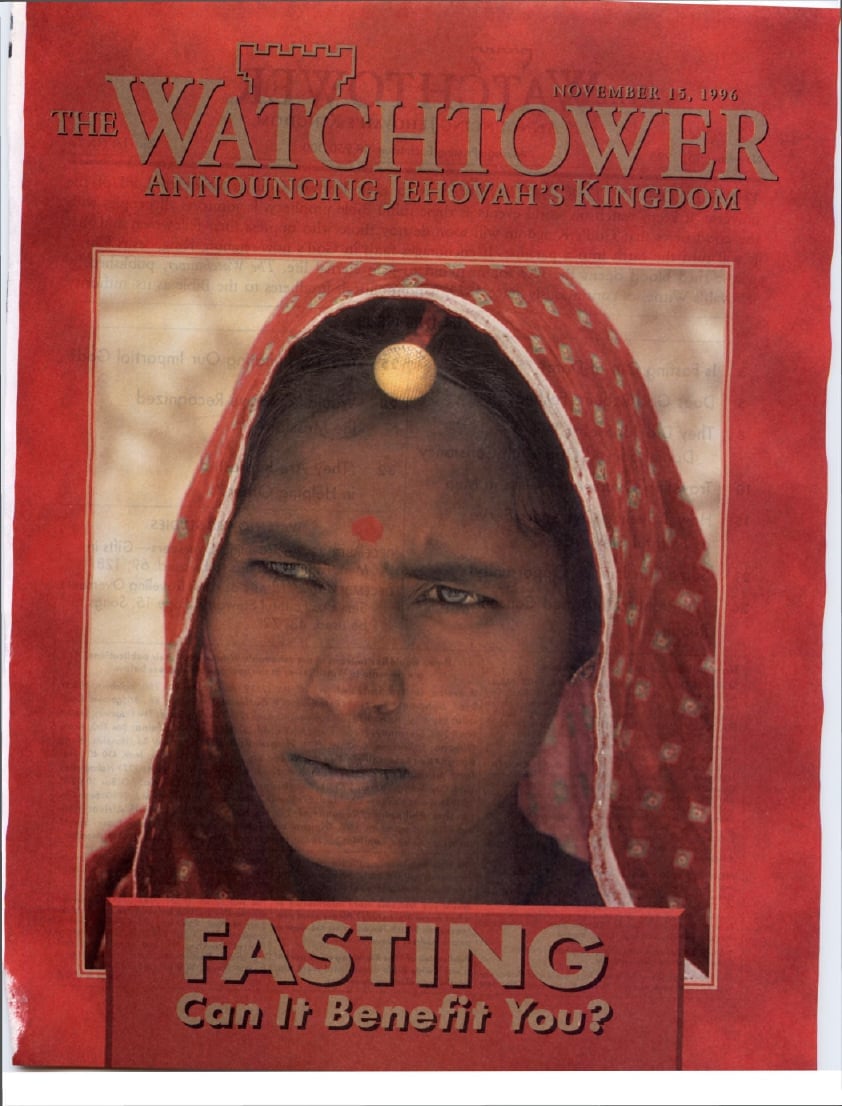
The Watchtower — November 15, 1996
Source: jw.org
Contents
Is Fasting Out-of-Date?
Does God Require Fasting?
Daniel Served God With Constancy
Traveling Overseers—Gifts in Men
How Traveling Overseers Serve as Faithful Stewards
Seize This Unique Opportunity!
The Right to Informed Consent Reaffirmed
Are You Imitating Our Impartial God?
Would You Have Recognized the Messiah?
‘They Are Interested in Helping Others’
Would You Welcome a Visit?
Is Fasting Out-of-Date?
Is Fasting Out-of-Date?
“I HAVE been fasting every Monday since I was a teenager,” says Mrudulaben, a prosperous 78-year-old Indian woman. This has been a part of her worship, a way to ensure that she had a good marriage and healthy children, as well as protection for her husband. Now a widow, she continues to fast on Mondays for good health and for the prosperity of her children. Like her, the majority of Hindu women make regular fasts part of their life.
Prakash, a middle-aged businessman living in a suburb of Mumbai (Bombay), India, says that he fasts every year on the Mondays of Sawan (Shravan). This is a month of special religious significance on the Hindu calendar. Prakash explains: “I started out for religious reasons, but now I find an added incentive to continue for health purposes. Since Sawan comes toward the end of the monsoon, it gives my system a chance to cleanse itself of illnesses peculiar to the rainy season.”
Some feel that fasting helps a person physically, mentally, and spiritually. For instance, the Grolier International Encyclopedia states: “Recent scientific research suggests that fasting may be healthful and, when engaged in carefully, may bring about heightened states of consciousness and sensibility.” It is said that Greek philosopher Plato would fast for ten days or more and that the mathematician Pythagoras made his students fast before he taught them.
To some, fasting means total abstinence from food and water for a fixed period of time, while others take liquids during their fasts. Missing certain meals or refraining from a particular type of food is considered fasting by many. But long-term unsupervised fasting can be hazardous. Journalist Parul Sheth says that after the body has drawn on its store of carbohydrates, it next converts muscle proteins into glucose and then turns to the body fat. Changing fat into glucose releases toxic products called ketone bodies. As these accumulate, they move to the brain, harming the central nervous system. “This is when fasting can turn dangerous,” says Sheth. “You can get confused, disoriented, and worse. . . . [It can cause] coma and eventually death.”
An Instrument and a Ritual
Fasting has been used as a powerful tool for political or social ends. A prominent wielder of this weapon was Mohandas K. Gandhi in India. Held in high esteem by hundreds of millions of people, he used fasting to exert a strong influence on India’s Hindu masses. Describing the result of his fast to settle an industrial dispute between mill laborers and mill owners, Gandhi said: “The net result of it was that an atmosphere of goodwill was created all round. The hearts of the mill-owners were touched . . . The strike was called off after I had fasted only for three days.” South Africa’s president, Nelson Mandela, participated in a five-day hunger strike during his years as a political prisoner.
The majority of those who have made a practice of fasting, though, have done so for religious reasons. Fasting is a prominent ritual in Hinduism. On certain days, states the book Fast and Festivals of India, “complete fast is observed . . . even water is not taken at all. Both men and women observe strict fast . . . to ensure happiness, prosperity and forgiveness of transgressions and sins.”
Fasting is widely practiced in the Jain religion. The Sunday Times of India Review reports: “A Jain muni [sage] in Bombay [Mumbai] drank just two glasses of boiled water a day—for 201 days. He lost 33 kg [73 lb].” Some even fast to the point of starving themselves to death, convinced that this will bring salvation.
For adults in general practicing Islam, fasting is obligatory during the month of Ramadan. No food or water may be taken from sunrise to sunset for the entire month. Anyone ill or on a journey during this time must make up the days of the fast. Lent, the 40-day period preceding Easter, is a time of fasting for some in Christendom, and many religious orders observe fasts on other specified days.
Fasting has certainly not died out. And since it is a part of so many religions, we may ask, Is fasting required by God? Are there occasions when Christians may decide to fast? Can this be beneficial? The next article will discuss these questions.
[Picture on page 3]
The Jain religion views fasting as a way to achieve the salvation of the soul
[Picture on page 4]
Mohandas K. Gandhi used fasting as a powerful tool for political or social ends
[Picture on page 4]
In Islam, fasting is obligatory during the month of Ramadan
[Credit Line]
Garo Nalbandian
Does God Require Fasting?
Does God Require Fasting?
GOD’S Law given through Moses required fasting only on one occasion—on the annual Day of Atonement. The Law commanded that on that day the Israelites were to ‘afflict their souls,’ which is understood to mean that they fasted. (Leviticus 16:29-31; 23:27; Psalm 35:13) However, this fast was not a mere formalism. The observance of the Day of Atonement moved the people of Israel to greater consciousness of their sinfulness and the need for redemption. They fasted on that day also to express sorrow for their sins and repentance before God.
Though this was the only obligatory fast under the Mosaic Law, the Israelites observed fasts on other occasions. (Exodus 34:28; 1 Samuel 7:6; 2 Chronicles 20:3; Ezra 8:21; Esther 4:3, 16) Included among these were voluntary fasts as a means of displaying repentance. Jehovah urged the erring people of Judah: “Come back to me with all your hearts, and with fasting and with weeping and with wailing.” This was not to be an outward show, for God goes on to say: “Rip apart your hearts, and not your garments.”—Joel 2:12-15.
In time, many fasted as an outward formalism. Jehovah detested such insincere fasting and therefore asked hypocritical Israelites: “Should the fast that I choose become like this, as a day for earthling man to afflict his soul? For bowing down his head just like a rush, and that he should spread out mere sackcloth and ashes as his couch? Is it this that you call a fast and a day acceptable to Jehovah?” (Isaiah 58:5) Rather than making a showy display of their fasting, these wayward people were asked to produce works befitting repentance.
Some fasts established by the Jews met with God’s disapproval right from the outset. For example, at one time the people of Judah had four annual fasts to commemorate the calamitous events associated with Jerusalem’s siege and desolation in the seventh century B.C.E. (2 Kings 25:1-4, 8, 9, 22-26; Zechariah 8:19) After the Jews were released from captivity in Babylon, Jehovah said through the prophet Zechariah: “When you fasted . . . , and this for seventy years, did you really fast to me, even me?” God did not approve of these fasts because the Jews were fasting and mourning over judgments that had come from Jehovah himself. They were fasting because of the calamity that befell them, not because of their own wrongdoing that led to it. After they were restored to their homeland, it was time for them to rejoice instead of bemoaning the past.—Zechariah 7:5.
Is Fasting for Christians?
Even though Jesus Christ never commanded his disciples to fast, he and his followers fasted on Atonement Day because they were under the Mosaic Law. Additionally, some of his disciples fasted voluntarily on other occasions, since Jesus did not direct them to avoid the practice altogether. (Acts 13:2, 3; 14:23) Yet, they were never to ‘disfigure their faces that they might appear to men to be fasting.’ (Matthew 6:16) Such an external display of piety might bring admiring glances and approving nods from other humans. Nevertheless, God is not pleased with such a showy display.—Matthew 6:17, 18.
Jesus also spoke of his followers’ fasting at the time of his death. He was not thereby instituting a ritual fast. Instead, he was indicating a reaction to the deep sorrow they would experience. Once he was resurrected, he would be with them again, and there would no longer be such a reason for them to fast.—Luke 5:34, 35.
The Mosaic Law ended when “the Christ was offered once for all time to bear the sins of many.” (Hebrews 9:24-28) And with the end of the Law, the command to fast on Atonement Day ended. Thus, the only obligatory fast mentioned in the Bible was removed.
What About Lent?
What, then, is the basis for Christendom’s practice of fasting during Lent? Both Catholic and Protestant churches recognize Lent, although the manner of observing it differs from church to church. Some eat just one meal a day during the full 40-day period preceding Easter. Others fast totally only on Ash Wednesday and Good Friday. For some, Lent requires abstaining from meat, fish, eggs, and milk products.
Lent is supposedly based on Jesus’ 40-day fast after his baptism. Was he then establishing a ritual to be followed yearly? Not at all. This is evident from the fact that the Bible does not record any such practice among the early Christians. Lent was first observed in the fourth century after Christ. Like many other teachings of Christendom, it was borrowed from pagan sources.
If Lent is in imitation of Jesus’ fasting in the wilderness after his baptism, why is it observed during the weeks leading up to Easter—supposedly the time of his resurrection? Jesus did not fast during the days prior to his death. The Gospel accounts indicate that he and his disciples visited homes and ate meals in Bethany just a few days before he died. And he ate the Passover meal the night before his death.—Matthew 26:6, 7; Luke 22:15; John 12:2.
There is something to be learned from Jesus’ fasting after his baptism. He was embarking on a vital ministry. The vindication of Jehovah’s sovereignty and the future of the entire human race were involved. This was a time for deep meditation and for prayerfully turning to Jehovah for help and guidance. During this time Jesus appropriately fasted. This indicates that fasting can be beneficial when done with the right motive and on a fitting occasion.—Compare Colossians 2:20-23.
When Fasting Could Be Beneficial
Let us consider some occasions today when a worshiper of God might fast. A person who has committed a sin may not feel like eating for a period of time. This would not be to impress others or be in anger at the discipline received. And, of course, fasting in itself would not straighten out matters with God. However, a truly repentant person would feel deep sorrow over having hurt Jehovah and probably friends and family. Anguish and fervent prayer for forgiveness may inhibit a desire for food.
Israel’s King David had a similar experience. When faced with the prospect of losing his son by Bath-sheba, he concentrated all his efforts on praying to Jehovah to obtain mercy regarding the child. As his emotions and strength went into his prayers, he fasted. Likewise, taking food may not seem appropriate under certain stressful conditions today.—2 Samuel 12:15-17.
There may also be times when a godly person wants to focus on some deep spiritual matter. Research in the Bible and Christian publications may be necessary. A period of time may be needed for meditation. During such an absorbing study session, an individual may choose not to be distracted by the eating of meals.—Compare Jeremiah 36:8-10.
There are Scriptural examples of servants of God fasting when serious decisions had to be made. In Nehemiah’s day an oath was to be made to Jehovah, and the Jews would be liable to a curse if they broke it. They were to promise to put away their foreign wives and to keep separate from the surrounding nations. Before making this oath and during the confession of their guilt, the entire congregation fasted. (Nehemiah 9:1, 38; 10:29, 30) When faced with weighty decisions, a Christian may therefore go without food for a short period of time.
Decision-making by bodies of elders in the early Christian congregation was sometimes accompanied by fasting. Today, congregation elders faced with difficult decisions, perhaps in connection with a judicial case, may abstain from food while considering the matter.
Choosing to fast in certain circumstances is an individual decision. One person should not judge another on this matter. We should not want to “appear righteous to men”; nor should we make food so important that it interferes with our caring for serious obligations. (Matthew 23:28; Luke 12:22, 23) And the Bible shows that God neither requires that we fast nor prohibits us from fasting.
[Picture on page 7]
Do you know why Jesus fasted for 40 days after his baptism?
Daniel Served God With Constancy
They Did Jehovah’s Will
Daniel Served God With Constancy
IT IS rare for the course of history to change overnight. Yet, that occurred in 539 B.C.E., when the Babylonian Empire was overthrown by the Medes and the Persians in just a matter of hours. By that year, Jehovah’s prophet Daniel had been living as a Jewish exile in Babylon for almost 80 years. Likely in his 90’s, Daniel was about to face one of the greatest tests of his integrity to God.
After Babylon’s fall, things initially seemed to go well for Daniel. The new king was Darius the Mede, a 62-year-old man who looked upon Daniel with favor. One of Darius’ first acts as king was to appoint 120 satraps and to elevate three men to the rank of high official.a Daniel was one of those three favored men. Recognizing Daniel’s exceptional potential, Darius was even intent on giving him the position of prime minister! Just then, however, something happened that abruptly changed the king’s plans.
A Devious Plan
Daniel’s fellow high officials, accompanied by a large group of satraps, approached the king with an intriguing idea. They implored Darius to establish a law stipulating: “Whoever makes a petition to any god or man for thirty days except to you, O king, should be thrown to the lions’ pit.” (Daniel 6:7) It may have seemed to Darius that these men were avowing their loyalty to him. He may also have reasoned that this law would help him, a foreigner, to reinforce his position as head of the realm.
However, the high officials and the satraps did not propose this edict for the king’s sake. They were “seeking to find some pretext against Daniel respecting the kingdom; but there was no pretext or corrupt thing at all that they were able to find, forasmuch as he was trustworthy and no negligence or corrupt thing at all was found in him.” So these devious men reasoned: “We shall find in this Daniel no pretext at all, except we have to find it against him in the law of his God.” (Daniel 6:4, 5) Aware that Daniel prayed to Jehovah daily, they sought to make this a capital offense.
Perhaps the high officials and the satraps harbored animosity toward Daniel because he “was steadily distinguishing himself over [them], forasmuch as an extraordinary spirit was in him; and the king was intending to elevate him over all the kingdom.” (Daniel 6:3) Daniel’s honesty may have created an unwelcome restraint against corruption and graft. Whatever the case, these men convinced the king to sign the edict, making it part of “the law of the Medes and the Persians, which is not annulled.”—Daniel 6:8, 9.
Daniel Remains Steadfast
After learning about the new statute, did Daniel stop praying to Jehovah? By no means! Kneeling in the roof chamber of his house, he prayed to God three times a day, “as he had been regularly doing prior to this.” (Daniel 6:10) While he was praying, his enemies “crowded in and found Daniel petitioning and imploring favor before his God.” (Daniel 6:11) When they brought the matter to the king’s attention, Darius was distressed that the law he had signed would implicate Daniel. “Till the setting of the sun he kept on striving to deliver him,” the account tells us. But even the king could not rescind the law he had enacted. Daniel was therefore taken to the lions’ pit, evidently a sunken or underground place. “Your God whom you are serving with constancy, he himself will rescue you,” the king assured Daniel.—Daniel 6:12-16.
After a sleepless night and fasting, Darius hurried to the pit. Daniel was alive and unharmed! The king’s response was immediate. He had Daniel’s enemies and their families thrown into the lions’ pit as retribution. Darius also made it known throughout the realm that “in every dominion of my kingdom, people are to be quaking and fearing before the God of Daniel.”—Daniel 6:17-27.
Lesson for Us
Daniel was a fine example of faithfulness. Even the king, who did not worship Jehovah, noticed that Daniel served Him “with constancy.” (Daniel 6:16, 20) The Aramaic root word translated “constancy” basically means to “move in a circle.” It suggests continuity. How well this describes Daniel’s unbroken integrity to Jehovah!
Daniel developed a pattern of constancy long before he was cast into the lions’ pit. As a young captive in Babylon, he refused to consume food or drink prohibited by the Mosaic Law or defiled by pagan ritual. (Daniel 1:8) Later, he boldly declared God’s message to Babylonian king Nebuchadnezzar. (Daniel 4:19-25) Just hours before Babylon’s fall, Daniel fearlessly proclaimed God’s judgment to King Belshazzar. (Daniel 5:22-28) So when Daniel faced the lions’ pit, he continued in the faithful course he had established.
You too can serve Jehovah with constancy. Are you a young person? Then act now to develop a pattern of constancy by rejecting this world’s bad association and corrupting conduct. If you have been serving God for some time, maintain a pattern of faithful endurance. Do not give up, for each trial we face gives us an opportunity to show Jehovah that we are determined to serve him with constancy.—Philippians 4:11-13.
[Footnote]
The term “satrap” (literally meaning “protector of the Kingdom”) refers to a governor appointed by the Persian king to serve as chief ruler over a jurisdictional district. As an official representative of the king, he was responsible for collecting taxes and remitting the tribute to the royal court.
Traveling Overseers—Gifts in Men
Traveling Overseers—Gifts in Men
“When he ascended on high he carried away captives; he gave gifts in men.”—EPHESIANS 4:8.
1. What new work was announced in this journal in 1894?
OVER a century ago, the Watch Tower announced something new. It was described as “Another Branch of the Work.” What did this new activity entail? It was the modern-day inauguration of the work of traveling overseers. The September 1, 1894, issue of this journal explained that henceforth qualified brothers would be visiting groups of Bible Students ‘for the purpose of building them up in the truth.’
2. Circuit and district overseers have what duties?
2 In the first century C.E., Christian congregations were visited by such overseers as Paul and Barnabas. These faithful men had the objective of ‘building up’ the congregations. (2 Corinthians 10:8) Today, we are blessed with thousands of men who are doing this in a systematic way. The Governing Body of Jehovah’s Witnesses has appointed them as circuit and district overseers. A circuit overseer serves about 20 congregations for a week each about twice a year, examining records, giving talks, and engaging in the field ministry with local Kingdom publishers. The district overseer is chairman for each of the annual circuit assemblies for a number of circuits, engages in the field ministry with the host congregations, and provides encouragement in Bible-based talks.
Their Self-Sacrificing Spirit
3. Why do traveling overseers need to have a self-sacrificing spirit?
3 Traveling overseers are constantly on the move. This in itself requires a self-sacrificing spirit. Traveling from one congregation to another can often be difficult, but these men and their wives do so with a joyful attitude. One circuit overseer said: “My wife is most supportive and uncomplaining . . . She deserves a lot of credit for her self-sacrificing spirit.” Some circuit overseers travel over 600 miles [1,000 km] between congregations. Many drive automobiles, but others get from one place to another by public transportation, by bicycle, on horseback, or on foot. One African circuit overseer even has to wade through a river with his wife on his shoulders in order to reach one congregation. On his missionary trips, the apostle Paul had to cope with heat and cold, hunger and thirst, sleepless nights, various dangers, and violent persecution. He also had “anxiety for all the congregations”—an experience common to traveling overseers today.—2 Corinthians 11:23-29.
4. What effect can health problems have on the lives of traveling overseers and their wives?
4 Like Paul’s companion Timothy, traveling overseers and their wives sometimes have health problems. (1 Timothy 5:23) This places extra stress on them. One circuit overseer’s wife explains: “Always being with the brothers is a strain when I am not feeling well. With the onset of menopause, I have found this especially difficult. Just having to pack all our belongings every week and move somewhere else is a real challenge. Often, I have to stop and pray to Jehovah to give me the strength to keep going.”
5. Despite various trials, what spirit has been shown by traveling overseers and their wives?
5 Despite health problems and other trials, traveling overseers and their wives find joy in their service and display self-sacrificing love. Some have risked their lives to render spiritual help in times of persecution or warfare. When visiting congregations, they have manifested a spirit similar to that of Paul, who told Thessalonian Christians: “We became gentle in the midst of you, as when a nursing mother cherishes her own children. So, having a tender affection for you, we were well pleased to impart to you, not only the good news of God, but also our own souls, because you became beloved to us.”—1 Thessalonians 2:7, 8.
6, 7. What positive influence can hardworking traveling overseers provide?
6 Like other elders in the Christian congregation, traveling overseers “work hard in speaking and teaching.” All such elders should “be reckoned worthy of double honor.” (1 Timothy 5:17) Their example can prove beneficial if, after ‘contemplating how their conduct turns out, we imitate their faith.’—Hebrews 13:7.
7 What effect have certain traveling elders had on others? “What a wonderful influence Brother P—— was in my life!” wrote one Witness of Jehovah. “He was a traveling overseer in Mexico from the year 1960 onward. As a child, I awaited his visits with expectation and joy. When I was ten years old, he told me, ‘You too are going to be a circuit overseer.’ During the difficult teenage years, I frequently sought him out because he always had words of wisdom to offer. He lived to shepherd the flock! Now that I am a circuit overseer, I always try to devote time to the young ones and to put theocratic goals before them as he did for me. Even in the final years of his life, despite problems with heart failure, Brother P—— always sought to offer an encouraging word. Just one day before his death in February 1995, he accompanied me to a special assembly day and put fine goals before a brother who is an architect. The brother immediately submitted an application to serve at Bethel.”
They Are Appreciated
8. Who are the “gifts in men” described in Ephesians chapter 4, and how do they benefit the congregation?
8 Traveling overseers and other elders favored with assignments of service by God’s undeserved kindness are called “gifts in men.” As Jehovah’s representative and Head of the congregation, Jesus has provided these spiritual men in order that we might be built up individually and attain to maturity. (Ephesians 4:8-15) Any gift deserves an expression of appreciation. Especially is this true of a gift that fortifies us to keep serving Jehovah. So, then, how can we display our appreciation for the work of traveling overseers? In what ways can we show that we ‘keep holding these men dear’?—Philippians 2:29.
9. In what ways can we show appreciation for traveling overseers?
9 When the circuit overseer’s visit is announced, we can start making plans to have a full share in the congregation’s activities for that week. Perhaps we can set aside extra time to support the field service arrangements during the visit. We may be able to serve as auxiliary pioneers during that month. Surely we will want to put the circuit overseer’s suggestions into practice in order to improve our ministry. Such a receptive spirit will benefit us and will reassure him that his visit is a useful one. Yes, traveling overseers visit the congregation to build us up, but they too need to be built up spiritually. There were times when Paul was in need of encouragement, and he often asked fellow Christians to pray for him. (Acts 28:15; Romans 15:30-32; 2 Corinthians 1:11; Colossians 4:2, 3; 1 Thessalonians 5:25) Present-day traveling overseers likewise need our prayers and encouragement.
10. How can we help to make a traveling overseer’s work a joy?
10 Have we told the circuit overseer and his wife how much we appreciate their visits? Do we thank him for the helpful counsel he gives us? Do we let him know when his field service suggestions increase our joy in the ministry? If we do, this will help to make his work a joy. (Hebrews 13:17) One circuit overseer in Spain particularly commented on how much he and his wife treasure the thank-you notes they have received after visiting congregations. “We keep these cards and read them when we are feeling low,” he says. “They are a source of real encouragement.”
11. Why should we let the circuit and district overseers’ wives know that they are loved and appreciated?
11 The traveling overseer’s wife surely benefits from words of commendation. She has made great sacrifices to assist her husband in this field of service. These faithful sisters forgo the natural desire to have their own home and, in many cases, also that of having children. Jephthah’s daughter was one of Jehovah’s servants who willingly relinquished her opportunity to have a husband and a family because of a vow her father made. (Judges 11:30-39) How was her sacrifice viewed? Judges 11:40 states: “From year to year the daughters of Israel would go to give commendation to the daughter of Jephthah the Gileadite, four days in the year.” How fine it is when we make a point of telling the circuit and district overseers’ wives that they are loved and appreciated!
“Do Not Forget Hospitality”
12, 13. (a) What Scriptural basis is there for being hospitable to traveling overseers and their wives? (b) Illustrate how such hospitality can be mutually beneficial.
12 Showing hospitality is another way to display love and appreciation for those in the Christian traveling work. (Hebrews 13:2) The apostle John commended Gaius for extending hospitality to those visiting the congregation as traveling missionaries. John wrote: “Beloved one, you are doing a faithful work in whatever you do for the brothers, and strangers at that, who have borne witness to your love before the congregation. These you will please send on their way in a manner worthy of God. For it was in behalf of his name that they went forth, not taking anything from the people of the nations. We, therefore, are under obligation to receive such persons hospitably, that we may become fellow workers in the truth.” (3 John 5-8) Today, we can further the Kingdom-preaching activity by extending similar hospitality to traveling overseers and their wives. Of course, local elders should make sure that accommodations are satisfactory, but one district overseer said: “Our involvement with the brothers cannot be predicated on who can do something for us. We would not even want to give that impression. We must be willing to accept the hospitality of any of our brothers, rich or poor.”
13 Hospitality can be mutually beneficial. “In my family, we had the custom of inviting traveling overseers to stay with us,” recalls Jorge, a former circuit overseer now serving at Bethel. “I feel that these visits helped me more than I then realized. During my adolescence, I had spiritual problems. My mother was worried about this but did not know just how to help and therefore asked the circuit overseer to talk with me. At first I avoided him, since I was afraid of being criticized. But his friendly manner finally won me over. He invited me to have a meal with him one Monday, and I opened my heart because I felt sure that I was being understood. He listened carefully. His practical suggestions really worked, and I began to progress spiritually.”
14. Why should we be appreciative rather than critical of traveling elders?
14 A traveling overseer tries to be spiritually helpful to young and old alike. Surely, then, we should show our appreciation for his efforts. However, what if we were to criticize him because of his weak points or compare him unfavorably with others who have visited the congregation? Likely, this would be very disheartening. It was not encouraging for Paul to hear criticisms of his work. Apparently, some Corinthian Christians were making disparaging remarks about his appearance and speaking ability. He himself quoted such critics as saying: “His letters are weighty and forceful, but his presence in person is weak and his speech contemptible.” (2 Corinthians 10:10) Happily, though, traveling overseers usually hear words of loving appreciation.
15, 16. How are traveling overseers and their wives affected by the love and zeal displayed by their fellow believers?
15 One circuit overseer in Latin America trudges a whole day along muddy trails in order to visit his spiritual brothers and sisters living in a zone controlled by guerrillas. “It is touching to see the way the brothers show their appreciation for the visit,” he writes. “Even though I have to make a great effort to get there, facing many dangers and hardships, all of this is rewarded by the love and zeal the brothers show.”
16 A circuit overseer in Africa writes: “Because of the love the brothers showed us, we loved the territory of Tanzania so much! Brothers were ready to learn from us, and they were happy to have us in their homes.” There was a loving and happy relationship between the apostle Paul and the first-century Christian married couple Aquila and Prisca. In fact, Paul said of them: “Give my greetings to Prisca and Aquila my fellow workers in Christ Jesus, who have risked their own necks for my soul, to whom not only I but also all the congregations of the nations render thanks.” (Romans 16:3, 4) Traveling overseers and their wives are thankful to have as their friends modern-day Aquilas and Priscas who go out of their way to show hospitality and provide companionship.
Strengthening the Congregations
17. Why can it be said that there is wisdom behind the arrangement for traveling overseers, and where do they get their instruction?
17 Jesus said: “Wisdom is proved righteous by its works.” (Matthew 11:19) The wisdom behind the traveling-overseer arrangement is evident in that it helps to strengthen the congregations of God’s people. During Paul’s second missionary journey, he and Silas successfully “went through Syria and Cilicia, strengthening the congregations.” The book of Acts tells us: “As they traveled on through the cities they would deliver to those there for observance the decrees that had been decided upon by the apostles and older men who were in Jerusalem. Therefore, indeed, the congregations continued to be made firm in the faith and to increase in number from day to day.” (Acts 15:40, 41; 16:4, 5) Present-day traveling overseers receive spiritual instruction through the Scriptures and the publications of “the faithful and discreet slave,” as do all other Christians.—Matthew 24:45.
18. How do traveling overseers strengthen the congregations?
18 Yes, traveling elders must continue to feed at Jehovah’s spiritual table. They must be well acquainted with the methods and guidelines followed by God’s organization. Then such men can be a real blessing to others. By means of their fine example of zeal in the field service, they can help fellow believers to improve in the Christian ministry. The Bible-based talks given by these visiting elders upbuild listeners spiritually. By helping others to apply the counsel of God’s Word, serve in harmony with Jehovah’s people earth wide, and put to use the spiritual provisions made by God through the ‘faithful slave,’ traveling overseers strengthen the congregations they are privileged to visit.
19. What questions remain for consideration?
19 When Jehovah’s organization instituted the work of traveling elders among the Bible Students about a hundred years ago, this journal stated: “We shall watch for results and for the Lord’s further leading.” Jehovah’s leading has been clearly manifest. Because of his blessing and under the supervision of the Governing Body, this work has been expanded and refined over the years. As a result, congregations of Jehovah’s Witnesses throughout the earth are being made firm in the faith and are increasing in number from day to day. Evidently, Jehovah is blessing the self-sacrificing spirit of these gifts in men. But how can traveling overseers successfully carry out their work? What are their objectives? How can they achieve the most good?
How Would You Respond?
□ What are some duties of circuit and district overseers?
□ Why do traveling overseers need to have a self-sacrificing spirit?
□ How can appreciation be shown for the work of traveling elders and their wives?
□ What can traveling overseers do to make congregations firm in the faith?
[Picture on page 10]
Being on the move requires a spirit of self-sacrifice
[Picture on page 13]
Have you shown hospitality to traveling overseers and their wives?
How Traveling Overseers Serve as Faithful Stewards
How Traveling Overseers Serve as Faithful Stewards
“In proportion as each one has received a gift, use it in ministering to one another as fine stewards of God’s undeserved kindness expressed in various ways.”—1 PETER 4:10.
1, 2. (a) How would you define the word “steward”? (b) Who are included among stewards used by God?
JEHOVAH uses all faithful Christians as stewards. A steward is often a servant in charge of a household. He may also manage his master’s business affairs. (Luke 16:1-3; Galatians 4:1, 2) Jesus called his body of loyal anointed ones on earth “the faithful steward.” To this steward he has committed “all his belongings,” including Kingdom-preaching activities.—Luke 12:42-44; Matthew 24:14, 45.
2 The apostle Peter said that all Christians are stewards of God’s undeserved kindness expressed in various ways. Each Christian has a place in which he can carry out a faithful stewardship. (1 Peter 4:10) Appointed Christian elders are stewards, and among them are traveling overseers. (Titus 1:7) How are these traveling elders to be viewed? What qualities and objectives should they have? And how can they accomplish the most good?
Grateful for Their Service
3. Why can traveling overseers be called “fine stewards”?
3 Writing to a traveling overseer and his wife, one Christian married couple said: “We would like to express our gratitude for all the time and love you have given to us. As a family, we have benefited greatly from all your encouragement and advice. We know that we have to continue growing spiritually, but with Jehovah’s help and with brothers and sisters like you, the growing pains are made easier.” Expressions like these are frequent because traveling overseers take a personal interest in fellow believers, just as a good steward cares well for a household’s needs. Some are outstanding speakers. Many excel in the preaching work, while others are known for their warmth and compassion. By cultivating and using such gifts in ministering to others, traveling overseers can rightly be called “fine stewards.”
4. What question will now be considered?
4 “What is looked for in stewards is for a man to be found faithful,” wrote the apostle Paul. (1 Corinthians 4:2) Ministering to fellow Christians in a different congregation week after week is a unique and joyous privilege. Nevertheless, it is also a heavy responsibility. How, then, can traveling overseers faithfully and successfully carry out their stewardship?
Successfully Carrying Out Their Stewardship
5, 6. Why is prayerful reliance upon Jehovah so important in the life of a traveling overseer?
5 Prayerful reliance upon Jehovah is essential if traveling overseers are to be successful stewards. Because of their schedule and many responsibilities, they could sometimes feel weighed down. (Compare 2 Corinthians 5:4.) So they need to act in harmony with the psalmist David’s song: “Throw your burden upon Jehovah himself, and he himself will sustain you. Never will he allow the righteous one to totter.” (Psalm 55:22) Comforting, too, are David’s words: “Blessed be Jehovah, who daily carries the load for us.”—Psalm 68:19.
6 Where did Paul get the strength to care for his spiritual responsibilities? “For all things I have the strength by virtue of him who imparts power to me,” he wrote. (Philippians 4:13) Yes, Jehovah God was the Source of Paul’s strength. Similarly, Peter advised: “If anyone ministers, let him minister as dependent on the strength that God supplies; so that in all things God may be glorified through Jesus Christ.” (1 Peter 4:11) One brother who was a traveling overseer for many years emphasized the need for reliance on God, stating: “Always look to Jehovah in handling problems, and seek the aid of his organization.”
7. How does balance play a part in a traveling overseer’s work?
7 Balance is needed by a successful traveling overseer. Like other Christians, he strives to “make sure of the more important things.” (Philippians 1:10)a When the local elders have questions about a certain matter, it is wise for them to consult with the visiting circuit overseer. (Proverbs 11:14; 15:22) Likely, his balanced observations and Scriptural counsel will prove to be very helpful as the elders continue handling the matter after he has left the congregation. Along somewhat similar lines, Paul told Timothy: “The things you heard from me with the support of many witnesses, these things commit to faithful men, who, in turn, will be adequately qualified to teach others.”—2 Timothy 2:2.
8. Why are Bible study, research, and meditation essential?
8 Scriptural study, research, and meditation are requisites for giving sound counsel. (Proverbs 15:28) One district overseer said: “When meeting with the elders, we should not be afraid to admit that we do not know the answer to a particular question.” Putting forth the effort to get “the mind of Christ” on a matter makes it possible to give Bible-based counsel that will help others to comply with God’s will. (1 Corinthians 2:16) Sometimes a traveling overseer needs to write to the Watch Tower Society for direction. In any case, faith in Jehovah and love for the truth are far more important than image or eloquence. Instead of coming with “an extravagance of speech or of wisdom,” Paul began his ministry in Corinth “in weakness and in fear and with much trembling.” Did this make him ineffective? On the contrary, it helped the Corinthians to have faith, “not in men’s wisdom, but in God’s power.”—1 Corinthians 2:1-5.
Other Vital Qualities
9. Why is empathy needed by traveling elders?
9 Empathy helps traveling overseers to achieve good results. Peter urged all Christians to ‘show fellow feeling,’ or to be “sympathetic.” (1 Peter 3:8, footnote) One circuit overseer feels the need to ‘be interested in everyone in the congregation and be genuinely attentive.’ With a similar spirit, Paul wrote: “Rejoice with people who rejoice; weep with people who weep.” (Romans 12:15) Such an attitude moves traveling overseers to make earnest efforts to understand the problems and circumstances of fellow believers. Then they can give upbuilding Scriptural counsel that can accomplish real good if it is applied. A circuit overseer who excels in showing empathy received this letter from a congregation near Turin, Italy: “If you want to be interesting, be interested; if you want to be pleasing, be pleasant; if you want to be loved, be lovable; if you want to be helped, be ready to help. This is what we have learned from you!”
10. What have circuit and district overseers said about being humble, and what example did Jesus set in this regard?
10 Being humble and approachable assists traveling overseers to do much good. One circuit overseer observed: “It is most important to maintain a humble attitude.” He would caution new traveling overseers: “Do not let yourselves be unduly influenced by the more affluent brothers because of what they may do for you, nor limit your friendship to such ones, but strive always to deal with others impartially.” (2 Chronicles 19:6, 7) And a truly humble traveling overseer will not have an exaggerated view of his own importance as a representative of the Society. A district overseer appropriately commented: “Be humble and willing to listen to the brothers. Always be approachable.” As the greatest man who ever lived, Jesus Christ could have made people feel uncomfortable, but he was so humble and approachable that even children felt at ease in his presence. (Matthew 18:5; Mark 10:13-16) Traveling overseers want children, teenagers, elderly ones—indeed anyone and everyone in the congregation—to feel free to approach them.
11. When it is needed, what can be the effect of an apology?
11 Of course, “we all stumble many times,” and no traveling overseer is immune to making mistakes. (James 3:2) When they make mistakes, a sincere apology gives other elders an example of humility. According to Proverbs 22:4, “the result of humility and the [reverential] fear of Jehovah is riches and glory and life.” And do not all of God’s servants need to ‘be humble in walking with their God’? (Micah 6:8, 1960 Edition) When asked what advice he would have for a new traveling elder, one circuit overseer commented: “Have high respect and regard for all the brothers, and consider them as being better than you. You will learn much from the brothers. Stay humble. Be yourself. Do not put on airs.”—Philippians 2:3.
12. Why is zeal for the Christian ministry so significant?
12 Zeal for the Christian ministry lends weight to a traveling overseer’s words. In fact, when he and his wife set zealous examples in the evangelizing work, elders, their wives, and the rest of the congregation are encouraged to display zeal in their ministry. “Be zealous for the service,” urged one circuit overseer. He added: “I have found that, generally, the more zealous a congregation is in the ministry, the fewer problems they experience.” Another circuit overseer remarked: “I believe that if the elders work in the field with the brothers and sisters and help them to enjoy the ministry, this will result in peace of mind and the greatest satisfaction in serving Jehovah.” The apostle Paul ‘mustered up boldness to speak the good news of God to the Thessalonians with a great deal of struggling.’ No wonder they had fond memories of his visit and preaching activity and longed to see him again!—1 Thessalonians 2:1, 2; 3:6.
13. What does a traveling overseer take into account when working with fellow Christians in the field service?
13 When working with fellow Christians in the field ministry, a traveling overseer takes into account their circumstances and limitations. Although his suggestions may be helpful, he knows that some may be nervous when preaching with an experienced elder. In certain cases, therefore, encouragement may be more useful than counsel. When he accompanies publishers or pioneers on a Bible study, they may prefer that he conduct it. This is likely to acquaint them with some ways to improve their teaching methods.
14. Why can it be said that zealous traveling overseers stimulate zeal in others?
14 Zealous traveling overseers stimulate zeal in others. One circuit overseer in Uganda walked through the thick forest for an hour in order to accompany a brother on a Bible study that was making little progress. During their walk it rained so heavily that they arrived soaked to the skin. When the family of six learned that their visitor was a traveling overseer, they were very impressed. They knew that ministers of their church would never show such interest in the flock. The next Sunday, they attended their first meeting and expressed a desire to become Jehovah’s Witnesses.
15. What fine experience was enjoyed by a zealous circuit overseer in Mexico?
15 In the Mexican state of Oaxaca, one circuit overseer made an effort not really expected of him. He arranged to stay in a prison cell for four nights in order to visit a group of seven inmates who had become Kingdom publishers. For several days he accompanied these prisoners as they witnessed from cell to cell and conducted Bible studies. Because of the interest shown, some of these studies continued well into the night. “At the end of the visit, the inmates and I felt full of joy as a result of the mutual encouragement,” writes this zealous circuit overseer.
16. Why is it so beneficial when traveling overseers and their wives provide encouragement?
16 Traveling overseers try to be encouraging. When Paul visited the congregations in Macedonia, he ‘encouraged them with many a word.’ (Acts 20:1, 2) Words of encouragement can be very helpful in directing both young and old toward spiritual goals. At one large branch office of the Watch Tower Society, an informal survey revealed that circuit overseers had encouraged nearly 20 percent of the volunteers to take up full-time service. By her fine example as a full-time Kingdom proclaimer, the traveling overseer’s wife also proves to be a great source of encouragement.
17. How does one elderly circuit overseer feel about his privilege of rendering aid to others?
17 Older ones and depressed souls are particularly in need of encouragement. One elderly circuit overseer writes: “The facet of my work that generates an unspeakable inner joy is the privilege of rendering aid to the inactive and feeble ones among God’s flock. The words of Romans 1:11, 12 have special meaning for me, as I derive immense encouragement and strength while ‘imparting some spiritual gift to such ones in order for them to be made firm.’”
Rewards of Their Joyful Work
18. What Scriptural objectives do traveling overseers have?
18 Traveling overseers have the best interests of fellow believers at heart. They want to strengthen the congregations and build them up spiritually. (Acts 15:41) One traveling overseer works hard “to give encouragement, provide refreshment, and promote a desire to fulfill the ministry and continue living the truth.” (3 John 3) Another one seeks to stabilize fellow believers in the faith. (Colossians 2:6, 7) Remember that the traveling overseer is a “genuine yokefellow,” not a master over the faith of others. (Philippians 4:3; 2 Corinthians 1:24) His visit is an occasion for encouragement and extra activity, as well as an opportunity for the body of elders to review progress made and consider future goals. By his words and example, congregation publishers, pioneers, ministerial servants, and elders can expect to be built up and stimulated for the work ahead. (Compare 1 Thessalonians 5:11.) So, then, wholeheartedly support the circuit overseer’s visits, and take full advantage of the service rendered by the district overseer.
19, 20. How have traveling overseers and their wives been rewarded for their faithful service?
19 Traveling overseers and their wives are richly rewarded for their faithful service, and they can be confident that Jehovah will bless them for the good they do. (Proverbs 19:17; Ephesians 6:8) Georg and Magdalena are an elderly couple who served for many years in the traveling work. At a convention in Luxembourg, Magdalena was approached by a person to whom she had given a witness over 20 years earlier. This Jewish woman’s interest in the truth was aroused by the Bible literature Magdalena left with her, and in time she was baptized. Georg was approached by a spiritual sister who remembered his visit to her home nearly 40 years ago. His enthusiastic presentation of the good news ultimately led both her and her husband to accept the truth. Needless to say, both Georg and Magdalena were overjoyed.
20 Paul’s fruitful ministry in Ephesus brought him joy and may have moved him to quote Jesus’ words: “There is more happiness in giving than there is in receiving.” (Acts 20:35) Since traveling work involves constant giving, those engaging in it experience happiness, especially when they become aware of the good results of their labor. One circuit overseer who helped a discouraged elder was told in a letter: “You have been a great ‘strengthening aid’ in my spiritual life—more than you know. . . . You will never fully know how much help you have been to a modern-day Asaph, whose ‘feet had almost turned aside.’”—Colossians 4:11; Psalm 73:2.
21. Why would you say that 1 Corinthians 15:58 applies to the activities of traveling overseers?
21 An elderly Christian who was in the circuit work for years likes to think of 1 Corinthians 15:58, where Paul urged: “Become steadfast, unmovable, always having plenty to do in the work of the Lord, knowing that your labor is not in vain in connection with the Lord.” Traveling overseers surely have much to do in the Lord’s work. And how grateful we are that they serve so joyfully as faithful stewards of Jehovah’s undeserved kindness!
[Footnote]
See the article “Can You Be Happy With Much to Do?” in The Watchtower, May 15, 1991, pages 28-31.
How Would You Respond?
□ Why can traveling overseers be viewed as “fine stewards”?
□ What are some factors that help circuit and district overseers to accomplish much good?
□ Why are humility and zeal so important for those engaging in the traveling work?
□ What fine objectives do traveling overseers have?
[Picture on page 16]
Traveling overseers seek to encourage fellow believers
[Pictures on page 17]
Young and old alike can benefit from association with traveling overseers and their wives
[Picture on page 18]
The traveling overseer’s zealous ministry promotes zeal in others
Seize This Unique Opportunity!
Seize This Unique Opportunity!
PETER was well advanced in his medical studies when the Bible’s message of salvation captured his interest. When he graduated and started to practice as a doctor in a hospital, his superiors continually encouraged him to specialize as a neurosurgeon. Here was an opportunity that many new doctors would seize without hesitation.
Yet, Petera decided to forgo this opportunity. Why? Did he simply lack the ambition and drive needed? No, for Peter did give the offer careful thought. After becoming a dedicated, baptized Witness of Jehovah, he desired to spend as much time as possible in the various aspects of the Christian ministry. Once he qualified as a neurosurgeon, he reasoned, his profession would swallow more and more of his time and energy. Was he foolish to give up this distinctive prospect, or was he wise?
To some, Peter’s decision may have seemed foolish. However, he took into account such Bible texts as Ephesians 5:15, 16. There the apostle Paul urged fellow Christians: “Keep strict watch that how you walk is not as unwise but as wise persons, buying out the opportune time for yourselves, because the days are wicked.”
Please note the expression “opportune time.” It is translated from a Greek word used in the Bible mostly to refer to a time or period marked by certain features or appropriate for a specific activity. Here Paul stressed that Christians should make time for important matters. Indeed, they need to “make sure of the more important things.” (Philippians 1:10) It is a question of setting priorities.
So, then, what is the divine purpose for our time? What is God’s will for those who love him? Bible prophecies clearly identify our day as “the time of the end,” or “the last days.” (Daniel 12:4; 2 Timothy 3:1) Christ Jesus left no doubt about what would be of paramount importance for our day. He specifically said that before the end of this wicked system of things, ‘this good news of the kingdom would be preached in all the inhabited earth for a witness to all the nations.’ Only then would the end come.—Matthew 24:3, 14.
Therefore, we need to seize every opportunity to preach the good news of the Kingdom and make disciples. (Matthew 28:19, 20) Since these activities are never-to-be-repeated, this is the last opportunity to give our all in this lifesaving work. “Now is the especially acceptable time.” Indeed, “now is the day of salvation.”—2 Corinthians 6:2.
Making a Wise Decision
Peter—the young man mentioned at the outset—carefully thought about his decision and weighed his options. He realized that it would not be wrong for him to study with a view to becoming a neurosurgeon. But what was most important to him? It was his activity in the Christian ministry, considering the urgency of this work. At the same time, he had obligations to fulfill. He was married and had to support his wife, who is participating in the preaching work full-time. (1 Timothy 5:8) Peter also had to repay debts associated with his education. What, then, did he decide to do?
Peter decided to specialize in radiology and to do ultrasound scans. This was work that would entail a normal workday. He would also receive his training during regular working hours. Yes, some might consider this a less prestigious position, but it would allow him more time to devote to spiritual pursuits.
Another consideration prompted Peter’s decision. While not judging others who may have decided differently, he knew that becoming too involved in secular matters does pose a danger for a Christian. It can cause him to neglect spiritual responsibilities. This is illustrated by another example that revolved around employment.
A certain full-time Kingdom preacher was a trained artist. He was able to support himself financially by selling his paintings. While devoting most of his time to the all-important Christian ministry, he could thus support himself comfortably. However, a desire to further his artistic career began to grow. He became more involved in painting and the art world, left the full-time ministry, and eventually became totally inactive as far as the Kingdom-preaching activity was concerned. In time, he became involved in unscriptural conduct, resulting in his being no longer a part of the Christian congregation.—1 Corinthians 5:11-13.
Our Time Is Special
As those now serving Jehovah, surely we want to remain faithful to him. We know that we are living in the most extraordinary time in human history. In order to keep on serving God and to cope with present-day circumstances effectively, we may need to make various adjustments. We can compare this to harvesttime for a farmer. That is a period of special activity, when farm workers are expected to exert themselves more than usual and put in longer workdays. Why? Because the harvest must be gathered within a limited period of time.
There is only a very limited time left for the present wicked system of things. Now more than ever before, a true Christian needs to exert himself to follow Jesus’ example and walk in his footsteps. His life course on earth clearly demonstrated what was of greatest importance to him. He said: “We must work the works of him that sent me while it is day; the night is coming when no man can work.” (John 9:4) By saying that the night was coming, Jesus was referring to the time of his trial, impalement, and death, when his earthly ministry would end and he would be unable to engage in the works of his heavenly Father.
True, during his three-and-a-half-year ministry, Jesus spent some of his time performing miracles and curing the sick. Nevertheless, he used most of his time to preach the Kingdom message and to “preach a release to the captives” of false religion. (Luke 4:18; Matthew 4:17) Jesus put earnest effort into his ministry and also took time to train his disciples so that they could build on the foundation he had laid and effectively continue with the preaching work. Jesus seized every opportunity to promote Kingdom interests and wanted his disciples to do the same thing.—Matthew 5:14-16; John 8:12.
Like Jesus, we who are his modern-day followers need to see mankind’s situation as Jehovah God does. Time is running out for this system of things, and God mercifully wants all to have the opportunity to gain salvation. (2 Peter 3:9) Therefore, would it not be wise to put all other pursuits in second place to the doing of Jehovah’s will? (Matthew 6:25-33) Especially during such a special time as this, something that would normally be regarded as important may well become of lesser importance in our lives as Christians.
Will any of us ever regret putting God’s will first in our lives? No indeed, for the Christian course of self-sacrifice is wonderfully rewarding. For instance, Jesus told his disciples: “Truly I say to you men, No one has left house or brothers or sisters or mother or father or children or fields for my sake and for the sake of the good news who will not get a hundredfold now in this period of time, houses and brothers and sisters and mothers and children and fields, with persecutions, and in the coming system of things everlasting life.”—Mark 10:29, 30.
No one can place a monetary value on the rewards enjoyed by those who use their time to praise Jehovah and proclaim the Kingdom message. They enjoy so many blessings! These include true friends, the satisfaction of doing the divine will, God’s smile of approval, and the prospect of endless life. (Revelation 21:3, 4) And what a blessing it is to help people spiritually and bring honor to Jehovah’s holy name as his Witnesses! Without question, “buying out the opportune time” is a truly wise and rewarding course. Now as never before is the time to share in declaring the good news of God’s Kingdom. Will you seize and hold on to this unique opportunity?
[Footnote]
A substitute name.
The Right to Informed Consent Reaffirmed
The Right to Informed Consent Reaffirmed
A RECENT sentence pronounced by the Judge for Preliminary Investigations of the Court of Messina, Italy, has reaffirmed that the medical wishes of an adult patient are binding upon doctors. The ruling was issued in a case involving one of Jehovah’s Witnesses.
In January 1994, Antonino Stellario Lentini, a 64-year-old Witness hemophiliac patient, was rushed to a hospital in Taormina, Messina. Antonino’s wife, Catena, pointed out to the hospital staff that as Jehovah’s Witnesses she and her husband would not consent to blood transfusion treatment. (Acts 15:20, 28, 29) Their wishes were honored.
However, during transport to another health-care center, Antonino went into respiratory arrest and arrived in critical condition. Soon thereafter, he died. Catena was devastated, but she found great comfort in the Bible’s promise of a resurrection. (Acts 24:15) Then, to her great surprise, the magistrates—perhaps misled by incorrect news propagated by the media—accused her of causing the death of her husband because she refused surgery for him that the doctors deemed imperative.
After more than a year, on July 11, 1995, Catena was acquitted, as she had committed no crime. In fact, the testimony of experts pointed out that, considering the condition of the patient, surgical intervention would have been useless anyway.
But the judge’s statements got to the main issue. It is difficult to accept, he pointed out, the idea that medical personnel have to intervene when treatment is refused by the patient or by persons representing him. The medical deontological code in Italy, he added, “foresees the necessity of acquiring the informed consent of the interested person before any intervention.” Thus, he stated that Catena “lawfully prevented her husband from being subjected to such an operation.”
…