The Watchtower, July 1, 1996
Download: PDF — The Watchtower, July 1, 1996
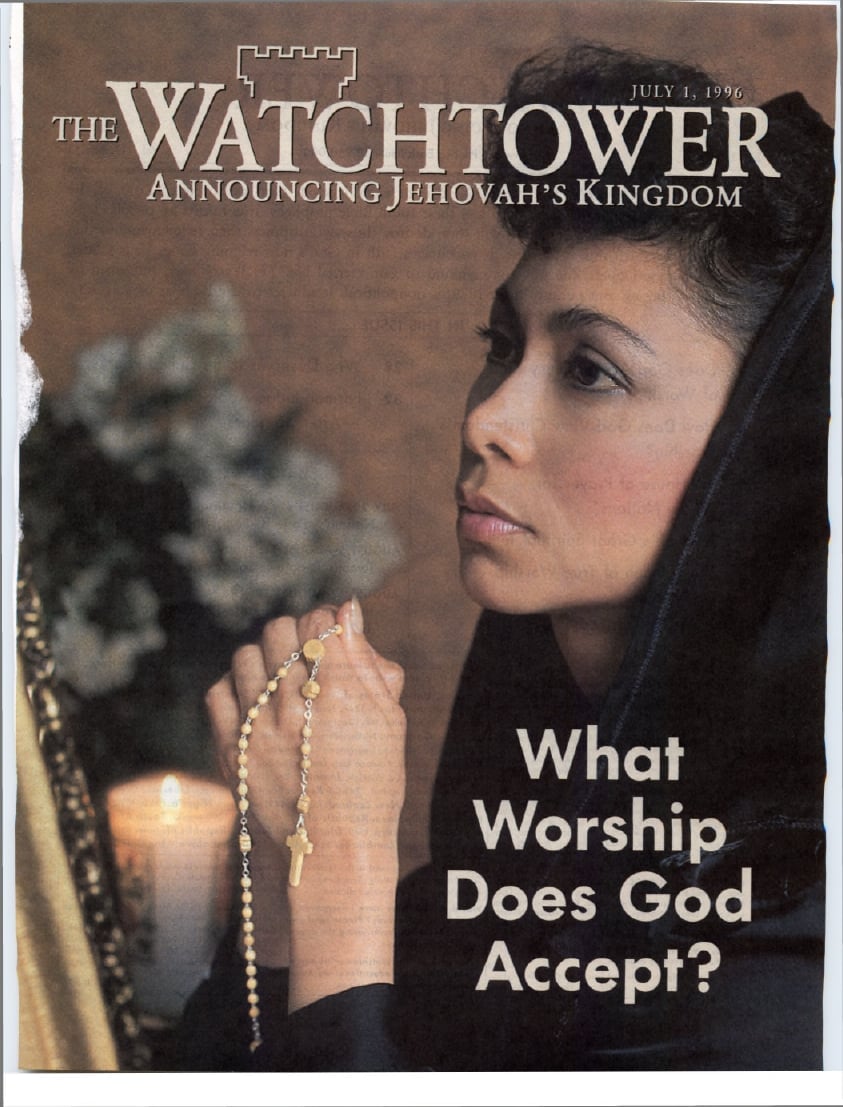
The Watchtower — July 1, 1996
Source: jw.org
Contents
Does God Accept Every Kind of Worship?
How Does God View Christendom’s Worship?
“A House of Prayer for All the Nations”
Jehovah’s Great Spiritual Temple
The Triumph of True Worship Draws Near
God’s Word Works “Miracles”
Who Deserves to Be Called Rabbi?
Annual Meeting October 5, 1996
Former Judge Apologizes—After 45 Years
Would You Welcome a Visit?
Does God Accept Every Kind of Worship?
Does God Accept Every Kind of Worship?
GOD created man with a spiritual need—a need to worship. It is not something that evolved. It was a part of man from the beginning.
Sadly, however, mankind has developed many different ways of worship, and for the most part, these have not produced a happy, united human family. Instead, bloody wars are still being fought in the name of religion. This raises the important question: Does it matter how a person worships God?
Questionable Worship in Ancient Times
The ancient nations who inhabited the Middle East provide a historical case that helps us to answer that question. Many worshiped a god called Baal. They also worshiped female companions of Baal, such as Asherah. The worship of Asherah involved the use of a sacred pole believed to be a sexual symbol. Archaeologists working in that region have dug up numerous images of nude women. These images, states The Encyclopedia of Religion, “feature a goddess with emphasized genitals, holding up her breasts,” and “probably represent . . . Asherah.” One thing is certain, Baal worship was often very immoral.
It is not surprising, therefore, that Baal worship included sex orgies. (Numbers 25:1-3) Shechem, a Canaanite, raped the young virgin Dinah. In spite of this, he was viewed as the most honorable man in his family. (Genesis 34:1, 2, 19) Incest, homosexuality, and bestiality were common. (Leviticus 18:6, 22-24, 27) The very word “sodomy,” a practice of homosexuals, comes from the name of a city that once existed in that part of the world. (Genesis 19:4, 5, 28) Baal worship also involved bloodshed. Why, Baal worshipers would throw their children alive into flaming fires as a sacrifice to their gods! (Jeremiah 19:5) All these practices were related to religious teachings. How so?
“The brutality, lust and abandon of Canaanite mythology,” explains Dr. Merrill Unger in his book Archaeology and the Old Testament, “is far worse than elsewhere in the Near East at the time. And the astounding characteristic of Canaanite deities, that they had no moral character whatever, must have brought out the worst traits in their devotees and entailed many of the most demoralizing practices of the time, such as sacred prostitution, [and] child sacrifice.”
Did God accept the worship of the Canaanites? Of course not. He taught the Israelites how to worship him in a pure way. Regarding the practices mentioned above, he warned: “Do not make yourselves unclean by any of these things, because by all these things the nations whom I am sending out from before you have made themselves unclean. Consequently the land is unclean, and I shall bring punishment for its error upon it, and the land will vomit its inhabitants out.”—Leviticus 18:24, 25.
Pure Worship Becomes Contaminated
Many Israelites did not accept God’s view of pure worship. Instead, they allowed Baal worship to continue in their land. Soon the Israelites were seduced into trying to mix the worship of Jehovah with that of Baal. Did God accept this mixed kind of worship? Consider what happened during the reign of King Manasseh. He set up altars to Baal, burned his own son as a sacrifice, and practiced magic. “Further, he put the carved image of the sacred pole [ʼashe·rahʹ in Hebrew] that he had made in the house of which Jehovah had said . . . : ‘In this house . . . I shall put my name to time indefinite.’”—2 Kings 21:3-7.
Manasseh’s subjects followed the example of their king. In fact, he “kept seducing them to do what was bad more than the nations whom Jehovah had annihilated from before the sons of Israel.” (2 Kings 21:9) Instead of heeding the repeated warnings from God’s prophets, Manasseh committed murder to the extent of filling Jerusalem with innocent blood. Though Manasseh eventually reformed, his son and successor, King Amon, revived Baal worship.—2 Kings 21:16, 19, 20.
In time, male prostitutes began to operate in the temple. How did God view this expression of Baal worship? Through Moses, he had warned: “You must not bring the hire of a harlot or the price of a dog [likely a pederast] into the house of Jehovah your God for any vow, because they are something detestable to Jehovah your God, even both of them.”—Deuteronomy 23:17, 18, footnote.
Manasseh’s grandson, King Josiah, cleansed the temple of immoral Baal worship. (2 Kings 23:6, 7) But things had gone too far. Not too long after King Josiah’s death, idol worship was again taking place in Jehovah’s temple. (Ezekiel 8:3, 5-17) So Jehovah caused the king of Babylon to destroy Jerusalem and its temple. This sad fact of history is proof that some forms of worship are not acceptable to God. What about our day?
How Does God View Christendom’s Worship?
How Does God View Christendom’s Worship?
“NOT everyone saying to me, ‘Lord, Lord,’ will enter into the kingdom of the heavens,” said Jesus Christ, “but the one doing the will of my Father who is in the heavens will. Many will say to me in that day, ‘Lord, Lord, did we not . . . perform many powerful works in your name?’ And yet then I will confess to them: I never knew you! Get away from me, you workers of lawlessness.”—Matthew 7:21-23.
Through his sacred Word, the Holy Bible, God has made clear what his will is. Are Christendom’s churches doing God’s will? Or are they what Jesus called “workers of lawlessness”?
Bloodshed
On the night before his Master’s death, Peter almost started an armed conflict with the band of soldiers sent to arrest Jesus. (John 18:3, 10) But Jesus restored calm and warned Peter: “All those who take the sword will perish by the sword.” (Matthew 26:52) This clear warning is repeated at Revelation 13:10. Have the churches of Christendom heeded it? Or do they share responsibility for ongoing wars in various parts of the earth?
During World War II, hundreds of thousands of Serbs and Croats were murdered in the name of religion. “In Croatia,” reports The New Encyclopædia Britannica, “the indigenous fascist regime set about a policy of ‘racial purification’ that went beyond even Nazi practices. . . . It was declared that one-third of the Serbian population would be deported, one-third converted to Roman Catholicism, and one-third liquidated. . . . The partial collaboration of the Catholic clergy in these practices compromised church-state relations seriously after the war.” Countless numbers of people were forced to convert to Catholicism or die; thousands of others were not even given a choice. Whole villages—men, women, and children—were forced into their Orthodox churches and killed. What about the opposing Communist armies? Did they also have religious support?
“Some of the priests participated in the war on the side of the revolutionary forces,” reports the book History of Yugoslavia. “The Partisan armies even came to include priests from both Serbian Orthodox and Roman Catholic churches,” states the book Yugoslavia and the New Communism. Religious differences continue to fan the flames of war in the Balkans.
And what about Rwanda? The general secretary of the Catholic Institute for International Relations, Ian Linden, made the following admission in the journal The Month: “Investigations by African Rights in London provide one or two examples of local Catholic, Anglican and Baptist Church leaders being implicated by omission or commission in militia killings. . . . There is absolutely no doubt that significant numbers of prominent Christians in parishes were involved in killings.” Sadly, fighting between so-called Christians continues to plague central Africa.
Fornication and Adultery
According to God’s Word, there is only one honorable place for sex, and that is within the bond of marriage. “Let marriage be honorable among all,” states the Bible, “and the marriage bed be without defilement, for God will judge fornicators and adulterers.” (Hebrews 13:4) Are church leaders upholding this teaching of God?
In 1989 the Anglican Church in Australia released an official document on sexuality that suggested that sex before marriage is not wrong if a couple are totally committed to each other. More recently, the leader of the Anglican Church in Scotland stated: “The Church should not condemn affairs as sinful and wrong. The Church must accept adultery is caused by our genetics.”
In South Africa a number of clergymen have spoken out in favor of homosexuality. For example, in 1990 the South African magazine You quoted a prominent Anglican minister as saying: “Scripture is not binding for ever. . . . I believe there will be changes in the church’s attitude and policy towards gay people.”—Contrast Romans 1:26, 27.
According to the 1994 Britannica Book of the Year, sexuality has become a dominant issue in American churches, especially matters such as “the ordination of announced gays and lesbians to the ministry, religious understanding of homosexual rights, blessing of ‘gay marriage,’ and legitimation or condemnation of lifestyles associated with homosexuality.” Most of the major church denominations tolerate clergymen who campaign for greater sexual freedom. According to the 1995 Britannica Book of the Year, 55 Episcopalian bishops signed a declaration “affirming the acceptability of homosexual ordination and practice.”
Some clergymen argue in favor of homosexuality, claiming that Jesus never spoke against it. But is that really so? Jesus Christ declared that God’s Word is truth. (John 17:17) That means that he endorsed God’s view of homosexuality as described at Leviticus 18:22, which reads: “You must not lie down with a male the same as you lie down with a woman. It is a detestable thing.” Moreover, Jesus listed fornication and adultery among the “wicked things [that] issue forth from within and defile a man.” (Mark 7:21-23) The Greek word for fornication is a broader term than that for adultery. It describes all forms of sexual relations outside lawful marriage, including homosexuality. (Jude 7) Jesus Christ also warned his followers not to tolerate any professed Christian teacher who minimizes the seriousness of fornication.—Revelation 1:1; 2:14, 20.
When religious leaders campaign for the ordination of homosexuals and Lesbians, what effect does this have on members of their churches, especially the young people? Is it not an inducement to experiment with sex outside marriage? In contrast, God’s Word urges Christians to “flee from fornication.” (1 Corinthians 6:18) If a fellow believer falls into such sin, loving help is given with a view to restoring the person to God’s favor. (James 5:16, 19, 20) What if this help is rejected? The Bible states that unless such ones repent, they ‘will not inherit God’s kingdom.’—1 Corinthians 6:9, 10.
“Forbidding to Marry”
Because of the “prevalence of fornication,” the Bible says that “it is better to marry than to be inflamed with passion.” (1 Corinthians 7:2, 9) In spite of this wise advice, many among the clergy are required to remain celibate, that is, unmarried. “The vow of celibacy is not broken,” explains Nino Lo Bello in his book The Vatican Papers, “if a priest, monk or nun engages in sexual relations. . . . Forgiveness for sexual relations can be obtained by making an honest declaration in the confessional, whereas the marriage of any priest would simply not be recognized by the Church.” Has this teaching produced good or bad fruitage?—Matthew 7:15-19.
No doubt, many priests live morally chaste lives, but a large number do not. According to the 1992 Britannica Book of the Year, “the Roman Catholic Church was reported to have paid out $300 million to settle cases of clergy sexual abuse.” Later, the 1994 edition said: “The death of a number of clergy from AIDS brought visibility to the presence of gay priests and observations that there were an inordinate number of . . . gays drawn to the priesthood.” No wonder the Bible states that “forbidding to marry” is a ‘teaching of demons.’ (1 Timothy 4:1-3) “In the view of some historians,” writes Peter de Rosa in his book Vicars of Christ, “[priestly celibacy] has probably done more harm to morals than any other institution in the West, including prostitution. . . . [It] has been more often than not a stain on the name of Christianity. . . . Enforced celibacy has always led to hypocrisy in the ranks of the clergy. . . . A priest can fall a thousand times but he is forbidden by canon law to marry once.”
Considering God’s view of Baal worship, it is not difficult to discern how he must view the divided churches of Christendom. The last book of the Bible combines all forms of false worship under the name “Babylon the Great, the mother of the harlots and of the disgusting things of the earth.” “In her,” the Bible adds, “was found the blood of prophets and of holy ones and of all those who have been slaughtered on the earth.”—Revelation 17:5; 18:24.
Hence, God urges all who want to be his true worshipers: “Get out of her, my people, if you do not want to share with her in her sins, and if you do not want to receive part of her plagues. . . . In one day her plagues will come, death and mourning and famine, and she will be completely burned with fire, because Jehovah God, who judged her, is strong.”—Revelation 18:4, 8.
The question now arises: After getting out of false religion, where should a person go? What form of worship is acceptable to God?
[Box/Picture on page 5]
Idolatry
Baal worship involved the use of idols. The Israelites tried to mix the worship of Jehovah with that of Baal. They even brought idols into Jehovah’s temple. God’s view of idol worship was made clear when he brought destruction upon Jerusalem and its temple.
Many of Christendom’s churches are filled with idols, be they in the form of a cross, icons, or statues of Mary. Moreover, many churchgoers are taught to bow, kneel, or make the sign of the cross before these images. In contrast, true Christians are commanded to “flee from idolatry.” (1 Corinthians 10:14) They do not try to worship God with the aid of material objects.—John 4:24.
[Credit Line]
Musée du Louvre, Paris
[Box on page 7]
“The Church Leader Should Be Without Fault”
THIS expression is from Titus 1:7, according to Today’s English Version. The King James Version reads: “A bishop must be blameless.” The word “bishop” comes from a Greek word meaning “overseer.” Thus men who are appointed to take the lead in the true Christian congregation must live up to basic Bible standards. If they do not, they must be removed from their position of oversight, since they are no longer “examples to the flock.” (1 Peter 5:2, 3) How seriously is this requirement taken by Christendom’s churches?
In his book I Care About Your Marriage, Dr. Everett Worthington refers to a survey of 100 pastors in the state of Virginia, U.S.A. Over 40 percent admitted to having engaged in some form of passion-arousing conduct with someone who was not their marriage partner. A large number of them had committed adultery.
“Over the past decade,” observes Christianity Today, “the church has been repeatedly staggered by revelations of immoral conduct by some of its most respected leaders.” The article “Why Adulterous Pastors Should Not Be Restored” challenged the common practice in Christendom of quickly restoring church leaders to their former positions after they have been “convicted of sexual sin.”
“A House of Prayer for All the Nations”
“A House of Prayer for All the Nations”
“Is it not written, ‘My house will be called a house of prayer for all the nations’?”—MARK 11:17.
1. What kind of relationship did Adam and Eve originally enjoy with God?
WHEN Adam and Eve were created, they enjoyed a close relationship with their heavenly Father. Jehovah God communicated with them and outlined his marvelous purpose for the human race. Surely, they were often moved to burst forth in praise of Jehovah for his magnificent works of creation. If Adam and Eve needed guidance as they contemplated their role as the future father and mother of the human family, they could approach God from any place in their Paradise home. They did not need the services of a priest in a temple.—Genesis 1:28.
2. What change took place when Adam and Eve sinned?
2 The situation changed when a rebellious angel seduced Eve into thinking that her lot in life would improve if she rejected Jehovah’s sovereignty, stating that she would “be like God.” Accordingly, Eve ate fruit from the tree that God had placed off limits. Then Satan used Eve to tempt her husband. Tragically, Adam listened to his sinful wife, showing that he valued his relationship with her more than his relationship with God. (Genesis 3:4-7) In effect, Adam and Eve chose Satan as their god.—Compare 2 Corinthians 4:4.
3. What were the bad results of Adam and Eve’s rebellion?
3 In so doing, the first human couple lost not only their precious relationship with God but also the prospect of living forever in an earthly paradise. (Genesis 2:16, 17) Their sinful bodies eventually deteriorated until they died. Their offspring inherited this sinful condition. “Thus,” the Bible explains, “death spread to all men.”—Romans 5:12.
4. What hope did God hold out to sinful mankind?
4 Something was needed to reconcile sinful mankind with their holy Creator. When sentencing Adam and Eve, God gave hope to their future offspring by promising a “seed” that would save mankind from the effects of Satan’s rebellion. (Genesis 3:15) Later, God revealed that the Seed of blessing would come through Abraham. (Genesis 22:18) With this loving purpose in mind, God selected Abraham’s descendants, the Israelites, to become his chosen nation.
5. Why should we be interested in details of God’s Law covenant with Israel?
5 In 1513 B.C.E., the Israelites entered into a covenant relationship with God and agreed to obey his laws. That Law covenant should be of great interest to all who want to worship God today because it pointed to the promised Seed. Paul said it contained “a shadow of the good things to come.” (Hebrews 10:1) When Paul made this statement, he was discussing the service of Israel’s priests at a movable tabernacle, or tent of worship. It was called “the temple of Jehovah” or “the house of Jehovah.” (1 Samuel 1:9, 24) By examining the sacred service performed at Jehovah’s earthly house, we can come to appreciate more fully the merciful arrangement whereby sinful humans today can become reconciled with God.
The Most Holy
6. What was positioned in the Most Holy, and how was God’s presence represented there?
6 “The Most High does not dwell in houses made with hands,” states the Bible. (Acts 7:48) However, God’s presence in his earthly house was represented by a cloud in the innermost compartment called the Most Holy. (Leviticus 16:2) Evidently, this cloud shone brightly, providing the Most Holy with light. It was positioned above a sacred chest called “the ark of the testimony,” which contained stone tablets engraved with some of the commands that God gave Israel. On the cover of the Ark were two golden cherubs with outstretched wings, which pictured spirit creatures of high rank in God’s heavenly organization. The miraculous cloud of light was situated above the cover and between the cherubs. (Exodus 25:22) This was pictorial of Almighty God enthroned upon a heavenly chariot supported by living cherubs. (1 Chronicles 28:18) It explains why King Hezekiah prayed: “O Jehovah of armies, the God of Israel, sitting upon the cherubs.”—Isaiah 37:16.
The Holy
7. What furnishings were there in the Holy?
7 The second compartment of the tabernacle was called the Holy. Inside this section, to the left of the entrance stood a beautiful seven-branched lampstand, and on the right was a table of showbread. Straight ahead stood an altar from which the aroma of burning incense ascended. It was situated in front of a curtain that separated the Holy from the Most Holy.
8. What duties did priests regularly perform in the Holy?
8 Every morning and every evening, a priest had to enter the tabernacle and burn incense on the altar of incense. (Exodus 30:7, 8) In the morning, while the incense burned, the seven lamps that rested upon the golden lampstand had to be replenished with oil. In the evening the lamps were lit to provide light for the Holy. Every Sabbath a priest had to place 12 fresh loaves on the table of showbread.—Leviticus 24:4-8.
The Courtyard
9. What was the purpose of the basin of water, and what lesson can we draw from this?
9 The tabernacle also had a courtyard, surrounded by a fence of tent cloths. In this courtyard was a large basin where the priests washed their hands and feet before entering the Holy. They also had to wash before offering sacrifices on the altar that was situated in the courtyard. (Exodus 30:18-21) This requirement of cleanliness is a strong reminder to God’s servants today that they must strive for physical, moral, mental, and spiritual purity if they want their worship to be acceptable to God. (2 Corinthians 7:1) In time the wood for the fire on the altar and the water for the basin were supplied by non-Israelite temple slaves.—Joshua 9:27.
10. What were some of the offerings made on the altar of sacrifice?
10 Every morning and every evening, a young sacrificial ram was burned on the altar along with a grain and drink offering. (Exodus 29:38-41) Other sacrifices were made on special days. Sometimes a sacrifice had to be made because of a specific personal sin. (Leviticus 5:5, 6) At other times an Israelite could offer a voluntary communion sacrifice in which portions were eaten by the priests and by the one who made the offering. This denoted that human sinners could have peace with God, enjoying a meal with him, as it were. Even an alien resident could become a worshiper of Jehovah and be privileged to present voluntary offerings at His house. But in order to show due honor to Jehovah, the priests could only accept offerings of the best quality. The flour of grain offerings had to be finely ground, and animals for sacrifices had to be without any defect.—Leviticus 2:1; 22:18-20; Malachi 1:6-8.
11. (a) What was done with the blood of animal sacrifices, and to what did this point? (b) What is God’s view of both human and animal blood?
11 The blood of these sacrifices was brought to the altar. This served as a daily reminder to the nation that they were sinners in need of a redeemer whose shed blood could permanently atone for their sins and save them from death. (Romans 7:24, 25; Galatians 3:24; compare Hebrews 10:3.) This sacred use of blood also reminded the Israelites that blood represents life and that life belongs to God. Any other use of blood by humans has always been forbidden by God.—Genesis 9:4; Leviticus 17:10-12; Acts 15:28, 29.
The Day of Atonement
12, 13. (a) What was the Day of Atonement? (b) Before the high priest could bring blood into the Most Holy, what did he have to do?
12 Once a year on what was called the Day of Atonement, the whole nation of Israel, including alien residents who worshiped Jehovah, had to cease from all work and fast. (Leviticus 16:29, 30) On this important day, the nation was cleansed from sin in an illustrative way so as to enjoy peaceful relations with God for another year. Let us imagine the scene and consider some of the highlights.
13 The high priest is in the courtyard of the tabernacle. Having washed himself at the basin of water, he slaughters a bull for sacrifice. The bull’s blood is poured into a bowl; it will be used in a special way to atone for the sins of the priestly tribe of Levi. (Leviticus 16:4, 6, 11) But before going any further with the sacrifice, there is something the high priest must do. He takes perfumed incense (likely putting it in a ladle) and burning coals from the altar in a fire holder. He now enters the Holy and walks toward the curtain of the Most Holy. He slowly passes around the curtain and stands before the ark of the covenant. Next, out of the view of any other human, he pours incense onto the fiery coals, and the Most Holy is filled with a sweet-smelling cloud.—Leviticus 16:12, 13.
14. Why did the high priest have to enter the Most Holy with the blood of two different animals?
14 Now God is willing to show mercy and be propitiated in an illustrative way. For this reason the cover of the Ark was called the “mercy seat” or “propitiatory cover.” (Hebrews 9:5, footnote) The high priest goes out of the Holy of Holies, takes the bull’s blood, and enters the Most Holy again. As commanded in the Law, he dips his finger into the blood and spatters it seven times before the cover of the Ark. (Leviticus 16:14) Next he goes back to the courtyard and slaughters a goat, which is a sin offering “for the people.” He brings some of the goat’s blood into the Most Holy and does with it the same as he did with the bull’s blood. (Leviticus 16:15) Other important services also took place on the Day of Atonement. For example, the high priest had to lay his hands on the head of a second goat and confess over it “the errors of the sons of Israel.” This live goat was then led into the wilderness to carry away the nation’s sins in a figurative sense. In this manner atonement was made each year “for the priests and for all the people of the congregation.”—Leviticus 16:16, 21, 22, 33.
15. (a) How was Solomon’s temple similar to the tabernacle? (b) What does the book of Hebrews say about the sacred service performed at both the tabernacle and the temple?
15 For the first 486 years of Israel’s history as God’s covenant people, the movable tabernacle served them as the place to worship their God, Jehovah. Then, Solomon of Israel was given the privilege of building a permanent structure. Though this temple was to be bigger and more elaborate, the divinely provided plan followed the same pattern as that of the tabernacle. Like the tabernacle, it was illustrative of a greater, more effective arrangement for worship that Jehovah would “put up, and not man.”—Hebrews 8:2, 5; 9:9, 11.
The First Temple and the Second
16. (a) What loving request did Solomon make when dedicating the temple? (b) How did Jehovah show his acceptance of Solomon’s prayer?
16 When dedicating that glorious temple, Solomon included this inspired request: “To the foreigner who is no part of your people Israel and who actually comes from a distant land by reason of your great name . . . , and they actually come and pray toward this house, then may you yourself listen from the heavens, from your established place of dwelling, and you must do according to all for which the foreigner calls to you; in order that all the peoples of the earth may know your name and may fear you the same as your people Israel do, and may know that your name has been called upon this house that I have built.” (2 Chronicles 6:32, 33) In an unmistakable way, God showed his acceptance of Solomon’s dedication prayer. A shaft of fire fell from heaven and consumed the animal sacrifices upon the altar, and Jehovah’s glory filled the temple.—2 Chronicles 7:1-3.
17. What eventually happened to the temple built by Solomon, and why?
17 Sadly, the Israelites lost their wholesome fear of Jehovah. In time, they profaned his great name through acts of bloodshed, idolatry, adultery, incest, and through the mistreatment of orphans, widows, and foreigners. (Ezekiel 22:2, 3, 7, 11, 12, 26, 29) Thus, in the year 607 B.C.E., God executed judgment by bringing up the Babylonian armies to destroy the temple. The surviving Israelites were taken captive to Babylon.
18. At the second temple, what privileges opened up to some non-Israelite men who wholeheartedly supported the worship of Jehovah?
18 After 70 years a repentant Jewish remnant returned to Jerusalem and were granted the privilege of rebuilding Jehovah’s temple. Interestingly, there was a shortage of priests and Levites to serve in this second temple. As a result, Nethinim, who descended from non-Israelite temple slaves, were given greater privileges as ministers of God’s house. However, they never became the equals of the priests and the Levites.—Ezra 7:24; 8:17, 20.
19. What promise did God make respecting the second temple, and how did these words come true?
19 At first it seemed that the second temple would be nothing compared to the former one. (Haggai 2:3) But Jehovah promised: “I will rock all the nations, and the desirable things of all the nations must come in; and I will fill this house with glory . . . Greater will the glory of this later house become than that of the former.” (Haggai 2:7, 9) True to these words, the second temple did attain a greater glory. It lasted 164 years longer, and many more worshipers from many more lands flocked into its courtyards. (Compare Acts 2:5-11.) A renovating of the second temple started in the days of King Herod, and its courtyards were enlarged. Elevated on a massive stone platform and surrounded by beautiful colonnades, it rivaled in grandeur the original temple built by Solomon. It included a large, outer courtyard for people of the nations who wanted to worship Jehovah. A stone barrier separated this Court of the Gentiles from the inner courtyards reserved for Israelites only.
20. (a) What outstanding distinction marked the rebuilt temple? (b) What showed that the Jews viewed the temple wrongly, and what did Jesus do in response to this?
20 This second temple enjoyed the great distinction of having the Son of God, Jesus Christ, teach within its courtyards. But as with the first temple, the Jews in general did not have a proper view of their privilege of being custodians of God’s house. Why, they even allowed merchants to do business in the courtyard of the Gentiles. Moreover, people were allowed to use the temple as a shortcut when carrying items around Jerusalem. Four days before his death, Jesus cleansed the temple of such secular practices, while he kept on saying: “Is it not written, ‘My house will be called a house of prayer for all the nations’? But you have made it a cave of robbers.”—Mark 11:15-17.
God Abandons His Earthly House Forever
21. What did Jesus indicate with regard to Jerusalem’s temple?
21 Because of Jesus’ courageous action in championing God’s pure worship, the Jewish religious leaders were determined to kill him. (Mark 11:18) Knowing that he would soon be murdered, Jesus said to the Jewish religious leaders: “Your house is abandoned to you.” (Matthew 23:37, 38) He thereby indicated that soon God would no longer accept the form of worship practiced at the typical temple in Jerusalem. It would no longer be “a house of prayer for all the nations.” When his disciples pointed out to Jesus the magnificent temple buildings, he said: “Do you not behold all these things? . . . By no means will a stone be left here upon a stone and not be thrown down.”—Matthew 24:1, 2.
22. (a) How were Jesus’ words about the temple fulfilled? (b) Instead of centering their hopes on an earthly city, what did early Christians seek?
22 Jesus’ prophecy was fulfilled 37 years later in the year 70 C.E., when Roman armies destroyed Jerusalem and its temple. That provided dramatic proof that God had indeed abandoned his typical house. Jesus never foretold the rebuilding of another temple in Jerusalem. Regarding that earthly city, the apostle Paul wrote to Hebrew Christians: “We do not have here a city that continues, but we are earnestly seeking the one to come.” (Hebrews 13:14) Early Christians looked forward to becoming part of “heavenly Jerusalem”—the citylike Kingdom of God. (Hebrews 12:22) Thus, the true worship of Jehovah is no longer centered at a physical temple on earth. In our next article, we will consider the superior arrangement that God has set up for all who desire to worship him “with spirit and truth.”—John 4:21, 24.
Review Questions
□ What relationship with God did Adam and Eve lose?
□ Why should features of the tabernacle interest us?
□ What do we learn from activities in the tabernacle courtyard?
□ Why did God allow his temple to be destroyed?
[Pictures on page 10, 11]
Temple Rebuilt by Herod
1. Most Holy
2. Holy
3. Altar of Burnt Offering
4. Molten Sea
5. Court of Priests
6. Court of Israel
7. Court of Women
Jehovah’s Great Spiritual Temple
Jehovah’s Great Spiritual Temple
“We have such a high priest as this, . . . a public servant of the holy place and of the true tent, which Jehovah put up, and not man.”—HEBREWS 8:1, 2.
1. What loving provision did God make for sinful mankind?
JEHOVAH GOD, out of his great love for mankind, provided a sacrifice to take away the sins of the world. (John 1:29; 3:16) It required transferring the life of his firstborn Son from heaven to the womb of a Jewish virgin named Mary. Jehovah’s angel clearly explained to Mary that the child she would conceive would “be called holy, God’s Son.” (Luke 1:34, 35) Joseph, who was engaged to Mary, was told about the miraculous nature of Jesus’ conception and learned that this one would “save his people from their sins.”—Matthew 1:20, 21.
2. What did Jesus do when he was about 30 years old, and why?
2 As Jesus grew up, he must have grasped some of these facts about his miraculous birth. He knew that his heavenly Father had a lifesaving work for him to do on earth. So, as a full-grown man of about 30 years of age, Jesus came to God’s prophet John to get baptized in the Jordan River.—Mark 1:9; Luke 3:23.
3. (a) What did Jesus mean by the words, “Sacrifice and offering you did not want”? (b) What outstanding example did Jesus set for all who want to become his disciples?
3 Jesus was praying at the time of his baptism. (Luke 3:21) Evidently, from this point on in his life, he fulfilled the words of Psalm 40:6-8, as later indicated by the apostle Paul: “Sacrifice and offering you did not want, but you prepared a body for me.” (Hebrews 10:5) Thus Jesus showed his awareness that God “did not want” animal sacrifices to continue being offered at Jerusalem’s temple. Instead, he realized that God had prepared a perfect human body for him, Jesus, to offer as a sacrifice. This would remove any further need of animal sacrifices. Showing his heartfelt desire to submit to God’s will, Jesus continued praying: “Look! I am come (in the roll of the book it is written about me) to do your will, O God.” (Hebrews 10:7) What a magnificent example of courage and unselfish devotion Jesus set on that day for all who would later become his disciples!—Mark 8:34.
4. How did God show his approval of Jesus’ offering of himself?
4 Did God show approval of Jesus’ baptismal prayer? Let one of Jesus’ chosen apostles give us the answer: “After being baptized Jesus immediately came up from the water; and, look! the heavens were opened up, and he saw descending like a dove God’s spirit coming upon him. Look! Also, there was a voice from the heavens that said: ‘This is my Son, the beloved, whom I have approved.’”—Matthew 3:16, 17; Luke 3:21, 22.
5. What was pictured by the literal temple altar?
5 God’s acceptance of the presentation of Jesus’ body for sacrifice meant that, in a spiritual sense, an altar greater than that in Jerusalem’s temple had come to the fore. The literal altar where animals were presented for sacrifice foreshadowed that spiritual altar, which was in effect God’s “will” or arrangement for accepting Jesus’ human life as a sacrifice. (Hebrews 10:10) That is why the apostle Paul could write to fellow Christians: “We have an altar from which those who do sacred service at the tent [or, temple] have no authority to eat.” (Hebrews 13:10) In other words, true Christians benefit from a superior sin-atoning sacrifice, which most Jewish priests rejected.
6. (a) What came to the fore at the time of Jesus’ baptism? (b) What does the title Messiah, or Christ, mean?
6 The anointing of Jesus with holy spirit meant that God had now brought forth his entire spiritual temple arrangement, with Jesus serving as High Priest. (Acts 10:38; Hebrews 5:5) The disciple Luke was inspired to pinpoint the year of this momentous event as being “the fifteenth year of the reign of Tiberius Caesar.” (Luke 3:1-3) That corresponds to the year 29 C.E.—exactly 69 weeks of years, or 483 years, from the time that King Artaxerxes had given the command for Jerusalem’s walls to be rebuilt. (Nehemiah 2:1, 5-8) According to prophecy, “Messiah the Leader” would appear in that marked year. (Daniel 9:25) Many Jews were evidently aware of this. Luke reports that “the people were in expectation” about the appearance of the Messiah, or Christ, titles that come from Hebrew and Greek words that have the same meaning, “anointed one.”—Luke 3:15.
7. (a) When did God anoint “the Holy of Holies,” and what did this mean? (b) What else happened to Jesus at the time of his baptism?
7 At the time of Jesus’ baptism, God’s heavenly abode was anointed, or set apart, as “the Holy of Holies” in the great spiritual temple arrangement. (Daniel 9:24) “The true tent [or, temple], which Jehovah put up, and not man” had come into operation. (Hebrews 8:2) Also, through his baptism with water and holy spirit, the man Jesus Christ was born again as a spiritual Son of God. (Compare John 3:3.) This meant that God would in due course recall his Son to heavenly life, where he would serve at his Father’s right hand as King and High Priest “according to the manner of Melchizedek forever.”—Hebrews 6:20; Psalm 110:1, 4.
The Heavenly Most Holy
8. What new features had God’s throne in heaven now taken on?
8 On the day of Jesus’ baptism, God’s heavenly throne had taken on new features. The identification of a perfect human sacrifice to atone for the sins of the world emphasized God’s holiness in contrast with man’s sinfulness. God’s mercy was also highlighted in that he now showed his willingness to be appeased, or propitiated. Thus God’s throne in heaven had become like the innermost compartment of the temple, where the high priest entered once a year with animal blood to atone for sin in an illustrative way.
9. (a) What did the curtain between the Holy and the Most Holy picture? (b) How did Jesus enter in beyond the curtain of God’s spiritual temple?
9 The curtain that separated the Holy from the Most Holy pictured Jesus’ fleshly body. (Hebrews 10:19, 20) It was the barrier that kept Jesus from entering into his Father’s presence while he was a man on earth. (1 Corinthians 15:50) At the time of Jesus’ death, “the curtain of the sanctuary was rent in two, from top to bottom.” (Matthew 27:51) This dramatically indicated that the barrier preventing Jesus’ entry into heaven had now been removed. Three days later, Jehovah God performed an outstanding miracle. He raised Jesus from the dead, not as a mortal human of flesh and blood, but as a glorious spirit creature “continuing alive forever.” (Hebrews 7:24) Forty days later, Jesus ascended to heaven and entered the real “Holy of Holies,” “to appear before the person of God for us.”—Hebrews 9:24.
10. (a) What happened after Jesus presented the value of his sacrifice to his heavenly Father? (b) What did the anointing with holy spirit mean for Christ’s disciples?
10 Did God accept the value of Jesus’ shed blood as atonement for the sins of the world? Indeed he did. Proof of this came exactly 50 days after Jesus’ resurrection, on the festival day of Pentecost. God’s holy spirit was poured out upon 120 disciples of Jesus gathered together in Jerusalem. (Acts 2:1, 4, 33) Like their High Priest, Jesus Christ, they were now anointed to serve as “a holy priesthood, to offer up spiritual sacrifices” under God’s great spiritual temple arrangement. (1 Peter 2:5) Furthermore, these anointed ones constituted a new nation, God’s “holy nation” of spiritual Israel. Henceforth, all prophecies of good things about Israel, such as the “new covenant” promise recorded at Jeremiah 31:31, would apply to the anointed Christian congregation, the real “Israel of God.”—1 Peter 2:9; Galatians 6:16.
Other Features of God’s Spiritual Temple
11, 12. (a) What was pictured by the priestly courtyard in the case of Jesus, and what is it in the case of his anointed followers? (b) What does the water basin picture, and how is it being used?
11 Although the Most Holy pictured “heaven itself,” where God is enthroned, all the other features of God’s spiritual temple relate to things on the earth. (Hebrews 9:24) In the temple in Jerusalem, there was an inner priestly courtyard containing an altar for sacrifice and a large basin of water, which the priests used to cleanse themselves before performing sacred service. What do these things picture in God’s spiritual temple arrangement?
12 In the case of Jesus Christ, the inner priestly courtyard pictured his sinless condition as a perfect human Son of God. Through exercising faith in Jesus’ sacrifice, anointed followers of Christ are credited with righteousness. Thus, God can justly deal with them as if they were sinless. (Romans 5:1; 8:1, 33) Hence, this courtyard also pictures the imputed righteous human condition that individual members of the holy priesthood enjoy before God. At the same time, anointed Christians are still imperfect and subject to committing sin. The water basin in the courtyard pictures God’s Word, which the High Priest uses to cleanse the holy priesthood progressively. By submitting to this cleansing process, they have attained a splendid appearance that honors God and draws outsiders to his pure worship.—Ephesians 5:25, 26; compare Malachi 3:1-3.
The Holy
13, 14. (a) What does the Holy of the temple picture in the case of Jesus and his anointed followers? (b) What does the golden lampstand picture?
13 The first compartment of the temple pictures a condition superior to that of the courtyard. In the case of the perfect human Jesus Christ, it pictures his rebirth as a spiritual Son of God destined to return to heavenly life. After being declared righteous on the basis of their faith in Christ’s shed blood, these anointed followers also experience this special operation of God’s spirit. (Romans 8:14-17) Through “water [that is, their baptism] and spirit,” they are “born again” as spiritual sons of God. As such, they have the hope of being resurrected to heavenly life as spirit sons of God, provided they remain faithful till death.—John 3:5, 7; Revelation 2:10.
14 Priests who served inside the Holy of the earthly temple were unseen by worshipers on the outside. Likewise, anointed Christians experience a spiritual condition that is not shared or fully understood by the majority of worshipers of God, whose hope is to live forever on a paradise earth. The golden lampstand of the tabernacle pictures the enlightened condition of anointed Christians. The operation of God’s holy spirit, like the oil in the lamps, sheds light on the Bible. The understanding that Christians gain as a result, they do not keep to themselves. Rather, they obey Jesus, who said: “You are the light of the world. . . . Let your light shine before men, that they may see your fine works and give glory to your Father who is in the heavens.”—Matthew 5:14, 16.
15. What is pictured by the bread on the table of showbread?
15 To remain in this enlightened condition, anointed Christians must regularly feed upon what is pictured by the bread on the table of showbread. Their primary source of spiritual food is the Word of God, which they endeavor to read and meditate upon daily. Jesus also promised to provide them with “food at the proper time” through his “faithful and discreet slave.” (Matthew 24:45) This “slave” is the entire body of anointed Christians on earth at any particular time. Christ has used this anointed body to publish information on the fulfillment of Bible prophecies and to give timely direction on the application of Bible principles in modern daily life. Hence, anointed Christians appreciatively feed on all such spiritual provisions. But the sustenance of their spiritual lives depends on more than taking knowledge of God into their minds and hearts. Jesus said: “My food is for me to do the will of him that sent me and to finish his work.” (John 4:34) Likewise, anointed Christians experience satisfaction by daily applying themselves to doing God’s revealed will.
16. What is pictured by service at the altar of incense?
16 In the morning and in the evening, a priest offered incense to God upon the altar of incense in the Holy. At the same time, nonpriestly worshipers would pray to God while standing in the outer courtyards of his temple. (Luke 1:8-10) “The incense,” explains the Bible, “means the prayers of the holy ones.” (Revelation 5:8) “May my prayer be prepared as incense before you,” wrote the psalmist David. (Psalm 141:2) Anointed Christians also treasure their privilege of approaching Jehovah in prayer through Jesus Christ. Fervent prayers that flow from the heart are like sweet-smelling incense. Anointed Christians also praise God in other ways, using their lips to teach others. Their endurance in the face of hardships and their integrity under trial are especially pleasing to God.—1 Peter 2:20, 21.
17. What was involved in the fulfillment of the prophetic picture provided by the first entry of the high priest into the Most Holy on the Day of Atonement?
17 On the Day of Atonement, Israel’s high priest had to enter the Most Holy and burn incense on a golden censer containing fiery coals. This had to be done before he brought in the blood of sin offerings. In fulfillment of this prophetic picture, the man Jesus kept absolute integrity to Jehovah God before offering his life as the one lasting sacrifice for our sins. Thus he demonstrated that a perfect man could keep his integrity to God no matter what pressure Satan brought upon him. (Proverbs 27:11) When put to the test, Jesus made use of prayer “with strong outcries and tears, and he was favorably heard for his godly fear.” (Hebrews 5:7) In this way he glorified Jehovah as the righteous and rightful Sovereign of the universe. God rewarded Jesus by resurrecting him from the dead to immortal heavenly life. In this lofty position, Jesus gives attention to the secondary reason for his coming to earth, namely, to reconcile repentant human sinners with God.—Hebrews 4:14-16.
The Greater Glory of God’s Spiritual Temple
18. How has Jehovah brought outstanding glory to his spiritual temple?
18 “Greater will the glory of this later house become than that of the former,” Jehovah foretold. (Haggai 2:9) By resurrecting Jesus as an immortal King and High Priest, Jehovah brought outstanding glory to his spiritual temple. Jesus is now in a position to bring “everlasting salvation to all those obeying him.” (Hebrews 5:9) The first to show such obedience were the 120 disciples who received holy spirit at Pentecost in 33 C.E. The book of Revelation foretold that these spiritual sons of Israel would finally number 144,000. (Revelation 7:4) Upon death, many of them had to lie unconscious in the common grave of mankind, awaiting the time of Jesus’ presence in kingly power. The prophetic chronology contained at Daniel 4:10-17, 20-27 points to 1914 as the time for Jesus to begin ruling in the midst of his enemies. (Psalm 110:2) For decades in advance, anointed Christians keenly awaited that year. The first world war and accompanying woes on mankind furnished proof that Jesus was indeed enthroned as King in 1914. (Matthew 24:3, 7, 8) Shortly thereafter, the time having arrived for “judgment to start with the house of God,” Jesus would fulfill the promise to his anointed disciples who had fallen asleep in death: “I am coming again and will receive you home to myself.”—1 Peter 4:17; John 14:3.
19. How will the remnant of the 144,000 gain access to the heavenly Most Holy?
19 The 144,000 members of the holy priesthood have not all been finally sealed and gathered to their heavenly home. A remnant of them still live on earth in the spiritual condition pictured by the Holy, separated from God’s holy presence by the “curtain,” or barrier, of their fleshly bodies. As these ones die in faithfulness, they are instantaneously resurrected as immortal spirit creatures to join those of the 144,000 already in heaven.—1 Corinthians 15:51-53.
20. What vital work are the remaining ones of the holy priesthood performing at this time, and with what results?
20 With so many priests serving along with the great High Priest in heaven, God’s spiritual temple has received added glory. Meanwhile, the remaining ones of the holy priesthood are performing a valuable work on earth. Through their preaching, God is ‘rocking all the nations’ with expressions of his judgment, as foretold at Haggai 2:7. At the same time, millions of worshipers described as “the desirable things of all the nations” are flocking into the earthly courtyards of Jehovah’s temple. How do these ones fit into God’s arrangement for worship, and what future glory can we expect for his great spiritual temple? These questions will be examined in the next article.
Review Questions
□ What outstanding example did Jesus set in 29 C.E.?
□ What arrangement went into operation in 29 C.E.?
□ What is pictured by the Holy and the Most Holy?
□ How has the great spiritual temple been glorified?
[Picture on page 17]
When Jesus was anointed with holy spirit in 29 C.E., God’s great spiritual temple began to operate
The Triumph of True Worship Draws Near
The Triumph of True Worship Draws Near
“Jehovah must become king over all the earth.”—ZECHARIAH 14:9.
1. What was the experience of anointed Christians during World War I, and how was this foretold?
DURING the first world war, anointed Christians suffered many hardships and imprisonments at the hands of the warring nations. Their sacrifices of praise to Jehovah were severely restricted, and they fell into a spiritually captive state. All of this was foretold at Zechariah 14:2, which describes an international attack on Jerusalem. The city of this prophecy is “heavenly Jerusalem,” God’s heavenly Kingdom and the location of “the throne of God and of the Lamb.” (Hebrews 12:22, 28; 13:14; Revelation 22:3) God’s anointed ones on earth represented that city. The faithful ones among them survived the attack, refusing to allow themselves to be exiled “from the city.”a
2, 3. (a) How has the worship of Jehovah triumphed since 1919? (b) Since 1935, what development has taken place?
2 In 1919 faithful anointed ones were set free from their captive condition, and they immediately made use of the period of peace that followed the war. As ambassadors of heavenly Jerusalem, they seized the grand opportunity to preach the good news of God’s Kingdom and to assist in gathering the final members of the 144,000. (Matthew 24:14; 2 Corinthians 5:20) In 1931 they adopted the fitting Scriptural name Jehovah’s Witnesses.—Isaiah 43:10, 12.
3 Since then, God’s anointed Witnesses have never looked back. Not even Hitler with his Nazi war machine could silence them. In spite of worldwide persecution, their work has borne fruit in all the earth. Particularly from the year 1935, they have been joined by the international “great crowd,” foretold in the book of Revelation. These too are dedicated, baptized Christians and have “washed their robes and made them white in the blood of the Lamb,” Jesus Christ. (Revelation 7:9, 14) However, they are not anointed ones, with the hope of heavenly life. Their hope is to inherit what Adam and Eve lost, namely, perfect human life on a paradise earth. (Psalm 37:29; Matthew 25:34) Today, the great crowd numbers more than five million souls. The true worship of Jehovah is triumphing, but its final triumph is yet to come.
Foreigners in God’s Spiritual Temple
4, 5. (a) Where do the great crowd worship Jehovah? (b) What privileges do they enjoy, and in fulfillment of what prophecy?
4 As foretold, the great crowd “are worshiping [God] day and night in his temple.” (Revelation 7:15, footnote) Since they are not spiritual, priestly Israelites, John likely saw them standing in the temple in the outer courtyard of the Gentiles. (1 Peter 2:5) How glorious Jehovah’s spiritual temple has become, its precincts being filled with this large throng who, along with the remnant of spiritual Israel, are praising him!
5 The great crowd do not serve God in the condition pictured by the inner priestly courtyard. They are not declared righteous for the purpose of being God’s adopted, spiritual sons. (Romans 8:1, 15) Nevertheless, by exercising faith in Jesus’ ransom, they have a clean standing before Jehovah. They are declared righteous with the purpose of being his friends. (Compare James 2:21, 23.) They too are privileged to present acceptable sacrifices upon God’s spiritual altar. Thus, in this large crowd, the prophecy of Isaiah 56:6, 7 is undergoing a glorious fulfillment: “The foreigners that have joined themselves to Jehovah to minister to him and to love the name of Jehovah, . . . I will also bring them to my holy mountain and make them rejoice inside my house of prayer. Their whole burnt offerings and their sacrifices will be for acceptance upon my altar. For my own house will be called even a house of prayer for all the peoples.”
6. (a) What kind of sacrifices do the foreigners offer? (b) Of what does the container of water in the priestly courtyard remind them?
6 Among the sacrifices that these foreigners offer are “the fruit of lips [like finely prepared grain offerings] which make public declaration to [God’s] name” and “the doing of good and the sharing of things with others.” (Hebrews 13:15, 16) The large container of water that the priests had to use to wash themselves is also an important reminder to these foreigners. They too must submit to spiritual and moral cleansing as God’s Word is made progressively clearer to them.
The Holy and Its Furnishings
7. (a) How do the great crowd view the privileges of the holy priesthood? (b) What additional privileges have some foreigners received?
7 Do the Holy and its furnishings have any meaning for this great crowd of foreigners? Well, they will never be in the condition pictured by the Holy. They are not born again as spiritual sons of God with heavenly citizenship. Does this make them feel envious or covetous? No. Rather, they rejoice in their privilege of supporting the remnant of the 144,000, and they show deep appreciation for God’s purpose in adopting these spiritual sons, who will share with Christ in uplifting mankind to perfection. Also, the great crowd of foreigners cherish God’s great undeserved kindness in granting them an earthly hope of everlasting life in Paradise. Some of these foreigners, like the Nethinim of old, have been given privileges of oversight in assisting the holy priesthood.b (Isaiah 61:5) From among these Jesus appoints “princes in all the earth.”—Psalm 45:16.
8, 9. What benefit do the great crowd derive from considering the furnishings of the Holy?
8 While they will never enter the antitypical Holy, the great crowd of foreigners learn valuable lessons from its furnishings. Just as the lampstand needed a constant supply of oil, so the foreigners need holy spirit to help them grasp progressive truths from God’s Word, channeled through “the faithful and discreet slave.” (Matthew 24:45-47) Further, God’s spirit helps them to respond to this invitation: “The spirit and the bride [the anointed remnant] keep on saying: ‘Come!’ And let anyone hearing say: ‘Come!’ And let anyone thirsting come; let anyone that wishes take life’s water free.” (Revelation 22:17) Thus, the lampstand is a reminder to the great crowd of their obligation to shine as Christians and to avoid anything in attitude, thought, word, or deed that would grieve God’s holy spirit.—Ephesians 4:30.
9 The table of showbread reminds the great crowd that to remain spiritually healthy, they must regularly partake of spiritual food from the Bible and from publications of “the faithful and discreet slave.” (Matthew 4:4) The altar of incense reminds them of the importance of earnestly praying to Jehovah for help so as to keep their integrity. (Luke 21:36) Their prayers should include heartfelt expressions of praise and thanksgiving. (Psalm 106:1) The incense altar also reminds them of the need to praise God in other ways, such as through their wholehearted singing of Kingdom songs at Christian meetings and by their preparing well to make effective “public declaration for salvation.”—Romans 10:10.
The Complete Triumph of True Worship
10. (a) To what grand prospect can we look forward? (b) What development must take place first?
10 Today “many peoples” out of all nations are streaming to Jehovah’s house of worship. (Isaiah 2:2, 3) Confirming this, Revelation 15:4 states: “Who will not really fear you, Jehovah, and glorify your name, because you alone are loyal? For all the nations will come and worship before you, because your righteous decrees have been made manifest.” Zechariah chapter 14 describes what follows. In the near future, the bad attitude of the majority of the people on earth will reach a climax as they gather for the last time to wage war against Jerusalem—the representatives on earth of the heavenly Jerusalem. Then Jehovah will act. As a Warrior-God, he “will certainly go forth and war against those nations” who dare to make this attack.—Zechariah 14:2, 3.
11, 12. (a) How will Jehovah respond to the coming global attack upon worshipers in his temple? (b) What will be the result of God’s war?
11 “This is what will prove to be the scourge with which Jehovah will scourge all the peoples that will actually do military service against Jerusalem: There will be a rotting away of one’s flesh, while one is standing upon one’s feet; and one’s very eyes will rot away in their sockets, and one’s very tongue will rot away in one’s mouth. And it must occur in that day that confusion from Jehovah will become widespread among them; and they will actually grab hold, each one of the hand of his companion, and his hand will actually come up against the hand of his companion.”—Zechariah 14:12, 13.
12 Whether this scourge is literal or figurative, we will have to wait and see. However, one thing is certain. While God’s enemies are moving to make their global attack on Jehovah’s servants, they will be stopped by awesome demonstrations of God’s almighty power. Their mouths will be silenced. It will be as if their tongues of defiance had rotted away. Their united goal will become blurred to their vision, as if their eyes had rotted away. Their physical powers, which emboldened them to make the attack, will waste away. In confusion, they will turn upon one another with a great slaughter. Thus all the earthly enemies of God’s worship will be wiped out. At last, all nations will have been forced to recognize Jehovah’s universal sovereignty. The prophecy will be fulfilled: “Jehovah must become king over all the earth.” (Zechariah 14:9) Thereafter, Satan and his demons will be bound as the Thousand Year Reign of Christ commences with great blessings in store for mankind.—Revelation 20:1, 2; 21:3, 4.
The Earthly Resurrection
13. Who are the ones “left remaining out of all the nations”?
13 Zechariah’s prophecy continues at Zec chapter 14, verse 16: “It must occur that, as regards everyone who is left remaining out of all the nations that are coming against Jerusalem, they must also go up from year to year to bow down to the King, Jehovah of armies, and to celebrate the festival of the booths.” According to the Bible, all people alive today who continue living to the end of this wicked system and who are judged to be enemies of true worship will undergo the “judicial punishment of everlasting destruction.” (2 Thessalonians 1:7-9; see also Matthew 25:31-33, 46.) They will not have a resurrection. Likely, then, the ones “left remaining” include the members of the nations who died before God’s final war and for whom there is a Bible-based hope of a resurrection. “The hour is coming,” Jesus promised, “in which all those in the memorial tombs will hear his voice and come out, those who did good things to a resurrection of life, those who practiced vile things to a resurrection of judgment.”—John 5:28, 29.
…