The Watchtower, February 15, 1995
Download: PDF — The Watchtower, February 15, 1995
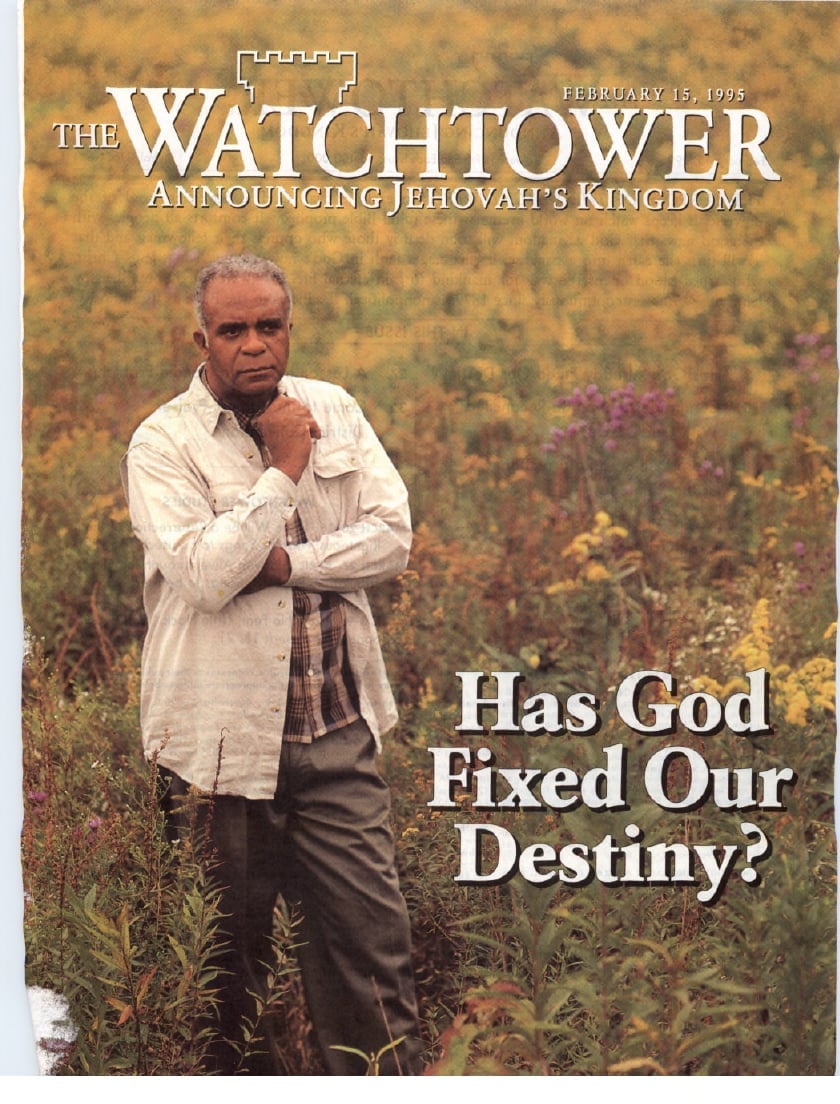
The Watchtower — February 15, 1995
Source: jw.org
Contents
Has God Already Fixed Our Destiny?
Can Predestination Be Reconciled With God’s Love?
There Will Be a Resurrection of the Righteous
Saved Alive Through the Great Tribulation
“Have No Fear, Little Flock”
Dominican Republic—Still Open to Discovery
A Lesson in How to Handle Problems
Come to the “Joyful Praisers” District Convention
Has God Already Fixed Our Destiny?
Has God Already Fixed Our Destiny?
“SO MANY imaginary problems would be avoided if the often-misunderstood term predestination were not used at all.” You may wonder why, if you have used the word “predestination” or heard it used.
According to the recent French Catholic encyclopedia Théo, we do well not to use the word “predestination.” Another book states: “Today, predestination is no longer at the heart of theological debates, even for most Protestants, it seems.”
Nevertheless, the question of predestination has disturbed many people throughout history. It was at the heart of the controversy that brought about the Reformation, and even within the Catholic Church, it was a subject of heated discussion for centuries. Although less debated today, it still remains a problem. Who would not want to know whether his destiny was fixed in advance?
Predestination—Meaning of the Word
What does the word “predestination” mean in the churches? The Dictionnaire de théologie catholique considers it to be “the divine intention to bring certain ones, who are designated by name, to everlasting life.” It is generally thought that the chosen ones, “designated by name,” are the ones referred to by the apostle Paul in his letter to the Romans, in the following terms: “God works for good with those who love him, who are called according to his purpose. For those whom he foreknew he also predestined to be conformed to the image of his Son . . . And those whom he predestined he also called; and those whom he called he also justified; and those whom he justified he also glorified.”—Romans 8:28-30, Revised Standard Version.
Even before their birth, some people were supposedly chosen by God with a view to sharing Christ’s glory in the heavens. This leads to the long-debated question: Does God arbitrarily choose whom he wants to save, or do men have free will and a part to play in obtaining and retaining God’s favor?
Augustine, the Father of Predestination
Although other Church Fathers had previously written about predestination, Augustine (354-430 C.E.) is generally considered to have laid the foundations of the doctrine for both Catholic and Protestant churches. According to Augustine, the righteous have from eternity been predestined by God to receive eternal blessings. On the other hand, the unrighteous, although not predestined by God in the strict sense of the word, are to receive the merited punishment for their sins, condemnation. Augustine’s explanation left little place for free will, thus opening the way for many a controversy.
Augustine’s Heirs
The debate regarding predestination and free will surfaced regularly during the Middle Ages, and it came to a head during the Reformation. Luther saw individual predestination as a free choice on God’s part, without His foreseeing the future merits or good works of the chosen ones. Calvin came to a more radical conclusion with his concept of twofold predestination: Some are predestined to eternal salvation, and others to eternal condemnation. However, Calvin too considered God’s choice to be arbitrary, even incomprehensible.
The issue of predestination and the closely related question of “grace”—a word used by the churches to designate the act by which God saves and declares men righteous—took on such proportions that in 1611 the Catholic Holy See forbade anything to be published on the subject without its consent. Within the Catholic Church, Augustine’s teachings received strong support from the French Jansenists of the 17th and 18th centuries. They advocated a very austere and elite form of Christianity and even had followers among the aristocracy. Yet, the controversy over the matter did not calm down. King Louis XIV ordered the destruction of the abbey of Port-Royal, the cradle of Jansenist thought.
Within the Protestant Reformed churches, the discussion was far from closed. Along with others, the Remonstrants, who followed Jacobus Arminius, believed that man has a role to play in his own salvation. The Protestant Synod of Dordrecht (1618-19) temporarily settled the question when it adopted a strict form of Calvinist orthodoxy. According to the book L’Aventure de la Réforme—Le monde de Jean Calvin, in Germany this quarrel on predestination and free will gave birth to a long period of “unsuccessful attempts at reconciliation, as well as abuses, imprisonments, and banishments of theologians.”
Predestination or Free Will?
From the beginning, these two diametrically opposed ideas, predestination and free will, aroused many heated conflicts. Augustine for his part had been unable to explain this incompatibility. Calvin too saw it as an expression of God’s sovereign will and hence inexplicable.
But does the Bible’s revelation of God’s qualities and personality help us to understand these questions more clearly? The following article will examine these points in detail.
[Pictures on page 4]
Calvin
Luther
Jansen
[Credit Line]
Pictures: Bibliothèque Nationale, Paris
Can Predestination Be Reconciled With God’s Love?
Can Predestination Be Reconciled With God’s Love?
“WE DEFINE predestination as the eternal design of God, whereby he determined what he wanted to do with each man. For he did not create them all in the same condition, but foreordains some to everlasting life and others to eternal damnation.”
That is how Protestant Reformer John Calvin defined his concept of predestination in the book Institutes of the Christian Religion. This concept is based on the idea that God is omniscient and that his creatures’ actions cannot call his purposes into question or oblige him to make changes.
But is this really what the Bible implies concerning God? More important, is such an explanation compatible with God’s qualities, especially his foremost quality—love?
A God Capable of Foretelling the Future
God is able to foretell the future. He describes himself as “the One telling from the beginning the finale, and from long ago the things that have not been done; the One saying, ‘My own counsel will stand, and everything that is my delight I shall do.’” (Isaiah 46:10) Down through human history, God has had his prophecies recorded to show that he can exercise his foreknowledge and foretell events before they take place.
Thus, in the days of Belshazzar, king of Babylon, when the prophet Daniel had a dream about two wild beasts, one supplanting the other, Jehovah gave him its interpretation: “The ram that you saw possessing the two horns stands for the kings of Media and Persia. And the hairy he-goat stands for the king of Greece.” (Daniel 8:20, 21) Obviously, God exercised his foreknowledge to reveal the succession of world powers. The then prevailing Babylonian Empire would be succeeded by Medo-Persia and then by Greece.
Prophecies can also concern one individual. For instance, the prophet Micah declared that the Messiah was to be born in Bethlehem. (Micah 5:2) Again, in this case God exercised his foreknowledge. However, this event was announced with a particular purpose—the identification of the Messiah. This instance does not justify generalizing a doctrine of predestination that includes each individual.
On the contrary, the Scriptures reveal that there are situations in which God chooses not to foreknow the outcome. Just before the destruction of Sodom and Gomorrah, he declared: “I am quite determined to go down that I may see whether they act altogether according to the outcry over it that has come to me, and, if not, I can get to know it.” (Genesis 18:21) This text clearly shows us that God did not foreknow the extent of the depravity in those cities before he investigated matters.
True, God can foresee certain events, but in many cases, he has chosen not to use his foreknowledge. Because God is almighty, he is free to exercise his abilities as he wishes, not according to the wishes of imperfect humans.
A God Who Can Set Matters Straight
As did Calvin, some say that God predetermined man’s fall before his creation and that he had predestinated the ‘chosen ones’ before that fall. But if this were true, would it not have been hypocritical for God to offer the prospect of everlasting life to Adam and Eve, fully aware that they would be unable to realize it? Moreover, the Scriptures nowhere deny that the first human couple were given a choice: either to follow divine directions and live forever or to reject them and die.—Genesis, chapter 2.
But did Adam and Eve’s sin really thwart God’s purpose? No, for immediately after their sinning, God announced that he would raise up a “seed” to destroy Satan and his agents and that he would again set matters straight on earth. Just as a few insects cannot stop a gardener from producing good yields, so Adam and Eve’s disobedience will not prevent God from making the earth into a paradise.—Genesis, chapter 3.
God later revealed that there would be a Kingdom government entrusted to a descendant of King David and that others would be associated in this Kingdom. These others are called “the holy ones of the Supreme One.”—Daniel 7:18; 2 Samuel 7:12; 1 Chronicles 17:11.a
To Foretell Is Not to Predestine
The fact that God did not choose to know which course mankind would take did not prevent him from prophesying the consequences of man’s good or bad actions. A mechanic who warns a driver of the poor condition of his vehicle cannot be held responsible if an accident occurs or be accused of predestining it. Likewise, God cannot be accused of predestining the sad consequences of individuals’ actions.
The same was true with the descendants of the first human couple. Before Cain killed his brother, Jehovah put a choice before Cain. Would he master sin, or would sin get mastery over him? Nothing in the account indicates that Jehovah predetermined that Cain would make the bad choice and murder his brother.—Genesis 4:3-7.
Later, the Mosaic Law warned the Israelites about what would happen if they turned away from Jehovah, for instance, by taking wives from among the pagan nations. What was foretold did happen. This can be seen from the example of King Solomon, who in his later years was influenced by his foreign wives to practice idolatry. (1 Kings 11:7, 8) Yes, God warned his people, but he did not predestine what their individual actions would be.
The Christian elect, or chosen ones, are encouraged to persevere if they do not wish to be deprived of the promised reward of reigning in the heavens with Christ. (2 Peter 1:10; Revelation 2:5, 10, 16; 3:11) As some theologians of the past have asked, Why were such reminders given if the calling of the chosen ones was final?
Predestination and God’s Love
Man was given free will, being created “in God’s image.” (Genesis 1:27) Free will was indispensable if humans were to honor and serve God out of love, not as robots with every movement determined beforehand. Love displayed by intelligent, free creatures would enable God to refute unjust accusations. He says: “Be wise, my son, and make my heart rejoice, that I may make a reply to him that is taunting me.”—Proverbs 27:11.
If God’s servants were predestined—or programmed, so to speak—could not the genuineness of their love for their Creator be called into question? Also, would it not be contrary to God’s impartiality for him to make a predetermined choice of persons destined to glory and happiness without taking their individual merits into account? Moreover, if some receive such preferential treatment, while others are destined to eternal punishment, this would hardly arouse sincere feelings of gratitude in the “elect,” or “chosen ones.”—Genesis 1:27; Job 1:8; Acts 10:34, 35.
Finally, Christ told his disciples to preach the good news to all mankind. If God has already chosen the ones to be saved, would this not dampen the zeal Christians show in evangelizing? Would it not make the preaching work essentially pointless?
Impartial love from God is the strongest force that can move men to love him in return. The greatest expression of God’s love was to sacrifice his Son in behalf of imperfect, sinful mankind. God’s foreknowledge respecting his Son is a special case, but it assures us that the restoration promises resting on Jesus will indeed be fulfilled. So may we put faith in that Son and draw close to God. Let us show our appreciation by accepting God’s invitation to come into a fine relationship with our Creator. Today, God addresses this invitation to all who want to exercise their free will and show their love for him.
[Footnotes]
When Jesus speaks of the Kingdom prepared “from the founding of the world” (Matthew 25:34), he must be referring to sometime after the first sin. Luke 11:50, 51 relates “the founding of the world,” or the founding of mankind redeemable by means of a ransom, to the time of Abel.
[Box on page 7]
PREDESTINED AS A CLASS
“Those God foreknew he also predestined to be conformed to the likeness of his Son, that he might be the firstborn among many brothers. And those he predestined, he also called; those he called, he also justified; those he justified, he also glorified.” (Romans 8:29, 30, New International Version) How should we understand the term “predestined” used by Paul in these verses?
Paul’s reasoning here is not a peremptory argument in favor of individual predestination. Earlier in our century, the Dictionnaire de théologie catholique explained Paul’s arguments (Romans, chapters 9-11) this way: “Increasingly, the prevailing opinion among Catholic scholars is that the actual concept of a predestination to eternal life has not been set out.” The same reference work then quotes M. Lagrange as saying: “The question primarily developed by Paul is not at all one of predestination and reprobation but merely that of the call of the Gentiles to the grace of Christianity, its antithesis being the incredulity of the Jews. . . . It concerns groups, Gentiles, Jews, and not specific individuals directly.”—Italics ours.
More recently, The Jerusalem Bible offered the same conclusion concerning these chapters (Ro 9-11), stating: “The subject of these chapters, therefore, is not the problem of individual predestination to glory, or even to faith, but of Israel’s part in the development of salvation history, the only problem raised by the statements in the O[ld] T[estament].”
The last verses of Romans chapter 8 belong to the same context. Thus, these verses can justly remind us that God foresaw the existence of a class, or group, from among mankind that would be called to reign with Christ, as well as the requirements they would have to meet—and this without designating ahead of time the specific individuals who would be chosen, for that would be contrary to his love and justice.
There Will Be a Resurrection of the Righteous
There Will Be a Resurrection of the Righteous
“I have hope toward God . . . that there is going to be a resurrection of both the righteous and the unrighteous.”—ACTS 24:15.
1. What situation has faced all humans since the fall of Adam and Eve?
“ALL that your hand finds to do, do with your very power, for there is no work nor devising nor knowledge nor wisdom in Sheol, the place to which you are going.” (Ecclesiastes 9:10) With these few, well-chosen words, wise King Solomon describes a situation that has faced every generation of mankind since the fall of our first parents, Adam and Eve. Without exception, death has eventually swallowed up everyone—rich and poor, king and commoner, faithful and faithless. Truly, death has “ruled as king.”—Romans 5:17.
2. Why may some faithful ones have been disappointed during this time of the end?
2 Despite the latest advances of medical science, death still rules as king even today. While this is no surprise, some may have been somewhat disappointed when they finally came face-to-face with this longtime enemy. Why? Well, back in the 1920’s, the Watch Tower Society proclaimed the message “Millions now living will never die.” Who would these millions be? The “sheep” spoken of in Jesus’ remarks about the sheep and the goats. (Matthew 25:31-46) These sheeplike ones were prophesied to appear during the time of the end, and their hope would be everlasting life on a paradise earth. As time went by, God’s people gained a better understanding of the position of these “sheep” in Jehovah’s purposes. It was realized that these obedient ones were to be distinguished from the stubborn “goats,” and after the destruction of the latter ones, the sheep would inherit the earthly realm of the Kingdom that had been prepared for them.
Gathering of Sheeplike Ones
3. On what work have God’s people concentrated since 1935?
3 Beginning in 1935, ‘the faithful slave’ has concentrated on locating such sheeplike ones and bringing them into Jehovah’s organization. (Matthew 24:45; John 10:16) These teachable Christians have come to realize that Jesus is now reigning in Jehovah’s heavenly Kingdom and that the time is fast approaching for the end of this wicked system of things and the ushering in of a new world in which righteousness is to dwell. (2 Peter 3:13; Revelation 12:10) In that new world, the heartening words of Isaiah will be fulfilled: “He will actually swallow up death forever.”—Isaiah 25:8.
4. Though earnestly hoping to see Jehovah’s sovereignty vindicated at Armageddon, what has happened to many of the other sheep?
4 Since the end of Satan’s world is so close, sheeplike Christians would dearly enjoy living until Jehovah’s sovereignty is vindicated during the coming tribulation on Babylon the Great and the rest of Satan’s world. (Revelation 19:1-3, 19-21) For a great number, it has not worked out that way. Many who had hoped to be among the “millions” who would never die have indeed died. Some were martyred for the truth in prisons and concentration camps or at the hands of religious fanatics. Others have died in accidents or from so-called natural causes—sickness and old age. (Psalm 90:9, 10; Ecclesiastes 9:11) Clearly, more will die before the end comes. How will such ones see the fulfillment of the promise of a new world in which righteousness is to dwell?
The Resurrection Hope
5, 6. What future exists for those with an earthly hope who die before Armageddon?
5 The apostle Paul gave the answer when he was speaking before the Roman governor Felix. As recorded at Acts 24:15, Paul boldly declared: “I have hope toward God . . . that there is going to be a resurrection of both the righteous and the unrighteous.” The hope of the resurrection gives us courage in the face of the worst adversities. Because of that hope, our dear friends who fall sick and sense that they are going to die do not lose heart. Whatever happens, they know that they will reap the reward of faithfulness. Because of the resurrection hope, our courageous brothers and sisters who face death at the hands of persecutors know that there is no way their persecutors can gain the victory. (Matthew 10:28) When someone in the congregation dies, we are sad to lose that person. At the same time, if he or she is one of the other sheep, we rejoice that our fellow believer has proved faithful to the end and is now resting, assured of a future in God’s new world.—1 Thessalonians 4:13.
6 Yes, the resurrection hope is a vital feature of our faith. Why, though, is our belief in the resurrection so strong, and who share that hope?
7. What is the resurrection, and what are some scriptures expressing its certainty?
7 The Greek word for “resurrection” is a·naʹsta·sis, which literally means “standing up.” It refers basically to a rising from the dead. Interestingly, the actual word “resurrection” does not appear in the Hebrew Scriptures, but the resurrection hope is clearly expressed there. We see it, for example, in the words uttered by Job in the midst of his suffering: “O that in Sheol you would conceal me, . . . that you would set a time limit for me and remember me!” (Job 14:13) Similarly, at Hosea 13:14, we read: “From the hand of Sheol I shall redeem them; from death I shall recover them. Where are your stings, O Death? Where is your destructiveness, O Sheol?” At 1 Corinthians 15:55, the apostle Paul quoted these words and showed that the prophesied victory over death is accomplished through the resurrection. (Of course, in that scripture Paul was speaking of the heavenly resurrection.)
Believers “Declared Righteous”
8, 9. (a) How can imperfect humans have a part in the resurrection of the righteous? (b) What is the basis of our hope in a life that will not be terminated by death?
8 In his statement to Felix, quoted in paragraph 5, Paul said that there would be a resurrection of the righteous and the unrighteous. Who are the righteous ones that will be raised? Well, no human is righteous by nature. All of us are sinners from birth, and we commit sins throughout our lifetime—which makes us deserving of death on two counts. (Romans 5:12; 6:23) However, in the Bible we find the term “declared righteous.” (Romans 3:28) This refers to humans who, although imperfect, have their sins forgiven by Jehovah.
9 The expression is most prominently used with regard to anointed Christians, who have a heavenly hope. At Romans 5:1, the apostle Paul says: “Now that we have been declared righteous as a result of faith, let us enjoy peace with God through our Lord Jesus Christ.” All anointed Christians are declared righteous because of faith. Faith in what? As Paul explains at some length in the book of Romans, it is faith in Jesus Christ. (Romans 10:4, 9, 10) Jesus died a perfect man and thereafter was resurrected from the dead and ascended to heaven to offer the value of his human life in our behalf. (Hebrews 7:26, 27; 9:11, 12) When Jehovah accepted that sacrifice, Jesus, in effect, purchased the human race out of slavery to sin and death. Those who exercise faith in this arrangement benefit greatly from it. (1 Corinthians 15:45) On its basis faithful men and women have the hope of inheriting a life that will not be terminated by the grim enemy, death.—John 3:16.
10, 11. (a) What resurrection awaits faithful anointed Christians? (b) What kind of resurrection was hoped for by pre-Christian worshipers?
10 Thanks to Jesus’ ransom sacrifice, faithful anointed ones, being declared righteous, have the sure hope of being resurrected as immortal spirit creatures, like Jesus. (Revelation 2:10) Their resurrection is mentioned at Revelation 20:6, which says: “Happy and holy is anyone having part in the first resurrection; over these the second death has no authority, but they will be priests of God and of the Christ, and will rule as kings with him for the thousand years.” This is the heavenly resurrection. Notice, though, that the Bible calls it “the first resurrection,” which implies that there is more to come.
11 In Hebrews chapter 11, Paul referred to a long line of pre-Christian servants of God who had manifested strong faith in Jehovah God. These too had faith in a resurrection. In Heb 11 verse 35 of that chapter, Paul speaks of miraculous resurrections that occurred during the history of Israel, saying: “Women received their dead by resurrection; but other men were tortured because they would not accept release by some ransom, in order that they might attain a better resurrection.” Those faithful witnesses of old could look forward to a resurrection better than the ones involving, for example, Elijah and Elisha. (1 Kings 17:17-22; 2 Kings 4:32-37; 13:20, 21) Their hope was resurrection into a world where servants of God would not be tortured for their faith, a world where women would not lose their loved ones in death. Yes, they looked forward to rising from the dead into the same new world that we hope for. (Isaiah 65:17-25) Jehovah had not revealed to them as much as he has to us about this new world. Nevertheless, they knew that it was coming, and they wanted to be in it.
The Earthly Resurrection
12. Were pre-Christian faithful ones declared righteous? Explain.
12 Should we think of the awakening of these faithful pre-Christian men and women in that new world as part of the resurrection of the righteous? Evidently yes, because the Bible refers to them as righteous. For example, the disciple James mentions a man and a woman of ancient times who were declared righteous. The man was Abraham, the progenitor of the Hebrew race. Regarding him we read: “‘Abraham put faith in Jehovah, and it was counted to him as righteousness,’ and he came to be called ‘Jehovah’s friend.’” The woman was Rahab, a non-Israelite who exercised faith in Jehovah. She was “declared righteous” and came to be part of the Hebrew nation. (James 2:23-25) Thus, men and women of old who exercised strong faith in Jehovah and his promises and remained faithful to the death were declared righteous by Jehovah on the basis of their faith, and they will without doubt share in the ‘resurrection of the righteous.’
13, 14. (a) How do we know that Christians with an earthly hope can be declared righteous? (b) What does this mean for them?
13 However, what of sheeplike individuals today, those with an earthly hope who dedicate themselves to Jehovah and who die faithful during this time of the end? Will they share in the resurrection of the righteous? Apparently so. A great crowd of such faithful ones was seen in vision by the apostle John. Notice how he describes them: “I saw, and, look! a great crowd, which no man was able to number, out of all nations and tribes and peoples and tongues, standing before the throne and before the Lamb, dressed in white robes; and there were palm branches in their hands. And they keep on crying with a loud voice, saying: ‘Salvation we owe to our God, who is seated on the throne, and to the Lamb.’”—Revelation 7:9, 10.
14 Notice that these meek ones are firmly convinced of their salvation, and they attribute this to Jehovah and Jesus, “the Lamb.” Moreover, they are standing before Jehovah and the Lamb, all dressed in white. Why in white? A heavenly creature tells John: “They have washed their robes and made them white in the blood of the Lamb.” (Revelation 7:14) In the Bible, white is a symbol of purity, righteousness. (Psalm 51:7; Daniel 12:10; Revelation 19:8) The fact that the great crowd are seen wearing white garments means that Jehovah views them as righteous. How is that possible? Because they have, as it were, washed their robes in the blood of the Lamb. They exercise faith in the shed blood of Jesus Christ and are therefore declared righteous as God’s friends with a view to surviving the great tribulation. Hence, any faithful dedicated Christian now a part of the “great crowd” who dies before the great tribulation can be sure of having a part in the earthly resurrection of the righteous.
15. Since both righteous and unrighteous will be resurrected, what is the advantage of the resurrection of the righteous?
15 That resurrection is described at Revelation chapter 20, verse 13, in these words: “The sea gave up those dead in it, and death and Hades gave up those dead in them, and they were judged individually according to their deeds.” Thus, during Jehovah’s great thousand-year Judgment Day, all those in God’s memory will be resurrected—both the righteous and the unrighteous. (Acts 17:31) How much better, though, it will be for the righteous! They have already lived lives of faith. They already have a close relationship with Jehovah and confidence in the outworking of his purposes. Righteous witnesses from before the Christian Era will awaken from death eager to learn how the promises of Jehovah regarding the Seed were fulfilled. (1 Peter 1:10-12) Those of the other sheep whom Jehovah views as righteous in our day will come forth from the grave eager to behold the Paradise earth that they spoke about when they declared the good news in this system of things. What a joyful time that will be!
16. What can we say about the Judgment Day resurrection of those who die in our time?
16 During that thousand-year Judgment Day, when exactly will those who died faithful in these final years of Satan’s system of things be resurrected? The Bible does not say. However, would it not be reasonable to think that those counted righteous who die in our time would have an early resurrection and thus could share with the great crowd of Armageddon survivors in the work of welcoming earlier generations back from the dead? Yes, indeed!
A Hope That Gives Comfort
17, 18. (a) What comfort does the resurrection hope provide? (b) What are we moved to declare about Jehovah?
17 The resurrection hope gives strength and comfort to all Christians today. If we remain faithful, no unforeseen occurrence and no enemy can rob us of our reward! For example, in the 1992 Yearbook of Jehovah’s Witnesses, on page 177, there appear pictures of courageous Christians in Ethiopia who died rather than compromise their faith. The caption reads: “Faces we expect to see in the resurrection.” What a privilege it will be to get to know these ones and countless others who have shown a similar faithfulness in the face of death!
18 What about our own loved ones and friends who because of age or infirmity do not make it through the great tribulation? In line with the resurrection hope, they have a wonderful future if they remain faithful. And if we also courageously exercise faith in Jesus’ ransom sacrifice, we have a wonderful future. Why? Because, like Paul, we hope in the “resurrection of both the righteous and the unrighteous.” With all our hearts, we thank Jehovah for this hope. Surely, it moves us to echo the psalmist’s words: “Declare among the nations [God’s] glory, among all the peoples his wonderful works. For Jehovah is great and very much to be praised.”—Psalm 96:3, 4.
Can You Explain?
□ What scriptures help confirm our hope in an earthly resurrection?
□ On what basis are Christians now declared righteous?
□ How does the resurrection hope give us courage and determination?
[Picture on page 9]
Like Paul, anointed Christians hope in the heavenly resurrection
Saved Alive Through the Great Tribulation
Saved Alive Through the Great Tribulation
“These are the ones that come out of the great tribulation, and they have washed their robes and made them white in the blood of the Lamb.”—REVELATION 7:14.
1. Who will greet the resurrected ones in the earthly resurrection?
WHEN untold millions are raised in the ‘resurrection of the righteous and the unrighteous,’ they will not be brought back to life on an empty earth. (Acts 24:15) They will awaken in beautifully improved surroundings and find that living quarters, clothing, and an abundance of food have been prepared for them. Who will make all these preparations? Clearly, there will be people living in the new world before the earthly resurrection begins. Who? The Bible indicates that they will be survivors of the coming great tribulation. Of all Bible teachings, undoubtedly this is one of the most intriguing—that some faithful ones will be saved alive through the great tribulation and will never have to die. This hope is well attested to in the Holy Scriptures.
As the Days of Noah
2, 3. (a) What similarities are drawn between the days of Noah and our time? (b) What is pointed to by the survival of Noah and his family through the Flood?
2 At Matthew 24:37-39, Jesus Christ made a comparison between the days of Noah and the last days, where we now find ourselves. He said: “Just as the days of Noah were, so the presence of the Son of man will be. For as they were in those days before the flood, eating and drinking, men marrying and women being given in marriage, until the day that Noah entered into the ark; and they took no note until the flood came and swept them all away, so the presence of the Son of man will be.”
3 The global Flood swept away all who paid no attention to God’s warning message. It did not, though, sweep away Noah and his family. They “entered into the ark,” as Jesus said. Because of their godly devotion, Jehovah provided them with a way of escape. Second Peter 2:5, 9 refers to the survival of Noah and his family when it says: “He [God] . . . kept Noah, a preacher of righteousness, safe with seven others when he brought a deluge upon a world of ungodly people. Jehovah knows how to deliver people of godly devotion out of trial.” Jesus drew a comparison between Noah’s day and the last days to show that people in general would not heed God’s warning message. Nevertheless, in doing so he also confirmed that Noah and his family obeyed Jehovah God, entered the ark, and survived the great Flood. Survival by Noah and his family points to the survival of God’s faithful servants at this world’s end.
A First-Century Pattern
4. In fulfillment of Jesus’ words, what events led up to the destruction of Jerusalem in 70 C.E.?
4 Jesus also spoke of events to take place at the end of this world. At Matthew 24:21, 22, we read: “Then there will be great tribulation such as has not occurred since the world’s beginning until now, no, nor will occur again. In fact, unless those days were cut short, no flesh would be saved; but on account of the chosen ones those days will be cut short.” These words had a preliminary fulfillment in the first century of our Common Era. In 66 C.E., the city of Jerusalem was besieged by Roman armies under Cestius Gallus. The Roman troops got to the point of undermining the temple wall, and many Jews were ready to surrender. Unexpectedly, however, and for no apparent reason, Cestius Gallus withdrew his troops. Upon seeing the Romans withdraw, the Christians acted on the words of Jesus, spoken many years before: “When you see Jerusalem surrounded by encamped armies, then know that the desolating of her has drawn near. Then let those in Judea begin fleeing to the mountains, and let those in the midst of her withdraw, and let those in the country places not enter into her.” (Luke 21:20, 21) The Christianized Jews, the chosen ones, immediately abandoned the doomed city of Jerusalem and were thus saved from the terrible destruction that came upon it soon after. In 70 C.E., the Roman legions under General Titus returned. They encamped around Jerusalem, besieged the city, and devastated it.
5. In what sense was the tribulation on Jerusalem cut short in 70 C.E.?
5 The Jewish historian Josephus relates that 1,100,000 Jews died, whereas 97,000 survived and were taken into captivity. Those non-Christian Jewish survivors were certainly not “the chosen ones” of Jesus’ prophecy. Speaking to the rebellious Jewish nation, Jesus had said: “Look! Your house is abandoned to you. For I say to you, You will by no means see me from henceforth until you say, ‘Blessed is he that comes in Jehovah’s name!’” (Matthew 23:38, 39) There is no record that those Jews, bottled up in Jerusalem, at the last minute accepted Jesus as the Messiah, became Christians, and received Jehovah’s favor. Nevertheless, the tribulation that came upon Jerusalem in 70 C.E. was cut short. The final siege by the Roman army was not of long duration. This allowed for some Jews to survive, if only to be sent off to various parts of the Roman Empire as slaves.
A Great Crowd of Survivors
6, 7. (a) What great religious city is yet to be destroyed, as part of what unparalleled tribulation? (b) What did John prophesy about the coming great tribulation on this world?
6 While Jerusalem’s destruction in 70 C.E. did indeed bring “great tribulation” on that religious city, the major fulfillment of Jesus’ words is yet to be realized. A greater religious city, Babylon the Great, the world empire of false religion, is to experience a death-dealing great tribulation followed immediately by an unparalleled tribulation on the rest of Satan’s system of things. (Matthew 24:29, 30; Revelation 18:21) Some 26 years after the destruction of Jerusalem, the apostle John, at Revelation 7:9-14, wrote about this world-embracing great tribulation. He showed that a great crowd of people would survive it.
7 These survivors, called the “great crowd,” are identified by certain decisive actions that they take. According to Revelation 7:14, one of the 24 elders in heaven told John: “These are the ones that come out of the great tribulation, and they have washed their robes and made them white in the blood of the Lamb.” Yes, the great crowd hail Jehovah as the source of their salvation. They exercise faith in Jesus’ shed blood and have a righteous standing before their Creator and his appointed King, Jesus Christ.
8. What fine relationship exists between the “great crowd” and the remaining ones of Jesus’ anointed brothers?
8 Today, almost five million members of the great crowd are living under the active leadership of the heavenly King Jesus Christ. They are in subjection to Christ and in close association with his anointed brothers yet on earth. Concerning the treatment that the great crowd accord these anointed ones, Jesus says: “Truly I say to you, To the extent that you did it to one of the least of these my brothers, you did it to me.” (Matthew 25:40) Because they unselfishly render aid to Christ’s anointed brothers, those of the great crowd are judged to have done good to Jesus himself. This helps them to have a secure relationship with Jesus Christ and Jehovah God. They have been privileged to join the anointed remnant in becoming God’s Witnesses and bearers of his name.—Isaiah 43:10, 11; Joel 2:31, 32.
Staying Awake
9, 10. (a) What must we do to maintain our righteous standing before the Son of man? (b) How must we act in order to “keep awake”?
9 The great crowd must maintain their righteous standing before the Son of man without letup, which requires staying watchful right up to the end. Jesus stated this clearly when he said: “Pay attention to yourselves that your hearts never become weighed down with overeating and heavy drinking and anxieties of life, and suddenly that day be instantly upon you as a snare. For it will come in upon all those dwelling upon the face of all the earth. Keep awake, then, all the time making supplication that you may succeed in escaping all these things that are destined to occur, and in standing before the Son of man.”—Luke 21:34-36.
10 To succeed in standing before the Son of man, we must have his approval, which we will not have if we allow ourselves to be influenced by the thinking of this world. Worldly thinking is seductive and can induce a person to overindulge in fleshly pleasures or to become so weighed down with life’s problems that he no longer keeps Kingdom interests first. (Matthew 6:33) Such a course weakens a person spiritually and could leave him indifferent about his responsibilities toward God and others. He could become inactive or jeopardize his place in the congregation by committing serious sin, perhaps even displaying an unrepentant attitude. Each individual in the great crowd must pay attention to himself. He must keep separate from this ungodly world and its practices.—John 17:16.
11. The application of what Scriptural principles will help us to survive Armageddon?
11 To that end, Jehovah has provided what we need by means of his Word, his holy spirit, and his visible organization. We must take full advantage of these. Further, we must be prayerful and obedient to God if we expect to have his favor. For one thing, we must develop a strong hatred for what is bad. The psalmist said: “I have not sat with men of untruth; and with those who hide what they are I do not come in. I have hated the congregation of evildoers, and with the wicked ones I do not sit. Do not take away my soul along with sinners, nor my life along with bloodguilty men.” (Psalm 26:4, 5, 9) In the Christian congregation, young and old alike need to limit association with those not dedicated to Jehovah. To receive God’s favor, we strive to be blameless and without spot from the world. (Psalm 26:1-5; James 1:27; 4:4) Thus, we will be assured that at Armageddon, Jehovah will not sweep us away in death along with the ungodly.
Some “Will Never Die at All”
12, 13. (a) Before resurrecting Lazarus, Jesus uttered what words that Martha did not fully understand? (b) What was not meant by Jesus’ words about some ‘never dying at all’?
12 It is exciting to contemplate survival of the end of this system of things and the possibility of never having to die. This is the prospect held out to us by Jesus. Just before resurrecting his dead friend Lazarus, Jesus told Lazarus’ sister Martha: “I am the resurrection and the life. He that exercises faith in me, even though he dies, will come to life; and everyone that is living and exercises faith in me will never die at all. Do you believe this?” Martha believed in the resurrection, but she did not understand all that Jesus was saying.—John 11:25, 26.
13 Jesus did not mean that his faithful apostles would continue living in the flesh and would never die. On the contrary, he later indicated that his disciples would die. (John 21:16-23) Indeed, their anointing with holy spirit at Pentecost 33 C.E. meant that they would have to die in order to receive their heavenly inheritance as kings and priests. (Revelation 20:4, 6) Thus, with the passage of time, all first-century Christians passed away. However, Jesus said what he did for a purpose. His words about living without ever dying will be fulfilled.
14, 15. (a) How will Jesus’ words about some ‘never dying at all’ be fulfilled? (b) What is the situation of this world, but what hope do righteous ones have?
14 For one thing, faithful anointed Christians will never experience everlasting death. (Revelation 20:6) Also, Jesus’ words point to a specific time when God will intervene in human affairs and will wipe out wickedness on the earth, just as he did in Noah’s day. Faithful ones found doing God’s will at that time will not have to die by God’s judgment acts. Rather, like Noah and his family, they will have the opportunity of surviving the destruction of a world. Such a hope is solid, being based on Bible teachings and illustrated by examples. (Compare Hebrews 6:19; 2 Peter 2:4-9.) The fulfillment of Bible prophecy shows that very soon the present world consisting of unrighteous human society is going to end in destruction. The present situation is irreversible, for the world is incorrigibly wicked. What God said about the world of Noah’s day is also true of the world today. Wickedness fills the hearts of the vast majority of humans, and their thoughts are only bad all the time.—Genesis 6:5.
15 Jehovah has allowed men to govern the earth for centuries without divine interference, but their time is almost up. Soon Jehovah will annihilate all the wicked on earth, just as the Bible says. (Psalm 145:20; Proverbs 2:21, 22) However, he will not destroy the righteous along with the wicked. God has never done such a thing! (Compare Genesis 18:22, 23, 26.) Why would he destroy those who are endeavoring to serve him faithfully, with godly fear? It is only reasonable that Jehovah’s faithful worshipers who are living when the great tribulation begins will find favor in his eyes and will not be destroyed, just as Noah and his family were not destroyed when the wicked world of his day came to a cataclysmic end. (Genesis 7:23) They will have divine protection and will survive the end of this world.
16. What wondrous things will happen in the new world, meaning what for survivors?
16 What then? In the new world, healing blessings will flow to mankind as the benefits of Jesus’ ransom sacrifice are fully applied. The Bible speaks of a symbolic “river of water of life, clear as crystal, flowing out from the throne of God and of the Lamb down the middle of its broad way. And on this side of the river and on that side there were trees of life producing twelve crops of fruit, yielding their fruits each month. And the leaves of the trees were for the curing of the nations.” (Revelation 22:1, 2) Marvelous to say, that “curing” includes the conquest of Adamic death itself! “He will actually swallow up death forever, and the Sovereign Lord Jehovah will certainly wipe the tears from all faces.” (Isaiah 25:8) Thus, those who survive the great tribulation into the new world need never face death!
A Sure Hope
17. How certain is the hope that some will survive Armageddon and “never die at all”?
17 Can we have full confidence in this astounding hope? Absolutely! Jesus indicated to Martha that there would be a time when people would live without ever dying. (John 11:26) Moreover, in chapter 7 of the Revelation that Jesus gave to John, it was revealed that a great crowd comes out of the great tribulation, surviving it. Can we believe Jesus Christ and the historical account of the Flood of Noah’s day? Unquestionably! Furthermore, the Bible has other accounts of occasions when God preserved his servants alive through judgment periods and the downfall of nations. Should any less be expected of him in this time of the end? Is anything impossible for the Creator?—Compare Matthew 19:26.
18. How can we be assured of life in Jehovah’s righteous new world?
18 By serving Jehovah faithfully now, we have the assurance of life everlasting in his new world. For untold millions, life in that new world will come by means of the resurrection. Yet, in our day, millions of Jehovah’s people—yes, a great crowd that no man can number or limit—will have the unique privilege of being saved alive through the great tribulation. And they will never have to die.
Please Explain
□ How was surviving Armageddon foreshadowed in Noah’s day?
□ What must we do in order to keep standing when Jesus comes to execute Jehovah’s judgments?
□ Why can we say that Armageddon survivors need “never die at all”?
[Picture on page 15]
Christians escaped Jerusalem’s tribulation
“Have No Fear, Little Flock”
“Have No Fear, Little Flock”
“Have no fear, little flock, because your Father has approved of giving you the kingdom.”—LUKE 12:32.
1. What was the basis for Jesus’ words: “Have no fear, little flock”?
“SEEK continually [God’s] kingdom.” (Luke 12:31) When Jesus said these words to his disciples, he expressed a principle that has guided the thinking of Christians from his day down to our own. The Kingdom of God must take the very first place in our lives. (Matthew 6:33) In Luke’s account, however, Jesus went on to speak endearing and reassuring words to a special group of Christians. He said: “Have no fear, little flock, because your Father has approved of giving you the kingdom.” (Luke 12:32) As the Fine Shepherd, Jesus knew that there were stormy times ahead for his intimate disciples. But there was no reason for them to be fearful if they kept seeking God’s Kingdom. Hence, Jesus’ exhortation was not a harsh command. Rather, it was a loving promise that served to inspire confidence and courage.
2. Who make up the little flock, and why are they especially privileged?
2 Jesus was speaking to his disciples, and he called them a “little flock.” He was also speaking to those to whom Jehovah would ‘give the kingdom.’ Compared with the vast crowds that would accept Jesus in later times, this group were indeed few in number. They were also considered precious because they were chosen for a remarkable future, to be used in royal service. Their Father, the Great Shepherd, Jehovah, calls the little flock with a view to their receiving a heavenly inheritance in connection with Christ’s Messianic Kingdom.
The Little Flock
3. What glorious vision of the little flock did John see?
3 Who, then, make up this little flock having such a wonderful prospect? The followers of Jesus Christ who receive an anointing with holy spirit. (Acts 2:1-4) Seeing them as heavenly singers with harps in their hands, the apostle John wrote: “I saw, and, look! the Lamb standing upon the Mount Zion, and with him a hundred and forty-four thousand having his name and the name of his Father written on their foreheads. These are the ones that did not defile themselves with women; in fact, they are virgins. These are the ones that keep following the Lamb no matter where he goes. These were bought from among mankind as firstfruits to God and to the Lamb, and no falsehood was found in their mouths; they are without blemish.”—Revelation 14:1, 4, 5.
4. What position does the little flock have on earth today?
4 Since Pentecost 33 C.E., these anointed, spirit-begotten ones have served as ambassadors of Christ on earth. (2 Corinthians 5:20) Today, only a remnant of them remain, serving together as the faithful and discreet slave class. (Matthew 24:45; Revelation 12:17) Since the year 1935 in particular, they have been joined by “other sheep,” Christians with an earthly hope, who now number into the millions. These assist in preaching the good news in all the earth.—John 10:16.
5. What is the attitude of the remaining ones of the little flock, and why need they have no fear?
5 What is the attitude of the remaining ones of this little flock who are yet on earth? Knowing that they are to receive ‘an unshakable Kingdom,’ they render their sacred service with godly fear and awe. (Hebrews 12:28) They humbly realize that theirs is an inestimable privilege that results in unbounded joy. They have found the “one pearl of high value” referred to by Jesus when he spoke about the Kingdom. (Matthew 13:46) As the great tribulation approaches, God’s anointed ones stand fearless. In spite of what is about to come upon the world of mankind during “the great and illustrious day of Jehovah,” they have no morbid fear of the future. (Acts 2:19-21) Why should they?
Numbers Decrease
6, 7. (a) Why is the number of the little flock still on earth quite small? (b) How should each individual view the hope he entertains?
6 In recent years the number of the little flock still on earth has become quite small. This was evident from the 1994 Memorial report. In some 75,000 congregations of Jehovah’s people worldwide, only 8,617 demonstrated by partaking of the emblems their profession to be members of the remnant. (Matthew 26:26-30) In contrast, the total attendance was 12,288,917. Anointed Christians know that this is to be expected. Jehovah has established a limited number, 144,000, to make up the little flock, and he has been gathering it since Pentecost 33 C.E. Logically, the calling of the little flock would draw to a close when the number was nearing completion, and the evidence is that the general gathering of these specially blessed ones ended in 1935. However, the other sheep in the time of the end were prophesied to grow to be “a great crowd, which no man was able to number, out of all nations and tribes and peoples and tongues.” Since 1935 the general gathering by Jehovah has been of this great crowd, whose hope is everlasting life on a paradise earth.—Revelation 7:9; 14:15, 16; Psalm 37:29.
7 Most of those of the little flock yet on earth are now in their 70’s, 80’s, and 90’s. A few have passed their 100th year of life. All of these, whatever their age, know that through a heavenly resurrection, they will eventually be united with Jesus Christ and will rule with him in his glorious Kingdom. Those of the great crowd will be earthly subjects of Christ the King. Let each one rejoice over what Jehovah has in store for those who love him. It is not for us to choose what hope to entertain. That is for Jehovah to determine. Both groups can thrill in their hope for a happy future, whether it be in the heavenly Kingdom or on a paradise earth under that Kingdom.—John 6:44, 65; Ephesians 1:17, 18.
8. How far along is the sealing of the 144,000, and what will happen when it is complete?
8 The 144,000-strong little flock is “the Israel of God,” which has replaced natural Israel in God’s purposes. (Galatians 6:16) Therefore, the remnant make up the remainder of that spiritual nation still on earth. Such remaining ones are being sealed for Jehovah’s final approval. In a vision, the apostle John saw this happening, and he reported: “I saw another angel ascending from the sunrising, having a seal of the living God; and he cried with a loud voice to the four angels to whom it was granted to harm the earth and the sea, saying: ‘Do not harm the earth or the sea or the trees, until after we have sealed the slaves of our God in their foreheads.’ And I heard the number of those who were sealed, a hundred and forty-four thousand, sealed out of every tribe of the sons of [spiritual] Israel.” (Revelation 7:2-4) Since this work of sealing spiritual Israel is evidently far along, exciting events soon to happen are portended. For one thing, “the great tribulation,” when the four winds of destruction are let loose upon the earth, must be very near.—Revelation 7:14.
9. How does the little flock view the increasing number of the great crowd?
9 Those of the great crowd who have already been gathered number in the millions. How this warms the hearts of the remnant! Although those of the little flock still on earth continue to decrease in number, they have trained and prepared qualified men of the great crowd to take on responsibilities in connection with God’s expanding earthly organization. (Isaiah 61:5) As Jesus indicated, there will be survivors of the great tribulation.—Matthew 24:22.
“Have No Fear”
10. (a) What attack is due to be launched on God’s people, and to what will it lead? (b) What questions are asked of each of us?
10 Satan and his demons have been debased to the vicinity of the earth. He and his hordes are being maneuvered to make their all-out attack on Jehovah’s people. This attack, foretold in the Bible, is described as the attack of Gog of Magog. Upon whom does the Devil specifically focus his assault? Is it not upon the last members of the little flock, the spiritual Israel of God, who are dwelling peacefully “in the center of the earth”? (Ezekiel 38:1-12) Yes, but the remnant of the faithful anointed class, together with their loyal companions, the other sheep, will witness how Satan’s attack precipitates a dramatic response on the part of Jehovah God. He will intervene in defense of his people, and this will trigger the outbreak of “the great and fear-inspiring day of Jehovah.” (Joel 2:31) Today, the faithful and discreet slave is accomplishing a vital, lifesaving service, warning of this coming intervention by Jehovah. (Malachi 4:5; 1 Timothy 4:16) Are you actively supporting that service, sharing in the preaching of the good news of Jehovah’s Kingdom? Will you continue to do so as a fearless Kingdom proclaimer?
11. Why is a courageous attitude vital today?
11 In view of the present world situation, how timely it is for the little flock to heed the words Jesus addressed to them: “Have no fear, little flock”! Such a courageous attitude is essential in view of all that is now being worked out in harmony with Jehovah’s purpose. Individually, each one of the little flock realizes the need to endure right down to the end. (Luke 21:19) As Jesus Christ, the Lord and Master of the little flock, endured and proved faithful until the completion of his earthly life, so each one of the remnant must endure and prove faithful.—Hebrews 12:1, 2.
12. How did Paul, like Jesus, exhort anointed Christians to have no fear?
12 All anointed ones must have the same outlook as had the apostle Paul. Note how his words as an anointed public proclaimer of the resurrection are in harmony with Jesus’ exhortation to have no fear. Paul wrote: “Remember that Jesus Christ was raised up from the dead and was of David’s seed, according to the good news I preach; in connection with which I am suffering evil to the point of prison bonds as an evildoer. Nevertheless, the word of God is not bound. On this account I go on enduring all things for the sake of the chosen ones, that they too may obtain the salvation that is in union with Christ Jesus along with everlasting glory. Faithful is the saying: Certainly if we died together, we shall also live together; if we go on enduring, we shall also rule together as kings; if we deny, he also will deny us; if we are unfaithful, he remains faithful, for he cannot deny himself.”—2 Timothy 2:8-13.
13. What deep convictions do the members of the little flock hold, and what does this move them to do?
13 Like the apostle Paul, the remaining members of the anointed little flock are willing to endure suffering as they declare the powerful message set forth in God’s Word. Their convictions are deeply rooted as they hold to the divine promises of salvation and of their being given “the crown of life” if they prove faithful until death. (Revelation 2:10) By experiencing an instantaneous resurrection and change, they will be brought into union with Christ, to rule together with him as kings. What a triumph for their integrity-keeping course as world conquerors!—1 John 5:3, 4.
A Unique Hope
14, 15. How is the resurrection hope of the little flock unique?
14 The resurrection hope entertained by the little flock is unique. In what ways? For one thing, it precedes the general resurrection of “the righteous and the unrighteous.” (Acts 24:15) Actually, the resurrection of the anointed falls into a certain order of importance, as is clearly established by these words found at 1 Corinthians 15:20, 23: “Christ has been raised up from the dead, the firstfruits of those who have fallen asleep in death. But each one in his own rank: Christ the firstfruits, afterward those who belong to the Christ during his presence.” By having the kind of endurance and faith that Jesus displayed, the little flock know what is in store for them as they finish their earthly course, particularly since the true Lord came to his temple for judgment in 1918.—Malachi 3:1.
15 Paul gives us an added reason to view this resurrection as unique. As recorded at 1 Corinthians 15:51-53, he wrote: “Look! I tell you a sacred secret: We shall not all fall asleep in death, but we shall all be changed, in a moment, in the twinkling of an eye, during the last trumpet. . . . For this which is corruptible must put on incorruption, and this which is mortal must put on immortality.” These words apply to those of the little flock who die during Christ’s presence. Without having to sleep a lengthy period of time in death, they are clothed with immortality, “in a moment, in the twinkling of an eye.”
16, 17. Regarding their hope of the resurrection, how are anointed Christians today especially blessed?
16 In the light of this understanding, we can grasp the sense of the apostle John’s words found at Revelation 14:12, 13. He wrote: “‘Here is where it means endurance for the holy ones, those who observe the commandments of God and the faith of Jesus.’ And I heard a voice out of heaven say: ‘Write: Happy are the dead who die in union with the Lord from this time onward. Yes, says the spirit, let them rest from their labors, for the things they did go right with them.’”
17 What a unique reward is in store for the remnant of the little flock! Their resurrection will come quickly, right after they fall asleep in death. What a remarkable change they will experience as they take up their assignment in the spirit realm! With such a glorification of the little flock in progress and with the fulfillment of major Bible prophecies so far along, the last remaining members of the little flock truly need “have no fear.” And their fearlessness serves to encourage those of the great crowd, who should cultivate a similar attitude of fearlessness as they anticipate deliverance during the greatest time of trouble the earth has ever known.
18, 19. (a) Why is the time we live in urgent? (b) Why should both the anointed and the other sheep have no fear?
18 Recounting the activities of the little flock enables them and the great crowd to keep on fearing the true God. The hour for judgment by him has arrived, and the favorable time left is precious. Limited, indeed, is the time for others to act. We, though, do not fear that God’s purpose will fail. It will certainly succeed!
…