The Watchtower, November 15, 1992
Download: PDF — The Watchtower, November 15, 1992
The Watchtower — November 15, 1992
Source: jw.org
Contents
Who Are Born Again?
Why Some Are Born Again
The Cross—Symbol of Christianity?
“Who Is Like Jehovah Our God?”
Jehovah Is Not to Blame
Serve Jehovah Loyally
Imparting Understanding in Namibia
Elders—Readjust Others in a Spirit of Mildness
Questions From Readers
Appearances Can Be Deceptive
This Is Impossible!
Would You Welcome a Visit?
Who Are Born Again?
Who Are Born Again?
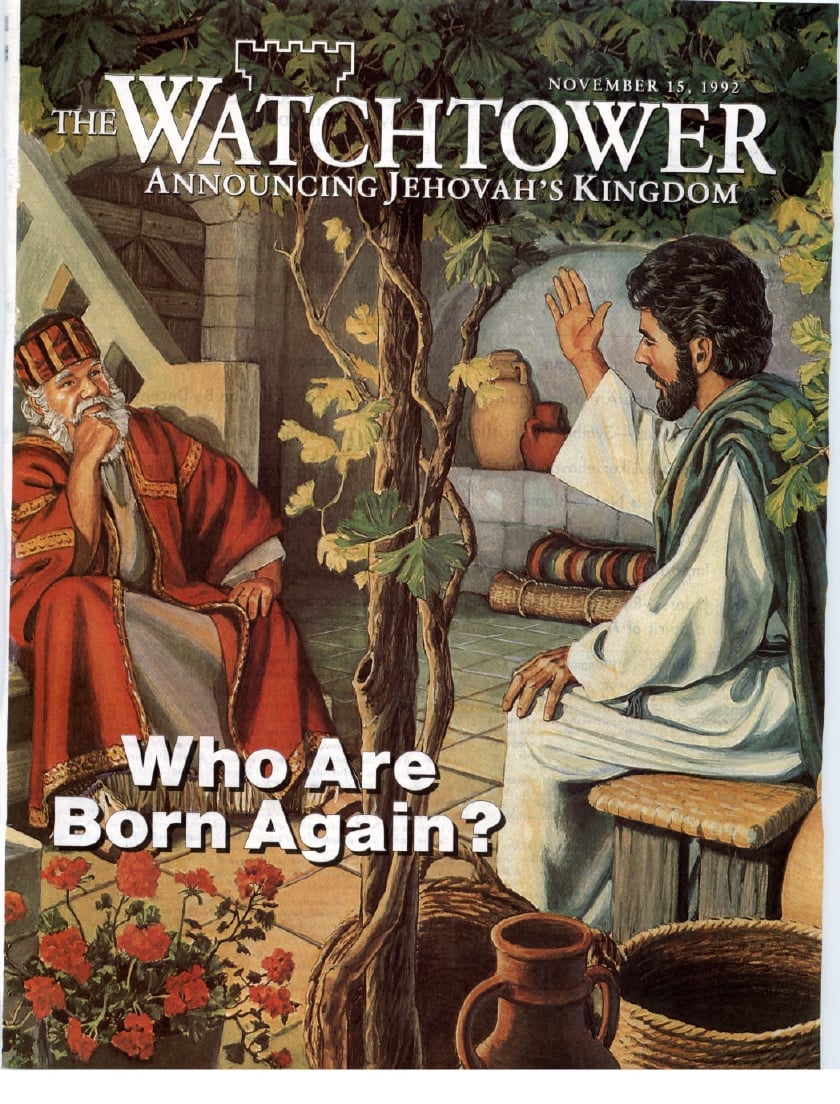
DO ALL good people go to heaven? Many think so, but Jesus Christ did not agree. Speaking to the Jewish ruler Nicodemus, who came to him secretly at night, Jesus said: “No man has ascended into heaven.”—John 3:13.
Yet, Jesus indicated to Nicodemus that the time would come when some people would have an opportunity to enter the Kingdom of heaven. Of these Jesus said: “Unless anyone is born from water and spirit, he cannot enter into the kingdom of God. What has been born from the flesh is flesh, and what has been born from the spirit is spirit. Do not marvel because I told you, You people must be born again.” But Nicodemus wondered how anyone could be born again.—John 3:1-9.
Perhaps you also wonder what Jesus meant. Could his words apply to the sudden conversion experiences claimed by many who feel that they have been filled with God’s holy spirit?
Emotions and the Mind
Some say that in determining whether a person has been born again, what counts is feeling the power of the spirit. Yet, our heart and mind can mislead us, especially if influenced by strong emotion.—Jeremiah 17:9.
William Sargant a researcher into the effects of emotion on the mind, cites the need “to be on our guard against beliefs acquired in states of emotional arousal when our brains may be betraying us.” According to Sargant, one example is the effect of revivalist preaching and threats of hellfire punishment. Who would not want to be born again to go to heaven if the only alternative were suffering eternal torment? Sargant says that under such emotional stress, “reason is dethroned, the normal brain computer is temporarily put out of action, and new ideas and beliefs are uncritically accepted.”—The Mind Possessed.
So, then, how can one tell if a belief on the matter of being born again has been “uncritically accepted”? The course of true wisdom is to be guided by everything that God’s holy spirit caused Bible writers to record. Christians are encouraged to worship God ‘with their power of reason’ and need to make sure that what they believe is true.—Romans 12:1, 2; 1 Thessalonians 5:21.
Being born again opens up one of the most momentous privileges ever extended to humans. It is linked with a truly remarkable development in the outworking of God’s purpose. While all of this is true, questions such as these arise: Who are born again? How does this take place? What prospects are set before such individuals? And will they alone be saved?
[Picture on page 3]
Nicodemus wondered how anyone could be born again
Why Some Are Born Again
Why Some Are Born Again
“UNLESS anyone is born again, he cannot see the kingdom of God.” (John 3:3) Those words have both thrilled and puzzled many people since Jesus Christ spoke them over 1,900 years ago.
For a proper understanding of Jesus’ statements about being born again, we must first answer these questions: What is God’s purpose for humankind? What happens to the soul at death? What is God’s Kingdom meant to do?
God’s Purpose for Mankind
The first man, Adam, was created a perfect human son of God. (Luke 3:38) Jehovah God never intended that Adam should die. Adam and his wife, Eve, had the prospect of producing a sinless human family that would live forever and fill a paradise earth. (Genesis 1:28) Death was not part of God’s original purpose for man and woman. It invaded the human scene only as a result of rebellion against divine law.—Genesis 2:15-17; 3:17-19.
This rebellion raised huge moral issues, such as the rightfulness of God’s sovereignty and the ability of humans to remain faithful to his laws. Time would be needed to settle these issues. But Jehovah God’s purpose for mankind did not change, and he cannot fail in what he sets out to do. He fully intends to fill the earth with a perfect human family that will enjoy everlasting life in Paradise. (Psalm 37:29; 104:5; Isaiah 45:18; Luke 23:43) We must keep this fundamental truth in mind when we consider Jesus’ words about being born again.
What Happens to the Soul at Death?
Unaware of what God’s holy spirit had revealed to Bible writers, Grecian philosophers struggled to find meaning in life. They could not believe that man was meant to live only a few years, often in miserable conditions, and then just cease to exist. In this they were right. But in their conclusions about man’s prospects after death, they were wrong. They concluded that human existence continued in some other form after death, that inside everyone there was an immortal soul.
Jews and professing Christians were influenced by such views. Says the book Heaven—A History: “Wherever diaspora Jews met Greek intellectuals, the idea of an immortal soul surfaced.” The book adds: “Greek doctrines about the soul made a lasting impression on Jewish and eventually Christian beliefs. . . . By creating a unique synthesis of Platonic philosophy and biblical tradition, Philo [a first-century Jewish philosopher of Alexandria] paved the way for later Christian thinkers.”
What did Philo believe? The same book continues: “For him, death restores the soul to its original, pre-birth state. Since the soul belongs to the spiritual world, life in the body becomes nothing but a brief, often unfortunate, episode.” However, Adam’s “pre-birth state” was nonexistence. According to the Bible account, God never purposed an automatic transfer to some other realm at death, as if the earth were only a staging area for a higher or a lower existence.
The belief that the human soul is immortal is not taught in God’s spirit-inspired Word, the Bible. Not once does it use the term “immortal soul.” It states that Adam was created as a soul, not with a soul. Genesis 2:7 says: “Jehovah God proceeded to form the man out of dust from the ground and to blow into his nostrils the breath of life, and the man came to be a living soul.” Mankind was never faced with the prospect of either everlasting life in heaven or eternal torment in hellfire. The Bible shows that the soul, or person, who dies has no conscious existence. (Psalm 146:3, 4; Ecclesiastes 9:5, 10; Ezekiel 18:4) Consequently, philosophers have held unscriptural views about the soul. We need to guard against misleading ideas that could cloud our understanding of Jesus’ words about being born again.
Born Again to Rule as Kings
Jesus told Nicodemus that those who are “born again . . . enter into the kingdom of God.” (John 3:3-5) What is that Kingdom? In symbolic language, early in human history, Jehovah God gave notice of his purpose to use a special “seed”—a coming ruler—to crush the head of the original Serpent, Satan the Devil. (Genesis 3:15; Revelation 12:9) As revealed progressively in the Scriptures, this “seed” is identified as Jesus Christ, who reigns with corulers in a unique expression of God’s sovereignty, the Messianic Kingdom. (Psalm 2:8, 9; Isaiah 9:6, 7; Daniel 2:44; 7:13, 14) This is the Kingdom of heaven, a government in the heavens that will vindicate Jehovah’s sovereignty and rescue mankind from bondage to sin and death.—Matthew 6:9, 10.
Associated with Jesus as corulers are 144,000 who are bought from humankind. (Revelation 5:9, 10; 14:1-4) God has chosen some from Adam’s imperfect human family to become these “holy ones of the Supreme One,” who rule with Christ in the Messianic Kingdom. (Daniel 7:27; 1 Corinthians 6:2; Revelation 3:21; 20:6) These men and women put faith in Jesus Christ, who said that they would be “born again.” (John 3:5-7) How and why does this birth happen?
These individuals have been baptized in water as Christ’s followers. God has forgiven their sins on the basis of Jesus’ ransom sacrifice, has declared them righteous, and has adopted them as spiritual sons. (Romans 3:23-26; 5:12-21; Colossians 1:13, 14) To such ones the apostle Paul says: “You received a spirit of adoption as sons, by which spirit we cry out: ‘Abba, Father!’ The spirit itself bears witness with our spirit that we are God’s children. If, then, we are children, we are also heirs: heirs indeed of God, but joint heirs with Christ, provided we suffer together that we may also be glorified together.”—Romans 8:15-17.
As followers of Christ, these have had a new birth, or new start, in life. It has resulted in a conviction that they would share Jesus’ heavenly inheritance. (Luke 12:32; 22:28-30; 1 Peter 1:23) The apostle Peter described the rebirth in this way: “According to [God’s] great mercy he gave us a new birth to a living hope through the resurrection of Jesus Christ from the dead, to an incorruptible and undefiled and unfading inheritance. It is reserved in the heavens for you.” (1 Peter 1:3, 4) This new life in heaven becomes possible for such individuals because God resurrects them as he resurrected Jesus.—1 Corinthians 15:42-49.
What About the Earth?
This does not mean that all obedient mankind will ultimately be born again to go from the earth to heaven. Such a mistaken idea was similar to that held by philosophers like Philo, who thought that “life in the body [is] nothing but a brief, often unfortunate, episode.” But there was nothing wrong with Jehovah God’s original earthly creation.—Genesis 1:31; Deuteronomy 32:4.
Human life was never meant to be brief and painful. Jesus Christ and those born again to serve as kings and priests with him in heaven will remove all the harmful consequences of Satan’s rebellion. (Ephesians 1:8-10) By means of them as the promised ‘seed of Abraham,’ “all nations of the earth will certainly bless themselves.” (Galatians 3:29; Genesis 22:18) For obedient mankind this will mean life on a paradise earth, far different from the brief, pain-filled existence of today.—Psalm 37:11, 29; Revelation 21:1-4.
Who Will Benefit?
Among those benefiting from God’s provision for blessing mankind will be the resurrected dead who exercise faith in Jesus’ ransom sacrifice. (John 5:28, 29; Acts 24:15) The majority of them have never learned about God and Christ and therefore could not show faith in Jesus. Those resurrected will also include faithful people like John the Baptizer, who died before Jesus’ death opened the way to heavenly life. (Matthew 11:11) Besides these, ‘a great crowd out of all nations have washed their robes and made them white in the blood of the Lamb,’ Jesus Christ. They respond favorably to the Kingdom-preaching work now spearheaded by Jesus’ born-again “brothers” and will survive God’s war of Armageddon to live on a cleansed earth. (Revelation 7:9-14; 16:14-16; Matthew 24:14; 25:31-46) In God’s arrangement, therefore, millions will be saved, though they are not born again to rule with Christ in the heavens.—1 John 2:1, 2.
Will you be among those who inherit life on a paradise earth? You can be if you exercise faith in the sacrifice of Jesus Christ and become actively associated with the true Christian congregation. It has not been corrupted by philosophies but has remained “a pillar and support of the truth.” (1 Timothy 3:15; compare John 4:24; 8:31, 32.) Then you can look forward to a marvelous future when born-again sons of God are ruling in heaven and all of God’s earthly children are restored to perfection on a wonderful paradise earth. So seize your opportunity for life in that new world of eternal blessings.—Romans 8:19-21; 2 Peter 3:13.
[Picture on page 6]
Adam was never given the alternative of either life in heaven or eternal torment in hellfire
The Cross—Symbol of Christianity?
The Cross—Symbol of Christianity?
FOR centuries multitudes have accepted the cross as a symbol of Christianity. But is it really? Many who have sincerely believed so are quite surprised to learn that the cross is not at all unique to Christendom. On the contrary, it has been widely used in non-Christian religions all over the world.
For example, in the early 1500’s, as Hernán Cortés and his “Christian” army prepared to attack the Aztec Empire, they carried banners proclaiming, “Let us follow the sign of the Holy Cross in true faith, for under this sign we shall conquer.” They must have been surprised to find that their pagan enemies venerated a cross not unlike their own. The book Great Religions of the World says: “Cortés and his followers recoiled from human sacrifices of the Aztecs and what seemed like satanic parodies of Christianity: . . . venerating crosslike symbols of wind and rain gods.”
In an editorial in the newspaper La Nación, writer José Alberto Furque points out that in the second half of the 18th century, there began “a fiery and exciting debate among anthropologists and archaeologists on the origins and meaning of the cruciform signs” they were finding across much of Central and South America. Apparently some had been so eager to protect the status of the cross as a uniquely “Christian” symbol that they propounded the theory that somehow the Americas had been evangelized before Columbus’ landmark voyage! This farfetched notion had to be discarded as unfounded.
In time, further discoveries in the field put all such debate to rest. Furque notes: “In a work published in 1893 by the Smithsonian Institution, it was established that the cross was already venerated . . . long before the arrival of the first Europeans in North America, which confirms the theory . . . that such a symbol appeared in all communities as part of cultic worship of the forces that originate life.”
The Bible shows that Jesus was not executed on a conventional cross at all but, rather, on a simple stake, or stau·rosʹ. This Greek word, appearing at Matthew 27:40, basically means a simple upright beam or pole, such as those used in building foundations. Hence, the cross never represented true Christianity. Jesus Christ identified the real symbol, or “mark,” of true Christianity when he told his followers: “By this all will know that you are my disciples, if you have love among yourselves.”—John 13:35.
“Who Is Like Jehovah Our God?”
“Who Is Like Jehovah Our God?”
“Who is like Jehovah our God, him who is making his dwelling on high?” —PSALM 113:5.
1, 2. (a) How do Jehovah’s Witnesses view God and the Bible? (b) What questions merit consideration?
JEHOVAH’S praisers are blessed indeed. What a privilege it is to be in this happy throng! As his Witnesses, we accept the counsel, laws, teachings, promises, and prophecies of God’s Word, the Bible. We are glad to learn from the Scriptures and be “taught by Jehovah.”—John 6:45.
2 Because of their deep reverence for God, Jehovah’s Witnesses can ask: “Who is like Jehovah our God?” (Psalm 113:5) Those words of the psalmist imply faith. But why do the Witnesses have such faith in God? And what reasons have they for praising Jehovah?
Faith and Praise Appropriate
3. What are the Hallel Psalms, and why are they so named?
3 Faith in Jehovah is warranted because he is the unique God. This is emphasized in Psalms 113, 114, and Ps 115, part of the six Hallel Psalms. According to the rabbinic School of Hillel, Psalms 113 and 114 were sung during the Jewish Passover meal after the second cup of wine was poured and the significance of the observance was explained. Psalms 115 through 118 were sung after the fourth cup of wine. (Compare Matthew 26:30.) They are termed “Hallel Psalms” because they repeatedly use the exclamation Hallelujah!—“Praise Jah!”
4. What is the meaning of the term “Hallelujah,” and how often does it appear in the Bible?
4 “Hallelujah!” is a transliteration of a Hebrew expression appearing 24 times in the Psalms. Elsewhere in the Bible, a Greek form of it appears four times in regard to joy experienced over the destruction of Babylon the Great, the world empire of false religion, and the rejoicing associated with Jehovah God’s beginning to rule as King. (Revelation 19:1-6) As we now examine three of the Hallel Psalms, we might well imagine ourselves singing these songs to Jehovah’s praise.
Praise Jah!
5. Psalm 113 answers what question, and to whom does the command of Psalm 113:1, 2 especially apply?
5 Psalm 113 answers the question, Why praise Jehovah? It opens with the command: “Praise Jah, you people! Offer praise, O you servants of Jehovah, praise the name of Jehovah. May Jehovah’s name become blessed from now on and to time indefinite.” (Psalm 113:1, 2) “Hallelujah!” Yes, “Praise Jah!” That command applies especially to God’s people in this “time of the end.” (Daniel 12:4) From now on and forevermore, Jehovah’s name shall be exalted earth wide. His Witnesses now declare that Jehovah is God, Christ is King, and the Kingdom has been established in heaven. Satan the Devil and his organization cannot prevent this praising of Jehovah.
6. How is Jehovah being praised ‘from sunrise to sunset’?
6 The song of praise will go forth until Jehovah causes it to fill the earth. “From the rising of the sun until its setting Jehovah’s name is to be praised.” (Psalm 113:3) This means more than daily worship by some earthly creatures. The sun rises in the east and sets in the west, covering all the earth. Everywhere the sun shines, Jehovah’s name will soon be praised by all people freed from bondage to false religion and Satan’s organization. In fact, this song that will never end is now sung by anointed Witnesses of Jehovah and those who will be earthly children of his King, Jesus Christ. What a privilege they have as singers of Jehovah’s praises!
Jehovah Is Incomparable
7. What two aspects of Jehovah’s supremacy are noted at Psalm 113:4?
7 The psalmist adds: “Jehovah has become high above all the nations; his glory is above the heavens.” (Psalm 113:4) This takes note of two aspects of God’s supremacy: (1) To Jehovah, the Supreme One, “high above all the nations,” they are as a drop from a bucket and as mere dust on the scales; (Isaiah 40:15; Daniel 7:18) (2) his glory is far greater than that of the physical heavens, for the angels do his sovereign will.—Psalm 19:1, 2; 103:20, 21.
8. Why and how does Jehovah condescend to take notice of matters in heaven and on earth?
8 Moved by God’s loftiness, the psalmist said: “Who is like Jehovah our God, him who is making his dwelling on high? He is condescending to look on heaven and earth.” (Psalm 113:5, 6) God is so exalted that he must condescend to take notice of matters in heaven and on earth. Though Jehovah is not inferior to anyone or in subjection to others, he shows humility in exercising mercy and compassion toward lowly sinners. Providing his Son, Jesus Christ, as “a propitiatory sacrifice” for anointed Christians and for the world of mankind is an expression of Jehovah’s humility.—1 John 2:1, 2.
Jehovah Is Compassionate
9, 10. How does God ‘exalt the poor one, to make him sit with nobles’?
9 Stressing God’s compassion, the psalmist adds that Jehovah is “raising up the lowly one from the very dust; he exalts the poor one from the ashpit itself, to make him sit with nobles, with the nobles of his people. He is causing the barren woman to dwell in a house as a joyful mother of sons. Praise Jah, you people!” (Psalm 113:7-9) Jehovah’s people have faith that he can deliver upright needy ones, change their state, and satisfy their proper needs and desires. ‘The High and Lofty One revives the spirit of the lowly ones and the heart of those being crushed.’—Isaiah 57:15.
10 How does Jehovah ‘exalt the poor one, to make him sit with nobles’? When it is God’s will, he puts his servants in positions of glory equal to that of nobles. He did so in the case of Joseph, who became Egypt’s food administrator. (Genesis 41:37-49) In Israel, sitting with the nobles, or men of authority among Jehovah’s people, was a privilege to be cherished. Like Christian elders today, such men had God’s aid and blessing.
11. Why may it be said that Psalm 113:7-9 especially applies to Jehovah’s people of modern times?
11 What about ‘making the barren woman a joyful mother’? God gave barren Hannah a son—Samuel, whom she devoted to His service. (1 Samuel 1:20-28) More significantly, beginning with Jesus and with the outpouring of holy spirit upon his disciples at Pentecost 33 C.E., God’s symbolic woman, heavenly Zion, started to bring forth spiritual children. (Isaiah 54:1-10, 13; Acts 2:1-4) And just as God restored the Jews to their homeland after exile in Babylon, in 1919 he freed the anointed remnant of “the Israel of God” from Babylonish captivity and has so greatly blessed them spiritually that the words of Psalm 113:7-9 apply to them. (Galatians 6:16) As loyal Witnesses of Jehovah, the remnant of spiritual Israel and their associates with earthly hopes are heartily responding to the final words of Psalm 113: “Praise Jah, you people!”
Proof of Jehovah’s Uniqueness
12. How does Psalm 114 show Jehovah’s uniqueness?
12 Psalm 114 shows Jehovah’s uniqueness by citing unique events involving the Israelites. Sang the psalmist: “When Israel went forth from Egypt, the house of Jacob from a people speaking unintelligibly, Judah became his holy place, Israel his grand dominion.” (Psalm 114:1, 2) God delivered Israel from slavery to the Egyptians, whose language was strange to their ears. The deliverance of Jehovah’s people, called Judah and Israel in poetic parallelism, shows that God can deliver all his servants today.
13. How does Psalm 114:3-6 show Jehovah’s supremacy and apply to ancient Israel’s experiences?
13 Jehovah’s sovereignty over all creation is evident in the words: “The sea itself saw and took to flight; as for the Jordan, it began to turn back. The mountains themselves skipped about like rams, the hills like lambs. What was the matter with you, O sea, that you took to flight, O Jordan, that you began to turn back? O mountains, that you went skipping about like rams; O hills, like lambs?” (Psalm 114:3-6) The Red Sea “took to flight” when God opened a path through it for his people. Israel then saw Jehovah’s great hand in action against the Egyptians who died in the returning waters. (Exodus 14:21-31) In a similar display of divine power, the Jordan River “began to turn back,” allowing the Israelites to cross into Canaan. (Joshua 3:14-16) ‘The mountains skipped about like rams’ as Mount Sinai smoked and trembled when the Law covenant was instituted. (Exodus 19:7-18) With the climax of his song in view, the psalmist put matters in question form, perhaps suggesting that the inanimate sea, river, mountains, and hills were awestruck by these displays of Jehovah’s power.
14. What was done by Jehovah’s power at Meribah and Kadesh, and how should this affect his modern-day servants?
14 Still alluding to Jehovah’s power, the psalmist sang: “Because of the Lord be in severe pains, O earth, because of the God of Jacob, who is changing the rock into a reedy pool of water, a flinty rock into a spring of water.” (Psalm 114:7, 8) In a figurative way, the psalmist thus indicates that mankind should stand in awe of Jehovah, the Lord and Universal Ruler of all the earth. He was “the God of Jacob,” or Israel, as he is of spiritual Israelites and their earthly companions. At Meribah and Kadesh in the wilderness, Jehovah showed his power by miraculously supplying Israel with water, “changing the rock into a reedy pool of water, a flinty rock into a spring.” (Exodus 17:1-7; Numbers 20:1-11) Such reminders of Jehovah’s awesome power and tender care give his Witnesses sound reasons for unquestioning faith in him.
Unlike Idol Gods
15. How may Psalm 115 have been sung?
15 Psalm 115 urges us to praise and trust Jehovah. It ascribes blessing and aid to him and proves that idols are useless. This psalm may have been sung antiphonally. That is, one voice might sing: “You that fear Jehovah, trust in Jehovah.” The congregation may have replied: “He is their help and their shield.”—Psalm 115:11.
16. What contrast can be drawn between Jehovah and the idols of the nations?
16 Glory should go not to us but to the name of Jehovah, the God of loving-kindness, or loyal love, and trueness. (Psalm 115:1) Enemies may mockingly ask: “Where . . . is their God?” But Jehovah’s people can reply: ‘Our God is in heaven and does everything he delights to do.’ (Ps 115 Verses 2, 3) The nations’ idols can do nothing, however, for they are man-made statues of silver and gold. Despite their mouths, eyes, and ears, they are speechless, blind, and deaf. They have noses but cannot smell, feet but are unable to walk, and throats but can utter no sound. Those making impotent idols as well as those trusting in them will become equally lifeless.—Ps 115 Verses 4-8.
17. Since the dead cannot praise Jehovah, what should we do, and with what prospects?
17 Exhortation is next given to trust in Jehovah as the Helper and the protective Shield of Israel, of Aaron’s priestly house, and of all who fear God. (Psalm 115:9-11) As those fearing Jehovah, we have a profound reverence for God and a wholesome dread of displeasing him. We also have faith that “the Maker of heaven and earth” blesses his loyal worshipers. (Ps 115 Verses 12-15) The heavens are the place of his throne, but God made the earth the eternal home of loyal and obedient mankind. Since the silent, unconscious dead cannot praise Jehovah, we, the living, should do so in total devotion and loyalty. (Ecclesiastes 9:5) Only those who praise Jehovah will enjoy eternal life and be able to “bless Jah” forever, speaking well of him “to time indefinite.” Let us therefore stand loyally with those heeding the exhortation: “Praise Jah, you people!”—Psalm 115:16-18.
Jehovah’s Wonderful Qualities
18, 19. In what ways do Jehovah’s qualities distinguish him from false gods?
18 Unlike lifeless idols, Jehovah is the living God, displaying wonderful qualities. He is the epitome of love and is “merciful and gracious, slow to anger and abundant in loving-kindness.” (Exodus 34:6; 1 John 4:8) How he differs from the cruel Canaanite god Molech, to whom children were sacrificed! It is suggested that this god’s image had a man’s form and a bull’s head. The idol reportedly was heated red hot, and children were cast into its outstretched arms, falling into the flaming furnace below. But Jehovah is so loving and merciful that the idea of such human sacrifices never even came “up into [his] heart.”—Jeremiah 7:31.
19 Jehovah’s principal qualities also include perfect justice, infinite wisdom, and almighty power. (Deuteronomy 32:4; Job 12:13; Isaiah 40:26) What about mythological deities? Instead of practicing justice, Babylonian gods and goddesses were vindictive. Egyptian deities were not paragons of wisdom but were depicted as having human weaknesses. That is not surprising, since false gods and goddesses have been products of “empty-headed” humans who claim to be wise. (Romans 1:21-23) Grecian deities supposedly conspired against one another. For instance, in the myths, Zeus abused his power by dethroning his father, Cronus, who had deposed his own father, Uranus. What a blessing it is to serve and praise Jehovah, the living and true God, who displays perfect love, justice, wisdom, and power!
Jehovah Worthy of Eternal Praise
20. What reasons did King David give for praising Jehovah’s name?
20 As the Hallel Psalms show, Jehovah deserves eternal praise. Similarly, when David and fellow Israelites contributed for temple construction, he said before the congregation: “Blessed may you be, O Jehovah the God of Israel our father, from time indefinite even to time indefinite. Yours, O Jehovah, are the greatness and the mightiness and the beauty and the excellency and the dignity; for everything in the heavens and in the earth is yours. Yours is the kingdom, O Jehovah, the One also lifting yourself up as head over all. The riches and the glory are on account of you, and you are dominating everything; and in your hand there are power and mightiness, and in your hand is ability to make great and to give strength to all. And now, O our God, we are thanking you and praising your beauteous name.”—1 Chronicles 29:10-13.
21. Revelation 19:1-6 gives what evidence of Jehovah’s being praised by the heavenly hosts?
21 Jehovah will also be blessed and praised eternally in the heavens. The apostle John heard “a great crowd in heaven” say: “Praise Jah, you people! The salvation and the glory and the power belong to our God, because his judgments are true and righteous. For he has executed judgment upon the great harlot [Babylon the Great] who corrupted the earth with her fornication, and he has avenged the blood of his slaves at her hand.” Again they said: “Praise Jah, you people!” So did “the twenty-four elders and the four living creatures.” A voice from the throne said: “Be praising our God, all you his slaves, who fear him, the small ones and the great.” Then John added: “I heard what was as a voice of a great crowd and as a sound of many waters and as a sound of heavy thunders. They said: ‘Praise Jah, you people, because Jehovah our God, the Almighty, has begun to rule as king.’”—Revelation 19:1-6.
22. How will Jehovah be praised in his promised new world?
22 How fitting it is that heavenly hosts praise Jehovah! In his new world now near, resurrected loyal ones will join survivors of this system’s end in praising Jah. Towering mountains will lift their heads in songs of praise to God. Verdant hills and fruitful trees will sing his praises. Why, every creature that lives and breathes will praise Jehovah’s name in the great Hallelujah chorus! (Psalm 148) Will your voice be heard in that joyous throng? It will be if you loyally serve Jah with his people. That should be your purpose in life, for who is like Jehovah our God?
How Would You Answer?
□ Why praise Jehovah God?
□ In what ways is Jehovah incomparable?
□ What evidence is there that Jehovah is compassionate?
□ How does Jehovah differ from lifeless idols and false deities?
□ Why can we say that Jehovah will receive eternal praise in heaven and on earth?
[Picture on page 9]
The Hallel Psalms were sung during the Passover meal
Jehovah Is Not to Blame
Jehovah Is Not to Blame
“As a father shows mercy to his sons, Jehovah has shown mercy to those fearing him. For he himself well knows the formation of us, remembering that we are dust.”—PSALM 103:13, 14.
1, 2. Who was Abraham, and how did his nephew Lot come to dwell in the wicked city of Sodom?
JEHOVAH is not responsible for hardships we may experience because of our mistakes. In this regard consider what happened some 3,900 years ago. God’s friend Abraham (Abram) and his nephew Lot had become very prosperous. (James 2:23) In fact, their possessions and livestock were so plentiful that ‘the land did not allow them to dwell together.’ Moreover, a quarrel arose between the herders of the two men. (Genesis 13:5-7) What could be done about this?
2 To end the quarreling, Abraham suggested that a separation take place, and he let Lot have the first choice. Though Abraham was the older man and it would have been appropriate for his nephew to let him take the best area, Lot selected the choicest region—the whole well-watered district of the Lower Jordan. Outward appearances were deceptive, for nearby were the morally decadent cities of Sodom and Gomorrah. Lot and his family eventually moved into Sodom, and this put them in spiritual peril. Furthermore, they were taken captive when King Chedorlaomer and his allies defeated the ruler of Sodom. Abraham and his men rescued them, but Lot and his family returned to Sodom.—Genesis 13:8-13; 14:4-16.
3, 4. What happened to Lot and members of his family when God destroyed Sodom and Gomorrah?
3 Because of the sexual perversion and moral degradation of Sodom and Gomorrah, Jehovah decided to destroy those cities. He mercifully sent two angels who led Lot, his wife, and their two daughters out of Sodom. They were not to look back, but Lot’s wife did so, perhaps longing for the material things left behind. At that, she became a pillar of salt.—Genesis 19:1-26.
4 What losses Lot and his daughters sustained! The girls had to leave behind men they were going to marry. Lot was now without his wife and his material wealth. In fact, he was eventually reduced to living in a cave with his daughters. (Genesis 19:30-38) What had looked so good to him had turned out to be just the opposite. Even though he had obviously made some serious mistakes, he was later called “righteous Lot.” (2 Peter 2:7, 8) And surely Jehovah God was not to blame for Lot’s mistakes.
“Mistakes—Who Can Discern?”
5. How did David feel about mistakes and presumptuousness?
5 Being imperfect and sinful, all of us make mistakes. (Romans 5:12; James 3:2) Like Lot, we may be deceived by outward appearances and may err in judgment. Thus, the psalmist David pleaded: “Mistakes—who can discern? From concealed sins pronounce me innocent. Also from presumptuous acts hold your servant back; do not let them dominate me. In that case I shall be complete, and I shall have remained innocent from much transgression.” (Psalm 19:12, 13) David knew that he might commit sins of which he was not even aware. Hence, he asked to be forgiven the transgressions that might have been hidden even from him. When he made a serious mistake because his imperfect flesh prodded him to take a wrong course, he greatly desired Jehovah’s help. He wanted God to restrain him from presumptuous deeds. David did not want presumptuousness to become his dominant attitude. Rather, he desired to be complete in his devotion to Jehovah God.
6. What comfort can be drawn from Psalm 103:10-14?
6 As Jehovah’s present-day dedicated servants, we also are imperfect and therefore make mistakes. Like Lot, for instance, we may make a bad choice as to our place of residence. Perhaps we pass up an opportunity to expand our sacred service to God. Though Jehovah sees such mistakes, he knows those who have a heart inclined toward righteousness. Even if we sin seriously but are repentant, Jehovah provides forgiveness and help and continues to view us as godly individuals. “He has not done to us even according to our sins; nor according to our errors has he brought upon us what we deserve,” declared David. “For as the heavens are higher than the earth, his loving-kindness is superior toward those fearing him. As far off as the sunrise is from the sunset, so far off from us he has put our transgressions. As a father shows mercy to his sons, Jehovah has shown mercy to those fearing him. For he himself well knows the formation of us, remembering that we are dust.” (Psalm 103:10-14) Our merciful heavenly Father may also enable us to make amends for our error or may grant us another opportunity to expand our sacred service, to his praise.
The Error of Blaming God
7. Why do we suffer adversities?
7 When things go wrong, it is a human tendency to blame someone or something for what has happened. Some even blame God. But Jehovah does not bring such hardships on people. He does good, not harmful things. Why, “he makes his sun rise upon wicked people and good and makes it rain upon righteous people and unrighteous”! (Matthew 5:45) A foremost reason why we suffer adversities is that we live in a world that functions on selfish principles and that rests in the power of Satan the Devil.—1 John 5:19.
8. What did Adam do when things did not go right for him?
8 Blaming Jehovah God for the hardships that our mistakes bring upon us is unwise and dangerous. Doing so can even cost us our very life. The first man, Adam, should have given God credit for all the good things he received. Yes, Adam should have been deeply grateful to Jehovah for life itself and for the blessings he enjoyed in a parklike home, the garden of Eden. (Genesis 2:7-9) What did Adam do when things did not go right because he disobeyed Jehovah and ate the forbidden fruit? Adam complained to God: “The woman whom you gave to be with me, she gave me fruit from the tree and so I ate.” (Genesis 2:15-17; 3:1-12) Surely, we should not blame Jehovah, as Adam did.
9. (a) If we encounter hardships because of our unwise actions, from what can we draw comfort? (b) According to Proverbs 19:3, what do some do when they bring difficulties upon themselves?
9 If we encounter hardships because our actions are unwise, we can draw comfort from the knowledge that Jehovah understands our weaknesses better than we do and will deliver us from our plight if we give him exclusive devotion. We should appreciate the divine help we receive, never blaming God for the predicaments and difficulties we bring upon ourselves. In this regard a wise proverb states: “It is the foolishness of an earthling man that distorts his way, and so his heart becomes enraged against Jehovah himself.” (Proverbs 19:3) Another rendering says: “Some people ruin themselves by their own stupid actions and then blame the LORD.” (Today’s English Version) Still another translation states: “A man’s ignorance muddles his affairs and he flies out against Jehovah.”—Byington.
10. How did Adam’s foolishness ‘distort his way’?
10 In keeping with the principle of this proverb, Adam acted selfishly and his foolish thinking ‘distorted his way.’ His heart turned from Jehovah God, and he set out on his own selfish, independent course. Why, Adam became such an ingrate that he blamed his Creator and thus made himself an enemy of the Most High! Adam’s sin brought his own way and that of his family to ruin. What a warning there is in this! Those inclined to blame Jehovah for undesirable conditions might well ask themselves: Do I give God credit for the good things I enjoy? Am I thankful that I have life as one of his creations? Could it be that my own errors have brought hardship upon me? Do I merit Jehovah’s favor or help because of following his guidance, as set forth in his inspired Word, the Bible?
A Danger Even for God’s Servants
11. As regards God, of what were first-century Jewish religious leaders guilty?
11 The Jewish religious leaders of the first century C.E. claimed to serve God but neglected his word of truth and leaned on their own understanding. (Matthew 15:8, 9) Because Jesus Christ exposed their wrong thinking, they put him to death. Later, they displayed great rage against his disciples. (Acts 7:54-60) So distorted was the way of those men that they actually became enraged against Jehovah himself.—Compare Acts 5:34, 38, 39.
12. What example shows that even some individuals associated with the Christian congregation try to blame Jehovah for their difficulties?
12 Even some individuals in the Christian congregation have developed dangerous thinking, trying to hold God responsible for the difficulties they have encountered. For example, appointed elders in a certain congregation found it necessary to give one young married woman kind but firm Scriptural counsel against associating with a worldly man. During one discussion, she blamed God for not helping her to withstand the temptation that her continued association with the man brought upon her. She actually said that she was mad at God! Scriptural reasoning and repeated efforts to help her were of no avail, and an immoral course later led to her expulsion from the Christian congregation.
13. Why avoid a complaining attitude?
13 A complaining spirit can lead a person to blame Jehovah. “Ungodly men” who slipped into the first-century congregation had a bad spirit of that kind, and it was accompanied by other types of spiritually corrupt thinking. As the disciple Jude said, these men were “turning the undeserved kindness of our God into an excuse for loose conduct and proving false to our only Owner and Lord, Jesus Christ.” Jude also stated: “These men are murmurers, complainers about their lot in life.” (Jude 3, 4, 16) Loyal servants of Jehovah will wisely pray that they have an appreciative spirit, not a complaining attitude that might eventually embitter them to the point that they lose faith in God and jeopardize their relationship with him.
14. How might one react if offended by a fellow Christian, but why would this not be the proper course?
14 You may feel that this would not happen to you. Yet, things that go wrong because of our mistakes or those of others might ultimately cause us to blame God. For instance, a person may be offended by what a fellow believer says or does. The offended individual—perhaps one who has served Jehovah loyally for many years—may then say: ‘If that person is in the congregation, I will not attend meetings.’ An individual might become so upset that he says in his heart: ‘If things like this go on, I do not want to be part of the congregation.’ But should a Christian have that attitude? If offended by another imperfect human, why take it out on an entire congregation of people acceptable to God and serving him loyally? Why should anyone who has made a dedication to Jehovah stop doing the divine will and thus take it out on God? How wise is it to let an individual or a set of circumstances destroy one’s good relationship with Jehovah? Surely, it would be foolish and sinful to stop worshiping Jehovah God for any reason.—James 4:17.
15, 16. Of what was Diotrephes guilty, but how did Gaius conduct himself?
15 Imagine that you were in the same congregation as the loving Christian Gaius. He was “doing a faithful work” in extending hospitality to visiting fellow worshipers—and strangers at that! But evidently in the same congregation, there was the proud man Diotrephes. He would accept nothing with respect from John, one of Jesus Christ’s apostles. In fact, Diotrephes even chattered about John with wicked words. The apostle said: “Not being content with these things, neither does [Diotrephes] himself receive the brothers with respect, and those who are wanting to receive them he tries to hinder and to throw out of the congregation.”—3 John 1, 5-10.
16 If John came to the congregation, he intended to call to remembrance what Diotrephes was doing. Meanwhile, how did Gaius and other hospitable Christians in that congregation react? There is no Scriptural indication that any of them said: ‘As long as Diotrephes is in the congregation, I do not want to be a part of it. You will not see me at the meetings.’ Doubtless Gaius and others like him stood firm. They let nothing cause them to stop doing the divine will, and they certainly did not become enraged against Jehovah. No, indeed, and they did not succumb to the crafty devices of Satan the Devil, who would have rejoiced if they had become unfaithful to Jehovah and had blamed God.—Ephesians 6:10-18.
Never Become Enraged Against Jehovah!
17. How should we act if some individual or situation offends or displeases us?
17 Even if some individual or situation in a congregation displeased or offended a servant of God, the one taking offense would really be distorting his own way if he stopped associating with Jehovah’s people. Such a person would not be putting his perceptive powers to proper use. (Hebrews 5:14) So be determined to face all adversities as an integrity keeper. Maintain loyalty to Jehovah God, Jesus Christ, and the Christian congregation. (Hebrews 10:24, 25) The truth that leads to eternal life can be found nowhere else.
18. Though we do not always understand divine dealings, of what can we be sure regarding Jehovah God?
18 Remember, too, that Jehovah never tries anyone with evil things. (James 1:13) God, who is the very epitome of love, does good, especially for those loving him. (1 John 4:8) Though we do not always understand divine dealings, we can be confident that Jehovah God will never fail to do what is best for his servants. As Peter said: “Humble yourselves, therefore, under the mighty hand of God, that he may exalt you in due time; while you throw all your anxiety upon him, because he cares for you.” (1 Peter 5:6, 7) Yes, Jehovah really cares for his people.—Psalm 94:14.
19, 20. How should we act, even if our trials sometimes depress us?
19 Therefore, do not let anything or anybody stumble you. As the psalmist so well said, “abundant peace belongs to those loving [Jehovah God’s] law, and for them there is no stumbling block.” (Psalm 119:165) All of us experience trials, and these may cause us to become somewhat depressed and disheartened at times. But never let bitterness develop in your heart, especially against Jehovah. (Proverbs 4:23) With his help and on a Scriptural basis, handle the problems you can solve and endure those that persist.—Matthew 18:15-17; Ephesians 4:26, 27.
20 Never let your emotions cause you to react foolishly and thus distort your way. Speak and act in a manner that will make God’s heart rejoice. (Proverbs 27:11) Call upon Jehovah in fervent prayer, knowing that he really cares for you as one of his servants and will give you the understanding needed to remain on the path of life with his people. (Proverbs 3:5, 6) Above all, do not become enraged against God. When things go wrong, always remember that Jehovah is not to blame.
How Would You Answer?
□ What mistake did Lot make, but how did God view him?
□ How did David feel about mistakes and presumptuousness?
□ When things go wrong, why should we not blame God?
□ What will help us to avoid becoming enraged against Jehovah?
[Picture on page 15]
When separating from Abraham, Lot made a poor choice as to his place of residence
Serve Jehovah Loyally
Serve Jehovah Loyally
“With someone loyal you [Jehovah] will act in loyalty.”—2 SAMUEL 22:26.
1. How does Jehovah act with those loyal to him?
JEHOVAH cannot be repaid for all that he does for his people. (Psalm 116:12) How wonderful are his spiritual and material gifts and tender mercy! King David of ancient Israel knew that God also acts in loyalty with those loyal to him. David said so in a song he composed “in the day that Jehovah had delivered him out of the palm of all his enemies and out of [King] Saul’s palm.”—2 Samuel 22:1.
2. What are some points presented in David’s song recorded in 2 Samuel chapter 22?
2 David began his song (paralleling Psalm 18) by praising Jehovah as “the Provider of escape” in answer to prayer. (2 Samuel 22:2-7) From his heavenly temple, God acted to deliver his loyal servant from mighty foes. (2Sa 22 Verses 8-19) David was thus rewarded for pursuing an upright course and keeping Jehovah’s ways. (2Sa 22 Verses 20-27) Enumerated next were deeds done in God-given strength. (2Sa 22 Verses 28-43) Last, David cited deliverance from faultfinders at home and from enemies abroad and gave thanks to Jehovah as “the One doing great acts of salvation for his king and exercising loving-kindness to his anointed one.” (2Sa 22 Verses 44-51) Jehovah can deliver us too if we pursue an upright course and rely on him for strength.
What It Means to Be Loyal
3. From a Scriptural standpoint, what does it mean to be loyal?
3 David’s song of deliverance gives us this comforting assurance: “With someone loyal you [Jehovah] will act in loyalty.” (2 Samuel 22:26) It is the Hebrew adjective cha·sidhʹ that denotes “someone loyal,” or “one of loving-kindness.” (Psalm 18:25, footnote) The noun cheʹsedh contains the thought of kindness that lovingly attaches itself to an object until its purpose in connection therewith is realized. Jehovah expresses that sort of kindness for his servants, even as they express it for him. This righteous, holy loyalty is rendered “loving-kindness” and “loyal love.” (Genesis 20:13; 21:23) In the Greek Scriptures, “loyalty” carries the idea of holiness and reverence, expressed in the noun ho·si·oʹtes and the adjective hoʹsi·os. Such loyalty includes faithfulness and devotion and means being devout and carefully performing all duties toward God. To be loyal to Jehovah means to stick to him with devotion so strong that it acts like a powerful adhesive.
4. How is Jehovah’s loyalty shown?
4 Jehovah’s own loyalty is shown in many ways. For example, he takes judicial action against the wicked because of loyal love for his people and loyalty to justice and righteousness. (Revelation 15:3, 4; 16:5) Loyalty to his covenant with Abraham moved him to be long-suffering toward the Israelites. (2 Kings 13:23) Those loyal to God can count on his help to the end of their loyal course and can be sure that he will remember them. (Psalm 37:27, 28; 97:10) Jesus was strengthened by the knowledge that as God’s chief “loyal one,” his soul would not be left in Sheol.—Psalm 16:10; Acts 2:25, 27.
5. Since Jehovah is loyal, what does he require of his servants, and what question will be given consideration?
5 Since Jehovah God is loyal, he requires loyalty of his servants. (Ephesians 4:24) For example, men must be loyal to qualify for appointment as congregation elders. (Titus 1:8) What factors should move Jehovah’s people to serve him loyally?
Appreciation for the Things Learned
6. How should we feel about the Scriptural things we have learned, and what should we remember about such knowledge?
6 Gratitude for the Scriptural things we have learned should move us to serve Jehovah loyally. The apostle Paul urged Timothy: “Continue in the things that you learned and were persuaded to believe, knowing from what persons you learned them and that from infancy you have known the holy writings, which are able to make you wise for salvation through the faith in connection with Christ Jesus.” (2 Timothy 3:14, 15) Remember that such knowledge came from God through “the faithful and discreet slave.”—Matthew 24:45-47.
7. How should elders feel about spiritual food provided by God through the faithful slave?
7 Especially should appointed elders appreciate the nourishing spiritual food provided by God through the faithful slave. Years ago a few elders lacked such appreciation. One observer noted that these men “were critical of the articles in The Watchtower, not wanting to accept it as . . . God’s channel of truth, always trying to influence others in their way of thinking.” However, loyal elders never try to influence others to reject any of the spiritual food provided by God through the faithful slave.
8. What if we do not fully appreciate some Scriptural point presented by the faithful and discreet slave?
8 As Jehovah’s dedicated Witnesses, all of us must be loyal to him and to his organization. We should never even contemplate turning aside from God’s wonderful light, pursuing an apostate course that can lead to spiritual death now and eventual destruction. (Jeremiah 17:13) But what if it is hard for us to accept or fully appreciate some Scriptural point presented by the faithful slave? Then let us humbly acknowledge where we learned the truth and pray for wisdom to deal with this trial until it comes to an end with some published clarification of matters.—James 1:5-8.
Appreciate the Christian Brotherhood
9. How does 1 John 1:3-6 show that Christians must have a spirit of fellowship?
9 Heartfelt appreciation for the spirit of fellowship existing within our Christian brotherhood furnishes another incentive to serve Jehovah loyally. In fact, our relationship with God and Christ cannot be spiritually sound without this spirit. The apostle John told anointed Christians: “That which we have seen and heard we are reporting also to you, that you too may be having a sharing [“fellowship,” Diaglott] with us. Furthermore, this sharing of ours is with the Father and with his Son Jesus Christ. . . . If we make the statement: ‘We are having a sharing with him,’ and yet we go on walking in the darkness, we are lying and are not practicing the truth.” (1 John 1:3-6) This principle applies to all Christians, whether their hope is heavenly or earthly.
10. Though Euodia and Syntyche apparently had difficulty resolving a personal problem, how did Paul view these women?
10 Effort is required to maintain a spirit of fellowship. For instance, the Christian women Euodia and Syntyche apparently found it difficult to resolve a problem between them. Paul thus exhorted them “to be of the same mind in the Lord.” He added: “I request you too, genuine yokefellow, keep assisting these women who have striven side by side with me in the good news along with Clement as well as the rest of my fellow workers, whose names are in the book of life.” (Philippians 4:2, 3) Those godly women had fought side by side with Paul and others “in the good news,” and he was sure that they were among those ‘whose names were in the book of life.’
11. If a loyal Christian encounters a spiritual problem, what would it be fitting to keep in mind?
11 Christians do not wear an insignia to show what they have been privileged to do in Jehovah’s organization and how they have served him loyally. If they have a spiritual problem, how unloving it would be to ignore their years of loyal service to Jehovah! Likely, the one called “genuine yokefellow” was a loyal brother eager to assist others. If you are an elder, are you a “genuine yokefellow,” ready to give help in a compassionate way? May all of us consider the good done by fellow believers, even as God does, and lovingly help them to bear their burdens.—Galatians 6:2; Hebrews 6:10.
Nowhere Else to Go
12. When Jesus’ statements caused ‘many disciples to go off to the things behind,’ what position did Peter take?
12 We will be impelled to serve Jehovah loyally with his organization if we remember that there is nowhere else to go for life eternal. When Jesus’ statements caused ‘many disciples to go off to the things behind,’ he asked his apostles: “You do not want to go also, do you?” Peter replied: “Lord, whom shall we go away to? You have sayings of everlasting life; and we have believed and come to know that you are the Holy One of God.”—John 6:66-69.
13, 14. (a) Why did first-century Judaism lack divine favor? (b) What did one longtime Witness of Jehovah say about God’s visible organization?
13 “Sayings of everlasting life” were not found in Judaism of the first century C.E. Its principal sin was the rejection of Jesus as the Messiah. In none of its forms was Judaism based exclusively on the Hebrew Scriptures. The Sadducees denied the existence of angels and did not believe in the resurrection. Though the Pharisees disagreed with them in these respects, they sinfully made God’s Word invalid because of their unscriptural traditions. (Matthew 15:1-11; Acts 23:6-9) These traditions enslaved the Jews and made it difficult for many to accept Jesus Christ. (Colossians 2:8) Zeal for ‘the traditions of his fathers’ caused Saul (Paul) in his ignorance to be a vicious persecutor of Christ’s followers.—Galatians 1:13, 14, 23.
14 Judaism lacked God’s favor, but Jehovah blessed the organization made up of his Son’s followers—‘a people zealous for fine works.’ (Titus 2:14) That organization still exists, and of it a longtime Witness of Jehovah said: “If one thing has been most important to me, it has been the matter of keeping close to Jehovah’s visible organization. My early experience taught me how unsound it is to rely on human reasoning. Once my mind had been resolved on that point, I determined to stay by the faithful organization. How else can one get Jehovah’s favor and blessing?” There is nowhere else to go for divine favor and life eternal.
15. Why cooperate with Jehovah’s visible organization and with those shouldering responsibility in it?
15 Our hearts should impel us to cooperate with Jehovah’s organization because we know that it alone is directed by his spirit and is making known his name and purposes. Of course, those shouldering responsibility in it are imperfect. (Romans 5:12) But “Jehovah’s anger got to be hot” against Aaron and Miriam when they found fault with Moses and forgot that he, not they, was entrusted with God-given responsibility. (Numbers 12:7-9) Today, loyal Christians cooperate with “those who are taking the lead” because that is what Jehovah requires. (Hebrews 13:7, 17) Evidence of our loyalty includes attending Christian meetings regularly and making comments that ‘incite others to love and fine works.’—Hebrews 10:24, 25.
Be Upbuilding
16. A desire to do what for others should also move us to serve Jehovah loyally?
16 A desire to be upbuilding to others should also motivate us to serve Jehovah loyally. Paul wrote: “Knowledge puffs up, but love builds up.” (1 Corinthians 8:1) Since a certain kind of knowledge puffed up its possessors, Paul must have meant that love also upbuilds those showing that quality. A book by Professors Weiss and English says: “The person who has the capacity to love is usually loved in return. The capacity to extend good will and consideration into every aspect of life . . . has a marked constructive effect upon the person who extends such feelings as well as upon the person who receives them and thus brings pleasure to both.” By showing love, we upbuild others and ourselves, as is implied by Jesus’ words: “There is more happiness in giving than there is in receiving.”—Acts 20:35.
17. How does love build up, and what will it prevent us from doing?
17 At 1 Corinthians 8:1, Paul used the Greek word a·gaʹpe, denoting principled love. It builds up, for it is long-suffering and kind, bears and endures all things, and never fails. This love dispels damaging emotions, such as pride and jealousy. (1 Corinthians 13:4-8) Such love will keep us from complaining about our brothers, who are imperfect even as we are. It will prevent us from becoming like the “ungodly men” who “slipped in” among true Christians of the first century. These men were “disregarding lordship and speaking abusively of glorious ones,” evidently maligning such individuals as anointed Christian overseers who had certain glory conferred upon them. (Jude 3, 4, 8) In loyalty to Jehovah, let us never yield to temptation to do anything similar.
Resist the Devil!
18. What would Satan like to do to Jehovah’s people, but why can he not do so?
18 Knowledge that Satan wants to destroy our unity as God’s people should increase our determination to serve Jehovah loyally. Satan would even like to do away with all of God’s people, and the Devil’s earthly servants sometimes kill true worshipers. But God will not allow Satan to wipe out all of them. Jesus died to “bring to nothing the one having the means to cause death, that is, the Devil.” (Hebrews 2:14) Especially has Satan’s realm for exercising power been limited since his ouster from heaven after Christ became King in 1914. And in Jehovah’s due time, Jesus will destroy Satan and his organization.
19. (a) What warning about Satan’s efforts did this journal give years ago? (b) To avoid Satan’s snares, what care should we exercise in dealing with fellow believers?
19 This journal once warned: “If Satan, the devil, can cause disorder among the people of God, can cause them to quarrel and fight among themselves, or to manifest and develop a selfish disposition that would lead to the destruction of love for the brethren, he would thereby succeed in devouring them.” (The Watch Tower, May 1, 1921, page 134) Let us not allow the Devil to destroy our unity, perhaps by inducing us to slander, or fight with, one another. (Leviticus 19:16) May Satan never overreach us in such a way that we personally harm those loyally serving Jehovah or make life more difficult for them. (Compare 2 Corinthians 2:10, 11.) Rather, let us apply Peter’s words: “Keep your senses, be watchful. Your adversary, the Devil, walks about like a roaring lion, seeking to devour someone. But take your stand against him, solid in the faith.” (1 Peter 5:8, 9) By taking a firm stand against Satan, we can maintain our blessed unity as Jehovah’s people.—Psalm 133:1-3.
Prayerfully Rely on God
20, 21. How is prayerful reliance on Jehovah related to serving him loyally?
20 Prayerful reliance on God will help us to continue serving Jehovah loyally. When we see that he is answering our prayers, we are drawn ever closer to him. Prayerful reliance on Jehovah God was urged when the apostle Paul wrote: “I desire that in every place the men carry on prayer, lifting up loyal hands, apart from wrath and debates.” (1 Timothy 2:8) For instance, how important it is that elders prayerfully rely on God! Such a display of loyalty to Jehovah when meeting to discuss congregation matters will help to prevent endless debates and possible outbursts of wrath.
…