The Watchtower, November 1, 1992
Download: PDF — The Watchtower, November 1, 1992
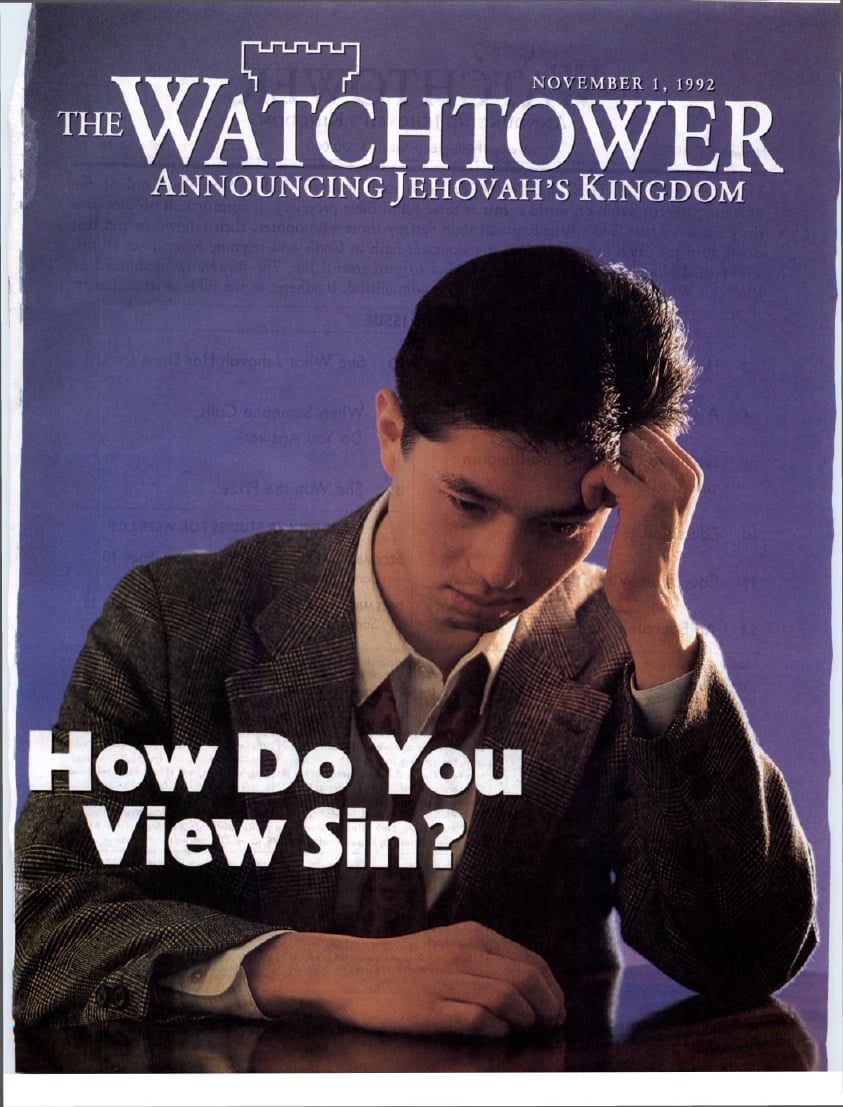
The Watchtower — November 1, 1992
Source: jw.org
Contents
How Do You View Sin?
A World Without Sin—How?
Going to Shiloh—Good Children and Bad
Education in Bible Times
Education With a Purpose
An Educated Man
See What Jehovah Has Done for Us!
When Someone Calls, Do You Answer?
She Won the Prize
Would You Welcome a Visit?
How Do You View Sin?
How Do You View Sin?
“WHY does she keep on asking for the forgiveness of our sins in prayer?” complained a housewife who was studying the Bible with one of Jehovah’s Witnesses. “It sounds as though I were a criminal.” Just like this woman, many today are not aware of their sins unless they have committed a crime.
This is especially true in the Orient, where people traditionally have no concept of inherited sin as taught in Judeo-Christian religions. (Genesis 3:1-5, 16-19; Romans 5:12) For example, Shintoists identify sin with filth that can easily be wiped away by a swing of a priest’s stick, which has paper or flax attached to its tip. In this process no repentance over what has been committed is required. Why? “Not only evil actions, but also uncontrollable natural calamities, were termed tsumi [sin],” explains Kodansha Encyclopedia of Japan. Natural disasters, tsumi that are not the responsibility of men, were considered to be sins that purification rites caused to cease to exist.
This led to the thinking that any sin, even evil acts committed willfully (except criminal acts punishable by law) can be wiped away by purification rites. Under the heading “Ritual of Political Cleansing in Japan,” The New York Times referred to such a mentality and explained that politicians in Japan who have been involved in scandals consider themselves “purified” when they are reelected by the voters. Thus, no real correction is made, and similar scandals may recur.
Buddhists who believe in samsara, or rebirth, and the doctrine of Karma have a different perspective. “According to the doctrine of karman,” explains The New Encyclopædia Britannica, “good conduct brings a pleasant and happy result and creates a tendency toward similar good acts, while bad conduct brings an evil result and creates a tendency toward repeated evil actions.” In other words, sinful conduct bears bad fruitage. The teaching of Karma is tied in with the teaching of rebirth, as some Karmas are said to bear fruit in future lives far removed from the life in which the act was committed.
How does this teaching affect its believers? A Buddhist woman who sincerely believed in Karma said: “I thought it did not make sense to have to suffer for something I was born with but about which I knew nothing. I had to accept it as my destiny. Chanting sutras and trying hard to live a good life didn’t solve my problems. I became ill-tempered and discontented, always complaining.” The Buddhist teaching about the results of evil conduct left her with a feeling of worthlessness.
Confucianism, another Eastern religion, taught a different way to deal with human evil. According to Hsün-tzu, one of the three great Confucian philosophers, human nature is evil and inclined to be selfish. In order to maintain social order among men with sinful tendencies, he stressed the importance of li, which means propriety, courtesy, and the order of things. Meng-tzu, another Confucian philosopher, although expressing an opposite view of human nature, recognized the existence of social ills and, trusting the nature of men to be good, relied on self-improvement for the solution. Either way, Confucian philosophers taught the importance of education and training in order to fight sin in the world. Although their teachings agree on the necessity of li, their concept of sin and evil is very vague.—Compare Psalm 14:3; 51:5.
Fading Concept of Sin in the West
In the West, views on sin have traditionally been clear-cut, and most people have agreed that sin exists and should be avoided. However, the Western attitude toward sin is changing. Many cast aside all awareness of sin, labeling the voice of conscience a “guilt trip,” something to be avoided. More than 40 years ago, Pope Pius XII lamented: “The sin of this century is the loss of all sense of sin.” According to a survey published in the Catholic weekly Le Pèlerin, an amazing 90 percent of the population of France, where most people profess to be Roman Catholics, no longer believe in sin.
Indeed, East and West, most people now seem to be dwelling in cozy complacence without being plagued by an awareness of sin. Does that mean, however, that sin is nonexistent? Can we safely ignore it? Will sin ever disappear?
A World Without Sin—How?
A World Without Sin—How?
SHRIEKING cries for help shattered the tranquillity of the early hours of a winter morning in a peaceful neighborhood of Tokyo. For from five to ten minutes, a dozen people heard the desperate screams of a newspaper-delivery woman being chased while being repeatedly stabbed. Not one person cared enough to find out what was going on. She died from excessive loss of blood. “If one of these people had reported the incident to the police as soon as they heard her scream,” said an investigator, “her life could have been saved.”
Although those who had heard the dying woman did nothing worse than simply ignore her, could they rightly claim that they were free of guilt? “My conscience tormented me all day Friday after I learned about the killing,” said one man who had heard her cries. This makes us wonder, What really is sin?
What Is Sin?
Pointing to the consciousness of sin, Hideo Odagiri, literary critic and professor emeritus at Hosei University in Tokyo, Japan, said, as quoted in the Asahi Shimbun newspaper: “I cannot blot out the vivid recollections I have of a consciousness of sins, such as the nasty egotism that exists in a child, shameful jealousy, betrayal behind a person’s back. This consciousness was branded on my mind when I was in elementary school and still torments me.” Have you ever experienced such feelings? Do you have an inner voice that condemns you if you do something that you know is wrong? Perhaps no crime has been committed, but an uncomfortable feeling lingers and weighs heavily on your mind. This is your conscience working, and the Bible refers to it in the following passage: “Whenever people of the nations that do not have law do by nature the things of the law, these people, although not having law, are a law to themselves. They are the very ones who demonstrate the matter of the law to be written in their hearts, while their conscience is bearing witness with them and, between their own thoughts, they are being accused or even excused.” (Romans 2:14, 15) Yes, by nature most people feel disturbed by such acts as adultery, stealing, and lying. Their conscience is testifying to sin.
However, when the voice of conscience is repeatedly ignored, it no longer serves as a safe guide. It can become insensitive and defiled. (Titus 1:15) A sensitivity to what is bad is lost. In fact, today most people’s conscience is dead as far as sin is concerned.
Is conscience the only measure of sin, or is there something that can serve as the absolute standard as to what constitutes sin and what does not? More that 3,000 years ago, God gave his chosen people a law code, and through this Law, sin came to be “recognized as sin.” (Romans 7:13, New International Version) Even conduct that had formerly been somewhat acceptable was now revealed for what it was—sin. God’s chosen people, the Israelites, were exposed as sinners and as such were under condemnation.
What are these sins of which our conscience makes us aware and which the Mosaic Law specified and listed? In the Biblical use of the word, sin means missing the mark with regard to the Creator. Anything out of harmony with his personality, standards, ways, and will is sin. He cannot grant continuing existence to any creation that falls short of the mark that he has established. So a law specialist in the first century warned Hebrew Christians: “Beware, brothers, for fear there should ever develop in any one of you a wicked heart lacking faith by drawing away from the living God.” (Hebrews 3:12) Yes, lack of faith in the Creator constitutes a major sin. Thus, the scope of sin as explained in the Bible is far wider than what is normally considered to be sin. The Bible goes so far as to state: “All have sinned and fall short of the glory of God.”—Romans 3:23.
Origin of Sin
Does that mean that man was created a sinner? No, Jehovah God, the Originator of human life, made the first man a perfect creature. (Genesis 1:26, 27; Deuteronomy 32:4) However, the first human couple missed the mark when they defied the only prohibition God had set, when they ate from the forbidden “tree of the knowledge of good and bad.” (Genesis 2:17) Though they were created perfect, they now missed the mark of complete obedience to their Father, became sinners, and were accordingly condemned to die.
What does this ancient history have to do with sin today? The Bible explains: “Through one man sin entered into the world and death through sin, and thus death spread to all men because they had all sinned.” (Romans 5:12) Without exception all of us are sinners by inheritance; hence, we have come under the condemnation of death.—Ecclesiastes 7:20.
Human Efforts to Erase Sin
Adam passed sin on to his offspring, but he also passed on the God-given faculty of conscience. Sin may give rise to an uneasy feeling. As mentioned before, men have contrived various schemes to alleviate such feelings. Are they really effective, however?
East and West, people have tried to deal with the effect of sin by changing their standards or by denying the very existence of sin. (1 Timothy 4:1, 2) Mankind’s sinful situation may be likened to that of a patient with a fever. Sin may be compared to the virus that causes the symptoms, while the disturbed conscience is comparable to the uncomfortable fever. Breaking the thermometer does not change the fact that the patient has a high fever. Throwing away moral standards, as many in Christendom have done, and ignoring the testimony of one’s own conscience is no help in blotting out the sin itself.
A person may apply an ice pack to relieve his fever. That is like trying to relieve twinges of conscience by going through the motions of Shinto purification rituals. An ice pack may temporarily cool the fever victim, but it does not remove the cause of the fever. The priests and prophets in Jeremiah’s day tried a similar healing for the Israelites of that time. They “lightly” healed the spiritual and moral wounds of the people, saying, “All is well, all is well.” (Jeremiah 6:14; 8:11, An American Translation) Simply going through religious motions and chanting something like “all is well” did not heal the moral breakdown of God’s people, and purification rites do not change people’s ethics today.
By taking antipyretics a feverish person may cause his fever to subside, but the virus is still in his system. The same is true with the Confucian way of dealing with evil through education. On the surface it may help people to turn away from evil, but practicing li only suppresses sinful conduct and does not rid a person of his inborn sinful inclination, the underlying cause of evil conduct.—Genesis 8:21.
What about the Buddhist teaching of entering into Nirvana to rid oneself of sinful inclinations? The state of Nirvana, said to mean “blowing out,” is supposed to be indescribable, the extinguishing of all passion and desire. Some claim that it is the cessation of individual existence. Does that not sound like telling a sick man with a fever to die in order to find relief? What is more, attaining the state of Nirvana is considered to be very difficult, even impossible. Does this teaching sound helpful for one with a troubled conscience?
Liberation From Sin
It is clear that human philosophies on life and sinful tendencies can, at best, only pacify one’s conscience. They do not remove the sinful condition. (1 Timothy 6:20) Is there any way to do this? In the Bible, an ancient book written in the Near East, we find the key to liberation from sin. “Though the sins of you people should prove to be as scarlet, they will be made white just like snow . . . If you people show willingness and do listen, the good of the land you will eat.” (Isaiah 1:18, 19) Here Jehovah was speaking to the Israelites, who, although being his chosen people, had missed the mark of integrity to him. The same principle, however, applies to mankind as a whole. Showing a willingness to listen to the words of the Creator is the key to having one’s sins cleansed, washed away, as it were.
What does God’s Word tell us as to the washing away of mankind’s sins? Just as through one man’s sin all mankind became sinners, through another man’s perfect obedience to God, obedient mankind will be released from their misery, says the Bible. (Romans 5:18, 19) How? “God recommends his own love to us in that, while we were yet sinners, Christ died for us.” (Romans 5:8) Jesus Christ, born as a perfect and sinless man, the equivalent of the original Adam before that one sinned, was in a position to carry away the sins of mankind. (Isaiah 53:12; John 1:14; 1 Peter 2:24) By being put to death on a torture stake as though a criminal, Jesus released mankind from bondage to sin and death. “For, indeed,” explained Paul to the Christians in Rome, “Christ, while we were yet weak, died for ungodly men at the appointed time. . . . Just as sin ruled as king with death, likewise also undeserved kindness might rule as king through righteousness with everlasting life in view through Jesus Christ our Lord.”—Romans 5:6, 21.
Christ’s dying for the whole of mankind and balancing the scale upset by Adam is called the “ransom” arrangement. (Matthew 20:28) It may be likened to a medicine that works against the virus causing the fever. By applying the value of Jesus’ ransom to mankind, mankind’s sickly condition caused by sin—including death itself—can be cured. This healing process is described figuratively in the last book of the Bible: “On this side of the river and on that side there were trees of life producing twelve crops of fruit, yielding their fruits each month. And the leaves of the trees were for the curing of the nations.” (Revelation 22:2) Imagine! A figurative river of water of life flowing between trees of life with their leaves, all for the healing of mankind. These divinely inspired symbols represent God’s provision for restoring mankind to perfection on the basis of Jesus’ ransom sacrifice.
The prophetic visions of the book of Revelation will soon be reality. (Revelation 22:6, 7) Then, with the complete application of the value of Jesus’ ransom sacrifice to mankind, all righthearted ones will become perfect and “will be set free from enslavement to corruption and have the glorious freedom of the children of God.” (Romans 8:21) Fulfillment of Bible prophecies indicates that this glorious liberation is near. (Revelation 6:1-8) Soon God will rid the globe of wickedness, and humans will enjoy eternal life on a paradise earth. (John 3:16) That will indeed be a world without sin!
[Picture on page 7]
Jesus’ ransom sacrifice will enable families like this to enjoy eternal happiness
Going to Shiloh—Good Children and Bad
Scenes From the Promised Land
Going to Shiloh—Good Children and Bad
WHEN you think of cities, towns, or areas of the Promised Land, do certain notable men and women come to your mind? Probably so, for most Biblical accounts involve adults. But what of the children back then? Do you imagine them in the scenes?
The view above can help us to focus on accounts involving youths, some of whom were fine examples for Christians and others of whom were warning examples. The rounded hill in the center is evidently the site of Shiloh.a
You likely recall that when Israel entered the Promised Land, they first located God’s tabernacle at Gilgal near Jericho. (Joshua 4:19) But when the land was being divided, this sacred tent—the focus of Israel’s worship—was moved here to Shiloh. (Joshua 18:1) This was about 20 miles [30 km] north of Jerusalem in the mountainous region of Ephraim. Men and women from all over Israel made their way to Shiloh; large masses could gather in the valley south of where the tabernacle likely stood. (Joshua 22:12) Can you picture children coming here?
Some did. The most notable example that we should know of was young Samuel. His parents, Elkanah and Hannah, lived in a town over the hills to the west. Each year they traveled here, perhaps bringing along some children by Elkanah’s other wife. Finally Jehovah blessed Hannah with a son, who was named Samuel. In time his parents brought him to live at Shiloh so that he could serve at the tabernacle with high priest Eli.—1 Samuel 1:1–2:11.
The boy had chores to do at God’s house, and he must have had many opportunities to hike in the nearby hills. (1 Samuel 3:1, 15) Some of them were terraced and full of olive trees, as seen in the picture on page 9. Note the small stone watchtower. Isolated farmers or shepherds could keep watch from such a watchtower, but you can imagine young Samuel climbing up for a look too. (Compare 2 Chronicles 20:24.) This would be a fine vantage point from which to watch for wild animals.
Back then, there were more trees than now, even forests where wild animals roamed. (Joshua 17:15, 18) We see this from an incident that happened when Elisha had become God’s main prophet. Elisha was traveling up from Jericho toward Bethel, so he was in this area, some ten miles [16 km] south of Shiloh. What reception would he receive from the people of Bethel, which had become a center for the worship of a golden calf? (1 Kings 12:27-33; 2 Kings 10:29) Evidently the adults were antagonistic toward Jehovah’s prophet, and their attitude seems to have rubbed off on their offspring.
Second Kings 2:23, 24 tells us that a band of youths jeered God’s prophet: “Go up, you baldhead! Go up, you baldhead!” In response, Elisha “called down evil upon them in the name of Jehovah. Then two she-bears came out from the woods and went tearing to pieces forty-two children of their number.” Such Syrian brown bears could be ferocious when surprised or when their cubs seemed threatened. (2 Samuel 17:8; Proverbs 17:12; 28:15) God used them to execute divine justice against those who grossly despised his representative and thus despised Jehovah himself.
That a child might meet such wildlife in the hills around Shiloh should help us to appreciate more the faith that Samuel’s parents showed in bringing him to serve at the tabernacle.
Another true worshiper had earlier shown similar faith and devotion—Judge Jephthah. He resided in the hill country of Gilead on the east side of the Jordan. Zealous for Jehovah against the enemy Ammonites, Jephthah vowed that the first of his house coming out to meet him would be sacrificed to Jehovah. His virgin daughter proved to be that one. So he brought his only child to God’s sanctuary at Shiloh, where she lived and served faithfully for years.—Judges 11:30-40.
The faithful devotion that Samuel and Jephthah’s daughter manifested in the area of Shiloh certainly is a fine contrast to the negative example of the 42 delinquents who mocked Jehovah’s prophet in this same region.—Compare 1 Corinthians 10:6, 11.
[Footnotes]
For a larger picture, see the 1992 Calendar of Jehovah’s Witnesses.
[Picture Credit Line on page 8]
Pictorial Archive (Near Eastern History) Est.
[Picture Credit Line on page 9]
Pictorial Archive (Near Eastern History) Est.
[Picture Credit Line on page 9]
Safari Zoo, Ramat-Gan, Tel Aviv
Education in Bible Times
Education in Bible Times
“You must also teach them to your sons.”—DEUTERONOMY 11:19.
1. What shows that Jehovah is interested in the education of his servants?
JEHOVAH is the Great Educator. He has never left his servants in a state of ignorance. He has always been willing to share knowledge with them. He teaches them his will and his ways. Over countless millenniums his only-begotten Son was at his side, constantly learning as God’s “master worker.” (Proverbs 8:30) When on earth Jesus stated: “Just as the Father taught me I speak these things.” (John 8:28) Referring to God as the Incomparable Educator, Elihu asked: “Who is an instructor like him?” (Job 36:22) The prophet Isaiah spoke of Jehovah as being the “Grand Instructor” of His people and prophesied: “All your sons will be persons taught by Jehovah, and the peace of your sons will be abundant.” (Isaiah 30:20; 54:13) Unquestionably, Jehovah desires his intelligent creatures to be enlightened and well educated.
Patriarchal Education
2, 3. (a) How did the faithful patriarchs view the education of their children, and what instruction did Jehovah give Abraham? (b) What grand purpose was behind the instruction to educate Abraham’s offspring?
2 One of the basic prerogatives of the family head in patriarchal times was the teaching of his children and of his household. For God’s servants the education of their children was a religious duty. Jehovah said of his servant Abraham: “I have become acquainted with him in order that he may command his sons and his household after him so that they shall keep Jehovah’s way to do righteousness and judgment; in order that Jehovah may certainly bring upon Abraham what he has spoken about him.”—Genesis 18:19.
3 This divine statement shows that Jehovah considered education to be of great importance. God required Abraham, Isaac, and Jacob to educate their households in His ways of righteousness and judgment so that future generations would be in a position to keep Jehovah’s way. Thus, Jehovah would fulfill his promises concerning Abraham’s seed and the blessing of “all the nations of the earth.”—Genesis 18:18; 22:17, 18.
The Educational System in Israel
4, 5. (a) What differentiated Israel’s educational system from that of other nations? (b) What other important difference is outlined in the Encyclopaedia Judaica, and what doubtless contributed to this difference?
4 The Encyclopaedia Judaica states: “The Bible is the primary source for an understanding of the process of education in ancient Israel.” Jehovah used Moses as Israel’s first human teacher. (Deuteronomy 1:3, 5; 4:5) Moses transmitted words given to him by Jehovah. (Exodus 24:3) So, in point of fact, God was Israel’s primary Educator. This in itself differentiated Israel’s educational system from that of other nations.
5 The same reference work declares: “Higher education or book learning in Mesopotamia and Egypt was formal and limited to the scribal class, which does not seem to have been the case in Israel. The difference was no doubt due to the simpler alphabetic system of writing used by the Hebrews. . . . The importance of alphabetic writing for the history of education must not be overlooked. It ushered in a break with the traditional scribal cultures of Egypt, Mesopotamia, and second-millennium Canaan. To be literate was no longer the identifying and exclusive characteristic of a class of professional scribes and priests, versed in the abstruse cuneiform and hieroglyphic scripts.”
6. What Biblical evidence is there that right from the beginning of their history, the Israelites were a literate people?
6 The Bible provides evidence that the Israelites were a literate people. Before they even entered the Promised Land, they were told to write Jehovah’s laws on their doorposts and on their gates. (Deuteronomy 6:1, 9; 11:20; 27:1-3) While this command was no doubt figurative, it would certainly have had no meaning to the average Israelite if he did not know how to read and write. Scriptures such as Joshua 18:9 and Judges 8:14 show that others besides leaders like Moses and Joshua knew how to write long before the monarchy was set up in Israel.—Exodus 34:27; Joshua 24:26.
Teaching Methods
7. (a) According to the Scriptures, who gave Israelite children their basic education? (b) What information is given by a French Bible scholar?
7 In Israel, children were taught from a very early age by both father and mother. (Deuteronomy 11:18, 19; Proverbs 1:8; 31:26) In the French Dictionnaire de la Bible, Bible scholar E. Mangenot wrote: “As soon as he could speak, the child learned a few passages from the Law. His mother would repeat a verse; when he knew it, she would give him another one. Later, the written text of the verses they could already recite from memory would be put into the children’s hands. Thus, they were introduced to reading, and when they had grown older, they could continue their religious instruction by reading and meditating on the law of the Lord.”
8. (a) What basic teaching method was used in Israel, but with what important characteristic? (b) What memory aids were used?
8 This suggests that a basic teaching method used was the learning of things by heart. The things learned concerning Jehovah’s laws and his dealings with his people were to penetrate into the heart. (Deuteronomy 6:6, 7) They were to be meditated upon. (Psalm 77:11, 12) To help young and old to memorize, various memory aids were used. These included alphabetic acrostics, successive verses in a psalm beginning with a different letter, in alphabetical order (such as Proverbs 31:10-31); alliteration (words beginning with the same letter or sound); and the use of numbers, like those used in the latter half of Proverbs chapter 30. Interestingly, the Gezer Calendar, one of the oldest examples of ancient Hebrew writing, is thought by some scholars to be a schoolboy’s memory exercise.
The Curriculum
9. (a) What was an important part of the study program for Israelite children? (b) What does a Bible encyclopedia state concerning teaching done in connection with the annual festivals?
9 Education in Israel was not limited to learning to read and write. One important subject taught was history. The learning of Jehovah’s wondrous doings in favor of his people was a fundamental part of the curriculum. These historical facts had to be taught from generation to generation. (Deuteronomy 4:9, 10; Psalm 78:1-7) The celebration of the annual festivals provided a fine opportunity for the family head to teach his children. (Exodus 13:14; Leviticus 23:37-43) In this connection The International Standard Bible Encyclopedia states: “Through the father’s instruction in the home and his explanations of the significance of the festivals, the Hebrew children were taught how God had manifested Himself to them in the past, how they were to live in the present, and what God’s promises were regarding the future of His people.”
10. What practical training was given to girls? to boys?
10 Parental education included practical training. Girls were taught household skills. The closing chapter of Proverbs shows that these were many and varied; they included spinning, weaving, cooking, trading, and general household management. Boys were usually taught their father’s secular occupation, whether in agriculture or some trade or craft. In later times Jewish rabbis were wont to say: “He who does not teach his son a useful trade is bringing him up to be a thief.”
11. What shows the underlying purpose of education in Israel, and what lesson does this contain for young ones today?
11 The spiritual depth of the teaching methods used in Israel is apparent throughout the book of Proverbs. It shows that the purpose was to teach “inexperienced ones” such elevated things as wisdom, discipline, understanding, insight, judgment, shrewdness, knowledge, and thinking ability—all of this in “the fear of Jehovah.” (Proverbs 1:1-7; 2:1-14) It underscores the motives that should move one of God’s servants today to improve his or her education.
Priests, Levites, and Prophets
12. Who besides parents took part in educating the people of Israel, and what is the basic meaning of the Hebrew word translated “law”?
12 While basic education was provided by parents, Jehovah further educated his people by means of the priests, the nonpriestly Levites, and the prophets. In his final blessing upon the tribe of Levi, Moses stated: “Let them instruct Jacob in your judicial decisions and Israel in your law.” (Deuteronomy 33:8, 10) Significantly, the word “law” in Hebrew (toh·rahʹ) is derived from a root that in its verbal form means “to show,” “to teach,” “to instruct.” The Encyclopaedia Judaica states: “The meaning of the word [torah] is therefore ‘teaching,’ ‘doctrine,’ or ‘instruction.’”
13. Why was Israel’s Law different from the legal systems of other nations?
13 This too set Israel apart from the other nations and even from modern-day nations. Political nations today have a body of laws of which the general population knows only a fragment. When people run afoul of the law, they have to pay lawyers high fees to defend them. Law schools are for the specialists. Yet, in Israel the Law was God’s means of telling his people how he wanted them to worship him and live in accordance with his will. Unlike other legal codes, it included love for God and neighbor. (Leviticus 19:18; Deuteronomy 6:5) The Law was far from being a cold statute-book. It provided doctrine, teaching, and instruction in a way of life that had to be learned.
14. What was one reason why Jehovah rejected the Levitical priesthood? (Malachi 2:7, 8)
14 While faithful, the priests and the Levites discharged their responsibility to teach the people. But more often than not, the priests neglected their duty to educate the nation. This lack of education in God’s Law was to have dire consequences for both priests and people. In the eighth century B.C.E., Jehovah prophesied: “My people will certainly be silenced, because there is no knowledge. Because the knowledge is what you yourself have rejected, I shall also reject you from serving as a priest to me; and because you keep forgetting the law of your God, I shall forget your sons, even I.”—Hosea 4:6.
15. (a) In addition to priests, whom did Jehovah raise up as teachers in Israel, and what did a Bible scholar write about their role as educators? (b) What finally happened to Israel and Judah because they rejected knowledge of Jehovah and his ways?
15 As well as the priests, Jehovah raised up prophets as educators. We read: “Jehovah kept warning Israel and Judah by means of all his prophets and every visionary, saying: ‘Turn back from your bad ways and keep my commandments, my statutes, according to all the law that I commanded your forefathers and that I have sent to you by means of my servants the prophets.’” (2 Kings 17:13) As to the role of the prophets as educators, French Bible scholar Roland de Vaux wrote: “The prophets, too, had a mission to instruct the people; this was at least as much a part of their task as foretelling the future. And prophetic inspiration lent to their preaching the authority of a word of God. It is certain that under the monarchy the prophets were the religious and moral teachers of the people; and, we may add, the best of all their teachers, if not always the most heeded.” Through lack of proper education by the priests and the Levites together with failure to heed Jehovah’s prophets, the Israelites forsook Jehovah’s ways. Samaria fell to the Assyrians in 740 B.C.E., and Jerusalem and its temple were destroyed by the Babylonians in 607 B.C.E.
Education During and After the Captivity
16, 17. (a) What educational program was forced upon Daniel and his three companions? (b) What enabled them to undergo this Babylonian education and yet remain faithful to Jehovah?
16 Some ten years before the destruction of Jerusalem, King Jehoiachin and a group of princes and nobles were carried off to Babylon by King Nebuchadnezzar. (2 Kings 24:15) Among them were Daniel and three other young nobles. (Daniel 1:3, 6) Nebuchadnezzar ordered the four of them to undergo a special three-year training course in “the writing and the tongue of the Chaldeans.” Moreover, they were provided with “a daily allowance from the delicacies of the king and from his drinking wine.” (Daniel 1:4, 5) This was potentially dangerous for several reasons. Likely, the curriculum was not simply a three-year language course. The term “Chaldeans” in this passage is thought by some to designate, “not the Babylonians as a people, but the learned class.” (The Soncino Books of the Bible) In his commentary on Daniel, C. F. Keil states: “Daniel and his companions were to be educated in the wisdom of the Chaldean priests and learned men, which was taught in the schools of Babylon.” The royal food allowance also exposed them to violating the dietary restrictions imposed by the Law of Moses. How did they fare?
17 As spokesman for the four young Jewish nobles, Daniel made it clear right from the start that they would not eat or drink in violation of their conscience. (Daniel 1:8, 11-13) Jehovah blessed this firm stand and softened the heart of the Babylonian official in charge. (Daniel 1:9, 14-16) As to their studies, subsequent events in the lives of all four young Hebrews prove beyond doubt that their compulsory three-year curriculum in Babylonian culture did not cause them to deviate from their profound attachment to Jehovah and his pure worship. (Daniel, chapters 3 and 6) Jehovah enabled them to emerge unscathed from this forced three-year immersion in Babylonian higher learning. “As for these children, the four of them, to them the true God gave knowledge and insight in all writing and wisdom; and Daniel himself had understanding in all sorts of visions and dreams. And as regards every matter of wisdom and understanding that the king inquired about from them, he even got to find them ten times better than all the magic-practicing priests and the conjurers that were in all his royal realm.”—Daniel 1:17, 20.
18. What educational program was carried out in Judah after the Babylonian captivity?
18 After the Babylonian captivity, a great work of education was carried out by Ezra, a priest who “prepared his heart to consult the law of Jehovah and to do it and to teach in Israel regulation and justice.” (Ezra 7:10) In this he was helped by faithful Levites, who “were explaining the law to the people.” (Nehemiah 8:7) Ezra was a Bible scholar and “a skilled copyist,” or scribe. (Ezra 7:6) It was in his day that scribes came into prominence as a class.
Rabbinic Schools
19. What class of educators had appeared in Israel by the time Jesus came to earth, and for what important reasons did he and his disciples not undergo Jewish higher education?
19 By the time Jesus appeared on earth, the scribes had become an elite class of teachers, more attached to traditions than to the true teachings of God’s Word. They liked to be called “Rabbi,” which had become an honorific title meaning “My Great (Excellent) One.” (Matthew 23:6, 7, footnote) In the Christian Greek Scriptures, the scribes are often associated with the Pharisees, some of whom were themselves teachers of the Law. (Acts 5:34) Jesus accused both groups of making the word of God invalid because of their tradition and teaching “commands of men as doctrines.” (Matthew 15:1, 6, 9) Small wonder that neither Jesus nor most of his disciples were educated in the rabbinical schools.—John 7:14, 15; Acts 4:13; 22:3.
20. What has this review of education in Bible times shown us, and what indicates that Jehovah’s servants need education?
20 This overview of education in Bible times has shown that Jehovah is the Grand Instructor of his people. Through Moses, God organized an efficient system of education in Israel. But after a long time, a system of Jewish higher education developed that taught things contrary to the Word of God. While Jesus did not attend such Jewish schools, he was, nevertheless, an incomparable Teacher. (Matthew 7:28, 29; 23:8; John 13:13) He also commissioned his disciples to teach, even until the conclusion of the system of things. (Matthew 28:19, 20) To do this, they would have to be good teachers and consequently would require education. So how should true Christians view education today? This question will be examined in the following article.
A Memory Test
□ Why can we be sure that Jehovah is interested in the education of his servants?
□ In what respects was Israel’s educational system different from that of the other nations?
□ What education did Israelite children receive?
□ What teaching methods were used in Israel?
□ Why did Jesus and his disciples not go to Jewish schools of higher learning?
[Picture on page 14]
Compulsory education in Babylon did not turn Daniel and his companions away from Jehovah
Education With a Purpose
Education With a Purpose
“Impart knowledge to someone righteous and he will increase in learning.”—PROVERBS 9:9.
1. What does Jehovah expect of his servants regarding knowledge?
JEHOVAH is “a God of knowledge.” (1 Samuel 2:3) He educates his servants. Moses foretold that contemporary peoples would say of Israel: “This great nation is undoubtedly a wise and understanding people.” (Deuteronomy 4:6) True Christians should likewise be knowledgeable. They need to be excellent students of God’s Word. Showing the purpose of such study, the apostle Paul wrote: “We . . . have not ceased praying for you and asking that you may be filled with the accurate knowledge of his will in all wisdom and spiritual comprehension, in order to walk worthily of Jehovah to the end of fully pleasing him as you go on bearing fruit in every good work and increasing in the accurate knowledge of God.”—Colossians 1:9, 10.
2. (a) What is necessary in order to acquire an accurate knowledge of God? (b) How has the Governing Body of Jehovah’s Witnesses addressed this matter?
2 Study with a view to acquiring an accurate knowledge of God and his purposes requires at least a minimum amount of education. But many people who have come to learn the truth of God’s Word live in countries where they had little or no opportunity to receive proper secular education. They were at a disadvantage. To overcome this problem, the Governing Body of Jehovah’s Witnesses has for many years now instructed that, where needed, literacy classes should be organized within the congregations. Over 30 years ago, the Brazilian newspaper Diário de Mogi published an article entitled “Jehovah’s Witnesses Wage War Against Illiteracy.” It stated: “A qualified instructor sets about . . . to patiently teach others to read and write. . . . The pupils, because of the very circumstances impelling them as ministers of God, must develop their knowledge of the language in order to give discourses.” Thousands of people all over the world have thus been enabled to become good students of God’s Word. They undertook this basic education with an elevated purpose in mind.
Skills Needed to Be Effective Ministers
3, 4. (a) Why are true Christians interested in education? (b) What was the situation in Israel, and what basic education is indispensable within our congregations today?
3 True Christians are interested in education, not for its own sake, but in order to become more effective servants of Jehovah. Christ gave all Christians the mission to “make disciples of people of all the nations, . . . teaching them to observe all the things I have commanded.” (Matthew 28:19, 20) To teach others, they themselves must first learn, and this requires good study methods. They must have the ability to examine the Scriptures carefully. (Acts 17:11) To fulfill their commission, they also need to be able to read fluently.—See Habakkuk 2:2; 1 Timothy 4:13.
4 As we saw in the previous article, there is good reason to believe that, by and large, even young ones in ancient Israel knew how to read and write. (Judges 8:14; Isaiah 10:19) Christian ministers today need to make neat notes as they witness from house to house. They write letters, take notes at meetings, and annotate their study material. All of this requires legible handwriting. Keeping records within the Christian congregation calls for at least a basic knowledge of arithmetic.
Advantages of Proper Schooling
5. (a) What is the origin of the word “school”? (b) What opportunity should young ones seize?
5 Interestingly, the word “school” comes from the Greek word skho·leʹ, which originally meant “leisure” or the use of leisure time for some serious activity, such as learning. It later came to designate the place where such learning was done. This indicates that, at one time, only the privileged class—in Greece and most other lands—had the leisure to learn. The working class generally remained ignorant. Today, in most countries children and young folk are given time to learn. Young Witnesses should certainly buy out the opportune time to become knowledgeable and capable servants of Jehovah.—Ephesians 5:15, 16.
6, 7. (a) What are some of the advantages of proper schooling? (b) In what ways can learning a foreign language be useful? (c) What is the situation today among many young people when they complete school?
6 A basic knowledge of history, geography, science, and so forth will enable young Witnesses to become rounded-out ministers. Their schooling will teach them not only many subjects but also the learning process. True Christians do not stop learning and studying when they leave school. What they get out of their studying, however, will greatly depend on their knowing how to study. Both secular and congregation schooling can help them to develop their thinking abilities. (Proverbs 5:1, 2) When they read they will be better able to discern what is important, what deserves noting and memorizing.
7 Learning a foreign language, for example, will not only develop the mental capacity of young people but also make them more useful to Jehovah’s organization. In some of the Watch Tower Society’s branches, a number of young brothers have found it advantageous to be able to speak or read English fluently. Moreover, all Christian ministers should endeavor to be articulate in their mother tongue. The good news of the Kingdom deserves to be expressed in a clear, grammatically correct manner. The facts show that in the world today, many youngsters when completing school still have difficulty in writing and speaking correctly and in doing even the simplest arithmetic; and they have only the vaguest knowledge of history and geography.
Adequate Education
8. What scriptures bear on the subject of secular education and a person’s ability to support himself?
8 This seems, therefore, to be an appropriate time to consider the Christian’s attitude toward secular education. What Bible principles bear on this subject? First, in most countries proper submission to “Caesar” requires Christian parents to send their children to school. (Mark 12:17; Titus 3:1) As for young Witnesses, in their schoolwork they should remember Colossians 3:23, which states: “Whatever you are doing, work at it whole-souled as to Jehovah, and not to men.” A second principle involved is that Christians should be able to support themselves, even if they are full-time pioneer ministers. (2 Thessalonians 3:10-12) If married, a man should be able to provide properly for his wife and any children that may be born, with a little extra to give to those in need and to support the local and worldwide preaching work.—Ephesians 4:28; 1 Timothy 5:8.
9, 10. (a) What appears to be a trend in many lands? (b) What might a pioneer minister consider to be an adequate wage?
9 How much education does a young Christian need in order to respect these Bible principles and meet his Christian obligations? This varies from country to country. By and large, however, it seems that the general trend in many lands is that the level of schooling required to earn decent wages is now higher than it was a few years ago. Reports received from branches of the Watch Tower Society in different parts of the world indicate that in many places it is difficult to find jobs with decent wages after completing simply the minimum schooling required by law or in some countries even after finishing secondary or high school.
10 What is meant by “decent wages”? It does not indicate highly paid jobs. Webster’s Dictionary defines “decent” in this context as “adequate, satisfactory.” What might be termed “adequate,” for instance, for those who wish to be pioneer ministers of the good news? Such ones generally need part-time work to avoid putting “an expensive burden” upon their brothers or their family. (1 Thessalonians 2:9) Their wages might be termed “adequate,” or “satisfactory,” if what they earn allows them to live decently while leaving them sufficient time and strength to accomplish their Christian ministry.
11. Why have some young ones given up the pioneer service, and what question is raised?
11 What is often the situation today? It has been reported that in some countries many well-intentioned youngsters have left school after completing the minimum required schooling in order to become pioneers. They had no trade or secular qualifications. If they were not helped by their parents, they had to find part-time work. Some have had to accept jobs that required them to work very long hours to make ends meet. Becoming physically exhausted, they gave up the pioneer ministry. What can such ones do to support themselves and get back into the pioneer service?
A Balanced View of Education
12. (a) With regard to education, what two extreme views will a Christian avoid? (b) For dedicated servants of Jehovah and their children, what purpose should education serve?
12 A balanced view of education can help. For many young people of the world, education is a status symbol, something to help them climb the social ladder, the key to a prosperous, materialistic life-style. For others, schooling is a chore to be dispensed with as quickly as possible. Neither of these views is appropriate for true Christians. What, then, might be termed “a balanced view”? Christians should regard education as a means to an end. In these last days, their purpose is to serve Jehovah as much and as effectively as possible. If, in the country where they live, minimal or even high school education will only allow them to find jobs providing insufficient income to support themselves as pioneers, then supplementary education or training might be considered. This would be with the specific goal of full-time service.
13. (a) How has one sister in the Philippines been able to continue her pioneer service while meeting her family obligations? (b) What warning is timely?
13 Some have taken training courses that have opened up job opportunities enabling them to engage in or resume full-time service. One sister in the Philippines was the family breadwinner, but she wanted to pioneer. The branch reports: “She has been able to do this because she has received additional education to qualify as a certified public accountant.” The same branch report stated: “We have quite a number who are studying and at the same time have been able to arrange their schedules to pioneer. Generally they become better publishers as they are more studious, provided they do not become overly ambitious in worldly pursuits.” The last remark should give us reason to reflect. The purpose of the extra schooling, where this seems necessary, must not be lost sight of or change into a materialistic goal.
14, 15. (a) Why should no hard-and-fast rules be made with regard to education? (b) What secular education did some responsible brothers receive, but what has compensated for this?
14 In a few countries, secondary schools provide vocational training that can prepare a young Christian for some trade or occupation by the time of graduation. Even when this is not the case, in some lands enterprising youngsters with only basic schooling do find part-time work that enables them to earn enough to pioneer. So no hard-and-fast rules should be made either for or against extra education.
15 Many who are now serving in responsible positions as traveling overseers, at the Society’s headquarters, or in one of the branches had only basic education. They were faithful pioneers, never stopped learning, received training, and have been entrusted with greater responsibilities. They have no regrets. On the other hand, some of their contemporaries chose to get a university education and fell by the wayside, subjugated by the faith-destroying philosophies and “wisdom of this world.”—1 Corinthians 1:19-21; 3:19, 20; Colossians 2:8.
Counting the Cost
16. (a) Who decides whether further education is desirable, and what should be kept uppermost in mind? (b) What should be taken into consideration?
16 Who decides whether a young Christian should undertake further education or training? The Bible principle of headship comes into play here. (1 Corinthians 11:3; Ephesians 6:1) On this basis parents will surely want to guide their children in the choice of a trade or occupation and consequently in the amount of education that will be needed. In many countries educational and occupational choices have to be made early on during secondary education. That is the time when Christian parents and youths need to seek Jehovah’s direction in making a wise choice, with Kingdom interests uppermost in mind. Young people have different propensities and aptitudes. Wise parents will take these into account. All honest work is honorable, be it blue-collar or white-collar. While the world may elevate office work and disparage working hard with one’s hands, the Bible certainly does not. (Acts 18:3) So when parents and young Christians today, after carefully and prayerfully weighing the pros and cons, decide for or against postsecondary studies, others in the congregation should not criticize them.
17. What choice do some Witness parents make for their children?
17 If Christian parents responsibly decide to provide their children with further education after high school, that is their prerogative. The period of these studies would vary according to the type of trade or occupation selected. For financial reasons and in order to enable their children to get into the full-time service as quickly as possible, many Christian parents have chosen for them short-term study programs in vocational or technical schools. In some cases youths have needed to be apprenticed to some trade but always with a full life of service to Jehovah as the goal.
18. If additional courses are taken, what should be kept in mind?
18 If additional courses are taken, certainly the motive should not be to shine scholastically or to carve out a prestigious worldly career. Courses should be chosen with care. This magazine has placed emphasis on the dangers of higher learning, and justifiably so, for much higher education opposes the “healthful teaching” of the Bible. (Titus 2:1; 1 Timothy 6:20, 21) Further, since the 1960’s, many schools of advanced learning have become hotbeds of lawlessness and immorality. “The faithful and discreet slave” has strongly discouraged entering that kind of environment. (Matthew 24:12, 45) It must be admitted, however, that nowadays youngsters meet up with these same dangers in high schools and technical colleges and even in the workplace.—1 John 5:19.a
19. (a) What precautions should be taken by those who decide to take supplementary courses? (b) How have some used their education to good advantage?
19 Should supplementary education be decided upon, a young Witness would do well, if at all possible, to take this while living at home, thus being able to maintain normal Christian study habits, meeting attendance, and preaching activity. At the outset a proper stand should also be taken on Bible principles. It should be remembered that Daniel and his three Hebrew companions were captives in exile when they were obliged to undertake advanced studies in Babylon, but they consistently kept their integrity. (Daniel, chapter 1) While placing spiritual interests first, young Witnesses in a number of countries have taken courses to equip themselves for part-time work as accountants, tradesmen, teachers, translators, interpreters, or other occupations that supported them adequately in their primary career of pioneering. (Matthew 6:33) A number of these youths have later become traveling overseers or Bethel volunteers.
A United, Educated People
20. What worldly distinction has no place among Jehovah’s people?
20 Among Jehovah’s people, whether a person’s occupation is white-collar, blue-collar, farming, or services, all need to be good students of the Bible and able teachers. Skills acquired by all in reading, studying, and teaching tend to dispel the distinction that the world makes between manual and office workers. This makes for the unity and mutual respect that is particularly visible among the volunteer workers in Bethel homes and on Watch Tower Society construction sites, where spiritual qualities are all-important and required of all. Here, experienced office personnel work joyfully with skilled manual workers, all displaying appreciative love for one another.—John 13:34, 35; Philippians 2:1-4.
21. What should be the aim of young Christians?
21 Parents, guide your children toward the goal of becoming useful members of the new world society! Young Christians, use your opportunities for education as a means of equipping you to lay hold more fully on your privileges in serving Jehovah! As taught ones, may all of you prove to be well-equipped members of the theocratic society both now and everlastingly in God’s promised “new earth.”—2 Peter 3:13; Isaiah 50:4; 54:13; 1 Corinthians 2:13.
[Footnotes]
See also The Watchtower of September 1, 1975, pages 542-4.
Test Your Memory
□ Why are true Christians interested in education?
□ What extreme views of education will true Christians avoid?
□ What dangers of added education should be taken into account, and what precautions should be taken?
□ What worldly distinction has no place among Jehovah’s people?
[Picture on page 16]
By studying diligently, young Christians can become more useful members of the new world society
[Picture on page 19]
Further education, if chosen, should be motivated by the desire to serve Jehovah better
An Educated Man
An Educated Man
“YOU behold his calling of you, brothers, that not many wise in a fleshly way were called, not many powerful, not many of noble birth.” (1 Corinthians 1:26) As these words indicate, there is a danger in being steeped in worldly wisdom or having a high social position. Such things can be a hindrance to one’s accepting the good news.—Proverbs 16:5; Mark 10:25.
Nevertheless, in Paul’s day some who were wise in a fleshly way did accept the truth, and one of these was Paul himself. Well educated and seemingly from a prominent family, Paul was a zealous evangelizer. He thus showed that privileged ones in this world can serve Jehovah if their heart is right. They can even use their secular abilities in Jehovah’s service.—Luke 16:9.
A Native of Tarsus
Paul was born in Tarsus, “no obscure city,” as he later described it. (Acts 21:39) Probably it was there that he gained a knowledge of languages—particularly a mastery of Greek—that was invaluable in his missionary work. Life in Tarsus would have exposed Paul not only to Jewish ways but also to Gentile culture, experience that he used in later years as apostle to the nations. He knew how to express the truth in a way that they could understand. (1 Corinthians 9:21) As an example, consider his speech to the Athenians reported in Acts chapter 17. There, he skillfully wove references to Athenian religion and even a quotation from one of their poets into his presentation of the truth.
A Roman Citizen
Paul had another worldly advantage. He was a Roman citizen, and he used this also for the furtherance of the good news. In Philippi, he and his companions were beaten and jailed without a trial. It was illegal to do this to a Roman citizen, and when Paul brought this fact to the attention of the authorities, they allowed him to remain and minister to the congregation before he left for his next destination.—Acts 16:37-40.
Later, when appearing before Governor Festus, Paul took advantage of his Roman citizenship to appeal his case to Caesar. Thus, he made a defense of the good news before the highest authority of the Roman Empire.—Acts 25:11, 12; Philippians 1:7.
Paul received training in a practical way that later proved useful. He was taught tentmaking, likely by his father. Thanks to this, he could maintain himself in the ministry when funds were low. (Acts 18:1-3) He also received an intensive religious education. He was brought up as “a Pharisee, a son of Pharisees.” (Acts 23:6) Indeed, he studied at the feet of Gamaliel, one of the most illustrious of Jewish teachers. (Acts 22:3) Such an education, perhaps comparable to a quality university education today, suggests that his family was quite prominent.
A Proper View
Paul’s background and training offered a bright future in Judaism. He could have gone far. However, once he accepted that Jesus was the Messiah, Paul’s goals changed. When writing to the Philippians, he outlined some of his former worldly advantages and said: “What things were gains to me, these I have considered loss on account of the Christ. Why, for that matter, I do indeed also consider all things to be loss on account of the excelling value of the knowledge of Christ Jesus my Lord.”—Philippians 3:7, 8.
This educated man did not look back with longing on what he could have done with his worldly education; neither did he use his “great learning” to overawe others. (Acts 26:24; 1 Corinthians 2:1-4) Rather, putting full faith in Jehovah God, he referred to his previous prospects, saying: “Forgetting the things behind and stretching forward to the things ahead, I am pursuing down toward the goal for the prize of the upward call of God by means of Christ Jesus.” (Philippians 3:13, 14) Paul valued spiritual things.
Nevertheless, Paul used that previous training in Jehovah’s service. When he said of the Jews, “I bear them witness that they have a zeal for God,” he spoke from personal experience. (Romans 10:2) As a practicing Pharisee, he certainly had a zeal for God and for the Scriptures. After Paul became a Christian, his zeal was tempered with accurate knowledge, and he could use his early education for a righteous purpose. In the book of Hebrews, for example, he used his profound knowledge of Israelite history and temple worship to demonstrate the superiority of the Christian system.
Today some who are wise in a fleshly way also respond to the good news. People with all kinds of educational qualifications, as well as members of all kinds of professions and trades, have accepted the truth and used their previous training in Jehovah’s service. Nevertheless, whatever their secular education, Christians never lose sight of the fact that the vital qualifications are spiritual. These are “the more important things” because they can lead us to everlasting life.—Philippians 1:10.
See What Jehovah Has Done for Us!
See What Jehovah Has Done for Us!
“WE USED to pray for such an occasion,” said one man. Another woke up every morning at four to pray. For what? “To pray that some day we would have freedom to worship Jehovah openly,” he said. In January 1992, when Jehovah’s Witnesses in Ethiopia met together in Addis Ababa for their “Lovers of Freedom” District Convention, it was clear that these humble, sincere prayers had been answered.
That Ethiopian convention was an indication of how things are changing in Africa. In recent years Jehovah’s people in 13 lands there have rejoiced to receive legal freedom where they had formerly been banned or restricted. In Ethiopia, 34 years of official ban ended on November 11, 1991, when government officials granted recognition and reregistration took place. Immediately, the Witnesses made arrangements to hold an international convention. Yet, to see a crowd of 7,573 gathered in the Addis Ababa City Stadium was beyond everyone’s fondest imagining. For most of those in attendance, it was as if they were dreaming. Again and again they were telling one another: “Brother, see what Jehovah our God has done for us!”—Compare Psalm 66:1-5; 126:1.
…