The Watchtower, March 15, 1991
Download: PDF — The Watchtower, March 15, 1991
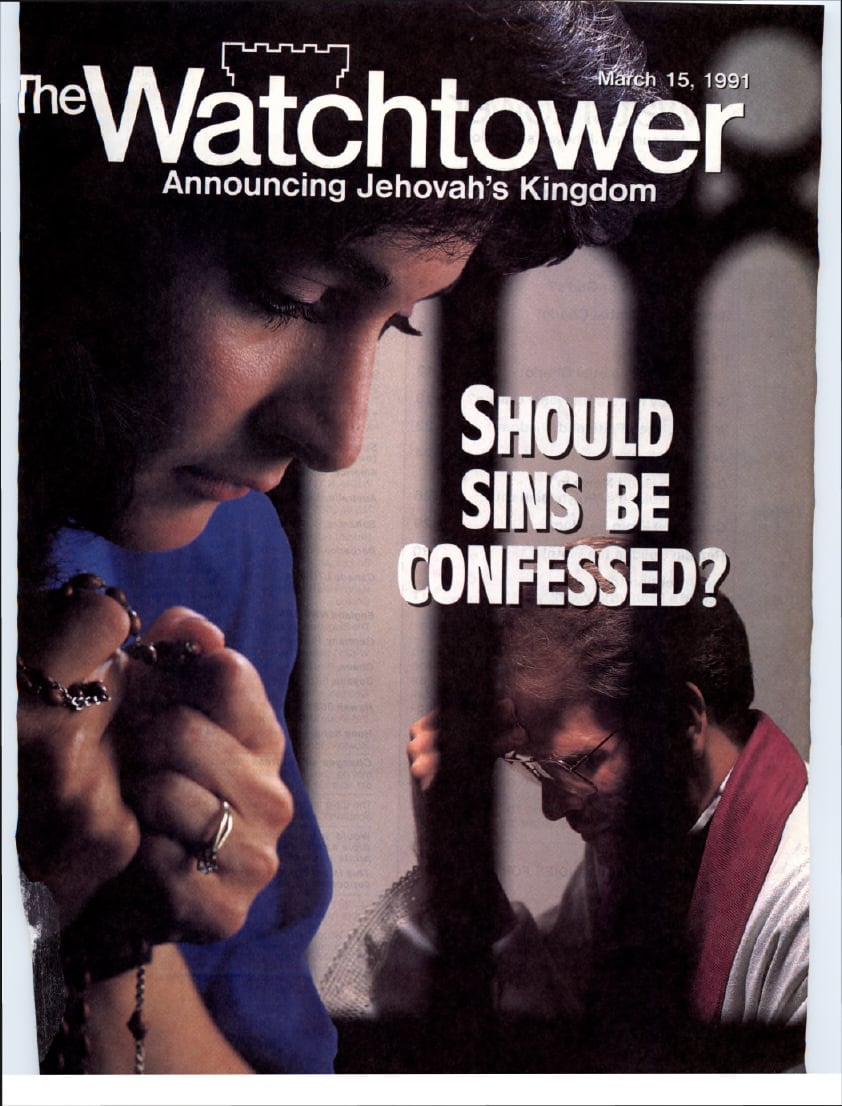
The Watchtower — March 15, 1991
Source: jw.org
Contents
Confession of Sins—Is Something Amiss?
Confession of Sins—Man’s Way or God’s?
Jehovah’s Celestial Chariot on the Move
Keep Pace With Jehovah’s Celestial Chariot
Who Really Have a Heavenly Calling?
Why We Need Faith and Wisdom
Jesus Is Alive!
Declaring Good News in New Zealand’s “Polynesian City”
Questions From Readers
Remain Solid in the Faith!
Pay Attention to God’s Prophetic Word!
Millions Are Going. Are You?
Confession of Sins—Is Something Amiss?
Confession of Sins—Is Something Amiss?
“CONFESSION is a spiritual cleansing, a way to start again, a way to wipe the slate clean. I love going to Confession, telling the priest my sins, having him forgive me and the euphoria that follows.” So says one devout Catholic.—Bless Me, Father, for I Have Sinned.
According to the New Catholic Encyclopedia, “to the priest alone Christ gave or deputed the power of binding and loosing, of forgiving and retaining” sins. The same reference work says that regular confession is meant “to restore the holiness of life forfeited by grievous sin and . . . to purify one’s conscience.” Yet, the moral climate in many lands shows that regular confession does not cause many who practice it to “turn away from what is bad, and do what is good.” (Psalm 34:14) So is something amiss?
Just a Ritual?
Confession may begin as a mere ritual. In Ireland, first confession comes immediately before first Communion. And is it any surprise that a seven-year-old girl would think more about the pretty, miniature bride’s dress she will wear than about ‘restoring the holiness of life forfeited by grievous sin’?
“The thing that excited me the most was the dress, besides getting money from my relatives,” admits Ramona, who made her first confession when she was seven. “Among all the girls I knew,” she goes on, “there was no spiritual feeling. None of us even thought about God at the time.”
In fact, obliging young children to confess sins regularly can lead to mechanical recitation. “I just used the same lines over and over again,” says Michael, who also began the practice of confession as a seven-year-old.
Comments of some Catholics quoted in the book Bless Me, Father, for I Have Sinned show that confession had little spiritual value for them even after they got older. “Confession teaches you to lie, because there are some things you just can’t bring yourself to tell the priest,” admitted one person. Lack of consistency among priests might be exploited for minimum penance. Some searched for a “good” confessor to get the counsel they wanted to hear. “After shopping around for three months, I found my confessor. I see him every month, face-to-face in the reconciliation room, and he’s terrific,” said one young woman. “If you were smart, you found a priest who was deaf and spoke no English except the words ‘three Hail Marys,’” said another Catholic.
Evidently, then, something is amiss with confession as practiced by certain people. But the Bible indicates that there is a need to confess sins, for it says: “No one who conceals his sins will prosper, whoever confesses and renounces them will find mercy.”—Proverbs 28:13, The New Jerusalem Bible.
Does this mean that a Christian should confess all his sins? If so, to whom? The next article will examine these questions.
Confession of Sins—Man’s Way or God’s?
Confession of Sins—Man’s Way or God’s?
AMONG Catholics, confession has changed dramatically over the centuries. In the early years of the Catholic Church, confession and penance were required only for serious sins. Concerning this, the book Religion in the Medieval West says: “Until the late sixth century the penitential system was very harsh: the sacrament could be administered only once in a lifetime, confession was public, the penance was long and severe.”
How severe was such penance? In 1052 one penitent was required to walk barefoot all the way from Bruges in Belgium to Jerusalem! “Catholics could still be found in 1700 at holy wells and springs, kneeling up to their necks in icy water to say their penitential prayers,” says the book Christianity in the West 1400-1700. Since at that time absolution was withheld until after the completion of the penance, many delayed their confession until they were dying.
When did the modern practice of confession begin? Religion in the Medieval West states: “A new form of penance was introduced in France in the late sixth century by Celtic monks. . . . This was auricular confession, in which the penitent confessed his sins privately to a priest, and it was an adaption of the monastic practice of spiritual counselling.” According to the older monastic practice, the monks confessed their sins to one another to get spiritual help in order to overcome their weaknesses. In newer auricular confession, however, the church claimed for the priest the much greater “power or authority to forgive sins.”—New Catholic Encyclopedia.
Did Jesus really give some of his followers such power? What did he say that has led some to this conclusion?
“The Keys of the Kingdom”
On one occasion, Jesus Christ told the apostle Peter: “I will give you the keys of the kingdom of heaven: whatever you bind on earth shall be considered bound in heaven; whatever you loose on earth shall be considered loosed in heaven.” (Matthew 16:19, The Jerusalem Bible) What did Jesus mean by “the keys of the kingdom”? We can understand this better if we look at another occasion when Jesus used the word “key.”
Jesus once told the Jewish religious leaders versed in the Mosaic Law: “Alas for you lawyers who have taken away the key of knowledge! You have not gone in yourselves, and have prevented others going in who wanted to.” (Luke 11:52, JB) ‘Prevented others from going in’ where? Jesus tells us at Matthew 23:13: “Alas for you, scribes and Pharisees, you hypocrites! You who shut up the kingdom of heaven in men’s faces, neither going in yourselves nor allowing others to go in who want to.” (JB) The Jewish clergy closed the door on many, as it were, by robbing them of the opportunity to be with Jesus Christ in heaven. The “key” those religious leaders had “taken away” had nothing to do with the forgiveness of sins. It was the key to divinely provided knowledge.
Similarly, “the keys of the kingdom” given to Peter do not represent power to inform heaven as to whose sins should be forgiven or retained. Rather, they represent Peter’s great privilege of opening up the way to heaven by disseminating divinely provided knowledge through his ministry. He did this first for Jews and Jewish proselytes, then for Samaritans, and finally for the Gentiles.—Acts 2:1-41; 8:14-17; 10:1-48.
“Whatever You Bind on Earth”
Later, what Jesus had told Peter was repeated to other disciples. “I tell you solemnly,” said Jesus, “whatever you bind on earth shall be considered bound in heaven; whatever you loose on earth shall be considered loosed in heaven.” (Matthew 18:18, JB) What authority did Christ here delegate to the disciples? The context shows that he was talking about settling problems between individual believers and keeping the congregation clean of unrepentant evildoers.—Matthew 18:15-17.
In matters involving serious violations of God’s law, responsible men in the congregation would have to judge matters and decide whether a wrongdoer should be “bound” (viewed as guilty) or “loosed” (acquitted). Did this mean that heaven would follow the decisions of humans? No. As Bible scholar Robert Young indicates, any decision made by the disciples would follow heaven’s decision, not precede it. He says that Mt 18 verse 18 should literally read: What you bind on earth “shall be that which has been bound (already)” in heaven.
Really, it is unreasonable to think that any imperfect human could make decisions that would be binding upon those in the heavenly courts. It is much more reasonable to say that Christ’s appointed representatives would follow his directions so as to keep his congregation clean. They would do this by making a decision based on principles already laid down in heaven. Jesus himself would guide them in doing this.—Matthew 18:20.
Is any man able to “represent Christ as the fatherly judge” to the extent of deciding the eternal future of a fellow worshiper? (New Catholic Encyclopedia) Priests who hear confessions almost invariably grant absolution, even though “there seems to be an unspoken belief [among Catholic theologians] that it is a rare person who is really sorry for his sins.” (The New Encyclopædia Britannica) Indeed, when was the last time that you heard of a priest refusing to grant absolution or to acquit a wrongdoer? Likely, this is because the individual priest does not think he has the ability to judge whether a sinner is repentant or not. But if this is the case, why does he claim the power to grant absolution?
Imagine a court of law in which a compassionate judge routinely acquitted criminals, even persistent lawbreakers, because they went through a ritual of admitting their crimes and saying that they were sorry. While this might satisfy wrongdoers, such a misguided view of mercy would seriously undermine respect for justice. Could it be that confession as practiced in the Catholic Church actually hardens people in a course of sin?—Ecclesiastes 8:11.
“Confession does not produce any inclination to try to avoid the sin in the future,” says Ramona, drawing on her experience of confessing as a Catholic since she was seven years old. She adds: “Confession develops the idea that God is all-forgiving and that whatever your imperfect flesh leads you to do he will forgive. It does not develop a deep desire to do what is right.”a
But what about Jesus’ words recorded at John 20:22, 23? There he told his disciples: “Receive the Holy Spirit. For those whose sins you forgive, they are forgiven; for those whose sins you retain, they are retained.” (JB) Does Jesus not here specifically give his disciples authority to forgive sins?
Taken alone, this Bible passage might seem to say that. However, when these words are considered along with the account at Matthew 18:15-18 and everything else that the Bible teaches about confession and forgiveness, what must we conclude? That at John 20:22, 23, Jesus gave his disciples authority to expel from the congregation unrepentant perpetrators of grave sins. At the same time, Christ gave his followers authority to extend mercy and forgive repentant sinners. Jesus certainly was not saying that his disciples should confess every sin to a priest.
Responsible ones in the congregation were thus authorized to decide how to deal with those committing grave sins. Such decisions would be made under the guidance of God’s holy spirit and in harmony with God’s directions given through Jesus Christ and the Holy Scriptures. (Compare Acts 5:1-5; 1 Corinthians 5:1-5, 11-13.) Those responsible men would thereby respond to direction from heaven, not imposing their decisions on heaven.
“Confess Your Sins to One Another”
So, then, when is it appropriate for Christians to confess sins to one another? In the case of serious sin (not every little failing), an individual should confess to responsible overseers of the congregation. Even if a sin is not grievous but the sinner’s conscience troubles him excessively, there is great value in confessing and seeking spiritual help.
In this regard the Bible writer James says: “If one of you is [spiritually] ill, he should send for the elders of the church, and they must anoint him with oil in the name of the Lord and pray over him. The prayer of faith will save the sick man and the Lord will raise him up again; and if he has committed any sins, he will be forgiven. So confess your sins to one another, and pray for one another.”—James 5:14-16, JB.
In these words, there is no suggestion of a formal, ritualistic, auricular confession. Rather, when a Christian is so burdened with sin that he feels he cannot pray, he should call the appointed elders, or overseers, of the congregation, and they will pray with him. To help him recover spiritually, they will also apply the oil of God’s Word.—Psalm 141:5; compare Luke 5:31, 32; Revelation 3:18.
Noteworthy is John the Baptizer’s admonition to “produce fruit that befits repentance.” (Matthew 3:8; compare Acts 26:20.) A truly repentant wrongdoer abandons his sinful course. Like King David of ancient Israel, the repentant sinner who confesses his error to God will receive forgiveness. David wrote: “My sin I finally confessed to you, and my error I did not cover. I said: ‘I shall make confession over my transgressions to Jehovah.’ And you yourself pardoned the error of my sins.”—Psalm 32:5.
Penitential acts cannot earn such forgiveness. Only God can grant it. He takes the requirements of perfect justice into account, but his forgiveness expresses his love for mankind. His forgiveness is also a manifestation of undeserved kindness founded on the ransom sacrifice of Jesus Christ and is extended solely to repentant sinners who have turned away from what is bad in God’s sight. (Psalm 51:7; Isaiah 1:18; John 3:16; Romans 3:23-26) Only those forgiven by Jehovah God will gain eternal life. And to receive such forgiveness, we must make confession in God’s way, not man’s.
[Footnotes]
In contrast, see Mark 3:29; Hebrews 6:4-6; 10:26. In these scriptures, the Bible writers show that God definitely does not forgive all sins.
[Picture on page 7]
David confessed to Jehovah, who granted forgiveness
Jehovah’s Celestial Chariot on the Move
Jehovah’s Celestial Chariot on the Move
“As regards the wheels, to them it was called out in my ears, ‘O wheelwork!’”—EZEKIEL 10:13.
1. What mode of transport does Jehovah have?
IN THESE days of sleek jetliners, world leaders may feel they enjoy the ultimate in travel efficiency. Yet, 2,600 years ago, Jehovah God revealed that he has a superlative mode of transport, the likes of which no engineer has ever seen. It is a vast, awesome chariot! Does it seem strange that the Creator of the universe rides in a chariotlike vehicle? No, for Jehovah’s celestial vehicle differs greatly from any conceived by men.
2. How does Ezekiel chapter 1 depict Jehovah’s celestial chariot, and to whom does the prophet first draw our attention?
2 In Eze chapter 1 of Ezekiel’s prophecy, Jehovah is pictured as riding in a colossal celestial chariot. This awe-inspiring four-wheeled vehicle is self-propelled and can do amazing things. Ezekiel saw this heavenly chariot in vision in 613 B.C.E., when he was by one of the canals of ancient Babylon. The prophet first draws our attention to those attending upon the celestial chariot of Jehovah. As we read, let us try to visualize what Ezekiel saw.
Four Living Creatures
3. What is denoted by the four faces of each of the four cherubs?
3 Ezekiel reports: “I began to see, and, look! there was a tempestuous wind coming from the north, a great cloud mass and quivering fire, and it had a brightness all around . . . And out of the midst of it there was the likeness of four living creatures.” (Ezekiel 1:4, 5) Each of these four living creatures, or cherubs, had four wings and four faces. They had a lion’s face, denoting Jehovah’s justice; a bull’s face, representing God’s power; and an eagle’s face, signifying His wisdom. They also had a man’s face, designating Jehovah’s love.—Deuteronomy 32:4; Job 12:13; Isaiah 40:26; Ezekiel 1:10; 1 John 4:8.
4. Why did the cherubs have four faces, and what were the cherubs like for speed?
4 Each cherub had a face looking in one of four directions. Hence, the cherubs could change course instantly and follow the face that looked in the desired direction. But what were those cherubs like for speed? Why, they could move with the speed of lightning! (Ezekiel 1:14) No man-made vehicle has ever achieved that speed.
5. How did Ezekiel describe the chariot’s wheels and their rims?
5 Suddenly, the chariot’s wheels come into view. How unusual they are! Eze 1 Verses 16 and 18 say: “Their appearance and their structure were just as when a wheel proved to be in the midst of a wheel. And as for their rims, they had such height that they caused fearfulness; and their rims were full of eyes all around the four of them.” A wheel alongside each cherub would result in four wheels in four related places. The wheels glowed like chrysolite, a transparent or translucent yellow or green stone. This adds light and beauty to this glorious vision. Since the rims of the wheels were “full of eyes all around,” they were not going blindly in just any direction. And the wheels were enormously high, thus being able to cover a great distance with just one revolution on their axis. They, like the four cherubs, could move as fast as lightning.
Wheels Within Wheels
6. (a) How was it that the chariot had wheels within wheels? (b) The wheels conformed the direction of their movement to what?
6 Something else was unusual. Each wheel had a wheel inside it—one of the same diameter that fitted crosswise into the base wheel. Only in this way could the wheels be said to “go on their four respective sides.” (Eze 1 Verse 17) Instantly, the wheels could change direction because there was a side of the wheel facing in each direction. The wheels conformed their direction of movement to that of the four cherubs. On the four wheels, the body of God’s chariot could ride by invisible support similar to a powerful craft that is held up by a cushion of air as it skims over water.
7. What was the power source for the wheels?
7 Where did the wheels get this power to conform to all the movements of the four cherubs? From the holy spirit of Almighty God. Eze 1 Verse 20 says: “Wherever the spirit inclined to go, they would go . . . The spirit of the living creature was in the wheels.” The same invisible active force of God that was within the cherubs was in those wheels.
8. What name was given the wheels, and why?
8 The wheels are referred to by the term “wheelwork.” (Ezekiel 10:13) This was evidently occasioned by what each wheel does. It rolls along or whirls. Designating this part of the celestial chariot in such a way calls attention to the speed with which the celestial chariot moves. Although its wheels whirled so speedily, they could always see their way because of their fullness of eyes.
9. How did Ezekiel describe what was above the chariot’s fast-moving four wheels?
9 But now let us look and see what is above those fearfully high, fast-moving four wheels. Verse 22 of Ezekiel chapter 1 says: “Over the heads of the living creatures there was the likeness of an expanse like the sparkle of awesome ice, stretched out over their heads up above.” The expanse, though solid, was translucent, “like the sparkle of awesome ice.” It was sparkling like thousands of diamonds as the sun strikes them. Awe-inspiring indeed!
The Glorious Chariot Rider
10. (a) How are the throne and the One on the throne described? (b) What is denoted by the fact that the chariot Rider is enveloped in glory?
10 Evidently, the chariot stops so that its Rider may speak to Ezekiel. Above the expanse, there is the likeness of a throne, sapphire, or deep blue, in appearance. On the throne, there is Someone whose appearance is like an earthling man. The human form could best help Ezekiel to appreciate this divine manifestation. But that human form is enveloped in glory, so that it glows like electrum, a shining alloy of silver and gold. What quivering beauty! From the waist of this manlike form, this elegant glory extends both upward and downward. The whole form is thus surrounded with glory. This indicates that Jehovah is indescribably glorious. Moreover, the chariot Rider is accompanied by a lovely rainbow. What calmness and tranquillity a rainbow communicates after a storm! Having that calm attitude, Jehovah keeps his attributes of wisdom, justice, power, and love in perfect balance.
11. How was Ezekiel affected by the vision of Jehovah’s chariot and throne?
11 Jehovah’s chariot and throne are surrounded by light and beautiful colors. What a contrast to Satan, the prince of darkness and of the occult! And how was Ezekiel affected by all of this? “When I got to see it,” he says, “then I fell upon my face, and I began to hear the voice of one speaking.”—Ezekiel 1:28.
What the Chariot Depicted
12. What is pictured by Jehovah’s celestial chariot?
12 What is pictured by this marvelous chariot? The celestial, or heavenly, organization of Jehovah God. It is composed of all of his holy spirit creatures in the invisible realm—seraphs, cherubs, and angels. Since Jehovah is the Most High God, all of his spirit creatures are subject to him, and he rides them in the sense of benevolently dominating them and using them according to his purpose.—Psalm 103:20.
13. (a) Why can it be said that Jehovah rides his organization? (b) How does the vision of Jehovah’s four-wheeled chariot on the move affect you?
13 Jehovah rides this organization as if on a chariot, causing it to move to wherever his spirit impels it to move. It is not running wild, without control or intelligent supervision. God is not letting this organization go in any direction it might be inclined to go. Rather, it follows his directions. Together, all are moving unitedly forward to the full accomplishment of God’s objectives. What a marvelous heavenly organization is revealed by this vision of Jehovah’s four-wheeled celestial chariot on the move! In harmony with this, Jehovah’s organization is represented as being foursquare, in perfect balance.
Appointed as a Watchman
14. Who is pictured by the prophet Ezekiel?
14 But who is pictured by the prophet Ezekiel? From the facts of history, it is evident that the body of spirit-anointed Witnesses of Jehovah has been associated with the celestial chariot. Thus, Ezekiel well pictures the anointed remnant of Jehovah’s Witnesses since 1919. Spiritually, God’s heavenly organization got in touch with the anointed remnant in that year, to revive them as Witnesses of Jehovah to all the world. (Compare Revelation 11:1-12.) That chariotlike organization was then on the move, even as it is today. In fact, its wheels of progress are turning faster than ever. Jehovah rides swiftly onward!
15. What does the voice of the Rider of the celestial chariot say, and what commission does Ezekiel receive?
15 Ezekiel desired to know why the celestial chariot had drawn up before him and stopped. He found out as a voice came to him from the One sitting upon the chariot. Overwhelmed at this awe-inspiring spectacle, Ezekiel prostrated himself. Listen as the voice of the Rider of the celestial chariot says: “Son of man, stand up upon your feet that I may speak with you.” (Ezekiel 2:1) Jehovah then commissions Ezekiel to be a watchman and to warn the rebellious house of Israel. He is even commissioned to speak in the divine name. Ezekiel’s name means “God Strengthens.” So it is that God has strengthened the Ezekiel class and sent them forth, appointing them as a watchman to Christendom.
16, 17. (a) How did the vision of the celestial chariot benefit Ezekiel? (b) In our day, how has the understanding of the vision of the celestial chariot affected the Ezekiel class and the great crowd?
16 The vision of the celestial chariot was sobering and stunning to Ezekiel, but it also prepared him for his commission as a watchman to sound the warning of the coming destruction of Jerusalem. The same has been true of the watchman class today. Their understanding of the vision of Jehovah’s celestial chariot on the move has had great impact on the anointed remnant. In 1931 they learned more about Ezekiel’s vision, as revealed in Vindication, Book One. They were then filled with such sober appreciation that from the issue of October 15, 1931, to that of August 1, 1950, the front-cover design of The Watchtower carried in its upper right-hand corner an artist’s conception of Ezekiel’s vision of the celestial chariot. Thus, the Ezekiel class has acted upon the commission given them, and they have been serving as a watchman, sounding out the divine warning. The time for Christendom’s fiery destruction from Jehovah enthroned on his celestial chariot was never nearer!
17 Today, “a great crowd” of sheeplike people are associated with the anointed remnant. (Revelation 7:9) Together, they are sounding forth the warning of the coming destruction upon Christendom and this entire diabolic system of things. That warning work is going on apace, and as indicated at Revelation 14:6, 7, the angels are supporting it.
Moving With the Celestial Chariot
18. What must be done to get the continued support of the angels, and to what should we be sensitive?
18 The submissive angels move in concert as part of God’s heavenly organization while assisting Jehovah’s earthly servants in fulfilling their commission to declare divine judgment warnings. If we desire the continued protection and guidance of these mighty angelic servants of God, we too must move in concert and keep pace with the symbolic wheelwork. Moreover, as part of Jehovah’s visible organization moving in parallel with his celestial chariot, we must be sensitive to the leadings of God’s spirit. (Compare Philippians 2:13.) If we are Jehovah’s Witnesses, we must move in the same direction as the celestial chariot. We surely must not work at cross-purposes with it. When given direction in the way we should go, we should follow it. Thus, the congregation is not divided.—1 Corinthians 1:10.
19. (a) Just as the celestial chariot’s wheels have eyes all around them, to what must Jehovah’s people be alert? (b) What should be our course of action in these turbulent times?
19 The eyes all around the wheels of God’s chariot indicate alertness. Just as the heavenly organization is alert, so we must be alert to support Jehovah’s earthly organization. On a congregational level, we can show that support by cooperating with the local elders. (Hebrews 13:17) And in these turbulent times, Christians need to stick very close to Jehovah’s organization. We do not want to place our own interpretation on events, for then we would not be moving with Jehovah’s celestial chariot. Let us always ask ourselves, ‘Which way is the celestial chariot moving?’ If we move ahead with God’s visible organization, we will also be moving with the invisible organization.
20. What fine counsel does the apostle Paul give at Philippians 3:13-16?
20 In this regard, Paul wrote: “Brothers, I do not yet consider myself as having laid hold on it; but there is one thing about it: Forgetting the things behind and stretching forward to the things ahead, I am pursuing down toward the goal for the prize of the upward call of God by means of Christ Jesus. Let us, then, as many of us as are mature, be of this mental attitude; and if you are mentally inclined otherwise in any respect, God will reveal the above attitude to you. At any rate, to what extent we have made progress, let us go on walking orderly in this same routine.”—Philippians 3:13-16.
21. By following what routine is it possible to make spiritual advancement with God’s organization?
21 Here the word “routine” does not mean a bad rut from which we cannot extricate ourselves. Jehovah’s servants have a fine routine by means of which they make spiritual advancement. It is a routine of engaging in personal Bible study, attending congregation meetings, regularly preaching the good news of the Kingdom, and reflecting the qualities of God’s heavenly organization. Such a routine enables them to follow the leadings of Jehovah’s celestial chariotlike organization. By persevering in this manner, we shall attain our goal, whether it is the prize of immortal life in the heavens or everlasting life on a paradise earth.
22. (a) For the anointed remnant and the great crowd of other sheep to be unitedly organized, what must be done? (b) What does not escape Jehovah’s notice?
22 As John 10:16 indicates, the “other sheep” and the Ezekiel class would be unitedly organized. Thus, it is essential that all in Jehovah’s organization grasp the full meaning and significance of the vision recorded in Ezekiel chapter 1 if they are to move in concert with God’s celestial chariot. The vision of it helps us to appreciate that we should move in harmony with God’s organization, visible and invisible. Keep in mind, too, that Jehovah’s eyes “are roving about through all the earth to show his strength in behalf of those whose heart is complete toward him.” (2 Chronicles 16:9) Not a single thing escapes Jehovah’s notice, especially anything regarding his purpose to vindicate himself as Universal Sovereign.
23. With Jehovah’s celestial chariot on the move, what must we do?
23 Jehovah’s celestial chariot is certainly on the move today. Soon everything will be brought to glory in harmony with the glorious One who rides that chariot—all in vindication of him as the Sovereign Lord of the universe. His seraphs, cherubs, and angels are backing us up in our great worldwide preaching work. Let us move ahead, then, with Jehovah’s heavenly organization. But how can we keep pace with that fast-moving celestial chariot?
How Would You Answer?
□ What qualities are represented by the four living creatures seen by Ezekiel?
□ Jehovah’s celestial chariot pictures what?
□ Who is pictured by God’s prophet Ezekiel?
□ How has the understanding of Jehovah’s celestial chariot affected the Ezekiel class and the great crowd?
Keep Pace With Jehovah’s Celestial Chariot
Keep Pace With Jehovah’s Celestial Chariot
“You must speak my words to them, regardless of whether they hear or they refrain.”—EZEKIEL 2:7.
1, 2. What royal carriage did Ezekiel behold, and what was he told?
JEHOVAH’S celestial chariot now stands before his servants. With eyes of faith, they behold that regal conveyance of their Sovereign Lord. It is glorious, awesome, majestic.
2 The same royal carriage pulled up before God’s prophet Ezekiel in vision some 2,600 years ago. From this throne-bearing chariot—God’s heavenly organization of spirit creatures—Jehovah issued this dramatic command to Ezekiel: “The sons insolent of face and hard of heart—I am sending you to them, and you must say to them, ‘This is what the Sovereign Lord Jehovah has said.’ And as for them, whether they will hear or will refrain—for they are a rebellious house—they will certainly know also that a prophet himself happened to be in the midst of them.”—Ezekiel 2:4, 5.
3. What modern-day counterpart does Ezekiel have?
3 Ezekiel resolutely carried out that commission, serving as a single instrument in the divine hand. Similarly, God now has a single organizational instrument in his control. The Ezekiel class, the anointed remnant, is at the forefront of the work of giving a final witness, with “a great crowd” of “other sheep” rallying around in support. (Revelation 7:9, 10; John 10:16) Together they are “one flock,” with the Fine Shepherd, Jesus Christ, leading them under the sovereignty of the grand Chariot Rider, Jehovah God.
4, 5. How did God’s visible organization come into existence, and what has it experienced in harmony with Isaiah 60:22?
4 Under Jehovah’s direction, this worldwide organization has grown from small beginnings to become a powerful agency for proclaiming the decree to “fear God and give him glory, because the hour of the judgment by him has arrived.” (Revelation 14:7) As Ezekiel did not raise up or appoint himself as a prophet, so God’s visible organization did not create or appoint itself. It did not spring from human will or effort. The divine Chariot Rider caused this organization to come into existence. Empowered by God’s spirit and backed by holy angels, Jehovah’s people have experienced such dramatic expansion that ‘the small one has become a mighty nation.’—Isaiah 60:22.
5 Over 4,000,000 Witnesses of Jehovah are proclaiming the Kingdom message in 212 lands. They are grouped in more than 63,000 congregations organized into circuits and districts. Extensive branch office and printing facilities are operating under the direction of the Governing Body as the center of the headquarters organization. As though they were one person, all are moving forward, preaching the good news, educating those who respond, building meeting places. Yes, Jehovah’s visible organization is keeping pace with the celestial chariot and its Rider.
6. What is involved in keeping pace with Jehovah’s visible organization?
6 If you are one of Jehovah’s Witnesses, are you keeping pace with God’s visible organization? Doing so is not simply a matter of attending Christian meetings and spending time in the ministry. Primarily, pace has to do with progress and spiritual growth. It involves having a positive outlook, setting proper priorities, and being up-to-date. If we are keeping pace with Jehovah’s celestial chariot, our lives are consistent with the message we proclaim.
7. Why consider Ezekiel’s conduct as God’s prophet?
7 In the matter of keeping pace, Jehovah’s modern-day servants can learn much from Ezekiel’s example. Though specially appointed as a prophet by Jehovah, Ezekiel still had feelings, concerns, and needs. For instance, as a comparatively young married man, he suffered the grief of losing his wife in death. Yet, he never lost sight of his commission as Jehovah’s prophet. By considering how Ezekiel conducted himself in other respects too, we can strengthen ourselves to keep pace with God’s visible organization. This will enable us to keep pace with his invisible organization.
Commission Accepted and Fulfilled
8. With regard to his commission, what example did Ezekiel set?
8 Ezekiel set a fine example by accepting his commission and fulfilling it. However, obedience and courage were needed to carry it out, for we read: “O son of man, do not be afraid of them; and of their words do not be afraid, because there are obstinate ones and things pricking you and it is among scorpions that you are dwelling. Of their words do not you be afraid, and at their faces do not you be struck with terror, for they are a rebellious house. And you must speak my words to them, regardless of whether they hear or they refrain, for they are a case of rebellion. And you, O son of man, hear what I am speaking to you. Do not become rebellious like the rebellious house.”—Ezekiel 2:6-8.
9. Only by doing what would Ezekiel be free of bloodguilt?
9 Ezekiel was not to be apathetic or fearful, needing to be prodded constantly to fulfill his commission. He would be free of bloodguilt only if he willingly and boldly spoke Jehovah’s words. Ezekiel was told: “In case you have warned someone wicked and he does not actually turn back from his wickedness and from his wicked way, he himself for his error will die; but as for you, you will have delivered your own soul.”—Ezekiel 3:19.
10. How has the Ezekiel class proved to be like the prophet?
10 As in Ezekiel’s case, the anointed Ezekiel class have accepted their God-given commission and are fulfilling it. If we are Jehovah’s Witnesses, we should remember that our life and the lives of others depend upon our obedience. (1 Timothy 4:15, 16) Each Witness needs to keep pace with Jehovah’s organization. God will not tie us to his chariot and drag us along. Apathy and a divided heart demean the Chariot Rider. So Jehovah’s visible organization exhorts us to keep divine interests at the center of our lives. A consistent response to such exhortation keeps us in step with God’s organization and elevates our sacred ministry above the routine, the mechanical. Certainly, Jehovah’s people as a whole display remarkable devotion. Our individual part is to maintain the pace.
God’s Words Taken Into the Heart
11. What example did Ezekiel set as regards God’s words?
11 Ezekiel also set a fine example by taking God’s words into his heart. On command, he ate a God-given roll, or scroll. “It came to be in my mouth like honey for sweetness,” said Ezekiel. Though the roll was filled with “dirges and moaning and wailing,” it was sweet to Ezekiel because he appreciated the honor of representing Jehovah. It was a sweet experience to the prophet to fulfill his God-given assignment. God told him: “Son of man, all my words that I shall speak to you, take into your heart and hear with your own ears.” (Ezekiel 2:9–3:3, Eze 3:10) Those visions made Ezekiel acutely aware of what God allowed him to participate in and strengthened his relationship with Jehovah.
12. What did Ezekiel do in more than two decades of prophetic service?
12 Ezekiel was given visions and messages for various purposes and audiences. He had to listen carefully and then speak and act as directed. New information and procedures were revealed to him progressively during some 22 years of prophetic service. Sometimes Ezekiel spoke a specially worded message. At other times, he resorted to pantomime, as in lying before a brick symbolizing Jerusalem. (Ezekiel 4:1-8) His example in personal matters, such as his reaction to his wife’s death, also carried a message. (Ezekiel 24:15-19) He had to be current, always presenting the right message and taking the right action at the right time. Ezekiel was bound in a very close, progressive working relationship with Jehovah.
13. How can we build a close relationship with Jehovah?
13 Similarly, to build and maintain a close relationship with Jehovah as his fellow workers, we must take God’s Word into our heart. (1 Corinthians 3:9) Keeping pace with God’s visible organization in this respect requires that we keep up with the flow of spiritual food as it is supplied at the proper time. (Matthew 24:45-47) The “pure language” is constantly expanding. (Zephaniah 3:9) Only if we are up-to-date will we really be able to respond obediently to the direction of the Chariot Rider.
14, 15. What routine is needed to keep the pace set by God’s organization?
14 To that end, we need a good routine of personal prayer, private study, and participation in the holy ministry of the good news. (Romans 15:16) Recall Ezekiel’s example in eating the roll containing God’s message. Ezekiel consumed the entire roll, not part of it. He did not pick and choose morsels that might have been more to his personal taste. Similarly, our personal study of the Bible and Christian publications should be regulated to keep pace with the flow of spiritual food, and we should partake of all that is put on the spiritual table, including deeper truths.
15 Do we make prayerful effort to get the sense of the solid food? Keeping pace requires that our knowledge and understanding progress beyond the elementary, for we read: “Everyone that partakes of milk is unacquainted with the word of righteousness, for he is a babe. But solid food belongs to mature people, to those who through use have their perceptive powers trained to distinguish both right and wrong.” (Hebrews 5:13, 14) Yes, making spiritual progress is a vital part of keeping the pace God’s organization sets.
Not Deterred by Indifference
16, 17. How did Ezekiel deal with indifference, ridicule, and lack of response?
16 Ezekiel also set a fine example by being obedient and not allowing himself to be deterred by indifference or ridicule. Similarly, by keeping up with the development of the pure language, we are attuned to the direction taken by the royal Chariot Rider. Thus we are equipped to respond to his commands, strengthened to be undeterred by the indifference or ridicule of those to whom we speak Jehovah’s judgment message. As with Ezekiel, God has forewarned us that some people would actively oppose, being hardheaded and hardhearted. Others would not hear because they do not want to listen to Jehovah. (Ezekiel 3:7-9) Still others would be hypocrites, as Ezekiel 33:31, 32 states: “They will come in to you, like the coming in of people, and sit before you as my people; and they will certainly hear your words but these they will not do, for with their mouth they are expressing lustful desires and after their unjust gain is where their heart is going. And, look! you are to them like a song of sensuous loves, like one with a pretty voice and playing a stringed instrument well. And they will certainly hear your words, but there are none doing them.”
17 What would be the outcome? Eze 33 Verse 33 adds: “And when it comes true—look! it must come true—they will also have to know that a prophet himself had proved to be in the midst of them.” Those words reveal that Ezekiel did not give up because of lack of response. The apathy of others did not make him apathetic. Whether people listened or not, he obeyed God and fulfilled his commission.
18. What questions might you ask yourself?
18 Jehovah’s visible organization is now intensifying the proclamation that all should fear God and give him glory. Do you persevere when criticized for taking a bold stand in giving the Kingdom witness, for being moral in your life-style? Are you standing firm when you are the target of pressure because of not accepting blood, not worshiping national emblems, not celebrating worldly holidays?—Matthew 5:11, 12; 1 Peter 4:4, 5.
19. As to direction, what will we do if we are keeping pace with Jehovah’s celestial chariot?
19 This course is not an easy one, but those who endure to the end will be saved. (Matthew 24:13) With Jehovah’s help, we will not let people of the world make us like them and thus get us out of pace with Jehovah’s celestial chariot. (Ezekiel 2:8; Romans 12:21) If we are keeping pace with the chariotlike angelic organization, we will promptly comply with direction and instructions received through God’s visible organization. Jehovah provides what we need to meet attacks on our faith, to maintain our grip on the Word of life, and to keep our eyes fixed on the spiritual realities that center on the Royal Rider of the celestial chariot.
Motivated to Keep Pace
20. What are some things recorded by Ezekiel that should motivate us to keep pace?
20 Ezekiel’s visions should motivate us to keep pace. He not only declared God’s judgments on Israel but also recorded prophecies of restoration. Ezekiel pointed to the One who would have the legal right to rule on Jehovah’s throne at the appointed time. (Ezekiel 21:27) That Royal Servant, “David,” would regather God’s people and shepherd them. (Ezekiel 34:23, 24) Though they would be attacked by Gog of Magog, God would deliver them, and His foes would be forced to ‘know Jehovah’ even as they went into destruction. (Ezekiel 38:8-12; 39:4, 7) Then God’s servants would enjoy endless life in a system of pure worship involving a spiritual temple. Waters of life flowing from the sanctuary would be a source of nourishment and healing, and a land inheritance would be apportioned for their blessing.—Ezekiel 40:2; 47:9, 12, 21.
21. Why is the role of Jehovah’s modern-day Witnesses greater than that of Ezekiel?
21 How thrilled Ezekiel must have been to record those prophecies! Yet, the role of Jehovah’s modern-day Witnesses is greater. We are living when some of those prophecies are being fulfilled. In fact, we are active participants in certain fulfillments. By the way we live, do we individually show our conviction that Jesus now rules as the One having the legal right? Are we personally convinced that Jehovah will soon sanctify himself and deliver into his new world those who keep pace with his organization? (2 Peter 3:13) Such conviction, accompanied by works of faith, demonstrates that we are indeed keeping pace with Jehovah’s celestial chariot.
Continue to Keep Pace
22. What can be done to avoid distractions so as to maintain a clear spiritual outlook?
22 Having ‘put our hand to the plow,’ we must not look back longingly to anything the world has to offer. (Luke 9:62; 17:32; Titus 2:11-13) So let us curb any inclination to store up treasures on earth, and let us keep our eye simple, focused on the Kingdom. (Matthew 6:19-22, 33) Simplifying our lives, shedding mundane weights wherever possible, will help us to keep pace with Jehovah’s organization. (Hebrews 12:1-3) Distractions can blur our vision of the celestial chariot and its Rider. But with his help, we can maintain a clear spiritual outlook, as did Ezekiel.
23. What do faithful Witnesses need to do in behalf of new ones?
23 Part of our responsibility as Jehovah’s Witnesses involves helping the many new ones to keep pace with God’s celestial chariot. In 1990 nearly 10,000,000 attended the Memorial of Jesus Christ’s death. While many of these individuals may be attending a few Christian meetings, they need to see the importance of progressing with Jehovah’s visible organization. As faithful Witnesses, we can help them by the spirit we show and the encouragement we give.
24. We should do what in these climactic times?
24 These are climactic times. With eyes of faith, we have seen the celestial chariot pull up before us. The regal Chariot Rider has given his visible organization a commission to preach to the nations so that, in the finale, they will know who Jehovah is. (Ezekiel 39:7) Make the most of this grand opportunity to share in the vindication of God’s sovereignty and the sanctification of his holy name by keeping pace with Jehovah’s celestial chariot.
How Would You Answer?
□ Ezekiel set what example as far as his commission was concerned?
□ What does it mean to keep pace with God’s organization?
□ How did Ezekiel view Jehovah’s words?
□ How can we follow Ezekiel’s example in dealing with indifference?
□ What should motivate Jehovah’s servants to keep pace with his celestial chariot?
[Pictures on page 15]
What is required to keep pace with Jehovah’s celestial chariot?
[Picture on page 16]
Ezekiel appreciated his God-given privileges. Do you?
Who Really Have a Heavenly Calling?
Who Really Have a Heavenly Calling?
JEHOVAH loves the human race. Why, this love is so great that he gave his Son, Jesus Christ, as a ransom to redeem what our forefather Adam lost! And what was that? Eternal, perfect human life with all its rights and prospects. (John 3:16) The ransom was also an expression of Jesus’ love for mankind.—Matthew 20:28.
Divine love has been displayed in opening up two God-given hopes based on the merit of Jesus’ ransom sacrifice. (1 John 2:1, 2) Before Jesus died as a man, the only hope open to those having divine approval was that of life in an earthly paradise. (Luke 23:43) After Pentecost 33 C.E., however, Jehovah gave a heavenly hope to a “little flock.” (Luke 12:32) But what has happened in recent times? Since 1931 the Kingdom message has focused more attention on the “other sheep,” and from 1935 onward God has been drawing “a great crowd” of such sheeplike ones to himself through Christ. (John 10:16; Revelation 7:9) In their heart, God has put the hope of eternal life in an earthly paradise. They want to eat perfect food, have loving dominion over animals, and enjoy association with righteous fellow humans forever.
Compassionate Priests and Kings
Since love moved Jesus to give his life as a ransom, surely he will be a compassionate heavenly King. Yet, Jesus will not be alone in uplifting mankind to perfection during his Thousand Year Reign. Jehovah has made provision for other compassionate kings in heaven. Yes, “they will be priests of God and of the Christ, and will rule as kings with him for the thousand years.”—Revelation 20:1-6.
How many corulers will Christ have, and how are they chosen for such an awesome privilege? Well, the apostle John saw 144,000 on heavenly Mount Zion with the Lamb, Jesus Christ. Having been “bought from among mankind,” they will know what it means to experience trials, endure the burdens of imperfection, suffer, and die as humans. (Revelation 14:1-5; Job 14:1) Therefore, what compassionate king-priests they will be!
The Spirit’s Witness
The 144,000 “have an anointing from the holy one,” Jehovah. (1 John 2:20) It is an anointing to a heavenly hope. God has ‘put his seal upon them and has given them the token of what is to come, that is, the spirit, in their hearts.’—2 Corinthians 1:21, 22.
Yes, those with the heavenly calling have the testimony of God’s spirit to that effect. Concerning this, Paul wrote at Romans 8:15-17: “You did not receive a spirit of slavery causing fear again, but you received a spirit of adoption as sons, by which spirit we cry out: ‘Abba, Father!’ The spirit itself bears witness with our spirit that we are God’s children. If, then, we are children, we are also heirs: heirs indeed of God, but joint heirs with Christ, provided we suffer together that we may also be glorified together.” It is by means of God’s spirit, or active force, that anointed ones cry out, “Abba, Father!”
The chief evidence that a person has been anointed to the heavenly calling is a spirit, or dominant sense, of sonship. (Galatians 4:6, 7) Such an individual is absolutely sure that he has been begotten by God to spiritual sonship as one of the 144,000 joint heirs of the heavenly Kingdom. He can testify that his heavenly hope is not his own cultivated desire or his imagination; rather, it is from Jehovah as a result of the action of God’s spirit toward him.—1 Peter 1:3, 4.
Under the influence of God’s holy spirit, the spirit, or dominant attitude, of anointed ones acts as an impelling force. It moves them to respond positively to what God’s Word says about the heavenly hope. They also respond in a positive way to Jehovah’s dealings with them by means of the holy spirit. Thus, they are sure that they are God’s spiritual children and heirs.
When anointed ones read what God’s Word says about his spiritual children and the heavenly hope, their spontaneous inclination is to say within themselves, ‘This means me!’ Yes, they respond joyfully when their Father’s Word promises a heavenly reward. They say, ‘That means me!’ when they read: “Beloved ones, now we are children of God.” (1 John 3:2) And when anointed ones read that God has brought people forth “to be certain firstfruits of his creatures,” their mental inclination is to respond, ‘Yes, he brought me forth for that purpose.’ (James 1:18) They know that they have been “baptized into Christ Jesus” and into his death. (Romans 6:3) So they have the firm conviction of being part of Christ’s spiritual body and entertain the hope of undergoing a death like his and being resurrected to heavenly life.
To inherit the heavenly Kingdom, anointed ones must ‘do their utmost to make their calling and choosing sure.’ (2 Peter 1:5-11) They walk by faith and keep growing spiritually, as do those with earthly hopes. So, what else is there to the witness of the spirit?
Why They Partake
Anointed Christians do not want to go to heaven because of malcontent over present-day earthly life. (Compare Jude 3, 4, 16.) Rather, the holy spirit bears witness with their spirit that they are God’s children. They are also certain that they have been taken into the new covenant. The parties to this covenant are Jehovah God and spiritual Israel. (Jeremiah 31:31-34; Galatians 6:15, 16; Hebrews 12:22-24) This covenant, made operative by Jesus’ shed blood, takes out a people for Jehovah’s name and makes these anointed Christians part of Abraham’s “seed.” (Galatians 3:26-29; Acts 15:14) The new covenant remains in operation until all spiritual Israelites are resurrected to immortal life in heaven.
Furthermore, those who truly have the heavenly calling have no doubt that they are also in the covenant for the heavenly Kingdom. Jesus referred to this covenant between himself and his followers when he said: “You are the ones that have stuck with me in my trials; and I make a covenant with you, just as my Father has made a covenant with me, for a kingdom, that you may eat and drink at my table in my kingdom, and sit on thrones to judge the twelve tribes of Israel.” (Luke 22:28-30) This covenant was inaugurated toward Jesus’ disciples by their being anointed with holy spirit on the day of Pentecost 33 C.E. It remains operative between Christ and his associate kings forever.—Revelation 22:5.
Those having the heavenly calling are positive that they are in the new covenant and the covenant for a Kingdom. Therefore, they properly partake of the emblematic bread and wine at annual commemorations of the Lord’s Evening Meal, or Memorial of Jesus Christ’s death. The unleavened bread symbolizes Jesus’ sinless human body, and the wine his perfect blood poured out in death and validating the new covenant.—1 Corinthians 11:23-26.
If Jehovah has cultivated in you the undeniable hope of heavenly life, you are counting on that. You offer prayers in expression of that hope. It engrosses you, and you cannot get it out of your system. You have consuming spiritual aspirations. But if you are divided and uncertain, then surely you should not partake of the emblems of the Lord’s Evening Meal.
Why Wrong Assumptions?
Some may wrongly partake of the Memorial emblems because they really do not acknowledge that anointing “depends, not upon the one wishing nor upon the one running, but upon God.” (Romans 9:16) It is not up to the individual to decide that he or she would like to be taken into the new covenant and become a joint heir with Christ in the heavenly Kingdom. Jehovah’s choice is what counts. In ancient Israel, God chose those who would serve as his priests, and he executed Korah for presumptuously seeking the priesthood divinely placed in Aaron’s family. (Exodus 28:1; Numbers 16:4-11, 31-35; 2 Chronicles 26:18; Hebrews 5:4, 5) Similarly, it would displease Jehovah if a person presented himself as one called to be among the heavenly kings and priests when God had not given him such a calling.—Compare 1 Timothy 5:24, 25.
A person may mistakenly assume that he has the heavenly calling because of strong emotion arising from severe problems. Death of a mate or another tragedy might cause a person to lose interest in life on earth. Or a close associate may profess to be of the anointed, and the person may desire the same destiny. Such factors might make him feel that life in heaven is for him. But this is not God’s way of giving anyone the spirit of sonship. It would show a lack of gratitude for God’s purpose regarding the earth if one desired to go to heaven because of undesirable situations or emotional distress related to earthly life.
Former religious views might also cause a person to conclude wrongly that he has the heavenly calling. Perhaps he was once associated with a false religion that held out heavenly life as the only hope for the faithful. Hence, a Christian needs to guard against being swayed by emotion and past wrong views.
Careful Examination Vital
A very significant point was made by the apostle Paul when he wrote: “Whoever eats the loaf or drinks the cup of the Lord unworthily will be guilty respecting the body and the blood of the Lord. First let a man approve himself after scrutiny, and thus let him eat of the loaf and drink of the cup. For he that eats and drinks eats and drinks judgment against himself if he does not discern the body.” (1 Corinthians 11:27-29) Therefore, a baptized Christian who in recent years began to think that he received the heavenly calling should give the matter very careful and prayerful thought.
Such a person might also ask himself: ‘Have others influenced me to entertain the idea of heavenly life?’ This would be improper, for God has not assigned anyone to recruit others for such a privilege. A tendency toward fantasy would be no indication of anointing by God, and he does not anoint Kingdom heirs by causing them to hear voices with messages to that effect.
Some might ask themselves: ‘Before becoming a Christian, was I involved in drug abuse? Am I using medications that affect the emotions? Have I received treatment for mental or emotional problems?’ Some have said that they first fought against what they thought was the heavenly hope. Others have said that for a time God took away their earthly hope and finally gave them a heavenly one. But such a procedure is contrary to divine dealings. Moreover, faith is not uncertain; it is sure.—Hebrews 11:6.
A person might also ask himself: ‘Do I desire prominence? Am I ambitious for a position of authority now or as one of the kings and priests associated with Christ?’ In the first century C.E., when a general invitation was going out to seek entrance into the heavenly Kingdom, not all anointed Christians held positions of responsibility as members of the governing body or as elders or ministerial servants. Many were women, and they had no special authority; nor does spirit anointing bring extraordinary understanding of God’s Word, for Paul found it necessary to instruct and counsel certain anointed ones. (1 Corinthians 3:1-3; Hebrews 5:11-14) Those with the heavenly calling do not view themselves as prominent individuals, and they do not draw attention to their being anointed ones. Rather, they manifest the humility rightly expected of those having “the mind of Christ.” (1 Corinthians 2:16) They also realize that God’s righteous requirements must be met by all Christians, whether their hope is heavenly or earthly.
Professing to have a heavenly calling does not bring a person special revelations. God has a channel of communication through which he provides spiritual food for his earthly organization. (Matthew 24:45-47) So nobody should think that being an anointed Christian gives him wisdom superior to that of the “great crowd” with the earthly hope. (Revelation 7:9) Spirit anointing is not indicated by proficiency in witnessing, answering Scriptural questions, or giving Bible talks, for Christians with the earthly hope also do very well in these respects. Like anointed ones, they too are living exemplary Christian lives. For that matter, Samson and others of pre-Christian times had God’s spirit and were filled with zeal and understanding. Yet, none of that ‘great cloud of witnesses’ had the heavenly hope.—Hebrews 11:32-38; 12:1; Exodus 35:30, 31; Judges 14:6, 19; 15:14; 1 Samuel 16:13; Ezekiel 2:2.
Remember Who Makes the Choice
If a fellow believer asks about the heavenly calling, an appointed elder or other mature Christian can discuss the matter with him. But one person cannot make this decision for another, and it is Jehovah who imparts the heavenly hope. An individual who truly has the heavenly calling never needs to ask fellow Christians if he has such a hope. Anointed ones “have been given a new birth, not by corruptible, but by incorruptible reproductive seed, through the word of the living and enduring God.” (1 Peter 1:23) By his spirit and Word, God implants the “seed” that makes the individual “a new creation,” with a heavenly hope. (2 Corinthians 5:17) Yes, Jehovah makes the choice.
When studying the Bible with new ones, therefore, it is not good to suggest that they try to decide whether they have the heavenly calling. But what if an anointed Christian proved unfaithful and a replacement was needed? Then it would be reasonable to conclude that God would give the heavenly calling to someone who had been exemplary in rendering faithful service to our heavenly Father for very many years.
Today, the main thrust of God’s message is not for people to become members of Christ’s heavenly bride. Rather, “the spirit and the bride keep on saying: ‘Come!’” This is an invitation to life in an earthly paradise. (Revelation 22:1, 2, 17) As anointed ones take the lead in this activity, they display “lowliness of mind” and work ‘to make their calling and choosing sure.’—Ephesians 4:1-3; 2 Peter 1:5-11.
Why We Need Faith and Wisdom
Why We Need Faith and Wisdom
Highlights From the Letter of James
JEHOVAH’S servants need endurance when under trial. They must also avoid conduct that would result in divine disapproval. Such points are emphasized in the letter of James, and doing something positive about them calls for active faith and heavenly wisdom.
The writer of this letter does not identify himself as one of Jesus’ two apostles named James but as ‘a slave of God and of Christ.’ Similarly, Jesus’ half brother Jude says he is “a slave of Jesus Christ, but a brother of James.” (James 1:1; Jude 1; Matthew 10:2, 3) Hence, Jesus’ half brother James evidently wrote the letter bearing his name.—Mark 6:3.
…