The Watchtower, October 15, 1990
Download: PDF — The Watchtower, October 15, 1990
The Watchtower — October 15, 1990
Source: jw.org
Contents
Masada—Why Did It Happen?
Masada—Proof That Messiah Had Come?
Betrayal and Arrest
Appreciating Why the Messiah Was to Come
Be Thankful—Jehovah’s Messianic Kingdom Rules
Insight on the News
“Standing Firm As One Flock” in Chad
He “Fought the Fine Fight”
Why Pursue Righteousness?
Questions From Readers
Is the Bible Really the Word of God?
Masada—Why Did It Happen?
Masada—Why Did It Happen?
“LONG since, my brave companions, we determined to serve neither the Romans nor anyone else but only God . . . Come, while our hands are free to hold the sword . . . Let us die before we become slaves under our enemies, and leave this life together as free men with our children and wives!”
This desperate exhortation reportedly was given by Eleazar, son of Jair (or Ben Yaʼir), to the defenders of Masada. It was recorded by the first-century historian Josephus in his work The Jewish War. Why did that Jewish leader urge his companions to commit mass murder and suicide, contrary to God’s law? (Exodus 20:13) More important, how can a knowledge of the circumstances help you survive in today’s violent world?
The Dagger Men of Masada
Prior to the outbreak of the Jewish revolt in 66 C.E., a Roman garrison was stationed at Masada, a fortified hilltop near the Dead Sea. Although Masada was in an isolated spot, Herod the Great had had a beautiful winter palace constructed there. He had a water system built so that even hot baths could be enjoyed. More critically, though, under Roman occupation the fortress housed a large cache of arms. When sentiments against the Roman occupiers of Palestine ran high, the arms were in danger of falling into the hands of Jewish revolutionaries. One such group was the Sicarii, meaning “dagger men,” mentioned in the Bible as being involved in an uprising.—Acts 21:38.
In 66 C.E. the dagger men captured Masada. With their newly acquired weapons, they marched to Jerusalem in support of the revolt against Roman rule. The Jewish revolutionaries’ massacre of Roman garrisons at both Masada and Jerusalem brought upon their countrymen the wrath of the Roman Empire. Before 66 C.E. ended, the Roman Twelfth Legion under Cestius Gallus marched into Judea and encamped outside Jerusalem. The Romans attacked the city from all sides and went so far as to undermine the northern foundations of the temple. Suddenly Gallus withdrew his troops and for no clear reason left Judea. “If only he had persevered with the siege a little longer he would have captured the City at once,” wrote eyewitness Josephus.
But the Romans were not finished. Four years later the Roman general Titus marched to Jerusalem with four legions.a This time the entire city was destroyed, and Judea was brought back under the iron rule of Rome. All except Masada.
Determined to crush this last pocket of resistance, the Romans encircled the fortress with a thick stone wall and eight stone-walled camps. They eventually built a ramp of earth leading to the top—a man-made incline stretching 645 feet [197 m] and rising 180 feet [55 m]! Upon it they built a tower and positioned a battering ram for breaching Masada’s wall. It was only a matter of time before the Roman army would flood through and capture this last Judean fortress!
Today the clear outline of the Roman camps, the encircling siege wall, and the vast ramp testify to how the Jewish revolt ended. An intensive archaeological excavation of Masada was completed in 1965. Commenting on the finds, The New Encyclopædia Britannica (1987) states: “The descriptions of the Roman-Jewish historian Josephus, until then the only detailed source of Masada’s history, were found to be extremely accurate.”
But with the Romans about to break through the walls, how did the dagger men react to the suicide speech of Eleazar, son of Jair? Josephus records: “One and all disposed of their families; . . . then, having chosen ten men by lot to be the executioners of the rest, each laid himself down beside his wife and children, and, flinging their arms around them, exposed their throats to those who had to perform the painful office.b The latter unflinchingly slaughtered them all, then followed the same mode for each other, . . . but an old woman, along with another . . . escaped . . . The victims numbered nine hundred and sixty, including the women and children.”
Why did the Jewish revolt end so tragically? Did it have something to do with the life and death of Jesus of Nazareth?
[Footnotes]
At Masada, archaeologists found hundreds of coins with Hebrew inscriptions celebrating the revolt, such as “For the freedom of Zion” and “Jerusalem the Holy.” Dr. Yigael Yadin in his book Masada explains: “The shekels in our finds represent all the years of the revolt, from the year one to the very rare year five, the last year the shekel was struck, corresponding to the year 70 AD when the Temple of Jerusalem was destroyed.” Note the coin above.
At a strategic spot near one of Masada’s gates, 11 fragments of pottery were found, with a short Hebrew nickname written on each. Several scholars suggest that these may be the lots referred to by Josephus. Inscribed on one was “Ben Yaʼir,” meaning “son of Jairus.” “Yadin’s discovery of lots, including one with the name Ben Jair on it, is uncanny confirmation of Josephus’ account,” states Louis Feldman in Josephus and Modern Scholarship.
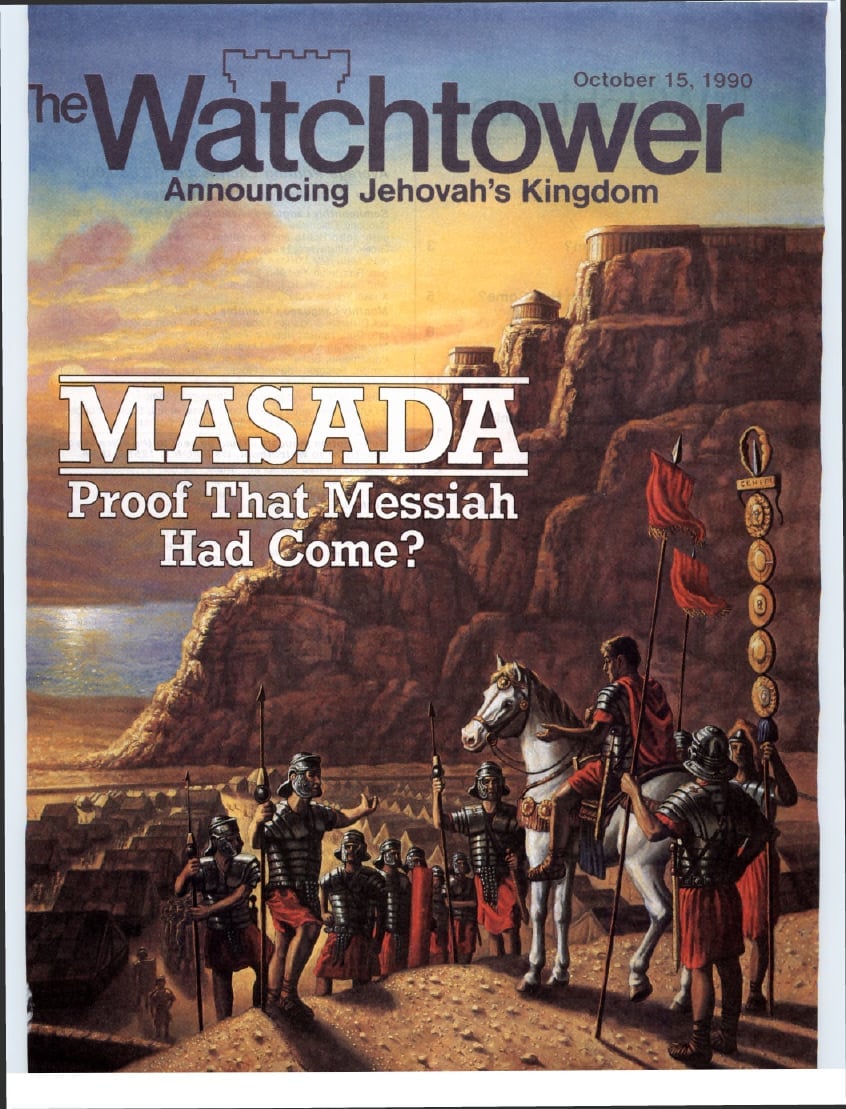
[Picture on cover]
Masada—Proof That Messiah Had Come?
[Picture on page 4]
A Jewish coin of 67 C.E., mentioning “Year 2” of the war with Rome
[Credit Line]
Pictorial Archive (Near Eastern History) Est.
Masada—Proof That Messiah Had Come?
Masada—Proof That Messiah Had Come?
BLOODSHED in the name of religion has been a recurring plague in history. Masada was no exception, for its defenders had strong religious motivations. If you visit the excavations at Masada, you can see the ruins of a synagogue where the dagger men met for worship and the ritual baths used for religious cleansing.
Fragments of the Bible have also been found at Masada. How, you may wonder, did the Biblical message available to the dagger men compare with what we read in the Bible today? Dr. Yigael Yadin, in his book Masada, wrote about the first such discovery:
“A quick examination on the spot showed us immediately that here was a fragment from the Book of Psalms, and we could even identify the chapters: the section ran Psalm 81 to Psalm 85. . . . It was possible to date it without the slightest doubt. It could not possibly be later than the year 73 AD, the year Masada fell. . . . This section from the Book of Psalms, like the other biblical scrolls which we found later, is almost exactly identical . . . to the text of the biblical books which we use today.”
Evidently, the dagger men believed that the Divine Author of the Hebrew Scriptures would bless their uprising against Rome. As The Universal Jewish Encyclopedia explains: “The fanatic zeal of the Jews in the Great War against Rome (66-73 C.E.) was strengthened by their belief that the Messianic era was near at hand. The loss of the Temple only increased the speculations as to the coming of the Messiah.”
The Coming of the Messiah
“Jewish messianic enthusiasts,” states The Encyclopedia of Religion, “would often base their calculations on the Book of Daniel.” True, the Hebrew prophet Daniel foretold the coming of “Messiah the Leader.” (Daniel 9:25) In two other accounts, Daniel said that the Messiah would become Ruler of the world and that His Kingdom would destroy all opposing human governments.—Daniel 2:44; 7:13, 14.
First-century Jewish revolutionaries felt that the time had arrived for the fulfillment of these prophetic visions. “What more than all else incited them to the war,” states Josephus, “was [the belief] that at that time one from their country would become ruler of the world.” But Daniel foretold that the Messianic Leader must first be “cut off” and that after his death Jerusalem and its temple would be brought to ruin by ‘the people of another leader who was coming.’—Daniel 9:25, 26.
Jewish Views of Gentile Rule
First-century Judea was divided between a few rich and many poor. Some rich Jews, especially among the Sadducees and Pharisees, treasured the authority that Rome allowed them to have in the land, and they despised the common people. Thus, they opposed any thought of revolution, working instead for peaceful relations with Rome.—Luke 16:14; 19:45, 46; John 2:14; 7:47-49; 11:47, 48.
On the other hand, ordinary Judeans suffered under the burden of Roman taxation and their own oppressive countrymen. They took no comfort in being under the so-called Pax Romana (Roman Peace) but wanted a change. This conflict of interests resulted in terrible civil strife. “One group was bent on domination,” wrote Josephus, “the other on violence and on robbing the rich.”
The dagger men, for example, plundered and killed fellow Jews and justified these terrorist acts as punishment of Jews who supposedly collaborated with Rome. A second-century rabbi, Johanan ben Torta, gave this reason for the calamity that came upon first-century Jews: “They lusted after money and hated one another.”
It is no wonder that those Jews who were truly God-fearing longed for the appearance of the Messiah, who they hoped would overthrow Roman rule and establish a just Kingdom of God. But unscrupulous men played on these hopes.
False Messiahs
About the year 33 C.E., a Jewish leader named Gamaliel reminded fellow rulers of Jerusalem: “Before these days . . . Judas the Galilean rose in the days of the registration, and he drew off people after him. And yet that man perished, and all those who were obeying him were scattered abroad.”—Acts 5:36, 37.
“The registration” that resulted in Judas’ uprising was organized in 6 C.E. for the purpose of raising taxes for Rome. Josephus tells us that Judas proclaimed that the Jews “were cowards if they submitted to paying taxes to the Romans.” The name Judas comes from the name Judah, suggesting that he belonged to the tribe from whom the Messiah was expected. (Genesis 49:10) “His fiery eloquence and the popularity of his doctrines drew vast numbers to his standard, by many of whom he was regarded as the Messiah,” states McClintock and Strong’s Cyclopædia.
Notice that Acts 5:37 reports that the followers of this Judas did not perish with him. His movement, according to Jewish scholar Gaalya Cornfeld, “struck deep roots and messianic hopes.” In fact, two leaders of the dagger men, Menahem and Eleazar, descended from that Judas the Galilean. At the start of the Jewish revolt in 66 C.E., Menahem armed his followers with weapons that had been stored at Masada. Then, “he returned like a king to Jerusalem” and “became the leader of the revolution.” “It is almost certain,” adds the Encyclopaedia Judaica, “that Menahem [son of] Judah was considered a Messiah.”
However, in that very year, Menahem was assassinated by members of a rival Jewish revolutionary movement. His followers fled back to Masada, where Eleazar took command of the dagger men until 73 C.E. Eleazar’s suicide speech echoes the mistaken teachings of his forefather Judas: “Long since, my brave companions, we determined to serve neither the Romans nor anyone else but only God.”
Neutrality of Judean Christians
Prior to the Jewish revolt in 66 C.E., Christian congregations had been established in Judea, including, of course, the congregation of Jerusalem. (Acts 9:31) These were made up of Jews who believed that Jesus of Nazareth was the Messiah whose death and resurrection had been foretold. (Acts 2:22-36) The Jewish Christians zealously spread their beliefs, while peacefully awaiting the Messiah’s second coming, as world ruler. Jesus had indicated that he would return “after a long time.”—Matthew 25:19, 31; 28:19, 20; Acts 1:8-11.
But once the Jewish revolt broke out in 66 C.E., what protected those Judean Christians from being carried away by its initial success? They no doubt recalled their Master’s warning: “All those who take the sword will perish by the sword.” (Matthew 26:52) Jesus also had given them a balanced view of Gentile governmental authority. “Pay back Caesar’s things to Caesar,” he said, “but God’s things to God.” (Mark 12:17) Furthermore, Jesus had foretold that messianic pretenders would come, saying, “‘I am he,’ and, ‘The due time has approached,’” but he warned: “Do not go after them.”—Luke 21:8.
Jesus had even predicted the outcome of the Jewish revolt, saying: “When you see Jerusalem surrounded by encamped armies, then know that the desolating of her has drawn near. Then let those in Judea begin fleeing to the mountains, and let those in the midst of her withdraw, and let those in the country places not enter into her; . . . for there will be great necessity upon the land and wrath on this people; and they will fall by the edge of the sword and be led captive into all the nations.”—Luke 21:20-24.
The terrible flood of destruction that followed the Jewish revolt was a dramatic fulfillment of Jesus’ prophecy! Yet, Judean Christians escaped by obediently “fleeing to the mountains.” “Prior to Jerusalem’s siege by Titus [in 70 C.E.],” states the Encyclopaedia Judaica, “its Christian community moved to Pella.” Interestingly, Pella was to the north, in the foothills of a mountain range across the Jordan River and so was completely separated from Judea by the Jordan Valley. “It is hard to account for this escape if [Jesus’] prophecy was written after the event,” states G. A. Williamson in his introduction to Josephus—The Jewish War.
Indeed, the successful escape of Judean Christians is powerful evidence that they were followers of the true Messiah. This raises important questions. What was the purpose of Messiah’s first coming? And what warning does the disastrous Jewish revolt sound for us today, especially the sector of humanity that is labeled “Christian”? These questions will be discussed further in this magazine.
Betrayal and Arrest
Jesus’ Life and Ministry
Betrayal and Arrest
IT IS well past midnight as Judas leads a large crowd of soldiers, chief priests, Pharisees, and others into the garden of Gethsemane. The priests have agreed to pay Judas 30 pieces of silver to betray Jesus.
Earlier, when Judas was dismissed from the Passover meal, he had evidently gone directly to the chief priests. These immediately assembled their own officers, as well as a band of soldiers. Judas had perhaps first led them to where Jesus and his apostles had celebrated the Passover. Discovering that they had left, the large crowd bearing weapons and carrying lamps and torches followed Judas out of Jerusalem and across the Kidron Valley.
As Judas leads the procession up the Mount of Olives, he feels sure he knows where to find Jesus. During the past week, as Jesus and the apostles traveled back and forth between Bethany and Jerusalem, they often stopped in the garden of Gethsemane to rest and to converse. But, now, with Jesus possibly concealed in the darkness beneath the olive trees, how will the soldiers identify him? They may never have seen him before. Judas provides a sign, saying: “Whoever it is I kiss, this is he; take him into custody and lead him away safely.”
Judas leads the great crowd into the garden, sees Jesus with his apostles, and goes straight up to him. “Good day, Rabbi!” he says and kisses him very tenderly.
“Fellow, for what purpose are you present?” Jesus retorts. Then, answering his own question, he says: “Judas, do you betray the Son of man with a kiss?” But enough of his betrayer! Jesus steps forward into the light of the burning torches and lamps and asks: “Whom are you looking for?”
“Jesus the Nazarene,” comes the answer.
“I am he,” Jesus replies, as he stands courageously before them. Astonished by his boldness and not knowing what to expect, the men draw back and fall to the ground.
“I told you I am he,” Jesus calmly continues. “If, therefore, it is I you are looking for, let these go.” Shortly before in the upper room, Jesus had told his Father in prayer that he had kept his faithful apostles and not one of them had been lost “except the son of destruction.” So, in order that his word might be fulfilled, he asks that his followers be let go.
As the soldiers regain their composure, stand up, and start to bind Jesus, the apostles recognize what is about to happen. “Lord, shall we strike with the sword?” they ask. Before Jesus replies, Peter, wielding one of the two swords the apostles have brought, attacks Malchus, a slave of the high priest. Peter’s blow misses the slave’s head but cuts off his right ear.
“Let it go as far as this,” Jesus says as he intervenes. Touching the ear, he heals the wound. Then he teaches an important lesson, commanding Peter: “Return your sword to its place, for all those who take the sword will perish by the sword. Or do you think that I cannot appeal to my Father to supply me at this moment more than twelve legions of angels?”
Jesus is willing to be arrested. For he explains: “How would the Scriptures be fulfilled that it must take place this way?” And he adds: “The cup that the Father has given me, should I not by all means drink it?” He is in complete agreement with God’s will for him!
Then Jesus addresses the crowd. “Have you come out with swords and clubs as against a robber to arrest me?” he asks. “Day after day I used to sit in the temple teaching, and yet you did not take me into custody. But all this has taken place for the scriptures of the prophets to be fulfilled.”
At that the soldier band and the military commander and the officers of the Jews seize Jesus and bind him. On seeing this, the apostles abandon Jesus and flee. However, a young man—likely it is the disciple Mark—remains among the crowd. He may have been at the home where Jesus celebrated the Passover and afterward followed the crowd from there. Now, however, he is recognized, and an attempt is made to seize him. But he leaves behind his linen garment and gets away lightly clad. Matthew 26:47-56; Mark 14:43-52; Luke 22:47-53; John 17:12; 18:3-12.
◆ Why did Judas feel sure he would find Jesus in the garden of Gethsemane?
◆ How does Jesus manifest concern for his apostles?
◆ What action does Peter take in Jesus’ defense, but what does Jesus say to him?
◆ How does Jesus reveal that he is in complete agreement with God’s will for him?
◆ When the apostles abandon Jesus, who remains, and what happens to him?
Appreciating Why the Messiah Was to Come
Appreciating Why the Messiah Was to Come
“We have found the Messiah.”—JOHN 1:41.
1. What startling announcement is recorded in the Bible, and when was it made?
A JEW named Andrew made the above startling announcement to his brother over 1,950 years ago. Can you sense the excitement in his words, recorded by the Christian apostle John? That unforgettable year was pinpointed by a Christian historian, Luke, as “the fifteenth year of the reign of Tiberius Caesar.” Tiberius’ 15th year, from the time he was proclaimed Roman emperor, began in September 28 C.E. and ended in September 29 C.E.—Luke 3:1-3, 21, 22; John 1:32-35, 41.
2. How did the prophecy of Daniel focus on the year 29 C.E.?
2 The year of Messiah’s appearance had been accurately foretold. Exactly 483 years had passed since the command was given by Persian king Artaxerxes to rebuild Jerusalem, that being in the 20th year of his reign, 455 B.C.E.a (Nehemiah 2:1-8) The prophet Daniel foretold “that from the going forth of the word to restore and to rebuild Jerusalem until Messiah the Leader, there will be seven weeks, also sixty-two weeks.” (Daniel 9:25) Thus, a period of 7 + 62 = 69 prophetic weeks would separate these two important events. Sixty-nine literal weeks equals 483 days. According to the prophetic rule of “a day for a year,” the Messiah would appear 483 years later, in 29 C.E.—Ezekiel 4:6.
3. (a) What is the meaning of the title “Messiah”? (b) What prophecies did the Messiah have to fulfill?
3 Justifiably, in the year 29 C.E., “the people were in expectation” of the Messiah. (Luke 3:1, 15) The title “Messiah” has the same meaning as “Christ” in Greek; both mean “Anointed One.” (John 1:41) The burning question among many Jews was, ‘Whom will Jehovah God anoint as king to rule not only Israel but all mankind?’ By means of prophecy, the choice had been narrowed down to a descendant of Abraham’s great-grandson Judah. Furthermore, the Messiah was to be heir to the throne of the Judean king David and was to be born in David’s hometown of Bethlehem.—Genesis 17:5, 6; 49:10; Psalm 132:11; Daniel 7:13, 14; Micah 5:2; John 7:42.
Unmistakable Identification
4, 5. (a) What happened in the key year 29 C.E.? (b) In what unmistakable way was the one chosen as Messiah identified?
4 In that key year, 29 C.E., this is what happened: “God’s declaration came to John the son of Zechariah in the wilderness. So he came into all the country around the Jordan, preaching baptism in symbol of repentance for forgiveness of sins.” (Luke 3:2, 3) John’s ministry prepared repentant Jews to accept the imminent coming of the Messiah. Furthermore, Jehovah gave John a sign. He was to look out for one “upon whom [he would] see the spirit coming down and remaining.”—John 1:33.
5 After baptizing Jesus of Nazareth, John saw this unmistakable anointing. Jesus was not anointed with oil, as his earthly forefather David had been, but with Jehovah God’s holy spirit. (1 Samuel 16:13; Acts 10:38) At the same time, God’s own voice said: “This is my Son, the beloved, whom I have approved.” (Matthew 3:16, 17) As John later testified: “I viewed the spirit coming down as a dove out of heaven, and it remained upon him. And I have seen it, and I have borne witness that this one is the Son of God.”—John 1:32, 34.
6. What fine example did Andrew and John set for us?
6 With such words, John the Baptizer faithfully introduced his disciples to Jesus, also calling him “the Lamb of God that takes away the sin of the world.” (John 1:29) Two disciples were quick to respond. After one day spent in Jesus’ company, they were thoroughly convinced. The name of the one was Andrew, who eagerly searched out his brother, Simon Peter. The other disciple is understood to be John the son of Zebedee, who became Jesus’ beloved apostle. After witnessing about the Messiah for nearly 70 years, this John was moved to write the above information for our benefit. Does his example and that of Andrew touch your heart? Are you as eager as they and the other “apostles of the Lamb” were to proclaim the thrilling truths about the Messiah?—Revelation 1:9; 21:14; John 1:35-41; Acts 5:40-42.
Anointed as King and High Priest
7. Why could Jesus not serve as a priest in Jerusalem’s temple?
7 Being born into the Jewish nation, Jesus “came to be under law.” (Galatians 4:4) Therefore, being of the tribe of Judah, he could not serve as a priest in Jehovah’s typical temple, whose priests were descendants of Aaron of the tribe of Levi. “Our Lord has sprung up out of Judah, a tribe about which Moses spoke nothing concerning priests,” the apostle Paul reminded fellow Christians.—Hebrews 7:14.
8. What did Jehovah’s earthly temple foreshadow?
8 The apostle John wrote: “The true light that gives light to every sort of man was about to come into the world.” (John 1:6-9) With Jesus’ baptism, it was as if a great spiritual temple came into existence, there now being a spiritual high priest who could save mankind from bondage to Satan’s world of spiritual darkness.—Hebrews 8:1-5; 9:24.
9, 10. (a) What was meant by Jesus’ words, “Sacrifice and offering you did not want” and, “You prepared a body for me”? (b) How did Jesus personally feel about this?
9 Jesus was praying at the time of his baptism. The Bible records some of his significant words, as later quoted by the apostle Paul: “‘Sacrifice and offering you did not want, but you prepared a body for me. You did not approve of whole burnt offerings and sin offering.’ Then I said, ‘Look! I am come (in the roll of the book it is written about me) to do your will, O God.’”—Hebrews 10:5-7; Luke 3:21.
10 Thus, Jesus applied to himself the prophecy at Psalm 40:6-8, which foretold Jehovah’s purpose to bring an end to animal sacrifices offered by Aaronic priests at Jerusalem’s temple. Jehovah did not “delight” in those offerings, in that they were only typical and unable to atone completely for human sin. Hence, Jehovah prepared a perfect human body for Jesus to sacrifice. God transferred the life of his heavenly Son to the womb of a Jewish virgin. Jesus was thus born uncontaminated by the sin of Adam. He was a perfect human Son of God, whose life could atone for the sin of mankind. (Luke 1:30-35) As Psalm 40:8 foretold, it was Jesus’ heartfelt desire to do his Father’s will. “By the said ‘will’ we have been sanctified through the offering of the body of Jesus Christ once for all time.”—Hebrews 10:10, 11.
11. What prophecy did the Messiah’s death fulfill, and how did it cause ‘sacrifice to cease’?
11 The sacrifice of Jesus’ human life once for all time canceled the need for additional offerings at the typical temple in Jerusalem. Furthermore, his death took place on Passover Day 33 C.E. That was about three and a half years after his baptism. The three and a half years would amount to half a prophetic week. (Numbers 14:34) So matters turned out exactly as Daniel had foretold concerning the cutting off of the Messiah: “At the half of the week he will cause sacrifice and gift offering to cease.” (Daniel 9:26, 27) Although the typical priesthood in Jerusalem functioned until the temple was destroyed in 70 C.E., the sacrifices that the priests offered during those years ceased to have any value, having been replaced by Jesus’ superior sacrifice.—Matthew 23:37, 38.
12. In what way is Jesus’ priesthood superior to that of Aaron?
12 Aaron had been the first in a long succession of Israelite high priests. After his being anointed with holy oil, he had to wait in the tabernacle for seven days before being empowered to serve as high priest. (Leviticus 8:12, 33) Similarly, Jesus had a waiting period before being empowered to intercede in behalf of mankind. That was from the time of his anointing as High Priest until his resurrection. Unlike Aaron, the immortal Son of God needs no successors, and he serves as both Priest and King “according to the manner of Melchizedek.”—Psalm 110:1-4; Genesis 14:18-20; Hebrews 6:20; 7:1-3, 11-17, 23-25.
13. (a) What heavy responsibility fell upon the high priests of Israel? (b) How has Jesus Christ shouldered an even greater responsibility?
13 In ancient Israel, the main responsibility for correct religious teaching fell upon the high priest. (Leviticus 10:8-11; Malachi 2:7) Jesus accordingly made known Jehovah’s righteous requirements for all who want to inherit the Kingdom and everlasting life. (Matthew 6:9, 10, 33; 7:28, 29; 11:12; 25:34, 46) When he was in a synagogue in Nazareth, Jesus read and applied to himself the prophecy: “Jehovah’s spirit is upon me, because he anointed me to declare good news.” Then, after spending time in Capernaum, he said: “Also to other cities I must declare the good news of the kingdom of God, because for this I was sent forth.” (Luke 4:18, 19, 43; Isaiah 61:1, 2) Jesus also trained 70 of his followers to expand this Kingdom-preaching work, and he foretold that they would do greater works than he himself had done. (Luke 10:1-9; John 14:12) This laid the foundation for a worldwide Bible educational campaign that Jesus would direct through ‘the faithful slave,’ consisting of his anointed followers.—Matthew 24:45-47; 28:19, 20.
Chief Vindicator of Jehovah’s Sovereignty
14. (a) Why did Israel’s high priest enter the Most Holy on the annual Day of Atonement? (b) What was pictured by the fragrant incense?
14 The most important reason why God’s Son came to earth was not to save mankind. Rather, it was to settle the slanderous issues raised by Satan with regard to Jehovah’s sovereignty. We can gain insight into this by reflecting on Israel’s annual Day of Atonement, when the typical high priest had to enter the Most Holy several times. The first entry was made with fragrant incense, which was poured upon an incense holder of burning coals. (Leviticus 16:12-16) This well represented what the antitypical High Priest was to do on earth before he ascended to heaven to appear before Jehovah with the value of his human sacrifice.b (Hebrews 9:24) As indicated by the use of the incense, Jesus’ course of faithfulness was marked by sincere prayers, a burning zeal for pure worship, and a deep love for Jehovah. (Psalm 141:2; Mark 1:35; John 2:13-17; 12:27, 28; 14:30, 31; Hebrews 5:7) Jesus succeeded in keeping flawless integrity in the face of all the subtle temptation, ridicule, and vicious persecution heaped upon him by Satan and his agents.—Proverbs 27:11; Matthew 22:15-18; Mark 14:60-65; 15:16-32; Luke 4:13, 29; John 8:44, 59.
15. How can we show our gratitude to Jehovah for providing such an excellent high priest? (Hebrews 10:21-26)
15 For vindicating Jehovah’s sovereignty, Jesus was rewarded with resurrection to immortal life in heaven. How grateful we should be to Jehovah for providing us with such an excellent High Priest! “Seeing, therefore, that we have a great high priest who has passed through the heavens, Jesus the Son of God, let us hold onto our confessing of him.” (Hebrews 4:14) Is it your earnest desire to follow Jesus’ example of integrity, regardless of what the Devil may do? If so, you can count on help, and you can succeed. That is because the very best of help is available. “We have as high priest, not one who cannot sympathize with our weaknesses, but one who has been tested in all respects like ourselves, but without sin. Let us, therefore, approach with freeness of speech to the throne of undeserved kindness, that we may obtain mercy and find undeserved kindness for help at the right time.”—Hebrews 4:15, 16; 5:7-10; Philippians 4:13; 1 John 2:1, 2.
The Need for Adjustment
16. What expectations did the Messiah’s early disciples have with respect to his Kingdom rule?
16 Andrew and John were quick to identify the true Messiah, but they and other early disciples had much to learn. (John 16:12, 13) Like many religious Jews at that time, they hoped that the Messianic Kingdom would begin ruling back then and that it would deliver the nation of Israel and its capital, Jerusalem, from Gentile domination. (Luke 2:38; 3:15; 19:11; 23:51; 24:21) Yet, what lasting benefit would that have brought sinful mankind?
17, 18. Why did Jesus give the illustration about “a certain man of noble birth”?
17 To remove sin and death from his future Kingdom subjects, it was vital that the Messiah first be cut off like a sacrificial lamb. (John 1:29; Isaiah 53:7, 12) When Jesus foretold how this would happen and how he would be resurrected, Peter responded: “Be kind to yourself, Lord; you will not have this destiny at all.” (Matthew 16:21, 22) Jesus knew, however, that his disciples “were not understanding the saying.”—Mark 9:31, 32; compare Matthew 17:22, 23.
18 On his last trip to Jerusalem, Jesus became even more explicit. (Matthew 20:18, 19) He also showed the great benefit his death would bring, saying: “The Son of man came . . . to give his soul a ransom in exchange for many.” (Matthew 20:28) Wrong expectations prevented his disciples from grasping this. Luke records: “He was near Jerusalem and they were imagining that the kingdom of God was going to display itself instantly.” To adjust their thinking, Jesus gave an illustration in which he likened himself to “a certain man of noble birth” who first had to travel “to a distant land to secure kingly power.” (Luke 19:11, 12) That “land” referred to heaven, to which Jesus ascended after his death and resurrection.
19. (a) What wrong expectation did Jesus’ disciples express after his resurrection? (b) What change in God’s relationship with humans took place at Pentecost 33 C.E.? (Hebrews 8:7-9, 13)
19 However, just before Jesus’ ascension, his disciples asked: “Lord, are you restoring the kingdom to Israel at this time?” (Acts 1:6) Did Jesus reject them for asking this? No, he explained that it was not yet the time and that they were to busy themselves with the important work of witnessing about the true Messiah. (Acts 1:7, 8) God’s covenant relationship with natural Israel was to cease before long. Therefore, the future Messianic Kingdom would not be restored to that unfaithful earthly nation. Jesus told his Jewish opposers: “The kingdom of God will be taken from you and be given to a nation producing its fruits.” (Matthew 21:43) Ten days after Jesus ascended to heaven, that nation was born. Holy spirit was poured out upon 120 of Jesus’ disciples, and thus they were anointed to be God’s “holy ones” and “joint heirs with Christ” in the coming Messianic Kingdom.—Daniel 7:13, 14, 18; Romans 1:7; 8:1, 16, 17; Acts 2:1-4; Galatians 6:15, 16.
20. In spite of having some wrong expectations, what did faithful first-century Christians do?
20 Even after their anointing, the first-century Christians had mistaken expectations. (2 Thessalonians 2:1, 2) But instead of becoming disgruntled quitters, they humbly accepted correction. Empowered by God’s holy spirit, they joyfully accepted the assignment to witness and “make disciples of people of all the nations.”—Matthew 28:19, 20; Acts 1:8; Colossians 1:23.
21. What questions will be considered in our next article?
21 What about our 20th century? Were Jehovah’s modern-day servants alert to the establishment of Jehovah’s Messianic Kingdom? And like their first-century counterparts, did they need to have their expectations adjusted in some ways?
[Footnotes]
Both The Encyclopedia Americana and the Great Soviet Encyclopedia agree that Artaxerxes’ reign ended in 424 B.C.E. When did it begin? In 474 B.C.E. In support of this, one archaeological inscription is dated in Artaxerxes’ 50th year; another indicates that he was succeeded in his 51st year. Counting back 50 complete years from 424 B.C.E., we come to the date 474 B.C.E. as the start of his reign. Therefore, Artaxerxes’ 20th year, when the command was given, would be 19 complete years into his reign, that is, 455 B.C.E. For further details, see Insight on the Scriptures, Volume 2, page 616, published by the Watchtower Bible and Tract Society of New York, Inc.
See The Watchtower of April 1, 1974, page 222.
How Would You Answer?
□ What is meant by the title “Messiah”?
□ What significant event took place in the year 29 C.E.?
□ How did Messiah ‘cause sacrifice to cease at the half of the week’?
□ Since his anointing, what responsibility has Jesus shouldered?
□ What was the main purpose of Messiah’s first coming, and how should this affect us?
[Picture on page 13]
The high priest’s first entry into the Most Holy foreshadowed something more important than mankind’s salvation
Be Thankful—Jehovah’s Messianic Kingdom Rules
Be Thankful—Jehovah’s Messianic Kingdom Rules
“We thank you, Jehovah God, the Almighty, . . . because you have taken your great power and begun ruling as king.”—REVELATION 11:17.
1. What did the president of the Watch Tower Society state after his tour of Europe in 1911?
EARLY in 1911, the president of the Watch Tower Society, C. T. Russell, gave a series of Bible lectures in major cities of Europe. Commenting on that tour, Russell wrote the following in The Watch Tower, May 15, 1911: “We were surprised to find so many evidences of prosperity everywhere . . . Our readers know that for some years we have been expecting this Age to close with an awful time of trouble, and we expect it to break out with suddenness and force not long after October, 1914, which, so far as we can understand the Scriptures, is the date at which the Times of the Gentiles—the lease of earth’s dominions to the Gentiles—will expire; the time, therefore, when Messiah’s kingdom will be due to begin its exercise of power.” Was this expectation fulfilled?
2. How was peace shattered in 1914, and with what sad consequences?
2 During the first half of 1914, the world seemed secure and safe from war. But peace was suddenly shattered with the assassination of the heir to the Austrian throne by a Serb on June 28, 1914. Austria-Hungary soon declared war against Serbia. Russia took sides with Serbia, so Germany declared war against Russia on August 1. Then Germany declared war against France on August 3; Great Britain against Germany on August 4; Montenegro against Austria-Hungary on August 7; Japan against Germany on August 23; Austria-Hungary against Belgium on August 28. Many believed that the war would soon be over. Instead, it escalated into the worst war of history up till that time, with 19 more countries taking sides in an international bloodbath that cost over 13,000,000 military and civilian lives, with over 21,000,000 maimed and wounded.
3, 4. What happened at the Society’s headquarters on Friday morning, October 2, 1914?
3 On Friday morning, October 2, 1914, Russell announced to the headquarters staff of the Watch Tower Society in Brooklyn, New York: “The Gentile times have ended; their kings have had their day.” This was greeted with enthusiastic applause by the family at Bethel, “the house of God.”
4 What justification did C. T. Russell and his associates have for being so joyful on that October morning? Where does the expression “Gentile Times” originate? What evidence is there that the Gentile Times ended in October 1914? And how should that affect you?
Jerusalem and the Gentile Times
5. Where does the expression “Gentile Times” originate?
5 The expression “Gentile Times,” or “appointed times of the nations,” comes from Jesus’ great prophecy concerning the destruction of Jerusalem. (Luke 21:5-36, King James Version) Two days prior to giving it, Jesus presented himself to the inhabitants of Jerusalem as their Messiah. While he humbly rode upon an ass toward the city, crowds of Jews shouted in triumph, just as Zechariah 9:9 foretold. “Blessed is the One coming as the King in Jehovah’s name,” they cried aloud.—Luke 19:28-40.
6, 7. What terrible bloodguilt did first-century Judeans bring upon themselves, and with what consequences?
6 But Jesus knew that public opinion would soon be swayed against him because of the murderous hatred by Jerusalem’s religious leaders under the influence of their father, the Devil. (Genesis 3:15; John 8:44) Shortly thereafter, on Nisan 14, a crowd of Jews clamored for Jesus’ death. “His blood come upon us and upon our children,” they cried to the reluctant Roman governor. (Matthew 27:24, 25) Instead of accepting Jesus as Messianic King, the chief priests declared: “We have no king but Caesar.” (John 19:15) The true Messiah was then nailed to a torture stake to die, having been falsely charged as a seditionist against Rome and a blasphemer against the God of the Jews.—Mark 14:61-64; Luke 23:2; John 18:36; 19:7.
7 Divine wrath was certain to come upon the inhabitants of Judea because of their terrible bloodguilt. Jerusalem, with its magnificent temple, could no longer be called “the city of the great King,” Jehovah. (Matthew 5:35; Luke 13:33-35) Some days before Jesus’ death, his disciples spoke admiringly of that city’s temple buildings. In response, Jesus predicted: “As for these things that you are beholding, the days will come in which not a stone upon a stone will be left here and not be thrown down.”—Luke 21:5, 6.
8. When Jesus gave “the sign” of events leading up to Jerusalem’s destruction, what else was involved?
8 Jesus’ disciples asked in surprise: “Teacher, when will these things actually be, and what will be the sign when these things are destined to occur?” (Luke 21:7) In reply Jesus accurately predicted the events that led up to Jerusalem’s destruction, and he added this significant phrase: “Jerusalem shall be trodden down of the Gentiles, until the times of the Gentiles be fulfilled.” (Luke 21:8-24, KJ) Jesus thus pointed ahead to something beyond Jerusalem’s destruction—something that had to wait “until the times of the Gentiles be fulfilled.” With reference to “the sign,” Jesus said: “When you see these things occurring, know that the kingdom of God is near.” (Luke 21:31) Therefore, the sign was to have a dual fulfillment. The first, or small-scale, fulfillment would indicate that ‘the desolating of Jerusalem had drawn near.’ (Luke 21:20) The second, and larger, fulfillment would come when the Gentile Times had ended, and it would indicate that “the kingdom of God is near.”—Compare Matthew 24:3.
Earthly Jerusalem Replaced by a Superior City
9. When did earthly Jerusalem lose its favored status, and by what has it been replaced?
9 By saying “Jerusalem will be trampled on by the nations, until the appointed times of the nations are fulfilled,” was Jesus suggesting that the earthly city would eventually be restored to divine favor? No. After the murder of God’s beloved Son, earthly Jerusalem lost its special status forever and has been replaced by a far superior “city of the living God, heavenly Jerusalem.”—Hebrews 12:22; Matthew 23:37, 38; 27:50, 51.
10. What is meant by the expression “heavenly Jerusalem”?
10 The expression “heavenly Jerusalem” is used in the Bible to describe the indestructible heavenly Kingdom to which anointed Christians have been called.a (Hebrews 11:10; 12:22, 28) When the apostle Paul wrote this, the earthly city with its temple was still very much admired by Jews. Thus, Paul reminded Hebrew Christians that “we do not have here a city that continues, but we are earnestly seeking the one to come.”—Hebrews 13:14.
Why Called Heavenly Jerusalem
11. Until earthly Jerusalem lost Jehovah’s favor, what did it represent?
11 Jerusalem was long the capital of the nation of Israel, whose kings were said to “sit upon Jehovah’s throne.” (1 Chronicles 29:23) Also, Jehovah made a covenant with David that the kingship would remain in his family forever. Just as modern-day capitals, such as Washington, Moscow, Canberra, and Pretoria, are used to identify their respective governments, so Jerusalem is used in the Bible to represent the Davidic kingdom.—2 Samuel 7:16; Luke 1:32.
12. How is the term “Gentile Times” to be applied?
12 David’s kingdom had a limited domain, extending only to the God-defined boundaries of ancient Israel. Earthly Jerusalem was therefore only a type of the real Messianic Kingdom that would rule from heaven and have the whole earth as its domain. (Psalm 2:2, 7, 8; Daniel 7:13, 14; 2 Timothy 4:18) Thus, the book The Time Is At Hand, published by the Watch Tower Society in 1889, clearly stated: “The term ‘Times of the Gentiles’ was applied by our Lord to that interval of earth’s history between the removal of the typical Kingdom of God, the Kingdom of Israel (Ezek. 21:25-27), and the introduction and establishment of its antitype, the true Kingdom of God.”
Gentile Times—How Long?
13. When did the Gentile Times begin, and why do you so answer?
13 The typical kingdom of God was overthrown by Babylonian king Nebuchadnezzar in 607 B.C.E. By the seventh Jewish month, about the middle of October, the land lay desolate.b (2 Kings 25:8, 9, 22, 25, 26) In proof that this happened by divine permission, Jehovah God gave Nebuchadnezzar a dream. It involved a tree that was chopped down and allowed to grow again after a period of “seven times.” The dream had an initial fulfillment when Nebuchadnezzar was restored to his throne after a temporary state of madness.—Daniel 4:10-17, 28-36.
14. What was the main point of Nebuchadnezzar’s dream?
14 However, the theme of Nebuchadnezzar’s dream showed that its main fulfillment involved God’s typical kingdom, which that Gentile king had been permitted to ‘chop down.’ The dream concluded with this statement of purpose: “That people living may know that the Most High is Ruler in the kingdom of mankind and that to the one whom he wants to, he gives it and he sets up over it even the lowliest one of mankind.”—Daniel 4:17.
15. How did Jesus Christ qualify as “the lowliest one of mankind”? (Matthew 11:29)
15 Only one person came to be qualified in all respects to be called “the lowliest one of mankind.” The only-begotten Son of God proved himself to be such by willingly leaving his heavenly glory to be born as a human, as Jesus, who suffered the most humiliating and cruel death at Satan’s hand. (Philippians 2:3, 5-11) After his resurrection back to heavenly glory, Jesus had to wait until the period of seven times of Gentile rule ended before being enthroned as the Messianic King over mankind.—Hebrews 10:12, 13.
16. How does the book of Revelation help Christians to calculate when the seven times ended?
16 But how did Jehovah’s Witnesses come to understand the length of the seven times? The Bible reveals that “a time and times and half a time,” or three and a half times, equals 1,260 days. (Revelation 12:6, 14) Therefore, double that number, or seven times, would amount to 2,520 days. On the basis of the prophetic guide of “a day for a year,” the seven times would equal 2,520 years. (Numbers 14:34; Ezekiel 4:6) By this calculation, the Gentile Times, which started in October 607 B.C.E., ended 2,520 years later in October 1914.
17. What happy announcement was due to be made known in 1914?
17 In October 1914, Jehovah God set his beloved Son, the Lord Jesus Christ, on the throne in the heavenly Kingdom. At last, the Revelation vision of the Christian apostle John started to become a reality, and the announcement could be made: “The kingdom of the world did become the kingdom of our Lord [Jehovah] and of his Christ, and he [Jehovah] will rule as king forever and ever.” (Revelation 1:10; 4:1; 11:15) What glorious news this is and what reason for the greatest happiness on the part of all joint heirs and subjects of that Kingdom!—Revelation 11:17.
18. Why have sorrowful conditions afflicted mankind since 1914?
18 True, for most of mankind, there has not been much happiness on earth since 1914. But the woeful conditions on earth are proof that Satan’s rule is about to end. How do we know this? The book of Revelation indicated that the establishment of God’s Kingdom would result in a war in heaven. Satan and his demons were to be cast out of heaven and limited to the vicinity of our earth. After seeing this victory in a prophetic vision, John heard a loud voice say: “Be glad, you heavens and you who reside in them! Woe for the earth and for the sea, because the Devil has come down to you, having great anger, knowing he has a short period of time.”—Revelation 12:1-12.
19. Why are true Christians so grateful to be alive at this time?
19 Worsening world conditions since 1914 are proof that John’s vision has become a reality and that the end of all humans who refuse to submit to God’s sovereignty is drawing perilously near. (Luke 21:10, 11, 25-32) How thrilling it is to be alive at this wonderful time when Jehovah God, the Almighty, will settle the great issue of his sovereignty over the earth! Then, earth will be transformed into a beautiful paradise, and righteous human survivors will be uplifted to perfection. Even the dead will be raised and given the opportunity to qualify for everlasting life.—Revelation 20:1-3, 12, 13; 21:3-5.
A Modern Need for Adjustment
20. (a) On earth, who proved to be Jehovah’s true servants before 1914? (b) What adjustments were faithful anointed Christians willing to make?
20 For 38 years prior to 1914, the Bible Students, as Jehovah’s Witnesses were then called, pointed to that date as the year when the Gentile Times would end.c What outstanding proof that is that they were true servants of Jehovah! Yet, like first-century servants of God, they also had some wrong expectations. For example, they expected that the full number of anointed Christians would be raised to heaven by October 1914. They also thought that the war that started in 1914 would lead directly on to the end of Satan’s world.
21. What discipline did true Christians experience during World War I?
21 In time, though, anointed Christians realized that there was much work for them to do on earth. Because of their persistence in public witnessing during World War I, they experienced vicious persecution from the political authorities, urged on by Christendom’s clergy. (Psalm 2:1-6) The activity of true Christians was dealt a severe blow on June 21, 1918, when leading officials of the Watch Tower Society in the United States were sentenced to 20 years’ imprisonment under false charges.
22, 23. (a) What have faithful anointed Christians done since 1919, and with what twofold response? (b) What is antitypical unfaithful Jerusalem?
22 World War I came to a sudden end in November 1918. Then, on March 25, 1919, the officials of the Watch Tower Society were released from prison. They were later fully exonerated. An unexpected period of peace opened up for those faithful anointed Christians, similar to the opportunities that presented themselves to Christ’s early disciples after they were empowered by holy spirit in 33 C.E.—Acts 2:17-21, 41.
23 Ever since 1919, faithful anointed Christians as a group have zealously obeyed the command involved in Jesus’ words at Matthew 24:14: “This good news of the kingdom will be preached in all the inhabited earth for a witness to all the nations; and then the end will come.” As a result, nearly four million of Christ’s “other sheep” have devoted their lives to serving Jehovah in unity with the anointed remnant. (John 10:16) Christendom, under the influence of its clergy, continues to reject the Kingdom message. Its preference for human political schemes and its persecution of Jehovah’s Witnesses parallel the shocking treatment of Christ by the first-century inhabitants of Judea. Just as Jehovah executed his judgment upon Jerusalem, so he will do to antitypical unfaithful Jerusalem, namely, Christendom. And as the generation that heard Christ’s judgment message lived to experience the destruction he foretold, so the present generation since 1914 “will by no means pass away” before the foretold “great tribulation” comes.—Matthew 24:21, 22, 34.
24. To survive into God’s new world, what must we do?
24 What must we do to survive the great tribulation and live on into God’s new world? Regardless of wrong expectations any of us may have had, we must guard against falling asleep as to our Christian duties. (Habakkuk 2:3; 1 Thessalonians 5:1-6) Those able to recall events from 1914 are becoming ever fewer. Thus, we need to be alert; there is no time to lose. (Matthew 24:42) All who want to survive the end of Satan’s wicked world must act now in a way that shows agreement with the inspired words: “We thank you, Jehovah God, the Almighty, . . . because you have taken your great power and begun ruling as king.”—Revelation 11:17.
[Footnotes]
See The Watchtower of March 15, 1983, page 22.
For more information as to why this marks the start of the Gentile Times, see “Let Your Kingdom Come,” chapter 14, published by the Watchtower Bible and Tract Society of New York, Inc.
C. T. Russell wrote an article entitled “Gentile Times: When Do They End?,” which was published in the magazine Bible Examiner, October 1876. On page 27, the article said: “The seven times will end in A.D. 1914.”
How Would You Answer?
□ What did ancient Jerusalem represent, but how did it lose its honored status?
□ When did the Gentile Times begin and end, and with what foretold result?
□ What did the destruction of unfaithful Jerusalem prefigure?
□ How do we know that the great tribulation is close, and what must we do to survive it?
[Picture on page 16]
Jerusalem and its temple lost their honored status, but God continued to bless his Son, the Messiah, even speaking to him directly from heaven
Insight on the News
Insight on the News
Homosexuals—Equal Before God?
In the Australian state of Queensland, homosexual acts—even in private by consenting partners—are illegal. Recently, a major church group in that state came out strongly against such laws; they want homosexuality decriminalized.
According to the newspaper The Courier-Mail, this Joint Church Social Justice Group is made up of members of the Anglican, Roman Catholic, Lutheran, Baptist, and Uniting churches and Quakers (Society of Friends). Claiming that existing laws against homosexuals are based on ignorance and prejudice, the group stated: “Our support for this position is based on the belief that all people are equal before God and should be equal before the law. We believe a homosexual person is no more or less a human person than a heterosexual person.”
While it is true that all men are born equal, what is God’s view of homosexuality? In the Bible, all homosexual acts are condemned as unnatural and as meriting God’s disapproval, leading to death. This was true not only in ancient Israel but also in Christian times. (Leviticus 18:22; Romans 1:26, 27) The condemnation is clear and needs no interpretation: “Neither fornicators, . . . nor men kept for unnatural purposes, nor men who lie with men . . . will inherit God’s kingdom.”—1 Corinthians 6:9, 10.
Rather than clamoring for the decriminalizing of homosexuality, true Christians urge those enslaved to this God-dishonoring practice to break free of it by turning to God’s Word of truth.
Blood Risks Continue
A recent investigation revealed that hundreds of mistakes have been made by the American Red Cross in the handling of contaminated blood. Nearly half of the 12 million to 15 million units of blood used in the United States annually are supplied by the American Red Cross. When any units of blood get released that are found to be contaminated, the FDA (Food and Drug Administration), an agency of the federal government, is to be notified. However, The New York Times states that a federal inspector contends that the Red Cross often failed to do this. He claims that a search of their records revealed 380 instances in which the mishandling of contaminated blood was never reported to the government. In addition, out of 228 cases of AIDS that may have been caused by blood transfusions, the inspector discovered that the Red Cross reported only 4 to the FDA.
While many still view it as lifesaving, transfused blood is responsible for the death of thousands each year. Yet, true worshipers of God, in obeying his laws with respect to blood, are at the same time protected from transfusion dangers. God commanded: “You must not eat the blood; pour it out on the ground like water . . . so that it may go well with you and your children after you, because you will be doing what is right.”—Deuteronomy 12:23-25, New International Version.
The Pope on Military Service
Last year the pope met with more than 7,000 military cadets at the Rome garrison of Cecchignola. At that time four young officers representing the garrison asked the pope whether military service is compatible with the Christian conscience. Specifically, according to the Vatican City newspaper L’Osservatore Romano, they asked: “Can one be a faithful Christian and, at the same time, a faithful soldier?” In response the pope said: “There is no basic difficulty or impossibility in uniting the Christian vocation with that of military service. If we look at the latter positively, it can be seen as a beautiful, worthy and fine thing.”
Is such a view, however, compatible with the neutrality maintained by early Christians? In his book An Historian’s Approach to Religion, Arnold Toynbee cites the case of Maximilianus, a third-century martyr who, when threatened with death by the Roman court for refusing recruitment into the military, said: “I won’t serve. You may behead me, but I won’t serve the powers of This World; I will serve my God.” Why, in the face of certain death, did he refuse participation in military service? Because he considered true followers of Jesus to be “no part of the world” just as Jesus was no part of the world. Moreover, he regarded the Christian’s warfare to be spiritual, in line with the apostle Paul’s words: “We do not wage warfare according to what we are in the flesh. For the weapons of our warfare are not fleshly.”—John 17:16; 2 Corinthians 10:3, 4.
“Standing Firm As One Flock” in Chad
“Standing Firm As One Flock” in Chad
Like their fellow Christians around the world, Jehovah’s Witnesses in Chad appreciate the annual assemblies that are arranged for their spiritual upbuilding. Here is the account of a trip to a series of special assembly days held in the southern part of this landlocked, central African country.
Because of distance and travel difficulties, assemblies in Chad are usually held in small groups, their timing being determined by the weather. From June to September, the rainy season renders travel difficult and in some areas impossible. The special assembly days are held after the heavy rains have passed. The end-of-year holidays are convenient for the larger district convention. And before the rains begin again in June, the two-day circuit assemblies are presented.
IT WAS a hot and sticky Sunday afternoon. The Kingdom Hall at N’Djamena, the capital of Chad, was packed with 184 persons. Despite the heat, they were paying rapt attention to the main talk, “Standing Firm in One Spirit.” That morning they were happy to witness three persons symbolize their dedication to Jehovah God by water baptism. This was the first of six special assembly days that a local traveling overseer and I were privileged to serve.
The theme of the series, “Standing Firm as One Flock,” was particularly appreciated by the 267 Witnesses in Chad. They live far from fellow Christians in other lands. Yet, their receiving the same spiritual food and being cared for in the same way encourages them to continue to work in unity with their brothers worldwide. The practical counsel of this program also fortified them to stand firm against the subtle influence of Satan’s world and the winds of persecution or opposition.
In N’Djamena
The first congregation of Jehovah’s Witnesses in Chad was formed in N’Djamena in 1964. Now it has over 90 publishers of the Kingdom good news. It was a pleasure to look out at the audience and see many who have been serving faithfully since the early days of the work in Chad. One brother had three wives when he first learned of the Bible’s truth. Soon he saw the need to conform his life to Bible standards. He legally married his first wife and separated from the others, though making caring arrangements for them. He was baptized in 1973 and has been active in the work ever since.
One elder who participated in the program had undergone a severe test of faith. In 1975 the government of that time enforced participation in certain customs that were based on worship of the dead; anyone who failed to comply could be put to death. When the brother stood firm and would not compromise his faith, the authorities began searching for him. Only a change in government at that crucial time spared him.
On the Road to Pala
After N’Djamena, the trip south to serve the remaining five assemblies began. We had often taken the route before but only in the dry season. Now, in late September at the close of the rainy season, everything was green and luxuriant. It was an enjoyable time to travel. We passed field after field of millet. The heads on the tall stalks lining the road were now ripening. Soon they would be harvested, dried, and stored in the cone-shaped earthen granaries that dot the countryside. Millet is the staple food for most Chadians. It is pounded in a large wooden mortar with a pestle that is often taller than the person using it. Then the flour is mixed with boiling water and molded into a ball to be eaten with a sauce made with okra or peanuts as a base.
We saw more and more fields of cotton as we traveled farther south. Because the terrain is flat in this part of the country, the flowering fields seemed to reach right to the horizon. Soon whole families would be out in the fields picking the cotton by hand. Cotton is the largest cash crop in Chad, 133,000 tons being harvested in 1988. By late afternoon, we were passing Lake Léré. Here the country is hilly and very picturesque, particularly at this time of the year. Being there at just the right time, we were able to purchase freshly caught carp that was fried right along the road. It was a meal that any host would be proud to serve.
…