The Watchtower, October 1, 1989
Download: PDF — The Watchtower, October 1, 1989
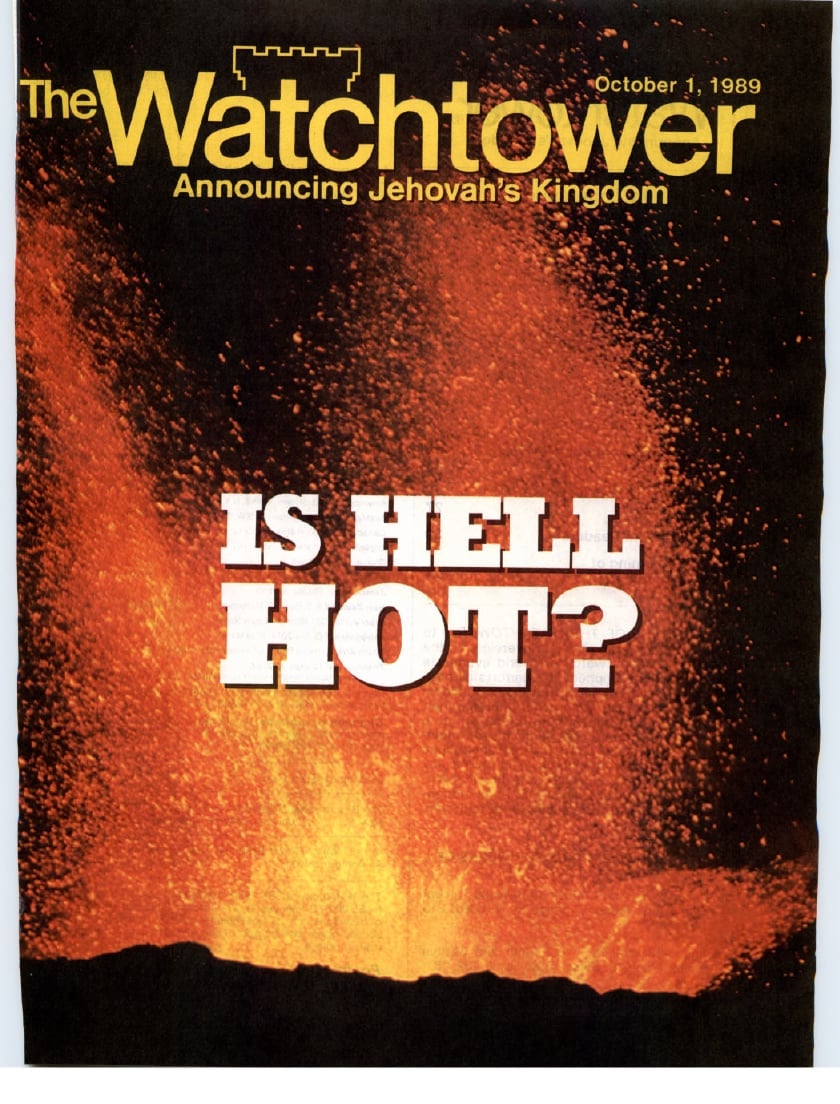
The Watchtower — October 1, 1989
Source: jw.org
Contents
Is Hell Hot?
The Origin of Hell
The Truth About Hell
The Illustration of the Minas
Do You Condemn the World Through Your Faith?
Maintain Your Faith and Spiritual Health
They Found a Reason to Change
Always Finding Something to Do for Jehovah
‘Unless Jehovah Builds the House . . .’
Questions From Readers
AIDS—‘Beginning of a New Morality’?
“I Would Happily Pick ‘Awake!’”
Is Hell Hot?
Is Hell Hot?
“AT SOME point in the nineteen-sixties, Hell disappeared.” So said British author David Lodge in his book Souls and Bodies, and his words reflect the thinking of many Catholics and Protestants during the decades following the second world war. For a time, many of the mainstream churches themselves soft-pedaled their official doctrine of a fiery hell in their efforts to adapt to modern thought patterns.
The idea of punishment after death was especially unacceptable to people because the notion of sin itself had become cloudy in their minds. Interviewed in 1984, Rome’s Cardinal Ratzinger said: “Our civilization . . . focuses on mitigating circumstances and alibis in the attempt to take away people’s sense of guilt, of sin . . . , that very reality with which belief in hell and Purgatory is associated.”
Is it possible today to believe in the reality of sin without accepting the doctrine of punishment after death in purgatory and hell? A recent book, Abrégé de la foi catholique (Summary of the Catholic Faith), prefaced by French Cardinal Decourtray, put the question squarely: “Is it necessary to believe in hell?” The answer: “It is not possible to elude the frightening question of hell.” The work Vatican Council II—More Postconciliar Documents (1982) quotes “The Credo of the People of God” as stating: “We believe . . . [that] those who have responded to the love and compassion of God will go into eternal life. Those who have refused them to the end will be consigned to the fire that is never extinguished.”
So, in spite of all theological efforts to prove the contrary, hellfire is still very much a part of official Catholic dogma. Yet A New Dictionary of Christian Theology (1983) speaks of the “embarrassment” and the “discomfort” that the doctrine of eternal damnation causes many members of Christendom’s churches today. They have trouble reconciling this dogma with the notion of a God of love. They wonder: ‘Is a hot hell really a Christian and Biblical doctrine? If not, where did it originate?’
[Picture on page 3]
Bourges Cathedral, France
The Origin of Hell
The Origin of Hell
“HELL,” explains the New Catholic Encyclopedia, is the word “used to signify the place of the damned.” A Protestant encyclopedia defines hell as “the place of future punishment for the wicked.”a But belief in such a place of punishment after death is not limited to the main churches of Christendom. It originated many centuries before Christendom came into existence.
The Mesopotamian Hell
About 2,000 years before the birth of Jesus, the Sumerians and the Babylonians believed in an underworld that they called the Land of No Return. This ancient belief is reflected in the Sumerian and the Akkadian poems known as “The Epic of Gilgamesh” and the “Descent of Ishtar to the Underworld.” They describe this abode of the dead as a house of darkness, “the house which none leave who have entered it.”
As to the conditions prevailing there, an ancient Assyrian text states that “the nether world was filled with terror.” The Assyrian prince who was supposedly granted a view of this subterranean abode of the dead testified that his “legs trembled” at what he saw. Describing Nergal, the king of the underworld, he recorded: “With a fierce cry he shrieked at me wrathfully like a furious storm.”
Egyptian and Oriental Religions
The ancient Egyptians believed in the immortality of the soul, and they had their own concept of the afterworld. The New Encyclopædia Britannica states: “Egyptian funerary texts depict the way to the next world as beset by awful perils: fearsome monsters, lakes of fire, gates that cannot be passed except by the use of magical formulas, and a sinister ferryman whose evil intent must be thwarted by magic.”
The Indo-Iranian religions developed various beliefs on punishment after death. Concerning Hinduism, the French Encyclopædia Universalis (Universal Encyclopedia) states: “There are innumerable descriptions of the 21 hells imagined by the Hindus. Sinners are devoured by wild beasts and by snakes, laboriously roasted, sawed into parts, tormented by thirst and hunger, boiled in oil, or ground to powder in iron or stone vessels.”
Jainism and Buddhism both have their versions of hell, where impenitent sinners are tormented. Zoroastrianism, founded in Iran, or Persia, also has a hell—a cold, ill-smelling place where the souls of sinners are tormented.
Interestingly, it would appear that the torments of the Egyptian, Hindu, Jain, Buddhist, and Zoroastrian versions of hell are not everlasting. According to these religions, after a period of suffering, the souls of sinners move on to some other place or state, depending on the particular religion’s concept of human destiny. Their ideas of hell resemble Catholicism’s purgatory.
Greek, Etruscan, and Roman Hells
The ancient Greeks believed in the survival of a soul (psy·kheʹ, the word they also used for the butterfly). They called Hades the realm of the dead and believed it was ruled over by a god of the same name. In his book Orpheus—A General History of Religions, French scholar Salomon Reinach wrote of the Greeks: “A widely spread belief was that [the soul] entered the infernal regions after crossing the river Styx in the boat of the old ferryman Charon, who exacted as the fare an obolus [coin], which was placed in the mouth of the dead person. In the infernal regions it appeared before the three judges of the place . . . ; if condemned for its crimes, it had to suffer in Tartarus. . . . The Greeks even invented a Limbo, the abode of children who had died in infancy, and a Purgatory, where a certain mild chastisement purified souls.” According to The World Book Encyclopedia, souls that ended up in Tartarus “suffered eternal torment.”
In Italy the Etruscans, whose civilization preceded that of the Romans, also believed in punishment after death. The Dictionnaire des Religions (Dictionary of Religions) states: “The extreme care that the Etruscans took of their dead is explained by their conception of the nether regions. Like the Babylonians, they considered these to be places of torture and despair for the manes [spirits of the dead]. The only relief for them could come from propitiatory offerings made by their descendants.” Another reference work declares: “Etruscan tombs show scenes of horror that inspired Christian paintings of hell.”
The Romans adopted the Etruscan hell, calling it Orcus or Infernus. They also borrowed the Greek myths about Hades, the king of the underworld, calling him Orcus, or Pluto.
The Jews and the Hebrew Scriptures
What about the Jews before Jesus’ day? Concerning them, we read in the Encyclopædia Britannica (1970): “From the 5th century B.C. onward, the Jews were in close contact with the Persians and the Greeks, both of whom had well-developed ideas of the hereafter. . . . By the time of Christ, the Jews had acquired a belief that wicked souls would be punished after death in Gehenna.” However, the Encyclopædia Judaica states: “No suggestion of this later notion of Gehenna is to be found in Scripture.”
This latter statement is correct. There is no suggestion in the Hebrew Scriptures of a postmortem punishment for a soul in a fiery hell. This frightening doctrine goes back to the post-Flood religions of Babylonia, not to the Bible. Christendom’s doctrine of punishment in hell originated with the early Babylonians. The Catholic idea of remedial suffering in purgatory goes back to the early Egyptian and Oriental religions. Limbo was copied from Greek mythology. Prayers and offerings for the dead were practiced by the Etruscans.
But upon what basic supposition are these doctrines of conscious punishment after death based?
[Footnotes]
M’Clintock and Strong’s Cyclopædia of Biblical, Theological, and Ecclesiastical Literature, Volume 4, page 165.
[Picture on page 5]
Crossing the Styx as described in Dante’s “Inferno”
[Credit Line]
Dover Publications, Inc.
The Truth About Hell
The Truth About Hell
OBVIOUSLY, the underlying doctrine behind belief in punishment after death is the belief that the real man does not actually die when the fleshly body dies but that something—often called a soul—survives the death of the body. This belief, as we saw in the preceding article, goes back to the early Sumerians and Babylonians in Mesopotamia. Later, it was adopted by the Greeks, whose philosophers, such as Plato, polished the theory. Their refined dualistic belief in “body and soul” became a part of apostate Jewish belief.
When did professed Christians adopt the belief in such an afterlife? Certainly not during the time of Jesus and his apostles. The French Encyclopædia Universalis states: “The [apocryphal] Apocalypse of Peter (2nd century C.E.) was the first Christian work to describe the punishment and tortures of sinners in hell.”
In fact, it appears that among the early church fathers, there was much disagreement over hell. Justin Martyr, Clement of Alexandria, Tertullian, and Cyprian were for a fiery hell. Origen tried to give hell a remedial twist, claiming that sinners in hell would eventually be saved. He was followed to a greater or lesser degree by Gregory of Nazianzus and Gregory of Nyssa. But Augustine put an end to such soft views of hell. In his book Early Christian Doctrines, Oxford professor J. N. D. Kelly writes: “By the fifth century the stern doctrine that sinners will have no second chance after this life and that the fire which will devour them will never be extinguished was everywhere paramount.”
As to purgatory, the book Orpheus—A General History of Religions states: “St. Augustine had held that there was an intermediate state of probation between future felicity and damnation, that of the purification of souls by fire. This is the Orphic [pagan Greek] and Virgilian [pagan Roman] doctrine of Purgatory: there is not a word about it in the Gospels. . . . The doctrine of Purgatory . . . was formulated in the sixth century, and proclaimed a dogma of the Church by the Council of Florence (1439).” The New Catholic Encyclopedia admits: “The Catholic doctrine on purgatory is based on tradition, not Sacred Scripture.” With regard to Limbo, Rome’s Cardinal Ratzinger admits that it is “only a theological hypothesis.”
No Punishment After Death
What, though, about the Bible? Does it say that the soul survives the body at death and can therefore be punished in a fiery hell or purgatory? The New Catholic Encyclopedia states: “The notion of the soul surviving after death is not readily discernible in the Bible. . . . The soul in the O[ld] T[estament] means not a part of man, but the whole man—man as a living being. Similarly, in the N[ew] T[estament] it signifies human life: the life of an individual.”
So the underlying premise for punishment after death falls flat. The Bible states: “The soul that sins shall die.” (Ezekiel 18:4, Revised Standard Version, Catholic Edition) It also declares: “The wages of sin is death.” (Romans 6:23, RSV) Therefore, when the Bible speaks of impenitent wicked people ending up in “Gehenna,” “everlasting fire,” or “the lake of fire,” it is merely using symbolic language to speak of their undergoing permanent death, “the second death.”—Matthew 23:33; 25:41, 46; Revelation 20:14; 21:8;a compare 2 Thessalonians 1:7-9.
Hell Emptied by the Resurrection
Is hell hot, then? Not according to the Bible. Indeed, the Hebrew and Greek words translated in some Bibles as “hell” merely designate the common grave of dead humans. It is not a hot place of torment. It is, rather, a place of rest, from which the dead will come forth in the resurrection. (Ecclesiastes 9:10; Acts 24:15) Oscar Cullmann, professor at the Theological Faculty of the University of Basel, Switzerland, and of the Sorbonne, in Paris, speaks of the “radical difference between the Christian expectation of the resurrection of the dead and the Greek belief in the immortality of the soul.” Correctly, he says that “the fact that later Christianity effected a link between the two beliefs . . . is not in fact a link at all but renunciation of one [the Bible doctrine of the resurrection] in favour of the other [the pagan belief in the immortality of the human soul].”—Italics ours.
Jehovah’s Witnesses have not renounced their faith in the resurrection in favor of the idea of the immortality of the soul. They will be delighted to share with you their happy hope and prove to you from the Bible that, of a truth, hell is not hot.
[Footnotes]
For further information on these and other Bible texts that have been used by some to attempt to bolster the doctrine of a fiery hell, see the book Is This Life All There Is? published by the Watchtower Bible and Tract Society of New York, Inc.
The Illustration of the Minas
Jesus’ Life and Ministry
The Illustration of the Minas
JESUS is perhaps still at the home of Zacchaeus, where he has stopped en route to Jerusalem. His disciples believe that when they get to Jerusalem, he will declare that he is the Messiah and set up his Kingdom. To correct this idea and to show that the Kingdom is yet a long way off, Jesus gives an illustration.
“A certain man of noble birth,” he relates, “traveled to a distant land to secure kingly power for himself and to return.” Jesus is the “man of noble birth,” and heaven is the “distant land.” When he arrives there, his Father will grant him kingly power.
Before leaving, however, the man of noble birth calls ten slaves and gives each of them a silver mina, saying: “Do business till I come.” The ten slaves in the initial fulfillment represent Jesus’ early disciples. In an enlarged application, they picture all who are prospective heirs with him in the heavenly Kingdom.
The silver minas are valuable pieces of money, each amounting to about three months’ wages for an agricultural worker. But what do the minas represent? And what kind of business are the slaves to do with them?
The minas represent assets that spirit-begotten disciples could make use of in producing more heirs of the heavenly Kingdom until Jesus’ coming as King in the promised Kingdom. After his resurrection and appearance to his disciples, he gave them the symbolic minas for making more disciples and thus adding to the Kingdom-of-heaven class.
“But,” Jesus continues, “his citizens hated [the man of noble birth] and sent out a body of ambassadors after him, to say, ‘We do not want this man to become king over us.’” The citizens are Israelites, or Jews, not including his disciples. After Jesus’ departure to heaven, these Jews by persecuting his disciples made known that they did not want him to be their king. In this way they were acting like the citizens who sent out the body of ambassadors.
How do the ten slaves use their minas? Jesus explains: “Eventually when he got back after having secured the kingly power, he commanded to be called to him these slaves to whom he had given the silver money, in order to ascertain what they had gained by business activity. Then the first one presented himself, saying, ‘Lord, your mina gained ten minas.’ So he said to him, ‘Well done, good slave! Because in a very small matter you have proved yourself faithful, hold authority over ten cities.’ Now the second came, saying, ‘Your mina, Lord, made five minas.’ He said to this one also, ‘You, too, be in charge of five cities.’”
The slave with ten minas pictures a class, or group, of disciples from Pentecost 33 C.E. until now that includes the apostles. Those that gained five minas also represent a group during the same time period that, according to their opportunities and abilities, increase their king’s assets on earth. Both groups zealously preach the good news, and as a result, many righthearted ones become Christians. Nine of the slaves did successful business and increased their holdings.
“But,” Jesus goes on, “a different one came, saying, ‘Lord, here is your mina, that I kept laid away in a cloth. You see, I was in fear of you, because you are a harsh man; you take up what you did not deposit and you reap what you did not sow.’ He said to him, ‘Out of your own mouth I judge you, wicked slave. You knew, did you, that I am a harsh man, taking up what I did not deposit and reaping what I did not sow? Hence why is it you did not put my silver money in a bank? Then on my arrival I would have collected it with interest.’ With that he said to those standing by, ‘Take the mina from him and give it to him that has the ten minas.’”
Loss of the symbolic mina means loss of a place in the heavenly Kingdom for the wicked slave. Yes, he loses the privilege of ruling, as it were, over ten cities or five cities. Note, too, that the slave is not pronounced wicked for any badness he does but, rather, for failing to work for the increase of the wealth of his master’s kingdom.
When the wicked slave’s mina is given to the first slave, the objection is made: “Lord, he has ten minas!” Yet, Jesus answers: “To everyone that has, more will be given; but from the one that does not have, even what he has will be taken away. Moreover, these enemies of mine that did not want me to become king over them bring here and slaughter them before me.” Luke 19:11-27; Matthew 28:19, 20.
◆ What prompts Jesus’ illustration of the minas?
◆ Who is the man of noble birth, and what is the land to which he goes?
◆ Who are the citizens, and how do they show their hatred?
◆ Who are the slaves, and what is represented by the minas?
◆ Why is one slave called wicked, and what does loss of his mina mean?
Do You Condemn the World Through Your Faith?
Do You Condemn the World Through Your Faith?
“By faith Noah . . . constructed an ark for the saving of his household; and through this faith he condemned the world.”—HEBREWS 11:7.
1, 2. What can we learn from an examination of Noah’s life?
JEHOVAH granted Noah and his family—just eight in number—the privilege of being the only humans to survive the Flood. The lives of all the rest of Noah’s contemporaries were cut short when God swept them into a watery grave. Since Noah is therefore our common ancestor, we should be very grateful for the faith he exercised.
2 We can learn much from examining Noah’s life. The Scriptures tell us why God favored him with salvation while He destroyed the people of Noah’s generation. This same divine record clearly shows that our generation faces a similar judgment by God. Concerning this, Jesus said: “There will be great tribulation such as has not occurred since the world’s beginning until now, no, nor will occur again.” (Matthew 24:21) By imitating Noah’s faith, we can have the sure hope of surviving the imminent destruction of this present wicked system.—Romans 15:4; compare Hebrews 13:7.
3. Why did Jehovah bring the Flood?
3 During the 1,656 years from Adam’s creation to the Deluge, very few humans had the inclination to do good. Morality plummeted to an extremely low level. “Jehovah saw that the badness of man was abundant in the earth and every inclination of the thoughts of his heart was only bad all the time.” (Genesis 6:5) Violence, pleasure-seeking, and the presence of materialized angels who married women and produced giant offspring were among the factors that led to the execution of God’s judgment upon that ancient world of mankind. To Noah, Jehovah said: “The end of all flesh has come before me, because the earth is full of violence as a result of them.” The patience of the Creator, the “Judge of all the earth,” had run out.—Genesis 6:13; 18:25.
Noah Walked With God
4. (a) How did Jehovah view Noah, and why? (b) While God’s justice demanded destruction of that wicked world, how was his love manifested in behalf of Noah and his family?
4 How different Noah was from people of his day! He “found favor in the eyes of Jehovah. . . . Noah was a righteous man. He proved himself faultless among his contemporaries. Noah walked with the true God.” (Genesis 6:8, 9) How did Noah walk with God? By doing right things such as preaching as an advocate of righteousness and building the ark in faith and obedience. Thus, although that ancient world was destroyed because it was completely corrupt, God “kept Noah, a preacher of righteousness, safe with seven others when he brought a deluge upon a world of ungodly people.” (2 Peter 2:5) Yes, our loving and just God, Jehovah, did not destroy the righteous with the wicked. He instructed Noah to build a huge ark for the saving of himself, his household, and a number of animals, all for repopulating the earth after the Deluge. And Noah “did just so.”—Genesis 6:22.
5. How do the Scriptures describe Noah’s righteousness and faith?
5 With the ark finished, God told Noah: “Go, you and all your household, into the ark, because you are the one I have seen to be righteous before me among this generation.” Paul sums matters up in this way: “By faith Noah, after being given divine warning of things not yet beheld, showed godly fear and constructed an ark for the saving of his household; and through this faith he condemned the world, and he became an heir of the righteousness that is according to faith.”—Genesis 7:1; Hebrews 11:7.
6. How did Noah condemn the world of his day through his faith?
6 Noah had outstanding faith. He believed what God said about wiping out that generation. Noah had a healthy fear of displeasing Jehovah and obediently built the ark according to God-given orders. Moreover, as a preacher of righteousness, Noah told others about the impending destruction. Though they did not heed his words, he refused to let that wicked world ‘squeeze him into its mold.’ (Romans 12:2, Phillips) Rather, through his faith, Noah condemned the world for its wickedness and showed that it deserved destruction. His obedience and righteous acts demonstrated that others besides him and his family could have survived if they had been willing to change their life-style. Indeed, Noah proved that, despite pressures from his own imperfect flesh, the wicked world around him, and the Devil, it was possible to live a life that pleased God.
Why God Will Destroy This System
7. How do we know that we are living in the last days?
7 Each decade of this 20th century has seen the world sink more deeply into wickedness. Particularly has this been true since the beginning of World War I. Mankind has become so steeped in such things as sexual immorality, crime, violence, warfare, hatred, greed, and misuse of blood that those who love what is right wonder if conditions can possibly get worse. Yet, the Bible foretold the development in our generation of extreme wickedness, giving further proof that we are in “the last days.”—2 Timothy 3:1-5; Matthew 24:34.
8. What have some said about consciousness of sin?
8 Today, the concept of sin has been neutralized in the minds of the vast majority. Over 40 years ago, Pope Pius XII observed: “The sin of this century is the loss of all sense of sin.” The present generation refuses to acknowledge sin and guilt. In his book Whatever Became of Sin? Dr. Karl Menninger stated: “The very word ‘sin’. . . has almost disappeared—the word, along with the notion. Why? Doesn’t anyone sin anymore?” Many have lost the ability to discern right from wrong. But we are not surprised at this, for Jesus foretold such developments when discussing ‘the sign of his presence’ in “the time of the end.”—Matthew 24:3; Daniel 12:4.
Pattern of Judgment Set in Noah’s Day
9. How did Jesus compare Noah’s day with what would occur during His presence?
9 Jesus drew a parallel between events of Noah’s day and what would occur during His presence in Kingdom power, beginning in 1914. He said: “Just as the days of Noah were, so the presence of the Son of man [Jesus] will be. For as they were in those days before the flood, eating and drinking, men marrying and women being given in marriage, until the day that Noah entered into the ark; and they took no note until the flood came and swept them all away, so the presence of the Son of man will be.”—Matthew 24:37-39.
10. How do people in general take no note of significant events associated with Christ’s presence?
10 Yes, as in Noah’s day, people today take no note. Being very busy with everyday living and selfish pursuits, they refuse to recognize that present conditions differ significantly from those of the past and fit exactly what Jesus said would mark the time of the end. For years, Jehovah’s Witnesses have been telling a modern generation that Jesus’ presence as Messianic King in heaven began in 1914 and runs parallel to “the conclusion of the system of things.” (Matthew 24:3) Most people scoff at the Kingdom message, but even this was foretold when the apostle Peter wrote: “You know this first, that in the last days there will come ridiculers with their ridicule, proceeding according to their own desires and saying: ‘Where is this promised presence of his? Why, from the day our forefathers fell asleep in death, all things are continuing exactly as from creation’s beginning.’”—2 Peter 3:3, 4.
11. Why will today’s generation be without excuse when the great tribulation arrives?
11 Yet, today’s generation will be without excuse when the great tribulation arrives. Why? Because there are Bible accounts of ancient divine judgments that set a pattern for what God will do in our day. (Jude 5-7) Bible prophecy in course of fulfillment right before their eyes shows conclusively where we are in the stream of time. This generation also has before it the preaching activity of Jehovah’s Witnesses and their record of integrity-keeping like that of Noah.
12. In essence, how does Peter compare the destruction of the world of Noah’s day with that to come upon “the heavens and the earth that are now”?
12 Peter explains what will happen to those who take no note of these facts. Like Jesus, the apostle does so by referring to what happened in Noah’s day, saying: “According to their wish, this fact escapes their notice, that there were heavens from of old and an earth standing compactly out of water and in the midst of water by the word of God; and by those means the world of that time suffered destruction when it was deluged with water. But by the same word the heavens and the earth that are now are stored up for fire and are being reserved to the day of judgment and of destruction of the ungodly men.”—2 Peter 3:5-7.
13. In view of the momentous events ahead, what counsel from Peter should be heeded?
13 With this certain judgment of God staring us in the face, let us not be deceived or intimidated by ridiculers. We need not share their destiny. Peter counsels: “Since all these things are thus to be dissolved, what sort of persons ought you to be in holy acts of conduct and deeds of godly devotion, awaiting and keeping close in mind the presence of the day of Jehovah, through which the heavens being on fire will be dissolved and the elements being intensely hot will melt! But there are new heavens and a new earth that we are awaiting according to his promise, and in these righteousness is to dwell.”—2 Peter 3:11-13.
Imitate Noah’s Faith for Survival
14. What questions can help us to analyze ourselves?
14 Today, we face the same challenges as those faced by Noah and his family in becoming and remaining candidates for survival. Like Noah, Jehovah’s Witnesses are condemning the world by their faith backed up by good works. But each of us might ask himself: ‘How am I personally doing? If the great tribulation were to come tomorrow, would God judge me worthy of survival? Like Noah, who “proved himself faultless among his contemporaries,” do I have the courage to be different from the world? Or is it sometimes difficult to tell the difference between me and a worldly person because of the way I act, speak, or dress?’ (Genesis 6:9) Jesus said of his disciples: “They are no part of the world, just as I am no part of the world.”—John 17:16; compare 1 John 4:4-6.
15. (a) According to 1 Peter 4:3, 4, how should we view our previous worldly thinking and conduct? (b) What should we do if we are criticized by former worldly friends?
15 Peter counsels: “The time that has passed by is sufficient for you to have worked out the will of the nations when you proceeded in deeds of loose conduct, lusts, excesses with wine, revelries, drinking matches, and illegal idolatries. Because you do not continue running with them in this course to the same low sink of debauchery, they are puzzled and go on speaking abusively of you.” (1 Peter 4:3, 4) Your former worldly friends may speak abusively of you because you are walking with God and no longer running with them. But, like Noah, you can condemn them by your faith and good works performed with modesty.—Micah 6:8.
16. How did God view Noah, and what questions may help us to examine our thoughts and conduct?
16 God considered Noah to be a righteous man. That faithful patriarch “found favor in the eyes of Jehovah.” (Genesis 6:8) When you examine your thoughts and conduct in the light of God’s standards, do you feel that he approves of what you are doing, of all the places that you go to? Do you sometimes dabble in degraded entertainment, now so prevalent? God’s Word says that we should think about clean, wholesome, and upbuilding things. (Philippians 4:8) Are you diligently studying God’s Word so as to ‘train your perceptive powers to distinguish both right and wrong’? (Hebrews 5:14) Do you reject bad associates and cherish association with fellow worshipers of Jehovah at Christian meetings and on other occasions?—1 Corinthians 15:33; Hebrews 10:24, 25; James 4:4.
17. As Witnesses of Jehovah, how can we be like Noah?
17 After reporting on the completion of the ark, the Scriptures say: “Noah proceeded to do according to all that God had commanded him. He did just so.” (Genesis 6:22) That godly man was also diligent in preaching as a witness of Jehovah. Like Noah, you can be a staunch advocate of what is right as a regular preacher of righteousness. Persevere in sounding the warning of the end of this wicked world, even though few listen. Work unitedly with fellow believers to get the disciple-making work done before the end.—Matthew 28:19, 20.
18. On what basis is Jehovah determining who should survive the great tribulation?
18 Applying the same righteous and just standards as he did in Noah’s day, God is now determining who should survive and who should perish during the great tribulation. Jesus likened the present dividing work to a shepherd’s separating of sheep from goats. (Matthew 25:31-46) People who center their lives on selfish desires and pursuits do not want the old world to end and will not survive. But those who avoid involvement in this world’s filth, who maintain strong faith in God, and who keep preaching the Kingdom message, sounding the warning of Jehovah’s coming judgment, will enjoy divine favor as survivors. Said Jesus: “Then two men will be in the field: one will be taken along and the other be abandoned; two women will be grinding at the hand mill: one will be taken along and the other be abandoned.”—Matthew 24:40, 41; 2 Thessalonians 1:6-9; Revelation 22:12-15.
Inherit Blessings With Noah
19. What ingathering did Isaiah and Micah foretell for the last days?
19 In parallel prophecies, God’s prophets Isaiah and Micah both described what would occur during the last days. They foresaw what we see being fulfilled today—a stream of righteoushearted people coming out of the old world and going up to the symbolic mountain of true worship. To others they extend the invitation: “Come, you people, and let us go up to the mountain of Jehovah, to the house of the God of Jacob; and he will instruct us about his ways, and we will walk in his paths.” (Isaiah 2:2, 3; Micah 4:1, 2) Are you walking with this happy throng?
20. What blessings will be enjoyed by those who condemn the world through their faith?
20 Isaiah and Micah also cited the blessings to be enjoyed by those who condemn the world by their faith. True peace and justice will prevail among them, and they will learn war no more. They will have the sure hope of an inheritance from Jehovah and will “sit, each one under his vine and under his fig tree.” But each person must make a firm decision, for Micah shows that two courses are possible, saying: “All the peoples, for their part, will walk each one in the name of its god; but we, for our part, shall walk in the name of Jehovah our God to time indefinite, even forever.”—Micah 4:3-5; Isaiah 2:4.
21. How can you share in the grand blessing of eternal life on earth?
21 The Scriptures clearly show what is needed to survive the great tribulation: a strong faith. Noah had such faith, but do you have it? If you do, like him you will become “an heir of the righteousness that is according to faith.” (Hebrews 11:7) Noah survived the God-decreed destruction that came upon his generation. Not only did he live for 350 years after the Flood but he is to be resurrected with the prospect of living on earth forever. What a grand blessing! (Hebrews 11:13-16) You can share in that blessing with Noah, his family, and millions of others who love righteousness. How? By enduring to the end and condemning the world through your faith.
Do You Recall?
□ Why is a study of Noah’s life important for Christians?
□ Of what do people of this generation take no note, leading to their destruction?
□ Like Noah, how can we condemn this world?
□ How can we be like Noah as a preacher of righteousness?
Maintain Your Faith and Spiritual Health
Maintain Your Faith and Spiritual Health
“Keep holding the pattern of healthful words that you heard from me with the faith and love that are in connection with Christ Jesus.”—2 TIMOTHY 1:13.
1. Why is good physical health a valuable possession that has to be maintained?
GOOD physical health is a precious possession. When we are healthy, we can do many things and enjoy life more. But when we are chronically sick or infirm, life is much more difficult. Of course, good health must be maintained. Many neglect their health or do things that cause illness. Those who look after themselves, however, usually have a measure of good health and strength throughout most of their lifetime.
2. (a) Why is spiritual health more valuable than physical health? (b) What is required to remain healthy in faith?
2 Spiritual health is far more important than physical health. The best physical health cannot bring God’s gift of eternal life. Good spiritual health results from clean worship and faith based on accurate knowledge. (John 17:3; Hebrews 11:6; James 1:27) The apostle Paul said: “Let the aged men be moderate in habits, serious, sound in mind, healthy in faith, in love, in endurance.” (Titus 2:2) Anyone desiring to be healthy in faith must put forth diligent effort and maintain constant vigilance. Threats to sound spiritual health may come from within us or from outside. We must be aware of these threats if we are to maintain faith and spiritual health in this sick world.
How Sick Is This World?
3, 4. How is moral sickness reflected in this world and in the actions of people?
3 There is no doubt that the world is very sick morally. We see deadly disease in all the “organs” of this world—its religions, its political systems, its commercial institutions, its entertainment. Few have respect for God and for the laws he has given for the welfare of mankind. And as history shows, moral decay invariably leads to an increase in physical diseases and troubles. Ironically, most do not want to do anything about curing this diseased moral condition because they love the things that cause it.
4 How sick this world is! In seeking thrills or in trying to escape reality, many have ruined their lives through alcohol and drug abuse. Violence is everywhere, life is cheap, and jails are filled to overflowing with criminals. In many countries, half of all marriages end in divorce. Children lacking proper parental supervision grow up as delinquents. Because sexual immorality is rampant, AIDS and other sexually transmitted diseases are spreading rapidly.
5. How did Isaiah describe conditions in ancient Judah?
5 God could say of this sick world what he inspired Isaiah to declare about wayward Judah: “Woe to the sinful nation, the people heavy with error, an evildoing seed, ruinous sons! They have left Jehovah, they have treated the Holy One of Israel with disrespect, they have turned backwards. Where else will you be struck still more, in that you add more revolt? The whole head is in a sick condition, and the whole heart is feeble. From the sole of the foot even to the head there is no sound spot in it.”—Isaiah 1:4-6.
6. In ancient Judah and in our day, what response has there been to Jehovah’s appeal to learn to do good?
6 Jehovah’s appeal to repent and “learn to do good” went generally unheeded in Judah. (Isaiah 1:16-20) This eventually led to the destruction of Jerusalem and the captivity of the Jews in Babylon. Only a few faithful ones experienced God’s blessing and preservation in the midst of the sick nation. Likewise today, in this world that is sick from head to toe, only a few desire to learn to do good. These faithful servants of Jehovah are making diligent efforts to maintain faith and spiritual health now, with the hope of gaining perfect physical health and eternal life in God’s promised new world.—2 Peter 3:13; Revelation 21:1-4.
Spiritual Dangers in This Sick World
7. (a) What dangers imperil our faith and spiritual health? (b) What do the Scriptures say about coping with the three main elements endangering spiritual health?
7 Maintaining faith and spiritual health is a challenge because this world’s moral sickness is very contagious. Christians must also contend with their own inherited imperfection. (Romans 7:21-25) Moreover, Satan, “the ruler of the world,” knows the weaknesses of the flesh and is a master of temptation. (John 14:30; 1 John 5:19) These three main dangers imperiling faith and spiritual health—the flesh, the world, and the Devil—are formidable. But it is possible to be “no part of the world,” though we live in it. We can ‘keep walking by God’s spirit and carry out no fleshly desire.’ And with divine help we can “stand firm against the machinations of the Devil.” (John 17:15, 16; Galatians 5:16; Ephesians 6:11; 2 Corinthians 2:11) But let us now consider how we can cope with these three main elements endangering faith and spiritual health.
8. How does Jesus describe the forces within us that work against spiritual health?
8 Within our imperfect human nature are forces that can result in sin and that can make us spiritually sick. (James 1:14, 15) This is particularly true within the figurative heart. Jesus said: “From inside, out of the heart of men, injurious reasonings issue forth: fornications, thieveries, murders, adulteries, covetings, acts of wickedness, deceit, loose conduct, an envious eye, blasphemy, haughtiness, unreasonableness. All these wicked things issue forth from within and defile a man.”—Mark 7:21-23.
9. (a) What desires are rooted in the figurative heart? (b) According to Proverbs 4:20-23, how can we safeguard the heart?
9 Although the heart is the source of bad desires, in godly persons it is also the seat of reverence for Jehovah and love for what is right. (Matthew 22:37; Ephesians 4:20-24) Whether good or bad will prevail in our case depends on what we take into our hearts. God’s Word counsels: “My son, to my words do pay attention. To my sayings incline your ear. May they not get away from your eyes. Keep them in the midst of your heart. For they are life to those finding them and health to all their flesh. More than all else that is to be guarded, safeguard your heart, for out of it are the sources of life.”—Proverbs 4:20-23.
10. How do our fleshly weaknesses affect our emotions and desires?
10 Our fleshly weaknesses affect our emotions and desires. Who is not occasionally plagued by discouragement, impatience, the taking of offense? If we promptly correct these fleshly tendencies, spiritual health can be maintained. But pride and ambition can quickly take root in the heart. Greed and a desire for excessive pleasures and revelries can take over. And sexual desire, while natural because of the way God made us, can subtly lead us astray. To prevent such spiritual sickness from developing within us, we need to cultivate the fruits of God’s spirit in our lives every day, training ourselves to “abhor what is wicked” and to “cling to what is good.”—Romans 12:9; Galatians 5:22, 23.
Outside Sources of Spiritual Disease
11. (a) What worldly attitudes and actions are very contagious? (b) According to Jesus, in what respect should we pay attention to our hearts?
11 Spiritual infection can come from outside sources. It can spread to us from those who are spiritually dead. (Ephesians 2:1-3) If we are too close to them, we can pick up their attitudes and life-styles. Getting ahead secularly, loving money, enjoying the best materially, and having a good time are the big things in the lives of people of this world. But desire for such things is very contagious, and even limited exposure to them can make us spiritually sluggish. Jesus warned: “Pay attention to yourselves that your hearts never become weighed down with overeating and heavy drinking and anxieties of life, and suddenly that day be instantly upon you as a snare. For it will come in upon all those dwelling upon the face of all the earth.”—Luke 21:34, 35.
12. How can wrong ideas and teachings be dangerous to spiritual health?
12 This world’s wrong ideas and teachings can also infect us. Paul warned: “There will be a period of time when they will not put up with the healthful teaching, but, in accord with their own desires, they will accumulate teachers for themselves to have their ears tickled; and they will turn their ears away from the truth, whereas they will be turned aside to false stories.” (2 Timothy 4:3, 4) False teachings are like gangrene. (2 Timothy 2:16, 17) When it sets in, a portion of your flesh dies because life-giving blood has been cut off from that part of the body.
13. If spiritual sickness has set in like gangrene, what should be done?
13 How fast gangrene spreads! To prevent death, the doctor may have to amputate a part of the body. So, if doubts, complaints, or apostasy threaten to contaminate you spiritually, cut them away quickly! (Compare Matthew 5:29, 30.) Get help from the congregation elders. Do not become like those whom Paul described as “mentally diseased over questionings and debates about words” because they did “not assent to healthful words.”—1 Timothy 6:3, 4.
14. What may the elders find it necessary to do to protect the spiritual health of the congregation?
14 To protect the spiritual health of the congregation, elders need “to exhort by the teaching that is healthful and to reprove those who contradict.” (Titus 1:9, 13, 16; 2:1) Perhaps such persons can be restored to a spiritually healthy state. (2 Timothy 2:23-26) But what if they unrepentantly promote false teaching? Then, in effect, they must be quarantined. They are disfellowshipped, and we stay away from them so that their spiritual infection does not spread to us.—Romans 16:17, 18; 1 Corinthians 5:9-13; Titus 3:9-11.
15. In trying to undermine the spiritual health of God’s people, what two main approaches has the Devil used?
15 The third source of danger to faith and spiritual health is the Devil. (Ephesians 6:11, 12) Right into our day, he has tried to weaken the faith of Jehovah’s people by persecution, including mob action, beatings, imprisonments, and threats of death. (Revelation 2:10) Since Satan rarely with these tactics succeeds in breaking the integrity of one of God’s servants, he uses the attractions of this world, of which he is the god, in an effort to cause some to fall.—2 Corinthians 4:4; 11:3, 14.
16. What defenses do we have in withstanding the Devil’s attacks on our faith and spiritual health?
16 How can we withstand attacks by the Devil? By putting on all the spiritual armor from God. Especially must we ‘take up the large shield of faith, with which we can quench all the burning missiles’ that Satan hurls at us. We must also pray in harmony with Jesus’ words: “Do not bring us into temptation, but deliver us from the wicked one.” (Ephesians 6:11-18; Matthew 6:13) If we pray in that way and act in accord with our prayers, we can expect our heavenly Father’s help in quenching all of Satan’s fiery missiles.
Staying Healthy in Faith
17. In maintaining spiritual health, how important is it to take in “food at the proper time” and to participate regularly in Christian activities?
17 Prevention is a big factor in maintaining good physical health. Nutritious food, proper exercise, and general care of the mind and body are vital. Natural defenses against disease are stronger in a healthy body. Similarly, to maintain spiritual health, it is vital to follow the diet God prescribes and to appreciate the nourishing spiritual “food at the proper time” provided through “the faithful and discreet slave.” Rejecting the spiritual junk food of this world, we must study the Bible and Christian publications and meet with God’s people regularly. (Matthew 24:45-47; Hebrews 10:24, 25) We also need the exercise that results from “always having plenty to do in the work of the Lord” in the ministry and other Christian activities.—1 Corinthians 15:58.
18. What is “the pattern of healthful words,” and why must we keep it in heart and mind?
18 To stay healthy in faith, make full use of God’s spiritual provisions. As Paul told Timothy: “Keep holding the pattern of healthful words that you heard from me with the faith and love that are in connection with Christ Jesus. This fine trust guard through the holy spirit which is dwelling in us.” (2 Timothy 1:13, 14) A language has a pattern of words. Similarly, the “pure language” of Bible truth has a pattern based mainly on the theme of Jehovah’s vindication through the Kingdom. (Zephaniah 3:9) We must keep this pattern of healthful words in heart and mind if we are to maintain our faith and spiritual health. Otherwise, it will fade in significance to us. This evidently happened in the congregation at Corinth, where some were “weak and sickly” because they lacked spiritual comprehension.—1 Corinthians 11:29-32.
19. (a) If spiritual sickness has developed, what should be done? (b) What can elders do if a person is spiritually sick?
19 What should be done if you have developed spiritual sickness? Loving help is definitely needed and is available, for James says: “Is there anyone sick among you? Let him call the older men of the congregation to him, and let them pray over him, greasing him with oil in the name of Jehovah.” (James 5:14) Yes, call upon the elders. As spiritual physicians, they can help you get to the root of the spiritual sickness. They will gently but effectively rub in the curative oil of God’s Word. If you have committed sins but are repentant, be assured that Jehovah truly does forgive. (Psalm 103:8-14) As the elders pray with you and in your behalf, what can be expected? James answers: “The prayer of faith will make the indisposed one well, and Jehovah will raise him up. Also, if he has committed sins, it will be forgiven him.”—James 5:15.
Spiritual Health Leads to Eternal Life
20. (a) What counsel did the first-century governing body give about maintaining spiritual health? (b) What will help us as we await the blessings of the new world?
20 “Good health to you!” With those words, the first-century governing body of Jehovah’s people closed its letter mentioning “necessary things” required of Christians. They were to “keep abstaining from things sacrificed to idols and from blood and from things strangled and from fornication.” (Acts 15:28, 29) That prescription for good spiritual health is still valid. And as we await the blessings of the new world, we can maintain our faith and spiritual health if we zealously keep preaching the Kingdom good news and upholding Jehovah’s name in this sick world. Staying busy in this way will keep us from becoming impatient for the blessings of the new world so near at hand. True, “expectation postponed is making the heart sick, but the thing desired is a tree of life when it does come.”—Proverbs 13:12.
21. What blessings are in store for those who successfully maintain their faith and spiritual health in this sick world?
21 Do not miss out on the grand blessings Jehovah has in store for those who love him. All the resisting of worldly influences, all the wrestling with your fleshly weaknesses, and all the turning away of the Devil’s burning missiles will not have been in vain. In Jehovah’s new world, you will see with your own eyes the time when “no resident will say: ‘I am sick.’” (Isaiah 33:24) This will be true because of God’s provision through the ransom sacrifice of Jesus Christ, the one who “took our sicknesses and carried our diseases.” (Matthew 8:17; Isaiah 53:4) You will be able to drink from the symbolic “river of water of life” and eat from “trees of life” that have leaves “for the curing of the nations.” (Revelation 22:1, 2) Endless life in perfection and happiness will be your reward for maintaining your faith and spiritual health in this sick world.
Do You Recall?
□ Why is being healthy in faith more important than being in good physical health?
□ What are the three main dangers imperiling faith and spiritual health?
□ What relationship does good spiritual health have to the figurative heart?
□ If one is spiritually sick, what should be done?
[Pictures on page 16]
Even in a sick world, it is possible to have strong faith and good spiritual health
[Pictures on page 18]
Good spiritual health depends on zealous Christian activity and regularly taking in spiritual food at the proper time
They Found a Reason to Change
Kingdom Proclaimers Report
They Found a Reason to Change
CAN gang members and violent persons change their conduct? What could help them to do so? Dramatic changes in conduct are possible as seen in the case of Saul of Tarsus, who changed from persecuting Christians to becoming a Christian himself. He was thereafter known as the apostle Paul. (Galatians 1:13, 14; 1 Timothy 1:13) Similar dramatic changes are reported from Kenya.
□ One young man was a gang member in the Nairobi area and was sent to western Kenya to scout out the possibilities for bank robberies there. He took up lodging with an elderly man and found a stack of old Awake! magazines in his house. The young man became so engrossed in reading these magazines that he completely forgot about his plans for bank robberies. When he had read everything, he asked for more, and the elderly man told him that one would be coming every two weeks by mail. From then on the young man implored his host to go to the post office every day to look for more magazines. In the meantime, he made the decision to abandon his bad ways, to follow what he had learned from the magazines, and to become a Witness of Jehovah. He even started telling the neighbors that he was one of Jehovah’s Witnesses. Later, a special pioneer worked the territory and was startled to find this young man claiming to be a Witness. A Bible study was started with him, he gained maturity, and today he is a regular pioneer. Accurate Bible knowledge gave him a reason to change his life.
□ A man in Argentina also found a reason to change his violent way of life. For 20 years, he had badly mistreated his wife, who was a Witness. It was said that he even dug a hole in his yard with a cross at its top, with a view to killing the person who was stealing his chickens and burying him there. Because of the man’s mean character, all the neighbors avoided him.
The circuit overseer called on him. While there, the circuit overseer offered the man a Bible study and was surprised when he said that he would be glad to study the Bible. The brother studied the brochure Enjoy Life on Earth Forever! with him. The man progressed in Bible knowledge and spiritual understanding. He is now attending all the meetings. He likes the meetings and association with the brothers so much that he said, “This is where I want to live.”
The change in this man was so remarkable that the neighbors asked his wife which doctor was treating him. When she explained that the change had occurred because he was studying the Bible with Jehovah’s Witnesses, one neighbor was so impressed that she asked for a Bible. Another neighbor subscribed to one of our magazines.
Accurate Bible knowledge gave these men a reason to change their way of life. It can help anyone who desires a more meaningful life now and a hope for eternal life in God’s promised new world.—John 17:3.
Always Finding Something to Do for Jehovah
Always Finding Something to Do for Jehovah
As told by Jean Queyroi
IT WAS a glorious summer back in 1939. The countryside around Martigny, in the Swiss canton of Valais, was radiant under the August sun. Above us towered some of the highest peaks in the Alps, such as snowcapped Grand Combin, reaching a height of 14,154 feet [4,314 meters]. I was enjoying the hospitality of a Christian family for a few days, and we spent many carefree hours rambling along mountain trails together. I felt as if I were already in Paradise.
All too soon it was time to say good-bye and return to Paris. I bought a newspaper to read on the train, and the alarming news brought me back to reality with a jolt. The world situation had greatly deteriorated, and war was imminent.
I resumed my work in the Paris office of the Watch Tower Society, where I had been serving for over a year. But a few days later, I received a draft notice and was ordered to report to the barracks of Fort of Vincennes, just east of Paris. My life was about to change drastically.
A Neutral Stand
On September 3, 1939, France and Great Britain declared war on Germany. I reported to Vincennes and took my stand on the issue of Christian neutrality. I quickly found myself in the sidecar of a military motorcycle driven by a young soldier who had orders to take me to the nearby Fort of Charenton. In spite of the deafening roar of the motorcycle, the young soldier, who knew why I was being sent there, tried to reason with me. He begged: “Queyroi, please don’t go through with it. Don’t refuse to fight, or things will not go well for you.” I hastened to assure him that I was not afraid.
Then came my first night in a prison cell. The cell measured six and a half feet [2 m] by five feet [1.5 m] and contained only a couple of blankets and a board to sleep on. There was no lighting. I reflected on what I could do for Jehovah in my present situation. When I awoke, I discovered that there was not even a tiny window to let in a gleam of daylight. For a quarter of an hour each day, I was allowed out to wash, escorted to the sink by a sergeant holding a revolver, accompanied by two soldiers with rifles. I was being treated like a dangerous criminal!
Different soldiers brought me my food. They were intrigued by my stand, and this gave me the opportunity to do something for Jehovah. I gave them a good witness, and shortly some of them warmed toward me and supplied me with matches, candles, and even extra food. Initially my Bible had been confiscated, but thanks to an officer, it was given back to me. How I appreciated reading its precious words by candlelight!
I was later transferred to a military prison that no longer exists, on the rue du Cherche-Midi, in Paris. I was put in solitary confinement, so I had plenty of time to meditate on my situation.
I was 27 and had been serving Jehovah full-time for two years. My family’s first contact with Jehovah’s Witnesses was through broadcasts on Radio Vitus, a private station in Paris. That was in 1933. I took my stand for the truth in 1935, after finishing compulsory military service. I was baptized in Lucerne, Switzerland, in August 1936.
My parents, my brother, my sister, and I were associated with the only congregation in Paris. Brother Knecht, who was then in charge of the work in France, continually encouraged young Witnesses to enter the full-time ministry. As a result, in April 1938, my brother, my sister, and I decided to become pioneers, or full-time ministers. Our assignment was Auxerre, a town about 96 miles [154 km] southeast of Paris. My sister Jeannette witnessed in the town itself, and my brother Marcel and I cycled out to the surrounding villages within a radius of about 20 miles [30 km]. Back then the preaching work consisted mainly of distributing Bible literature, without making return visits. I can remember how much this bothered me.
In June 1938 I was invited to work in the Paris office of the Watch Tower Society. At that time the staff, or Bethel family, in France was made up of about ten members, and I was assigned to help in the Shipping Department. This was where I was working when I was called up for military service and received a “new assignment.”
My New Assignment—Prison
From the start I realized that if I did not seek ways to do something—however little—for Jehovah while I was in prison, my faith would quickly weaken. But I was soon able to create opportunities to talk about the truth of God’s Word. A few weeks after I arrived at the Cherche-Midi prison, I was transferred to a common room with other prisoners. There I met a law student who had been sentenced to prison because he returned from his military leave a few days late. There was also a Catholic seminary student who had been sentenced for stealing. The three of us enjoyed many long conversations about Bible truth.
One day I noticed a prisoner all alone in a corner of the yard. As I approached, I could see that he was reading. I spoke to him. He turned around and showed me his Bible. Just imagine! He was one of Jehovah’s Witnesses! He was of Polish descent, named Ceglarski, and like me, he was in prison because of his neutrality. Christian fellowship at last! You can imagine how overjoyed we both were. We could now enjoy many hours in upbuilding conversation.
In this prison we were allowed out into the yard several hours a day, so I managed to speak with a few prisoners who enjoyed hearing the Bible message. Sometimes even some of the guards joined in our discussions. I had found something to do for Jehovah. In fact, prison had become my new preaching assignment, and I was now doing pioneer hours, even though I could not report them. But that did not trouble me.
The Exodus
Months passed by relatively uneventfully—the so-called Phony War. But this came to an end in May 1940, when the Germans attacked France. In June the French authorities evacuated all the Paris prisons because of the advancing German troops. We were loaded into military trucks and taken to Orleans, a town over 70 miles [100 km] south of Paris. After a short halt, both civil and military prisoners were grouped and instructed to continue southeast on foot along the north bank of the river Loire. Armed guards kept watch over the convoy. The going was hard under the hot June sun.
There were criminals among us, and the guards had received instructions to shoot anyone who stopped, fell, or was unable to continue walking. On the third day, Brother Ceglarski began to suffer from sunstroke. To abandon him would have meant certain death for him. The guards allowed me, with the help of some other prisoners, to put him in a blanket, and we carried him. The following day he felt better and was able to continue on foot.
Just before arriving at Briare, a small town situated on the north bank of the Loire, our group met up with a stream of people laden with as many of their possessions as they could carry or push in a cart. They were fleeing south from the advancing German armies. We were able to grasp to some degree the extent of the civilian exodus as thousands fled for their lives.
…