The Watchtower, October 1, 1987
Download: PDF — The Watchtower, October 1, 1987
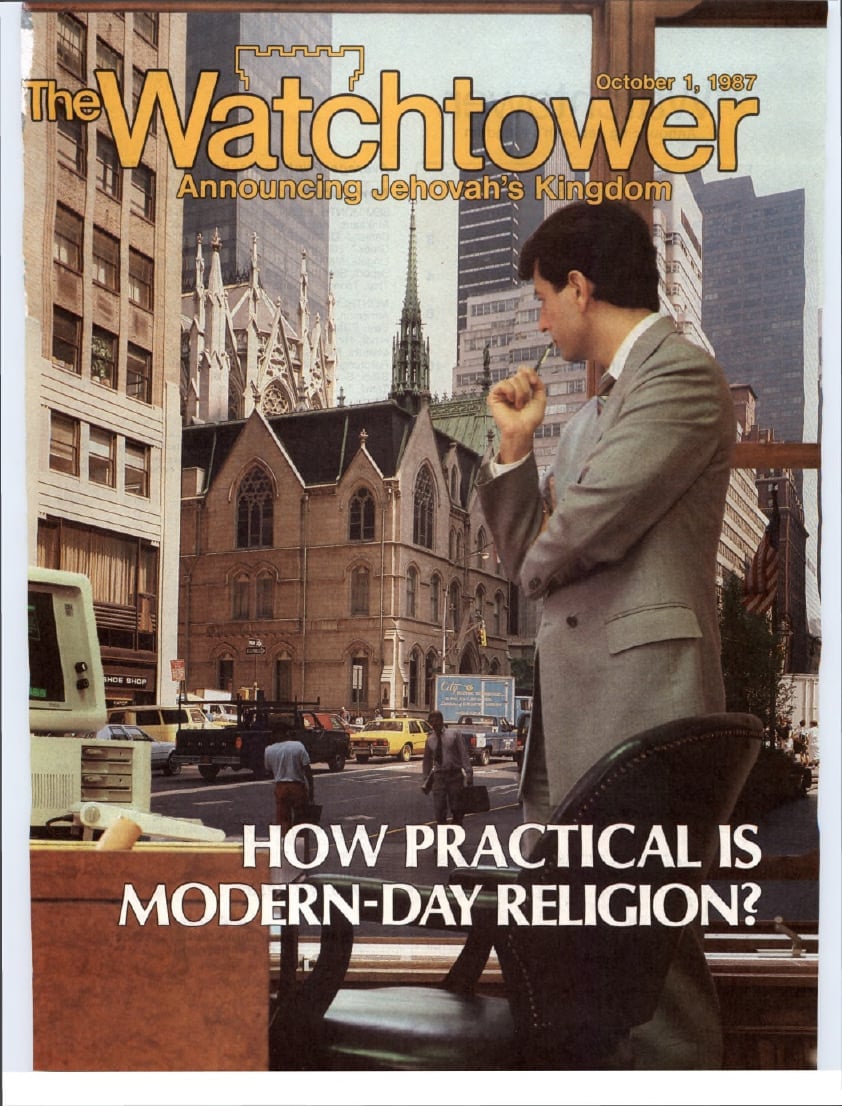
The Watchtower — October 1, 1987
Source: jw.org
Contents
How Practical Is Modern-Day Religion?
Can You Find the Right Religion?
Jesus—“True Bread From Heaven”
Are You Satisfied With Jehovah’s Spiritual Provisions?
Discipline Yields Peaceable Fruit
A Chief Speaks Up
The Reformation Waters Burst Forth
I Have Seen That Jehovah Is Good
Questions From Readers
Does Your Child Have a Personal Subscription?
How Practical Is Modern-Day Religion?
How Practical Is Modern-Day Religion?
“I THREW the Bible in the den on my way to my bedroom. I thought I would never pick it up again or attend another church. I had been searching for about six years. Still I found no help.”
Ronald, a 26-year-old computer operator, had gone through some hardships and feared his life would fall apart. Religion seemed to be of no practical value to him. “I am through with it,” he said.
Many people, like Ronald, are disappointed with religion. How about you? Do you think religion has given people practical help and guidance to become better workmates, neighbors, husbands, wives, parents, or children? Has religion been a force for peace and unity among people? Has it helped them understand the purpose of life? Has it instilled in their minds and hearts a sure hope for the future?
Practical Guidance Lacking
In this complex world, people need wise, clear guidance. Can they expect this from spiritual leaders? In a letter to a magazine columnist, a woman complained:
“All we ever hear now in our church . . . for quite awhile now is love, love, love. . . . What ever happened to the ‘Thou shalt nots’—‘Thou shalt not kill. Thou shalt not steal,’ and all the rest? We need to be reminded often that some things are No-No’s. . . . But we don’t even hear the word ‘Sin’ any more. It’s like they shun it as if it were a dirty three letter word.”
Evidently, some feel that their religious counselors have become too lax, too permissive. Such spiritual guides are weak. They are like a doctor who glosses over his patient’s problem and prescribes diluted medicine. What are some reasons for such failure?
Profession in Crisis
A person who is weighed down with his own problems is not going to be able to spend much time and effort helping others. Media reports show that an increasing number of clergymen are deeply encumbered with their own professional and personal problems. Here are some examples:
“While stress and burnout are common in many professions today, nowhere are they more critical than among the Jewish clergy,” says clinical psychologist Dr. Leslie R. Freedman after a four-year university study of the Jewish clergy.
“If I had a son, would I want him to become a priest? Regrettably, my answer has to be no,” contends a priest, William Wells, in a report on clergymen’s problems. Why not? He says he cannot encourage a young man to consider a profession so plagued by “conflict, turbulence, and uncertainties as the Roman Catholic priesthood is today.”
Priests in the Swedish State-supported Lutheran Church are also in trouble. A Swedish daily says: “Priests have psychological problems, which in severe cases lead to suicide. . . . The clerical profession is in crisis.”
Distracting Disunity
In those countries where the religious leaders are involved in exhausting and divisive wars, they are diverted from giving proper attention to people’s spiritual needs. They also have to share the responsibility for the loss of manpower and money that could have been used for people’s material welfare.
There are those in all parts of the world who have lost their trust in religion and become religiously indifferent. Loss of members and decline in churchgoing are reported from such places as Sweden, Finland, Germany, Britain, Italy, Canada, and the United States.
Are you among those who, like Ronald, think they are through with religion? And yet, could there be a religion that has proved to be of practical value to many? The following article will discuss this.
Can You Find the Right Religion?
Can You Find the Right Religion?
RONALD—mentioned in the preceding article—thought he should give up his search for a religion that could give him practical help and guidance. But he decided to give himself a last chance. “If there really was a God, I wanted him to know that I was honestly searching for him,” he said. So one night Ronald prayed: “If you really are a loving God, you find me because for years I have looked for you and found nothing.”
A few days later at his job, Ronald was assigned to work on a shift with one of Jehovah’s Witnesses. He began to ask her questions about the Bible. The answers triggered his curiosity. Soon he began to study the Bible regularly. He also went to meetings of the local congregation of Jehovah’s Witnesses.
Six months later Ronald was convinced that he had found a religion that gave him the incentive to adjust his life in a most practical way. After three years of association with Jehovah’s Witnesses, he explained in a letter to the Watchtower magazine some benefits he had derived from this association.
“Killer Instinct” Done Away With
Ronald writes: “The first benefit from learning the truth [the Bible’s teaching] was being better able to control my temper. For a long time I was involved in the martial arts. . . . I used to train from six to eight hours a day, and it was always instilled in me to develop a killer instinct.”
Fighting and killing are not effective ways to solve conflicts with one’s fellowman. Therefore, a useful religion is a force for peace. The Bible says at Romans 12:18: “Be peaceable with all men.” Jehovah’s Witnesses do not train their bodies for fighting, nor do they seek to protect themselves by learning to handle guns. They are known around the globe for their peaceful, neutral stand in time of war.
Seeing the practical force or potential of such a religion, a Roman Catholic nun wrote in an Italian church magazine: “How different the world would be if we all woke up one morning firmly decided not to take up arms again, . . . just like Jehovah’s Witnesses!”
This peaceable attitude among the Witnesses has contributed to the forming of a worldwide brotherhood of more than three million people in 208 lands. They treat one another as true friends, whatever their nationality, race, or social rank. This is most practical in a hostile world, especially when help is needed. Eva, a young Swedish woman who is one of Jehovah’s Witnesses, experienced this.
While visiting Greece, Eva contracted meningitis. Unconscious, and with blood poisoning and internal bleeding, she was rushed to a hospital in Athens, where she knew no one. Her father in Sweden was informed by phone. He called an elder in the local congregation of Jehovah’s Witnesses. This elder called Witnesses he knew in Athens. Eva was quickly contacted by Greek fellow believers she had never met before.
This calls to mind an illustration that the apostle Paul used, showing how oneness and compassion belong together. He said at 1 Corinthians 12:25, 26: “There should be no division in the body, but . . . its members should have the same care for one another. And if one member suffers, all the other members suffer with it.”
This is what Eva experienced in Greece. For almost three weeks her new friends did not leave her unattended. She recovered and returned to her home. She says: “I really experienced the benefits of a loving brotherhood.”
Not Desiring “That Extra Dollar”
Let us go back to Ronald’s letter. After telling how his new belief helped him to control his temper, get rid of that “killer instinct,” and become more peaceable, he says that the Bible’s teaching gave him a balanced view of work and money. “I was my employer’s number one computer operator,” Ronald says, “and I used to skip being with my family and friends just to work overtime. I worked nights for over seven years. I always wanted that extra dollar.”
Such desire for “that extra dollar” can, in the long run, be harmful, fatally harmful. “To some, money means security. To some it means power. To others it means they’re going to be able to buy love, and to a fourth group it means competition and winning the game,” says psychiatrist Jay Rohrlich, whose clients are mostly financial executives from New York’s Wall Street district.
Commenting on this statement, a report in the magazine Science Digest says: “The belief that money can produce these things . . . often leads to impotence, insomnia, heart attacks and problems with a spouse or children.” The Bible’s advice is: “Let your manner of life be free of the love of money.” Ronald learned that and applied it. He found it most beneficial.—Hebrews 13:5.
Proper View of Work
The quest for money often induces people to force themselves up the career ladder. This can cause the healthiest people severe stress and emotional conflict—even to the point of suicide. “One man, who came into work one morning to find that his desk had been moved, climbed up to the top of the building and jumped off.” Dr. Douglas LaBier related that in a U.S.News & World Report interview dealing with the link between careers and emotional problems.
“What is needed,” says Dr. LaBier, “is a more developed life, one that is not so centered around a career. In addition to such things as adequate diet, rest and exercise, people who want more balanced lives need to think about doing more with their families and developing noncareer competencies that give them pleasure.”
Jehovah’s Witnesses learn from the Bible to be balanced as to work and money. Ecclesiastes 4:4, 6 speaks about hard work that involves “rivalry of one toward another” and says: “Better is a handful of rest than a double handful of hard work and striving after the wind.” Ronald found this to be practical wisdom. He cut down on his secular work so as to have more time for his spiritual interests and for his family and friends.
A Happier Family Life
Ronald then says in his letter that the Bible’s counsel on marriage and family life has helped him to deal more wisely with family situations. This is essential now when family life seems to be on the way out in many places. Industrialized countries report fewer marriages, more divorces, and a falling birth rate.
This trend is alarming because the family circle is where some of the most basic human needs are satisfied. In a survey, the Australian Sydney Morning Herald asked 2,000 people which of the following gave them greatest satisfaction: work, family, friends, leisure activities, possessions, or religion. The overwhelming majority gave “family” the first place.
Jehovah’s Witnesses are interested in keeping their families strong. For example, over just the last five years, their two magazines The Watchtower and Awake! (combined circulation of some 22 million copies in over 100 languages) have carried some 60 practical articles about handling different situations in family life. Without a doubt, a Bible-based religion that helps people to take care of their families in a wise and loving way is practical.
The Big “Why?” Answered
Ronald concludes his letter by saying: “There is one thing that often comes to mind when I read the newspaper, watch the news, converse with workmates, or tell others about my faith. It is that being one of Jehovah’s Witnesses gives me the answer to one of the most widely asked questions in the world—‘Why?’ Why all the crime, violence, war, immorality, disease, turmoil, besides all the everyday problems? Knowing that this system and its problems are only temporary has lifted a heavy weight from my shoulders.”
The Bible reveals what is behind today’s perplexing world situation. It explains why the Creator’s original purpose to make this earth a paradise home for mankind has not yet become a reality. It explains how God will remove all disturbing influences from the earth and establish a permanent paradise for people to enjoy forever.—2 Peter 3:9-13.
For a religion to be of practical value, it must bear good fruit. It must produce better people. It must be able to explain why things are as they are on earth today. And it should instill a sure hope for the future in people’s minds and hearts. Ronald searched for such a religion, and he found it. The same opportunity is still open for you.—Matthew 7:17-20.
[Picture on page 5]
Real Christians treat one another as true friends
Jesus—“True Bread From Heaven”
Jesus’ Life and Ministry
Jesus—“True Bread From Heaven”
THE day had truly been eventful. Jesus miraculously fed thousands and then escaped the attempt of the people to make him king. That night he traversed on foot the stormy sea of Galilee; rescued Peter, who began to sink when he walked on the storm-tossed water; and calmed the waves to save his disciples from shipwreck.
The next day people whom Jesus had miraculously fed northeast of the sea of Galilee find him near Capernaum. Rebuking them, Jesus says that they have come looking for him because they expect another free meal. He urges them to work, not for food that perishes, but for food that remains for everlasting life. So the people inquire: “What shall we do to work the works of God?”
Jesus names but one work of the highest value. “This is the work of God,” he explains, “that you exercise faith in him whom that One sent forth.”
The people, however, do not exercise faith in Jesus, despite all the miracles he has performed. The day before, he miraculously fed 5,000 men, as well as women and children, and yet now, unbelievably, they ask: “What, then, are you performing as a sign, in order for us to see it and believe you? What work are you doing? Our forefathers ate the manna in the wilderness, just as it is written, ‘He gave them bread from heaven to eat.’ ”
In response to their request for a sign, Jesus makes clear the Source of miraculous provisions, saying: “Moses did not give you the bread from heaven, but my Father does give you the true bread from heaven. For the bread of God is the one who comes down from heaven and gives life to the world.”
“Lord,” the people say, “always give us this bread.”
“I am the bread of life,” Jesus explains. “He that comes to me will not get hungry at all, and he that exercises faith in me will never get thirsty at all. But I have said to you, You have even seen me and yet do not believe. Everything the Father gives me will come to me, and the one that comes to me I will by no means drive away; because I have come down from heaven to do, not my will, but the will of him that sent me. This is the will of him that sent me, that I should lose nothing out of all that he has given me but that I should resurrect it at the last day. For this is the will of my Father, that everyone that beholds the Son and exercises faith in him should have everlasting life.”
At this the Jews begin murmuring at Jesus because he said, “I am the bread that came down from heaven.” They see in him nothing more than a son of human parents and so object in the same manner as did the people of Nazareth: “Is this not Jesus the son of Joseph, whose father and mother we know? How is it that now he says, ‘I have come down from heaven’?”
“Stop murmuring among yourselves,” Jesus responds. “No man can come to me unless the Father, who sent me, draws him; and I will resurrect him in the last day. It is written in the Prophets, ‘And they will all be taught by Jehovah.’ Everyone that has heard from the Father and has learned comes to me. Not that any man has seen the Father, except he who is from God; this one has seen the Father. Most truly I say to you, He that believes has everlasting life.”
Continuing, Jesus repeats: “I am the bread of life. Your forefathers ate the manna in the wilderness and yet died. This is the bread that comes down from heaven, so that anyone may eat of it and not die. I am the living bread that came down from heaven; if anyone eats of this bread he will live forever.” Yes, by exercising faith in Jesus, the one God sent forth, people can have everlasting life. No manna, or any other such bread, can provide that!
The discussion regarding the bread from heaven apparently began shortly after the people found Jesus near Capernaum. But it continued, reaching a climax later while Jesus was teaching in a synagogue in Capernaum. John 6:26-51, 59; Psalm 78:24; Isaiah 54:13; Matthew 13:55-57.
◆ What events preceded Jesus’ discussion regarding the bread from heaven?
◆ In view of what Jesus has just done, why is the request for a sign so inappropriate?
◆ Why do the Jews murmur at Jesus’ claim that he is the true bread from heaven?
◆ Where did the discussion about the bread from heaven take place?
Are You Satisfied With Jehovah’s Spiritual Provisions?
Are You Satisfied With Jehovah’s Spiritual Provisions?
“‘Test me out, please, in this respect,’ Jehovah of armies has said, ‘whether I shall not open to you people the floodgates of the heavens and actually empty out upon you a blessing until there is no more want.’”—MALACHI 3:10.
1. With what provisions are most living creatures satisfied?
IF YOU stop breathing air, you will die in a few minutes. If you stop drinking water, you will die in a few days. If you stop eating food, you will die in a few weeks. If you stop feeding on Jehovah’s spiritual provisions, then when you die you will be dead forever. Jehovah provides the air, water, and food that all living creatures need. Hence, to Jehovah the psalmist says: “You are opening your hand and satisfying the desire of every living thing.” (Psalm 145:16) The desire of most living things is fulfilled by the material provisions. But this is not true of human creatures.
2. What is the desire of man’s heart, and what provision is necessary for its fulfillment?
2 Jesus pointed this out when he said: “Man must live, not on bread alone, but on every utterance coming forth through Jehovah’s mouth.” (Matthew 4:4) The lower creations have no concept of eternity, but man does, as Ecclesiastes 3:11 says: “Even time indefinite he has put in their heart.” Or as the Revised Standard Version renders it: “He has put eternity into man’s mind.” Hence, man’s heartfelt desire is to live to time indefinite, even forever. Air, water, and bread alone are not enough for that. To live forever requires spiritual provisions based on “every utterance coming forth through Jehovah’s mouth.” Today, they are found in one book, the Bible, and the supply is inexhaustible—all that you need, more than you can hold. This cupboard is never bare.
3. What did Jesus single out as most important, and what secret did Paul learn?
3 Jesus taught us to pray for the needed material food: “Give us today our bread for this day.” But soon thereafter he put spiritual matters in first place when he said: “Keep on, then, seeking first the kingdom and his righteousness.” (Matthew 6:11, 33) Material food keeps us alive a day at a time; continued spiritual feeding can do it for a lifetime, and even for eternity. So do not be anxious about material things. Paul was not. He spoke of spiritual resources that enabled him to be content regardless of material circumstances, saying: “I have learned the secret of both how to be full and how to hunger, both how to have an abundance and how to suffer want. For all things I have the strength by virtue of him who imparts power to me.”—Philippians 4:12, 13.
Calamity Comes to Dissatisfied Ones
4. What provisions were not enough for the first human pair, and what more did they want?
4 Many, however, are not satisfied with Jehovah’s provisions. Our first parents were not. They lived in a paradise garden—beautiful scenery delighted their eyes, fragrant flowers perfumed the air they breathed, delicious foods stimulated their taste buds, the songs of birds serenaded their ears. Moreover, they had the interesting work of caring for this garden, plus the blessing of filling the earth with perfect offspring. But they were selfish. What God had given was not enough. They wanted more. They wanted to decide for themselves what was right and what was wrong. So they did, and the very first decision they made was calamitous, resulting in the loss of everything, for themselves and for their offspring.—Genesis 3:1-7, 16-19.
5. With what did Jehovah bless the Israelites, and what was their reaction?
5 The Israelites copied their bad example. God delivered them from slavery in Egypt, made them a nation, gave them a perfect Law, guided them in their wilderness journeyings, provided them with clothes that never wore out, and miraculously sustained them with manna that fell from heaven and water that gushed out of a rock. But they were not satisfied with Jehovah’s provisions. (1 Corinthians 10:1-5) As they traveled through the wilderness, they complained time and time again.—Exodus 13:21, 22; Numbers 11:1-6; Deuteronomy 29:5.
6. What course brought destruction upon the Israelites as a nation?
6 They still grumbled after they were established in the Promised Land—a fertile, well-watered land “flowing with milk and honey.” Still ungrateful, still dissatisfied with Jehovah’s provisions, they abandoned worship of him, turned to idolatrous sex worship, sacrificed their children to Molech, and brought destruction upon themselves as a nation. Restored from Babylonian captivity, they followed oral traditions that made void God’s Word. They ended up killing their promised Messiah, Christ Jesus.—Deuteronomy 6:3; 8:7-9; Judges 10:6; 1 Kings 14:22-24; 2 Kings 21:1-16; Isaiah 24:1-6; Matthew 15:3-9; 27:17-26.
7. How have Christendom’s clergy of today continued in the same course as the unfaithful priests of Malachi’s time?
7 Down to this day mankind generally has continued to prefer false religious creeds. The clergy despise Jehovah’s name, not even using it. They dishonor him with such unscriptural teachings as the Trinity, the immortal soul, and eternal torment in hellfire. Their doctrines are not only polluted with falsehoods taken from ancient Babylon and Egypt but also, in many cases, poisoned by the denial of Christ’s ransom and the acceptance of evolution. They rob Jehovah of his deserved praise, just as did the priests in Malachi’s day.—Malachi 1:6-8; 3:7-9.
8. (a) What invitation did the priests of Malachi’s day and the religious leaders of today reject? (b) Who did respond to the invitation, and with what result?
8 Israelites back then were encouraged to cleanse themselves and return to Jehovah. “Return to me, and I will return to you,” Jehovah said. He further invited them: “‘Test me out, please, in this respect,’ Jehovah of armies has said, ‘whether I shall not open to you people the floodgates of the heavens and actually empty out upon you a blessing until there is no more want.’” (Malachi 3:7, 10) Only a remnant of the Jewish nation returned; today, a faithful remnant of spiritual Israel have come out of this world’s false religions. They, together with a growing great crowd of other sheeplike worshipers, praise Jehovah as his Witnesses. (John 10:16) To them, Jehovah has kept his promise and has ‘opened the floodgates of heaven and emptied out upon them blessings until there is no more want’—a veritable banquet of spiritual food!—Isaiah 25:6.
Spiritual Food in Abundance
9. What spiritual provisions are available today, by what means, and with what result?
9 “The faithful and discreet slave” Jesus foretold for our day is busily providing spiritual food in abundance. (Matthew 24:45) Last year alone, in 208 lands and islands of the sea, and in some 200 languages, over three million of Jehovah’s Witnesses made these spiritual provisions available through house-to-house visits and the distribution of hundreds of millions of books, magazines, and Bibles. Many partook of this spiritual food and were satisfied: Over 225,000 new ones were baptized in one year!
10. What provisions are available for heeding Paul’s admonition to assemble together?
10 Jehovah’s spiritual provisions have also been made available by means of district conventions, circuit assemblies, and the five weekly meetings regularly held in some 52,000 congregations of Jehovah’s Witnesses—all in obedience to Paul’s admonition at Hebrews 10:25 ‘not to forsake our gathering together.’
11. What illustrates the desirable way for spiritual food to be prepared?
11 When a woman invites guests to a meal, she does not just boil a piece of meat and plop it on a plate. She uses spices and sauces to add tantalizing flavors and some decorative touches to give it eye appeal. Just its appearance and aroma are enough to make the mouth water and the gastric juices flow. That is the way Jehovah’s spiritual provisions have been prepared—not in a dry, encyclopedic style, but in a tasty way to delight the mind and touch the heart. Each individual Christian should follow that example. “Does not the ear itself test out words as the palate tastes food?”—Job 12:11.
12. What examples do we have of spiritual food being appetizingly prepared?
12 The Theocratic Ministry School Guidebook in its first lesson stresses using delightful words. Solomon used not only correct words but also delightful ones. (Ecclesiastes 12:10) Psalm 45:2 foretold of the Messiah, Jesus Christ: “Charm has been poured out upon your lips.” It proved to be so. His hearers marveled “at the winsome words proceeding out of his mouth.” They kept hanging onto him to hear him, came early to the temple to hear him, listened to him with pleasure, were astounded at his way of teaching. Officers sent to arrest him declared: “Never has another man spoken like this.” (Luke 4:22; 19:48; 21:38; Mark 12:37; Matthew 7:28; John 7:46) The Guidebook was provided to help us speak delightful words of truth. Do you use it to the full?
13. How emphatic is Ephesians 5:15-17 about ‘buying out time,’ and why is this stressed?
13 Ephesians 5:15-17 admonishes us: “Keep strict watch that how you walk is not as unwise but as wise persons, buying out the opportune time for yourselves, because the days are wicked. On this account cease becoming unreasonable, but go on perceiving what the will of Jehovah is.” The Greek word here translated “time” does not mean time in just a general sense but signifies an appointed time, a seasonable time for a specific purpose. The Greek verb translated “buying out” is in the intensive form, and “in this context it probably means to ‘buy up intensively’; i.e., to snap up every opportunity that comes.”a Do you snap up time from your schedule to make yourself wise by partaking of Jehovah’s spiritual provisions? You should. All of us should. Why? “Because the days are wicked.”
From Spiritual Desert to Spiritual Paradise
14. What Bible verse serves as an example of what feature of our English-language New World Translation Reference Bible?
14 An outstanding spiritual provision is our New World Translation of the Holy Scriptures—With References, released in 1984. It has many features that make it possible to use ‘bought-out time’ to increase our knowledge.b One example is its cross-references. Take Psalm 1:3, which deals with the condition of the man that meditates on God’s law day and night. That verse reads: “He will certainly become like a tree planted by streams of water, that gives its own fruit in its season and the foliage of which does not wither, and everything he does will succeed.” There is more, much more, to this verse than meets the eye of the reader who merely reads quickly and passes on.
15. What questions are raised about the tree of Psalm 1:3, and what enlightenment does Isaiah 44:4 give?
15 Please take note: The tree is planted. Who planted it? It is by streams, plural. Does one tree grow on the banks of several streams? No. So be curious. What is this tree all about? The cross-references open the eyes of our mind. They are Isaiah 44:4,; 61:3, and Jeremiah 17:8. Isaiah 44:4 says that his people will be like trees “by the water ditches.” Many water ditches? Why, yes! The streams are irrigation ditches that water the trees in an orchard!
16. What further clarification is given by Isaiah 61:3 and Jeremiah 17:8?
16 Isaiah 61:3 calls some of these trees “big trees of righteousness, the planting of Jehovah, for him to be beautified.” Jehovah is the one who plants and irrigates these, and he is the one beautified by the fruits the trees bear! Jeremiah 17:8 likens the man who meditates on God’s law day and night to “a tree planted by the waters, that sends out its roots right by the watercourse; and he will not see when heat comes, but his foliage will actually prove to be luxuriant. And in the year of drought he will not become anxious, nor will he leave off from producing fruit.” Its foliage does not wither; everything it does succeeds!
17. What picture now emerges concerning Psalm 1:3, and what role do we play in it?
17 Now the scales fall from our eyes! Psalm 1:3 is painting a beautiful picture. Those who meditate on Jehovah’s law day and night are like trees planted by an unfailing source of water. They are no longer any part of spiritually arid worldly organizations but are now associated with God’s organization that is abundantly supplied with the refreshing waters of truth. Indeed, they are in a spiritual paradise, are refreshed spiritually, and are bearing spiritual fruitage to Jehovah’s praise. And just think! God is using his Witnesses to direct people away from the arid, parched, worldly organizations to this refreshing, well-watered spiritual paradise.
18. How do some react when they see others excelling in witnessing, and why may they fall short?
18 To accomplish this work effectively, we must discipline our minds and hearts so as to make use of all of Jehovah’s spiritual provisions. Some hear others explain Bible texts and then say: “I wish I knew the Bible as he does!” But if such ones discipline themselves to study the Bible, they too can increase in Bible knowledge. Some hear others witness at the doors and then say: “I wish I could witness at the doors the way she does!” But if they discipline themselves to share frequently in the field service, using the book Reasoning From the Scriptures, they too can become more skilled Witnesses. Some hear others give Bible lectures and then say: “I wish I could give talks the way he does.” But, again, if these ones discipline themselves to prepare their speaking assignments well, absorbing the lessons of the Theocratic Ministry School Guidebook, they too will progress in speaking ability.
19. What is the key to developing our potentials for witnessing?
19 Now, to wish is fine, but wishing without working does not get the job done. It is work that makes the wish come true. Discipline yourself to buy out the time, and do the work that makes the wish come true. If you do not use a muscle, it will atrophy. If you do not use a skill, it will fade away. If you do not use your mind, thinking ability will wither. If you do not use knowledge, you will lose what you have. In each and every case, the rule is, “Use it or lose it.” It is ‘through use that the perceptive powers are trained.’ Then “thinking ability itself will keep guard over you, discernment itself will safeguard you.”—Hebrews 5:14; Proverbs 2:11.
20. By taking advantage of Jehovah’s spiritual provisions, what will we avoid, and what will we gain?
20 So use Jehovah’s spiritual provisions. Rejoice with his satisfied ones. Escape the famine that Amos foretold: “‘Look! There are days coming,’ is the utterance of the Sovereign Lord Jehovah, ‘and I will send a famine into the land, a famine, not for bread, and a thirst, not for water, but for hearing the words of Jehovah.’” (Amos 8:11) Share with those who eat and rejoice, not with those who reject the food and suffer shame: “This is what the Sovereign Lord Jehovah has said: ‘Look! My own servants will eat, but you yourselves will go hungry. Look! My own servants will drink, but you yourselves will go thirsty. Look! My own servants will rejoice, but you yourselves will suffer shame.”—Isaiah 65:13.
[Footnotes]
See The New International Dictionary of New Testament Theology, Volume 1, page 268, by Colin Brown.
You may not have it in your language as yet but will no doubt find interest in the above example of its use.
Do You Recall?
□ How did the nation of Israel show its dissatisfaction with Jehovah’s provisions?
□ How has Malachi 3:10 been fulfilled upon Jehovah’s Witnesses?
□ What is the underlying meaning of Psalm 1:3?
□ Why is it essential to make use of the things learned through Jehovah’s spiritual provisions?
[Picture on page 15]
Those who meditate on Jehovah’s law are like trees planted by an unfailing source of water
Discipline Yields Peaceable Fruit
Discipline Yields Peaceable Fruit
“No discipline seems for the present to be joyous, but grievous; yet afterward to those who have been trained by it it yields peaceable fruit, namely, righteousness.”—HEBREWS 12:11.
1. (a) What does Jehovah’s Word say about man’s ability to direct his life’s course, yet what does man say? (b) Who has been proved true, and who false?
JEHOVAH’S Word says that “it does not belong to man who is walking even to direct his step.” (Jeremiah 10:23) Man says it is in him to do so, and from the outbreak of rebellion in Eden, he has done so. From then until now, with many people it has been as it was in the days of the Judges in Israel: “What was right in his own eyes was what each one was accustomed to do.” (Judges 21:25) But the words of Jehovah at Proverbs 14:12 have proved true: “There exists a way that is upright before a man, but the ways of death are the end of it afterward.” For 6,000 years, men have taken the way that seemed right to them, and all that time it has led to war, famine, sickness, crime, and death. History has proved Jehovah’s words true and man’s ways false.
2. What position do child psychologists take on spanking, but what fruitage has their permissiveness produced?
2 Imperfect people need discipline. They need it from childhood onward. God’s Word says: “The one holding back his rod is hating his son, but the one loving him is he that does look for him with discipline.” (Proverbs 13:24) Many child psychologists dispute this divine wisdom. Years ago one asked: “Do you mothers realize that every time you spank your child you show that you are hating your child?” Yet their permissiveness produced such a deluge of juvenile delinquents that a Brooklyn court judge made this caustic comment: “I think we need the woodshed for some young folks. But that is not considered fashionable now. Now we are told you must not strike a child; you may be stunting a genius.” But their permissiveness produced no crop of geniuses—only a lawless wave of teenage criminals.
3. Based on the statements of several authorities, what trend is becoming evident?
3 Now winds of change are in the air. Burton L. White, authority on child development, says that your strictness will not cause your child to “love you less than if you were lenient. . . . Even if you spank them regularly, you will find they keep coming back to you.” He stresses the child’s primary need for overflowing “irrational love.” Dr. Joyce Brothers reported on a study of hundreds of strictly disciplined fifth and sixth graders who believed that the strict rules “were an expression of parental love.” The Journal of Lifetime Living said: “The child psychologists, wrangling over scheduled versus demand feeding, spanking versus non-spanking, have found that none of it makes much difference so long as the child is loved.” Even Dr. Benjamin Spock, author of Baby and Child Care, took part of the blame for the lack of parental firmness and the resulting delinquency. He said blame rested on the experts, “the child psychiatrists, psychologists, teachers, social workers and pediatricians like myself.”
The Rod of Discipline
4. Of what is the rod of discipline a symbol, and what is shown by its proper use in contrast with permissiveness?
4 “Rod” as used above does not necessarily mean spanking; it represents the means of correction, whatever form it may take. The New International Version says on this verse: “rod. Probably a figure of speech for discipline of any kind.” A rod is a symbol of rule or authority—in this case parental authority. A parent gets no thanks later for his permissiveness and spoiling: “If one is pampering one’s servant [or child] from youth on, in his later life he will even become a thankless one.” (Proverbs 29:21) To abdicate parental authority by permissiveness brings shame and shows not love but indifference; to use the rod of discipline kindly but firmly reflects loving concern. “The rod and reproof are what give wisdom; but a boy let on the loose will be causing his mother shame.”—Proverbs 29:15.
5. (a) What does one commentary say on Proverbs 13:24, and with what other Bible text is it in agreement? (b) Who are the ones that Jesus and Jehovah discipline?
5 Referring to Proverbs 13:24, the Keil-Delitzsch Commentary on the Old Testament explains: “A father who truly wishes well to his son keeps him betimes under strict discipline, to give him while he is yet capable of being influenced the right direction, and to allow no errors to root themselves in him; but he who is indulgent toward his child when he ought to be strict, acts as if he really wished his ruin.” Moffatt’s New Translation of the Bible at Proverbs 19:18 concurs: “Chastise your son, while there is still hope of him, and do not let him run to ruin.” Kind but firm discipline from early childhood reflects parental love. Jesus said: “All those for whom I have affection I reprove and discipline.” As for Jehovah, “whom Jehovah loves he disciplines.”—Revelation 3:19; Hebrews 12:6.
6. What form does discipline often take, and what examples support your answer?
6 Discipline may at times involve spanking, but often it does not. Proverbs 8:33 does not say, “feel” discipline but, “listen to discipline and become wise.” Many times discipline comes in the form of words, not spankings: “The reproofs of discipline are the way of life.” “Take hold on discipline; do not let go. Safeguard it, for it itself is your life.” (Proverbs 4:13; 6:23) When Jehovah’s servant Job needed to be disciplined, it was accomplished by reproving words, first by Elihu and then by Jehovah himself. (Job, chapters 32-41) Job accepted the reproof and said to Jehovah: “I make a retraction, and I do repent in dust and ashes.”—Job 42:6.
7. What is the meaning of the Greek word translated “discipline,” how is it to be administered, and what does it accomplish?
7 Pai·deiʹa is the Greek word translated “discipline.” In its various forms it means to train, to educate, to be “instructing with mildness.” (2 Timothy 2:25) It relates more to training in conduct than to acquiring knowledge. This disciplining is to be “with all long-suffering and art of teaching.” (2 Timothy 4:2) It is well exemplified in the admonition to fathers: “And you, fathers, do not be irritating your children, but go on bringing them up in the discipline and mental-regulating of Jehovah.” (Ephesians 6:4) Kindly but firmly, this discipline is to regulate youth in Jehovah’s way of thinking.
The Source of Discipline
8. From what source and in what ways can we discipline ourselves?
8 The principles involved in disciplining children also apply to adults. The Bible is the source of information about what we should and should not be. As we read it, we can test ourselves and apply correction where needed. (2 Corinthians 13:5) As we ponder Jehovah’s precepts, feelings of guilt may be stirred up in us, helping to identify needed changes for us. It did this for the psalmist: “I shall bless Jehovah, who has given me advice. Really, during the nights my kidneys [“my deepest emotions”] have corrected me.” (Psalm 16:7) We may discipline ourselves as Paul did: “I pummel my body and lead it as a slave, that, after I have preached to others, I myself should not become disapproved somehow.”—1 Corinthians 9:27.
9. What other means are there for beneficial disciplining?
9 Discipline may come from someone else. It may come as a look, a frown, a word, a gesture, a verbal reproof. Jesus gave Peter a look that reminded him of the prediction of his grave sin, and he went out and wept bitterly. (Luke 22:61, 62) Another time it was a rebuke in four words that crushed Peter: “Get behind me, Satan!” (Matthew 16:23) Reading Watch Tower publications, attending meetings, talking with others, enduring hard experiences—all such activities may open our eyes to areas where we need to make changes. The all-important source and guide for disciplining, however, is God’s Word itself.—Psalm 119:105.
10. Of what value are the proverbs of Solomon for disciplining, yet what course do some insist on following?
10 The proverbs of Solomon were given for people of all ages, for them “to know wisdom and discipline, to discern the sayings of understanding, to receive the discipline that gives insight, righteousness and judgment and uprightness, to give to the inexperienced ones shrewdness, to a young man knowledge and thinking ability.” But perhaps a person “will not let himself be corrected by mere words, for he understands but he is paying no heed.” (Proverbs 1:2-4; 29:19) Some inexperienced ones insist on learning in life’s “school of hard knocks,” as did the prodigal son before “he came to his senses.”—Luke 15:11-17.
11. (a) How were the Corinthian congregation and Jonah disciplined? (b) What disciplinary punishments were visited upon David for his adultery and cover-up efforts? (c) What words of Psalm 51 written by David show the depth of his repentance?
11 Commenting on a letter that he had previously written to the Christian congregation at Corinth, Paul said: “You were saddened into repenting; for you were saddened in a godly way, . . . [and it resulted in the] righting of the wrong.” (2 Corinthians 7:9-11) Jonah was disciplined by means of an ocean storm and a big fish. (Jonah 1:2, 3, 12, 17; 2:10; 3:1-4) David’s adultery and attempts at a cover-up brought disciplinary punishments upon him, as shown at 2 Samuel 12:9-14. His repentance was movingly expressed in these words from the 51st Psalm: ‘Wash me from my error, cleanse me from my sin. My sin is in front of me constantly. Wipe out all my errors, create in me a pure heart, put within me a new spirit. Do not throw me away from before your face. A heart broken and crushed, O God, you will not despise.’—Ps 51 Verses 2, 3, 9-11, 17.
12. What more drastic measures are needed for some, and what is the outcome for those who reject repeated reproofs?
12 With some persons more drastic measures may be necessary, as Proverbs 26:3 indicates: “A whip is for the horse, a bridle is for the ass, and the rod is for the back of stupid people.” At times Jehovah let his nation of Israel be subdued by the troubles they brought upon themselves: “They had behaved rebelliously against the sayings of God; and the counsel of the Most High they had disrespected. So with trouble he proceeded to subdue their heart; they stumbled, and there was no one helping. And they began calling to Jehovah for help in their distress; out of the stresses upon them he as usual saved them.” (Psalm 107:11-13) Some stupid ones, however, harden themselves beyond the reach of any kind of healing discipline: “A man repeatedly reproved but making his neck hard will suddenly be broken, and that without healing.”—Proverbs 29:1.
Giving and Receiving Reproof
13. What should we avoid in giving reproof, and how should it be given?
13 Whatever form the discipline may take, it should never be given in anger. In fact, rather than helping, “anger stirs up contention.” We are also advised: “He that is slow to anger is abundant in discernment, but one that is impatient is exalting foolishness.” Moreover, “the insight of a man certainly slows down his anger, and it is beauty on his part to pass over transgression.” (Proverbs 29:22; 14:29; 19:11) When needed, discipline should never be excessive. Give it at the proper time and to the proper degree—not too soon, not too late, not too little, not too much.
14. What other guidelines are given for those offering reproof?
14 Here are some guidelines for those giving reproof: “Do not severely criticize an older man. To the contrary, entreat him as a father, younger men as brothers, older women as mothers, younger women as sisters with all chasteness.” (1 Timothy 5:1, 2) Do you entreat, not browbeat? “Brothers, even though a man takes some false step before he is aware of it, you who have spiritual qualifications try to readjust such a man in a spirit of mildness, as you each keep an eye on yourself, for fear you also may be tempted.” (Galatians 6:1) Do we counsel in mildness, always aware of our own frailties? “Always treat others as you would like them to treat you.” (Matthew 7:12, The New English Bible) Do you put yourself in the other one’s place, showing empathy?
15. What does receiving reproof require, and what additional counsel is given to those being reproved?
15 Receiving reproof requires humility. Does it seem picky, unfair, unjust? Do not be hasty. Think about it. Do not be negative. Reflect on it positively. If not all seems valid, is part of it? Open your mind to be receptive; evaluate it objectively. Are you being overly sensitive, too quickly offended? It may take time to see it in a positive light, after any initial hurt or offense has subsided. So wait. Hold your tongue. Calmly evaluate what was said. Is it possible that you are prejudiced against the one giving the counsel, and you rejected it on that basis? Nevertheless, see it as well meant and not to be summarily rejected.
16. (a) What scriptures and related questions should we consider when receiving counsel? (b) What feeling expressed by the psalmist might we imitate?
16 Here are some scriptures to reflect on when you are reproved: “Anyone holding back his sayings is possessed of knowledge, and a man of discernment is cool of spirit.” (Proverbs 17:27) Do you listen and remain cool? “The way of the foolish one is right in his own eyes, but the one listening to counsel is wise.” (Proverbs 12:15) Do you quickly decide that you are right, or do you listen receptively? “Be swift about hearing, slow about speaking, slow about wrath.” (James 1:19) Do you follow these words when counseled? “Do not hurry yourself in your spirit to become offended, for the taking of offense is what rests in the bosom of the stupid ones.” (Ecclesiastes 7:9) Are you quick to take offense? How lovely if we can feel as the psalmist did: “Should the righteous one strike me, it would be a loving-kindness; and should he reprove me, it would be oil upon the head, which my head would not want to refuse.”—Psalm 141:5.
Endure Discipline and Reap Peaceable Fruit
17. Why is discipline not always easy to take, yet how will keeping Hebrews 12:7, 11 in mind help us endure it?
17 Discipline is not always easy to take. It may involve some embarrassment and bring some restrictions. It may even cause you some grief. But endure all of this. It will pass; joy comes afterward. Remember: “It is for discipline you are enduring. God is dealing with you as with sons. For what son is he that a father does not discipline? True, no discipline seems for the present to be joyous, but grievous; yet afterward to those who have been trained by it it yields peaceable fruit, namely, righteousness.”—Hebrews 12:7, 11.
18, 19. What strong feelings did both Jeremiah and the psalmist express that set a proper course for us when we are undergoing discipline?
18 So if the discipline is grievous and hard to endure, wait for the peaceable fruit that comes afterward. Wait for Jehovah, as did Jeremiah: “Without fail your soul will remember and bow low over me. This is what I shall bring back to my heart. That is why I shall show a waiting attitude.” (Lamentations 3:20, 21) Remember what the psalmist in distress said to himself: “Why are you in despair, O my soul, and why are you boisterous within me? Wait for God, for I shall yet laud him as the grand salvation of my person.”—Psalm 42:5, 11; 43:5.
19 So when disciplined, let each one of us wait for God. After we have been trained by it, we will reap the harvest of peaceable fruit, namely, righteousness.
Do You Recall?
□ What is the value of using the rod of discipline?
□ What is the main source of discipline? What are other sources of discipline?
□ In addition to words of reproof, what stronger measures may be needed?
□ What are some guidelines for giving reproof?
□ What counsel will help us to accept reproof?
[Picture on page 17]
Do you wisely “listen to discipline”?
[Picture on page 18]
The principles involved in disciplining children also apply to adults
A Chief Speaks Up
Kingdom Proclaimers Report
A Chief Speaks Up
IT IS encouraging to know that there are still men in high station in this world who love honesty and justice and who speak out to uphold these qualities. An example is a chief in an African country where the work of Jehovah’s Witnesses is restricted. Let the report tell us:
“Recently different religious groups held an interdenominational convention in our town, and this included Catholics, Presbyterians, Pentecostals, and so forth. The Paramount Chief was invited to address the convention toward the closing sessions. To the surprise of the whole gathering, he told them, among other things, to imitate the honesty and high moral standards of Jehovah’s Witnesses, adding that if all were like Jehovah’s Witnesses, there would be peace in the nation.
“The next day leading members of the churches represented at the convention came to the Chief’s palace and protested vehemently against the part of his address that praised the Witnesses and asked him if he was not aware that the Witnesses had been banned in the country. The Chief replied in the affirmative but told them that he found no fault in Jehovah’s Witnesses. He went on to say: ‘For all my years as Paramount Chief, not once has one of Jehovah’s Witnesses been brought to my court for gross wrongdoing. On the other hand, if cassava is stolen from a farm, it often turns out that a Catholic is the thief. If yam is stolen, it is a Presbyterian who is responsible. Members of your church have polluted my land with abortions, and yet not one of Jehovah’s Witnesses has been brought to my court for such offenses. Do not God’s laws forbid such evils, or are the churches no longer bound by God’s law?’ The clergymen had no answer.
“Later, the Paramount Chief called representatives of Jehovah’s Witnesses and exhorted them to take good care of themselves so that no reproach is brought upon the name of their God and upon his own name as the Paramount Chief who has spoken up for Jehovah’s Witnesses.”
The report states that now many new ones are taking their stand for the truth. One Witness states that he has recently been able to start Bible studies with three chiefs in the area, one of them being the Paramount Chief, and all three are attending meetings of Jehovah’s Witnesses!
Jehovah God takes note of those who love truth and righteousness and speak up in behalf of his servants.—Matthew 10:42.
The Reformation Waters Burst Forth
The Reformation Waters Burst Forth
“SUDDENLY I heard another sound, as if of thunder, rushing toward us. Our family . . . started to run frantically to a nearby hill. The foaming waters overtook us. We swam as never before. Though gulping down a quantity of seawater . . . , we made it.”
This is how one Filipino recounted a terrifying experience that changed his world. You have probably never been hit by a natural disaster—of water or any other kind. But a look at history reveals that millions of lives have been reshaped by cataclysms of one form or another.
Religion has also witnessed a number of tremendous upheavals, turning upside down the daily lot of countless people. These have included Hindus, Buddhists, Muslims, Jews, and Christians. Has your life been affected by such turmoil? Almost certainly it has, wherever you happen to live. Let us illustrate this by journeying back some 400 years in time to the 16th century. First of all we focus our attention on Europe, which was then churning with dissent, like a whirlpool gathering speed.
A Growing Swell
For centuries, leading up to what we call the Reformation, the Roman Catholic Church and European monarchs had vied with one another, each claiming authority over the other and over the populace. A body of people on the continent raised their voices in objection to what they saw as abuses by the church.
What sort of abuses did they see? Greed, flagrant immorality, and interference in politics. Common folk were indignant at men and women who on the one hand claimed special privileges by reason of their vows of poverty and chastity but at the same time flouted the law by being openly corrupt and immoral. Noblemen in England were incensed at the rather strange situation of having to pay tribute to a pope who was then living in and allied with France, England’s enemy at war.
The corruption within the Catholic Church seeped down from the top. Historian Barbara W. Tuchman writes in her book The March of Folly that the six popes who were in office from 1471 onward carried on “an excess of venality, amorality, avarice, and spectacularly calamitous power politics.” Barbara Tuchman further describes how Pope Sixtus IV, in order to elevate and enrich his hitherto poor family, appointed five nephews and a grandnephew as cardinals, another grandnephew as bishop, and married six of his other relatives into ruling families. Alexander VI, when he became pope, was known to have had several mistresses and seven children. In his determination to be elected to office, he bribed his two main rivals, one of them receiving “four mule-loads of bullion,” writes Barbara Tuchman. He later presided over a Vatican banquet that became “famous in the annals of pornography.” The same work then outlines how famous sculptor Michelangelo was commissioned by Pope Julius II to model a statue of him. When asked by the craftsman if the statue should show him holding a book, the warrior pope replied: “Put a sword there. I know nothing of letters.”
Breach in the Dam
Ordinary Europeans still desired spiritual guidance. Observing the various echelons of power locked in a frenzy of self-gratification, these more lowly ones turned to an alternative source of authority, one they considered superior to all others—the Bible. According to author Joel Hurstfield, the Reformation was “in the profoundest sense a crisis of authority.” Appalled at the corruption in the church, preachers and friars in Italy took to speaking publicly on the need for reform. But nowhere were the waters of discontent gathering more ominously than in Germany.
In pagan times, Germanic tribes had a tradition whereby money could be paid to effect release from punishment for crimes. With the expansion of the Roman faith, the custom found accommodation within the church in the form of indulgences. This allowed a sinner to buy from the pope the value of dead “saints’” merits and apply these against temporal penalties for sins committed. Under financial pressure, caused by wars against France and by extensive building works in Rome, Pope Leo X authorized the sale of indulgences, offering total remission of temporal penalties for sin. An indignant Martin Luther expounded his now famous 95 theses on the false teachings of the church. The movement toward reform, which had started as a trickle some generations before, became a torrent as more and more people gave their support.
In the 16th century, individuals such as Luther in Germany, Zwingli and Calvin in Switzerland, and Knox in Scotland became rallying points for many who saw the chance to purify Christianity and return to the original values and standards of the Bible. A term was coined in Germany to describe those who refused to acknowledge restrictions placed on faith by Roman Catholic princes, and who avowed allegiance to God above anyone else. This term later came to include all who lent support to the Reformation movement. The term was “Protestant.”
Protestantism swept through Europe with breathtaking speed, reshaping the religious landscape, sketching new theological boundaries. Germany and Switzerland led the way, quickly followed by Scotland, Sweden, Norway, and Denmark. There were reformation movements in Austria, Bohemia, Poland, Transylvania, the Netherlands, and France.
In England discontent had been surfacing for more than a century, since the days of John Wycliffe and the Lollards. But when the break from the Catholic Church finally came, it was for more mundane reasons. The king resolved to change not his religion but his wife. In 1534 Henry VIII declared himself head of the new Church of England. His motives were different from those of the continental dissenters, but his action nonetheless opened the floodgates for the waters of religious change to flow into Britain. All over Europe, these waters swiftly turned red with the blood of thousands who were stretched on the rack of religious polarization.
Wherever the urge for reform took hold, church properties and estates caught the eye. Within just four years, the English Crown confiscated 560 monasteries, some having huge incomes. Other countries saw kings as well as laymen taking over church lands. When Rome itself was sacked, cruelty knew no bounds. “The ferocity and bloodthirstiness of the attackers ‘would have moved a stone to compassion,’” is how Barbara Tuchman describes it. “Screams and groans filled every quarter; the Tiber floated with dead bodies.” Minorities, both Catholic and Protestant, were brutally persecuted. In Bohemia, Protestants were expropriated, whereas in Ireland it was the Catholics’ turn. Protestant French Huguenots were hounded, as were Scottish Presbyterians and English Puritans. It seemed as if a senseless merry-go-round of slaughter had been set in motion, and religion was the chief lubricant. Would the atrocities never stop?
The church had no olive branch to offer. But the monarchs, tired of the drain of civil war, reached agreements that formalized the boundaries between opposing faiths. The Peace of Augsburg in 1555 and the Peace of Westphalia in 1648 brought religious and national frontiers into unison, allowing the local prince to decide which faith his populace was to follow. Europe thus embarked upon a new epoch, one which was to last some 300 years. Not until the end of World War II was influence in Europe to be totally redefined by the then victorious Allies.
The yearning for religious freedom and reform had built up pressure behind the dam of church restraint. After centuries of unyielding constraint, the waters finally burst forth, cascading through the valleys of Europe, leaving a devastated landscape in their wake. When the swell settled, guidance in matters of faith in Protestant lands had been swept away from the clergy and lay beached on the shores of secular powers. Europe was still drenched in religious intolerance, though, and refugees fled from one country to another. The continent could no longer embrace the loosened waters. They soon began to spill abroad. The 17th century offered a channel for the overflow. The New World was being colonized.
Spillover Funneled Abroad
“One of the prime causes for early migration to America,” writes A. P. Stokes in Church and State in the United States, “was the desire for religious freedom.” People were tired of the harassment. Baptists, Quakers, Roman Catholics, Huguenots, Puritans, Mennonites, and others all were willing to put up with the rigors of the voyage and to take a plunge into the unknown. Stokes quotes one as saying: “I yearned for a country where I could be free to worship God according to what the Bible taught me.” The measure of intolerance these emigrants left behind can be judged by the hardships they were willing to endure. According to historian David Hawke in The Colonial Experience, a heartbreaking departure from the home country was likely to be followed by “two, three, or four months spent with daily expectation of swallowing waves and cruel pirates.” Thereafter, the weather-beaten traveler would be “landed among barbarous Indians, famous for nothing but cruelty . . . [and would remain] in a famishing condition for a long space.”
…