The Watchtower, November 15, 1985
Download: PDF — The Watchtower, November 15, 1985
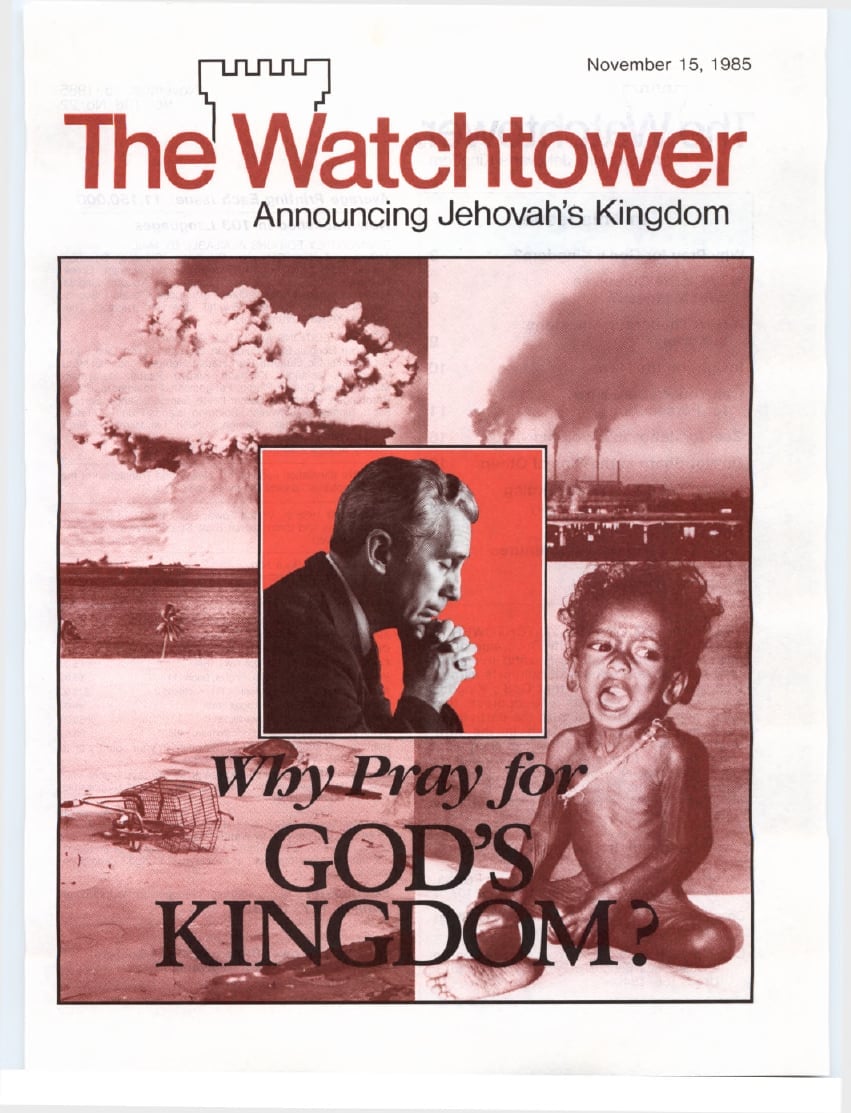
The Watchtower — November 15, 1985
Source: jw.org
Contents
Why Pray for God’s Kingdom?
Why Clothe Ourselves With Mildness?
A New Theocratic Milestone in Korea
Insight on the News
Can You Prepare Now for Persecution?
Zeal for Jehovah’s Worship
Do Not Share in the Sins of Others
Elders, Take Your Shepherding Responsibilities Seriously
Part 2—Spiritual Gems From the Christian Greek Scriptures
Her Husband Surprised Her
Why Pray for God’s Kingdom?
Why Pray for God’s Kingdom?
“OUR FATHER in the heavens, let your name be sanctified. Let your kingdom come. Let your will take place, as in heaven, also upon earth.”—Matthew 6:9, 10.
For almost 2,000 years, faithful Christians have used these words as a model for their own prayers to God. First spoken by Jesus Christ, it is known as the Lord’s Prayer, or the Our Father.
Today, however, many no longer pray the Lord’s Prayer. Rather than looking to God’s Kingdom, they look to human governments, economic systems, scientific methods, or the United Nations to provide hope for the future. Do you do that? If so, are you being realistic?
The Problems
Some people regard today’s civilization as the most prosperous in history. But it is in a precarious situation. Many forces threaten the future of civilization, even the future of life itself on earth. Consider just some of these threatening forces.
Nuclear Weapons
The total strength of such weapons currently existing is equivalent to more than three tons of TNT for every man, woman, and child on earth. In an article entitled “The Bomb—Beyond Control?” Canadian journalist David Lancashire noted that “with the growing sophistication of the weapons has come an increasing chance of accidental war by computer error.” And he quoted a United Nations study as follows: “History indicates that once a particular type of weapon has been developed past the testing stage, it will generally be used. This has not been true of nuclear weapons, with two exceptions [at Hiroshima and Nagasaki], but there can be no assurance that it will remain so.”
World Poverty
While some nations today have an extremely high standard of living, others are very, very poor. A writer in the magazine New Scientist felt that if the present inequalities continue, they will “inevitably lead to some sort of conflict.” But even if they do not lead to conflict, these inequalities might bring disaster. How?
The poorer countries have huge debts. In 1981 correspondent John Madeley explained: “This has put the world banking and financial system nearer to the edge of a precipice than the banking world has previously wanted to admit. Unless there are immediate and fundamental reforms in the world economic system to give developing countries the chance to earn more, [there could be] even more defaults and reschedulings, setting off a chain reaction to collapse.” (World Press Review) In various lands, the financial system remains in a precarious state.
Polluted Atmosphere
For a long time, mankind has been heedlessly pumping pollutants into the atmosphere. Now, according to the Chicago Tribune, “a growing number of scientists fear that, like a balloon stretched to the bursting point, the Earth’s envelope of air has been pushed to the point where catastrophic changes may be in store. . . . Some of the disasters are already upon us and others are coming sooner than expected.”
Polluted Water
Mankind has polluted the earth’s water in various places. For instance, in the United States it is reported: “In Biscayne Bay, fish are turning into diseased monsters. In New Orleans, where 112 different chemicals have been found in the drinking water, the rate of cancer mortality is soaring. From coast to coast, people and animals alike are paying a fearful price for the continuing contamination of our fresh water, our sea water, and our tap water.”—New Times.
These are just a few of the problems imperiling our future. Others include the depletion of energy sources, the population explosion, the destruction of forests, the spread of deserts, and the growing shortage of fresh water. It may be that some of the threats have been exaggerated. But do you honestly believe that all are exaggerations? And when considering all the problems, do you think that man has any chance of solving them? Yet if they are not solved, what future is there for the human race? And why are we plagued with so many seemingly insoluble problems?
Why the Problems?
Well, these problems demonstrate a basic truth: Man really cannot govern himself successfully. No human ruler has ever had the wisdom, the altruism, or the power to govern for the greatest good of everyone. The Bible tells us: “To earthling man his way does not belong. It does not belong to man who is walking even to direct his step.” (Jeremiah 10:23) Man was not made to rule himself.
There is also another factor, one that many find it difficult to accept in this materialistic age. Rulership of mankind does not involve only humans. When Jesus was on earth, a superhuman creature, Satan, offered him rulership of all the kingdoms of the world. And later Jesus’ follower Paul called Satan “the god of this system of things.” (2 Corinthians 4:4; Matthew 4:8, 9) How can Satan be the ruler of this world, when so many no longer believe in him? Because most people—even if unknowingly—do not accept God’s rulership and hence are furthering Satan’s designs.—Matthew 12:30.
Satan’s situation has worsened since Jesus’ day. The Bible reveals that today Satan has “great anger, knowing he has a short period of time.” (Revelation 12:12) Like Hitler at the end of the last world war, Satan is now desperate in his resolve to “rule or ruin.” Since his long rule has been so unsuccessful, Satan the Devil is now clearly bent on ruining the human race. Is it not sobering to know that such a malevolent, powerful force exists? Especially is that so when we remember that all those stockpiled nuclear weapons seem to be “beyond [human] control”! But what does all of this have to do with God’s Kingdom?
We Need the Kingdom
Since our problems are caused by man’s inability to rule himself, and also by the baleful influence of a superhuman power, their solution clearly lies outside the human race. This is why we desperately need God’s Kingdom. This Kingdom is a real government. But it is superhuman, heavenly, and has the power to overcome Satan. Being God’s Kingdom, it also has the wisdom, altruism, and authority to make right decisions and rule successfully.
Hence, we can be happy that the Bible tells us: “In the days of those kings [modern-day rulers] the God of heaven will set up a kingdom that will never be brought to ruin. And the kingdom itself will not be passed on to any other people. It will crush and put an end to all these kingdoms, and it itself will stand to times indefinite.” (Daniel 2:44) The King of that Kingdom is Jesus Christ, of whom it was said prophetically: “In his days the righteous one will sprout, and the abundance of peace until the moon is no more. And he will have subjects from sea to sea and from the River to the ends of the earth.”—Psalm 72:7, 8.
Yes, God’s Kingdom will solve mankind’s problems. So why not search the Bible to find out what this Kingdom is and how you can even now be a subject of it. You, and all others of mankind, truly need this Kingdom. Jehovah’s Witnesses stand ready to help you to learn about it.
[Picture Credit Line on page 4]
U.S. National Archives
[Picture Credit Line on page 4]
WHO photo
Why Clothe Ourselves With Mildness?
Why Clothe Ourselves With Mildness?
IT IS admired and appreciated. It helps us to avoid strife. It is often mistaken for weakness, but it has far greater strength than steel. That is mildness!
In the Bible, mildness is associated with humility, meekness. The Greek term for it denotes meekness, ‘mild and gentle friendliness; the opposite of roughness, bad temper, sudden anger, and brusqueness.’ Yet, mildness is more readily demonstrated by actions than defined by words.
But why clothe ourselves with mildness? And how can it help us?
Why So Important
Christians should display mildness because this pleases Jehovah God. The Bible counsels us to walk “with complete lowliness of mind and mildness.” Christian women are to put on “the incorruptible apparel of the quiet and mild spirit, which is of great value in the eyes of God.” (Ephesians 4:1-3; 1 Peter 3:3, 4) And the apostle Paul fittingly urges fellow believers: “As God’s chosen ones, holy and loved, clothe yourselves with the tender affections of compassion, kindness, lowliness of mind, mildness, and long-suffering.”—Colossians 3:12.
Being clothed with mildness is beneficial because this protective covering can shield us from harm. By being clothed with mildness when a potentially explosive situation develops, we may be able to defuse the anger of the offended person and achieve peace. Indeed, “an answer, when mild, turns away rage.” (Proverbs 15:1) Moreover, mildness helps us to cope with irksome everyday problems, relieves tense situations at work or in school, promotes peace and unity, and enables us to lead calmer, healthier, and happier lives. (Proverbs 14:30) So there are good reasons to clothe ourselves with mildness.
How It Can Be Done
Displaying mildness may seem difficult, but we can manifest this quality if that is our desire. Why? Well, for one thing, God created us in his image. (Genesis 1:26) Jehovah exemplifies mildness. His mildness is evident in the way he deals with sinful mankind. “He has not done to us even according to our sins; nor according to our errors has he brought upon us what we deserve.”—Psalm 103:10.
Mildness is part of the fruitage of God’s holy spirit. (Galatians 5:22, 23) If we sense a personal need for mildness, then, we can pray for the holy spirit that will help us to cultivate and display a mild attitude and manner.—Luke 11:13.
Since mildness is a product of God’s spirit, it is an essential feature of the Christian personality. In effect, it must be part of the clothing that identifies us as Christians. Yes, we can and should ‘clothe ourselves with mildness,’ an endowment from Jehovah resulting from his spirit and blessing.
Mildness Is Practical
Jesus Christ, who is firm for righteousness, nevertheless displays mildness. He pronounced mild-tempered ones happy. Jesus also taught the principle of ‘turning the other cheek,’ of not retaliating under provocation. (Matthew 5:5, 39; 21:5) Some say that this is impractical in today’s competitive world. But it is a mistake to conclude that Christian mildness denotes cowardice or weakness of personality. Such mildness is blended with strong faith, love for Jehovah, and appreciation for his righteous ways. Hence, it has great strength.
Throughout Biblical history, God-fearing men and women provided fine examples of mildness. For instance, “Moses was by far the meekest [the most mild-tempered] of all the men who were upon the surface of the ground.” (Numbers 12:3) But who would say that he had a weak personality or was a coward?
When contrasted with “the works of the flesh,” mildness proves superior. (Galatians 5:19-23) For example, mildness is practical when contrasted with uncontrolled anger. The Roman poet Horace observed: “Anger is momentary madness, so control your passion or it will control you.”
Acting “with a mildness that belongs to wisdom” means conducting ourselves in harmony with Jehovah’s personality, dealings, and ways. (James 3:13) For instance, a man who qualifies to teach fellow believers needs to be gentle, peaceful, and calm, not harsh, arrogant, and opinionated. (1 Timothy 1:6, 7; 2 Timothy 2:24, 25) But mildness can also be of great help to us in other aspects of life.
How Mildness Helps in Daily Life
Mildness can help us if problems should arise with neighbors. It worked for Cathy. During a picnic with some friends at her home, one of the children climbed up on a neighbor’s neat stack of firewood. The child tipped over part of the woodpile just as the neighbor was looking out his window. Infuriated, he charged outside, upbraiding the host family, the offending boy, and his parents. Instead of arguing, however, the hosts did what they could to allay their irate neighbor’s anger. They answered in mildness. The next day, Cathy baked bread for her family and made two extra loaves for the neighbor and his wife. Well, this gesture of human kindness, without a word about the incident that had been handled with mildness, was all that was needed to ease the tension and restore good relations.
It has been said that a good supervisor takes less than his share of the credit when things go right and more than his share of the blame when things go wrong. Don, who directs a construction crew, follows that mild policy. It works for him. On one occasion the supervisor of a construction project became upset because of the way something was built. He demanded: “Who is responsible for this?” Although another worker had not followed Don’s orders, Don answered: “It was my fault. I did not explain it clearly enough for my men to understand how it should be built.” On the other hand, when others praise Don for a construction job well done, he responds: “These men deserve the credit.” Because of Don’s mild manner and strength of personality, he is loved and respected by his superiors and his men.
These same principles apply when Jehovah’s Witnesses visit their neighbors while engaging in the field ministry. Some people do not appreciate these visits and may even become angry. Yet, mildness helps the visiting Witnesses to avoid imputing bad motives to the householders or judging them harshly. Although Jehovah’s Witnesses have good motives, did the call interrupt something the householder was enjoying? Did it wake him up? Mildness makes it possible to deal with such situations considerately.—1 Peter 3:15.
Similarly, if a person ‘takes a false step before he is aware of it,’ mildness helps Christian elders to maintain balance while counseling him. Their purpose is not to punish such a man but to “readjust” him, as when a doctor gently readjusts a bone that is out of joint. Indeed, those having spiritual qualifications must never forget that they should try to readjust the erring person “in a spirit of mildness.”—Galatians 6:1.
Continue Pursuing Mildness
The quality of mildness may be likened to soil in which other fruits of God’s spirit are more easily cultivated and maintained. If we are mild-tempered, we will readily yield to the guidance of Jehovah’s spirit. And if we display mildness, God will bless us, for he loves the meek and mild-tempered.—Isaiah 29:18-21; 61:1.
People flocked to Jesus because he was “mild-tempered and lowly in heart.” (Matthew 11:28, 29) That kind of disposition attracts honest-hearted people just as an inn with a glowing fireplace beckons weary travelers on a chilly night. A meek, mild person surely is a desirable associate. How fitting, then, that we pursue “mildness of temper”! (1 Timothy 6:11) Yes, let us clothe ourselves with mildness.
[Picture on page 7]
Jesus Christ displayed mildness. Do you?
A New Theocratic Milestone in Korea
A New Theocratic Milestone in Korea
KEEPING pace with the rest of the world, the Kingdom-preaching work in Korea is moving forward by leaps and bounds. Just three years, almost to the day, after the branch building in Kongdo, Korea, was inaugurated, a new addition was dedicated on May 11, 1985.a It was another milestone in the theocratic history of Jehovah’s Witnesses in Korea.
As seen in the picture, the new addition consists of a third floor on the office (the right section in the picture), two additional floors on the factory (the middle section), and an adjoining three-story Bethel home (the entire left section). The structures in the background are the existing Bethel home.
But why the addition so soon? In 1982, when the new factory first went into operation, it was producing 380,000 Watchtower and Awake! magazines each month. This has now doubled to 760,000 each month. Clearly, the added factory space will be put to good use. To care for the increased production, there are now 86 staff members serving at the branch headquarters. The new home can more than accommodate the increase; there is now enough room for 120 members.
A. D. Schroeder, a member of the Governing Body of Jehovah’s Witnesses in Brooklyn, New York, was on hand for the dedication program. Members of the Korean Branch Committee reported on the work in the field and gave details of the construction. All 2,199 present were filled with heartfelt thanks to Jehovah for his rich blessing.
[Footnotes]
For a report on the May 8, 1982, dedication, please see The Watchtower of September 15, 1982, pages 26-8.
Insight on the News
Insight on the News
Argentina’s Silent Church
“Blood taints church in Argentina,” read the headline of the National Catholic Reporter of April 12, 1985. Incredibly, an estimated 10,000 to 30,000 citizens were abducted and killed without trial under Argentina’s previous military government. Yet observers say that thousands of innocent lives could have been spared if the Catholic Church had protested. Instead, states the report, “the Argentine church—with a few heroic exceptions—was volubly silent throughout the seven-year terror,” which ended when a civilian government took power in 1983. Worse, some members of the hierarchy collaborated with the military regime.
Why was the church silent? In part, because of fear of reprisals. But the newspaper cites another reason: “The episcopacy also embraced the military as a source of power.” It was granted many privileges. Concludes the report: “The Argentine experience so closely resembles the performance of the Catholic church in Nazi Germany, it again raises the question of whether power is more important to the church than the Gospel imperative to be a witness to the truth.”
This shows the folly of religion’s currying the favor of political powers. It can lead to a compromise of principles. Interestingly, the book of Revelation condemns the linkage of Church and State when it describes the world empire of false religion as a harlot “with whom the kings of the earth committed fornication.” (Revelation 17:2) No wonder Jesus told his followers that they were to be “no part of the world.”—John 15:19.
“Inability to Feed Itself”
“It is impossible to travel in Africa today without being overwhelmed by military images,” says the Bulletin of the Atomic Scientists. But the drain of money and manpower to sustain these armies contributes to famine, particularly when war breaks out. The Bulletin gives some examples: “In Ethiopia, Chad, Mozambique, Angola, the Sudan, and Uganda serious and often prolonged insurgencies, wars, or border conflicts have damaged infrastructure, destroyed crops, and deepened human suffering.” States the report: “On a continent with such severe problems, including a fundamental inability to feed itself, the diversion of vast sums and significant manpower for military purposes is tragic.”
Tragic indeed! Fittingly, the book of Revelation portrays these conditions symbolically. It describes a sword-wielding horseman on a fiery-colored horse, who “was granted to take peace away from the earth” by warfare. Then, immediately following, came a black horse with its rider announcing famine. (Revelation 6:3-6) The combination of war and famine in Africa is one example of this prophecy’s fulfillment in our day.—See also Matthew 24:6-8.
“A Life of Drudgery”
“The traditional image of millionaires cavorting on the beaches of St Tropez, basking on the slopes of Aspen, driving their Cadillac or Rolls-Royce to the races or simply chewing a good cigar, is far from reality.” So says The Guardian Weekly in a report of a recent study by Dr. Thomas Stanley of Georgia State University. “America’s average millionaire is more than likely to live a life of drudgery.” Why? Because he works longer hours than other people—typically 75 hours a week. “Most of the country’s rich are simply ordinary small businessmen leading humdrum, hard lives.” They save up money for retirement. But due to their exhausting work schedules, many die before they get to retire. Such men have little time for life’s pleasures.
In contrast, a wise man of ancient times recommended: “Every man should eat and indeed drink and see good for all his hard work. It is the gift of God.” (Ecclesiastes 3:12, 13) Instead of being drudgery, a man’s work should be satisfying, enabling him to enjoy the wholesome, simple things that God provides. Wisely, then, true Christians shun the empty quest for wealth. They know that real contentment comes by ‘storing up treasures in heaven, not on earth.’—Matthew 6:19, 20.
Can You Prepare Now for Persecution?
Can You Prepare Now for Persecution?
“If they have persecuted me, they will persecute you also.”—JOHN 15:20.
1, 2. What unexpected action have some governments taken against Jehovah’s Witnesses?
IMAGINE yourself resting in bed early one morning. You are drowsily wondering whether to get up immediately or to relax a few moments longer. But first, you turn on the radio for the early news. Suddenly, the newscaster startles you into full wakefulness. He announces: “According to a government decree, the sect known as Jehovah’s Witnesses has been banned throughout the country.” No more relaxing for you!
2 This, or something like it, has been the experience of Christians in some countries in modern times. Often, there have been warnings of what might happen. But sometimes the ban has been completely unexpected. Should this surprise us?
3. What contrasting experiences did Jesus Christ have in 33 C.E.?
3 Not really. Similar things happened in the first century. Remember how Jesus Christ, in the early spring of 33 C.E., rode into Jerusalem on an ass. The people joyfully acclaimed him, spreading their garments on the road ahead of him. But what happened a few days later? Jesus was on trial before Pontius Pilate, and a mob from that same city bloodthirstily yelled: “Let him be impaled! . . . Let him be impaled!” (Matthew 21:6-9; 27:22, 23) The situation had changed suddenly.
4. As Jesus’ followers, what treatment should we expect?
4 Hence, we should not be surprised if in some lands today the situation changes and persecution unexpectedly arises. Remember, if we are truly Jesus’ followers, we should expect persecution. (John 15:20) This highlights the importance of Jesus’ words, “Keep on the watch.”—Matthew 24:42.
5. What questions now merit our consideration?
5 How can we do this? Is there any way we can prepare, in case the worst should happen?
Prepare Your Mind and Heart
6, 7. (a) Why is it difficult to make physical preparations for persecution? (b) What far more important preparation for persecution can be made?
6 It is difficult to make physical preparations for persecution because you do not know just what the situation will be. Until it actually happens, you do not know whether a ban will be strictly or loosely enforced, or even what will be banned. Perhaps only the house-to-house preaching work will be forbidden, or maybe religious meetings. Sometimes the legal organization of Jehovah’s Witnesses is dissolved, or certain individuals are immediately imprisoned. We can have in mind various places where literature could be hidden in case of need. But beyond that, there is little we can do in the way of physical preparation.
7 However, you can prepare your mind and heart, and this is far more important. Set your mind on why persecution is permitted and why you may be haled before rulers. “For a witness,” said Jesus. (Matthew 10:16-19) If your heart is fully prepared to stay faithful no matter what, Jehovah can reveal the wise way to act when the need arises. Hence, how can we prepare ourselves spiritually for persecution?
How Do You Deal With People?
8. Why could Paul say that he ‘took pleasure in insults’?
8 The apostle Paul said: “I take pleasure in weaknesses, in insults, in cases of need, in persecutions and difficulties, for Christ.” (2 Corinthians 12:10) Did Paul enjoy being insulted? Of course not. But persecution often involves being insulted, and if this was what it took to bring praise to God’s name, then Paul was happy to endure it.
9. How can we now prepare to endure “insults . . . for Christ”?
9 We, too, can be sure that at some time we will have to endure “insults . . . for Christ.” We may be verbally, or even physically, abused. Will we endure? Well, how do we view ourselves now? Do we take ourselves very seriously and react quickly to real or imagined insults? If so, then why not work on developing “long-suffering, . . . mildness, self-control”? (Galatians 5:22, 23) This will be excellent training for Christian living now, and it could save your life in times of persecution.
How Do You View Field Service?
10. What is the proper Scriptural reaction when our preaching work is banned?
10 Often, the first thing restricted under a ban is the public preaching of the “good news.” Yet preaching and disciple making are vital in these last days. How else will people learn about God’s Kingdom? Hence, the proper reaction to such a ban is the one expressed by the apostles, when the Jewish religious leaders tried to ban their preaching activity. (Acts 5:28, 29) Under ban, some avenues of preaching may be closed. But, somehow, the work has to be done. Would you have the strength to continue preaching under the pressure of persecution?
11, 12. How might you determine whether you would have the strength needed to continue preaching when persecuted?
11 Well, how do you view the preaching work now? Do you permit small obstacles to interfere and make you irregular in the field service? If so, what would you do under a ban? Do you fear men now? Are you willing to preach from house to house on your own street? Are you afraid to work alone? In some lands, two people working together often draw too much attention. So, where it is safe to do so, why not work alone now from time to time? It will be good training.
12 Do you share in magazine street work? Do you have the courage and initiative to create opportunities for informal witnessing? Do you work business territories? Are you afraid to approach wealthy or influential people? If you only share in certain kinds of preaching, what will you do if, under ban, that kind of preaching is no longer possible?
13. What can you now do about your ministry so as to be better prepared to preach in times of persecution?
13 Do you recognize that you have a weakness in some respect? Now is the time to work on it. Learn to rely on Jehovah and become more qualified as a minister. Then you will be better equipped to preach now and better prepared to persevere in times of persecution.
Are You Reliable?
14, 15. (a) What kind of first-century Christians must have been a fine stabilizing influence when persecution broke out? (b) How can a present-day servant of Jehovah become like those strong early Christians?
14 Throughout the Christian Greek Scriptures, individuals are mentioned who were towers of strength in the congregation. For example, Onesiphorus courageously helped Paul when he was in prison in Rome. (2 Timothy 1:16) Phoebe was recommended because of her hard work in the congregation at Cenchreae. (Romans 16:1, 2) Such men and women must have been a fine stabilizing influence when persecution broke out. They ‘stayed awake, stood firm in the faith, carried on as men, grew mighty.’—1 Corinthians 16:13.
15 All Christians, particularly elders, should try to make progress and become like the strong early Christians. (1 Timothy 4:15) Learn to keep confidential matters private and to make decisions based on Scriptural principles. Train yourself to discern Christian qualities in others so that you will know who will be reliable under pressure. Work, with Jehovah’s strength, to become a pillar in your congregation, a person who helps others rather than one who always needs help.—Galatians 6:5.
How Do You Get Along With People?
16, 17. How can applying Colossians 3:12, 13 now help you to prepare for persecution?
16 The apostle Paul encouraged us: “Clothe yourselves with the tender affections of compassion, kindness, lowliness of mind, mildness, and long-suffering. Continue putting up with one another and forgiving one another freely.” (Colossians 3:12, 13) Is this easy for you? Or do other people’s imperfections irritate you unduly? Do you quickly take offense or get discouraged? If so, here is another field where preparation can be made.
17 In lands where meetings are banned, Christians regularly come together in small numbers. In such circumstances, their shortcomings become even more evident. So why not train yourself now to put up with others’ weaknesses, just as they doubtless are putting up with yours? Do not be critical of others and thus greatly discourage them. Also, train yourself and your children to respect other people’s property while attending Congregation Book Studies. Under persecution, such respect will promote peaceful relations.
Are You Inquisitive?
18. Why is it sometimes safer to know only what you need to know?
18 By nature, some of us are very inquisitive. We cannot bear not being “in the know.” Are you like that? If so, consider this: Sometimes, when the work of Jehovah’s Witnesses has been banned, the authorities try to discover their organizational arrangements and the names of responsible overseers. If you were one who knew these things, you could be subjected to physical abuse in an effort to force you to reveal them. And if you did reveal them, the work of your brothers could be seriously affected. Hence, sometimes it is safer to know only as much as you need to know and no more.
19. What can now help you to avoid revealing confidential matters when persecuted?
19 Can you train for that now? Yes. For example, if there is a judicial committee case in the congregation, individuals should be satisfied with whatever the elders see fit to say and not pry in order to find out any details. Wives and children of elders should not try to pressure them into revealing confidential matters. In every way, we should learn not to ‘meddle in what does not concern us.’—2 Thessalonians 3:11.
Are You a Bible Student?
20, 21. How will diligent Bible study now help you if the work is banned?
20 The Bible is the basis for a Christian’s spiritual strength. It gives him answers to his most important questions and grants access to the wisdom of God himself. (2 Timothy 3:14-16) All Christians acknowledge this in principle, but what part does the Bible really play in your life? Do you study it regularly and allow it to guide you in everything you do?—Psalm 119:105.
21 Often, access to our Bible literature is severely restricted when the work is banned. Sometimes, even Bibles are hard to find. Under such circumstances, the holy spirit will remind you of things you have learned in times past. But it will not remind you of things you have not learned! Therefore, the more you study now, the more will be stored in your mind and heart for the holy spirit to bring out in times of need.—Mark 13:11.
Do You Pray?
22. How can ‘persevering in prayer’ prove helpful in preparing for persecution?
22 This is an important question when we think of persecution. The Bible counsels: “Persevere in prayer.” (Romans 12:12) Prayer is direct communication with Jehovah God. Through it we can ask for the strength to endure difficulties and make right decisions, as well as build a personal relationship with Jehovah God. Even if opposers take away our literature, our Bibles, and our association with other Christians, they can never take away our privilege of prayer. In the strongest prison, a Christian can get in touch with God. Taking full advantage of the privilege of prayer, then, is a fine way to prepare for whatever the future may hold.
Do You Trust Authority?
23. Why build up trust in the appointed elders and in “the faithful and discreet slave”?
23 Building up this trust is also important. The elders in the congregation are a part of God’s provision to protect us. Elders need to act in a way that deserves trust, and the rest of the congregation needs to learn to give them their trust. (Isaiah 32:1, 2; Hebrews 13:7, 17) Even more important, we should learn to trust “the faithful and discreet slave.”—Matthew 24:45-47.
24. What can be done to prepare to resist lying attacks by enemies of Jehovah’s people?
24 Enemies may spread lies about God’s organization. (1 Timothy 4:1, 2) In one country, some Christians were misled to believe that the Governing Body of Jehovah’s Witnesses had forsaken Christianity, whereas they themselves were still remaining faithful to it. A good way to prepare to resist attacks like this is to build a strong love for your brothers and learn to trust in Jehovah’s arrangement of things.—1 John 3:11.
You Can Be Victorious
25. What will help us to come off victorious when persecuted?
25 The aged apostle John, after suffering persecution, told us: “Everything that has been born from God conquers the world. And this is the conquest that has conquered the world, our faith.” (1 John 5:4) You cannot conquer in your own strength. Satan and his world are stronger than you are. But they are not stronger than Jehovah God. Hence, if we obey God’s commands, praying for his spirit to uphold us and relying on him completely for strength to endure, then we can come off victorious.—Habakkuk 3:13, 18; Revelation 15:2; 1 Corinthians 15:57.
26. Even if you are not now suffering persecution, what should you do?
26 In all lands, there are some Christians being persecuted, either by opposed marriage mates or in some other way. In some lands, all of God’s servants are suffering because of the official acts of the local government. But even if, right now, you personally are not suffering opposition or unusual hardship, remember that it could happen at any time. Jesus said that persecution of Christians would be a part of the sign of the time of the end; hence, we should always expect it. (Matthew 24:9) So why not prepare for it now? Be determined that, whatever may lie ahead, your conduct will always bring praise to your heavenly Father, Jehovah God.—Proverbs 27:11.
What Are Your Answers?
□ What kind of preparations for persecution can you now make?
□ What can you now do to develop the strength needed to continue preaching when persecuted?
□ How can applying Colossians 3:12, 13 now be helpful when persecution occurs?
□ Why build up your trust in the appointed elders and “the faithful and discreet slave”?
□ How can you be a victor when persecuted?
Zeal for Jehovah’s Worship
Jesus’ Life and Ministry
Zeal for Jehovah’s Worship
AFTER attending the wedding in Cana, Jesus travels to Capernaum, a city near the Sea of Galilee. With him are his disciples, his mother, and his brothers, who are James, Joseph, Simon, and Judas. Before making this trip, however, they may have stopped first at Jesus’ home in Nazareth so that the family could pack the things they would need.
But why does Jesus go to Capernaum, rather than carry on his ministry in Cana, in Nazareth, or in some other place in the hills of Galilee? For one thing, Capernaum is more prominently situated and is evidently a larger city. Also, most of Jesus’ newly acquired disciples live in or near Capernaum, so they will not have to leave their homes to receive training from him.
During his stay in Capernaum, Jesus performs marvelous works, as he himself testifies some months later. But soon Jesus and his companions are on the road again. It is spring, and they are on their way to Jerusalem to attend the Passover of 30 C.E. While there, his disciples see something about Jesus that they have perhaps not seen before.
According to God’s Law, Israelites are required to make animal sacrifices. So, for their convenience, merchants in Jerusalem sell animals or birds for this purpose. But they are selling right inside the temple, and they are cheating the people by charging them too much.
Filled with indignation, Jesus makes a whip of ropes and drives the sellers out. He pours out the coins of the money changers and overturns their tables. “Take these things away from here!” he cries out to those selling the doves. “Stop making the house of my Father a house of merchandise!”
When Jesus’ disciples see this, they remember the prophecy about God’s Son: “The zeal for your house will eat me up.” But the Jews ask: “What sign have you to show us, since you are doing these things?” Jesus answers: “Break down this temple, and in three days I will raise it up.”
The Jews assume that Jesus is talking about the literal temple, but he is talking about the temple of his body. And three years later his disciples remember this saying of his when he is raised from the dead. John 2:12-22; Matthew 13:55; Luke 4:23.
◆ After the wedding in Cana, to what places does Jesus travel?
◆ Why is Jesus indignant, and what does he do?
◆ What do Jesus’ disciples recall on seeing his actions?
◆ What did Jesus say about “this temple,” and what did he mean?
Do Not Share in the Sins of Others
Do Not Share in the Sins of Others
“I have not sat with men of untruth; and with those who hide what they are I do not come in.”—PSALM 26:4.
1. Why did Jude change his purpose in writing to fellow Christians?
NINETEEN centuries ago, the disciple Jude had intended to write fellow believers about ‘the salvation they held in common.’ But he found it necessary to urge them to “put up a hard fight for the faith that was once for all time delivered to the holy ones.” Why? Because certain “ungodly men” had slipped into the congregation and were “turning the undeserved kindness of our God into an excuse for loose conduct.”—Jude 3, 4.
2. Although it is refreshing to discuss salvation, at times what must we consider prayerfully?
2 How refreshing to discuss salvation held in common! Meditating on that message brings great satisfaction, and we rejoice when anticipating all the blessings of that salvation. Nevertheless, there are times when, rather than speaking about salvation, we are faced with the need to consider other serious matters. If not corrected, these can tear down our faith and cause us to lose out in the race for life. Even as Jude’s warning against wrong conduct was strong and forceful, so Christians today must at times prayerfully consider Scriptural counsel that is direct, very much to the point.
Our Own Sins
3. Why do we need discipline, and how should it be received?
3 The psalmist David said: “With error I was brought forth with birth pains, and in sin my mother conceived me.” (Psalm 51:5) All of us have been born as sinners. (Romans 5:12) The apostle John wrote: “If we make the statement: ‘We have no sin,’ we are misleading ourselves and the truth is not in us.” (1 John 1:8) As sinners, there are times when we need discipline so as to correct our course. Such discipline comes from Jehovah through his Word, the Bible, and his organization. His discipline corrects us and helps us to walk in uprightness before him. As the apostle Paul observed: “True, no discipline seems for the present to be joyous, but grievous; yet afterward to those who have been trained by it it yields peaceable fruit, namely, righteousness.” (Hebrews 12:11) In view of the peaceable fruit of such discipline, we surely should receive it with gratitude.
4. When may discipline be given, and what may be the effect of it?
4 Discipline from Jehovah may be given when we are just starting on a course that could lead to greater wrongdoing. (Galatians 6:1) At other times, the discipline may come after we have more fully entered into a wrong course. Such discipline may have to be severe, as when the apostle Paul strongly urged the Corinthians to take action against a fornicator in the congregation. (1 Corinthians 5:1-5) In either case, the discipline is given so that the wrongdoer might repent, turn around, and steer a steady course away from the sinful desires leading into serious wrongdoing. (Compare Acts 3:19.) Servants of Jehovah are grateful for such discipline, even as the rebuked individual in ancient Corinth benefited and apparently was restored to loving association with the congregation.—2 Corinthians 2:5-8.
5. Christians who become involved in serious sin usually do what?
5 The vast majority of those dedicated to Jehovah are very much aware of the need to walk in an upright manner before God. If they should become involved in serious sin, they quickly turn away from the bad course, go to the appointed elders, and give evidence of genuine repentance. (James 5:13-16) The fact that relatively few of Jehovah’s Witnesses are disfellowshipped each year is evidence that they hate what is bad and desire to do what is good.—Psalm 34:14; 45:7.
The Sins of Others
6, 7. How do some wrongdoers try to influence others?
6 Yet some who apparently love what is right seem to have allowed their hearts to deceive them, for they do not appear to hate what is bad. (Psalm 97:10; Amos 5:15) As a result, they get involved in doing sinful things and do not maintain the fight to do what is right. At times, they may go even further, seeking to involve others in their sinful course. How important that we reject such suggestions!—Compare Proverbs 1:10-15.
7 Sometimes those who apparently do not hate what is bad talk so smoothly that a yearning to do what is wrong may develop in the hearts of those listening to them. The encouragement may be to engage in immorality or in some action bordering on conduct disapproved by God. Or a person may be urged to become involved in a situation that is potentially dangerous in a spiritual way. Those thus trying to persuade others may claim that Jehovah is a loving God who will be merciful when we sin. Such treachery of the heart can cause lasting damage. (Jeremiah 17:9; Jude 4) Surely, we should ‘hold back our foot from their roadway’!—Proverbs 1:15.
Sharing in the Sins of Others
8. What questions require consideration?
8 But suppose we realize that a suggested course of action is wrong? Does our rejecting it necessarily free us of further responsibility in the matter? If we know that those suggesting wrongdoing are engaging in it, what should we do?
9. Why may some fail to report wrongdoing by others, but why is this a serious matter?
9 Some who have knowledge of wrongdoing by others may be inclined to say nothing about it to those having the prime responsibility to keep the congregation clean. Why? Perhaps they do not want to be viewed as informers. Or, because of a false sense of loyalty, they may keep the matter quiet or may speak only to those who promise to keep it secret. This is very serious. Why? Because it can actually result in sharing in the sins of others.
10, 11. (a) What did the apostle John say about sharing in the sins of others? (b) If we have learned of wrongdoing by a member of the congregation, what might we ask ourselves?
10 The apostle John showed that it is possible to share in another person’s sin. He wrote: “Everyone that pushes ahead and does not remain in the teaching of the Christ does not have God. . . . If anyone comes to you and does not bring this teaching, never receive him into your homes or say a greeting to him. For he that says a greeting to him is a sharer in his wicked works.” (2 John 9-11) An apostate from “the teaching of the Christ” would not be a worthy associate, and by not even greeting him, the loyal Christian would avoid being a sharer in his wickedness.
11 Since that is the case with an apostate, surely we would not want to become sharers in the wickedness of others whose immoral acts come to our attention. What, then, if we know that a member of the congregation has become a thief or a drunkard? If we fail to encourage that individual to seek Jehovah’s forgiveness and confess his sin to the elders, are we entirely blameless? No, for we have a serious responsibility.
Cleanness and Protection Vital
12. Why show concern for the spiritual cleanness of the congregation?
12 We must individually show concern for the spiritual cleanness of the congregation. How well this was emphasized when Jewish exiles were about to leave Babylon in the sixth century B.C.E.! The God-given command was: “Turn away, turn away, get out of there, touch nothing unclean; get out from the midst of [Babylon], keep yourselves clean, you who are carrying the utensils of Jehovah.”—Isaiah 52:11.
13. How did Jude show that we must be concerned about protecting Jehovah’s people from wrongdoers?
13 We must also be concerned about protecting Jehovah’s people from those who would seek to entice them into wrongdoing. The “ungodly men” of Jude’s day sought to ‘turn the undeserved kindness of God into an excuse for loose conduct,’ but that loyal disciple acted to warn fellow believers and thus protect them. He reminded them of warning examples provided by unfaithful Israelites, the disobedient angels, and others. Read his divinely inspired letter, and you will see that loyal Christians cannot sit idly by when the cleanness of the congregation is threatened or God’s people need protection from immoral persons having unclean motives.
14. If a wrongdoer fails to confess to the elders, how can Psalm 26:4 help us to decide what to do?
14 Yet, suppose we have encouraged a wrongdoer to seek God’s forgiveness and confess to the elders, but he keeps putting this off or sees no need to take these steps. Can we just drop the matter? Some might reason that they do not want to become involved. They may not want to risk losing the friendship of the erring one. And they may not want to be thought of as persons who betray a confidence by telling the elders. But this is faulty reasoning. The psalmist David said: “I have not sat with men of untruth; and with those who hide what they are I do not come in.” (Psalm 26:4) Surely, then, we would not want to become accomplices of “those who hide what they are.”
15. How does Leviticus 5:1 show our responsibility after giving an erring individual a reasonable amount of time to approach the elders about his wrongdoing?
15 Therefore, after we have given the erring individual a reasonable amount of time to approach the elders about his wrongdoing, it is our responsibility before Jehovah not to be a sharer in his sin. We need to inform the responsible overseers that the person has revealed serious wrongdoing that merits their investigation. This would be in harmony with Leviticus 5:1, which says: “Now in case a soul sins in that he has heard public cursing and he is a witness or he has seen it or has come to know of it, if he does not report it, then he must answer for his error.” Of course, we must avoid acting hastily on mere supposition of wrongdoing.
16. What is of far greater importance than loyalty to a friend who refuses to reveal his serious wrongdoing to the appointed elders?
16 In today’s world, covering over the wrongdoing of others is a general practice. Many are as mute as a stone wall when it comes to revealing the wrongdoing of others to those who should know about such actions. It requires strength of Christian personality to inform appointed elders of the serious sin of a fellow believer. But if we are to have Jehovah’s favor, we must not let personal friendship blind us to the wrongdoing of another individual. Our relationship with God is of far greater importance than loyalty to a friend who is guilty of serious wrongdoing and refuses to reveal the matter to the appointed elders.
A Problem for All to Consider
17. What illustrates that certain youths among us need to guard against sharing in the sins of others?
17 The problem of sharing in the sins of others sometimes exists among certain youths in our midst. They may remain silent and refuse to tell those who should be informed when others do things that could detrimentally affect the congregation and could result in Jehovah’s disfavor. Covering over the wrongdoing of others is quite common in the worldly school systems. But when this viewpoint spreads to the congregation, many problems may result. There have even been reports of young ones banding together to engage in wrong conduct while swearing one another to secrecy so that elders and parents will not learn about such activity. Yielding to pressure from peers and a desire to be accepted by the group has caused much heartache for these youths, their parents, and others in the congregation when the wrongdoing has been discovered. We must remember that there is nothing hidden that will not be revealed, and one of our primary responsibilities before Jehovah is to help to keep his organization clean.—Luke 8:17.
18. Christian parents should do what if their children do wrong?
18 All servants of Jehovah should be very careful not to share in the sins of others. Some parents try to justify the wrong conduct of their children, endeavoring to shelter them. But Christian parents should not adopt the attitude that everyone is against their children when these younger ones do wrong. Instead, godly parents should help their erring offspring to receive, accept, and benefit from any needed discipline outlined in God’s Word.
19. (a) Regarding serious sins, about what do Christian married couples need to be careful? (b) What must elders do if one of them or a ministerial servant should commit a serious sin?
19 Christian married couples also need to be careful that they do not violate God’s laws by covering over each other’s serious sins. They should remember the case of Ananias and Sapphira, who conspired but unsuccessfully sought to cover over serious sin. (Acts 5:1-11) Elders must also be alert not to protect one another or ministerial servants if one of them has committed a serious sin that could result in disfellowshipping. They should follow the principle outlined by Paul, who wrote: “Never lay your hands hastily upon any man; neither be a sharer in the sins of others; preserve yourself chaste.”—1 Timothy 5:22.
The Wisdom of Maintaining Blamelessness
20. Rather than covering over or sharing in the gross sins of others, what should we do?
20 Servants of Jehovah should neither share in nor imitate the bad ways of this world. In writing to Gaius, the apostle John said: “Beloved one, be an imitator, not of what is bad, but of what is good. He that does good originates with God. He that does bad has not seen God.” (3 John 11) How good it is to be guided by the sure Word of God and thus do what is good! Rather than covering over or sharing in the gross sins of others, therefore, it should be our resolve to shine as illuminators, being blameless and innocent. (Philippians 2:14, 15) Each servant of God is responsible for keeping the congregation clean, while remaining unblemished personally. (2 Peter 3:14) But what if you are troubled about the propriety of what someone has done? You should feel free to speak with the elders and get direction as to the right course to follow.
21. (a) How is Christ’s love for his congregation an example for us? (b) Regarding the wrongdoing of others, what responsibility should we shoulder?
21 Our love for Jehovah’s organization should imitate the love of Jesus Christ for his spiritual bride, the congregation. He “loved the congregation and delivered up himself for it, that he might sanctify it, cleansing it with the bath of water by means of the word, that he might present the congregation to himself in its splendor, not having a spot or a wrinkle or any of such things, but that it should be holy and without blemish.” (Ephesians 5:25-27) Similarly, our love for Jehovah’s organization should move us to do what we can to keep it clean. Never may we do anything to dishonor God or his organization or condone the wrongdoing of others in the congregation. Rather, let us encourage wrongdoers to correct their conduct and seek the help of the elders. If they fail to do this within a reasonable amount of time, let us shoulder our responsibility to inform the appointed overseers. In this way, we will avoid becoming sharers in the sins of others and bearing some responsibility for their wrong conduct.
22. (a) To attain salvation, what must we do? (b) What questions remain for consideration?
22 The salvation we hold in common is a treasure beyond compare. To attain it we must continue to walk before Jehovah in an upright way. Therefore, let us help one another to do so, never sharing in the sins of others. Jehovah has lovingly provided an organizational arrangement to assist us in these efforts, and in this regard appointed elders play an important role. But how do they imitate Jehovah and his Son, the Fine Shepherd? What assistance can elders give us on the roadway to life? The following article will answer these questions.
Can You Recall?
□ How should you view discipline?
□ If a fellow believer tells you that he has committed a serious sin, what should you urge him to do?
□ What should you do if you know that a wrongdoer has not confessed his sin to the appointed elders?
□ Whether we are elders, marriage mates, or children, how can we avoid sharing in the sins of others?
[Picture on page 20]
The apostle John warned against sharing in the sins of others
Elders, Take Your Shepherding Responsibilities Seriously
Elders, Take Your Shepherding Responsibilities Seriously
“Shepherd the flock of God in your care.”—1 PETER 5:2.
1. Why is it so appropriate that sheep should be used to symbolize humans approved by God?
HOW appropriate it is that sheep should be used to symbolize humans favored by Jehovah God! Sheep are docile creatures that respond to the voice of their shepherd and readily follow him. God’s sheeplike people similarly allow themselves to be led by the Fine Shepherd, Jesus Christ. They know him, respond to his voice, and joyfully accept his leadership. (John 10:11-16) Of course, without a good shepherd, literal sheep quickly become fearful and helpless. No wonder, then, that Jesus Christ felt pity for people who were “skinned and thrown about like sheep without a shepherd.”—Matthew 9:36.
2. How did Jehovah view the sheeplike ones who suffered under the unloving “shepherds of Israel”?
2 Jehovah God is deeply interested in the spiritual welfare of honest-hearted humans Scripturally designated as “sheep.” For instance, through the prophet Ezekiel, God pronounced woe upon “the shepherds of Israel,” the responsible men who fed themselves while neglecting the sheep. But Jehovah was not going to allow sheeplike ones to suffer without relief, for he said: “The lost one I shall search for, and the dispersed one I shall bring back, and the broken one I shall bandage and the ailing one I shall strengthen.”—Ezekiel 34:2-16.
3. How has Jesus Christ shown concern for the sheep?
3 The Fine Shepherd, Jesus Christ, has similar concern for sheeplike ones. Before ascending to heaven, therefore, Jesus expressed his desire that the sheep receive proper care. He told the apostle Peter, ‘Feed my lambs, shepherd my little sheep, feed my little sheep.’ (John 21:15-17) And to assure continued loving attention to the sheep, Jesus gave “some as shepherds” to build up “the body of the Christ.”—Ephesians 4:11, 12.
4. The apostle Paul urged spirit-appointed “older men” to do what?
4 Since both God and Christ have such deep love and concern for the sheeplike ones, being an undershepherd of God’s sheep is a very responsible assignment. Thus the apostle Paul urged the spirit-appointed “older men” of Ephesus to “shepherd the congregation of God,” paying due attention to it. (Acts 20:17, 28) So how can appointed elders properly care for this responsibility?
Shepherds Receive Direction
5. What counsel did Peter give fellow overseers?
5 The apostle Peter, who was expected to feed Jesus’ sheep, told fellow overseers: “Shepherd the flock of God in your care, not under compulsion, but willingly; neither for love of dishonest gain, but eagerly; neither as lording it over those who are God’s inheritance, but becoming examples to the flock.” (1 Peter 5:1-3) Let us see how elders, appointed by holy spirit, can satisfactorily comply with this counsel.
6. With what attitude should elders serve “the flock of God”?
6 Peter urged fellow elders: “Shepherd the flock of God in your care, not under compulsion, but willingly.” Those privileged to serve as spiritual shepherds should not do so grudgingly, feeling compelled to care for the sheep. They should not feel coerced, as though this were some form of drudgery or as if others were prodding them to shepherd the flock. Rather, elders should serve with a willing spirit. (Compare Psalm 110:3.) When a person is willing to do good for others, he usually does so wholeheartedly, exerting himself and going out of his way to serve their interests. A willing elder gives freely of his time and energies. He knows that at times sheep may go astray, and he desires to help them, imitating God’s concern for the sheeplike ones. Why, so great was Jehovah’s concern for Israelites who went astray that his words were: “I have said, ‘Here I am, here I am!’ to a nation that was not calling upon my name”!—Isaiah 65:1.
7, 8. (a) What does it mean to carry out the shepherding work without love for dishonest gain? (b) Serving eagerly means doing what?
7 Peter said that the shepherding work should be done “neither for love of dishonest gain, but eagerly.” The appointed elders do not desire to be a burden to the sheep. That was the apostle Paul’s attitude, for he told Christians in Thessalonica: “Certainly you bear in mind, brothers, our labor and toil. It was with working night and day, so as not to put an expensive burden upon any one of you, that we preached the good news of God to you.” He also reminded them: “We did not behave disorderly among you nor did we eat food from anyone free. To the contrary, by labor and toil night and day we were working so as not to impose an expensive burden upon any one of you.”—1 Thessalonians 2:9; 2 Thessalonians 3:7, 8.
8 Similarly, faithful shepherds of God’s flock today do not covetously desire what the sheep have or try to make unjust profit at their expense. (Luke 12:13-15; Acts 20:33-35) Paul showed that those qualifying to be overseers ‘must not be greedy of dishonest gain.’ (Titus 1:7) Rather, they must serve eagerly, having enthusiastic interest in their work and seeking the advantage of the sheep entrusted to their care. (Philippians 2:4) In this way, these shepherds show unselfish concern for the sheep similar to that displayed by Jehovah God and his Son, Jesus Christ.
9. Why must a Christian shepherd ‘not lord it over those who are God’s inheritance’?
9 Peter also said that elders were to shepherd Jehovah’s people “neither as lording it over those who are God’s inheritance, but becoming examples to the flock.” A loving shepherd is careful that he does not abuse his authority by having an air of superiority and lording it over the sheep. A proud spirit is unchristian and must be avoided by all those desiring to please Jehovah. Proverbs 21:4 says: “Haughty eyes and an arrogant heart, the lamp of the wicked ones, are sin.” And Jesus told his followers: “You know that the rulers of the nations lord it over them and the great men wield authority over them. This is not the way among you; but whoever wants to become great among you must be your minister, and whoever wants to be first among you must be your slave.” (Matthew 20:25-27) Indeed, elders must remember that those making up the flock are God’s sheep and must not be dealt with in a harsh manner.
10. (a) What were some shepherds of the people doing in Ezekiel’s day? (b) How are loyal overseers fine examples to the flock?
10 To the self-serving shepherds of Ezekiel’s day, Jehovah said: “The sickened ones you have not strengthened, and the ailing one you have not healed, and the broken one you have not bandaged, and the dispersed one you have not brought back, and the lost one you have not sought to find, but with harshness you have had them in subjection, even with tyranny.” God further said that the harsh shepherds had ‘kept shoving all the sickened ones until these had been scattered.’ (Ezekiel 34:4, 20, 21) But it is not that way with the loving shepherds of “the flock of God” today. They do not flaunt their authority and are careful not to stumble any of the sheep. (Compare Mark 9:42.) Rather, such elders provide loving help and encouragement. Moreover, they prayerfully rely on Jehovah and work hard to be fine examples “in speaking, in conduct, in love, in faith, in chasteness.” (1 Timothy 4:12) Consequently, the sheep are contented and feel secure, knowing that they are being cared for by loving, God-fearing shepherds.
…