The Watchtower, October 1, 1985
Download: PDF — The Watchtower, October 1, 1985
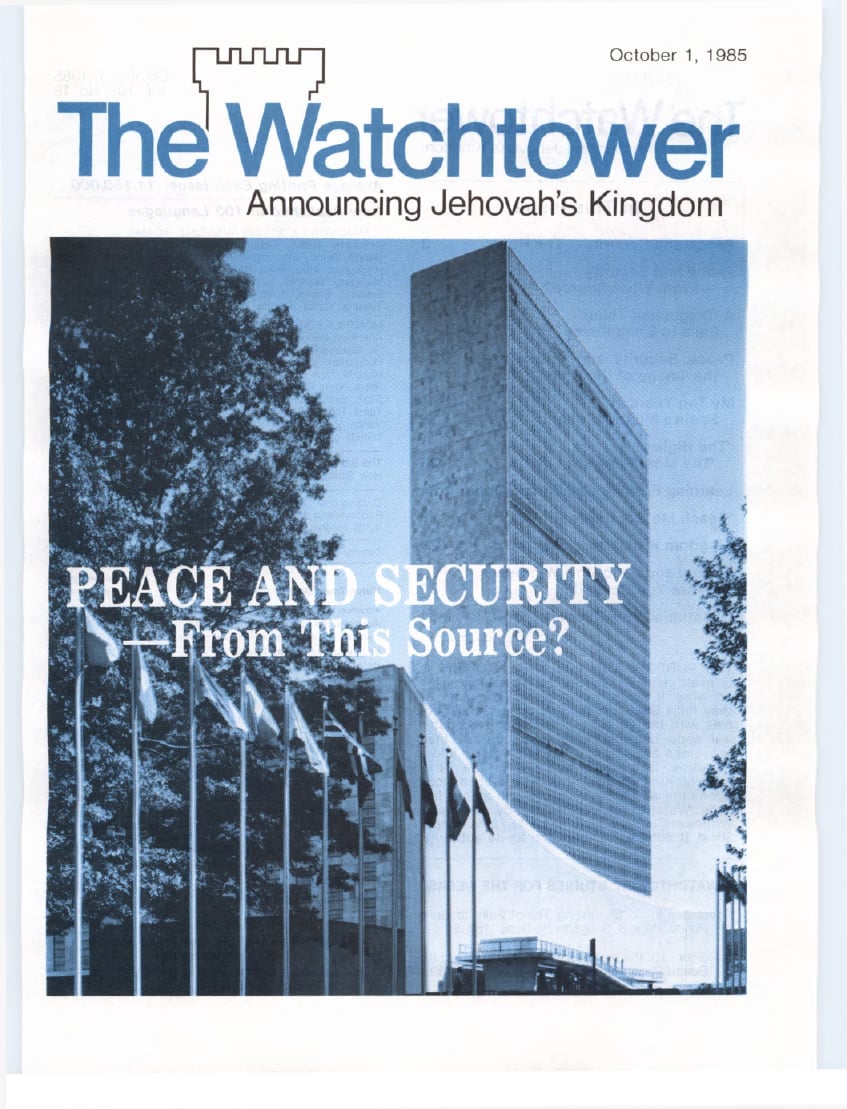
The Watchtower — October 1, 1985
Source: jw.org
Contents
Peace and Security—The Hope
Peace and Security—From What Source?
A “Disgusting Thing” Fails to Bring Peace
Peace, Security, and the ‘Image of the Beast’
My Ten Years in Spain’s Military Prisons
“The Highest Service,” “The Most Pleasant Life”
Learning From Jesus’ Temptations
“Teach Me Goodness”
Finding a Purpose in Life
“School and Jehovah’s Witnesses”—Are You Using It?
Questions From Readers
Kind Acts Bring Joy
Peace and Security—The Hope
Peace and Security—The Hope
“The General Assembly of the United Nations unanimously declared 1986 as the International Year of Peace. The Year will be solemnly proclaimed on 24 October 1985, the fortieth anniversary of the United Nations.”
HOW do you view this official statement from the United Nations organization? Does it make you feel more confident about the future? Many would say that anything that holds out even the remotest chance of bringing peace is worth trying. So why not an “International Year of Peace”?
Certainly, such a “Year of Peace” would be in harmony with the goals of the founders of the United Nations organization. Back in 1944 the president of the United States declared: “We have been determined . . . to so organize the peace-loving nations that they may through unity of desire, unity of will, and unity of strength be in position to assure that no other would-be aggressor or conqueror shall even get started. That is why from the very beginning of the war, and paralleling our military plans, we have begun to lay the foundations for the general organization for the maintenance of peace and security.”
Those ideals were shared by many. “For the United Nations to come into existence, it was necessary for a large body of persons to believe in the human capacity for good, and to feel that their hopes might be justified,” says the book Defeat of an Ideal by Shirley Hazzard, who worked for a decade in the United Nations Secretariat.
The charter of the newborn organization expressed the hopes of its founders: “The Purposes of the United Nations are: 1. To maintain international peace and security . . . 2. To develop friendly relations among nations based on respect for the principle of equal rights and self-determination of peoples . . . 3. To achieve international cooperation in solving international problems.” Could anything be wrong with such goals?
Admittedly, the United Nations had an impressive start. Weighty world issues were discussed. In 1948 an outstanding Universal Declaration of Human Rights was adopted. Valuable humanitarian work was initiated to alleviate poverty, hunger, sickness, and the plight of refugees. International standards were established, such as safety standards for ships and aircraft, health certificates for travelers to some regions, uniform postal rates, and the assignment of space on broadcast bands.
The United Nations was closely involved in the efforts to make peace in the India-Pakistan conflict of 1947-49. It even showed military muscle when soldiers under its flag went into Korea in 1950 and into the Congo (now Zaire) in 1960. There are still UN peace-keeping forces in Cyprus and the Middle East. Yes, in the last 40 years the United Nations has made its mark. More than 150 countries have shown that they recognize this by sending delegates to its distinctive headquarters in New York City, on the banks of the East River.
But to what extent has the United Nations fulfilled its basic mandate to “maintain international peace and security”? And what effect will the proclaimed “International Year of Peace” have?
Peace and Security—From What Source?
Peace and Security—From What Source?
WHILE the United Nations has performed valuable services in some fields, anyone who keeps up with the news has to admit that it has so far failed in the area of peace and security. This is openly admitted by the organization’s most ardent advocates.
Thus, back in 1953, only eight years after its birth, Dag Hammarskjöld, then secretary-general, confessed: “Where our predecessors dreamed of a new heaven, our greatest hope is that we may be permitted to save the old earth.” Twenty-six years later, C. William Maynes, a United States assistant secretary of state, was forced to admit: “The main purpose of the Security Council and the General Assembly was the maintenance of international peace and security. . . . You have evidence that the organization has failed in its central purpose.”
How Relevant?
The truth is, most of the outstanding decisions affecting peace and security during the past 40 years have been made largely outside the United Nations. In 1982, Secretary-General Javier Pérez de Cuéllar bemoaned the fact that “this year, time after time we have seen the Organization set aside or rebuffed, for this reason or for that, in situations in which it should, and could, have played an important and constructive role.” Why is this?
Some point to the organization’s spectacular growth in membership as a reason. The 51 original members increased to more than 150, each with an equal vote in the General Assembly. Yet some of these nations are very small. Thus, the island nation of Saint Christopher and Nevis, the 158th nation to join the organization, has a population of fewer than 50,000, yet it has an equal vote with China, whose population is close to one billion. True, this arrangement gives smaller nations the opportunity to be heard; but it hardly encourages the larger powers to take the organization’s decisions seriously.
A second problem is touched on by Shirley Hazzard: “Powers of compulsion were not invested in the United Nations Organization, except in so far as they might reside in the very members most likely to need compelling.” In other words, the organization can make decisions, but for the most part it cannot enforce them. Weighty world problems are regularly discussed at length. Resolutions are solemnly passed—and then forgotten. In 1982 the UN secretary-general was moved to deplore the “lack of respect for its decisions by those to whom they are addressed.”
These are organizational problems—and there are others mentioned by analysts. But there are deeper, more serious reasons why the United Nations has failed.
The Deeper Problems
“It then seemed possible to establish, as a first priority, a system for maintaining international peace and security under the provisions of the Charter,” said Javier Pérez de Cuéllar, recalling the idealism of the founders of the organization. “What has happened to that majestic vision? It was soon clouded by the differences of the major Powers. . . . Moreover, the world turned out to be a more complex, far less orderly place than had been hoped.”
In fact, there was never any chance that the United Nations would bring peace and security. The task was just too difficult. The secretary-general’s comments remind us of the words of the prophet Jeremiah: “It does not belong to man who is walking even to direct his step.” (Jeremiah 10:23) Humans, with their limited wisdom and abilities, will never be able to solve the problem of bringing peace and security for all.
The secretary-general said that the founders of the United Nations discovered the world to be “more complex” than they had hoped. There is a basic reason for this situation, and apparently they were not aware of it. But the apostle John explains it thus: “The whole world is lying in the power of the wicked one.” (1 John 5:19) The Bible tells us that today “the wicked one,” Satan, is causing “woe for the earth,” “having great anger.” (Revelation 12:12) The grim reality of Satan and his influence foredoomed the United Nations’ efforts to bring peace before the organization even got started.
Remember, too, that the United Nations organization is a child of this world and thus inherits its characteristics. The weaknesses, evils, and corruption that characterize the individual nations inevitably also exist in the United Nations. Alexander Solzhenitsyn was quoted as saying in 1972: “A quarter of a century ago, with great hopes from all mankind, the United Nations Organization was born. Alas, in an immoral world it too grew up immoral.” The Bible warns: “‘There is no peace,’ Jehovah has said, ‘for the wicked ones.’” (Isaiah 48:22) An “immoral” organization can never bring peace and security.
What About Peace and Security?
So, will the declaring of 1986 to be an “International Year of Peace” make any difference? That is highly unlikely, since the aforementioned problems are completely unsolvable by humans. The “Year of Peace” is no more likely to bring mankind closer to peace and security than the “Year of the Child” in 1979 improved the international lot of children or the “International Women’s Year” in 1975 made the world a better place for women.
However, if mankind is to survive, it is obvious that someone has to do something about peace and security. Today, the nuclear-armed nations are in a position to destroy most life on earth. Sophisticated conventional weapons cause an appalling loss of life each year. Real peace seems further away than ever! If the United Nations has failed to solve these problems, who can?
A look at history suggests a hopeful answer. About 3,000 years ago King David, a Middle Eastern warrior-king, wrote about a future ruler who would succeed in bringing international peace. In a prayer for this ruler, David said: “Let the mountains carry peace to the people, also the hills, through righteousness. In his days the righteous one will sprout, and the abundance of peace until the moon is no more.”—Psalm 72:3, 7.
What ruler could possibly bring such lasting peace? David was pointing, not to a human organization, but to his God, Jehovah, as the one through whose authority this would happen. Was this mere wishful thinking? No. David’s son Solomon relied on the same God, and during his reign, Jehovah showed His power in a typical way by bringing peace to Solomon’s kingdom, situated as it was in one of the most war-torn regions on earth. Solomon was not a warrior-king, yet during his reign, “Judah and Israel continued to dwell in security, everyone under his own vine and under his own fig tree, from Dan [in the north] to Beer-sheba [in the south], all the days of Solomon.”—1 Kings 4:25.
Of course, that peace did not last. The Israelites fell into the ways of the immoral world and lost their God-given security. Nevertheless, more than two centuries later, when the cruel Assyrians were engaged in a peace-through-terror campaign, the prophet Isaiah foretold the coming of the King that Solomon had foreshadowed. He wrote: “His name will be called Wonderful Counselor . . . Prince of Peace. To the abundance of the princely rule and to peace there will be no end.”—Isaiah 9:6, 7.
Who is that “Prince of Peace”? More than 700 years after Isaiah, while the Roman world power was trying to enforce its version of international peace and security, that King appeared in David’s country, Judea, in the person of Jesus Christ. He told his countrymen about God’s Kingdom, of which he was to be the King. This Kingdom would be heavenly, thus able to solve the problems of Satan’s influence and of man’s innate inability to rule himself. Jesus’ countrymen apparently preferred Roman rule and had Jesus judicially murdered. Nevertheless, as history clearly testifies, he was raised from the dead and ascended to heaven, awaiting God’s due time for him to begin ruling as King of God’s Kingdom.
In fact, fulfillment of prophecy marks our present day as the time for that great event. It was the birth of God’s Kingdom in heaven and the subsequent casting of Satan to earth that led to Satan’s “great anger” and his causing “woe for the earth.” (Revelation 12:7-12) The result? Wars and other human distresses, as prophesied by Jesus himself. Earth has become the scene of “anguish of nations, not knowing the way out.”—Luke 21:25, 26; Matthew 24:3-13.
Man’s Way or God’s Way?
Jesus’ prophecies, coming to us from almost 2,000 years ago, have provided a more accurate description of world conditions than the optimistic statements made at the birth of the United Nations 40 years ago. The failure of that organization to find a “way out” only serves to highlight the accuracy of the Bible’s predictions. Truly, in the words of Isaiah, ‘the very messengers of peace weep bitterly’ in frustration at their failures.—Isaiah 33:7.
This highlights a final reason why the United Nations can never succeed in bringing peace to the earth. It is going about it in a way completely opposed to God’s way. According to Jehovah’s stated purposes, peace will come, not by a uniting of this world’s nations, but by their being completely replaced by God’s Kingdom. (Daniel 2:44) Dag Hammarskjöld said he was working to “save the old earth.” If by this he meant the present world system comprised of independent political nations, then his hopes were doomed to failure from the outset. The fact is, the “old earth” has to give way to a new system. “The world is passing away.” (1 John 2:17) Nothing can save it, not even a United Nations organization.
Given the nationalistic selfishness of the nations, there is only one realistic approach to bringing peace and security. God’s Kingdom alone can bring the kind of peace that man has longed for since he was expelled from the garden of Eden. Here is one description of the security that will result from the Kingdom’s activities: “[God] will wipe out every tear from their eyes, and death will be no more, neither will mourning nor outcry nor pain be anymore. The former things have passed away.”—Revelation 21:4.
Does that promise sound unrealistic? In truth, it is the only hope we have, and the next issue of The Watchtower will discuss in greater depth why this is so. In the meantime, we would like to draw your attention to an important fact: The history of the United Nations has not yet ended. That organization has an important part to play in future events. We encourage you to read the next two articles, which discuss the future of the United Nations organization in the light of Bible prophecy.
[Picture on page 5]
The task of bringing peace is just too difficult for the United Nations
[Credit Line]
U.S. Army photo
[Picture on page 6]
‘The whole world lies in the power of the wicked one.’ This includes the United Nations
[Picture on page 7]
The United Nations will never be more moral than the individual nations that make it up
A “Disgusting Thing” Fails to Bring Peace
A “Disgusting Thing” Fails to Bring Peace
“When you see Jerusalem surrounded by encamped armies . . . then let those in Judea begin fleeing to the mountains.”—LUKE 21:20, 21.
1, 2. (a) Why will man never bring peace through organizations such as the United Nations? (b) How will God bring peace to the earth?
HOWEVER hard men try to bring peace and security through institutions such as the United Nations, they will never succeed. Why? Because mankind today is not at peace with God, and lasting security can be based only on man’s being at peace with his Creator. (Psalm 46:1-9; 127:1; Isaiah 11:9; 57:21) How can this problem be solved? Happily, Jehovah himself already has the matter in hand. Peace and security will finally be brought to this earth through God’s Kingdom by his Son, Jesus, at whose birth angels sang: “Glory in the heights above to God, and upon earth peace among men of goodwill.”—Luke 2:14; Psalm 72:7.
2 In the first century, Jesus announced God’s Kingdom and offered peaceable ones the opportunity to become sons of God and corulers with him in that Kingdom. (Matthew 4:23; 5:9; Luke 12:32) The events that followed were very similar to events in our own century. Examining them will teach us much about the future course of man’s “peace and security” organization, the United Nations.
The Jews Make a Choice
3. Who was trying to maintain international peace and security in Jesus’ day, and why could this never succeed completely?
3 In Jesus’ day, the Roman Empire ruled much of the earth and had its own ideas about peace and security. It had, by means of its legions, enforced the Pax Romana (Roman Peace) throughout much of the known world. But the Pax Romana could never be a permanent peace, because pagan Rome and its legions could never bring about a reconciliation between man and God. Hence, the Kingdom that Jesus announced was far superior.
4. How did most Jews react to Jesus’ preaching? Nevertheless, what gradually developed in the first century?
4 Nevertheless, the majority of Jesus’ fellow countrymen rejected God’s Kingdom. (John 1:11; 7:47, 48; 9:22) Their rulers, viewing Jesus as a threat to national security, handed him over to be executed, insisting: “We have no king but Caesar.” (John 11:48; 19:14, 15) Some Jews, however, and later many Gentiles, gladly recognized Jesus as God’s chosen King. (Colossians 1:13-20) They preached about him in many lands, and Jerusalem became the center of an international association of Christians.—Acts 15:2; 1 Peter 5:9.
5, 6. (a) How did the relationship between the Jews and Rome develop? (b) What warning did Jesus give, and how did it save the lives of Christians in 70 C.E.?
5 Despite the fact that the Jews had chosen Caesar over Christ, relations between Jerusalem and Rome soon deteriorated. Jewish Zealots conducted guerrilla campaigns against the empire until finally, in 66 C.E., open warfare erupted. Roman troops tried to restore Pax Romana, and soon Jerusalem was under siege. For Christians this was significant. Many years before, Jesus had warned: “When you see Jerusalem surrounded by encamped armies, then know that the desolating of her has drawn near. Then let those in Judea begin fleeing to the mountains, and let those in the midst of her withdraw.” (Luke 21:20, 21) Jerusalem was now surrounded, and the Christians waited for an opportunity to flee.
6 This came quickly. The Romans were undermining the temple wall, and many Jews were ready to surrender when the Roman commander, Cestius Gallus, unexpectedly withdrew his troops and left. The Zealots seized the opportunity to reorganize their defenses, but the Christians abandoned the doomed city. In 70 C.E., Roman legions were back, encamped around the walls of Jerusalem, and this time the city perished. How does this historical tragedy affect us? In this: Jesus’ warning that saved his followers’ lives also has meaning for us today.
More Than One Fulfillment
7-9. (a) How do we know that Jesus’ prophecy about the surrounding of Jerusalem by armies would have more than one fulfillment? (b) How does reading the book of Daniel with understanding support this?
7 This warning was part of a long prophecy uttered by Jesus in response to an important question. His followers had asked: “When will [the destruction of the Jewish temple] be, and what will be the sign of your presence and of the conclusion of the system of things?” In answer, Jesus gave a sign made up of many features, including the besieging of Jerusalem. (Matthew 24; Mark 13; Luke 21) In the years following Jesus’ death, many of the features of this prophecy were fulfilled, culminating in the destruction of Jerusalem and the Jewish system of things in 70 C.E.—Matthew 24:7, 14; Acts 11:28; Colossians 1:23.
8 However, the disciples had also asked about Jesus’ “presence,” which the Bible associates with the end of a whole world system of things. (Daniel 2:44; Matthew 24:3, 21) Since Jesus’ spiritual presence and the end of the worldwide system of things did not happen in the first century, a future, greater fulfillment of Jesus’ prophecy could be expected, with those first-century events providing a pattern for the larger fulfillment. This would include a larger fulfillment of Jesus’ warning about the destruction of Jerusalem.
9 This becomes more evident if we examine the way this warning was recorded in the other two Bible books where it appears. In Matthew the besieging troops are described as “the disgusting thing that causes desolation, as spoken of through Daniel the prophet, standing in a holy place.” (Matthew 24:15) In Mark’s account “the disgusting thing” stands “where it ought not.” (Mark 13:14) Matthew’s account says that “the disgusting thing” was also mentioned in the book of Daniel. In fact, the expression “disgusting thing” appears three times in that book: once (in the plural) in Daniel 9:27 where it is part of a prophecy fulfilled when Jerusalem was destroyed in 70 C.E., and then, in Daniel 11:31 and Daniel 12:11. According to these latter two scriptures, a “disgusting thing” was to be set in place during “the time appointed,” or “the time of the end.” (Daniel 11:29; 12:9) We have been living in “the time of the end” since 1914; hence, Jesus’ warning applies today too.—Matthew 24:15.
Christendom’s Choice
10, 11. How have events in our century resembled those in the first century?
10 In our century, events have followed a pattern similar to that of the first century. Today, as then, there is an empire dominating the world scene. The modern one is the Anglo-American world power, which tries hard to impose its own ideas about peace and security on mankind. In the first century, fleshly Israel rejected Jesus as God’s anointed King. In 1914 Jesus’ “presence” as Jehovah’s enthroned King began. (Psalm 2:6; Revelation 11:15-18) But the nations, including those of Christendom, refused to acknowledge him. (Psalm 2:2, 3, 10, 11) In fact, they got involved in a vicious world war for international sovereignty. The religious leaders of Christendom—like the Jewish leaders—have taken the lead in rejecting Jesus. Since 1914 they have consistently acted in the political arena and have opposed the preaching of the good news of the Kingdom.—Mark 13:9.
11 Nevertheless, as in Jesus’ day, many individuals today have gladly recognized Jehovah’s King and have spread the good news of his Kingdom around the world. (Matthew 24:14) Over two and a half million of Jehovah’s Witnesses now express loyalty to God’s Kingdom. (Revelation 7:9, 10) Neutral as to this world’s politics, they have full faith in Jehovah’s arrangements for bringing peace and security.—John 17:15, 16; Ephesians 1:10.
“The Disgusting Thing” Today
12. What is the modern-day “disgusting thing”?
12 What, then, is the modern “disgusting thing that causes desolation”? In the first century it was the Roman troops sent to reimpose Pax Romana in Jerusalem. In modern times, however, the nations that fought in World War I became disillusioned about the usefulness of all-out war in imposing peace and experimented with something new: an international organization to preserve world peace. This began life in 1919 as the League of Nations and still exists as the United Nations. Here is the modern “disgusting thing that causes desolation.”
13, 14. (a) What flattering statements have been made by Christendom about “the disgusting thing”? (b) Why was this idolatry, and where did it place “the disgusting thing”?
13 Interestingly, the Hebrew word translated “disgusting thing” in Daniel is shiq·qutsʹ. In the Bible, this word is used principally of idols and idolatry. (1 Kings 11:5, 7) With this in mind, read some comments by religious leaders about the League:
“What is this vision of a world-federation of humanity . . . if it be not of the Kingdom of God?” “The League of Nations is rooted in the Gospel.” (Federal Council of the Churches of Christ in America) “Every one of [the League of Nations’] objects and activities may be claimed as fulfilling the will of God as made known in the teaching of Jesus Christ.” (Bishops of the Church of England) “The meeting therefore commends to the support and prayers of all Christian people the League of Nations as the only available instrument for attaining [peace on earth].” (General Body of Baptists, Congregationalists, and Presbyterians in Britain). “[The League of Nations] is the only organised effort which has been made to carry into effect the repeated wishes of the Holy See.”—Cardinal Bourne, Archbishop of Westminster.
14 When the nations not only rejected God’s Kingdom but also established their own organization to bring peace, that was rebellion. When religious leaders of Christendom identified that organization with God’s Kingdom and the Gospel, proclaiming it to be “the only available instrument” for bringing peace, that was idolatry. They were putting it in the position of God’s Kingdom, “in a holy place.” Certainly, it was “standing where it ought not.” (Matthew 24:15; Mark 13:14) And religious leaders continue to support the League’s successor, the United Nations, rather than point men to God’s established Kingdom.
The Danger to Christendom
15, 16. How are relations developing between Christendom and the nations supporting “the disgusting thing”?
15 Although Christendom’s religions chose the League of Nations and its successor over God’s Kingdom, their relations with the member nations of these organizations have deteriorated. This is similar to what happened between the Jews and Rome. Since 1945 the United Nations has included more and more countries that are either unchristian or antichristian, and this does not bode well for Christendom.
16 Moreover, in many lands there is friction between Christendom’s religions and the State. In Poland the Catholic Church is seen as an opponent of the regime there. In Northern Ireland and Lebanon, religions of Christendom have exacerbated the problems of peace and security. Additionally, Christendom’s religions have produced some who, like the Jewish Zealots, encourage violence. Thus, the Protestant World Council of Churches has made donations to terrorist organizations, while Catholic priests fight in the jungles as guerrillas and serve in revolutionary governments.
17. (a) What is modern-day Jerusalem? (b) What will finally happen to it?
17 Time alone will reveal how far relations will deteriorate between Christendom’s religions and the nations, but events in the first century have already foreshadowed how all of this will end. As Jesus foresaw, in the first century Rome’s armies finally destroyed Jerusalem with much tribulation. True to the prophetic pattern, the nations along with the United Nations will attack and destroy “Jerusalem,” that is, Christendom’s religious structure.—Luke 21:20, 23.
Flee to the Mountains
18. What should meekhearted ones do when they discern that “the disgusting thing” is in place?
18 In the first century, after “the disgusting thing” appeared, Christians had the opportunity to flee. Jesus counseled them to do so instantly because they did not know how long that opportunity would last. (Mark 13:15, 16) In the same way, when meekhearted people today discern that “the disgusting thing” exists, they should immediately flee from the religious domain of Christendom. Every second they stay therein their spiritual lives are in danger, and who knows how long the opportunity to flee will be open to them?
19, 20. (a) What did first-century Christians do when they saw Jerusalem surrounded by Roman armies? (b) What is represented today by “the mountains,” and what should prompt meekhearted ones today to flee there?
19 Luke’s gospel warned Christians of his day to flee when they saw “Jerusalem surrounded by encamped armies.” As already noted, those armies came in 66 C.E., and the opportunity to flee arose that same year when Cestius Gallus withdrew his troops. After the Christians fled, war continued between the Jews and the Romans—although not around Jerusalem. Vespasian was sent by Emperor Nero to Palestine, and successful campaigns were conducted there in 67 and 68. Then Nero died, and Vespasian got involved in the Imperial succession. But after he was made emperor in 69 C.E., he sent his son Titus to finish the Judean war. In 70 C.E., Jerusalem was destroyed.
20 Christians, though, did not wait in Jerusalem to see all of that. As soon as they first saw the besieging armies, they knew the city was in deadly danger. Likewise today, the instrument of Christendom’s destruction has appeared. Hence, as soon as we discern the danger that Christendom is in, we should ‘flee to the mountains,’ Jehovah’s place of refuge with his theocratic organization. Other prophecies give no basis for believing that there will be a breathing space between the initial attack on Christendom and her final desolation. In truth, there will be no need for such a pause in hostilities. Meekhearted ones are wise to flee from Christendom now.
Jerusalem and Christendom
21. Why did “the disgusting thing” appear at the end of Jerusalem’s time of the end, whereas in this century it appeared toward the beginning of this system’s time of the end?
21 Should we be surprised that in the first century “the disgusting thing” appeared just before the destruction of Jerusalem, whereas today it appeared right at the beginning of this world’s time of the end? No. In each case, “the disgusting thing” appeared at the moment Jehovah wanted his people to flee. In the first century, Christians had to remain for a time in Jerusalem in order to preach there. (Acts 1:8) Only in 66 C.E., when destruction was imminent, did a “disgusting thing” appear, warning them to flee. But to be “in” modern-day Jerusalem means to be part of the religious domain of Christendom.a It is impossible to serve Jehovah acceptably in such a corrupt and apostate environment. Hence, early in this world’s time of the end “the disgusting thing” appeared, warning Christians to flee. The flight out of Christendom is ongoing, each person having a warning to flee as soon as he discerns that “the disgusting thing” is in place.
22. What questions remain to be answered?
22 We may ask, though, what leads to this most unexpected act, the destruction of Christendom by militarized elements from within the United Nations? When will it happen? And how can this possibly contribute to peace and security on our earth? We will discuss these questions in the next article.
[Footnotes]
A somewhat similar comparison could be made between the city of Babylon, from which the Jews fled in 537 B.C.E., and the modern Babylon the Great, from which Christians flee today.—Isaiah 52:11; Jeremiah 51:45; Revelation 18:4.
Do you remember?
□ Why must Jesus’ prophecy about “the disgusting thing” have a modern-day fulfillment?
□ What is “the disgusting thing” today, and since when has it been in place?
□ What is the modern-day Jerusalem of Jesus’ prophecy?
□ How does Luke 21:20, 21 help us to see the urgency of fleeing?
□ What are “the mountains” to which meekhearted ones flee?
[Blurb on page 11]
When the religious leaders of Christendom identified the United Nations with God’s Kingdom and the gospel, that was idolatry
Peace, Security, and the ‘Image of the Beast’
Peace, Security, and the ‘Image of the Beast’
“And he carried me away in the power of the spirit into a wilderness. And I caught sight of a woman sitting upon a scarlet-colored wild beast that was full of blasphemous names and that had seven heads and ten horns.”—REVELATION 17:3.
1. Why is John’s vision of a seven-headed, ten-horned beast of concern to us?
THE apostle John saw this frightening beast in a divinely inspired vision. But John is not the only one to have seen it. In all likelihood, you, too, have seen it, or at least read about it in the newspapers. Did you recognize it?
2, 3. What series of creatures did John see in his vision?
2 Of course, when we today see this beast, it does not have the appearance that John described. What John saw was symbolic of something that would exist on earth “in the Lord’s day.” (Revelation 1:10) Today we see its fulfillment. The repellent shape of the beast that John saw reflects Jehovah’s view of what it represents—it is repugnant to Him! John had already witnessed in his vision Satan the Devil cast down to the earth “having great anger, knowing he has a short period of time.” (Revelation 12:12) He had also seen the political systems of Satan’s world represented as a monstrous beast with seven heads and ten horns ascending out of the “sea” of humanity. (Revelation 13:2; 17:15; Isaiah 57:20; Luke 4:5, 6) This beast had authority over all mankind, and people were forced to submit to the ‘mark of the beast’ in their right hand or upon their forehead, signifying their support for it.—Revelation 13:7, 16, 17.
3 John had watched as men made an image of this beast. (Revelation 13:14, 15) It is this image that he saw in the above vision described in Revelation chapter 17. This seven-headed, ten-horned “image” will play an important part in future events; so it is vital for us to identify it. How can we do that?
The “Image” of the Beast Today
4, 5. What did the heads of the visionary beast represent?
4 An angel gave John some information that helps us. He said: “The seven heads mean seven mountains, where the woman sits on top. And there are seven kings: five have fallen, one is, the other has not yet arrived, but when he does arrive he must remain a short while.” (Revelation 17:9, 10) The mention of “kings” and “mountains”—which in the Bible can often represent political powers—indicates that the heads of the beast represent governments. (Jeremiah 51:25) Which seven governments are involved?
5 Well, five had already fallen in John’s day, one still existed, and one was to come. In Bible history, five major empires flourished, oppressed God’s people, and then fell before John’s day: Egypt, Assyria, Babylon, Medo-Persia, and Greece. When John was alive, the Roman empire was in power. Centuries after John’s death, the Roman empire passed from the scene as the dominant world power and was eventually replaced by the British empire. Soon this empire’s western colonies gained independence and came to act closely with Britain to form the Anglo-American world power. This is the “king” that had “not yet arrived” in John’s day. What was the relationship between the beast that John saw and the seven empires represented by its heads? “It is also itself an eighth king, but springs from the seven.”—Revelation 17:11.
6. (a) What did the horns of the beast mean? (b) In what way had they “not yet received a kingdom”?
6 Remember, too, that the beast had ten horns. About these, the angel said: “The ten horns that you saw mean ten kings, who have not yet received a kingdom, but they do receive authority as kings one hour with the wild beast.” (Revelation 17:12) In the Bible, the number ten represents completeness as to things on earth. Therefore, these horns symbolize all the governmental powers earth wide that support the wild beast for a short time (“one hour”) during “the Lord’s day.” They include the seventh world power, as well as the modern governments that have descended from the other six ‘heads of the beast,’ though these six are no longer world powers. These “kings” did not exist in John’s day.a Now that they have gained authority, they “give their power and authority to the wild beast.”—Revelation 17:13.
7, 8. (a) What is the beast that John saw, as described in Revelation chapter 17? (b) How is it related to the heads and the horns?
7 Do you recognize the beast now? Yes, it is the same as “the disgusting thing that causes desolation” that began as the League of Nations and that now exists as the United Nations. (Matthew 24:15; Daniel 12:11) How does this organization ‘spring from the seven world powers’? In the sense that the whole beastlike organization, like an eighth power, is brought into existence by already existing governments, with the Anglo-American world power being its chief sponsor and supporter.
8 In addition, as the angel told John, all the “ten horns” give “power and authority to the wild beast.” (Revelation 17:13) In fact, without support from the governments represented by the heads and the horns, the beast would be powerless. Why? Because it is merely an image. (Revelation 13:14) Like all images, it is powerless in itself. (Isaiah 44:14-17) Any life that it has comes from its supporters. (Revelation 13:15) At times some of these have taken decisive action through the United Nations, as, for example, during the Korean War.
9. How is our identification of the beast confirmed?
9 Our identification of this beast is confirmed by some further details given by the angel: “The wild beast that you saw was, but is not, and yet is about to ascend out of the abyss, and it is to go off into destruction.” (Revelation 17:8) This has already been fulfilled in part. The second world war effectively killed the League of Nations. In 1942, when Jehovah’s Witnesses came to understand this prophecy clearly, it could be said of the League-beast: “It ‘is not.’”b But in 1945 it ‘ascended out of the abyss’ as the United Nations organization. Will it succeed in its mission to bring peace and security? The prophecy says no. Rather, it is “to go off into destruction.”
The Rider of the Beast
10, 11. (a) Who was riding the beast in John’s vision? (b) How has this feature of the vision been fulfilled in modern times?
10 Did you notice something else about the beast? There was a “woman” riding it. She is identified as the worldwide empire of false religion, “Babylon the Great, the mother of the harlots and of the disgusting things of the earth.” (Revelation 17:3-5, 15) Have the world’s religions ‘ridden’ both organizations, trying to guide their course? Yes, particularly the religions of Christendom.
11 For example, Dutch correspondent Pierre van Paassen described the “something akin to religious enthusiasm” of the representatives of the Protestant churches of America, Britain, and the Scandinavian countries who attended sessions of the League of Nations. In 1945 the Federal Council of the Churches of Christ in America declared: “We are determined to work for the continued expansion of the curative and creative functions of the United Nations Organization.” In 1965 Pope Paul VI declared that he saw in the organization “the reflection of the loving and transcendent design of God for the progress of the human family on earth—a reflection in which We see the message of the Gospel which is heavenly become earthly.” Indeed, religious leaders have made that organization “full of blasphemous names.”—Revelation 17:3; compare Matthew 24:15; Mark 13:14.
No Force for Peace
12. What has been the relationship of the United Nations organization’s supporters and God’s Kingdom?
12 The United Nations does not enjoy good relations with God’s Kingdom. In fact, its supporters oppose that Kingdom. The angel told John: “[The ten horns] will battle with the Lamb, but, because he is Lord of lords and King of kings, the Lamb will conquer them. Also, those called and chosen and faithful with him will do so.” (Revelation 17:14) True to the prophecy, the nations have persistently ‘battled with the Lamb’ throughout this time of the end, opposing and persecuting those who act as ambassadors of his Kingdom. The Lamb, though, is unconquerable, and so are his servants on earth who continue preaching the good news of God’s Kingdom despite bannings, imprisonments, and even death.—Matthew 10:16-18; John 16:33; 1 John 5:4.
13. Why could the United Nations never be a force for real peace?
13 In truth, the United Nations could never be a force for real peace. Its rider, “Babylon the Great,” is one of the most wicked war makers in history, and she is “drunk with the blood of the holy ones and with the blood of the witnesses of Jesus.” (Revelation 17:6) The wars of the nations who support that organization have soaked the earth in blood. (Matthew 24:6, 7) And the power behind them, Satan the Devil, “the great dragon,” is no peacemaker. (Revelation 12:9, 17; 13:2) Mankind will never enjoy security as long as these entities exist. They will have to be removed.
The Necessary Steps Toward Peace
14. (a) In John’s vision, what happened to the rider of the beast? (b) How will this be fulfilled?
14 The first to go is false religion, in a most unexpected way. This is the way it happens: “The ten horns that you saw, and the wild beast, these will hate the harlot and will make her devastated and naked, and will eat up her fleshy parts and will completely burn her with fire.” What a shock to mankind! (Revelation 17:16; 18:9-19) It is the destructive, nationalistic “horns,” prominent in the United Nations organization, that will devastate her. How remarkably this reminds us of Jesus’ prophecy that “the disgusting thing” would desolate “Jerusalem”! (Mark 13:14-20; Luke 21:20) However, while it is the nations that perform this execution, they are really carrying out God’s judgment on “the great harlot,” including Christendom. The result? False religion “will never be found again.”—Revelation 17:1; 18:21.
15, 16. (a) What is the “great tribulation”? (b) What will it result in? (c) How will Satan be prevented from ruining the peace prospects of mankind?
15 Jesus said that the destruction of Christendom would be the start of a “great tribulation such as has not occurred since the world’s beginning until now, no, nor will occur again.” (Matthew 24:15, 21) As the tribulation continues, God’s Kingdom will execute judgment on all the political and commercial parts of Satan’s organization. (Daniel 2:44) John now sees the King in action: “I saw the heaven opened, and, look! a white horse. And the one seated upon it is called Faithful and True, and he judges and carries on war in righteousness.” Ranged against him are the political nations of the earth along with the ‘image of the beast.’ The result of the war? Once again, destruction for the peace destroyers!—Revelation 19:11, 19-21.
16 That will leave just one great obstacle to peace: Satan the Devil himself. John goes on to describe the incapacitating of this great enemy of mankind: “I saw an angel coming down out of heaven with the key of the abyss and a great chain in his hand. And he seized the dragon, the original serpent, who is the Devil and Satan, and bound him for a thousand years.”—Revelation 20:1-3.
A Time of Choice
17. What steps should be taken now by individuals who desire to see real peace?
17 What a time of changes for mankind! But while organizations and governments are being removed, what happens to individuals is largely a matter of their own choice. In an expression of love, Jehovah decreed: “In all the nations the good news has to be preached first,” before the great tribulation. (Mark 13:10) Peace lovers are invited to “get out of” Babylon the Great. (Revelation 18:4) Those in Christendom are urged to ‘flee to the mountains.’ (Luke 21:21) Those who submit to God’s Kingdom must avoid having ‘the mark of the beast.’ (Revelation 14:9-12; John 17:15, 16) A great crowd of such righthearted ones will “come out of the great tribulation.” (Revelation 7:9-14) In fact, no one necessarily has to perish along with Satan’s system.—Proverbs 2:21, 22.
18, 19. (a) What can be said about when the great tribulation will break out? (b) How are Christians now preparing themselves for that time?
18 When will these earth-shaking events take place? Well, the “good news” is being heard around the world today. “The disgusting thing” is in place. (Matthew 24:14-16) In fact, the ‘image of the beast,’ already in the second stage of its existence, is now due to “go off into destruction.” (Revelation 17:8) The fulfillment of the “sign” shows that we have been living in the time of Jesus’ presence for 71 years, since 1914. (Matthew 24:3) Jesus said: “When you see all these things, know that he is near at the doors. Truly I say to you that this generation will by no means pass away until all these things occur.” (Matthew 24:33, 34) Hence, the “great tribulation” must be very close. Can we be more precise than that? Not at this time.
19 The apostle Paul foretold: “Whenever it is that they are saying: ‘Peace and security!’ then sudden destruction is to be instantly upon them.” (1 Thessalonians 5:3) So the great tribulation will be a shocking surprise to mankind in general. It will not, however, be a shock for Christians. They know that it is coming, and they follow Jesus’ counsel: “Keep awake, then, all the time making supplication that you may succeed in escaping all these things that are destined to occur.”—Luke 21:36.
20. Why at this time can Christians not say when the great tribulation will come?
20 Nevertheless, Christians cannot say in advance exactly when the great tribulation will strike. Jehovah has not revealed “that day or the hour.” (Mark 13:32; Matthew 24:42) Thus when, for example, the United Nations declares the year 1986 an “International Year of Peace,” Christians watch the event with interest. But they cannot say in advance whether this will prove to be the fulfillment of Paul’s words quoted above. They are, though, grateful that Jehovah has enabled them to discern the significance of the ‘image of the beast’ and “the disgusting thing that causes desolation.” Thus they see this organization the way Jehovah sees it and are not misled by its efforts to bring peace.
21. (a) What peace do Christians enjoy even now? (b) To what can they confidently look forward?
21 Those who do “keep awake” and submit themselves to God’s Kingdom enjoy peace even now. Jehovah, “the God of peace,” is with them and gives them “the peace of God that excels all thought.” (Philippians 4:7, 9) Moreover, they look forward to the not-too-distant time when the whole earth will enjoy the fulfillment of Isaiah’s beautiful prophecy: “The work of the true righteousness must become peace; and the service of the true righteousness, quietness and security to time indefinite. And my people must dwell in a peaceful abiding place and in residences of full confidence and in undisturbed resting-places.” (Isaiah 32:16-18) This will be security on a worldwide scale. (Isaiah 11:9) And it will be real peace because Jehovah himself will be its author.
[Footnotes]
The political scene today is quite different from that of John’s day. Very few member nations of the UN even existed back then. Hence, it is true to say that they had “not yet received a kingdom.” There are a few exceptions, such as Egypt. But even in these lands, the power structure has changed so much over the centuries that the angel’s comment is still true: The governments now in power had “not yet received a kingdom” in John’s day.
While World War II was escalating in all its fury, the president of the Watch Tower Society, on September 20, 1942, delivered to the New World Theocratic Convention of Jehovah’s Witnesses the speech “Peace—Can It Last?” Therein, he showed from Revelation chapter 17 that, contrary to the expectation of many, World War II would not culminate in Armageddon. First the ‘peace beast’ must rise again from the abyss of inactivity to rule for a figurative “one hour” with the political powers.
Do You Recall?
□ What are some characteristics of the beast of Revelation 17?
□ What does this beast represent?
□ Why can this figurative beast never bring peace?
□ How will God’s Kingdom finally bring peace and security to mankind?
□ How may individuals benefit from this knowledge?
[Blurb on page 15]
Pope Paul VI saw in the United Nations “the reflection of the loving and transcendent design of God for the progress of the human family”
[Picture on page 17]
Peace lovers are urged to “get out of” Babylon the Great
My Ten Years in Spain’s Military Prisons
My Ten Years in Spain’s Military Prisons
As told by Fernando Marín
TEN years in prison in Franco’s Spain—ten years that enriched my life. That might sound like a contradiction; yet that is true in my case. Not because those years were full of the comforts of life. On the contrary, there was all the cruel reality of a military prison. But along with all of that, there was also the real evidence, at times amazing, of divine protection. I can recall the events as if they happened yesterday.
I was raised a Catholic and had studied at Catholic schools in Barcelona. I grew up with a morbid fear of hellfire torment and purgatory. Then when I was 16 I studied the Bible with Jehovah’s Witnesses, and those terrifying teachings were wiped from my mind. I saw clearly from the Bible that there is no immortal human soul. In that case, how could there be places of torment and purging for such?—Ezekiel 18:4, 20; Ecclesiastes 9:5, 6, 10.
In 1961, at the age of 18, I symbolized my dedication to God by baptism in Paris, France, at the first large convention that I attended. I was one of a small group of Spaniards who had been able to arrange the trip to France in spite of our poor economic situation and the ban on Jehovah’s Witnesses in Spain at that time. Our preaching work was underground during most of the Franco era (1939-75).
I was so grateful to know Jehovah and his truth through Christ Jesus that my dedication was made without reservation. I wanted to be a full-time pioneer minister. My wish was fulfilled in February 1962. I have been in that service ever since—even when I was in prison. But why did I have to go to prison?
My First Big Test
In February of 1964, at the age of 21, I was drafted for military service. I was prepared for what was to come. For years, like other young men of my generation in the congregation, I had two goals in life—to be a full-time pioneer minister and to keep my integrity on the issue of Christian neutrality.—John 17:16; 18:36.
When I left home to go to the barracks, I went with an air of expectancy, with a kind of cold nervousness, but with my convictions very clear in mind. On my arrival at the local army quarters, I explained my position as a conscientious objector—something that was hardly understood at that time in Spain and certainly not tolerated. I was given a travel pass and told to present myself at the barracks in Tenerife (Canary Islands)—over a thousand miles (1,600 km) from my home in Catalonia.
In Tenerife the military authorities thought I was mad. Who in his right mind would refuse to do military service under a Fascist dictatorship? I was assigned to a psychiatric hospital for treatment! Fortunately I was examined by a doctor who knew of the Witnesses, and I was thus saved from treatment that could have done permanent damage. They soon locked me up in a military prison. For how long would I be there? I had no idea, as there was no fixed sentence in those days for conscientious objectors.
During the years that followed, I came to know the inner emptiness of loneliness and the degradation of debased cell mates. I passed through life-threatening situations, and I was made tempting offers to break my integrity and neutrality. Slowly I came to realize that the small rectangle of a cell could also be a universe when one enjoys an intimate relationship with God. I developed an overwhelming trust in Jehovah as my God.—Psalm 23.
Solitary Confinement
From Tenerife I was sent to the dread military prison of San Francisco del Risco on the island of Las Palmas de Gran Canaria—dreaded because of the reputation of the prison commandant—a short, stocky, sadistic type who enjoyed beating up the prisoners personally. His nickname was Pisamondongo (Guts Treader).
I was put in solitary confinement, and all my belongings were removed, including my Bible. I was only briefly allowed out at night—to empty my latrine and to pick up my supper bowl. Yet, in all those months of solitary confinement I was never truly alone. (Psalm 145:18) Like missionary Harold King, who for years was in solitary confinement in China, I cultivated my relationship with Jehovah. (See The Watchtower, 1963, pages 437-42.)
One Sunday my meal included a slice of lemon. As I squeezed it onto the rice some drops fell on the red tile floor of my cell, leaving a slight stain. This gave me the idea of using lemon juice to inscribe a text on the cell floor. Once a week the meal included a slice of lemon. Thus, little by little, I was able to write across the floor of my cell: “El nombre de mi Dios es Jehová.” (“The name of my God is Jehovah.”) Those words were a constant reminder that I was not entirely alone. That simple truth at my feet triggered my mind to recall deeper truths about man’s relationship to God. Later, using the wax from a candle, I polished the whole of the cell floor until it was smooth and shiny like a mirror.
What I Risked to Read the Bible
Brothers imprisoned in El Aaiún, in the Sahara, heard about my isolation and the fact that I was denied any Bible or Bible literature. By means of another prisoner who was being transferred, they managed to send some pages from a Watchtower magazine and a copy of one of the Gospels. The problem was, how could he get them to me while I was in solitary confinement?
That night when I went to empty my latrine a small package was dropped over the lavatory wall. I grabbed it like a starving man grasping bread. Back in my cell, I passed the night reading those pages again and again. It was the first literature speaking of Jehovah that I had seen in a year! Dawn came. With what ravishing hunger I had devoured those articles and Jesus’ comforting words from the Gospel!
The following night, as I returned to my cell with my supper bowl in my hand, I saw the prison commandant, don Gregorio, waiting for me. He had a menacing look on his face and his short bull neck swelled with rage. In his hand were my magazine pages. My cache of precious Bible literature had been discovered! Using gross insults against Jehovah’s name and threats of death, he called me over. I immediately offered an intense and silent prayer to Jehovah, asking that he help me to bear what was to follow with the dignity of a true Christian.
The commandant opened my cell door. I ran to the corner of the cell and tried to cover my vulnerable parts against the onslaught that I knew must come. Furious and screaming, with his eyes bloodshot, he hurled himself at me. The floor was highly polished. He slipped and fell on his face. Wild with rage, he tried to get up. As he did so, his eyes fell on the words written on the floor, “El nombre de mi Dios es Jehová.” He was very superstitious. When he got to God’s name, he said incredulously in a low tone, “Jehovah!” Then his voice rose as he began shouting again and again “Jehovah! Jehovah! . . .” Then, almost on all fours he fled from the cell! I was spared a thrashing, and he never bothered me again.
This experience strengthened my faith in Jehovah’s protecting hand. Here I was totally alone and yet not abandoned. I was persecuted but not destroyed.—2 Corinthians 4:7-10.
A Congregation—In Prison
Eventually I was transferred to the prison of Santa Catalina, in Cádiz, where there were soon about a hundred brothers. We organized ourselves as a congregation, one of the largest in Spain at that time! We maintained our schedule of meetings and personal study and even repeated the circuit and district assembly programs right there in the prison.
It would have been easy to dramatize our situation, but our brothers and sisters on the outside were also facing tests of loyalty and integrity in their daily lives—in some cases tests that we did not have in prison. At least we did not feel cut off from Jehovah and his organization. His principles were vital to us, especially when psychological fatigue took over, and the days, which seemed endless, fell on us like the relentless blows of a hammer, crushing the flower of our youth. But we did not allow such despair to overcome us.—Psalm 71.
In our cramped surroundings, we had to maintain a good spirit of Christian coexistence, which was not always easy. Privacy was virtually impossible in communal cells even though we were separated from the other military prisoners. Unhappily, a case arose in our ranks of a gross moral sin. Action had to be taken to keep our congregation clean. The person was disfellowshipped. Yet he had to continue living with us—we could not put him out of the prison, nor did we want to ask to have him moved to the common prison section because of the reproach it would cast on Jehovah and the rest of us. We were puzzled as to how to handle this embarrassing situation. An answer came from an unexpected source.
Through a Cupboard Door
At about that time we received a most welcome visit from Grant Suiter, a member of the Governing Body. He was allowed to see just one prisoner in the visitors’ room. But we all wanted to see and hear him. How would it be possible? We had discovered in the workshop an unused door that led into our dormitory. It was hidden behind wallpaper. We decided to camouflage it completely by covering it with a backless cupboard. Thus one could step into the cupboard, open the door behind—and find oneself in a maze of tightly packed three-tier bunk beds!
When Brother Suiter was alone with me in the visiting room, I invited him to the workshop on the pretext of showing him some of our handiwork. Imagine his surprise at being asked to step into a cupboard—then to find himself in a dormitory with over a hundred brothers waiting to see him! We took a risk, but for us, starved for outside association, it was worth it. We could hardly believe that we had a member of the Governing Body actually in our midst.
We took the opportunity to explain our disfellowshipping problem to him. His answer was clear: Jehovah’s organization and principles cannot be subverted by man’s rules and regulations. ‘The organization is not in prison!’ he said. Then he suggested, ‘Why not speak to the commandant and ask to have the offender transferred?’
The commandant, the sarcastic type, usually scoffed at us. I explained to him, “We do not permit transgressors in our ranks. We must keep our organization clean.” How did he react? As if he had understood some eternal principle that I had thought was beyond his ken, he tried to console me! I was flabbergasted! He said he would give orders immediately for the transgressor to be transferred and that he would not be readmitted to our section until our judicial committee requested it. He even praised our loyalty and respect for high principles.
Amnesty and Freedom
Our test in prison was not only the endless years of imprisonment but also the uncertainty—we never knew when we would get free, if ever. Why not? Because as each sentence was completed, we were put through the process again and given an even harsher sentence. One of the brothers was condemned to a total of 26 years in prison—all for refusing 18 months of military service! What sustained us during the long test? Prayer was one of the cornerstones of our integrity.
Rumors circulated from about 1972 onward that the Spanish government might grant amnesty to the conscientious objectors who had been so long in prison. A few days before the amnesty went into effect, 70 out of the 100 who were to be released applied for full-time pioneer service! That gives some idea of the elevated sense of Christian responsibility that we had developed over the years in prison. We did not see our new freedom as an excuse to live it up and make up for all we had apparently missed. Instead, we wanted to show Jehovah our gratitude for the protection we had enjoyed over the years. And it was no fleeting, emotional reaction—many of those brothers are still in the pioneer ranks! More than a dozen are in the circuit or district work, or in Bethel service, and that includes me and my wife Conchita.
Did I waste ten years of my life in prison? Integrity is never wasted. The combined record of integrity keeping of hundreds of faithful brothers imprisoned in Spain made Jehovah’s name reach the highest circles of the government, parliament, and the Catholic Church. Even General Franco had to recognize this unusual body of unbending Christians. In 1970 Jehovah’s Witnesses were granted legal recognition by his government.
In Spain’s prisons we survived a long test of patience and endurance. But it was a unique opportunity for serious personal study of the Bible and for cultivating a close relationship with Jehovah. We did not waste those valuable years. That is why so many of us came out of prison much stronger spiritually than when we went in. Yes, for many years ‘we were persecuted, but not left in the lurch; we were thrown down, but never destroyed.’—2 Corinthians 4:9.
…