The Watchtower, April 15, 1984
Download: PDF — The Watchtower, April 15, 1984
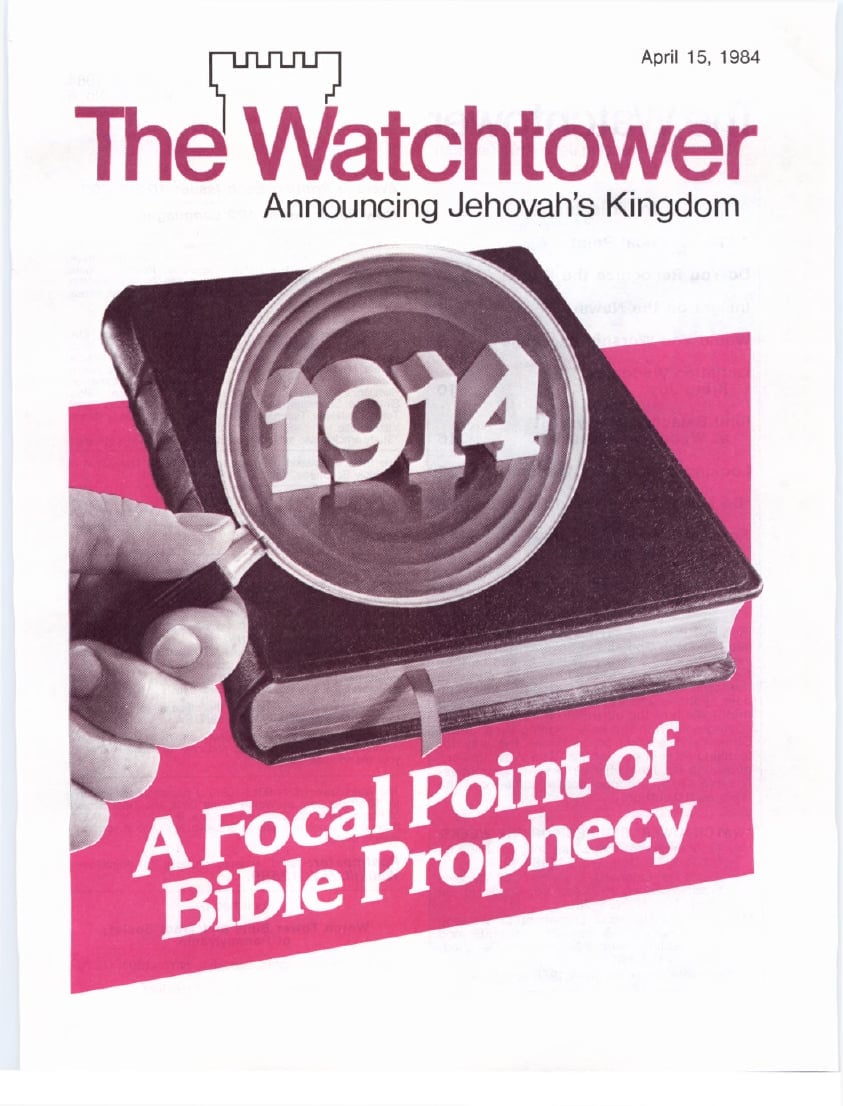
The Watchtower — April 15, 1984
Source: jw.org
Contents
1914—A Focal Point
Do You Recognize the Sign?
Insight on the News
Would You Worship an Image?
Christian Weddings That Bring Joy
Find Balanced Enjoyment at Wedding Feasts
Looking Beyond the Wedding
“Do Not Let Your Hand Rest”
Respect Jehovah, Urges the Book of Numbers
Do You Remember?
A True Help in Time of Need
1914—A Focal Point
1914—A Focal Point
“EXACTLY what would occur in 1914 we did not then know, but of one thing we were certain: The year 1914 would see the beginning of the worst time of trouble the earth had yet known; for so many Bible prophecies foretold that. Our faith was strong and our hopes were based on much more than mere human speculation.”
With these words, A. H. Macmillan, author of the 1957 best-seller Faith on the March, described his early conviction that 1914 would be a focal point of Bible prophecy. More than 40 years after 1914, his conviction had not waned.
When Events Converge
“Focal point” is defined as “a center of activity or of interest: the point of convergence of lines of action.” Was 1914 a focal point in that sense? Yes. Consider what Macmillan and many other Bible Students expected of that year.
The March 1880 issue of Zion’s Watch Tower and Herald of Christ’s Presence described two events of earthshaking importance that were looked forward to as due to happen in 1914: “‘The Times of the Gentiles’ extend to 1914, and the heavenly kingdom will not have full sway till then.” Hence, many Bible Students expected God’s Kingdom to be fully established in that year. This would mean the beginning of the time for Christ to ‘go subduing in the midst of his enemies.’ It would, of necessity, also mean the beginning of “the conclusion of the [wicked] system of things.”—Psalm 110:1, 2; Matthew 24:3; Revelation 12:10, 12.
These sincere Bible Students came to this conclusion after a searching review of Bible chronology.a But Bible chronology was only one line of evidence—one witness, as it were. According to the Bible, God’s Kingdom was to be heavenly, hence invisible. So how would Bible students know whether their hopes had been fulfilled or not? They would need visible proof, a sign.
Jesus’ disciples had asked for such a sign when they said: “What will be the sign of your presence and of the conclusion of the system of things?” (Matthew 24:3) By providing such a sign, Jesus added the testimony of a second witness to pinpoint 1914. This harmonized with the Bible principle “that at the mouth of two or three witnesses every matter may be established.”—Matthew 18:16.
Whereas the chronological indications point forward to 1914, the composite sign by Jesus was designed to point back to 1914 as the beginning of a new era. The year 1914 should thus have proved to be “the point of convergence of lines of action.”
Was it? Can the sign that Jesus gave really be recognized in events since 1914? We invite you to investigate the matter and then answer for yourself.
[Footnotes]
The count of time indicating that “the Times of the Gentiles” expired in 1914 was discussed at length in the April 1, 1984, issue of The Watchtower.
Do You Recognize the Sign?
Do You Recognize the Sign?
WHEN Jesus’ disciples asked him for a “sign” of his “presence and of the conclusion of the system of things” they used the Greek word semeíon. The same word was also used by Greeks to designate the symptoms of a disease. Since Jesus’ sign would reveal when the last, or dying, days of Satan’s world system had arrived, in this respect the terminology is quite appropriate. Recognizing the symptoms of the world’s terminal illness would be crucial for people to avoid dying with it.—Matthew 24:3; 1 John 2:16, 17.
Of What Is the Sign Composed?
The more symptoms a patient has, the easier it is for a well-trained doctor to diagnose the disease with accuracy. Likewise, to help us to recognize unmistakably the world’s terminal illness, Jesus gave us a composite sign, one composed of many “symptoms.”
To determine all the sign’s features, you would have to read Matthew 24 and 25, Mark 13, and Luke 21. We encourage you to do so. But for the moment, let us refer to just a few of the many symptoms that Jesus mentioned.
GLOBAL WAR: “Nation will rise against nation, and kingdom against kingdom.”—Luke 21:10.
FAMINE: “There will be food shortages.”—Matthew 24:7.
EARTHQUAKES: “There will be earthquakes in one place after another.”—Mark 13:8.
FEAR: “On the earth anguish of nations, not knowing the way out . . . while men become faint out of fear and expectation of the things coming upon the inhabited earth.”—Luke 21:25, 26.
DISEASE: “In one place after another pestilences.”—Luke 21:11.
CRIME: “Because of the increasing of lawlessness the love of the greater number will cool off.”—Matthew 24:12.
In What Way Different?
None of these things are unique to our century. So if they were to identify “the conclusion of the system of things” they would, in some way, have to differ from like conditions in previous times. In what ways?
First, every feature of the sign would have to be observed by one generation. Jesus said: “This generation will by no means pass away until all things occur.”—Luke 21:32.
Second, the effects of the sign would have to be felt worldwide. Jesus spoke about “all the inhabited earth” and about “all the nations.”—Matthew 24:9, 14, 30, 31 and Mt 25:32.
Third, the combined conditions or symptoms would have to grow progressively worse during this period. “All these things are a beginning of pangs of distress,” Jesus said.—Matthew 24:8.
Fourth, the occurrence of all these things would be accompanied by a change in people’s attitudes and actions. Jesus warned: “The love of the greater number will cool off.” The apostle Paul also foretold this worsening of attitudes.—Matthew 24:12; 2 Timothy 3:1-5.
How Serious Are the Symptoms?
Do not play down the seriousness of today’s conditions, saying, “Oh, but it could be so much worse!” Does the person with the symptoms of a disease—let us say a rather high fever—simply ignore it because, after all, “it could be much worse”? Rather, ask yourself: If today’s symptoms do not indicate that we are living in “the last days . . . hard to deal with,” just how much worse must they get before they will?
GLOBAL WAR: A European historian said of August 1914: “During the first days of this fateful month one of the most peaceful periods our continent had ever experienced came to an end.” Even the second world war did not ensure peace. The German newsmagazine Der Spiegel claims: “Not for a single day since 1945 has there been any real peace in the world . . . Peace experts have counted 130 wars, civil wars, uprisings, genocidal conflicts and terrorist campaigns since the end of World War II. Almost one hundred countries have been involved and some 35 million people have lost their lives, far more than in the First World War.”
FOOD SHORTAGES: World War I was followed by serious food shortages. But the problem of hunger at the end of World War II was so serious that the first permanent specialized agency formed by the United Nations was the FAO (Food and Agriculture Organization), designed to alleviate the problem.
What about today? As to the findings of a 20-member Commission on World Hunger, it was reported: “The hunger problem today is vastly different from that of the past. . . . Now there is so little food in so many parts of the world, year after year, that fully 25% of the globe’s population is hungry or undernourished, and one person in eight suffers from debilitating malnutrition.”
EARTHQUAKES: Earthquakes occur so regularly “in one place after another” that many pay them little attention. Yet in 1973 the publication Earthquakes warned: “One may have the very uncomfortable feeling that we are again heading for a period of increased earthquake activity. This feeling, very unfortunately, is correct.” Three years later, T’ang-shan, China, was struck by what an American specialist called “the greatest earthquake disaster in the history of mankind.” And how many of the major quakes since then do you remember? Perhaps the ones in Algeria, Italy, North Yemen, Colombia and Iran?
FEAR: In the summer of 1983, German journalist Wolfgang Wagner wrote: “Confidence in the future seems to have withered like trees beset by acid rain . . . We have reason enough for the fear that has befallen so many. Killing and murdering has gone on throughout history, but never before was man capable, as he is now, of annihilating himself. Destruction of animal and plant species has always taken place, but never before have so many species been wiped out so quickly.”
Speaking of this century as “the Century of Fear,” Hamburg’s newspaper Die Welt says: “Never before has there been so much reading material about fear as at present.”
DISEASE: World War I was followed by a terrible flu epidemic that took the lives of at least 20 million people, double the number of those who died on the battlefields. Now, Dr. William Foege, director of Atlanta’s CDC (Centers for Disease Control), says: “I fully anticipate that possibly in our lifetime we will see another flu strain that is as deadly as 1918.” He adds: “Once you get rid of one disease, a new one becomes visible.”
In recent years a number of mysterious “new” ailments have cropped up, Legionnaires’ disease, toxic shock syndrome and the much-feared AIDS, to mention only three.
CRIME: Most people do not need to hear statistics to be convinced that crime is on the increase—even in unexpected places. A 1979 news report says: “For years China has cultivated an image of itself as a peace-loving society that had eradicated much of the violent crime plaguing the decadent capitalist West. No longer . . . [Today] the country appears to be in the midst of a nationwide crime wave.”
Today’s crime is truly crime with a difference. According to one report, ‘the curse of violent crime is rampant not just in the ghettos of depressed cities but everywhere. More significant, the crimes are becoming more brutal, more irrational, more random—and therefore all the more frightening.’
Good News in the Midst of Bad
But another significant part of Jesus’ sign was this: “This good news of the kingdom will be preached in all the inhabited earth for a witness to all the nations; and then the end will come.” (Matthew 24:14) The good news is that since 1914 God’s Kingdom has been ruling from the heavens! Soon it will destroy Satan’s system and then start solving the problems resulting from the global wars, food shortages, earthquakes, fear, disease and crime. Think of it! These and all other disagreeable symptoms of a dying society will soon be gone. Could there be any better news than that?—Compare Psalm 46:9; 72:16; Isaiah 33:24; Daniel 2:44; Micah 4:3, 4; Revelation 21:3-5.
For this reason, Jesus, after calling attention in his sign to the various symptoms of Satan’s dying society, said: “But as these things start to occur, raise yourselves erect and lift your heads up, because your deliverance is getting near.”—Luke 21:28.
These things did indeed begin occurring in 1914. The fulfillment of Jesus’ sign since 1914 points back to that date as being the correct one to which Bible chronology had pointed forward. Yes, 1914 is indeed a focal point of Bible prophecy!
Insight on the News
Insight on the News
Sex Education Failing
Only one in three of grade 7 students in Canada believe that it is possible for a girl under 16 years of age to get pregnant. That surprising lack of elementary knowledge about sexual reproduction is revealed in a study of 28,905 Canadian students. Statistics on abortion reported in the Toronto Star also seem to point to evidence that sex education is not getting through to many youths. In Toronto last year the number of abortions for girls aged 10 to 14 increased. “Just looking at the abortion figures makes me worry,” says a Toronto alderman.
Abortion among the young women is a worldwide problem, not just Canada’s. It is part of the rising wave of immorality that is now sweeping our globe—another evidence that this system is in its “last days.” (2 Timothy 3:1-4) Sex education without proper moral guidance will not stop the flood of pregnancies among the unwed. But education in God’s moral standards, like a bulwark, will. The Bible places the main responsibility upon parents to inculcate divine moral principles, including those on sexual matters, into their children.—Deuteronomy 6:6, 7; Ephesians 6:4; see also Proverbs chapters 5 and 7.
‘Violent’ Toys
At Christmastime cries of “Peace on earth!” are usually heard from its celebrators. But this past season in Zululand, South Africa, the comments of a three-year-old revealed a different spirit. When the tot was asked what he wanted for Christmas, he replied: “Guns, so I can kill people.” Why such a belligerent request from one so small? Pointing to a probable reason, the Zululand Observer said: “A trip to a well-stocked toy shop in Empangeni [Zululand] this week showed no fewer than 73 different types of toy guns on the shelves.” Among other toys offered were plastic hand grenades and video games boosting the shooting down of aircraft. The manufacturer of one toy, which was labeled as being “suitable for children from three years up,” told kids that they would be able to “wipe [their] foes off the face of the earth.”
In sharp contrast with the warlike spirit seen in many of today’s toys, the Bible prophet Micah foretold that worshipers of Jehovah God, young or old, would ‘learn war no more.’ (Micah 4:1-4) If you as a parent are worried about the militaristic bent evident in many toys sold today, it would be well to remember this proverb: “Teach a child how he should live, and he will remember it all his life.” (Proverbs 22:6, Today’s English Version) Besides letting children have fun, toys should teach children about the world around them and prepare them for adulthood. Being selective in purchasing their toys is one ingredient in helping your children to grow into responsible Christian adults. You should also help your children to imitate God’s Son, Jesus Christ, who said: “I give you my peace.”—John 14:27.
Date of Death
The date of Jesus Christ’s death has been debated for centuries. There are advocates for virtually every year between 26 and 36 C.E. Jehovah’s Witnesses have long pointed to April 3, 33 C.E., Julian calendar (or April 1 according to our present Gregorian calendar) as the date of Jesus’ impalement and death. Their calculations are based on the Bible record and secular dates that agree with Biblical chronology because the Witnesses believe that “all Scripture is inspired of God.”—2 Timothy 3:16.
Interestingly, in an article published in Nature, two British scientists fix Jesus’ impalement as April 3, 33 C.E., Julian calendar. C. J. Humphreys and W. G. Waddington of Oxford University assert that they used astronomical calculations “to reconstruct the Jewish calendar in the first century AD, improving on the accuracy of previous versions.” Thus, they narrowed the number of possible dates to two—April 7, 30 C.E., and April 3, 33 C.E. They rule out the April 7, 30 C.E., date because it does not allow enough time for Jesus’ ministry to include the four Passovers indicated by the Gospels. (John 2:13; 5:1; 6:4; 13:1) According to their research, a lunar eclipse was visible in Jerusalem on April 3, 33 C.E., and none during the year 30 C.E. Many of the details that these scientists report on were presented years ago in The Watchtower. See the issue of August 15, 1959, pages 489-92.
Would You Worship an Image?
God’s Word Is Alive
Would You Worship an Image?
What if the penalty for not worshiping is execution? Would you worship an image then? That was the situation faced in ancient Babylon over 2,500 years ago.
NEBUCHADNEZZAR the king has a huge gold image some 90 feet (27 m) high set up in the plain of Dura. Then he calls together his government officials from all over the country to worship it. Three worshipers of Jehovah named Shadrach, Meshach and Abednego, as you can see, are among those present.
A representative of the king shouts that all should “fall down and worship the image of gold that Nebuchadnezzar the king has set up.” If you had been there, what would you have done? Everyone falls down and worships except Shadrach, Meshach and Abednego. They remain standing because they know it is against God’s law to worship an image.—Exodus 20:4, 5.
The three worshipers of Jehovah God are brought before King Nebuchadnezzar. “Is it really so,” he asks, “that you are not serving my own gods, and the image of gold that I have set up?” Then he says: “If you do not worship, at that same moment you will be thrown into the burning fiery furnace. And who is that god that can rescue you out of my hands?”
Faced with such a threat, what would you have done? Shadrach, Meshach and Abednego, as you can see, speak right up and say: “If it is to be, our God whom we are serving is able to rescue us. . . . But if not, let it become known to you, O king, that your gods are not the ones we are serving, and the image of gold that you have set up we will not worship.”
The king is furious. He commands: ‘Heat up the furnace seven times hotter than usual! Bind them up and throw them in!’ But what happens to Shadrach, Meshach and Abednego? They fall right into the middle of the fire. Then they get up and start walking around.
When the king looks in, he sees four persons walking around unharmed instead of just three! The fourth person is an angel that Jehovah has sent to protect his faithful servants. At that the king becomes very frightened and calls out: “Shadrach, Meshach and Abednego, you servants of the Most High God, step out and come here!” And they do.—Daniel 3:1-30.
Jehovah was pleased with the faith and courage of his servants. He will be pleased with us, too, if we have the courage to refuse to worship or render homage to any kind of image that worldly leaders may set up.
Christian Weddings That Bring Joy
Christian Weddings That Bring Joy
1, 2. How do most people react to the word “wedding,” and why? (Matthew 19:4-6)
THE apostle John, an eyewitness, reports: “There was a wedding at Cana in Galilee. The mother of Jesus was there, and Jesus and his disciples had also been invited.” (Italics ours.)—John 2:1, 2, The Jerusalem Bible.
2 How do you react to those words at John 2:1, 2? It would be no surprise if you responded warmly, for the word “wedding” has a joyful connotation. People enjoy weddings. As we read at Genesis 2:18-24, the first wedding occurred in Paradise, when humans were without sin. That wedding of a perfect man and woman was arranged for and approved of by our Creator. It had an elevated tone and set a happy precedent for future weddings.
3. What spirit do the Scriptures associate with weddings, but what difficulty has arisen? (Jeremiah 7:34)
3 Your enjoying weddings agrees with what we read in God’s Word. Describing participants in a royal wedding, Psalm 45:15 says: “They will be brought with rejoicing and joyfulness; they will enter into the palace of the king.” Joyfulness is reflected also in the Bible’s illustrative references to marriages. (Matthew 22:2-4; 25:1-10; Revelation 19:6-9) Yes, although a serious step is being undertaken—a couple’s entering the sacred marital arrangement—weddings should be remembered as joyful, dignified events. However, reports from around the world indicate that many a wedding misses that mark, resulting in problems and sadness for the couple and distress for those who attend. This has been true even of some weddings involving servants of Jehovah. Why?
4. (a) Why are most weddings public affairs? (b) What did Jesus say about marrying in our time?
4 In most lands a couple may marry in a private ceremony that fulfills legal requirements. If a couple chose such a ceremony, others should not criticize them or think that they must be ashamed of something. It could simply be their preference and might even have very real advantages, for example, economically in getting equipped for a fuller share in Jehovah’s service. (Luke 12:29-31) Yet, most weddings are more public, with many friends and relatives present. Thus the couple’s changed status becomes widely recognized in the community. If there is a religious ceremony or Bible talk, a spiritual element is introduced. And others can share the joy of the couple. These are positive values. Still, larger weddings do pose dangers, especially today when the world is so involved in ‘marrying and being given in marriage’ that they ‘take no note’ that the wicked system of things is soon to end.—Matthew 24:37-39.
5. Who should be interested in God’s counsel about weddings?
5 If you envision a joyous Christian wedding in your own future, there are matters that deserve your consideration. But all of us who may be guests or participants at Christian weddings also can benefit from considering Bible counsel on this subject.
The Problem of Excess
6. Large weddings can present what sort of problems?
6 For many worldly people, a large wedding can be a status symbol, visible proof of financial or social superiority. Sadly, even Christians can get caught up in trying to impress others with lavish dress or elaborate arrangements. (Galatians 5:26) Some Christian elders in West Africa recently decried the “strong tendency to ‘ape’ the world in customs, showy display and unbridled entertainment” at weddings. This detracts from the dignity and joy that are appropriate in the lives of those who no longer ‘conduct themselves in harmony with the flesh, doing the things willed by the flesh.’ (Ephesians 2:3) Rather than joy and fine memories, such weddings often produce ‘loose conduct, enmities, jealousy, contentions, envies, revelries’—the works of the flesh.—Galatians 5:19-21.
7. What may move some people to want lavish weddings?
7 History tells us that when Ptolemy VI Philometor gave his daughter in marriage to Alexander Balas of Syria, they “celebrated her wedding at Ptolemais with great pomp, as kings do.” (1 Maccabees 10:58, The Oxford Annotated Bible) Today, many who have limited funds feel that they (or their children) must also marry “with great pomp, as kings do.” They may have been manipulated into this fantasy by advertising. Businessmen with a vested interest in large ornate weddings foster the vision of a bride who is “queen for a day,” as if certain types of printed invitations, photographs, flowers or rings assure you a perfect wedding. They want you to feel, ‘This once I deserve the very best’—whether you can afford it or not. This “showy display of one’s means of life” belongs to the world that is passing away. (1 John 2:15-17) Some Christian elders commented: “A spirit of competition has been observed. [For example,] influenced by worldly customs, the bride and her party may change into four or five expensive costumes.”
8. (a) What can we learn from Bible verses regarding wedding apparel? (b) Why have some Christians chosen the wedding garb that they have?
8 The Bible does not suggest that weddings need be Spartan, austere affairs. For instance, we read of “the bridegroom who, in a priestly way, puts on a headdress, and . . . the bride who decks herself with her ornamental things.” (Isaiah 61:10; Psalm 45:13, 14; Isaiah 49:18; Jeremiah 2:32; Ezekiel 16:9-13; Revelation 21:2) The figurative bride of Christ is described as “arrayed in bright, clean, fine linen.” Thus, it is fitting for bride and groom (and those in their party) to wear clean, attractive clothing, but they do not need garb that creates a financial hardship. Some couples have deliberately chosen apparel much less costly than they could afford. Why? To avoid clothing that might be awe inspiring, but that could make guests uneasy or that could detract from the simple dignity, joy and spirituality of the wedding.—Revelation 19:8; Proverbs 11:2; 1 Timothy 2:9.
9. How should we feel about wedding customs or traditions?
9 Another cause of excess at weddings is undue emphasis on protocol—the numerous rituals that “experts” in etiquette say must be followed. This does not mean that God’s servants deliberately reject everything that is local custom regarding weddings.a The Bible relates that in connection with getting married, ‘Samson proceeded to hold a banquet; for that was the way the young fellows used to do.’ (Judges 14:10) However, slavish conformity to social formalities can clutter a wedding, eclipsing the real meaning of the celebration and robbing everyone of the joyfulness that should be felt.
Legally Married—Bible Times and Today
10. What were weddings like in Bible times?
10 We can benefit from what the Bible says about weddings, even if practices differ in our time and locality. In the Biblical period no special legal or religious ceremony was needed. The groom would go to the home of his betrothed and publicly escort her to his home. This was done with rejoicing on the part of the couple, their close relatives and onlookers who showed excited interest in the happy event. Usually the bride and groom were attired in fine garments, and at his home they would have a wedding feast with invited guests.—Genesis 24:65-67; Matthew 1:24; 25:1-10; compare 1 Maccabees 9:37, 39.
11. What was the situation as to marriage documents needed in ancient times?
11 Nations around the Hebrews had laws demanding written marriage contracts. While the Bible does not mention such documents, it does speak of marriage in terms of a “covenant.” (Malachi 2:14) The Bible’s detailed genealogies suggest that marriages were recorded in some way, and, interestingly, Joseph and Mary complied with a type of legal registration. (Luke 2:1-5; 3:23-38) Papyruses of the fifth century B.C.E. from a Jewish colony at Elephantine (Egypt) contain marriage contracts, one reading:
‘ . . . I have come to your house that you might give me your daughter Miphtahiah in marriage. She is my wife and I am her husband from this day for ever. I have given you as the bride-price of your daughter Miphtahiah (a sum of) 5 shekels. . . .’
12. (a) How do Jehovah’s Witnesses feel about civil marriages? (b) What is advisable if there is a civil and a religious ceremony?
12 Jehovah’s Witnesses appreciate that a wedding should conform to local law, thus ‘rendering to Caesar what belongs to Caesar.’ (Mark 12:17; Romans 13:1, 7) The law may require that a couple have a blood test, obtain a license and take vows before an authorized marrying agent. In some lands, only civil officials, such as a mayor or a judge, may perform marriages. Yet, members of Christendom’s churches often feel that they really are not married until they have a church wedding. True Christians recognize that a civil marriage is valid, but some still prefer (or local sentiment may recommend) that the civil service be followed by a Scriptural talk. When that is to be done, it is best that this feature come soon after the civil marriage.b
13. If a Christian elder is to officiate, what likely will occur before the wedding?
13 Some lands authorize ministers of Jehovah’s Witnesses to solemnize marriages. Usually these are performed by congregation elders, men with experience, insight, maturity and knowledge of God’s Word. An elder who is asked to officiate will probably meet beforehand with the prospective bride and groom. They will, naturally, want to assure him that there are no moral or legal impediments to their marrying. He may offer sound Scriptural counsel and fatherly advice. He also will likely discuss with them arrangements for the ceremony and any social gathering to follow, since he will want to have a clear conscience about this event in which he is being asked to play a major role.—Proverbs 1:1-4; 2:1; 3:1; 5:15-21; Hebrews 13:17, 18.
14. What sort of wedding talks are appropriate?
14 Whether preceded by a civil ceremony or not, a wedding talk by a minister of Jehovah’s Witnesses can help to emphasize that from its start a marriage should have a spiritual aspect. Such talks are not of great length, as if containing all that the Bible says on marriage, nor should they be heavily weighted with humor or excessive praise of the couple. The balanced, happy and Scriptural content of these talks can benefit those getting married, as well as all others present.c—2 Timothy 3:16.
15. How do the vows used by Jehovah’s Witnesses differ from other vows used today?
15 Vows are part of most weddings. Those used at some “modern” worldly weddings are concocted from odd poetry, or they voice idiosyncratic views of life. A Time magazine essay on “The Hazards of Homemade Vows” told of a clergyman who asked: “Gina, do you agree to love Peter more than you love chocolate?” Then to Peter: “Do you agree to love Gina more than the morning newspaper?” The article stressed, though, that “a wedding is public business” and should dignify the important social step being taken. At weddings of Jehovah’s Witnesses the vows will conform to the requirements of local law. Where permitted, these vows that honor God, the Source of marriage, are used:
“I —— take you —— to be my wedded wife, to love and to cherish in accordance with the divine law as set forth in the Holy Scriptures for Christian husbands, for as long as we both shall live together on earth according to God’s marital arrangement.”
“I —— take you —— to be my wedded husband, to love and to cherish and deeply respect, in accordance with the divine law as set forth in the Holy Scriptures for Christian wives, for as long as we both shall live together on earth according to God’s marital arrangement.”
These vows should not be altered or replaced to suit some whim of the couple.d
Weddings at the Kingdom Hall
16, 17. (a) How is the body of elders involved in weddings at the Kingdom Hall? (James 3:17) (b) Why is such involvement advisable?
16 Christians are told to marry “only in the Lord.” (1 Corinthians 7:39) When two Christians in good standing in the congregation desire to have their wedding (or, wedding talk) at the Kingdom Hall, they should seek permission from the body of elders.e These men will not impose their personal tastes as to wedding arrangements, but they will inquire about the couple’s plans so that nothing will be done at the Hall that is likely to disturb the congregation.—Compare 1 Corinthians 14:26-33.
17 For example, disturbing things have been reported about weddings that were not at the Kingdom Hall. Prior to one, loud music was played, and the bride, groom and their party came dancing into the hired hall. The guests joined in the dancing until a chairman interrupted so that, after prayer, the wedding talk could commence. Clearly, that was not the proper atmosphere for a Christian wedding. It does illustrate, however, why the elders exercise care as to Kingdom Hall weddings. At the Hall, only uplifting music, such as found in the songbook of Jehovah’s Witnesses, is used. Any flowers or similar decorations should be modest and reasonable, as should be the way the wedding party enters the Hall and the way photographs are taken.—Philippians 4:5.
18. Who may be with the bride and groom at the wedding? (1 Corinthians 5:13; James 2:1-4)
18 In Bible times, there usually was a “friend of the bridegroom” and female companions of the bride. (John 3:29; Psalm 45:14) This is also often the case at Kingdom Hall weddings. Reasonableness, though, is needed as to how many such participants there are, as well as how they dress and act. It would be unfitting to have in the wedding party people who are disfellowshipped or whose scandalous life-style grossly conflicts with Bible principles. (2 Corinthians 6:14-16) Rather than selecting people who are prominent or who might give a costly present, many Christian couples (and speakers) prefer to have in the wedding party ones who are close to them in serving Jehovah.
19. Attention to what other aspects will help a Kingdom Hall wedding to be joyful?
19 If the Kingdom Hall is to be used, a brief announcement may be made concerning the time of the wedding. In that way the congregation will know that the Hall will be in use and they can attend if they choose. Since the Kingdom Hall is principally for Christian meetings, the wedding will be at an hour that will not conflict with these. Whatever time is scheduled, it reflects love and consideration for all to be punctual. In a parable Jesus gave involving a wedding, “the bridegroom was delaying,” which resulted in major problems for some.—Matthew 25:1-12.
20. What additional feature of weddings deserves our attention?
20 The prophet Isaiah wrote of “the exultation of a bridegroom over a bride.” (Isaiah 62:5) The bride also rejoices on her wedding day. Many well-wishers, too, ‘have a great deal of joy’ over Christian weddings. (John 3:29) Often that joy is expressed and added to by a social gathering following the wedding, a reception, or wedding feast. What advice does Jehovah provide in his Word that will contribute to happiness rather than problems at such gatherings? Let us see.
[Footnotes]
For a discussion of wedding customs, see The Watchtower of January 15, 1969, pages 58 and 59.
If a lengthy period intervened, people in the community might be stumbled by the couple’s course, whether they lived as husband and wife or refrained from doing so.—2 Corinthians 6:3.
Scriptural discussions upon which such talks may be based can be found in The Watchtower of March 15, 1969, pages 174-9; May 1, 1974, pages 274-7; March 15, 1977, pages 172-85.
If the marriage had been solemnized earlier by a civil official and is being followed by a Christian wedding talk, the minister may mention that the legal step has already been taken. Some couples still choose to repeat these vows before God and the congregation.
On occasion two persons who are serving God and awaiting an assembly to get baptized have been wedded at a Kingdom Hall.
Remember This Point?
□ Christians need to be alert to what dangers regarding lavish weddings?
□ What position do Jehovah’s Witnesses take as to civil or religious wedding ceremonies?
□ How can a couple’s decisions as to their wedding ceremony increase the Christian joy of the event?
□ What sort of weddings may be held at the Kingdom Hall?
[Picture on page 13]
With joy and dignity the Hebrew groom would bring his bride home
Find Balanced Enjoyment at Wedding Feasts
Find Balanced Enjoyment at Wedding Feasts
1, 2. (a) Why should we give attention to wedding receptions today? (b) How necessary are receptions?
YOU probably have seen ample proof of the prophecy being true that in “the last days” people are “lovers of pleasures rather than lovers of God.” (2 Timothy 3:1-4) Evidence of this can easily be seen in the way many view wedding feasts or receptions and the way they act at them.a What should our view of these be? Should Christians avoid holding or attending wedding feasts? Or is the point that to be “lovers of God” we need to avoid certain pitfalls?
2 No matter how common it is locally to hold a social event right after a couple’s wedding, Christians certainly are not under any Scriptural obligation to do so. Some couples prefer instead to gather with just their immediate family or a few very close friends, perhaps enjoying a private meal with them. But having or attending a wedding feast cannot of itself be equated with being “lovers of pleasures,” for Jesus and his disciples attended such a celebration in Cana.
3. How common were wedding feasts in Biblical times?
3 A wedding is a time of rejoicing for the newlyweds, and their relatives and friends. Joyous wedding feasts have long been common. (Genesis 29:21, 22; Judges 14:3, 10, 17) Because the Jews were familiar with wedding feasts, Jesus could use them in three illustrations. (Matthew 22:2-14; 25:1-13; Luke 14:7-11) Even the final book of the Bible says: “Happy are those invited to the evening meal of the Lamb’s marriage.”—Revelation 19:9.
4. What have many wedding feasts been like?
4 God’s servants in the past—including Jesus and his disciples—found balanced pleasure in wedding feasts. Thousands of Christians in our time have also done that. An unbelieving relative who attended one in South Africa said: “I didn’t know that the Witnesses have such nice weddings. We are tired of all this drinking and loud music that goes on at weddings nowadays.” Many, many Christian receptions would qualify for similar commendation.
5. Problems of what sort have arisen?
5 However, pressure from the world to become “lovers of pleasures” is strong. Thus some Christian elders report:
“A number take advantage of [a wedding feast] to unwind. They reason that there are not many such opportunities, so they want to make the most of it to let off steam, to give free rein to desires that are held in the rest of the time. It is not surprising that the atmosphere is turbulent.”—Europe.
“It appears that a marriage celebration consists of a talk, eat a bite and then dance until the wee hours of the morning. Some feel that at receptions they can drink more than usually, and often they drink too much.”—Latin America.
“A wedding feast may include ‘dancing till daybreak.’ Some of these affairs are truly worldly—boisterous, with much drinking and worldly dancing. Many endeavour to make a showy display with expensive dress and numerous cartons of beer.”—Africa.
Moderation Needed
6. We can learn what about Jewish feasts from a remark made in Cana?
6 Most people know that at the wedding feast in Cana, Jesus turned water into wine. Recall, though, this point: “When, now, the director of the feast tasted the water that had been turned into wine . . . , [he] called the bridegroom and said to him: ‘Every other man puts out the fine wine first, and when people are intoxicated, the inferior.’” (John 2:9, 10) He did not say that at this particular feast the guests got “intoxicated.”b In fact, it is unthinkable that Jesus would countenance drunkenness and add to it by making more wine. Still, this man knew that overdrinking was common at Jewish wedding feasts.
7. What should the Christian consider about serving alcohol?
7 At some receptions the hosts have not served any alcohol because overindulgence was so common in the area, and so as to avoid tempting any guest who had had a drinking problem. Certain African brothers even stated that serving no alcohol made for a “pure Christian wedding.” And it is true that not having alcoholic beverages may be advisable where community sentiment is strong against Christians’ consuming liquor. (Romans 14:20, 21) Still, balanced evaluation is needed. Ask yourself, Was the feast that Jesus attended ‘impure’ because wine was served? The Bible condemns drunkenness, not moderate consumption of alcoholic beverages.—Proverbs 23:20, 21; 1 Peter 4:3.
8, 9. (a) If alcoholic beverages are served, how can moderation be maintained? (b) What did one elder say about the problem?
8 If a couple wishes to have alcoholic beverages at their reception, it is wise and considerate of them to give due attention to moderation. (1 Timothy 3:2; Matthew 23:25) For example, at the feast in Cana, how were the guests served? Evidently by “those ministering.” (John 2:5, 9) Thus a couple may designate people to serve (and perhaps limit quantities of) drinks. Of course, at any Christian reception, there should be nonalcoholic beverages for those who should have, or may prefer, such.
9 An elder in Central America commented: “A problem has been that the receptions are too big, so there is no way to control all who attend. Sometimes worldly people have crashed the parties, bringing with them bottles of liquor and causing a scandal.” So who will provide control or direction? How many will attend? What will take place at such feasts?
Direction From Whom?
10. Following what Biblical indication may contribute to better control at receptions?
10 At the feast in Cana, there was a “director of the feast.” (John 2:9) Similarly, at receptions today a capable, responsible brother may be authorized to oversee details. Being familiar with the newlyweds’ wishes, he can provide direction for the musicians, waiters and others, or can consult with the couple and then follow through. That may include overseeing the attendants. Together they would be able to assist the guests and deal with any ‘party crashers.’ Bearing on the matter of control, note in Jesus’ illustration what occurred with a guest who showed blatant disrespect at a wedding feast.—Matthew 22:11-13.
11. What should be considered in selecting someone to assist the couple in directing matters?
11 At many worldly receptions the manager of a hall or the band leader acts as master of ceremonies. He may know the normal routine and likely he has some practiced speech or suggestive jokes. But if you want a reception that harmonizes with Christian principles, would you have some worldly man—who was neither your spiritual brother nor a member of your family—address your guests or be the focus of attention? Would that fit the counsel to “work what is good toward all, but especially toward those related to [you] in the faith”?—Galatians 6:10.
12. What indication does the Bible give as to who mainly is responsible for what goes on at a reception?
12 Sometimes the parents of the bride or groom help the couple by paying for the wedding reception. The parents thus may feel that they should have a major voice as to who will be invited, the type of food and drink that will be served or what the program will be. The Bible does not say who paid for the feast in Cana, but it does tell us that when an important matter developed “the director of the feast called the bridegroom.” (John 2:9) At a wedding reception the groom is the Scriptural head of the newly formed family. (Ephesians 5:22, 23) Hence, while he lovingly ought to consider the wishes of his bride on this special day, and their families’ wishes, he primarily needs to accept responsibility for what will go on and for what will not.
Who Will Be There?
13. How large were wedding feasts in Biblical times?
13 We do not know how large wedding feasts were in Bible times. Samson’s included his parents, 30 acquaintances of his bride and likely other friends or relatives. (Judges 14:5, 10, 11, 18) Guests at Jewish weddings were fellow worshipers from the town as well as visitors. Jesus and his disciples, from elsewhere in Galilee, went to the feast in Cana. The amount of wine that was produced suggests a sizable group.—John 2:1, 2, 6.
14, 15. How have some arranged for “open house” receptions, but what problems can develop?
14 Today, customs and preferences differ as to the type and size of receptions. In some areas it is customary to have open house; all fellow Christians who are friends of the newlyweds are welcome. They may be served light refreshments, the object being not to satisfy everyone’s appetite but to let them extend good wishes and enjoy warm association. Elsewhere at gatherings open to all friends, many people bring some food—a cooked dish, a beverage or a dessert. All who thus volunteer have the joy of contributing, and everyone can enjoy a varied meal without a burden falling on the couple or anyone else.—Acts 20:35.
15 From what we read in Jesus’ illustrations, it seems that often at Jewish weddings a large meal was provided. (Matthew 22:2; Luke 14:8) Of course, having a regular meal for all guests at a reception today requires much planning. A mother in North America related this sad experience:
‘When it became known that there was a wedding, young people from a wide area showed up for free food and dancing. While those who were invited were at the Kingdom Hall, others went to the reception hall and took all the available tables. When I arrived I could have cried, for there was no room. I was terribly hurt at the lack of love shown by crashing a wedding and eating up food put out by the host for close friends and relatives.’
16. We can learn what from the Bible as to wedding guests?
16 Mary, Jesus and his disciples did not crash the feast in Cana; they ‘were invited.’ (John 2:1, 2) Jesus said, “When you are invited by someone to a marriage feast . . . “ (Luke 14:8, 9, 16, 17) In the illustration of the marriage of the king’s son, Jesus also spoke of “those invited.” (Matthew 22:3, 9, 10) Moreover, when an invited man showed disrespect, attendants were directed to put him out. In another parable, five virgins who wanted to share in a marriage feast were actually prevented from entering the door. (Matthew 22:11-13; 25:10-12) So it should not seem strange if a reception is restricted to invited guests and that these be properly attired. And it is understandable that a host’s generosity need not cover people whose primary concerns are food and pleasure.—Philippians 3:18, 19; Ecclesiastes 5:11.
17. What difficulty has arisen about the size of wedding feasts?
17 If a couple or their relatives wish to provide a full meal for many guests, that can involve quite an expense. (Compare Mark 6:35-37.) From the Pacific comes this report:
“There is a tendency to overdo receptions. Some go into debt to put on a big feast, thus starting off married life in debt. Often there seems to be a desire to avoid losing face, so they put on a reception that is beyond what they can afford.”
How sad when a young couple begins married life burdened with debts that can strain their relationship. Or how would they feel knowing that their parents faced a problem in paying off the major expenses of a large reception? Of course, worldly people might assume a staggering wedding debt out of a prideful desire to impress others or to save face in the community. (Proverbs 15:25; Galatians 6:3) But should that be true of Christians, in view of what we read at Luke 12:29-31?
18, 19. (a) Why may some have decided to have large receptions? (b) How should we react if we are not invited to a friend’s reception? (Luke 14:12)
18 The motivation behind some very large feasts has been a desire to match or outdo others. Elders in West Africa commented:
“Some go into heavy expenses over refreshments. The one spreading the most costly wedding feast is the pacesetter. This has caused problems for those not courageous enough to be different. The showy display of one’s means may stumble others and trying ‘to keep up with the Joneses’ is not necessary.”—See 1 John 2:15-17.
19 Others have felt pressured into a mammoth reception for fear of causing offense. They imagine that if certain acquaintances are not invited, these will be hurt. Hence, more are invited than is wise. Honestly, though, who of us would want our friends to be so afraid of slighting us that they would get saddled with debt and perhaps miss out on the full-time ministry? If we are not invited, how much better to trust that they maturely weighed all factors, including finances. Their not inviting us may even reflect their confidence that we are mature and will not be quick to take offense. (Ecclesiastes 7:9; 1 Corinthians 13:4-7) We still can share their happiness by attending the Bible-based wedding talk, which is the more important part. If we held that in lower esteem than the reception, might we be turning into “lovers of pleasures rather than lovers of God”?—2 Timothy 3:4.
20. Limiting the size of one’s reception may avoid what sort of practices?
20 Being reasonable about the size and cost of receptions also helps to avoid undesirable practices. For example, desire for money has moved a few to buy special cloth for wedding garments, then to ask the wedding party to purchase it from them at a higher price. Guests at some receptions had to “buy” pieces of the cake or “purchase” a dance with the new bride, pinning money on her dress. Such emphasis on money may also underlie guests’ flaunting their money by “spraying” (throwing) money on the musicians or making large gifts so as to get special seating near the newlyweds.—Luke 14:8-11.
Help All to Find Enjoyment
21. What role does music play in wedding feasts?
21 During the Maccabean wars a Jewish wedding procession was met by a group “with tambourines and musicians.” (1 Maccabees 9:39, The Oxford Annotated Bible; compare Psalm 45:8.) Today, too, music often is included at wedding receptions. It can add to the Christian enjoyment of the occasion—or it can take away from it. Why may the latter be so? In a number of cases the music has been very loud and unrestrained. Some musicians like disco-type music, or they may revel in wildly showing off their abilities. But a Christian reception is not the place for either of these. Can guests, young or old, enjoy Christian fellowship if the music is so loud that conversation across a table is impossible?
22. How can problems about music be reduced?
22 Clearly, the music at wedding feasts needs careful planning and oversight, especially live music. It is preferable not to engage worldly musicians. If there are paid musicians, the bridegroom or the brother chosen should firmly explain to the musicians what music may be played, and what may not. (Exodus 32:6, 17, 18) It should be stipulated that no special requests from guests may be played without approval from the bridegroom or from the “director” of the reception. Because of common problems over the nature and loudness of live music, many couples have chosen to use phonograph records or tapes with the exact selections they want. They have had these played by an adult who will not be easily swayed by what is popular among immature youths.—1 Corinthians 13:11; Hebrews 5:14.
23-25. What other practical steps can newlyweds take to assure a pleasant Christian gathering?
23 Christian newlyweds want their guests to be able to look back on the reception with happiness. So if there is music and/or dancing, it should harmonize with Christian principles. If some people are asked to say a few words, those selected and what they say should fit a dignified Christian gathering.
24 In the parable of the ten virgins the feast began “in the middle of the night” because the wedding party had been delayed. (Matthew 25:5, 6) In another case, what Jesus said about the king’s having a feast ready and servants inviting people on the road indicates that the feast was in the daytime. (Matthew 22:4, 9) In modern times some receptions have gone late into the night, becoming more uncontrolled as mature Christians leave to get a reasonable night’s sleep. To prevent this, many balanced couples have scheduled a time for their reception to begin and a time to end. That way all can make their plans, including plans for appropriate Christian activity the day following an enjoyable reception.
25 A wedding reception can be a splendid occasion for proper and balanced Christian enjoyment. But what is its role in relation to what follows—married life as true Christians?
[Footnotes]
In some lands, after a marriage ceremony, all guests can attend a reception where soft drinks or coffee and pastry are served. Later the newlyweds, their family and some friends share a wedding meal at a home or a restaurant. Elsewhere the reception is a postwedding gathering—whether with snacks or a feast.
From the Greek methusko, meaning “get drunk, become intoxicated.” Some commentators argue that the word implies drinking just enough to dull the taste or to produce hilarity. Other texts do not support this view.—Matthew 24:49; Luke 12:45; Acts 2:15; Ephesians 5:18; 1 Thessalonians 5:7.
From the Foregoing, Do You Recall?
□ Why should Christians be concerned about receptions?
□ What is advisable as to alcoholic beverages at wedding feasts?
□ Who is responsible for what is done at receptions?
[Picture on page 19]
The director of the feast consulted with the bridegroom about the wine
Looking Beyond the Wedding
Looking Beyond the Wedding
1, 2. Weddings in Japan present what instructive contrast?
TIME magazine (December 6, 1982) stated that in Japan weddings are a ‘$17,000,000,000 business,’ amounting to “an astonishing $22,000 per couple.” Yet “Japan’s divorce rate [is at] an alltime high; three out of ten couples will break up.”
2 In contrast, the newspaper Hokuu Shimbun said about a wedding of two of Jehovah’s Witnesses in Noshiro: “Both are zealous Christians, and based on that teaching they think, ‘The wedding can be simple but also one that has everyone’s blessing.’” Compared to the costly, elaborate weddings that are common, the simplicity of this wedding made it newsworthy. “Even so,” the newspaper pointed out, “the wedding was filled with the happiness of wishing the couple well for the future.”
3. How can your wedding day affect your happiness?
3 A couple’s attitude toward and the demands of a wedding can bear directly on their future happiness. Why? According to psychologist Dr. Sally Witte, “studies show that it’s not only stressful to have bad things happen to you, but good things, too.” Mental health experts indicate that getting married brings more stress on you than losing your job. Obviously, when the wedding is mammoth rather than modest, sumptuous instead of simple, the stress you feel will be more severe.
4. What often happens after elaborate weddings?
4 Further, many who get married nowadays focus so much attention—and unrealistic expectations—on the wedding that afterward there is a drastic letdown. A new wife related: “For months, everyone I knew seemed to be excited, not just me. But then the wedding was over in about a second, and when we got home from the reception, I was overcome by sadness.” A young man quoted in the book Getting Married said:
‘The period when you get engaged is supposed to be very glorious and exciting. Then you’re supposed to have a big, fancy wedding. That’s terrific. Then you go on a honeymoon, and that’s super terrific. You’re building up an expectation that something magical and fantastic is going to happen as soon as you get married. Then suddenly there’s that quiet. Suddenly you’re left all by yourself with this woman and she’s left with you.’
5. What perspective should Christians have as to their wedding?
5 All of us would agree that a couple should look forward to their wedding as a happy, special, momentous occasion, for they are taking a major step in their lives. Yet they will contribute to their own happiness if they avoid emphasizing the wedding so much that it overshadows what really is more important, their subsequent life as married Christians.
Preparing for a Happy Marriage
6. Before the wedding day, what is advisable?
6 Jesus stated a truism that unmarried people can apply: “Who of you that wants to build a tower does not first sit down and calculate the expense, to see if he has enough to complete it?” (Luke 14:28) Yes, there is wisdom in considering a project before starting it. That is true of marriage also. Many marriage counselors advise their clients that prospective newlyweds take courses in, or go to workshops about, adjusting to married life and coping with potential problems. One counselor said: “If kids graduating from high school knew a hundredth as much about marital interaction as they do about computers, marriage would be a lot more satisfactory experience.”
7. Where could you find helpful information about married life?
7 Jehovah’s Witnesses have provided sound guidance in this area, guidance based, not on the shifting sands of human opinion about what brings success in married life, but on the perfect counsel of the Originator of marriage. (Psalm 119:98-105) Both The Watchtower and Awake! present a broad variety of articles on married life. You can better appreciate the abundance of such material by looking at the many subheadings and references under the topic “Marriage” in the indexes of the Watch Tower Society’s publications, such as the index for 1976-1980. Many articles about marriage are studied in the congregation, allowing prospective mates to hear practical observations from Christian men and women who have personal experience and are keen students of God’s Word.
8. If you were planning to get married, what beneficial step could you take?
8 If you are planning to marry, you should also consider relevant material published in other Bible study aids. For example, Happiness—How to Find Ita has chapters dealing with money problems, sex and achieving success in family life. Making Your Family Life Happyb contains additional practical advice from God’s perfect Word. Some chapters are “Laying a Fine Foundation for Your Marriage,” “After the Wedding Day,” “A Husband Who Gains Deep Respect,” “A Wife Who Is Dearly Loved” and “Love, ‘a Perfect Bond of Union.’” Plan to go over that material with your future mate before your wedding. How beneficial it would be, also, for you to discuss that material together with a mature Christian brother whom you respect and who can offer helpful suggestions. (Proverbs 4:1-9) This will help both of you to keep your wedding plans in perspective relative to what is more important, your life together as a married couple.
Be Ready to Work
9, 10. (a) Why is a realistic view of marriage important? (b) How are Christians helped to have this?
9 We noted that many approach their wedding day expecting that “something magical and fantastic is going to happen as soon as you get married.” People with this unrealistic view are ripe for disillusionment, frustration and unhappiness. The fact is that a happy marriage takes work, far more work than all that went into a wedding, no matter how large it might have been. At a marital therapy session arranged by Professor E. M. Pattison, a young woman named Betty stated: “I had magical fantasies about marriage, only reinforced by living together. But there was no magic in marriage—just a lot of hard work.”
10 A study of God’s Word should help to prepare Christians for the realities of married life. Why? First, because we know that all humans have inherited imperfection from Adam. Romans 3:23 assures us: “For all have sinned and fall short of the glory of God.” Just as assuredly, the imperfect human who is going to be your mate is going to fall short of some of your expectations. Once the routine of daily life begins, your husband may be impatient, have a bit of a temper, be somewhat lazy or tend to shirk his Scriptural duties as head of your family. Or, as you live with your wife, the closeness of marriage may reveal her to be somewhat vain, a shade bossy, at times critical or surprisingly interested in possessions.
11, 12. How is your being a Christian helpful as to improving the quality of marital life?
11 Your both being Christians with faith in the perfection of God’s counsel provides a basis for improvement. You may be able to discuss tactfully but honestly areas where each would appreciate seeing closer conformity to God’s advice. Use wisdom and discernment in selecting the time to discuss such matters, not doing it when one mate is clearly irritated or upset. The most good will be accomplished if, during such discussions, you earnestly try to avoid refuting your mate’s viewpoint. Instead, actually listen to and acknowledge your mate’s objection or request.—Proverbs 15:28; 18:13.
12 Occasionally such matters arise rather naturally while husband and wife share in their family study of the Scriptures. The very nature of that setting can be helpful, for it emphasizes that both have a sincere desire to accept God’s counsel as well as a desire to please his or her mate. This Scriptural interest in pleasing one’s mate accords with what the apostle Paul wrote: “Let each one of you [husbands] individually so love his wife as he does himself; on the other hand, the wife should have deep respect for her husband.”—Ephesians 5:33; compare 1 Corinthians 13:4-7.
Cultivate Trust in Your Marriage
13. What is the situation as to trust between mates?
13 You will have considerable help in resolving any marital problems or conflicts if both mates cultivate a quality lacking in many worldly marriages—trust. The deplorable state common in those marriages is similar to what existed for a time in Israel: “Do not put your faith in a companion. Do not put your trust in a confidential friend. From her who is lying in your bosom guard the openings of your mouth.” (Micah 7:5; Jeremiah 9:4, 5) There was no trust between husband and wife, each being afraid that even private matters would unlovingly be spread about or misused. When such distrust exists, what hope is there that mates will work together to resolve differences and improve marital ties after their wedding day is past?
…