The Watchtower, June 1, 1983
Download: PDF — The Watchtower, June 1, 1983
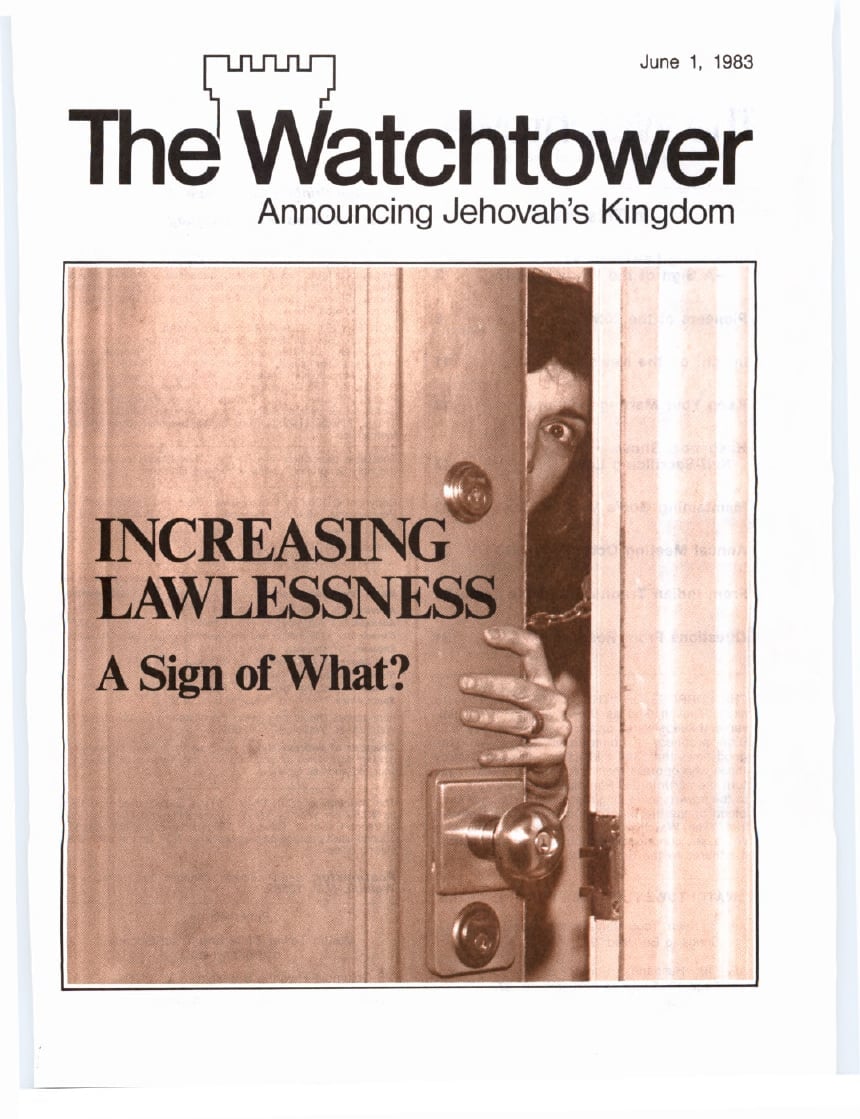
The Watchtower — June 1, 1983
Source: jw.org
Contents
Increasing Lawlessness—A Sign of the World’s End?
Pioneers of the 20th Century
Insight on the News
Keep Your Marriage Honorable
Husbands, Show Self-Sacrificing Love
Maintaining God’s View of Sex
Annual Meeting October 1, 1983
From Indian Tradition to Bible Truth
Graduating to a Higher Assignment
Questions From Readers
Unity in a Disunited World
Increasing Lawlessness—A Sign of the World’s End?
Increasing Lawlessness—A Sign of the World’s End?
“WHAT will be the sign of your presence and of the conclusion of the system of things?”
In answer Jesus Christ revealed that a period of history would be marked by international war, food shortages and earthquakes, and he added: “Because of the increasing of lawlessness the love of the greater number will cool off. But he that has endured to the end is the one that will be saved.”—Matthew 24:3, 7-13.
An increase of lawlessness—a truly menacing development since the original Greek word suggests contempt for known laws of God. The force of the word is that one places self, and not God, at the center of one’s life. Jesus did not say there would be a ‘start’ of lawlessness, but an “increasing,” a multiplying and spreading of it. This feature would be a development so striking that the majority, “the greater number,” of professed Christians would be affected. Their love for God, his laws and their neighbor would chill, just as a hot drink is cooled by an icy blast!
There is strong evidence that our 20th century ushered in, especially with World War I, an increase of lawlessness on a scale far greater than any since Jesus uttered these words. If so, this means we are living in the “last days”—in the final part of “the conclusion of the system of things.” (2 Timothy 3:1; Matthew 24:3) Do you not yearn for the end of this lawless system that has saturated our earth with violence, immorality and injustice, and to see it replaced by a loving society of people, “a new earth” in which righteousness is to dwell?—2 Peter 3:13.
‘But wait,’ say some students of history. ‘Is not the 20th century the most civilized in all history? Was not the raw violence and immorality of past centuries much worse?’
The Past—How Bad?
“Nobody could feel himself unapprehensive of danger to his person or property if he walked in the street after dark, nor could any man promise himself security in his bed,” bemoaned the solicitor general of London in 1785. Others then expressed great fear of crime.
But how much criminal activity really existed in times past? No one can say with certainty, primarily because of the faulty judicial records. And because of the lack of reliable or specific population data in the past, there is no dependable way of comparing the number of crimes-per-population rate to ours today. Some indications are that earlier centuries were comparatively peaceful. “At no time in the history of Massachusetts,” reported the state’s attorney general in 1859, “have life, liberty, and property been more secure than at present.”
But during the 150 years before 1914 a series of developments—unique in all history—set the stage for unprecedented lawlessness in the 20th century.
The Industrial Revolution
“The most sweeping revolution in all human history.” That is how history professors M. Klein and H. A. Kantor, in their book Prisoners of Progress, describe the effects of the Industrial Revolution on the United States of America between 1850 and 1920. The extensive industrial use of newly developed machines, such as the steam engine, and mass-production techniques started in England. Like a tidal wave it swept through Europe and the United States, shattering a former life-style.
Reflecting on the period before the Industrial Revolution, Klein and Kantor continued: “Compared with our own age, life appeared to be more orderly and settled. Men still attached great importance to religion and organized their values and lifestyles around their creed.”
Most people then were self-employed and took pride in their work—money was not the sole object of business. Though there were thieves and murderers, and prevailing religious beliefs were interwoven with magic and superstition, the average person in so-called Christian nations usually respected the laws of God.
Between 1880 and 1913 world manufacturing production increased three times as fast as the world population—a rate never equaled before or since. As a result, more workers had a greater amount of money to spend for these newly manufactured goods. But many, caught up by “rags-to-riches” tales, worshiped success as a goddess.
“Those who are determined to be rich,” warns the Bible, “fall into temptation and a snare . . . and by reaching out for this love some have been led astray from the faith.” (1 Timothy 6:9, 10) This happened to multitudes. Men made work their life. Family life suffered as it had to revolve around the nearly 60-hours-a-week work schedule. When many women joined the work force, children were often without guidance and became delinquent. A devotion to making a living caused many to put religion in the backseat.
The influential German philosopher Nietzsche urged, “Become who you are!” Selfishness and greed led to violent labor disputes—2,093 strikes and lockouts in the United States during just the first six months of 1916! Cutthroat business practices were common. Many imitated the merchant described in a 1905 novel: “He’s the biggest dog, and it’s dog eat dog in our business.” Truly, the love of neighbor began to cool off all over.
Rapid-Growth Cities
In search of education, fame, adventure, entertainment, more personal freedom—but especially money—masses flocked to the cities. In 1815 less than 2 percent of all Europeans lived in cities with populations of over 100,000; by 1910 the figure was 15 percent—over seven times as many, while the population merely doubled. In the United States the number of people living in cities of 8,000 persons or more leaped from 131,000 in 1790 to over 18 million in 1890—from 3 percent to 29 percent of the total population!
Cities throughout the industrial world grew with breathtaking speed. “Urbanization has, in fact, gone ahead much faster and reached proportions far greater during the last century and a half than at any previous time in world history,” wrote Kingsley Davis, an authority on urban growth.—Italics ours.
Most of those who came from the farms to the city were young and single. In the obscurity of the city, where there was a very liberal spirit, they were no longer restrained by the social relationships of the village. “It would be hard to find a young man or a young woman, over seventeen, who is chaste,” wrote a perceptive observer concerning the laboring class in one city. This man, who lived at the dawn of the 20th century, added: “Sexual intercourse, largely the product of these dance-halls, has assumed enormous proportions among the youth of to-day. It is regarded quite simply as natural and customary.”
Yes, many showed contempt for God’s moral laws. The Bible commands: “Abstain from fornication; . . . the man that shows disregard is disregarding, not man, but God.” (1 Thessalonians 4:3, 8) However, some young men in Europe, to prove their manhood, boasted about sleeping with prostitutes—even taking pride if catching a venereal disease from them! According to a study of one European country published in 1914, about one of every five men there had syphilis.
“The cities must be hot-beds of immorality,” wrote historian Adna Weber in 1899. He showed that illegitimacy rates in cities in much of Europe were, on the average, twice as great as in the rurals. In England during that time cities had twice, or even four times, the amount of crime that rural communities had.
But not only did the Industrial Revolution and the growing cities pave the way for our 20th-century increase of lawlessness; another occurrence—also unique to our day—was to have a dramatic effect.
The Great War
Erupting in 1914, this war was called “the bloodiest and costliest conflict in the history of mankind” up until that time. The major participants in this monstrous act of lawlessness were “Christian” nations! Referring to the war’s atrocities, a letter in a 1914 newspaper ironically protested: “Nations should fight like Christians, or, at least, like gentlemen.”
Because of that war, force and violence came to be viewed as acceptable. “When the rules of civilized society are suspended, when killing becomes a business and a sign of valor and heroism,” wrote clergyman Charles Parsons in 1917, “then it seems almost useless to talk about crime in the ordinary sense.” No wonder that researchers D. Archer and R. Gartner found that most of the nations they analyzed that were involved in World War I had “substantial postwar increases” in the rate of murders—Italy had a 52-percent increase and Germany a 98-percent increase over that before the war! But war led to a different type of lawlessness.
Jehovah God, who ‘hates a divorcing,’ considers the unscriptural putting away of a mate and remarriage a serious sin. (Malachi 2:16) In the wake of World War I there was an unprecedented upsurge in divorces. For instance, in England and Wales during the 50 years before 1911, the number of divorces averaged 516 each year. In 1919, the first postwar year, there were 5,184—over 10 times the average for the previous 50-year period!
The war mobilized 65,000,000 men, separating many from their family for years. “The abnormal strains and enforced separations of the 1914-18 War,” according to historians G. Rowntree and N. H. Carrier, not only increased the divorce rate but also insidiously “modified public disapproval. . . . The more liberal attitude established in the aftermath of war, appears to have been extended.” This broad-minded attitude began then and has extended till today!
So with the rapid migration in “Christian” nations to industrialized cities, coupled with the violent lessons taught by World War I, the setting was ripe for an increasing of lawlessness on a magnitude never before beheld. What have been the results since 1914? Has the love of the greater number of professed Christians truly grown cold?
Current Surge of Lawlessness
Back in 1945 many persons in the United States were surprised that the total crimes reported to police rose to 1,566,000. But 35 years later the total reached 13,295,000—and is still rising! This is a 750-percent increase, while the population grew about 60 percent! Rape increased over 600 percent! Violent crimes in general, nearly 900 percent! Imagine, in 1981 one out of every three households was touched by some form of crime! And this trend is not just in the United States. “The one thing that hits you in the eye when you look at crime on the world scale,” wrote a leading criminologist, Sir Leon Radzinowicz, in his book The Growth of Crime, “is a pervasive and persistent increase everywhere. Such exceptions as there are stand out in splendid isolation, and may soon be swamped in the rising tide.”
Are all these increases simply the better reporting of crimes to the police? For an answer, a team headed by Dr. Herbert Jacob of the Center for Urban Affairs Policy Research at Northwestern University analyzed the crime statistics, police expenditures and methods, arrest rates, and much other information from 396 cities in the United States during the period between 1948 and 1978. In an interview with a representative of this magazine, Dr. Jacob stated: “Reported crime rates have surged everywhere in the U.S. Part of this is undoubtedly a consequence of better police and civilian reporting of crimes. But this does not account for all the increase.”
“What is surprising,” continued Dr. Jacob, “is that in every kind of city—in the north or south, declining or increasing in growth, with a large minority population or a small one—the crime rose at approximately the same rate. It was a nationwide trend.” Can the police stop this ominous trend? “The police force has been generally ineffective because of several social forces beyond their control,” answered Dr. Jacob.
Of course, crime is not the only indicator of an increasing of lawlessness. Just look at the general disregard for God’s laws. The illegitimacy rate of the United States of 7.1 for every 1,000 single women in 1940 pales alongside the 27.8 figure in 1979. The 83,000 divorces in 1910 have zoomed to 1,182,000 in 1980, a 1,300-percent increase! Now, instead of one divorce for every 11 marriages during a year, as in 1910, the United States has one for every 2 marriages! Similar trends are reported earth wide.
Consider also the shocking atrocities committed in our 20th century. When in all human history was there anything to compare with the carefully planned execution of 6 million Jews in Nazi concentration camps during World War II? or the total death toll from that war—55,000,000? More recently, consider the 1979 reports of a possible slaughter of over 2 million Cambodians. What other generation ever developed and used a weapon that in a single blast eventually killed perhaps as many as 140,000 persons, such as the atomic bomb dropped on Hiroshima, Japan?
Space does not allow us to give further details of contempt for God’s laws, but what has been presented clearly shows that since 1914 there is an increasing of lawlessness on a magnitude unlike any period in history! Yes, among the greater number of professed followers of Jesus, the love for God and neighbor has cooled off, just as Jesus predicted.
Do not, however, let such growing lawlessness affect your heart. Keep your love for God and his laws warm, and it may be your joy to be saved into the promised “new earth,” where never again will there be a plague of lawlessness.—2 Peter 3:13; Matthew 24:12, 13.
[Graph on page 6]
(For fully formatted text, see publication)
total number of reported serious crimes in the United States increased over 1,000 percent from 1935 to 1980, while the population increased only about 78 percent during that same period!
1935 1,138,000
1950 2,220,000
1965 2,780,000
1980 13,295,000
[Credit Line]
Source: FBI Uniform Crime Reports of the total number of murders, rapes, robberies, aggravated assaults, burglaries, larcenies and auto thefts reported to police. Because of incomplete reports the 1935 and 1950 figures have been adjusted to represent total population
[Pictures on page 5]
INDUSTRIAL REVOLUTION
WORLD WAR I
RAPID-GROWTH CITIES
These developments, unique to our modern age, have contributed to the greatest increase of lawlessness in all history
Pioneers of the 20th Century
Pioneers of the 20th Century
THE word “pioneer” is known around the world. It often refers to a person who is the first to settle a region, preparing the way for others to come later. The efforts of past pioneers in opening up new territories have been of great service to future generations.
Are there still new frontiers to be explored? Yes. Not in outer space, but right here on earth. We need pioneers who can blaze a trail out of the present moral, economic and political quagmire that man has got himself into. A small group of dedicated people have been pointing to the way out for more than a hundred years. These are the true pioneers of the 20th century.
Jehovah’s Witnesses use the Bible as their pathfinder. (Psalm 119:105) God’s written Word leads them to his Kingdom as the only means for solving the sticky problems bogging down human rulers. Not only will present-day distress be eliminated but Jehovah’s good promises go beyond. The future will see a Paradise earth. (Revelation 21:1-4) It is through God’s heavenly government, with Christ Jesus as King, that this will find fulfillment. Isaiah 9:7 says: “To the abundance of the princely rule and to peace there will be no end, upon the throne of David and upon his kingdom in order to establish it firmly and to sustain it by means of justice and by means of righteousness, from now on and to time indefinite. The very zeal of Jehovah of armies will do this.”
Like the early pioneers, among whom men, women and youth all shared in settling a new land, Jehovah’s Witnesses of different ages and of both sexes all share in spreading the good news from the Bible. Among these, however, there are those who voluntarily take the lead, spending from 60 to 140 hours a month in the evangelizing work. Appropriately, these full-time preachers are called pioneers.a
Would this type of pioneering be the best for you? Or would you choose another type of 20th-century pioneering?
Not All Pioneering Leads to Satisfaction
Individuals who pave the way for a new method of technology or a fresh line of thought are pioneers too. Pioneering in the secular field, however, can often lead to frustration and bitterness. Here are some of the better-known examples.
A pioneer of the steel industry, Andrew Carnegie, has long been admired by many. He was one of the richest men of his time. As a philanthropist he gave away millions. Was he happy? Once when a reporter told Mr. Carnegie how much he envied him, the reporter was surprised by this reply: “I am not to be envied. How can my wealth help me? I am sixty years old, and cannot digest my food. I would give all my millions if I could have youth and health.” Then, in a bitter tone he continued, “I would gladly sell anything to have my life over again.”
Another multimillionaire, J. Paul Getty, an oil magnate, echoed this thought when he said: “Money doesn’t necessarily have any connection with happiness. Maybe with unhappiness.”
How about a career of pioneering in the science field? Listen to what one of the most respected scientists and pioneers in nuclear physics, Albert Einstein, once said about modern science: “In war it serves that we may poison and mutilate each other. In peace it has made our lives hurried and uncertain. . . . It has made men into slaves of machinery who for the most part complete their monotonous long day’s work with disgust.” Further, in a letter to a friend, Einstein expressed his bitterness at seeing his knowledge of the atom used for producing the atomic bomb.
Would a political career be more rewarding? Even if we were able to transport ourselves back in time to a less complex society, pioneering in the political arena would not guarantee satisfaction. For example, Abraham Lincoln is one of the most admired politicians. He served as president at the nation’s capital. Yet after he was assassinated, his own son, Tad, said of him: “He was never happy after he came here. This was not a good place for him.”
Neither wealth, secular knowledge nor fame can assure satisfaction. Many dream of blazing a new path in the business, sports, entertainment, political or science field. They chase after their dream and, if and when it is realized, end up saying disappointedly: ‘Is that all there is?’
Pioneering That Does Satisfy
Others have decided upon a different path for their career—the full-time preaching work. It is a real stimulus to see what these pioneers have accomplished and how they feel about their work.
In 1923 a man, his wife and their child were asked to move from their home in Trinidad to Sierra Leone. For what reason? To spearhead the preaching work in West Africa. W. R. Brown and his family agreed. Soon upon their arrival a hall was rented for a Bible discourse. It was packed out; hundreds were turned away. The next Sunday another talk was given, “To Hell and Back—Who Are There?” Again, another capacity audience—people were hungry for Bible truths. And the Browns were there to feed them spiritually, pioneering the way for other Bible teachers to follow.
Then, in 1930, the Browns went to Nigeria to organize the preaching work in that country. In the next 27 years they saw the congregation grow from zero to 165 in Nigeria. Time was also spent visiting and giving Bible lectures in other countries such as Ghana, Liberia and Gambia. Throughout all of West Africa he became known as Bible Brown. Today in this part of Africa there are more than 131,000 Witnesses.
More important than numbers, though, is the effect that this Bible teaching, pioneered by W. R. Brown and his wife, had on people’s lives. Dr. Azikiwe, the governor-general of Nigeria in 1960, said: “I have known Mr. and Mrs. Brown for about thirty years, and they have added greatly to the spiritual upbuilding of our people in Nigeria . . . If all the religious denominations were like Jehovah’s Witnesses, we would have no murders, burglaries, delinquencies, prisoners and atomic bombs. Doors would not be locked day in and day out.”
How did W. R. “Bible” Brown feel after 53 years as a pioneer minister? He said: “What a joy it is to see men and women becoming obedient to the good news of God’s Kingdom! . . . I love pioneering. It is one of the highest privileges that can be offered to a human creature, to be an ambassador of Jehovah!” Do you, too, feel a love for the pioneer service?
Kathe B. Palm started her career of full-time preaching in 1931. Forty-six of these years have been spent in Chile, South America, witnessing from one end of the country to the other. Reflecting back on her career of pioneering, she says: “I could not have found any other work that could have brought me as much contentment or could have been so spiritually rewarding . . . I get a warm, satisfied feeling as I see so many persons with whom I have had Bible studies publishing the good news, helping others to come to the water of life. I invited them to drink of the waters of truth, and now they are inviting others.” When she started in 1936, there were only 50 active Witnesses in all of Chile. Now there are over 18,000. Have you tasted the contentment and spiritual reward of pioneering?
In 1967 Malinda Z. Keefer said: “My happiness arises largely from the fact that over fifty years ago I offered myself as a willing volunteer in the full-time service.” Today she has logged more than 75 years as a pioneer! Away back in June of 1907, not being content with door-to-door witnessing just on Sunday morning, she expressed to Brother Russell, the Watch Tower Society’s president, her desire to enter the full-time service. She doubted, though, that she had enough knowledge. Brother Russell told her: “If you want to wait until you know it all you will never get started, but you will learn as you go along.” The next month she began her pioneer career that has taken her to 15 states in the United States. As Malinda enters her 100th year of life, she is still found active in the pioneer ministry.
A good stepping-stone to the career of pioneering is the auxiliary pioneer service. The spending of just 60 hours a month preaching can become a pleasing experience for you. Jehovah invites us to “taste and see” that worship of him is good. (Psalm 34:8) This form of pioneering will give you a sample “taste” of what full-time preaching and teaching is like. If you have never tasted of the pioneer work in this manner, you have not yet discovered what joys and satisfaction full-time evangelizing can bring.
Have you given serious consideration to your career? Can you, too, accept this wonderful heritage of the pioneer work? Will you join the swelling ranks of full-time preachers and become a pioneer of the 20th century?
[Footnotes]
See Webster’s Third New International Dictionary, page 1721.
Insight on the News
Insight on the News
Reaping What They Sow
A report in the New York Times Magazine says that “sexually active homosexuals are prone to a host of diseases: syphilis, gonorrhea, genital herpes, hepatitis, amebiasis (one of the most common diseases in what doctors call the ‘gay bowel syndrome’) and infections caused by fungi and protozoa usually seen only in the tropics.” Just why these “bizarre infections are so common in the homosexual community” has long puzzled doctors. Now, recently added to the list, is AIDS (acquired immune deficiency syndrome)—leaving the body helpless to fight cancer or other infections. “AIDS is deadly,” states the Times. “Homosexual men still represent 75 percent of the disease’s victims, and the specter of AIDS haunts every member of the homosexual community.” “Behavioral changes [i.e., sexual restraint] are currently the only prudent advice physicians can offer.”
“I strongly recommend that my patients be very circumspect and cautious in their future sexual contacts,” says Dr. Dan William, whose patients are primarily homosexual men. “I tell my patients what the epidemiologists know—which isn’t much. We are more or less convinced that we are dealing with a sexually transmissible agent.”
This drastic increase in sexually transmitted diseases well illustrates the Bible principle that “whatever a man is sowing, this he will also reap.” Tragic as it may be, violating God’s standards for sexual morality results in their “receiving in themselves the full recompense, which was due for their error.”—Galatians 6:7, 8; Romans 1:26, 27.
“Holy Racketeering”
“It seems that true Christian principles are swiftly being swept under the carpet as exorbitant taxes are charged by modern ministers for customary rituals which in the past were performed free of charge,” states Echo, a supplement to The Natal Witness newspaper in South Africa. Priests in Lesotho “‘sell’ holy communion” as well as charge a high rate for “a few drops of water used for baptism,” reports the paper, mentioning that the Anglican bishop is concerned about the “holy racketeering” but unable to stop the practice.
Cited also was the example of “a well-known leader of a huge independent church” who would charge R10 (over $9, U.S.) for just a handshake, and his son who now collects “anything from R5 upwards just to smear a cross sign on the face of a follower with Blue Seal Vaseline.”
Why do followers support such money-making schemes? “The general motive behind the ‘pray and pay’ syndrome is that if a person contributes generously to the Church he or she will get a decent funeral service,” says Echo. Yet Christ, who left those who represent him ‘a model to follow his steps closely,’ did not charge anything for the services and miracles he performed. (1 Peter 2:21) And, when instructing his disciples in their ministry as his representatives, he commanded: “You received free, give free.”—Matthew 10:8.
No Change
“If Christ returned,” asks columnist Sydney J. Harris, “would there not soon be a second crucifixion?” He continued: “And this time, not by the Romans or the Jews, but by those who proudly call themselves Christians?”
Then he noted that Jesus would no doubt be ‘assailed, attacked, castigated, dismissed, denounced, rejected, despised, scorned and laughed at’ by the present various factions of mankind. He also said: “I wonder how we today would regard and treat this man with his strange and frightening and ‘impractical’ doctrines of human behavior and social relationships. Would we believe and follow, any more than the masses of people in his day believed and followed?”
Questions such as these help one to understand why the “revelation of the Lord Jesus from heaven with his powerful angels” must come ‘to bring vengeance upon those who do not know God and those who do not obey the good news about Jesus.’—2 Thessalonians 1:7-9.
Keep Your Marriage Honorable
Keep Your Marriage Honorable
“Let marriage be honorable among all.”—HEBREWS 13:4.
1. What question did a newspaper columnist ask, and how did one husband answer?
“IF YOU had it to do over again, would you marry the person to whom you are now married?” asked a popular newspaper columnist. Over half of the 50,000 that responded to this poll answered “Yes.” How would you have answered? A Christian man, married for 33 years, was asked this by his wife. “I sure would!” he beamed. “Looking back, I know there were times it was not easy—we had our problems. But our marriage was really worth the effort. We have something that is very precious!”
2. At Hebrews 13:4, what does “honorable” mean?
2 Since God is its Author, marriage is capable of providing genuine satisfaction and joy. Yet many marriages—even some among dedicated Christians—are strained to the limit. The apostle Paul therefore urged, “Let marriage be honorable [”held as of great price, precious . . . especially dear”a] among all.” (Hebrews 13:4) Because marriage brings “tribulation in [the] flesh,” the challenge is in keeping your marriage honorable. (1 Corinthians 7:28) But how can you do this? First, you must recognize one of the biggest problems.
Lack of Personal Communication
3, 4. (a) What is one of the biggest problems in marriage? (b) What is involved in a couple’s being “one flesh”?
3 One Christian couple had been married nearly 20 years. Suddenly, their marriage was shattered by adultery. How could this happen? “When I analyzed what happened over the years,” said the wife, “I realized that we talked about household matters, even our service to God. But when it came to communication on a personal basis—we had none.” This lack of emotional closeness gradually contributed to a weakening of the marriage commitment and to her husband’s adultery. Such a breakdown of meaningful communications is cited in research studies as one of the major causes for either divorce or “loveless marriages.”
4 Yet Jehovah said: “A man will leave his father and his mother and he must stick to his wife and they must become one flesh.” (Genesis 2:24) Marriage should thus be the closest of all human relationships. It unites two differing personalities—a delicate task indeed! For such a union to work, each must talk honestly with the other and bare his or her feelings.
5. (a) What hinders personal communication? (b) How can others respect marriage?
5 What hinders such personal communication? At times, aloofness is the custom of the land. Some are reticent, shy about expressing themselves. Still others are captivated by our recreation-oriented and materialistic world. They become more interested in things than in their marriage. Having too many people in one’s marriage, or clinging too tightly to parents can also inhibit your closeness. Certainly, others should respect a married couple’s need for privacy and not take undue liberties nor seek the attention that should rightly go to the mate.—Proverbs 25:17.
6. (a) How can a marriage mate become like a “strong town” and “contentions” become like a fortress “bar”? (b) What questions in the accompanying box help reveal the status of your communication?
6 But perhaps the most common reason for a lack of personal communication is suggested at Proverbs 18:19: “A brother who is transgressed against is more than a strong town; and there are contentions that are like the bar of a dwelling tower.” For example, a wife may confide in her mate. What, though, if her feelings are disregarded or belittled, perhaps even used against her on another occasion? She might react by putting up a strong wall of reserve to avoid further emotional damage, as it were, becoming like a fortified “strong town.” A war of pride might ensue, each refusing to back down. Such needless contentions can shut out personal communication and reconciliation as if the couple were separated by the iron bars of a fortress! But what can you do to improve communication?
Cultivating Personal Communication
7. How does Philippians 2:4 show what is needed to cultivate personal communication?
7 You must maintain a “personal interest” in the concerns of your mate. (Philippians 2:4) This requires taking the time to talk about personal matters together. For instance, one Christian couple sets aside time right after the husband comes home from work to have a cup of tea and talk to each other. For at least 15 minutes they savor each other’s thoughts and experiences before beginning evening chores. They have done this on a regular basis for 27 years!
8. Why is attentive listening so vital?
8 But more is needed than just talking. Asked what she liked best about her husband, a Christian wife replied: “He listens to me. He’s my best friend.” Attentive listening, rather than simply hearing, tells your mate: ‘You are an important person to me. I want to know your thoughts and feelings, share your experiences—even the unpleasant ones.’ Being a good listener is an art of the heart. It requires what Peter called “fellow feeling” (literally, “to suffer with”) along with ‘tender compassion’ and ‘humility.’ (1 Peter 3:8) So confide in each other. Share even trivial matters. Convert your feelings into words.
9, 10. How can a married couple imitate the way Isaac, Manoah’s wife and Elkanah treated their mates?
9 Just imagine the closeness between Isaac and Rebekah. When troubled she was able to pour out her heart to her husband. “I have come to abhor this life of mine,” she lamented on one occasion. Did Isaac make her feel ashamed of these feelings? No, he sympathetically listened and took steps to allay her fears. (Genesis 27:46–28:5) The wife of Manoah noted her husband’s anxiety and offered consoling words.—Judges 13:22, 23.
10 Elkanah was sensitive to his wife’s feelings. After noticing his wife’s depression he strove to ‘draw up’ the intentions of her heart by gentle questions, saying: “Hannah, why do you weep, and why do you not eat, and why does your heart feel bad?” (1 Samuel 1:8) What about you? Are you quick to probe your mate’s feelings? Do you let your mate feel free to express his or her feelings without being made to appear condemned? At times a sympathetic ear is needed rather than a pouring forth of advice.—Proverbs 20:5; 21:13.
Discuss Delicate Problems
11-13. (a) When is personal communication especially hard? (b) Why was Sarah deeply upset? (c) What could she have done, yet what did she do?
11 What if your mate does something or allows something that pains you and that could even damage your marriage? How can you communicate during such times? An episode in the life of Abraham and Sarah provides helpful insight.
12 On the day when her son Isaac was weaned, Sarah noticed Ishmael, Abraham’s son through the slave Hagar, “poking fun” at Isaac.b Undoubtedly, teenage Ishmael taunted his five-year-old half brother, now destined to replace him as the God-appointed heir of Abraham. Sarah was deeply disturbed over this threatening speech. What if her husband suddenly died? Could Hagar perhaps convince others that her son, not Isaac, should be the heir of the promise?—Genesis 17:19; 21:8, 9.
13 Sarah could have feared Abraham’s displeasure and swallowed her feelings, for she knew he dearly loved Ishmael. She may not have made an issue over other matters, allowing her love to cover over. She was noted as a wife who ‘obeyed Abraham, calling him “lord.”’ (1 Peter 3:6) But this was a critical situation. Of course, she could have given Abraham the “silent treatment,” hoping that he would figure out what was troubling her. But no, Sarah communicated! “Drive out this slave girl and her son,” she said, “for the son of this slave girl is not going to be an heir with my son, with Isaac!”—Genesis 21:10.
14. What action did Abraham take, and why?
14 Abraham found this demand very displeasing; at least momentarily he allowed affection for Ishmael to cloud his thinking. But did Abraham retort: ‘How dare you talk to me that way! Who is the head of this family?’ No. In fact, God told him: “Do not let anything that Sarah keeps saying to you be displeasing to you about the boy and about your slave girl. Listen to her voice.” The next morning Abraham did just that. This preserved peace and God’s purpose was carried out—though it pained Abraham deeply.—Genesis 21:11-14.
15, 16. (a) Name some problems that can put a strain on marriages. (b) How can married couples imitate Abraham and Sarah, and with what results? Give an example.
15 Many problems today can put a strain on your marriage. For instance, you may feel that your mate is giving undue attention to another person. Research studies, along with countless actual experiences, show that if a husband or a wife gives too much attention to a personal friend, especially of the opposite sex, it causes considerable marital strain. Or possibly your mate cherishes a job, a hobby or some form of recreation that is having a detrimental effect on your marriage. Maybe your mate has become calloused to your feelings. Do you, like Sarah, discuss such delicate matters and perhaps prevent further damage? And if your mate did bring up something that pained your heart, would you respond like Abraham, seriously considering God’s direction? Would not such a response encourage open communication?—Proverbs 27:5.
16 Of course, “love covers a multitude of sins.” (1 Peter 4:8) So do not make an issue over all differences and human flaws. But some have fearfully held back from discussing serious problems; or if they did discuss these, their mate belittled them. Sadly, patterns of conduct are thus established that often lead to marital disaster. One Christian wife was deeply upset for some time because of her husband’s lack of consideration for her emotional makeup during sexual intimacy. She felt she was being “used” for his self-gratification. She considered leaving him. Yet she had not even discussed it with her husband, fearing that he would not understand. Following the advice of a mature Christian, she finally bared her pent-up feelings. He had not realized how his actions were affecting her! He made needed changes and now that problem no longer mars their happiness. Preserve the honorableness of your marriage by cultivating personal communication.
Law of Loving-Kindness Upon the Tongue
17. What “law” should be on a couple’s tongue? Illustrate.
17 But does the need for personal communication give a license for thoughtless speech? “There exists the one speaking thoughtlessly as with the stabs of a sword, but the tongue of the wise ones is a healing.” (Proverbs 12:18) Yes, even if you are right and have the best of intentions, a thoughtless remark still “stabs.” For good reason a capable wife is described as having “the law of loving-kindness” upon her tongue. (Proverbs 31:26) So consistent is her kindly speech that it is called a law. When a man fails in some endeavor, how much he appreciates such a law on his wife’s tongue! One Christian man was crushed because of a business loss. “At least you tried,” said his considerate wife. “It’s going to come out better the next time.” How his spirits soared!
18. How did one wife more fully practice this “law”?
18 Especially is kindly speech needed during an argument. The sarcastic speech of a contentious wife can drive a husband away and make him prefer dwelling in a barren wilderness. (Proverbs 19:13; 21:19) Because of contention in her marriage a Christian wife decided to practice this law more fully. How? “When something is bothering me I just don’t blurt it out as I used to,” she explained. “I try to wait for the best time when we are alone. I even control my facial expressions and I don’t put my husband down in front of the children. It sure has made a difference!” Of course, both husband and wife must consider how costly their words might be in terms of the other’s self-esteem.—Proverbs 25:11; Galatians 5:15.
19, 20. (a) Having “insight” involves what? (b) How did insight slow down the anger of one husband, and with what result? (c) What are some revealing questions?
19 But what is needed when emotions become heated? Insight! “The heart of the wise one causes his mouth to show insight, and to his lips it adds persuasiveness.” (Proverbs 16:23) Insight involves looking beyond the obvious. At Nehemiah 8:8 the Hebrew word is rendered “meaning.” How does insight stop an argument? One husband walked in to find his wife throwing silverware across the room in a rage. “You don’t care about me!” she tearfully blurted. “You come home and spend your time in the garden. I need help!” But what was really bothering the wife was physical and emotional frustration. She had just had a baby and now was expecting another. She felt trapped at home. Her husband had insight. Overlooking her unchristian outburst, he perceived the underlying frustration. His reply? “I’m sorry, honey. I should have been in here helping you.” Soon she calmed down. “My respect for him jumped to a new height,” she later revealed.
20 How true are the words of Proverbs 19:11: “The insight of a man certainly slows down his anger, and it is beauty on his part to pass over transgression”! Do you show such insight? Do you look behind the words? Are you able to pass over such a personal transgression? Insight can also add persuasiveness to whatever request you make of the other. Yes, a mate who is discreet, possessing insight, is a gift from Jehovah and contributes to a precious marriage.—Proverbs 19:14.
Allow for Differences and Imperfection
21. How can accepting differences keep your marriage precious?
21 Despite the best of efforts, no couple will agree on everything. Differences will exist. A traveling Christian overseer, married for over 25 years, observed: “Some couples are saying, ‘We are so different!’ Then they concentrate on these differences and soon cannot stand living together. Sure, my wife and I have some different tastes, but we have a lot in common too. By focusing on what we hold in common, our marriage becomes more precious each day.” Are you as willing to accommodate and allow for differences in your marriage?
22. (a) What can help mates to realize satisfaction in marriage? (b) What is the strongest incentive to keep your marriage honorable?
22 The perfect mate does not exist. Satisfaction can be attained by learning to accept differences and to put up with minor weaknesses. (Colossians 3:13) The fact is, our relationship with God, wanting him to remain our Friend, is the strongest incentive to keep our marriage honorable. Truly commendable is the course of those Christians who out of regard for their relationship with Jehovah have striven to make a success of their marriage.
23. How can we keep our marriage precious?
23 Any marriage that is neglected will tarnish. Yet you can restore the luster by putting forth a genuine effort to (1) cultivate personal communication, (2) keep the law of loving-kindness on your tongue and (3) allow for differences and imperfection. This, coupled with God’s blessing, will keep your marriage precious not only to you but to its Grand Author.
[Footnotes]
A Greek-English Lexicon of the New Testament, by J. H. Thayer. The same word is used to describe the “precious blood” of Christ.—1 Peter 1:19.
The Bible reveals that this was more than mere child’s play. It was ‘persecution.’—Galatians 4:29, 30.
Can You Remember?
□ Why is personal communication so vital?
□ How will following the example of Abraham and Sarah improve communication?
□ How does one show that “the law of loving-kindness” is upon his/her tongue?
□ How does insight add to an honorable marriage?
[Box on page 13]
How is your communication?
(1) How much time do you spend together just talking?
(2) How many of your conversations are purely business (household affairs, the children, possessions, and so forth), rather than a sharing of thoughts and feelings?
(3) Are there certain issues or feelings that you have, but that you do not feel free to discuss with your mate?
(4) How long has it been since one of you gave a gift to the other simply out of affection?
(5) How frequently do you hold hands or touch each other, other than during sexual relations?
[Picture on page 15]
A wife who has “the law of loving-kindness” on her tongue is dearly appreciated, especially during times of stress
Husbands, Show Self-Sacrificing Love
Husbands, Show Self-Sacrificing Love
“Husbands, continue loving your wives, just as the Christ also loved the congregation and delivered up himself for it.”—EPHESIANS 5:25.
1. Why is Christian headship both demanding and rewarding?
“MARRIAGE! Nothing else demands so much from a man!” Thus wrote Norwegian poet Ibsen. In view of the Bible principle of headship, you may heartily agree. Yet, when properly exercised, Christian headship can also create a homelife that is a haven of mutual love and respect where your heart is at ease. However, your divinely appointed position as head does bring with it greater accountability before God.—Luke 12:48.
2. Is happiness in the home solely up to the efforts of the husband?
2 Does this mean that you as a husband are solely responsible for the happiness in your home? No, both you and your wife must try to improve the atmosphere there. (Proverbs 14:1) The fact that much of what follows applies to the husband does not mean that wives are less imperfect. But it is designed to help husbands live up to the demands of Christian headship. Just how is headship to be exercised? This is a matter that all Christians—even the unmarried—need to understand.
Love as Christ Loved the Congregation
3. How does Ephesians 5:25 describe proper headship, and what does this mean?
3 “Husbands, continue loving your wives, just as the Christ also loved the congregation and delivered up himself for it,” wrote the apostle Paul. (Ephesians 5:25) Since husbands have the Scriptural right to make final decisions in the family, it would be easy for you to allow selfishness to creep in. Admittedly, most family decisions are matters where personal preferences play a large role. Do your own likes prevail when no Bible principle is involved? Note that a husband must imitate Jesus’ self-sacrificing love. He delivered up himself for his disciples. “Christ did not please himself.” (Romans 15:3) Self-sacrifice means giving up some pleasure or going through some trouble or inconvenience for the benefit of another.
4. In what way did Jesus show his concern for his disciples?
4 Jesus’ consuming interest was to help his disciples spiritually. While firm for righteousness, he was never harsh when his disciples expressed wrong views, or were arrogant, impulsive or cowardly. (Matthew 18:1-3; Luke 22:24-26, 47-51, 59-62) ‘By means of the Word of God,’ and his example, he aided his disciples in overcoming serious weaknesses so that they, as a group, would “be holy and without blemish.”—Ephesians 5:26, 27.
5, 6. How can a husband imitate Jesus’ self-sacrificing love, and when is this especially hard?
5 Do you show such self-sacrificing love? Some men feel that providing for their wives materially is sufficient sacrifice. True, such labor is difficult and should be deeply appreciated. Yet at the heart of Jesus’ example was his tireless exertion in caring for the spiritual and emotional needs of his disciples in addition to their physical ones. After all the anxieties of the world in caring materially for their families, many men may understandably not want to be further taxed mentally at home. While this attitude is common in families that do not try to follow the Bible, sadly even one Christian wife confided: “My husband gave me no direction at all. There were times when I poured out my heart for guidance on certain matters, but his mind was somewhere else.”
6 Self-sacrificing love is the answer. If your wife has a baffling problem, rather than put her off by a word or facial expression this love will motivate you to reason matters out with her patiently. You will be very concerned about her spirituality, studying the Bible and sharing in sacred service with her. You will avoid letting her shoulder weighty decisions that are rightly your responsibility. You will also see that she has opportunity to relax and rest up a bit. (Mark 6:31) Such initiative gives a wife self-respect and real security.
Lowly at Heart
7. To exercise a balanced headship, what quality is needed?
7 Often, men have difficulty finding a balance with headship. At times some will feel threatened even if a wife makes a suggestion or is somewhat critical. Jesus, the model for Christian heads, said: “I am mild-tempered and lowly in heart.” (Matthew 11:29) His humility was not on the surface, only to disappear when someone differed with him.
8, 9. (a) For what did Sarah blame Abraham, and why? (b) Why did Abraham not belittle her or answer harshly?
8 Abraham was also an example of humility. His wife, Sarah, was treated disrespectfully by her slave girl Hagar. Abraham either did not notice this haughty action or failed to take swift action. “The violence done me be upon you,” said Sarah. “I myself gave my maidservant over to your bosom, and she became aware that she was pregnant, and I began to be despised in her eyes. May Jehovah judge between me and you.”—Genesis 16:5.
9 How those words must have stung! For Abraham dearly loved Sarah and would never want her hurt. Though Sarah may have had reason to blame Abraham for her predicament, she may have overreacted, for she even appealed to God as if Abraham would not be just. Now, did Abraham lash out in defense of his headship? Did he consider her unsubmissive? He knew that Sarah had left a comfortable home in Ur and for over 10 years had dwelt in tents as he responded to God’s leading. That was subjection! Her submissive, unselfish support had endeared her to him. (1 Peter 3:5, 6) “Look! Your maidservant is at your disposal,” was his mild reply. “Do to her what is good in your eyes.” (Genesis 16:6) Abraham was lowly in heart. What a man!
10. (a) How can a husband imitate Abraham? (b) Will you always be successful?
10 When your wife may blame you for some problem, try to respond as did Abraham. It is not always easy. There will be times when you fall short. But listen, try to understand and evaluate what she is saying. Sometimes in a burst of emotion a wife may not say just the proper words. She may overreact just like Sarah. Try to see how you can work it out together.
11. Why should a husband not view his wife as a “second-class” person?
11 True, a husband can set down various rules for the household. (Romans 7:2) Yet your wife is not a child or a “second-class” person. Jehovah said, “I am going to make a helper for [the man], as a complement of him [literally, “one like him”].” (Genesis 2:18) Eve was to be on Adam’s level of intelligence, his counterpart, really able to help him in carrying out his divine assignment.
12. (a) What was accomplished when one husband developed modesty of heart? (b) How does modesty work for happiness in marriage?
12 The capable wife described in Proverbs 31 was trusted by her husband. She purchased property; even planted a vineyard “from the fruitage of her hands”—no small task! Was the husband resentful, feeling his headship threatened? No, he praised her! (Pr 31 Verses 10, 11, 16, 28) A similar attitude can help you avoid needless arguments. For instance, one husband and his wife argued constantly. He admittedly exercised a “bossy” headship. After prayerful self-examination he swallowed this improper pride. He began to evaluate her suggestions. Eventually he even let her take care of some of the money matters. He now says: “She does a great job!” The wife adds: “I just wanted to be trusted. It is good to feel inside that your husband has confidence in you.” Proverbs 13:10 thus warns: “By presumptuousness one only causes a struggle, but with those consulting together there is wisdom.” A husband who is modest, aware of his limitations, rejoices with his wife’s skills, thereby showing himself to be modest at heart.—Proverbs 11:2.
Show Honor to the “Weaker Vessel”
13. (a) First Peter 3:7 shows that a husband must do what? (b) What emotional need makes a woman the “weaker vessel”?
13 “You husbands,” wrote the apostle Peter, “continue dwelling in like manner with [your wives] according to knowledge, assigning them honor as to a weaker vessel, the feminine one.” (1 Peter 3:7) You must have knowledge of your wife’s emotional makeup, which is basically why she is considered the weaker vessel. A wife must sense that she is loved and cherished by her husband. Without this one ingredient—despite what material goods she has—she will feel inadequate. She must be convinced that her husband feels as did the husband of long ago who said to his wife: “There are many daughters that have shown capableness, but you—you have ascended above them all.”—Proverbs 31:28, 29.
14. What gives a woman emotional security?
14 ‘My wife should know I love her. I married her, didn’t I?’ may be the thinking of some men. Women, however, thrive on expressed affection. The faithful man Isaac was sensitive to this need. After 35 years of marriage he was seen showing affection to his wife. (Genesis 26:8) Do likewise. By the attention you give, let her know that your heart is with her, that to you ‘she excels all women.’
15. To be attentive to their wives, what must husbands guard, and why is this so important?
15 To be this attentive takes time and thought. Some husbands find it easier to become attentive to someone who seems new and exciting. This happened in Israel during the time of Malachi. Jehovah said to those self-centered men who were dealing treacherously with their wives: “You must guard yourselves respecting your spirit.” (Malachi 2:13-16) Yes, these needed to guard, watch out for, their feelings. Because we may work or live close to other women, we must do the same. It takes a conscious effort and self-discipline to prevent egotism, boredom or curiosity from changing your spirit, inner feelings, toward your wife.—Matthew 5:27-30.
The Wife’s “Due”
16. What area of marriage has many problems, and how is unselfishness indicated at 1 Corinthians 7:3, 4?
16 Your self-sacrifice is especially necessary with the marital “due.” “Let the husband render to his wife her due; but let the wife also do likewise to her husband. The wife does not exercise authority over her own body, but her husband does; likewise, also, the husband does not exercise authority over his own body, but his wife does.” (1 Corinthians 7:3, 4) Problems abound in this sensitive relationship. Some research studies have shown that one half of all couples will experience a serious sexual problem at some time during their marriage.
17. (a) What should be included in paying a wife her marital due? (b) How does one researcher explain the needs of a wife?
17 Many husbands often equate their wife’s needs or sexual “due” with their own. In a completely different avenue Paul showed that not all “dues” are alike. At Romans 13:7 some governmental officials are due the tax, others the tribute, still others honor. The due required depends on the specific need or request of the individual. As to the marital due of your wife, more than physical union is necessary. In The Family, Society, and the Individual, researcher William M. Kephart states: “The essence of female sexuality, then, can best be described in terms of love and affection. . . . During sex activities the average woman is perhaps as much concerned with amatory behavior—being held, caressed, kissed . . . it seems to be in the nature of women to think of sex in terms of tenderness and love, rather than as an isolated physical drive.”
18. What can create self-centeredness?
18 Your wife’s emotional makeup as the “weaker vessel” requires that you be self-sacrificing and not merely concerned with your own satisfaction. Furthermore, being entertained by material that features sex can create an improper “sexual appetite” and lead to self-centeredness, making common and crude what should be beautiful. Avoid such material like the plague! (Colossians 3:5) But patiently, through expressions of tender love, render to your wife her full due.—1 Corinthians 10:24.
Self-Sacrifice Touches the Heart
19. If a husband is self-sacrificing, should a Christian wife take advantage of it?
19 With such emphasis on the husband’s self-sacrifice you may feel, ‘Will not wives take advantage of it—always insisting on their own way?’ That should not be the case! Christian wives should respond as the congregation did to Jesus’ self-sacrificing love. Paul writes: “The love the Christ has compels us . . . and he died for all that those who live might live no longer for themselves.” (2 Corinthians 5:14, 15) So, too, your wife should respond with unselfishness. As one happy Christian wife said: “I will knock myself out for my husband so that we can keep serving in a very difficult theocratic assignment, because I know he cares about me.”
20. (a) How does reflection on Genesis 3:16 show that both husbands and wives can become unbalanced? (b) Why should wives not be quick to point to their husband’s errors?
20 Yes, wives, there is need on your part to be unselfish. Just as a man can abuse his headship by selfishly dominating his wife, so, too, a wife can have an inordinate craving for the attention of her husband. (Genesis 3:16) Balance is not easy. With all the demands on your husband, including heavy congregational duties, there are bound to be times when he may not satisfy all your emotional needs. “If errors were what you watched, O Jah, O Jehovah, who could stand?” confessed the psalmist. None of us could! (Psalm 130:3) Just as your husband will have an accounting with Jehovah, so will you. But right now your expressions of appreciation for the good he does along with mercy will capture not just the eye of your husband but his very heart.
Help From Above
21. How does God help? Give an illustration.
21 Of course, all these responsibilities may seem overwhelming. But God will help you “to be made mighty in the man [or, woman] you are inside with power through his spirit.” It is this inner strength that can enable you to carry any load, for Jehovah, through his power, can “do more than superabundantly beyond all the things we ask or conceive.” (Ephesians 3:16, 20) One Christian couple separated because of problems. After some time they sat down together to discuss a possible reconciliation. The shouting started again. Then the husband suggested that they pray together. They calmed down. “That appeared to be the real problem in our marriage,” confided the husband. “We always tried to settle our problems on our own instead of bringing Jehovah into them. And nothing ever worked.” After being reunited for over five years, the wife said: “It just gets better. The more we apply the truth of the Bible, the happier we become. Now we try to include Jehovah in every aspect of our marriage. We enjoy so much working together in the preaching work.”
22, 23. (a) Around what should a Christian marriage be centered? (b) Why are many wives to be heartily commended?
22 Yes, a Christian’s marriage should be centered around his relationship with God, not simply around pleasing his mate. As Paul wrote: “Let those who have wives be as though they had none.” (1 Corinthians 7:29) Of course, Paul was not telling husbands to ignore their wives. It is only proper that a married man be eager to “gain the approval of his wife.” (1 Corinthians 7:33) But as a man advances spiritually and shows the qualities of a good husband he will likely be appointed to service privileges in the congregation. This would take up some of the time that previously was shared with his wife, though he should not become unbalanced. But still occasionally she may have to do without his full attention.
23 Many of you wives have unselfishly bided your time on various occasions while your husband had to care for necessary congregational duties. You are truly to be commended! Your patient support is deeply appreciated by your husband and Jehovah. You are just what the Bible says—“a crown” to your husband and one that brings “goodwill from Jehovah”!—Proverbs 12:4; 18:22.
24. What should husband and wife individually try to do?
24 So, husbands, continue showing self-sacrificing love. Wives, continue to respond with unselfish support. Build your marriage around your relationship with God. And may our tender Father richly bless your efforts!
Do You Recall?
□ How does a husband ‘love his wife as Christ loved the congregation’?
□ How can a husband imitate the lowliness of heart of Abraham?
□ How does a husband show honor to his wife as a weaker vessel?
□ What should be the response of wives to such self-sacrifice?
[Pictures on page 20]
A HUSBAND SHOULD TAKE THE LEAD
…