The Watchtower, January 15, 1983
Download: PDF — The Watchtower, January 15, 1983
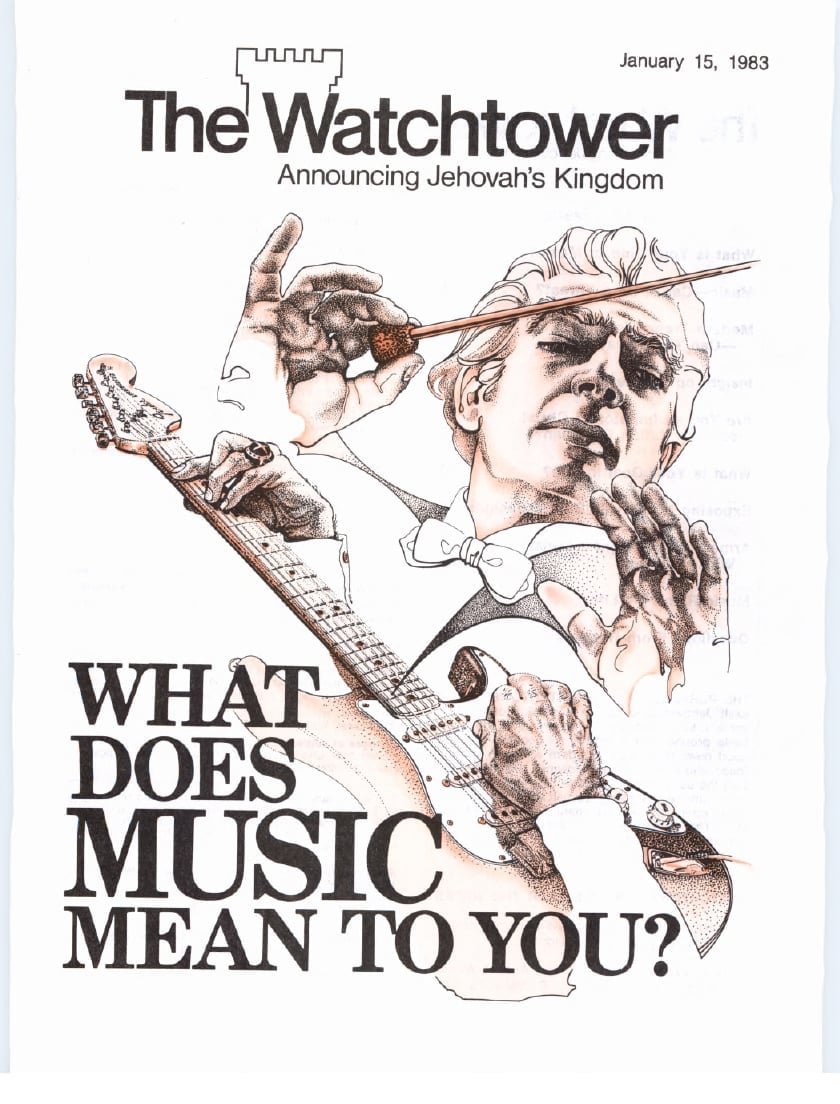
The Watchtower — January 15, 1983
Source: jw.org
Contents
What Is Your Kind of Music?
Music—Can It Be a Threat?
Modern Trends in Music—Can They Sway You?
Insight on the News
Are You an Imitator of Christ or an Imitation Christian?
What Is Your Goal in Life?
Exposing the Devil’s Subtle Designs
Armed for the Fight Against Wicked Spirits
Music Was My Life
Questions From Readers
It Will Hold Your Attention
What Is Your Kind of Music?
What Is Your Kind of Music?
AN OLD Spanish proverb says: ‘In music and medicine everybody knows a little.’ True, practically anyone can hum, sing or whistle a tune. Yes, music and appreciation for it are among mankind’s natural gifts. The poet Longfellow went so far as to say: “Music is the universal language of mankind.”
Why, man has been exposed to music since his earliest beginnings! Who has not heard the delightful song of a bird? We may well marvel at the torrent of varied notes pouring out of the tiny throat of a canary. Or we may thrill at the versatility of the mockingbird, the simple cry of the cuckoo or the warbling of other splendid feathered songsters.
Even babies respond appreciatively to their favorite lullaby. Indeed, it has recently been shown that human fetuses react to music. By their movements they indicate their comfort or discomfort over what they are hearing.
When Did Musical Instruments Develop?
From the secular standpoint, that question is not easy to answer. The Encyclopædia Britannica states: “The development of musical instruments among ancient high civilizations appears to have been most substantial in Asia and North Africa. . . . The harp was used from early times in Mesopotamia [and] Egypt.”
However, the Bible is specific in saying that Jubal, an early descendant of the first man, Adam, “proved to be the founder of all those who handle the harp and the pipe.” (Genesis 4:21) Either he invented the first string and wind instruments or he founded a profession that gave impetus to the progress of music—and all of that some 5,000 years ago!
Music was an accepted part of patriarchal life after the Flood of Noah’s day. For example, Laban complained to his son-in-law Jacob: “Why did you have to run away secretly . . . and not tell me, that I might send you away with rejoicing and with songs, with tambourine and with harp?”—Genesis 31:27.
Centuries later, for service at God’s temple, there were “four thousand [Levite] givers of praise to Jehovah on the instruments that David said ‘I have made for giving praise.’” (1 Chronicles 23:5) Israel’s King David himself was an accomplished musician on the 10-stringed harp, and he may have designed new musical instruments.—Psalm 144:9; 2 Chronicles 7:6; 29:26, 27; Amos 6:5.
Present-Day Music
Music is perhaps more prevalent today than ever before. There is a proliferation of it through radio, television, records and cassettes. And what enormous variety! There is folk, choral, classical, operatic, jazz, country and western, rhythm and blues, disco, forms of rock music—the list seems endless and is ever changing. As fast as one popular style dies away, another takes its place.
So, what is your kind of music? Does your preference really make a difference? Can it affect your outlook—and your future?
[Picture on page 3]
Musical instruments—as they have developed
Music—Can It Be a Threat?
Music—Can It Be a Threat?
‘HOW could music possibly be a threat?’ you might ask. ‘After all, music is only sound.’ True, but sounds can influence us deeply. Who does not react to a scream in the dead of night? And what about infectious laughter? When one member of an audience laughs outright, the whole crowd often breaks into unrestrained laughter.
Music Has Power
Now turn those sounds into music. Depending on the type of song or music, soon feet will be tapping, bodies swaying, fingers snapping, voices humming. An entire audience can be affected! By what? By the sound of music.
To illustrate: At one time David, mentioned earlier, served as a musician in King Saul’s court. The young man was “skilled at playing” the harp. And his music helped to calm troubled Saul.—1 Samuel 16:18-23.
Music stirs the emotions. A crowd may rise to its feet as a jazz group starts to beat out a familiar tune. Lovers of classical music may be gripped by emotion as they listen to the 1812 Overture by Tchaikovsky. With battles raging, cannons firing and victory bells ringing, they almost imagine they are there. Yes, music has power.
For centuries, politicians and rulers have used that power to sway people’s hearts. In what way? By means of national anthems and patriotic songs. How Hitler and the Nazi party used the anthem Deutschland, Deutschland über alles (Germany, Germany above all else) to lead the masses along a pathway of death and destruction! Curiously, this anthem was based on classical music composed by Haydn. In answer to it, the British fervently sang “God Save the King.” Hitler, for his part, was greatly enamored also by the music of Wagner.
The persuasive power of music was evident also in Bible times. The record in Exodus informs us that while Moses was on Mount Horeb receiving the Law tablets from Jehovah, the Israelites became impatient and ordered Moses’ brother Aaron to make for them another god—a molten statue of a calf. Then they offered sacrifices to this idol in a religious festival. And what next? “The people sat down to eat and drink. Then they got up to have a good time.”—Exodus 32:1-6.
When Moses and Joshua descended from the mountain, they heard a shouting in the Israelite camp. Joshua thought it was the noise of battle. But Moses interpreted the sound correctly. It was singing, not about a mighty battle performance or defeat. It was “the sound of other singing.” Moses could tell by the unusual sound that the music had a sinister connection. What was it? The people were singing and dancing around the golden calf. They were participating in unrestrained idolatry along with song and dance. Music was prominent in their false, immoral worship.—Exodus 32:7-25.
That event provides some lessons for Christians today. For one thing, music can affect you. The modern world is very much music oriented. But should raucous music and other popular music, with sexual overtones conducive to loose morals, be featured at gatherings of Jehovah’s Witnesses? Never should that be! During recent years, however, even with some elders and parents condoning it, there has been a tendency to be lax in this respect. Some of this music has exalted immorality, rebellion, drugs and even spiritism.
Does this mean that music in itself is necessarily a negative influence? Not at all. As mentioned above, music was used in the sacred worship of Jehovah. And Jesus, in his illustration of the return of the prodigal son, spoke of the father’s celebrating with “a music concert and dancing.”—Luke 15:25.
Can Music Convey a Philosophy?
In our modern times music plays a much more insistent role in daily living. Over the last few decades, a vast world industry has mushroomed, churning out hundreds of millions of records and cassettes every year. Whereas a hundred years ago listening to live performances or active participation therein was the only exposure to music, and that infrequently, today the hearing of music is a daily experience. So the question is pertinent—can music convey a philosophy? Can music influence a person’s thinking or life-style?
An immediate clue is found in radio and television advertising. Many commercial advertisements are accompanied by music. Thus, with the aid of music, the product’s name is engraved on minds—even those of children and infants.
In ancient Israel, music was used in a similar way but for a far more noble purpose. The psalms were sung to music, which doubtlessly aided the people in memorizing the text. For example, the Bible record tells us that, at the inauguration of Solomon’s temple, the Levite singers were gathered and also others “with cymbals and with stringed instruments and harps . . . and along with them priests to the number of a hundred and twenty sounding the trumpets; and . . . the trumpeters and the singers were as one in causing one sound to be heard in praising and thanking Jehovah.” Here, music was inspirational and upbuilding. It served to praise Jehovah.—2 Chronicles 5:12, 13.
Likely, on that occasion they were singing and playing Psalm 136, and the music would certainly help them to recall the words. This illustrates the point—that music can convey a message. It can also be the vehicle for advocating a product or a philosophy, or for recommending a life-style, whether the music is accompanied by words or not. This is true today whether we speak of classical or modern music idioms.
For example, the Encyclopædia Britannica, in its biography of Ludwig van Beethoven, “widely regarded as the greatest composer who ever lived,” states: “He revealed more vividly than any of his predecessors the power of music to convey a philosophy of life without the aid of a spoken text.” His universally known Pastoral Symphony is an example of this. It clearly transmits Beethoven’s love for nature. Yes, music can move us and affect our emotions.
Take as another example the works of the Austrian composer Gustav Mahler, now in vogue among classical music lovers. One musicologist speaks of this composer’s “obsession with death” and describes “the unremitting quest to discover some meaning in life that was to pervade Mahler’s life and music.” Speaking of his Symphony No. 1, the writer describes its contents, saying: “The joy of life becomes clouded over by an obsession with death.” He goes on to say: “Symphony No. 2 begins with the death obsession . . . and culminates in an avowal of the Christian belief in immortality. . . . The religious element in these works is highly significant.” So now the question arises, Could Mahler’s religious confusion, obsessions and neurosis affect the listener?
Another case is that of Stravinsky’s The Rite of Spring. This ballet music represents a pagan rite in which a young virgin dances herself to death to propitiate the god of spring. This rite, as one commentator wrote, “is here expressed in music whose most immediately striking characteristic is its rhythmic power—the hypnotic, compulsive force of rhythmic patterns.” The effect is startling and perhaps disquieting. In fact, “it was calculated to overthrow European certainties about musical tradition.”
So, even classical music should make you pause and ask yourself, Will excessive exposure to a certain type of music tend to depress me or overexcite me? Will the composer’s philosophy creep through and perhaps affect my thinking negatively? Of course, if his music does not undermine faith in the Creator and in His great works, the composer’s influence may turn out to be neutral or even very positive. Then again, it is possible to listen to music without ever knowing what the composer had in mind. In that case the meaning, if any, will depend entirely on the listener’s imagination.
Now, can these criteria be applied to modern music? Is modern music upbuilding or debasing? Could it represent a threat to Christian morality and spirituality? Our next article will analyze these and other issues.
[Picture on page 5]
Music can be used for sinister ends
[Pictures on page 6]
Is All Their Music Upbuilding?
MAHLER
WAGNER
STRAVINSKY
Modern Trends in Music—Can They Sway You?
Modern Trends in Music—Can They Sway You?
NOW what about modern music—rock, punk, funk, rhythm and blues, country and western and all the other diverse trends that proliferate today? Can they, with or without lyrics, influence your way of thinking or undermine your spirituality?
Bill Mullane, former rock musician from New Jersey, U.S.A., explained it this way: “When I was playing bass guitar in a rock group the whole effect was physical. The insistent rampaging beat and the aggressive style just got through to you. As a musician I became a part of it. Then, as I watched the audience respond and get swept along with the same primitive urges, I wanted to affect them more. It’s that kind of sound. It grabs you. Of course, at that time I was often under the influence of drugs, even as many in the audience were. So the euphoria grows. You know, it’s like casting off all restraint. You can go wild and forget your inhibitions.
“That’s why I think the young people go for many of the different sounds coming out these days. They identify with them and their message. Looking back I can see that it reflects the way they feel about the world and modern life. After all, a nuclear threat hangs over mankind. Who knows how long we may live? So they adopt the attitude of ‘Live while you can. Get out of life all you can.’”
That comment about identification leads us to the crux of the matter. (Compare 1 Corinthians 15:32.) Should a genuine Christian want to identify with most of the trends in modern music? Recently the Toronto Star, a Canadian newspaper, reported: “Sex and sadism merge in the Tubes [San Francisco rock group] concert.” The writer went on to comment: “What is social satire to The Tubes may be just plain sado-masochism, sex in bondage, profanity and perversion to anybody else.” What can Christianity have in common with that?
The New York Post carried an article entitled “Satanic World of the Rolling Stones.” It was a full-page résumé of that group’s involvement in drugs. The Rolling Stones’ attitudes on drugs, sex and Satan come through loud and clear in their music. Can you harmonize with such attitudes and still identify with Christ?—2 Corinthians 6:14, 15.
Music and Spiritism
Unfortunately, these are not the only dangers in much modern music that the conscientious Christian must take into account. The apostle Paul urged Christians: “Put on the complete suit of armor from God that you may be able to stand firm against the machinations [“crafty acts,” The Kingdom Interlinear Translation of the Greek Scriptures] of the Devil; because we have a wrestling . . . against the world rulers of this darkness, against the wicked spirit forces in the heavenly places.” (Ephesians 6:11, 12) We should never take this warning too lightly. Demonic influence is rampant, and what better way is there to dupe people, especially the up-and-coming generation, than through music?
It now turns out that many modern groups are deeply involved in spiritism and occult practices. Others try to promote Oriental religion and philosophy through their music. For example:
Robert Palmer, a jazz critic writing for The New York Times under the heading “Witchery Pervades a Jazz Album,” commented about the black jazz group called The Art Ensemble of Chicago, stating: “The Art Ensemble of Chicago’s slogan is ‘Great Black Music—Ancient to the Future’ . . . But there is more than one sort of blackness here. There is . . . the blackness of voodoo spells cast in the dead of night. It isn’t exactly a malevolent blackness, but this is not the sort of record one would put on at even the wildest party. . . . It is a phantasmagorical expedition into the heart of darkness.” As a disciple of Christ would you want that type of music in your collection?
In view of what Paul said to the Ephesian Christians about wicked spirit forces, would it be reasonable for a modern-day Christian to have records in his personal collection that exalt demonism and spiritism? If he knows that some groups are deeply involved in occult studies and practices, would it be safe to assume that none of that influence would creep through into the lyrics, the beat or even the record-album cover?
For example, one group plays a piece called “Mr. Crowley.” Who is Mr. Crowley? A 20th-century satanist and promoter of modern witchcraft! In many cases, one look at the album cover should be enough for a Christian witness of Jehovah to decide whether to buy the record or not, especially when there are portrayals of witchcraft and demonism, or symbols of paganism and the occult.
Former nightclub performer Gordon Grant, who once earned his living playing jazz and then rock in Los Angeles, U.S.A., stated: “All the groups that I was associated with were to some degree into spiritism. The opening gambit when you met someone new was ‘What’s your sign?’ They took astrology seriously and your zodiac sign was important.” Do you want to be identified with astrology and other demonic practices?—Deuteronomy 18:10-13.
Music and Immorality
The apostle Paul gave more straight counsel in his letter to the Ephesians that applies equally today and in the realm of music. He exhorted: “Let fornication and uncleanness of every sort or greediness [including sexual greediness] not even be mentioned among you, just as it befits holy people; neither shameful conduct . . . nor obscene jesting.”—Ephesians 5:3-5.
You parents and young people: Have you checked the lyrics of some of the discs that are on sale—or that are perhaps already in your home? Maybe you think the music is catchy, or perhaps it has a beat that you like. At first you do not worry about the words and soon you find yourself humming the melody. Even some skating rinks are featuring this type of music. Would it be proper for Jehovah’s Witnesses to be skating around, joining in with the music? ‘But where is the danger in this?’ you might ask.
In their music, popular groups are putting across fornication and drugs as a way of life. Yes, their music conveys their life-style. “I wanna see what you’re like in bed” and “She’s hot, she’s sexy,” are lyrics from one recent album. One famous singer expresses his point of view right on the album cover, in saying: “I can’t see anything wrong with sex between consenting anybodies. . . . I don’t believe in overly moralistic philosophies.” What possible meeting of the minds can there be between true Christians and the attitudes manifested in such lyrics and philosophy? Should Christ’s followers be identifying with this ‘alienated thinking’?—Ephesians 4:18; compare Genesis 39:7-12.
Music and the Older Generation
It is easy for the older generation to think that all of this applies only to the younger people and their music. But what about the song hits of 20 and 30 years ago that nostalgics still enjoy? “Big Spender” portrayed a prostitute trying to “hook” a client. “Fever” was a thinly disguised description of intense sexual desire. “Never on Sunday” was also a prostitute’s song. How many at that time enjoyed such melodies, without giving thought to their connections?
We could continue to give examples that show the subtlety of Satan’s crafty schemes in getting us to entertain, through music, debased thoughts and philosophies that we would normally reject immediately. What does this illustrate? That all of us, young and old, need to take a serious look at the kind of music we have been enjoying. Without even realizing it we may have been identifying ourselves with this world’s “low sink of debauchery.”—1 Peter 4:4.
There is food for thought here for every Christian—whether an elder in a congregation, a parent, a young person or a child. Limitations of space prevent us from presenting all the available evidence regarding the degrading effects of some “serious” and modern music idioms. But every conscientious Christian would do well to examine his tastes in music and also whatever record collection he may have, and act in harmony with sound Scriptural reasoning.
What Can a Christian Do?
When Paul preached in Ephesus his ministry was so successful that many practicers of the occult accepted Christianity and took action to safeguard their future spirituality. The record says: “Indeed, quite a number of those who practiced magical arts brought their [spiritistic] books together and burned them up before everybody. And they calculated together the prices of them and found them worth fifty thousand pieces of silver. Thus in a mighty way the word of Jehovah kept growing and prevailing.”—Acts 19:18-20.
Will Jehovah’s Word keep growing and prevailing in your case? If it is necessary, will you take action so that you can be considered a worthy member of Jehovah’s “holy people”? (Ephesians 5:3) Recently, when this issue was placed squarely before one large group of full-time servants of Jehovah, several trash cans full of albums were turned in and destroyed simply because of their immoral content, demonic tendency or advocacy of this world’s degraded life-style. The important factor was not their value in monetary terms but their possible detrimental effect on spiritual values.
Some may feel that we should be more specific about certain modern groups or types of music. However, the apostle Paul says: “Solid food belongs to mature people, to those who through use have their perceptive powers trained to distinguish both right and wrong.” (Hebrews 5:14) The mature Christian, by exercising his Bible-trained conscience, should have no difficulty in discerning which types of music are acceptable. Jehovah’s Witnesses do not require a talmudic list of prohibitions to guide their conduct or an “Index” of forbidden music. Let each one use discernment as he seeks to please his heavenly Father in all things, including his choice of music.—Ephesians 5:18-20; Philippians 1:9-11.
[Picture on page 9]
Do your records advocate spiritism, drugs or immorality?
Insight on the News
Insight on the News
Bible Still Essential
“What five books should every educated person have read?” A panel of experts consisting of well-known educators, authors, professors and historians were asked that question recently by Time magazine, which subsequently published the recommendations.
As might be expected, there was little agreement as to what books constitute essential reading. Among the over 50 recommended, only three books were mentioned specifically by name more than once. The one exception was the Holy Bible. Far and above all the other books, it was nominated by a clear majority of the experts.
Throughout the ages, knowledge of the Bible has been considered an essential part of a well-rounded education, and it is no less so today, as borne out by the Time survey. Even though some people may feel that the Bible is now out of date, this kind of thinking only betrays a limited outlook on life. “An educated person should have some concept of metaphysics. That is, what is out there in the world and what are its limits?” said one of the interviewees, a Harvard professor.
The Bible is timeless not only because it is capable of “making the inexperienced one wise,” as the psalmist put it, but also because it is the only book that provides what people through the ages have been searching for—truth. “Your word is truth,” said Jesus Christ in a prayer to his heavenly Father, Jehovah God. Knowledge of the truth that is contained in God’s Word, the Bible, brings eternal life.—Psalm 19:7; John 17:3, 17.
Governments Faltering
“In all my years, I’ve never seen the world in so much turmoil,” says 95-year-old Alf Landon, who has been in American politics for 70 years. “There isn’t a nation in the world that really has a stable government today,” he adds.
In a similar vein, Horace Busby, political consultant and former White House aide, writes in a recent issue of Public Affairs Review: “Since the 1960s, governments everywhere, West and East, have begun not to work. . . . [They] are proving unable to establish or hold a consensus of support among the governed.” Or, in the words of The Washington Post columnist Haynes Johnson, “They reinforce the idea that events are out of control.”
Why are the governments failing? “To earthling man his way does not belong,” said the prophet Jeremiah. “It does not belong to man who is walking even to direct his step.” (Jeremiah 10:23) “The world in so much turmoil” is the sorry result of man’s inability to govern himself. “Man has dominated man to his injury,” says the Bible at Ecclesiastes 8:9.
As governments falter, where can honest-hearted ones look for hope? “We thank you, Jehovah God, the Almighty, the One who is and who was, because you have taken your great power and begun ruling as king.” Yes, God’s Kingdom will come to man’s rescue. “It will crush and put an end to all these kingdoms, and it itself will stand to times indefinite.”—Revelation 11:17; Daniel 2:44.
Brain Far Superior
After 37 years of development, the computer has revolutionized science, business and industry. Now the push is toward “artificial intelligence” (AI). Researchers are looking forward to the time when computer chips, called “very large-scale integrated circuits” (VLSI) containing hundreds of thousands or even millions of transistors, will “begin to approach the size of biological neurons themselves,” according to Tom Alexander in a Fortune magazine series entitled “Thinking Machines.”
However, before anyone should jump to the conclusion that the human brain will soon become obsolete, Alexander points out that the brain contains some 100,000 million neuron cells, each one a superior VLSI, capable of processing and storing vast amounts of information. There is no danger of the brain’s being replaced by computers in the foreseeable future.
The credit for the brain’s superior structure goes, of course, to the brain’s designer and maker, Jehovah God, who created us “in a fear-inspiring way.”—Psalm 139:14.
Are You an Imitator of Christ or an Imitation Christian?
Are You an Imitator of Christ or an Imitation Christian?
—Paul’s Messages to the Thessalonians
THE apostle Paul was an exemplary Christian. Because he zealously followed Jesus’ example he could properly make this recommendation to his fellows in the faith: “Become imitators of me, even as I am of Christ.” (1 Corinthians 11:1) Paul’s course of life and his teaching helped many of his contemporaries to find and abide by “The Way” of true Christianity.—Acts 9:2.
Paul felt loving concern for others. Very appropriately, when God summoned Paul and Silas to leave the area of Asia and take up missionary work in Macedonia, He gave Paul a vision of a man there entreating him and saying: “Step over . . . and help us.” In faith and with fellow feeling, Paul and Silas willingly obeyed, setting out by ship from Troas.—Acts 16:6-10.
After landing at Neapolis, Paul and his companions first visited Philippi. From there they moved on along the great Roman highway Via Egnatia through Amphipolis and Apollonia to Thessalonica, a total of some 75 miles (121 km). (Acts 16:11, 12; 17:1) In Thessalonica Paul made use of the Sabbath-day gatherings of the Jews in the local synagogue to preach the “good news.” As a result, “some” of the Jews, together with “a great multitude of the Greeks,” became believers.—Acts 17:2-4.
Jealous of Paul’s success, the unbelieving Jews formed a mob and caused an uproar in the city of Thessalonica, so that the brothers sent Paul and Silas on to Beroea. The message of God’s Kingdom through Jesus Christ had proved to be a stumbling stone to the Jews. They even raised an accusation against Paul and Silas and the Thessalonians who had associated themselves with them, saying: “These men act in opposition to the decrees of Caesar, saying there is another king, Jesus.”—Acts 17:5-10.
Paul’s Concern for the Thessalonian Christians
On reaching Corinth, Paul sent back his young co-worker Timothy to contact the newly formed congregation at Thessalonica. When Timothy returned to Paul, he conveyed the welcome news that those newly baptized Christians were firm in the faith and thriving, despite continuing persecutions. They had become imitators of other faithful Christians in enduring tribulation. (1 Thessalonians 2:14-16; 3:6, 7) Paul was anxious to let the Thessalonians know of his feelings toward them and to give them further encouragement and counsel. So he wrote two letters to the congregation. Likely, these were Paul’s first canonical letters, written in the years 50 and 51 C.E. They well describe what is involved in true Christianity.
However, does not Luke’s report in Acts 17:11, 12 speak unfavorably of those Thessalonians, as not having received the word as eagerly as the Beroeans? No, for here Luke is referring, not to the Christians, but to the Jews. In contrast to the meager results of Paul and Silas’ preaching among the Jews in Thessalonica, “many” who went to the Jewish synagogue in Beroea became believers.
The newly converted Christians at Thessalonica studied and adhered to God’s Word. Paul commends them in his first letter for having imitated him and the Lord on the basis of their acceptance of “the word under much tribulation with joy of holy spirit.” (1 Thessalonians 1:6) They had accepted the “good news” as “the word of God,” and now this was “at work,” that is, bearing Christian fruit, in the believers. (1 Thessalonians 2:3-5, 13) In no sense were they imitation Christians.
Paul himself was a hardworking imitator of Christ. Short though his first visit to Thessalonica may have been, the members of the congregation there had his self-sacrificing example indelibly imprinted on their minds. They had given up their former idolatry “to slave for a living and true God” and they, in turn, had become an example of faith to all the believers in Macedonia and Achaia. (1 Thessalonians 1:7, 9) Among them were overseers who were “working hard” to take care of the needs of the flock, as should be the case in all congregations of true Christians.—1 Thessalonians 5:12; 1 Peter 5:2, 3.
Yes, Paul and his companions had given their all for those Thessalonians, working night and day, fearlessly making known the truth and nourishing the congregation tenderly “as when a nursing mother cherishes her own children.” (1 Thessalonians 2:3-11; 2 Thessalonians 3:7, 8) With what purpose in mind? That these new brothers in the faith might “go on walking worthily of God” and “that no one might be swayed by . . . tribulations.” Paul wanted to stimulate them to “stay awake” spiritually, to make them “firm in every good deed and word.” He wanted them to ‘endure for the Christ,’ so that they would never “give up in doing right.”—1 Thessalonians 2:12; 3:3; 5:6; 2 Thessalonians 2:17; 3:5, 13.
Paul’s deep concern for those Thessalonians is recorded for our encouragement also today, that we may continue to walk with God and as pleasing him. (Amos 3:3) For one who calls himself a Christian to do anything else would amount to his being no more than a worthless imitation Christian.—1 Thessalonians 4:1.
A Threat From Within!
Unbelieving Jews had brought persecution upon the young congregation from the outside, but now even greater danger was threatening from within! Evidently some in the congregation were spreading twisted views about Jehovah’s day as being imminent. Paul hastened to set things straight, saying with regard to that “day”: “Let no one seduce you in any manner, because it will not come unless the apostasy comes first and the man of lawlessness gets revealed, the son of destruction.”—2 Thessalonians 2:1-3.
When Paul, in his second letter to the Thessalonians, warned the congregation of this coming “man of lawlessness,” the details of that one’s lawless course were still a “mystery,” or a religious secret. However, the apostle mentions that even while he was yet with them he “used to tell” of this future apostasy and the “restraint” holding it back.—2 Thessalonians 2:5-7.
If we at this point open our Bibles to 2 Thessalonians 2:3-12 and examine the context of Paul’s words, we, too, can discern what Paul had in mind. The “apostasy” to come would be rooted in a lack of “love of the truth.” It would result from a ‘believing of the lie’ and taking “pleasure in unrighteousness.” It would come boldly to the fore soon after the removal of the “restraint” referred to by Paul. It would continue all the way down to the ‘manifestation of the presence’ of Jesus Christ, at which time Christ would expose and do away with that “lawless one,” bringing it to nothing.—Compare 2 Thessalonians 2:8 with Isaiah 11:4 and Revelation 19:11, 14, 15.
Identifying the “Man of Lawlessness”
Judging by the longevity of the “man of lawlessness,” from Paul’s day down to Christ’s presence, it had to be—no, not an individual but a class of people. Since this lawless one “lifts himself up over everyone who is called ‘god’ or an object of reverence,” application of the term focuses on the leaders of the apostasy. They would be associated with misleading “powerful works” done in Christ’s name. (Compare 2 Thessalonians 2:9 with Matthew 7:22, 23.) Multitudes would join themselves to them as an easier religious way, soothing to the conscience but unburdensome to a selfish, worldly, even immoral way of life. Such elements of counterfeit Christianity were already “at work” among professing Christians in Paul’s day.—1 Thessalonians 4:3-8; 5:6-9, 14, 15, 19-22; 2 Thessalonians 3:6-15; compare Matthew 25:41-46.
Paul and the other apostles and older men of the Christian congregation served as the “restraint” against such forces, shepherding the flock according to Christ’s example. In view of the threatening apostasy, Paul admonished the Thessalonians in these words: “So, then, brothers, stand firm and maintain your hold on the traditions that you were taught.” Following the death of Paul and the other apostles, self-seeking men pushed truth aside, set themselves up as leaders and led the flock astray. Only those who responded to Paul’s counsel were made “firm in every good deed and word.” The “man of lawlessness” became identified as the clergy of a counterfeit Christianity.—2 Thessalonians 2:15-17; compare Matthew 13:24-30, 37-43.a
Awaiting Jehovah’s Day
Paul had to warn the Thessalonian Christians of still another danger: That of becoming complacent or spiritually drowsy with regard to Jehovah’s day. Some religious writers of our time have tried to play down the significance and urgency of the Scriptural message about Jesus’ “presence and . . . the conclusion of the system of things” by reference to Paul’s later words: “We request of you not to be quickly shaken from your reason nor to be excited either through an inspired expression or through a verbal message or through a letter . . . to the effect that the day of Jehovah is here.”—Matthew 24:3; 2 Thessalonians 2:1, 2.
Now, could it truly have been Paul’s desire that sincere Christians be little concerned about the presence of their Lord and the day of Jehovah? Or did he not, rather, want them to maintain mental balance in the matter, to ‘keep their senses’ by making “sure of all things”? Thus, neither would they be thrown out of equilibrium by unfounded messages about Jehovah’s day being at hand nor would they be unprepared, careless and callous regarding it.—1 Thessalonians 5:8, 21; compare 2 Peter 3:3, 10-12 and 1 John 4:1.
Here we should bear in mind that those Thessalonians were fully aware that Jehovah’s day was “coming exactly as a thief in the night.” Far from being a reason for nonchalance, this meant that they should “stay awake,” as persons assigned “not to wrath, but to the acquiring of salvation.” After the apostasy had put in its full appearance, the day of Jehovah would come. This would be at a time when those in opposition to Jehovah’s Kingdom—including no doubt the “man of lawlessness”—would be saying: “Peace and security!” That would be the signal for their instant, sudden destruction. (1 Thessalonians 5:1-11) In that day of execution of righteous judgment, happy will be those ‘knowing God and obeying the good news about the Lord Jesus’!—2 Thessalonians 1:8.b
Imitators or Imitations?
Paul’s letters of loving concern to the Christian congregation at Thessalonica outline what true followers of Christ Jesus today must be, and what they must believe and do. But what of persons and groups that claim to be Christian and yet do not imitate Christ, Paul and the faithful Thessalonians? These stand exposed as imitation Christians! (2 Thessalonians 3:6, 7; 2 Peter 2:1-3) Paul emphasizes that only those who “obey the good news” will be “counted worthy of the kingdom of God.” Jesus expressed himself similarly with regard to the righteous “sheep” who inherit the realm of the Kingdom on earth.—2 Thessalonians 1:4-10; compare Matthew 7:21 and Mt 25:31-34.
The good news, as made known by Paul in his letters to the Thessalonians, should motivate us to hard work in God’s service, to high moral standards of living, yes, to endurance in leading joyful, prayerful, appreciative, spirited, blameless Christian lives that will recommend us to others within and outside the congregation of Jehovah’s people. (1 Thessalonians 5:16-23) May sincere deliberation on Paul’s example and letters and on the faith of the Christians at Thessalonica prove beneficial to you, so that you may “more fully” imitate Christ’s example. May this, in turn, bring you deliverance “from the wrath which is coming” and salvation to eternal life under God’s glorious Kingdom rule.—1 Thessalonians 1:10; 4:1; Hebrews 12:2, 3; Revelation 21:1, 3, 4.
[Footnotes]
a For a detailed discussion of the “man of lawlessness,” see our publication God’s Kingdom of a Thousand Years Has Approached, pages 364-397.
b More information about events leading up to the “day of Jehovah” can be found in The Watchtower of November 15, 1981, pages 10-21.
[Picture on page 14]
Paul writes about the rise of an ecclesiastical “man of lawlessness”
What Is Your Goal in Life?
God’s Word Is Alive
What Is Your Goal in Life?
WHAT do you want to achieve in life? An advanced secular education? a good position in the world? money? fame? security? These are common goals. But will realizing them actually give you what you want out of life?
To help answer such questions, consider the life of Moses, as illustrated in these pictures. He was raised as “the son of the daughter of Pharaoh”—the world ruler. So, as a part of Pharaoh’s royal household, Moses had full opportunity to share in the “enjoyment of sin.” Also, he had ready access to “the treasures of Egypt.”—Hebrews 11:24-26.
Furthermore, the Bible says, “Moses was instructed in all the wisdom of the Egyptians.” (Acts 7:22) So, then, due to his favored position, Moses had everything that most people today seek to attain. Yet did these things bring him true satisfaction and happiness?
Not really. Although he had everything in a material way, Moses knew that these things were of no lasting value. Do you realize this important fact? It is just as Jesus Christ himself said: “What benefit will it be to a man if he gains the whole world but forfeits his [life]?” (Matthew 16:26) Everything we may have is worthless if we lose our life. Is that not so?
Therefore, the Bible says of Moses: “He looked intently toward the payment of the reward.” Yes, Moses looked to what God offers. He realized that God’s gift of everlasting life is more valuable than anything else. So Moses “continued steadfast as seeing the One who is invisible.” (Hebrews 11:26, 27) Jehovah was real to Moses, and so were His promises of everlasting life.
Is that true of you? When you read about God’s promises to provide everlasting life in an earthly Paradise, are these promises real to you? Do you picture yourself as being a part of that Paradise and enjoying the blessings God has in store for his people? (Psalm 37:9-11, 29; 46:8, 9; 72:7, 8, 16; Isaiah 9:6, 7; 11:6-9; 35:5, 6; Luke 23:43; Revelation 21:3, 4) If you do, you will be like Moses and will set as your main goal in life the serving of Jehovah God and the winning of his approval.
[Picture on page 16]
What was Moses’ goal in life?
[Picture on page 17]
Is it your goal in life to enjoy what God offers to his servants?
Exposing the Devil’s Subtle Designs
Exposing the Devil’s Subtle Designs
“Your adversary, the Devil, walks about like a roaring lion, seeking to devour someone.”—1 PETER 5:8.
1, 2. (a) What could be a terrifying situation that Jesus himself faced? (b) Why were people trying to kill Jesus?
SUPPOSE you learned that someone had been hired to kill you. What if you knew that right now he was stalking you, just waiting for the best moment to attack. That could be terrifying! Did you realize that Jesus Christ faced a similar situation?
2 The Bible says: “Jesus continued walking about in Galilee, for he did not want to walk about in Judea, because the Jews were seeking to kill him.” However, despite the danger to his life, in 32 C.E. Jesus went up to Jerusalem for the Festival of Tabernacles. On that occasion, “some of the inhabitants of Jerusalem began to say: ‘This is the man they are seeking to kill, is it not?’” (John 7:1, 25) Why were people trying to murder Jesus? Because they had been put up to it by the Devil! Jesus himself said, as recorded in John 8:44: “The Devil . . . was a manslayer when he began.”
3. Why is the apostle Peter’s warning about the Devil especially appropriate today?
3 So, then, we should not be surprised that the Devil is out to get godly persons today, especially since he has been thrown out of heaven. The Bible explains: “Woe for the earth and for the sea, because the Devil has come down to you, having great anger, knowing he has a short period of time.” (Revelation 12:7-12) This means that Satan and his demons are waging all-out war on us! The warning is therefore especially appropriate now: “Your adversary, the Devil, walks about like a roaring lion, seeking to devour someone.” That someone includes you, if you are one of Jehovah’s Witnesses. That is why Peter also said: “Keep your senses, be watchful.”—1 Peter 5:8.
4. (a) What is the Devil’s purpose in subtly approaching us? (b) How only can the Devil prove successful in his approaches?
4 But what is the Devil’s purpose in subtly approaching us? It is not to cause our death immediately. In his wily approach against Jesus, Satan’s purpose was to get him to compromise his worship of Jehovah. (Matthew 4:3-10) When his efforts to tempt Jesus to disobey God failed, Satan’s aim was to cause him to seek relief from the threats of death by compromising his integrity to God. Similarly today, the real purpose of Satan’s approach is to destroy our good relationship with God. Will he be successful? There is only one way that he can be. The Bible shows what that way is when it says: “Jehovah is with you as long as you prove to be with him; . . . but if you leave him he will leave you.”—2 Chronicles 15:2.
5. (a) What can be said about the success of Satan’s methods? (b) If we are to stand firm, of what must we be continually aware?
5 Sadly, each year some are overcome by Satan’s methods. They leave Jehovah. Many of them, in fact, must be disfellowshipped from the Christian congregation for their ungodly conduct. (1 Corinthians 5:13) Others become, as it were, ‘prisoners of war’ by getting caught up in the Devil’s system. Will you stand firm against all of Satan’s efforts to cause you to leave Jehovah? If you are to do so, you continually need to be aware of the Devil’s subtle designs.
The Way Satan Operates
6. Why need we not be in the dark regarding Satan’s designs?
6 We are not left in the dark as to how Satan operates. “We are not ignorant of his designs,” the apostle Paul explained. (2 Corinthians 2:11) This means that Satan’s attention is on us—he is thinking about us, using all his shrewd thinking to get us away from serving God. Is that not a sobering thought? But in the Bible we have a thorough history of Satan’s designs, that is, his schemes, maneuvers and strategy, so that no one need be ignorant in this regard. A good soldier studies historical battles of the past and applies with benefit what he learns. Similarly, ‘as fine soldiers of Christ Jesus,’ we can study the various tactics of Satan and thus avoid being caught off guard by any of his methods of operation.—2 Timothy 2:3.
7. (a) What frontal approaches does Satan at times use? (b) What other methods does he use, and why?
7 Eventually Satan’s agents brutalized and killed Jesus. (John 19:1; Matthew 27:49, 50) And Jesus foretold regarding his followers: “People will deliver you up to tribulation and will kill you.” (Matthew 24:9) However, such frontal approaches often boomerang, resulting in God’s persecuted servants’ having even greater zeal for his service. (Acts 5:41, 42) Therefore, Satan more often tries other methods—subtle designs—to break the integrity of God’s servants.
8. How does the Bible reveal that Satan would use subtle designs?
8 The Bible points to such subtle designs when it encourages: “Stand firm against the machinations of the Devil.” (Ephesians 6:11) The Greek word here for “machinations” means “crafty acts.” (Kingdom Interlinear Translation of the Greek Scriptures) That Satan is a master of deception, being extremely crafty and cunning, is also indicated when the Bible says: “Satan himself keeps transforming himself into an angel of light.”—2 Corinthians 11:14.
9, 10. (a) What can we learn from examining Satan’s first successful machination? (b) What shows that he continues to use the same cunning and craftiness?
9 Consider Satan’s first successful machination. When approaching Eve he did not try to argue that God would approve if she ate the forbidden fruit. Eve knew better than that. So Satan made the fruit seem extremely desirable to Eve. He told her that eating it would really improve her situation, providing her an appealing prospect. “You are bound to be like God,” he said. (Genesis 3:5) Eve yielded to Satan’s enticement. She cultivated wrong desire, which led to her sin.—James 1:14, 15.
10 Satan continues to use cunning and craftiness, as the apostle Paul wrote: “I am afraid that somehow, as the serpent seduced Eve by its cunning, your minds might be corrupted away from the sincerity and the chastity that are due the Christ.” (2 Corinthians 11:3) If Satan’s advances were not so subtle it is unlikely that so many persons would be battle casualties. He constantly presents tempting diversions, subtly trying to interest us in things that eventually will inhibit our spirituality. His aim is to weaken us so that we gradually leave Jehovah, or so that a frontal attack may succeed in breaking our integrity to God.
11. (a) In what way can Satan’s methods be compared with those of a fisherman? (b) What must we never forget?
11 Satan’s methods can be compared with those of a fisherman who uses lures to catch fish. The fisherman experiments to find out which lure will appeal to the fish. Of course, when the fish bite they do not realize that there is a hook behind the lure. How about us? Are we aware of the lures Satan uses? Do we fully appreciate the consequences of getting “hooked”? Do not be deceived! Satan and his demons are real enemies who are out to get us! So never forget that “the whole world is lying in the power of the wicked one.” He has blinded most people’s minds to this fact. Do not let him blind yours.—1 John 5:19; 2 Corinthians 4:4.
Subtle Forms of Materialism
12. (a) What is a chief lure that Satan uses? (b) What things can the eye desire?
12 A chief lure that Satan uses is love of material things and pleasures. (1 Timothy 6:10) The Bible refers to “the desire of the eyes,” warning that such desire “does not originate with the Father, but originates with the world.” (1 John 2:16) In our modern world there are more things than ever for the eye to desire. There is the latest in new homes, cars, vans, boats, clothes, televisions, hi-fis, watches, computers, video games and other electronic devices of all kinds. Also, there are the many pleasures to be enjoyed in the way of music, dancing, movies, the theater, TV viewing, an endless variety of sports, and so forth.
13. (a) How can Satan use things that can be beneficial to lure Christians away from serving God? (b) Why should we not underestimate Satan as a foe?
13 Now, of course, material things and pleasures are not necessarily wrong in themselves. Jehovah created a delightful material universe, including our earth with all its beauty, to please our sight and other senses. Obviously, various forms of recreation and entertainment can be beneficial when kept in a proper place. (1 Timothy 4:8) Yet, at the same time, we need to be aware that Satan often uses these very things to lure Christians away from serving God. No doubt Satan himself has had much to do with the development and use of these modern material things and pleasures that have served to distract so many people from serving Jehovah God. Do not underestimate our foe the Devil. He has become a master at sneak attack.
14. (a) What are clues to show that a person is being influenced by subtle forms of materialism? (b) Why can drifting away from God be almost imperceptible?
14 How can you know when you are being taken in by Satan’s subtle lure of materialism? You can if any form of relaxation or pursuit of material possessions has begun to interfere with your study of the Bible, regular attendance at Christian meetings or weekly field ministry activity. Really, there is a need to be watchful. A materialistic lure can cause you to drift away by simply absorbing more and more of your time, interest and energy. (Hebrews 2:1) When a boat drifts you may not detect that it is moving. You may say that it is not moving at all. But proof that it is drifting is seen in that it gradually changes positions. It is similar with a person who drifts away from God and His organization.
15, 16. (a) What examination would it be wise for us to make of ourselves? (b) What situation shows that it is wise to make such an examination of ourselves?
15 Wisely, therefore, we should often examine our own Christian activity, asking: “Do I study the Bible as regularly as I once did? Is my meeting attendance as regular as it was in the past? Do I put in as much time in the field ministry as formerly?” Perhaps you say: “Oh, I am much busier now.” But busier doing what? Could it be that you are spending more time in the pursuit of pleasures, perhaps in front of a television screen? Is it that your accumulation of material things and taking care of them is hindering you rather than helping you in your service to God? Are you really heeding Jesus’ counsel not to be anxious about material things but to seek God’s Kingdom first?—Matthew 6:31-33.
16 All around the world there are battle casualties—Christians who have been taken in by the Devil’s subtle forms of materialism and have fallen out of God’s service. Perhaps in your own congregation you can think of ones who once were faithful fellow workers, but who no longer are active in God’s service because of succumbing to subtle materialistic lures that caused them gradually to drift away. (Philippians 3:18) So “keep your senses, be watchful.” Do not let the Devil devour you!—1 Peter 5:8.
A Subtle Form of Spiritism
17. (a) Why did angels leave their positions in heaven, and what happened to them when the Floodwaters fell? (b) These angels have been responsible for what?
17 Do you recall when other angels joined Satan in rebellion against Jehovah? It was shortly before the Flood. The Bible reveals that the attractive daughters of men served as a lure to the angels. Some of these left their heavenly positions of service to come to earth to have sexual relations with those beautiful women. What they did was just as wrong as were the homosexual acts committed by the people of Sodom and Gomorrah. (Genesis 6:1, 2; Jude 6, 7) When the Floodwaters fell, the angels shed their materialized bodies and returned to heaven. Although being denied any longer the ability to materialize human bodies to satisfy their unnatural sexual desires, these angels have been very active in corrupting the human family morally. The great increase today in sexual immorality of all kinds is a direct result of their having been cast out of heaven and confined to the vicinity of the earth.—1 Timothy 4:1; Revelation 12:9, 12.
18. What evidence, past and present, reveals that sexual immorality has been one of Satan’s foremost means of corrupting Jehovah’s servants?
18 The lure of sexual immorality has always been one of the Devil’s foremost means of corrupting Jehovah’s servants. Shortly before God’s people of Israel were to enter the Promised Land, Satan used attractive Moabite women as bait to lure the Israelites away from Jehovah’s service. Thousands of Israelites were “hooked” into committing fornication, and, as a result, were put to death for their wrongdoing. (Numbers 25:1-3) In connection with that occasion, Christians are warned: “Neither let us practice fornication, as some of them committed fornication, only to fall, twenty-three thousand of them in one day.” (1 Corinthians 10:7, 8, 11) This subtle design of Satan worked then, and it is working today. More people are disfellowshipped for sexual immorality than for all other reasons combined.
19. (a) Why do so many of Jehovah’s servants become involved in sexual immorality when they know it displeases God? (b) What will help you to avoid becoming involved in sexual immorality?
19 But since Jehovah’s servants know that fornication and adultery are against God’s laws, why do so many of them become involved in such activity? Well, why did Eve disobey God’s law? Because Satan made doing so appear extremely attractive; it was an opportunity she thought that she could not pass up. Similarly today, through his propaganda channels—television, movies, the press, and so forth—fornication and adultery are made to appear not only exciting and pleasurable but also acceptable. So if you bite at the lure offered through the Devil’s propaganda channels, what will happen? You, too, may be “hooked”!
Avoid Independent Thinking
20. (a) What is another subtle design of the Devil? (b) How has Satan been using this design for some 6,000 years?
20 From the very outset of his rebellion Satan called into question God’s way of doing things. He promoted independent thinking. ‘You can decide for yourself what is good and bad,’ Satan told Eve. ‘You don’t have to listen to God. He is not really telling you the truth.’ (Genesis 3:1-5) To this day, it has been Satan’s subtle design to infect God’s people with this type of thinking.—2 Timothy 3:1, 13.
21. What are examples of independent thinking in modern times, and what have been the results?
21 How is such independent thinking manifested? A common way is by questioning the counsel that is provided by God’s visible organization. For example, God’s organization has from time to time given warnings about listening to certain types of immoral and suggestive music, and about frequenting discos and other types of worldly dance halls where such music is played and people are known to engage in immoral conduct. (1 Corinthians 15:33) Yet certain ones have professed to know better. They have rebelled against such counsel and have done what is right in their own eyes. With what result? Very often they have become involved in sexual immorality and have suffered severe spiritual harm. But even if they have not been so affected, are they not reprehensible if others follow their example and suffer bad consequences?—Matthew 18:6.
22. (a) Of what must we be constantly aware? (b) What appropriately will be considered in our next study?
22 This fact cannot be overemphasized: We are in a war with superhuman foes, and we constantly need to be aware of this. Satan and his demons are real; they are not mere figments of the imagination. They are “the world rulers of this darkness,” and we have a spiritual fight against them. (Ephesians 6:12) It is absolutely vital that we recognize their subtle designs and not allow ourselves to be overreached by them. Very appropriately, then, we will next consider how we can arm ourselves to fight against these wicked spirits.
Can You Answer These Questions?
□ What is the Devil’s purpose in subtly approaching Jehovah’s people?
□ Why does the Devil use subtle designs?
□ What are various subtle designs Satan uses?
□ What will help us to avoid being overreached by these subtle designs?
[Picture on page 21]
The movement of a slowly drifting boat is almost imperceptible. So can be the drift of a Christian away from God and His organization
Armed for the Fight Against Wicked Spirits
Armed for the Fight Against Wicked Spirits
“We have a wrestling . . . against the wicked spirit forces in the heavenly places.”—EPHESIANS 6:12.
1. What fight do Christians have, and for how long must it continue?
AS LONG as the wicked spirits and the world under their control exist, we must fight to keep from coming under their influence. The apostle Paul wrote: “Put on the complete suit of armor from God that you may be able to stand firm against the [crafty acts] of the Devil; because we have a wrestling, not against blood and flesh, but against the governments, against the authorities, against the world rulers of this darkness, against the wicked spirit forces in the heavenly places.”—Ephesians 6:11, 12.
2. (a) As a result of the Devil’s original efforts, what additional fight do we have? (b) How does the Bible show that the situation is so serious that we really need to be armed for the fight?
2 Yet it is not only these outside attacks of wicked spirits with which we must contend; what makes our fight particularly hard is our inherited imperfection that resulted from the failure of Adam and Eve to resist the Devil’s original efforts. Thus, as the Bible says: “The inclination of the heart of man is bad from his youth up.” (Genesis 8:21; Romans 5:12) Even the apostle Paul had to fight to do what was right. “When I wish to do what is right,” he explained, “what is bad is present with me.” (Romans 7:21-23) “The heart is more treacherous than anything else and is desperate,” the Bible states. (Jeremiah 17:9) How clear it is that we need to be armed for the fight against the efforts of the wicked spirits to get us to do what is bad!
Fight Against Materialistic Desires
3. (a) What can we learn from the Devil’s original approach to Eve? (b) How might a person seeking material things rationalize?
3 We can be sure that the wicked spirits will try to cultivate in us materialistic inclinations. They will see to it that we are tempted by things that are ‘desirable to the eyes.’ (1 John 2:16) Recall Satan’s original approach to Eve, how he drew attention to the innocent-looking tree with its forbidden fruit. Having had her interest in the tree and its fruit aroused, Eve began to notice “that it was something to be longed for to the eyes, yes, the tree was desirable to look upon.” So what happened? “She began taking of its fruit and eating it.” (Genesis 3:6) Wicked spirits will use similar tactics, playing on our natural desire for nice-looking things. They are no doubt responsible for the rationalizing that is sometimes heard: ‘Well, if I have to work for a living I might as well make a lot of money and get many things. That way I can share them with others.’
4. (a) What sharing is commendable, yet what kind of gift giving is wrong? (b) Servants of God in the past fell into what trap that we must avoid?
4 Surely it is commendable for present-day witnesses of Jehovah with more in a material way to share with those having less, as did early Christians at their love feasts. (Jude 12) Yet, what if a person has an ulterior motive, perhaps giving a gift to an individual because he knows that one is in a position to give him in return some privilege within the Christian congregation? That would indeed be wrong! And it would also be wrong for the one accepting such a gift to repay it with that kind of favor. If one did such a thing, it could be compared to the taking of a bribe. Wisely a Christian would guard against falling into such a trap, a trap that certain past servants of God fell into when entrusted with positions of responsibility.—1 Samuel 8:1-3; 2 Chronicles 19:6, 7.
5. What danger is there when material things become of undue importance in one’s life?
5 When material things become especially prominent or important in a person’s life, regardless of the professed reason, that person is in a very dangerous situation. What can happen? Spirituality can, and often is, slowly choked. In one of his illustrations Jesus described some who had learned God’s truth, saying: “But, by being carried away by anxieties and riches and pleasures of this life, they are completely choked and bring nothing to perfection.” (Luke 8:14) Yet even if the spirituality of the Christian that puts undue emphasis on material things is not choked, does it mean that the subtle advances by wicked spirits have not been successful?
…