The Watchtower, May 15, 1981
Download: PDF — The Watchtower, May 15, 1981
The Watchtower — May 15, 1981
Source: jw.org
Contents
Page Two
I Have Seen Lives Marvelously Changed
Showing Lifesaving Neighbor Love
The House-to-House Challenge
The Kingdom—Is It Real to You?
Have Faith in the Kingdom!
Who Really Rules the World?
Insight on the News
Attend the 1981 “Kingdom Loyalty” District Conventions
A Tower of Help for Over 100 Years
Page Two
Page Two
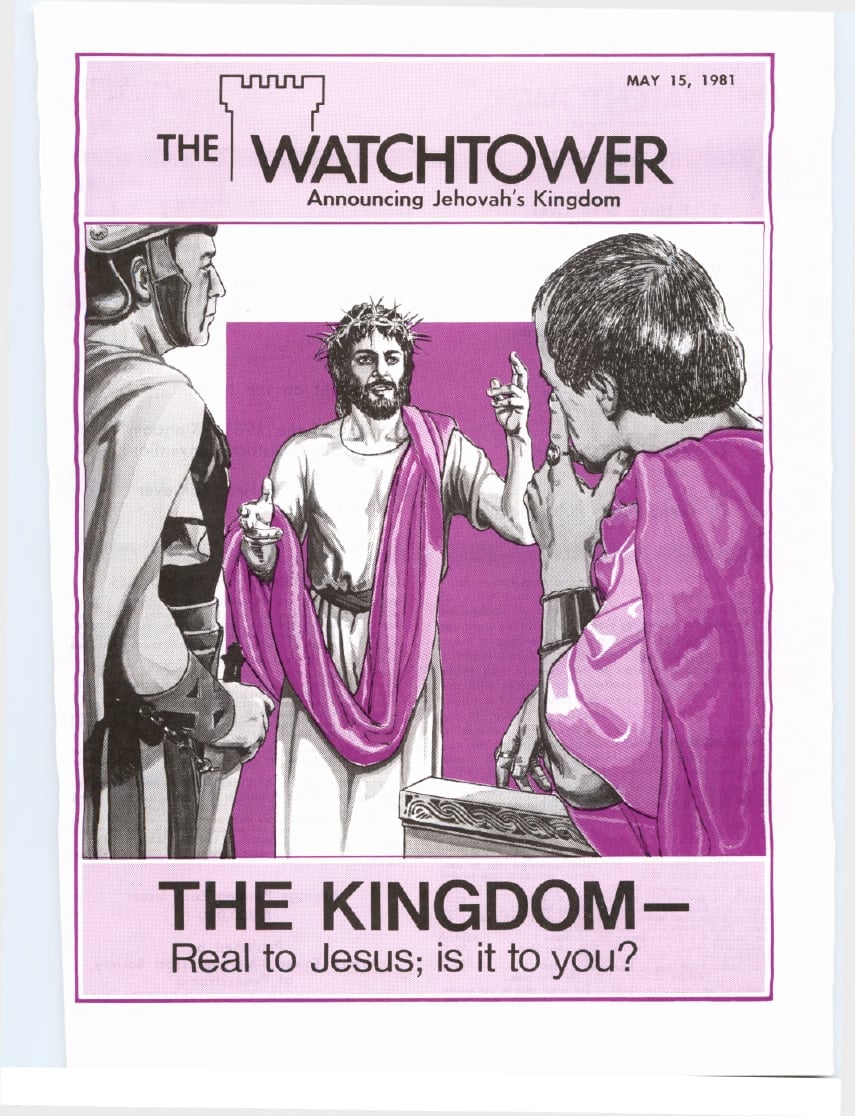
OUR COVER: When Jesus Christ was before the Roman governor Pontius Pilate, the issue involved a kingdom that was very real to Jesus. What is that kingdom? And does it affect you? See pages 17 to 27
I Have Seen Lives Marvelously Changed
I Have Seen Lives Marvelously Changed
As told by Percy Iszlaub
BACK in 1949 a Japanese man named Kimihiro Nakata murdered two men. He was paid to do it. Those were violent times. Millions of lives had been wasted on the battlefields, and, for a while, the violence of those times spilled over into the postwar years.
My wife, Ilma, and I had just come to Japan as missionaries in the wake of World War II. Kimihiro was only 18 years of age then. The court sentenced him to death by hanging. If he had been only a few months younger, he could not have been given the death sentence. He was sent to Fukuoka prison and assigned to death row.
In Japan it is not the policy to tell a condemned man when he will be executed. A person may be on death row for a week, a month, a year, or for many years; one man was there for 30 years. In prison, Kimihiro became a disturbed and violent man. He would grab the bars of his cell and scream out: “Why don’t you kill me! Get it over with!” But the years passed and he was not executed.
In time, Kimihiro became interested in religion. He obtained a Bible and began to read it with enjoyment. However, he had questions for which he was unable to get answers. One day, in the mid-1950’s, he received a copy of the Watchtower magazine. An acquaintance, who was not interested in the magazine himself, had sent it to him. This was just what Kimihiro was looking for. He wrote the Watch Tower Society for more information, and one of Jehovah’s Witnesses was sent to call on him. The Witness arrived at the prison, and there, on death row, Kimihiro began to study the Bible.
Meanwhile, in September of 1957, our missionary assignment was changed to Fukuoka City. At the same time, the Witness who studied with Kimihiro moved away, so I took over the weekly studies on death row. Just prior to our arrival in Fukuoka, Kimihiro had been baptized in the prison bath.
So here I found a Christian brother whose personality had changed radically. Kimihiro became nearer and dearer to me as my weekly visits continued and the months passed. As we became acquainted, I could see similarities in our earlier lives. In fact, I often thought that if I had continued my former way of life I also may have ended up in prison.
A ROWDY LIFE
As a schoolboy growing up in southeast Queensland, Australia, I began smoking and drinking. This led me into trouble with the local police. Drunken barroom brawls were a weekly occurrence. One time I threw a glass of beer into the face of a man who insulted me. Drunken driving caused me to wreck two cars and I narrowly escaped serious injury when motorbike racing.
Smoking and drinking led me to gambling. When police raided our gambling hangout, we would find another place to gamble. Once, to win a bet, I walked into a crowded dance hall at midnight in my pajamas with an ice cream in one hand and a string of sausages around my neck. I won the bet but lost the race with the police, who charged me with disorderly conduct.
I was even involved in stealing, starting this activity by robbing a private home. Then I broke into a motion-picture theater, taking money and cigarettes. My stealing operations expanded when a mate of mine and I stole a car engine and installed it in another chassis. We sold it for a profit.
Rugby football was a favorite sport of mine. I played halfback behind the scrum. We played to win; ‘get the other fellow’ was our motto. One day when I was running with the ball the opposition “got” me—I came out with two broken ribs and an injured diaphragm.
SOME SENSE OF RESPONSIBILITY
At the same time, I cared for my family. When my father and mother got sick and couldn’t work, I quit school and got a job as an auto mechanic to help support the family. I was only 14. Ten years later, in 1940, I was foreman of a garage, overseeing 17 mechanics.
A principal entertainment in those days was the Saturday night dances. I played the cornet in a dance band. Often I would leave work about noon on Saturday, travel to a distant town and play late, arriving back home as the sun was coming up. Saturday night dances and going out with girls were a big part of my life.
A FINE INFLUENCE IN MY LIFE
It was when I was about 23 that I met Ilma at a dance. We began seeing each other regularly, first at the dances. But then she would come over to our house, my mother and she becoming good friends. Soon I made clear my intentions of marrying her. What a change our relationship was to have on my life!
I should mention here that some years earlier my mother had become one of Jehovah’s Witnesses. Oh, how I hated this! I was ashamed of her standing on the streets offering passersby Bible literature. I argued with her about giving it up, but without success. And I let her know that I didn’t want her talking to Ilma about her ‘crazy religion.’
Well, anyway, one particular night after a dance Ilma and I were talking about the war—the second world war had just begun in September 1939. Our conversation touched on world conditions, and Ilma said: “Wouldn’t you like to see a just and righteous government established that would bring peaceful conditions to all mankind?”
“Sure I would,” I replied, “but just who can accomplish it? Man has tried for years and where are we now? We’re starting a world war!”
“Well, Almighty God can do it, and he will do it,” Ilma replied.
“How come, then, that the Almighty has not done anything before now? Look at the war and the suffering everywhere. Can you answer that, my dear?”
Well, Ilma did answer my question, but not in the way I had anticipated. She brought out a little booklet, Government and Peace, and began to read from it: “There cannot be lasting peace without a just and righteous government. There can be no just and righteous government without peace.”
I agreed with this. “But how would such a thing be accomplished?” I wanted to know. “Show me that booklet.”
She passed it to me. Turning to the front page, I saw “WATCH TOWER BIBLE AND TRACT SOCIETY . . . First Printing 10,000,000 copies.” Did I ‘hit the roof’! “How did you get this?” I asked.
“Why, from your mother,” she said, “and I read it and I believe it.”
It made me madder than ever to learn that Mother had been talking religion to Ilma. It so happened that some weeks earlier Ilma had asked Mother a question that perplexed her. “My church teaches that the wicked go to hell and the good go to heaven,” she began. “Well, I don’t feel I’m good enough to go to heaven, but I’m not so bad that I should go to hell. So where do I fit in?”
Mother happily seized the opportunity to tell Ilma about God’s original purpose to make the earth a paradise, and how that purpose will soon be fulfilled under the rule of his kingdom. She pointed out such scriptures as Psalm 37:11 and 29, which say: “The meek shall inherit the earth; and shall delight themselves in the abundance of peace. The righteous shall inherit the land, and dwell therein for ever.” (Authorized Version) And she explained that Jesus had even promised the evildoer who died next to him that he would be brought back to life in that earthly paradise.—Luke 23:43.
So when Ilma would come over to our home to visit on weekends, my mother would sweetly ask me to go to the market and get some things for supper. While I was gone, she was busy discussing Bible teachings with Ilma. For how long this had gone on I don’t know, but it came to a sizzling head that night.
I told Ilma that my mother wasn’t supposed to talk to her about her religion because I was in disagreement with that. But then Ilma asked, “Don’t you believe in freedom?”
“Sure I do!”
“Then aren’t you a hypocrite?” she shot back at me.
I had been called worse things before, but this was different, coming from Ilma. “You said it would be a wonderful thing if there were a peaceful government,” she went on. “But when you learned that it is Jehovah’s Witnesses who are telling how God will bring about such a thing you’re not interested.”
That was food for thought and, grumbling, I left in a huff. A week passed and I telephoned Ilma to see if I could come over and see her again. “Yes, if you act reasonable and discuss the things we were talking about the other night,” she said.
So I visited her and asked just what made her believe “Rutherford’s religion,” as I called it. (J. F. Rutherford then was president of the Watch Tower Society.) “This is the first time that I have heard such wonderful things,” she said. “It makes sense to me. When your mother answered my questions I could have danced for joy. I knew it was the truth from the time I heard it.”
I must admit that I was not in the mood for dancing. But I did listen to some scriptures, and I agreed to investigate further. So, on December 8, 1939, we were married.
HOW MY LIFE CHANGED DRAMATICALLY
“All right, we’ll get somebody to study the Bible with us,” I told Ilma. “But I don’t want my mother or her 70-year-old friend.” I really thought this was an old women’s religion. So a couple of full-time ministers of Jehovah’s Witnesses came.
At first I argued with them a lot. I couldn’t understand, for example, how the first man Adam could have sinned if he was perfect. It seemed to me that God could not have done a very good job in creating him if he turned bad. But, in time, it got through to me that God created man a free moral agent—not a robot. So he had the ability to choose to do right or wrong.
As our studies progressed into February and March, my interest grew. One day I told Ilma: “Let’s go to the assembly in Brisbane.” It was in April, just four months after our marriage. So we went. What an impression it made! I couldn’t believe that there were so many young people of our age that we met; this certainly wasn’t just an old people’s religion.
Returning home, I took our studies even more seriously and became zealous in preaching to others. In a nearby town, Norman Bellotti, a youth who had belonged to a rival gang, also became a Witness. So as companions now, rather than rival combatants, we began witnessing. In our small towns many knew us and couldn’t believe what they saw. Smoking, drunken brawls, stealing, reckless driving, gambling, toying with sexual immorality—all these were things of the past. Why?
My eyes of understanding had been opened. I truly believed with my whole heart that Jehovah God would establish a just government, his kingdom for which we pray. (Matt. 6:9, 10; Dan. 2:44) It was this knowledge and my appreciation of it that were responsible for the dramatic changes in my life. This may well have saved me from the kind of trouble that Kimihiro Nakata became involved in.
BEGINNING OF A NEW LIFE
In July 1940, Ilma and I decided to go to the assembly in Sydney and afterward begin the full-time preaching work, or pioneering as it is called. I quit my job as foreman at the garage, and we sold all our newly purchased furniture. I called Norman to tell him our plans. “Wait for me! Wait for me! I’ll come too!” he said. So Norman and his sister Beatrice joined us.
During a faith-strengthening assembly, all four of us, on July 24, 1940, symbolized our dedication to God by water baptism. Afterward we went to the Watch Tower Society’s branch office in Sydney and asked for pioneer assignments. We were sent to the city of Townsville, North Queensland.
The new life we began was not an easy one. But it was rewarding and we were happy because we were confident that we were doing what pleases Jehovah God.
The rainy season runs from November to January in North Queensland. At times it rained 15 inches (39 cm) and more daily, causing flash floods. Once we were isolated for several days between two swollen rivers. When our food supplies ran out, we ate wild tomatoes.
As the world war progressed, prejudice against Jehovah’s Witnesses grew. In January 1941 the government banned our activities in Australia. But we kept right on with our preaching work. Norman and I would set out on a Monday morning to work outlying rural areas. We would load two cartons of books on one bike, and on the other blankets, a frying pan and a container with water for tea. Meanwhile Ilma and Beatrice did their witnessing around the town until we returned on Friday night.
Sometimes our food supplies ran low, and Norman and I would not have anything to eat for a day or two. Then we would be able to exchange some books for food. Or, on certain occasions, we would chop wood in exchange for a meal. Night found us sleeping under an old creek bridge, or more often under a tree. To keep the multitudes of mosquitoes at bay, we would burn cattle manure, a pile at the foot of our blanket and another pile at our head.
ENLARGED PRIVILEGES OF SERVICE
After a few months of pioneering, we returned home one day to find a letter from the Watch Tower Society. It was an invitation to serve at Bethel, the branch headquarters of Jehovah’s Witnesses in Sydney. Happily we accepted. But soon after we began work at Bethel the government ordered all Bethel family members out of the home and took over the Society’s property.
Ilma and I were assigned to work in Melbourne. During the ban we preached with only our Bible, working by ourselves as inconspicuously as possible. Things became a bit lonely at times, but there were blessings. Ilma tells it this way: “One day I was working along and preached to a middle-aged woman about the paradise earth. She recognized the ring of Bible truth immediately. She studied and came right along, even though we were under ban at that very time.” The ban was lifted in June 1943.
The year 1947 found us in the circuit work in New South Wales, where I then served as a traveling representative of Jehovah’s Witnesses. Now a new privilege was extended to us—an invitation to attend the Watchtower Bible School of Gilead, a missionary training school in New York State. What should we do?
Having left school at 14, I was apprehensive, feeling unqualified to attend such a school. But viewing the invitation as God’s will, our response was that of his prophet Isaiah: ‘Here we are! Send us.’ (Isa. 6:8) Thus in January 1948, along with 17 others from Australia and New Zealand—including my former pioneer companion Norman Bellotti—we sailed for the United States.
After five months of intensive Bible instruction we were given our missionary assignments. Ours was Japan.
MISSIONARY LIFE IN JAPAN
Our first assignment was the city of Kobe. Our missionary home was situated on a high hill, which gave us a delightful view of the beautiful Inland Sea, with quaint boats of all shapes and sizes chugging up and down the sea-lanes. A lighthouse, faithfully twinkling day and night, guided seamen past the submerged rocks.
A kindly doctor who lived next door to us was moved to say: “This missionary home will become a source of spiritual light to the people in this vicinity.” How true his words came to be! There were no local Witnesses in Kobe City then, but now there are 20 congregations there with nearly 1,400 Kingdom publishers. The doctor’s two daughters were baptized more than 20 years later, in the Tokyo area.
Our home was without furniture and in need of a good cleanup. The garden grass was very high, so we cut it and spread it out on the floor, sleeping in our clothes in this grass for three weeks until our goods arrived. We amusingly called it the “Three-Week Itch Hitch.”
Learning the language was pretty rough on us at first, particularly on me. I used to tell the brothers such things as, “eat” (taberu) the sheep instead of “feed” (tabesaseru) them, or support the Watchtower “noodles” (udon) instead of support the Watchtower “campaign” (undo). However, the brothers always lovingly helped me over these rough spots, and we pressed on.
CHANGED LIVES—A BEAUTIFUL THING
Ilma and I have been in Japan for over 31 years now. It has become our home. When we arrived, there were only three native Witnesses in the whole country. Now there are over 58,400 of our brothers and sisters proclaiming the good news of the Kingdom. During these years I have seen many, many lives marvelously changed—persons who were guilty of ‘shady deals’ in business and those living very immoral lives. But then their hearts were touched by the truths of God’s Word, and what a beautiful thing it has been to observe the change!
But to me the most dramatic change in anyone’s life was that of Kimihiro Nakata, the disturbed, violent death-row prisoner who had murdered two men. What a meek, kind young man he became! He was one of the most zealous Kingdom publishers I have known. “When I see the blue sky through my cell window,” he would tell visitors, “how I wish I could be out there helping you preach!”
Yet even from his death-row cell Kimihiro helped many. He wrote the family of the persons he killed, witnessing to them, and they expressed interest. He also witnessed extensively to his own family. He studied Braille, and transcribed the book “Let God Be True,” the booklet “This Good News of the Kingdom” and Watchtower and Awake! articles into Braille. These publications were distributed to different parts of Japan, including schools for the blind.
CONCENTRATING ON THE HOPE AHEAD
On June 10, 1959, a police car pulled up at our missionary home. Kimihiro had requested my presence at his execution that morning. His last words to me are not to be forgotten: “Today I feel strongly confident in Jehovah, and in the ransom sacrifice and the resurrection hope. For a little while I will sleep, and if it be Jehovah’s will, I shall meet you all in the paradise.” Kimihiro died to satisfy justice, giving ‘life for life.’ But he died not a hopeless hardened criminal but a dedicated, baptized, faithful servant of Jehovah.
Yes, I have seen lives marvelously changed—Kimihiro’s life, my life. In spite of failing health, Ilma is still my faithful companion in full-time service, a privilege we have enjoyed for over 40 years. Together our gratitude goes out to Jehovah, the God who can change lives.
[Blurb on page 6]
This may well have saved me from the kind of trouble that Kimihiro Nakata became involved in
[Blurb on page 7]
Night found us sleeping under an old creek bridge, or more often under a tree
[Blurb on page 8]
Kimihiro had requested my presence at his execution that morning
Showing Lifesaving Neighbor Love
Showing Lifesaving Neighbor Love
THE year was 1559 of our Common Era. Prince William of the Netherlands and King Henry of France were in a hunting party on the outskirts of Paris. When, by chance, the two men were off by themselves, King Henry freely talked with the prince about a plan King Philip of Spain had formed to kill off all the Protestants in the Netherlands and in France. The executioners for the Netherlands were to be the Spanish troops stationed there.
All of this was shocking news to the Dutch prince, as he had not had the slightest inkling of such a plan.a Although himself reared a Catholic (with a Lutheran background), he felt keenly for all those Protestants that were slated to be slain. Most discreetly he betrayed no surprise nor any other emotion at learning of this murderous plan, for which reason he became known as “William the Silent.”
Before returning to the Netherlands, he was given specific orders as to his part in carrying out this terrible plot. But as soon as he got back to his homeland he aroused public sentiment for the departure of the Spanish troops from his country. In fact, he did all he could to frustrate that evil plan—all of which, it might be observed, started him on the road to becoming “the Father of his country.”
In particular William had been given the names of certain “excellent persons suspected of the new religion” with instructions to make sure that these did not escape. Far from carrying out such instructions, he warned those “excellent persons,” enabling them to get away. As he later put it, he was “thinking it more necessary to obey God than men.” In all of this, William was truly displaying lifesaving neighbor love.b
A WARNING BEING SOUNDED TODAY
Today there is a group of people, the Christian witnesses of Jehovah, that are similarly motivated. They are warning as many people as they can of a certain dire fate awaiting them in the near future. However, the fate that awaits so many today is not to result because of religious intolerance on the part of blinded men. Rather, it is because the righteous God of heaven and earth will soon take action against all those bringing reproach upon his name and ruining the earth. Fulfillment of Bible prophecy indicates that “the appointed time” is hastening on for Jehovah God “to bring to ruin those ruining the earth.” (Rev. 11:18) Yes, near is the time for the beginning of the greatest tribulation ever to occur.—Matt. 24:21.
Because of the nearness of that catastrophic event Jehovah’s Witnesses are echoing the angelic warning to all lovers of truth and righteousness in the domain of the world empire of false religion, “Babylon the Great”: “Get out of her, . . . if you do not want to share with her in her sins, and if you do not want to receive part of her plagues.” (Rev. 18:2, 4) Of course, it is not enough for these sincere ones to separate themselves from all false organized religion. They must also flee for safety to God’s kingdom. So the Witnesses keep preaching “this good news of the kingdom” worldwide.—Matt. 24:14.
That is why Jehovah’s Witnesses are also devoting all their efforts in helping sincere truth-seekers to obey the command found in the Bible book of Zephaniah: “Seek Jehovah, all you meek ones of the earth, who have practiced His own judicial decision. Seek righteousness, seek meekness. Probably you may be concealed in the day of Jehovah’s anger.” (Zeph. 2:3) Thus these Witnesses are obeying the parting command of Jesus Christ to his followers: “Go therefore and make disciples of people of all the nations, baptizing them in the name of the Father and of the Son and of the holy spirit, teaching them to observe all the things I have commanded you.”—Matt. 28:19, 20.
PREACHING AND TEACHING FROM HOUSE TO HOUSE
It is because of the nearness of Jehovah’s day of judgment that the Witnesses feel an urgency to point truth-lovers to God’s kingdom as their only means of escape. Since life is so important, it is surely showing love to aid people in this way.
Reports show that fine Christian conduct has helped some people to get on the road leading to life. As one Russian journalist, attending a Witness convention in Germany, put it: “Your conduct is your best sermon.” The Witnesses have found that standing on street corners offering Bible magazines to passersby is an effective way of preaching the “good news.” More than that, Witnesses are alert to find or to make opportunities to preach the good news of God’s kingdom to people they happen to meet in business contacts and when traveling, or by preaching to people with whom they work. The facts show that all such activity is also fruitful.
However, it is obvious that if Jehovah’s people limited their witnessing to these kinds of activities many would be overlooked who might well be lovers of truth and righteousness and deserving of hearing the warning message as well as the Kingdom good news. For this reason the Witnesses have embraced the house-to-house form of preaching. In fact, they have become so industrious in pursuing this method of preaching that it has become a trademark, as it were, of the Witnesses. Thus on a certain TV program a family group were shown responding to a knock at the door with the observation, ‘Most likely one of Jehovah’s Witnesses.’
Not long ago this activity of the Witnesses was banned in a certain Central American land. When the Witnesses appealed, the government official handling the appeal said: ‘Other religious denominations do not go from house to house the way you Witnesses do. Is this activity a part of your worship?’ He was told that it was not only a part of their worship but one of the most important parts of their worship. As a result the ban was lifted.
For pursuing the house-to-house activity the Witnesses have sound Scriptural precedents. When Jesus sent out his disciples, he commanded them to go to the homes of the people with their message. (Matt. 10:7, 12, 13, 42; Luke 10:5, 6) Furthermore, the apostle Paul told the elders of the congregation at Ephesus: “You well know how from the first day that I stepped into the district of Asia I was with you the whole time, . . . while I did not hold back from telling you any of the things that were profitable nor from teaching you publicly and from house to house. But I thoroughly bore witness both to Jews and to Greeks about repentance toward God and faith in our Lord Jesus.”—Acts 20:18-21.
Yes, Paul taught in ‘house after house.’ While he no doubt called on those who already were Christians to strengthen and encourage them, we may by no means limit Paul’s words here to such pastoral or shepherding activities. Why not? Because Paul said that he was preaching “repentance toward God and faith in our Lord Jesus” to both Jew and Greek. That clearly indicates that these were not as yet Christians. That he considered this a lifesaving work can be seen from his further statement that, as a result of his preaching, he was “clean from the blood of all men.”—Acts 20:25-27.
A PROPHETIC PATTERN
Corroborating the foregoing is the prophecy found at Ezekiel chapter 9, which foreshadowed the house-to-house activity of Jehovah’s Witnesses today. It tells of a vision that the prophet Ezekiel had some 2,500 years ago.
In the previous chapter the prophet tells of having been given a vision showing various kinds of idolatries and apostasies carried on by the Jews at their temple in Jerusalem. Then, in Eze chapter 9, Ezekiel records a vision of six men armed with slaughtering weapons and a seventh man clothed not in armor but in linen with a secretary’s inkhorn at his side. This man was told to go through the city of Jerusalem and “put a mark on the foreheads of the men that are sighing and groaning over all the detestable things that are being done in the midst of it.” (Eze 9 Verse 4) The six men with slaughtering weapons were commanded to follow after him and to execute all those who did not have that mark, yes, all those who did not groan and sigh because of all the wickedness being practiced in the city.
How was this man in linen to locate all those who were sighing and groaning? The Watchtower of January 15, 1972, explained: “Not just by going to the public square or to the marketplace, but to the homes of the people, going from house to house. In that way he would be able to hear their heartfelt expressions and decide whether they should be marked on the forehead or not. This was no speedy operation, by any means, but called for patiently and conscientiously going from house to house or from door to door and making an honest inspection, showing no partiality but marking only those who sincerely grieved at all the detestable things that others were doing inside the royal city. . . . he put the distinguishing mark upon their foreheads where it could be publicly seen by friend or foe.”
Even as it required house-to-house visitation for the man clothed in linen to discharge fully his obligation of marking those deserving to be spared from execution, so today it takes house-to-house activity on the part of Jehovah’s Witnesses to find all those who love truth and righteousness and give them the opportunity to flee to God’s kingdom.
What today would correspond to the mark that the man in linen put upon the foreheads of those deserving to be spared? Being marked in the forehead appears to represent the cultivating of a Christlike personality. Only by possessing such a personality would one merit being spared by Jehovah’s executioners at the coming “great tribulation.” (Matt. 24:21) A Christlike personality would be something for all to see, even as a mark on the forehead could be seen by all. Cultivating such a Christlike personality is repeatedly urged in the Scriptures. Of course, to mark a person in such a way takes much time, energy and means, but Jehovah’s Witnesses are glad to make such sacrifices. Thereby also they are showing lifesaving neighbor love.—Eph. 4:20-24; Col. 3:9-11.
Yes, important as is the first step of going from house to house to find those lovers of truth and righteousness who are sighing and groaning because of the wicked conditions prevailing, it is but the first step. Showing lifesaving neighbor love requires the servant of Jehovah to follow through by making return visits and conducting Bible studies. Such Bible students also need to learn how to pray, they need to associate with the Christian congregation and they need to apply Bible principles in their lives. In turn, they themselves need to share in letting still others know about the things they are learning. All of this should lead to their dedicating themselves to Jehovah God to do his will and to their being baptized. Such a course, it should be added, is essential to being ‘marked,’ to putting on the Christlike personality. And by carrying on this activity the witnesses of Jehovah are truly showing lifesaving neighbor love.
[Footnotes]
a The accidental discovery of this plot by William may well have been providential, as there is no telling how much the history of Europe and the progress toward religious freedom might have been altered had the plot been carried out successfully.
b Rise of the Dutch Republic, Vol. 1, pp. 239, 240.
The House-to-House Challenge
The House-to-House Challenge
HE WAS one of Jehovah’s Witnesses in his mid-70’s. As he went from door to door he hobbled quite a bit; but no wonder, for he was getting around on two wooden legs. Upon his knocking on one door, a woman came out. Pointing a finger at him, she asked in an angry tone of voice: ‘Are you one of Jehovah’s Witnesses?’
He paused for a moment and then, looking the woman straight in the eye, said: ‘I tell you, ma’am, I try to be. It isn’t easy. I’m working at it. It’s a difficult assignment. Can you imagine what it means to be a witness of the Most High, Jehovah, the Sovereign of the universe? That’s a real assignment. I’ll tell you, ma’am, I’m working at it.’
What did the woman say in reply? Not a word. What could she say?
There is no gainsaying it. Going from house to house with the good news of Jehovah God’s kingdom presents a real challenge. Doubtless that is why this form of evangelism is unique with the Witnesses. No other religious group stresses or expects this kind of activity on the part of all its members. And it is indeed of interest that those who so severely criticize the teachings of Jehovah’s Witnesses do not accuse them of carrying on a work for which there is no Scriptural precedent. Far from charging that the Witnesses do not have a Scriptural basis for their activity, time and again these critics have in print acknowledged the Scripturalness of this type of evangelism. Some even lament the fact that their own particular denomination does not expect the same from its members.
It is not that the Witnesses would have no reasons for going from door to door even if there were no direct or explicit commands and precedents found in God’s Word for their doing so. Love of God and of neighbor impels them to witness to all they can, telling others the good news of God’s kingdom and warning them about the “great tribulation” just ahead—and to do so by every effective means. In apostolic times the apostle Paul and others visited synagogues and were able to preach the “good news” to those assembled. (Matt. 24:14, 21; Acts 13:14-16; 14:1; 17:1, 2, 10, 17; 18:4, 19, 26; 19:8) Of course, today Witnesses rarely have the opportunity to address audiences in synagogues or other religious edifices. But the fact that present-day Witnesses cannot imitate this kind of activity does not mean that they should not imitate other kinds of apostolic evangelism that are available to them.
Why, the very fact that house-to-house evangelizing meets with so much opposition is testimony to its effectiveness! When a government becomes totalitarian, one of the first things it invariably does is ban the house-to-house preaching work of the Witnesses. Many religious leaders, particularly in times past, have influenced even democratic governmental authorities to interfere with this kind of evangelism, either by misapplying laws to them or by having laws passed for the specific purpose of stopping their house-to-house work. To establish their legal right to preach from door to door, the Witnesses have time and again carried legal battles into the higher courts, including the Supreme Court of the United States. Almost invariably that court has decided in their favor, which decisions testified not only to the legal right of the Witnesses to carry on this work but also to the effectiveness of it. Typical is the following verdict:
“The hand distribution of religious tracts is an age-old form of missionary evangelism—as old as the history of printing presses. It has been a potent force in various religious movements down through the years. This form of evangelism is utilized today, on a large scale by various religious sects whose colporteurs carry the Gospel to thousands upon thousands of homes and seek through personal visitations to win adherents to their faith. . . . This form of religious activity occupies the same high estate under the First Ammendment as do worship in the churches and preaching from the pulpits.”
A CHALLENGE
Let us face it: to begin going from house to house with a Bible message is one of the hardest things for the average modest person, male or female, young or old, to do. In fact, occasionally Witnesses who have spent decades preaching full time have confessed that after all those years it so goes against their natural inclinations that it takes real effort to get started each morning. There is always the uncertainty of what kind of reception one may get at the door. Without question, not a few persons are offended when an individual comes to their door with a Bible message, and no one enjoys offending people. The initial reaction of many a truth-lover who was studying the Bible with one of the Witnesses has been, ‘I could never go from house to house.’ How difficult it may seem can be seen from the experience of a New York City fireman. Accompanying his Bible teacher in going from house to house for the first time, he exclaimed: “Why, this is worse than going into a burning building!” But before long he, too, was enjoying house-to-house preaching.
Of course, the average churchgoer has little to motivate him to go from house to house. What would he tell the householders? Most likely he does not have a good knowledge of what his own church teaches; merely a lot of generalities based on the creeds of his church. More than that, by and large, religion is presented as primarily a selfish matter. Its chief concern is saving one’s own soul; church services are not structured to train and motivate the listeners to become active evangelizers. So it is no wonder that the house-to-house activity is a challenge rarely met by others than Jehovah’s Witnesses.
Challenge though it is, the house-to-house activity is not above the capabilities of even the most humble Christian. Thus, once a Mexican Witness from the rurals, dressed in very simple country garb, knocked at the door of a palatial mansion. A man in a silken bathrobe responded and asked what he wanted. The Witness said: “If a mule should come to your door with two bags of gold, would you accept it?” Annoyed, the householder replied: “I do not understand what you are telling me. I am a famous engineer.” The Witness then asked him: “What do you understand about prophecies?” The man admitted he did not know anything about them. Then the Witness said: “That is what I want to speak to you about. . . . I am that mule that came to your door, and the two bags of gold are these magazines, The Watchtower and Awake!” The man was impressed by the presentation of this humble Witness and took the two magazines. All of this calls to mind the incident recorded at Acts 4:8-13.
THE CHALLENGE OF PERSEVERING
Time and again Jehovah’s servants have had to meet challenges by persevering and enduring. A notable example is that of Jeremiah who, for upward of 40 years, kept proclaiming Jehovah God’s message under the most unfavorable circumstances. No wonder that he at one time felt like quitting! But he could not keep quiet; he just had to speak, to witness about his God Jehovah and against the wayward Jews of his time.—Jer. 20:9.
Today, also, the servants of Jehovah must persevere, yes, even persist, in carrying out their God-given assignment. And there are many reasons for their doing so. Each time they call on a householder they endeavor to leave a few grains of truth, a few drops of spiritual water, as it were, either orally or by means of the printed page. Time and again these have had a cumulative effect, eventually bearing fruit, even as the apostle Paul noted when he said: “I planted, Apollos watered, but God kept making it grow.”—1 Cor. 3:6.
And there are more reasons for Jehovah’s Witnesses to persevere, to persist in their house-to-house ministry. As The Watchtower once so well expressed it:
“Lives are involved. (2 Tim. 4:5) That means making repeated calls. For one thing, circumstances keep changing. Today a man may not be at home, next time he may be. Today he may be too busy to listen, but the next time he may not be. Today one member of the family answers the door, the next time another member does; . . . Often families are divided as to religion, . . . Besides, people keep moving . . .
“Not only do the circumstances change, but the people themselves change. . . . For just some trifle a man may have been out of sorts and not at all willing to discuss religion or anything else no matter who came to his door, but it does not at all follow that he will be of that mental attitude at another time. Or, just because a man was not at all interested in discussing religion last month does not mean he might not be this month. Since the last time a Witness called this man may have had a soul-harrowing experience or in some other way learned something that made him humble instead of proud, hungry and conscious of his spiritual need instead of self-satisfied.”
Truly many are the reasons for calling on people time and again, persevering, searching for sheeplike ones.—Matt. 25:31-33.
PERSONAL BENEFITS
Foremost among the things accomplished by the Witnesses going from house to house is that the name of Jehovah is being made known. That they are making people aware of this distinctive name of the Creator is apparent from the cartoon that was once published by a popular New York City magazine. It showed a man praying alongside his bed and the Germanic god Wotan standing on the other side of his bed. The cartoon quoted the man praying as saying: “I’m sorry that I inconvenienced you, Wotan. You see, I just naturally thought that when I said God, I would get, you know, Jehovah.”
Further, as can be seen from the foregoing, preaching from house to house enables Jehovah’s Witnesses to help lovers of truth and righteousness to get on the road leading to life. Also, by proclaiming the day of Jehovah’s vengeance, the Witnesses serve lovingly to warn all who are not lovers of truth and righteousness, but lovers of pleasures. (2 Tim. 3:1-5) And many, indeed, are the benefits that accrue to the Witnesses themselves, for the Bible proverb is true: “A generous man will prosper; he who refreshes others will himself be refreshed.”—Prov. 11:25, New International Version.
Thus a Witness elder who once spent nine years in a German concentration camp once stated that there was nothing like the house-to-house method of evangelizing to help one to cultivate the fruits of God’s holy spirit. There is no doubt about it. By persevering in this activity one learns to exercise unselfish love, to be joyful, peaceably inclined, patient and long-suffering, to put one’s faith to work and to manifest mildness, kindness, goodness and self-control.—Gal. 5:22, 23.
Going from house to house with the good news of the Kingdom also helps one to cultivate the virtue of humility. A proud person is sensitive, acts independently, is not concerned with pleasing others. But for a Witness to be effective he must, like the apostle Paul, “become all things to people of all sorts” so that he might win some.—1 Cor. 9:19-23.
Still another blessing that comes to those who keep meeting the house-to-house challenge is that it tends to make one more sympathetic, more empathetic. On the one hand, one learns to feel for persons who have been blinded spiritually by false shepherds, and on the other hand, one learns to commiserate with people as they tell of their problems: poverty, unemployment, sickness, domestic discord, juvenile delinquency, and so forth. Even as was true in Jesus’ day, the people today are “skinned and thrown about like sheep without a shepherd.” They need Jehovah’s kingdom. Jesus’ words to his disciples of the first century are even more meaningful in these “last days,” namely, “The harvest is great, but the workers are few.” While praying for more workers to be sent out into the harvest, are we ourselves sharing zealously in Kingdom work, successfully meeting the house-to-house challenge?—Matt. 9:36-38.
A PROTECTION
The house-to-house activity serves also as a protection from the world. Concerning it the apostle John warns: “Do not be loving either the world or the things in the world. If anyone loves the world, the love of the Father is not in him; because everything in the world—the desire of the flesh and the desire of the eyes and the showy display of one’s means of life—does not originate with the Father, but originates with the world.” These worldly things tend to tempt the Christian witness of Jehovah, but his keeping active by preaching will tend to minimize this temptation.—1 John 2:15, 16.
Making this point is an old Jewish legend or parable. It tells about a certain righteous man who came to the wicked city of Sodom and kept on preaching although no one paid any attention to him. One day, a native noticing this asked him why he kept on preaching when no one was paying any attention to him. What was his reply? ‘So that the people of Sodom do not change me.’ Well has it been said that ‘the best defense is an offense.’ So long as the Witnesses are trying hard to change people of the world, the world will not succeed in changing them.
Nor is that all. By their obeying God’s commands to witness to his name and kingdom, they are doing good to others and actually are laying up treasures in heaven, even as Jesus urged in his Sermon on the Mount. (Matt. 6:19-21) Yes, by using their time, their energies and their means in such unselfish ways, they are making friends for themselves of Jehovah God and Jesus Christ. Then when this wicked system of things comes to its end they can hope to survive it to enter into a post-Armageddon new system of things, even as Noah and his family survived the Deluge to enter into a new system of things.—Luke 16:9.
There is no question about it. Representing the Most High God Jehovah is a great honor and presents a real challenge. It has a sound Scriptural precedent and is within the capabilities of just about every dedicated Christian regardless of secular education. Those who successfully meet the challenge of house-to-house witnessing are able to do much good to their fellowmen and receive blessings from Jehovah God for it.
The Kingdom—Is It Real to You?
The Kingdom—Is It Real to You?
“My kingdom is no part of this world. If my kingdom were part of this world, my attendants would have fought than I should not be delivered up to the Jews. But, as it is, my kingdom is not from this source.”—John 18:36.
1. (a) How are kingdom and government linked in Isaiah 9:6, 7? (b) Earlier, where were kingdom and government referred to figuratively?
OVER 2,600 years ago, with prophetic vision Isaiah said concerning government and kingdom:
“For there has been a child born to us, there has been a son given to us; and the princely rule [government] will come to be upon his shoulder. And his name will be called Wonderful Counselor, Mighty God, Eternal Father, Prince of Peace. To the abundance of the princely rule [government] and to peace there will be no end, upon the throne of David and upon his kingdom in order to establish it firmly and to sustain it by means of justice and by means of righteousness, from now on and to time indefinite. The very zeal of Jehovah of armies will do this.” (Isa. 9:6, 7; compare “An American Translation”; “Authorized Version.”)
Centuries earlier, our heavenly Father spoke figuratively of this same kingdom and government as going into action. Spearheaded by the ‘seed of His woman,’ it was to strike a deathblow to the archenemy of the Kingdom government.—Gen. 3:15.
2. How did Abraham demonstrate his faith in the Kingdom government promise?
2 The Creator of heaven and earth did not let that original promise die. Years later, Jehovah told his friend Abraham:
“I will bless those who bless you, and him that calls down evil upon you I shall curse, and all the families of the ground will certainly bless themselves by means of you.” (Gen. 12:3)
The blessing to “all the families of the ground” would take place only through fulfillment of that first promise, and this Abraham recognized. Hence, the Christian apostle Paul reports: “By faith [Abraham] resided as an alien in the land of the promise as in a foreign land, and dwelt in tents with Isaac and Jacob, the heirs with him of the very same promise. For he was awaiting the city [kingdom] having real foundations, the builder and maker of which city is God.” (Heb. 11:9, 10) Abraham was so intent on his hope in that Kingdom government that he acted as a foreigner and an alien resident, even though residing in the Promised Land.
3. What questions might we ask ourselves about our faith in the Kingdom government?
3 How do we personally look upon this world? Do we see ourselves as ‘foreigners’ and ‘aliens,’ even though we may dwell in the land of our birth with our own race? Are others in our community viewing us as being different? Do they see us as set apart? If not, how strong is our faith in the Kingdom government? Are we merely ‘blending in’ with our community? Or, are we God’s friends, as was Abraham?—Jas. 2:23.
4. Who stand to benefit by recognition of the “seed” of heavenly government, and what must they do to benefit?
4 Jehovah kept that hope glowing within Abraham by reminding him much later:
“I shall surely bless you and I shall surely multiply your seed like the stars of the heavens and like the grains of sand that are on the seashore; and your seed will take possession of the gate of his enemies. And by means of your seed all nations of the earth will certainly bless themselves due to the fact that you have listened to my voice.” (Gen. 22:17, 18)
Actually, by means of the same “seed” mentioned at Genesis 3:15, not just some but all nations of the earth would bless themselves. Yes, and so would every individual in those nations, regardless of race and whether rich or poor, provided that person recognizes and acknowledges the importance of that “seed.” Indeed, as matters turn out, “everyone exercising faith in him [will] not be destroyed but have everlasting life.” The opportunity is there for many to be subjects of that government, if they exercise faith.—John 3:16; Acts 10:34, 35.
5. As the promised “Seed” and King, what will be accomplished through Christ?
5 How do we know that Jesus Christ was, indeed, that principal “seed” of Abraham? With startling frankness, Paul says: “Now the promises were spoken to Abraham and to his seed. It says, not: ‘And to seeds,’ as in the case of many such, but as in the case of one: ‘And to your seed,’ who is Christ.” (Gal. 3:16) Then, in writing Ephesian Christians, the apostle points to Jehovah’s way of handling matters with regard to unifying Jesus’ disciples under Christ, the promised “Seed” and King, and bringing the rest of mankind on earth into harmony with God through His Son. Paul wrote:
“It is according to his good pleasure which he purposed in himself for an administration at the full limit of the appointed times, namely, to gather all things together again in the Christ, the things in the heavens and the things on the earth.”—Eph. 1:8-10.
KINGDOM GOVERNMENT BECOMES THE ISSUE
6. Why was Jesus aware of his future role in Kingdom government?
6 Prior to his earthly sojourn, “the Christ” had acted as the Word (or, Logos), the mouthpiece of our heavenly Father. (John 1:1) So Jesus knew of the prophecies recorded at Genesis 3:15 and Isaiah 9:6, 7. He was aware of the words directed to Abraham. (Gen. 12:3; 22:17, 18) Additionally, he was conscious of the fact that he would be the one to fulfill the wonderful promises related to the promised seed and the Kingdom government.
7. How did Jesus draw attention to his kingly role?
7 During Jesus’ earthly sojourn and particularly his three-and-a-half-year ministry, he drew attention to that kingly role. Such expressions as “the kingdom of God is in your midst” and “the kingdom of God has drawn near” were heard from his lips. By means of his many illustrations and parables, Jesus drew attention to that kingdom.—Matt. 13:1-52; Mark 1:14, 15; Luke 17:21.
8. What miraculous things did Jesus do?
8 As the King-designate, Jesus also did many miraculous things. Through the power of the holy spirit, he walked on water. He gave sight to the blind and hearing to the deaf. Jesus healed the sick and the lame, and restored the dead to life. Why, if such a man were facing a television interviewer today, just imagine the probable line of questioning! ‘Are you the man who walked on water? How did you give sight to the blind, hearing to the deaf and life to the dead—how is this possible?’ Well, when before the “interviewer” Pontius Pilate, what did Jesus Christ do?
9. When Jesus was before Pilate, what outstandingly was pushed to the fore?
9 Jesus outstandingly made the Kingdom the issue. Pilate ‘ate out of Christ’s hand,’ as it were, in following and emphasizing the theme of Kingdom government. Of course, Pilate had no choice, owing to the deft way that Jesus handled matters in those closing hours of his earthly life. Let us take our Bibles and turn to the Gospel of John, chapter 18, verse 33.
10. What was Pilate’s first question to Jesus, and why was it so fitting?
10 In his first question directed to Jesus, Pilate asked, “Are you the king of the Jews?” So, in the Roman governor’s mind, the theme had already been set. It was the very theme that needed to be pursued that day, for when Pilate had asked the Jews what accusation they were bringing against Jesus, they had said: “This man we found subverting our nation and forbidding the paying of taxes to Caesar and saying he himself is Christ a king.” Fittingly, then, Pilate asked Jesus: “Are you the king of the Jews?”—Luke 23:1-3.
11. (a) To answer Pilate’s further question, what might Jesus have done? (b) What has always been the principal issue with God’s people?
11 If you had been in Jesus’ place and had been asked the same question, how would you have replied? Would you have related all the things you had or had not done in an effort to make your judgment lighter, thus possibly avoiding a death sentence? This would be the normal reaction of most, but it was not that of Jesus. He might have been able to lead Pilate off the theme of the Kingdom. But Kingdom government really was the issue. Down through the decades the Kingdom always has been the issue, and now, with God’s modern-day people, the issue is still the Kingdom. It was in Nazi Germany, Fascist Italy, America, Australia, Canada and other parts of the earth during World War II. The question has been, Which government is supreme in an individual’s life—man’s or God’s? In recent times, too, the issue remains the same, whether in Malawi, China, the Soviet Union, or any other land. The principal issue is not one of blood transfusion or some other prohibition, but always finally, Which government is ultimately superior in a person’s life?
12. How did Jesus further draw attention to the Kingdom, and what question did this now cause Pilate to utter?
12 Jesus did not answer Pilate’s question directly, but replied:
“My kingdom is no part of the world. If my kingdom were part of this world, my attendants would have fought that I should not be delivered up to the Jews. But, as it is, my kingdom is not from this source.”
Notice that in Jesus’ short reply he mentioned the Kingdom three times. This brought Pilate and all those listening back to the theme of the Kingdom government, as Pilate then said: “Well, then, are you a king?” (John 18:36, 37) The scene was firmly set on that dramatic stage, and no one would be able to overlook the reason for Christ’s being on trial. Notice the sequence of events. Jesus responded and said:
“You yourself are saying that I am a king. For this I have been born, and for this I have come into the world that I should bear witness to the truth. Everyone that is on the side of the truth listens to my voice.”—John 18:37.
13. How was the Kingdom issue further emphasized in Herod’s meeting with Jesus?
13 At this point Pilate said to the religious leaders and the Jewish mob: “I find no crime in this man.” However, the crowd became insistent and told Pilate how Jesus’ Kingdom teaching had spread throughout Judea, starting from Galilee. At that time Herod Antipas was tetrarch in Galilee and was aspiring to the kingship of the Jews. To Pilate, what could be more fitting than that Herod should be confronted by Jesus, since Herod was in Jerusalem at the time? So he sent Jesus to Herod, who questioned Jesus at length, in the hope that he would perform some sign. But Jesus, Jehovah’s anointed King, had no desire to belittle his kingship just to satisfy Herod’s curiosity. He remained silent. Frustrated, would-be king Herod made fun of Jesus’ kingship, having his soldiers clothe Jesus with a regal garment and sending him back to Pilate.—Luke 23:4-11.
14. With regard to kingship, what would be the final outcome to Herod and to Jesus?
14 Though Pilate befriended Herod from that day, it did Herod no good. In passing, we may note the contrast between the final outcome to Herod and to Jesus. History relates that, some years later, the ambitious Herod was egged on by his adulterous wife, Herodias, to go to Rome and request kingship from the emperor Caligula. But this angered Caesar, who banished Herod to Gaul. Herod lost both his position and his wealth. Jesus, for his part, had refused to be made an earthly king. He had divested himself of everything he might have possessed here on earth. (Matt. 8:20; John 6:15) He humbled himself, becoming completely submissive to Jehovah’s will. He rejoiced to do that will and to make the heavenly kingdom his goal. “For the joy that was set before him,” he endured every indignity and torture that his enemies could heap upon him, knowing that his integrity to the death would qualify him for the glorious kingship that lay ahead of him.—Heb. 12:2; Matt. 25:31.
15. How was the issue of kingship highlighted by the discussion when Jesus was before Pilate?
15 Once again, Jesus stood before Pilate. And once again the Kingdom issue came to the fore, as Pilate asked the Jewish mob: “Do you . . . wish me to release to you the king of the Jews?” But it did not end there. The Roman soldiers picked up the theme that kingship and government were at issue. In mockery, they made a crown of thorns and took a purple outer garment and put these on Jesus. They slapped him on the face, calling him the king of the Jews. (John 18:39–19:3) There is no indication that Jesus tried to remove that crown of thorns. It remained on his head, and that served to highlight the issue at stake. No one was to be left in doubt. When Pilate suggested to the Jews that they take Jesus and impale him themselves, they very artfully but falsely focused on the issue as an infringement on Roman governmental authority, saying: “If you release this man, you are not a friend of Caesar. Every man making himself a king speaks against Caesar.”—John 19:12.
16. How did those present at Jesus’ trial bear witness to the issue over which Christ was about to be killed?
16 It was as though Pilate served God’s purpose on that day, as Cyrus the Persian had in the past. (Compare Isaiah 45:1-7.) Next, Pilate began to climax matters by saying: “See! Your king!” At that, the Jews demanded Jesus’ impalement, whereupon Pilate asked: “Shall I impale your king?” Their response? “We have no king but Caesar.” (John 19:14, 15) In essence, these people themselves were bearing witness concerning the issue over which Christ was about to be killed, and Jesus did not need to say a word. The matter was being very well emphasized by their own mouths.
17. How did Pilate’s final action with regard to Jesus stress the issue of Kingdom government?
17 Emphasis on the issue of Kingdom government finally was highlighted by Pilate’s action in having placed on Jesus’ torture stake a title written in Hebrew, Latin and Greek. All present that day could read it and would not be left in doubt as to why the impalement took place. This title said: “Jesus the Nazarene the King of the Jews.” When the Jewish chief priests saw it, they were incensed and said to Pilate: “Do not write ‘The King of the Jews,’ but that he said, ‘I am King of the Jews.’” However, Pilate replied: “What I have written I have written.”—John 19:19-22.
18. (a) What should our lives be centered on today? (b) What questions should we ask ourselves?
18 The dramatic events of that trialsome day should make very evident to all Christians what their lives should be centered on today. Every dedicated servant of Jehovah should examine just how real that Kingdom is to him or to her. Do we see ourselves as prospective subjects of that government? What efforts are we making as advocates of Kingdom rule? How zealous is our activity in support of that government? In the succeeding article, we will find good reason for intense interest in the issue of the Kingdom. And we will note that there is need for a sense of urgency in manifesting such interest. ‘May the Lord be with the spirit we show’ in upholding the Kingdom!—2 Tim. 4:22.
[Picture on page 20]
The Kingdom was real to Jesus
Have Faith in the Kingdom!
Have Faith in the Kingdom!
“Now as for the times and the seasons, brothers, you need nothing to be written to you. For you yourselves know quite well that Jehovah’s day is coming exactly as a thief in the night.”—1 Thessalonians 5:1, 2.
1, 2. How has Jehovah continued to use the resurrected Jesus Christ?
AS THE “Word,” or Logos, Jesus Christ was used extensively by our heavenly Father. (John 1:1-3; Col. 1:16) But Jehovah God’s use of Jesus continued even after his death and resurrection. This is well emphasized by the enlightening comments of the apostle Paul.
2 The apostle plainly declared that God has purposed to reconcile all things in heaven and on earth to him, doing so through the shed blood of Jesus Christ. (Col. 1:19, 20) This harmonizes with Paul’s statement to the effect that Jehovah has arranged for ‘gathering together again in Christ all things in heaven and on earth.’ (Eph. 1:10; Phil. 2:9-11) But climactic developments in this regard would also involve the establishment of God’s Messianic kingdom and the dramatic coming of “Jehovah’s day.” (1 Thess. 5:1, 2) The Scriptures make abundantly clear the role of Christ since his ascension to heaven over 1,900 years ago. We do well to give our rapt attention to his significant place in Jehovah’s arrangement.
…