The Watchtower, March 15, 1981
Download: PDF — The Watchtower, March 15, 1981
The Watchtower — March 15, 1981
Source: jw.org
Contents
Page Two
Do All Religions Lead to God?
Worship God in His Way
Paradise: Paint It or Preach It—Which?
Insight on the News
Do All Good Persons Go to Heaven?
Who Are God’s Ministers?
Women—May They Be “Ministers”?
Glorifying the Ministry
Worker-Ministers
Questions From Readers
A Sincere Atheist
Page Two
Page Two
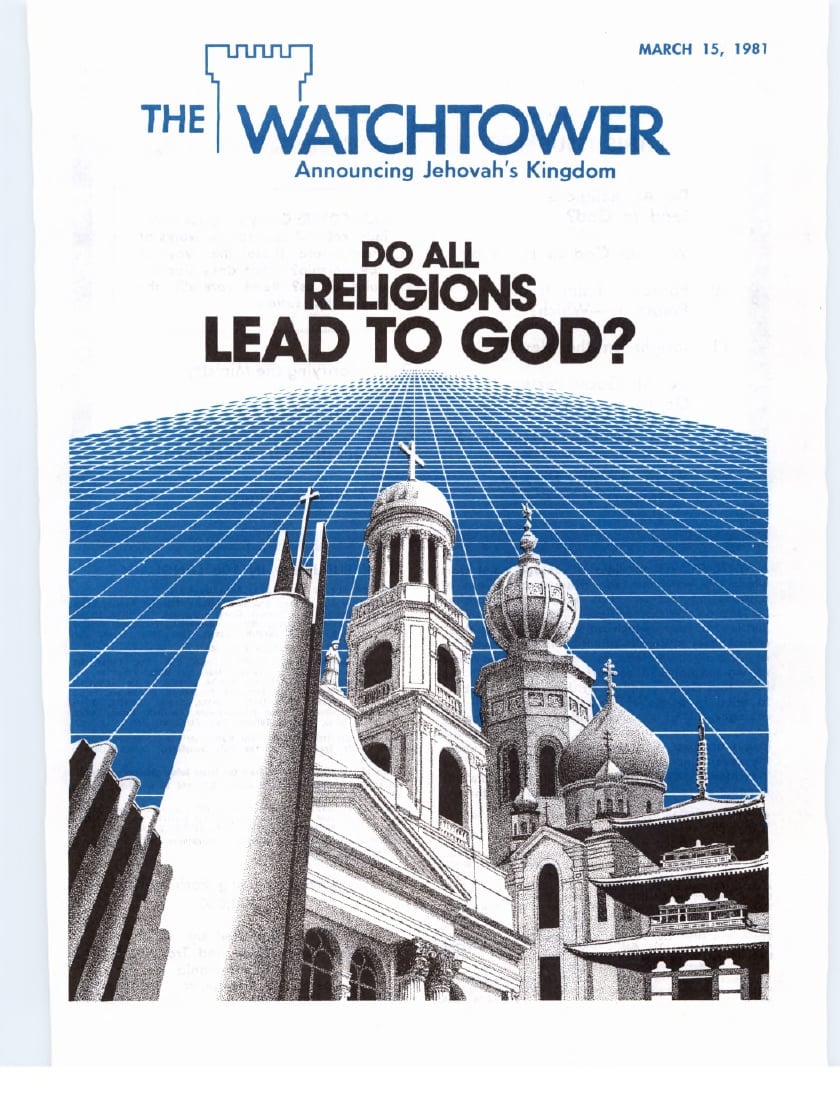
OUR COVER: Costly religious buildings, colorful ceremonies, works of charity—are these the way of true worship? What does God require of us? Read carefully the pages that follow
Do All Religions Lead to God?
Do All Religions Lead to God?
DID you know that there is a religion called “Kennedy Worshipers”? Its adherents believe that the deceased president of the United States John F. Kennedy can ‘cure them of congenital and even terminal diseases.’
Or what about the Ministry of Universal Wisdom church? It is based on belief in flying saucers, and its founder claims to have been given a 2 a.m. ride in one.
And who has not heard of, and been shocked by, the mass suicide in Guyana of over 900 members of “Reverend” Jim Jones’ People’s Temple?
Such examples may raise serious questions about a commonly held view, one that you may have heard expressed. The view is often stated this way, ‘All religions are just different roads leading to God.’
WHY THIS VIEW IS POPULAR
One reason why many today believe this way is that there is a growing ‘liberal spirit.’ People are very sensitive about giving any impression of being narrow-minded or fanatical.
Another reason why some say that ‘there is good in all religions’ is that most churches do speak about love and teach that it is bad to hurt others, to murder, to lie or to steal. Churches have established hospitals and schools to help the needy. And religious groups have translated and distributed the Bible, thus allowing many persons to learn about the true God and his Son, Jesus.
If, though, there is a true God who has provided guidance in his written Word, and whose Son accurately taught about religion we ask: “How do God and Jesus view the different religions? Do they agree that ‘all religions lead to God’”?
WITH THE “MANY” OR THE “FEW”?
Around the globe Jesus Christ is honored as having been a wise and godly teacher, certainly not narrow-minded. Yet, in his famous Sermon on the Mount, Jesus plainly said:
“Not everyone saying to me, ‘Lord, Lord,’ will enter into the kingdom of the heavens, but the one doing the will of my Father who is in the heavens will. Many will say to me in that day, ‘Lord, Lord, did we not . . . perform many powerful works in your name?’ And yet then I will confess to them: I never knew you! Get away from me.”—Matt. 7:21-23.
Note that Jesus did not take today’s popular and ecumenical view that most persons who practice some religion in their own way are pleasing God. Rather, Jesus said that “many” even of those who claim to recognize Jesus as Lord or Christ are not acceptable.
In the same sermon, Jesus straightforwardly advised:
“Go in through the narrow gate; because broad and spacious is the road leading off into destruction, and many are the ones going in through it; whereas narrow is the gate and cramped the road leading off into life, and few are the ones finding it.”—Matt. 7:13, 14.
Why do you think that Jesus took such a position? The Scriptures make it clear that Jesus knew that to please God a person needs to ‘do the will of the Father,’ which is outlined in the Bible. Bearing this out, Jesus condemned practicing and teaching things in conflict with God’s Word. It was right for him to do that for he knew that religion can be used to ensnare and mislead people. (Matt. 23:13; 2 Cor. 4:4) A comparison with the Scriptures shows that much of what is today taught in the churches misrepresents the loving and generous ways of the true God.
It follows, then, that it would not be sufficient for someone, including ourselves, simply to go along with the religion of our parents or to follow the major religion around us. For even if we did this in sincerity, it might put us among the “many” who Jesus said are on the ‘broad road leading to destruction.’
Certainly you would prefer to be among the “few” whom God judges as being on the “road” that is truly leading to him. It is also the road that Jesus said is leading to “life,” everlasting life.—John 3:16; 17:3.
ACCURATE KNOWLEDGE THAT LEADS TO GOD
You can undoubtedly see that we do not have to be theologians or have an extensive knowledge of religion to avoid churches marked by belief in miracles from a deceased politician, or by flying-saucer travels, or those leading to maniacal suicides. Yet we do need knowledge—accurate knowledge.
We have graphic proof of this in the case of the first-century Jewish lawyer named Saul (or Paul) who became a Christian apostle. He had been very zealous in his former faith, even trying to stamp out worship that he felt was improper. Yet through God’s mercy Paul came to realize that very religious persons, himself included, might have “a zeal for God; but not according to accurate knowledge.” When Paul increased in knowledge of God’s will and dealings, he became a convert to the more correct way of worship.—Acts 8:1-3; 9:1, 2; Rom. 10:2; 1 Tim. 1:12-16.
This ought to have a bearing on our thinking today, for it is God’s will that all persons “come to an accurate knowledge of truth” and worship him accordingly. (1 Tim. 2:3, 4) God inspired Paul to foretell that in our time many persons would ‘have a form of godly devotion but prove false to its power.’ We are commanded: “From these turn away.”—2 Tim. 3:1-5.
We, then, very much need to determine whether we are pursuing a religion or way of worship that is truly leading to God. But how can we be sure?
[Pictures on page 4]
Are you on the broad way . . .
. . . or the narrow way?
Worship God in His Way
Worship God in His Way
HAVE you observed evidence of this religious paradox:
“The 1980s will see ‘more people won to the Christian faith than in all previous history, and more Christians defecting from organised Christianity than in any previous era.’”—Sydney “Morning Herald,” July 21, 1979.
This Australian report, based on a survey of 50 major religions and 9,000 “Christian” groups, showed that people are abandoning their churches in record numbers. You may know of many who used to be quite religious and attended church, but who have now stopped.
Yet many individuals, sensing an inner need to worship God, are drawn to some religion or other, often to a religion that touches their emotions, perhaps urging them to “get saved.”
You also have a God-instilled need to worship your Creator. But how should you do it? What is his way to be worshiped?
HOW CAN YOU KNOW?
Naturally, it is God, not any man or church, who should determine what is truth and true worship. Jesus told a woman who was part of a first-century religious community: “God is a Spirit, and those worshiping him must worship with spirit and truth.” (John 4:24) That also applies to us today.
Yes, for us to please God we need an inclination toward pure worship, showing that with wholeheartedness and sincerity. We also must be seeking truth and striving to conform to it. That means acting in accord with truth revealed in God’s Word, rather than following mere church traditions or even religious doctrines that conflict with Bible truth.
In analyzing whether a religion—even your own church, or the faith popular around you—conforms to truth, many different areas could be examined. But even an investigation limited to just three areas could help you to worship God in his way. Observe:
A COMMON BELIEF—BUT IS IT TRUTH?
One teaching common to most religions around the globe is that man has within him an invisible soul that survives the death of the body and lives on immortally as a spirit. Do you recognize that teaching? It often is linked with the idea that the soul of a good person goes to heaven at death. And it is behind the widespread concern about the “spirits” of dead relatives or ghosts. The Encyclopædia Britannica points out: “The belief in human immortality in some form is almost universal.” Probably you know that.
But it is quite appropriate that the encyclopedia says “almost universal.” Why? Because the ancient Hebrews and early Christians did not believe that humans have immortal souls.
You may be surprised to hear that, for many persons think that this church doctrine is drawn from the Bible. However, note this:
According to the Scriptures the first lie, told by Satan the Devil, was that human sin would not bring death. (Gen. 3:1-4) When our original human parents did die anyway, and death claimed everyone afterward, what would be more deceptive than to say, ‘They are not really dead—just their body is; their soul lives immortally’? Yes, the doctrine of the immortality of the human soul tends to further Satan’s lie and has led millions to fear the dead.
Simply put, however, the Scriptures teach that your soul is you. We find an indication of that in what the Bible reports about Adam. The Creator formed a body from dust and then provided life and the breath needed to sustain life. The result? Adam “came to be a living soul.” (Gen. 2:7) He was not given a soul. Adam was a soul.—Compare 1 Corinthians 15:45.
Consistent with this, the Bible teaches that a soul (a person) can die. See Ezekiel 18:4. Does that mean that when some person is dead he has no thoughts or feelings? Exactly. In fact, Ecclesiastes 9:5 informs us: “The living are conscious that they will die; but as for the dead, they are conscious of nothing at all.”
Does that mean that there is no more hope for our relatives and friends who have died? No, for the Bible gives examples in which God brought dead persons back to life, resurrected them. For instance, you may already know that God resurrected Jesus Christ as a spirit on the third day after his death. (Acts 10:39, 40; 1 Pet. 3:18) On the basis of this and related Bible promises, we can look forward to the time when God will resurrect those in his memory.—Acts 17:31; 24:15.
When you reflect on matters, then, you can see that the immortal-soul doctrine taught by most religions conflicts directly with what the Bible says. So ask yourself: ‘What does this mean for me? Do I need to make some adjustment so as to worship God in his way, with truth?’
CONDUCT IS ALSO INVOLVED
Jesus Christ gave us added aid in identifying God’s way to worship him. He told his followers: “By this all will know that you are my disciples, if you have love among yourselves.” (John 13:35) Do most churches today really urge all their followers to show the very kind of love that Jesus did?
For example, the early Christians were put to the test as to true love when they were asked to join or support the Roman army. They wanted to obey governmental laws, but could not do so when it meant breaking God’s laws, such as his law against killing. (Matt. 22:21; Acts 5:29) Moreover, God had said of his people: “They will have to beat their swords into plowshares and their spears into pruning shears. Nation will not lift up sword against nation, neither will they learn war anymore.”—Isa. 2:4.
In harmony with that, early Christians would not fight in behalf of the Roman Empire or any other nation.
Think, though, of the position taken by the churches of our time and by their ministers and priests. After giving some excuse, they have approved of and blessed warfare—warfare in which Catholics kill Catholics and Protestants kill Protestants. That is not God’s way!
GOD’S MORAL STANDARDS
As a third area to examine in determining God’s way of worship, we should see whether a religious group upholds his moral standards rather than simply overlooking wrongdoing.
Jesus worked to help sin-laden persons, including drunkards and the sexually immoral. His disciples were to do the same. (Matt. 9:10-13; 21:31; Luke 7:36-48; 1 Cor. 6:9, 11) And the Bible shows that even after individuals repented and became Christians some of them might slip and commit serious sin. (Gal. 6:1) For example, a man in the Christian congregation in ancient Corinth became a fornicator.—1 Cor. 5:1.
If a Christian did fall into a practice of sin, other Christians were to try to restore him to God’s favor and to spiritual strength. (Jas. 5:13-16) But what if one unrepentantly practiced sin? God’s Word says of that man in Corinth or any like him:
“Quit mixing in company with anyone called a brother that is a fornicator or a greedy person or an idolater or a reviler or a drunkard or an extortioner, not even eating with such a man. . . . ‘Remove the wicked man from among yourselves.’”—1 Cor. 5:11-13.
So if a gross sinner refuses to accept help and repent, he must be expelled or disfellowshiped from the true Christian congregation. Perhaps that will shock him to his senses. Yet, whether that happens or not, this God-directed expulsion from the congregation will protect the sincere Christians.—1 Cor. 5:2-8.
But does such disciplining occur in most of the churches you know of? Or is it not true that most churchgoers who openly practice sin continue to be accepted as part of the group?
The front page of a Nigerian newspaper recently reported:
“Nearly one-third of married Roman Catholic men in the archdiocese of Lusaka have live-in concubines . . . The report, based on a survey by Archbishop Emmanuel Milingo, says that there are concubines in 3,225 out of 10,903 Catholic households.”—Sept. 14, 1980.
By refusing to follow God’s command to disfellowship unrepentant sinners, the churches cause others to think that they can sin too and get away with it. Or they may just turn away from religion.—Eccl. 8:11.
A young lad wrote the following to a newspaper:
“I hate going to church because I see people there who I know are drunkards, gossips, liars and cheats, and they are right there every Sunday saying their prayers and singing the hymns. I don’t have any respect for hypocrites and our church is full of them.”—Palm Beach “Post-Times,” May 27, 1979.
Clearly God cannot approve of individuals or churches that produce such fruitage and do not worship him “with spirit and truth.”—John 4:24; Matt. 7:15-20.
WHAT WILL YOU DO?
We have examined only three areas. But these make it clear that if we want to worship God in his way, we may have to make some basic changes in our beliefs and ways, even as did the apostle Paul and many others who have become true Christians. Separating ourselves from religions that are not promoting God’s way of being worshiped is vital. In fact, God commands us to ‘get out if we do not want to share in their sins and receive part of the plagues coming from God.’—Rev. 18:4, 5; 2 Cor. 6:14-18.
Jehovah’s Witnesses are seriously interested in conforming their lives to God’s Word, thus worshiping the Creator “with spirit and truth.” They will be very much pleased to assist you, too, in your desire to worship God in his way.
[Box on page 6]
“A careful review of all the information available goes to show that, until the time of Marcus Aurelius [emperor from 161 to 180 C.E.], no Christian became a soldier; and no soldier, after becoming a Christian, remained in military service.”—“The Rise of Christianity.”
[Box on page 6]
“VALUES AND VIOLENCE IN AUSCHWITZ”
In her book of that title, Polish sociologist Anna Pawelczynska observed that in Nazi Germany “Jehovah’s Witnesses waged passive resistance for their belief, which opposed all war and violence.” With what result? She explains:
“This little group of prisoners was a solid ideological force and they won their battle against Nazism. The German group of this sect had been a tiny island of unflagging resistance existing in the bosom of a terrorized nation, and in that same undismayed spirit they functioned in the camp at Auschwitz. They managed to win the respect of their fellow-prisoners . . . of prisoner-functionaries, and even of the SS officers. Everyone knew that no Jehovah’s Witness would perform a command contrary to his religious belief.”
Paradise: Paint It or Preach It—Which?
Paradise: Paint It or Preach It—Which?
As told by Randy Morales
I GREW up on the southern coast of the island of Puerto Rico, near the city of Guayama. Our house in the country was set among sugarcane plantations. It was indeed a beautiful location, a veritable paradise. These surroundings, I believe, influenced my desire to become a painter, to capture such beauty on canvas.
So it was that, one afternoon late in August 1948, I set sail from San Juan with great expectations. I was on my way to New York city with dreams of becoming an artist. I was only 18.
SCHOOLING OFFERS SURPRISES
In September I started classes at Pratt Institute in Brooklyn, New York. One of our textbooks, Art Through the Ages, was very revealing, as were the weekly lectures on the history of art. We learned that in ancient Egypt huge sums were spent to decorate the temples and pyramids, while the people were kept in ignorance, superstition and fear. It was similar in other nations such as Babylon, Greece and Rome. But the big surprise for me came when we studied so-called Christian Art, especially during the Renaissance period.
I was startled to learn how the Catholic Church obtained the funds to build all those fabulously ornate cathedrals in Europe, especially in Italy and what is now Vatican City. The methods used by various popes to acquire wealth were openly discussed in class. I have since then remembered the following quotation from The New Funk & Wagnalls Encyclopedia of 1949 regarding Pope Alexander VI:
“He acquired wealth and lived a life of pleasure even after his elevation to the papacy, which he secured by bribery in 1492. . . . He achieved the aggrandizement of the fortunes of his children principally by the thinly disguised robbery of nobles and ecclesiastics, a number of whom he caused to be assassinated or poisoned to that end.”
Yes, the way that the popes exerted their power to secure money, workers and artists to build temples and palaces for church officials was certainly eye-opening to me. In this connection, a special issue of Life magazine, published while I was going to school, really made an impression on me. It discussed the works of the great Italian sculptor and painter Michelangelo Buonarroti from the city of Florence.
That December 26, 1949, issue of Life said that Pope Julius II “literally had to force [Michelangelo] to paint the Sistine frescoes. . . . Michelangelo refused twice to come to Rome and execute the murals. He consented the third time only on the insistence of the Florentine government, which feared that the enraged pope would attack the city of Florence with the papal army.”
I had not been particularly religious. My mother, who was nominally Catholic, taught me and my brother to pray before going to bed. I kept up the habit, praying to la virgencita—the virgin—but from what I was learning in school, my faith in the Catholic Church vanished. Yet I still believed in God, and I felt there must be a proper way to worship him.
SEARCH FOR SOMETHING BETTER
One of my schoolmates invited me to join a club of Protestant students. They would invite members of the clergy, including Catholic priests, Protestant ministers and even rabbis, to give talks. I attended, but was disappointed because the Bible was never used. The clergymen seemed to present simply their own philosophical ideas and opinions.
Early in 1950 I went to visit a lady who had been our neighbor in Guayama but was now living in the Bronx, New York. My mother had asked me to see her since they were very good friends. While there I was given copies of The Watchtower, a magazine I had never seen before.
A couple of months later, in March, a middle-aged couple called at my door, explaining that they were talking to their neighbors about the Bible. I invited them in, and for the first time in my life I heard what the kingdom of God is all about. It is a government that will bring peace to earth, yes, see that it is transformed everywhere into a gorgeous paradise. That was the first time I had opportunity to handle the Bible and see that it really did tell about such wonderful things. (Ps. 37:9-11, 29; Rev. 21:3, 4) The couple left with me the Bible study aid “Let God Be True,” and from then on we had regular Bible discussions.
In June I went home to Puerto Rico for my summer vacation. When I returned to school toward the end of summer, I resumed my Bible discussions and started attending the congregational meetings at 124 Columbia Heights, where the world headquarters of Jehovah’s Witnesses was located. Soon afterward I began sharing with others the wonderful message about a paradise earth. This I did by going from house to house, thus copying the example of first-century Christians. (Acts 20:20) Then, on May 13, 1951, in symbol of my dedication to Jehovah God, I was baptized.
Finally I had found the truth that makes persons free. As Jesus Christ said: “You will know the truth, and the truth will set you free.” (John 8:32) Yes, free from fear of hellfire, limbo, purgatory and other false doctrines taught in the name of God. Free from subjection to religious leaders who so often are lovers of riches, money and earthly power. Free from the belief that world peace is dependent on political leaders to straighten out world problems. And free from the fear of the destruction of the earth by terrible atomic weapons in the hands of ungodly men.
CAREER AS AN ARTIST OR A PREACHER?
By 1952 I had been studying to be an artist for nearly four years. What would I do? Returning to Puerto Rico, my desire to share what I had learned from the Bible was even stronger than my desire to be an artist. Thus, in August 1952, I began serving in the full-time preaching activity as a pioneer. By the end of the year we had established a little congregation of eight or nine new witnesses for Jehovah in Guayama. Soon the congregation grew to 18.
Then, in July 1954, another Witness and I were invited to become special pioneers. Our assignment was Yauco, a town on the southern coast of Puerto Rico. There were no Witnesses there, but soon we found interested persons, even though the local religious leaders warned the people not to listen to us. Although my partner left after seven months, I remained for two years, helping to support myself by doing some artwork. Today there are three strong congregations of Jehovah’s Witnesses in Yauco.
SPECIAL PRIVILEGES OF SERVICE
In 1957 I was invited to the Gilead missionary school in New York State. The graduation exercises of the 31st class of Gilead were held July 27, 1958, in Yankee Stadium during the “Divine Will” International Assembly of Jehovah’s Witnesses. An amazing total of 180,291 spectators were present! I was assigned to the missionary work in Honduras, finally arriving there in December 1958.
Soon I was assigned to visit congregations of Jehovah’s Witnesses as a circuit overseer. Getting around the country was really an experience! Often I traveled by varonesa (local bus), at other times by train or by cayuco (local oar boat), on occasion by airplane, and even by mule or horse to get to more remote areas.
I will never forget the first time in my life I rode a horse; well, really it was a mule. Somebody put a spur on my right boot, and I guess I kicked the mule too hard and it took off galloping, with me trying not to fall off. Finally I was able to stop it, saving my skin and bones!
In January 1961 I married Johneth Fischer, who had been a missionary in Honduras since 1952. By the end of that year our first daughter, Jeanneatte Rose, was born. After that we stayed in Honduras for almost two years, but due to increasing family responsibilities we moved back to Guayama and started working with the congregation of about 20 Kingdom publishers.
It was our joy to see the Guayama Congregation grow. Among those we were able to help was my mother. She accepted the Bible truths we were teaching, and it brought us real joy when she was baptized. She died in 1970, and I pray that Jehovah will remember her in the resurrection. It certainly is a hope that encourages us to keep on serving our loving Father.
On June 6, 1976, I was invited to become a member of the Branch Committee of Jehovah’s Witnesses, which oversees the activities of Jehovah’s Witnesses in Puerto Rico. A further privilege of service came in 1978 when I was invited to attend the Gilead Branch School in New York. Also, my wife and I have been blessed with five children, and it is a real joy to see them serving their Creator willingly and putting their trust in him.
It has been many, many years now since painting was my chief pursuit in life. Mind you, it is still important to me. I derive real pleasure from it, and it has helped me to provide a living for our family. I hope that, if it is Jehovah’s will, in his paradise earth I will be able to pursue more fully my desire to reproduce on canvas the marvels of his grand creations.
Insight on the News
Insight on the News
No Comfort for Quake Victims
● When the most violent earthquake to strike Europe in recent times rocked southern Italy last November, over 3,000 died. Scores in the village of Balvano died when their church collapsed near the end of a Sunday evening Mass. What kind of spiritual comfort did the parish priest offer his flock? “I don’t know why us,” he reportedly cried. “How can I explain to these people that God decided to take their loved ones during a Mass?”
However, what happened can be explained, and in a most comforting way. From the Catholic “Jerusalem Bible” we can learn what our “gentle Father and the God of all consolation, who comforts us in all our sorrows,” has to say to those bereaved through such disasters. No, God did not “take their loved ones.” Rather, all humans “are subject to time and mischance. . . . like birds taken in the snare, so is man overtaken by misfortune suddenly falling on him.” Knowing this, sorrowing relatives and friends may be further encouraged by Jesus’ uplifting promise: “Do not be surprised at this, for the hour is coming when the dead will leave their graves at the sound of his voice” to enjoy a potentially happy future.—2 Cor. 1:3, 4; Eccl. 9:11, 12; John 5:28, 29.
Update on Christ’s Birth Date
● At least 10 planetariums in the Federal Republic of Germany, Greece and the United States revised their recent winter shows to reflect what they believe to be a more accurate year for Christ’s birth. For centuries, scholars had accepted the year 5 B.C.E. or earlier for Jesus’ birth. based on an eclipse cited by Jewish historian Josephus as occurring prior to the death of Herod the Great. Now John Mosley of Los Angeles’ Griffith Observatory says that recent research offers “convincing demonstration that the lunar eclipse mentioned by Josephus . . . could not have been the eclipse of 4 B.C.”
The eclipse Josephus actually had in mind must have been one of two that occurred in 1 B.C.E. Therefore, as a report by United Press International states: “Herod actually died in 1 B.C. rather than in 4 B.C. as commonly believed. The issue is pivotal because New Testament records make it clear that Herod was alive when Jesus was born.” So instead of earlier dates, says the news service, the “research indicates that Jesus was born in the summer or early autumn of 3 B.C. or 2 B.C.”
Once again, the evidence brings authorities into agreement with the Bible’s historical record. Luke’s Gospel account says that Jesus “was about thirty years old,” when he was baptized by John, who began his work six months earlier “in the fifteenth year of the reign of Tiberius Caesar.” According to secular history, this was the year 29 C.E. Hence, placing Jesus’ birth at possibly “early autumn of . . . 2 B.C.” agrees with an age of “about thirty” at his baptism.—Luke 1:34-36, 60; 3:1, 2, 23.
To Avoid Rape—Fight!
● “The view that a woman who resists [a rapist] is more likely to be injured or killed is an old wives tale,” declared Detroit Police executive deputy chief James Bannon. “There has never been any evidence to back it up.” On the other hand, Dr. Mary Lystad, director of the National Center for the Prevention and Control of Rape, says new studies prove that “women who used an array of physical and psychological resistance such as screaming, hitting, biting, kicking and attempting to flee were more successful in avoiding rape.”
But women who merely cried or tried to talk their way out were more apt to be raped. In fact, the passive ones also were more likely to be seriously injured than were those who actively resisted the rapist’s advances. “The, thing not to do is act utterly passive,” warned Lystad. “A woman who behaves as if she is weak and defenseless appears to increase her risk of rape.”
Similar advice has long been available to Bible readers. In ancient Israel, the Law required a woman confronted by a rapist to scream, thus putting up active resistance.—Deut. 22:23-27.
Do All Good Persons Go to Heaven?
God’s Word Is Alive
Do All Good Persons Go to Heaven?
. . . OR WILL MOST LIVE ON A PARADISE EARTH?
PERHAPS most persons believe that they do. But is that what the Bible teaches?
Shortly after Jesus Christ was raised from the dead, the apostle Peter told a crowd of Jews: “The family head David . . . both deceased and was buried and his tomb is among us to this day. Actually David did not ascend to the heavens.”—Acts 2:29, 34.
Did the good man Job go to heaven when he died? While suffering, Job prayed to God: “O that in Sheol [the grave] you would conceal me, that you would keep me secret until your anger turns back, that you would set a time limit for me and remember me!”—Job 14:13.
When he died, Job expected to be unconscious in the grave. But he had hope, as he explained: “If an able-bodied man dies can he live again? All the days of my compulsory service [appointed time in the grave] I shall wait, until my relief comes. You will call, and I myself shall answer you.”—Job 14:14, 15.
John the Baptizer was indeed a good man. Yet Jesus said: “A person that is a lesser one in the kingdom of the heavens is greater than he is.” (Matt. 11:11) This is so because John the Baptizer will not go to heaven. He will be resurrected to life on earth. David, Job, John the Baptizer and all other faithful men and women who died before Christ did will receive a resurrection to life on earth. They will be earthly subjects of God’s kingdom.
Jesus Christ will rule as king in heaven. His apostles and other spirit-begotten Christians will go to heaven to rule with him, as the Bible says: “They are to rule as kings over the earth.” (Rev. 5:10) The Bible shows that only a limited number of persons, a “little flock,” will go to heaven to be those kings. The Bible gives their total number as 144,000. The rest of faithful humankind will live on earth under these rulers.—Luke 12:32; Rev. 14:1, 3.
What will it be like on earth when God’s kingdom rules? The earth will become a paradise earth wide, even as God originally purposed it to be when he put Adam and Eve in the paradise of Eden. Then the Bible promise will be fulfilled: “The righteous themselves will possess the earth, and they will reside forever upon it.”—Ps. 37:29.
[Pictures on page 12]
King David—in heaven or where?
Was it Job’s hope to go to heaven?
Did John the Baptizer go to heaven?
Who Are God’s Ministers?
Who Are God’s Ministers?
SEVERAL years ago a number of objections were raised against having the term “minister” apply to all dedicated and baptized Christians. These objections were based on differences in language, the way other religious bodies and men in official positions might view their claim to be ministers, and so forth. However, it does not appear that such objections are sufficiently strong to negate the position that Jehovah’s people have held for the greater part of the last 100 years.
“DI·AʹKO·NOS”—A MINISTER
In the English translation of the Christian Greek Scriptures the verb “minister” and the noun “minister” occur many times. The Greek noun thus translated is di·aʹko·nos, which literally means ‘through the dust,’ as though applying to one who gets dusty running errands. It appears to be used in three distinct senses, which we will now examine.
First of all, the term di·aʹko·nos is used to refer to one who serves in a material, secular sense, and may simply refer to serving in a household. Thus, in one of Jesus’ parables, we read: “The king said to his servants [di·aʹko·noi], ‘Bind him hand and foot.’” (Matt. 22:13) The same word is rendered “minister” at Romans 13:4, where the reference is to secular governments.
In certain contexts, this Greek word di·aʹko·nos is used in a special restricted official sense, as at Philippians 1:1, where it is applied to certain persons in the Christian congregation who hold an appointive office, for it is there linked with others holding the office of overseer, or “bishop.” Thus we read: “Paul and Timothy, slaves of Christ Jesus, to all the holy ones in union with Christ Jesus who are in Philippi, along with overseers and ministerial servants [or, “deacons,” di·aʹko·noi].” The term is also used in this special sense at 1 Timothy 3:8, 12, where the apostle Paul lists the qualifications of such ministerial servants, or “deacons.”
Finally, there are other instances in which these inspired Christian Greek Scripture writers appear to have used this term in a broader way, which also carries more weight than merely referring to a servant that performs mundane duties. This is when it is used to apply to any dedicated person who serves God in sacred or spiritual matters, and so here some languages translate it by a more fitting word, namely, “minister,” which conveys the sense of an elevated or godly service. Thus the apostle Paul at Colossians 1:23 refers to himself as one who was “made a minister [di·aʹko·nos],” or one who ‘had become or became a minister.’ (See Authorized Version; Revised Standard Version; Phillips’ New Testament in Modern English; The New English Bible.) Paul also speaks of others as ministers, as in the case of Timothy.—1 Tim. 4:6, AV; RSV; New International Version.
“DI·A·KO·NIʹA”—MINISTRY
Closely related to the Greek word di·aʹko·nos is the noun di·a·ko·niʹa, referring to a “service” or a “ministry.” This Greek word is also used in both a secular and a religious, or sacred, sense. It is used in a secular sense at Acts 6:1, where we read: “Now in those days, when the disciples were increasing, a murmuring arose on the part of the Greek-speaking Jews against the Hebrew-speaking Jews, because their widows were being overlooked in the daily distribution [footnote, “ministration”].”
When di·a·ko·niʹa is used in a religious sense some translators in certain languages use a special word for it, rendering it not as a “distribution” or a “service,” but as a “ministry,” meaning an elevated, godly service. Thus in such languages the apostle Paul is made to say regarding his apostleship to the Gentiles, “I glorify my ministry.” (Rom. 11:13, RSV; NE; NIV)a He further wrote that he was grateful that God ‘considered him faithful by assigning him to a ministry,’ a godly, elevated “service.” (1 Tim. 1:12, Kingdom Interlinear Translation) Thus Paul wrote Timothy: “You, though, keep your senses in all things, suffer evil, do the work of an evangelizer, fully accomplish your ministry.” Timothy’s evangelizing, or preaching of the “good news,” was not a mundane service. It was a godly, elevated service—a ministry—and it constituted him a minister. By the same token today, all who share in this evangelizing ministry are indeed ministers.—2 Tim. 4:5, AV; NIV; RSV.
It is the way Christian Greek Scripture writers under inspiration use the Greek words di·aʹko·nos, di·a·ko·niʹa and similar ones that sets the pattern for Jehovah’s Witnesses. Actually, not only are Jehovah’s Witnesses a religious organization in the commonly accepted meaning of the term “congregation,” or “church,” but they also constitute an association for the training and equipping of men, women and youths to be ministers, “servants,” in an elevated or godly sense, preachers of the good news of God’s kingdom. For this purpose they have an ongoing body of study courses for the education of men, women and young people in the vital knowledge of the Bible so that they may be increasingly effective as God’s ministers. These study courses are covered at five weekly meetings in which there is exposition of Bible doctrine, interpretation of Bible prophecies, instruction in Christian conduct and training in the preaching and teaching of Bible truths.
ORDINATION AS MINISTERS
As with all religious organizations, Jehovah’s Witnesses have the privilege and right to determine when their students have reached the point where they qualify to be ministers of God’s Word, “servants” in an elevated, godly sense. After an appropriate personal training period they are examined by the duly appointed elders in their congregation. If students can give evidence of having an adequate knowledge of God’s Word, a heart appreciation of its message, and have unreservedly dedicated themselves to Jehovah to do his will and to follow in the footsteps of Jesus Christ, and if they have brought their lives in line with God’s requirements and principles, they are admitted to baptism and are thereby ordained as ministers. There is sound Scriptural precedent for this procedure, for it was only after Jesus had presented himself for baptism that he began his career as God’s anointed minister, preaching the good news of God’s kingdom.—Mark 1:9-15.
But is there sound reason for considering baptism, complete submersion in water, as an adequate ordination ceremony?b Perhaps not according to prevailing customs in Christendom, but there certainly is from a Scriptural point of view, even as can be seen from what M’Clintock and Strong’s Cyclopædia of Biblical, Theological, and Ecclesiastical Literature (1877), Vol. VII, page 411, has to say on the subject. According to it, an ordination is “the appointment or designation of a person to a ministerial office, whether with or without attendant ceremonies. . . . A scriptural investigation of this subject can hardly fail to impress any ingenuous mind with the great significance of the fact that neither the Lord Jesus Christ nor any of his disciples gave specific commands or declarations in reference to ordination.” A diploma or an ordination certificate is no more needed by ministers today than one was needed by the apostle Paul.—2 Cor. 3:1-3.
MINISTRY OF JEHOVAH’S WITNESSES
How do Jehovah’s Witnesses carry on their ministry? Some of them serve as appointed elders, and as such they preach and teach in their congregations from the platform and at congregational Bible classes held in the homes of the Witnesses. However, the most extensive and most distinctive method used by the Witnesses in their ministry is that used by the apostles and other early disciples of Jesus in obedience to his command: “Into whatever city or village you enter, search out who in it is deserving . . . When you are entering into the house, greet the household; and if the house is deserving, let the peace you wish it come upon it.”—Matt. 10:11-13.
Similarly, the apostle Paul distinguished himself by preaching both to congregations and to individuals in their homes. As he told the elders of Ephesus: “You well know how . . . I did not hold back from telling you any of the things that were profitable nor from teaching you publicly and from house to house. But I thoroughly bore witness both to Jews and to Greeks about repentance toward God and faith in our Lord Jesus.” (Acts 20:18-21) This provides a fine precedent for God’s ministers today.
Regarding modern-day house-to-house ministry with the use of religious tracts the Supreme Court of the United States in the case of Murdock v. Commonwealth of Pennsylvania (1943) ruled: “The hand distribution of religious tracts is an age-old form of missionary evangelism—as old as the history of printing presses. . . . This form of religious activity occupies the same high estate under the First Amendment as do worship in the churches and preaching from the pulpits.”
Also, in the United States Court of Appeals for the Seventh Circuit, in the case of Ransom v. United States (1955), that court stated that it could not “validly distinguish . . . between ministers of Jehovah’s Witnesses who preach from door to door and on street corners as their vocations, and ministers of more conventional faiths who preach in pulpits, teach in church schools or carry on various other religious activities for their churches.”
Would the fact that these ministers did not devote all their time to their ministry reflect unfavorably on their claim to be ministers, meaning they did not qualify to be such? Not at all, for even the apostle Paul engaged in secular activities to support himself and those with him. (Acts 18:3, 4; 20:33, 34) This position was supported by this ruling of the United States Court of Appeals for the Fifth Circuit in the case of Wiggins v. United States (1958): “Ministers of Jehovah’s Witnesses . . . have no choice except to engage in secular pursuits in order to obtain funds to make the ministry their vocation. . . . The test . . . is . . . whether, as a vocation, regularly, not occasionally, he teaches and preaches the principles of his religion.”
So who are God’s ministers? They are the dedicated and baptized Christians who make service to God and neighbor their chief aim in life! (Mark 12:28-31) Please see also the three succeeding articles.
[Footnotes]
See succeeding article.
See The Watchtower, August 15, 1957, pp. 485-487.
[Picture on page 15]
Scripturally, ordination as a minister of God takes place at one’s baptism
[Pictures on page 16]
Following the Bible precedent, Jehovah’s Witnesses pursue their ministry “publicly and from house to house”
Women—May They Be “Ministers”?
Women—May They Be “Ministers”?
TODAY more and more women are occupying Protestant pulpits. At a certain church some women share the pulpit with their husbands. Many nuns have agitated for the Catholic Church to allow women also to be ordained as clergymen or priests, but thus far the pope has refused to accede to their wishes.
Regardless of what human wisdom might dictate on the subject, or what our own inclinations or preferences might be, the ‘wisdom that comes from above,’ as expressed in God’s Word, will be the determining factor as far as all sincere followers of Jesus Christ are concerned.—Jas. 3:15-17.
God’s Word shows that Jesus Christ set a precedent by appointing only men to be among the 12 apostles and the 70 evangelists. (Matt. 10:1-4; Luke 10:1) In keeping with this precedent, we find that the apostle Paul limited the appointment of congregational elders (and ministerial servants) to men. (1 Tim. 3:1-13; Titus 1:5-9) Moreover, he reminded Timothy: “I do not permit a woman to teach, or to exercise authority over a man, but to be in silence.”—1 Tim. 2:12.
However, from other scriptures it is apparent that this restriction applies only within the congregation. That women can be preachers, proclaimers, ministers of the “good news” outside the congregational meetings can be seen from the prophecy at Joel 2:28, 29, which the apostle Peter showed had a fulfillment on the day of Pentecost by saying: “‘In the last days,’ God says, ‘I shall pour out some of my spirit upon every sort of flesh, and your sons and your daughters will prophesy . . . and even upon my men slaves and upon my women slaves I will pour out some of my spirit in those days, and they will prophesy.’” Yes, at Pentecost the holy spirit fell upon both men and women.—Acts 1:14, 15; 2:1-4, 17, 18.
Also pertinent here is Isaiah 61:6, which reads, in part: “As for you, the priests of Jehovah you will be called; the ministers of our God you will be said to be.” This prophecy had its initial fulfillment when the Jewish exiles, as a composite or national group, returned from ancient Babylon. However, as can be seen from the physical facts and in keeping with Romans 15:4 these words are having a modern fulfillment upon spiritual Israelites. (Gal. 6:16)a They were in spiritual captivity to “Babylon the Great” during World War I, and were set free shortly thereafter, with the symbolic fall of that world empire of false religion.
Since this restoration prophecy does find a fulfillment in modern times, who are included in the expression “ministers” or “servants” in an elevated or sacred sense? Is it limited to elders and ministerial servants, or “deacons,” in the congregation? Apparently not. Back there this prophecy applied to all the Jews who returned from Babylon as a composite or national group. Likewise today, this prophecy can be applied to all spiritual Israel who have come out of modern Babylon, both men and women, both old and young—yes, regardless of age or sex, provided, of course, that they do “minister.”
Does this mean that the term “ministers” is limited now to the anointed spiritual remnant? No, for this expression can be applied also to the “great crowd” of “other sheep” who are assisting the remnant today. This can be seen from the way many other scriptures apply to these “other sheep.”—John 10:16; Rev. 7:9.
For example, Isaiah 43:10-12 applied first to the natural Israelites whom Jehovah God delivered from Egypt and made his witnesses. Today, this scripture applies to the spiritual Israelites whom Jehovah has delivered from Satan’s organization, making them Jehovah’s Witnesses. Proof that this term cannot be limited to the anointed remnant of spiritual Israel can be seen from the fact that today there are more than two million worshipers of Jehovah who have an earthly hope and who truly are witnessing to their God, Jehovah.
FEMALE MINISTERS
Yes, all dedicated and baptized Christians, regardless of sex or age, can be proclaimers, preachers, ministers, “servants” in an elevated or sacred sense—provided they give proof thereof by their conduct and their witnessing. Thus the apostle Paul wrote at Romans 16:1: “I recommend to you Phoebe our sister, who is a minister of the congregation that is in Cenchreae, that you may welcome her in the Lord in a way worthy of the holy ones, and that you may assist her in any matter where she may need you, for she herself also proved to be a defender of many, yes, of me myself.” Obviously, Paul’s reference is to something more than merely physical service. It is to something having to do with the spoken word, the Christian ministry. However, she had not been appointed as a female ministerial servant, as Jehovah God through Paul made no provision for women in such an office.
Again, when writing the Christian congregation in Philippi, Paul makes reference to Euodia and Syntyche as “women who have striven side by side with me in the good news [evidently preaching and teaching the good news of God’s kingdom] along with Clement as well as the rest of my fellow workers, whose names are in the book of life.”—Phil. 4:2, 3.
Also, not to be overlooked is Priscilla, wife of Aquila. She is mentioned repeatedly, most often even ahead of her husband. (Acts 18:2, 18, 26; Rom. 16:3; 1 Cor. 16:19; 2 Tim. 4:19) When eloquent Apollos arrived in Ephesus and it was apparent that he needed further instruction, ‘Priscilla and Aquila took him to their home and they both expounded the word of God more correctly to him.’—Acts 18:26, Kingdom Interlinear Translation.
Several courts in the United States have recognized female Jehovah’s Witnesses, in carrying on the door-to-door evangelistic work, as ministers. For example, the Supreme Court of Vermont, in Vermont v. Greaves (1941), stated that Elva Greaves “is an ordained minister of a sect or class known and designated as ‘Jehovah’s Witnesses’.”
YOUTHFUL MINISTERS
The same principle may be applied to youthful Christians. Although in no sense of the word could they serve as appointed servants in the congregation, their age would be no impediment to their being preachers and proclaimers of the “good news,” ministers of God. Jesus at the age of 12 showed himself to be capable of ‘ministering’ God’s Word. (Luke 2:46-50) Samuel became “a minister of Jehovah” as a mere “boy.” (1 Sam. 2:11, NW; see also American Standard Version; The Jerusalem Bible; Rotherham.) And so in modern times some in their early teens or even younger, after having dedicated themselves to Jehovah and having been baptized, are proving by their activity in preaching the good news of God’s kingdom at every opportunity, as well as by their conduct, that they are indeed ministers of God.—2 Tim. 2:22; Eccl. 12:1.
A “SACRED SERVICE”
Jesus laid down the rule that a man’s claims must be measured by his works. He stated: “The works themselves that I am doing, bear witness about me that the Father dispatched me.” (John 5:36) By the same token, those ministers (or, “servants” in an elevated sense) that God sends forth, male or female, young or old, are to be recognized by their service for the Kingdom interests, their “sacred service” to their God, Jehovah.—Matt. 4:10; Rom. 12:1, 2.
So among Jehovah’s Witnesses today, anyone who upon adequate instruction in God’s Word has been baptized in symbol of dedicating his or her life to God, and who thereafter seriously undertakes service to Jehovah God in witnessing to his name and kingdom, is truly a minister in God’s view. (John 12:26) However, whether they would always want to introduce themselves when calling from house to house as a “minister” would depend upon the circumstances, including the local attitude toward the term “minister.” In any case, today’s ‘great crowd out of all nations’ are described at Revelation 7:9-17 as ‘rendering God sacred service day and night in his temple.’ All are God’s ministers—his servants in a sacred, elevated sense.
[Footnotes]
See The Watchtower, July 1, 1978, pp. 16-29.
[Picture on page 18]
At Pentecost, holy spirit commissioned men and women to be ministers of our God, Jehovah
[Picture on page 19]
Youths may serve as ‘ministers of God,’ preaching the “good news” and bringing spiritual comfort to others
Glorifying the Ministry
Glorifying the Ministry
“I glorify my ministry.”—Rom. 11:13.
1, 2. According to Zechariah 13:4-6, instead of glorifying their ministry, what will the ministers of false religion try to do at a certain future time?
THE time approaches when those who are ministers of any false religion will be ashamed. They will try to hide what their occupation is. That is what Bible prophecy indicates. Speaking of them as “prophets” or visionaries, Zechariah 13:4-6 says:
2 “And it must occur in that day that the prophets will become ashamed, each one of his vision when he prophesies; and they will not wear an official garment of hair for the purpose of deceiving. And he will certainly say, ‘I am no prophet. I am a man cultivating the soil, because an earthling man himself acquired me from my youth on.’ And one must say to him, ‘What are these wounds on your person between your hands?’ And he will have to say, ‘Those with which I was struck in the house of my intense lovers.’”
3. To what extent will such wounds be inflicted upon the clergymen of Christendom?
3 The onetime lovers of the religious clergymen will finally turn upon them and strike them and wound them even to death or to where they give up their religious profession and its style of dress. In the last book of the Bible, Revelation, the turning of the worldly officials against those of a religious profession is pictured with strong imagery. Re Chapter 17 presents the whole world empire of false religion, which stems from ancient Babylon, as being an international harlot called Babylon the Great.
4, 5. (a) In Revelation, chapter 17, how is the world empire of false religion symbolized? (b) Finally, what will the symbolic 10 horns, and the royal-colored wild beast itself, do to its rider with God’s permission?
4 Pictorially, she sits upon a scarlet-colored wild beast, with seven heads and ten horns upon those heads. The beast makes a descent into an abyss, disappears, and comes to view again, just like in the case of the League of Nations and its successor, the United Nations. Babylon the Great climbed back upon this reappearing international political “beast” in 1945 C.E. Since then Babylon the Great has ridden the royal-colored “beast” for more than 35 years. The time must now be near when, to the shock of religionists, the symbolic beast will turn upon the loose “woman” that has dominated politics during the lifetime of seven successive world powers. Then what? Revelation 17:15-18 portrays it for us, saying:
5 “The waters that you saw, where the harlot is sitting, mean peoples and crowds and nations and tongues. And the ten horns that you saw, and the wild beast, these will hate the harlot and will make her devastated and naked, and will eat up her fleshy parts and will completely burn her with fire. For God put it into their hearts to carry out his thought, even to carry out their one thought by giving their kingdom to the wild beast [the eighth world power], until the words of God will have been accomplished. And the woman whom you saw means the great city [modern Babylon the Great, the world empire of false religion] that has a kingdom over the kings of the earth.”—Note Revelation 18:21-24.
6. To what extent will the destruction of Babylon the Great affect religion, and what is the reason for this?
6 Will the oncoming destruction of Babylon the Great, which includes Christendom, mean the wiping out of all religion from the face of the earth? As long as there is the one living and true God, No! His worshipers, who are no part of Christendom or of the rest of Babylon the Great, will survive the worldwide onslaught against all religion. They will have the protection of the God, Jehovah, and of his reigning “Lord of lords and King of kings,” Jesus Christ. Afterward, they will witness the destruction of the godless, irreligious rulers that will then dominate the earth entirely. The “form of worship that is clean and undefiled from the standpoint of our God and Father” will never perish from the earth, which is his “footstool.”—Rev. 17:12-14; Jas. 1:27; Isa. 66:1.
NOT MINISTERS OF POLITICAL GOVERNMENTS
7. In the war at Har–Magedon, what will happen to the officiating “ministers” of the political governments arrayed against Jehovah?
7 In the showdown “war of the great day of God the Almighty” at Har–Magedon, the officiating “ministers” of the political states there arrayed against God the Almighty will be destroyed with their earthly governments. (Rev. 16:13-16; 19:11-21) Those who are nonpolitical “ministers” of the victorious Almighty God, Jehovah, will be preserved by him through that war of all wars with which the present system of earthly governments will end. What a grand reward that will be for their having kept on faithfully in their Christian ministry to him! Their being called “ministers” may be objected to in many lands, Communist and non-Communist. In such lands the term “minister” may be reserved strictly for the high-ranking officers of the State. However, in the English-speaking land of the United States of America the members of the president’s cabinet are entitled secretaries, such as secretary of state, secretary of the interior, and so on, and attorney general. Yet they will not survive.
8. In modern Greece, what are the members of the president’s cabinet called, and for whom is the word “deacon” reserved there?
8 In the Holy Bible, in its Christian Greek Scriptures, the term “minister” is a translation of the Greek word di·aʹko·nos, which word is understood to mean, literally, “through dust,” as in the case of someone sent or summoned. However, in modern Greece the president is called the proʹe·dros, meaning “the one sitting before or in front.” The members of his cabinet are not called by the Greek word di·aʹko·nos (“minister”) but are given the title hyp·our·gosʹ, meaning, literally, an “underworker.” This word occurs in the Greek Septuagint Version of the Hebrew Scriptures, according to the Sinaitic and Vatican No. 1209 manuscripts. There Joshua 1:1 reads: “Now it came to pass after the death of Moses the servant of the LORD, that the LORD spoke unto Joshua the son of Nun, Moses’ minister [hyp·our·gosʹ].” (The Jewish Publication Society of America and Bagster’s) The translation by Charles Thomson calls Joshua “the lieutenant of Moses.” Similarly, in the Republic of Greece, the president (proʹe·dros) has his lieutenants, attendants, assistants or underworkers (hyp·our·gosʹ), and he leaves the service of di·aʹko·nos, or “deacons,” to the religious organizations of the land.
9. Despite the political usage of the term, are there Scripturally “ministers” of God, and what did the Watch Tower magazine say about this in 1882?
9 Granted that today some lands use and apply the term “minister” in only a political sense. However, this does not mean that, from the standpoint of the Bible in its original languages, a person who dedicates himself wholly to God and devotes himself to doing the will of Jehovah God is not to be called a “minister,” or di·aʹko·nos, of Jehovah God, in imitation of Jesus Christ. Nearly a century ago, in its monthly issue of June 1882 (page 7), the magazine Zion’s Watch Tower and Herald of Christ’s Presence said concerning religious ministers:
The disciples were sent to preach and teach and baptize. And while we believe that every consecrated member of the body of Christ is a minister in some sense, and all are “anointed to preach the glad tidings,” yet there are various members adapted to different parts of the work, just as there are different members and offices in the human body, which Scripturally is used to illustrate the body of Christ—the church.
10. What did the magazine issue of January 1, 1892, say about full-time publishers known as colporteurs in the light of what the nominal church of Christendom claims to be God’s ministers?
10 In its later issue of January 1, 1892 (page 9), the Watch Tower magazine said, under the heading “Views from the Tower,” the following:
Few know these colporteurs as the Lord’s real representatives, or recognize that dignity which the Lord sees in their humility and self-sacrifice. Missionaries? No, say the world and the nominal church, ours are the missionaries, who go to foreign lands. Yes, says the Lord, these are my missionaries, charged with a grand mission— . . .
Ministers? No, say the world and the nominal church, only ours who wear “clerical” garments and preach from our pulpits are God’s ministers. Yes, says the Lord, my servants (ministers) they are because they serve me, dispensing present truth to my household. I have sent forth the message which they bear. He that despiseth them despiseth me, and he that receiveth the sealing in the forehead which I send by them will know the doctrine, that it is of me. “My sheep know my voice.”
(See also the issue of February 1, 1899, paragraphs 6 and 7, under the heading “Is Present Truth Unreasonable?”)
11. From what language are the words “minister” and “ministry” drawn, and what are they defined as meaning?
11 However, has the Watchtower magazine been self-assuming or presumptuous in saying that every consecrated or dedicated, baptized disciple of Jesus Christ is a “minister”? Not at all! The English words “minister” and “ministry,” as well as the corresponding words in Italian, Spanish, Portuguese and French, are drawn from the ancient Latin words minister and ministerium, words found in the Latin Vulgate Version of the Bible. Minister is defined as follows: “An attendant, waiter, servant, also a priest’s attendant, or assistant; likewise an inferior officer, underofficer.” Ministerium is defined as “the office or functions of a minister, attendance, service, ministry, in a good or bad sense; an office, occupation, work, task, employment, administration, etc.”—A New Latin Dictionary, by Lewis and Short, page 1146.
12. How widely is the Bible version first quoted from by this magazine and other Watch Tower publications used even today, and is politics being discussed in the matter of the ministry?
…