The Watchtower, January 15, 1981
Download: PDF — The Watchtower, January 15, 1981
The Watchtower — January 15, 1981
Source: jw.org
Contents
Page Two
Why Will a Loving God Exact Vengeance?
Is God’s Day of Vengeance Near?
A Historic Celebration
The Future for God’s Loyal Ones
It Pays to Swallow Your Pride
What Has Given Real Meaning to My Life
What Happens at Death?
Insight on the News
Do Not Fall Prey to Modern-Day Judaizers!
Babylon’s Record—Ancient and Modern
Nebuchadnezzar’s Babylon
Questions From Readers
“Answer to a Prayer”
Page Two
Page Two
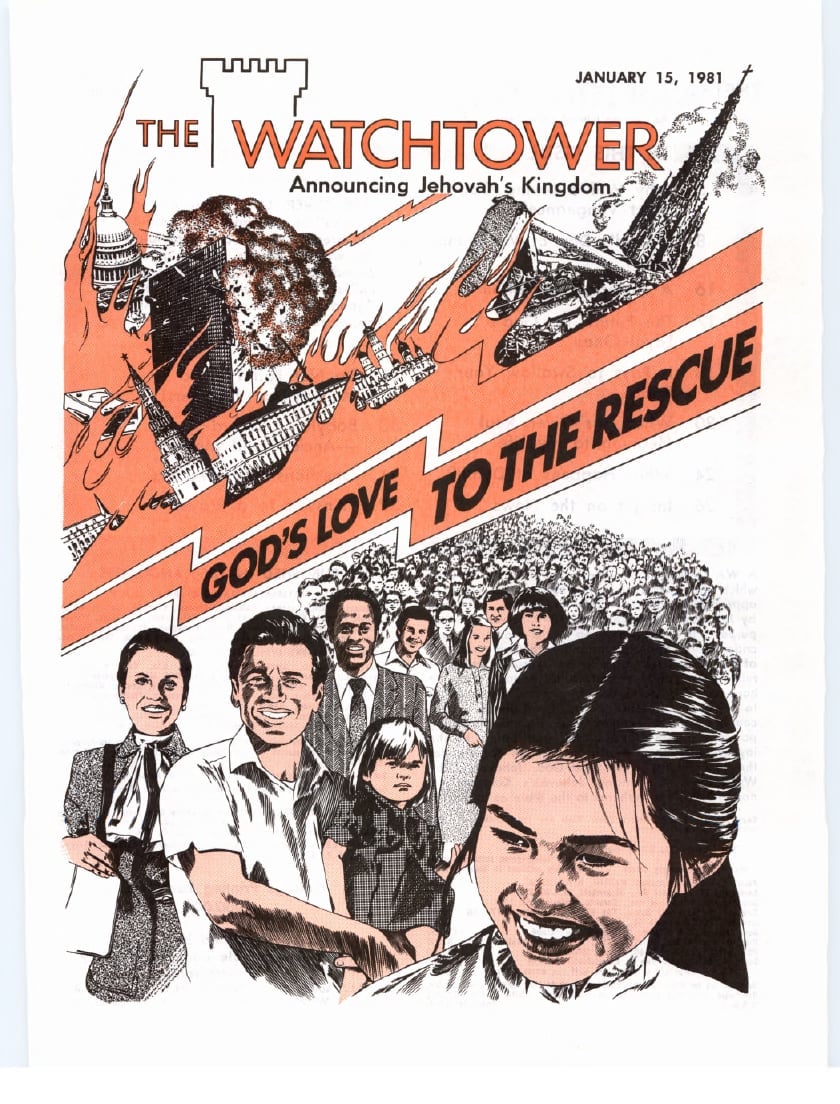
OUR COVER: God’s “day of vengeance” is at hand! Yet, out of his great love, God is providing the way of escape into a global paradise. You can be one of the millions that are responding to this “good news.” Read the following pages for the details
Why Will a Loving God Exact Vengeance?
Why Will a Loving God Exact Vengeance?
“God is love.”—1 John 4:8.
1. What will help us to understand an apparent contradiction in our theme?
VENGEANCE? From a loving God? How can that be? Is not the thought of a loving God’s doing something vengeful a contradiction? It might seem that way. But let us consider the loving qualities that the Creator displays, and then we will understand more clearly how this relates to his vengeance.
2. Why can we say God’s love is superlative, and what are some of his loving provisions for which we should be thankful? (Ps. 136:1-6)
2 When we talk about God’s love, we can say that it is superlative, that is, of the highest degree. And it has been expressed toward us in a multitude of ways. Consider, for example, the earth on which we live. The Bible says that the earth is ‘God’s gift’ to humans. (Ps. 115:16) And what a marvelous gift! Think how lovingly God prepared this globe for us. God placed it in the heavens for it to get just the right amount of heat and light from the sun, and clothed it with a lovely carpet of greenery, along with a wide variety of beautifully colored flowers. And out of God’s love, he stocked our earth with an abundance of animal, bird and fish life, and provided an overflow of grain and other foods.—Ps. 104:1, 13-15.
3. How did God display love in creating us humans?
3 However, God’s love is expressed not only in the things he made for us; it is also expressed in the way he made us. He made us to enjoy his creations. How well the psalmist expressed it when he said: “O Jehovah, . . . I shall laud you because in a fear-inspiring way I am wonderfully made”! (Ps. 139:1, 14) Out of his generosity and love, God gave us eyes to behold the beauty of the world about us. He gave us ears with which we could delight in different sounds such as music and human voices. He gave us a nose by which we could take in the aromas of food and the fragrance of flowers. And to top it all is the human brain, which reasons, remembers and coordinates the body’s actions. Really, we have to marvel at God’s rich endowment of our bodies. Truly, “God is love.”—1 John 4:8.
God’s love to the rescue
4. How was God’s love expressed in the paradise of Eden?
4 When God created the first man, Adam, he placed him in the beautiful paradise of Eden. What pleasure Adam must have found in the abundance of God’s loving provisions around him! Later, God formed Eve and brought her to Adam. How delightful for Eve, on her first day of life, to be united with a husband and head who would cherish and guide her! Together they could look forward to carrying out God’s will in beautifying and populating the earth, and having loving dominion over the animal creation. What a grand future God placed before them!
5. (a) How did our first ancestors become unworthy of God’s love? (b) Yet how was God’s love extended to their offspring?
5 However, sad to say, that future was not to be, at least not for them. A rebellious spirit creature selfishly took himself out from under God’s love, making himself into Satan the Devil. This Devil persuaded Eve, and through her, Adam, to ‘do their own thing.’ Thus, they took a selfish course, independent of their Creator. But in doing this, they showed themselves completely unworthy of their Creator’s love. So God rightly passed the sentence of death on those willful sinners. Yet, out of his love for mankind, he permitted them to survive until they could produce children, otherwise we would not be alive right now. Moreover, though the human race had inherited sin and death from our first parents, the loving God provided a basis for hope.—Gen. 3:16-23; Rom. 8:20, 21.
6. What pronouncements in Eden showed forth God’s love, and how?
6 In what way? Well, at the very onset of rebellion, God made known that he would raise up a ‘Seed,’ that is, an offspring. He would send this One forth from his own loyal heavenly organization to undo all the damage caused by the Devil, and Adam and Eve. However, back there in Eden, the loving God also declared that he would execute vengeance upon Satan and all others who would make themselves part of the offspring of Satan by turning from God’s love.—Gen. 3:15; Rev. 12:9.
GOD OF LOVE, AND OF VENGEANCE
7. In line with Deuteronomy 32:43, what reasons do we have for gladness?
7 So the God of love declared himself also to be a God of vengeance. But his taking vengeance on his enemies would be right. Why so? Because it would clear the way for all persons who love God to be glad, to rejoice. Surely, we now can rejoice that God will clear the way for us to enjoy his provision of everlasting life. Notice what God inspired Moses to say: “Be glad, you nations, with his people, for he will avenge the blood of his servants, and he will pay back vengeance to his adversaries.”—Deut. 32:43.
8, 9. (a) Out of his love, what two things does God purpose to do? (b) In expression of his love, what marvelous gift has God made?
8 Yes, our loving God purposes to vindicate the rightfulness of his rule, and to rescue those who love him from their adversaries. Why, he will even rescue us from the great enemy, death, that comes into our lives by inheritance from our first parents. (Rom. 5:12) But how does God do this? The Bible tells us that he does it by the gift of his Son: “God is love. By this the love of God was made manifest in our case, because God sent forth his only-begotten Son into the world that we might gain life through him. The love is in this respect, not that we have loved God, but that he loved us and sent forth his Son as a propitiatory sacrifice for our sins.”—1 John 4:8-10; 1 Cor. 15:25, 26.
9 So God provided his Son Jesus Christ to release us from the death that comes to us because of the sin inherited from Adam. Yes, as the Bible says at First Timothy 2:6, Christ “gave himself a corresponding ransom for all” who would exercise faith in him. Jesus could therefore say concerning his sheeplike followers: “I have come that they might have life and might have it in abundance,” yes, everlasting life.—John 10:10.
10. (a) Why is the ‘God of love’ a God also of “vengeance”? (b) Why is it so important today that we know and obey God?
10 Yet, repeatedly, the Bible tells us that the ‘God of love’ is also a ‘God of vengeance.’ Why? Because God’s love cannot forever tolerate evil. (Nah. 1:2; Deut. 32:35, 41) That is why the apostle Paul writes about the “revelation of the Lord Jesus from heaven with his powerful angels in a flaming fire, as he brings vengeance upon those who do not know God and those who do not obey the good news about our Lord Jesus.” (2 Thess. 1:6-9) How important it is, then, that we come to know God! In this mixed-up world of so many different religions, how vital it is, as the Bible says, ‘to seek the true God and really find him!’—Acts 17:27.
BALANCING VENGEANCE WITH LOVE
11, 12. (a) What situation developed early in human history, calling for what action on God’s part? (b) How was God’s vengeance there balanced out with his love?
11 However, let us return to the beginnings of human history. This will help us to understand better the relationship between God’s love and his vengeance. Lovingly, God had permitted the offspring of Adam to multiply. But wayward humans did not respond to that love. So, after some 500 years, Jehovah sent his prophet Enoch to pronounce divine judgment on wicked humans because of their ungodly deeds and the shocking things that they spoke against God. (Jude 14, 15) Another thousand years passed, and that ancient world reached its zenith of immorality and violence. Thus, God’s Word says, “the earth came to be ruined in the sight of the true God and the earth became filled with violence. So God saw the earth and, look! it was ruined.”—Gen. 6:11, 12.
12 Now, what would God do? Would he exact vengeance? Yes! But even in this, his quality of love came to the fore. Why do we say so? At that time, there was one family on earth devoted to doing God’s will. It was the family of Noah, the man who is called in the Bible “a preacher of righteousness.” Lovingly, Jehovah had Noah construct an ark “for the saving of his household.” Then came the global flood, which wiped out Noah’s wicked neighbors. (2 Pet. 2:5; Heb. 11:7) The entire earth was cleansed of ruinous violence and immorality, so that it again became a fit place for the families of mankind to multiply.—Gen. 6:9, 22; 7:21-23; 8:15-17.
13. Was Jehovah’s judging of Sodom and Gomorrah unloving, and why do you so answer?
13 However, sinful tendencies inherited from Adam remained, and soon godless humans began to show bad traits again. (Ps. 51:5) Take, for example, the people of Sodom and Gomorrah, who dwelt in a district that was once “like the garden of Jehovah.” The Bible tells us that “the men of Sodom were bad and were gross sinners against Jehovah.” They were homosexuals, and were violent in seeking to gratify their lusts. (Gen. 13:10, 13; 19:4-11) The loving God, Jehovah, determined to destroy those cities. In this way righteous Abraham and his nephew Lot would no longer have to put up with such vile neighbors. As Genesis 18:25 says, the “Judge of all the earth,” Jehovah, did ‘what was right.’ He delivered Lot and his two daughters, but rained fiery destruction on Sodom and Gomorrah, decontaminating that entire district.—Luke 17:29; Jude 7.
14, 15. (a) How innocent were the Canaanites? (b) Did God act rightly in executing vengeance on them?
14 Years afterward Jehovah again did ‘what was right’ toward his people, Israel. How? In arranging to drive away the Canaanites from the Promised Land. (Deut. 18:9-12) ‘But was that not unfair to those innocent Canaanites?’ someone may ask. Innocent Canaanites? By no means were they innocent! Those Canaanites had become disgusting in their practices of incest, sexual uncleanness, adultery, sacrificing of children, homosexuality and bestiality. For example, in the worship of their false gods they sacrificed their children by throwing them alive into the fire. Also, they had female and male temple prostitutes.a Therefore, Jehovah gave these instructions to his people: “Do not make yourselves unclean by any of these things, because by all these things the nations whom I am sending out from before you have made themselves unclean. Consequently the land is unclean, and I shall bring punishment for its error upon it, and the land will vomit its inhabitants out.”—Lev. 18:1-25.
15 Again, it was out of love for his own people that Jehovah commanded Israel to clear out those wrongdoers. Their filthy way of life endangered God’s people. It was as the Bible puts it, “something detestable to Jehovah.” Rightly, then, God’s vengeance blazed against them.—Ps. 106:34-40; Deut. 18:12.
16. How were God’s love and patience expressed toward Israel?
16 On the other hand, how did God deal with the people of Israel? Jehovah expressed a most tender love toward them. Moses described it in these beautiful words at Deuteronomy 32:11 and 12: “Just as an eagle stirs up its nest, hovers over its fledglings, spreads out its wings, takes them, carries them on its pinions, Jehovah alone kept leading him, and there was no foreign god along with him.” But, alas! In time, foreign gods did intrude into Israel’s worship. Thus, the God who had declared that he would pay back vengeance to their adversaries was compelled to exact vengeance from his own people. But how patient Jehovah was toward Israel! Why, for 900 years he endured their waywardness! During all that time, Jehovah extended his hand of mercy toward them. “I take delight,” declared Jehovah God, “not in the death of the wicked one, but in that someone wicked turns back from his way and actually keeps living. Turn back, turn back from your bad ways, for why is it that you should die, O house of Israel?”—Ezek. 33:11.
17. (a) What warning did God give Israel? (b) How was God’s executing of vengeance on Israel tempered by his love?
17 Time and again, God warned his people of the consequences of their idolatry, their immorality, and their shedding of innocent blood. But, at last, Jehovah was compelled to exact vengeance from Israel by allowing King Nebuchadnezzar of Babylon to destroy Jerusalem and their temple. The survivors were carried off to Babylon. However, after 70 years God maneuvered the overthrow of Babylon so that an appreciative Israelite remnant could return to their own land and resume pure worship there.—2 Ki. 24:3, 4; 2 Chron. 36:12-21; Ezra 1:1-3; Heb. 12:6.
JESUS SPEAKS OF LOVE AND VENGEANCE
18. What expressions did Jesus make concerning (a) God’s love, and (b) his vengeance?
18 What did Jesus Christ have to say about this matter of God’s love and vengeance? For one thing, he spoke warmly of his Father’s love, saying: “God loved the world [of mankind] so much that he gave his only-begotten Son, in order that everyone exercising faith in him might not be destroyed but have everlasting life.” (John 3:16) But did he hesitate to speak of God’s vengeance? Why, no! For the Bible says that Jesus, just like his Father, ‘loved righteousness, and hated lawlessness.’ Jesus in particular hated the lawlessness and bloodguilt of the religious leaders. (Heb. 1:9; Ps. 11:5, 7) He never minced words when he spoke to, or about, the Jewish clergy of his day. Three times in his Sermon on the Mount, he called them “hypocrites.” (Matt. 6:2, 5, 16) He told those clergy: “You are from your father the Devil,” thus linking them with ‘the seed of the serpent.’ (John 8:44; Gen. 3:15) Then, just three days before he was murdered, Jesus denounced those Jewish religious leaders publicly, saying: “Serpents, offspring of vipers, how are you to flee from the judgment of Gehenna?”—Matt. 23:13-33.
19. (a) Why were Jesus’ attitude and warning message most loving? (b) But how did Jehovah act rightly?
19 Did this mean that Jesus was unloving? Not at all, for while Jesus knew that those Jews were about to add to their bloodguilt by killing him, yet he went on to say, in Matthew chapter 23: “Jerusalem, Jerusalem, the killer of the prophets and stoner of those sent forth to her,—how often I wanted to gather your children together, the way a hen gathers her chicks together under her wings! But you people did not want it. Look! Your house is abandoned to you.” (Matt. 23:37, 38; Acts 3:13-15) Thirty-seven years later Roman armies sacked Jerusalem and destroyed its temple. This was a calamity in which 1,100,000 of its rebellious people died! Then, at that time, the full force of Jesus’ prophetic words became clear. Rightly, Jehovah had exacted vengeance!
20. In connection with love and vengeance, what interesting features are to be found at Isaiah 61:1, 2?
20 Centuries earlier, Isaiah, one of the prophets reportedly murdered in ancient Jerusalem, spoke these words: “The spirit of the Sovereign Lord Jehovah is upon me, for the reason that Jehovah has anointed me to tell good news to the meek ones . . . to proclaim the year of goodwill on the part of Jehovah and the day of vengeance on the part of our God; to comfort all the mourning ones.”—Isa. 61:1, 2.
21. (a) What may have been Jesus’ reason for quoting Isaiah 61:1, 2 only in part? (b) What question arises, involving Isaiah 2:2-5?
21 Jesus read this prophecy, in part, at the start of his earthly ministry and applied it to himself as the Chief Anointed One of Jehovah. (Luke 4:18-21) However, when Jesus quoted those words of Isaiah he stopped short of mentioning the day of God’s vengeance. Why? Apparently the major emphasis on proclaiming the day of God’s vengeance would come “in the final part of the days,” as Isaiah chapter 2 puts it. Have we now reached that time?
[Footnotes]
See also Aid to Bible Understanding, published by the Watch Tower Society, pages 76, 145 and 287, under “Anath,” “Ashtoreth” and “Canaan, Canaanite.”
[Box on page 3]
“How many your works are, O Jehovah! All of them in wisdom you have made. The earth is full of your productions. . . . Bless Jehovah, O my soul. Praise Jah, you people!”—Ps. 104:24, 35.
[Box on page 4]
THE GREATEST GIFT OF GOD’S LOVE
Out of the depth of his love for suffering mankind, God was willing to sacrifice his most precious possession, his most intimate companion, the “master worker” with him in creation, the “one he was specially fond of day by day.” He was prepared to send his firstborn heavenly Son down to this earth, to suffer all the reproaches, indignities and cruelties that the Devil and his dupes might heap upon him. Under test, the Son would prove that, as a perfect man, he could uphold God’s sovereignty under the severest trials, even to death itself. Moreover, he would thus “give his soul a ransom” on behalf of the many from sin-stricken mankind who would exercise faith in him. (Prov. 8:30; Matt. 20:28) Jesus could therefore say concerning his sheeplike followers, both of the “little flock” and his “other sheep”: “I give them everlasting life, and they will by no means ever be destroyed.” The majority would attain to that life by a resurrection from the dead. (Luke 12:32; John 10:16, 28; 5:28, 29) What an undeserved kindness this is, as expressed toward helpless mankind! If we should spurn this loving provision, indeed we would be deserving of God’s vengeful wrath!
[Box on page 5]
OUR LIVES DEPEND ON IT!
Most people are born into a religion. But does this mean that they worship the true God? Rather, is not the religion of many an accident of birth? But our very lives depend on ‘knowing God and obeying the good news about the Lord Jesus,’ whom he sent forth to ransom us from sin and death. (2 Thess. 1:8; Mark 10:45) Quite obviously, the world about us does not “know God.” The Bible states plainly that there is “one God and Father of all persons.” (Eph. 4:6) Yet mankind is divided into worshiping a multiplicity of religious gods. There are the Buddhas, the ancestral gods of Shintoism and Confucianism, Allah of the Moslems, also Brahma, Vishnu and Siva—the trinity of the Hindus—and Christendom’s trinity of Father, Son and “Holy Ghost.” Many persons even worship prominent men, dead or alive, such as “rock” stars, sports heroes and revolutionary leaders.
[Box on page 6]
ARCHAEOLOGICAL FINDS IN CANAAN:
“Canaanites worshipped, by immoral indulgence, as a religious rite, in the presence of their gods; and then, by murdering their first-born children, as a sacrifice to these same gods. It seems that, in large measure, the land of Canaan had become a sort of Sodom and Gomorrah on a national scale. . . . Did a civilization of such abominable filth and brutality have any right longer to exist? . . . Archaeologists who dig in the ruins of Canaanite cities wonder that God did not destroy them sooner than he did.”—“Halley’s Bible Handbook,” H. H. Halley, p. 161.
[Box on page 7]
JEHOVAH’S EXCELLING QUALITY OF MERCY
Even when he severely disciplined rebellious Israel, Jehovah extended his hand of mercy, saying through his prophet Jeremiah: “Not to time indefinite will Jehovah keep on casting off. For although he has caused grief, he will also certainly show mercy according to the abundance of his loving-kindness. For not out of his own heart has he afflicted or does he grieve the sons of men.”—Lam. 3:31-33
Is God’s Day of Vengeance Near?
Is God’s Day of Vengeance Near?
“Jehovah has a day of vengeance.”—Isa. 34:8.
1. Does Luke 21:25, 26 have its application today?
JESUS CHRIST foretold that the time for God to execute vengeance would be identified by “anguish of nations, not knowing the way out” because of the problems agitating human society. He said that men would “become faint out of fear and expectation of the things coming upon the inhabited earth.” (Luke 21:25, 26) Do we see this situation as we pass into 1981?
YES! WE CERTAINLY DO!
2. (a) What indicates that Revelation 11:15, 18 began its fulfillment in 1914? (b) To what are these events a preliminary?
2 The present world crisis is the outgrowth of distresses that have multiplied among mankind since the nations first became locked in total warfare in the year 1914. According to the prophecy of Revelation chapter 11, that year when “the nations became wrathful”—1914—also marked the time when rightfully “the kingdom of the world did become the kingdom of our Lord [Jehovah] and of his Christ.” (Rev. 11:15, 18) This enthroning of Christ with authority to rule is a preliminary step that paves the way for the execution of vengeance.
3. Where do Christendom’s churches stand with regard to God’s message of vengeance and comfort?
3 Today, is anyone commissioned by God’s spirit to proclaim the day of Jehovah’s vengeance and to comfort all who mourn? Yes, but it is not the churches of Christendom. They have no message of real comfort; nor do they want Jehovah as their God. Not only do they avoid the use of Jehovah’s name, but they persecute true Christians who do honor that name.
4. What reasons do we have to be glad?
4 However, Jehovah’s Witnesses are happy to bear God’s name, the greatest in the universe! They are glad to be called Jehovah’s Witnesses. They are overjoyed that, since the Kingdom’s being established in that eventful year 1914, they have been privileged to declare Jehovah’s “day of vengeance” in all the earth. Indeed, they are determined, as Micah 4:5 puts it, to “walk in the name of Jehovah [their] God to time indefinite, even forever”! And they are delighted that millions of mourning ones have listened to their message, have been comforted and have flocked to the side of God’s incoming kingdom.
GOD’S VENGEANCE—IS IT DESERVED?
5. (a) Of what are these “critical times” the final fruitage? (b) In fulfillment of Paul’s prophecy on “the last days,” what conditions do we now see in Christendom?
5 However, is the world today really so bad that it must meet up with God’s vengeance? Listen to the inspired words of the apostle Paul. He said: “Know this, that in the last days critical times hard to deal with will be here.” These critical times are the final fruitage, the end result of the failure of people to respond to the preaching of the truth. (2 Tim. 2:23-26) Even in the realm of Christendom we now see a frightening increase in crime and violence, the breakdown of the family, disrespect for authority, and loss of morality. At the root of it all are selfishness and greed, the lack of genuine love. Paul goes on to say: “Men will be lovers of themselves, lovers of money, . . . without love of goodness, . . . lovers of pleasures rather than lovers of God.” (2 Tim. 3:1-5) Well, do we see this prophecy being fulfilled throughout the earth today? Yes, indeed. It is being fulfilled in precise detail.
6. What situation has developed in fulfillment of Matthew 24:12?
6 Jesus himself, in prophesying of the “sign . . . of the conclusion of the system of things,” said: “Because of the increasing of lawlessness the love of the greater number will cool off.” (Matt. 24:3, 12) How true this is even of Christendom, as well as of the entire world today! As each Christmastime comes around, there is much talk in Christendom about love, about peace and goodwill among men, but do the nations of Christendom practice such things? Significant are the words of Britain’s prime minister, spoken just one week before Christmas, 1979. She said: “We face a new decade—I have called it ‘the dangerous decade’—in which the challenges to our security and to our way of life may, if anything, be more acute than in the 1970’s.”
7, 8. (a) What doomsday situation do we now find? (b) What assurances does Jehovah give, and how do these involve “love” and “vengeance”?
7 How are the nations responding to such challenges? By intensifying their war preparations. Think of it! This loveless world is spending about one million dollars a minute on armaments, more than 500 billion dollars a year! All of this escalates a doomsday situation for which the world can find no solution. According to information published by a group of physicians, scientists and others in the New York Times of March 2, 1980, if a nuclear war were to break out tomorrow, it could, in just one hour, destroy most life on earth—thousands of millions of people. Yet the nations are working feverishly to produce even more diabolical superweapons.
8 Now, then, will our loving God, the Creator of this beautiful earth, permit wicked nations to burn it to a cinder? Never! For he plainly states in his Word: “This is what Jehovah has said, the Creator of the heavens, He the true God, the Former of the earth and the Maker of it, He the One who firmly established it, who did not create it simply for nothing, who formed it even to be inhabited: ‘I am Jehovah, and there is no one else.’” His peerless name Jehovah stands as guarantee that He, as loving Creator and Sovereign Lord of the universe, will not permit the desolating of our globe. Divine love demands that God exact vengeance from those who desecrate our earth and who would annihilate his human creation.—Isa. 45:18; Jer. 10:10-12.
9. Since the nations refuse to disarm, what does Jehovah propose to do, and why?
9 Since the first world war broke out in 1914, this earth has been drenched with the blood of tens of millions of innocent persons. Why, World War II alone took 55 million lives! And now the prospect of a nuclear holocaust is even more fearsome. So, since the nations refuse to disarm, then our loving God declares that shortly he will disarm them, in his own effective and permanent way. He says: “Come, you people, behold the activities of Jehovah, how he has set astonishing events on the earth. He is making wars to cease to the extremity of the earth.” (Ps. 46:8, 9) Yes, it is Jehovah’s loving purpose to do what the nations will never do—pulverize all their war equipment, even to defusing all their nuclear missiles. As Jehovah says: “Vengeance is mine, I will repay.” (Rom. 12:19; Zeph. 3:8, 9) Does not our loving God’s promise that he will exact vengeance make us glad? It should!
SORROWS MULTIPLY
10. The wars of this century have brought what shocking consequences?
10 The wars fought since 1914 have helped to bring in their wake horrible consequences. Among these are unbridled indulgence in sex, resulting in epidemics of venereal disease and unwanted pregnancies. These unwanted pregnancies have brought with them a tidal wave of abortions. It is estimated that now, worldwide, about 30 to 40 million unborn children are aborted, murdered, every year! That is the most extensive murder of innocents the world has ever seen, dwarfing the deaths in the worst year of any war in history.
11. In what ways are ‘wicked men advancing from bad to worse’?
11 Also, in recent times, we have seen drug addiction, divorce, delinquency and lawlessness of all types on a frightful scale. Today, the homosexual community boasts that it has 20 million adherents in the United States alone. Recently, one homosexual set a modern record by the shocking murder of 33 young men he had sexually assaulted. Yet homosexuality is only one aspect of the immorality increasingly practiced in Christendom and throughout the earth. It is just as Second Timothy chapter 3 says about these “last days,” that “wicked men . . . will advance from bad to worse.”—Vs. 13.
12. What indications do we have that this wicked world has reached its end?
12 Viewing the immoral world around us, we are compelled to exclaim: How like Noah’s day! How like the time of Sodom and Gomorrah! How like the depraved Canaanites and the backsliding Israelites! As this present world sinks ever deeper into the mire of immorality, we are reminded of the warning of the apostle Paul that “those practicing such things are deserving of death.” (Rom. 1:18, 26-32) No, the loving God will not much longer tolerate the horrendous wickedness of this system of things. Instead, he will bring to ruin those who make his earth filthy.—Rev. 11:18.
IDENTIFYING A “FAMOUS PROSTITUTE”
13. What is meant by ‘spiritual adultery’?
13 However, the Bible speaks also of spiritual immorality. This is indulged in by those who claim to be practicing pure religion, but who get mixed up in the affairs of Satan’s world. The Bible says: “Adulteresses, do you not know that the friendship with the world is enmity with God? Whoever, therefore, wants to be a friend of the world is constituting himself an enemy of God.” (Jas. 4:4) Such friendship—spiritual adultery—on the part of those who claim to be God’s servants provides another major reason for Jehovah’s exacting vengeance. Why do we say so?
14. Identify the “famous prostitute” and the “many waters” on which she sits.
14 It is because of what is said in Revelation chapter 17. There we read of “the great harlot who sits on many waters.” What does this mean? The “many waters” are clearly identified for us at verse 15 as meaning “peoples and crowds and nations and tongues.” But who is this “great harlot” that exercises power over the people? The Jerusalem Bible, a Catholic translation, refers to her as the “famous prostitute.” What has she done to make her so famous? Revelation 17:5 provides a clue, stating: “Upon her forehead was written a name, a mystery: ‘Babylon the Great, the mother of the harlots and of the disgusting things of the earth.’”
15. What happened to Babylon, but what legacy did she leave?
15 So the “famous prostitute” has a name, “Babylon the Great.” This links her with the Babylon of ancient history, in the time of King Nebuchadnezzar, which history reveals was full of depraved sex worship and corruption. (Dan. 4:28-30) Today, Nebuchadnezzar’s Babylon is no more. Her site in modern Iraq is a desolation, “as when God overthrew Sodom and Gomorrah.” (Isa. 13:19-22) However, ancient Babylon did leave a legacy for mankind. And what is that? Her idolatry—her religion!
16. (a) How did a world empire of false religion develop? (b) What judgment does God pass on Babylon the Great, and why?
16 From earliest times following the Flood, Babylon was identified with false religion. It was there that men, in defiance of Jehovah, built a city and a religious tower with its top in the heavens. And when Jehovah confused their language, it was from Babylon that they scattered over all the earth, taking their false religion with them. In the fourth century, apostate Christians fused the doctrine and ceremonial practice of Babylon into the religious system that exists to this day in the various sects of Catholicism and Protestantism. Thus, there has developed a world empire of false religion, “Babylon the Great,” embracing “Christian” and nonChristian religions. Because of the involvement of “Babylon the Great” in the persecutions, violence, and even the world wars of history, God passes judgment on her, saying: “In her was found the blood of prophets and of holy ones and of all those who have been slaughtered on the earth.”—Rev. 17:5, 6; 18:24; Gen. 10:8-10; 11:1-9.
17. What is the “scarlet-colored wild beast,” and how has it fulfilled prophecy?
17 Babylon the Great’s adulterous “friendship with the world” goes even farther. It includes her domineering relationship with a symbolic “beast.” For she is described at Revelation 17:3 as also “sitting upon a scarlet-colored wild beast that was full of blasphemous names.” In the Bible, “beasts” are often used to symbolize political nations. (Dan. 7:2-8; 8:5-8, 20, 21; Rev. 13:1-18) But here the prophecy speaks of a grotesque combination “beast” having “seven heads and ten horns.” Modern history shows that this “beast” first appeared in 1920. It was a combine of the nations—the League of Nations. It took a plunge into temporary inactivity during World War II. But—in fulfillment of prophecy—it appeared again as the United Nations in 1945. Shortly, it “goes off into destruction.”—Rev. 17:8-11.
18. How will Babylon the Great’s religious-political intimacies end?
18 False religion, “Babylon the Great,” has tried to give a guiding hand to both the League of Nations and the United Nations. But God’s Word shows that all such religious-political intimacies by popes and other religious leaders will soon come to an end. At a time when the “famous prostitute” thinks she is sitting pretty God will cause the symbolic “ten horns” of the United Nations “beast” to turn their militarized might against her. They will get her off their back, devastate her, destroy her completely, as if by fire.—Rev. 17:16, 17.
“GET OUT OF HER, MY PEOPLE”
19. How does God now express his love to all sincere religious persons?
19 As that hour of judgment approaches, how is God expressing his love? In this way: to all sincere Catholics, Protestants, Buddhists, Hindus—to people of all false religions who want to become God’s people—God extends the urgent invitation recorded in Revelation 18:4, 5: “Get out of [Babylon the Great], my people, if you do not want to share with her in her sins, and if you do not want to receive part of her plagues. For her sins have massed together clear up to heaven, and God has called her acts of injustice to mind.”
20. Why is it high time to get well away from Babylon the Great?
20 Without a doubt, the execution of God’s judgment draws ever closer! Antireligious nations already wield great power in the United Nations. Oil-hungry militaristic countries threaten the Moslem world as well as those nations long regarded as the bulwark of Christendom’s religions. That is why it is now high time for all lovers of truth and righteousness to get well away from the “famous prostitute,” yes, to flee to God’s kingdom.
21. What is Armageddon, and when do the nations find themselves there?
21 What follows the devastation of “Babylon the Great,” the world empire of false religion? The Scriptures indicate that the “ten horns” of the “beast” will turn against true religion, as represented on earth by Jehovah’s Witnesses. But when that happens, those nations will find themselves fighting against God at Armageddon! And Armageddon is not just a small corner in the land of Palestine. Rather, Armageddon is a worldwide situation that calls for vengeance in “the war of the great day of God the Almighty,” the greatest conflict of all time!—Rev. 16:14, 16; 17:12-14.
22. How do the Scriptures show Armageddon to be a righteous war?
22 The Bible says that God uses Christ Jesus with the armies of heaven to ‘judge and carry on war in righteousness.’ Yes, Armageddon will be a righteous war. Righteous? How so? In that it will bring deserved vengeance upon the nations and peoples of earth that have chosen not to know God and who oppose his right to rule. It will be selective in its destruction. It will destroy the wicked, but bring salvation to all who “obey the good news about our Lord Jesus,” says the apostle Paul. Thus, Armageddon will balance out God’s vengeance with God’s love.—2 Thess. 1:8; Ps. 145:20; Rev. 19:11-21.
23. (a) What kind of God is Jehovah, as shown by Psalm 145:17-21? (b) Why, then, does this ‘God of love’ bring vengeance? (c) What action should we take with regard to the approaching “day of vengeance”?
23 Do we not appreciate, then, why the ‘God of love’ must be also a God of vengeance? It is because he loves righteousness and hates wickedness, and so should we. (Ps. 145:17-21) How necessary it is that Jehovah’s great name and purposes be vindicated! How necessary that our earth be cleansed of all the bloodguilt, corruption and immorality that have sullied this beautiful creation of God over the past millenniums! Only then will the earth become the global paradise that God has purposed for mankind. So, first, the matchless ‘God of love’ must clear the way by inflicting vengeance upon his enemies. Are we not glad that his day of vengeance is now at hand? Let us, then, be among those who accept Jehovah’s loving invitation: “Be glad, you nations, with his people, for he will . . . pay back vengeance to his adversaries.”—Deut. 32:43.
[Box on page 10]
THE SHAPE OF THINGS IN THE WORLD
“TOWARDS COLLISION: WORLD. Military expenditure continues to burgeon alarmingly . . . it is now . . . double the tally a decade ago. . . . The amount the world spent equipping each soldier in 1966 was 60 times the amount spent educating each child.”—“To the Point,” November 3, 1978
“. . . FRENCH FORESEE DISASTER. The atmosphere of trouble and fear of the future is real. Some people have gotten to the point of mumbling that economic collapse or war or both are sure to come, and they seem almost relieved at the idea that there is nothing to be done but resign themselves to coming disaster.”—New York “Times,” November 17, 1979
“WEST GERMANS FEAR ARMAGEDDON. The spectre of war has returned to haunt West Germany as the international situation seems to be slipping inexorably out of control. . . . Almost 60 per cent of the population, according to a recent poll, believe that war is likely or at least possible in the next three years.”—“The Times,” London, April 23, 1980
“The world spends more than $500 billion a year on military activities, or about a million dollars a minute. As if this huge sum were not enough, we are about to see a sharp rise in military spending.”—“World Press Review,” August, 1980
[Box on page 13]
FRUITAGE OF “THE LAST DAYS”
“The Los Angeles Police Department reported that 25,000 boys 17 years old or younger in that city alone have been recruited into a homosexual ring to provide sex for adult male customers. One boy, just 12, was described as a $1,000 a day prostitute.”—“Indianapolis Sunday Star,” June 17, 1979
“There were about 1,000 prostitute arrests in Denver last year, and 400 of them were men. That record probably will be exceeded this year and for the first time the number of male prostitutes arrested could exceed the number of females.”—“Rocky Mountain News,” July 8, 1979
“The highest court of the United Methodist Church has ruled that an avowed homosexual . . . may remain as pastor of the Washington Square Church in New York City.”—The New York “Times,” November 3, 1979
[Box on page 14]
THE UNITED NATIONS OR GOD’S KINGDOM—WHICH?
Religion still tries to sit atop the U.N. and control its policies. A recent move was that by Pope John Paul II, who appeared before the United Nations General Assembly on October 2, 1979, amid a great fanfare of publicity. The pope declared: “The formal reason for my intervention today is, without any question, the special bond of cooperation that links the apostolic See with the United Nations Organization. . . . I hope that the United Nations will ever remain the supreme forum of peace and justice, the authentic seat of freedom of peoples and individuals in their longing for a better future.” But the pope did not see fit even to mention God’s instrument for establishing peace, justice and freedom—the Kingdom concerning which Jesus prayed to his Father: “Let your kingdom come. Let your will take place, as in heaven, also upon earth.” (Matt. 6:10; Rev. 11:15) The emergence of powerful antireligious forces in the U.N. does not bode well for the future of the ‘world empire of false religion.’—Rev. 17:16, 17.
[Picture on page 12]
To make room for the New Order the old must be peeled away
A Historic Celebration
A Historic Celebration
“THE WAR of the great day of God the Almighty” at Armageddon will be the greatest in the history of our globe, and it will be the last. (Rev. 16:14, 16) As God’s prophet declared, for the comfort of those who love him: “Jehovah is good, a stronghold in the day of distress. . . . He is causing an outright extermination. Distress will not rise up a second time.”—Nah. 1:7-9.
What follows next? The apostle John tells us that he hears “a loud voice of a great crowd in heaven.” In grand chorus, this angelic host is singing: “Hallelujah! The salvation and the glory and the power belong to our God, because his judgments are true and righteous. For he has executed judgment upon the great harlot who corrupted the earth with her fornication, and he has avenged the blood of his slaves at her hand.” (Rev. 19:1, 2, “Kingdom Interlinear Translation”) What rejoicing! Because, for all time, the oppressions, the apostasy and the murderous ways of the world empire of false religion, “Babylon the Great,” have been swept off the face of God’s earth.
What else does the apostle hear? “And right away for the second time they said: ‘Hallelujah!’” Then a third “Hallelujah!” rings out, and appropriately John, who is elsewhere called ‘a Son of Thunder,’ adds the climactic words: “I heard what was as a voice of a great crowd and as a sound of many waters and as a sound of heavy thunders. They said: ‘Hallelujah, because Jehovah our God, the Almighty, has begun to rule as king.’”—Rev. 19:3-6, “Int.”; Mark 3:17.
The singing of those heavenly voices is far grander than any “Hallelujah chorus” ever heard on this earth. The myriads of angels know what that song is all about. So they sing it with delightful feeling and expression: “Hallelujah!”—meaning “Praise Jah, you people!” God’s people on earth come out of the “great tribulation” to share in that song, praising Jah, Jehovah, the Sovereign Lord of all the universe, for his great victory over all the forces of wickedness.
Other glorious events follow. Jehovah’s people are invited to “rejoice and be overjoyed,” because now a marriage takes place in heaven. The Lamb is united with his “wife”—the full number of 144,000 resurrected “holy ones,” who have been identified by the “righteous acts” that they performed while humans on earth. (Rev. 19:6-8; 14:1-5) The governmental arrangement of the “new heavens” is now complete. Already, before the “great tribulation,” the Lamb had been shepherding a “great crowd” of human worshipers. (Rev. 7:9, 14) But now the promise that God “will wipe out every tear from their eyes” is to be fulfilled toward all mankind, including the resurrected dead, as a “new earth” society begins to operate among humans.—Rev. 21:1, 4; 2 Pet. 3:13.
God’s loyal ones in heaven and on earth will be united in that grandest, that most meaningful singing of the Hallelujah chorus. For Jah, Jehovah, will have gained the victory!
The Future for God’s Loyal Ones
The Future for God’s Loyal Ones
“JEHOVAH is righteous; he does love righteous acts. The upright are the ones that will behold his face.” Those words of King David are found at Psalm 11, verse 7. And today, what a glorious future lies ahead of those who perform righteous acts in God’s service! Revelation chapter 7 describes “a great crowd . . . out of all nations and tribes and peoples and tongues,” that survives the final war of Armageddon. Over them God spreads his “tent,” drawing these dedicated servants into a grand intimacy with him.—Rev. 7:9-17.
Our loving God does not want us to be destroyed with the wicked in His day of vengeance. He wants us to find salvation. And to encourage us in this, he provides in the Bible a glorious forevision of “a new heaven and a new earth.” That new earth will be a stable human society, united by divine love under the “new heaven” composed of Christ Jesus and his 144,000 corulers. All these anointed ones will have shown themselves to be loyal to God here on earth, and will have been resurrected to rule with Christ in his heavenly kingdom. The billions of mankind will find it easy to place great confidence in those tried and proven governors.—Rev. 14:1, 4, 5; 20:6; 21:1, 2.
Did we say billions of humans here on earth under Kingdom rule? Yes, billions! For that will be the grand time of the resurrection of the dead into the paradise earth. That is the paradise that Jesus spoke about to the evildoer who was with him at Calvary. (Luke 23:43) What rejoicing there will be among those resurrected ones over being released from the grip of death! Tears, mourning, outcry, pain—even inherited death—will be no more.—Rev. 20:11-14; 21:3, 4.
In that new order, blind eyes will be opened to rejoice in beholding God’s beautiful creations. Deaf ears will be unstopped to listen to music more delightful than any yet composed by man. Song writers themselves will be perfect, and their melodies will exalt Jehovah and his grand accomplishments. The tongue of the dumb will be loosed, to share in delightful conversation and in praising Jehovah. Lame ones will run again, and radiant health will be the lot of all mankind. All these blessings, and many more, will flow to humanity.—Compare Isaiah 35:1-6.
In God’s new order, there will be no corrupt politicians to oppress, no armies to kill and maim, no selfish profiteers to inflate oil and commodity prices. No longer will thousands of Babylonish religious sects confuse people, or shed innocent blood in religious warfare. Instead, all mankind will be united in the one true worship of our loving God, who declares from his heavenly throne: “Look! I am making all things new.”—Rev. 21:5.
Let all who look forward to that grand provision of Jehovah now share in the fulfillment of his prophecy: “Your loyal ones will bless you. About the glory of your kingship they will talk.”—Ps. 145:10, 11.
It Pays to Swallow Your Pride
It Pays to Swallow Your Pride
FOR at least half a dozen reasons it pays to swallow your pride. This is not to say, however, that for the Christian pride must be categorically condemned each and every time. For though pride often arises from haughtiness and lack of humility, at times it has to do with self-respect, praiseworthy accomplishment or our relationship with God.
For example, the apostle Paul wrote to the congregation at Thessalonica, which it was his privilege to establish, in these words: “We are obligated to give God thanks always for you, brothers, as it is fitting, because your faith is growing exceedingly and the love of each and all of you is increasing one toward the other. As a result we ourselves take pride in you among the congregations of God because of your endurance and faith in all your persecutions and the tribulations that you are bearing.” Such faith and love on their part made proper pride on Paul’s part appropriate.—2 Thess. 1:3, 4.
The apostle Paul also spoke of some who took pride in God. (Rom. 2:17) And, repeatedly, in the Bible we read of God’s servants’ making their boast in Jehovah God and Jesus Christ, or, it might be said, taking pride in them.—Ps. 34:2; 1 Cor. 1:31; Phil. 3:3.
It doubtless could be said that there are times when family members may take proper pride in the qualities, virtues or achievements of one another, as when a husband is proud of his wife’s cooking. Or parents may be proud that children they have reared make a choice of full-time service to their God.
However, you may be surprised to know that, in the Word of God, pride is referred to in a condemnatory way 20 times as often as it is in a favorable way. Why is this so? Why do we need to be counseled repeatedly against pride? Because usually it is an ingrained form of selfishness that can so easily get us into trouble unless we are always on guard against it. Yes, “the inclination of the heart of man is bad from his youth up.”—Gen. 8:21.
Really, it is as though we needed to lean over backward, as the saying goes, to reject anything and everything that savors of self-exaltation or pride. How many have made fools of themselves because of pride! Worse yet, how many have perished because of their pride! Well did an English essayist once observe: “In general, pride is at the bottom of all great mistakes.” A modern notorious example is that of Adolf Hitler.
Most seriously counting against pride is the fact that it can make us enemies of Jehovah God, for we read: “God opposes the haughty ones, but he gives undeserved kindness to the humble ones.” (1 Pet. 5:5) Yes, in this sense “everyone that is proud in heart is something detestable to Jehovah.” (Prov. 16:5) No wonder that we further read that “pride is before a crash, and a haughty spirit before stumbling.”—Prov. 16:18.
Many are the Bible examples showing that it is the course of wisdom to swallow one’s pride, as when we are given counsel. A case in point was the Syrian army chief Naaman who was afflicted by leprosy. It hurt his pride to have Elisha’s attendant tell him to dip himself seven times in the waters of the Jordan in order to be cured. Naaman bragged that the rivers of Damascus were superior to the Jordan. However, he swallowed his pride and let his servants persuade him to act on the message sent by Elisha. Doing so, Naaman was cured of his leprosy. Surely it paid him to swallow his pride. (2 Ki. 5:11-14) So it is with us. When we are given wise counsel that goes against our inclinations, we do well to swallow our pride.
In this connection, we read: “Give a reproof to a wise person and he will love you.” “The ear that is listening to the reproof of life lodges right in among wise people.” (Prov. 9:8; 15:31) One who refused to accept reproof in earliest times was Cain. Jehovah God warned him: “There is sin crouching at the entrance, and for you is its craving; and will you, for your part, get the mastery over it?” Because of his pride Cain refused to listen and so became a murderer and was ostracized. (Gen. 4:7) Another example was that of King Uzziah. His military successes so went to his head that he sought to usurp the functions of a priest. When rebuked, he stubbornly refused to swallow his pride and, as a result, died as a leper.—2 Chron. 26:16-21.
At times we may be slighted or insulted in one way or another. What shall we do? Retaliate? Respond in kind? No, for we are not to render evil for evil. (Rom. 12:17-21) In such instances, Jesus’ words apply: “Whoever slaps you on your right cheek, turn the other also to him.” (Matt. 5:39) One who refused to take a slight, refused to swallow his pride, was Haman the Agagite. King Ahasuerus had ordered that all bow down before Haman, but Mordecai the Jew, for good reasons, refused to do so. This so enraged proud and vain Haman that he was determined to kill not only Mordecai but all the Jews. In the end Haman was first greatly humiliated and shortly thereafter died on the stake he had prepared for Mordecai. Had Haman swallowed his pride and ignored the slight Mordecai gave him, he might not have come to such an untimely and humiliating end. (Esther, chaps. 3 to 9) Well do we read: “A fool shows his ill humour at once; a clever man slighted conceals his feelings.”—Prov. 12:16, The New English Bible.
Then again, it pays to swallow our pride and apologize if we have wronged another by some word or action. We really owe it to ourselves and the other person to make amends. As Jesus counseled in his Sermon on the Mount: “If, then, you are bringing your gift to the altar and you there remember that your brother has something against you, leave your gift there in front of the altar, and go away; first make your peace with your brother, and then, when you have come back, offer up your gift.”—Matt. 5:23, 24.
Still another instance in which we may need to swallow our pride is to admit a mistake when we have made one. Nobody knows everything; nobody is perfect. So when we find that we really did not know what we were talking about, or made some mistake in judgment and so acted unwisely, the course of wisdom is to admit it to others who may be affected by it. This is especially important on the part of those having oversight, be they parents, supervisors or appointed elders in a congregation.—Compare James 3:1, 2.
Also, it will pay us to swallow our pride by always expecting less than we think we are entitled to. Thus Jesus said that when invited to a banquet we should take the lowest seat, even though we might feel that we are entitled to a more honorable one. Better it is to be asked to go to a more honorable seat than to be asked to step down to a less honorable one.—Luke 14:7-11.
Truly, there are many reasons, are there not, for our swallowing our pride? It does pay to do so.
What Has Given Real Meaning to My Life
What Has Given Real Meaning to My Life
As told by Jaya Reddy
IT WAS my love of books that first awakened my interest in religion. For as far back as I can remember, books have held a special fascination for me. One day I was searching among a pile of books for something to read when I came across one with an unusual title, From Paradise Lost to Paradise Regained. We had obtained it from one of Jehovah’s Witnesses who had called at our door. It had been left in the drawer, forgotten and untouched. I found it strangely absorbing. Within a week I had read it from cover to cover.
I was 12 years old at the time. The book awakened my interest in the Bible, the textbook of a religion different from my own. I was born into a Hindu family, but I really never practiced the religion. We live in Durban, that bustling port on the east coast of South Africa.
PHYSICAL DISABILITY
My mother had three children and all of us had one thing in common. We were all born with a hereditary disease, muscular dystrophy. There are three different forms of the disease. My elder brother had the worst form, and he died at the age of four.
We were all normal and well at birth, deceptively so. It is later that the signs show up—perhaps a weakness in the arms, a lack of strength in the legs, which causes one to stumble suddenly, and, over the years, a progressive slowness in the limbs and muscles. The disease creeps up on one in a slow, insidious manner.
Over the years, more and more of my muscles have weakened as a result of the disease. Thus, to do such simple things as eating or combing my hair require unusual effort. Even sitting can put a great strain on the muscles. My muscles are so very weak that I have to wear the lightest clothes and I sit only with the aid of a spinal brace.
When the muscles tire through strain, they become tense and ache, sometimes for days. At times the tension buildup in my muscles is so bad that every nerve and fibre screams with the ache. The muscles that enable one to sit weakened over the years, and I developed a curvature of the spine.
When I was 18 I underwent a major operation for correction of the spine. This was the Harrington procedure, whereby steel rods are placed in the spine to keep it straight and are kept in place by steel screws. In my brother’s case the progress of the disease was much slower, but eventually he, too, ended up in a wheelchair in his mid-teens.
DEVELOPING WIDE INTERESTS
Being confined to a wheelchair did not keep me from developing many interests. My mother is to be thanked for that. She did her utmost for us, sparing nothing and sacrificing much. She gave us a normal upbringing. We were never pampered or mollycoddled.
I was 11 years old when mother first suggested that I take up writing. It would be the ideal thing, she said. I could work at home, in my own time. The idea appealed to me. Apart from the practical considerations, I loved the world of make-believe. I was also the introspective type, given to daydreaming and reverie. So my early attempts at writing were all fairy tales.
On looking back now, I’m glad I began at an early age, since writing is not an easy profession. Yet it is something that grows on you and develops with you. Inevitably it becomes so much a part of you that one portion of your mind is always automatically absorbing ideas, impressions and thoughts for future use.
I developed a particular interest in history and wildlife. Also, I read all that I could find on religion. Because I loved poetry and literature, I found the rare lyricism and beauty of the Bible especially striking. Later, with my growing awareness of life and the injustices of man’s inhumanity to man, I developed an interest in sociology and the humanities.
LOOKING FOR ANSWERS IN RELIGION
When I was 15 I joined one of the minor “Christian” sects, and attended its services occasionally in an effort to find something satisfying and wholesome. But I was deeply dissatisfied with much that I saw.
I noticed that the priest, with a few exceptions, took no interest in the members of his flock. He appeared to be very prosperous, for he often had a new car and lived well. Also, racial inequality was practiced. A Black priest earned far less than his White counterpart. The sermons were a bore. One sermon was no different from another and they seemed to concentrate on just a handful of scriptures.
I questioned the ability that certain members of the church were supposed to have of speaking in tongues and healing the disabled. Despite my physical condition, in my search for the truth I was not looking for physical healing. It seemed unreasonable to me that a God of love would heal a few while overlooking the sufferings of the masses. I felt sure there was something deeper involved.
I was learning nothing in church. So I stopped attending and decided to study the Bible on my own.
DEVELOPING VIEWPOINTS
In the meantime, I had begun to question life around me. History as a whole seemed to be marked by man’s inhumanity to man, inequality, injustice and oppression of the poor by a handful who held the reins of power. We needed an ideology that spelled freedom and equality for all and that allowed the individual to develop freely to his full potential.
I felt strongly that the answer lay in politics, for power in the right hands exercised in the right way could result in good. How much better it would be if our leaders were real Christians who cared about individual rights and freedoms and who allowed the teachings of Jesus Christ to guide their decisions for their country’s benefit!
Occasionally I used to get The Watchtower and Awake! I noted that all facts and counsel given in these magazines were supported by the Bible. To me the reasoning was sound and especially suited for the problems and difficulties experienced in today’s world. But there was one point in particular that I could not accept: The neutrality of Christians in political affairs. True Christians, I was convinced, could be a powerful force for good in the world if they became politically involved.
As I came to feel more strongly about this, the more I disagreed with the Witnesses on their political neutrality. And yet I admired their stand. From my study of history, I agreed that war was a terrible thing. Two world wars had caused enough havoc for us to wish that we would never repeat the mistake.
Actually, I was against all mindless killing, including the wanton destruction of wildlife. Through man’s folly and selfishness, many beautiful and rare species were on the verge of extinction. From my study of the Bible, I knew that God had not purposed it to be so. Man’s dominion over God’s animal creation was meant to be a dominion of love.
I became convinced that the answer to man’s problems lay somewhere within the pages of the Bible. But my knowledge was too inadequate. Meanwhile, I had decided to use my writing as a vehicle for highlighting the hardships and oppression suffered by the Blacks. I felt there had to be a change.
THE SOURCE OF TRUE WISDOM
At this point in my life, I went into the hospital for the spinal operation. Recovery was slow and lengthy. Two years later, when I was 20, I began an in-depth study of the Bible.
A Witness with whom I was slightly acquainted rang me up one day in January 1969 for a friendly chat. I invited him to come by that weekend. He placed the book The Truth That Leads to Eternal Life with me, saying: “I know you’ll read it within the week. But reading it is not enough. The material the book contains is deep and requires careful study.”
…