The Watchtower, November 15, 1980
Download: PDF — The Watchtower, November 15, 1980
The Watchtower — November 15, 1980
Source: jw.org
Contents
Page Two
Isolation Can Be Hazardous
Do Not Isolate Yourself
Generosity Brings Blessings
Insight on the News
Missionaries Told: “Glorify Your Ministry!”
The Road to Recuperation Opened by God
Humanity’s State of Health That Might Have Been
“Jehovah of Armies” to the Rescue!
By What System Is Your Family Governed?
Jesus As Sound Engineer
Questions From Readers
Could All Animals Have Fit in Noah’s Ark?
Prayers and Efforts Are Rewarded
Page Two
Page Two
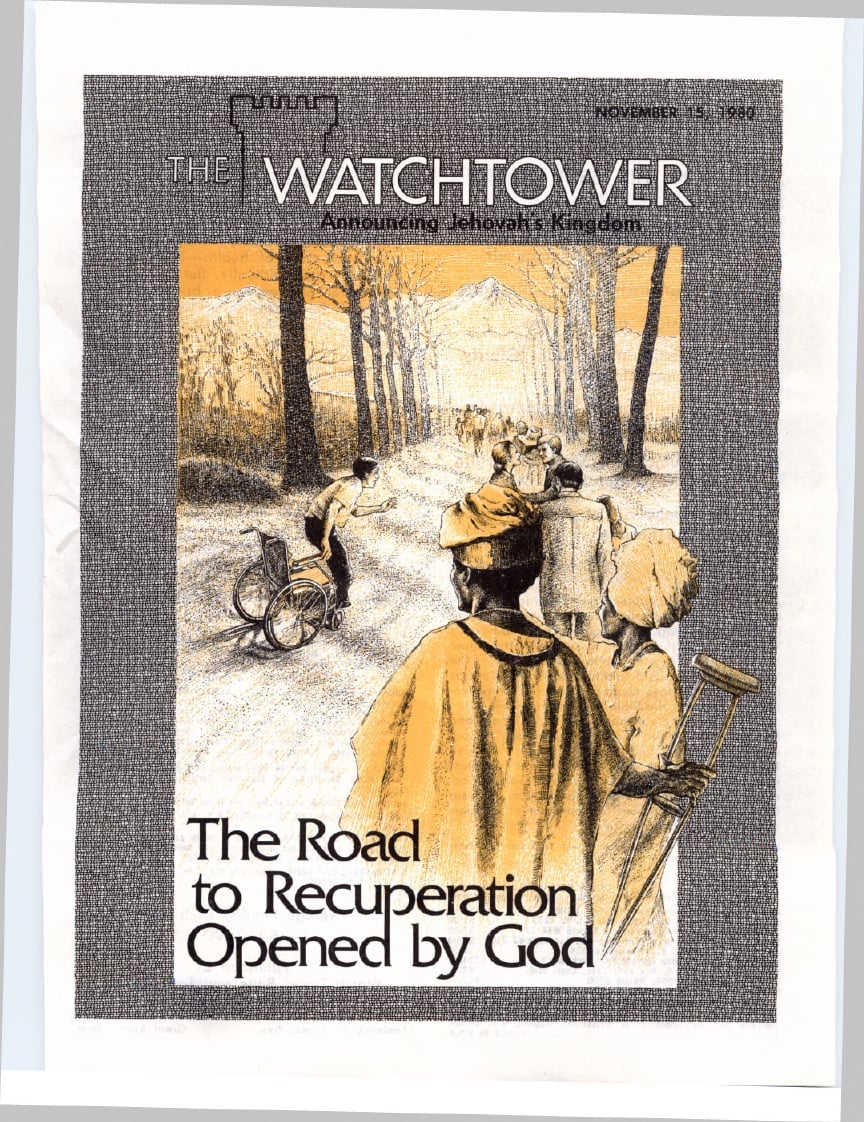
OUR COVER: Humanity today is in a poor state of health—both physically and spiritually. But the outlook for relief was never brighter! Read the discussion of Isaiah chapters 58 and 59 starting from page 12
Isolation Can Be Hazardous
Isolation Can Be Hazardous
“WARNING: Isolation may be dangerous to your health.” Similarly worded notices are usually reserved for serious dangers to a person’s well-being, as well as threats posed by chemicals and drugs. But recent findings indicate that this is a warning that may justifiably be issued to those who, by circumstances or choice, live a life of isolation.
For example, the impact of losing a marriage mate can be very injurious. Time magazine reports that “the coronary death rate among widows between 25 and 34 is five times that of married women in the same age group. At all ages, the divorced are twice as likely as the married to develop lung cancer or suffer a stroke.”
However, loneliness produced by isolation also takes its toll among adults who have never been married. A study made by Dr. James Lynch of the University of Maryland shows death from heart disease to be two to five times as high for single persons. This study indicates that the likelihood of a bachelor’s spending time in a mental institution is 23 times as great as for married men, and a single woman’s 10 times as great as for a married woman. It is very evident that this doctor did not examine records of those who are living in close harmony with the inspired Holy Bible, such as the Christian witnesses of Jehovah. The statistics about these would be very different. According to the doctor’s statistics, loneliness due to isolation can bring about mental and emotional anguish that constitutes a threat to life.
The experience of so-called distress centers in large cities reflects the seriousness of the problem. Consider metropolitan Toronto, Canada, with a population of more than two million. At just one of several distress centers some 33,000 telephone calls were received within a year’s time. That is one call every 16 minutes. About 75 percent of the callers were people suffering from isolation, “the walking wounded,” as one doctor termed them. Six percent of them were suicidal. The Toronto Star spoke of them as persons suffering from an “invisible disease” that has reached epidemic proportions. Dr. Vello Sermat defined it as “a feeling of utter desolation as if totally separated from other individuals. . . . A lack of human ties.” Many of those suffering from isolation are the aged, including widows and widowers.
Sadly, the aged who live alone are often the victims of crime. In a number of large cities these unfortunate ones are forced to continue living in rapidly deteriorating neighborhoods, where young hoodlums consider them easy targets. Thefts, savage beatings, rape and torture have been the lot of some of these lonely senior citizens. Fear causes these older persons to isolate themselves further. They may bar their doors and board up their windows, and have food and other necessities delivered to them.
The young, too, have suffered from the perils of a solitary life. Some have thought that they would create a new life-style that was not dependent on the conventional togetherness of the past. They have hoped for a happier way of life. But has it been truly satisfying? The Toronto Star reports that the fastest-growing rate of suicides in the province of Ontario is among the 20- to 30-year-olds. Then there are those who realize too late that they have become victims of wrongly motivated persons. As one 26-year-old put it: “He told me he was crazy about me, . . . he sent me flowers . . . bought me dinners . . . and then he told me the truth. He was living with another woman.”
Problems of Isolation
Even the ‘single swingers’ are beginning to find that a person cannot easily deny what is natural in life. Despite what appears on the surface, there is a growing awareness among the young that constancy in companionship is what is really desired and needed for a satisfying life. In an article called “Alone in the Crowd—The Cracks Are Showing in the Singles Dream,” Canada’s weekly newsmagazine Maclean’s observed: “More women—and some men—are admitting to being tired, frustrated and bored by casual sex.” Sex in itself has not been the answer. Something is lacking: Genuine love and a commitment. With the years passing all too quickly, many face the problem of finding a suitable marriage mate. The summary of their self-induced isolation has turned out to be—swinging in the 60’s, sulking in the 70’s and aching today.
Manifestly, something happens to the reasoning processes of a person who is isolated by choice or by force of circumstances. What often occurs is that, contrary to the counsel given in the Bible, he thinks too much about himself, even giving in to self-pity. He becomes critical of the omissions of others and overemphasizes their failures toward him, sometimes attributing bad motives. He waits for others to be friendly and feels they have failed him if they are not. An example is a young married woman with two children. For a period of time this mother kept herself from the company of persons whom she knew well. When a friend mentioned not seeing her recently, she responded: “I did it to see if anyone noticed or cared.”
So there are clear indications that a failure among people in general to form solid human relationships can endanger a person’s health. But what does a person do if the circumstances are seemingly beyond his control? How can he adjust to unwanted changes in his life?
Do Not Isolate Yourself
Do Not Isolate Yourself
IN MOST situations isolation is unnatural. Persistent isolation is unchristian. Though complete in himself and not needing companionship, Jehovah God saw fit to surround himself with myriads of spirit sons. (Job 38:4-7; Dan. 7:10) This was an active expression of his love. Moved by the same love, he later produced an earthly son, Adam. A marvelously designed ability to communicate was built into both heavenly and earthly sons. (1 Cor. 13:1) God did not bring forth these intelligent beings merely to receive from them, but, rather, to give. He found delight in such sons, and they were pleased to be with him and with one another.—Compare Proverbs 8:30, 31.
The Most High also decided that it would not be good for Adam to continue being alone and, therefore, provided a partner for him. (Gen. 2:18) Fulfillment of Jehovah’s command for the first pair to fill the earth was to bring into being an earth-wide, communicating family of humankind. (Gen. 1:28) How clear it is that humans were not intended to suffer from the ill effects of isolation!
Little wonder, then, that most Bible references to forms of isolation relate to negative aspects. (Ps. 25:16; 102:7) Cain’s banishment for the murder of his brother was an isolating of him from the rest of the human family. He viewed this as a punishment, something difficult to bear.—Gen. 4:11-14.
The Remedy
But what can a person do who feels alone, unloved or unwanted? Rather than pitying himself, waiting for others to do something, expecting to receive, he should take the initiative in actively expressing love for others in imitation of God and Christ. By isolating himself, whether intentionally or unintentionally, an individual acts contrary to the divine purpose for mankind. No wonder that isolation brings problems! So the remedy is in doing what the Creator had in mind for us. He desired that we enjoy companionship with fellow humans. One formerly lonely woman came to appreciate this point. She said: ‘It dawned on me at last. So I got on my feet and stopped thinking about myself and started to work hard. I’ve been working hard ever since.’
What can we learn from this experience? A person does not have to be lonely. There is something positive that he can do about it. He can practice basic Christianity. After all, can an individual be a Christian and an isolationist at the same time? No, for loving one’s neighbor requires the doing of good to one’s fellowman, being active in imitating the Creator. (Matt. 22:37-39; 7:12) And merciful giving to needy persons brings joy. Such giving banishes the unhappiness that often characterizes a lonely life.
Prevention
Of course, it takes effort to become active in sharing with others, not allowing oneself to become discouraged because of feeling inadequate. Since it is not easy to overcome loneliness, we do well to avoid becoming a victim of this malady. Hence, even though others may disappoint us, we need to guard against drawing away from people. The Bible says: “No one of us lives . . . for himself alone.” (Rom. 14:7, The New English Bible) Once a person isolates himself, he is in danger of thinking unwisely, even foolishly, to his injury. A Bible proverb expresses it in this way: “One isolating himself will seek his own selfish longing; against all practical wisdom he will break forth.”—Prov. 18:1.
Take the case of a young wife who became addicted to watching late-night pornographic movies on television. Subjected to this unwholesome influence, she soon stopped praying, reading the Scriptures and attending Christian meetings. Soon she felt that her husband was inadequate and began pitying herself. She embarked on a course that months before she would have quickly rejected as foolishness. Drawn out by her wrong desires, she abandoned her husband and small daughter to take up life with another man. Did she really find happiness? No. She later admitted to a friend that her new male associate had been beating her and that she was miserable without her child. This woman had hurt herself, her husband, her child and her fellow Christians and had brought great reproach on the Creator—all of this because of isolating herself.
Isolation Is Unchristian
Isolation really is unchristian. It is divisive, puts a damper on zealous Christian works and limits communication. Cut off from others, the individual may become depressed and give in to doubts respecting trustworthy humans, even about God and the Scriptures. The disciple Jude shows that some in his day failed to appreciate that even angels hurt themselves when they abandoned association with God and faithful angels to indulge their wrong desires.—Jude 6, 8, 10, 20-22.
The whole spirit of the Bible runs counter to isolation and its undesirable results—inactivity, lack of communication and failure to express love. The Scriptures teach and stimulate positive action, using many action words to do so. We are encouraged to ‘do unto others,’ to ‘go make disciples,’ to ‘ask and it will be given to us,’ to ‘keep on knocking’ for response, to ‘love one’s neighbor,’ to ‘assemble with other Christians,’ to ‘follow the course of hospitality.’ These are all antidotes to lethargy, pitying oneself, feeling unwanted or useless. Christianity requires that a person show compassion by pitying others, making someone feel wanted and useful instead of feeling useless. When we give wholeheartedly, we can rest assured that we will receive bountifully from our heavenly Father. (Matt. 6:1-4) Giving endears one to others, dispelling feelings of loneliness.
Of course, there are times when we need our privacy. Even Jesus Christ, though busy in aiding others, made time for solitude. On hearing the news regarding the death of John the Baptizer, he went “into a lonely place for isolation.” (Matt. 14:13) For those who are usually in the company of others, isolation can be a refreshing change and can provide fine opportunity for thinking. The Son of God once said to his disciples: “‘Come, you yourselves, privately into a lonely place and rest up a bit.’ For there were many coming and going, and they had no leisure time even to eat a meal.” (Mark 6:31; 3:20) Solitude was just what they needed then.
When we spend times of solitude in purposeful meditation, we can strengthen our faith. Such meditation can serve to draw us nearer to God. It can move us to express ourselves appreciatively in prayer, thus enhancing our personal relationship with the Almighty. But such occasions are temporary. Never would we want to isolate ourselves to the extent of taking up a monastic life.—Compare John 17:15.
Truly, we have sound reasons for avoiding a life of isolation. It is harmful indeed. Isolation can adversely affect Christian activity, association and communication. Therefore, take full advantage of God’s spiritual provisions. Read his Word daily. Do not neglect prayer. Keep the mind filled with wholesome thoughts. Maintain regular association with those of like precious faith. Keep busy in the worthwhile work of teaching God’s Word, and in other ways respond to the needs of fellow humans. Sticking close to Jehovah and his Word and yielding to the influence of his spirit will “prevent you from being either inactive or unfruitful regarding the accurate knowledge of our Lord Jesus Christ.” (2 Pet. 1:5-8) Do not isolate yourself.
Generosity Brings Blessings
God’s Word Is Alive
Generosity Brings Blessings
THE scene is an upstairs room somewhere in Joppa, a city on the shores of the Mediterranean Sea. The woman lying on the bed had become sick and had died. She was a first-century Christian disciple named Tabitha, which in Greek is Dorcas. When Dorcas died, two messengers were sent to the nearby city of Lydda to bring the apostle Peter here.
When Peter was led to the upstairs room, he found women weeping. They loved Dorcas because of her many kind deeds. They are showing Peter the clothes that she had made for them. As a Christian disciple, Dorcas also must have been very active in telling others about God’s kingdom. But what could Peter do for her now that she was dead?
The first thing Peter did was to put everybody outside. Then, after kneeling and praying, he turned to the body and said: “Tabitha, rise!” At that, as you can see, she opens her eyes. She comes to life! Then Peter helped her up.
At that, Peter called the others in. You can just imagine how they must have been beside themselves with joy when they saw Dorcas up and alive! Truly, what a marvelous blessing to be raised from the dead!—Acts 9:36-42.
We can learn a lesson from this. It illustrates that the person who seeks to help others—giving generously of his time, energies and abilities—will be richly rewarded. In this case, not only did these women love Dorcas for her kind deeds, but so did Jehovah God. That is why he gave Peter the power to raise her from the dead.
So, then, learn well this lesson: If you are generous toward others, you will be remembered with their love. Furthermore, generosity is one of the important qualities you need in order to be remembered by God. And he can reward you with life—everlasting life in his righteous new order.—Prov. 11:25; 1 John 2:17.
Insight on the News
Insight on the News
Baptists “Addicted to War”?
● “We in the Baptist tradition are addicted to war,” charged a Baptist leader speaking to the Ethics Commission of the Baptist World Congress held in Toronto, Canada, this past July. Delmar Smyth, professor of administration at Toronto’s York University, called on Baptists around the world to launch a peace crusade. “The choices before us are non-violence or nonexistence,” he said, as he urged Baptists to “take the pledge” for peace.
According to the Toronto “Star,” Smyth pointed out that “the idea of ‘a just war’ was not accepted by Christianity until it became an established religion in the fourth century A.D.” Additionally, the Baptist leader noted that Jesus’ early disciples “believed he taught and practised non-violence . . . Early Christian writers condemned war. They branded killing in war as murder.” Modern historians also have observed this early Christian stand. Now, one wonders, Will Baptists respond to the call for peace? What will they do in the event of another war?
Ill-fated Futurists
● In 1955, the editors of “Fortune” magazine asked prominent Americans to make their predictions about life in 1980. Recently the Boston “Sunday Globe” republished some of these speculations, noting that “they bristle with faith in the wonders of science and technology, productivity and the American dollar.
In 1955, George M. Humphrey, a former U.S. secretary of the treasury, declared: “We must work to ensure that the dollar of 1980 will buy at least as much food and clothing as the dollar will buy today, preferably and properly more.” David Sarnoff, former chairman of the Radio Corporation of America (RCA) rhapsodized: “The ever more plentiful supplies of food and goods, higher standards of living and education and health—these should make the containment of violence easier during the coming 25 years . . . We cannot know when or what form the coming ‘one world’ will take, but world law enforced by world police seems inherent in the age of science and technology.” And Henry R. Luce, former editor-in-chief of “Time,” “Life,” and “Fortune,” added: “Secure in his person, his larder, and his opportunities, the individual of 1980 can start his private quest from a higher plateau of earthly human achievement.”
Now we have seen what those 25 years actually brought. Does it inspire confidence in the optimistic promises of world leaders that men can cure the human condition? Or, rather, should it make realistic persons acknowledge that these truly are the “last days” during which the Bible says “critical times hard to deal with will be here”?—2 Tim. 3:1; compare Matthew 24:3-22.
Loving to Be King
● According to an Associated Press dispatch, when Pope John Paul II visited Brazil last summer “he obviously continued to draw strength from the huge crowds that mob him, chanting ‘King, king, king, John Paul is our king.’” But when Jesus Christ, whose vicar John Paul claims to be, faced a similar situation he reacted quite differently. On seeing the miracles Jesus was performing, the crowds began to admire him, saying, “This is indeed the Prophet who is to come into the world,” and Jesus could see that the mood of the crowd was to “make him king.” But rather than ‘drawing strength’ as politicians do from such adulation, the Bible says “he fled again to the mountain, himself alone.”—John 6:14, 15, “Catholic Confraternity” Version.
Showing that no man can play a kinglike role in the true Christian church, the apostle Paul drew a strong contrast between those who would try to do so and true apostles: “I wish you were really kings, and we could be kings with you! But instead, it seems to me, God has put us apostles (including Peter) at the end of his parade, with the men sentenced to death . . . you are celebrities, we are nobodies. . . . we work for our living with our own hands. . . . We are treated as the offal of the world, still to this day, the scum of the earth.” Do you think this Scriptural description of the apostles of Christ is reflected by the attitude of those who claim to be their successors?—1 Cor. 4:8-13, Catholic “Jerusalem Bible.”
Missionaries Told: “Glorify Your Ministry!”
Missionaries Told: “Glorify Your Ministry!”
FIFTY students of the Watchtower Bible School of Gilead graduated on September 14, 1980, receiving their assignments to 19 lands. The School’s president, F. W. Franz, addressed them, centering his remarks around the scripture at Romans 11:13, where the apostle Paul wrote: “Forasmuch as I am, in reality, an apostle to the nations, I glorify my ministry.”
Dedicated Christians have a glorious ministry, explained Franz, something that all of them, men and women, can share in. They are ministers of the Word of God. This ministry, then, is not caring for secular things or family matters but is the classified ministry of preaching and teaching the good news of God’s kingdom. And why is this especially glorious today? “Since 1914,” he said, “you graduates of Gilead and all dedicated and baptized Christians—you are preaching the good news of an established kingdom; that is what makes the difference.”
Franz explained that many English Bible translations, such as the “King James Version” and the “New World Translation,” use the word “minister.” Thus it is a legitimate term for all who are dedicated, baptized followers of Jesus Christ. “You graduates of Gilead,” he declared, “are entitled to call yourselves ministers and to ask for all the exemptions given to the clergymen of Christendom.”
‘We are living in the “time of the end,” concluded the School’s president, ‘and this is the time of all times to be living as a minister of the Most High God Jehovah! So, may you remember what the apostle Paul said with regard to his ministry. He said: “I glorify my ministry.” I want to encourage you to do the same thing—to glorify your ministry!’
Earlier, L. A. Swingle talked about the satisfaction that there is in accomplishment. But with accomplishment, he said, there are certain pitfalls; one can become puffed up and proud. The graduates were encouraged to be like the apostle Paul, who accomplished much in his ministry, but gave credit to God.—2 Tim. 4:17.
Discussing Psalm 102:1-6, D. Sydlik showed that the psalmist felt like “the pelican of the wilderness.” A missionary, too, might at times feel homesick and out of his environment. If so, it helps to read the Psalms and to keep always in mind that a missionary assignment is from Jehovah.
Max Larson spoke on “Building with Jehovah.” He pointed out the privilege it is to be “God’s fellow workers” by building up spiritual minds in people by means of the Word of God. (1 Cor. 3:9; Acts 20:32) “Stay on the job,” he stressed in closing; “your Building Partner will.”
Instructor J. Redford said that man was made to work, not loaf. (Gen. 2:15; Rom. 12:11) But ‘do not covet work assignments of someone else in God’s organization,’ he said. ‘Go where he sends you, and may all of you long enjoy the work of your hands.’
The School’s registrar, instructor U. V. Glass, presented a three-point ‘plan for spiritual survival’: (1) Establish and maintain a close personal relationship with Jehovah. (2) Recognize Jehovah’s channel of communication. (3) Stay close to Christian brothers and “have intense love for one another.”—1 Pet. 4:8.
L. Barry pointed out the fine example that Jesus set in humility. (Phil. 2:7-10) The hardships that missionaries sometimes face help to keep them humble, he explained. Having a sense of humor also helps. Humility brings many rewards.—Prov. 22:4.
After Chairman K. Klein distributed the diplomas to the students, T. Jaracz announced that a Cultural School for Latin Americans is being established in Mexico. It will be conducted in the Spanish language. Each class will have 25 students and be of two and a half months’ duration. The first class begins November 24, 1980.
In the afternoon, the graduates put on a most delightful student program, with songs, native dances and two fine Bible dramas entitled “Jehovah Rewards His Loyal Ones” and “Beware of Rebellious Talk.” The first dealt with David and events preceding his kingship, that tested his loyalty to Jehovah. The second drama was about Korah, a fomenter of rebellion.
For the 2,059 in attendance, the entire day’s program provided grand encouragement to serve Jehovah humbly and loyally, and for them always to ‘glorify their ministry.’
The Road to Recuperation Opened by God
The Road to Recuperation Opened by God
Before going through the following three articles the reader would do well first to familiarize himself with the material on which the articles are based, namely, the prophecy of Isaiah, chapters 58 and 59
“Speedily would recuperation spring up for you.”—Isa. 58:8.
1. Why does humanity need recuperation in its general state of health?
DOES all humanity need recuperation—healing? People who keep informed by all the modern means for gathering information from far and near will hardly hesitate to answer Yes! The question is, Who of us humans can bring about the sorely needed recuperation? Humanitarian persons hopefully keep on trying, but all their sincere efforts have failed to halt the worsening of humanity’s state of health socially, morally, economically, domestically. The cry of complaint from ailing mankind grows louder!
2, 3. (a) Who has more reason to complain over how far mankind has fallen than humanity itself? (b) How, in Romans 3:9-18, is the fallen state of humanity described?
2 If we ordinary creatures find plenty of room for complaint, how much more should the superhuman Creator of the universe find cause for complaint! He certainly did not discredit his creative ability by starting off his human creation in such a mess as we find ourselves in today. He candidly states that the entry of sin caused it all. Nineteen centuries ago he pointed out how far mankind had fallen from original perfection by inspiring one of the writers of the books of the Bible to pen these words of explanation:
3 “What then? Are we in a better position? Not at all! For above we have made the charge that Jews as well as Greeks are all under sin; just as it is written: ‘There is not a righteous man, not even one; there is no one that has any insight, there is no one that seeks for God. All men have deflected, all of them together have become worthless; there is no one that does kindness, there is not so much as one.’ ‘Their throat is an open grave, they have used deceit with their tongues.’ ‘Poison of asps is behind their lips.’ ‘And their mouth is full of cursing and bitter expression.’ ‘Their feet are speedy to shed blood.’ ‘Ruin and misery are in their ways, and they have not known the way of peace.’ ‘There is no fear of God before their eyes.’”—Rom. 3:9-18.
4. (a) In those words, from what was Paul quoting? (b) What, then, do we find the state of affairs to be today, 19 centuries later?
4 In the above portion of his letter that was written to the Christian congregation in ancient Rome, the apostle Paul was making quotations from the Hebrew Scriptures that were all written under inspiration more than 450 years before the writing of his letter about the year 56 C.E. For example, Paul quotes from Isaiah 59:7-20. This indicates that the situation was already quite bad away back there in his day, not only with reference to mankind in general, but especially with regard to those who claimed to be the people of Jehovah God, namely, the Jews, or Israelites. Well, then, today, more than 19 centuries after Paul wrote such things to the Christian congregation in the imperial capital of Rome, what ought we to expect the moral and religious condition of the world to be, not leaving out the section that is called Christendom? What the plain-speaking newspapers and magazines galore reveal to us about it is quite shocking, yes, terrifying.
5, 6. (a) According to the source of the name Christendom, how ought the nations making up her realm to be conducting themselves? (b) When reading Isaiah’s prophecies addressed to Israel, what larger application of them should we have in mind?
5 According to the source of its name. Christendom ought to be imitating Christ Jesus and living up to his teachings. The nations that make up Christendom ought to know how to do this. Among such so-called Christian nations Bibles, and particularly copies of the “New Testament,” circulate by the hundreds of millions of copies in all the known languages of their realm. Most of their inhabitants know how to read those inspired Scriptures so as to learn how to be a Christian. Since Christendom identifies herself with Christ and claims to be his congregation, her failure to follow the example of Christ brands her as a hypocrite. Her social, moral, religious state is like that of the once “chosen people” of Jehovah God in the days of the prophet Isaiah 800 years before Christianity came upon the earthly scene.
6 Really, Christendom’s sorry state parallels that of Israel in Isaiah’s day, for she claims to have replaced Israel as the chosen people of God. So, as we read certain chapters of Isaiah’s prophecy, we can have in mind their larger application to Christendom. Did Isaiah’s God look upon Israel of the prophet’s time as being hypocritical and needing spiritual recuperation? Let Jehovah God state his findings!
Divine Findings on Religious Hypocrisy
7. According to Isaiah 58:1, what findings of Jehovah was the prophet to proclaim to his chosen people?
7 Comes God’s command to Isaiah: “Call out full-throated; do not hold back. Raise your voice just like a horn, and tell my people their revolt, and the house of Jacob their sins.”—Isa. 58:1.
8. With what audibleness was Isaiah’s proclamation of Jehovah’s findings to be made, and why should he have felt the urge to prophesy?
8 According to that command, Jehovah God had found Israel guilty of “revolt,” or rebelliousness, and other unspecified “sins.” He used Isaiah as his mouthpiece to announce His findings, and this prophet was told to blare out God’s charges with the loudness of a “horn” or trumpet. At being told, “Do not hold back,” Isaiah may have felt like Amos, when that earlier prophet said: “There is a lion that has roared! Who will not be afraid? The Sovereign Lord Jehovah himself has spoken! Who will not prophesy?”—Amos 3:8.
9. To what extent should Jehovah’s hard message be heralded today, and what should it help the hearers to do?
9 The dedicated, baptized people of the Sovereign Lord Jehovah today should feel the same way about it. They should be moved to take up the divine message for today and blast it out over a far-reaching area. As Jehovah’s Witnesses, let them tell out that there is worldwide rebelliousness against the Sovereign Lord of the universe, who requires his people to be loyal and to avoid worldly sins. That explains why this hard message is being heralded earth wide. By heeding it the hearers can be helped to find recuperation.
10, 11. At the same time that the Israelites were making a show of delight in Jehovah by fasting and self-affliction, what else were they doing without self-control?
10 In what Isaiah was ordered to sound out loudly to “the house of Jacob,” he stripped its hypocrisy bare by saying:
11 “Yet day after day it was I whom they kept seeking, and it was in the knowledge of my ways that they would express delight, like a nation that carried on righteousness itself and that had not left the very justice of their God, in that they kept asking me for righteous judgments, drawing near to God in whom they had delight, [saying:] ‘For what reason did we fast and you did not see, and did we afflict our soul and you would take no note?’ Indeed you people were finding delight in the very day of your fasting, when there were all your toilers that you kept driving to work. Indeed for quarreling and struggle you would fast, and for striking with the fist of wickedness.
12. Was Jehovah’s acceptable kind of fast day to be a time for making a showy display of piety and self-affliction?
12 “Did you not keep fasting as in the day for making your voice to be heard in the height? Should the fast that I choose become like this, as a day for earthling man to afflict his soul? For bowing down his head just like a rush, and that he should spread out mere sackcloth and ashes as his couch? Is it this that you call a fast and a day acceptable to Jehovah?”—Isa. 58:2-5.
13. In his Sermon on the Mount, what did Jesus, without being hypocritical, say about fasting on the part of God’s people?
13 True, Jesus Christ, after he was anointed with Jehovah’s spirit, fasted for 40 days, but this was unobserved by men, and in the wilderness of Judea. And so later on in his Sermon on the Mount he could say without hypocrisy: “When you are fasting, stop becoming sad-faced like the hypocrites, for they disfigure their faces that they may appear to men to be fasting. Truly I say to you, They are having their reward in full. But you, when fasting, grease your head and wash your face, that you may appear to be fasting, not to men, but to your Father who is in secrecy; then your Father who is looking on in secrecy will repay you.”—Matt. 6:16-18.
14. (a) In Christendom, religious fastings are what kind of arrangement, and why? (b) In ancient Israel, formal fastings and self-affliction could not serve as a cover-up for what else?
14 No days of fasting were imposed upon Christ’s disciples; fasting is voluntary, optional. Christendom has its mandatory fasts, but these are merely man-made arrangements. In the prophet Isaiah’s day, if the self-chosen fasts of “the house of Jacob” had had the right idea and motivation behind them, there might have been no objection to them. But let us keep in mind what was going on in “the house of Jacob” at the same time as the fasting or before and after the days of fasting, the quarreling, the struggling, the yelling at one another on the highest pitches of the voice, the striking of others with the “fist of wickedness.” The formal fasting and self-affliction could never serve as a cover-up for all this badness before the penetrating eyes of Jehovah God. Little surprise that he seemed not to see their fasting or to take any notice!
15. (a) In Israel, the outward display of piety and self-abstinence was offset by what treatment of the toiling class? (b) With whom is the case similar today, and why is it improper?
15 For making an outward show of piety the formalistic Jews would let their heads droop like the top of a bulrush or would spread out sackcloth and ashes under them as if in deep mourning. But such demonstrations were no sincere sign of heartfelt repentance over their sins and revolt, or rebelliousness, against God and their disorderliness and irregularities. If their fasting was of a real kind, an abstention from ordinarily rightful things, why were they at the same time heartlessly driving their “toilers,” their own brothers, to work, thus heaping oppressive affliction upon them? Formal abstinence on fast days on the part of employers who acted as slave drivers to those toiling for them was truly hypocritical. It gained no favor or approval from God, nor did it give him any pleasure. The case is the same with Christendom, the observer of fasts, today, for she claims to worship the very God who inspired Isaiah to make public the revolt and sins of God’s chosen people.
16. What relief measures, if taken by the Israelites, would impress God more favorably than their holding formal fasts?
16 What kind of fast, what course of abstinence, is acceptable to Isaiah’s God, the God whom Christendom makes a show of worshiping? We can read Jehovah’s words as recorded by Isaiah in order to find out. For the benefit of those who feel the need of spiritual recuperation or who want to improve their relationship with the God of the Holy Bible, he says: “Is not this the fast that I choose? To loosen the fetters of wickedness, to release the bands of the yoke bar, and to send away the crushed ones free, and that you people should tear in two every yoke bar? Is it not the dividing of your bread out to the hungry one, and that you should bring the afflicted, homeless people into your house? That, in case you should see someone naked, you must cover him, and that you should not hide yourself from your own flesh?”—Isa. 58:6, 7.
17. Those words of Isaiah 58:6, 7 indicate that what things were going on in Israel, and so from what was there need of recuperation?
17 In an indirect way those descriptive words of Jehovah reveal that Israelites were being put in fetters unjustly, wickedly. Others were made to bear a yoke bar as if they were beasts of burden. Still others were being crushed by the work load that was being saddled upon them. Unfortunate Israelites were being allowed to go hungry or without proper shelter. Those having the means to furnish relief pretended not to be aware of the miserable state of fellow Israelites. Ah, yes, they dutifully carried out the formalities of a national fast, but they did not have enough brotherly love to lift the injustices and oppressions from off their own flesh and blood. The mere holding of fasts did not remove such heartless practices, nor comply with God’s commandment: “You must love your fellow as yourself. I am Jehovah.” (Lev. 19:18) If anything, those Israelites needed a recuperation from a spiritual ailment that meant certain death to their relationship with God!
18. Why is it no overstatement to say that Israel’s religious ailment, if left unchecked, meant death to their relationship with Jehovah?
18 This is not overstating matters, for in the century following Isaiah’s prophecy the nation of Israel lost its homeland and was buried out of sight in Babylonia, from 607 to 537 B.C.E. (Ezek. 37:1-11) Although reinstated in its own home territory by Jehovah’s undeserved kindness, the nation lost its covenant relationship with Jehovah God 569 years later, in the year 33 C.E. In 70 C.E. the Romans under General Titus destroyed rebellious Jerusalem, and the Jewish people were scattered world wide as objects of reproach. All of this stands as a warning to mortally sick Christendom.
Those Who Have Taken the Road to Recuperation
19. Was Isaiah himself sick with the spiritual ailment of his fellow Israelites, and what do words quoted from him in the book of Hebrews indicate?
19 Let no one imagine that the prophet Isaiah was spiritually sick with the religious hypocrisy that afflicted his nation. The man whom Jehovah God would use to expose such hypocrisy needed to have a healthy relationship with Him. Isaiah indicated the spiritual health of himself and his family, when he said: “Look! I and the children whom Jehovah has given me are as signs and as miracles in Israel from Jehovah of armies, who is residing in Mount Zion.” (Isa. 8:18) The Christian apostle Paul quotes this in his letter to the Hebrews and applies it to Jesus Christ and his anointed spirit-begotten disciples in these words: “He says: ‘I will declare your name to my brothers; in the middle of the congregation I will praise you with song.’ And again: ‘I will have my trust in him.’ And again: ‘Look! I and the young children, whom Jehovah gave me.’”—Heb. 2:12, 13.
20. Who at first were the “children” whom Jehovah gave to the Greater Isaiah, Jesus Christ?
20 The “young children” of Jehovah God whom he gave to Jesus Christ at Pentecost of 33 C.E. were men and women who belonged to the Jewish organization that had its capital at Jerusalem. Hence, before being anointed with God’s spirit at Pentecost, they had been associated with that spiritually sick system of things that embraced those whom Jesus Christ called “the lost sheep of the house of Israel.” (Matt. 10:6; 15:24) But from Pentecost onward they no longer belonged to the religious organization to which the prophet Isaiah was commanded to declare Jehovah’s words of criticism. Under the guidance of Jesus Christ they had taken the road to the recuperation promised by Jehovah in Isaiah 58:8. They left the organization that had among its members the self-righteous Pharisee who, in prayer at the temple, boastfully said: “I fast twice a week.”—Luke 18:11, 12.
21. For breaking away from the modern counterpart of unfaithful Israel, what benefits were prophetically promised in Isaiah 58:8 to Christ’s disciples?
21 Similarly, the dedicated, baptized witnesses of Jehovah of today have, for the most part, come out of the sects and denominations of Christendom, the modern counterpart of the Israelite nation of Isaiah’s day and of Christ’s day. As a reward for breaking away from spiritually sick, bedarkened Christendom, the prophetic promise of Isaiah 58:8 has been fulfilled upon them, as stated: “In that case your light would break forth just like the dawn; and speedily would recuperation spring up for you. And before you your righteousness would certainly walk; the very glory of Jehovah would be your rear guard.”
22. When did the promised “recuperation” begin to spring up for the disciples who made the breakaway?
22 Promptly, in the postwar year of 1919 C.E., that prophecy began undergoing fulfillment for the Christian witnesses of Jehovah who then made a complete breakaway from creed-bound, tradition-bound, clergy-ruled Christendom. For these liberated ones the enlightenment on Bible truth and prophecy began breaking forth “just like the dawn.” Their “recuperation” to good spiritual health in relationship with Jehovah God through Christ sprang up with rapid improvement. Like Isaiah at the temple, they have been cleansed to serve as Jehovah’s Witnesses.—Isa. 6:1-10; 43:10-12.
23. What kind of advance guard and “rear guard” have they had, even during World War II?
23 “Righteousness,” not Christendom’s crookedness, has gone ahead of them to lead them in ways right in Jehovah’s eyes. For their protection he has got behind them as a “rear guard” till now. Because of this they have kept under his approval and have been preserved from the extermination with which their enemies threatened them during World War II of 1939-1945.—Matt. 24:9-14.
Humanity’s State of Health That Might Have Been
Humanity’s State of Health That Might Have Been
1. Why is there need of a world physician, and what rule quoted by Christ applies to the medical profession and health agencies?
HUMANITY’S state of health is in a poor way! As never before there is need for a world physician, for new ailments are being discovered and are claiming victims. The medical profession and the health agencies, all of them together, have failed to be a world physician able to heal all earth’s maladies. We could not expect it otherwise, for the rule applies: “Physician, cure yourself.” Who quoted that? A man who cured all sorts of ailments, even raising a man to life on the fourth day of his death. The man with such a medical record was Jesus Christ. (Luke 4:23; Mark 6:4-6) His own death in 33 C.E. was not from natural causes. It was at the hands of murderers. (Acts 7:52) What might have been humanity’s state of health today if they had accepted him back there?
2, 3. (a) What question do we ask with regard to Jehovah as a Healer? (b) What did Jehovah bring upon ancient Egypt for the liberating of his people, and about what did he warn the Israelites if they did not listen to his voice?
2 Pushing the question still farther back in time, we ask, What would have been the case if people had accepted the services of the One who said to his chosen people in the days of the prophet Moses: “I am Jehovah who is healing you”?—Ex. 15:26.
3 Aiming at the deliverance of his chosen people from slavery in ancient Egypt, Jehovah afflicted that land with miraculous plagues. Later he lifted the preliminary nine plagues. He brought his liberated people into a national covenant that was to work for their physical, mental and spiritual well-being. He used Moses to warn those Israelites about what would follow if they kept breaking the law of that covenant, saying: “Also, any sickness and any plague that is not written in the book of this law, Jehovah will bring them upon you until you have been annihilated. And you will indeed be left with very few in number, although you have become like the stars of the heavens for multitude, because you did not listen to the voice of Jehovah your God.”—Deut. 28:61, 62.
4, 5. (a) Since the surviving Jews are faring so badly today, what question may we ask about Israel’s modern counterpart? (b) For mending their ways, what would have been the case according to Isaiah 58:9-12?
4 Today not only the millions of surviving Jews are suffering from bodily ailments, not to speak also of mental, religious, social and economic disorders, but also all humanity is doing so. In these respects not even Christendom has any advantage over the natural Jews. In fact, Christendom has the greater responsibility toward God. If ancient Israel fared so badly because of not mending its ways as Jehovah through Isaiah told them to do, how may we expect Christendom to fare finally, and that shortly? What might have been, the prophet Isaiah sets out as follows:
5 “In that case you would call, and Jehovah himself would answer; you would cry for help, and he would say, ‘Here I am!’ If you will remove from your midst the yoke bar, the poking out of the finger [in disdain or in condemnation] and the speaking of what is hurtful; and you will grant to the hungry one your own soulful desire, and you will satisfy the soul that is being afflicted, your light also will certainly flash up even in the darkness, and your gloom will be like midday. And Jehovah will be bound to lead you constantly and to satisfy your soul even in a scorched land, and he will invigorate your very bones; and you must become like a well-watered garden, and like the source of water, the waters of which do not lie. And at your instance men will certainly build up the places devastated a long time; you will raise up even the foundations of continuous generations. And you will actually be called the repairer of the gap, the restorer of roadways by which to dwell.”—Isa. 58:9-12.
6. In the light of the possibilities set before Israel of Isaiah’s day, what question are we led to ask about the possibilities in the case of Israel’s modern counterpart?
6 Oh, what might have been the national condition of ancient Israel if it had followed the counsel plainly given by Jehovah! In view of his almightiness he could easily have produced the conditions that he said would follow if Israel removed from itself the objectionable things that hurt both them and their covenant relationship with God. For not doing so Israel went from bad to worse. Terrible was the disciplinary experience that Israel went through in the century that followed Isaiah’s prophesying. In the light of all that as an illustration, we are led to ask, What about Israel’s modern counterpart, Christendom? What might have been her state of health socially, economically, morally, religiously if she had taken her medicine from the Divine Healer, Jehovah, and had accepted the Kingdom message that has been proclaimed by his Christian witnesses for now more than a century?
7. What living illustration today do we have of what might have been the case with Christendom?
7 What might have been the case with Christendom is illustrated. How? By what has taken place today with those who were pictured by the sons of Isaiah, the “children” whom Jehovah gave him and whom Jehovah used to typify the spirit-anointed disciples of Jesus Christ. (Isa. 8:18; Heb. 2:13) For more than 65 years they have announced to the world that Jehovah’s Messianic kingdom now rests upon the shoulder of the enthroned Son of God, Jesus Christ as the Prince of Peace. (Isa. 9:6, 7) Thus they have dispelled from hundreds of thousands of despairing persons the gloomy darkness that blankets the whole world. By means of the Kingdom news as foretold by Jesus in Matthew 24:14 they have been feeding the spiritually hungry people with something more life-sustaining than material food. Spiritual recuperation has resulted to these.
8. The spiritually recuperated ones are now heeding what further words of Jehovah, about the Sabbath, in the face of what promises?
8 All the spiritually recuperated ones are now heeding Jehovah’s further words of guidance that ancient Israel did not heed: “If in view of the sabbath you will turn back your foot as regards doing your own delights on my holy day, and will actually call the sabbath an exquisite delight, a holy day of Jehovah, one being glorified, and will actually glorify it rather than doing your own ways, rather than finding what delights you and speaking a word; you will in that case find your exquisite delight in Jehovah, and I will make you ride upon the high places of the earth; and I will cause you to eat from the hereditary possession of Jacob your forefather, for the mouth of Jehovah itself has spoken it.”—Isa. 58:13, 14.
9. Are dedicated, baptized Christians now under a weekly Sabbath arrangement, and what Sabbath period are they rapidly nearing?
9 Dedicated, baptized Christians, such as are Jehovah’s Witnesses of today, have no obligation to keep a weekly Sabbath that begins at sundown on Friday and ends with sundown of Saturday, for they are not under the code of laws given by Moses the mediator. (Ex. 20:1-11) Nor did Jesus Christ, the Mediator of the new covenant, command his disciples to keep Sunday as a Sabbath day. They know that they are living in the seventh day of the creative week of Jehovah God, during which he has been resting from direct creative works respecting our earth. (Gen. 1:1 through 2:4) World events as well as Bible chronology indicate that we are now rapidly nearing the time for the thousand-year-long reign of Jesus Christ to start. His reign of a thousand years for the blessing of all mankind will occupy the last thousand years of Jehovah’s rest day or Sabbath day of seven thousand years. Christ’s reign will be a Sabbath day of exquisite delight for all mankind.
10. Is Christendom’s weekly “sabbath” Biblical, and for what purpose is it mainly used today?
10 For more than 1,500 years Christendom has been formally keeping Sunday as a sort of Christian sabbath. But Sunday is neither Christian nor Jewish. As its name shows, it is actually a pagan holiday in celebration of the sun god. Today Christendom is certainly not observing its own Sunday as a rest day in Jehovah’s honor and for the good of the human body. For the most part, she is taking advantage of it as a day for sports, picnics, going to theaters, and other nonreligious activities and selfish delights, not to speak of gambling and a variety of immoral activities.
11. How do the Christian witnesses of Jehovah keep a true “sabbath” and thus conform to his own example?
11 What the Christian witnesses of Jehovah are observing is a continual “sabbath” to Jehovah God. How? By resting or desisting from their own works in an attempt to justify themselves before God and thus earn their own eternal salvation. By faith they rest in the merit or redemptive value of Christ’s ransom sacrifice as the basis for their eternal salvation. In this way they conform themselves to the great seventh “day” of Jehovah’s Creative Week, during which figurative “day” he himself has been resting.
12. What is the present ‘sabbath rest’ that “remains” for God’s people, and so how do Jehovah’s Witnesses use the Jewish sabbath and Christendom’s Sunday?
12 As to the Christian’s resting by faith in Jehovah’s “sabbath” of seven millenniums, we read: “In one place he has said of the seventh day as follows: ‘And God rested on the seventh day from all his works.’ . . . So there remains a sabbath resting for the people of God. For the man that has entered into God’s rest has also himself rested from his own works, just as God did from his own.” (Heb. 4:4-10) Jehovah’s Witnesses rest by faith in Christ’s sacrifice as God’s provision for human salvation. So they can conscientiously use the Jewish sabbath day and Christendom’s Sunday to preach the good news of God’s kingdom from house to house.
Division Between Christendom and the Needed Healer
13. According to Isaiah 59:1-4, what kind of conduct by God’s professed people has made a division between him and them?
13 How it might have been with Christendom rather than what it is today is not because the Almighty God lacks ability. Why, then, did salvation not come to ancient Israel, and, correspondingly, why has it not come to Christendom or to the rest of the world? The reason is given in these words: “Look! The hand of Jehovah has not become too short that it cannot save, nor has his ear become too heavy that it cannot hear. No, but the very errors of you people have become the things causing division between you and your God, and your own sins have caused the concealing of his face from you to keep from hearing. For your own palms have become polluted with blood, and your fingers with error. Your own lips have spoken falsehood. Your own tongue kept muttering sheer unrighteousness. There is no one calling out in righteousness, and no one at all has gone to court in faithfulness. There has been a trusting in unreality, and a speaking of worthlessness. There has been a conceiving of trouble, and a bringing of what is hurtful to birth.”—Isa. 59:1-4.
14. Like Israel of Isaiah’s day, why could 20th-century Christendom not clear herself in the divine court of justice?
14 That look into what Israel was in Isaiah’s day revealed a lot of details. How could Jehovah keep close to people of a nation like that or bless them? The nation was the one that was creating the rift between him and it. The same is true as regards the rift between him and his professed people, Christendom. Hands, fingers, lips, tongue are all taking part in what is bad, with injury to Christendom herself. After two world wars, not only are her hands already dripping with human blood, but she is planning on shedding human blood on an even vaster scale, likely next time with atomic and nuclear bombs besides other fiendish means for causing agonizing death to unnumbered people. Certainly her taking international problems to the United Nations or to the International Court of Justice at The Hague, Netherlands, is not the same as taking matters into the divine court of justice “in faithfulness” before all heaven and earth. In such a divine court Christendom could never clear herself!
15, 16. From what is being internationally conceived, what naturally must be brought to birth, and all the diplomatic talk is a speaking and muttering of what?
15 In the United Nations the non-Christian nations already outnumber the nations of Christendom. Yet her clergy and religious leaders look to that makeshift for God’s kingdom as “the only hope of the world” and are acting and proceeding as if it were such. If this is not a case of “trusting in unreality,” then what is? All the public and private talk about relying on the United Nations and other man-made agencies for world peace and security—has this not been a “speaking of worthlessness,” especially on Christendom’s part? Otherwise, what has all this palaver proved to be?
16 Since only “trouble,” not peaceful relations with Jehovah God, is being internationally conceived, only “what is hurtful” is what is naturally to be expected or brought to birth. What a “problem child” it is bound to be! From Jehovah’s standpoint, all the diplomatic talk between nations, Christian and non-Christian, has been only ‘speaking falsehood’ and ‘muttering of sheer unrighteousness.’
17. As if by what are God’s professed people being poisoned, and why did the course that they have taken not provide a safe roadway for travelers?
17 Today people both inside and outside Christendom are being poisoned, not just chemically, but also spiritually. According to Isaiah 59:5-8, complainers could say before God, the Judge of all: “The eggs of a poisonous snake are what they have hatched, and they kept weaving the mere cobweb of a spider. Anyone eating some of their eggs would die, and the egg that was smashed would be hatched into a viper. Their mere cobweb will not serve as a garment, nor will they cover themselves with their works. Their works are hurtful works, and the activity of violence is in their palms. Their own feet keep running to sheer badness, and they are in a hurry to shed innocent blood. Their thoughts are hurtful thoughts; despoiling and breakdown are in their highways. The way of peace they have ignored, and there is no justice in their tracks. Their roadways they have made crooked for themselves. No one at all treading in them will actually know peace.”
18. What sort of example has Christendom been with regard to maintaining peace?
18 If Christendom cannot keep the peace inside herself how can we expect the rest of the world to do so? She has been a bad example, grossly misrepresenting what real Christianity is. She has been loudmouthed in making appeals for peace and security, but certainly her arming herself heavily for war in suspicion of her worldly neighbors is not the way to pave the road to peace.
19. The hypocritical state in ancient Israel resulted in what with reference to justice and discerning the right why to go?
19 “That is why justice has come to be far away from us,” Jehovah’s prophet Isaiah goes on to say, “and righteousness does not catch up with us. We keep hoping for light, but, look! darkness; for brightness, but in continuous gloom we kept walking. We keep groping for the wall just like blind men, and like those without eyes we keep groping. We have stumbled at high noon just as in evening darkness; among the stout ones we are just like dead people.
20. (a) Were the revolts, transgressions and sins of Israel something plain to see? (b) So, under the circumstances, how did justice, righteousness and truth fare?
20 “We keep groaning, all of us, just like bears; and like doves we mournfully keep cooing. We kept hoping for justice, but there was none; for salvation, but it has stayed far away from us. For our revolts have become many in front of you; and as for our sins, each one has testified against us. For our revolts are with us; and as for our errors, we well know them. There have been transgressing and a denying of Jehovah; and there was a moving back from our God, a speaking of oppression and revolt; a conceiving and a muttering of words of falsehood from the very heart. And justice was forced to move back, and righteousness itself kept standing simply far off. For truth has stumbled even in the public square, and what is straightforward is unable to enter. And the truth proves to be missing, and anyone turning away from badness is being despoiled.”—Isa. 59:9-15; Rom. 3:15-18.
21. That description of Israel in Isaiah’s day matches what today very well, and how might humanity have had a better outlook?
21 How well that ancient description matches the condition in Christendom today! Since the end of World War I in 1918 Jehovah’s Witnesses have become very prominent on the world stage, despite furious persecution. What if the message of Jehovah’s kingdom in the hands of the glorified Christ had been favorably acted upon instead of being resisted with injustice and persecution of Jehovah’s Witnesses world wide? How much better humanity’s state of health and especially that of Christendom would have been by now in every way! What a brighter outlook there might have been for humanity!
“Jehovah of Armies” to the Rescue!
“Jehovah of Armies” to the Rescue!
1. Since there are resisters, what will the bringing of lasting relief to humanity mean first?
WORLD disaster lies inescapably ahead! But recuperation from its global effects will certainly follow. The “good news” of this has been circulated around the whole earth by dedicated men and women who have been entrusted with the glorious message of lasting relief for mankind. Their information is reliable, for it comes from the One who is more concerned about the condition of humanity than anybody else in all heaven and earth. Happily, that one is perfectly able to bring the needed relief to all humanity. In fact, he has purposed to do so. But his doing so will mean a fight with opposers of his purpose, the fight of all fights!
2. According to Isaiah 59:15b, who is that victorious fighter?
2 Who that victorious fighter is the prophet Isaiah makes known under inspiration when he says: “And Jehovah got to see, and it was bad in his eyes that there was no justice.”—Isa. 59:15b.
3. Figuratively speaking, what is this earth to Jehovah as King, and yet has he shown interest in what goes on here?
3 Nowadays people in general do not take into account that the Creator of heaven and earth is closely watching human affairs. And why should the Creator not do so? One of the last things that his prophet Isaiah wrote down is this statement: “This is what Jehovah has said: ‘The heavens are my throne, and the earth is my footstool.’” (Isa. 66:1) Well, then, should not this King, who thrones over all creation, be interested in his earthly footstool and what takes place there? He has shown that he is. How?
…