The Watchtower, October 1, 1980
Download: PDF — The Watchtower, October 1, 1980
The Watchtower — October 1, 1980
Source: jw.org
Contents
Page Two
Should You Believe the Bible?
Archaeology Confirms the Bible
Science Attests the Accuracy of the Bible
The Bible—A Book of Hope
Insight on the News
“In the Last Days” Since When?
After These “Last Days” God’s Messianic Kingdom!
Questions From Readers
Read the Truth About Religion
The Deaf Hear the Truth
Page Two
Page Two
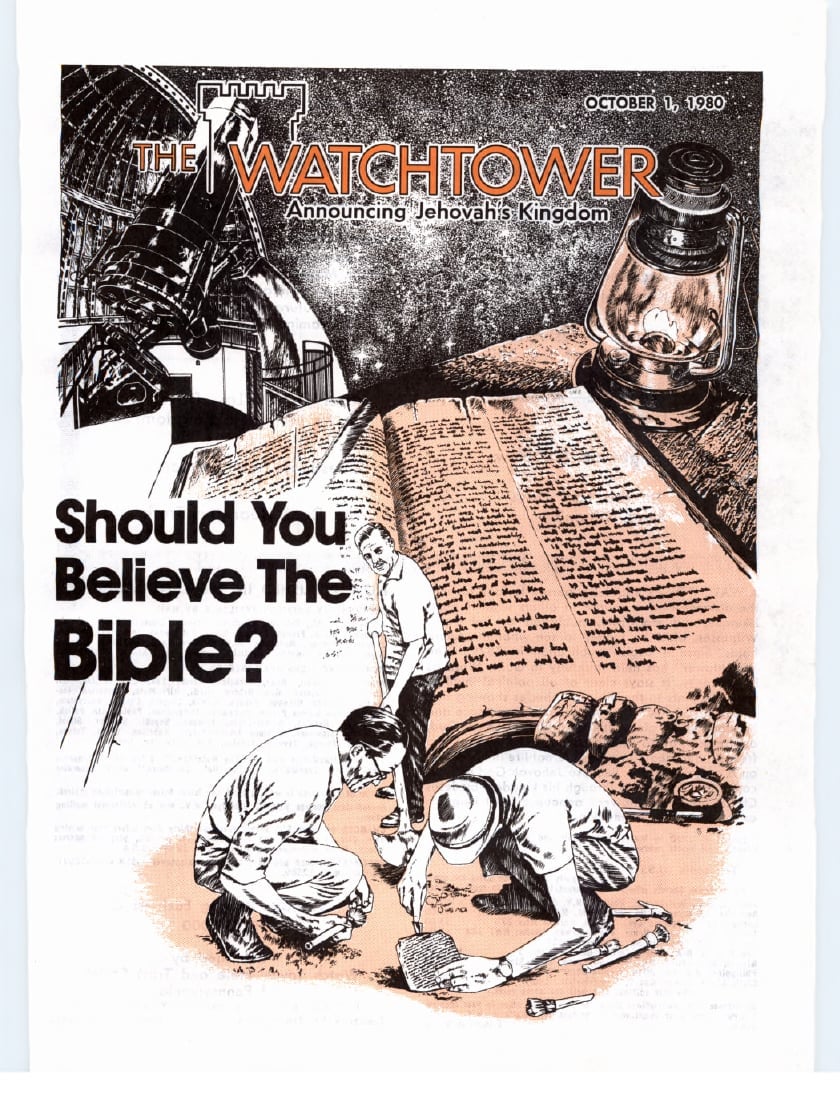
OUR COVER: There are powerful scientific reasons for believing the Bible. Moreover, its prophetic message concerning “the last days” and our future hope should impel us to examine its pages carefully
Should You Believe the Bible?
Should You Believe the Bible?
FAITH or doubt? Reliable or unreliable? These alternatives have become a part of people’s everyday life. So many things we read and hear are unreliable. Of human wisdom, author Aldous Huxley once wrote: “Finding bad reasons for what one believes for other bad reasons—that’s philosophy.”
As for science, bookshelves in all the great national libraries are filled with scientific, scholarly works that have become outdated over the past 50 years. Small wonder that people have become skeptical about what they read.
NEGATIVE DOUBTING OR POSITIVE RESEARCH?
In a world where skepticism is often a necessary shield against deception and fraud, a person can easily fall into the habit of having doubts about everything and everyone. “Once bitten, twice shy,” is a saying often heard, and understandably so. But is it really satisfying to live in a world of doubt? Can an individual have firm convictions if he does not have some reliable source of information?
Negative doubting will get you nowhere. Sincere questioning and positive research can, on the other hand, be useful tools for the truth seeker. This is true in the field of science. In his masterwork Introduction à l’étude de la médecine expérimentale (Introduction to the Study of Experimental Medicine), French scientist Claude Bernard stated: “The first requirement to be met by a scientist investigating natural phenomena is to maintain complete independence of thought. . . . He who doubts is a true scientist, having doubts about himself and his own interpretation of things, but putting faith in science.”
So according to this famous French physiologist, scientific research requires both doubt and faith. A research scientist doubts if everything has yet been learned in a certain field, but in carrying out his experiments he is obliged to put faith in what is considered to be scientific truth in other fields. In other words, he does not call into question science as a whole. His doubts in one certain field are constructive, inasmuch as he hopes to further the interests of science by making a new discovery.
The same can be true in the field of religion. Without doubting the existence of God, a person can justifiably have doubts about some of the doctrines taught by churches that claim to be Christian. Sincere research can result in the rejection of religious error; it can also lead to the discovery of true worship. But on what basis can that research be carried on?
THE BIBLE—A BASIS FOR FAITH
The universally recognized basis for examining the Christian religion is the Holy Bible. Interestingly, the Bible itself does not require blind faith of its readers. Warning against credulity, it states: “Anyone inexperienced puts faith in every word, but the shrewd one considers his steps.” (Prov. 14:15) And again: “Make sure of all things; hold fast to what is fine.” (1 Thess. 5:21) That implies careful examination, sifting, the exercising of your “power of reason” and then holding on to what is found to be true.—Rom. 12:1, 2.
Such reasoning, and proving to oneself, enables a person to acquire convictions. And such convictions build up faith. As defined in the Bible, “Faith is the assured expectation of things hoped for, the evident demonstration of realities though not beheld.” (Heb. 11:1) Bible faith requires “demonstration,” proof. It takes knowledge to have the kind of faith recommended in the Bible. An individual is not born with such faith. It is something that grows with knowledge and experience. The Bible further states: “Faith follows the thing heard. In turn the thing heard is through the word about Christ.” (Rom. 10:17) And the only place to find the authentic “word about Christ” is in the Bible.
FAITH—A DESIRABLE QUALITY TODAY
To build up your faith, you need knowledge and the ability to use it. Such ability is what the Bible calls “wisdom.” That you can do something about acquiring such wisdom is borne out by the following Biblical advice: “If any one of you is lacking in wisdom, let him keep on asking God, for he gives generously to all and without reproaching; and it will be given him. But let him keep on asking in faith, not doubting at all, for he who doubts is like a wave of the sea driven by the wind and blown about. . . . he is an indecisive man, unsteady in all his ways.”—Jas. 1:5-8.
In a world beset by doubts and uncertain as to its destiny, a world that has rejected time-proved moral values, is it not obvious that man needs a spiritual compass with which to guide himself? The doubter is truly “like a wave of the sea driven by the wind and blown about,” virtually hurled hither and thither by the changing philosophies of unstable men. Such a person is sure of nothing. He has no convictions. No argument, be it ever so logical, can convince him. He cannot believe because he does not want to believe.
PUT THE BIBLE TO THE TEST
Such skeptics doubt that life has any meaning. They are content to live their life span (which is shorter than that of certain animals) and to die, with no hope of living forever. We hope that you, dear reader, are among those who feel it is illogical to conceive of man living just 70 or 80 years, only to die, with all his accumulated knowledge and experience disappearing forever. It is hoped that you are in the category of the life seekers, who are also truth seekers. Of such persons living in the first century, the Bible states: “All those who were rightly disposed for everlasting life became believers.”—Acts 13:48.
To help you believe that the Bible is able to provide life-giving knowledge, we invite you to consider the following archaeological and scientific proof of the Bible’s reliability.
Archaeology Confirms the Bible
Archaeology Confirms the Bible
TO PROUD men who obstinately refused to recognize his Messiahship and despised his disciples, Jesus said: “If these remained silent, the stones would cry out.” (Luke 19:40) Happily, Jesus had, and still has, disciples who refuse to remain silent. Yet, in a way, stones that were silent witnesses of Biblical events have been made to cry out, testifying that the Bible is trustworthy. The science that has allowed such stones to speak up in favor of the Bible is called archaeology, defined as “the scientific study of the material remains of the past.”
In his scholarly work Light from the Ancient Past, Jack Finegan informs us that “modern archeology may be said to have had its beginning in 1798, when nearly one hundred French scholars and artists accompanied Napoleon on his invasion of Egypt.” In 1822 French Egyptologist Champollion succeeded in deciphering the hieroglyphics on the Rosetta stone. By the end of the 19th century archaeological excavations were being carried out systematically in Egypt, Assyria, Babylon and Palestine, and they have continued until the present time. Has the archaeologist’s spade confirmed the Bible record?
THE ORIGIN OF THE WORLD AND MAN
One discovery made in Egyptian tombs allows us to compare the Bible explanation of the origin of man with the creation account contained in an ancient Egyptian Book of the Dead, one of which can be seen in a long glass case in the Louvre Museum, Paris. Writing in the authoritative Supplément au Dictionnaire de la Bible, Louis Speleers, curator of the Cinquantenaire Museum in Brussels, Belgium, explains: “The Book of the Dead relates that one day [the sun-god] Ra left his divine Eye shining in heaven. Shu and Tefnut brought him back his Eye, which began to cry, and men appeared from Ra’s tears.”
Another archaeological discovery that makes possible an interesting comparison with the Bible account is a series of seven clay tablets containing the Enuma elish, or Sumerian-Babylonian “Epic of Creation.” According to this ancient record, Marduk, city-god of Babylon, vanquished the primeval sea goddess Tiamat and cut her in two. “From one half he fashioned the vault of the heavens, from the other the solid earth. That done, he organized the world. . . . Then ‘in order that the gods should live in a world to rejoice their hearts’ Marduk created humanity.”—Larousse Encyclopedia of Mythology.
Do you believe man came from Ra’s tears? Many highly civilized and educated Egyptians did. Or can you accept the assertion that the cloven body of a goddess gave rise to the heavens and the earth? These are just two examples of the creation myths that were believed by succeeding generations of people in times gone by.
Today, many highly educated men ask us to believe that the universe and all life forms came about spontaneously, without the intervention of any superior living Being, in spite of the fact that French scientist Louis Pasteur proved conclusively that life comes from life. Is it not more logical to accept the Bible account that states quite simply that the material universe is an expression of God’s “dynamic energy” (for Einstein and others have shown that matter is a form of energy)? And is it not more reasonable to believe the Holy Scriptures, which show that all life forms owe their existence to God, the great Source of life, and that man was created “in God’s image”?—Gen. 1:27; Ps. 36:9; Isa. 40:26-28; Jer. 10:10-13.
ARCHAEOLOGY AND ABRAHAM
A key character in the Bible is Abraham. Not only is he the ancestor of all the Bible writers, of the Jews and of many Arabs, but he is also called “the father of all those having faith.” (Rom. 4:11) Moreover, peoples of all nations should be interested in knowing if the Bible account concerning Abraham is authentic. Why? Because it was to him that God promised: “By means of your seed all nations of the earth will certainly bless themselves.” (Gen. 22:16-18) If we desire to be among “those having faith” who will be blessed through the seed of Abraham, evidence showing the accuracy of details given in the Bible about Abraham’s life and times should be of the utmost interest to us.
The Bible informs us that Abraham (then called Abram) was raised in “Ur of the Chaldeans.” (Gen. 11:27, 28) Is this a legendary site? What have the picks and shovels of the archaeologists revealed? As early as 1854, J. E. Taylor tentatively identified Ur with Tell el-Muqayyar (“Mound of Bitumen”), just a few miles west of the Euphrates. In 1869, French Orientalist Jules Oppert gave a report at the Collège de France, in Paris, definitely identifying the site with Ur, on the basis of cuneiform-inscribed clay cylinders found there by Taylor. Then, much later, from 1922 to 1934, British archaeologist Sir Leonard Woolley not only confirmed this identification but also discovered that the Ur left by Abraham was a flourishing and highly civilized city with comfortable houses and a huge temple tower, or ziggurat, dedicated to the worship of the moon-god Nanna, or Sin. Historians had long expressed doubts about the city of Ur mentioned in the Bible in connection with Abraham. But the archaeologist’s spade proved the Bible to be true.
Archaeologists have also confirmed many customs referred to in the Bible account concerning Abraham. For example, at Nuzu, or Nuzi, an ancient Hurrian city southeast of Nineveh, clay tablets have been found that authenticate such customs as these: Slaves becoming heirs to childless parents (compare Abraham’s remarks about his slave Eliezer—Genesis 15:1-4); a barren wife’s being obligated to provide her husband with a concubine (Sarah, or Sarai, gave Hagar to Abraham—Genesis 16:1, 2); and business transactions taking place at the gate of a city (compare Abraham’s purchase of the field and cave of Machpelah, near Hebron—Genesis 23:1-20). Examples of how the Nuzi excavations back up the Bible fill over eight small-print columns in the scholarly French Supplément au Dictionnaire de la Bible. (Volume VI, columns 663-672) The Encyclopædia Britannica states: “This Nuzi material has clarified many difficult passages in the contemporary patriarchal narratives of Genesis.”
PROPER NAMES CONFIRMED
French archaeologist André Parrot carried out extensive diggings on the site of the ancient royal city of Mari, on the Middle Euphrates. The city-state of Mari was one of the dominant powers in Upper Mesopotamia in the early second millennium B.C.E., until it was taken and destroyed by Babylonian King Hammurabi. In the ruins of the huge palace discovered there, the French team of archaeologists found over 20,000 clay tablets. Some of these cuneiform tablets mention cities by the name of Peleg, Serug, Nahor, Terah and Haran. Interestingly, all these names occur in the Genesis account as names of Abraham’s relatives.—Gen. 11:17-26.
Commenting on this similarity of early proper names, John Bright writes in his History of Israel: “In none of these cases do we . . . have a mention of the Biblical patriarchs themselves. But the profusion of such evidence from contemporary documents shows clearly that their names fit perfectly in the nomenclature of the Amorite population of the early second millennium, rather than in that of any later day. The patriarchal narratives are thus in this respect quite authentic.”
As recently as 1976, Italian and Syrian archaeologists identified, in northern Syria, the ancient city-state of Ebla. Like Mari, Ebla is not mentioned in the Bible, but both names appear in ancient texts dating back to the patriarchal period. So what did the digger’s spade uncover on this new site? In the library of the royal palace, thousands of clay tablets were found, dating from the late third or early second millennium before the Common Era. Reporting on this discovery in its March 19, 1979, issue, the French newsweekly Le Point stated: “The proper names are amazingly similar [to those in the Scriptures]. In the Bible we find ‘Abraham;’ in the Ebla tablets, ‘Ab-ra-um;’ Esau—E-sa-um; Michael—Mi-ki-ilu; David—Da-u-dum; Ishmael—Ish-ma-ilum; Israel—Ish-ra-ilu. The archives of Ebla also contain the names of Sodom and Gomorrah, cities mentioned in the Bible, but whose historicity was long challenged by scholars. . . . What is more, the tablets list cities in exactly the same order in which they are mentioned in the Old Testament: Sodom, Gomorrah, Admah, Zeboiim and Bela [Gen. 14:2].” According to Boyce Rensberger, writing in the New York Times, “some biblical scholars believe [the Ebla tablets] rival the Dead Sea Scrolls in authenticating and adding to knowledge of life in biblical . . . times.”
CUSTOMS AND LAWS
Archaeology has done much to explain customs alluded to in the Bible, thus showing the accuracy of the Biblical record. One instance of this is the account in Genesis, chapter 31, where it is reported that Jacob’s wife Rachel “stole the teraphim that belonged to her father,” Laban. (Gen 31 Vs. 19) It is stated why Laban went to the trouble of chasing after his daughter and her husband for seven days. It was in order to retrieve his “gods.” (Gen 31 Vss. 23, 30) Interestingly, an archaeological discovery in the ancient northern Mesopotamian city of Nuzi has revealed the existence of a patriarchal law whereby the possession of family gods gave a man the title deeds to the estate of his deceased father-in-law. When a person remembers that Laban was a native of northwestern Mesopotamia and how treacherously he had dealt with Jacob, knowledge of this law sheds light on Rachel’s strange theft and on Laban’s frantic efforts to recover his “gods.” The Louvre Museum, in Paris, displays several such “household gods” discovered in various cities of Mesopotamia. Their small size (four to six inches [10 to 15 cm]) also helps to explain how Rachel was able to hide the teraphim by sitting on a saddle basket containing them and refusing to get up when Laban made his search.—Gen 31 Vss. 34, 35.
One of the most treasured possessions of the Louvre Museum is an upright black stone slab nearly eight feet (exactly 2.25 m) tall and commonly known as the “Code of Hammurabi.” Under a relief showing King Hammurabi of Babylon receiving authority from the sun-god Shamash, there are 282 laws written in columns of cuneiform writing. Since Hammurabi is said to have reigned from 1728 to 1686 B.C.E., some Bible critics have claimed that Moses, who recorded the laws of Israel over a century and a half later, merely plagiarized the code of this Babylonian king. Giving the lie to this accusation, W. J. Martin writes in the book Documents from Old Testament Times:
“Despite many resemblances, there is no ground for assuming any direct borrowing by the Hebrew from the Babylonian. Even where the two sets of laws differ little in the letter, they differ much in the spirit. For example, in the Hammurabi Code, theft and receiving stolen goods were punished by the death penalty (Laws 6 and 22), but in Israel’s laws the punishment was compensation. (Ex. 22:1; Lev. 6:1-5) Whereas the Mosaic law forbade handing over an escaped slave to his master (Deut. 23:15, 16), the Babylonian laws punished by death anyone taking in a fugitive slave.—Laws 15, 16, 19.”
In the Supplément au Dictionnaire de la Bible, French Orientalist Joseph Plessis wrote: “It does not appear that the Hebrew legislator made any use of the various codes of Babylonia and Assyria. Nothing in his work can be proved to have been borrowed. Although there are interesting similarities, they are not such that they cannot easily be explained by the codifying of customs shared by people with a common origin.”
Whereas the Code of Hammurabi reflects a spirit of retaliation, the Mosaic law states: “You must not hate your brother in your heart. . . . You must not take vengeance nor have a grudge against the sons of your people; and you must love your fellow as yourself.” (Lev. 19:17, 18) So not only is it proved that Moses did not borrow from Hammurabi but a comparison of the Bible laws and those inscribed on the tablets and steles dug up by archaeologists shows the Biblical laws to be far superior to those governing other ancient peoples.
ARCHAEOLOGY AND THE GREEK SCRIPTURES
What about the Greek Scriptures, commonly known as the “New Testament”? Has archaeology confirmed the accuracy of this important part of the Bible? Whole books have been written showing that there is such confirmation. As early as 1890, French Bible scholar F. Vigouroux published a book of over 400 pages entitled “Le Nouveau Testament et les découvertes archéologiques modernes” (The New Testament and Modern Archaeological Discoveries). In it he supplied abundant proof supporting the Gospels, Acts of the Apostles and the letters contained in the Greek Scriptures. In 1895, W. M. Ramsay published his now classic book St. Paul the Traveller and the Roman Citizen, providing much valuable material showing the authenticity of the Christian Greek Scriptures.
More recently, many other books and scholarly articles have been published showing how archaeology has shown the truthfulness of the entire Bible. In his book The Archaeology of the New Testament, first published in 1970, E. M. Blaiklock writes: “Striking vindications of biblical historiography have taught historians to respect the authority of both Old Testament and New, and to admire the accuracy, the deep concern for truth, and the inspired historical insight of the varied writers who gave the Bible its books of history.”
Yes, archaeology clearly backs up the Bible. But what about other fields of science?
[Map on page 6]
(For fully formatted text, see publication)
Haran
Ebla
Mari
Nuzi
Babylon
Lagash
Ur
Sumer
Persian Gulf
[Picture on page 6]
Ziggurat uncovered in Ur of ancient Chaldea
[Pictures on page 7]
Household god (found in Lagash)
The Code of Hammurabi
Science Attests the Accuracy of the Bible
Science Attests the Accuracy of the Bible
DO SCIENTIFIC discoveries contradict the Bible? In reply, it must first be said that the Bible is not a book of science. However, when it touches on scientific subjects, it refutes unproved human speculations and theories. The discovery of universal laws has again and again confirmed the accuracy of the Holy Scriptures and the truthfulness of the Bible psalm writer, who said with regard to God: “The substance of your word is truth.” (Ps. 119:160) Let us examine the fields of astronomy, medicine, botany, anatomy and physiology, to see if these sciences really confirm the accuracy of the Bible.
ASTRONOMY
It is a well-known fact that the opening chapters of Genesis have been the object of mockery and of particularly scathing attacks. In flat contradiction of the assertions made by many of Christendom’s clergymen to the effect that Genesis is merely a collection of poetry and legends, in the fifth century Catholic “church father” and scholar Augustine stated that the Genesis “account is not the kind of literary style where things are stated figuratively, . . . but from beginning to end it relates facts that have really happened, as in the book of Kings and other historical books.” (De Genesi ad litteram, VIII, 1, 2) An examination of the first chapter of Genesis will reveal that the Bible was far ahead of contemporary conceptions.
Long before Aristotle (384-322 B.C.E.), who believed that the stars were driven into the sky like nails, Genesis (1:6-8) described the heavenly vault as an “expanse” (New World Translation), or “firmament” (Douay Version). The word “firmament” comes from the Latin firmare, which means to give consistency, to make firm, or solid. Jerome used this expression in the Latin Vulgate in translating the Hebrew word raqia that, to the contrary, means “extended surface,” “expanse.” According to T. Moreux, former head of Bourges Observatory, France, “this expanse, which to us constitutes heaven, is designated in the Hebrew text by a word which the [Greek] Septuagint, influenced by the cosmological ideas prevailing at the time, translated by stereoma, firmament, solid canopy. Moses transmits no such thought. The Hebrew word raqia only conveys the idea of extent or, better still, expanse.” The Bible has therefore described, most accurately, the expanse or atmosphere above us.
Genesis speaks of luminaries that shine upon the earth “to make a division between the light and the darkness.” (Gen. 1:14-18) Now, those words were written by Moses in the 16th century before our Common Era. Note just one of the fanciful conceptions then existing on this subject. Paul Couderc, astronomer at the Paris Observatory, writes: “Up until the fifth century before our common era, men were mistaken as regards the fundamental question concerning day and night. For them, light was a bright vapor, while darkness was a black vapor which, in the evening, ascended from the ground.” What a contrast with the succinct but scientifically accurate statement made in the Bible concerning the cause of day and night on our planet!
Those who lived at the time the Bible was being written entertained strange ideas concerning the shape and the foundation of the earth. According to ancient Egyptian cosmology, “the universe is a rectangular box, placed in a north-south position, like Egypt. The earth is located on the bottom, as a slightly concave plain with Egypt in the center. . . . At the four cardinal points very high peaks hold up the sky. The sky is a metallic cover, flat or curving outward, pierced with holes. From it hang stars, like lamps hanging on cables.”
Had such childish theories been abandoned centuries later? Far from it. Greek astronomer and philosopher Anaximander (sixth century B.C.E.) held: “The Earth is cylindrical, three times as wide as it is deep, and only the upper part is inhabited. But this Earth is isolated in space, and the sky is a complete sphere in the center of which is located, unsupported, our cylinder, the Earth, situated at an equal distance from all the points of the sky.” A century later, Anaxagoras believed both the earth and the moon to be flat.
The Bible was far ahead of the scientific conceptions taught at that time. In the 15th century before the Common Era, it described the Creator as “hanging the earth upon nothing,” and in the eighth century B.C.E., it spoke of “the circle of the earth.” (Job 26:7; Isa. 40:22) Is that not exactly how the earth appeared to you on your television screen when the astronauts photographed it from the moon?
MEDICINE AND BOTANY
The Bible refers to plants and trees that grew in various lands. For example, it accurately refers to the curative powers of balsam, obtained from several evergreen trees. Writing in the French Encyclopedic Dictionary of the Bible, C. E. Martin explains: “Small quantities of mastic [resin] drip naturally from the tree, but in order to obtain more, longitudinal incisions are cut in the trunk, allowing the resin to flow freely. . . . It had the reputation of calming pain and healing wounds; balm of Gilead, renowned for wounds, is mentioned in a figurative sense by Jeremiah (8:22; 46:11; 51:8); it is also mentioned proverbially in modern-day language.” Many Roman and Greek historians, such as Pliny and Diodorus of Sicily, made mention of this balsam.
According to the Bible record, in the ninth century B.C.E. the Hebrew prophet Jonah journeyed to Nineveh, ancient capital of Assyria. As a result of his missionary activity, “the men of Nineveh began to put faith in God.” (Jonah 3:5) Later on, he camped east of the city and was provided relief from the sun under a bottle-gourd plant, which came up overnight, in order to become a shade over Jonah’s head. (Jonah 4:6, 10, 11) Is it true that the bottle-gourd plant (Cucurbita lagenaria) develops so rapidly? The French Bible Dictionary, published under the direction of F. Vigouroux, states the following: “It is known that the gourd plant grows very rapidly in hot countries and that it is used for covering with verdure the walls of houses and shelters where it clings, like the Virginia creeper, providing a protection against the heat by means of its large leaves. . . . In the symbolic paintings found in the catacombs based on the story of Jonah, it is always this plant that is portrayed.” So it was nicely consistent with the fact that a normally rapidly growing gourd plant should be miraculously caused to grow up in one night by Jehovah’s power in order to shield Jonah from the hot rays of the sun.
Describing the fate of national groups that are opposed to God’s sovereignty, the Bible states that they will be “like a thistle [Hebrew, galgal] whirl before a stormwind.” (Isa. 17:13) The Encyclopædia Judaica says: “The biblical galgal has a unique way of scattering its seed. At the end of the summer it detaches from the ground, and its prickly leaves, resembling sails, fly in the wind and scatter the seeds.” Nogah Hareuveni, author of the booklet entitled “Ecologie dans la Bible” (Ecology in the Bible), refers to the galgal thistle, writing: “The plant that bears this name starts its rapid growth in March. . . . In a few weeks this apparently innocent galgal becomes a prickly monster, its leaves and flowers being covered with sharp thorns. In summer, the plant begins to dry up, but it appears so firmly rooted and so threatening that it seems impossible to get rid of it. When the galgal is fully developed, something strange takes place underground between the stalk and the roots: a cellular separation occurs between the stalk and the roots, and it requires only the least breath of summer wind to sweep away the whole plant.” And so, just like this thistle, which seems fearsome but which the wind can so easily sweep away, those who oppose divine sovereignty will be swept away. The Biblical comparison “like a thistle” is accurate.
ANATOMY AND PHYSIOLOGY
If the Bible originates with the Creator of man, we should be able to find in its pages convincing proof that it is not the product of human wisdom. As we have already seen, people of ancient times had some very fanciful ideas about man’s origin. Similarly, medical texts from ancient Egypt reveal great ignorance in the field of medicine. Although Moses was “instructed in all the wisdom of the Egyptians,” he wrote that man was formed, not out of Ra’s tears but “out of dust from the ground.” (Gen. 2:7; Acts 7:22) Has modern medical science confirmed the fact that man was formed from mineral elements from the earth’s soil?
In their joint work Les oligoéléments (Trace Elements), Andrée Goudot and Didier Bertrand, member of the French Agricultural Academy, inform us: “In all the living organisms studied, in addition to carbon, oxygen, hydrogen, nitrogen, phosphorus, calcium, sulfur, chlorine, magnesium, potassium and sodium, the presence of the following elements can be considered to be a proved fact: six nonmetallic elements: fluorine, bromine, iodine, boron, arsenic and silicon; a transition element: vanadium; and thirteen metals: iron, zinc, manganese, copper, nickel, cobalt, lithium, rubidium, cesium, aluminium, titanium, chromium, molybdenum and also probably tin, lead, silver, gallium, strontium and barium.” All these substances are to be found in the earth’s crust, proving that man is truly formed from the ground, as the Bible states.
For many centuries, the Bible has stated that the blood of a creature represents its life, or soul. “The soul of every sort of flesh is its blood.” (Lev. 17:14) Is this position medically sound? It is a scientific fact that blood is intimately involved in the life processes. Furthermore, science has discovered quite recently that each person’s blood is specific and unique. Léone Bourdel, professor at the French Higher School of Anthropobiology, writes as follows: “The genetical combinations in procreation are such that our blood is unique, never identical to that of either of our parents, nor to that of our children. And we make this same blood all our life. In fact, no matter how many transfusions we may receive, we will never adopt the blood that the donor has given us; it is always our own blood that prevails and that is renewed perpetually and identically.”
REASONS FOR BELIEVING THE BIBLE
To paraphrase Aldous Huxley, quoted earlier, ‘finding good reasons for what one believes for other good reasons’ has been the purpose of this discussion of the question “Should You Believe the Bible?”
First, we have seen that the Bible itself does not ask us to have blind faith. It invites us to use our “power of reason” and to “make sure of all things.” (Rom. 12:1, 2; 1 Thess. 5:21) We have seen that archaeology backs up the historical accuracy of the Bible. Moreover, it has been shown, by means of a few examples, that even in its minutest details, the Scriptural record is scientifically sound.
These are “good reasons” for believing the Bible. But there are “other good reasons”—in fact, even better reasons, for it is quite clear that faith in God and reliance on his Word cannot depend merely on archaeological discoveries and scientific investigations. In addition to its intrinsic value as a moral guide, the Bible is the only book that provides us with the revelation of God’s will and purpose for mankind. Yes, this divinely inspired Book of Books gives us real hope for the future of our earth and mankind upon it, as the concluding article of this series will show.
[Picture on page 11]
Egyptian concept of the universe
[Picture on page 12]
“Galgal” thistle
The Bible—A Book of Hope
The Bible—A Book of Hope
WILLIAM GLADSTONE, said to be the “greatest British statesman of the 19th century,” once wrote: “Science and research have done much to sustain the historical credit of the Old Testament: . . . in doing this they have added strength to the argument which contends that in them we find a Divine revelation; . . . the evidence, rationally viewed, both of contents and of results, binds us to stand where our forefathers have stood, upon the impregnable rock of Holy Scripture.”
The Bible has indeed weathered the storms of time like an immovable rock. A person who stands upon this rock can see, from its lofty heights, not only way back into the past but far into the future. Let us now examine the internal evidence proving that the Bible is a book of hope that you can trust.
INTERNAL HARMONY AROUND A CENTRAL THEME
The 66 books of the Bible were written over a period of 16 centuries by some 40 different writers. That statement is easy to read. But think about it. Do you know of any book that was started, say, toward the end of the fourth century of our Common Era and continued to be written, off and on, by dozens of different men of all stations of life right up to our day?
No such book exists. But if it did and if it had been written from the time of the Roman Empire, right through the period of the monarchies and into the time of modern-day republics, by people as different as soldiers, kings, priests, fishermen, and even a herdsman and a medical doctor, would you expect every part of that book to have the same basic approach and to follow the same central theme? Hardly!
Yet the Bible actually was written over a similar time period, under various political regimes, by all those categories of men and even more, and in three languages. Nevertheless, it is harmonious throughout. Its basic message has the same thrust from beginning to end. Is that not amazing?
Such internal harmony would have been impossible without some timeless, unifying spirit pervading the entire writing team. That spirit was God’s active force. The apostle Peter bore witness to that fact, saying: “No prophecy of Scripture springs from any private interpretation. For prophecy was at no time brought by man’s will, but men spoke from God as they were borne along by holy spirit.”—2 Pet. 1:20, 21.
Under the one divine editorship, these Bible writers developed a single central theme: The vindication of Jehovah’s sovereignty and the ultimate fulfillment of his purpose for the earth by means of his kingdom under Christ, the “Seed” of promise. (See box on page 16.)
A BOOK OF PROPHECY
Perhaps the greatest reason for believing that the Bible is not man’s word but God’s is the fact that it is a book of remarkable prophecies. With all their sophisticated scientific equipment, men are still unable regularly to make accurate weather forecasts, let alone foretell hundreds of events. Yet the Bible contains literally hundreds of prophecies that have proved to be astonishingly accurate. Does this not indicate that the great Mastermind behind such prophesying was the One who stated: “I am God unrivalled God who has no like. From the beginning I foretold the future, and predicted beforehand what is to be”?—Isa. 46:9, 10, The Jerusalem Bible.
Many of the most important prophecies in the Bible tie in with its central theme: God’s vindication through the kingdom of the promised “Seed.” To avoid all doubt about the correct identification of the “Seed,” God inspired many different prophets to provide details about the birth, life and death of this promised deliverer. These prophecies about the “Seed” or “Messiah”—of which over 300 have been counted—were all fulfilled in Jesus Christ.a
Some freethinkers have tried to suggest that Christ fitted himself into these prophecies and thus rigged their fulfillment. Freethinkers generally pride themselves with being very logical. But is it sound thinking to claim that Jesus rigged his own birth in Bethlehem (Mic. 5:2; Matt. 2:1, 5, 6), of the tribe of Judah (Gen. 49:10; Luke 3:23, 33) and as a descendant of King David?—Isa. 9:7; Matt. 1:1.
Others might retort that if Jesus was the Son of God and lived previously in heaven, he could have arranged for his human birth to fulfill such prophecies. True, but a freethinker’s use of that argument would defeat his purpose, which is precisely to deny that Jesus was anything other than a normal man.
And what about the circumstances of Jesus’ death: his being struck, spat on, nailed to a stake, and (something very exceptional for people executed on a stake) having none of his bones broken? (Isa. 50:6; Mic. 5:1; Isa. 53:5; Ps. 34:20; Matt. 27:26, 30; Luke 23:33; John 19:33-36) Did Jesus rig all these things too? Impossible! So these were true prophecies, written over 700 years before their fulfillment. Powerful testimony, indeed, in favor of the Bible’s reliableness!
One of the most remarkable prophecies, and one whose fulfillment has been amply confirmed by secular history, was Jesus’ foretelling the destruction of Jerusalem. This was not just a prediction that any astute political forecaster could have made, in view of the Jews’ chafing under Roman rule. It included details that no futurologist could have foreseen. Who could have imagined that, in 66 C.E., Roman commander Cestius Gallus would withdraw his troops from Jerusalem “without any reason in the world,” as Josephus put it, just when the city was ready to fall into his hands like a ripe plum? But Jesus had predicted some such opportunity for individuals to flee the beleaguered city. (Luke 21:20-22) His disciples, who were watching for this sign, were thus able to escape. Then, nearly four years later, in 70 C.E., the total destruction of Jerusalem and its temple took place, just as Jesus had also foretold.—Luke 19:41-44; Matt. 24:2.
Jesus’ prophecy about the destruction of first-century Jerusalem is of the greatest interest to us, because it is interwoven with his prophecy about the end of the present wicked system and the establishment of God’s kingdom in the hands of the promised “Seed.” Just as Jesus gave first-century Christians a sign that enabled them to know that Jerusalem’s end was near and to flee to safety, so he has given Christians alive today the sign whereby they know that his kingdom is near.
After speaking of international wars, great earthquakes, pestilences, food shortages and persecution of true Christians, Jesus mentioned “anguish of nations [not just of the Jews],” and predicted that men would become “faint out of fear and expectation of the things coming upon the inhabited earth [not just upon Jerusalem].” (Luke 21:10-19, 25, 26) These expressions alone give the lie to the assertion that his prophecy was completely fulfilled by the destruction of Jerusalem in 70 C.E. His prophecy obviously had much wider scope and extended down to the time when not only apostate Jerusalem but all false religions and the rest of Satan’s wicked system of things would be destroyed to make way for the righteous “new earth that we are awaiting according to his [God’s] promise.”—2 Pet. 3:13.
This is confirmed by the very question Jesus’ disciples put to him, namely: “Tell us, When will these things be [he had just spoken about the destruction of Jerusalem], and what will be the sign of your presence and of the conclusion of the system of things [end of this world, Phillips]?”—Matt. 24:3.
Further showing that Jesus’ mind went far beyond the destruction of Jerusalem and on to the time when he would come again in power and God’s kingdom would be established, he stated: “And then they will see the Son of man coming in a cloud with power and great glory. . . . Note the fig tree and all the other trees: When they are already in the bud, by observing it you know for yourselves that now the summer is near. In this way you also, when you see these things occurring [wars, earthquakes, pestilences, food shortages, persecution of Christians, anguish of nations], know that the kingdom of God is near.”—Luke 21:10-31.
Just as surely as Jesus’ prophecy concerning the destruction of Jerusalem turned out to be truthful in its minutest details, so also his prophecy on the end of the present wicked system of things will be fulfilled. Since 1914, we see abundant evidence that Jesus’ prophecies recorded in Matthew chapters 24 and 25, Mark chapter 13 and Luke chapter 21 are in the course of fulfillment. After stating that “all these things are a beginning of pangs of distress,” Jesus added: “And this good news of the kingdom will be preached in all the inhabited earth for a witness to all the nations; and then the end will come.”—Matt. 24:8, 14.
Yes, the present time of “distress” harbingers the fulfillment of a glorious hope. “This good news of the kingdom” is today being preached “in all the inhabited earth” by Jehovah’s Witnesses. They are heralding far and wide the grandest of news, that soon Jehovah God’s sovereignty will be vindicated and his purpose for the earth will be fulfilled, when the Kingdom of the “Seed,” Jesus Christ, destroys the wicked and sees to it that God’s will is done on earth as in heaven. (Matt. 6:9, 10) Then all men and women who love righteousness, both those who survive the end of the present system and the millions of resurrected ones, will have the opportunity of living forever on a paradise earth.—John 5:28, 29.
Such is the wonderful hope held out to mankind in the Bible. The philosophers, scientists and politicians of this world can offer you no such hope. So why reject the only book of hope that exists today, THE BIBLE? Jehovah’s Witnesses will be happy to help you to get to know the Bible better.
[Footnotes]
a For a partial list of these Messianic prophecies, see the book “All Scriptures Is Inspired of God and Beneficial,” pages 343-345, published by the Watch Tower Society.
[Box on page 16]
THE BIBLE DEVELOPS ONE CENTRAL THEME:
The vindication of Jehovah God’s sovereignty and the ultimate fulfillment of his purpose for the earth, by means of his kingdom under Christ, the promised “Seed”
THE PRIMARY TRUTH:
“In the beginning God . . .”—Gen. 1:1
GOD GAVE MAN A GOOD START:
“God saw everything he had made and, look! it was very good.”—Gen. 1:31
GOD PURPOSED AN EARTH-WIDE PARADISE:
“God said to them: ‘Be fruitful and become many and fill the earth and subdue it.’”—Gen. 1:27, 28; 2:8
THE FIRST MAN REBELLED AND TRANSMITTED DEATH TO HIS DESCENDANTS:
“Through one man sin entered into the world and death through sin, and thus death spread to all men.”—Rom. 5:12
GOD PROMISED DELIVERANCE THROUGH THE “SEED”:
“By means of your seed [Abraham’s] all nations of the earth will certainly bless themselves.”—Gen. 22:17, 18; compare Genesis 3:15
CHRIST IS THE PROMISED “SEED”:
“Now the promises were spoken to Abraham and to his seed. It says, not: ‘And to seeds,’ as in the case of many such, but as in the case of one: ‘And to your seed,’ who is Christ.”—Gal. 3:16
GOD’S KINGDOM UNDER THE “SEED” WILL FULFILL GOD’S PURPOSE FOR THE EARTH:
“You must pray, then, this way: ‘Our Father in the heavens, let your name be sanctified. Let your kingdom come. Let your will take place, as in heaven, also upon earth.’”—Matt. 6:9, 10; Rev. 12:10
THE DESTRUCTION OF ALL REBELS WILL VINDICATE GOD’S NAME AND SOVEREIGNTY:
“O may they be ashamed and be disturbed for all times, and may they become abashed and perish; that people may know that you, whose name is Jehovah, you alone are the Most High over all the earth.”—Ps. 83:17, 18
CHRIST’S 1,000-YEAR KINGDOM RULE WILL RESTORE PARADISE AMONG MANKIND:
“Happy and holy is anyone having part in the first resurrection; over these the second death has no authority, but they will be priests of God and of the Christ, and will rule as kings with him for the thousand years.”—Rev. 20:6
THE EFFECTS OF SIN WILL BE WIPED OUT:
“Look! The tent of God is with mankind, and he will reside with them, and they will be his peoples. And God himself will be with them. And he will wipe out every tear from their eyes, and death will be no more, neither will mourning nor outcry nor pain be anymore. The former things have passed away.”—Rev. 21:3, 4
ORDER WILL BE RESTORED AND GOD FINALLY VINDICATED:
“Next, the end, when he [Christ] hands over the kingdom to his God and Father, when he has brought to nothing all government and all authority and power. For he must rule as king until God has put all enemies under his feet. As the last enemy, death is to be brought to nothing. . . . But when all things will have been subjected to him, then the Son himself will also subject himself to the One who subjected all things to him, that God may be all things to everyone.”—1 Cor. 15:24-28
Insight on the News
Insight on the News
Door-to-Door Evangelism
● Two independent, fundamental Baptist churches in Red Deer, Alberta, Canada, have indicated approval of door-to-door evangelizing. “The Advocate,” a Red Deer newspaper, in an article in a series on local churches, quotes the pastor of one of the churches as saying: “If you look around, you see other ministries are springing up because the church is not getting its message across. . . . We’ve gotten bogged down with buildings and property and meetings instead of getting involved with people.” After telling of his starting a door-to-door work, he added: “Now when you knock on doors, people say ‘Oh no, it’s the Jehovah’s Witness[es] again.’ We want to get them to say ‘Oh no, it’s the Baptists again.’” Various religious groups have recognized that the house-to-house evangelism of Jehovah’s Witnesses is Scriptural and have acknowledged its effectiveness. (Acts 5:42; 20:20) Not many of these groups, however, have been able to follow through zealously, and none with the true Kingdom message.
‘World Needs Messiah’
● A press dispatch from Rome quotes the president and founder of the famed “Club of Rome” (an international group of intellectuals) as calling for a “messiah” to save the world from its present social and economic upheavals. The report said: “Aurelio Peccei, who has seen life from nearly every spectrum for 72 years, says the world is desperately in need of a messiah. The president and founder of the Club of Rome says a charismatic leader—scientific, political or religious—would be the world’s only salvation from the social and economic upheavals that threaten to destroy civilization. Such a leader would have to override national and international interests as well as political and economic structures in order to lead humanity away from the maladies that afflict it, Peccei said.”
The Sovereign of the universe has long been aware of this need. He has promised such a leader with the power “to override national and international interests.” This is shown by the prophecy about the Messianic king at Daniel 7:14: “To him there were given rulership and dignity and kingdom, that the peoples, national groups and languages should all serve even him.”
The glorified Jesus Christ is really God’s promised Messianic king whom he has given “as a leader and commander to the national groups.” (Isa. 55:4) What kind of ruler will he be? Jehovah’s prophet describes him as having “the spirit of wisdom and of understanding, the spirit of counsel and of mightiness, the spirit of knowledge and of the fear of Jehovah,” so as to judge with uprightness and to unite mankind in peace.—Isa. 11:1-9.
Deadly Game
● A 13-year-old boy, visiting his grandparents’ home, watched a movie on cable TV in which there were repeated scenes of Russian roulette “games.” After the boy watched the movie at least three times, he found a revolver in the home, put one bullet in it, and began playing the “game.” Pointing the gun at his head, he pulled the trigger. It fired, killing him. The boy’s family blamed the movie for the tragedy. His grandfather said: “I’m having that cable television ripped out of my home.” “He was a super-intelligent kid,” said the boy’s uncle, Deputy Sheriff Tony Johnson, “a fantastic athlete who had everything going for him. That movie should be burned. . . . He thought it was a game to be played, enjoyed, a daring game. . . . it’s sad that our society allows juveniles to watch it so easily.”
“Bad associations spoil useful habits,” says the Bible; and such association can end in disaster. (1 Cor. 15:33) One can have detrimental association simply by viewing a movie on TV. Well does Proverbs 13:20 warn: “He that is walking with wise persons will become wise, but he that is having dealings with the stupid ones will fare badly.” Having association with spiritually stupid ones easily leads youths into doing stupid things, causing them to “fare badly.”
“In the Last Days” Since When?
“In the Last Days” Since When?
“You may be quite sure that in the last days there are going to be some difficult times.”—2 Tim. 3:1, “The Jerusalem Bible.”
1, 2. (a) Why is it excellent for us that we are so deep into “the time of the end”? (b) What does the Bible have to say about this at 2 Peter 3:13, 14?
“THE LAST DAYS” of what? As it means the last days of an old, unsatisfactory, unsuccessful, hopeless system of things, it is fine that we have reached the “time of the end” of it. (Dan. 12:4) Happily for us, the complete end of the old organization of things will not leave our earth a frightening, empty, lifeless void. It will make room for the start of a righteous, peaceful new system of things that promises the highest success. Hence, it is excellent for us that we are now so deep into the “time of the end.” In glowing terms the Bible, the inspired Book that foretold the current “time of the end,” has this to say:
2 “But there are new heavens and a new earth that we are awaiting according to his promise, and in these righteousness is to dwell. Hence, beloved ones, since you are awaiting these things, do your utmost to be found finally by him spotless and unblemished and in peace.”—2 Pet. 3:13, 14.
3, 4. (a) Where, when and why did the apostle Peter speak about the “last days,” and to whom? (b) In explanation, what prophecy did Peter quote?
3 About 30 years before writing those words, the Christian apostle Peter spoke about the “last days.” That was on the festival day of Pentecost (Sivan 6) of the year 33 C.E. He spoke in the city of Jerusalem, but not in Herod’s temple in that city. He spoke in a residential section, where about 120 disciples of the lately impaled Jesus Christ had assembled in an upper room, early, before 9 a.m. Suddenly their expectations were fulfilled. The holy spirit that Jesus Christ had promised to pour out upon them after his return to heaven fell upon them with a visible demonstration. They were inspired to speak with foreign languages about “the magnificent things of God.” (Acts 2:1-11) Jewish celebrators by the thousands gathered to witness the spectacle and find out what it was all about. The apostle Peter was inspired to speak to them, explaining:
4 “This is what was said through the prophet Joel, “And in the last days,” God says, “I shall pour out some of my spirit upon every sort of flesh, and your sons and your daughters will prophesy and your young men will see visions and your old men will dream dreams; and even upon my men slaves and upon my women slaves I will pour out some of my spirit in those days, and they will prophesy. And I will give portents in heaven above and signs on earth below, blood and fire and smoke mist; the sun will be turned into darkness and the moon into blood before the great and illustrious day of Jehovah arrives. And everyone who calls on the name of Jehovah will be saved.”’”—Acts 2:16-21.
5. (a) According to Peter, when had those “last days” begun? (b) What can be said as to whether Peter then meant the “last days” of the old world system of things?
5 When had God said such a thing? Hundreds of years previously in Joel 2:28-32. In Hebrew the prophecy opens up, saying: “And after that it must occur that I shall pour out my spirit on every sort of flesh,” and so on. Under inspiration of God’s spirit the apostle Peter located where “after that” applied on the stream of time by saying “in the last days.” So about 850 years after Joel’s prophecy had been finished, those “last days” had begun, and Peter was living in them. But we now ask, was Peter living in the “last days” of the whole world system of things? Hardly so, for here we are, living more than 19 centuries after Peter was killed as a Christian martyr. (John 21:18, 19; 2 Pet. 1:14) How can it even Scripturally be reasoned that the “last days” applies to all this process of time from Peter’s days down to and including our troublous times, which are not yet ended? It cannot be, even though during all those past 19 centuries till now God has evidently poured out his spirit upon believers of every fleshly sort, making them spiritual sons and daughters of Jehovah God through Jesus Christ.
6. When did the “last days” in which Peter was living begin?
6 Do the Scriptures speak of Peter as living in the “last days” of something away back there? Yes! Those particular “last days” began with the baptism of Jesus by John the Baptizer and Jesus’ being anointed with the holy spirit after his coming up out of the water. Thus he became the Christ, or Anointed One.—Acts 10:37, 38.
7. How does Paul, at Hebrews 1:1, 2, indicate that those “last days” began when Jesus was 30 years of age?
7 So the “last days” back there began in the autumn of 29 C.E., when Jesus of Nazareth was an adult of 30 years of age. (Luke 3:21-23) Indicating the time period for this, the apostle Paul wrote the Hebrew Christians (evidently at Jerusalem) and said: “God, who long ago spoke on many occasions and in many ways to our forefathers by means of the prophets, has [when?] at the end of these days spoken to us by means of a Son, whom he appointed heir of all things, and through whom he made the systems of things.”—Heb. 1:1, 2.
8. (a) What did John the Baptizer say to indicate that the “last days” were at hand? (b) Why was the warning that Peter gave at Pentecost timely for the Jews?
8 Yes, the time proved to be “the end of these days” of the Jewish system of things, there in the Middle East. Little wonder, then, that John the Baptizer said to the Sadducees and Pharisees who came to him for baptism: “Offspring of vipers, who has intimated to you to flee from the coming wrath? So then produce fruit that befits repentance.” (Matt. 3:7, 8) Only in that way could they hope to escape from the fire of destructive trouble that would burn up the chafflike members of their nation, figuratively speaking, in 70 C.E. So, on the day of Pentecost of 33 C.E., the apostle Peter said to the repentant Jews who presented themselves for water baptism: “Get saved from this crooked generation.”—Acts 2:37-40.
“LAST DAYS” OF THE JEWISH LAW COVENANT AND SYSTEM
9. Jesus’ baptism and anointing with holy spirit spelled the “last days” for what covenant, and why so?
9 Jesus was born under the Jewish Law covenant as mediated by the prophet Moses. When Jesus got baptized and anointed with holy spirit, he became the Mediator of a new covenant that was to be made with spiritual Jews, or Israelites. This spelled the “last days” for the Jewish Law covenant and the Jewish system that revolved around the Herodian temple there at Jerusalem. When Jesus ascended to heaven as Mediator between God and his disciples, the new covenant was sealed with the value of the blood of his perfect human sacrifice. The proof of this was given on that marvelous day of Pentecost with the outpouring of the holy spirit, which produced spiritual Israelites with whom to make the new covenant. At one and the same time this blotted out, canceled, the old Law covenant with fleshly Israel. (Eph. 2:15, 16; Col. 2:13, 14) But God’s special favor was prolonged toward the Jews for three and a half years more, till autumn of 36 C.E. Why so?
10. (a) Why did Jehovah’s favor continue temporarily with the Jews after Pentecost of 33 C.E.? (b) When, though, did the Jewish system in the Middle East end?
10 Because the prophecy specified that God’s particular favor would be continued with his covenant people for “seventy weeks of years,” and that period of 490 years ended in 36 C.E., Jesus Christ himself being martyred in the middle of that 70th week. (Dan. 9:24-27, An American Translation) But Jerusalem and its temple were not destroyed in that year, nor were the Jews deported from the province of Judea in that year. When this occurred in 70 C.E., then the Jewish system of things in the Middle East ended. That was the “end” that Jesus had in mind when he made his prophecy to his disciples.
11. (a) What shows that Jesus had the “end” of earthly Jerusalem in mind when giving his prophecy to his disciples on the Mount of Olives? (b)Was Jesus there saying that the “appointed times of the nations” would first begin after Jerusalem’s destruction, which was to take place 37 years after Peter’s speech at Pentecost?
11 Peter and Andrew, James and John asked Jesus: “When will these things be?” What things? When Jesus was touring the temple, he had said: “Do you behold all these things? Truly I say to you, By no means will a stone be left here upon a stone and not be thrown down.” (Matt. 24:1-3; Mark 13:1, 2; Luke 21:5, 6) In the prophecy that Jesus gave afterward on the Mount of Olives, he said: “There will be great necessity upon the land and wrath on this people; and they will fall by the edge of the sword and be led captive into all the nations; and Jerusalem will be trampled on by the nations, until the appointed times of the nations are fulfilled.” (Luke 21:23, 24) Jesus was not there saying that the “appointed times of the nations” would first begin in 70 C.E. at Jerusalem’s destruction and the depopulating of all Judea. That calamitous ending of the Jewish system of things in and around Jerusalem and its temple occurred 37 years after Peter’s speech on the day of Pentecost, so that he was correct in saying that the outpouring of God’s spirit was taking place “in the last days”—of the Jewish order of things.
12. Besides false Christs and prophets, what else was to enter into the “sign” that his Jewish disciples lived in the “last days”?
12 In his prophecy of Matthew 24:4-22 Jesus showed that the mere coming of false Christs and false prophets would not be all that there was to the “sign” that his Jewish disciples were living in the “last days” of the Jewish system of things. Jesus added: “You are going to hear of wars and reports of wars; see that you are not terrified. For these things must take place, but the end is not yet. For nation will rise against nation and kingdom against kingdom, and there will be food shortages and earthquakes in one place after another. All these things are a beginning of pangs of distress.
13. What human activities would be part of the “sign”?
13 “Then people will deliver you up to tribulation and will kill you, and you will be objects of hatred by all the nations on account of my name. Then, also, many will be stumbled and will betray one another and will hate one another. And many false prophets will arise and mislead many; and because of the increasing of lawlessness the love of the greater number will cool off. But he that has endured to the end is the one that will be saved. And this good news of the kingdom will be preached in all the inhabited earth for a witness to all the nations; and then the end [télos] will come. Therefore, when you catch sight of the disgusting thing that causes desolation, as spoken of through Daniel the prophet, standing in a holy place, (let the reader use discernment,) then let those in Judea begin fleeing to the mountains.”—Matt. 24:3-16.
14. According to Paul, till then, what would be the case of the Jews?
14 Till then, what? Writing about the year 50 C.E., the apostle Paul refers to the Jews and says: “They always fill up the measure of their sins. But his [God’s] wrath has at length come upon them.” (1 Thess. 2:16) Such a thing was to be expected in the “last days” of the Jewish system of things there in the Middle East.
15. Were the efforts of the Jews to stave off the “end” of their “last days” successful or not, and why?
15 The unchristianized Jews tried to stave off the end of the “last days” of their Palestinian system of things. In 65 C.E. they rose up against their Roman overlords. This resulted in an independent Jewish state for about five years. Even Jewish money coins were stamped to mark those desperate years. But remorselessly the end (télos) came in 70 C.E. at the hands of the face-saving Romans.
…