The Watchtower, June 1, 1980
Download: PDF — The Watchtower, June 1, 1980
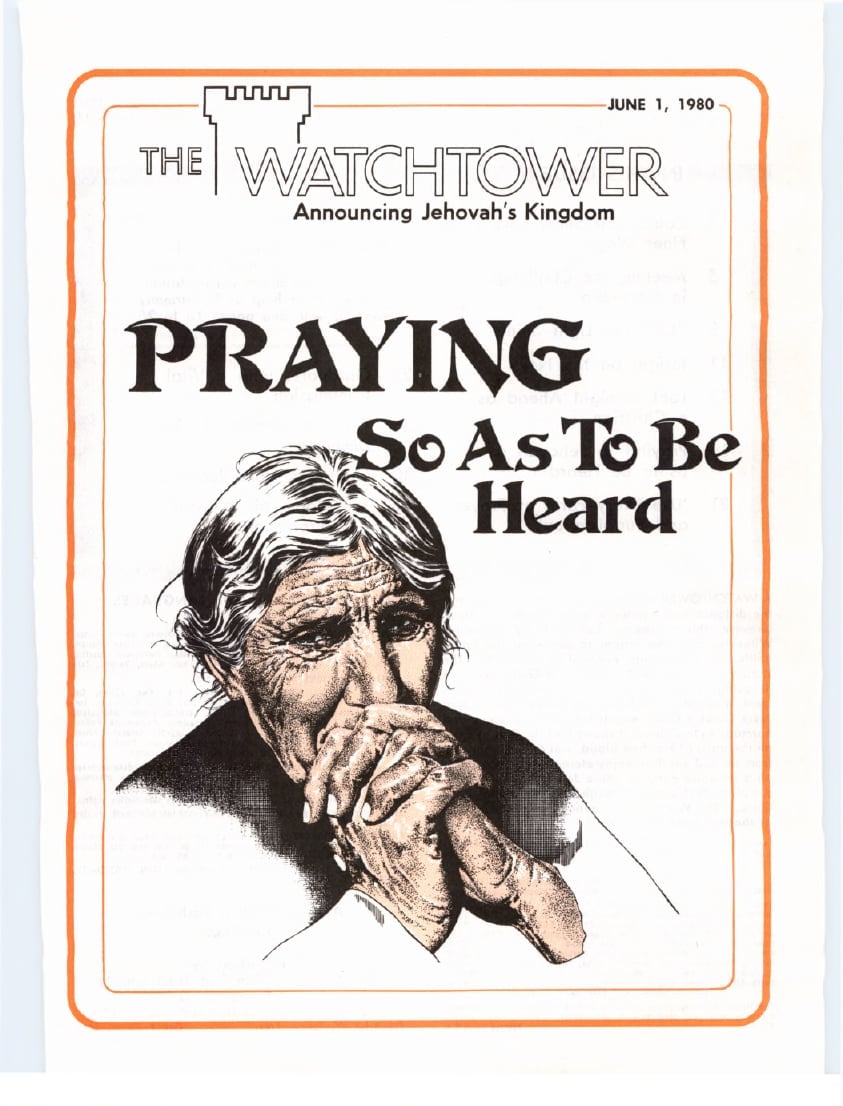
The Watchtower — June 1, 1980
Source: jw.org
Contents
Page Two
Could You Show Love in a Finer Way?
Meeting the Challenge in Colombia
“Let Your Light Shine”
Insight on the News
Look Straight Ahead as a Christian
Praying to Jehovah so as to Be Heard
‘Use Every Form of Prayer and Supplication’
Graduates with a Vital Commission
The First Woman to Be Deceived
Questions From Readers
Information at Your Fingertips
The Name of Jehovah—A Protection
Page Two
Page Two
OUR COVER: Coming to Jehovah God in prayer, we may be confident that he knows our limitations and wants to help us in harmony with his will. See pages 16 to 26
Could You Show Love in a Finer Way?
Could You Show Love in a Finer Way?
OF ALL the qualities that we might cultivate, “the greatest of these is love.” (1 Cor. 13:13) The kind of love the apostle Paul was here speaking about was not éros, a love based on sex attraction and from which we get the word “erotic”; nor was it storgé, the love that is based on family relationship; neither was it philía, the love that is based on similarity of personal likes and dislikes. Rather, the Greek word that the apostle here used was agápe, the positive love that is based on principle and is wholly outgoing.
Among the ways we can show love is by giving things of material nature or value. That in itself is good, but may there be a finer way? A well-beloved Bible student of years ago is reported to have observed: ‘If we can choose between giving more money to the Lord’s work or giving more of our time and energy, the wiser course would be to choose to do the latter—give more of our time and energies.’ Why? Because this might well result in more honor and praise going to God and in more happiness to oneself.
By and large, the Christian witnesses of Jehovah appreciate this principle. A few years back, a Pittsburgh newspaper headline stated: “Jehovah’s Witnesses Donate Labor to Build Assembly Hall Near Airport.” The article contained a large picture of this work being carried on and told that literally thousands had volunteered their help and that at times more came to help than could actually be used. Reading this report, a Protestant church deacon was moved to complain about the poor response he was getting to a call for help for a certain project of which he had the oversight: “Think of the vast number of Protestant churches and all the allied groups involved in the project . . . [yet] it’s hard for me to get six men out at any one time to give a day of free labor to develop a project.” Evidently, these many churchgoers felt it was easier to contribute their money than to give of themselves, to give of their time and energies.
However, candor, such as is manifested by God’s penmen, the inspired Bible writers, would require noting that those professing to be fully dedicated servants of Jehovah God may be also at times a little amiss in this respect. For example, in connection with the construction of a recently built Jehovah’s Witnesses Assembly Hall, the one in charge of the construction stated that the way the brothers responded with monetary contributions was nothing short of a miracle; though the hall would cost close to a million dollars, it would practically be paid for by the time the building was completed. However, when it came to giving support to this building project in the way of personal time and effort, that same appreciation seemed to be lacking.
What was the problem? Evidently many felt that their generous monetary contributions sufficed. True, making generous contributions was a very good thing. But of itself, the monetary giving did not relieve them from helping out with time and energy if they were able to do so. Jesus Christ might be said to have made this point when he told a certain rich young ruler not only to sell his belongings and give the proceeds to the poor but then to follow him.—Luke 18:18-23.
This same principle applies to all aspects of Christian service. In fact, would it not be finer for a person to devote all his time and energies to God’s service if able to do so? It may be more convenient to drop money into the contribution box at the Kingdom Hall than to show up for cleaning the Kingdom Hall and caring for the grounds surrounding it when one is responsible for doing so. But might not the latter show more love? It may be easier to contribute money to the printing of Bibles and Bible literature than to devote time taking this printed material to the homes of the people, preaching the good news of God’s kingdom and endeavoring to make disciples. But again, is not the latter a finer way to show love, and is it not what Jesus prophesied and commanded that his followers do? It is, even as can be seen from Matthew 24:14 and Matthew 28:19, 20.
Within the family circle this principle also applies. For a husband to spend money on his wife is commendable. But does not his showing love by giving her his time, attention and interest show more love? In fact, he may be very generous when it comes to money and yet not even truly love his wife. Thus there was once a politically prominent lawyer who provided very generously for his wife in a material way. But one day she was shocked to learn that he was keeping another woman on the side. So the giving of material things may not even be an expression of genuine love. Depending upon circumstances, husbands may be able to provide more or less in a material way; but when it comes to the “surpassing way,” rich and poor alike have much the same opportunities.—1 Cor. 12:31–13:13.
The situation is similar when it comes to parents’ showing love for their children. Some parents, because of having had little of this world’s goods when they were children, resolve that their children shall have an abundance of good things, fine clothes, toys, means for hobbies and what not. But if they let it go at that, they are very unwise. Far more important is it that they give of themselves, of their time, interest and energies, to their children. This really may cost more in the way of self-sacrifice, but such a course is also more rewarding. In other words, do not let the TV or a baby-sitter substitute for you except in emergencies, or on other rare occasions; not so that the parents can frequent some nightclub!
So let us ever bear in mind that the finer way for us to show love is to give of ourselves, our time, our energies, our interest, our attention, our affection. Giving things of a material value to God’s work or to those we love is a good thing, for such are necessary; but we never want to content ourselves with such giving if we can also give of the more valuable things. And should we have the opportunity to choose between the two, let us show the finer love as well as the greater wisdom by giving of ourselves, imparting even “our own souls.” That is what the apostle Paul did, and how richly God blessed him for it!—1 Thess. 1:6-10; 2:8.
Meeting the Challenge in Colombia
Meeting the Challenge in Colombia
WHAT challenge? That of declaring the “good news” throughout a country where climate, geography and cultural background present tremendous contrasts. We are talking about Colombia, located at the northwestern tip of South America. Its capital, Bogotá, and many other cities provide excellent territory for spreading the “good news.” But the Kingdom message also is being declared in the extensive rural areas, where unpaved roads, swarms of insects and occasional downpours of rain are a constant challenge.
Here in Colombia temperatures may drop from 28 degrees Celsius (82° F) in the steaming jungles to 12 degrees Celsius (54° F) in the mountain heights. However, the regions in between offer an eternal springlike temperature. The great mountain masses are said to contain inexhaustible reserves of rock salt. And the Zipaquirá mine not only supplies Colombians with most of their salt but also has been converted into one of the greatest works of subterranean architecture. Internationally renowned, the famous Salt Cathedral was carved out deep in the mine.
SPREADING THE “GOOD NEWS”
Colombia is rich in mineral deposits. But far more precious are the God-fearing persons found here. Back in 1922, Heliodoro Hernández, who lived near the towns of Paz de Río and Tasco, started reading The Watch Tower and acquired spiritual wisdom, something of much greater value than gold. (Prov. 3:13, 14) He began to share this newfound wisdom with his fellow countrymen, and by 1924 Juan B. Estupiñán had joined him in spreading the “good news.”
Since 1922, Kingdom proclaimers in Colombia have overcome many obstacles, and their faithful perseverance has been rewarded by steady growth. By 1978, their number had risen to 14,856. Of course, there is still much to be done. For example, Bogotá has an estimated population of around 5,000,000, but there are only about 3,000 Kingdom publishers associated with its 36 congregations.
It is a joy to observe numerous individuals make great changes in order to harmonize their lives with Bible principles, and this encourages others to remain steadfast in the witnessing work. For example, in 1975 a young man preparing to become a priest came in contact with the truth. His family threatened to cut off financial support and said that he would have to leave home if he kept on studying with Jehovah’s Witnesses. At first, he asked to have his personal Bible study discontinued. But after meditating on the Scriptural knowledge he was acquiring, he requested two studies a week. Since he was teaching at a religious school, he then quit his job. He was also forced to leave home. Only one month of study and meditation on the Holy Scriptures produced notable changes in this young man’s life. He stopped smoking, got an appropriate haircut and changed his manner of dress. In fact, the transformation was so remarkable that when he arrived at the Kingdom Hall nobody recognized him. Someone even asked him if he was the visiting public speaker. Since the young man did not have any other responsibilities, he began witnessing every day. Soon he was baptized, later becoming a regular pioneer (a full-time Kingdom proclaimer). Now he serves as a member of the Bethel family at the Watch Tower Society’s branch office in Colombia.
Consider, too, the personality change made by a certain man living in the city of Cali. He had been a sailor, musician, ventriloquist and policeman. Since he was very aggressive and always ready for fisticuffs or the use of his gun, his neighbors were afraid of him. He was always drunk over the weekend and the neighbors’ light bulbs served as targets as he practiced his shooting.
In 1971, this individual reluctantly listened to a pioneer who visited his home, and ultimately a Bible study was started with him. Soon, however, he discontinued his study and joined the Pentecostal Church. But later the pioneer called and invited him to examine the Bible to see what was behind the supposed miracles performed by that religious organization. The man wrote down all the texts considered and decided to keep studying with the Witnesses. That very night he went to see the Pentecostal minister to ask him about the texts he had read. When the pastor was unable to supply a satisfactory Biblical answer, not only did this man leave the church but 15 other persons left with him.
Not long thereafter, this man’s mother died and he arranged for a funeral talk in which the resurrection hope would be explained. (John 5:28, 29) This proved to be a test of his faith, for the entire family objected to this decision, to the extent that one of his brothers struck him a violent blow. However, this man’s newly acquired Bible knowledge enabled him to maintain self-control, and he calmly explained the reason for his position. The family was so surprised by his peaceableness that they permitted the Bible-based funeral talk to be given. Not only did his family later start studying the Bible, but his neighbors were so impressed by the change in his personality that eight families from his block began to study the Bible with Jehovah’s Witnesses. This man offered his house for a congregation book study, later enlarged his home so that a new congregation could meet there, and eventually helped to build a Kingdom Hall. Presently, this individual is serving as an appointed Christian elder in one of the city’s congregations.
REACHING OUT TO NEW TERRITORIES
In spite of the excellent growth experienced in Colombia through the years, there remains the challenge of carrying the Kingdom message into the extensive areas mainly composed of hot, humid, junglelike territories and rural areas. Taking the “good news” into these sections of the country represents a challenge, not only because of the physical difficulties to be faced there but also due to the varied cultures, customs and characteristics of the inhabitants. Getting to understand Colombia’s different cultures and adapting oneself to them has much to do with reaching the heart of these persons with the Kingdom message.
Although most Colombians are Roman Catholics, their ceremonies vary greatly from one region to another. Since their religious guides and publications fail to provide accurate Scriptural instruction, the people tend to confuse religious matters with magical phenomena. Their folklore attributes conscious life to inanimate objects, and the people say that the dead can cure the sick and help the living in other ways. Also, it is quite common to find that the people living in rural areas have a repertoire of prayers to cover their daily problems. For example, they have prayers to cure their cows of worms, to bring prosperity, to free them of their enemies, to heal snakebites and to protect their chickens and cattle.
In Colombian cities, funeral services are similar to those held in most Catholic countries. But in the rural regions things are different. To illustrate: In the region of Jegüita, for nine nights after a death occurs, the local reciter of prayers leads mourners in petitions for the deceased. After about an hour of recitation, he calls upon the “soul” of the dead person to leave the house. That night a glass of water, with a small piece of cotton in it, is left by the coffin. Why? Supposedly, so that the deceased individual’s spirit may quench its thirst. So even though the dead person’s “soul” is ordered out of the house on the first night, the mourners keep praying for eight more nights to make sure that it does not come back and bother them. When they bury the body on the 10th day, the closest relative is not allowed to look at the coffin while it is being lowered into the earth because tradition has it that if he does this he will be the next family member to die. Incidentally, those who participate in the vigil over the deceased must be furnished with food, liquor and tobacco. Consequently, many incur debt in order to feed and entertain those sharing in the nine nights of prayer.
At one time, Alberto Medina was the reciter of prayers in the Jardin region of Córdoba State. But through his study of the Bible he learned that the soul dies, that the dead are conscious of nothing at all and that their only hope is the resurrection. (Eccl. 9:5, 10; Ezek. 18:4, 20; Acts 24:15) Of course, taking a stand for Scriptural truth made it necessary for Medina to face the challenge of pressures from unbelieving relatives and opposition from neighbors who did not want others to abandon the community’s long-standing traditions. Nevertheless, he has been able to help members of his own family and many others to gain accurate knowledge of God’s Word and purposes.
CONTINUING TO MEET THE CHALLENGE
Yes, accepting the Kingdom message presents a challenge. So does declaring the “good news,” especially in remote areas. Here in Colombia, this sometimes requires traveling on horseback, rowing a canoe and enduring swarms of insects. During the rainy season, there are many places in this country where a Kingdom proclaimer must trudge through ankle-deep mud. But such efforts have been rewarded, for there now are congregations in some of these areas.
Those who appreciate their Christian privilege of declaring the “good news” are happy to meet such challenges. And, surely, there is no experience quite as joyful as finding persons who are hungering for the truth, regardless of where they live. At the commemoration of the Lord’s Evening Meal in 1979, a total of 59,383 was present throughout this country. Indeed, the ‘fields are white for harvesting’ and there is yet much to do in promoting true worship.—John 4:35.
So if you are a dedicated witness of Jehovah, why not make a serious appraisal of your circumstances to determine whether you can increase your efforts or effectiveness in proclaiming the Kingdom message? Perhaps you can serve where the need is great, either in Colombia or in your own country. (1 Cor. 16:9) Whatever your circumstances are, however, prayerfully seek God’s aid in meeting the challenge of Christian life and service to Jehovah.
“Let Your Light Shine”
“Let Your Light Shine”
DISCIPLES of Jesus Christ are to shine as brilliant lights in this world, pointing fellow humans to the way that leads to an eternity of happy living. In his Sermon on the Mount, God’s Son said: “You are the light of the world. A city cannot be hid when situated upon a mountain. People light a lamp and set it, not under the measuring basket, but upon the lampstand, and it shines upon all those in the house. Likewise let your light shine before men, that they may see your fine works and give glory to your Father who is in the heavens.”—Matt. 5:14-16.
The exemplary conduct of Christ’s disciples should make them stand out noticeably from among persons who are unacquainted with the Bible’s message. Their kindness, patience, long-suffering, love and other fine qualities should make them appear as lights in a cruel, loveless world. However, for others to come to know the reason for their laudable conduct, Christians must be proclaimers of their beliefs. That is why many witnesses of Jehovah set aside time each week to visit their neighbors with the comforting message of God’s Word. Additionally, they make good use of their opportunities to share their Scriptural knowledge with whomever they may meet while caring for the daily affairs of life.
DESPITE OPPOSITION
It is not always easy for God’s servants to shine as lights. Not infrequently they become objects of ridicule and hatred. The message they proclaim—that God’s kingdom is about to crush the wicked system preparatory to bringing in the New Order—is not popular with the world. Those who prefer living a life devoid of faith in Jehovah God and his Son do not want to hear the Bible’s message. They oppose it and may even succeed in having a ban placed on the activity of God’s people. Also, the changes for the better that a Christian may have made in his life can result in his being reproached. The apostle Peter made this point, saying: “Because you do not continue running with them [worldlings] in this course to the same low sink of debauchery, they are puzzled and go on speaking abusively of you.”—1 Pet. 4:4.
A review of recent history shows that this has been the experience of Jehovah’s Witnesses. Happily, this has not stopped them, as a body, from continuing to act on Jesus’ words to ‘let their light shine.’ They realize that it is never a time for Christians fearfully to hide their light, as if ‘putting it under a measuring basket.’ No matter what the circumstances may be, the truth needs to shine forth in the words and actions of Jehovah’s dedicated servants.
Of course, this does not mean that a person would rashly ignore the unfavorable circumstances under which he must carry out his Christian activities. Jesus Christ admonished that his followers conduct themselves wisely in an enemy world. He said to his apostles: “Look! I am sending you forth as sheep amidst wolves; therefore prove yourselves cautious as serpents and yet innocent as doves. Be on your guard against men.” (Matt. 10:16, 17) Hence, in difficult times, caution is in order when we are looking for sincere seekers after God.
WHY BE CONCERNED?
But why should we be so concerned about letting our light shine? The Bible shows that the Creator has set a day of reckoning, or judgment, for all mankind. (Acts 17:31) For that day of judgment to result in blessings for us, we need an approved standing with him. How is such an approved standing possible? We need the kind of faith that impels us to do our utmost to help others to become and continue to be Christ’s true disciples.
Notice how the apostle Paul linked this matter of judgment with the importance of preaching that is backed by commendable conduct. He wrote: “We must all be made manifest before the judgment seat of the Christ, that each one may get his award for the things done through the body, according to the things he has practiced, whether it is good or vile. Knowing, therefore, the fear of the Lord, we keep persuading men.”—2 Cor. 5:10, 11.
Paul recognized the unparalleled authority that Jehovah God had granted to his Son. Jesus Christ now has ‘all authority in heaven and on the earth.’ (Matt. 28:18) Regarding his judicial powers, God’s Son declared: “The Father judges no one at all, but he has committed all the judging to the Son.” (John 5:22) Jesus Christ’s judgment will be flawless and final. He cannot be deceived by outward appearances or clever words. Prophetically it was said of him: “He will not judge by any mere appearance to his eyes, nor reprove simply according to the thing heard by his ears. And with righteousness he must judge the lowly ones, and with uprightness he must give reproof in behalf of the meek ones of the earth.” (Isa. 11:3, 4) Truly, there is sound reason for having a wholesome fear of such an eminently qualified judge who has full authority to render final decisions. Not only should we personally want to act in a way that demonstrates our faith in him as judge, but we should also want to persuade others to take the necessary steps to gain a favorable verdict from him.
Clearly, then, people of all races, nations and tribes need to know what they must do so that the fast-approaching day of reckoning will turn out for their benefit. This is nicely emphasized by the apostle Paul in these words: “‘Everyone who calls on the name of Jehovah will be saved.’ However, how will they call on him in whom they have not put faith? How, in turn, will they put faith in him of whom they have not heard? How, in turn, will they hear without someone to preach?”—Rom. 10:13, 14.
Because of appreciating the importance of declaring the “good news,” many witnesses of Jehovah share in the auxiliary pioneer service, devoting at least 60 hours during a particular month to spreading Bible truth. This has led to many blessings. For example, about three years ago, there was one lone Witness in Dacca, Bangladesh. Then another Witness, accompanied by his wife, came to the city on a work contract. This married couple began zealously sharing the Bible’s message with others, and soon the number of Kingdom proclaimers increased to eight. Of this number, two regularly served as auxiliary pioneers. What resulted from this increased activity? About a year ago over 20 Bible studies were being conducted with interested persons, and many of these were attending the meetings that had been arranged.
If we truly believe that the day of reckoning is drawing ever closer, should this not reflect itself in an earnest desire to inform people about the certainty of this event? How is the knowledge that you will stand before God’s appointed Judge influencing your life? Are you making it your determination to think, speak and act in a manner that will appeal to the good conscience of your fellowmen? Do you on a regular basis set aside time to share with others the truths of God’s Word? Is your heart moving you to speak at other times also? If you are diligently striving to be like God’s Son in thought, word and action, you will indeed be living in harmony with his admonition: “Let your light shine.”
“Go on walking as children of light, for the fruitage of the light consists of every sort of goodness and righteousness and truth.”—Eph. 5:8, 9.
Insight on the News
Insight on the News
Is Smarter Better?
● Three women in the eastern United States were among the first to become pregnant under a California millionaire’s plan to increase the number of “people at the top of the population.” He convinced five Nobel Prize-winning scientists to donate sperm to a special repository. “Intellectually advanced” women whose husbands are sterile were solicited to receive the “superior” sperm by artificial insemination. The women could choose anonymous numbered sperm on the basis of such things as the scientists’ IQ, age, weight, height, and eye color. One woman reportedly said: “I’m very excited about this . . . I’m tentatively going to select No. 13 because he’s the youngest of the donors and has the highest IQ.”
Even aside from the adulterous moral implications of this arrangement, does high IQ necessarily mean high quality? One authority on ethics observed: “There’s no guarantee that high IQ people produce better people or a better society. It is not the retarded kids of the world who produce the wars and destruction.” In fact, the last person to promote a “master race” died in a Nazi bunker at the end of World War II.
Medical Tide Turns
● The medical journal “Żyjmy Dlużej” (Live Longer) of the Polish People’s Republic recently commented on a growing medical trend away from blood transfusions, saying that doctors have come “from naïve faith in the saving value of blood” in the past, “until our day, when sober judgment shows that blood can also be very dangerous.” The writer, Professor Franciszek Smolarek, M.D., added: “There was a time when the healing progress was measured by liters of transfused blood. Today we see the real truth, that blood is a foreign tissue . . . able to cause far-reaching immunological reactions.”—August 1979, p. 14.
Similarly in North America, Professor Horace Herbsman, M.D., of the State University of New York Downstate Medical Center, confirms this changing medical view. He writes in “Emergency Medicine” magazine: “Indeed, perhaps our experience with Jehovah’s Witnesses might be interpreted to mean that we do not need to rely on blood transfusions, with all their potential complications, as much as we once thought.”—January 15, 1980, p. 76.
And in Canada, after interviewing a number of surgeons on the subject, reporter Marilyn Dunlop of the Toronto “Star” asks: “How great a risk to the lives of their children or themselves do Jehovah’s Witnesses take by refusing on religious grounds to accept blood?” Her answer? “There is growing medical evidence that it may not be as great as the rest of society and the medical profession has long assumed.”
Such changes in thinking are not uncommon in any field of science. And this is not to the discredit of physicians who sincerely wish to give their patients the best form of treatment possible. No doubt when they become convinced that alternative treatment is better, they will say as did one heart surgeon interviewed for the “Star”: “There is an advantage to doing it that way [without blood]. Blood is not good for people. If you can do without it that is great.”—February 24, 1980, p. A10.
Fostering Pharisees
● In February, Massachusetts became the first state to attempt the reinstituting of prayer in schools since the U.S. Supreme Court outlawed such in 1963. The Massachusetts law lasted six weeks before it was struck down as unconstitutional by the state Supreme Judicial Court. Under the now defunct law, teachers were to ask for a volunteer to lead the class in prayer each day, and allow those who did not wish to participate to leave the room.
But many resented such legislated religion. In fact, as columnist Norman Lockman of the Boston “Globe” observed: “The self righteous are trying to use public schools to teach children to be pharisees, people who pray for show.” This echoes Jesus’ comments about the prayers of the original Pharisees 1,900 years ago: “When you pray, you must not be as the hypocrites; because they like to pray . . . to be visible to men.”—Matt. 6:5.
Look Straight Ahead as a Christian
Look Straight Ahead as a Christian
THE seal hunters were hopelessly lost in a world of nothing but ice and blinding snowstorms. When things were at their worst, one of them said: “I don’t believe any of us will survive to tell the tale.” However, a couple of the men persistently refused to lose heart. One of them, a section leader, was thinking affectionately of his fiancée. When his exhausted companions wanted to give up, her face was constantly before him. He did not intend to die, and he encouraged his comrades not to lie down in the snow but to keep moving. He and about 50 other men survived the disaster. His love for his fiancée, whom he afterward married, and the clear image of her face in his mind’s eye had saved many from death.
This true story illustrates the importance of never losing sight of our goal in the Christian contest for life. At times, the Christian fight against deviating from the righteous path can be as hard as the struggle of those exhausted seal hunters. Death sets in when a person ceases to “fight” and gives in to the overwhelming urge to lie down and go to sleep. How happy are those having before their mind’s eye an image that encourages them to look straight ahead and not give up!
This is exactly what faithful men of old did. For instance, instead of continuing his princely way of life at the court of Pharaoh of Egypt, Moses chose “to be ill-treated with the people of God.” And why did he make this choice? “For he looked intently toward the payment of the reward.” Yes, Moses looked ahead and saw not only the reward but also the One who gave the prospect of such a reward. As it were, Moses saw “the One who is invisible,” his God Jehovah.—Heb. 11:24-27.
Also, Jesus Christ did not give up the bitter struggle to maintain his integrity, even though he had to do this with “strong outcries and tears.” (Heb. 5:7) He learned obedience from the things he suffered and kept looking straight ahead toward the prize his Father, Jehovah, had set before him.—Heb. 12:2.
WHAT WE SEE IF WE LOOK STRAIGHT AHEAD
The Most High God reveals himself to mankind by his name Jehovah and through his love, mercy, tender care and generosity. (Ps. 83:18; Acts 14:17) Jehovah has proved himself so bountiful in these things that, like faithful Job of old, we should be able to cry out: “In hearsay I have heard about you, but now my own eye does see you.” (Job 42:5) With the eye of faith we also see Jesus sitting at the right hand of God in heaven. He is the one who gave his life to free us from slavery to sin and death. What a captivating view to behold!—Col. 3:1, 2; compare Acts 7:55, 56.
As if this were not enough, on the horizon we see, too, the glow of a new dawn. The day when God’s kingdom will start making the earth a paradise is at hand! We must never lose sight of these realities. Our eye must be in focus like the precisely adjusted lens of a good camera, so that the things that lie before us make a clear impression on our spirit and our heart.
“The lamp of the body is your eye,” said Jesus. “When your eye is simple, your whole body is also bright.” (Luke 11:34) With a simple eye turned toward Jehovah God, his Son and the Kingdom, in even the most difficult circumstances we shall be able to overcome the inclination to give up. So we will pay close attention to the admonition: “As for your eyes, straight ahead they should look, yes, your own beaming eyes should gaze straight in front of you. Smooth out the course of your foot, and may all your own ways be firmly established.”—Prov. 4:25, 26.
LOOKING STRAIGHT AHEAD REQUIRES EFFORT
From the true-life story presented at the outset, it is clear that great effort is needed to keep going ahead in extreme situations. The inclination is to give up and lie down. At this moment of world history we are living in the extreme situation about which Paul warned us at 2 Timothy 3:1: “But know this, that in the last days critical times hard to deal with will be here.” Although many Christians provide excellent examples of perseverance, others show signs of weariness and some are inclined even to abandon the contest. It is a great help to know some of the reasons why a Christian begins to show symptoms of fatigue and, above all, to know what can be done to offset this. The following factors have helped certain Christians to keep looking straight ahead when they had lost heart or had nearly given up.
DEVELOP A POSITIVE OUTLOOK
Encouragement is a strong force for perseverance. (Acts 27:33-36) A positive attitude is needed for encouragement, whereas a negative attitude has just the opposite effect and is discouraging. Do you know people who are very negative and who are critical about nearly everything? Are they happy people? Not all criticism, of course, need be wrong, for valid criticism exists too. But do you not agree that criticism of a negative kind makes such a critical person weary and can result in his becoming very unhappy? Because this is really a matter of outlook, the cure lies in the development of a positive attitude.
Jehovah always looks for the good, even in wrongdoers. Although King Jehoshaphat’s wrongdoing incited God’s indignation against him, Jehovah said to him: “Nevertheless, there are good things that have been found with you.” (2 Chron. 19:3) So why not be like Jehovah in this respect and look for the good in other people? For instance, if you should be disposed to criticize an appointed elder in the Christian congregation, would it not be profitable to consider his many good points—his love for Jehovah and the congregation, his hard work in preparing meetings and his willingness to help? This will help to remove negative thoughts from your mind. And whenever you are confronted with seemingly negative situations, why not consider the good that will come from your reacting correctly in such situations? We have the sterling example of Jesus, who suffered at the hands of his enemies but “learned obedience from the things he suffered.”—Heb. 5:8.
BUILD UP GREATER FAITH AND TRUST
You may also have met people who allowed themselves to be overcome by an inferiority complex. Even Christians can be so overpowered by such feelings that they view themselves as worthless and no longer fit to continue on the Christian path. But is this the right way to look at the matter? Of course not. Jehovah’s earthly children are very precious to him. (Hag. 2:7) No one who is trying to do what is right is inferior in his eyes. So what we need is increased trust in Jehovah and greater faith in God’s ability to make us qualified servants through his spirit.—2 Cor. 3:5.
Instead of allowing ourselves to become discouraged and give up, with the foregoing thoughts in mind we will be encouraged to look straight ahead with confidence. We will find joy in persevering, for “happy is he that is trusting in Jehovah.”—Prov. 16:20.
DO NOT BE ANXIOUS
Excessive anxiety also robs people of the joy of life and makes them weary. That this is an important factor at present is indicated by Jesus’ words about the “time of the end.” (Dan. 12:4) He pointed out that “men [would] become faint out of fear and expectation of the things coming upon the inhabited earth.”—Luke 21:26.
Some people are always talking about the troublous times, the difficult economic situation, the high inflation, the increase in crime, the breakdown in family life, loneliness and many other unpleasant things. Because of this anxiety even some Christians have lost the will to keep walking against the storm and are in danger of losing their lives. So there is every reason to have a completely different outlook. Here is Paul’s stirring admonition: “Always [yes, even when problems arise] rejoice in the Lord. Once more I will say, Rejoice! . . . Do not be anxious over anything, but in everything by prayer and supplication along with thanksgiving let your petitions be made known to God.” With what result? Then “the peace of God that excels all thought will guard your hearts and your mental powers by means of Christ Jesus.” (Phil. 4:4-7) Such a person will not lose heart.
DEEPEN YOUR SPIRITUALITY
Persistently going ahead in a snowstorm requires a great deal of vitality. Dwindling energy reserves in the body must be replenished. Likewise, a Christian who does not constantly feed his mind and heart on spiritual food will lose his happiness and get tired. If this condition lasts too long, he will not continue on the way of life.—Matt. 4:4.
The emphasis laid nowadays on pleasures and diversions could cause even formerly strong Christians to become “lovers of pleasures rather than lovers of God.” (2 Tim. 3:4) This, in turn, would deprive them of valuable time needed to feed themselves spiritually. Also, materialism, the ‘determination to be rich,’ makes such demands on a person’s time reserves that his spiritual inclination can be destroyed by it. Paul’s words of warning are particularly applicable to our times: “By reaching out for this love [of money] some have been led astray from the faith.”—1 Tim. 6:9, 10.
A person who wants to stand firm in these stormy times must deepen his spirituality by scheduling daily periods for study of the Bible and Scriptural publications. And he must seek regular association with fellow believers. (2 Tim. 3:16, 17; Heb. 10:24, 25) This will help to give his mind and heart the vigor described in Isaiah 40:29-31: “He [Jehovah] is giving to the tired one power; and to the one without dynamic energy he makes full might abound. . . . those who are hoping in Jehovah . . . will run and not grow weary; they will walk and not tire out.”
WALK WITH GOD
Happy is the individual who does not ‘go on his own’ but has a companion on the way. Yes, “two are better than one . . . For if one of them should fall, the other one can raise his partner up.” (Eccl. 4:9, 10) Faithful men of old like Enoch and Noah had the best companion on their way. They walked with the true God. (Gen. 5:24; 6:9) Walking with God gives a person the needed help to survive the worst of storms. The individual’s daily communication with Jehovah and strong personal relationship with his heavenly Father will keep him on his feet.
For instance, if a person feels lonely because of having lost a beloved marriage mate or child in death, this intimacy with God will make the terrible loss bearable. When the Christian is mistreated, suffers some unrighteousness, or even when he is terribly hurt by a brother in the faith, this precious relationship with Jehovah will protect him from ever giving up the fight. Even if a person has sinned and his conscience is deeply troubled in repentance, his relationship with Jehovah will restore him and, through the ransom sacrifice of Jesus Christ, his sins will be forgiven. (1 John 1:7) He will keep on looking and walking straight ahead as a Christian.
LOOKING AHEAD BRINGS A RICH REWARD
As we have seen, there is need for a positive attitude to enable us to weather heavy personal storms in our lives. Besides, we may personally have to face the “great tribulation,” a severe worldwide “storm” that will devastate this entire system of things. (Matt. 24:21, 22; Jer. 25:31, 32) God’s spirit will help us to weather this tempest and be found alive when it is all over and the sun rises over a cleansed earth, one that will be transformed into a global paradise.
Jehovah God does not want us to tire out and give up. He wants us to be among those whom the apostle Paul describes at Hebrews 6:11, 12: “We desire each one of you to show the same industriousness so as to have the full assurance of the hope down to the end, in order that you may not become sluggish, but be imitators of those who through faith and patience inherit the promises.” So, let us not become weary, but let our personal relationship with Jehovah God, our faith in the ransom sacrifice of Jesus and the bright outlook of the New Order be the energizing forces in our life. Then we shall be like Moses, who saw Jehovah by faith, and like Jesus, who looked ahead to the joy that was set before him. Yes, and like the hundreds of thousands of Christians around the globe who look straight ahead and confidently say: “We are not the sort that shrink back to destruction, but the sort that have faith to the preserving alive of the soul.”—Heb. 10:39.
Praying to Jehovah so as to Be Heard
Praying to Jehovah so as to Be Heard
“He that approaches God must believe that he is and that he becomes the rewarder of those earnestly seeking him.”—Heb. 11:6.
1-3. (a) What does the experience of a little girl tell us? (b) What lesson is there in this for all parents?
IT HAPPENED at a Kingdom Hall of Jehovah’s Witnesses. Despite repeated stern looks and whispered reproofs from her mother, a little girl continued to misbehave. The mother then signaled for the father to take over, and he did. With his daughter, he strode toward a small room at the rear of the hall. Realizing what was in store for her, the little girl cried out: “O Jehovah, please help!”
2 Whenever this incident is related, it elicits chuckles, and well it might. But is it only amusing, or does it tell us something? Indeed it does tell us something. The little girl knew the name of God the Creator, that it is Jehovah, something very few little girls know. She had been taught the value of prayer and that Jehovah can be appealed to for help in times of trouble. True, it does seem amusing that she would ask God to protect her from needed discipline. But, really, is such a request limited to naïve little girls? Not at all. The nation of Israel time and again did the very same thing, especially in the days of the judges. Repeatedly, when receiving merited punishment, they prayed to God for relief.—Judg. 2:11-18; 4:1-3, 23, 24; 10:6-16; 11:32, 33.
3 There is a lesson in this for all Christian parents. Start early in life to inculcate in your children faith in Jehovah God. Help them to appreciate and to understand that Jehovah is a real person who hears and answers prayers. Teaching children about prayer from infancy will contribute much toward their becoming God-fearing when they reach the age of accountability.—Compare Psalm 22:9, 10; Proverbs 22:6; 2 Timothy 3:14, 15.
WHY GIVE THOUGHT TO YOUR PRAYERS
4, 5. (a) What questions regarding prayer do we do well to ask ourselves? (b) Why are such questions most timely?
4 But what role does prayer play in your life? How much do you pray? Do you often find yourself too busy even to pray? Or, do you perhaps hurry through your prayers mechanically, as a chore, a duty that must be fulfilled? What is the quality of your prayers?
5 These thought-provoking questions are timely. Even among those identifying themselves as Jehovah’s servants there are persons who do not pray regularly. others feel that their prayers lack meaningful content and substance. This is something that a Christian may not take lightly, for the quality of his prayers reflects his spiritual condition. A person’s spiritual health, in turn, depends largely on his being conscious of his spiritual need and doing something about it. (Matt. 5:3) At the same time, by giving thought to the quality of his prayers, the individual can improve his spiritual state.
WHY WE CAN COME TO JEHOVAH IN CONFIDENCE
6. In view of what the Bible says at Psalm 65:2, Philippians 4:6 and 1 Thessalonians 5:17, why can we pray to God with confidence?
6 Why can we confidently come to Jehovah, expecting him to listen to our prayers? First of all, because he identifies himself as the “Hearer of prayer” and repeatedly commands us to pray. (Ps. 65:2) His Word contains such commands as: “Pray continually, that you may not enter into temptation.” (Matt. 26:41) “Pray for one another.” (Jas. 5:16) “Persevere in prayer.” (Rom. 12:12) “Pray incessantly.” (1 Thess. 5:17) “Do not be anxious over anything, but in everything by prayer and supplication along with thanksgiving let your petitions be made known to God.”—Phil. 4:6.
7. Who were some exemplary men of prayer?
7 The Bible also provides examples, in effect, indirect commands for us to pray. From Genesis to Revelation, the inspired record abounds with examples of men of prayer. We read of Abraham’s praying to Jehovah. (Gen. 12:8) From the time of his baptism in the Jordan to his hanging on the execution stake, Jesus Christ time and again prayed to his Father. (Luke 3:21; 23:46) The apostle Paul mentions the subject of prayer literally dozens of times in his letters. Repeatedly he tells of praying for others, gives encouragement to pray, or asks others to pray for him. (Phil. 1:9-11; Eph. 6:18, 19) The book of Revelation, written by the apostle John, closes with two prayers.—Rev. 22:20, 21.
8. Because of what issue can we approach God with confidence?
8 A second reason for our being able to approach God confidently in prayer is that his name is involved. This includes his name or reputation as the “Hearer of prayer.” Also, since his name is attached to his people, seeming evidence of his forsaking them would be wrongly interpreted by observers as revealing Jehovah’s inability to aid his wayward servants. This would bring reproach on his name. Thus, at Psalm 79:9, we read: “Help us, O God of our salvation, for the sake of the glory of your name; and deliver us and cover over our sins on account of your name.” Moses, Joshua, David and Hezekiah all prayed to the same effect. (Ex. 32:11, 12; Josh. 7:8, 9; 2 Ki. 19:15-19; Ps. 25:11) And the prophet Daniel made his appeal in these words: ‘O Jehovah, do pay attention and act. Do not delay, for your own name has been called upon your city and upon your people.’ (Dan. 9:19) Yes, if we really bear Jehovah’s name, we can plead with him on that basis.
9. Why can we confidently plead with God for mercy and forgiveness?
9 A third reason for expecting Jehovah to hear our prayers is that he knows our limitations and wants to help us. The psalmist David expressed this as follows: “As far off as the sunrise is from the sunset, so far off from us he has put our transgressions. As a father shows mercy to his sons, Jehovah has shown mercy to those fearing him. For he himself well knows the formation of us, remembering that we are dust.” (Ps. 103:12-14; see also Psalm 51:5.) Hence, when we are overtaken in a fault, when we bungle matters or make a serious mistake, we can plead with Jehovah God on the basis of our weaknesses and imperfections.
10. As illustrated in the case of Job and that of Paul and others, why can we approach God with confidence?
10 Another weighty reason for being able to come to Jehovah with confidence is that he will hear our prayers on the basis of our being integrity-keepers. Job made an eloquent plea to this effect, saying: “Let God weigh me in the scales of justice, and he will know that I am innocent!” (Job 31:6, The New English Bible) Similarly, Paul asked fellow believers: “Carry on prayer for us, for we trust we have an honest conscience, as we wish to conduct ourselves honestly in all things.” (Heb. 13:18) That we have to be upright from God’s standpoint is also evident from what the apostle John wrote: “Beloved ones, if our hearts do not condemn us, we have freeness of speech toward God; and whatever we ask we receive from him, because we are observing his commandments and are doing the things that are pleasing in his eyes.”—1 John 3:21, 22.
PRAY THROUGH, NOT TO, JESUS CHRIST
11. Through whom only can we approach God in prayer?
11 How can we gain access to the great “Hearer of prayer”? He has appointed that this be through Jesus Christ alone. There is only one Mediator between God and men, and one High Priest, Jesus Christ. (1 Tim. 2:5; Heb. 7:25, 26) Jesus himself put it very explicitly, saying: “No one comes to the Father except through me.” (John 14:6) “Most truly I say to you, If you ask the Father for anything he will give it to you in my name. . . . Ask and you will receive, that your joy may be made full.”—John 16:23, 24.
12, 13. (a) In view of what the apostle John and Stephen did, what questions might be asked? (b) But why cannot the examples of Stephen and the apostle John be taken as reasons for praying directly to Jesus?
12 However, some persons wonder: ‘May we not also ask things directly of Jesus himself? Did not the disciple Stephen in prayer directly address Jesus, and did not the apostle John do likewise?’ True, Stephen, just before he expired, said: “Lord Jesus, receive my spirit.” (Acts 7:59) And the apostle John did pray: “Amen! Come, Lord Jesus.”—Rev. 22:20.
13 However, we do well to consider the circumstances. Stephen, for example, had a vision, for he said: “Look! I behold the heavens opened up and the Son of man standing at God’s right hand.” Therefore, because of seeing Jesus in a vision, Stephen could directly address the Son of God. (Acts 7:56) The apostle John likewise had a vision of heavenly things. (Rev. 1:1, 10; 4:1, 2) While having this vision, the apostle saw Jesus and heard him say: “He that bears witness of these things says, ‘Yes; I am coming quickly.’” (Rev. 22:20) Accordingly, John replied to what he had just heard Jesus say. Such instances are comparable to what took place when the persecutor Saul of Tarsus was on his way to Damascus. Jesus Christ revealed himself to Saul, saying: “Saul, Saul, why are you persecuting me?” As was true of the apostle John and of Stephen, Saul replied directly to Jesus: “Who are you, Lord?”—Acts 9:4, 5.
WITH DUE REVERENCE
14, 15. When we are praying, what should our attitude, words and tone of voice indicate, and why?
14 In approaching the great Sovereign of the universe in prayer, we must also come to him in the proper manner. We may approach him only with the greatest respect, deference and deep humility. The fact that God’s Word tells us that we may come to God with “freeness of speech” does not mean that we may become familiar or casual with the great Creator. (Heb. 4:16; 1 John 3:21, 22) How thoughtlessly inappropriate to begin a prayer with an expression such as, “Good afternoon, Jehovah!” We can come with freeness of speech because of our faith and confidence in His willingness to hear and because of our being integrity-keepers. But we should do so with deep respect, with reverence.—Compare Ecclesiastes 5:1, 2.
15 We should never forget that Jehovah God is exalted far above us. Because of our terrestrial existence and organism we are lower than the angels in power and glory. (Heb. 2:7) Moreover, we are imperfect, sinful humans. Appropriately, then, in our prayers we should use words and a tone of voice showing that we understand and appreciate our relationship with Jehovah God, for he grants an audience only to the humble ones ‘who tremble at his word.’ (Isa. 66:2) How well Jesus Christ underscored this principle in his parable about the two men who went up to the temple in Jerusalem to pray! Jehovah God paid no attention to the proud, self-righteous Pharisee, but he apparently heard and answered the prayer of the humble, contrite tax collector!—Luke 18:9-14.
IN FAITH AND WITH PERSEVERANCE
16. What scriptures show the importance of faith in prayer?
16 Another important requirement for being heard by Jehovah is to come to him in faith. Repeatedly, this condition of prayer is called to our attention in God’s Word. Jesus said: “If you have faith the size of a mustard grain . . . nothing will be impossible for you.” (Matt. 17:20) At Hebrews 11:6 we are told that to please God well we must not only have faith that he exists but also that he rewards those “earnestly seeking him.” The disciple James wrote: “Keep on asking in faith, not doubting at all, for he who doubts” will not “receive anything from Jehovah.”—Jas. 1:6, 7.
17. What counsel do the Scriptures give as to persevering in prayer?
17 For our petitions to be answered, we must also persevere in prayer. We should want to make prayer a habit. The Bible admonishes us: “Steadfastly maintain the habit of prayer.” (Rom. 12:12, The New Testament in Modern English, J. B. Phillips) Jesus time and again stressed this aspect of prayer. In his Sermon on the Mount, he said: “Keep on asking, and it will be given you; keep on seeking, and you will find; keep on knocking, and it will be opened to you.” (Matt. 7:7) In his parable about the widow who got justice from a judge who neither feared God nor respected man, Jesus likewise stressed the importance of persevering in prayer. (Luke 18:1-8) If we are truly earnest about the things for which we ask Jehovah God, we will “persevere in prayer” and “pray incessantly.”—Rom. 12:12; 1 Thess. 5:17.
18. What things should we not permit to interfere with our having time to pray?
18 Closely related to persevering in prayer is the taking of time to pray. We should never be too busy to pray. True, there are the necessary things of life—our daily occupation, eating, grooming, sleeping—that take up most of our daily 24 hours. But are there not also many other things that may encroach on our time more than they should? These things may include reading the newspaper, watching television, engaging in sports activities and other forms of recreation or in relaxation. Unless we truly appreciate the precious privilege of prayer, we may well find ourselves neglecting it because of such things crowding out our time for it.
OCCASIONS FOR PRAYER
19. What are some of the many occasions that we have for praying?
19 Many indeed are the occasions or opportunities that we have for prayer. For us to be ‘praying incessantly’ involves praying on all occasions—on rising in the morning, when retiring in the evening, before meals and during the wakeful hours of the night. (See Psalm 5:3; 92:1, 2; 119:147-149, 164; 1 Timothy 4:4, 5.) We may face serious problems or times of stress, have to shoulder weighty responsibilities; we may be called upon to speak before a Christian audience or make a defense of our faith before governmental officials. Surely, these are times for committing our concerns to Jehovah. Yes, “in all your ways take notice of [God], and he himself will make your paths straight.” (Prov. 3:6) Furthermore, whenever we receive some special blessing, particularly if it is unexpected or keenly desired, our hearts should well up in gratitude to Jehovah. But, of course, we do not need special reasons. Our hearts and our minds may move us to express gratitude at any other time.
20. What can be said about our bodily position in prayer?
20 Since any and all times may be fitting for prayer, does this mean that we do not need to give any thought to our bodily position when praying? True, the Bible does not prescribe assuming a certain position, such as kneeling and folding the hands, when praying. But we do read of persons praying while standing, kneeling or in a prostrate position, and with hands outstretched. (See Genesis 24:26, 48; 1 Kings 8:22, 42, 44, 54; Nehemiah 2:1-4; Mark 11:25.) This would indicate that it is appropriate, when possible, to assume a respectful physical attitude when praying. For example, at a congregation meeting we may rise and bow our heads. Such a change in bodily position may also help us to concentrate on the prayer being offered in our behalf. It does seem that kneeling is an especially appropriate posture for private prayers. (Compare Daniel 6:10; Philippians 2:9, 10.) Even if we should lie prone in bed when praying before going to sleep, we must be careful to heed the apostolic injunction to “keep awake,” alert, watchful when praying.—Eph. 6:18.
21. To come to God so as to be heard, how must we pray?
21 Truly, praying to Jehovah God is something that we want to take seriously. How thankful we should be that we can approach our heavenly Father, confident that he will hear us at any time! Of course, this depends on our coming to him in faith, through the proper channel, with the right frame of mind, and then persevering in prayer, never being too busy to pray. And, if you have children, patiently teach them the importance of prayer both by precept and by fine example.
‘Use Every Form of Prayer and Supplication’
‘Use Every Form of Prayer and Supplication’
“With every form of prayer and supplication . . . carry on prayer on every occasion in spirit. And to that end keep awake with all constancy and with supplication in behalf of all the holy ones.”—Eph. 6:18.
1. (a) In what ways do we want to think of Jehovah God when we come to him in prayers? (b) What four basic kinds of prayer are there?
THE Creator, Jehovah God, is not a mere impersonal First Cause but a real person with feelings. He is able to see and hear. We always want to think of him in this way when we approach him in prayer. God’s Word counsels us to do so “with every form of prayer and supplication.” (Eph. 6:18) What does this include? There are four basic forms of prayer—praise, thanksgiving, petition and supplication.
PRAISING GOD IN PRAYER
2, 3. What is a most noble and exalted form of prayer, and what are some of many reasons for its being due Jehovah God?
2 Praise is certainly a noble, exalted form of prayer. It is due the Creator because of his qualities and accomplishments. As the “Sovereign Lord Jehovah,” he is unequaled in authority. (2 Sam. 7:28) Having neither beginning nor end, Jehovah God is the peerless “King of eternity.” (1 Tim. 1:17) He is such a glorious person that no man can see him and yet live. (Ex. 33:20) The Most High is without equal, being infinite in power and wisdom, wholly just and the personification of unselfish love. (Deut. 32:4; Job 37:23; Rom. 11:33; 1 John 4:8) He made all things and so owns the entire universe. (Gen. 1:1, 31; Ps. 50:10) In name and fame, he is unrivaled. Only he can rightly say: “I SHALL PROVE TO BE.” He alone has the name Jehovah, which is understood to mean “He causes to become.” (Ex. 3:14; 6:3) Only he can rightly declare: “To whom will you people liken me or make me equal or compare me that we may resemble each other?” “I am the Divine One and there is no other God, nor anyone like me.”—Isa. 46:5, 9.
3 Above all others, such an incomparable, matchless, peerless, unrivaled God is deserving of praise. Fittingly, scores of times, from Exodus 15:11 to Revelation 19:6, encouragement is given to praise Jehovah. In harmony with this, may we not only keep on praising the Most High in our prayers but, also, may our everyday conversation call attention to him rather than to ourselves. After all, we have nothing that we did not receive and, apart from him, we really cannot accomplish anything.—Ps. 127:1; 1 Cor. 4:7.
RENDERING JEHOVAH THANKSGIVING
4, 5. What do the various Bible writers have to say about our giving thanks to Jehovah, and what are some of the many reasons for our doing so?
4 Closely related to praising Jehovah is the rendering of thanks to him. It is only right that we express appreciation for all that Jehovah has done, is doing and will yet do for us. The writers of the psalms appear to have been especially aware of the appropriateness of our expressing thanks to Jehovah. Time and again we read such expressions as “O let people give thanks to Jehovah for his loving-kindness and for his wonderful works to the sons of men.” (Ps. 107:8, 15, 21, 31) Similarly, Paul counsels us to make “supplication along with thanksgiving.” Yes, we are to be “giving thanks always for all things to our God and Father.”—Phil. 4:6; Eph. 5:20.
5 How many are the things for which we should daily express gratitude to our heavenly Father! We owe him thanks for all the physical and material things that we receive and that make life not only possible but also enjoyable. (Jas. 1:17) Do we appreciate all the spiritual blessings that Jehovah showers on his servants—the benefits of Christ’s sacrifice, God’s Word and his spirit, the Christian congregation and the gift of prayer? Do we appreciate the blessing of association with fellow believers, the privilege of ministering to the needs of others, and the wonderful Kingdom hope? If so, let us express gratitude in our prayers. True, we may not always remember or enumerate all that God has done for us. But we should feel as did the psalmist: “Bless Jehovah, O my soul, and do not forget all his doings.”—Ps. 103:2.
…