The Watchtower, February 1, 1980
Download: PDF — The Watchtower, February 1, 1980
The Watchtower — February 1, 1980
Source: jw.org
Contents
Page Two
The Power Behind the Universe—A Mysterious Force or a Real Person?
Does God Have a Name?
God’s Name in Early History
The Divine Name in Later Times
What Is Your Attitude Toward God’s Name?
“Great Is Jehovah, the Lord!”
Modern-Day Bible Burning Fails of Its Purpose
Serve the “King of the Nations” and Survive
Insight on the News
Our Actions Affect the Congregation
Plan Now to Attend the “Divine Love” District Convention
Listen
God’s Word Has Power
Page Two
Page Two
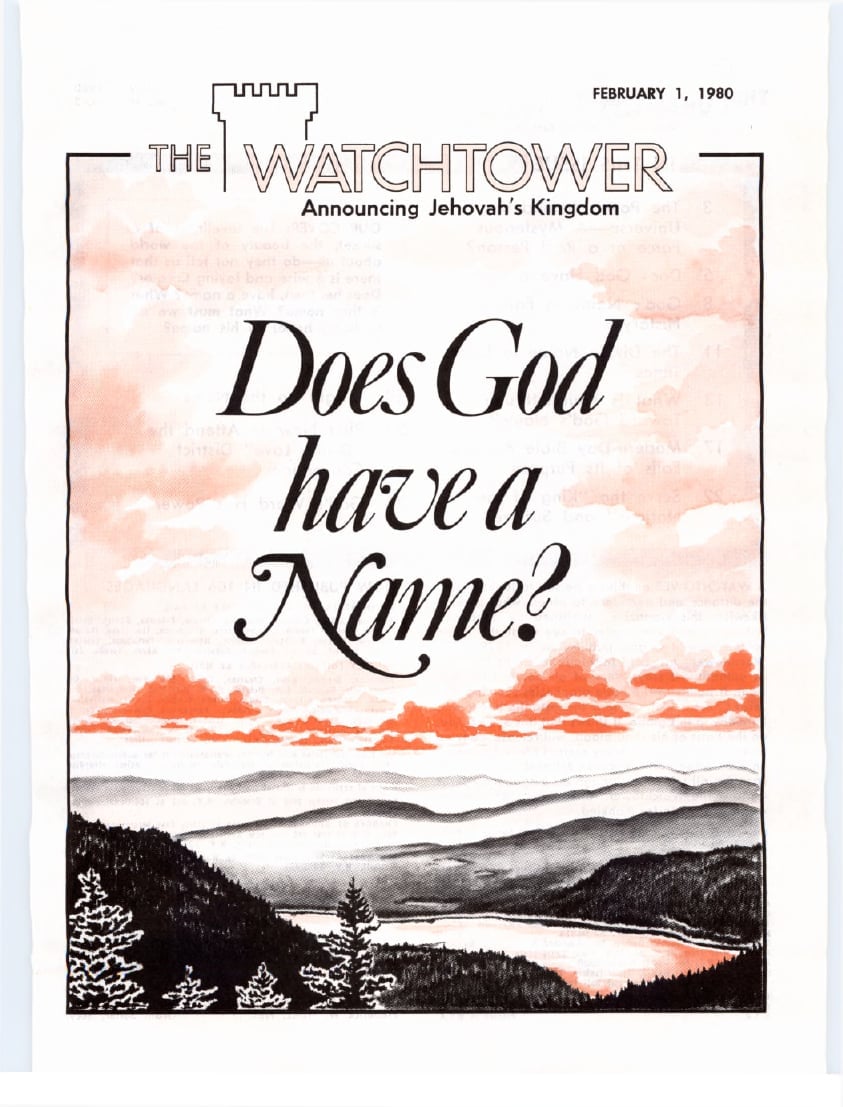
OUR COVER: The loveliness of a sunset, the beauty of the world about us—do they not tell us that there is a wise and loving Creator? Does he, then, have a name? What is that name? What must we do to bring honor to his name?
The Power Behind the Universe—A Mysterious Force or a Real Person?
The Power Behind the Universe—A Mysterious Force or a Real Person?
TRIPS to the moon and scientific observations of many kinds have added tremendously to our knowledge of the universe. Its awe-inspiring vastness and orderly arrangement are becoming more and more apparent. For many people, the existence of such a universe without some sort of controlling power seems illogical. Although millions have lost faith in churches, creeds and religions in general, they still believe in “God.”
But what does the word “God” mean to you? A mysterious force? A vague intelligence? A remote, indefinable and nameless Person?
Or, to you, does “God” mean someone very personal, even close and dear like a loving father? For those who put faith in science and technology, that may sound like nonsense. But consider this:
SCIENCE AND TECHNOLOGY HAVE THEIR LIMITS
From the viewpoint of discovery and increasing knowledge, we live in an exciting century. Man’s achievements have been remarkable. Gifted persons have enriched the human race with astounding inventions that have tremendously widened the scope of mankind’s activity and knowledge.
Yet scientists, with all their increased knowledge and advanced technology, will be the first to admit that they cannot produce a single living cell. A common thing like a blade of grass is far beyond the power of scientists to make.
To try to explain the marvels around them, some writers resort to such expressions as “Mother Nature made this,” or, “Evolution did that,” as if these were persons with intelligence. But is it not quite clear that an unintelligent force cannot possibly account for the amazing variety of life, nor for the infinite wisdom and power manifest in the universe?
THE REALM OF THE INTELLECT OR SPIRIT
When we enter the realm of the intellect or spirit and seek to understand the origin of qualities such as wisdom, justice, mercy, kindness and truth, where can we find reliable answers to our questions? Can any man explain the functions and origin of that amazing “mechanism” of man’s inner self that can tell him when he does wrong—the human conscience? Animals do not have it. But even primitive, uneducated people do. As the early Christian writer Paul once explained: “They show the work of the law written in their hearts, their conscience bearing witness therewith, and their thoughts one with another accusing or else excusing them.” (Rom. 2:15, American Standard Version) Such matters are beyond the scope of human understanding. And, yet, are not man’s intellectual and spiritual accomplishments of far greater importance than his physical abilities?
Many animals have greater physical abilities than does man. Elephants are stronger, eagles can see farther, deer can run faster, bats can hear better, dogs have a greater sense of smell. But what animal can devise new things? True, birds can make nests, beavers can construct dams, spiders can spin webs. But these creatures invariably make the same thing after the same pattern. None can plan something new and develop it.
In sharp contrast, humans can conceive of, plan and make things of tremendous variety. Whether it is a woman knitting a jersey or technicians constructing spacecraft that can go to the moon and back, mankind finds delight in making things. It is part of human makeup. With mental capacity and traits far, far superior to those of animals and an innate ability to make things, man is an imperfect reflection of the Supreme Being, who made man according to His likeness.—Gen. 1:26.
Consider now another quality of man that is not shared by the animals—his desire to worship. It is an irrefutable fact, manifest in all ages and races, that mankind has a deep, natural desire to revere an unseen power or powers.
Modern philosophers may deny this, saying, “We have advanced beyond that.” “Advanced” to what? To a world that staggers from one crisis to another and that cringes under the mushroom-shaped shadow of feared world cataclysm. Why? Because so many have worshiped the “gods” of technology and various ideologies while rejecting the wisdom of the Supreme Being.—Jer. 8:9.
Hence, many people today, although disillusioned with churches and religions, agree with these words from the most widely read and respected book of all time, the Bible, which says of the Supreme Being: “His invisible attributes, that is to say his everlasting power and deity, have been visible, ever since the world began, to the eye of reason, in the things he has made.”—Rom. 1:20, The New English Bible.
SCIENTISTS HAVE HELPED CONSIDERABLY
The more scientists probe the universe, the atom and all forms of life, the more their studies reveal the beauty, the harmony and the complexity of all these things. The immensity and intricacy of the universe make men’s minds reel. But there is no effect without a cause. Behind all this beauty, this marvelous manifestation of wisdom and dynamic power, can you not “see” with “the eye of reason” the “invisible attributes” of the Great Maker? Obviously, the universe is governed by immutable laws. Does that not prove the existence of a Supreme Lawgiver? Countless conditions and provisions on earth clearly were made to fit man’s requirements exactly. And those multiple effects must have a corresponding CAUSE, a great Provider and Life-Giver.
What do some scientists say about this?
Frank Allen, a biophysicist, made this comment: “The adjustments of the earth for life are far too numerous to be accounted for by chance.”
A professor of mathematics from Cambridge University, P. Dirac, wrote in Scientific American: “God is a mathematician of a very high order, and He used very advanced mathematics in constructing the universe.”
Sir Isaac Newton, described by many historians of science as “the greatest scientific mind the world has ever seen,” wrote in his famous work Principia: “This most beautiful system of the sun, planets, and comets, could only proceed from the counsel and dominion of an intelligent and powerful Being. . . . The Supreme God is a Being eternal, infinite, absolutely perfect.”
Perhaps you agree with Sir Isaac Newton. Maybe you, too, delight in the glory of the stars, the radiance of the sun, the serene beauty of the moon, the refreshment of rain, the majesty of mountains, the ever-changing kaleidoscope of cloud and sea, the fascinating variety of flowers, trees, insects, birds and animals, the laughter of children, the kindness of friends and the love of a mate. And deep in your heart you know that all of this was provided by a real PERSON—the great Builder of the universe.—Heb. 3:4.
Logically, then, in accord with all facts and reason, the Supreme Being must be a REAL PERSON. That being so, does he have a name? If so, what is that NAME?
Does God Have a Name?
Does God Have a Name?
MANY people might say: ‘Does God’s name matter? There is only one Supreme Being.’ For example, a clergyman in Canada once said: “The name that people give to God is also unimportant.” This cleric held that it would make no difference if one used “Allah,” as do Moslems, or “Manitou,” as do some North American Indians. Many of the clergy have the same opinion.
But let us consider: Why do we use names? What is in a name?
Basically, names are used for identification. They are also often closely linked with personal achievements or fame. To millions, such names as Alexander the Great or Ghandi immediately bring to mind the achievements of these men.
But why is God’s name necessary? Because, although many people believe in only one true God, countless others worship many gods. Hindu people have millions of gods. In other parts of Asia and in Africa, millions worship their ancestors. Many worship the State, political leaders or “stars” of the stage or screen. And of others, it is said that “their god is their belly.”—Phil. 3:19.
To distinguish the Supreme Being from this “galaxy” of gods, he has a very exclusive and personal name. And this name, as we shall see, is not only important for identification but vitally linked with his reputation. He has made a name for himself.
WHAT, THEN, IS GOD’S NAME?
Could God’s name be “Allah”? No. As a good dictionary will show you, “Allah” is a shortened form of the Arabic term meaning “the god.” Obviously, this is not a name.
How about “Lord”? That is not a name either. “There are many ‘gods’ and many ‘lords,’ “ says the Bible. (1 Cor. 8:5) The Spanish word for “Lord,” used frequently in Spanish versions of the Bible, is Señor, which usually means “mister” or “sir.” How could that possibly be a personal, exclusive name for the Supreme Being?
Some might say: ‘Is not Jesus the name of God?’ When the birth of Jesus was announced to Mary, the heavenly messenger or angel told her: “You are to call his name Jesus. This one will be great and will be called Son of the Most High.” (Luke 1:30-32) So Jesus is the name of God’s Son, not that of the Supreme Being. Jesus himself said: “The Father is greater than I am.”—John 14:28; compare Proverbs 30:4.
Being God’s Son, Jesus enjoys a very close relationship with his Father. And Jesus made it clear that his Father has a name. When Christ taught his disciples the famous Model Prayer, sometimes called the “Lord’s Prayer,” his very first words were: “Our Father in the heavens, let your name be sanctified.” (Matt. 6:9) In a subsequent prayer to his Father, Jesus said: “I have made your name manifest to the men you gave me. . . . I have made your name known to them and will make it known.” (John 17:6, 26) Accordingly, Jesus revealed to them the full significance of the Father’s name.
Interestingly, the Hebrew form of “Jesus” is “Jehoshuah,” which is an abbreviated form of “Jehovah-yeshua,” meaning “Jehovah is salvation.” So there it is—the name of the Father, the Supreme Being, is JEHOVAH. And how appropriate that Jesus, as Jehovah’s agent for salvation, should thus be named after his Father!
WHERE IS THE NAME FOUND?
The name “Jehovah” is found in numerous writings and in many places. But the principal source of the name is in ancient Hebrew writings contained in the Bible. You may say, ‘Well, I have never seen that name in my Bible.’ It is true that some Bibles do not use God’s name. But remember that what we have in our Bibles are translations, and translators vary in their renderings of the original text. That happens not only with the Bible but also with any book or article that is translated by different people.
For example, the New World Translation of the Holy Scriptures, widely used in this magazine, contains the name “Jehovah” thousands of times. But in the well-known King James Version it is found only a few times. If you have a copy of this latter Bible, check the book of Exodus, chapter 6, verse 3, and you will find these words: “And I appeared unto Abraham, unto Isaac, and unto Jacob, by the name of God Almighty, but by my name JEHOVAH was I not known to them.”
Maybe you prefer a Catholic translation. Many of them do not contain the name of God. But if you have a copy of The Jerusalem Bible, a modern Catholic translation, and care to check the above-mentioned verse, you will find that it uses the name “Yahweh” instead of “Jehovah.” Why is that?
WHY “YAHWEH”?
“Yahweh” (sometimes “Jahveh”) is simply an attempt to express God’s name in a form nearer to the original Hebrew. In writing ancient Hebrew, only consonants, no vowels, were used. God’s name in the older Hebrew manuscripts is shown as יהוה (YHWH or JHVH), and Bible commentators often refer to these characters as the “Tetragrammaton,” meaning “four letters.”
Down through the centuries, the correct pronunciation of the divine name in Hebrew has been lost. Hence, it is uncertain what vowels should be used to fill in the name. By combining vowel signs of the two Hebrew words A·do·nayʹ (Lord) and El·o·himʹ (God) with the Tetragrammaton, the pronunciation Ye·ho·wahʹ was formed. Eventually, in a Latinized form, this became “Jehovah.” Nevertheless, many Hebrew scholars say that “Yahweh” is more correct. But Rudolph Kittel, editor of Biblia Hebraica, vowelizes the Hebrew tetragram as “Yehwah,” in all his editions.
“JEHOVAH” IS FAR BETTER KNOWN
The name “Jehovah,” however, is far more widely known and used. For centuries, it has appeared in Bible translations and literature of all kinds.a It also appears in various inscriptions. For example, a Latin inscription on the municipal coat of arms of the city of Plymouth, England, reads Turris Fortissima Est Nomen Jehova, meaning: “The name Jehovah is the strongest tower.” (See Proverbs 18:10.) Hence, the name “Jehovah” appears even on the local buses.
Now let us pay a brief “visit” to the island of Minorca in the Mediterranean Sea, off the coast of Spain. Here, in the main town of Mahón, the Tetragrammaton appears on the wall in a public vegetable market, formerly a church cloister. Nearby, in the small town of San Luis, the Hebrew letters of Jehovah’s name have been inscribed on the local church tower.
Now let us look inside the famous Cathedral of Toledo, Spain’s ancient ecclesiastical city. Notice the beautiful fresco on the ceiling of the principal vestry. It is the work of Lucas Giordano, a famous Italian painter of the 17th century. There, in a prominent position, are the four Hebrew letters of God’s name.
Perhaps the most famous of all Christendom’s churches is St. Peter’s Basilica in Vatican City. There, adorning the tomb of Pope Pius X (1835-1914), is a painting of the high priest of Israel with the Tetragrammaton on his headdress. It is also found on a band on the forehead of a statue decorating the tomb of Pope Clement XIII (1693-1769).
Have you ever heard of the “Flavit Jehovah” medal? It was struck to commemorate the victory of the English fleet against the Spanish Armada in 1588 C.E.—when a fierce tempest finished off the invaders. Inscribed on this medal are these words in Latin and Hebrew: Flavit יהוה et dissipati sunt—“Jehovah blew and they were scattered.”
Lovers of serious music are well acquainted with the majestic “Hallelujah chorus” from Handel’s famous oratorio, The Messiah. Millions of people have heard it sung since its first performance in 1743. But how many have realized that “Hallelujah” (or, “Alleluiah”) means “Praise Jehovah”?
Another famous musician, Franz Schubert, composed the music for a song entitled “The Almightiness” (German, Die Allmacht), taking as its theme: “Great Is Jehovah, the Lord!” (See page 16.)
The personal name of God is honored and displayed in countless other places and settings. A little research also leaves no doubt that JHVH (YHWH) is the NAME of the Supreme Being, as shown in the Hebrew Bible. How often does that sacred name appear there? SIX THOUSAND NINE HUNDRED AND SIXTY TIMES! Is it not very obvious that the divine name was NOT MEANT TO BE LEFT OUT?
And yet many Bible translations have omitted God’s name. Why? Before answering, let us consider God’s name in history.
[Footnotes]
a Webster’s New International Dictionary (1955) says concerning “Jehovah”: “The Supreme Being; God; the Almighty . . . A Christian form given the Tetragrammaton.”
[Pictures on page 7]
Church tower Menorca, Spain
City buses Plymouth, England
Statue on tomb of Pope Clement XIII
God’s Name in Early History
God’s Name in Early History
GOD, the Power behind the universe, is a real Person. Moreover, we have seen that he has an exclusive, personal name—Jehovah (or, Yahweh—in Hebrew, YHWH).
But what about the historical background of that name? What light can history throw on the divine name?
EARLY HISTORICAL BACKGROUND
Let us return to the 16th century B.C.E. The Israelites are in Egypt suffering under the harsh rule of Pharaoh. Moses is commissioned by Jehovah to request freedom for Israel. To show in whose name Moses should act and speak, God says to him: “This is what you are to say to the sons of Israel, ‘Jehovah the God of your forefathers . . . has sent me to you.’ This is my name to time indefinite.”—Ex. 3:15.
But Pharaoh himself later refuses to listen, saying: “Who is Jehovah . . . ? I do not know Jehovah.” (Ex. 5:2) After several plagues, God tells Pharaoh: “For this cause I have kept you in existence, for the sake of showing you my power and in order to have my name declared in all the earth.”—Ex. 9:16.
The first five books of the Bible, which contain the aforementioned record, are full of references to God’s personal name. It occurs 550 times in the Hebrew text of Deuteronomy alone. The name was used not only by priests and Levites. Moses wrote: “Listen, O Israel: Jehovah our God is one Jehovah. And you must love Jehovah your God with all your heart and all your soul and all your vital force. And these words that I am commanding you today must prove to be on your heart; and you must inculcate them in your son and speak of them when you sit in your house and when you walk on the road and when you lie down and when you get up.” (Deut. 6:4-7) Unquestionably, God’s exalted name was used freely in family worship in those days.
REIGN OF KING DAVID
In the reign of King David, the use of the name Jehovah reached new and glorious heights. Under divine inspiration, David wrote many beautiful psalms, or songs of praise, to Jehovah. David also organized a large temple orchestra and chorus involving thousands of singers and players. They regularly played and sang beautiful, moving songs of praise to Jehovah, ‘making melody to his name.’—Ps. 68:4.
Was Jehovah displeased with all this public and family use of his name? Did he condemn David and his contemporaries in the terms of the third commandment: “You must not take up the name of Jehovah your God in a worthless way”? (Ex. 20:7) Obviously not! David was richly blessed by God and his reign was highly successful.
CHANGING VIEWPOINTS
Approximately five centuries later, Jehovah’s faithful prophet Malachi used the Tetragrammaton (the four Hebrew letters of God’s name) 48 times in the four short chapters of his prophecy. In part, the word of Jehovah spoken through Malachi was: “From the sun’s rising even to its setting my name will be great among the nations.” And the point is repeated for emphasis—“‘My name will be great among the nations,’ Jehovah of armies has said.”—Mal. 1:1, 11.
Note also what Malachi wrote concerning some of the priests of his day: “‘A son, for his part, honors a father; and a servant, his grand master. So if I am a father, where is the honor to me? And if I am a grand master, where is the fear of me?’ Jehovah of armies has said to you, O priests who are despising my name.”—Mal. 1:6.
The context shows that the priests were not guilty of failing to use God’s name but were showing disrespect for it by offering unacceptable sacrifices. The Hebrew Scriptures and other writings of that period show that Jehovah’s name was widely used. For example, documents (called the Elephantine Papyri) dating from the fifth century B.C.E. and from a Jewish colony in Upper Egypt contain the divine name. However, there is some evidence that before Jerusalem’s destruction by the Romans, there developed a superstitious tendency to avoid using the divine name.a This may have been due to an extremist, fanatical interpretation of the third commandment—not to use God’s name in a worthless way. (Ex. 20:7) But when God gave that command, did he mean that his name should never be used except on rare, special occasions, perhaps only at the sanctuary? That could not be the case, for when the divine name was widely used (as in David’s day), God’s blessing was very evident in Israel. But divine blessing was conspicuously absent from that nation as a whole at the time of Jesus Christ’s life and ministry on earth when God’s name had gone out of use due to the religious tradition of the Jews. The Jewish religious leaders of that day had become so alienated from God and his principles that not only did they shroud his name in secrecy but they also made themselves responsible for the death of his beloved Son. Not many years later, in 70 C.E., the Jews paid a terrible price for this when their temple and the holy city of Jerusalem were destroyed by the Roman armies.
WHAT DID CHRIST AND HIS DISCIPLES DO?
Did Jesus Christ and his disciples follow the Jewish tradition concerning God’s name? In a fearless way, Jesus condemned the tradition of the Pharisees and scribes, freeing his disciples from such spiritually deadening influences. He said to those “hypocrites”: “Why is it you also overstep the commandment of God because of your tradition? . . . You have made the word of God invalid because of your tradition.”—Matt. 15:3-9.
Did Jesus and his disciples, then, use God’s name freely? Assuredly so, for they all quoted frequently from the Scriptures that contained Jehovah’s name. They often used the Septuagint Version, a translation of the Hebrew Scriptures into Greek that began to be prepared in Alexandria about the third century B.C.E., copies of which still contained the Tetragrammaton. True, copies of the Septuagint Version made centuries later followed the Jewish tradition of omitting God’s name. But scrolls or portions of the Greek Septuagint dating from Jesus’ time on earth contain the Tetragrammaton in Hebrew characters.—See The Watchtower of May 1, 1978, pp. 6-8.
Jesus himself clearly indicated that he used the divine name. For instance, he said in prayer to his Father: “I have made your name manifest to the men you gave me out of the world. . . . I have made your name known to them and will make it known.” (John 17:6, 26) Moreover, Jesus taught his followers to pray: “Our Father in the heavens, let your name be sanctified.” (Matt. 6:9) Why would Jesus make those statements unless he had used God’s name?
Thus God’s name was widely used by his new chosen people, spiritual Israel, the Christian congregation. (Gal. 6:16) That is why certain translations of the Greek Scriptures (the “New Testament”) do include Jehovah’s name. For example, this is true of the Greek Scriptures in Hebrew, by Franz Delitzsch (1877); The Emphatic Diaglott, by Benjamin Wilson (1864); The Christian’s Bible—New Testament, by George N. LeFevre (1928), and the New World Translation of the Christian Greek Scriptures (1950), as well as other translations. In contrast, the majority of translations have followed the tradition of the Jews and have omitted God’s name.
Not long after Jesus’ day, the foretold apostasy began to corrupt the true Christian doctrine and spirit. (2 Thess. 2:3; 2 Pet. 2:1-3) As the long night of the “Dark Ages” set in, the use of the divine name faded out.b For many centuries, the very knowledge of God’s name was mainly confined to the cloister—available only to such scholars as monks.
How, then, did the divine name become known world wide, as it is today?
[Footnotes]
a Many Jewish religious leaders of the first century C.E. were strongly influenced by pagan Greek philosophy. For example, Philo, a Jewish philosopher of Alexandria, believed that Plato, the famous Greek philosopher, was divinely inspired and taught that God was indefinable and, hence, unnameable.
b For over 1,000 years the theology of Christendom was molded by the teachings of Plato. See A History of Europe, by H. A. L. Fisher,. p. 52; The Encyclopædia Britannica, 1964 edition, Vol. 18, p. 63.
The Divine Name in Later Times
The Divine Name in Later Times
THAT the divine name was used in early history is beyond question. But what about later times? Why have certain Bible translations omitted the name? And what is its meaning and significance to us?
THE NAME “JEHOVAH” BECOMES WIDELY KNOWN
Interestingly, Raymundus Martini, a Spanish monk of the Dominican order, first rendered the divine name as “Jehova.” This form appeared in his book Pugeo Fidei, published in 1270 C.E.—over 700 years ago.
In time, as reform movements developed both inside and outside the Catholic Church, the Bible was made available to the people in general, and the name “Jehovah” became more widely known. In 1611 C.E. the King James or Authorized Version of the Bible was published. It uses the name Jehovah four times. (Ex. 6:3; Ps. 83:18; Isa. 12:2; 26:4) Since then, the Bible has been translated many, many times. Some translations follow the example of the Authorized Version and include the divine name only a few times.
In this category is An American Translation (by Smith and Goodspeed) with a slight variation of using “Yahweh” instead of “Jehovah.” Yet, one may ask: “Why have the translators done this? If using ‘Jehovah’ or ‘Yahweh’ is wrong, why put it in at all? If right, why not be consistent and use it every time it appears in the Bible text?”
Against the preceding historical and factual background, let us now examine what the translators say in answer.
THE TRANSLATORS’ ANSWER
Says the Preface of An American Translation: “In this translation we have followed the orthodox Jewish tradition and substituted ‘the Lord’ for the name ‘Yahweh.’ “ But by following “the orthodox Jewish tradition,” did the translators realize how harmful it can be to ignore God’s clear determination that his ‘name be declared in all the earth’? Moreover, Jesus condemned man-made tradition that would invalidate God’s word.—Ex. 9:16; Mark 7:5-9.
The Preface of the Revised Standard Version states: “The present revision returns to the procedure of the King James Version, which follows . . . the long established practice in the reading of the Hebrew scriptures in the synagogue. . . . For two reasons the Committee has returned to the more familiar usage of the King James Version: (1) The word ‘Jehovah’ does not accurately represent any form of the Name ever used in Hebrew; and (2) the use of any proper name for the one and only God, as though there were other gods from whom he had to be distinguished, was discontinued in Judaism before the Christian era and is entirely inappropriate for the universal faith of the Christian Church.” (Italics ours.)
The translators made a great mistake in following the example of the King James Version and Jewish tradition. Did they really think it was God’s will that his name should be kept in the background? Is the divine name something to be ashamed of so that it should be left out of the Bible?
RELIGIOUS PREJUDICE?
An interesting fact is that the American Standard Version, published in 1901, uses Jehovah’s name right through the Hebrew Scriptures. In contrast, the Revised Standard Version, published in 1952, makes only a very brief reference to the Tetragrammaton in a footnote (at Exodus 3:15). During that period, Jehovah’s Witnesses were proclaiming God’s name world wide. Could it be that the omission of the divine name in certain translations was caused by prejudice against their witnessing activity?
That this could be so in some cases is indicated by the following statement appearing in the Katholische Bildepost (a Catholic magazine of Germany): “The name of God, however, which they [Jehovah’s Witnesses] have changed to ‘Jehovah’ is simply an invention of the sect.” (August 24, 1969) This statement smacks of religious prejudice. It also reveals poor research since, as already mentioned, the first writer to use the term “Jehova” was a Catholic monk—obviously not one of Jehovah’s Witnesses!
DOUBLE STANDARD
“The word ‘Jehovah’ does not accurately represent any form of the Name ever used in Hebrew,” says the Preface of the Revised Standard Version. But what word does “accurately represent” the divine name in Hebrew? Some prefer “Yahweh,” others “Yehwah,” others “Jave,” and so on. The problem is that when writing ancient Hebrew only consonants were used, and even experts admit that it is a matter of conjecture as to which vowels made up the complete divine name.
One could also ask those objecting to the form “Jehovah” why they do not object to other names such as “Jesus” or “Peter.” Why do these critics not insist on using the original Greek forms of those names (Iesoús and Petros)? Are these individuals not guilty of applying a double standard in rejecting “Jehovah”?
OTHER TRANSLATIONS
Many translations, of course, do use “Jehovah” or “Yahweh” or some other representation of the Tetragrammaton. Moreover, there are about 40 vernacular translations of the Christian Greek Scriptures (“New Testament”) that use a vernacular form of the Tetragrammaton such as Iehova (Hawaiian) and uJehova (Zulu).
The Bible in Living English (by Steven T. Byington) also uses “Jehovah” right through the Hebrew text. In his Preface, Byington says concerning “Jehovah”: “The spelling and the pronunciation are not highly important. What is highly important is to keep it clear that this is a personal name.” Yes, the name of the most exalted Person in the universe is unique, exclusive, incomparable, sublime.
WHAT DOES THIS UNIQUE NAME MEAN?
To answer this, a historical flashback is appropriate. When he was commissioned by the Most High to lead the Israelites out of Egypt, “Moses said to the true God: ‘Suppose I am now come to the sons of Israel and I do say to them, “The God of your forefathers has sent me to you,” and they do say to me, “What is his name?” What shall I say to them?’ At this God said to Moses: “I SHALL PROVE TO BE WHAT I SHALL PROVE TO BE.’ And he added: ‘This is what you are to say to the sons of Israel, “I SHALL PROVE TO BE has sent me to you.”’” (Ex. 3:13, 14) This means Jehovah would carry his own grand purpose to completion in vindication of his name and sovereignty, and this helps us to understand the memorial name “Jehovah,” given in Ex 3 verse 15. According to the Hebrew root of the name, it appears to mean “He Causes To Become” (or, “Prove To Be”) with respect to himself. Thus God’s name has real significance to thoughtful persons. That name reveals him as being One who unfailingly fulfills what he promises and is perfectly in control of whatever situation may arise.
What a deep, sacred meaning the divine name has! It is the name par excellence of the universe, a glorious name. The term “Lord” is pale and inexplicit in comparison. Jesus loved and respected his Father’s name and once said to him: “Father, glorify your name.” The account continues: “Therefore a voice came out of heaven: ‘I both glorified it and will glorify it again.’”—John 12:28.
If Jesus had been a Bible translator today, would he have omitted his Father’s name from new translations? Hardly! Without a doubt, Jesus, of all persons, had the right attitude toward Almighty God and His name. So what should be our attitude toward God and his name?
What Is Your Attitude Toward God’s Name?
What Is Your Attitude Toward God’s Name?
NO DOUBT, deep in your heart, you are already convinced that God exists and that he did provide or create the countless lovely things that we see around us. Perhaps you have real respect for God—and yet do not feel close to him. To you, God may seem aloof and inscrutable.
However, to come to know and really love God, to recognize him as the Father of a universal family and to become a part of that great family are matters of paramount importance and pressing urgency. From a personal standpoint, our coming to know, respect and obey God as a loving Father is a matter of life and death. And from a global standpoint, the formation of this worldwide family is the only solution to the terrible mess mankind is in today. Divine prophecy makes it very clear that this old system of things is heading for a global cataclysm that only those who really love God and their neighbors will survive. (Ps. 37:10, 11, 28, 29) But you may ask . . .
“HOW CAN I REALLY GET TO KNOW GOD?”
Suppose you were undertaking studies in a certain field of knowledge and had great admiration for a famous teacher in that field. Also, suppose you desired to know him better and to learn more from him, but he lived in a remote country. What then? Would you not endeavor to read all his writings and whatever was published concerning him? Would you not talk to other students who already knew more about him and his teaching? Then, suppose you wrote to him about some difficult personal questions or problems and you received very satisfying answers. Your admiration and respect for this fine teacher would increase considerably and his help would endear him to you.
Is this also possible with Jehovah, the Greatest Teacher? It certainly is. (Isa. 30:20, 21) But how?
Have you ever read ‘His writings’—the Bible? Perhaps you have tried and have found some parts difficult to understand. Then, why not follow the example of an African state official who also was reading the Scriptures and had questions? What did he do? He asked Philip, a witness of Jehovah, to help him. Why not read about this interesting incident in the book of Acts, chapter 8, verses 26 to 39?
Incidentally, you can do the same thing today. If you read the Bible and have questions, why not consult with Jehovah’s Witnesses? They are always very willing to help those seeking knowledge of the heavenly Father, Jehovah. And they have Bible-based publications (in addition to this magazine) to enlighten sincere students.
Actually, discussion of the Bible with an experienced student of the Scriptures can greatly increase your knowledge of Jehovah and your respect and love for him. For instance, you will learn that Jehovah is “a God merciful and gracious, slow to anger and abundant in loving-kindness and truth.” (Ex. 34:6) You will note many examples of Jehovah’s mercy and patience, as in the case of David, who sinned outrageously but repented and was spared.—2 Sam. 12:13, 14; Ps. 51.
You will also understand why Jehovah has allowed wickedness to continue, why he has not yet blotted out evil and corruption—something that is just as certain to happen as the sun’s rising tomorrow morning. (Prov. 2:21, 22; 2 Pet. 3:7) You will come to appreciate Jehovah’s great long-suffering, his infinite wisdom and understanding, and his marvelous purpose to clean up the earth and restore peace and paradise.—Compare Isaiah 65:17, 21-25.
“KEEP ON SEEKING”
But you may run into difficulties and opposition. Some people, even from among your own family and friends, may belittle your efforts to study Jehovah’s Word, and they may even try to slander those helping you. Jesus warned his disciples to expect such things.—Matt. 5:11.
However, if you are convinced that there is a sublime Person who holds the key to mankind’s future, then stick to your determination to come to know him and his Son, Jesus Christ. It was this very Son who stated: “This means everlasting life, their taking in knowledge of you, the only true God, and of the one whom you sent forth, Jesus Christ.” Jesus also said: “Keep on seeking, and you will find; keep on knocking, and it will be opened to you.”—John 17:3; Matt. 7:7.
If you do this, you will be agreeably surprised to discover how near, how approachable, Jehovah really is. Said the apostle Paul in a public speech before a group of Athenians: “He [God] is not far off from each one of us.” (Acts 17:27) And a divinely inspired prophet wrote: “Search for Jehovah, you people, while he may be found. Call to him while he proves to be near.”—Isa. 55:6.
Yes, “call to him.” “Draw close to God, and he will draw close to you.” (Jas. 4:8) If you are searching for truth, if you have grievous problems or sins that weigh you down, call on Jehovah, “the Father of tender mercies and the God of all comfort.” (2 Cor. 1:3) Do so in the name of his Son, Jesus Christ, who said: “Come to me, all you who are toiling and loaded down, and I will refresh you.”—Matt. 11:28.
You will be delighted to discover what a deep, satisfying difference your efforts to draw close to Jehovah can make in your life. Your mind will be cleared of disturbing, confusing false religious creeds and views. Also, your study of God’s prophecies and purposes will show you why the world is so full of problems, corruption and fear. Yes, and such consideration of the Bible will reveal the marvelous future in store for the earth and for those privileged to live on it under God’s kingdom.—Matt. 6:9, 10.
Do you not agree that, in this dark hour of man’s history, we have urgent need of understanding, vision and spiritual light? Psalm 119:105 appropriately says of God: “Your word is a lamp to my foot, and a light to my roadway.” Yes, God’s Word can reveal a wonderful new path of life now and grand vistas for the future. It can lead you to accurate knowledge and deep love of the true God, Jehovah.
ATTITUDE TOWARD GOD’S NAME
Whatever one’s race or nationality may be, a firm, kind and loving family head is much to be appreciated. A good father is not only a life-giver but also a provider, a counselor, a protector, a friend in need. A father like that has the respect and love of his children.
Would you not always
—speak of him with praise?
—defend him when he is criticized?
—avoid displeasing him?
—feel proud to bear his name?
Those who become members of Jehovah’s worldwide family always speak of him with praise. They do not support any campaign to suppress God’s name but are keen to make his great name known among the nations. (Ps. 105:1-3) They are always ready to “offer to God a sacrifice of praise, that is, the fruit of lips which make public declaration to his name.”—Heb. 13:15.
Such individuals are always anxious to defend their Father’s name when he is criticized. Having studied his Word carefully, they can refute the God-dishonoring doctrine of ‘hellfire and torment.’ They can show that “God is love.” (1 John 4:8) Moreover, they can point out that he is not “dead” but very much alive and concerned about the situation here on earth and is bringing his purposes for mankind to a grand climax.
Members of this worldwide family also continually endeavor to avoid doing anything displeasing to their Father. They take to heart the ancient commandment: “You must not take up the name of Jehovah your God in a worthless way.” (Ex. 20:7) Although imperfect and, like King David, susceptible to making mistakes, those loving Jehovah try to maintain high standards of conduct—honesty, physical and moral cleanness and the avoidance of idolatry, greed and covetousness. (Luke 12:15; 1 Cor. 6:9, 10; Heb. 13:18; 1 John 5:21; Rev. 19:8; 21:8) They keep clear of political conflicts and violence, which supposedly are carried out in the name of God but actually have brought great reproach on his name. (Isa. 2:4; John 15:19) But God’s servants respect governments and civil authorities and they are law-abiding, tax-paying citizens who render their employers an honest day’s work “that the name of God . . . may never be spoken of injuriously.”—1 Tim. 6:1; Rom. 13:1-7.
PROUD TO BEAR HIS NAME
If you come from a good family, you probably are proud to bear your father’s name. So are those who bear Jehovah’s name today. A great international, worldwide family proudly bear the heavenly Father’s name as Jehovah’s Witnesses. (Isa. 43:10, 12; Rev. 7:4-10) While appreciating the increased knowledge and facilities provided by clever men, they recognize and honor “the living God, who made the heaven and the earth and the sea and all the things in them.” He it is who provides “rains from heaven and fruitful seasons, filling [human] hearts to the full with food and good cheer.” (Acts 14:15-17) And he made the superlative gift of his Son, by whom we may “have everlasting life.” (John 3:16) Praisers of Jehovah are deeply grateful to him for all his gifts.—Jas. 1:17.
As an expression of deep gratitude to their Creator, this dedicated, global family contributes to the sanctifying of God’s glorious, exclusive name by recognizing its rightful place in His own holy book—both the Hebrew and the Christian Greek Scriptures. And, following in the steps of the Master, Jesus Christ, and his first-century followers, they are zealously spreading the vital message for this day: that the kingdom of God is at hand and is mankind’s only hope.—Matt. 4:23; 24:14; 28:19, 20.
AN APPEAL
We urgently appeal to you to find out more about the true God, Jehovah, his Son, Jesus Christ, and this happy, united family that is ‘declaring God’s name in all the earth.’ (Ex. 9:16; Rom. 9:17) Not only could this change your whole life now, but it could lead to your surviving the coming “great tribulation” and living eternally in God’s promised new system of things.—Matt. 24:21, 22; 2 Pet. 3:13.
It is a fact that your very life depends on the course you pursue. The Scriptures give the assurance that “everyone who calls on the name of Jehovah will be saved.” (Rom. 10:13; Joel 2:32) Will you call on the divine name in faith as a devoted worshiper of Jehovah?
[Picture on page 15]
GOD’S BIBLICAL NAME IS PROCLAIMED WORLD WIDE
“Great Is Jehovah, the Lord!”
“Great Is Jehovah, the Lord!”
Franz Schubert composed the music for this lyric entitled “The Almightiness” written by Johann Ladislav Pyrker (Opus 79/2, DV 852, 1825):
Great is Jehovah, the Lord! For heavens
and earth proclaim his power.
You hear it in the roaring storm,
in the loud rushing call of the stream of the wood;
you hear it in the rustling of the green wood,
you see it in the gold of surging crops,
in the glowing bloom of delightful flowers,
in the brightness of the star-spangled heaven,
aweful it sounds in the rolling of thunder and
flashes in the fast flickering flight of the lightning.
But the beating heart makes known to you even
more perceptibly Jehovah’s, the eternal God’s, power,
as you fervently look on high and hope for favor
and mercy.
Modern-Day Bible Burning Fails of Its Purpose
Modern-Day Bible Burning Fails of Its Purpose
“He proceeded to tear it apart with the secretary’s knife, pitching it also into the fire that was in the brazier until all the roll ended up in the fire that was in the brazier.”—Jer. 36:23.
1. Why is the burning of the Bible in whole or in part not new?
BURNING of the Holy Bible in whole or in part is not new. The first reported case of such a thing took place more than 2,600 years ago. This was in the days of the third-last king of the nation to which the Bible had originally been given.
2. What led up to the making of Jeremiah’s written prophecy fuel for the flames?
2 The season was that of winter at Jerusalem, where King Jehoiakim was seated near a brazier in which a fire was burning to heat up the throne room. Just how a vital part of the Holy Bible came to be fuel for the flames in this brazier, the factual account informs us. From it we here quote:
Now it came about in the fourth year of Jehoiakim the son of Josiah, the king of Judah, that this word occurred to Jeremiah from Jehovah, saying: “Take for yourself a roll of a book, and you must write in it all the words that I have spoken to you against Israel and against Judah and against all the nations, since the day that I spoke to you, since the days of Josiah, clear down to this day. Perhaps those of the house of Judah will listen to all the calamity that I am thinking of doing to them, to the end that they may return, each one from his bad way, and that I may actually forgive their error and their sin.” (Jer. 36:1-3)
If we read the preceding 35 chapters of the book of Jeremiah, we can appreciate how unpopular his written message was certain to be.
3. Why was Jeremiah not trying to make a nuisance of himself, and how much time yet remained for people to do something about the situation?
3 Today the message that corresponds with what Jeremiah was told to write on the “roll of a book” proves to be just as unpopular. However, the purport of the message is not just to irritate people, to nag them, to plague them with calamity howling. Those Christians who today correspond with the prophet Jeremiah are not trying just to make a nuisance of themselves. No, but they render a public service by warning all the people about the oncoming international catastrophe. This could stir some people to repentance and reform while Jehovah is still favorably inclined. For this course, these could then be spared during the world calamity ahead. Back there in Jeremiah’s day the nation of Judah had just 18 years yet to go till the Babylonians destroyed the holy city Jerusalem. Today, after 60 years of activity by the modern Jeremiah class, how much time does Jerusalem’s counterpart, Christendom, yet have before her calamitous destruction starts off the “great tribulation” for the whole world?—Matt. 24:21, 22.
PUBLIC DELIVERY OF THE MESSAGE OF DOOM
4. After Jeremiah completed the compiling of his prophecies from the start onward, how was the message presented to Jerusalem, and why?
4 Obediently Jeremiah dictated the message to his secretary, Baruch the son of Neriah. The resulting manuscript contained all the words of Jehovah to Jeremiah from the 13th year of the reign of King Josiah onward, the year when Jehovah raised up the young priest-designate Jeremiah to be a prophet. On completion of the manuscript, Jeremiah felt unable to go to Jerusalem, just about three miles (5 km) from his Levite hometown of Anathoth, to read aloud the manuscript in the temple courtyards. Hence, he sent his secretary Baruch there to do so, adding: “Perhaps their request for favor will fall before Jehovah and they will return, each one from his bad way, for great is the anger and the rage that Jehovah has spoken against this people.”—Jer. 36:4-7.
5. What would seem to be the appropriate time for the manuscript of Jeremiah’s prophecies to be read in Jerusalem’s temple?
5 How would any of us have liked to do such an audible reading in a public place through which people coursed? It must have called for courage on Baruch’s part. Yet, with the strength of his God, he did it! But we must remember that it took time on Baruch’s part to copy down all that Jeremiah dictated to him. (Jer. 36:17, 18) Since the manuscript contained Jehovah’s stern messages against all the nations, including Israel and Judah, a public event would furnish the fitting time for such a manuscript to be read aloud. Say, a national fast day! Then the fasters would be thronging Jerusalem’s temple. For such an occasion, time must wait!
6. During the year that Jeremiah wrote his manuscript, how did it become manifest who would be the one used to carry out Jeremiah’s prophecy about Jerusalem’s overthrow?
6 So Baruch’s reading of the completed manuscript publicly did not take place in the fourth year of King Jehoiakim, during which year King Nebuchadnezzar of Babylon defeated the military forces of Pharaoh Nechoh of Egypt and established himself as the world’s new dominant ruler. This Nebuchadnezzar was the Gentile ruler whom Jeremiah foretold as the one to overthrow Judah and Jerusalem, this to be followed by the land’s lying desolate without man or domestic animal for 70 years.—Jer. 36:6; 25:1-11.
7. In what year and on what occasion did Baruch read Jeremiah’s manuscript in the temple of Jerusalem?
7 Comes now the fifth year of King Jehoiakim of Judah. This coincides with the second year of Nebuchadnezzar as world ruler. The account of Jeremiah 36:9, 10 makes this certain. It says:
Now it came about in the fifth year [624-623 B.C.E.] of Jehoiakim the son of Josiah, the king of Judah, in the ninth month [Chislev, or, November-December], that all the people in Jerusalem and all the people that were coming in from the cities of Judah into Jerusalem proclaimed a fast before Jehovah. And Baruch began to read aloud from the book the words of Jeremiah at the house of Jehovah, in the dining room of Gemariah the son of Shaphan the copyist, in the upper courtyard, at the entrance of the new gate of the house of Jehovah, in the ears of all the people.
8. In what season of the year did Baruch proceed to carry out Jeremiah’s orders to him?
8 Reigns of the kings of Judah were counted from the spring month of Abib, or Nisan. The ninth month of their lunar year, which came to be called Chislev, would fall in the winter season. It would include part of what we call December (this Latin name meaning 10th month). In Maccabean times the “festival of dedication” of Jerusalem’s temple came to be held on Chislev 25, and this was said to be in the “wintertime.” (John 10:22) Despite the wintry weather of the month of Chislev, Baruch, the secretary of Jeremiah, proceeded to carry out his orders from Jeremiah.
9. How did the princes of Judah feel about the manuscript as read to them, and what did they tell Baruch, along with Jeremiah, to do?
9 Jeremiah’s words that Baruch read aloud to the people at the temple were of concern to all the nation. So the princes of Judah called for Baruch to read the prophetic message to them. (Jer. 36:11-15) If we recall what the previous chapters of Jeremiah’s prophecy had to say about the doomed kingdom of Judah, we can appreciate why the princes felt dread on hearing what Baruch read to them. Nationalistically they felt obliged to tell King Jehoiakim. They took the manuscript book from Baruch, but, feeling kindly disposed to the book’s author and the copyist, they told Baruch to go into hiding with Jeremiah. This worked out well.—Jer. 36:16-20.
THE FIRST BIBLE BURNING ON RECORD
10. What did King Jehoiakim do as Jehudi read the book to him, and what was the effect of this outcome?
10 The princes went into the winter house of King Jehoiakim to make their report. He wanted to get his hands on the roll of Jeremiah’s prophecy. So he sent the court official named Jehudi to bring back the book from the temple where it had been left. What happened now as Jehudi proceeded to unroll the scroll and read aloud column after column? “Then it came about that as soon as Jehudi had read three or four page-columns, he [King Jehoiakim] proceeded to tear it apart with the secretary’s knife, pitching it also into the fire that was in the brazier until all the roll ended up in the fire that was in the brazier. And they felt no dread; neither did the king and all his servants, who were listening to all these words, rip their garments apart.”—Jer. 36:21-24.
11. How did Jehoiakim’s conduct differ from that of his father Josiah on hearing Deuteronomy read, and had Jehoiakim obeyed Deuteronomy 17:18-20?
11 What disrespect for the inspired written word of God! How unlike the conduct of his father Josiah this act of King Jehoiakim was! When the roll of the book of Deuteronomy as written by the prophet Moses had been discovered during the cleaning up of the defiled temple, Josiah had a secretary read it to him. Josiah took it to heart and ripped his garments. Then he led his people in making a special covenant with Jehovah to obey him and to carry out his pure worship. (2 Chron. 34:14-33) Moreover, that very law code commanded any future king of Israel to write an exact copy of the law and read it regularly and keep it. (Deut. 17:18-20) What indications are there that King Jehoiakim did such a godly thing? None! His example was bad!
12. What two incidents are here cited to show whether there are any like King Jehoiakim today?
12 Are there modern Jehoiakims? Yes, as far as burning copies of the Sacred Scriptures is concerned. Yes, right in the realm of Christendom! Recall how, in the year 1961, down in Ejutla, Oaxaca, Mexico, a Roman Catholic priest incited a mob to invade and ransack a home where cultural meetings were regularly held, and they seized all the Bibles to be found and burned them in the public square. The local newspaper reported that they did this as though they were committing “an act of faith.” Also, in February of 1962 a communication was issued in Portugal prohibiting the circulation of the literature of Jehovah’s Witnesses through the mail. Though there had been no official notice published by the Portuguese government of banning Jehovah’s Witnesses, large quantities of their religious literature and also Bibles were seized and burned.
13, 14. (a) In this regard, what happened two years ago down in Argentina? (b) What question does that affair raise, and what is the real reason why the religious clergy try to debar Jehovah’s Witnesses from Christian activity?
13 In 1976 Jehovah’s Witnesses were banned in Argentina, and just two years ago at their headquarters in Buenos Aires large quantities of their literature was confiscated, including 250 copies of the New World Translation of the Holy Scriptures in Spanish. All of this was sold to paper manufacturers and shredded and boiled to a pulp for cellulose. Furthermore, Jehovah’s Witnesses who were identified when crossing from Uruguay into Argentina had their Bibles taken away from them, and these were burned. Other instances of Bible burning might be set in array before our readers, but all of this raises a question.
14 What is it that makes the Bible seemingly a dangerous instrument in the hands of Jehovah’s Witnesses, so that, even in lands called Christian, it should be confiscated so unjustly and destroyed? Is it because nationalists look upon Jehovah’s Witnesses as King Jehoiakim looked upon Jeremiah and Baruch—as being subversive political dangers to the State, obstructors of defensive measures of the nation? This is what religious leaders of Christendom would like political and other elements of the State to believe! But the real reason why government officials and religious clergymen want to put Jehovah’s Witnesses out of Christian activity is this: They serve the same God that Jeremiah and Baruch did, and they get out of the Hebrew Scriptures God’s message similar to that of the prophet Jeremiah. Then, like Jeremiah, they obey Jehovah’s command as set out in those inspired Scriptures and proclaim His message against the present evil system of things, including Christendom and all the worldly elements with which she keeps up an intimate relationship, to get their active support. So, Down with Jehovah’s Witnesses, who expose Christendom!
15, 16. (a) What instances in the seventh century B.C.E. do we have to show whether all subordinate officials go along with the harassment of Jehovah’s Witnesses? (b) What did Jehovah do for his servants?
15 There have been and still are a few subordinate government officials who do not go along with their superiors in this nasty persecution of Jehovah’s Witnesses. They protest, out of a sense of fairness and out of respect for the God of whom these harassed Christians are witnesses—but all in vain! This is just as in the outstanding case of the seventh century B.C.E. “Even Elnathan and Delaiah and Gemariah themselves pleaded with the king not to burn the roll, but he did not listen to them. Further, the king commanded Jerahmeel the son of the king and Seraiah the son of Azriel and Shelemiah the son of Abdeel to get Baruch the secretary and Jeremiah the prophet. But Jehovah kept them concealed.”—Jer. 36:25, 26.
16 King Jehoiakim sent not his royal heir Jehoiachin but his “son” Jerahmeel along with two other officials to hunt down Jeremiah and his secretary. The king’s intent was plainly an evil one. But where they had gone into hiding Jehovah did not allow to be found out, whether in Jerusalem or in nearby Anathoth or elsewhere. At the very beginning of his prophetic career, Jeremiah had been given Jehovah’s assurance: “ ‘They will be certain to fight against you, but they will not prevail against you, for “I am with you,” is the utterance of Jehovah, “to deliver you.”’”—Jer. 1:19.
17, 18. (a) According to the earlier prophecy of Isaiah 40:8, how was Jehoiakim’s objective in Bible burning to fare? (b) What was Jeremiah commanded to write upon another roll against Jehoiakim?
17 In the century prior to Jeremiah, the prophet Isaiah wrote: “As for the word of our God, it will last to time indefinite.” (Isa. 40:8; 1 Pet. 1:25) So King Jehoiakim’s burning of the manuscript roll of Jeremiah was bound to fail of its objective, for God saw to that. He purposed that we today should have the full prophecy of Jeremiah, more than two and a half millenniums later. How has this proved to be so? Jeremiah tells us while he and Baruch were being concealed by Jehovah.
18 “The word of Jehovah occurred further to Jeremiah after the king had burned up the roll with the words that Baruch had written at the mouth of Jeremiah, saying: ‘Take again for yourself a roll, another one, and write on it all the first words that proved to be on the first roll, which Jehoiakim the king of Judah burned up. And against Jehoiakim the king of Judah you should say, “This is what Jehovah has said: ‘You yourself have burned up this roll, saying, “Why is it that you have written on it, saying: ‘The king of Babylon will come without fail and will certainly bring this land to ruin and cause man and beast to cease from it’?” Therefore this is what Jehovah has said against Jehoiakim the king of Judah, “He will come to have no one sitting upon the throne of David, and his own dead body will become something thrown out to the heat by day and to the frost by night. And I will call to account against him and against his offspring and against his servants their error, and I will bring upon them and upon the inhabitants of Jerusalem and upon the men of Judah all the calamity that I have spoken against them, and they did not listen.”’”’”—Jer. 36:27-31.
19. Obeying God’s command meant what kind of work for Jeremiah and Baruch, and how extensive was the replacement manuscript?
19 Obeying God’s command meant underground work for the prophet and his secretary, but did Jeremiah obey? “And Jeremiah himself took another roll and then gave it to Baruch the son of Neriah the secretary, who proceeded to write upon it at the mouth of Jeremiah all the words of the book that Jehoiakim the king of Judah had burned in the fire; and there were added to them many more words like those.”—Jer. 36:32.
20. What kind of burial did Jehoiakim have at death, and did his son Jehoiachin have any sons mount the throne of Jerusalem?
20 As matters turned out, Jehoiakim experienced a disgraceful death and was not buried in the tombs of the kings at Jerusalem, no more than an ass would be. (Jer. 22:18, 19) His son Jehoiachin (or, Coniah) reigned only three months and 10 days in Jerusalem and then surrendered to the Babylonians and was deported to Babylon, from where he did not return. (Jer. 22:24-30; 37:1) Down to the destruction of the rebuilt city of Jerusalem by the Romans in 70 C.E., no descendant of Jehoiachin, the son of Jehoiakim, the king of Judah, mounted a royal throne in Jerusalem. Jeremiah’s prophetic words, written in his underground location, did not fail to come true!
21. When driven underground, what have Jehovah’s Witnesses of today done, and how effective has modern-day Bible burning proved to be?
21 Nowadays Jehovah’s Witnesses have been driven underground in many lands. When the Bibles owned and used by them are seized and burned, what do they do? They simply print more Bibles themselves or get translations of other Bibles and use these. Even underground, if necessary, they keep proclaiming the message of doom against the God-defying world similar to what Jeremiah proclaimed. Bible burning, in order to silence Jehovah’s Witnesses of today, has failed of its objective. Neither has it frightened them off from distributing Bible literature nor will it prevent Jehovah’s Word from coming true in full force in the fiery times ahead! Opposers simply prove themselves worthy of eternal destruction then!
[Picture on page 17]
Jehoiakim burns God’s word—a pattern followed in modern times
…