The Watchtower, August 15, 1979
Download: PDF — The Watchtower, August 15, 1979
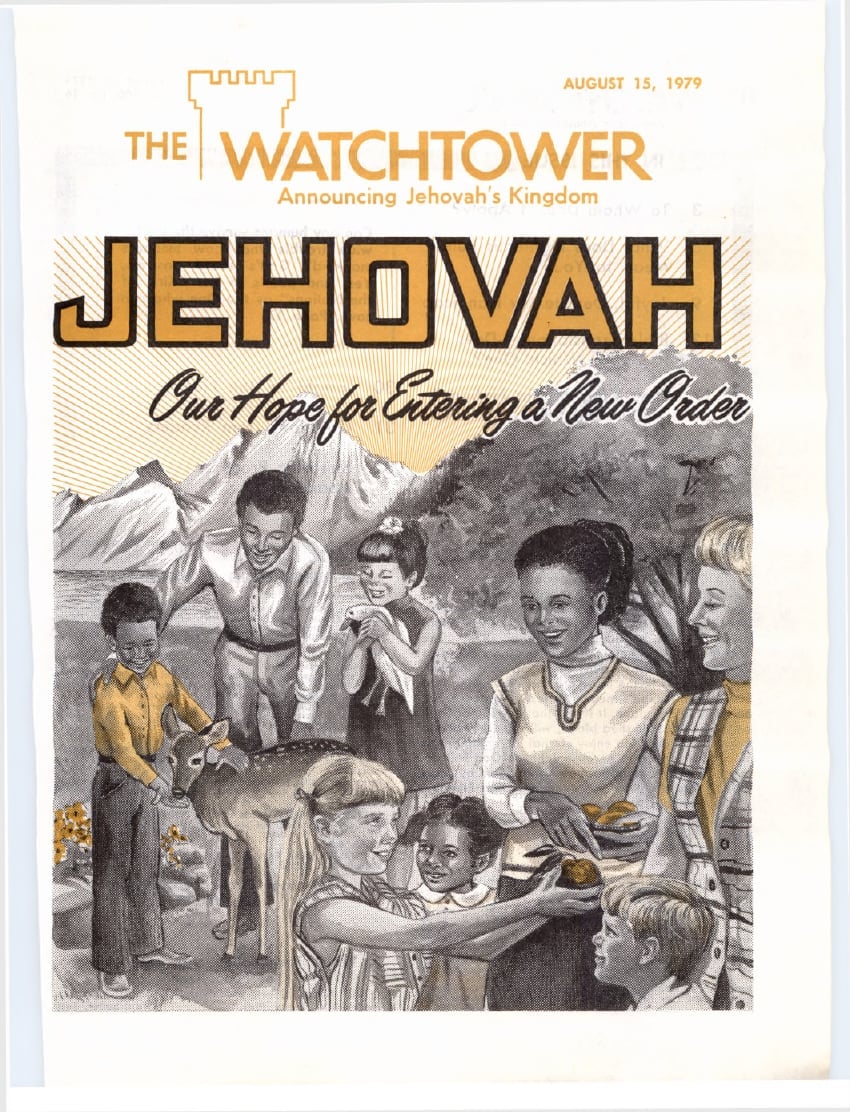
The Watchtower — August 15, 1979
Source: jw.org
Contents
Page Two
To Whom Does It Apply?
What Does Righteous Rule Mean to You?
Joyful, Despite My Handicap
Bible Translations—Does It Matter Which One?
God’s Name in the Bible
The “King of the Nations”—Our Only Help
Jehovah—Our Hope for Entering a New Order
Do You Remember?
Annual Meeting October 1, 1979
Insight on the News
Questions From Readers
A Correction
Spiritistic Practices Abandoned
Offer of Literature
Page Two
Page Two
Can any humans survive the worldwide trouble that now menaces mankind? God’s Word answers, Yes, and points to the “King of the Nations” as the One who can save. Page 17
To Whom Does It Apply?
To Whom Does It Apply?
“THERE are the pronouncing of curses and practicing of deception and murdering and stealing and committing of adultery that have broken forth, and acts of bloodshed have touched other acts of bloodshed.” (Hos. 4:2) ‘Why,’ the casual Bible reader may say, ‘that certainly describes ungodly persons today.’
True, the world of mankind alienated from God has for centuries engaged in such sinful acts. But reflect on that statement recorded by God’s prophet Hosea. To whom does it apply?
A WARNING AGAINST SPIRITUAL DECLINE
The preceding verse states: “Hear the word of Jehovah, O sons of Israel, for Jehovah has a legal case with the inhabitants of the land [in which the Israelites resided], for there is no truth nor loving-kindness nor knowledge of God in the land.” (Hos. 4:1) So the strong words of Hosea 4:1, 2 applied principally to whom? To people in a covenant relationship with God. They had failed to live up to his righteous requirements.
Since ‘all Scripture is beneficial for teaching and reproving,’ a Christian will be wise if he does not view these words as of concern only as they relate to the world in general. (2 Tim. 3:16, 17) Rather, if he recognizes that they were originally directed to God’s people of that time, he will benefit personally. Not only will he realize that he must avoid such wrongdoing as the practicing of deception, but he will accept Hosea’s words as a personal warning against spiritual decline through departure from godly ways.
OUR RELATIONSHIP WITH OTHERS
The psalmist David said: “O Jehovah, why have my adversaries become many? Why are many rising up against me? Many are saying of my soul: ‘There is no salvation for him by God.’” (Ps. 3:1, 2) To whom did that statement apply? To worldly enemies of God’s people?
Jehovah’s people do have adversaries among those having no personal relationship with God. But these words of King David applied to adversaries among his own people, the Israelites. Many of them were saying, ‘God is not going to save David.’ In fact, as the Ps 3:superscription of the third Psalm shows, it is “a melody of David when he was running away on account of Absalom his son.” David’s enemies included a member of his own household, a man belonging to a nation of God’s people. Absalom had conspired against his own father and had driven him from the throne. This conspiracy ended in failure. (2 Sam. 15:1–18:33) Nevertheless, we may derive increased personal benefit from this psalm if we ask, How can I apply this information in my own service to God?
Since Absalom’s rebellion took place among God’s people of ancient times, the incident may alert a Christian to a personal need to guard his own spirit. It may serve as a warning against yielding to yearnings for personal prominence, perhaps by devious actions that are intended to exalt him and harm others devoted to Jehovah. Then, again, fully realizing to whom the words of the third Psalm 3 applied in David’s time may impress on a Christian the need for personal fidelity to family members and others who are whole-souled in their devotion to Jehovah. For example, even after becoming an adult, a child may thus be reminded that he should be loyal to aging Christian parents.—Prov. 19:26.
ATTITUDES TO BE AVOIDED
Centuries after David’s day, the Christian apostle Paul referred to certain enemies and wrote: “Such men are false apostles, deceitful workers, transforming themselves into apostles of Christ. And no wonder, for Satan himself keeps transforming himself into an angel of light. It is therefore nothing great if his ministers also keep transforming themselves into ministers of righteousness. But their end shall be according to their works.”—2 Cor. 11:13-15.
‘What an indictment of the false religious clergy of Christendom!’ someone may exclaim. But, in reading Paul’s scathing statement, ask yourself, To whom did it apply?
The apostle was writing to the Christian congregation in Corinth. His inspired letter was directed to believers—to God’s people. Some prominent men among them showed animosity toward Paul, were ‘false apostles, deceitful workers, ministers of Satan.’ And those unscrupulous men professed to be spirit-begotten followers of Jesus Christ. They evidently entertained the hope of one day ruling with Christ in heaven. In fact, those arrogant men apparently had already sought such prominence among fellow believers that it was as though they had already “begun ruling as kings”—of course, without the apostle Paul, whom they despised. (1 Cor. 4:8-14) Men with such attitudes would never be accepted as heavenly associate rulers with Christ, no matter how great and righteous they considered themselves to be. “God opposes the haughty ones, but he gives undeserved kindness to the humble ones.”—Jas. 4:6.
By reflecting upon Paul’s words at 2 Corinthians 11:13-15, and by not applying them exclusively to worldly clergymen, Christians will be alerted to the personal danger of becoming haughty and deceitful. Moreover, we will be moved to accept and trust our proved and faithful fellow worshipers of Jehovah. Yes, we can be helped to avoid wrong attitudes when we thoughtfully ask, To whom did it apply then, and how can it benefit me now?
DO NOT MISS THE POINT
Our giving thought as to whom certain Scriptural words were directed can be beneficial to the Bible reader in many ways. For instance, when reading the book of James, one does well to realize that it dealt with problems inside the Christian congregation, “the Israel of God.” (Jas. 1:1; Gal. 6:16) This leads the present-day Christian to apply personally such counsel as that found in chapter two of that inspired letter. And this should prompt him to avoid showing favoritism and making class distinctions. This, in turn, will aid him to act with impartiality.
Of course, persons of the world engage in wrongdoing. They often lack fidelity to family members, as did Absalom. Also, they make false claims and show favoritism. Yet, how vital it is to consider the context when reading the Scriptures! Then a person is less likely to miss the full force of what he reads. Rather, he may realize true personal benefit if he pauses to ask, To whom does it apply?
What Does Righteous Rule Mean to You?
Psalms
What Does Righteous Rule Mean to You?
HOW desirable would be a rulership that is distinguished by an active concern for all its subjects! If poverty, oppression and injustices could be removed, this would surely mean refreshing relief for earth’s inhabitants.
In the 72nd Psalm 72, evidently written by David (Ps 72 verse 20), we find the description of a rulership that will accomplish this. It is the kingdom of God by Jesus Christ. A foregleam of this rulership was provided by the peaceful and prosperous reign of King Solomon during the period of his remaining a faithful servant of Jehovah God. Pointing forward to the initial fulfillment, the superscription of Psalm 72 says, “Regarding Solomon.”
The opening verse reveals that righteous rule cannot exist apart from the eternal principles of divine justice. We read: “O God, give your own judicial decisions to the king, and your righteousness to the son of the king.” (Ps. 72:1) These words constitute a prayerful appeal that the king, in rendering decisions, might express Jehovah’s judgments. Moreover, the righteousness that distinguishes the true God should also be an attribute of the king’s son.
The expression “son of the king” fits both Solomon and Jesus Christ. Solomon was the son of King David, whereas Jesus is the Son of the great King Jehovah God. (Isa. 33:22) Regarding Solomon, his subjects came to recognize “that the wisdom of God was within him to execute judicial decision.” (1 Ki. 3:28) And Jesus Christ said: “I cannot do a single thing of my own initiative; just as I hear, I judge; and the judgment that I render is righteous, because I seek, not my own will, but the will of him that sent me.”—John 5:30.
Of course, for righteousness to flourish, all persons must receive the benefits of impartial justice. The psalm continues: “May he plead the cause of your [God’s] people with righteousness and of your afflicted ones with judicial decision. Let the mountains carry peace to the people, also the hills, through righteousness. Let him judge the afflicted ones of the people, let him save [deliver from oppression] the sons of the poor one, and let him crush the defrauder.” (Ps. 72:2-4) When justice is administered impartially to all, including the afflicted and the poor and their offspring, the result is peace and security. Then no one has to live in fear of being defrauded or of having his rights denied. For the mountains and hills that dominate the landscape to “carry peace to the people” would mean that such peace would extend throughout the land. It is just as when the streams and rivers that have their sources in hills and mountains carry life-sustaining water to the valleys and plains. Those who commonly suffer under corrupt rule will enjoy security, as all oppressive, fraudulent men will be ‘crushed,’ punished or brought to justice.
Such a righteous rule would bring great honor to Jehovah God. As the psalm says: “They will fear you as long as there is a sun, and before the moon for generation after generation.” (Ps. 72:5) Since the king expresses the judgments of Jehovah, the subjects will have a wholesome fear of the Most High. This fear would last as long as the sun and moon continue, throughout all generations. When, for example, Solomon judged the case of two prostitutes, the people, seeing the evidence of divine wisdom in action, did ‘become fearful.’ (1 Ki. 3:28) It may also be noted that the miracles performed by Jesus Christ while on earth filled many persons with a wholesome fear and moved them to praise Jehovah God.—Matt. 9:8; Luke 7:16.
The refreshing effect of righteous rule is described as follows: “He will descend like the rain upon the mown grass, like copious showers that wet the earth. In his days the righteous one will sprout, and the abundance of peace until the moon is no more. And he will have subjects from sea to sea and from the River to the ends of the earth.” (Ps. 72:6-8) The king’s righteous rule would be as refreshing as abundant showers that are needed to make the mown grass flourish. In view of the existing peace and security, the righteous person could “sprout,” that is, flourish or prosper. Sooner would the moon pass away than would peace end under this righteous rule.—Compare Matthew 5:18.
It is noteworthy that Solomon’s reign was outstandingly peaceful. The Bible reports: “Peace itself became his in every region of his, all around. And Judah and Israel continued to dwell in security, everyone under his own vine and under his own fig tree, from Dan to Beer-sheba, all the days of Solomon.” (1 Ki. 4:24, 25) Under the rulership of Jesus Christ, the “Prince of Peace,” we can expect even a grander fulfillment of the psalmist’s words.—Isa. 9:6.
Solomon’s dominion extended from the Red Sea to the Mediterranean Sea, and from the Euphrates River to the land lying to the south and the west. (Compare Exodus 23:31.) But Jesus Christ will rule over the entire earth.—Zech. 9:9, 10; compare Daniel 2:34, 35, 44, 45; Matthew 21:4-9; John 12:12-16.
Regarding the peoples who would come under the king’s authority, Psalm 72 states: “Before him the inhabitants of waterless regions will bow down, and his very enemies will lick the dust itself. The kings of Tarshish and of the islands—tribute they will pay. The kings of Sheba and of Seba—a gift they will present. And to him all the kings will prostrate themselves; all the nations, for their part, will serve him.” (Ps 72 Vss. 9-11) What do these words indicate? The tent-dwelling nomads inhabiting the wilderness region to the east of the land of Israel would submit to this king. His enemies would submissively prostrate themselves before him, with their faces touching the dust itself. Tribute would be brought from far and wide. You may read at First Kings 10:22-25 the extent to which the psalm was fulfilled during Solomon’s reign.
However, compared with the rule of Jesus Christ, the dominion and glory of Solomon will pale into insignificance. Not only has the Son of God inherited dominion over the whole earth, but even the angels of heaven acknowledge his lordship.—Phil. 2:9, 10; Heb. 1:3-9; 2:5-9.
The greatness of the king’s dominion does not mean that he would have no time for giving individual attention to the needs of his subjects. He was to be accessible to all and to have depth of concern for them. Verses 12 through 14 of Psalm 72 tell us: “For he will deliver the poor one crying for help, also the afflicted one and whoever has no helper. He will feel sorry for the lowly one and the poor one, and the souls of the poor ones he will save. From oppression and from violence he will redeem their soul, and their blood will be precious in his eyes.”
Yes, even the lowliest subjects could have an audience with this king, and he would come to the rescue of all needing help. He would take pity on the poor and the needy, delivering them from the wrong that is being done to them. To him, blood, representing human life, would have a very high value, would not be something to be shed without genuine cause. During Solomon’s reign, the subjects did have access to the throne for judgment. This is clear from the fact that two prostitutes were able to come before him with their case, and heard a just decision pronounced on that very day. (1 Ki. 3:16-27) How different he was from the Persian kings of a later period! Not even a queen could come uninvited before her husband without jeopardizing her life. (Esther 4:11) On earth, the one greater than Solomon, Jesus Christ, repeatedly demonstrated his active concern for humankind. When he saw the crowds, “he felt pity for them, because they were skinned and thrown about like sheep without a shepherd.” (Matt. 9:36) Why, he even gave up his life for humankind.—Matt. 20:28.
With reference to such a king as described by the psalmist, it would only be right to exclaim: ‘Long live the king!’ He should receive tribute and, in behalf of such a ruler, prayers should be offered up. He would be deserving of blessing, not cursing. These thoughts are emphasized in verse 15 of Psalm 72: “And let him live, and to him let some of the gold of Sheba be given. And in his behalf let prayer be made constantly; all day long let him be blessed.”
How can we act in harmony with the spirit of Psalm 72:15 toward Jesus Christ? This is done by loyally submitting to him, ‘openly acknowledging him as Lord to the glory of God the Father.’ (Phil. 2:11) Note how the sentiments of Psalm 72:15 parallel the following words of Revelation 5:13, 14: “Every creature that is in heaven and on earth and underneath the earth [the dead who will be resurrected] and on the sea, and all the things in them, I heard saying: ‘To the One [Jehovah God] sitting on the throne and to the Lamb [Jesus Christ] be the blessing and the honor and the glory and the might forever and ever.’ And the four living creatures [the cherubs] went saying: ‘Amen!’ and the elders fell down and worshiped.”
Describing the prosperity that would attend righteous rule, Psalm 72 continues: “There will come to be plenty of grain on the earth; on the top of the mountains there will be an overflow. His fruit will be as in Lebanon, and those who are from the city will blossom like the vegetation of the earth.”—Ps 72 Vs. 16.
Being free from the devastations of war and the insecurity brought about by injustice and oppression, the subjects could peacefully pursue agriculture. With God’s blessing, the ground would produce abundantly. It would be as if grain were growing along the sides of the mountain, clear to the top. Since mountaintops are not generally places for there to be an overflow of grain, the words “on the top of the mountains there will be an overflow” present a beautiful picture of how great the abundance would be. The fruitage would be flourishing as Lebanon, yes, like the massive cedars of Lebanon that are luxurious in their growth. This may indicate that the stalks of grain would be tall and thick, able to support heavy ears of grain. Even the inhabitants of the city would flourish, becoming numerous as the vegetation. This proved to be true during Solomon’s reign, for we read: “Judah and Israel were many, like the grains of sand that are by the sea for multitude, eating and drinking and rejoicing.” (1 Ki. 4:20) Even better conditions will exist in the “new earth” under the rule of Jesus Christ.
Truly, righteous rule and its accompanying blessings should give rise to deep gratitude, the kind of appreciation described in Psalm 72:17: “Let his name prove to be to time indefinite; before the sun let his name have increase, and by means of him let them bless themselves; let all nations pronounce him happy.” The name of a king who rules in righteousness deserves to continue for time indefinite. In the case of Solomon, the psalmist’s words express the wish that his dynasty continue and flourish. For the name to “have increase” would point to the king’s having offspring to continue the dynasty. And for the people to bless themselves by the name of the king would mean to mention him in wishing like blessings on others. That people of other nations must have pronounced Solomon happy is evident from the expression made by the queen of Sheba: “Happy are your men; happy are these servants of yours who are standing before you constantly, listening to your wisdom!”—1 Ki. 10:8.
The words of the psalmist are grandly fulfilled in Jesus Christ to whom Jehovah God gave “the name that is above every other name.” (Phil. 2:9) Being the immortal Son of God, he needs no successors. Since he has life-giving power, he can restore the dead to life and thus become the father to many millions. (Isa. 9:6, 7; John 5:26, 28; 1 Tim. 6:15, 16) What great increase that will mean for his name! As the primary ‘seed of Abraham,’ he is the one by means of whom “all nations of the earth will certainly bless themselves.”—Gen. 22:18.
How desirable will be the righteous rule of the Son of God! The queen of Sheba said to Solomon: “May Jehovah your God come to be blessed, who has taken delight in you by putting you upon the throne of Israel; because Jehovah loves Israel.” (1 Ki. 10:9) May we likewise bless Jehovah for designating his Son as king, taking up the words of the psalmist: “Blessed be Jehovah God, Israel’s God, who alone is doing wonderful works. And blessed be his glorious name to time indefinite, and let his glory fill the whole earth. Amen and Amen.”—Ps. 72:18, 19.
Joyful, Despite My Handicap
Joyful, Despite My Handicap
As told by Lee Doo-yong
It was a cold wintry day in February 1951 when retreating fellow soldiers left me for dead in a foxhole. I was severely wounded in both legs. With only snow to eat, by the third day the pains from hunger were greater than the pains from my wounds. On the seventh day enemy soldiers found me, only to leave me to die. During this time I prayed to “God,” whoever he might be. If he would help me now, I promised I would serve him.
THE war that burst forth in June 1950 changed the lives of all of us on the Korean peninsula. I was inducted into the military forces of South Korea later that year, and within four months I lay terribly wounded in a foxhole. This gave me time to think, since that was all there was to do.
I was brought up in the Buddhist religion but it never instilled any real hope in me. In addition, my parents believed in many teachings of Confucius, ancestor worship being a big thing in our family life. But now, when I needed help, I looked elsewhere, praying to “God,” called Ha-nanim in Korean.
Finally, Red Chinese soldiers captured me and took me to an abandoned house where a few of my fellow soldiers were being held. Not wanting to be taken by the North Korean forces, I escaped, dragging myself along the ground. But I was captured again by the Red Chinese, who soon abandoned me as not alive enough to be taken as a prisoner of war.
By now about 50 days had passed since I had been wounded. I fell into a deep sleep. Sometime later, because of the seesaw nature of the war, friendly South Korean soldiers found me. The field hospital in Wonju, Korea, where I was taken, was not equipped to take care of the gangrene that had set in, so I was moved to the hospital in Pusan. My left leg was amputated at the upper thigh, and my right leg was cut off below the knee. I was depressed and discouraged, feeling that I had no reason to live.
HOPE IN RELIGION?
During my hospitalization an army chaplain visited me. Since I had already prayed to God, I wondered now whether this “Christian” religion would bring substance and joy to my life. But any hope I had soon faded.
The chaplain was a nice person. He told me that I had served my country well, and would consequently go to heaven. Yet I could not relate to that. My attendance at their services in no way enhanced my knowledge of God or gave me reason to live. In fact, it convinced me that the “Christian” belief in eternal torment not only was unreasonable, but could not be from the true God.
ATTEMPTS AT REHABILITATION
My two years in the hospital were painful, bitter and empty. The first time the nurses helped me to walk with my new artificial limbs, an airplane flew over and, as I looked up at it, I fell over backward. This completely unnerved and frustrated me. The nurses worked hard to encourage me, even suggesting that in time I would be able to dance with my new legs. But I found no comfort in what they said.
Shortly thereafter the nurse caught me taking 15 tranquilizer tablets that I had secretly saved up in an attempt to take my life. She made me vomit them up. I lived through three such suicide attempts.
In the spring of 1953, at age 23, I was discharged with a very small pension. My life had no direction to it. Both my parents were killed in the war, and the only place I had to go was to my older brother’s. In the Orient, the older brother becomes the head of the house in such situations, and all the younger brothers and sisters become subject to him, especially in family matters. I wanted freedom from this tradition and an independent life. I thought that having a wife would help me to attain this.
But here in Korea one does not just go to another and propose marriage. There must be a go-between, one who arranges the marriage, either a relative or a close friend. My friend’s wife took on this obligation and found a young girl who had a will to help. Marriage brought me a measure of independence, but life still proved to be difficult. Together, my wife and I passed through many hardships, including economic problems.
TOUCHED BY RELIGION PERMANENTLY
It was a very hot day in August 1955 when the question was presented to me: Can You Live Forever in Happiness on Earth? One of Jehovah’s Witnesses called at my door and offered a booklet with that title. The question was a good one for me. That Witness was to become a great influence in my life.
On one of his first return visits I was very much relieved to hear him explain from the Bible that there is no burning hell. In time I began to see that there is a God of love. This, along with the prospect of enjoying a happy life on earth forever, opened up to me something that I could relate to. (Ps. 37:29) And in my condition, with my lower limbs missing, you can imagine how happy I was when prophecies were read to me from the Bible about the lame ones leaping as animals do. This indeed was real hope and encouragement!—Isa. 35:6.
After the third or fourth visit of the Witness I found myself praying to Jehovah and expressing appreciation for what I was getting to know. I was so thrilled by what I was learning from the Bible that some nights I lost sleep just thinking about these things. Now, for the first time, I had a real reason to live. It was not just to get life, but to use my life to serve our loving Creator, Jehovah God.
I was so happy about what was happening that my enthusiasm bubbled over to fellow handicapped veterans with whom I was in business. Three of them soon joined in our weekly Bible study.
CONGREGATION ASSOCIATION
Attending my first meeting at the Kingdom Hall was not easy for me. I was very sensitive about my condition, crutches and all, and I disliked having people show me pity. So I usually avoided gatherings. The only excuse I gave for not going to the Kingdom Hall was that I could not climb the two flights of stairs, even though that was not the real problem.
Then, within a few weeks of his first visit, the Witness brought with him an American missionary who regularly visited congregations in Korea. He also encouraged me to attend meetings at the Kingdom Hall, pointing out the need and the benefits. I was deeply impressed to have him visit my humble place and speak my language, which I knew was difficult for him. So it was hard to say No to his invitation.
When the day came, I was there at the Kingdom Hall. What a profound effect it had on me! Never had I experienced a gathering of such people, eager to learn more about God’s purposes and to serve Him. This was so different from religious gatherings either in Buddhist temples or in any church I had attended. From that time on regular attendance at the Kingdom Hall was part of my life. The hour and twenty minutes it took me to walk the two and a half miles (4 km) was well worth the effort.
OTHER CHANGES AND DEDICATION
After I was wounded in the war, excessive drinking and smoking had become very important in my life. They were the only things at the time that seemed to ease the pain, both mental and physical. But after about three months of Bible study and association with the Witnesses, who neither use tobacco nor get drunk, I saw the need to give up these unclean habits. My physical and mental condition no longer required these props. Bible truth was treating not the symptoms of my problems, but the causes of them. As a result, the quality of my life became richer.
According to Korean custom, the head of the family takes the lead in ancestor worship, and all the younger brothers and their wives are expected to follow his lead. The occasions for ancestor worship arise a number of times each year. After realizing that God’s Word shows the dead to be unconscious and unable to help or hinder us, I refused to share in this false worship. (Eccl. 9:5, 10) This came as a shock to my older brother. Because I would not participate, his opposition grew against my wife. It was extremely difficult for her to stand up against this opposition and to become a Witness.
About nine months after my first contact with the Witnesses, a national assembly was held in Seoul. For the first time a member of the Governing Body of Jehovah’s Witnesses was present, N. H. Knorr. I was thrilled by his encouraging Scriptural talks. This large assembly reinforced my faith as I saw the organization and orderliness of the people and their care for one another. On this occasion, in April 1956, I was baptized in symbol of my dedication to serve Jehovah God, along with over 300 other assembly delegates.
TRUSTING IN JEHOVAH
My first partners in business were fellow veterans, one of whom was baptized with me. However, other partners, because I devoted so much time to Christian meetings, Bible study and preaching to others, took advantage of me. They eventually took all my customers and set up their own business. To pay off our debts, I had to sell the small house I had, and for a while our family lived in a temporary shelter under a tarpaulin roof.—Matt. 6:33.
Being a veteran, well-paying jobs were available to me. However, taking these jobs would have required my violating my Christian conscience, because the jobs were connected with activity described in the Bible as unacceptable for God’s servants.—Isa. 2:4.
Yet help came from an unexpected source when a director of a hospital for the handicapped approached me and asked if I would make knitted items for use in his hospital. Although I had no experience in this, I trusted in Jehovah and looked at my secular work as his means of providing for our necessities. For the past five years, with my son’s help, we have been able to make a reasonably comfortable living without interrupting our responsibilities and privileges in the Christian congregation.
JOINED BY MY FAMILY IN TRUE WORSHIP
I regularly took my children to the Kingdom Hall, and remember some trying times when the young ones were mischievous while I was on the platform. Even though my wife was opposed to any physical discipline, I felt that there was a time and place for it. On the way home from the meetings I took advantage of a vacant lot to sit down and reason with them on why they should behave. Sometimes, when they knew they were going to get spanked, they took off and ran faster than my crutches could carry me and escaped this aspect of their training. Now we all look back and laugh about it, but at the time I surely envied parents who had whole bodies.
After my wife began studying the Bible, and became spiritually strong enough to stand up to my older brother in matters of ancestor worship, she was baptized in 1969. This added to the richness of our family life, and training the children was no longer the problem it had been. We were happy when our first daughter married a ministerial servant in another congregation.
We have had a goal in training our children. This has been to cultivate in their hearts a desire to serve Jehovah. We have held before them as highly desirable the full-time preaching and teaching activity. And all our children have tasted this grand service. Since 1974 our second daughter, Mee-hee, has been in this full-time service, which has helped our family spiritually.
CONGREGATIONAL ACTIVITY
About four years after my baptism a congregation was formed near our house, and I was appointed the congregation servant (presiding overseer). We have since formed three other congregations from that one. I have especially been interested in giving attention to unbelieving husbands of our Christian sisters, thus far being able to help over 30 of them to become Witnesses. These later admitted that, because of my physical condition, they could not refuse to talk to me. Others, who have not accepted the truth, have at least been more understanding toward their Christian wives, who have appreciated this.
One husband was a believer in the teachings of Confucius and opposed his wife very much, mainly because he thought a woman’s place was in the home and that she should be there all the time. This, of course, meant that she would be unable to attend Christian meetings or share in preaching to others outside the home. I called on him on several occasions, getting friendly with him. Finally, at his wife’s persuasion, he consented to attending a session of one of our assemblies. He was so impressed with the program and people there that on his way home he visited me and asked for a Bible study. He is now an elder in the Christian congregation.
It has been almost a quarter of a century since I began learning the Bible truths that have given such meaning and hope to my life. I have never lost my confidence in the precious promises of God, and this is what has given me such joy in living, despite my handicap.
[Picture of Lee Doo-yong on page 9]
Bible Translations—Does It Matter Which One?
Bible Translations—Does It Matter Which One?
TODAY all the Bible manuscripts we have are only valuable copies of the originals in Hebrew, Aramaic and Greek—and most of them are in museums. In any event, few of us are able to read these ancient languages. So we have no alternative but to use modern translations. It is essential, therefore, to use good discernment in assessing Bible translations to be sure that we are reading a faithful and accurate reflection of the original writings.
THE GENERALITY OF PARAPHRASE
What do you look for in a Bible translation? Basically, there are two types: a literal rendition and a paraphrase. The first clings as closely as possible to the original language, that is, as much as idioms and word choice will allow. In contrast, the paraphrase is a “free” translation in which the translator seeks to express the original writer’s thoughts as he may interpret them rather than the exact words used in the text. Evidently these two lines of approach are quite different, and the looseness of the paraphrased Bible does hold hidden dangers, as we shall see.
In the Preface to the paraphrased Living Bible, the following statement is made: “Whenever the author’s exact words are not translated from the original languages, there is a possibility that the translator, however honest, may be giving the English reader something that the original writer did not mean to say. . . . For when the Greek or Hebrew is not clear, then the theology of the translator is his guide.” Let us consider just one example to illustrate this problem.
In Acts, chapter 15, we have recorded for us the important meeting of the apostles and older men held in Jerusalem to decide on the issue of circumcision. The outcome of this gathering was also the settling of the matter of Christian doctrine on the vital issue of blood and its uses, along with the prohibition on fornication. Notice, however, how The Living Bible interprets the words of James at Acts 15:19 and the declaration of the letter as recorded in Ac 15 verse 28: “And so my judgment is that we should not insist that the Gentiles who turn to God must obey our Jewish laws.” “For it seemed good to the Holy Spirit and to us to lay no greater burden of Jewish laws on you.” (Italics ours)
A check on Greek manuscripts clearly shows that the references to the “Jewish laws” are interpolations, added as a direct result of the free translation. Does that matter, bearing in mind that James and all those in his company were of Jewish lineage and that the Jewish laws did prohibit the things mentioned? Indeed, it does! In fact, if accepted, this rendering could put Christians in a state of dangerous compromise, for the simple reason that the prohibition on blood and its uses was imposed centuries earlier by Jehovah upon the patriarch Noah and his family. (Gen. 9:1-6) Although that prohibition later was incorporated in the Mosaic law, which did pass away, it has never been repealed and its application to the entire human family today is beyond question.
Paraphrase Bibles are often colorful and easy to read. But, in their use, caution needs to be exercised at all times. For rapid reading, to get the overall feel of a passage of Scripture, they may have some merit. However, guard against taking what you read in detail as being completely reliable and accurate. Kenneth N. Taylor, in his Preface to the Living Gospels paraphrase translation, summed up the situation well in saying: “For study purposes, a paraphrase should be checked against a rigid translation.” It is essential to follow such good advice if we are to “come to an accurate knowledge of truth.”—1 Tim. 2:4.
TRANSLATION OR INTERPRETATION?
During the Church of England’s Synod in July 1978, an altercation developed between bishops concerning the value of the popular Good News Bible. The Bishop of Chichester criticized the translation as being ‘too full of paraphrases,’ and particularly for its rendering of the Greek word sarx at Galatians 5:19. Sarx means “flesh.” Instead of translating erga tis sarkos as “works of the flesh,” the Good News Bible paraphrases the three Greek words, attributing the vices listed at Galatians 5:19-21 simply to “human nature.”
By following the thinking of such an interpretation, we could well justify and excuse unchristian conduct. How easy, but how wrong, to blame our “human nature” instead of ourselves! Paul’s argument continues (in Galatians, chapter 5) to show what fruitage of God’s holy spirit can be expected in a Christian life. Yes, in spite of our fleshly tendencies, we can change and bear such fruitage as love, joy, peace and self-control.
According to The Living Bible, Job’s sons celebrated their birthdays. (Job 1:4) Yet the Good News Bible, in full harmony with the original Hebrew, merely speaks of a feast, with no allusion to birthdays at all. The first rendering is a clear case of interpretation. This example also illustrates the extreme variations existing between paraphrased translations.
The Living Bible paraphrases the words of Ruth 1:1 as follows: “Long ago when judges ruled in Israel.” Yet, is it correct to imply that judges rule as do kings? No. In further contrast, the Good News Bible loosely states: “Long ago, in the days before Israel had a king.” To an inexperienced Bible reader the continuity of Jehovah’s purpose in directing the nation of Israel through the turbulent times of the judges is thereby lost, and there is no gain from the paraphrase. But a literal and meaningful translation reads: “Now it came about in the days when the judges administered justice.” (New World Translation) Thus the historical picture is clearly presented.
One of the first translations to make its mark after World War II was clergyman J. B. Phillips’ Letters to Young Churches, first published in the year 1947. Expressly stated as not being a version for close meticulous study, it has the acceptable flow of a paraphrase. Of unusual interest, however, is the rendering of 1 Corinthians 14:22, which says that tongues are a sign “not for those who are unbelievers but to those who already believe.” Likewise, “preaching the word of God” is said to be a sign “to those who do not believe rather than to believers.” (Italics ours) This is the exact opposite of what the Greek manuscripts say.
In his Translator’s Preface (Twelfth Edition), J. B. Phillips explains why he so deliberately departed from the accepted text. “I felt bound to conclude that we have here either a slip of the pen on Paul’s part or a textual corruption, and I have therefore been bold enough to alter the verse in order to make good sense.” The serious Bible student is naturally glad for this honest explanation. Indeed, a weighty responsibility rests on any translator of the inspired Scriptures to convey facts accurately.—2 Tim. 3:15-17.
SCHOLARSHIP AND LITERAL TRANSLATIONS
The complete New World Translation of the Holy Scriptures is now printed in seven languages and has been circulated world wide in 23 million copies. In the foreword to the 1950 first edition of the Christian Greek Scriptures, it is stated: “We offer no paraphrase of the Scriptures. Our endeavor all through has been to give as literal a translation as possible, where modern English idiom allows and where a literal rendition does not for any clumsiness hide the thought. In that way we can best meet the desire of those who are scrupulous for getting, as nearly as possible, word for word, the exact statement of the original.” In view of such integrity, a Bible student can, in full confidence, approach this translation and measure the thoughts of the original inspired writings. Let us take some examples.
In the Christian Greek Scriptures, the quality of love is mentioned nearly 200 times (over 250 times, if related words such as “loving-kindness” are included). What is not generally realized is that Greek has four basic words for the English equivalent “love.” In the Christian Greek Scriptures, three of these words are employed: Storgé, relating to the special love existing between parents and children; philía, denoting personal attachment and tender affection among friends; and agápe, often described as the love that is governed or guided by principles—such as Jehovah’s love for the human family.—John 3:16.
To differentiate between these words calls for skilled translating—a fine point not always acknowledged by those who undertake the task. The conversation between Jesus and Peter, recorded at John 21:15-17, is a clear example. Here most translations use the simple word “love” seven times. But not so the New World Translation. This is because the Gospel writer John, in quoting Jesus, twice used agápe, calling for Peter’s unselfish love in ministering to others (“Simon son of John, do you love me?”). However, in giving Peter’s answers, John used philía, denoting very personal affection for Jesus. The use of philía when citing Christ’s third question (“Simon son of John, do you have affection for me?”) underlines the warmth of affection that existed between Jesus and Peter.
You may recall that, according to Matthew chapter six, Jesus condemned in a very forthright way those who hypocritically made a showing of their gifts of mercy. Most translations are content to say that such ones already ‘have their reward.’ The Greek verb apécho, however, carries the distinct thought, conveyed by the New World Translation, that they were “having their reward in full.” (Matt. 6:5) They sought the praise of men and that was all they would receive. How pointed were Jesus’ remarks!
The King James Version of 1611 always uses the word “hell” to translate three distinct Greek words, Hades, Gehenna and Tartarus. Modern translations often differentiate between these words, but not consistently so, as does the New World Translation. Hades, transliterated from the Greek, literally means “the unseen place.” Peter’s use of it, as noted at Acts 2:27, shows that it is equivalent to the Hebrew word Sheol (the common grave of mankind), whereas Gehenna, descriptive of the Valley of Hinnom to the southwest of Jerusalem, denotes everlasting destruction. Tartarus occurs but once, at 2 Peter 2:4, and applies only to the fallen angelic spirits.
For many sincere people, the word “hell” is an emotive one on account of their religious training. A concise and accurate translation of the Greek clears out false teachings. Not all translators desire this, however, as seems apparent from this paraphrase of Matthew 7:13: “Go in through the narrow gate, because the gate to hell is wide and the road that leads to it is easy, and there are many who travel it.” (Good News Bible) The introduction of “hell” here for the Greek apóleia, meaning “destruction,” is quite misleading. The precision of the literal New World Translation dispels any ambiguity, in stating: “Go in through the narrow gate; because broad and spacious is the road leading off into destruction, and many are the ones going in through it.” (Compare the use of the Greek “Apollyon” as transliterated at Revelation 9:11 along with the Hebrew “Abaddon,” meaning “Destroyer” and “Destruction” respectively.)
When Paul wrote to the Christian congregation at Colossae, he spoke of the need to have “accurate knowledge” and the ‘riches of the full assurance of our understanding.’ (Col. 2:2) The New World Translation has undertaken to draw its readers as closely as possible to the original divinely inspired writings. It merits serious study. Jehovah’s Witnesses are grateful to have this translation for use at their meetings, in their public preaching activity and for vital personal research. Yes, it really does matter which Bible translation you use.
God’s Name in the Bible
God’s Name in the Bible
Increasing evidence points to the conclusion that God’s personal name (written in Hebrew with the consonants “yhwh,” but usually written in English “Jehovah”) was originally included in what is called the New Testament. Summarizing an article on this in another scholarly journal, a recent publication said:
“In pre-Christian Greek [manuscripts] of the O[ld] T[estament], the divine name (yhwh) was not rendered by ‘kyrios’ [lord] as has often been thought. Usually the Tetragram was written out in Aramaic or in paleo-Hebrew letters. . . . At a later time, surrogates [substitutes] such as ‘theos’ [God] and ‘kyrios’ replaced the Tetragram . . . There is good reason to believe that a similar pattern evolved in the N[ew] T[estament], i.e. the divine name was originally written in the NT quotations of and allusions to the OT, but in the course of time it was replaced by surrogates.”—“New Testament Abstracts,” 3, 1977, p. 306.
The “King of the Nations”—Our Only Help
The “King of the Nations”—Our Only Help
“Who should not fear you, O King of the nations, for to you it is fitting; because among all the wise ones of the nations and among all their kingships there is in no way anyone like you.”—Jer. 10:7.
1. From whom does the cry for help arise world wide, and why?
“HELP! HELP!” From every quarter of the globe this cry arises. It ascends from persons who see the course that the world keeps taking and the disastrous consequences in which it will end very shortly. The outlook horrifies them and moves them to great sadness. They incline to say, just as the prophet Jeremiah did not long before the destruction of Jerusalem, which he predicted: “O that my head were waters, and that my eyes were a source of tears! Then I could weep day and night for the slain ones of the daughter of my people [Israel].”—Jer. 9:1.
2. Because of what outlook might the sympathetic person well weep today?
2 Why should not a sympathetic person today weep? For now there impends over mankind what was long ago foreshadowed by the national calamity concerning which Jeremiah was told to say: “Teach your daughters a lamentation, and each woman [teach] her companion a dirge. For death has come up through our windows [into our very homes]; it has come into our dwelling towers, in order to cut off the child from the street, the young men from the public squares. . . . ‘The dead bodies of mankind must also fall like manure upon the face of the field [spread out as fertilizer] and like a row of newly cut grain after the reaper, with no one to do the gathering up.’”—Jer. 9:20-22.
3. In view of the world trouble plainly foreseen, what or whom do people consult for guidance?
3 Who is it that cannot see worldwide trouble ahead, the worst in all human history? We do not need to have the prophetic foresight of Jeremiah of old to see this. So, then, how can any of us survive what even uninspired observers of world trends today predict? At the menacing outlook, even irreligious persons are involuntarily driven to call upon some higher and more than human factor to step in and save the human family. The political rulers, even those of Christendom, consult spirit mediums and clairvoyants anxiously. In their uncertainty about making a single move of importance, they seek astrologers to consult their horoscopes and read the portents of the heavens. Others appeal to their gods, their images made of wood and covered over with silver and gold and decked with gorgeous handmade or machine-made garments. Are such features of popular custom the things to which to look for help now as the world situation becomes more threatening and forebodes world catastrophe in the near future? No!—Jer. 10:1-5.
4. Why is now some sightless, unintelligent “kind providence” not our only help, and where does true help lie?
4 Where does true help lie? What or who is our only help? It is not some blind, unintelligent “kind providence.” It must be some real person who sees the dangers of our situation as much as our wise political forecasters do, yes, even better than those highly intelligent men do. For certainly unintelligence cannot precisely help intelligent persons such as we are. Our only help is the One who was intelligent enough to make the whole universe, including us intelligences. He is “on top” of the situation. He is the One whom the prophet calls the “King of the nations.”
5. At Jeremiah 10:6-8, how does the prophet describe our only help?
5 Do we ask who that One is? He is the One beyond all comparison, for Jeremiah says: “In no way is there anyone like you, O Jehovah. You are great, and your name is great in mightiness. Who should not fear you, O King of the nations, for to you it [such fear] is fitting; because among all the wise ones of the nations and among all their kingships there is in no way anyone like you. And at one and the same time they [the nations and their kingships] prove to be unreasoning and stupid. A tree [a wooden image overlaid with silver and gold and decked with garments like a god] is a mere exhortation of vanities.”—Jer. 10:6-8.
6. What were the first two nations mentioned after the deluge of Noah’s day, and what does the Bible indicate as to whether Jehovah was their King?
6 In what way was Jehovah God the “King of the nations” in Jeremiah’s day? Did the non-Jewish or Gentile nations recognize him as their King? Had he set up their kingdoms or their kingships, their royalties? Did he give them their form of government and laws or enter into a covenant with them so as to put them in a binding relationship with him? Well, the first nations that the Bible mentions after the deluge of Noah’s days are Babylon (Babel) and Assyria. Are we to understand that Jehovah was their King? How could such a thing be? For Genesis 10:8-12 tells us:
“And Cush [Noah’s grandson] became father to Nimrod. He made the start in becoming a mighty one in the earth. He displayed himself a mighty hunter in opposition to Jehovah. That is why there is a saying: ‘Just like Nimrod a mighty hunter in opposition to Jehovah.’ And the beginning of his kingdom came to be Babel [Babylon] and Erech and Accad and Calneh in the land of Shinar. Out of that land he went forth into Assyria and set himself to building Nineveh and Rehoboth-Ir and Calah and Resen between Nineveh and Calah: this is the great city.”—Note Genesis 2:14; 1 Chronicles 1:10.
7. What ancient background would indicate whether Jehovah was the King of the neo-Babylonian Empire of Jeremiah’s day?
7 When the builders of Babylon (Babel) were engaged in building their ‘tower of Babel,’ or ziggurat, for religious worship, what happened to hinder them from finishing the job? Why, Jehovah proceeded to do as he said: “Confuse their language that they may not listen [understandingly] to one another’s language.” What resulted? Nations, speaking different languages; for we read: “Accordingly Jehovah scattered them from there [Babel] over all the surface of the earth, and they gradually left off building the city. That is why its name was called Babel [Confusion], because there Jehovah had confused the language of all the earth.” (Gen. 11:7-9) Obviously, then, Jehovah was not the King of that first Babylonian Empire any more than he was the King of the neo-Babylonian Empire of Jeremiah’s day. The god of that neo-Babylonian Empire was Bel or Merodach (Marduk), whom Emperor Nebuchadnezzar worshiped. (Jer. 50:1, 2) Jehovah was no Babylonian god.
8, 9. (a) Whom did the other Gentile nations worship as their superhuman rulers? (b) How did Satan indicate to Jesus that he was what Jesus called him, “the ruler of this world”?
8 Other Gentile peoples had their national gods, whom they regarded as their rulers and in representation of whom they made idolatrous images. For example, the nation of Ammonites worshiped a false god whom they called Molech, a name meaning “Reigning One,” or “King.” (Lev. 15:21; 20:2-5; 1 Ki. 11:7; Acts 7:43) Such nations really worshiped spirit demons or devils. (1 Cor. 10:20) Over all these invisible demons is Satan the Devil. At 2 Corinthians 4:4 he is called “the god of this system of things.”
9 Claiming kingship over all the worldly nations, Satan the Devil tried to tempt Jesus Christ by saying: “I will give you all this authority and the glory of them [all the kingdoms of the inhabited earth], because it has been delivered to me, and to whomever I wish I give it. You, therefore, if you do an act of worship before me, it will all be yours.” (Luke 4:5-7) But Jesus refused to become a human king under God’s great adversary. Hence, shortly before his death, Jesus spoke of Satan the Devil as “the ruler of this world.” (John 12:31; 14:30; 16:11) The Bible’s last book, written seven centuries after Jeremiah’s day, says that “all the earth” was worshiping Satan the Devil and his visible political organization, pictured as a seven-headed beast.—Rev. 13:3, 4.
10. (a) On what basis was Jehovah the King of only the nation of Israel till it rejected the Messiah? (b) Though the “kingdom of the world” became that of Jehovah and his Christ in 1914, what do the nations refuse to do?
10 Anciently the Israelites acknowledged Jehovah God as their Lord and King. In harmony with that the inspired psalmist went on to say: “He is telling his word to Jacob, his regulations and his judicial decisions to Israel. He has not done that way to any other nation; and as for his judicial decisions, they have not known them. Praise Jah, you people [or, Hallelujah]!” (Ps. 147:5, 19, 20; 145:1, 12, 13) Consequently, the worldly Gentile nations were not the kingdoms of Jehovah God. The theocratic government that he set up over ancient Israel in the days of the prophet Moses was God’s only earthly kingdom until the nation of Israel rejected the Son of God, Jesus Christ, as the Messiah from God. (Ex. 15:18-21; Deut. 33:2-5; 1 Chron. 29:11, 12, 23; Matt. 21:43) First since the end of the Gentile Times in 1914 C.E. “the kingdom of the world did become the kingdom of our Lord and of his Christ”; and yet the worldly nations still refuse to have Jehovah as their King.—Rev. 11:15-18.
HOW “KING OF THE NATIONS”?
11. From what standpoint did Jeremiah address Jehovah as “King of the nations”?
11 From what standpoint, then, could Jeremiah address Jehovah as “King of the nations”? From the standpoint that among all those who were kings of the nations and who thus held kingship He was the outstanding King. He ruled as King of kings, the Superlative King, the One who dominates all other kings. “For,” said Moses to Israel back in 1473 B.C.E., “Jehovah your God is the God of gods and the Lord of lords, the God great, mighty and fear-inspiring.” (Deut. 10:17) Later, the inspired psalmist said to Jehovah’s people: “Give thanks to the God of the gods: for his loving-kindness is to time indefinite; give thanks to the Lord of the lords: . . . to the One striking down great kings: . . . and who proceeded to kill majestic kings: . . . even Sihon the king of the Amorites: . . . and Og the king of Bashan: . . . and who gave their land as an inheritance: . . . an inheritance to Israel his servant.” (Ps. 136:2, 3, 17-22) In this way he dominates “all the nations,” in spite of their having their own demon and human kingships.—Jer. 9:25, 26.
12. How did Jehovah illustrate and explain to Jeremiah that He was “King of the nations”?
12 So then, Jehovah could tell Jeremiah: “See, I have commissioned you this day to be over the nations and over the kingdoms.” (Jer. 1:10) That Jeremiah addressed him aright as “King of the nations,” Jehovah illustrated to him. Jehovah commanded him to go down to the house of a potter. After the potter made a vessel that proved to be spoiled and then remolded the clay into a vessel meeting his approval, Jehovah said:
“Am I not able to do just like this potter to you people, O house of Israel? . . . Look! As the clay in the hand of the potter, so you are in my hand, O house of Israel. At any moment that I may speak against a nation and against a kingdom to uproot it and to pull it down and to destroy it, and that nation actually turns back from its badness against which I spoke, I will also feel regret over the calamity that I had thought to execute upon it. But at any moment that I may speak concerning a nation and concerning a kingdom to build it up and to plant it, and it actually does what is bad in my eyes by not obeying my voice, I will also feel regret over the good that I said to myself to do for its good.”—Jer. 18:1-10; also note Jeremiah 1:10.
13. How did Jehovah the Great Potter follow that same stated rule of action toward ancient Egypt and toward Israel?
13 Centuries previous to this statement, Jehovah had favored the land of Egypt in the days when Joseph the son of Jacob was made its food administrator. But some time after Joseph’s death, when Egypt’s Pharaohs began to oppress Joseph’s people, the descendants of Jacob (or, Israel), and even tried to wipe them out of existence, Jehovah intervened. He plagued the land of Egypt and destroyed Pharaoh and his military hosts and freed His chosen people, the Israelites. (Ps. 136:10-16; Rom. 9:17, 18, 21-24) According to that same rule of action, when the kingdom of Judah rebelled against the God of its covenant and persisted in its bad ways, Jehovah the Great Potter purposed to overthrow that Israelite kingdom. (Jer. 18:11-17) Those rebels even returned bad to Jehovah’s prophet Jeremiah for the good that he was seeking to do to them. Why, they even schemed to kill Jeremiah. (Jer. 18:18-20, 23) Hence, finally, it became agreeable to Jeremiah for Jehovah’s adverse judgments to be executed upon those rebels.—Jer. 18:21, 22.
14. Why should we today, as individuals, take to heart those historical examples of the dealings of the Great Potter?
14 These historical examples are something for all nations, especially those of Christendom, to take to heart today. At least we common people, as individuals, ought to do so. Jehovah the Great Potter is still supreme, and he is about to show to all mankind that he is still the “King of the nations.” Today, more than ever before, the following words of Jeremiah still hold true:
“But [in contrast with the false gods described just before this] Jehovah is in truth God. He is the living God and the King to time indefinite. Because of his indignation the earth will rock, and no nations will hold up under his denunciation. This is what you men will say to them [to the nations]: ‘The gods that did not make the very heavens and the earth are the ones who will perish from the earth and from under these heavens.’a He is the Maker of the earth by his power, the One firmly establishing the productive land by his wisdom, and the One who by his understanding stretched out the heavens.”—Jer. 10:10-12.
15. Why does Jehovah have good reason for indignation against the nations, and how will he express it?
15 Is there real reason for Jehovah God the Creator to have indignation today? Well, let us just think of the widespread disregard for his laws, the contempt for his name, the crime, the love of pleasures rather than the love of God, the immorality, the religious hypocrisy, the persecution upon those who form a modern-day Jeremiah class, the refusal of the nations to submit to Jehovah’s kingdom by Christ. Certainly, in the face of all these things, there is every good reason for Jehovah God the Great Potter to have indignation. Soon he will express it, just as he did in Jeremiah’s day by destroying Jerusalem and the kingdom of Judah.
16. Why will the wicked nations not “hold up” under Jehovah’s expressed denunciation?
16 In his written Word, the Bible, Jehovah has denounced all wickedness. Shortly he will destroy the things that he has denounced. Under his expressed denunciation “no nations will hold up.” Their “gods,” the things that they have deified and idolized, will prove helpless and perish. Their worshipers will perish with them.
17. From whom do cries for help go up to our only Help, and why?
17 Logically, our only help is the one living and true God, the “King of the nations.” Cries for help go up to him from everywhere, from those who, like Jeremiah, deplore the godless conditions and from all others who are “sighing and groaning over all the detestable things that are being done,” especially in hypocritical Christendom. (Ezek. 9:4) Their hearts are rent because a “breakdown” like that described by Jeremiah impends over all the nations due to the fact that their rulers have not searched for Jehovah as our only help. (Jer. 10:19-22) Their United Nations organization will fail as an agency for world peace and security. All human schemes for directing the course of history and for warding off destruction at the hands of the Great Potter will prove futile.
…