The Watchtower, April 15, 1979
Download: PDF — The Watchtower, April 15, 1979
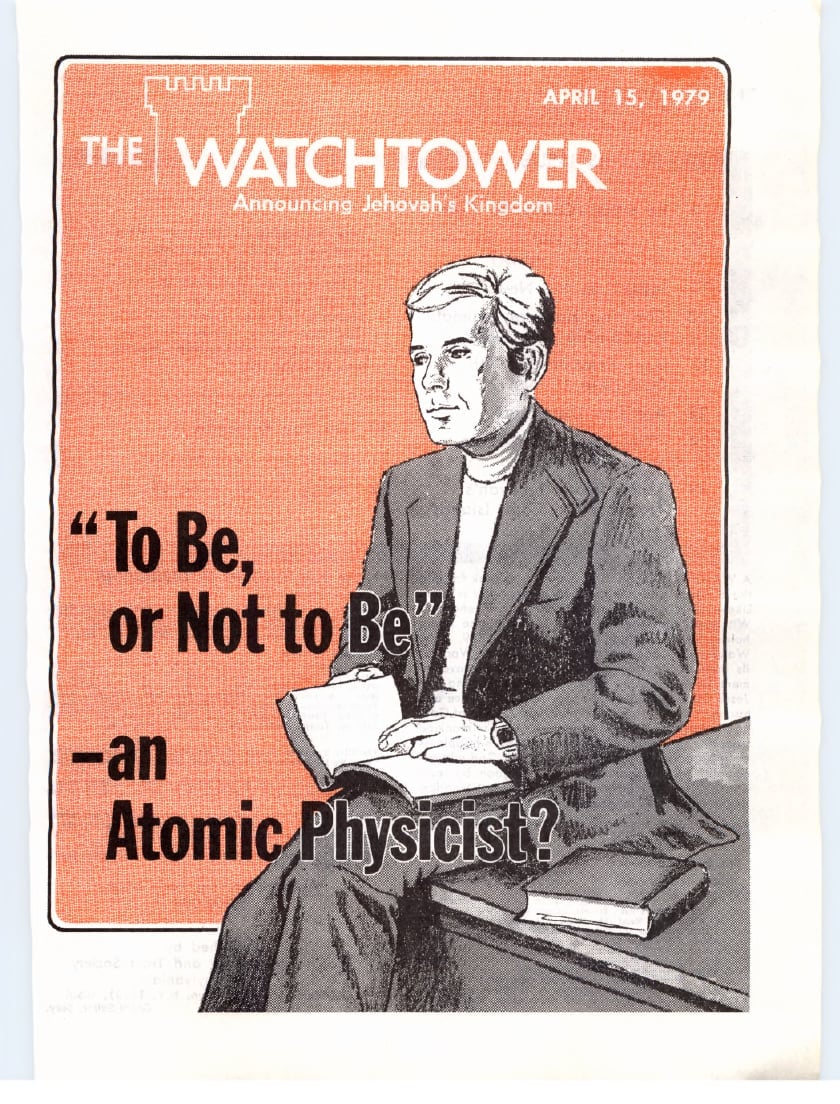
The Watchtower — April 15, 1979
Source: jw.org
Contents
Page Two
Be Wise—Count the Cost
“To Be, or Not to Be”—An Atomic Physicist
Insight on the News
Can You Have an Intimate Relationship with God?
Does Relationship with God Help Us Now?
Are You Disturbed?
“You Must Assist Those Who Are Weak”
Telling Forth Jehovah’s Praise in the Cook Islands
Do You Remember?
Questions From Readers
Being Tactful Is Beneficial
Death—A Door to What?
Page Two
Page Two
True friendship is precious. Most precious of all is the friendship we may enjoy with the grand Creator of the Universe. More than anyone, he can help us to cope with the pressures of life. Friendship with God can be a reality—a close, warm, secure relationship. Please turn to page 12.
Be Wise—Count the Cost
Be Wise—Count the Cost
“COUNT the cost.” “Calculate the expense.”a Thus counseled Jesus Christ, the wisest man that ever walked on the earth. He spoke those words in discussing the matter of a person’s becoming one of his disciples. Nevertheless, they state a principle that can have wide application in our everyday affairs. How so?
With regard to acquiring material possessions: Due in large measure to the great amount of advertising done in the media—newspapers, magazines, TV and radio—people’s desires and wants often far outstrip their ability to pay. But for many, their longings for these things are so strong that they cannot resist the blandishments of a salesman who assures them that they can afford such things by means of installment buying: “Enjoy things while you are paying for them. Why do without them until you have enough money saved up to pay for them?” No wonder U.S. News & World Report, November 20, 1978, states: “People Going Deeper in Debt: ‘It’s Really Worrisome.’” It went on to show that private debts in the United States amounted to $2,500,000,000,000.
With what result? For many, it means personal bankruptcy due to unforeseen circumstances. Thus, in a recent year, there were a quarter million bankruptcies in the United States, 85 percent of these being, not of a business nature, but of a personal one. What do most of these bankruptcies indicate? A failure to use sound judgment; failure wisely to count the cost of extending oneself financially.
The wisdom of first counting the cost is also apparent when it comes to marriage. How many persons enter into marriage without giving due thought to all that is involved, and this is particularly true of young folks! That is why separations and divorces are so much more numerous among teen-agers than among people of any other age group. What does this suggest? That especially these persons had failed to count the cost—not just in dollars and cents.
To make a success of marriage costs a great deal. It often means paying the cost of making allowances for the shortcomings of others in the interest of peace, patiently enduring what cannot easily be changed, if at all. It means not only thinking of “us” instead of just “me,” but also being willing to put the interests of one’s mate ahead of one’s own. All of this implies a realistic view of oneself and of the other person, recognizing that no marriage is perfect and that one must take the bitter, ‘tribulation in the flesh,’ with the sweet. (1 Cor. 7:28) Yes, far more marriages would be lasting and happy if those entering them had first of all counted the cost. In the case of many young folks, this most likely would have meant wisely waiting a few years until they were better equipped in every way, mentally, physically, emotionally and financially, to assume the responsibilities of marriage.
And there are other aspects of life where a person may err, betray a lack of wisdom, by not first counting the cost. Young folks may persuade their parents to make purchases of some costly items needed for pursuing a particular hobby, only for the youngsters soon to tire of it. The youth did not count the cost of what it took in time, energy, and attention to make such an investment worth while, and so not only was his father’s money wasted but so was the time that the youth had spent on the hobby.
As noted earlier, “count the cost” was originally said by Jesus Christ in discussing the matter of a person’s becoming one of his disciples. Does becoming a disciple of Jesus Christ cost something? Indeed it does! Thus, regarding a promising popular TV star who decided to become a follower of Jesus Christ as a witness of Jehovah God, an article in the New York Sunday Daily News commented as follows:
“[She] could be living in snooty Bel Air, driving a sleek Rolls Royce, decked out in St. Laurent’s latest fashions. She could be having headlined romances, be drinking, playing around and causing a lot of talk. . . . Gone is her marvelous opportunity to become an instant millionairess, television superstar, night club sensation.”
Why?
“Mainly because she refused to permit anything or anyone to compromise her newly-found religion, Jehovah’s Witnesses. . . . A little more than a year ago, she thought nothing of dancing semi-nude, gambling, guzzling, gadding about. As she puts it, ‘I did all kinds of things before I came into the truth. I was in darkness and ignorance, and therefore I followed the standards of the world.’”
Yes, for her to become a true Christian cost her something. Did she benefit from counting the cost? Yes, for as that article went on to say: “She’s never been happier.” Much of that happiness is due to her being a full-time preacher of the good news of God’s kingdom. As a Christian with faith, she knows that far greater happiness is in store for her.
The Toronto Star, September 12, 1978, told of a hockey player who, in 1977, was the highest scoring defenseman on his team, but decided to quit. The article quoted him as saying: “I feel that I can’t devote myself to hockey and serve Jehovah. I would be splitting my devotion. It centres around principles in the Bible . . . It was no snap decision. I had thought about it a year ago.” Then after giving details about his career as a sportsman, the report further quoted him as saying:
I went to an assembly in Montreal over the summer and was baptized there, shortly after I was married. It all began when I started reading a few (Witness) publications. I felt it sounded so right. I always believed in a God, but I wasn’t totally sure. I simply came to the conclusion it is more important to serve Jehovah than to play hockey.”
After telling that he does door-to-door preaching, the article in conclusion quoted him as saying: “I don’t have to work for a while—my accountant invested well for me. I realize the money I made was quite a lure, but it’s more important to do what is pleasing to Jehovah.” No question about it, he also counted the cost and willingly began paying it.
However, there is one aspect about what Jesus said as to counting the cost that is not generally appreciated. What is that? Just what did Jesus mean when he said to his disciples back there to “count the cost”? Did he mean for them to weigh, in the first place, all the pros and cons as to whether an individual would want to become a disciple of his or not? (Such would be the case, of course, in such matters as investing in material things.) No, the counting of the cost that Jesus referred to was not as to a person’s deciding whether he would become a disciple of his or not, but, rather, as to inquiring about what is involved.
As The Watchtower once expressed it: “God’s Word counsels us to count the cost. Not so as to determine whether we should dedicate ourselves [to do God’s will] or not—there is but one answer to that question—but so as to appreciate what is involved. So that we will be prepared to say, as Jesus on that occasion also put it, ‘goodbye to all our belongings,’ should that be necessary.”
In these days it is quite likely that some did not fully count the cost when dedicating themselves to do God’s will and to follow the footsteps of Jesus Christ. Because of this, as tests came of one kind or another, such as persecutions or temptations as to materialism or immorality, they fell by the way. How sad! Jehovah’s reward for faithfully serving him is certain, for his promises never fail—be it this year, next year, or in the resurrection. The wise Christian, having counted the cost of what is involved in becoming a follower of Jesus Christ, has no regrets.—Josh. 23:14.
[Footnotes]
a Luke 14:28, Revised Standard Version, New World Translation.
“To Be, or Not to Be”—An Atomic Physicist
“To Be, or Not to Be”—An Atomic Physicist
As told by Fred Wilson
“THAT is the question” that confronted me back in the early 1940’s. ‘Not such a difficult question,’ you say. Well, on the surface it appears easy, for the world was just entering the atomic era. For physicists, lucrative jobs were plentiful. And the work was intensely interesting, even absorbing. Why, then, the question?
Basically, because religion was involved. Yes, something even more interesting and more absorbing entered my life. But let us go back a few years and get the background.
Our family lived in a typical small village on the Canadian prairies where everything depended on the wheat crop. At an early age we were taught the value of hard work, and after school we would earn money working in stores, sawing wood, hauling grain or driving horses. At home, we four brothers bemoaned the lack of a sister, for that meant we had to prepare meals, do the dishes and wash and iron clothes. Only years later did I really appreciate the value of what I learned in those earlier days.
EARLY RELIGIOUS BACKGROUND
Religion played a definite part in life, in spite of our efforts not to “get involved.” Mother belonged to a strict “hellfire” group that met in the “Gospel Hall,” the only name we ever knew for our religion. Dad was a Mason and left religion up to mother. How I envied him as he sat at home reading the newspaper while we had to go to Sunday school! My mother and grandfather had daily Bible readings and, if we were careless enough to be around the house at the time, we had to take part.
What turned me against religion, even as a young boy, was something that happened one winter evening. It was my turn to light the fire in the hall for a special meeting with a traveling evangelist. The fire had just got started nicely when who should walk in but the preacher himself! He sat me on a chair and started to preach, wanting me to get down on my knees right there and “get saved.” “If you do not do so,” said he, “it will be the same as calling your mother a liar.” Well, that was the last thing I would have done. But at the same time I could not do as he asked. Finally, he gave up and let me go. From then on my interest in religion waned.
PREPARING FOR A CAREER
In the early 1930’s the economic depression hit the prairies and we were hard pressed to meet the family budget. The climax came in 1937 when all the young men had to leave home to look for work in provinces where disaster had not hit so hard. I, with others, headed for Manitoba. After a few months of work, we mailed our money back and returned home.
This money helped pay tuition fees and lodging during my studies at the University of Saskatchewan. The curriculum covered a variety of courses, among them biology, which included instruction in the basics of evolution. In view of my hellfire religious experience, this theory seemed plausible. To have questioned the theory would have meant to ‘accept the unacceptable,’ that is, creation. So ours was a blind faith in a theory, with no questions asked.
After graduation in 1938, I decided to go on to specialize in atomic physics. Things began to be a little easier financially since we graduates were hired as laboratory instructors for the undergraduate classes. I also worked as a technician in a radon plant operated at the university by the cancer clinic for treatment of surface cancers. As a technician, my job was to pump off the radioactive gas radon and store it in a fine, gold tubing, which, after being cut into small “seeds,” would be injected by the doctor into the tissue surrounding the cancer. The radiation from the radon attacks the cancerous tissues without unduly affecting the healthy tissues. We could determine the strength needed for use in any operation planned for a certain time, since radon decays at a fixed rate. This evidence of design and order in radioactive materials was just one of many facts that made me wonder: How could all of this happen just by chance, as evolution would have us believe?
At that time I was working for my Master of Arts degree under Dr. G. Herzberg (Nobel Prize winner for chemistry in 1971), conducting experiments to determine the distance between the atoms in the silicon sulphide (SiS) molecule. This was done by measuring the wavelength of lines in the absorption spectrum of SiS and by the use of complicated mathematical formulas. Here again was evidence of order and design. Why, it meant that behind all of this there must be a Scientist and Mathematician! But vital questions remained unanswered: Who? How? When?
We graduates all applied for scholarships, and how elated I was to receive offers from the Massachusetts Institute of Technology and Cornell University in the United States! However, the world scene was changing at an alarming rate. I remember how we in the physics department felt the day when the newspapers announced ‘The atom has been split!’ Dr. Herzberg’s words carried a sense of doom as he said with great emotion: “What won’t they do next?” As World War II progressed, we wondered how it would affect us. Then Canada closed its borders, so that no science graduates could leave the country. Consequently, I applied for and (in 1941) received a scholarship from the National Research Council so as to continue my studies at the University of Toronto.
There I completed the curriculum for my PhD degree, at the same time working at the university as a civilian instructor for the army in fundamental radar. When these courses ended in 1943, the instructors had to make a choice: either go into industry or into the navy as radar operators along Canada’s vulnerable east coast, until such time as we might be able to continue our studies. However, in 1942 I had married a physiotherapy student and most of Grace’s graduation class were entering the Nursing Corps. Since this meant that we would be separated, we decided against joining the armed forces, and I obtained work as an experimental physicist for an aircraft instruments firm.
THE QUESTION BEGINS TO TAKE FORM
Although neither of us was very religious (in fact, I began to teach Grace the basics of evolution), we did feel that we should belong to some church. So we attended different ones. After each visit we would analyze what we had heard: a book review in one, a sermon for army recruiting in another! With so little to choose from, we decided just to buy a Bible and read it on our own. Some weeks later a lady called and read some Bible texts to my wife, offering to call again. “I told her I was busy studying for my final exams and that she could come back in a couple of months,” Grace told me later. “Oh, well,” I answered, “she probably won’t come back.” But I was mistaken, for she did return. Since we had guests, a visit was arranged for the following evening.
We were quite apprehensive when the woman returned with her husband. One of the first questions I asked was: “What do you believe about hell?” “It really doesn’t matter what we believe,” was the answer. “What is important is what the Bible teaches. Do you have a Bible?” Then we were shown in our own new Bible that in certain places where the text reads “hell,” marginal notes read “or, the grave.” This really set us thinking! Thus began a series of Bible discussions with Teije and Elsie Hoornveld, who devoted all their time to this preaching work. After a few visits, they told us that they, as Jehovah’s Witnesses, were banned in Canada. This did not overly concern us, since we were enjoying what we were learning. In fact, it was not long before my wife and I began to accompany them in declaring the “good news” from house to house. Three months later, on August 22, 1943, we were baptized at a convention in Detroit, Michigan, U.S.A.
At that time many of us believed that Armageddon was just around the corner. (Rev. 16:14, 16) So we felt that we should devote more time to the preaching work, as Teije and Elsie were doing. Also, my conscience began to bother me because of my work. Was it consistent with Christian neutrality? We were telling others about the Kingdom, and Jesus Christ had said: “My kingdom is no part of this world.” (John 18:36) So was I part of it as I helped to produce instruments for war planes? (Isa. 2:2-4) On the other hand, in view of my years spent studying to be a physicist, should I give up such work? After much consideration, I handed in my resignation in November 1943 and began working as a full-time proclaimer of the “good news.”
MEETING THE QUESTION HEAD ON
Until that time I had been exempt from military service, since my work was considered essential to the war effort. Then, however, my exemption was canceled and along came my call for military service. In letters to the authorities I explained my desire to continue as a full-time minister and, as such, requested exemption from compulsory service. Their answer came on December 25 in the form of six policemen. Two of them stood at the front door, two at the back door and two entered the home where we were living. And where was I? In the bathtub! It was my last comfortable bath for some time. I was arrested, charged with nonfulfillment of compulsory service, and sentenced to one month in jail at Toronto, after which I would be turned over to the military.
Now I really had time to think about my position. It seemed that the question “‘To be, or not to be,’ an atomic physicist?” was being answered in the negative. But, strangely enough, I was not depressed. ‘Sometime in the future I will be able to continue my studies,’ I thought. More important questions had been answered satisfactorily. I knew that there is a Creator whose name is Jehovah. (Ps. 83:18) Also, I knew of his purpose to establish a new order of peace and righteousness. More than that, we could share in it. I knew where we were going and why. So during that month in jail I used my time wisely, reading through the entire Bible. How this served to strengthen my decision!
However, I was brokenhearted to receive a letter from my religious mother. “I never thought that one of my boys would be a criminal,” it read. Yet, my unreligious father wrote: “Son, if that is what you believe, don’t let anyone, not even [Prime Minister] Mackenzie King change your mind.” The reaction of each parent was just the opposite of what I had expected!
During my first few days in jail, the other prisoners in our cell block ridiculed me. And what a crowd they were—thieves, drug addicts and filthy drunkards! Among them was the then Public Enemy No. 1, Mickey MacDonald, awaiting trial for hijacking a truck loaded with whiskey. One day when the others were heaping abuse on me, he said: “Listen, you guys! We are all here because we broke the law. But this fellow did nothing wrong. Leave him alone or else!” After that, no one bothered me.
After serving my sentence I was handed over for induction into the army. The commanding officer signed all the papers and I was now a soldier. Upon my refusal to obey certain orders, I was remanded for a court-martial. At the trial, I was given full opportunity to present my defense before the three judges. It was a new and thrilling experience for me to feel how ‘the holy spirit teaches you the things you ought to say,’ for it aided me to recall appropriate texts, such as John 17:16 and Daniel 2:44. (Luke 12:11, 12) After the trial, one of the judges took me aside. He could not understand why I did not want to serve, since I had already received a commission in the army through the Officers Training Corps at the university. So he suggested that I enter the army as a chaplain, in which case they would drop the proceedings. The essence of my refusal was: “Who is more reprehensible, the one who blesses the rifle or the one who pulls the trigger?” So I was sentenced to six months in a military detention camp at Niagara-on-the-Lake.
This camp consisted of a small barracks with about a dozen cells and a large, fenced compound. In no uncertain terms, the officer in charge—a short, stocky man with the voice of a bull—let us know what was expected of us. There would be absolutely no talking and everything would be “on the double.” We scrubbed floors until our hands were cracked and blistered. Then it was around the compound on the double in the hot sun until the sweat ran down our backs. If anyone slowed down, the guard was there to give him a boost with the butt of his rifle. Next, we might have to lift a tub of water over our heads, and then, on the double again, we had to run around the compound with this cold water splashing over us. This was the daily routine.
Three of us Witnesses were detained in this camp. But after a short time one decided to join the army. While awaiting his release, he was given freedom to talk with me in an attempt to convince me to follow his course. But I realized that what knowledge I had of God’s purposes had been received in association with Jehovah’s Witnesses. So I was determined to stick with them.
Under the rigorous conditions in the camp, time passed slowly. But finally came my release and transfer back to the army barracks. The procedure was repeated and soon I received notice of a second court-martial.
The next sentence was also for six months, but in a civil work camp at Burwash, in northern Ontario. The trip was unforgettable, for I went as part of a chain gang, handcuffed in pairs and then all joined together by a heavy chain. As we walked through the streets of downtown Toronto to the railroad station and settled in our seats on the train, still chained together, we were the object of many curious stares. I was the only Witness in the gang.
In Burwash, life was better than in the military prison, for we worked outside cutting trees and logging them through the snow during the winter of 1944. In the evenings, we could read and talk. So I was able to do considerable witnessing to other prisoners. After about five months I was on my way out, having been dishonorably discharged from the army. I had been classified as deficient under the PULHEMS health test. In this test each of these letters stands for a part of the human body (U-upper limbs, and so forth) and anyone who received an “8” under any letter would be discharged. I got an “8” under the “S” (Sense perception). Simply put, I was considered mentally unbalanced.
THE QUESTION HAPPILY RESOLVED
Even with that ‘risky recommendation,’ I was invited to help in the printery used by the Watch Tower Society. Grace already was working there. Operating a press was a new experience but enjoyable, and it was a delight to work with a fine group of fellow believers. After four years, in June 1944, the ban was lifted, the Society’s office in Toronto was reopened and soon plans were under way to get the Kingdom-preaching work moving openly.
In December 1945, we were assigned to work in the Society’s literature depot at Vancouver. Two years later, we were participating in the circuit work, visiting the congregations in beautiful Fraser Valley. After a year of this exciting work, we were thrilled to be invited to the Watchtower Bible School of Gilead to receive training as missionaries. How this strengthened our faith in the Source of the “dynamic energy” manifest in the tiny atom! (Isa. 40:26) All too soon, graduation day came and went and we were packing our bags for a foreign assignment. Eliminating the unnecessary items, I hesitated a long time over two books by Dr. Herzberg on atomic and molecular structure, volumes that had served as the basis for my studies. Finally, they were left behind. The question had definitely been resolved.
On December 29, 1949, we reached our assignment in Santiago, Chile. At first, Spanish was a problem. But then we began to see that our labors were producing fruit in the form of productive Bible studies with honest-hearted persons, some of whom had never before seen the Scriptures. Several of these loving Chileans became our spiritual brothers and sisters. How heartwarming it was to see their enthusiasm and zeal for the truth! The Kingdom-preaching work grew by leaps and bounds as more missionaries joined us and congregations were formed throughout the land. Our new vocation truly was rewarding!
With the years came new privileges of service: helping in the Society’s expanded branch office at Santiago, serving as Kingdom Ministry School instructor and visiting branch offices and missionary homes in nine neighboring countries in order to give encouragement and to help to unify the preaching work. What joy and satisfaction to see Jehovah’s blessing as the number of his praisers in these lands continued growing!
April 1969 brought a big change in our lives. We were assigned to the branch office in São Paulo, Brazil. Yes, it was necessary to learn a new language, Portuguese. Leaving Chile was not easy after having seen Jehovah’s people there increase from 200 to 6,000 over a period of 19 years. Among these persons were several of our spiritual children and grandchildren, as well as many of those with whom we had worked for years. However, our motto was, “Here I am! Send me.” (Isa. 6:8) So, with heavy hearts, we said “Hasta luego” to them all, but with many happy memories to cherish in the years ahead.
In Brazil there already were 55,000 persons zealously proclaiming the “good news.” The work was making progress in this Catholic land where so many lean toward spiritism. Yet, here is found the same willing spirit in serving Jehovah, with thousands accepting Bible truths each year and dedicating their lives to God. Through their diligent work there are now over 106,000 Kingdom publishers in 2,012 congregations in Brazil. In São Paulo, the Bethel family, which cares for the needs of these congregations, has grown from 40 to 155. Five years ago, we rejoiced in the dedication of a new factory for printing The Watchtower and Awake! in Portuguese. Now, crowded to overflowing, we are again in the midst of a building program involving a new Bethel home and factory, located in a peaceful setting among Jehovah’s marvelous creations 140 kilometers (87 miles) from São Paulo. And only Jehovah knows what increases are still in store for his people in this land.
So do I ever regret not having answered affirmatively the question: “‘To be, or not to be,’ an atomic physicist?” I still find atomic physics intensely interesting, absorbing. But how could there be regrets over having come to know the great Scientist and Mathematician who designed and created the atom? How can we regret using most of our lives in making him known to others? Can there be regrets over having become part of a worldwide spiritual family dedicated to Jehovah? Far from regrets, I feel just as did Asaph, who declared: “The drawing near to God is good for me. In the Sovereign Lord Jehovah I have placed my refuge, to declare all your works.”—Ps. 73:28.
[Picture of Fred Wilson on page 5]
Insight on the News
Insight on the News
Hope for Esperanto Dims
● The “international language” of Esperanto passed its first 100 years of existence last December with very little note. London’s “Daily Telegraph” reports that “there was no celebration, no birthday cards, not even a telephone call from any of the 1,500 members of the British Esperanto Association.” Esperanto’s inventor devised it as a universal language in the hope that it could help to end all war. (The word literally means: “He who hopes.”) The general secretary of the Association admits: “We now accept that he was wrong.”
Certainly a language spoken by all could be a real benefit. However, the hatreds and warfare that exist even among those who speak the same language make it obvious that ideas of well-intentioned humans cannot bring an end to wars. Only our Creator, the One who “is making wars to cease to the extremity of the earth” has the power to do what is necessary. This he has promised to do, not by means of any social programs, but, rather, by the judgment and “destruction of the ungodly men” who foment divisions among their fellows.—Ps. 46:9; 2 Pet. 3:7.
Insight on Pope’s Declaration
● The new pope, John Paul II, has stated: “(There is) repressive and discriminatory action practiced against vast numbers of citizens, who have had to suffer all sorts of oppression, even death, simply in order to preserve their spiritual values, yet who, despite this, have never ceased to cooperate in everything that serves the true civil and social progress of their country.”
In an editorial commenting on this, Argentina’s “Buenos Aires Herald” stated: “The Pope, obviously, was referring specifically to religious persecution in the Communist countries. Yet sadly enough, almost every word he uttered could be applied to Argentina today. . . . religious freedom is denied to several thousand [over 30,000] Jehovah’s Witnesses in this country.”
The editorial notes that Witnesses are arrested, beaten and their children expelled from school, yet they “are hard-working, honest, God-fearing people. . . . and their religion is based on the teachings of the Bible. If all other modern, stable and pluralistic democracies in the world can tolerate the Jehovah’s Witnesses there is no reason why this government cannot do so.”
“The whole issue could be defused by a few sensible measures which will allow the Jehovah’s Witnesses the religious freedom that the Pope has called for. There are good Argentines who are only asking to be allowed to serve their God and their country, in that order. Indeed, patriotism would probably be strengthened in Argentina if more stress was placed on inward dedication and commitment to the country and its constitution and less on an outward show of observance of symbols.”
India’s Catholic Hinduism
● “It is difficult to believe,” reports “The Indian Express” of Bombay, “but it is true that priests and nuns sing bhajans [devotional songs] squatting barefoot on the floor, perform ‘arati’ [wave a plate containing incense and camphor flame] instead of swinging the thurible [censer],” and follow other Hindu practices. The newspaper observes that “it is now not uncommon in churches in Kerala, with its hoary tradition of a 2,000 years, to hear the Upanishadic hymn ‘Asatho ma sad gamaya, thamaso ma iyothirgamaya, mruthvorama amrutham gamaya’ being chanted before starting the holy mass.”
India’s Roman Catholic Cardinal Joseph Parecattil, said to be “a strong advocate of Indianisation of the church,” declares that “this movement is destined to win ultimately.” According to the “Express,” Cardinal Parecattil said that it “was in the fitness of things to draw on the rich resources of Hinduism” for certain features of Catholic worship among Indians.
As broad-minded as such a philosophy may sound, does it reflect a true Christian view of worship? Hardly. The Catholic “New American Bible” commands: “Do not yoke yourselves in a mismatch with unbelievers. After all, what do righteousness and lawlessness have in common, or what fellowship can light have with darkness? . . . what common lot between believer and unbeliever?”—2 Cor. 6:14-18.
Can You Have an Intimate Relationship with God?
Can You Have an Intimate Relationship with God?
“The intimacy with Jehovah belongs to those fearful of him, also his covenant, to cause them to know it.”—Ps. 25:14.
1. What relationship does God have with all people?
GOD, as Creator, has a certain relationship with all people. The apostle Paul said to a group of philosophers in Athens: “He himself gives to all persons life and breath and all things.” (Acts 17:25) But those who are persistently wicked cannot enjoy intimacy with him. (Prov. 3:32) Nevertheless, he allows them to have children, to enjoy the good things of the earth, and to have opportunity to repent, if they are so inclined.—Acts 14:16, 17.
2. What is required in order to receive God’s favor, and can this requirement be met by humans?
2 However, a closer relationship than being a mere creature of God is necessary to receive his favor and to have him as a friend and close companion. Harmony with him and his purposes is essential if one hopes to gain everlasting life. The marvelous thing is that everyone can have this relationship if he really desires it after having the opportunity opened to him, for the apostle Paul told the Athenians that God has also provided for men “to seek God, if they might grope for him and really find him, although, in fact, he is not far off from each one of us.”—Acts 17:27.
3. What barrier must all persons who hope to approach God recognize as existing between God and themselves?
3 What is involved in seeking God? And what action does he take toward the sincere seeker? The hindrance to our approaching God is human sinfulness. Our sins can block off communication just like a heavy cloud mass. (Compare Lamentations 3:44.) They may keep us from even wanting to appeal to God; they may make us feel unclean and unworthy of approaching him. Nevertheless, if we do not recognize that we are all sinners, doing things that even our own consciences condemn each day, we are not in a position to approach God, and God will not hear the prayers of those who do not recognize this fact that applies universally to all humans.—1 Pet. 3:12.
CHRIST’S DEATH AND RESURRECTION THE FOUNDATION
4. How did God make the first move toward removing the barrier to communication and intimacy with him?
4 Actually, God himself has made the first move toward a relationship with him by making an arrangement to remove this barrier to communication and intimacy. What is this arrangement? The apostle Paul answers: “God recommends his own love to us in that, while we were yet sinners, Christ died for us.” (Rom. 5:8) Christ was a perfect, sinless man when on earth, but he took on himself the punishment of all sinners just as though he were the sinner. Though innocent, he suffered the complete penalty for mankind’s sins. The apostle Peter tells us: “He himself bore our sins in his own body upon the stake . . . And ‘by his stripes you were healed.’” (1 Pet. 2:24) This was purposed by God centuries earlier, as the prophet Isaiah foretold: “He was being pierced for our transgression; he was being crushed for our errors.” (Isa. 53:5) Jesus Christ’s action in substituting for mankind counterbalanced all demands of justice for sins committed and laid the foundation for removing condemnation from all who acknowledge their own sins and exercise faith in God’s arrangement.—Rom. 8:1.
5. Why was not only the death of Jesus, but also his resurrection, essential to us?
5 Additionally, the fact that Christ did not remain dead, but was resurrected and now lives, guarantees his ever-present help, so that a person can enjoy a close relationship with God. The Scriptures assure us: “He was delivered up [to suffering and death] for the sake of our trespasses and was raised up for the sake of declaring us righteous.” (Rom. 4:25) He appeared in God’s presence to present the value of his sacrifice. Today he is the glorified Jesus whom John saw in vision in the midst of seven golden lampstands, representing the Christian congregation, and with seven stars, or the body of anointed overseers, in his right hand. (Rev. 1:12-16) Of him as our living High Priest, it is written: “He is able also to save completely those who are approaching God through him, because he is always alive to plead for them.”—Heb. 7:25.
6, 7. How is it that Christ died “with reference to sin” but lives “with reference to God”?
6 Therefore, the person putting faith in Christ can live not as one spiritually dead because of his sins, blocked from communication with God, but as one alive, serving God, in a positive, upbuilding way, actively obeying God’s commands, upbuilding others. About this, the apostle says to the “holy ones” in Rome: “For we know that Christ, now that he has been raised up from the dead, dies no more; death is master over him no more. For the death that he died, he died with reference to sin once for all time; but the life that he lives, he lives with reference to God. Likewise also you: reckon yourselves to be dead indeed with reference to sin but living with reference to God by Christ Jesus.”—Rom. 1:7; 6:9-11.
7 Here the apostle points out that Christ came to earth for the specific purpose of dealing with that unclean, detestable thing—sin—a thing hated, yes, loathed by both God and Christ. (Heb. 1:9) Though Christ always took delight in doing his Father’s will, sin is an enemy, and, in doing away with sin, Jesus had to undergo many distasteful and disagreeable experiences. Just before he died, he said: “It has been accomplished!” (John 19:30) So he suffered and died with reference to sin—to do away with sin. But now “he lives with reference to God.” He is glorified in heaven, forever, in association with God, for his sacrifice does not need to be repeated. This being accomplished he could enter on an upbuilding work, to bring people into close intimacy with God again, and to bring about God’s will toward all who want life.—Heb. 7:25; 8:1; 9:28.
GOD DRAWS MEN TOWARD CHRIST
8, 9. How does God draw persons to Christ?
8 Jehovah God expressed great love and undeserved kindness toward humans by making this arrangement. And even more than that, God is working in connection with his purpose. It is God who draws right-hearted persons to Christ. Jesus said: “No man can come to me unless the Father, who sent me, draws him.” He spoke of his apostles as being given, to him from the Father.—John 6:37, 39, 44.
9 How does God do the drawing? Certainly it is not done arbitrarily, partially, or by forcibly compelling the person. The will of the stubborn, sinful human does not naturally, of itself, incline to submit to God. But God can effect a change in the person’s will. He knows what is deepest in a person’s heart. He can then not only cause him to hear about Christ and the way of salvation, but also give understanding of the arrangement. He can open blind eyes. God’s drawing of men and women to put faith in Christ during this system of things, though they would never of themselves have done so, is the getting into their hearts a knowledge of the fineness of Christ, the wonderful advantage of being united with him.
10. What effect does God’s drawing have on the sincere individual?
10 Then, on the part of the individual, he desires from the heart to follow Christ and unite with him, just as people, when they really see and realize the goodness of a good person, desire to approach him and become his friend. An example of God’s action in drawing hearts is found in the people of ancient Israel in the days of David the son of Jesse. God had promised David the kingdom. When it came time for God to give David the kingdom, he drew the hearts of the people to David, to serve willingly under him. (2 Sam. 2:4; 3:36; 5:1-3) So God draws the hearts of men to Christ.
INDIVIDUAL WILL MUST BE EXERCISED
11. What part does the will of the individual play in coming to Christ, and how is the will of the uninformed one changed?
11 It is not that the will of the individual has nothing to do with the matter. Though he may not initially have a will actively to come to Christ, that will can change when he learns—when the ‘eyes of his heart’ are opened. (Eph. 1:18) Jesus quoted from the prophecy of Isaiah concerning those who become the children of Jehovah’s heavenly woman, Zion, during this system of things, saying: “It is written in the Prophets, ‘And they will all be taught by Jehovah.’ Everyone that has heard from the Father and has learned comes to me.” (John 6:45; Isa. 54:1, 13) The person, seeing and understanding, changes his will. If he does not want to do so, he is not compelled to change. Understanding brings faith, and the individual’s faith moves God and his Son to accept that one, just as Jesus later told his followers: “He that has my commandments and observes them, that one is he who loves me. In turn he that loves me will be loved by my Father, and I will love him and will plainly show myself to him. . . . If anyone loves me, he will observe my word, and my Father will love him, and we shall come to him and make our abode with him.”—John 14:21-23.
12. How does Christ, in turn, bring the person closer to God?
12 Since the Father has always been invisible to humans, he reveals himself through Christ, for Jesus, when on earth, revealed the fine personality of God, so that he could say: “He that has seen me has seen the Father also.” (John 14:9) Coming to Christ, those exercising faith come to know the Father more and more closely as Christ opens up to their hearts the depth and fineness of God’s qualities.
13. What view must a person have of himself, in order to be able to make an acceptable approach to God?
13 On the part of the individual, then, what are the steps to be taken to achieve approach and intimacy with God? A person must have a sense of need, a feeling that not everything is fully satisfactory in his life. He must see himself as imperfect, not self-sufficient, recognizing that he is a sinner, and realizing the futility of his situation. If anyone does not have a full appreciation of his needy situation, a consideration of the Law given by God through Moses to Israel will convince him that he is thoroughly a sinner. The Law’s purpose was to show that no man is righteous and also to direct the honest-hearted, searching one to see the need of a redeemer.—Gal. 3:19, 24.
14. What further steps are required on the part of the individual who wants to have a relationship with God?
14 Feeling this need, the right-minded person will look in sincerity and earnestness into the Bible and learn of God’s way through Christ. When he comes to realize his total lack of relationship with God, he also is convinced of the real badness of sin and what it has done to him. He sees that he is actually an enemy of God. Then he wants to change. (Rom. 5:10) Accordingly, he repents and asks for forgiveness. All along he must recognize that it is not his own superior insight or goodness, but God who is drawing him. The individual has found that he can get this forgiveness on the basis of Christ’s atonement sacrifice. Having come to know and appreciate God’s purpose, he expresses the desire and decision to become a fully dedicated servant of God, and demonstrates this faith and decision before others by requesting water baptism.
A NEW STATUS WITH GOD
15. What is the “good conscience” for which one being baptized makes request?
15 By this baptism, the person is making request to God for a good conscience. (1 Pet. 3:21) A “good conscience” means that the feeling of guilt for past sins no longer weighs on his conscience. It means, in addition, that he has a new relationship with God and Christ as his friends. (John 15:14, 15) This is for the reason that his faith in Christ’s sacrifice gains for him pardon from his past sins and also even more than that.
16. What good standing does such a person now have with God, and how can he maintain that standing?
16 To use an example: A pardon from a worldly authority wipes out a criminal’s past crimes. But the criminal is then only back where he started. He has no comfort or assurance that he will receive future help, or that the wrongs that he may commit in the future will not be charged against him. But the one exercising faith in Christ is accepted by God as a friend, one with whom God continues to deal as an intimate, now and in the future, until that one finally is made perfect. (1 Pet. 5:10) As long as he maintains that same faith and faithfulness, he can pray for forgiveness of his day-to-day sins and preserve that intimate relationship. Of course, he should not “accept the undeserved kindness of God and miss its purpose.” (2 Cor. 6:1) He cannot rightly think that he may presume on that intimacy and continue to hold his good standing with God.
ENTRUSTED TO CHRIST’S CARE
17. When God has drawn a person to Christ, what does Christ then do for the person?
17 When God has drawn a person to Jesus Christ, what is his (or her) situation? Jesus acknowledged that all persons belong to the Father and that those whom Jehovah draws are given to Jesus, turned over to him for their care and Christian growth. (John 17:9, 10) God had promised through the prophet Isaiah about Christ: “Because of the trouble of his soul he will see, he will be satisfied.” (Isa. 53:11) Jesus Christ therefore looked to God to cause his work and sacrifice to bear fruit. Jesus said also that God had given him authority over all flesh. (John 17:2) By exercising this authority he can protect those whom God draws to him, safeguarding them from wicked, vicious opposers of the truth. Of the given ones, Jesus said: “I give them everlasting life, and they will by no means ever be destroyed, and no one will snatch them out of my hand. What my Father has given me is something greater than all other things, and no one can snatch them out of the hand of the Father.” (John 10:28, 29) Accordingly, no persecution, sickness, hardships, opposition, or anything else, even death, should be feared by the Christian.—Rom. 8:38, 39.
18. What is the final result to the person who follows the Fine Shepherd faithfully?
18 Under Jesus Christ the Fine Shepherd, those who follow him faithfully are assured of everlasting life. Jesus said: “For God loved the world so much that he gave his only-begotten Son, in order that everyone exercising faith in him might not be destroyed but have everlasting life.”—John 3:16.
19, 20. What, then, is the value of having an intimate relationship with God?
19 Everlasting life! Even though a person may die, his hope is not dimmed. For Jesus expressed the permanency and unbreakableness of the fine relationship of the Son with those the Father brings to him as members of the “little flock” of his sheep when he said: “Everything the Father gives me will come to me, and the one that comes to me I will by no means drive away.”—Luke 12:31, 32; John 6:37.
20 Consequently, under the care of the Fine Shepherd those who come to him can expect aid and guidance in every avenue of life, with hope of everlasting life ahead. What could be better, then, than establishing a fine relationship with God and his Son? But, in the day-to-day affairs of life, how does that fine relationship prove to be a reality—a close, warm, secure relationship?
Does Relationship with God Help Us Now?
Does Relationship with God Help Us Now?
“Jehovah is near to all those calling upon him, . . . and their cry for help he will hear, and he will save them.”—Ps. 145:18, 19.
1, 2. How do David’s words show us the fine situation of the man who has an intimate relationship with God?
KING DAVID, who was also a prophet, spoke of the happiness of the man to whom God counts “righteousness apart from works,” saying: “Happy are those whose lawless deeds have been pardoned and whose sins have been covered; happy is the man whose sin Jehovah will by no means take into account.” (Rom. 4:6-8; Ps. 32:1, 2) Such a man has his sins forgiven—he is clean in God’s sight. Jehovah accepts him as a close intimate, viewing him as having no unrighteousness, for unrighteousness causes a separation from God.
2 Referring to the fineness of having this standing with God, David further said: “Bless Jehovah, O my soul, and do not forget all his doings, him who is forgiving all your error, who is healing all your maladies, who is reclaiming your life from the very pit, who is crowning you with loving-kindness and mercies, who is satisfying your lifetime with what is good; your youth keeps renewing itself just like that of an eagle.”—Ps. 103:2-5.
FRIENDS OF GOD
3. (a) With what term of endearment can those whose sins are forgiven through Christ’s sacrifice be permitted to address God? (b) How is this standing preserved by the individual?
3 Such a person can call on God as Father. (Matt. 6:9) When he errs and sins, as do all imperfect humans, he can, when he finds that he has done so, appeal to God for forgiveness and cleansing, thereby preserving that right standing. The apostle John wrote about this: “If we make the statement: ‘We have no sin,’ we are misleading ourselves and the truth is not in us. If we confess our sins, he is faithful and righteous so as to forgive us our sins and to cleanse us from all unrighteousness.”—1 John 1:8, 9.
4. How did Christ show his closeness to those who are his disciples?
4 How, in day-to-day living, does an intimate relationship with God ‘satisfy your lifetime with what is good’? And what is such a relationship like? Jesus revealed the kind of closeness that he had with his faithful apostles when he told them: “I no longer call you slaves, because a slave does not know what his master does. But I have called you friends, because all the things I have heard from my Father I have made known to you.” (John 15:15) Furthermore, “he is not ashamed to call them ‘brothers.’” (Heb. 2:11) It is true that the Bible speaks of Christians as slaves of God and of Christ. But often the Bible uses human terms, that is, terms familiar to us, to make certain matters clear to us. This is because of our imperfection and sometimes because of our immaturity in Christian knowledge and understanding. (Compare Romans 6:19; 1 Corinthians 3:1, 2; see also Luke 17:7-10.) So, although the word “slave” is used, Jesus Christ actually loves us far more than any master ever loved a slave, and desires us to be assured that he views us as his friends.
5. How did Jesus reveal the closeness and affection of God for those who love him?
5 Jesus pointed out that God is equally close to those who come to Christ, when he said: “If anyone loves me, he will observe my word, and my Father will love him, and we shall come to him and make our abode with him.” (John 14:23) What closer relationship could one desire? (Compare Revelation 3:20.) After telling his disciples that he was going away to be with his Father, Jesus showed that God was closer to them than they imagined when he said: “In that day you will ask me no question at all. Most truly I say to you, If you ask the Father for anything he will give it to you in my name. Until this present time you have not asked a single thing in my name. Ask and you will receive, that your joy may be made full. I have spoken these things to you in comparisons. The hour is coming when I will speak to you no more in comparisons, but I will report to you with plainness concerning the Father. In that day you will ask in my name, and I do not say to you that I shall make request of the Father concerning you. For the Father himself has affection for you, because you have had affection for me and have believed that I came out as the Father’s representative.”—John 16:23-27.
PROTECTION FROM DOING WRONG
6, 7. (a) Does God actually tempt anyone to sin? (b) How does he ‘set a guard and a watch’ over us?
6 Certainly one having intimacy with God would enjoy protection against falling into badness. Jesus said that we should pray to God: “Do not bring us into temptation, but deliver us from the wicked one.” (Matt. 6:13) This is similar to the psalmist’s prayer: “Do set a guard, O Jehovah, for my mouth; do set a watch over the door of my lips. Do not incline my heart to anything bad.”—Ps. 141:3.
7 Even though he allowed Christ to encounter temptation, a thing common to all men, God does not try anyone with bad things. (Jas. 1:13) On the other hand, he will not forcibly prevent a person from choosing a bad course. Rather, when temptations or trials arise, God protects the person who has intimacy with him by opening his eyes clearly and sharply to the danger that he is in. He ‘sets a guard and a watch’ over him. One associated with God will have strong warning signals presented to his attention.
8. How does God answer the prayer, “Do not bring us into temptation”?
8 For example, a person tempted to steal or to speak slanderously will be reminded immediately of certain alarming facts: the bad act will strain or damage his fine relationship with God; such acts are against the law of love; they bring reproach upon the good name of God and Christ, because the Christian professes to be their representative; if he gives in to such wrong desires he will bring reproach and sorrow upon himself and his loved ones; he will disgrace the Christian congregation, of which he is a member. The good conscience he asked for when exercising faith in Christ’s sacrifice for sins will be sorely hurt. These warning thoughts arise because of the Christian’s constant reading of the Bible and by the prompting of God’s spirit, or, sometimes, of a fellow Christian. They will act as deterrents to his going headlong and precipitately into following a fleshly desire, as would be the case with a person not having the safeguard of a good relationship with God.—Compare Proverbs 7:22, 23 and David’s experience, at 1 Samuel 25:32-35.
FREEDOM OF THOUGHT AND SPEECH
9. How is the power of God’s Word shown when we consider the nations called “Christendom”?
9 A major blessing that results from having a relationship with God is the enjoyment of great freedom of thought and speech. For proof of the power of God’s Word in this matter, look at the nations called “Christendom.” Though they have never really been close to God, they have, in the past two centuries, generally allowed free circulation of the Word of God. The Bible has become a household book, and though it is rejected now by many, there have been men, even in ruling positions, that have tried to follow the Bible’s fine moral principles. This has promoted freedom of thought and speech and has liberated men from the shackles of religious traditions and the superstition of the Dark Ages. In proportion to the Bible’s circulation in these lands, the living standards of the people have been improved.
10. (a) How far into an understanding of God have scientists and others gone who study the marvels of creation? (b) What must a person do who really wants a close relationship with God?
10 While such incidental association with God through his Word has brought enlightenment and better living, people who really read the Bible and make it a guide in their lives profit in far greater measure. The patriarch Job points out that more than a surface knowledge of God is necessary. After remarking about some of the marvelous facts of creation that scientists can understand and explain only after much research, he says: “Look! These are the fringes of [God’s] ways, and what a whisper of a matter has been heard of him!” Later, Job points out that the real wisdom requires more of us than learning the mere “fringes of his ways”—something more than mere scientific facts. We must come to know the fineness of God’s personality, to fear him as the One who upholds right principles, and to follow these principles. This wisdom can be gained only by a study of his Word. Job says: “Look! The fear of Jehovah—that is wisdom, and to turn away from bad is understanding.” (Job 26:14; 28:28) To one who seeks, by looking into the Bible, to achieve a relationship with God, the psalmist wrote: “Happy is the one you choose and cause to approach, that he may reside in your courtyards. He will certainly be satisfied with the goodness of your house.”—Ps. 65:4.
WHO CAN ENJOY INTIMACY WITH GOD?
11, 12. What kind of person will God accept into close, friendly relationship with him?
11 Consequently, a relationship in which God recognizes the individual as his friend would have infinitely great and lasting blessings. The one whom God would choose for such intimacy is described at Psalm 15:
“O Jehovah, who will be a guest in your tent?
Who will reside in your holy mountain?
He who is walking faultlessly and practicing righteousness
And speaking the truth in his heart.
He has not slandered with his tongue.
To his companion he has done nothing bad,
And no reproach has he taken up against his intimate acquaintance.
In his eyes anyone contemptible is certainly rejected,
But those fearing Jehovah he honors.
He has sworn to what is bad for himself, and yet he does not alter.
His money he has not given out on interest,
And a bribe against the innocent one he has not taken.
He that is doing these things will never be made to totter.”—Ps. 15:1-5.
12 Only such a person will come to fear God and really come to know him. Such a friend of God faces the same general problems that everyone else encounters. But he is not left without help.
HELP DURING ILLNESS
13. What does God do for a Christian who is seriously sick, and how does the Christian view endurance under illness?
13 The Christian may become seriously ill. Often, physical illness has an undesirable effect on one’s spiritual health. Good balance is hard to maintain during sickness. God deeply sympathizes with the sick one. More than that, he gives help. The psalmist says: “Jehovah himself will sustain him upon a divan of illness; all his bed you will certainly change during his sickness.” (Ps. 41:3) God does not promise that his servant will in all cases recover full health. But he assures the Christian that he will stand by him and make his sickness bearable. The language of the psalm reminds one of a nurse who constantly attends a patient so that no part of the body is uneasy, or of a parent lovingly taking care of a sick child, making him comfortable, washing him, changing and smoothing his bed, so that he feels refreshed and cheered up. If it is best for the individual, God can raise him up out of his sickbed and turn it into a bed of health. But even if he does not recover, God causes all things to work for his good. (Rom. 8:28) Spiritually he is made stronger, and endures the sickness, regarding it as a form of discipline or training that is shaping him to be a stronger, more considerate, more sympathetic Christian. He remembers that Christ suffered. Jesus’ experience worked for his benefit, and ours. God did not forsake Jesus, and his reward for patient endurance was great.—Heb. 4:15; 5:8, 9.
AID DURING PERSECUTION
14. Should we be surprised if persecution comes, and what assurance of help do we have?
14 Because of the Christian’s stand for Bible principles, opposition and even persecution may come. This happened to David, who was hunted as an animal by King Saul, betrayed by a close friend and conspired against by his own sons when he was sick. (1 Sam. 24:2; Ps. 41:9; 2 Sam. 15:31; 1 Ki. 1:1, 5) Yet, from personal experience, he wrote: “He [Jehovah] will hide me in his covert in the day of calamity; he will conceal me in the secret place of his tent.” “In case my own father and my own mother did leave me, even Jehovah himself would take me up.”—Ps. 27:5, 10.
FREEDOM FROM ECONOMIC FEARS
15. Why should the Christian not fear that he will fail to have the material necessities of life?
15 Even the economic situation should not overly concern the Christian. The apostle Paul wrote: “Let your manner of life be free of the love of money, while you are content with the present things. For he has said: ‘I will by no means leave you nor by any means forsake you.’ So that we may be of good courage and say: ‘Jehovah is my helper; I will not be afraid. What can man do to me?’” (Heb. 13:5, 6) David also declared: “As for those seeking Jehovah, they will not lack anything good.” Again, he said: “A young man I used to be, I have also grown old, and yet I have not seen anyone righteous left entirely, nor his offspring looking for bread.”—Ps. 34:10; 37:25.
PEACE, AND THE JOY OF HELPING OTHERS
16. What are some of the most valuable benefits that the Christian has now by reason of his relationship with God?
…