The Watchtower, December 1, 1978
Download: PDF — The Watchtower, December 1, 1978
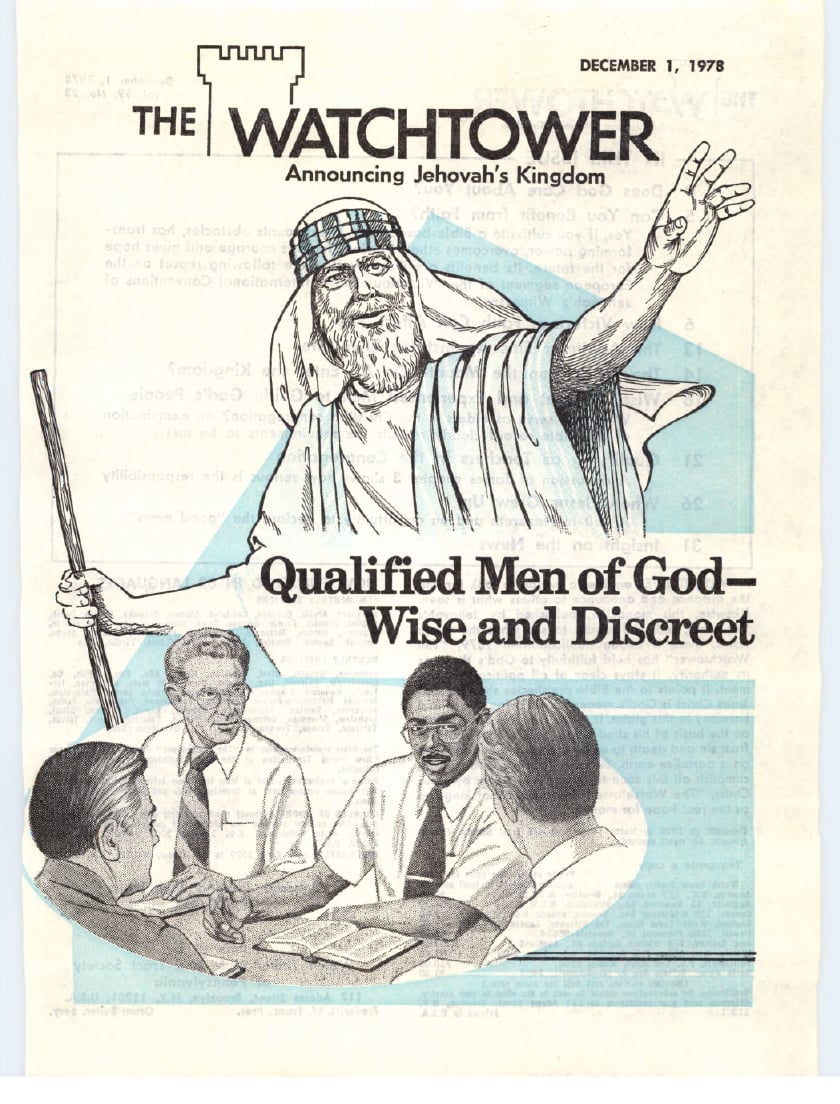
The Watchtower — December 1, 1978
Source: jw.org
Contents
Page Two
Does God Care About You?
Can You Benefit from Faith?
How Victorious Faith Can Affect You
The Adulterer Sins Against His Own Life
The Sermon on the Mount—Do All Enter the Kingdom?
Wise, Discreet and Experienced Men to Guide God’s People
Qualifying as Teachers in the Congregation
Where Jesus Grew Up
Insight on the News
Make Learning Pleasant
Page Two
Page Two
Can You Benefit from Faith? 5
Yes, if you cultivate a Bible-based faith. It surmounts obstacles, has transforming power, overcomes ethnic barriers, imparts courage and gives hope for the future. Its benefits are illustrated by the following report on the European segment of the “Victorious Faith” International Conventions of Jehovah’s Witnesses
Wise, Discreet and Experienced Men to Guide God’s People 16
Who may serve as elders in the Christian congregation? An examination of the Bible record clearly reveals the requirements to be met
Qualifying as Teachers in the Congregation 21
A discussion of James chapter 3 shows how serious is the responsibility
Where Jesus Grew Up 26
A visit to Nazareth and an opportunity to declare the “good news”
Does God Care About You?
Does God Care About You?
“WHENEVER I get to thinking a great deal of myself, I take myself into the corner, so to speak, and say: ‘You little speck of dust. What have you got to be proud of?’”
That statement, attributed to a Christian minister of some years ago, reflected a noteworthy trait—humility. And that quality certainly is desirable, for “the result of humility and the fear of Jehovah is riches and glory and life.”—Prov. 22:4.
Considering the magnitude of the universe and its millions of celestial bodies, we realize that inhabitants of this earth are small and truly have reason to be humble. Not without good cause has it been said that humans are merely ‘specks upon a speck’ in the universe.
But does this mean that the Most High is far too lofty to be concerned about humans on this relatively small planet? Really, does God care about you?
WHAT ABOUT THE EARTH?
True, the earth is a relatively small body in space. Yet, is it an insignificant speck? Not to God, for he says: “The heavens are my throne, and the earth is my footstool.” (Isa. 66:1) Surely, such a figurative “footstool” used by the Most High is not a mere insignificant “speck.”
In fact, Jehovah has grand things in mind for his “footstool,” the earth. One day it will be a place of paradisaic beauty, a magnificent home for obedient mankind. (Isa. 45:18; Luke 23:43) Hence, while Bible students acknowledge the smallness of the earth, they realize that it was created by Jehovah God and is important to him.—Gen. 1:1.
‘WHAT IS MAN?’
From God’s view, then, the earth is no insignificant “speck” in universal space. But what about humans?
Greatly impressed by the heavenly works of God, the inspired psalmist David asked: “When I see your heavens, the works of your fingers, the moon and the stars that you have prepared, what is mortal man that you keep him in mind, and the son of earthling man that you take care of him?” (Ps. 8:3, 4) True, reflection on our place in the universe should properly humble us. Man, created lower than the angels, would seemingly not merit Jehovah God’s consideration. Yet the psalmist’s question shows that God does care about humans.
Consider: David asked, in essence: ‘What is man that God keeps him in mind, that Jehovah takes care of him?’ Clearly, then, God does keep man in mind. The Most High does take care of man. Rather than treating humans as insignificant “specks,” God allows the sun to shine and the rain to fall on both the righteous and the unrighteous. (Matt. 5:45) In fact, generation after generation of humans have reason to thank God that he has not forgotten them, for he has given them “rains from heaven and fruitful seasons.”—Acts 14:16, 17.
Jehovah God does care for the human family. And why should he not care? We are told in scripture: “God proceeded to create the man in his image, in God’s image he created him; male and female he created them.” (Gen. 1:27) Since God is “a Spirit,” there is no physical likeness between God and man. (John 4:24) However, man has qualities reflecting those of his heavenly Maker, traits that definitely distinguish man from the animal creation. For instance, like God, man has the principal attributes of love, justice, wisdom and power. (1 John 4:8; Deut. 32:4; Job 12:13; Isa. 40:26) So humankind is not insignificant to the Creator.
If a person were to view and treat a fellow human as an inconsequential “speck,” he could, in effect, be assailing the Creator of humankind. Fittingly, we are told in God’s Word: “He that is holding the one of little means in derision has reproached his Maker.” (Prov. 17:5) Also, at Proverbs 14:31 we read: “He that is defrauding the lowly one has reproached his Maker, but the one showing favor to the poor one is glorifying Him,” that is, Jehovah God.
Actually, a person who defrauds the lowly one or holds him in derision really reproaches man’s Maker. In fact, our worship can have little meaning if we downgrade others. (Jas. 3:17) Hence, we should show regard for fellow humans, even as Jehovah does. But a question remains:
HOW MUCH DOES GOD CARE?
From a universal standpoint, both earth and man are quite small. And, certainly, man’s littleness is evident when he is compared with his Creator. For that matter, inherited sin and imperfection would leave humans in a hopeless state if God really did not care about man.—Rom. 5:12.
But Jehovah God does care! “God loved the world so much,” said Jesus Christ, “that he gave his only-begotten Son, in order that everyone exercising faith in him might not be destroyed but have everlasting life.” And this provision is a very personal one, for the apostle John wrote: “He that exercises faith in the Son has everlasting life; he that disobeys the Son will not see life, but the wrath of God remains upon him.”—John 3:16, 36.
Does this mean that God is eager to destroy sinful humans? No indeed! For the Christian apostle Peter stated that Jehovah “does not desire any to be destroyed but desires all to attain to repentance” with the prospect of eternal life in his promised new system of things. (2 Pet. 3:9, 13) The same apostle indicated also that God is concerned about individuals, for he declared: “For a certainty I perceive that God is not partial, but in every nation the man that fears him and works righteousness is acceptable to him.”—Acts 10:34, 35.
So Jehovah does care about humankind—as individuals. He will preserve and bless all those who love kindness and humbly walk with him. (Mic. 6:8) Therefore, cultivate a close personal relationship with your Creator, for God does care about you.
Can You Benefit from Faith?
Can You Benefit from Faith?
THROUGHOUT the earth in recent years there has been what some term a religious revival. Why has it taken place?
Giving his answer, Professor Martin E. Marty of the University of Chicago Divinity School said: “Number one, nothing else works—which is a crude way of saying that as recently as the last 15 years people put a lot of faith in human mastery, in the combination of technology and politics. And, we made some wonderful gains, I think, in our country [the United States]—in civil rights, human rights, in interpersonal relations, in certain features of health care and the provision of security.”
“But,” continued Professor Marty, “we also learned the limits of the human venture. We found that these achievements weren’t giving a sense of meaning in life. They weren’t giving us sets of values that a new generation could pick up. And, whenever in history people sense their limits, they reach in two directions—one, deeper inside themselves for inner experience, and two, further beyond themselves to the transcendent. . . . People seek meaning. People seek belonging. And there are urgent reasons for that in the ’70s, and I think that’s why you have the revival.”
Yet, has the modern-day religious revival removed the ethnic barriers that divide the human race? Has religion in general really transformed lives and provided ‘sets of values that a new generation can pick up’? Has it given the people a sure hope for the future?
Informed observers realize that, despite any worldwide religious revival, ethnic barriers still divide the human family. Such professions of faith have not brought an end to marital strife, spiraling divorce rates and the sexual irresponsibility that actually produces frustration and unhappiness. Moreover, although more and more people are turning to religion, there is little evidence that what most of them are getting is imparting real courage or giving them well-founded hope for the future. For instance, suicide has become the third principal cause of death among 15 to-24-year-old individuals in the United States, and Dr. Calvin J. Frederick of the National Institute of Mental Health attributes such suicides “to depression brought on by ‘haplessness, helplessness and hopelessness.’”—Newsweek, Aug. 28, 1978.
Since the religious revival of recent years has not made a marked impression on human society, a person may well ask: ‘Can I benefit from faith? Does it really have an effect on one’s life?’
An individual can be religious and yet not have true faith. For that matter, the Christian apostle Paul wrote: “Faith is not a possession of all people.” (2 Thess. 3:2) But Bible-based faith is the possession of some people, and it does affect their lives. Such faith surmounts obstacles and hardships. It has transforming power. True faith knows no ethnic barriers. It imparts courage and gives hope for the future.
Are these mere assertions? No indeed! Please weigh the evidence in the following article.
How Victorious Faith Can Affect You
How Victorious Faith Can Affect You
OVER 100 “Victorious Faith” International Conventions of Jehovah’s Witnesses have been scheduled for 1978 and 1979 in cities throughout the world. More than 1,700,000 persons had attended these gatherings by September 1, 1978, and this series of assemblies is still in progress.
What is the purpose of these conventions? They are being held to build faith. No, not mere belief but victorious faith—the kind meant by the Christian apostle John who wrote: “This is the victory that has come off victorious over the world, our faith.”—1 John 5:4, The Bible in Living English.
This victorious faith has influenced the lives of thousands. It can affect you, even as it has affected others. Observe how true this is as we briefly consider some aspects of the “Victorious Faith” International Conventions in European lands.
FAITH SURMOUNTS OBSTACLES AND HARDSHIPS
For some, their very presence at these assemblies required the exercise of faith and the overcoming of obstacles. Distance certainly was no insurmountable problem. To come to the convention in Lille, France, a young delegate from Poland traveled 750 miles (1,200 kilometers) by bicycle in six days.
Forty Witnesses from Poland attended the convention in Copenhagen, Denmark. This was made easier because of the recent opening up of a direct passenger ship route from Svinoucie to the Danish capital. Nevertheless, the trip cost each of them a month’s salary. They received travel permits although they gave “attending assembly of Jehovah’s Witnesses in Denmark” as the reason for their trip. However, an invitation and visa paid from abroad were required for them to leave Poland, and Danish brothers provided these. Besides enjoying a large convention with so many fellow believers, these delegates benefited from a two-and-a-half-day program in Polish, including three Bible dramas presented by means of tape recordings and photographic slides. Together with English, Greek, Spanish and Yugoslavian delegates, the Polish brothers added a special international flavor to the Copenhagen convention. Two days of the assembly program were presented in the Greek, Spanish and Croatian languages. Hence, even language barriers were overcome.
One couple with 11 children wanted to accompany other Witnesses from the Azores and attend the convention in Lisbon, Portugal. But how could they afford it? Well, some of the older children helped to raise funds by taking jobs for some months before the assembly. The cost of plane tickets, food and the like was well over $1,100 (U.S.), a fortune for these humble islanders. But they overcame such economic obstacles by showing faith in Jehovah, and the whole family of 13 members was present for the Lisbon convention.
Also present at certain “Victorious Faith” International Conventions were survivors of Nazi concentration camps. Two Witnesses attending the assembly in Brussels, Belgium, still possessed their striped uniforms. These they put on for the benefit of delegates at an English-speaking session. One man who now is a Christian overseer was five years old when his father was arrested in 1941, and still remembers asking his mother how long she would be away when she was arrested, for he thought she was just going on an errand. He did not see her again until four years had passed. But victorious faith won out over all their hardships and persecution.
To the conventioners assembled at Helsinki, Finland, an elderly couple brought greetings from West Berlin. They were both full-time Kingdom proclaimers and had served in that capacity for a combined total of more than 100 years! The audience almost held its breath as this sprightly couple told of their experiences. The husband had been a member of the Bethel family (the Watch Tower Society’s branch office staff) in Hitler’s Third German Reich, had been arrested by the Gestapo, and had ended up in the Sachsenhausen concentration camp with 600 other brothers. On his release at the end of World War II, he again served at Bethel. His wife also had been imprisoned. After their marriage, they both found themselves in a Communist prison camp. Together they have spent a total of 41 years in prison! Did they sound depressed or dejected? Not at all! The brother remarked: “For this special privilege we are grateful to Jehovah.” Yes, they had suffered as Christian neutrals but their faith had been victorious.
Truly, those having victorious faith surmount formidable obstacles, endure hardships and do not succumb to their persecutors. They do not shrink back, but, rather, “have faith to the preserving alive of the soul.” (Heb. 10:38, 39) Victorious faith can have the same effect in your life.
FAITH HAS TRANSFORMING POWER
But does faith affect individual behavior or conduct? Well, the French newspaper Le Soir contrasted the serenity of the Christian convention of Jehovah’s Witnesses held in Marseilles with the usual disorderliness seen at the stadium they used. It said: “The people are peaceful and friendly, ready to talk. . . . There is none of the unruliness usually connected with crowds. All are quietly seated in chairs brought in for the occasion. Nobody walks or tramples on the grass. These are not screaming fanatics, but people who discuss calmly. They have found their object in life, their truth, with Jehovah’s Witnesses.”
Commenting on the “Victorious Faith” International Convention in Rome, the Italian newspaper Paese Sera termed the Witnesses a “well-behaved” people with “irreprehensible conduct.” Also, regarding the assembly site, Il Messaggero of Rome commented: “Missing are the litter of scrap paper and rubbish that, sad to say, so characterize the mass meetings held in our country.” This was said to be “a sign of civility due in part to the efficient collection services, but also to the good breeding of those in attendance.”
Actually, any credit for desirable or godly conduct must go to Jehovah God. Faith in him and the application of the Scriptures in life are responsible for transforming those who have become true Christians. (Rom. 12:2; 1 Cor. 6:9-11) The French newspaper Le Dauphiné libéré notes: “Let us dispel the notion of a ‘conjurer’ who transforms you with a few magic words and a wand. No, Jehovah’s Witnesses are not interested in exchanging the ‘quality’ of deep-founded conviction for a ‘quantity’ of people who imagine that they have been convinced by a passed-on faith.”
How, then, can one acquire real faith? The same newspaper continues: “It must be understood that such a faith is cultivated in the light of the Holy Scriptures. Nobody is born as a Jehovah’s Witness. One must take a stand at a certain time in his life in all ‘spiritual’ liberty, whether brought up among Jehovah’s Witnesses or having made their acquaintance by chance.” The Christian apostle Paul put matters this way: ‘So faith follows the thing heard. In turn the thing heard is through the word about Christ.”—Rom. 10:17.
Yes, victorious faith follows the “thing heard.” And the transforming power of faith is based solidly on the Word of God. The Helsingin Sanomat said this, in reporting on the convention in Helsinki:
“Large conventions have been important occasions for Jehovah’s Witnesses from the point of view of present and future families: whole families come to the meetings and the young people meet other young ones. A future marriage mate must also be one of Jehovah’s Witnesses.” (Deut. 7:3, 4; 1 Cor. 7:39) The newspaper adds: “Jehovah’s Witnesses’ guidelines for life in other spheres of family life are also plain: common-law marriage is unknown and sex before marriage is not acceptable. Marriage is considered binding. Divorce is forbidden ‘except on the grounds of fornication’. Jehovah’s Witnesses live that way simply because the Bible so exhorts.”
Entire families can and do benefit from faith. And observers can see that Jehovah’s Witnesses in general have been affected by their faith in God and his Word. Indeed, faith has affected them as individuals.
FAITH KNOWS NO ETHNIC BARRIERS
A highly significant feature of each “Victorious Faith” International Convention is the “Declaration of Our Faith.” By their bold and strong affirmation, assembled thousands are thus registering their determination to move forward in Jehovah’s service. And, among other things, they are attesting to the truthfulness of these words, embodied in the Declaration: “We have seen what faith can produce on a global scale; how God’s spirit has produced something that remains unique: an earth-wide ‘association of brothers.’ (1 Pet. 2:17) ‘By this all will know that you are my disciples,’ Christ Jesus said, ‘if you have love among yourselves.’ (John 13:35) We rejoice to be part of the only real international brotherhood on the face of the earth, a brotherhood bound together in unbreakable love—for God and his Son, for truth, for what is right, and for one another.”
Are these merely empty words? No indeed! Individuals of all races and nations have risen above national prejudices and racial bias. They have been bound together in unbreakable bonds of Christian love. There is clear proof that victorious faith knows no ethnic barriers.
The current conventions truly are international in nature. For instance, missionaries trained at the Watchtower Bible School of Gilead and now serving in 35 different nations were present for the assembly in Munich, Federal Republic of Germany. There sessions were held in various languages. On the English program the speakers were from 11 countries.
The fact that Jehovah’s Witnesses constitute an international brotherhood has not gone unnoticed by outside observers. For instance, in reporting on the “Victorious Faith” International Convention in Vienna, Austria, the Wiener Morgen Kurier said: “The ‘Jehovah’s Witnesses’ come from different social levels, but the bond that unites them is their deep feeling of religiousness, which has its roots exclusively in the Bible.”
One Witness attending the international convention in Copenhagen, Denmark, told about meeting a social worker who was very impressed with the work accomplished by Jehovah’s Witnesses. This woman deals with elderly people and has often seen the beneficial effect that the Kingdom message has on these individuals. The social worker remarked: “I admire your work . . . On occasions when I have dealings with the clergy I get very disappointed. You have the only international brotherhood in the world. I admire your courage in preaching. Keep up the good work!”
FAITH IMPARTS COURAGE
That is exactly what Jehovah’s Witnesses are doing. They are ‘keeping up the good work!’ Victorious faith imparts courage to pursue Christianity as a way of life and to declare boldly the “good news.” (Mark 13:10) For that matter, in the “Declaration of Our Faith” enthusiastically affirmed at the “Victorious Faith” International Conventions, it is pointedly stated:
“We will not, we cannot, stop speaking about the things we have seen and heard and experienced. (Acts 4:20) We are impelled to give expression with our lips to our strong faith in Jehovah’s victorious kingdom and we sincerely want to share the blessings of this ‘good news’ with all. Like the apostle Paul, our plea is: ‘Become reconciled to God.’ (2 Cor. 5:20) That is our determination, to make public declaration of this good news of Jehovah God’s kingdom from here on until the end of this system of things.”—Matt. 24:14; 28:19, 20.
When asked, “Do you agree?” the convention delegates are responding with a thundering “Yes!” But they are doing more than that. They are putting their affirmation into action.
In fact, delegates are devoting the morning of the third convention day to enthusiastic witnessing activities in the field. It is reported, for example, that this endeavor “saw the biggest witness ever” in Dublin, Ireland. Reportedly, 2,650 adults personally checked in with the Field Service Department there to obtain the colorful literature kits used in this special endeavor. One of Dublin’s Christian elders was heard to say: “For the first time there are more Witnesses preaching in O’Connell Street than there are priests walking up and down it.” One convention release in Dublin that is certain to further the Kingdom-preaching work in Ireland was the Gaelic tract entitled “Mankind’s Only Hope for Peace.”
True, such evangelizing work is a demonstration of victorious faith. But is it really having an effect on those to whom Jehovah’s Witnesses are declaring the Kingdom message? Well, in Paris, France, on this morning of special activity, a 30-year-old woman welcomed the Witnesses, saying: “Your visit is providential. I absolutely needed to talk to someone. I have already had three nervous breakdowns and even wanted to commit suicide.” She then confided in the visiting Witnesses that she felt the need to draw nearer to God. The woman had done research on some Oriental religions, but without finding peace of mind. So she expressed a desire to study the Bible. Arrangements were made for her to accompany a friend to the public talk. This woman accepted literature offered by the Witnesses and was happy to find Scriptural answers to her questions.
Participating in this faith-strengthening activity in Lisbon, Portugal, was a visiting member of the Governing Body of Jehovah’s Witnesses and his wife. Of course, you may think! Well, due to a recent accident, he had three broken ribs. Nevertheless, it brought him pleasure to share with fellow believers in this special field service endeavor.
A great witness was given in Rome, Italy, where another international convention was held. True, the city was rather empty because most of its inhabitants were on vacation, and much attention had been drawn to the death of Pope Paul VI. A Christian elder from central Italy remarked: “Every Witness on the streets of Rome was searching to find persons to whom to witness. When I approached one man, he said to me: ‘Please! You are the 25th Witness that has stopped me this morning!’” One lady said: “I have been to market, and they were there. I went to the butcher, and they were there, too. At the grocery store I found them. Here I find them. I find Jehovah’s Witnesses everywhere.” One brother saw many priests reading literature that had been placed with them that morning.
Referring to this Friday morning field service activity by conventioners in Milan, Italy, the daily Il Giorno commented that the Witnesses “knocked at the doors from house to house” and “explained the reasons for their faith.” It added: “All was done in a very pleasant manner, without becoming offended when someone treated these faithful ones as inopportune disturbers, rejecting them ungraciously.”
Yet, victorious faith does much more than impart courage for some temporary effort in declaring the “good news.” It is long-lasting, sustaining, even over a period of many years. In this regard, interesting is a report on Jehovah’s Witnesses in Italy, as published in the Philadelphia Inquirer. In a dispatch from Rome, Italy, it stated, in part:
“As Catholics waited in long lines last weekend to visit the grave of Pope Paul VI, about 65,000 Italians gathered under colorful umbrellas in the Flaminio soccer stadium to pay homage to their God.
“But it was a different God than the one represented by the pontiff who lay buried in the grottos beneath St. Peter’s Basilica. Here, in the world’s most Catholic nation the Jehovah’s Witnesses have gained a strong and growing toehold. . . .
“Jehovah’s Witnesses, who had 95 adherents in Italy during World War II, now claim to be Italy’s second largest religious group. They are certainly its fastest growing. . . .
“Their numbers have gone from 25,810 in 1972 to 66,315 in 1977. They claim 71,796 members today . . .
“Their numbers are still small in relation to the 54 million population of Italy, most of whom are at least nominally Catholic. But they have made their presence felt here.
“Officials of the church say some Jehovah’s Witness or other has knocked on every door in Italy by now. Each member is required to perform evangelical duties.”
It does take effort—and courage—to persist against great odds in declaring the Kingdom message. Referring to the “Victorious Faith” International Convention of Jehovah’s Witnesses in Barcelona, Spain, Diario de Barcelona noted: “The head of their press service said that they are ‘no part of this world’. That may be, but they undoubtedly know the world well and have the courage to express their beliefs to it.” Yes, it is Scripturally based faith that has always imparted “courage to speak the word of God fearlessly.”—Phil. 1:14.
VICTORIOUS FAITH GIVES HOPE FOR THE FUTURE
The “Victorious Faith” International Conventions of Jehovah’s Witnesses are providing sound Scriptural counsel. They are building faith. And the benefits will be far-reaching, for victorious faith gives sure hope for the future.
Significant features of these international conventions are Bible dramas. Despite the conscientious effort of dedicated Christians in preparing these presentations, unexpected problems can be encountered. For instance, heavy rains fell during three of the four dramas presented in the open ball field at the Copenhagen convention. But the actors in thin oriental robes acted out their parts as enthusiastically as they might have done so under the warm sun of the Middle East. Hence, they ‘reaped extra heavy applause’ from the sheltered audience.
Why so much effort? It seems that the underlying reason was well expressed by El Noticiero Universal of Barcelona, Spain, in stating: “One has to admit this people’s merit, as none of the actors is professional; they are members who volunteered to perform. So they help their fellow believers.”
However, have these dramas affected observers? Indeed they have! One of these dramas, entitled “‘Do Not Look Behind You and Do Not Stand Still,’” deals with the Biblical story of Lot. (Gen. chap. 19) Reflecting on that presentation, an experienced Christian elder commented: “Materialism has proved very deceptive. We notice how many of yesterday’s luxuries have become today’s necessities, and people load themselves with heavy burdens trying to follow the trends of the day. . . . A timely message!”
Among other things, the international convention program furnishes sound Biblical counsel on marriage. Does it affect individuals personally? Yes, it does. Said a young couple after returning from the convention in Marseilles, France: “How we have appreciated this assembly, particularly the talks on marriage, and the practical counsel on how to solve marital problems! This convention was necessary to remind us of what Jehovah says in his Word, to help us consolidate our union and solve our problems. We came back from the assembly strengthened and happy.” If you have not yet attended a “Victorious Faith” International Convention, could you benefit by being present?
Victorious faith, founded on the sure Word of God, does affect individuals. It benefits them. How well this was demonstrated in the case of a 62-year-old woman baptized during one of the international conventions at Sheffield, England! As a journalist she had written and edited a local church magazine. But 20 years ago she suffered a stroke and thereafter the church showed no further interest in her. In 1977 a Christian woman began studying the Bible with this infirm individual and reports: “Each week she had a note pad with questions on it. She found all the scriptures herself. We could really see Jehovah’s spirit in action each time we saw her. Her progress was marvelous. As the study continued, she improved to the point of reading paragraphs and conducting a conversation.”
“Her physical health improved as her spiritual condition did,” remarked her husband. The woman stopped smoking when she learned this was displeasing to Jehovah, and she was baptized at the convention. But this was a touching conquest by faith, for the woman and her wheelchair both had to be lowered into the water. Certainly, Bible truth has given her sure hope for the future. At the time of her baptism, she exclaimed: “I am so very happy to be among the many here!” Now, with a real purpose in life, what is her viewpoint? Faith has given her hope, and she says: ‘I just want to tell others about the peaceful future promised by Jehovah.’
Jehovah’s Witnesses face the future with confidence. They can do so because they have victorious faith that surmounts obstacles and hardships. It is a faith that has had transforming power in their life. These Christians are joyful because they are part of the only truly united worldwide brotherhood. Their faith knows no ethnic barriers. It is a faith that imparts courage. Moreover, this victorious faith gives them hope for the future.
Faith based solidly on the Bible can affect you in similar ways. Indeed, you can benefit from victorious faith.
[Picture on page 8]
Faith builds happy families
[Picture on page 11]
Conventioners share the “good news”
[Picture on page 12]
Drama on Lot’s family teaches a vital lesson
The Adulterer Sins Against His Own Life
The Adulterer Sins Against His Own Life
THE writer of the book of Proverbs speaks as a father counseling his son. Proverbs 6:30-35 reads: “People do not despise a thief just because he commits thievery to fill his soul when he is hungry. But, when found, he will make it good with seven times as much; all the valuables of his house he will give. Anyone committing adultery with a woman is in want of heart; he that does it is bringing his own soul to ruin. A plague and dishonor he will find, and his reproach itself will not be wiped out. For the rage of an able-bodied man is jealousy, and he will not show compassion in the day of vengeance. He will have no consideration for any sort of ransom, neither will he show willingness, no matter how large you make the present.”
Here a thief and an adulterer are compared. Men may have some feeling of compassion toward a thief who steals because he is hungry. Some versions, however, read: “Do not men despise a thief?” Whether he is despised or not, when caught, the thief is punished. Under the Mosaic law the thief was to pay double, fourfold or fivefold, according to the items stolen and the circumstances. (Ex. 22:1, 4, 7) Here in Proverbs 6 ‘sevenfold’ likely means a complete payment, according to what the judges would assess, “seven” often being used to denote completeness. Or it may mean that, in order to appease the injured party and establish peace with him, it could cost the thief all he owned.
On the other hand, the adulterer is “in want of heart”—there is nothing in his motive that gives any room for others to feel compassion for him. They will despise him much more than they would the thief. Furthermore, the adulterer is not merely forfeiting his possessions, but bringing his own soul—his life—to ruin. Under the Law adulterers were put to death. (Lev. 20:10) But even though, as in modern times, he may not be punished with death, his dishonor and reproach cannot be wiped out—the scars that it causes to himself, his mate, his family, his relationships with friends, are never fully healed. And he may contract a harmful venereal disease.
Moreover, the adulterer has to face the wrath of the jealous husband. When the husband finds out, his rage will accept no arguments or excuses. While the thief can make peace by restitution, no ransom or payment can satisfy the injured husband and offer protection from his vengeance.—Compare Proverbs 27:4.
The Sermon on the Mount—Do All Enter the Kingdom?
The Sermon on the Mount—Do All Enter the Kingdom?
AFTER warning of false prophets whom his hearers might meet up with during the first century C.E., Jesus said: “Not everyone saying to me, ‘Lord, Lord,’ will enter into the kingdom of the heavens, but the one doing the will of my Father who is in the heavens will.”—Matt. 7:21; compare Luke 6:46.
In order to enjoy the blessings of God’s kingdom, persons must acknowledge the lordship of Jesus Christ. (Rom. 10:9; Phil. 2:11) But more is involved than paying lip service to the Son of God by addressing him as “Lord, Lord.”
Admittance to the full range of Kingdom blessings is only for “the one doing the will of my Father who is in the heavens.” That “will” is adequately set forth in the Sermon on the Mount. It requires doing “fine works” in declaring Kingdom truths to others. It also includes transforming one’s personality so as to display godlike qualities such as mildness, chasteness, trustworthiness, unselfishness, love, sincerity and faith.—See Matthew 5:16, 21, 22, 27-30, 33-48; 6:1-18, 25-34.
The next words of Jesus show that many who would claim to be his followers would fall short in this regard: “Many will say to me in that day, ‘Lord, Lord, did we not prophesy in your name, and expel demons in your name, and perform many powerful works in your name?’ And yet then I will confess to them: I never knew you! Get away from me, you workers of lawlessness.”—Matt. 7:22, 23.
“In that day,” when God executes judgment against his enemies (Zech. 14:1-3; 2 Thess. 2:1, 2; 2 Pet. 3:10-12), “many” will seek favorable consideration by claiming to have accomplished remarkable feats ‘in his name,’ that is, as if representatives of Jesus Christ and by means of divine power obtained through him.
They will ask: “Did we not prophesy [that is, utter divine communications and perhaps predictions of future events] in your name?” But such ‘prophesying’ is not a sure identification of true Christian discipleship. According to the Scriptures, predictions that sometimes came true, as well as messages delivered as if by divine authority, were proclaimed also by false prophets.—Deut. 13:1-3; Jer. 14:14.
Some would boast that they ‘expelled demons in his name.’ There are persons in Christendom today who claim to have such power. But the practice of casting out demons (by means of mystical rites) has always been a feature of non-Biblical religions. Moreover, certain Jews of the first century C.E. expelled demons by means of magical formulas that they believed were handed down from King Solomon.a
It is not supernatural prophesying, expelling of demons or any other “powerful works” (miracles) that identify true Christians. In fact, when foretelling the sign of his presence and the conclusion of the present system of things, Jesus declared: “False Christs and false prophets will arise and will give great signs and wonders so as to mislead, if possible, even the chosen ones.” (Matt. 24:24) Such false prophets, impostors, would appear right in the Christian congregation and would attempt to lead astray many of its members.—Acts 20:29; 2 Pet. 2:2, 3, 10-22; Jude 4, 8-13, 16-19.
As noted above, Jesus pointed out that the genuine Christian would be “the one doing the will of my Father.” And what is the Father’s “will” for this day? As foretold by Jesus, it is that “this good news of the [established] kingdom . . . be preached in all the inhabited earth for a witness to all the nations” before the end comes. (Matt. 24:14) Do the sects of Christendom proclaim God’s kingdom to be at hand? No, for they regard it as something merely in the hearts of people, or in the far-distant future. They hypocritically give lip service to Jesus, but they refrain from doing the will of his Father. It is left to the comparatively small group known as Jehovah’s Witnesses to “declare good news of good things” of God’s Kingdom purposes “to the extremities of the inhabited earth.”—Rom. 10:15, 18; see also 1 Corinthians 9:16.
All who claim to have a relationship with Jesus Christ, without doing Kingdom works and putting on a truly Christlike personality, will fare badly when he executes divine vengeance against the present system of things. Then Jesus will “confess,” or make publicly manifest, that he “never knew” those whose Christianity was no deeper than lip service and so-called “charismatic” gifts. Never did the “many powerful works” in which they boast fool the Son of God. Rather than displaying righteousness, in actuality they proved to be “workers of lawlessness.” Hence, when Jesus acts as God’s executioner at the coming “great tribulation,” he will declare to them: “Get away from me.” Those imitation Christians will be denied entrance into the eternal blessings of God’s kingdom.—Compare Matthew 24:21, 22; 25:41, 46.
[Footnotes]
With regard to Jews’ expelling demons, we read in Exorcism Through the Ages: “The chief characteristic of these Jewish exorcisms is their naming of names believed to be efficacious, i.e. names of good angels, which are used either alone or in combination with El (=God); indeed reliance on mere names had long before become a superstition with the Jews, and it was considered most important that the appropriate names, which varied for different times and occasions, should be used. It was this superstitious belief, no doubt, that prompted the sons of Sceva, who had witnessed St. Paul’s successful exorcisms in the name of Jesus, to try on their own account the formula, ‘I conjure you by Jesus whom Paul preacheth,’ with results disastrous to their credit (Acts, xix, 13). It was a popular Jewish belief, accepted even by a learned cosmopolitan like Josephus, that Solomon had received the power of expelling demons, and that he had composed and transmitted certain formulae that were efficacious for that purpose. The Jewish historian records how a certain Eleazar, in the presence of the Emperor Vespasian and his officers, succeeded, by means of a magical ring applied to the nose of a possessed person, in drawing out the demon through the nostrils—the virtue of the ring being due to the fact that it enclosed a certain rare root indicated in the formulae of Solomon, and which it was exceedingly difficult to obtain.”—See Josephus’ Antiquities of the Jews, Book 8, chap. 2, sec. 5 and The Jewish War, Book 7, chap. 6, sec. 3.
Wise, Discreet and Experienced Men to Guide God’s People
Wise, Discreet and Experienced Men to Guide God’s People
“And I will give you shepherds in agreement with my heart, and they will certainly feed you with knowledge and insight.”—Jer. 3:15.
1. What led to Moses’ action described at Deuteronomy 1:12, 13?
ISRAEL was on the plains of Moab, poised to cross the Jordan and enter the land of Canaan. For their benefit, Moses recounted God’s dealings with them during their 40 years in the Sinai wilderness. The early part of that period had been a stormy one, particularly for Moses, due to wrong attitudes prevailing among the nation. Now, Moses reminded them that, feeling unable to carry any longer the burden of a quarreling people by himself, he had followed the counsel of Jethro and had said to the people: “Get wise and discreet and experienced men of your tribes, that I may set them as heads over you.”—Deut. 1:3, 12, 13; Ex. 18:17-26.
2. Why was the use of such men in handling problems not something radically new and different?
2 In selecting these men, Moses was drawing on what appears to be the oldest form of community direction. Bodies or councils of elders are shown to have functioned among ancient peoples from the earliest stages of human history. In their own experience, the Israelites, as descendants of Jacob, had earlier contact with elder bodies of Egypt, Moab and Midian. (Gen. 50:7; Num. 22:4, 7) Sheiks of Arabian peoples were also tribal elders, for the Arabic word sheikh means simply “elder,” or “older man.” (Gen. 36:15) Before Moses was commissioned to lead the people, Israel already had such elders, and it was to them that Moses was instructed to present the evidence of his divine appointment. (Ex. 3:16, 18) So Moses’ later action in Sinai, availing himself of the aid of elders to decentralize the handling of problems, was not a major innovation.
3. (a) What provision for congregational direction did the Greater Moses make? (b) How do the qualifications compare as regards the elders Moses selected and those serving as Christian elders?
3 In God’s due time, the Christian congregation was formed as a spiritual people, one that spread over all the earth. God’s Son, as the Greater Moses, caused direction to be provided through congregational bodies of elders. It is interesting to note the qualifications that Moses looked for in assigning Israelite elders to do responsible work and to compare these with the qualifications looked for in Christian elders. The similarity is evident in the accompanying chart:
4. What role did bodies of Israelite elders carry out in the Promised Land, and what role do Christian elders fulfill?
4 After Israel became established in the Promised Land, living in cities and villages, all the different communities were guided and aided by bodies of elders. (Josh. 20:4; Judg. 8:14, 16; 1 Sam. 16:4) They were to give wise counsel, help with problems, protect against apostasy and thus serve for the peace, good order and spiritual health of their respective communities. At times they were called on to fulfill judicial roles in settling disputes or in acting for the protection of the community. (Deut. 16:18-20; 19:12; 31:9; Ruth 4:1-11) They were to be a source of comfort and strength in times of crisis. (Isa. 32:1, 2) But they were not the taskmasters of their fellow residents nor were they authorized or responsible to try to live the personal lives of others for them. In bearing weighty responsibilities, Christian elders serve in similar ways. (Compare Acts 20:28-35; 1 Corinthians 3:4, 5, 21-23; 2 Corinthians 1:24.) Added to all of this, the Christian congregation has the commission to make known the good news of God’s kingdom to all persons.
FINDING QUALIFIED MEN TODAY
5. What may help today in making a wise selection of elders?
5 Keeping in mind the past history of the elder arrangement can help us to use good judgment in the selection of elders today. We might think of an individual congregation as though it were like a small village in Israel. The question may be asked: If that were the case, who are the men in the congregation that would serve well as village elders, able to give wise and sound direction, those showing themselves to be discreet, with good balance and judgment?
6. How can the illustration of a family also aid in weighing the qualifications of men to serve as elders?
6 The worldwide congregation of God’s servants is spoken of at 1 Timothy 3:15 as “God’s household” (“God’s family,” The Jerusalem Bible). So, we might also think of an individual congregation as a large family. In a family, if the head of the house is not personally present, the family members often look to the older sons to represent and uphold the standards and instructions of the family head. We may therefore ask: Who are those in the “household” of the faith who are like older brothers in a family to whom the family members would naturally turn for sound counsel and sensible help?—Compare 1 Timothy 5:1, 2.
7. (a) What will usually prove to be the case with those who are found to qualify as elders? (b) Is it an appointment that gives a man the qualities of an elder, and what does it accomplish?
7 In reality, in most cases a man who is recommended to serve as a congregational elder should be one whom the congregation members have already come to view as an ‘older brother,’ in the sense that he has already gained their esteem and confidence as one showing insight, balance and judgment. No one can actually “make” someone an elder, but he himself must become such through spiritual growth, development and experience. (Prov. 1:2-5; 4:7-9; Jas. 3:1, 13) When such a man is selected to serve in this capacity, his appointment is, in actuality, an acknowledgment and recognition of the desirable qualities of an elder that he already manifests. In ancient Israel, as in other lands, it was evidently the case that when a man was noted by the local council of elders as manifesting qualities of godly wisdom, judgment and discretion he was then invited to form part of the council and share in its discussions and decisions.—1 Tim. 5:22, 25.
8. What can one earn by serving faithfully for a period of time as a ministerial servant?
8 Of “ministerial servants,” the apostle writes, “the men who minister in a fine manner are acquiring for themselves a fine standing and great freeness of speech in the faith in connection with Christ Jesus.” (1 Tim. 3:12, 13) No man should think that this means that he can, simply by working at a certain assignment, “earn” the right to serve as an elder within God’s congregation. What he can truly earn is the respect and appreciation of his brothers for his diligent and faithful service, as well as gaining a confidence toward God that enables him to speak with “great freeness of speech.” This is, in itself, a fine reward for faithful service.
EXPERIENCED MEN
9. (a) What do the Scriptures indicate as to the factor of age in the qualifications of an elder? (b) What truth should be recognized about youth in this respect?
9 No age limit is specified in the Bible for those serving as elders. The term “elder” of itself implies age, though it must be recognized that the emphasis is on spiritual, rather than physical, qualities. Age alone is not the determining factor; yet, even as Moses recognized, experience is certainly a valuable asset for men caring for serious responsibilities. (Deut. 1:13) Proverbs 20:29 says: “The beauty of young men is their power, and the splendor of old men is their gray-headedness.” While youth may manifest much energy and enthusiasm, this is not proof of wisdom. But the years of life represented by gray hairs generally give reason for expecting an increased measure of wisdom, even as Job said: “Is there not wisdom among the aged and understanding in length of days?” (Job 12:12; compare 12 verse 20; 32:6, 7.) A young person may be willing, even eager, to serve and show promise for the future. But lack of experience in life can put him at a severe disadvantage when it comes to helping those older than himself with the serious problems of life. His words, however sincere, cannot be expected to carry the same weight as those of one with more years behind him.
10. Does the responsibility placed on Timothy minimize the value of age and experience among elders?
10 Timothy was likely in his 30’s when the apostle Paul wrote the words: “Let no man ever look down on your youth.” (1 Tim. 4:12) So, even at that age, many persons of his time would still incline to view him as “young.” It should be noted, too, that Timothy’s advancement and the responsibility accorded him were exceptional, unusual. He had known the Scriptures from infancy and had already shown fine progress before the apostle Paul selected him as a traveling companion. (2 Tim. 1:5; 3:14, 15; Acts 16:1-3) Thereafter the years that he spent with Paul and others contributed a wealth of valuable experience and knowledge that few persons would gain at his age.
11. How can those who are elders aid others to take on heavier loads of responsibility?
11 Paul encouraged Timothy to aid other elders to benefit from what he had learned, saying: “And the things you heard from me with the support of many witnesses, these things commit to faithful men, who, in turn, will be adequately qualified to teach others.” (2 Tim. 2:2) In a similar way, elders can help other brothers in the congregation to develop spiritually, endeavoring to pass on to them the benefit of their experience and knowledge. It is not simply a matter of helping them to learn some clerical duty within the congregation but of aiding them to develop in judgment, insight and ability to communicate the sound principles of God’s Word to others. As Paul had Timothy accompany him while he carried out his commission as an apostle to the nations and as he served as a shepherd in God’s flock, so elders can invite other developing men in the congregation to accompany them as they serve in similar ways.—Prov. 1:4, 5; 13:20.
12. (a) What part does experience play in qualifying to serve as an elder? (b) Why was Paul’s counsel at 1 Timothy 3:6 especially appropriate in Ephesus?
12 As with age, the length of one’s experience as a Christian disciple is not of itself a determining factor in eldership. It is a relative factor, its importance being governed at least partially by the prevailing circumstances. Paul wrote Timothy that, in selecting elders for the Ephesus congregation, he should guard against the selection of “a newly converted man, for fear that he might get puffed up with pride.” (1 Tim. 3:6) True Christianity had been established in Ephesus for about a decade by that time and so it would be especially inappropriate there to select one of the newer disciples to serve among the elders of the congregation.
13, 14. (a) What examples illustrate that circumstances can play a part in determining how to view an individual’s degree of experience? (b) What factors should nevertheless receive prime consideration in all cases?
13 In writing to Titus in Crete, Paul evidently did not feel the same urgency for this cautionary admonition and did not include it in his remarks about the selection of elders. The fact that true worship had been established in Crete for only a relatively short time may have had some bearing on this. We note that in Paul’s first missionary journey he and Barnabas proclaimed the “good news” in cities such as Lystra, Iconium and Pisidian Antioch and then, during the same journey, they returned and ‘appointed older men for them in the congregation.’ (Acts 13:14, 42-52; 14:1-7, 20-23) Since the entire missionary journey likely covered only parts of two years, it is evident that at least some of these men did not have long years of experience as Christian disciples. But since there were Jewish believers among them, no doubt many, if not all, of those selected had a good background of Bible knowledge and experience in applying the principles of the Hebrew Scriptures even before their becoming Christians. They would, of course, have to adjust their thinking to the truths resulting from the developments in pure worship that Christianity brought. The apostle Paul himself was selected by Christ Jesus right from the time of his conversion as one who would be used in a special way and later showed the qualities sought for in an elder. (Gal. 1:15–2:2; Acts 13:1-4) But in his case also his Scriptural background as a devoted Jewish worshiper of Jehovah God made rapid development possible once he had been helped to recognize and accept the Messiah.—Acts 9:15-18, 20, 22, 26-30; Gal. 2:6, 7.
14 So, rather than endeavor to establish fixed limits, we must be governed by wisdom and sound judgment, weighing the circumstances as to a prospective elder’s experience in true worship. In a congregation where many members have been in the truth for decades, the man who has been baptized for only three years or so might seem relatively “new.” But in a newly formed congregation where most of the members have themselves only recently embraced the truth, the experience of such a man might seem reasonably long in comparison to theirs. Whatever the case, at all times it is vital to keep ever in sight the need for wisdom, discretion and sound judgment to be manifest by a man if he is to carry out the weighty responsibilities involved in shepherding the flock of God.
PROGRESS IN MANIFESTING WISDOM AND DISCERNMENT
15. What spirit should elders show regarding improvement as to their own qualities and abilities?
15 Timothy was already an experienced elder when the apostle Paul exhorted him to be absorbed in spiritual matters that his “advancement may be manifest to all.” (1 Tim. 4:15, 16) The wise person does not become heady or feel that he can no longer be taught or improve. “Who is wise and understanding among you?” wrote the disciple James, adding, “Let him show out of his fine conduct his works with a mildness [modesty, New English Bible] that belongs to wisdom.” Such a spirit will produce harmony within a body of elders, eliminating any spirit of discord, jealousy or contentiousness.—Jas. 3:13-18.
16. (a) In what sense are elders equal? (b) How can their advancement be manifest with great spiritual benefit to all in God’s flock?
16 While elders may be “equal” in their responsibility and authority to serve and work on behalf of the flock, they are not necessarily equal in other respects. Some have far greater experience, both in life and in the truth, and have made advancement in wisdom as a result of years of serious study and effort. Each has his strengths along with his weaknesses. If we will appreciate and benefit from the strengths of others we, too, can ‘let our advancement be manifest to all.’ (Rom. 12:3-10, 16) By means of the aid given through such humble, earnest, God-fearing shepherds possessed of knowledge and insight, the prophetic word will prove true and God’s flock today will indeed “become many and certainly bear fruit in the land,” all to God’s eternal praise.—Jer. 3:15, 16.
[Chart on page 17]
Among Among
Israelite elders Christian elders
(Ex. 18:21; Deut. 1:13) (1 Tim. 3:1-7; Titus 1:5-9)
To be capable, wise To be qualified to teach, able
to exhort and reprove
fearing God righteous, lover of goodness,
holding firmly to faithful
word in teaching
trustworthy free from accusation, loyal,
fine testimony from outsiders
hating unjust profit not greedy of dishonest gain
or lover of money
discreet moderate in habits, sound in
mind, reasonable
experienced father of family (in many
cases), not new convert
Qualifying as Teachers in the Congregation
Qualifying as Teachers in the Congregation
“Who is wise and understanding among you? Let him show out of his fine conduct his works with a mildness that belongs to wisdom.”—Jas. 3:13.
1. Why is it very important that those who serve as teachers in the Christian congregation be qualified men?
THE influence of a teacher can be either beneficial or hurtful. Especially is this the case in matters of worship. With reference to the Pharisees, Jesus Christ said: “Blind guides is what they are. If, then, a blind man guides a blind man, both will fall into a pit.” (Matt. 15:14) All who blindly followed the unscriptural teachings of the Pharisees were headed for spiritual ruin and death, whereas those who heeded the sound teaching of the Son of God were on the road to life. (Matt. 7:13-20, 24-27) The fact that lives are involved makes it imperative that those who serve as teachers in the Christian congregation be qualified men.
2. Why could the apostle Paul say, “I am clean from the blood of all men”?
2 What the apostle Paul said regarding himself to the elders of the Ephesus congregation shows that the way in which a Christian teacher handles his responsibility may make him either bloodguilty or free from bloodguilt. The apostle stated: “I call you to witness this very day that I am clean from the blood of all men, for I have not held back from telling you all the counsel of God.” (Acts 20:26, 27) Whenever any elders in the Ephesus congregation became unfaithful and began twisting the Scriptures to their spiritual ruin and to the injury of their fellow believers, this could not be charged to Paul’s account. (Compare Acts 20:29, 30.) They themselves would be bloodguilty. The apostle had done his utmost to impart to them “all the counsel of God.” He had not withheld anything from them that was necessary for salvation. It had not been his desire to gain popularity by tickling ears or by avoiding subjects that forcefully exposed wrong attitudes, words and actions.—Compare 2 Timothy 4:3, 4.
3. In harmony with Paul’s example, what should we expect from a man who qualifies as a teacher in the congregation?
3 In harmony with the apostle Paul’s example, a man who qualifies as a teacher in the Christian congregation must know and understand everything that is essential for salvation so that his teaching will not be seriously defective. He must also be willing to impart “all the counsel of God,” regardless of the congregation’s attitude. There may be times when the congregation responds well to the reproof and correction provided in God’s Word. But there may also be times when many do not really want to change their wrong attitudes and ways. The Christian teacher, however, must continue to stick faithfully to God’s Word in providing spiritual help. If some are wrongly inclined, he must restrain himself from becoming impatient and keep on declaring the truth. In this regard, consider what the apostle Paul wrote to Timothy: “Preach the word, be at it urgently in favorable season, in troublesome season, reprove, reprimand, exhort, with all long-suffering and art of teaching.”—2 Tim. 4:2.
4. To whom was the counsel in James 3:1 directed?
4 Because sound doctrine has a bearing on a person’s salvation, teaching is a responsibility that should be entrusted only to men who are qualified. The Christian disciple James wrote: “Not many of you should become teachers, my brothers.” (Jas. 3:1) This inspired admonition was not given to discourage qualified men from becoming teachers, for the Scriptures also say: “If any man is reaching out for an office of overseer, he is desirous of a fine work.” (1 Tim. 3:1) James was directing his words to men who were setting themselves up as teachers of their fellow believers even though they were not appointed or qualified to teach. These unqualified men wanted the prominence and authority that was associated with being teachers, without regard for the qualifications. They must have been like the men whom the apostle Paul described as “wanting to be teachers of law, but not perceiving either the things they are saying or the things about which they are making strong assertions.”—1 Tim. 1:7.
‘A HEAVIER JUDGMENT’
5. How do teachers “receive heavier judgment”?
5 Because of not fully comprehending or appreciating “all the counsel of God,” would-be teachers needed to have impressed on them the serious position in which a teacher finds himself. James pointed out that teachers, including himself, “shall receive heavier judgment.” (Jas. 3:1) Because a teacher stands before others as instructing or leading them, more is expected from him than from other members of the congregation. This is in harmony with the Scriptural principle: “The one whom people put in charge of much, they will demand more than usual of him.” (Luke 12:48) Hence, a teacher’s words and actions come under closer scrutiny than those of other Christians. Furthermore, if a man errs in his teaching and this results in problems for members of the congregation, or if his actions give occasion for legitimate offense, he comes in line for severe judgment by Jehovah God through the Lord Jesus Christ. The Son of God said: “I tell you that every unprofitable saying that men speak, they will render an account concerning it on Judgment Day; for by your words you will be declared righteous, and by your words you will be condemned.”—Matt. 12:36, 37.
…