The Watchtower, November 1, 1978
Download: PDF — The Watchtower, November 1, 1978
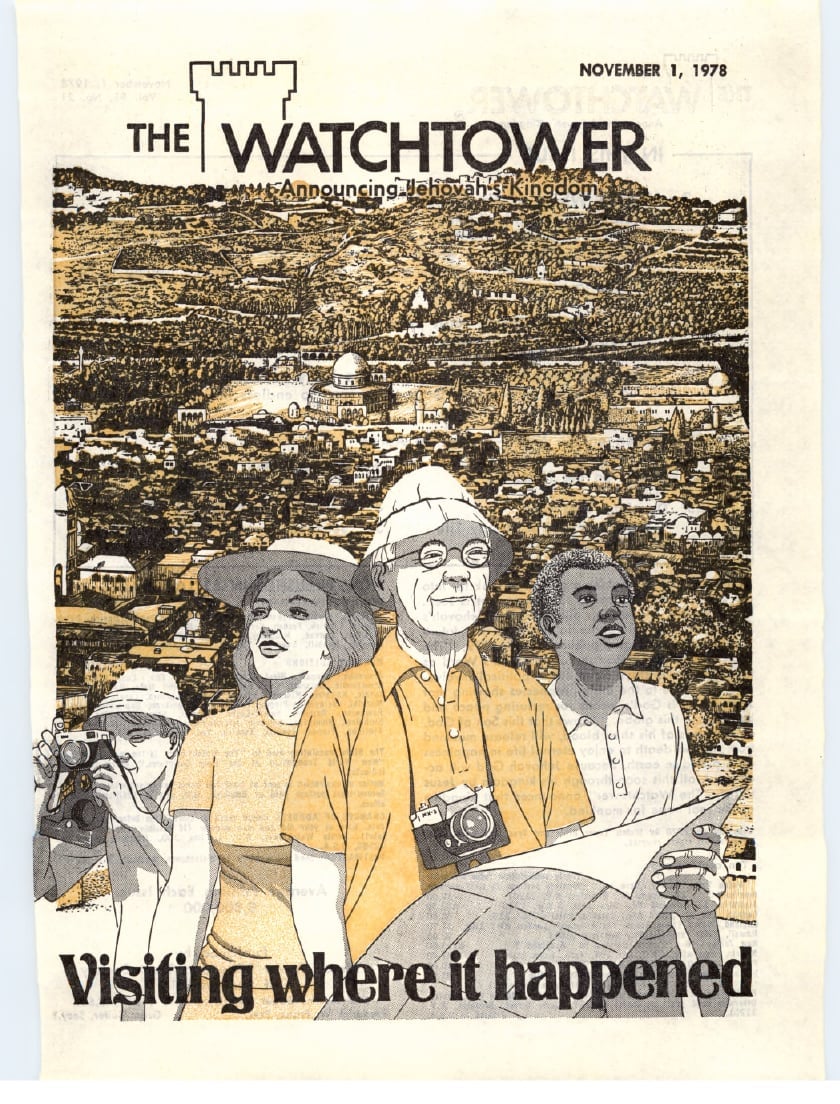
The Watchtower — November 1, 1978
Source: jw.org
Contents
Page Two
Visiting Where It Happened
Our Choice to Work with Jehovah God
Doing Jehovah’s Work in Jehovah’s Way
The Sermon on the Mount—“Keep on Asking”
Insight on the News
Decisions That Have Contributed to a Happy Life
Gilead’s 65th Class Encouraged to Remain Faithful
Questions From Readers
Jehovah Reveals His Judgments
Does It Matter Which Bible You Use?
Page Two
Page Two
Visiting Where It Happened 3
Abraham and his offspring lived here. Judges and kings of Israel fought their battles here. Prophets spoke, Jesus preached and taught, and the Christian congregation was established here. Thousands of persons on tour here in 1978 found much that was interesting, yes, enthralling in “the land”
Our Choice to Work with Jehovah God 12
How important are dedication and baptism to those seeking salvation?
Doing Jehovah’s Work in Jehovah’s Way 16
A balanced service now leads to joy and to endless life in God’s new order
Visiting Where It Happened
Visiting Where It Happened
ON THE morning of June 12, 1978, two young Arabs were helping a group of about 10 of us from Norway to travel to Bethlehem. As we waited at a bus stop in a Jerusalem suburb, there was a tremendous “bang!” It sounded like a bomb. The faces of the Arab youths immediately reflected alarm. But then relief, as a large truck swerved over to the side of the street—one of its big tires having blown out.
“If that had been a bomb,” one of the youths said, “we would be in trouble.” He explained that all Arabs in the vicinity of an explosion are taken into custody, and can be detained for some time. Thus was illustrated to us firsthand the tense situation that exists in Israel. Yet, contrary to the fears that some expressed earlier in the year, the consensus of recent travelers is that the country is quite safe for tourists.
We from Norway were part of a charter tour of Jehovah’s Witnesses. Since early spring Witnesses had been arriving in Israel from around the world—2,400 from France, 1,500 from Germany, 1,200 from the Netherlands, 750 from the United States, and so forth. By July about 9,000 had come, and a total of some 15,000 was expected by the end of October.
Many on tour wore identification badges, and the touring buses were identified by a sign in the front window: JEHOVAH’S WITNESSES TOURING THE LAND OF THE BIBLE. In surprise, a Jewish woman from California, after returning from a visit to Israel, told a relative: “Everywhere we went we saw you Witnesses. I had no idea you would be so interested in Israel.” She wondered why we were.
PURPOSE OF VISIT
The reason is, basically, that Jehovah’s Witnesses believe that the Bible is God’s Word and so desire to know as much about it as possible. Since Israel is where most Bible events took place, we are interested in the country. There is real value in being familiar with places about which you read. To illustrate:
Say that you read in the newspaper about a notable happening near the place where you grew up. Say that specific landmarks such as a hill, a building, a river, and so forth, are mentioned in connection with the story. Now wouldn’t you read about the happening with more interest and understanding than if you had never been to the place? Yes, for now you can visualize the setting. You can see in your mind’s eye the lay of the country—the height of the hill, the width of the river and other geographical features that make the event come to life for you.
Yes, knowing the country helps a person better to understand the people of the Bible and the events involving them.
MODERN WITNESSES
Yet it is not only ancient servants of Jehovah in whom we are interested. At a special meeting for visiting Norwegian Witnesses at the Haifa Kingdom Hall, we were told about the five modern congregations of Jehovah’s Witnesses in Israel and the some 260 Kingdom preachers associated with them. It was explained that there are congregations in Bethlehem and Ramallah, mostly made up of Arabic-speaking Witnesses. In the two congregations in Tel Aviv, most are Jews. But of the 75 Witnesses in Haifa, about half are Jews and the other half are Arabic speaking.
For weeks these local Witnesses were kept busy arranging special meetings, where an interchange of spiritual encouragement was enjoyed with the visitors. Also, while our bus group from Norway was on a tour of Bethlehem June 11, we met a local Witness who took us to the fine, newly constructed Kingdom Hall. There he and another Witness answered many of our questions.
They told us that in Jerusalem, about 8 kilometersa to the north, there are only four Witnesses and none in Hebron some 24 kilometers to the south. “Bethlehem’s 25 Kingdom publishers have a huge territory to cover,” they noted. The following day some from our group joined Witnesses from Bethlehem in the door-to-door preaching in Jerusalem. Others of us, with two local Witnesses as guides, boarded an Arab bus from near our hotel in Jerusalem to go back to Bethlehem.
SOUTH OF JERUSALEM
In a few minutes we were entering Bethlehem. To us, the location is rich with significance. Yes, Jesus Christ was born here, and angels appeared to shepherds in one of those nearby fields to inform them of the birth.1 The terrain is hilly, more so than we had expected, and it appears quite dry and arid. We were surprised to find the elevation of Bethlehem to be the same as that of Jerusalem. The surrounding countryside reminded us of many other Bible events.
This was the area near which Jacob was passing when his beloved Rachel died while giving birth to Benjamin.2 It was the home of Boaz and Naomi. And the Moabitess Ruth came here from across the rugged barren wilderness to the east and gleaned in Boaz’ fields.3 Also, here the young shepherd David grew up and tended his father’s sheep and, evidently, this was the home of his famous nephews Joab and Abishai as well.4
Soon we hired a car and started south toward Hebron. The elevation of Hebron is some 137 metersb above that of Jerusalem and of Bethlehem, being about 914 meters above sea level. As we headed south, the land began to change. It took on a more productive look. The area around Hebron has long been famous for its crops; it is from the nearby valley of Eshcol that the Israelite spies brought back to Moses the huge cluster of grapes that it took two men to carry.5 And today, too, the fertility of the land is evident.
Walking through the old narrow streets of Hebron, we felt transported back in time. Hebron is one of the world’s oldest, still inhabited cities. It was near ancient Hebron that Abraham, Sarah, Isaac, Rebekah, Jacob and Leah were buried in the cave of Machpelah.6 We visited the reputed burial place; a Moslem mosque now stands over the cave. Evidently Abraham’s principal place of residence was nearby at Mamre, where once big trees grew.7 He entertained the angels here prior to the destruction of Sodom and Gomorrah.8 From a point near Hebron, he looked down some 1,220 meters and many kilometers away to see the thick smoke of that great destruction.9
As we considered the mountainous territory through which we had passed to reach Hebron, our appreciation of another Bible account grew. While dwelling at Hebron, Jacob told his 17-year-old son Joseph to go and check on the welfare of his 10 half brothers, who were pasturing the sheep at the family’s former residence of Shechem (present-day Nablus).10 That meant, not only a hike of 35 kilometers or so to near Jerusalem, but dozens of kilometers farther north through difficult terrain. Joseph finally caught up with his brothers beyond Shechem, at Dothan (just south of modern-day Jenin), some 130 kilometers or more from Hebron!
As we walked through Hebron’s ancient streets, or observed the old marketplace, we thought that life must not have been much different when David lived here. We recalled that it was at Hebron that he was anointed king, and he ruled from here for seven and a half years before moving his capital north to Jerusalem.11 But, of course, never far away are evidences of the present time—one being the Israeli soldiers with rifles ever at hand.
Hebron is an occupied city. It belongs to the area having nearly 700,000 Palestinian inhabitants and which is militarily controlled. This area, now called the “West Bank,” lies between the Dead Sea and the Jordan River on the east and the Jewish coastal plain of the Mediterranean Sea on the west. This huge, 3,700-square-kilometer area of rolling hills and valleys was taken by Israel from Jordan in 1967 during the Six-Day War.
It was nearly midafternoon before we left Hebron and headed back toward Bethlehem. However, before getting there we turned off the main road where a sign pointed to the Pools of Solomon. We could hardly believe our eyes! How massive they were—there were three, the largest one being 178 meters long, 54 meters wide and some 15 meters deep! These were apparently rebuilt in Roman times to supply water for Jerusalem, but possibly they had been used for the same purpose even as far back as Solomon’s time.
Arriving back in Bethlehem, we wanted to see one more thing—Herodium. Here on a prominent, towering hill, a few kilometers southeast of Bethlehem, Herod the Great, who had tried to kill the babe Jesus,12 built a fortress named after himself. On an earlier day we had seen Herod’s spectacular palace-fortress at Masada farther southeast near the Dead Sea. There the Jews made their last stand against the Romans in 73 C.E. But, although not as large, in some ways Herodium was even more meaningful to us.
This is because of the magnificent view of the surrounding land, which, despite its barrenness, had an enchanting golden-brown beauty in the setting sun. To the east, we could see all the way to the Dead Sea. Here before us was the Judean wilderness where David successfully eluded his pursuer, Saul.13 Seeing the ruggedness of the territory, we understood how he could do so, especially since from his youth he must have been very familiar with the territory. We thought, too, that, while pasturing his sheep, David perhaps often climbed this very hill for the magnificent view we were enjoying.
SOUTH OF TEL AVIV-YAFO
During the first week in Israel we stayed near Tel Aviv in a hotel close to the Mediterranean. Tel Aviv, Israel’s largest city, is of modern origin, but it adjoins the ancient city Joppa—so the cities are officially called Tel Aviv-Yafo.
It was at Joppa that the apostle Peter resurrected Dorcas,14 and it was here that he received a vision while staying at the house of Simon the tanner near the sea. Because of this vision Peter was prepared to accompany messengers from Caesarea, who were sent by the Gentile Cornelius.15 As we had occasion to travel the main highway running from Tel Aviv north to Caesarea, we would think how this trip of about an hour by car took Peter and his companions two days.
On the day that we headed south, we went into the ancient Philistine territory. Since no bus tours were arranged that first week, we rented a car for excursions to places of Biblical interest. On the route south, we came first to Ashdod, where a modern Israeli city is being built on the Mediterranean. But we recalled that nearby there once stood a prominent Philistine city, and that Jehovah’s ark of the covenant was brought there after being captured in battle. The Ashdodites were struck with painful piles, prompting them to send the Ark away.16
We continued south to Ashkelon, which is becoming a prominent tourist center, with delightful beaches. But this, too, was once a major Philistine city. Visiting the ancient ruins, we were pleased to see that a sign there incorporated the words of David’s song regarding the death of Saul and Jonathan during warfare with the Philistines: “Publish it not in the streets of Ashkelon; lest the daughters of the Philistines rejoice, lest the daughters of the uncircumcised triumph.”17
Next we headed on toward Gaza and the “Gaza Strip,” the site of yet another principal Philistine city near the sea. All along we were impressed by the productivity of the land; it is a land of agriculture, which evidently contributed to the prosperity of ancient Philistia. But Gaza today bears the scars of war. Driving through its streets, we felt an atmosphere of depression and hopelessness.
The location made us remember the Israelite judge Samson, who knew Gaza well. One night he pulled out the doors of the city gate, “put them upon his shoulders and went carrying them up to the top of the mountain that is in front of Hebron.”18 Now, after having been to these places, we appreciate more fully the miraculous strength involved in climbing up nearly 914 meters with such a load to a mountain over 50 kilometers away! And here in Gaza, too, Samson killed thousands of Philistines, as well as himself, when he pulled down the roof-supporting pillars of the building in which the Philistines were feasting.19
From Gaza we turned southeast, heading for Beer-sheba, some 50 kilometers away. The fine road carried us across wide open spaces, where we saw camels, sheep and goats, along with their Arab caretakers. As we saw their tents in the distance, we thought that life must not be much different from when Abraham and Isaac used to live in the area. In Beer-sheba, which, for the most part, is quite a modern city, we visited the Bedouin market (open on Thursdays) and marveled at the fine produce—and how inexpensive! We bought two kilos of oranges (about a dozen of them) for the equivalent of 30 cents (U.S.).
Our main interest, however, was the tell, or ancient mound, outside of town, generally accepted as the Biblical Beer-sheba. This high mound dominates the surrounding area. We climbed it and were afforded a grand view of the vast low-lying countryside, beautifully painted in shadows and light by the disappearing sun. As we examined the excavations of the ancient ruins, we thought: ‘What a fine place in which to live!’ Abraham must have thought so too. He was staying here when God instructed him to take Isaac up to Mount Moriah (within Jerusalem’s walls today) to offer him as a sacrifice. Abraham afterward returned to Beer-sheba.20
As we headed back to the hotel that night, we felt exhilarated. Seeing these places—many even bearing the same Bible names—confirmed and provided depth of meaning to the Bible accounts that we had read from our youth.
INTO SAMARIA
On another day we drove north along the Mediterranean, turning east at Netanya. This took us across the fertile Plain of Sharon, and, after just a few kilometers, we were in the mountains of Samaria. Suddenly, right beside us was the hill on which once stood Samaria, the ancient capital of the northern 10-tribe kingdom of Israel. Driving up to it, we enjoyed a magnificent view of the surrounding mountains and fertile valleys. At the top we saw the remains of what has been identified as Israelite King Ahab’s palace. Pieces of ivory found here, dating back to the eighth and ninth centuries B.C.E., testify to the original luxury of the palace.21
Returning to the main road, we headed north to Dothan Valley, where young Joseph found his brothers and their flocks. Farmers in the fields harvesting grain, as well as flocks of sheep and goats, created pleasant pastoral scenes out of the past. Near Jenin (the ancient Levite city of En-gannim) we turned around and retraced our route, eventually coming to Nablus. Here, at the site of ancient Shechem, Mt. Ebal was above us to the north and Mt. Gerizim above to the south.22 At the foot of Gerizim stands Jacob’s well, probably the very well at which Jesus met the Samaritan woman on his return from Jerusalem. Her words to Jesus, “Our forefathers worshiped in this mountain,” evidently referred to Mt. Gerizim.23
After descending from the top of historic Mt. Gerizim, we turned south again, traveling perhaps the same route Jesus followed on his way to and from Jerusalem. Suddenly we spotted the road sign “Shiloh.” With excitement we turned east along a very narrow road, heading for the place where Jehovah’s ark of the covenant was kept during the time of the judges.24 A young Israeli soldier checked us, seemingly surprised at our coming to this remote place where not another person was in sight. Yet, for us, it was a memorable experience to contemplate that here, in this quiet hilly setting, Jephthah’s daughter and later little Samuel once served at Jehovah’s tabernacle.25
By now it was midafternoon and there was much more we wanted to see. Continuing south for several kilometers through mountainous territory, we turned east a short distance to the Arab villages of Beitin and Deir Dibwan. Nearby the Bible cities of Bethel and Ai were once located. But having difficulty in finding them, we inquired of two men on the road. They spoke English, and for the next hour or two kindly conducted us on a tour of the ancient excavated ruins.
How impressive it was to stand at this elevated place, some 914 meters above sea level, and, as the cool evening wind whipped at our hair and clothes, to view the surrounding countryside! Apparently it was here that Abraham invited Lot to choose the direction that he would go when separating from Abraham because of the quarrels between the caretakers of their animals. And, as the Bible says, “Lot raised his eyes and saw the whole District of the Jordan, that all of it was a well-watered region.”26
We were ready to leave, but one of the men insisted that we visit his home for tea and meet his family. What a pleasant time we enjoyed there! As darkness descended, we pulled ourselves away, delighted at experiencing this unexpected expression of hospitality from total strangers.
BEAUTIFUL GALILEE
Galilee to us was a highlight. Its physical features alone are inviting—the coastal Carmel mountain range, the rugged northern terrain, the blue, jewellike Sea of Galilee, and the beautifully green Jezreel Valley (also called Plain of Esdraelon) that separates Samaria to the south and the Galilean mountains to the north. But, of course, what made Galilee especially appealing to us is the fact that here Jesus spent most of his earthly life, and many important Bible events occurred here.
As our tour bus left Haifa and followed the Jezreel Valley, the Carmel range was to our right and the Kishon River, lined with purple flowers, was to our left. Looking up at the mountain range, we thought about Jehovah’s miracle there, consuming Elijah’s sacrifice in that famous fire test. Then Elijah had the 450 prophets of Baal brought down here to the Kishon, just a few meters to our left, and had them slaughtered.27 Seeing the place where it happened added meaning to and appreciation for the event.
A few kilometers farther and we were at the ruins of ancient Megiddo, a city located at a truly strategic spot. What a marvelous view of the beautiful Jezreel Valley from here! Whoever held this well-fortified place could control the pass through the Carmel mountain range; indeed, decisive battles were fought here. How appropriate that the name Har–Magedon (meaning “Mountain of Megiddo”) is associated in the Bible with God’s victorious war over all political opposers!28
From Megiddo we picked out features of this famous valley, or plain. There, near the center of the valley, is the hill of Moreh. On or near its slopes once lay such towns as Nain, Shunem and En-dor. Beyond this hill, a few kilometers to the northeast, stands the prominent Mt. Tabor, with its rounded top. From there Judge Barak, with Deborah, descended and defeated the surprised Canaanites.29 (A magnificent view of the area is also afforded from Tabor’s top, which we earlier had ascended by car.) Hidden from our sight in the Galilean mountains, but very close to the valley, is Nazareth, the early home of Jesus. Jesus was likely familiar with the area before our eyes, since Nazareth is a relatively short walking distance from all these places.
We looked to the other side of the valley, far to the southeast, toward Mt. Gilboa. Near its foot is the well, or spring, of Harod. There Gideon faced 135,000 Midianites who were camped across at the hill of Moreh. We recalled how Jehovah directed Gideon to reduce his forces to a mere 300, and yet, with only these, gave Gideon the victory.30 Later, in a similar battle confrontation, the Philistines were apparently near the hill of Moreh and the Israelites again at the well of Harod. At this time the Philistines routed the Israelites, and Saul and Jonathan were killed.31 Seeing these locations helped us to visualize so much better such Bible events.
But perhaps the most beautiful sight of all was our first view of the Sea of Galilee. At the time, we were descending from the mountains to the north of the sea. There below us, set like a jewel in a deep basin, was the 21-kilometer-long, 12-kilometer-wide body of blue water. But it seemed much smaller, because from our elevation we had a bird’s-eye view. Surprisingly, the lake is nearly 213 meters below sea level, with hills and mountains practically surrounding it.
As we spent time on the lake’s shores, traversing it by boat or viewing it from elevated vantage points, we thought of many events that occurred here. Jesus walked on these waters,32 calmed them during a storm,33 had a post-resurrection breakfast with his disciples on Galilee’s shores,34 gave the best-known speech ever recorded on a nearby mountainside,35 fed thousands here with just a few loaves of bread and a couple of fishes,36 and made his home in Capernaum, a city on its northern shore.37
On the day our bus tour left Galilee for Jerusalem, we came to the city of Beth-shean, situated strategically between the Jezreel and Jordan valleys. The tell, or ruins of the ancient city, is on a mound that rises to a height of some 80 meters. What an excellent view is afforded from the top looking up the Jezreel Valley toward Mt. Gilboa and Megiddo, and down the Jordan Valley toward Jericho! Here at Beth-shean the Philistines fastened Saul’s corpse on the city wall after his death in battle at Mt. Gilboa.38
JERICHO AND JERUSALEM
We followed the Jordan Valley down about 80 kilometers to Jericho. The area was hot and arid, but we realized that in the spring of the year it would be cooler. So we wondered if Jesus and his family might not have taken this easier-to-travel, but longer, route on their annual trips to Jerusalem for the Passover, rather than going through mountainous Samaria.39
How impressive it was to come upon Jericho with its many palm trees!40 Getting out of the air-conditioned bus, we felt the sun’s intense heat. It helped us to appreciate more fully Jesus’ commendation of those who would give “only a cup of cold water” to his disciples.41 We climbed the mound where the ruins of ancient Jericho have been excavated. The area is relatively small, helping us to appreciate how it was possible for Joshua and his army to march around the city seven times in one day.42
Our last four days in Israel were spent in Jerusalem, the principal city of the Bible. It was indeed meaningful to get a firsthand view of the places about which we had read so much. Standing on the Mount of Olives, we recalled that Judas betrayed Jesus to his enemies in the Garden of Gethsemane somewhere in this vicinity.43 Looking across the Kidron Valley, we saw the Moslem Dome of the Rock, but realized that in Jesus’ day he saw the temple standing there. With the temple in view, he gave his famous prophecy about the “conclusion of the system of things.”44
From our position on the Mount of Olives, we could see the actual location of the “city of David,” and its relation to the enlarged Jerusalem of later years, which lay toward the north and west. The original “city of David,” or “Mount Zion,” was captured from the Jebusites.45 It is outside the present-day walls of Jerusalem, being located south of the Dome of the Rock. On another day we saw more clearly why the actual location of the original city is so certain.
We walked down into the Kidron Valley to the spring of Gihon, just below the hill on which the “city of David” was built. This spring, hidden in a cave, is vital to the location of the city, since a protected water supply was necessary in ancient times. It was apparently through a shaft, which the Jebusites had made down to this spring outside the city’s walls, that Joab and his men ascended to reach the inside of the city high above. Thus from inside, they led the attack that won the city for David and the Israelites.46 Years later King Hezekiah had a 533-meter-long tunnel built from Gihon to the pool of Siloam, which in Hezekiah’s time was inside the city—truly an engineering masterpiece.47 This ensured Jerusalem a water supply during any possible siege.
Water still flows through Hezekiah’s tunnel. It was about knee-deep when we walked through it. After coming out at the pool of Siloam, we walked farther down the valley to the spring of En-rogel. We recalled that it was here at En-rogel that David’s rebellious son Adonijah held a feast to enlist support for his usurpation of the throne.48 When dying King David was told of this, he had his son Solomon anointed as king at the spring of Gihon, just a few hundred meters up the valley.49
What effect did visiting these places have on us? Well, we did not need to see them to believe that they existed. Yet, visiting them was a confirmation that they really do exist. But, in particular, actually being there and becoming familiar with the physical setting of Bible events has added a depth of meaning to and appreciation for these happenings.
[Footnotes]
a One kilometer equals about .6 mile.
b One meter equals about 3.3 feet.
[Box on page 11]
BIBLICAL REFERENCES
1 Luke 2:4-16.
2 Genesis 35:16-20.
3 Ruth 1:16-19; 2:2-4.
4 John 7:42; 2 Samuel 2:18, 32.
5 Numbers 13:23.
6 Genesis 23:14-19; 25:9; 49:30, 31; 50:13.
7 Genesis 13:18; 35:27.
8 Genesis 18:1-8.
9 Genesis 19:27-29.
10 Genesis 37:12-14.
11 2 Samuel 5:1-5.
12 Matthew 2:7-18.
13 1 Samuel 24:1-3.
14 Acts 9:36-43.
15 Acts 10:1-25.
16 1 Samuel 5:1-9.
17 2 Samuel 1:20, AV.
18 Judges 16:3.
19 Judges 16:21, 25-30.
20 Genesis 21:30-34; 22:1-19.
21 1 Kings 22:37-39; Amos 6:1, 4.
22 Deuteronomy 11:29, 30; Joshua 8:30-35.
23 John 4:5-7, 19, 20.
24 Joshua 18:1.
25 Judges 11:40; 1 Samuel 3:21.
26 Genesis 13:1-11.
27 1 Kings 18:18-40.
28 Revelation 16:14, 16.
29 Judges 4:4-16.
30 Judges 7:1-22; 8:10.
31 1 Samuel 28:4; 31:1-4.
32 Matthew 14:23-32.
33 Mark 4:35-41.
34 John 21:9-14.
35 Matthew 5:1, 2.
36 Matthew 14:14-22.
37 Mark 2:1.
38 1 Samuel 31:10.
39 Luke 2:41, 42.
40 Deuteronomy 34:3.
41 Matthew 10:42.
42 Joshua 6:15.
43 Matthew 26:30, 36-47.
44 Mark 13:3, 4; Matthew 24:3.
45 2 Samuel 5:7, 9; 6:12.
46 2 Samuel 5:6-9; 1 Chronicles 11:4-7.
47 2 Kings 20:20; 2 Chronicles 32:30.
48 1 Kings 1:9, 10.
49 1 Kings 1:33-41.
[Map on page 4]
(For fully formatted text, see publication)
ISRAEL
MEDITERRANEAN SEA
Capernaum
SEA of GALILEE
Nazareth
Kishon River
MT. CARMEL
MT. TABOR
Hill of Moreh
Jezreel Valley
Megiddo
Caesarea
En-gannim (Jenin)
MT. GILBOA
Beth-shean
Plain of Sharon
Netanya
Samaria
MT. EBAL
MT. GERIZIM
Shechem (Nablus)
Jordan River
WEST BANK
Shiloh
Joppa (Tel Aviv)
Bethel
Ai
Jericho
JORDAN
Jerusalem
Ashdod
Bethlehem
Ashkelon
Pools of Solomon
Herodium
Valley of Eshcol
Mamre
Gaza
Hebron
DEAD SEA
Masada
Beer-sheba
Sodom and Gomorrah?
[Picture on page 7]
We saw this young shepherdess taking care of sheep and goats near Tell Beer-sheba
[Picture on page 9]
The beautiful Sea of Galilee as it appears today
Our Choice to Work with Jehovah God
Our Choice to Work with Jehovah God
“Choose for yourselves today whom you will serve . . . But as for me and my household, we shall serve Jehovah.”—Josh. 24:15.
1, 2. What choice did Elijah cause his people of Israel to make, and by what means?
ALL day long the prophets and priests of Baal had been hobbling around an altar upon which lay a sacrifice. Imploring their god Baal to make himself known by consuming the offering by fire, they even went to the length of gashing themselves with knives. But all to no avail!
2 Then it was the turn of Elijah the prophet, the spokesman of Jehovah God. After building an altar, laying wood and a slain animal upon it, he had this drenched with water, after which he prayed to his God Jehovah. The result? Fire came down from heaven and consumed, not only the wood and the sacrifice, but even the very stones of the altar. At that the Israelite onlookers cried out: “Jehovah is the true God! Jehovah is the true God!” For years they had been “limping upon two different opinions,” but now they chose to recognize Jehovah the true God as their God.—1 Ki. 18:21-40.
3. Why can man be termed a “free moral agent,” and why uniquely so?
3 Man’s ability to choose between right and wrong, between serving the true God Jehovah or serving self and false gods shows him to be a free moral agent, created in the image and likeness of Jehovah God. (Gen. 1:27) The animals have no such ability. You can teach a dog not to take something, but you cannot reason with him as to why it is wrong to steal. Unfortunately, for some six thousand years, men have abused their moral freedom, and that is why the world is in its present mess.—Compare Deuteronomy 32:5.
4. (a) Who was the first one to abuse this freedom, and why did he do so? (b) Who were among those that followed his example?
4 The first one to abuse this ability and freedom of choice was none other than the one who became Satan the Devil. He chose to follow selfish desire; this gave birth to the sin of rebellion, which will lead eventually to his destruction, annihilation. (John 8:44; Jas. 1:14, 15) Adam and Eve, the antediluvians in the days of Noah, the angels that did not keep their original position, Nimrod and his crowd after the Flood, the inhabitants of Sodom and Gomorrah and a host of others through the centuries down to our day—these have chosen to follow the example of Satan the Devil by making selfish, wrong and bad choices.
THOSE WHO MADE THE RIGHT CHOICE
5. Who were among those who made the right choice?
5 On the other hand, there was Abel who chose to serve Jehovah God, and who did so at the cost of his life. After him came Enoch, Noah and the patriarchs Abraham, Isaac and Jacob. From the apostle Paul’s words at Hebrews 11:13-16, we can see that these patriarchs made the right choice. Then there was Moses. Reared in the palace of Pharaoh, educated in all the wisdom and learning of Egypt, a man of fame, power and wealth, he found himself at the age of 40 faced with the need to make a choice. What kind of choice did he make? He chose “to be ill-treated with the people of God rather than to have the temporary enjoyment of sin, because he esteemed the reproach of the Christ as riches greater than the treasures of Egypt.” (Heb. 11:25; Acts 7:20-29) Would you have done likewise?
6. What choice did (a) Moses, (b) Joshua, present to the people?
6 Toward the end of his long career as Jehovah’s prophet and leader of His people, Moses put the matter of choice squarely before His people: “I do take the heavens and the earth as witnesses against you today, that I have put life and death before you, the blessing and the malediction; and you must choose life in order that you may keep alive, you and your offspring, by loving Jehovah your God, by listening to his voice and by sticking to him.” (Deut. 30:19, 20) Moses’ successor, Joshua, put a like choice before the people of Israel at the end of his long career. He himself made the right choice, as did the prophet Elijah centuries later.—Josh. 24:15; 1 Ki. 19:10.
7. (a) What choice did Jesus make when tempted by the Devil? (b) What choice did his disciples make?
7 The man Jesus Christ had to make a choice when Satan the Devil offered him all the kingdoms of the world in return for one act of worship. Jesus made the right choice. (Matt. 4:10) Similarly, Jesus’ first disciples made the right choice; they recognized him as the Messiah, the Son of God, and accepted him as their Leader and King. (John 1:49) And so did Saul of Tarsus. When he was on his way to Damascus to persecute Christians, Jesus Christ miraculously appeared to him. Saul asked, “What shall I do, Lord?” Upon receiving an answer, he chose to accept and follow the direction given, becoming a baptized Christian.—Acts 22:10.
8. (a) The preaching of the “good news” of God’s kingdom requires people to make what kind of choice? (b) Why is there an urgency about it?
8 Today, as the result of the preaching of “this good news of the kingdom,” a choice faces all who hear. What is it? It is whether to set out on a course of righteousness and to serve Jehovah God, the Creator of the universe, as well as its Sustainer and Sovereign, or to continue in a course of selfishness under the dominance of Satan the Devil, the “god of this system of things.” This opportunity to make a choice will not continue indefinitely, for we are living in the ‘conclusion of this system of things,’ in ‘the critical hard times of the last days,’ as fulfillment of Bible prophecy clearly shows. Yes, we are involved. The choice is there to be made and we cannot avoid it.—Matt. 24:14; 2 Cor. 4:4; Matt. 13:39; 2 Tim. 3:1.
WHY CHOOSE TO WORK WITH JEHOVAH GOD?
9, 10. Giving heed to the preaching of the “good news” should result in an individual’s taking what steps?
9 By giving heed to the preaching of the “good news” of God’s kingdom, an individual gains an accurate knowledge of God’s Word and help in applying it in his life. This, in turn, can result in sincere repentance of whatever wrong course a person may have been taking, followed by a turning around or converting to take a course that is pleasing to Jehovah God. As the apostle Peter told the Jews of his day: “Repent, therefore, and turn around so as to get your sins blotted out.”—Acts 3:19.
10 Taking these two steps should logically lead a person in making the choice to do God’s will, to work with Him and to follow in the footsteps of Jesus Christ. Such a choice must be a distinct formal step, a step that Jesus himself took at the age of 30, at which time he is prophetically pictured as saying: “Look! I am come (in the roll of the book it is written about me) to do your will, O God.” (Heb. 10:7; Ps. 40:7, 8) To follow Jesus’ example in this means to dedicate oneself to do God’s will and to symbolize such a dedication by water baptism. Taking this step is the truly wise, the truly right and the truly loving thing to do.
11-13. Why is taking the steps of dedication and baptism (a) truly wise? (b) truly right and just? (c) truly loving and an evidence of gratitude?
11 The truly wise thing to do? Yes, Jehovah God knows what is best for us. His Word abundantly shows the folly of pursuing a selfish, unrighteous course. That is why we read that “godly devotion is beneficial for all things, as it holds promise of the life now and that which is to come.” (1 Tim. 4:8) As Jehovah through his ancient prophet expressed it: “I, Jehovah, am your God, the One teaching you to benefit yourself.” (Isa. 48:17) To help us to benefit ourselves we have the “holy writings,” the inspired Scriptures. (2 Tim. 3:15-17) They remind us that “whatever a man is sowing, this he will also reap.” (Gal. 6:7) Yes, “the blessing of Jehovah—that is what makes rich, and he adds no pain with it.” (Prov. 10:22) Truly, then, making the choice to work with Jehovah God is the course of wisdom.
12 To choose to dedicate ourselves to do Jehovah’s will is also the just, the right thing to do. In fact, we owe it to God to do his will. Why? Because Jehovah God, by reason of his having created all things, owns this earth and all things and creatures on it. He made us not merely to enjoy our own pleasure but also to serve his purpose, to do his will. Not only did he create all things in the first place but he also keeps sustaining all things, providing the sunshine and the rain. That is why we read: “You are worthy, Jehovah, even our God, to receive the glory and the honor and the power, because you created all things, and because of your will they existed and were created.”—Rev. 4:11.
13 Additionally, to dedicate ourselves to do Jehovah’s will and be baptized in symbol thereof is the loving, the grateful thing to do. When we think of all the love that Jehovah God has showered on humankind to make life possible and a joy (Acts 14:17), when we think of his patience in dealing with humankind for the past 6,000 years (2 Pet. 3:8, 9), and when we think of his loving us so much as to give his only-begotten Son to be our Savior and Redeemer (John 3:16)—what must we conclude? The least that we can do to keep self-respect is to dedicate ourselves to our loving heavenly Father to do his will, and then to symbolize that dedication by water baptism.
DEDICATION AND BAPTISM IMPERATIVE
14, 15. (a) What questions might some raise as to the need of dedication and baptism? (b) What Scriptural illustration shows the need of formally dedicating ourselves to do God’s will?
14 But could we not please Jehovah God and gain the reward of everlasting life by merely leading a clean life? believing in God and Jesus Christ? associating with God’s people? telling others about the “good news”? without formally dedicating ourselves to do God’s will and getting baptized? Apparently there are some persons who think so, because, while they do these other things, they stop short of dedicating themselves and getting baptized. But in this they are mistaken.
15 For Jehovah God to reward us we must exercise faith in him and love him to the extent of dedicating ourselves to do God’s will and to follow in the footsteps of Jesus Christ. For example: At Mount Sinai, Jehovah God set before the nation of Israel his laws and the rewards that they would get from obeying his laws. The Israelites formally agreed to do God’s will so that they might receive God’s guidance, protection and blessing. Likewise, his servants today must make such a commitment. (Ex. 19:3-8) They must heed Jesus’ command that those who would observe his commandments must begin by getting baptized.—Matt. 28:19, 20.
16, 17. (a) Illustrate the inconsistency of those who want to serve God without being baptized. (b) How may Romans 10:9, 10 be applied in this regard? (c) How might the lack of sincerity of some persons delaying baptism be illustrated?
16 We might illustrate the matter in this way: A certain man walking along a road in the country sees a great many people helping to harvest a crop. He feels impelled to join them and so helps them for days until the crop is fully harvested. However, when the time comes for the workers to receive their pay, can he rightly expect any wages to be paid him? No, because he was not hired. He made no contract with the master of the harvest for payment. He did not come under the normal arrangement for a worker to get paid. The situation is similar with those who become God’s servants. That is why Romans 10:9, 10 does not apply to just any public declaration, but has particular application to a formal public declaration such as that made at the time one who has dedicated himself to do God’s will gets baptized. “For if you publicly declare that ‘word in your own mouth,’ that Jesus is Lord, and exercise faith in your heart that God raised him up from the dead, you will be saved. For with the heart one exercises faith for righteousness, but with the mouth one makes public declaration for salvation.” That public declaration gives notice to all that a person has made the choice to work with Jehovah God. Yes, we cannot expect God to reward us with everlasting life if, as it were, we do not sign up to work for him.
17 Or, to use another illustration: A young man keeps calling on a young lady. He protests that he loves her very much. He takes her out to dine, to the theater, and buys gifts for her. Others think he is courting her, but he studiously avoids the subject of marriage. Can he be said to love the young lady? What she most likely has in mind is getting married. However, he does not want to lose his freedom, he does not want to be “tied down” to her. So all his protestations of loving her are empty, insincere. It is similar with any person who professes that he loves Jehovah God and that he appreciates all that God has done for him. If within a reasonable period of time he does not dedicate himself to do God’s will, following in Jesus’ footsteps, his professions have a hollow ring, betray a lack of love, trust and faith in Jehovah God and may actually be insincere.
18. What does 1 Peter 3:21 show as to the need for a person’s getting baptized?
18 Furthermore, baptism is essential for gaining a good conscience toward God. The apostle Peter makes this point clear at 1 Peter 3:21: “That which corresponds to this [that is, the flood of Noah’s day] is also now saving you, namely, baptism, (not [merely] the putting away of the filth of the flesh [important as that is], but the request made to God for a good conscience,) through the resurrection of Jesus Christ.”
19. (a) How fitting is the symbol of baptism? (b) What practical aspects does it have?
19 Baptism is a most fitting symbol of our having made our choice to work with Jehovah God by dedicating ourselves to do his will as footstep followers of Jesus Christ. By going down into the water, being covered by it, we are, as it were, buried. We die as to our former course of action; it marks the death of our selfish course, our choosing to do as WE please. Being raised up out of the water well pictures our being made alive to the doing of God’s will, so as to walk ‘in newness of life.’ Water baptism might also be said to have a very practical aspect, as a person might easily forget that he orally agreed to do God’s will, or even forget that he once signed a paper to that effect; for how many things we forget that we have said or even written down! But can one forget that once, after hearing a discourse on baptism and joining in prayer, he changed his clothes to a bathing suit and got baptized in the presence of many witnesses? Hardly! Having taken such a step, one has the obligation of following through by being a co-worker with Jehovah God. What all this involves will be considered in the succeeding article.
Doing Jehovah’s Work in Jehovah’s Way
Doing Jehovah’s Work in Jehovah’s Way
“Let us, then, as many of us as are mature, be of this mental attitude; and . . . to what extent we have made progress, let us go on walking orderly in this same routine.”—Phil. 3:15, 16.
1, 2. What twofold activity is required of dedicated Christians today, as shown by what scriptures?
WHAT is Jehovah’s work for those who have dedicated themselves to do his will and to follow in the footsteps of Jesus Christ his Son? It is a twofold work that was both foretold and commanded by Jesus Christ.
2 He prophesied: “This good news of the kingdom will be preached in all the inhabited earth for a witness to all the nations; and then the end will come.” (Matt. 24:14) So, to share in preaching this good news of the Kingdom is certainly an important part of doing Jehovah’s work today. Jesus further commanded his early disciples: “Go therefore and make disciples of people of all the nations, baptizing them in the name of the Father and of the Son and of the holy spirit, teaching them to observe all the things I have commanded you.” (Matt. 28:19, 20) Christians not only must preach, but also must teach people what they themselves have been taught. They should help others to do the things Jesus himself commanded his original apostles and disciples to do.
3. What do the Scriptures show as to how God’s work is to be done?
3 How is Jehovah God’s work to be done? Is each Christian to do this work as he feels like doing it or thinks it should be done? Not at all. Rather, God’s Word commands how we should do it. This principle was illustrated as far back as the days of Moses, for at Deuteronomy 12:8 we read: “You must not do according to all that we are doing here today, each one whatever is right in his own eyes.” On the contrary, we are to do as commanded at Deuteronomy 6:18: “You must do what is right and good in Jehovah’s eyes, in order that it may go well with you.” The apostle Paul shows that these principles also apply to the Christian congregation: “Now I exhort you, brothers, . . . that you should all speak in agreement, and that there should not be divisions among you, but that you may be fitly united in the same mind and in the same line of thought.” (1 Cor. 1:10) And, at Philippians 3:15, 16, Paul shows that to think, speak and work harmoniously is a mark of mature Christians. This unity of purpose and action is essential in doing Jehovah God’s work in his way.
GIVING GOD’S WORK THE FIRST PLACE
4. (a) What place should God’s work have in our lives? (b) What things rightfully may make demands on our assets?
4 Now what are some of the things included in doing Jehovah’s work in Jehovah’s way? For one thing, we need to give it priority in our lives. As Jesus urged: “Keep on, then, seeking first the kingdom and his righteousness.” (Matt. 6:33) We have only so much time, so much physical and mental strength or energy and only so much of this world’s goods. There are so many things that rightfully make demands on our time. For example: a father must provide for his family, not only spiritually but also materially, and arrange for a certain amount of recreation for them. All these things are required of him.—Compare 1 Timothy 5:8.
5. (a) How can a Christian put Jehovah’s work first with regard to his secular job? (b) How was one father rewarded for doing so?
5 However, even in regard to such obligations there are areas wherein Christians may be able to choose. For example, in order to put God’s kingdom first in our lives, we may be able to take the kind of employment that will leave us the most possible time for sharing in the preaching and discipling work and in caring for the spiritual interests of our families. One father working as a laboratory technician quit that job and became self-employed, doing all manner of odd jobs, so that he could devote more time to caring for the spiritual interests of his four sons and daughter. The result? The children also grew up to be fine Christian workers.
6. What choice must we make as to the use of our leisure time?
6 Then there is the matter of our leisure time. We all need recreation, but how much? Does it come first in our lives? Do we intensely pursue our favorite form of recreation so much that our spiritual interests suffer? Or, do we first take care of our spiritual needs and then, as time is available, engage in some recreation? Often it is a case of choosing, for usually it is not this AND that, but this OR that. Do we regard God’s work of living and spreading the “good news” as the cream, so to speak, of our lives and the other things as the skim milk? Or, do we thoughtlessly make pleasure the cream of our time, energies and means, and God’s work the skim milk? Are we laying ourselves open to the charge of being “lovers of pleasures rather than lovers of God”?—2 Tim. 3:4.
BALANCE AND TIMING
7, 8. (a) What does doing Jehovah’s work in Jehovah’s way require of us as to the ways in which we share the “good news” with others? (b) As to timing?
7 Jesus said that he did nothing of his own originality. He followed closely the direction given by his Father. (John 14:10) So we do well to study carefully his example and carry on the preaching of the “good news” in the ways that he did. In this way we will be doing Jehovah’s work in Jehovah’s way. Jesus did not wait for people to come to him, nor did he limit his preaching of the “good news” to persons with whom he was already acquainted. He went “from city to city and from village to village, preaching and declaring the good news of the kingdom of God.” (Luke 8:1) Imitating his example, his disciples took the initiative to approach other people with the “good news”; they witnessed to groups in marketplaces and other locations where people congregated. (Acts 16:13-15; 17:17-21) Today, Jehovah’s Witnesses follow the same principles. They take the initiative in sharing the “good news” with others, whether these are acquaintances or strangers. As they go about the affairs of daily life, they have contacts with relatives and neighbors, in business and in school; and they endeavor to use these contacts to share Bible truth in appropriate ways. But not everyone would hear the “good news” if we limited our activity to this. There are some who would never be met if we did not call personally at their homes. Having the kind of love that reaches out to include all sorts of persons, Jehovah’s Witnesses put forth the effort to reach everyone with the Kingdom message. Does your personal share in this activity reflect this balanced Christian outlook?—Matt. 5:46-48; 1 Tim. 2:3, 4.
8 Closely related to balance is the matter of timing. There is indeed ‘an appointed time for every affair under heaven.’ (Eccl. 3:1-8) In keeping with this principle, when we are at a congregation meeting and a Christian minister is giving a talk, that is not the time to be dozing, whispering or reading something not related to the subject being discussed. Also, the evenings when meetings are held are not the time to make return visits or to engage in other Christian activities that could just as well be taken care of at some other time. It seems that elders especially need to exercise care in this matter of timing. Often they may be tempted to take care of congregation matters right during meetings. With a little better planning, however, these things could well be cared for at some other time.
DOING GOD’S WORK PEACEABLY, JOYFULLY
9, 10. (a) Why should we do Jehovah’s work peaceably? (b) Why is this sometimes a problem?
9 Jesus counseled his apostles: “Keep peace between one another.” (Mark 9:50) After all, is not Jehovah the “God of peace,” and his Son the “Prince of Peace”? (Phil. 4:9; Isa. 9:6) And did not Jesus pronounce happy the peaceable, that is, the peacemakers? (Matt. 5:9, Kingdom Interlinear Translation) This means that we should be concerned and put forth efforts to have peace among ourselves.
10 Why does working together peaceably sometimes present a problem? One reason doubtless is that we all have different personalities. So should we not be willing to make allowances for different ways of thinking and acting, being understanding rather than critical? Another reason why keeping the peace presents a problem at times is that we have a keen desire to see God’s work done in the best possible manner, and we naturally think our way is the best. Sometimes that may be so. But often there is more than one acceptable way to do something. When that is so, it is far more important that we work peaceably together than that something be done in absolutely the most efficient manner.
11. In the interest of peace, what should an elder be willing to do?
11 In particular do elders, when coming together to consider matters relating to the congregation, need to keep in mind the importance of maintaining peace. Where there is no compelling principle involved, and the question is only a matter of taste or a little more or less expense, in the interest of peace the wise one will yield to the one who feels strongly about the matter. If we keep insisting on having our way, we may cause hard feelings and even cause our brothers to be estranged. Then would the victory have been worth it? Of course not! So doing Jehovah’s work in his way also means striving to do it peaceably, calling to mind Psalm 133:1: “Look! How good and how pleasant it is for brothers to dwell together in unity!”
12. Why is doing Jehovah’s work with joy a most reasonable requirement?
12 Still another important aspect of doing Jehovah’s work is that we do it joyfully. Even as an unhappy housewife reflects unfavorably on her husband so would our serving God without joy reflect on him. Most fittingly, the apostle Paul commands: “Always rejoice in the Lord. Once more I will say, Rejoice!” (Phil. 4:4) And how many reasons Christians have today to be joyful! The ‘truth has indeed set them free’ (John 8:32); they have forgiveness of sins (Acts 13:38); they see the knowledge of truth becoming ever more abundant (Dan. 12:4); they have fine association with one another (Rom. 1:11, 12); they experience the greater happiness that comes from giving (Acts 20:35); they are enjoying the blessings of a spiritual paradise (2 Cor. 12:4); and by keeping integrity they know that they make even the heart of their great God Jehovah glad.—Prov. 27:11.
DOING GOD’S WORK WITH CLEAN HANDS
13. In what certain respect did ancient Israel often come short, causing Jehovah to command them to do what?
13 One aspect of doing Jehovah’s work in his way is that of doing it with clean hands, that is, virtuously. In this, not a few have fallen short. We may be as busy as possible in Jehovah’s work, but unless we live by the Bible’s moral principles it is all in vain. Jehovah God made that point in connection with his ancient people Israel. He told them that he found their various kinds of formal worship detestable and then said: “Wash yourselves; make yourselves clean; remove the badness of your dealings from in front of my eyes; cease to do bad.”—Isa. 1:13-16.
14. How did Paul show himself exemplary as to conduct, in keeping with what ancient command?
14 Jehovah God is holy, pure and righteous, and he commands that his servants be likewise holy and pure. “You must be holy, because I am holy.” (1 Pet. 1:16) We are all imperfect and, therefore, we have a real struggle to keep holy and pure. At times we may feel as did the apostle Paul when he wrote that the things he wanted to do he did not do, and the things that he did not want to do he did. (Rom. 7:19) But he never quit striving against inherited weaknesses, for he wrote: “I pummel my body and lead it as a slave, that, after I have preached to others, I myself should not become disapproved somehow.” (1 Cor. 9:27) The Jews returning from ancient Babylon were commanded: “Keep yourselves clean, you who are carrying the utensils of Jehovah.” While this command may have had primary reference to religious cleanness, the principle also applies to moral cleanness.—Isa. 52:11.
15. What added reason is there for watching our conduct?
15 It is most fitting that we keep clean, not only because of the clean message we bear, but also in order not to stumble others. Jesus warned that it is an extremely serious matter to stumble one of his little ones. (Luke 17:1, 2) Paul was careful in this regard, as is evident from his words: “In no way are we giving any cause for stumbling, that our ministry might not be found fault with; but in every way we recommend ourselves as God’s ministers, by the endurance of much, . . . by purity, . . . by love free from hypocrisy.” Truly doing Jehovah’s work in Jehovah’s way means our being careful that we do Jehovah’s work with clean hands, lest we bring reproach on Jehovah and his congregation and lest we stumble others.—2 Cor. 6:3-10.
DOING JEHOVAH’S WORK UNSELFISHLY
16. What did King David pray that God should do for him, meaning what?
16 And above all, doing Jehovah’s work will profit us absolutely nothing unless we do it out of love, unselfishly, out of a pure heart. King David appreciated the importance of this, and that is why he prayed: “Instruct me, O Jehovah, about your way. I shall walk in your truth. Unify my heart to fear your name.” (Ps. 86:11) To serve with a divided heart would mean to let selfishness enter. It would indicate an ulterior motive. That is why we are commanded to love Jehovah God with our whole heart, soul, mind and strength.—Mark 12:29-31.
17. Why is the matter of watching one’s motives not an easy one?
17 This is not an easy thing to do. The Israelites continually were falling short in this regard. Why? Because imperfect human hearts are exceedingly deceitful, treacherous, even as we read at Jeremiah 17:9. And, as Jeremiah goes on to show, only Jehovah God can fully understand the heart. That is why a study of his Word will help us to discern our selfish tendencies or schemings, and to war against them successfully. Yes, the fallen inclinations of our hearts are ever out to vitiate or spoil our good works. Selfish or ulterior motives were the cause of the trouble with the religious leaders in Jesus’ day, for which reason they so opposed Jesus. It is the same with Christendom’s clergy today. Ostensibly they are serving God, but actually they are concerned chiefly with their own interests.—Matt. 23:13-33.
18. How does the apostle Paul drive home the point of our needing to serve Jehovah God unselfishly?
18 How plain does the apostle Paul make the importance of right motive: “If I speak in the tongues of men and of angels but do not have love, I have become a sounding piece of brass or a clashing cymbal. And if I have the gift of prophesying and am acquainted with all the sacred secrets and all knowledge, and if I have all the faith so as to transplant mountains, but do not have love, I am nothing. And if I give all my belongings to feed others, and if I hand over my body, that I may boast, but do not have love, I am not profited at all”!—1 Cor. 13:1-3.
19. What further counsel do the Scriptures give as to the kind of love we must manifest?
19 Most fittingly, therefore, Paul counsels us: “Let all your affairs take place with love.” (1 Cor. 16:14) But does Paul let it go at that? No, appreciating how treacherous our fallen hearts are, he says: “Let your love be without hypocrisy.” (Rom. 12:9) How easy it is to make expressions of love that do not really stem from a rightly motivated heart! That is why Paul made it a point to recommend himself as one of God’s ministers by his “love free from hypocrisy.” (2 Cor. 6:6) Yes, our love needs to be “love out of a clean heart”; and, as the apostle Peter expressed it, ours must be an “unhypocritical brotherly love.”—1 Tim. 1:5; 1 Pet. 1:22.
20. To sum up, doing Jehovah’s work in Jehovah’s way requires what of us, resulting in what for us?
20 What a wide field doing Jehovah’s work in Jehovah’s way covers! To give it first place in our lives, to be doing it wisely, peacefully, joyously, with clean hands and pure heart, is what Jehovah God requires of us. Doing so, we can have much joy now and win his approval and endless life in the new system of things so near at hand.
[Picture on page 20]
A well-organized, loving service to God, placing Kingdom interests first at all times, can result in much joy now and in the days ahead
The Sermon on the Mount—“Keep on Asking”
The Sermon on the Mount—“Keep on Asking”
AFTER counseling his hearers to avoid adverse judging of their fellowman, Jesus said: “Keep on asking, and it will be given you; keep on seeking, and you will find; keep on knocking, and it will be opened to you.”—Matt. 7:7.a
With these words, the Son of God urged his disciples to persevere in prayer. There was a pressing need for this. The Sermon on the Mount had shown clearly that righteousness in God’s eyes was not simply a matter of performing religious and charitable deeds. (Matt. 5:20; 6:1) To be meaningful, acts of worship must spring from proper heart motivations, including forgiveness, chasteness, truthfulness and love. (Matt. 5:22, 27, 28, 33-37, 43-48) Since these qualities run counter to sinful human nature, the disciples would have to petition God regularly for assistance in meeting his requirements for true worship.
Hence, they were to “keep on asking” for needed strength and wisdom to live a godly life. (2 Cor. 4:7; 2 Pet. 1:3) They should “keep on seeking” this as they would hid treasure. (Compare Matthew 13:44.) They must “keep on knocking” to secure full admittance into the blessings that God has in store for those who meet his approval.—Note Luke 13:24, 25.
Persons who earnestly pray for such blessings and work in harmony with their prayers can draw encouragement from Jesus’ further words: “Everyone asking receives, and everyone seeking finds, and to everyone knocking it will be opened.” (Matt. 7:8) This does not mean that people can pray for anything that they want and receive an answer. Proper prayer must always be in harmony with God’s will. (1 John 5:14) However, disciples of Jesus could be confident that God would answer their prayers for help in carrying on true worship.
…