The Watchtower, July 15, 1978
Download: PDF — The Watchtower, July 15, 1978
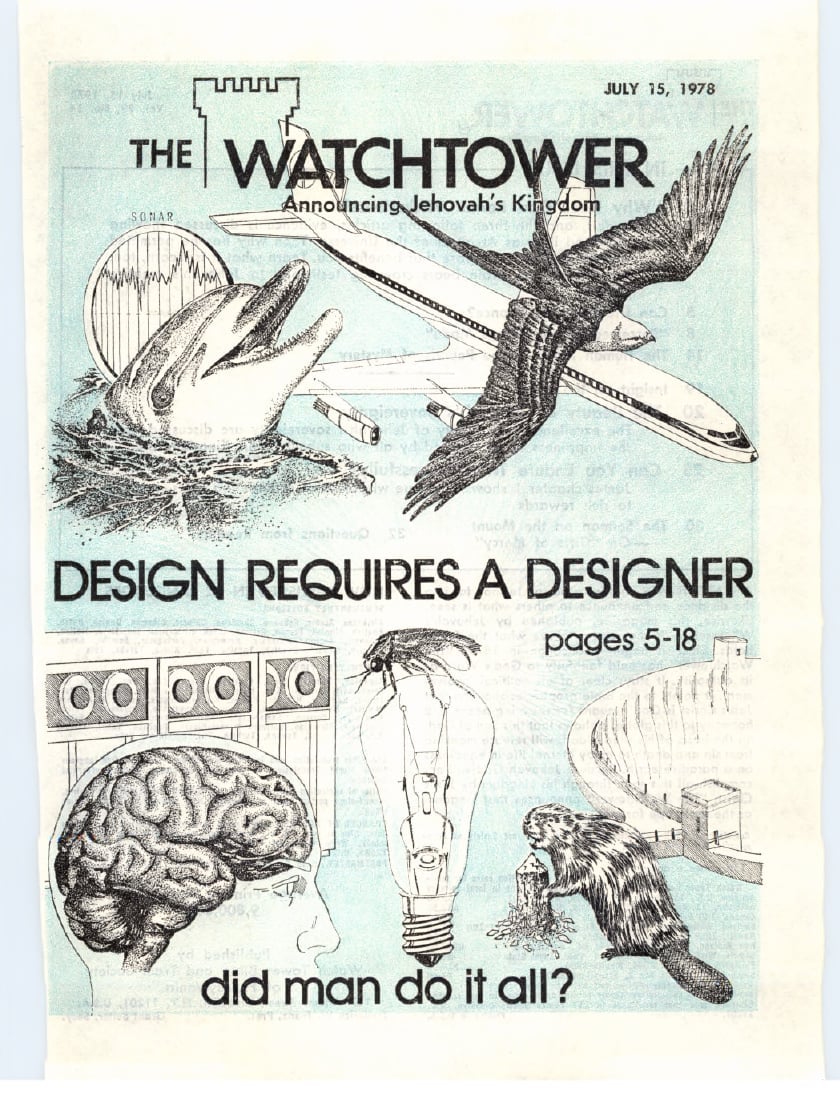
The Watchtower — July 15, 1978
Source: jw.org
Contents
Page Two
“Why Does God Permit Wickedness?”
Can Life Arise by Chance?
“Perceived by the Things Made”
The Human Brain—Three Pounds of Mystery
Insight on the News
The Beauty of Jehovah’s Sovereignty
Can You Endure Trials Successfully?
The Sermon on the Mount—‘Let Your Gifts of Mercy Be in Secret’
Questions From Readers
Sick Money—Are You Worried by It?
Page Two
Page Two
“Why Does God Permit Wickedness?” 3
In this, and the three following articles, evidence is discussed showing that God lives as Architect of the Universe. Then why has he permitted wickedness? For a purpose that benefits you. Learn what it is. Learn, too, how the human brain bears crowning testimony to Jehovah’s creative powers
The Beauty of Jehovah’s Sovereignty 20
The excellence and dignity of Jehovah’s sovereignty are discussed, and the happiness to be enjoyed by all who submit to his Kingdom rule
Can You Endure Trials Successfully? 25
James chapter 1 shows how true wisdom aids in enduring trials, leading to rich rewards
“Why Does God Permit Wickedness?”
“Why Does God Permit Wickedness?”
Many Persons Ask, “If There Is a God, Why . . .”
MANY persons ask questions prefaced with the words, “If there is a God, why . . .” Some of such questioners are merely wanting to ridicule those who believe in the existence of God. However, many others are deeply disturbed and are searching for answers to bolster their faltering faith. Probably the most frequently recurring question of this kind is, “If there is a God, why does he permit wickedness?”
It is true that God permits it. But there are many people on earth who not only permit it; they also perpetrate it. They declare wars; drop bombs on women and children; scorch the earth, causing famines; and spread sickness and death by polluting air and water and soil—both in wartime and in peacetime. Not only do they foster wickedness internationally and nationally, but they also inflict hardship on themselves individually.
They overeat and become obese, overdrink and get cirrhosis of the liver, smoke and suffer lung cancer, practice adultery and sodomy and contract venereal diseases, drive recklessly and kill scores of thousands annually, greedily pursue money and possessions and, in so doing, create stresses that cause ulcers and heart attacks—on and on the list continues.
WHAT DO THEY REALLY WANT?
Such persons do not really want the elimination of wickedness; they want only the elimination of the penalties for wickedness. They want promiscuity without venereal disease, smoking without lung cancer, heavy drinking without liver trouble, reckless driving without accidents, and so forth. They want to sow evil but not reap it. They want to pluck apples from weeds and gather grapes from thistles.
Then, when they do reap the woeful harvest of their wicked sowing, they moan and groan and raise the bitter lament: ‘Why me, God? Why me?’ But why not? “Whatever a man is sowing, this he will also reap.” (Gal. 6:7) Their reaction is exactly as Jehovah foreknew it would be: “A man’s own folly wrecks his life, and then he bears a grudge against the LORD.”—Prov. 19:3, The New English Bible.
Jehovah God condemns sins and excesses. Millions berate God for permitting wickedness, but the bulk of their woes stems from their flouting of his commands. Since they permit the wickedness and perpetuate it, why should not God think that they prefer it? And if God did stop it, if he reached down to take the cigarettes from their mouths, or the highballs from their hands, or to separate the fornicators, or to slow their cars down from 75 miles an hour to 55 (120 kilometers to 90), would they not set up a great howl that their freedoms were being curtailed? If he permits it he is denounced; if he stops it he is denounced.
The time is coming when Jehovah will stop it by removing the wicked:
“The upright are the ones that will reside in the earth, and the blameless are the ones that will be left over in it. As regards the wicked, they will be cut off from the very earth; and as for the treacherous, they will be torn away from it.”—Prov. 2:21, 22.
Some may decry this action by God as cruel, but how else will wickedness be stopped? By rehabilitation? Society has spent millions trying this. The programs fail. Criminals turned loose from prison lapse into their old ways. They soon claim more victims. If the wicked refuse to reform, what is the solution? Can you have a rose garden in a weed patch, or chickens with foxes in the hen house, or a peaceful paradise with vandals running loose?
JEHOVAH’S REASON FOR PERMITTING WICKEDNESS
Jehovah God created humankind to be caretakers of a paradise earth. He did not make them robots, but gave them freedom of choice. Would they choose to care for the earth in keeping with God’s purpose? Satan said that they would not, and challenged God with the boast that he could turn all men against God. Jehovah accepted the challenge. Time was required to settle the issue.
That this issue had been raised is shown relative to Job. Jehovah called Satan’s attention to Job, saying: “He worships me and is careful not to do anything evil.” Satan retorted: “Would Job worship you if he got nothing out of it? You have always protected him.” Jehovah then permitted Satan to afflict Job, to try to break his integrity. Job’s wife thought that she discerned the cause of her husband’s troubles and chided him: “You are still as faithful as ever, aren’t you? Why don’t you curse God and die?” But Job kept integrity, proved Satan false, and was blessed by God.—Job 1:6-12; 2:1-10; 42:12, Today’s English Version.
Have you parents ever entrusted some possession or responsibility to your sons or daughters, to see whether they were capable of meriting even greater trusts? So Jehovah God is testing humankind, to see which individuals are to be trusted to care for the paradise earth under Christ’s kingdom. He permits wickedness now for a purpose, but he does not cause it. Some calamities come by chance: “Time and unforeseen occurrence befall them all.” (Eccl. 9:11) Other calamities come as a result of human foolishness. “God made man simple; man’s complex problems are of his own devising.” (Eccl. 7:29, Jerusalem Bible) Still others are brought about by Satan in his endeavor to turn all persons against God, knowing that they will blame God instead of him, knowing that many do not even believe that he, Satan, exists.—Rev. 12:12.
There is a God, and he has reasons for permitting wickedness. But his time for stopping it is not far off.
Can Life Arise by Chance?
Can Life Arise by Chance?
If there is no Creator, life must have started of itself. Many think that it did. But does increasing knowledge support this view?
ANCIENT Egyptians saw scarab beetles suddenly appear out of the ground, and believed them to be self-produced. The Encyclopedia Americana says: “Tremendous numbers of scarabs were often found on the surface of the mudbanks along the Nile River, and this supported the belief in spontaneous generation.” (Vol. 24, p. 336, 1977 edition) But what really happened? Female beetles rolled up a ball of dung, laid eggs in it, and buried it. The eggs hatched, the larvae fed on the dung, and later emerged as beetles. There was no spontaneous generation after all.
The Greek philosophers taught spontaneous generation of life. In the fifth century B.C.E. both Anaxagoras and Empedocles believed in it. A century later Aristotle thought that worms and snails were products of putrefaction. As late as the 17th century C.E., men of science, such as Francis Bacon and William Harvey, taught spontaneous generation.
However, in that same century Redi showed that maggots appeared in meat only after flies laid eggs on it. Bacteria were discovered, and they were hailed as proof of spontaneous generation, until in the 18th century Spallanzani showed that they came from spores. A century later Pasteur settled matters. He proved that life comes only from life. Men of science now accept that view but many insist that life arose spontaneously some two or three thousand million years ago.
CHEMICAL EVOLUTION, THE LATEST SPECULATION
Many scientists believe that a primitive atmosphere of methane, ammonia, water vapor, carbon dioxide and a few other gases was bombarded by ultraviolet rays, thus breaking the molecules into atoms, which recombined to form amino acids, the building blocks of proteins. These and other organic compounds, we are told, agglomerated in water, acquired a membrane and became a living cell; this derived its energy perhaps first from methane, later from fermentation. Still later, it is said, the cell had to “invent” the process of photosynthesis. But could a simple cell really produce and sustain itself in this way? Why, even the finest scientists will admit humbly that they cannot understand photosynthesis completely, much less duplicate it!
SOME PITFALLS
Many scientists have theorized that the cell evolved spontaneously in this way. But the pitfalls for their theory are many, and very, very deep!
First pitfall: It is a bold assumption that earth’s primitive atmosphere contained the necessary gases in the right proportions to start the chain of reactions. There is no evidence to support this.
Second pitfall: If such an atmosphere did exist, and if the amino acids were produced, they would be destroyed by the same source of energy that split the methane and ammonia and water vapor. Amino acids are very complex molecules; therefore they are less stable and more easily destroyed—just as it is easier to topple a stack of 10 bricks than a stack of three. Formed high in the atmosphere, such amino acids could hardly survive to reach water on earth, and, if they did, they would not endure here long enough to become concentrated into the “soup” of the evolutionary theory. The following excerpts from an article by Dr. D. E. Hull in the May 28, 1960, scientific magazine Nature confirm this:
“These short lives for decomposition in the atmosphere or ocean clearly preclude the possibility of accumulating useful concentrations of organic compounds over eons of time. . . . the highest admissible value seems hopelessly low as starting material for the spontaneous generation of life. . . . The conclusion from these arguments presents the most serious obstacle, if indeed it is not fatal, to the theory of spontaneous generation. First, thermodynamic calculations predict vanishingly small concentrations of even the simplest organic compounds. Secondly, the reactions that are invoked to synthesize such compounds are seen to be much more effective in decomposing them.”
In an experiment, when scientists subjected a carefully prepared gas mixture to a electrical discharge, a few of the simplest amino acids did accumulate, but only because they were quickly removed from the area. If these amino acids had been left exposed to the discharge, the situation could be compared to what would happen if one man is making bricks and another is hitting them with a hammer as soon as they are formed. It takes several hundred amino acids linked together in correct sequence in a chain to make an average protein, and it takes several hundred different proteins to make the simplest of organisms. So in our analogy of the man making bricks: he must cement together hundreds of bricks in a string, and accumulate hundreds of these strings of hundreds—and do all of this while the other man is wildly swinging his hammer! This is still grossly oversimplified, for it takes much more than a chain of amino acids to make a living organism.
MORE PITFALLS
Third pitfall: When amino acids are formed at random they come in two forms that are chemically the same but one is a “right-handed” molecule and the other a “left-handed” molecule. They are all mixed together, in about equal numbers of each kind. But in living organisms only “left-handed” amino acids are used. So returning to our illustration, the man making bricks makes two kinds, red and blue, and accumulates a pile containing millions of bricks, reds and blues mixed together. (Of course, we must assume that the hammer swinger has been eliminated, just as evolutionists assume that the destructive ultraviolet rays have been removed from the action.) Now a monstrous shovel gouges into the pile of millions of red and blue bricks and scoops out several hundred thousand bricks, and, by chance, every one of them is a red brick! In the same way, by chance, every one of the hundreds of thousands of amino acids, and sometimes millions, forming a one-celled living organism must be “left-handed,” even though taken from a mixture containing millions of others that are “right-handed.”
Fourth pitfall: It is not enough to get the right kind in sufficient quantity. Each of the 20 different kinds of amino acids must link up in the protein chain in the correct sequence. If one amino acid is out of place, the organism may be crippled or killed. So the huge shovel must, not only scoop up all red bricks, but also drop each one of them into its proper place!
Fifth pitfall: The cell membrane is formed from membranous tissue. Evolutionists theorize that a film of water around a glob of proteins became a membrane, or that fatty globules enveloped proteins and became a cell membrane. The membrane is extremely complex, made up of sugar, protein and fatty molecules, and governs what substances can or cannot enter and leave the cell. Not all of its intricacies are understood. Bernal says, in The Origin of Life: ‘What we lack still, as mentioned earlier, is a plausible model for the origin of fats.” (Page 145) Without the fats there could be no membrane; without the membrane, no living organisms.
IMPOSSIBILITIES NO DETERRENT
There are literally thousands of pitfalls for the evolutionary theory, en route from a primitive atmosphere, bombarded by lightning or radiation, to a one-celled living organism able to reproduce itself. Every competent scientist knows this. He knows that the many speculations advanced to evade these pitfalls are inadequate. Laws governing energy and matter declare impossible the spontaneous generation of life. Mathematical laws of probability doom its chances.
The simplest known self-reproducing organism (H39 strain of Mycoplasma) has 625 proteins averaging 400 amino acids each. However, some contend that, theoretically, one might get by with 124 such proteins. What are the chances of one of these proteins of 400 “left-handed” amino acids forming from a mixture of both “right-” and “left-handed” ones? One chance in 10120 (1 followed by 120 zeros).
However, for this nonexistent cell 124 proteins are needed. What are the chances of spontaneously forming that many, all from “left-handed” molecules? One chance in 1014,880. But these amino acids cannot be tied together just indiscriminately; they must be in the right sequence. To get these 124 proteins, averaging 400 “left-handed” amino acids each, with the acids in the correct sequence, the chances are 1 in 1079,360. If we wrote out this last number in full (1 followed by 79,360 zeros), it would take about 20 pages of this magazine to do it! Dr. Emil Borel, an authority on probabilities, says that if there is less than a 1 in 1050 chance for something to happen, it will never happen, no matter how much time is allowed. And that number could be written in less than two of these lines.
Prominent evolutionists know the problems. Some try to push them into outer space. British astronomer Sir Fred Hoyle said that ‘existing terrestrial theories of the origin of life are highly unsatisfactory for sound chemical reasons,’ and that ‘life did not originate on earth itself but, rather, on comets.’ Others grit their teeth and believe in spite of the lack of evidence. Nobel-Prize-winning biologist Dr. George Wald stated: “One only has to contemplate the magnitude of this task to concede that the spontaneous generation of a living organism is impossible. Yet here we are—as a result I believe, of spontaneous generation.” On his own admission, he believes in the impossible. This kind of reasoning is comparable to that of an earlier biologist, D. H. Watson, who said that evolution was “universally accepted not because it can be proved by logically coherent evidence to be true, but because the only alternative, special creation, is clearly incredible.”
ARE YOU GULLIBLE OR LOGICAL?
Having no other foundation, writers on evolution stoop to the tyranny of authority: ‘All scientists of consequence believe it; no reputable biologist doubts it; informed persons don’t question it; all intelligent persons accept it; only those with religious prejudice reject it; it has been proved many times over; no further proof is needed now.’ So, on and on go the pressuring and the brainwashing.
You, however, should investigate it for yourself. Then, decide for yourself. Your life could depend on your decision. And consider this: You could jump off a 20-story building. Just before you hit the street a sudden, terrific gust of wind catches you and whisks you back up onto the top of the building. Is that likely? It is very unlikely. Do not count on it. But it is far more likely than that a living organism would form spontaneously! Do not count on that either!
The Bible says at Psalm 36:9: “With you [God] is the source of life.” It is gullible to believe that life arose by chance. It is logical to believe that it was created by an intelligent God, as the following article shows.
“Perceived by the Things Made”
“Perceived by the Things Made”
If crude stone tools prove the existence of a designer, with far greater force do not living creatures of intricate design declare the existence of a wise and powerful Creator?
IF THERE is a rockslide in the mountains, we expect to see a jumble of boulders where it comes to rest at the bottom. We would not believe our eyes if all the boulders came to rest in the form of a beautiful rock house—for a house requires design and purposeful work. And there is no design without a designer, or purposeful work without an intelligent worker. This agrees with the Bible’s statement at Hebrews 3:4: “Every house is constructed by someone.”
A scientist digs in the rubble of the earth and finds a round, oblong stone that is smooth and has a groove circling the middle. He has no doubt but that it was shaped by a primitive man. He is convinced that it was attached to a stick by a leather thong and used as a hammer or a weapon. Similarly, he finds a flat stone with a sharp edge and is sure that it was made by a “Stone Age” man for use as a knife or a scraper. Or, a small piece of sharp flint shaped like an arrowhead convinces him that it was designed by man to use on the tip of an arrow or a spear. Such purposeful, designed things, the scientist concludes, are not products of chance.
The work reflects the worker. These tools and weapons are crude. Hence, their makers are considered primitive, for apes do not make weapons, and those of modern man are of ingenious design. So the scientist places the man who made the stone items in a stone age, and speculates that his appearance and brainpower must be somewhere between ape and modern man. Hence, he envisions a stoop-shouldered, low-browed, shuffling, hairy ape-man. This one’s creations reflect more purpose and design than the stick the ape might pick up, but far less than the things modern man creates. The scientist sees the worker through his works, and judges his qualities from his works.
THEY ABANDON THEIR OWN LOGIC
However, when it comes to the teeming plant and animal life found on the earth, most scientists reverse themselves on their view that design requires a designer. Of far greater complexity than crude stone tools are the simplest of organisms. Yes, even the single-celled protozoan cannot be considered simple. For within that single cell it has the capacity for performing all the body functions that are cared for by the many organs of a vertebrate. In itself it is a complex organism. Evolutionary scientists insist that such complex organisms had no designer but popped into existence by chance. In comparison to the protozoan’s producing itself spontaneously, it would be easy for crude stone tools to be formed by a landslide or a rushing stream, or even simplicity itself for a rock house to be built by an avalanche of boulders!
When it comes to the most complexly designed creations in the universe, is it emotional prejudice that causes many intelligent persons to abandon their logical rule that purposeful work reflects the qualities of an intelligent worker? The Bible agrees with their rule, but they shy away from the Bible’s application of it: “His invisible qualities are clearly seen from the world’s creation onward, because they are perceived by the things made, even his eternal power and Godship.” (Rom. 1:20) They would never accept chance as the maker of a crude stone tool, but they readily embrace it as the creator not only of protozoa but of all life on earth, man included! They balk at perceiving in these marvels of design the great Designer and Creator of the universe. Consider a few of such wonders. Ponder whether blind chance has the qualities that they reflect.
THE SOIL BENEATH YOUR FEET
On the third creative day Jehovah said: “Let the dry land appear.” (Gen. 1:9) This opened the way for land plants. But for these plants to thrive there must be the marvel of the soil. The soil? Is that a marvel? Is it not one of the commonest things on the face of the earth? Truly, it is. However, the soil is a vital resource, and today there is concern as its erosion causes dust bowls and spreading deserts. It has often taken thousands of years for rocks to turn into fertile soil. They undergo weathering; fungi settle and germinate, sending out shoots that enmesh algae, and thus fungi and algae unite to become lichens. Lichens grow on the surface of rocks, disintegrate them, build up a thin soil that will support mosses, and the mosses, in turn, live and die and make more soil that eventually will support seedlings. Erosive forces move these soils into locations where they accumulate to depths that will support higher forms of plants, and ultimately trees.
As plants shed leaves and die, bacteria cause decay, and rich organic soils are created. Microbes break down these organic compounds into the simple nutrients needed by plants. Although we speak of solid ground, many soils are far from solid, for they are filled with air, water and multitudes of living things. An ounce of soil particles may have surfaces that would cover six acres (2.4 hectares). In temperate regions, a teaspoonful of soil may contain over 5,000,000,000 living organisms! Each one is a marvel of design and purpose and all together are needed before “the land itself will give its yield.” (Ezek. 34:27) Is the soil something merely to be trampled on? Without it there would be no life on earth!
NAVIGATORS BEYOND HUMAN COMPREHENSION
To escape cold seasons and to find food, many birds migrate. Their navigational skills are awesome and still defy complete understanding. In the northern hemisphere when the cold starts, how do they know that warm weather and food lie south, and not east or west? And when returning in the spring, how do they know to fly north? Different hormones released in their blood tell them. Some birds migrate hundreds of miles, others thousands, to the same locality they left six months earlier. Terns and plovers make one-way trips of about 4,000 miles (6,400 kilometers). Young birds make the trip alone for the first time. As late as the Middle Ages naturalists refused to believe that birds migrated, but concocted fantastic explanations for appearances and disappearances in spring and fall. But as early as the seventh century before Christ, the Bible spoke of migrations: “Even the stork in the heavens—it well knows its appointed times; and the turtledove and the swift and the bulbul—they observe well the time of each one’s coming in.”—Jer. 8:7.
Even after migration was accepted for big birds, naturalists argued that small ones crossed oceans by hitching rides on the backs of larger ones. But the little blackpoll warbler, like many other midgets, does it on his own. He leaves Alaska in the fall, travels in stages to the New England coast, waits for the right weather, then takes off over the Atlantic and flies from three to five days to the northeastern coast of South America. Nonstop, for days, over 2,400 miles (3,800 kilometers) of ocean, by a bird weighing less than three quarters of an ounce! What awesome computer is in that tiny head that tells time, computes the movement of the sun, uses the stars, orients all of this to a map of his destination, and even enables the bird to arrive safely if skies are overcast? Can anyone, deep within himself, really believe that chance created this little blackpoll warbler?
Studies with homing pigeons have revealed another guidance system available to birds. Carried in a dark box by circuitous routes and released 600 miles (960 kilometers) from their home coop, they return home in one day. If the sun is shining, they use their guidance system. But they can also return on overcast days or during the night. They sense the earth’s magnetic field and use it as a guidance system. A flock was released; half the birds had magnets tied to their backs, and this distorted the earth’s magnetic field and made it useless. On a sunny day the entire flock returned safely. However, on an overcast day the ones without magnets returned but those with the attached magnets circled at random. For years it was thought impossible for any creature to sense earth’s magnetic field; it is so weak. Now scientists know that it is sensed not only by birds but also by honeybees. Recent experiments seem to suggest that even some snails are sensitive to it.
Not only birds migrate but whales, seals, turtles, eels, crabs, fish, butterflies and caribou do also. However, with some sleepyheads, hibernation is preferred for escaping the rigors of winter. The small 13-lined ground squirrel illustrates some of the remarkable physiological changes that occur in hibernators. Body temperature drops to within a few degrees of the cold outside the den. The heart beats only once or twice a minute. When active, this squirrel may breathe a few hundred times a minute, but in hibernation it takes a slow breath once every five minutes. Yet its blood remains saturated with oxygen, and little-used muscles retain their tone. What triggers its decision to sleep in fall and wake up in spring? Not just weather. A chemical released in the blood starts it hibernating, and another causes it to wake up. By the use of such chemicals scientists have made hibernators enter their long sleep in midsummer.
Concerning such wonders, Job admitted: “I talked, but I was not understanding things too wonderful for me, which I do not know.”—Job 42:3.
A MISCELLANY OF INGENIOUS DESIGNS
Remember the crude stone tool that could not just happen? Keep it in mind for comparison as you decide whether the following could just happen.
Most persons know that the chameleon can shoot its tongue out several inches to pick off insects. But do you know how this creature does it? Lying horizontally in the back of its mouth is a cone-shaped bone, the point forward. At its base the long, hollow tongue is anchored. Long muscles hold the tongue, pleated like accordion bellows, compressed around this bone. At the tip of the tongue are sphincter muscles that rest at the point of the bone. The chameleon’s turret eyes, turning individually, spot an insect within range. The long muscles contract powerfully and hold the tongue over the bone like a compressed spring. Then the sphincter muscles surrounding the tip of the slippery bone suddenly tighten and, as they do, the long muscles compressing the “spring” relax, and the tongue shoots out. The insect is stuck on the gluey tip and the long, limp tongue is slowly drawn in. The action is like a boy shooting prune pits or slippery watermelon seeds from between thumb and forefinger; only in this case the slippery bone stays put and the tongue tip applying the pressure shoots out. Such an ingenious design certainly needs a designer.
The bombardier beetle uses explosives to deter predators. Three chemicals secreted by glands are stored in a reservoir. When an enemy approaches, a valve opens to let the chemicals into a strong-walled compartment. There an enzyme causes them to explode and a noxious mist shoots out of a turret that can aim in any direction. The beetle can explode repeatedly, dozens of times in minutes, with an audible “pop” each time. The enemy retreats, sometimes with seizures. This beetle has a laboratory, makes explosives, and uses them purposefully. It is an appalling little bomb factory!
The whirligig beetle has bifocal eyes to see above and below pond water, but that is the least of its marvels. It can fly, crawl, walk on water or submerge. When doing the latter, it takes along an air bubble that acts like a lung. It receives carbon dioxide wastes from the beetle and puts them into the water, and transfers oxygen from the water to the beetle. The creature can stay under water for hours. The beetle’s underparts like water, but the upper parts, including the upper halves of the compound eyes, are kept greased by glands so that water is repelled. It darts rapidly about in all directions on the surface film of the water, setting up bow waves as it does so. When these ripples hit the bank, or objects on the surface film—maybe another whirligig or an edible insect—they are reflected back. With two antennae held at the surface of the water, the beetle monitors their messages about its surroundings. It catches food and avoids collisions as hundreds of its fellows join it in darting erratically about, all making waves, but each one monitoring only its own. The system works day or night. The whirligig beetle does with water waves what bats do with sound waves—what a computer encased in that tiny head!
“NOTHING NEW UNDER THE SUN”
People look at technical accomplishments and admire human inventors. They look at the same principles employed purposefully by living creatures and say that it just happened. For the most part human inventors are really adapters. It has been done before, as Solomon said: “There is nothing new under the sun.” (Eccl. 1:9) In the book Bionics, by Daniel Halacy, Jr., we read on page 19:
“A commercial airplane was marketed with a wing curve patterned after that of a bird. A rubber company was experimenting with a streamlining artificial ‘skin’ for boats, copied after that of marine mammals. A new ground-speed indicator for planes was patterned on the eye of a beetle, and a better TV camera simulated the mechanism of the eye of the horseshoe crab.”
Men pore over the creations of Jehovah God to discover their ingenious workings and adapt them to human inventions. It reminds us of the words of Job 12:7-9: “Ask, please, the domestic animals, and they will instruct you; also the winged creatures of the heavens, and they will tell you. Or show your concern to the earth, and it will instruct you; and the fishes of the sea will declare it to you. Who among all these does not well know that the hand of Jehovah itself has done this?” Inventors appreciate receiving credit for their clever adaptations, but so often they deny recognition to the One who “in wisdom” originated everything.—Ps. 104:24.
The Bible speaks of the harvester ant at Proverbs 6:8: “It prepares its food even in the summer; it has gathered its food supplies even in the harvest.” For centuries the existence of ants that harvested and stored grain was doubted, but in 1871 a British naturalist discovered their granaries. Ants also tend crops, have slaves and keep livestock. Termites air-condition their nests, as bees do their hives. By a dance in the dark, honeybees also show others where nectar is, in what direction and how far. Insects display amazing abilities that men cannot duplicate. “They are instinctively wise,” as the Bible says, created so by Jehovah God.—Prov. 30:24.
“Water, water, every where, nor any drop to drink,” the saying goes about the ocean. But some seabirds have glands that desalt seawater. Some fish and eels generate electricity, up to 400 volts. Many fish, worms and insects produce cold light, to the envy of scientists whose own lights lose energy to heat. Bats and dolphins use sonar, wasps make paper, ants build bridges, beavers make dams, certain snakes have thermometers sensitive to a change in temperature of a thousandth of a degree Celsius. Pond insects use snorkels and diving bells, octopuses use jet propulsion, spiders spin seven kinds of webs, make trapdoors, nets, lassos, and have babies that are balloonists traveling thousands of miles at great heights. A female moth sprays a perfume that a male six miles (10 kilometers) away can detect if only one molecule of it touches his antennae. Salmon return to the stream of their birth, after spending years in the open sea, because each one remembers the characteristic smell of its home stream and can detect it as it swims in coastal waters.
Jehovah called Job’s attention to His many creative wonders. What was Job’s response? It was this: “I have come to know that you are able to do all things, and there is no idea that is unattainable for you.”—Job 42:2.
It is impossible for such amazing design to exist without a designer. Evolutionists claim that ‘natural selection and survival of the fittest’ is the designer. But the problem is the arrival of the fittest, not the survival. You cannot select until there is a choice available. You cannot build a house before building materials arrive. As the Bible says: “Of course, every house is constructed by someone, but he that constructed all things is God.” The evidence is everywhere. Many who see an ape-man reflected by a crude stone tool cannot perceive God’s qualities mirrored by all his amazing works. “They are inexcusable.” (Rom. 1:20) But let us have ‘eyes that see’ Jehovah’s existence as reflected in his creative works.—Matt. 13:14-16.
[Picture on page 11]
CHAMELEON
hyoid bone
sphincter muscles
hyoid muscles
central bone
sticky tongue holds insects
[Picture on page 12]
bombardier beetle
[Picture on page 13]
Navigation, sonar, jet propulsion, gardening, communication—who did it first?
The Human Brain—Three Pounds of Mystery
The Human Brain—Three Pounds of Mystery
Who would argue that a building could build itself, or a television set manufacture itself, or a computer design and program itself? It takes brains to do these things. Yet some argue that brains just happened. Is the human brain simpler than buildings, television sets and computers?
DAVID gazed at the starry vault above and saw the message reflected there: “The heavens are declaring the glory of God; and of the work of his hands the expanse is telling.” He was awed by their immensity and wondered why God would be mindful of insignificant man: “When I see your heavens, the works of your fingers, the moon and the stars that you have prepared, what is mortal man that you keep him in mind, and the son of earthling man that you take care of him?” Yet when David contemplated his own body he again marveled: “I shall laud you because in a fear-inspiring way I am wonderfully made. Your works are wonderful, as my soul is very well aware.”—Pss. 19:1; 8:3, 4; 139:14.
What a contrast with men today! David was overwhelmed by God’s majestic power when he saw some 2,000 stars. Today men discern some hundred billion stars in our Milky Way galaxy, estimate a hundred billion other galaxies in the universe (each with billions of stars), yet deny the existence of a Creator. David marveled at the intricate design of his own body and lauded Jehovah. Today men know far more about the body’s wonders, but attribute it all to blind evolution. They are ever learning but seem unable to come to the knowledge of the truth declared by their discoveries, namely, that it takes a wise and powerful Creator to bring into existence such marvels of design.
The Scientific American magazine noted this design and said: “It almost seems as if the universe must in some sense have known that we were coming.” The magazine attributed this preparation for us to “the many accidents of physics and astronomy that have worked together to our benefit.” However, it was not the universe but Jehovah God who knew that we were coming, and through no accidents he prepared the earth and its immediate heavens for us. No doubt we feel as David did when we view the grandeur of the earth and the vast expanse of the heavens—small and insignificant. But when Jehovah tells us that the earth was made for man, that he expects man to be its caretaker, and that he has equipped man with the ability to meet this responsibility, then we need not feel that our smallness disqualifies us from being worthy of his attention.—Gen. 1:14-18, 26-28; 2:15; Isa. 45:18.
THREE POUNDS OF MYSTERY
The greatest of God’s gifts to equip us to care for the earth is a gray, mushy substance slightly larger than a grapefruit. Its preciousness is emphasized by its protected location. It is enveloped by three membranes and practically floats in a cushioning fluid, and all of this is encased in solid bone—the skull. It is what sets us apart from unreasoning animals and imparts to us the possibility of being in the image and likeness of God. We think, learn, feel, dream and remember with it—but we cannot understand it. In spite of all the intensive scientific research to fathom its workings, it remains a mystery. British physiologist Sir Charles Sherrington wrote: “The brain is a mystery; it has been and still will be. How does the brain produce thoughts? That is the central question and we have still no answer to it.” The noted anthropologist Dr. Henry Fairfield Osborn wrote: “To my mind, the human brain is the most marvelous and mysterious object in the whole universe.”
The nervous system is of awesome complexity. Its cells are called neurons and extend throughout the body. Some are only a fraction of an inch in length; others are several feet long. The longest connects the brain with the big toe. The electrochemical impulses carrying messages to and from the brain travel from 2 to 200 miles (3.2 to 320 kilometers) an hour. The larger nerves are composed of thousands of fibers, the optic nerve having some million fibers, each carrying a separate message. The autonomic nervous system directs, without one’s conscious thought, the workings of organs, circulatory system, membranes and many muscles, such as those having to do with breathing, swallowing and the peristaltic movements in the intestines.
The brain itself has 10 billion neurons and 100 billion glia cells that form supportive structures and probably have nutritional functions. The neurons of the brain are active day and night, even during sleep, and use up energy at a high rate. In each cell the energy is derived from the oxidation of glucose. The brain is motionless, neither contracts nor grows, and is only 2 percent of the body’s weight. And yet, to keep functioning, it must receive 20 percent of the blood pumped from the heart; it requires 25 percent of the blood’s oxygen supply. If it is deprived of blood for 15 seconds, consciousness is lost; if for four minutes, irreversible brain damage may occur. Its electrical activity can be measured and recorded on paper as wavy lines, called brain waves, and this recording is called an electroencephalogram, or EEG.
The higher thought processes of the brain are centered in the cerebrum, with its various lobes, and is divided into a right and a left side. The left brain controls the right side of the body, is generally the dominant one, and is the center of logic, verbal abilities and the data processing of the millions of bits of information pouring into the brain every second. The right brain controls the left side of the body, and it is devoted to the creative and intuitive activities of the mind. But if one side of the cerebrum fails at a young age, the other side takes over most of its functions. The brain is considered to be underutilized; it has a potential for making geniuses out of plain, ordinary folk.
MESSAGES, THOUGHTS, EMOTIONS
“The hearing ear and the seeing eye—Jehovah himself has made even both of them.” (Prov. 20:12) The ear receives sound waves and turns them into electrical triggers that touch off impulses in the auditory nerve. When they reach the hearing area of the brain, they are interpreted as sounds, and thoughts are created. Light enters the eye, and rods and cones turn this light into electrical triggers that set impulses moving along the optic nerve to the brain, where they become scenes that stimulate thinking. Similarly, Jehovah has provided sensory nerve receptors in the nose and mouth and skin that turn smells and tastes and touches and heat into electrical triggers. These send impulses to the brain, which, in turn, analyzes the messages thus received, and decides on the appropriate responses to make.
The neurons or nerve cells have on one end dendrites that spread out like the branches on a tree; the other end is a long thread called an axon. The dendrites pick up the impulses and send them along the axon, which passes them on to the dendrites of the next neuron. But axon and dendrites never touch. There is a tiny gap 1/500th as narrow as a human hair that must be bridged as the impulses race on from neuron to neuron until they reach the brain. These gaps, or synapses as they are called, are bridged usually by chemical messengers known as neurotransmitters. The messages do not travel to and from the brain like electricity in a wire. They are electrochemical in nature, travel in impulses that vary in frequencies depending on the intensity of the stimulus, and do not need to be pushed along by an outside source of power as electricity in a wire does. Each neuron is like a small battery, is its own power source, and the intensity or power of the impulse is constant all the way to or from the brain. There are no losses along the way.
The data-processing abilities of the brain defy understanding. Imagine what must be going on in the brain of the conductor of a great symphony orchestra! There are conductors who have memorized the scores for 50 or 100 instruments. As the orchestra plays, and hundreds of notes a second with their various frequencies are pouring into the conductor’s brain, he is comparing them with his memory patterns. If one of the many instruments plays a wrong note, he detects it! Or consider a concert pianist playing a difficult score with all fingers flying! What an amazing kinematic sense his brain must have, to order the exact spacial relationship of the fingers, so that they strike the right keys to match the notes in his memory!
The networks of interconnections among the 10 billion neurons in the brain reach such astronomical numbers as to be incomprehensible, meaningless. The latest research shows not only connections between axons and dendrites but also connections between axon and axon, and microcircuits between the dendrites themselves. The following quotations provide further information.
“Of the many billions of nerve cells in the cerebral cortex, by far the great majority are utilized in associative memory. These cells are linked together in chains by billions of association fibers. These cells and fibers may be reused indefinitely; each time they are used, impulses cross their synapses with greater ease. Memories stored in some cells can thus associate with those stored in others, and new impressions can be compared with memories of previous impressions. Thus logical conclusions can be reached and these can further result in creative thinking.”—Encyclopedia Americana, Vol. 4, p. 423, 1977 edition.
“The brain weighs less than three pounds, yet a computer capable of handling a single brain’s output would cover the entire earth. The brain sorts one hundred million bits of data from the eyes, ears, nose and other sensory outposts each second, yet uses far less electricity than an average light bulb. . . . Since each neuron contains some two hundred thousand synapses along its numerous leaf points, and there are billions of neurons, the synapses provide the brain with an almost limitless flexibility.”—Mainliner Magazine, March 1978, pp. 43, 44.
A thought, if strong enough, produces a feeling. The feeling, if strong enough, causes an action. You think of Jehovah’s creations, you feel gratitude, you serve him. You think of a loved one in danger, you feel fear, you take action to save him. Evil thoughts work the same way. When someone looks at a woman with adulterous thoughts, desire grows; adultery may be committed. Both Jesus and the disciple James confirm this: “Each one is tried by being drawn out and enticed by his own desire. Then the desire, when it has become fertile, gives birth to sin.” (Jas. 1:14, 15; Matt. 5:27, 28) Sensory nerves to the brain produce feelings. For example, there are pleasure centers in the brain that, when stimulated with electrodes, produce pleasure. When stimulated by electrodes other emotional centers produce rage, fear or peace. Cats thus stimulated can be made to cringe in fear at the sight of a mouse. Rats with electrodes in one spot feel rage; in another spot, feel pleasure. Pedals have been wired up so that rats, on pressing them, stimulate their pleasure centers. They pressed these pedals up to 5,000 times an hour, ignoring food and sex and sleep until they dropped from sheer exhaustion!
MANY MYSTERIES REMAIN
Much has been learned about the brain, but far more remains a mystery. By the use of electrodes, areas of the cerebral cortex have been mapped out, showing what functions are performed and where. Some false beliefs have been removed, such as phrenology—the study of “character traits” by feeling bumps on the head. The shape of the skull is not determined by the shape of the cerebrum, nor is it possible to assign “character traits” to specific areas of the brain.
However, it is not known how the tips of nerves at sensory receptors turn the stimuli they receive into electrical triggers. It is not known how memory works. It is not known how thought arises from electrochemical impulses, or how decisions are reached, or how responses sent out on the motor nerves are initiated. Even the transmissions of impulses along the neurons are not completely understood. Beyond our understanding is how these electrical impulses cause dreams, the writing of poems, the composing of music—or, for that matter, cause consciousness itself to exist!
Have you considered the magnitude of brainwork required for acts that we take for granted—walking, talking, eating, swimming, riding a bicycle, or catching a baseball? A beginner weaves around under a high fly ball, and it usually lands several feet from him. In contrast, the professional takes off at the crack of the bat. The sound of the bat on the ball tells him how hard it has been hit, his eye notes its trajectory and speed, and his brain computes the general area where it will land. He races in that direction, but, as he runs, his computer brain is making continuous calculations to pinpoint the spot where he must be to catch it. Is there a wind? How strong is it? Is it pushing the ball to the right or the left? Is it slowing the ball down, or carrying it farther? Must he change direction, run faster or slower? Is the ground uneven, is there a hole to be avoided, is another fielder coming up to catch it, and should he let him have it or wave him off?
All these things he must note, yet never take his eye off the ball! To do so would “unplug his computer,” and he would miss the catch. There is no time consciously to make these many calculations and decisions. The player’s mind and muscles, trained by experiences recorded in his memory, perform automatically because his brain has been programmed by practice to do it all. How he came to have the ability to catch a baseball is in itself a mystery!
Can the intelligence of the brain be attributed to chance, as so many scientists now do? They are very inconsistent when they consider chance. They talk of beaming radio signals to stars to establish communication with a distant civilization on a hypothetical planet. How would those distant receivers recognize the signals as coming from an intelligent source and not being just chance? They might carry simple arithmetic equations, such as two times three equals six. This can be done easily. Or, the signals could be far more complicated, but having an order that would convey information, perhaps even make a picture of a man. Certainly if one of our big radio telescopes probing deep space picked up such a pictorial message scientists would never doubt that it originated from an intelligent source. Yet this is so simple compared to the brain, and far more simple than the single cell in the womb that can make not only a brain but a complete human creature! Is it consistent to say that the brain can just happen, that the cell in the womb can just happen, but that patterned radio signals prove beyond doubt that an intelligent source is behind them? Such a question needs no answer.
While conversing on the nature of God, the universe and man, Albert Einstein suddenly looked up at the sky and said: “We know nothing about it at all. Our knowledge is but the knowledge of schoolchildren.” He was asked: “Do you think that we shall ever probe the secret?” He replied: “Possibly we shall know a little more than we do now. But the real nature of things—that we shall never know, never.”
Both Einstein and David were awed by the mysteries of the night sky and man. And we continue to be awed by that three pounds of mystery encased inside our skulls—the human brain.
Insight on the News
Insight on the News
Since WW II—150 Wars!
● According to a recent report in “Esquire” magazine, in the 33 years since the end of World War II, there have been about 150 additional wars, large and small, that have taken an estimated 25 million lives. Moreover, researchers from the Stockholm International Peace Research Institute say that ‘on any given day, there is an average of 12 wars going on somewhere in the world.’
“Esquire” also notes that “as one Hungarian professor computed it, ‘there were no more than twenty-six days [since WW II] . . . in which there was no war somewhere in the world.’” The article is accompanied by a list, year by year, of the 150 wars and their death tolls. “We can count on war—every day, every year,” it concludes. “War is here to stay.”
Certainly this record of war and bloodshed fits the apostle John’s prophetic vision of a fiery-colored horse and its rider who would “take peace away from the earth so that they should slaughter one another.” This unprecedented period began with the first world war in 1914, and, as noted above, is continuing to the present time. It is one of the major evidences that Jesus said would mark the “conclusion of the system of things.”—Rev. 6:4; Matt. 24:3-14.
Loyalty—from Mouth or Heart?
● “Loyalty to the Nation: Not in Mere Words,” is the headline of a column appearing in the Lagos, Nigeria, “Daily Times.” In it the writer, Abel Emiko, comments on the case of two students expelled from school for failure, on religious grounds, to recite the pledge of loyalty to the nation. Emiko notes that “the rationale behind the requirement of the loyalty pledge is to inculcate in the youths of this country, early enough the instinct of loyalty to the fatherland.”
However, he asks: “Is there any assurance that the mere recitation of words will actually inculcate a sense of loyalty in the youths? . . . Words uttered under coercion are proofs of loyalty to nothing. Love of country and loyalty to the nation must spring from willing hearts and free minds . . .
“We have no evidence before us now to prove that the Commissioner for Education who ordered the latest expulsion of the two students . . . is more loyal to this nation than the students expelled.
“Any spark of love for this country, which may be generated in a child or his associates by forcing him to make what is to him an empty gesture and recite words barren of meaning wrung from him, contrary to his religious beliefs, is overshadowed by the desirability of preserving freedom of conscience to the full.”
“Instinctive Wisdom”
● “I boasted that I could store food in an open container for a whole week and keep it safely out of the reach of house ants,” says O. A. Battista, president of the American Institute of Chemists. However, the ants “put me to shame,” he writes in “Science Digest.” Battista had placed some chocolate candy on top of a tall stool that was standing in the middle of a large wooden tub of water. Around the tub, he painted a wide band of slow-drying glue. But when he returned six days later to check his “ant trap,” “ants were swarming over the bait!” How did they do it?
Well, the ants had made a bridge across the glue with their own (sacrificed) bodies. After reaching the water, he relates, “they had assembled tiny shreds of grass and slivers of wood no longer than a thirty-second of an inch [.8 millimeter], and had glued them together with saliva until their bridge” reached the stool’s leg. Not only that, but some ants were walking across the ceiling and, “when they came directly over the bait, they let themselves fall squarely into the middle of their merry brethren.”
After citing several other amazing feats, Battista marvels at the ants’ “instinctive wisdom.” This is also noted in the Bible, where ants are listed among creatures that are “instinctively wise.” Surely this instinctive wisdom reflects the work of an all-wise Creator, rather than the vagaries of time and chance.—Prov. 30:3, 24, 25.
The Beauty of Jehovah’s Sovereignty
The Beauty of Jehovah’s Sovereignty
“One thing I have asked from Jehovah—it is what I shall look for, that I may dwell in the house of Jehovah all the days of my life, to behold the pleasantness of Jehovah and to look with appreciation upon his temple.”—Ps. 27:4.
1. What comes to mind when the word “sovereignty” is mentioned?
WHAT does the term “sovereignty” mean to you? You doubtless think of supremacy, particularly the supremacy of a ruler—the power of government. Rulership or domination can be a harsh or a rigid one, strictly meting out full justice according to the law without mercy; or it can be one that deals with partiality toward some and that oppresses others. Few man-made rulerships act out of real love for their subjects.
2. By what right does Jehovah exercise sovereignty?
2 The Bible speaks of God as “Sovereign” and “Sovereign Lord.” (Acts 4:24, Rotherham; Revised Standard Version; The New English Bible,; New World Translation) By what right does he have sovereignty? Revelation 4:11 answers: “You are worthy, Jehovah, even our God, to receive the glory and the honor and the power, because you created all things, and because of your will they existed and were created.”
3. How did King David describe Jehovah’s sovereignty?
3 What kind of sovereignty does Jehovah exercise? Is it different from other forms of rule? King David, who exercised rulership over the kingdom of ancient Israel under Jehovah’s sovereignty, said: “Yours, O Jehovah, are the greatness and the mightiness and the beauty and the excellency and the dignity; for everything in the heavens and in the earth is yours. Yours is the kingdom, O Jehovah, the One also lifting yourself up as head over all.”—1 Chron. 29:11.
DOMINANT QUALITIES OF JEHOVAH’S SOVEREIGNTY
4. How do Psalm 89:14 and Exodus 34:6, 7 give us a picture of Jehovah’s sovereignty?
4 Accordingly, Jehovah’s sovereignty has beauty, excellence and dignity. The psalmist writes: “Righteousness and judgment [or, “justice”] are the established place of your throne; loving-kindness and trueness themselves come in before your face.” (Ps. 89:14) When Moses asked to see God’s glory, he was told that he would not be able to see God’s face, because no man can look on God and live. (Ex. 33:18, 20) Nevertheless, God did come down in a cloud on Mount Sinai and declare to Moses: “Jehovah, Jehovah, a God merciful and gracious, slow to anger and abundant in loving-kindness and truth, preserving loving-kindness for thousands, pardoning error and transgression and sin, but by no means will he give exemption from punishment, bringing punishment for the error of fathers upon sons and upon grandsons, upon the third generation and upon the fourth generation.”—Ex. 34:6, 7.
5. (a) What qualities about himself did Jehovah bring first to Moses’ attention, at Mount Sinai? (b) Even though Jehovah is merciful, why does one doing wrong suffer punishment, and how does Jehovah feel about administering punishment?
5 Note that the first things Jehovah brought to Moses’ attention were mercy, graciousness, slowness to anger, loving-kindness, truth and forgiveness. He says in another place: “I am Jehovah, the One exercising loving-kindness, justice and righteousness in the earth; for in these things I do take delight.” (Jer. 9:24) However, when anyone sins against God, even though forgiven for his sin, he cannot escape the consequences of the chain of events that he has set in motion. For example, one committing adultery affects others close to him. His whole family is bound to feel the effects. And those who turn away from God or who reject his sovereignty will suffer punishment. When rebellious men began to build the tower of Babel, God thwarted their scheme by confusing their language. They then scattered over the earth and influenced their offspring, who became worshipers of idols and practicers of very bad things. (Gen. 11:1-9) But God does not take delight in the punishment or suffering of those who do wrong. He says: “I do not take any delight in the death of someone dying, . . . So cause a turning back and keep living, O you people.”—Ezek. 18:32.
6. What, then, are some dominant features of Jehovah’s sovereignty, and how does it compare with human rulerships?
6 It is evident from the foregoing Scripture passages that among the dominant features of God’s sovereignty are loving-kindness, mercy, righteousness and impartiality in administering justice. Therefore, when we view Jehovah’s sovereignty, we are compelled to look at it differently from that of human rulerships. Would it not be fine if you could also view the government that you live under as radiating from its capital pure love and mercy toward all?
THE “GOOD NEWS” RELATED TO GOD’S SOVEREIGNTY
7. How is the “good news” directly connected with God’s sovereignty, and what, therefore, does the proclaiming of the “good news” promote?
7 The good news of the Kingdom is directly connected with God’s sovereignty. The apostle Paul wrote to Christians in Rome: “Thanks to God that you were the slaves of sin but you became obedient from the heart to that form of teaching to which you were handed over.” Those who hear with a good heart and obey are not here told that the “good news” was handed over to them, but that they were ‘handed over to that form of teaching,’ the gospel or good news of the Kingdom. They are now willing subjects and supporters of God’s sovereignty. When they, in turn, proclaim the “good news,” the receivers are handed over to such teaching. What does this promote in the earth? Righteousness, loving-kindness and mercy. For, instead of their former uncleanness and lawlessness, these ‘now present their body members as slaves to righteousness.’—Rom. 6:17-19.
WHY SUBMIT TO JEHOVAH’S SOVEREIGNTY
8. What is the motivation for submission to God’s sovereignty?
8 What is the motivation for submission to God’s sovereignty? It is love for God because of his divine qualities, and also love for what is right and good for all creation. The one who understands what Jehovah’s sovereignty means prefers it above all other sovereignties. In fact, those supporting God’s rulership prefer it to having absolute independence, if that were possible. Why? Because they know that they will be much happier under God’s sovereignty than they would be if they could do altogether as they pleased. They realize that the wisdom, love, knowledge and power of God are so far superior to theirs that there is no comparison. Humans cannot keep themselves living everlastingly, neither can they bring about peace, righteousness and justice throughout the earth. “It does not belong to man who is walking even to direct his step,” said Jeremiah, a faithful supporter of Jehovah’s sovereignty.—Jer. 10:23.
…