The Watchtower, May 15, 1977
Download: PDF — The Watchtower, May 15, 1977
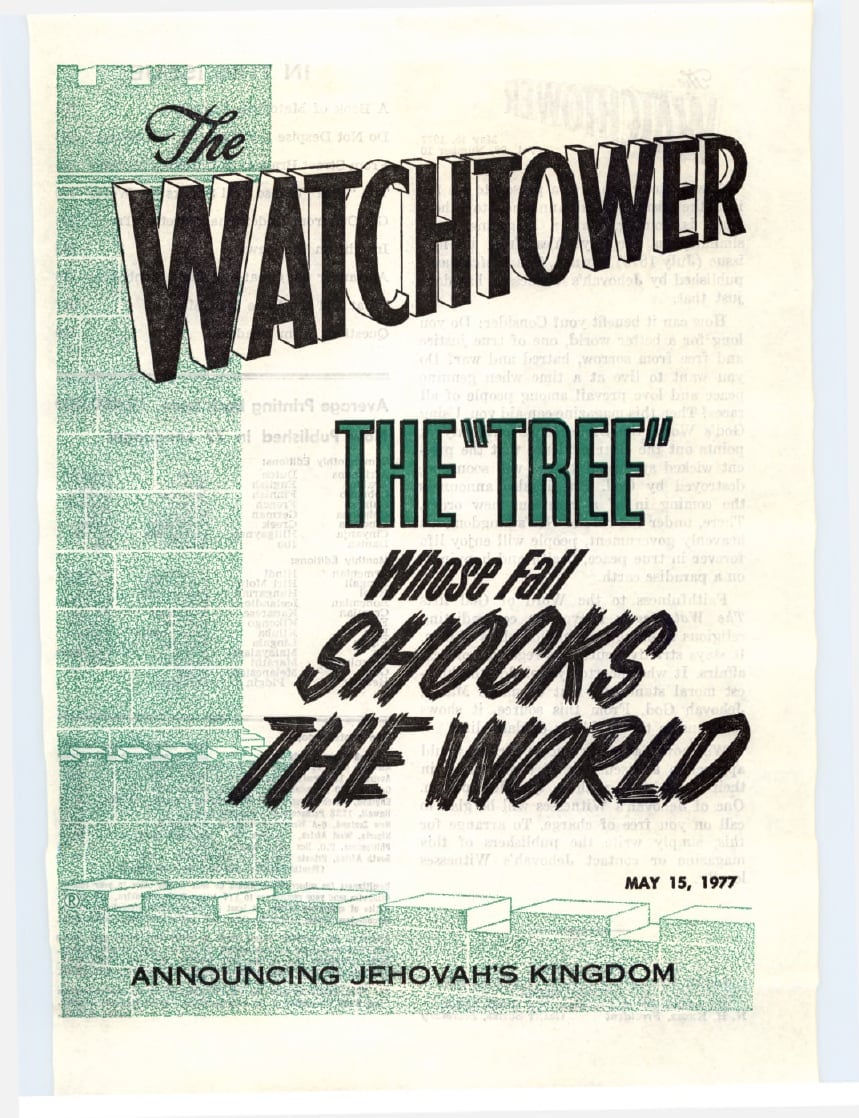
The Watchtower — May 15, 1977
Source: jw.org
Contents
A Book of Matchless Impact
Do Not Despise the Man of Little Means
From Street Brawler to Christian Minister
The “Tree” Whose Fall Shocks the World
Get Out from Under That “Pretty” Tree!
Insight on the News
Alexander the Great and Bible Symbolism
What Did the Wise Man Mean?
Questions From Readers
Dating and Courtship
A Book of Matchless Impact
A Book of Matchless Impact
THERE is a book with an Eastern setting, written by Orientals, that doubtless has had a greater impact on humankind than any other book. It has been translated, the whole or a part thereof, into more than 1,600 languages. And here is a most remarkable fact: It is because of this book that many individuals and even entire nations have learned to read! Previously unwritten languages now have scripts only because this book was translated into these particular tongues. This unique book is the Bible.
It is simply amazing that the Bible has found acceptance among many millions of every race and nation. Here we are living in the twentieth century, removed by many hundreds of years from the events narrated in the Holy Scriptures. For the majority of readers, the Bible’s setting is also far removed geographically. Yet the Scriptures have appealed to people’s hearts in a way that no other writings have.
Charles D. Eldridge, in Christianity’s Contributions to Civilization, made the following observation on this point: “Books written in one land seldom become popular in other lands; they are like trees which cannot stand the strain of transplanting; though published with acceptance under favorable conditions in one nation, they rarely survive the changed conditions of social, educational, political, and religious life in other nations. Not so the Bible: it has been transplanted to every soil under the sun without serious loss of vigor and charm.”
A basic reason for the Bible’s appeal to all tribes, nations and races is that it realistically depicts life, with its joys and its sorrows, its triumphs and its failures, its advances and its setbacks, its love and its hate. T. H. Darlow, in the introduction to The Greatest Book in the World, expressed this as follows: “There is one Book, and only one, which embraces all the heights and depths of human nature. The Bible belongs to those elemental things—like the sky and the wind and the sea, like bread and wine, like the kisses of little children and tears shed beside the grave—which can never grow stale or out of date, because they are the common heritage of mankind.”
The impact that the Bible has had on learning and literature staggers the imagination. Take the English-speaking world, which includes some 358 million people. Writes John R. Green, in A Short History of the English People: “The whole prose literature of England, save the forgotten tracts of Wyclif, has grown up since the translation of the Scriptures by Tyndale and Coverdale. So far as the nation at large was concerned, no history, no romance, hardly any poetry, save the little-known verse of Chaucer, existed in the English tongue when the Bible was ordered to be set up in churches.” English dramatist and poet William Shakespeare got much of the inspiration for his works from the Bible. It has been said that “no writer has assimilated the thoughts and reproduced the words of Holy Scripture more copiously than Shakespeare.” Similarly, for the English poet Shelley, the Bible was the foremost book in his limited library.
In more recent years, English novelist Hall Caine admitted: “Whatever strong situations I have in my books are not my creation, but are taken from the Bible. ‘The Deemster’ is a story of the Prodigal Son, ‘The Bondman’ is the story of Esau and Jacob, ‘The Scapegoat’ is the story of Eli and his sons, . . . and ‘The Manxman’ is the story of David and Uriah.”
American humorist and editor Thomas L. Masson said of the Bible’s impact on literature: “It is the bedrock foundation of all our literature and, therefore, if you want to know anything, the Bible is where you must find it. . . . It is too big for systems, it comprehends man himself and all his thoughts. It is, in reality, a great gallery of superb human portraits.”
Most appropriately, therefore, the 1971 edition of the Encyclopædia Britannica describes the Bible as constituting “probably the most influential collection of books in human history.” We further read: “Whatever one may think of the Bible’s contents, its role in the development of western culture and in the evolution of many eastern cultures makes at least some acquaintance with its literature and history an indispensable mark of the educated man in the English-speaking world.”
Not only have major literary works in the English language been influenced by the Bible, but so have the major writings in most other Western countries. A case in point is German literature. German lyric poet and literary critic Heinrich Heine was moved to say: “All expressions and idioms to be found in the Luther Bible are German. The writer must go on using them. And as this book is in the possession of the poorest people, they need not be exceptionally erudite to be able to express themselves in literary form.” Many German proverbs are drawn from the Bible, and Luther’s translation of the Scriptures provided the basis for literary German.
The comments of two famous German literary figures, Johann Wolfgang von Goethe and Heinrich Heine, regarding the effect of the Bible upon their work, are especially noteworthy. Goethe said of his career: “It is belief in the Bible, the fruit of deep meditation, which has served me as the guide of my moral and literary life.—I have found it a capital safely invested, and richly productive of interest.” Commenting in a similar vein, Heine stated: “I owe my enlightenment quite simply to the reading of a book.—A book? Yes, and it is an old simple book, modest as nature itself, and as natural; a book that appears as efficacious and unpretentious as the sun that warms us, as the bread that nourishes us; a book that looks at us as sadly and affectionately as an old grandmother, who herself reads the book daily, with loving, quivering lips, and her spectacles on her nose.—And the name of this book is quite offhandishly the book, the Bible.”
How could some forty men living over a period of about 1,600 years have produced such a book, a work that continued to be a source of inspiration for many centuries after its completion and remains such? None of its writers took credit to themselves. Their purpose was to convey, not their own message, but that of Jehovah God, the Source of their inspiration. The psalmist David declared: “The spirit of Jehovah it was that spoke by me, and his word was upon my tongue.” (2 Sam. 23:2) Does not the outstanding nature of the Bible support this expression? So, then, does not this book merit our very best attention?
[Box on page 291]
Holy Bible
Appeals to people of all nations
Now in more than 1,575 languages
Because of it, entire nations have learned to read
Many languages have written script only because of this book
“Probably the most influential collection of books in human history”
“The bedrock foundation of all our literature”
Do Not Despise the Man of Little Means
Do Not Despise the Man of Little Means
HOW would you react if a friend, an average worker of modest means, returned from a vacation driving a $20,000 luxury automobile? West Germany’s auto club wanted to know how people would respond to such a sudden showy display by someone really unable to afford a very expensive car. So, for three weeks it furnished an auto of this type for a middle-income computer programmer who had been driving a small station wagon. He lived in a lower-middle-class neighborhood of Munich and initially gave no explanation to neighbors, relatives and fellow employees.
Some of the man’s acquaintances became annoyed. Others were suspicious. But there were other reactions too. For instance, a resort hotel that was ‘booked up,’ according to a telephone inquiry, strangely located a room for these people when they drove up in the high-priced car. Also, a doorman who formerly had motioned their little auto away from a loading zone outside a luxury hotel raised no objection at all when they parked the expensive, showy automobile there.
Yes, people reacted in varying ways during this experiment. There is no question, however, that some were influenced by seeming wealth. They were ready to give special consideration to persons thought to be rich.
ESTIMATING A PERSON’S VALUE
But, please think about your own attitude. How do you estimate an individual’s value? Do you feel that you can assess a man’s worth by what he possesses? Before you answer, put yourself in this position: Suppose you were part of the privileged generation living in the Roman province of Judea during the first century of our Common Era. They had the opportunity to identify the Messiah sent by Jehovah God for the redemption of mankind. (John 3:16) Those Judeans had the Messiah in their midst, and their hope of attaining everlasting life depended upon their being able to discern the superior qualities that clearly distinguished him from all other men.
Likely, most of the Jews thought that the Messiah could be only a man of great wealth and power. How they despised Jesus, that “nobody” from Nazareth! They knew him only as the son of a lowly carpenter, Joseph, who had to struggle as a common laborer just to provide necessities for his family. (Matt. 13:55) Yet Jesus was anointed with God’s holy spirit at his baptism when thirty years of age. (Matt. 3:13-17) And those accepting Jesus as the Messiah, God’s anointed, had to put their confidence in a man of little means. In fact, rather than possessing riches, land and houses, he had “nowhere to lay down his head.”—Luke 9:58.
Despite overwhelming evidence, even miracles, proving that Jesus was the Messiah, his contemporaries largely found no good in him and condemned him to a disgraceful death with common criminals. (John 12:37) That was a final expression of contempt for a man they regarded as having nothing of value for the benefit of others. If you were there, would you have scoffed at Jesus, as did the majority? Or, would you have discerned his worth and come to be counted among his disciples?
Clearly, it is not wise to estimate a person’s worth on the basis of his possessions. The acquisition of wealth does not automatically mean that a man has acquired skill, sound judgment or ability to take the lead. Many rich people simply inherited their wealth. Hence, it tells nothing about their abilities or experience. And how many times have you heard about unethical or dishonest business schemes used by certain rich persons to increase their wealth? Indeed, how often flagrant violation of the law goes unpunished when wealth is used to tip the scales of justice! So, to assume that a rich person is to be respected and honored simply because of his wealth leads to a distorted, unrealistic view of others.
The converse also is true. A man’s lack of wealth does not mean that he is a failure. He may prefer to live modestly. It may be his choice to avoid the anxiety and frustration accompanying the pursuit of material things. Or, he may be in poor health, limiting his earning power. Perhaps he is unjustly discriminated against because of race or nationality. His modest income in business might reflect his unwillingness to use shrewd or questionable practices to beat the competition. He may place a premium on the well-being of his family, preferring to spend time with them rather than making more money to spend on them. So, a man’s lack of wealth does not prove that he lacks competence or ability.
Why, then, are most people inclined to give preference and honor to the wealthy, even as some did during the automobile experiment cited earlier? Well, being sinners, humans are inclined toward selfishness. A Bible proverb says: “One who is of little means is an object of hatred, but many are the friends of the rich person.” (Prov. 14:20) The wealthy man is able to bestow gifts and favors. So there are always those who will seek his company and address him with flattering words, even though they are insincere. But what happens if his wealth suddenly disappears? Most of his “friends” soon disappear too. When his money is gone, who seeks his friendship? Hence, if we find ourselves inclined to cater to those with great material means, remember the age-old tendency to flatter the rich for selfish advantage. Using “flattering speech” or “a false front for covetousness” cannot be harmonized with godliness.—1 Thess. 2:5.
WHAT IS GOD’S VIEWPOINT?
Does wealth make a difference in Jehovah God’s eyes? Can we offer him anything of value that he does not already possess? Absolutely not! Since he “made the world and all the things in it,” he rightly claims ownership of all wealth that exists. (Ps. 50:7-12; Acts 17:24) Any attempt to buy God’s favor without honesthearted, godly works is nothing more than a bribe. But “with Jehovah our God there is no unrighteousness or partiality or taking of a bribe.” (2 Chron. 19:7) Wealth gives no advantage in judgment by God.
At the same time, poverty is no hindrance. The poor need not fear that their lowly status disqualifies them for God’s goodwill. Psalm 69:33 assures that “Jehovah is listening to the poor ones.” In God’s sight, there is nothing that preferentially distinguishes the rich from the poor. “The rich one and the one of little means have met each other. The Maker of them all is Jehovah.” (Prov. 22:2) In rendering judgment, Jehovah does not examine pocketbooks. He is “searching the heart . . . to give to each one according to his ways.”—Jer. 17:10.
Jesus Christ views matters exactly as his Father does. Christ invited all to come to him for spiritual refreshment, whether rich or poor, young or old, bond or free. (Matt. 11:28) Both rich and poor benefited from his teaching and miracles. The richest received no more or no less than the poorest. All were given opportunity to hear and to respond to the good news, and Jesus taught them to love their neighbors as themselves.—Matt. 22:39.
Since most of the wealthy ignored Jesus, the poor and lowly benefited most from his time and attention. He condemned the hypocritical scribes and Pharisees because they greedily demanded the best for themselves. (Matt. 23:2-7) Also, he would tolerate no attempt by any of his disciples to gain prominence over the others.
SHOWING HONOR TO ONE ANOTHER
If we are to be judged favorably by Jehovah God, we must deal fairly and impartially with others. “He that is holding the one of little means in derision has reproached his Maker,” whereas “the one showing favor to the poor one is glorifying Him.” (Prov. 17:5; 14:31) Jehovah rewards those showing consideration for others in need, and “he that is giving to the one of little means will have no want.” (Prov. 28:27) Our worship can have little meaning if we make “partial distinctions” that downgrade others.—Jas. 3:17.
Consequently, Christians happily share the good news of God’s kingdom with all who will listen. They are just as willing to visit humble homes in the poorest neighborhood as they are to go to the imposing residences of the well-to-do. Each individual is viewed as one among the many for whom Jesus gave his life. (Matt. 20:28) Any who demonstrate sheeplike qualities are entitled to all the spiritual provisions made by the Christian congregation.
Inside the congregation, there is no place for acts of favoritism. In the first century C.E., those showing favoritism to the rich were soundly denounced as practicing something sinful. (Jas. 2:1-9) Both the lowly and the rich should receive spiritual attention and care without partiality.—Lev. 19:15.
Those of little means are an integral part of the congregation. Hence, they should not be made to feel that they are ‘left out’ because some clique exists among certain ones. “Poor people” were among those whom Jesus recommended inviting to a feast as a demonstration of genuine hospitality. (Luke 14:12-14) And naturally, if some Christians have acquired material things that certain fellow believers cannot afford, the affluent ones will not make ‘a showy display of their means of life.’—1 John 2:16.
So, how do you estimate a man’s worth? Look closely at what he is and not at what he has. Measure him by his success in cultivating Christian qualities. Is he a man who fears Jehovah? (Ps. 111:10) Does he have strong faith? (Heb. 10:38, 39) Is he hospitable? (Rom. 12:13) Does he show kindness and willingness to forgive others? (Eph. 4:32) Is he known for truthful, wholesome speech? (Eph. 4:29; Titus 2:6-8) Does the person display the love that was to identify Christ’s disciples? (John 13:35) Surely, this is the kind of person you should want as your friend!
From Street Brawler to Christian Minister
From Street Brawler to Christian Minister
As told by Harry S. Yoshikawa
OUR neighbors in the small community where I grew up in Hawaii nearly fifty years ago were gamblers, fighters and thieves. My father was a rough and rugged fisherman—an expert in the martial arts.
Dad taught my brother and me at an early age how to defend ourselves. We entered martial arts contests, and usually either won or placed second. When I was thirteen we went to Japan for six months, where we received further training in the martial arts. I also learned boxing skills from a former middleweight champion of Hawaii.
Brawling became my weekly activity. Tiny the Bruiser was my nickname, and I wasn’t tiny. Friends would pick me up at midnight just to fight someone in Honolulu or Waikiki.
In 1944 I joined the army and was sent to Europe. The second world war was being fought, and it was terrible to see. After it was over, I formed a musical group called the “Beach Combers,” and also a Hawaiian boxing team. We traveled through Europe entertaining both troops and civilians. We made some recordings, as well as doing radio broadcasts.
TWO YOUTHS I’LL ALWAYS REMEMBER
It was during the war in Belgium, early in 1945, that I first heard something that, at the time, didn’t mean too much to me. I was a first sergeant, and every week a youth about eighteen years old would come to my office. He would tell me how God will establish a government that will bring peace to the earth. When I asked him why he wasn’t enlisted, he said that he was already in an army—Christ’s. It was a puzzling answer to me.
After returning from the European theater of war in 1946, another teen-ager spoke to me about the Bible. At first I thought he did so because of the kind of life I was living—always fighting, getting drunk and doing other mischievous things. I recalled what the Belgian youth had said, and I was surprised because the message was the same.
This young man would distribute religious magazines on the street next to a theater. Since I felt sorry and ashamed for him, I offered to buy all his magazines so he could go home or go to the movies with me. But he always refused. I thought he was unusual for a boy of his age.
MARRIAGE DIDN’T CHANGE ME
Occasionally I took time off from brawling to court the girls, and eventually I got married. But marriage didn’t end my weekly fighting.
Sometimes when I got home there was a different kind of fight. My wife would be angry at me for leaving her and the children at home. Once, feeling great after winning a street fight, I got home at 6 a.m., and my wife was waiting up for me. I tried to sneak in through the basement, pretending to be drunk, but I didn’t fool her. She was waiting, and hit me with a geta, a wooden clog.
HOW I STARTED TO CHANGE
The year 1954 marked a turning point in my life. A fellow worker at the bus company gave me two booklets, Basis for Belief in a New World and After Armageddon—God’s New World. I took them and stayed up all night reading and rereading them. I could see that this religion was certainly different, not like others I had come to know.
I was told that there was a family of these people somewhere in the same block where we lived. So I went from house to house looking for them. It was a Tuesday evening, and a Bible study was in progress at this home when I called there. When I inquired if they were Jehovah’s Witnesses, they hesitated to reply, perhaps because I spoke in a gruff, rough way, and I was dressed in old work clothes. They may have thought that I had come to cause trouble.
However, I was invited in and treated in an extremely kind and hospitable manner, which made me feel completely at home. As a consequence, all my characteristic attitudes began to disappear. I felt ashamed of my conduct and speech. The people took the time to explain to me many points from the Bible, and encouraged me to have my own personal Bible study and to attend all their Bible meetings. I left there feeling that these people must have the truth.
It was suggested that I study with a fellow worker at the bus company where I worked; he was one of Jehovah’s Witnesses. Wouldn’t you know—he was a person that I wanted to beat up at one time because I just didn’t like his appearance! But I wanted to learn, so I humbled myself and determined to ask him to study the Bible with me.
As I approached his home, he saw me coming. He thought for sure that I had come over to cause trouble. His wife greeted me, and she showed me extraordinary Christian kindness. Her husband’s fears soon vanished, and a Bible study was started. Within two months I began telling my friends and relatives things that I was learning, but in an untactful way.
I bluntly let my wife know that we were no longer Buddhists, and that we would not be celebrating Christmas or any other pagan holidays. I told her that she must accept this decision or else. Believing that I had gone totally insane, she pleaded with my parents for advice as to what she should do, because ‘their son’ was acting very strange. My mother was most reassuring, telling her: “Don’t worry, my son never is interested in one thing too long. Give him three months and he’ll forget all about this crazy religion and Jehovah.”
PUBLIC WITNESSING
This time, though, mother was wrong. Soon I was joining others in witnessing publicly. The first time was memorable, almost disastrous. The presiding overseer took me with him to distribute Bible magazines on the street.
I was calling out to passersby, “Read the Awake!” One person in a nasty way responded: “I’m wide awake so I don’t need that trashy magazine.” Instantly my old personality returned.
“You’re wide awake, huh?! Well, you won’t be for long. You’ll be sleeping shortly.” I swung at him and chased him two blocks. In the meantime the horrified overseer caught up with me and said how glad he was that I hadn’t caught the fellow yet. He explained that if I did beat him up it would bring reproach on God’s name. I told him that had the police apprehended me, I wouldn’t tell them that I was one of Jehovah’s Witnesses, but that I was a Pentecostal.
Patiently the overseer corrected me, explaining that that would be lying. Thereafter he stood right next to me. I felt really ashamed, and when I went home I prayed to Jehovah to forgive me, for I never meant to bring reproach on his name.
My first experience of calling on people in their homes was another story. At the first door I met a lady who was quite nice. She listened to my sermon, asking questions, but her inquiries were not about the Bible. She asked, “Are you married? How many children do you have? Who does your cooking?”
Her husband, wondering who was speaking to her, came out. He told me that I was wasting my time, for she was a mental case, totally out of her right mind. But she kept asking me questions, and I gave my entire Bible sermon. This gave me confidence to go on to the next house. Lo and behold, at the next house an interested householder accepted three Bible study aids from me! By the end of the day I had placed seven more.
RADICAL CHANGES MADE
I had been so much under the influence of nicotine that once when I ran out of cigarettes I woke my wife up and made her go ask the neighbors for a couple of cigarettes. But from my study of God’s Word I learned that smoking has no place in the life of a Christian. So three months after I started to study I gave up smoking.
I decided to symbolize my dedication to Jehovah by water baptism, and was baptized July 17, 1954. My big desire now was that my family would join me in true worship.
The Oriental custom is that the wife does all the household duties without the assistance of the husband. I had been a firm believer in this custom. But since my desire to have my wife study the Bible was greater, I soon found myself washing dishes, rinsing dirty diapers, helping with the cooking and with the children.
Once when having a picnic with our friends at the beach, instead of enjoying the surf or having our usual conversation, I started reading the Bible to them. They decided to take a walk to get away from my persistent preaching. But to their dismay I was right behind them with the Bible in hand. Finally, my wife, our friend and his wife consented to have a regular Bible study.
My mother could see that I hadn’t lost interest in serving Jehovah, as she thought I would. It became clear to her that the new personality that I was developing wasn’t a temporary fad. So she, too, agreed to study the Bible to find out what it was that had made me a different person.
June 25, 1955, was one of the happiest days of my life. It was the day for baptism at an assembly of Jehovah’s Witnesses, and who do you think was sitting up front as baptismal candidates? My wife, my mother, our friend and his wife—all four of them ready to symbolize their dedication to Jehovah.
I have since had the joy of seeing a number of my fellow bus drivers accept Bible truths and become Jehovah’s Witnesses. Among them was a driver whom I once pinned against the wall threatening to beat him up. He is now a traveling overseer.
OPPORTUNITIES TO SERVE
The year following my baptism I began to be used in various capacities within the congregation. Then in 1958 I was appointed to be presiding overseer, and also city overseer for Honolulu.
Due to family obligations, full-time preaching service as a “pioneer” seemed out of the question for me. My four children were still of school age. But, as a family, we shared in temporary pioneering whenever we could. Then in 1963 my wife became a regular pioneer.
Our congregation was pioneer-minded. During some months more than half the congregation temporary pioneered; once seventy-two of us did. With this many pioneering in one congregation there had to be good scheduling, and a lot of mutual help. Baby-sitting, transportation and territory arrangements were made carefully. What a joyful month we had together!
In 1967 I was invited to share in the circuit work, visiting a number of congregations in the Hawaiian islands and giving spiritual encouragement to them. This was a cherished opportunity, but one that I couldn’t accept without first speaking with my family, since three of our children were still in school.
My wonderful children were willing to do part-time work and help in any way possible so that I could take on this new assignment. One daughter said: “Dad, you always encourage us to pioneer, but what about you? Here’s your opportunity to devote yourself full time to Jehovah.”
While in the circuit work we encountered many different, and sometimes amusing situations. One stands out in my mind. Two neighbors were on very bad terms, as one had cut his neighbor’s mango tree that was hanging over part of his yard. There had been harsh words and threats. When I called at the door of the man who had cut the tree, he thought I was a detective investigating the case, so he invited me in.
Once I started talking the man thought, ‘What a strange approach this detective is using, trying to discipline me with the Bible!’ After a few minutes, however, he discovered that I was a Witness, and informed me that he had never let Jehovah’s Witnesses in his home before. He agreed to a home Bible study, and his whole family joined in and made good progress. In time, ten of his relatives and friends became Witnesses.
Our children are all grown now. One son served for four years at Brooklyn Bethel, the world headquarters of Jehovah’s Witnesses. He, with his wife, is now serving as district and circuit overseer in American Samoa. Two daughters are special pioneers, and our other son and his wife, with a baby girl now, are also active preachers of the good news. And my wife and I are still doing circuit work.
My reputation as a street brawler is remembered by only a few persons today. In fact, some find my past hard to believe. For now I’m known widely in the islands as a peaceful Christian minister, and what a joy it is thus to represent our great God, Jehovah!
[Picture on page 298]
Contrary to Oriental custom, I began helping my wife with household chores
The “Tree” Whose Fall Shocks the World
The “Tree” Whose Fall Shocks the World
“At the sound of its downfall I shall certainly cause nations to rock when I bring it down to Sheʹol with those going down into the pit, and in the land down below all the trees of Eden, the choicest and the best of Lebanon, all those drinking water, will be comforted.”—Ezek. 31:16.
1. Why can the cutting down of a particular tree produce feelings of sadness?
WE HUMANS can develop an affection for a tree. Stirred by such sentimental feeling for a mere tree, the poet addressed his words of protest to a man armed with an ax and said: “Woodman, spare that tree! Touch not a single bough! In youth it sheltered me, and I’ll protect it now.” A stately tree, grown to the magnificence of its full stature, can call forth the admiration of many beholders. The beauty of trees awakened the soul of the poet to burst forth with the words: “I think that I shall never see a poem lovely as a tree. . . . Poems are made by fools like me, but only God can make a tree.” Because of heartfelt attachment to such a handiwork of God, the cutting down of a particular tree can produce feelings of sorrow.
2. With regard to worship of trees, what questions is it good to ask ourselves?
2 The worship of trees is not uncommon throughout the earth. The insistence of religious celebrators that a gaudily decorated, brilliantly lit evergreen tree must mark the occasion on December 25 of each year smacks of such tree worship. For thousands of years there has been a “tree” that has captured the attention and admiration of the whole world of mankind. Their attitude and actions toward it prove them to be worshipers of this “tree” of worldwide prominence. Cold disbelief and eager curiosity may move us to ask, What is that “tree”? Do I worship it?
3. Why does mankind think that this “tree” will never fall?
3 It is an old “tree,” now more than 4,200 years old. So it could be described and talked about more than two and a half millenniums ago. From writings of that long ago we can pick a fine description of this tree, which has entrenched itself so long and has become so deeply rooted in our earth that mankind thinks that it will never fall by any means. Here is the description:
4, 5. According to Ezekiel 31:3-9, what contributes to the matchless prettiness of this “tree”?
4 “A cedar in Lebanon, pretty in bough, with a woody thicket offering shadow, and high in stature, so that among the clouds its treetop proved to be. Waters were what made it get big; the watery deep caused it to grow high. With its streams it [the watery deep] was going all around its planting place; and its channels it [the watery deep] sent forth to all the trees of the field. That is why it grew higher in its stature than all the other trees of the field.
5 “And its boughs kept multiplying, and its branches continued getting longer because of much water in its watercourses. On its boughs all the flying creatures of the heavens made their nests, and under its branches all the wild beasts of the field gave birth, and in its shade all the populous nations would dwell. And it came to be pretty in its greatness, in the length of its foliage, for its root system proved to be over many waters. Other cedars were no match for it in the garden of God. As for juniper trees, they bore no resemblance as respects its boughs. And plane trees themselves did not prove to be like it in branches. No other tree in the garden of God resembled it in its prettiness. Pretty is the way that I made it in the abundance of its foliage, and all the other trees of Eden that were in the garden of the true God kept envying it.”—Ezek. 31:3-9.
6. Why can man take no credit for planting the cedars of Lebanon?
6 The Republic of Lebanon has been much in the world news in recent years, but the cedars on the mountains of Lebanon have been famous for millenniums. (Note Judges 9:15.) No man planted those tall wide-spreading cedars there. Cedar trees were already on site before the confusion of the human language at the Tower of Babel scattered the builders in all directions from ancient Babylon on the Euphrates River, in the second century after the global flood. The Creator of heaven and earth takes the credit for planting those cedars. So Psalm 80:10 speaks of them as “the cedars of God,” and Psalm 104:16 calls them “the cedars of Lebanon that he [Jehovah] planted.”
7. How did God talk about the location of the cedar tree, and did this mean that Paradise had been restored to earth?
7 The fact that these cedars, together with the juniper and plane trees, were said to be in Eden and in “the garden of God” does not mean that the garden of Eden was restored after the deluge of Noah’s day, 2370 B.C.E. Rather, the location of this particular cedar was so pleasant, so Edenic, so like man’s original home, that it was like “the garden of God.” The Hebrew word for “garden” (gan) means, basically, a “fenced-in or enclosed place”; and we remember that the original “garden of Eden” had a passageway “at the east of the garden” through which the disobedient Adam and Eve were driven out and where God stationed the cherubs “to guard the way to the tree of life.”—Gen. 3:24.
8. Where did Ezekiel 28:11-14 say that the king of the Lebanon seaport of Tyre was located, and why?
8 In the days of the prophecy of Ezekiel the cedar-famed land of Lebanon was so beautiful that Ezekiel was inspired to say to the king of Tyre (a seaport of Lebanon): “In Eden, the garden of God, you proved to be. . . . You are the anointed cherub that is covering, and I have set you. On the holy mountain of God you proved to be.” (Ezek. 28:11-14) Quite appropriately, then, in the seventh century B.C.E. this specially “pretty” cedar of Lebanon was spoken of as being in Eden, in “the garden of God.” It was therefore in a highly favored location, with fine possibilities.
ITS MEANING IN 1977 C.E.
9. According to what is said to dwell under the shade of that “pretty” cedar of Lebanon, what sort of thing does it picture?
9 We, of modern times, are concerned, not so much with things of more than 2,500 years ago, but especially with those of our day, things having a connection with us and that affect us. So does this “pretty” tree, this “cedar in Lebanon,” picture anything on the modern scene? How are we going to determine this correctly? Well, for one thing, the prophecy says that, not only did the birds lodge on its far-reaching branches and the wild beasts give birth to their young beneath it, but “in its shade all the populous nations would dwell.” Also: “At the sound of its downfall I [Jehovah] shall certainly cause nations to rock.” (Ezek. 31:6, 16) Those words carry political overtones. They indicate that this upstanding “cedar in Lebanon” pictures something political. It does!
10. In harmony with its political significance, to whom is the prophecy about the “cedar in Lebanon” addressed?
10 Even the ancient application of Ezekiel’s prophecy makes certain that the “cedar in Lebanon” pictures something political. Back there, to whom was the prophecy addressed? Ezekiel tells us, saying: “And it occurred further that in the eleventh year [607 B.C.E.], in the third month [the spring month of Sivan], on the first day of the month [five days before the feast of Pentecost], the word of Jehovah occurred to me, saying: ‘Son of man, say to Pharaoh the king of Egypt and to his crowd, “Whom have you come to resemble in your greatness? Look! An Assyrian, a cedar in Lebanon, pretty in bough, with a woody thicket offering shadow, and high in stature, so that among the clouds its treetop proved to be.”’”—Ezek. 31:1-3.
11. What was indicated by the comparison of Pharaoh and his crowd to “an Assyrian”?
11 Ah! Here we have it! “Pharaoh the king of Egypt and . . . his crowd” were likened to the unusually tall, long-boughed cedar on a mountain of Lebanon. They are also said to resemble “an Assyrian,” but the bulk of the prophecy is given to the “cedar in Lebanon” and what happens to it rather than to the “Assyrian.” The comparison of them to “an Assyrian” would convey the idea of great military and political strength. Down to twenty-five years before Ezekiel’s prophecy, the Assyrian Empire had been the world power of the day and had eclipsed the Egyptian Empire, the previous world power of Bible prophecy. It had even occupied part of Egyptian territory. But now, in the prophet Ezekiel’s day, Egypt was the chief contender against the Babylonian Empire, the new world power, the Third World Power. So the comparison of Pharaoh and his crowd to “an Assyrian” indicates that even then Egypt was a political factor that still had to be taken into account, by Babylon.
12. How was Egypt, even in Ezekiel’s day, still like that tall, overshadowing “cedar in Lebanon”?
12 Even in Ezekiel’s time the Jewish government of Jerusalem had appealed to Egypt for military aid against the expanding empire of Babylon. (Ezek. 17:7-17) There is no questioning that Egypt still held international influence. (Jer. 37:5-7) Thus Pharaoh the king of Egypt and his crowd were still like a tall political, military structure that reached up higher than cedars of Lebanon that can grow to the height of a hundred feet (30 meters) or more. Like a cedar of Lebanon that extends out its lower branches so far that they make the tallest cedar look squat, Egypt of that time even challenged Babylon and offered shade to nations that chose to ally themselves to the land of the Nile and to come under the protection of its wide-spreading branches of military aid. Egypt still looked “pretty in bough” to distressed nations back there, who preferred alliance with Egypt to submission to Babylon, which power Jehovah God was then using as his instrument for executing divine wrath.
13, 14. Today, does the “cedar in Lebanon” picture the Egypt of our time, or what, and on what Scriptural basis?
13 That was all very interesting and exciting for two and a half millenniums ago, but what about today? Certainly the prophecy of the “cedar in Lebanon” cannot be fitted to Egypt of our modern day, which is now occupied by the Arab Republic of Egypt under Moslem control. We agree that the prophecy cannot, today, be applied that way. Especially because the inspired Bible does not apply it that way. So what is this magnificently “pretty” cedar of Lebanon of today? What or whom do Pharaoh the king of Egypt and his crowd resemble now, in our twentieth century? What today is the symbolic “cedar in Lebanon,” the fall of which will shortly shock the world?
14 The doomed “tree” symbolizes something that is not generally recognized today. What? A spiritual Egypt! If, now, we turn to the last book of the Sacred Bible, there, in Revelation 11:8, the inspired apostle John writes: “And their corpses will be on the broad way of the great city which is in a spiritual sense called Sodom and Egypt, where their Lord was also impaled.” The one called “their Lord” is the Lord Jesus Christ, and the ones whose corpses lay exposed in the city’s broad way are the faithful followers or disciples of Christ. In Revelation 11:3, those disciples of the Lord Jesus Christ are called “my two witnesses,” and they get killed for preaching a gloomy, unpopular message to the nations.
15. What objection is there to applying the term “Egypt” in Revelation 11:8 to the literal land of Egypt?
15 In what “great city” were these modern-day “witnesses” killed and their corpses left lying exposed to public shame? Not in the capital city of modern Egypt. Certainly Jesus Christ, the “Lord” of these witnesses, was not impaled down in first-century Egypt, for Revelation 11:8 says that the Lord’s “witnesses” were killed and exposed in the same place in which he was impaled in the year 33 of our Common Era. We are helped to understand when we note that the “great city” is symbolic and it “is in a spiritual sense called Sodom and Egypt.” So this would exclude the literal city of Sodom, which was then out of existence, and also the literal land of Egypt, which was then subject to the Roman Empire. In a spiritual sense, then, where was the Lord Jesus Christ impaled and his true disciples killed and exposed?
16, 17. So, in what symbolic “great city” was it that the Lord Jesus Christ was impaled?
16 Well, a “city” is a political organization, and a “great city” would be a great political organization, a great system of government. Ancient Sodom was once a political organization, and ancient Egypt was a land with a mighty political system that made it for centuries the First World Power of Bible prophecy. Consequently, what is called Egypt “in a spiritual sense” must be the worldwide system of political rulership, the political structure of man rule by man-made governments. In the midst of such a “great city” the Lord Jesus Christ was “impaled” back in 33 C.E., outside the city of Jerusalem. The world of mankind is part and parcel of this system of things. So where Jesus Christ was impaled was in this world that upholds this system of things. Accordingly, he said to his disciples:
17 “As long as I am in the world, I am the world’s light.” (John 9:5) “If the world hates you, you know that it has hated me before it hated you. If you were part of the world, the world would be fond of what is its own. Now because you are no part of the world, but I have chosen you out of the world, on this account the world hates you.”—John 15:18, 19.
18. How did Jesus’ death as a sacrificial lamb on a certain day harmonize with the idea of his being impaled in spiritual Egypt?
18 Not in literal Egypt, out of which he was once brought as a child, but in what is called Egypt “in a spiritual sense” Jesus Christ was sacrificed as “the Lamb of God that takes away the sin of the world.” (Matt. 2:13-21; John 1:29, 36) Not by mere chance was the Lord Jesus Christ sacrificed as the Lamb of God on Passover Day of 33 C.E. Why not? Because he had been foreshadowed by the lamb that was sacrificed by the Israelites on that first Passover Day of the year 1513 B.C.E. down in ancient Egypt. The Egyptians who did not sacrifice a Passover lamb and sprinkle its blood upon their doorways lost their firstborn ones of man and beast. This led to Pharaoh’s releasing the Israelites from slavery that they might go out a free, liberated people.
19. So from what is it that Christ’s disciples are delivered in correspondency with Israel’s deliverance from ancient Egypt?
19 In that ancient deliverance of Jehovah’s chosen people, what did the land of Egypt picture? Also, what did Pharaoh and his crowd picture? The plague-stricken land of Egypt pictured this worldly system of things, and Pharaoh and his crowd pictured the ruling factors of this system. In this “spiritual Egypt” it was that “Christ our passover has been sacrificed. Consequently let us [Christ’s disciples] keep the festival.” (1 Cor. 5:7, 8) In full accord with this truth, the Egypt from which the faithful disciples of the Lamb Jesus Christ are delivered is this worldly system of things. That is why Christ’s disciples are told, in Galatians 1:3, 4: “May you have undeserved kindness and peace from God our Father and the Lord Jesus Christ. He gave himself for our sins that he might deliver us from the present wicked system of things.”
20. What, then, does the “cedar in Lebanon” picture in our day, and when did this have its beginning?
20 From this, what do we rightly conclude? That the “cedar in Lebanon,” which in the prophet Ezekiel’s day pictured “Pharaoh the king of Egypt and . . . his crowd,” pictures something larger today. It pictures the world system of things in which the political ruling factors govern all the earthly nations. Although it is likened to the cedar that was the envy of all the other trees in the Edenic land of Lebanon, this system of things was not planted by Jehovah God, who planted those evergreen trees in the literal land of Lebanon, which was then like “the garden of God.” As far as the Planter’s record, the Sacred Bible, shows, the symbolic political “cedar in Lebanon” had its beginning on earth in the days of the mighty hunter, Nimrod, the founder of the first Babylonian empire, in the second century after the deluge of Noah’s day. Just as Nimrod, the great-grandson of Noah, rebelled against the universal sovereignty of Noah’s God, Jehovah, so too, the symbolic “cedar in Lebanon” does not recognize the sovereignty of the Most High God but defies it.—Gen. 10:8-12; 1 Chron. 1:8-10.
21. What popular course have the nations of the world taken toward the “cedar of Lebanon”?
21 Drawing upon the human resources at its disposal like a watery deep, it has tried to exalt itself above Jehovah God, as it were, sticking its treetop into the clouds. It has multiplied its boughs and extended its branches so as to exercise domination over all of God’s “footstool,” the earth. (Isa. 66:1; Matt. 5:35) Under its sturdy structure all the man-made governments, even “all the populous nations,” have taken up their dwelling down till this day. (Ezek. 31:4-6) In course of time, even the nation of Israel, whom Jehovah God planted in the Promised Land of Palestine, was tempted to follow the course of these worldly nations, to its great hurt. But in the taking of this popular course there has been one exception. What is this exception? Do we want to belong to it, and gain everlasting benefit, or imitate the course of “all the populous nations”? We now need help to make the right choice!
[Picture on page 300]
POLITICAL RULERSHIP WORLD WIDE
Get Out from Under That “Pretty” Tree!
Get Out from Under That “Pretty” Tree!
1. In what way have the treelike nations envied the “cedar in Lebanon”?
LIKE the “cedar in Lebanon” that Jehovah described in Ezekiel’s prophecy, Eze chapter thirty-one, the man-made political structure of this system of things looks prettier than anything else. As Jehovah said, in Ezekiel 31:8, 9, “no other tree in the garden of God resembled it in its prettiness. Pretty is the way that I made it [the literal cedar that is used as an illustration] in the abundance of its foliage, and all the other trees of Eden that were in the garden of the true God kept envying it.” This worldwide political system of things has produced many boughs to carry its abundance of shadegiving foliage, so as to cover and protect the political needs of all worldly nations. Each treelike nation would like to be a world power to dominate all else, thus being an enviable organization.
2. How does the world of mankind show that it considers the “cedar in Lebanon” prettier than anything else?
2 All people who believe in man’s ability to rule himself independently of Jehovah God admire that symbolic “cedar in Lebanon,” thinking it to be the acme of prettiness. To appreciate this fact, a soberminded person merely has to note the worldwide rage for nationalism and national sovereignties. Coupled with this is the great power-struggle on the part of great blocs of nations for world domination. Worship of the State is what is taking place on a global scale. It is being demanded of all the inhabitants of the earth. This form of envious admiration of the symbolic “cedar in Lebanon” compares with the adoring admiration that is foretold in the last book of the Bible, at Revelation 13:3, 4, 15, where we read:
3. How was worship of the political State pictured in Revelation 13:3, 4, 15?
3 “All the earth followed the wild beast with admiration. And they worshiped the dragon because it gave the authority to the wild beast, and they worshiped the wild beast with the words: ‘Who is like the wild beast, and who can do battle with it?’ And there was granted it to give breath to the image of the wild beast, so that the image of the wild beast should both speak and cause to be killed all those who would not in any way worship the image of the wild beast.”
4. Why could worshipers of the one living and true God not take part in such worship?
4 In that prophetic description of the things to come, we note how widespread the enforced worship was to become, earth wide, and the extreme to which the worship would go, to mankind’s adoring, not God Jehovah, but an earthly creature and its idolatrous “image.” So, now, what about it? Could such creature worship be participated in by the worshipers of the one living and true God, the Creator, who requires exclusive devotion for himself? No! (Ex. 20:1-6) Speaking for himself, this Creator says, according to the words of the American Standard Version of the Bible: “I am Jehovah, that is my name; and my glory will I not give to another, neither my praise unto graven images.”—Isa. 42:8.
5. With respect to those divine words, who is the man whose example we can safely follow today? Why?
5 In today’s nationalistically minded world, are we personally going to take those words seriously, even though they were uttered more than 2,700 years ago? In this respect there is one man whose example above all we can safely follow, and that is Jesus Christ. When Satan the Devil, the symbolic Dragon, offered him world rule in exchange for one act of Devil worship, Jesus replied: “It is Jehovah your God you must worship, and it is to him alone you must render sacred service.”—Matt. 4:8-10.
6. How does God view the “cedar in Lebanon” and, therefore, what courses do we have to choose between without delay?
6 Jesus’ rebuff to Satan showed that the symbolic “cedar in Lebanon” did not look “pretty” to him. Neither has that man-made political structure of this system of things looked alluringly “pretty” and worshipful to Christ’s true disciples to this day. True, Jehovah God describes the “prettiness” of the symbolic “cedar in Lebanon” from the world’s standpoint, but to Him the thing symbolized by that “cedar in Lebanon” (Pharaoh the king of Egypt and his crowd) does not look “pretty.” It is wicked; for which reason he says: “According to its wickedness I will drive it out.” (Ezek. 31:11) Do we today view the symbolic “cedar” as Jehovah God does, and do we believe that the final fulfillment of His words will shortly take place without fail? Our conviction in this matter will decide for us the question: Shall we go along with the nations and dwell under the symbolic “cedar,” or shall we get out from under it without delay?
THE FALL OF THE “TREE” CERTAIN
7, 8. Urgent action on our part is necessary because of what determination of Jehovah regarding the “cedar in Lebanon”?
7 There is real urgency about making the right decision in this matter. The crashing fall of the symbolic “cedar” (Pharaoh and his crowd’s counterpart today) is certain. It is the divine determination that this event of worldwide importance shall take place. After describing the enviable “prettiness” of the symbolic “cedar in Lebanon,” the prophecy given through Ezekiel goes on to say:
8 “This is what the Sovereign Lord Jehovah has said, ‘For the reason that you became high in stature, so that it put its treetop even among the clouds and its heart became exalted because of its height, I shall also give it into the hand of the despot of the nations. Without fail he will act against it. According to its wickedness I will drive it out. And strangers, the tyrants of the nations, will cut it down, and people will abandon it upon the mountains; and in all the valleys its foliage will certainly fall, and its branches will be broken among all the stream beds of the earth. And out from its shade all the peoples of the earth will come down [from the mountain] and abandon it. Upon its fallen trunk all the flying creatures of the heavens will reside, and upon its branches there will certainly come to be all the wild beasts of the field; to the end that none of the watered trees may become high in their stature, or put their treetops even among the clouds, and that none drinking water may stand up against them in their height, for they will certainly all of them be given to death, to the land down below, in the midst of the sons of mankind, to those going down into the pit.’”—Ezek. 31:10-14.
9. How does Jehovah designate those who will cut down the “cedar in Lebanon,” and should mention of them have affected nations sheltered under it?
9 The skyscraping “cedar in Lebanon” high up on the mountainside was to be cut down by a team of woodchoppers. ‘Impossible!’ the “populous nations” dwelling under its shade might say, but Jehovah God would see to it that his words are carried out. He would send against this symbolical “tree” what he calls “the despot of the nations.” This composite “despot” would be made up of foreign nations not dwelling under the symbolic “cedar,” namely, “strangers, the tyrants of the nations.” All the “populous nations” dwelling under the “cedar” would not be able to prevent these international terrors from cutting down the sheltering structure over them. Since those tree fellers are said to be “the despot of the nations,” “the tyrants of the nations,” the bare mention of them should have struck terror into the hearts of those dwelling under the tall, long-branched “cedar.”
10. Who was the “despot of the nations” used by Jehovah as his executional ax, and finally what threat did the “cedar” cease to offer?
10 God Almighty, who does not lie, fulfilled his prophecy upon that symbolic cedar of ancient times. He sent against “Pharaoh the king of Egypt and . . . his crowd” the newly risen world power, the Babylonian Empire. This “despot of the nations” was no friend of Pharaoh and his crowd, but was made up of “strangers” to them. Such hostile ones acted toward the Egyptian “cedar” like “the tyrants of the nations.” These were out to dominate the world, tyrannically, and Jehovah used them as the executional ax in His hand. When Pharaoh the king of Egypt and his military crowd tried to come to the aid of beleaguered Jerusalem at the appeal of King Zedekiah, they were beaten back by the tyrannical Babylonians. So, in the year 607 B.C.E. Pharaoh and his forces witnessed the destruction of Jerusalem and its sacred temple. Some sixteen years later Jehovah gave the land of Egypt to King Nebuchadnezzar as a compensation for his service as an executioner in divine hands. (Ezek. 29:17-20) Then, indeed, the strong arms of Pharaoh were broken beyond repair and never again offered the threat of world domination.—Ezek. 30:20-26.
11, 12. What fear-inspiring bloc of nations comes to mind, but why is it not the modern “despot of the nations” used by God?
11 However, that is all history of more than two and a half millenniums ago. What interests us today is, Who is the modern “despot of the nations,” and who are the “strangers, the tyrants of the nations”? They are the fear-inspiring Communist bloc of nations, are they not?
12 To this we flatly answer, No! For the Communist nations dwell under the spreading boughs of the symbolic “cedar in Lebanon” as much as the liberal, democratic nations do. They are a part of this world and operate according to the man-made political structure of this system of things. They are nationalistic and worship the political State and are bent on dominating all the earth with their political ideology and methods. Hence, we could not expect them to cut down the symbolic “cedar in Lebanon,” the modern counterpart of ancient Pharaoh of Egypt and his crowd. They will never put themselves out of business! Daniel 11:40 through 12:1 indicates that they will be caught with all others in the “time of distress such as has not been made to occur since there came to be a nation until that time.”
13. Why are Jehovah’s Christian witnesses not the ones whom he will use to accomplish a work like that of the “despot,” or “tyrants,” of the nations?
13 So, then, for cutting down the symbolic “cedar in Lebanon” that still dominates the earth, who will be Jehovah’s instrument that will do a work like that of the “despot of the nations,” or the “strangers, the tyrants of the nations,” back in the prophet Ezekiel’s day? It will not be Jehovah’s Christian witnesses, who today number just some two million scattered among 210 lands around the globe. They are not despotic, not tyrannical, and strike no terror in people’s hearts, for which reason they are openly persecuted as a helpless, defenseless religious minority. Not a puny earthly instrument, but a mighty heavenly instrument is what Jehovah will use.
14, 15. Whom, then, will Jehovah use, as indicated by Jesus in Matthew 24:29-31?
14 Jehovah’s instrument is the glorified Jesus Christ and his armies of heavenly angels. Hardheaded politicians of today may laugh at such a thought. But the ancient King Sennacherib of Assyria could likewise have laughed at the idea that in one night the angel of Jehovah would kill off 185,000 of his crack troops. (2 Ki. 19:35, 36) So, in his prophecy on the “conclusion of the system of things,” Jesus Christ said:
15 “The powers of the heavens will be shaken. And then the sign of the Son of man will appear in heaven, and then all the tribes of the earth will beat themselves in lamentation, and they will see the Son of man coming on the clouds of heaven with power and great glory. And he will send forth his angels with a great trumpet sound.”—Matt. 24:29-31.
16. Into whose hands has God given the “cedar” and all those taking shelter under it, and what must we do in order not to perish with it?
16 The entire “system of things,” together with all the worldly nations that have taken refuge under it, Jehovah has given into the hands of his Son, Jesus Christ, the “Lord of lords and King of kings.” He, with his heavenly angels, will cut down the pretty-looking “cedar in Lebanon.” (Rev. 11:15; 17:14; 19:11-16) As a memento of his victory at Har–Magedon in the “war of the great day of God the Almighty,” there will lie on the ground the “fallen trunk” of the symbolic “cedar in Lebanon,” the modern counterparts of “Pharaoh the king of Egypt and . . . his crowd.” (Rev. 16:13-16) These will be like those who go down in death into “the land down below,” yes, “into the pit” of burial. (Ezek. 31:14) The question is, Do we, who live in the midst of this “system of things,” want to go down there with them? Certainly if we do not want this to happen, we shall have to get out from any place of shelter and refuge under that doomed “tree”! Let not its fall mean our destruction also!
MOURNING AT THE FALL OF THE “TREE”
17, 18. According to Ezekiel 31:15-17, why will there shortly be worldwide mourning?
17 Shortly there is going to be a day of worldwide mourning. It will be over the downfall of something more significant than a pretty “cedar in Lebanon” that has won the admiration of a world of tourists. It will be over the downfall of the worldwide system of things and its operators, the modern-day “Pharaoh the king of Egypt and . . . his crowd.” There should be no uncertainty on our part about this, for the divine prophecy goes on to say:
18 “This is what the Sovereign Lord Jehovah has said, ‘On the day of its going down to Sheʹol I shall certainly cause a mourning. On its account I will cover the watery deep [the abyss, LXX], that I may hold back its streams and that the many waters may be restrained; and on its account I shall darken Lebanon, and on its account the trees of the field will all swoon away. At the sound of its downfall I shall certainly cause nations to rock when I bring it down to Sheʹol with those going down into the pit, and in the land down below all the trees of Eden, the choicest and the best of Lebanon, all those [trees] drinking water, will be comforted. With him they themselves also have gone down to Sheʹol, to those slain by the sword, and to those who as his seed have dwelt in his shadow in the midst of nations.’”—Ezek. 31:15-17.
…