The Watchtower, December 15, 1975
Download: PDF — The Watchtower, December 15, 1975
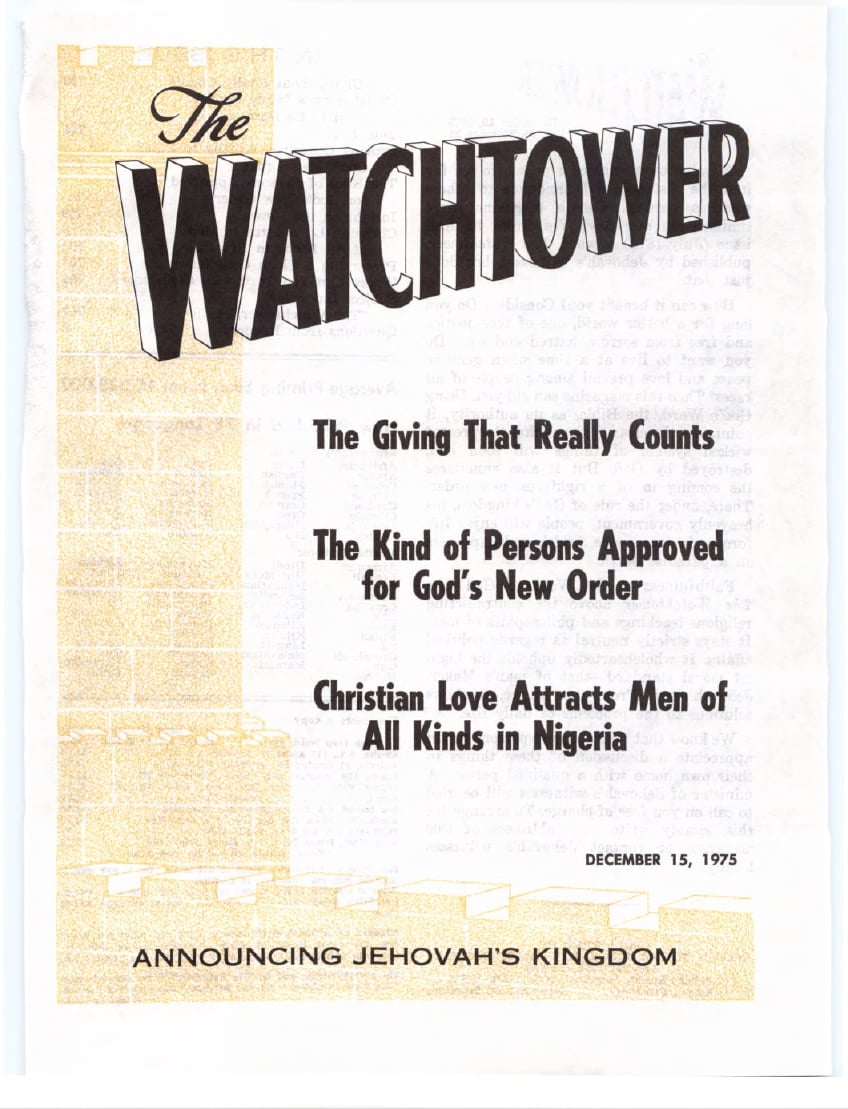
The Watchtower — December 15, 1975
Source: jw.org
Contents
The Giving That Really Counts
Christendom’s “Holy Place” Soon to Be Desolated
Your Soul
Proving Ourselves Worthy to Enter God’s New Order
The Kind of Persons Approved for God’s New Order
Insight on the News
Christian Love Attracts Men of All Kinds in Nigeria
Preserving a Clean Conscience
Where Can You Turn with Confidence?
Subject Index for “The Watchtower,” 1975
Questions From Readers
Visit Distant Lands
The Giving That Really Counts
The Giving That Really Counts
WHO does not appreciate receiving a present from someone who has no ulterior motives? Unselfish giving has real heart appeal. But what about the giving that is part of the Christmas celebration? Is it free from selfish motives? More important, does it meet the noble requirements that the Bible sets for those giving presents? Does it actually count with God?
Many people take for granted that the giving of Christmas presents is in harmony with the Scriptures. This is because they believe that Christmas is a “holy day” that honors Christ and that three “wise men” brought presents for the infant Jesus. But is this the case? What really are the origins of Christmas?
An editorial in the December 1974 issue of MD, a medical journal, stated: “This festive occasion, which in some countries is still regarded as a holy day and not merely as a holiday, combines both religious and secular customs, most of which are drawn from pagan and mythical sources. . . .
“December 25 was originally a sun feast, motivated by the fear of man, whose life depended on the light and warmth of the sun, that the golden-orbed god would not return from his yearly journey into the heavens. . . . In the icy northern lands, the winter solstice was the moment for lighting huge bonfires to lend strength to the winter sun and bring it back to life. The idea of the winter solstice—the return of light—was eventually crystallized in the symbol of the birth of Christ, the Light of mankind. In the fourth century the Fathers of the Church chose the winter solstice as the best date to celebrate the birth of Christ, thus uniting it symbolically with a date of tremendous pagan importance.”—P. 13.
Since the Christmas celebration has ancient non-Christian roots, reasonably we should not expect its features to be in harmony with God’s Word. But might not the characteristic giving of presents be an exception?
There are persons who think that the gifts brought by the “wise men from the east” to the young child Jesus provide the basis for giving Christmas presents. (Matt. 2:1, Authorized Version) The Bible account reads: “When they went into the house they saw the young child with Mary its mother, and, falling down, they did obeisance to it. They also opened their treasures and presented it with gifts, gold and frankincense and myrrh.” (Matt. 2:11) However, these “wise men,” actually an unspecified number of astrologers, simply did what was then customary when visiting someone of note—in this case “one born king of the Jews.” (Matt. 2:2) Regarding the origin of giving Christmas presents, The Encyclopedia Americana (1959 edition, Vol. VI, p. 622) says that from the Roman feast honoring the god Saturn, celebrated toward the end of December, “were derived the elaborate feasting, the giving of gifts, and the burning of candles.”
In view of the ancient idolatrous background of giving Christmas presents, would one’s sharing in it result in favorable recognition from God? How could that be the case when his Word condemns mixing true worship with the darkness of idolatry? We read: “What sharing does light have with darkness? Further, what harmony is there between Christ and Belial [Satan]? Or what portion does a faithful person have with an unbeliever? . . . ‘Therefore get out from among them, and separate yourselves,’ says Jehovah, ‘and quit touching the unclean thing.’”—2 Cor. 6:14-17.
Also, in other respects Christmas giving falls short of what the Scriptures recommend to those who give. Often such Christmas giving is merely an exchanging of gifts. Few persons present gifts with no intent of getting anything back. They do not give for the sheer joy of giving and contributing to the happiness of someone else. Their actions prove that they do not appreciate the words of Jesus Christ, the one whom they profess to honor. Jesus said: “There is more happiness in giving than there is in receiving.”—Acts 20:35.
Instead of being a celebration that lifts the spirits of people as a result of their sharing in unselfish giving, Christmas frequently has the very opposite effect. It may result in worry, disappointment and displeasure as a result of what is given and received. “Even for the ‘normal’ individual,” writes Doctor Felix Marti-Ibañez, “Christmas is a period of intensification of many conflicts: dread of solitude, financial, social, and emotional insecurity—in effect, fear of life.”—MD, December 1974, p. 14.
Because of feeling pressured to give, many people find no joy in it. They give simply out of a sense of duty. This, too, is out of harmony with Bible principles. The Scriptures tell us: “Let each one do just as he has resolved in his heart, not grudgingly or under compulsion, for God loves a cheerful giver.”—2 Cor. 9:7.
Giving that counts with God should also be without any showy display. The giver should not call attention to himself. Jesus Christ urged: “When making gifts of mercy, do not let your left hand know what your right is doing, that your gifts of mercy may be in secret; then your Father who is looking on in secret will repay you.” (Matt. 6:3, 4) Have you not found that this principle is often ignored at Christmastime?
Some persons, of course, may be rightly motivated in their giving. But far too many give just because they feel obligated to do so. Theirs is not the unselfish, openhearted giving that the Bible recommends. Furthermore, regardless of what the motivation may be, Christmas giving perpetuates a practice rooted in ancient idolatry. This is something the Scriptures specifically condemn. How, then, could Christmas giving possibly count with God?
If you want your giving to be acceptable from God’s standpoint, does this not bring you face to face with a decision? Should you not want to discard any practices associated with idolatry? At the same time, would you not find real delight in giving at other times of the year, not under compulsion, but cheerfully, from the heart?
Christendom’s “Holy Place” Soon to Be Desolated
Christendom’s “Holy Place” Soon to Be Desolated
THE destruction of religious buildings during wars, earthquakes, storms or the like comes as a great shock to many religious people. And even persons who may not view the ruined structures as sacred may be saddened by the fact that impressive works of art have been destroyed. How great, then, would be the shock if all of Christendom’s sacred edifices were suddenly to come to nothing! Surprising as that may seem, the Bible indicates that this will soon occur.
This future event had a historical parallel in the first century C.E. At that time Jerusalem and its glorious temple were utterly destroyed. No longer could Aaronic priests sacrifice at the altar. Gone, too, were the records on the basis of which a man might establish his descent from Aaron and claim a legitimate right to serve as priest. The Jewish system of things that had existed for centuries definitely ended. Since the destruction of Jerusalem in the first century C.E., the Jews have been unable to carry out their worship in the manner set forth in the Mosaic law.
Jesus Christ, the greatest prophet ever to walk the earth, foretold this startling development. Regarding what would befall Jerusalem, he said: “They will not leave a stone upon a stone in you.” (Luke 19:44) Another time, with reference to the temple, Jesus noted: “By no means will a stone be left here upon a stone and not be thrown down.”—Matt. 24:2.
So that his disciples might escape that terrible calamity, Jesus Christ gave this admonition: “When you catch sight of the disgusting thing that causes desolation, as spoken of through Daniel the prophet, standing in a holy place, (let the reader use discernment,) then let those in Judea begin fleeing to the mountains.”—Matt. 24:15, 16.
It was in 66 C.E. that Jesus’ words could first be acted upon. In that year the Roman armies under Cestius Gallus stood in a “holy place,” that is, Jerusalem and its environs. (Compare Matthew 4:5; 27:53.) The Roman armies got into the city itself and even began undermining the temple wall—an act that meant assailing what the Jews considered to be very “holy.” Actually, Jerusalem and its temple had already lost a sacred standing with God. As Jesus Christ had said earlier: “Jerusalem, Jerusalem, the killer of the prophets and stoner of those sent forth to her—how often I wanted to gather your children together in the manner that a hen gathers her brood of chicks under her wings, but you people did not want it! Look! Your house is abandoned to you.”—Luke 13:34, 35.
Yet, to the Jewish people Jerusalem still was a “holy place.” The presence of the Roman armies in this “holy place” was, therefore, disgusting. Furthermore, the Roman armies were not acting out of any love for the true God in coming against Jerusalem. Rightly, then, the Roman armies were prophetically designated as the “disgusting thing.”
A FUTURE FULFILLMENT IN OUR DAY
The prophecy involving ancient Jerusalem is not limited to the time when the Roman armies came against the city and then withdrew, enabling Christianized Jews to flee to the mountains before the ‘disgusting desolator’ returned and destroyed the city in 70 C.E. A consideration of the rest of Jesus’ words (in Matthew chapter 24) reveals that they have a future application, for he spoke about his coming “with power and great glory.” The effect of that coming would be to cause “all the tribes of the earth” to beat themselves in bitter lamentation due to the calamitous results of having failed to submit to him as King. (Matt. 24:30) Such a thing did not happen in connection with the destruction of Jerusalem in the year 70 C.E.
Hence, what befell ancient Jerusalem must have been prophetic of a far greater tribulation to come upon the entire human system of things, causing those who are adversely affected thereby to give way to bitter lamentation. That coming tribulation will, in the fullest sense, fit Jesus’ description: “There will be great tribulation such as has not occurred since the world’s beginning until now, no, nor will occur again.”—Matt. 24:21.
Accordingly, ancient Jerusalem must have a modern counterpart. What might that be? The city of Jerusalem had a sacred status because of its being the religious center of a people who claimed to be in a covenant relationship with God. So the modern counterpart must likewise claim to enjoy a covenant relationship with the Most High. Do not the religious systems of Christendom claim to be Christian and, hence, parties with God in the “new covenant”? (Heb. 9:15) But does not their course of action reveal that they, like unfaithful Jerusalem, are false to their claim?
Christendom has made herself a friend of the world. She has willingly participated in the world’s wars and in its corrupt politics. God therefore views her as unclean. The Bible says: “Adulteresses, do you not know that the friendship with the world is enmity with God? Whoever, therefore, wants to be a friend of the world is constituting himself an enemy of God.” (Jas. 4:4) Accordingly, Christendom is a part of the worldwide religious system that is spoken of in Scripture as a “harlot,” “Babylon the Great.” (Rev. 17:1-5) But what is Christendom’s “holy place”?
CHRISTENDOM’S “HOLY PLACE”
This is a symbolic place representing everything that the religions of Christendom control and hold sacred—their whole field of operation and claimed religious rights. Christendom’s clergymen have considered themselves to be God’s special representatives toward the people and, hence, entitled to the treatment of a privileged class, exempt from duties and responsibilities to which the rest of the population may be subject. Contrary to Jesus’ admonition not to take to themselves such titles as “Rabbi,” “Leader” and “Father,” they regard it as their right to be addressed as “Father,” “Reverend” and the like. (Matt. 23:8-10) The religious systems of Christendom have constructed magnificent buildings throughout the earth. They have also amassed great wealth in other forms. In many lands, these vast holdings are, by reason of their claimed sacred status, exempt from the assessments and taxes imposed upon businesses in general.
Christendom’s “holy place,” however, will soon be invaded and destroyed. It is no more sacred in the eyes of God than were Jerusalem and her temple prior to their destruction in 70 C.E. The religions of Christendom will be deprived of their field of operation, losing control of everything. No respect will be shown for any of their claimed religious rights. Who or what will be the ‘disgusting desolator’ that will soon take a stand in Christendom’s “holy place” and bring it to ruin?
THE DISGUSTING DESOLATOR
The Bible points to an organization reflecting the flaws and weaknesses of the entire present-day political system. This organization is spoken of as being the “image of the wild beast” and is itself referred to as a “scarlet-colored wild beast.” (Rev. 13:15; 17:3) The “wild beast” of which the “scarlet-colored wild beast” is the “image” is described in Scripture as being “like a leopard,” having feet “as those of a bear” and a mouth “as a lion’s mouth.” (Rev. 13:2) By comparing this description with what is stated at Daniel 7:3-7, 17-23, we can see that the “wild beast” is a combination of beasts, such as those mentioned in the book of Daniel. Those beasts are specifically identified as kings or kingdoms.
Therefore, the “wild beast” out of the “sea” must represent the global political system made up of the “kings” or ruling powers on earth. It is said to have “ten horns and seven heads, and upon its horns ten diadems, but upon its heads blasphemous names.” (Rev. 13:1) So it is Satan’s agelong political organization that has always blasphemed the true God.
The identification of the “wild beast” provides the key for determining the identity of its “image.” What organization today is the “image” or reflection of the worldwide political system? Is it not the United Nations organization? Does not that organization mirror the flaws and imperfections of the world’s political system?
The Bible speaks of a harlot, “Babylon the Great,” as riding on the back of the “scarlet-colored wild beast,” or the political “image” of the “wild beast,” that is, the United Nations of today. When the United Nations organization came into existence, “Babylon the Great,” of which the religions of Christendom are a dominant part, gave her support to it, viewing it as man’s only hope for peace and security. She looked to that organization to prevent conflicts that could result in her annihilation. In this way the United Nations organization has proved to be like a mount under her. She has depended upon it as does a rider upon his horse.
“Babylon the Great,” however, will experience bitter disappointment. She will become an object of hatred. With reference to what the “scarlet-colored wild beast” will do to her, Revelation 17:16 says: “The ten horns that you saw, and the wild beast, these will hate the harlot and will make her devastated and naked, and will eat up her fleshy parts and will completely burn her with fire.”
According to Revelation 17:12, the “ten horns” are “ten kings.” Ten being a number of completeness in the symbolic language of the Bible (comparable to ten toes and ten fingers), a complete number of earthly rulers, not a minority, will turn against the religions of Christendom and the rest of “Babylon the Great.” But not just the symbolic “ten kings” will take such aggressive action. The entire organization represented by the “scarlet-colored wild beast” (the United Nations) will do so.
In acting against Christendom’s religions, the ‘desolator’ will not be acting out of any love for God. But God will maneuver it to serve his purpose in destroying religions that are “Christian” in name only. The motivations of the desolator will be totally selfish. It has utter contempt for Christendom’s church systems. But since these religious organizations claim to represent the true God, the desolator will act also in hatred against the One whom they pretend to serve. This vicious, beastly attitude against God and its ‘blaspheming’ his name make the desolator a “disgusting thing” from Jehovah’s viewpoint.
ACT NOW
The very fact that “Babylon the Great” and the “disgusting thing” can be identified shows that there is no time to lose in getting out of Christendom’s religious organizations. This is not a flight to another geographical location, as in the first century C.E. “Babylon the Great” is not confined to one geographic location but is a worldwide religious empire. Hence, fleeing from the religious systems of Christendom means severing all connections with them and identifying oneself as being a true disciple of the Lord Jesus Christ.
No one should delay his flight until the “disgusting thing” actually starts to invade Christendom’s “holy place.” There being no necessity to flee to another geographical location, a person should not expect a historical development corresponding to the Roman armies’ abandoning the siege of Jerusalem in 66 C.E. The appearance of the Roman armies and their withdrawal positively identified the “disgusting thing” and enabled Christianized Jews to act in harmony with Jesus’ admonition to flee.
Today, once a person has identified Christendom’s religious systems as part of “Babylon the Great” and recognizes that the “disgusting thing” is about to stand in her “holy place,” he should act on the command found at Revelation 18:4: “Get out of her, my people, if you do not want to share with her in her sins, and if you do not want to receive part of her plagues.”
Is this what you have done? If not, do not delay. Christendom’s holy place—her field of operation and her claimed religious rights—is soon to be desolated.
[Picture on page 742]
The destruction of Jerusalem and its temple by the Roman armies in 70 C.E. was prophetic of a greater tribulation soon to come upon Christendom
Your Soul
Your Soul
◇ Most churches of Christendom teach that you have a soul within you that survives the body and goes on to the spirit realm. But is this doctrine based on the inspired Scriptures?
In the recent book Western Civilization: Its Genesis and Destiny, Professor Norman F. Cantor, admitted that it is not:
“Christian thinkers of the second century, particularly those in Alexandria, emulated Philo’s attempt to synthesize Platonism and Judaism. . . . Their God was pure spirit; man was a union of spirit and matter, of soul and body; and salvation was made possible by the separation of the soul from the body and its flight to join the angelic hosts surrounding the God-Spirit. This view was a marked departure from Hebraic thought, which viewed man as nefesh [soul], the whole, undifferentiated human being.”
The fact is that the entire Bible teaches that man is a soul and that the prospect for future life for one who dies depends upon a future resurrection.
Proving Ourselves Worthy to Enter God’s New Order
Proving Ourselves Worthy to Enter God’s New Order
“Since you are awaiting these things, do your utmost to be found finally by him spotless and unblemished and in peace.”—2 Pet. 3:14.
1. What can discontents with the old order not do about it, but what can God do?
DISCONTENT with the existing old order of things is widespread throughout the earth. Many radically minded persons call it “the establishment” and protest against it. Many of such want to destroy it. However, they find themselves having nothing suitable with which to replace it. They can contrive nothing new and better as a substitute. If they destroyed the established old order, it would leave only ruin. Happily, there is someone higher than man who also is not satisfied with the old order on earth. He is able, not only to destroy the old order completely, but also to replace it with an order brilliantly new for mankind. He is the Almighty God, the Creator of the heavens and the earth.
2. What has this Almighty God promised to do about it, and where do we find his promise written down?
2 This same God has promised both the removal of the oppressive, death-dealing old order from this earth and the setting up of a righteous, life-giving new order that will satisfy the needs and rightful desires of all mankind. The divine promise of this marvelous change in human affairs we find written down in the Book of which God is the Author, the Holy Bible. One first-century Bible writer referred to that precious promise when he wrote the words: “But there are new heavens and a new earth that we are awaiting according to his promise, and in these righteousness is to dwell.”—2 Pet. 3:13.
3, 4. (a) What question arises about us as regards that divine promise? (b) What kind of experience will it be for mankind when Revelation 21:3-5 is fulfilled toward them?
3 The first-century readers of those confident words of the Christian apostle Peter were indeed eagerly waiting for the promised “new heavens and a new earth” from a God who does not lie. His promise still stands true today! Hence, the question is, Do we also believe it? If we claim to do so, are we likewise awaiting such righteous “new” things? With credit to the God whose promise never fails, we ought to be doing so. (Josh. 21:45; 23:14; Titus 1:2) Really, we should be delighted, because the “new heavens and a new earth” are almost upon us! Certainly we need them as never before! Those new things symbolize God’s righteous new order. It will truly be something “new.” Thus far men have never seen anything like it. It will undeniably be a new experience for mankind when the words near the close of the Bible are fulfilled:
4 “‘And God himself will be with them. And he will wipe out every tear from their eyes, and death will be no more, neither will mourning nor outcry nor pain be anymore. The former things have passed away.’ And the One seated on the throne said: ‘Look! I am making all things new.’ Also, he says: ‘Write, because these words are faithful and true.’”—Rev. 21:3-5.
5. How do promises of politicians prove to be in contrast with God’s promises?
5 Sadly mankind have found the ambitious promises of their vote-seeking politicians to be hollow, empty, exaggerated, unrealizable and not deserving of trust and confidence. In sharp contrast to that, the promises of the Creator of the “new heavens and a new earth” will prove to be “faithful and true.” We can await what He has promised with no possibility of our being disappointed.
THE OLD MUST GIVE WAY TO THE NEW
6, 7. What do many people religiously believe about the old order, and of what Book and its Authorship are they ignorant?
6 For thousands of years now the old order of things has prevailed over the earth. That has been long enough for the people to get sick and tired of it. Countless millions of mankind religiously believe that the old order is man’s fate, his unchangeable destiny. They resign themselves to it in hopeless despair. Such religious persons do not know the Holy Bible. They do not know the divine Author of the Bible. Surprisingly many do not even know his name. They know the personal names of the non-Biblical gods whom they have been taught to worship, but not the personal name of the Bible’s God. Still, His name is there in the Book. To find it, they merely have to take the most popular English translation of the Holy Bible, the Authorized Version, as authorized by King James I of Great Britain to be read in all the churches of the land, and turn to Exodus (the second book of the Bible), Ex chapter six, verses two and three. There they will read:
7 “And God spake unto Moses, and said unto him, I am the LORD: And I appeared unto Abraham, unto Isaac, and unto Jacob, by the name of God Almighty, but by my name JEHOVAH was I not known to them.”
8, 9. What is the name of “the most high over all the earth,” and how and why may we use his personal name?
8 If this one case of the divine name in their own copy of the Bible is not enough for them, they can turn to Psalm 83 Eighty-three, verse eighteen, and there they will read: “That men may know that thou, whose name alone is JEHOVAH, art the most high over all the earth.” They can also look up Isaiah 12:2 and Isa 26:4, AV.
9 So the personal name of the One who is God and “the most high over all the earth” is Jehovah. In the original Hebrew Scriptures, generally called the Old Testament, that divine personal name occurs around seven thousand times and is spelled with four Hebrew consonants. Since God’s own personal name is used so frequently in the Bible writings, we today are authorized to use that name, only in a reverential way, not taking it in vain. Thus we can designate the God whom we mean, the Bible God. His personal name is different from that of his beloved Son, Jesus, which name means “Jehovah Is Salvation.”
10. (a) God’s promise of new heavens and a new earth mean what for the old order of things? (b) Though not permitted to live till the entry of the promised “new” things, what did Peter encourage his readers to do?
10 The Heavenly Father, Jehovah, is the One who has promised the New Order, composed of “new heavens and a new earth.” As soon as He mentioned the new heavens and new earth, it meant that the old order of things, which never came from Jehovah God, was doomed to pass away. Is that not good news? (Compare Hebrews 8:13.) Ever since the giving of the divine promise, persons of true faith in the Giver of the promise have eagerly looked forward to his bringing in such a righteous new order. The apostle Peter and the congregations of Christians to whom he wrote his letter were among those who looked beyond the present and confidently waited for the setting up of the righteous new governmental “heavens” and the righteous new social “earth.” Because of what Peter’s Master, the Lord Jesus Christ, had told him, Peter himself did not expect to live to see that blessed day on earth. (John 21:18, 19; 2 Pet. 1:13-15) But he encouraged his readers to await the entry of the righteous new order. Peter’s inspired encouragement applies to us now, nineteen centuries later.
THE END OF THE OLD ORDER EXPECTED FIRST
11. What must be removed from the earth first, and how was it demonstrated this this is not too big a job for the Creator?
11 First, though, we must expect the end of the ungodly old order. From shortly after the worldwide deluge that engulfed the earth in the days of the prophet Noah, more than 4,300 years ago, a wicked old order has entrenched itself in the earth. So it does not propose to give up easily, without a fight. A fight against whom? Why, of course, against the Author of the New Order, the Creator of “new heavens and a new earth.” But the uprooting of the old order is not too big a job for the Almighty God to undertake. In the days of Noah this God showed his ability to destroy a whole world of mankind with one stroke, one “act of God” that was not an accident. Long previous, on the second day of His creative week, he caused a division of the waters so that great masses of water were suspended in space all around the globe, with an atmospheric expanse, or “firmament,” in between. (Gen. 1:6-8, AV) At his appointed time He caused those suspended waters to drop earthward. This produced a global cataclysm that drowned all earth’s human population except the eight human souls in Noah’s ark.—1 Pet. 3:20.
12. For how long at least did God show self-restraint in bringing the deluge, and what did the deluge destroy?
12 That global deluge was a punishment from Jehovah God. He had patiently held back from inflicting that punishment for at least 120 years. (Gen. 6:1-3) The apostle Peter especially pointed up this self-restraint on God’s part, when he wrote: “He did not hold back from punishing an ancient world, but kept Noah, a preacher of righteousness, safe with seven others when he brought a deluge upon a world of ungodly people.” That this meant a world destruction, the apostle Peter emphasizes again when he adds: “And by those means the world of that time suffered destruction when it was deluged with water.”—2 Pet. 2:5; 3:6.
13. How do the “ancient world” and the present “world,” or human society, compare when God’s long-suffering is taken into account?
13 Thus the “ancient world,” the first society of mankind, lasted for about 1,656 years after man’s creation. As for this present “world,” or human society, God’s patience with it has lasted much longer, for about forty-two centuries or since the “act of God” in confusing the language of the builders of the tower of Babel. (Gen. 10:8-10; 11:1-9) The “ancient world” of Noah’s day was buried in a watery grave because it was “ungodly.” It had filled the earth with violence. It was ruining the earth and not subduing it to a paradisaic beauty. “The badness of man was abundant in the earth.” (Gen. 6:5-9, 12, 13) It deserved to be destroyed.
14. Why were Noah and his family counted worthy to survive the deluge?
14 Why, then, were Noah and his family counted worthy to be spared through the deluge and to enter the post-deluge period? It was because Noah led his family in ‘walking with the true God,’ not with the ungodly world. God found Noah to be righteous, “faultless among his contemporaries.” He was a “preacher of righteousness.” He had exemplary faith in God. That was why he obediently built the ark for the preserving of his household alive.—Gen. 6:9 through 7:1; Heb. 11:7.
15, 16. (a) What is the lesson here to be learned, with application to the present? (b) How did Jesus foretell the end of a world on a global scale?
15 Let us not miss the lesson here set forth: It is possible for Jehovah God to bring to an end a whole world of bad human society and, more than that, to preserve approved human individuals through such an end of a world. (2 Pet. 2:9, 10) The end of a world that will likewise be global in extent is ahead of us today. God’s own Son, Jesus Christ himself, foretold it, saying:
16 “Moreover, just as it occurred in the days of Noah, so it will be also in the days of the Son of man: they were eating, they were drinking, men were marrying, women were being given in marriage, until that day when Noah entered into the ark, and the flood arrived and destroyed them all. . . . The same way it will be on that day when the Son of man is to be revealed.”—Luke 17:26-30; Matt. 24:37-39.
17, 18. Why did the “ancient world” not take heed to God’s warning by means of Noah, and when was divine judgment revealed?
17 Back there in the year 2370 B.C.E., the ungodly people did not believe the evidence that was before their eyes that the end of their “ancient world” was at hand. To them it seemed improbable, most unlikely, impossible! That man Noah was warning them of a natural phenomenon that was too colossal for them to believe. So why worry?
18 Life till then had continued on just normally for them, with eating, drinking, and marrying so as to produce the next generation. They did not take into account any day of reckoning at God’s hand for all their badness, the violence with which they were filling the earth, the manner in which they were ruining the earth, and their selfish way upon the earth. Noah’s completing of the ark and his bringing of the basic bird and animal kinds into the ark lent no weight to Noah’s warning for them. They showed a complete lack of faith. So they stood out condemned in God’s sight, in contrast with Noah’s course of faith backed up by works. Finally, the seventeenth day of the second lunar month (likely Bul, which means “Rain”) of the year 2370 B.C.E. arrived. Then the destructive judgment of Noah’s God was revealed to that “world of ungodly people.”—Gen. 7:11-17; 2 Pet. 2:5.
19. If we desire to be like Noah in surviving the end of a world, what more is required than merely wishing to escape destruction with this system of things?
19 Do we today desire to be like Noah and his family in surviving an end of a world and to enter into God’s righteous new order, to enjoy the “new heavens and a new earth”? For us to be counted worthy of such a privilege, there is more to the matter than merely wishing to escape destruction with the “present wicked system of things.” (Gal. 1:4) We have to resemble the family of Noah, the “preacher of righteousness,” in their days before the global deluge. Noah had to do works of faith besides preaching righteousness and sounding the warning of world destruction. Should less be expected of us, who now find ourselves in the “conclusion of the system of things,” according to Jesus’ prophetic description of the eventful period of time through which we have passed since 1914 C.E.? No! Not if the modern-day antitype is to match the ancient type of Noah’s day.—Matt. 24:3-39.
20. In reminding us of what to do, what argument does Peter use with regard to God’s ability to deal with righteous and unrighteous people?
20 What we need to do is the very thing of which the apostle Peter reminds the readers of his second letter to Christian believers. Building up an argument upon God’s execution of judgment upon wicked angels and men, Peter writes: “If he did not spare the ancient world but kept Noah, the herald of righteousness, safe with seven others, when he let loose the deluge on the world of impious men: . . .—then be sure the Lord knows how to rescue the godly from trial, and how to keep the unrighteous under punishment till the day of doom, particularly those who fall in with the polluting appetite of the flesh and despise the Powers celestial.”—2 Pet. 2:5-10, Moffatt.
DIVINE PROGRESS TOWARD JUDGMENT DAY NOT SLOW
21. Why does this generation think that destruction for them is slumbering and that God is slow about executing judgment?
21 Toward the end of two hundred years after the Noachian deluge, Noah’s descendants in general began to forget God’s worldwide execution of judgment upon impious, ungodly people. They then built up a human society in rebellion against Jehovah God as the Universal Sovereign. The notorious city named Babel (or, Babylon) became a symbol of such God-defying human society. (Gen. 10:8-10) That was thousands of years ago. So this world of mankind that ignores the Supreme Judge, who let loose the deluge upon the “ancient world,” has been permitted to live for a long time by now. It is a long time even when measured from the founding of Christendom in the days of Emperor Constantine the Great, in the fourth century of our Common Era. Furthermore, in our own generation, it has already been sixty-one years since the start of the “time of the end” in the year 1914 C.E. (Dan. 12:1-4) Consequently, the hypocritical religionists of Christendom may incline to think that God’s judgment is slow in moving toward execution and that their destruction is slumbering. They think that, despite their religious hypocrisy with regard to the God of the Bible, he will not repeat his performance of the destruction of a whole world of rebellious humans.
22. According to what patterns of dealing with peoples in the past will God not spare the present-day world of mankind?
22 Today, the wise thing for us to do is to take to heart the inspired words of the apostle Peter, when he wrote: “But as for them, the judgment from of old is not moving slowly, and the destruction of them is not slumbering.” (2 Pet. 2:3) According to all the evidence viewed in the light of the inspired Scriptures, the hour is very late. God’s tolerant long-suffering is about to reach its limit. Just so certainly as He did not spare angels who became disobedient during the years before the deluge, and just so surely as he did not spare the materialistic world of ungodly people in the days of Noah, and just so certainly as he did not spare the immoral cities of Sodom and Gomorrah in the days of Abraham and his nephew Lot, just so surely this God of unchanging standards of righteousness will not spare the present-day world of faithless, self-centered people.
23, 24. (a) Why should we not conclude that God has no fixed time schedule in this regard? (b) For what did God’s exercise of long-suffering in the days of Noah allow?
23 Just because this world has not been told in the Bible the exact day and hour for the “Judge of all the earth” to execute his sentence of destruction upon this system of things, it is not a case of His having no fixed time schedule.—Gen. 18:25.
24 This is not a case of legal matters moving very slowly for the carrying out of justice, as in modern-day lawcourts. It is not a case of God’s slumbering upon the judicial bench or of his being fast asleep, with regard to bringing destruction on the “present wicked system of things.” (Gal. 1:4) His appointed time for this has not been set at a date before now because He has been long-suffering, “slow to anger.” (Ex. 34:6) Happy can all of us today be because of God’s timing of events that way! Why so? For the good reason that it has allowed for our getting saved. It is as in the days of Noah, when God’s allowing of 120 years until the deluge afforded the opportunity for Noah and his wife to have three sons and for these to grow up and marry three girls and then for all eight of them to join in building the ark and to bring creature life into it for salvation.—Gen. 6:3 through 7:10; Ps. 103:8.
25. How do people belonging to the old order and those desiring God’s new order take advantage of his long-suffering?
25 The ungodly world of today takes advantage of God’s long-suffering to enjoy that much longer their selfish pleasures in the corrupt old order. Those who long for God’s righteous new order take advantage of His ‘slowness to anger’ to repent of their death-dealing works and to prove worthy of salvation into His new order. They take the viewpoint that the apostle Peter sets out in these words: “Jehovah is not slow respecting his promise, as some people consider slowness, but he is patient with you because he does not desire any to be destroyed but desires all to attain to repentance.”—2 Pet. 3:9.
26, 27. (a) The repentance here referred to has relationship to what? (b) How did Jesus show that this was the kind of repentance he had in mind?
26 Have we attained to repentance? When asking this, we do not mean ordinary repentance as over some wrong done, as when Jesus referred to a repeated offender, saying: “Even if he sins seven times a day against you and he comes back to you seven times, saying, ‘I repent,’ you must forgive him.” (Luke 17:4) Rather, the repentance spoken of in 2 Peter 3:9 has to do with one’s course of action regarding the kingdom of God, the government in which Jesus Christ is assigned to be King over all mankind.
27 Such repentance in connection with the heavenly Messianic kingdom of God, Jesus had in mind, according to the record of Matthew 4:17, where we read: “From that time on Jesus commenced preaching and saying: ‘Repent, you people, for the kingdom of the heavens has drawn near.’” (See also Mark 1:14, 15; Matthew 3:1, 2.) In harmony with such a record regarding repentance, we are told that Jesus Christ sent out his twelve apostles by twos to preach as he himself did, “The kingdom of the heavens has drawn near.” Accordingly, “they set out and preached in order that people might repent.”—Matt. 10:1-15; Mark 6:7-12.
28. How did Peter and Paul point to the urgency of the repentance in connection with God’s Messianic kingdom?
28 Back there it was urgent that the Jewish people should repent in connection with the Messianic kingdom. Hence, Jesus said to them: “Unless you repent, you will all likewise be destroyed.” (Luke 13:1-4) On the day of Pentecost of the year 33 C.E., the apostle Peter said to thousands of inquiring Jews: “Repent, and let each one of you be baptized in the name of Jesus Christ for forgiveness of your sins.” (Acts 2:1-38) Later, Peter gave similar counsel to the Jews at Jerusalem’s temple, according to Acts 3:19-23. Repentance in the face of God’s Messianic kingdom was also stressed by the apostle Paul. For example, in Athens, Greece, after “declaring the good news of Jesus and the resurrection,” Paul said to the Court of the Areopagus on Mars Hill: “God has overlooked the times of such ignorance, yet now he is telling mankind that they should all everywhere repent. [Why?] Because he has set a day in which he purposes to judge the inhabited earth in righteousness by a man whom he has appointed, and he has furnished a guarantee to all men in that he has resurrected him from the dead.”—Acts 17:16-31. See also Acts 26:20; Romans 2:4.
29. (a) So, what is our first step toward proving ourselves worthy to enter God’s new order? (b) According to Peter, is attaining to repentance the end of the matter?
29 So, the matter is not open to question: Our first step towards proving ourselves worthy to enter God’s righteous new order is that of repentance, and this with regard to God’s Messianic kingdom. Only through God’s appointed king for that government, Jesus Christ, can persons who repent gain God’s forgiveness of their sins. (Acts 2:38) By means of that Messianic kingdom God will vindicate his universal sovereignty, and men must repent of having been under the sovereignty of God’s great Adversary, Satan the Devil. Have all of us, in harmony with God’s desire for us, attained to such repentance? If we can answer Yes, then, according to the apostle Peter, we are on the way to do what more remains to be done if we want to get God’s final approval. We can take advantage of his tolerant long-suffering that he is exercising toward this wicked old order of things. Thus we can make sure of His final approval. This will mean salvation for us.
[Pictures on page 748]
Noah led his family in worship
He was a ‘preacher of righteousness’
He obediently built the ark
The Kind of Persons Approved for God’s New Order
The Kind of Persons Approved for God’s New Order
1. Although foreseeing the violent end of the old order, why do we not need to be troubled at the prospect of disagreeable situations then?
PERSONS who really believe in the early passing away of today’s old order ought to be preparing themselves for God’s New Order. They foresee the violent end of the present governmental “heavens” and the present social “earth” beneath. But such a prospect does not frighten them. From the Holy Bible they understand just what the “end” means, how it will come about and what the purpose of it is. They eagerly desire and confidently expect “new heavens and a new earth” as guaranteed by God’s promise. This counterbalances all thoughts of disagreeable situations on earth that are bound to come with the end of the old order. Quite appropriately they call to mind Noah and his family. During the cataclysmic end of the “ancient world” of “ungodly people,” living conditions inside an ark loaded with animals and birds may not have been the most agreeable for Noah and his family for more than an entire lunar year. And yet those eight human souls survived. Thus they were able to give a righteous new start to the human family.
2. (a) Why is now none too early for us to prepare for God’s new order? (b) While doing what things do we not need to fear the arrival of Jehovah’s “day”?
2 God’s new order, as represented by the “new heavens and a new earth” in which righteousness is to dwell, is something worth waiting for until God’s appointed time to establish it. (2 Pet. 3:13) Now is none too early for us believers to begin preparing for it, that we may be counted worthy to enter it to our everlasting benefit and joy. The apostle Peter reminds us of the need for being ready, especially since “Jehovah’s day” will come as a thief in the night, with destruction for the old order of things. Says Peter: “Since all these things are thus to be dissolved, what sort of persons ought you to be in holy acts of conduct and deeds of godly devotion, awaiting and keeping close in mind the presence of the day of Jehovah.” (2 Pet. 3:10-12) If we were to fear the arrival of Jehovah’s day with all its awesome accompaniments, we would not be awaiting it and keeping it close in mind, but would be wishing to postpone it into the indefinite future beyond our lifetime, beyond “this generation.” We shall not need to fear its becoming a present reality if we are sincerely performing “holy acts of conduct and deeds of godly devotion.”
3. In our repentance toward the God of the New Order, what have we done, and what do we desire in contrast with the unrighteousness of the old order?
3 Are we that “sort of persons”? Genuine repentance toward God, who has promised the righteous new order, should have led us to be that sort of persons, with works befitting repentance. In our repentance toward God we have dedicated ourselves to him through Christ and symbolized that dedication by water baptism. We have done so because we really love Jehovah God and we love the righteousness for which He stands. We want to be deserving of His new order of things. Due to the fact that this different order of things will present a combination of “new heavens and a new earth,” we love the righteousness that is to dwell in those new things. We wholeheartedly desire to be admitted into such a clean new order. We find no pleasure or satisfaction in the unrighteousness of the imperfect, corrupt, doomed order of things.
4. (a) How will the world try to get us away from our “holy acts of conduct and deeds of godly devotion”? (b) Under even what coming circumstances will we refuse to deal compromisingly with the world?
4 We are so devoted to the Creator of the “new heavens” and “new earth” that we disdain all popularity with the “world of ungodly people” and we seek his pleased approval of us. By ridicule or threats the world will try to frighten us away from “holy acts of conduct and deeds of godly devotion”; that failing, the world will try to allure us away from our righteous course that condemns it as out of harmony with God. But with our faces firmly fixed upon God’s new order of righteous living we do not let ourselves be attracted by what the doomed system of things has to offer. We forge right ahead in the holy pathway that God has marked out for us. Not for a moment may we throw our lot in with Christendom, the popular “friend of the world.” (Jas. 4:4) And when nominal Christianity, or Christendom, is turned upon by her alienated political lovers and is destroyed along with the rest of religious Babylon the Great, not for an instant will we consider a compromising treaty with those political despoilers of false religion.
5. Who alone, then, will survive the coming “great tribulation” into God’s precious new order?
5 We know that the “great tribulation” that is without parallel in human history is just ahead for both Babylon the Great and her political destroyers. (Matt. 24:3-22, 37-39) This global tribulation is meant to destroy them, not us, for it comes from the hand of the God whom we worship. It will destroy the symbolic “heavens and the earth that are now,” this old order. (2 Pet. 3:7) All the same, it will bring with it a climactic test of our faith in God and our devotion to him. Only Christian witnesses of Jehovah who successfully pass this test will survive and come forth like fire-refined gold for God’s use in his precious new order.
6. At the close of the “great tribulation,” what will God still have on earth to display as a trophy of his victory?
6 It is not God’s desire that those who turn to him in repentance and become baptized disciples of Jesus Christ should suffer everlasting destruction in the “great tribulation” of his “great day,” the “fear-inspiring day of Jehovah.” (Rev. 16:14; Joel 2:31) He has in mind repeating what he performed in the days of Noah, namely, the bringing of his faithful tested worshipers through the end of a “world of ungodly people.” (2 Pet. 2:5) The coming attack of the symbolic “Gog of the land of Magog,” long ago foretold, will fail to wipe out from the earth the regathered worshipers of Jehovah, but will be frustrated, crushed in disgraceful defeat. (Ezek. 38:1 through 39:26) After the frightful “great tribulation” is all past, God the Almighty will still have on the earth his preserved worshipers to display as a trophy of his glorious victory!
7. According to Peter, our being a part of God’s living trophy will depend upon our being found by Him in what state finally?
7 What a great privilege it will be for anyone to be a part of that living trophy testifying to Jehovah’s triumph in the “war of the great day of God the Almighty” at Har–Magedon! (Rev. 16:14, 16) As far as we are concerned, God’s assignment of this privilege will depend upon “what sort of persons” he finds us to be on that world-changing “day of Jehovah.” To true Christians who would like to survive the end of the doomed old order, the apostle Peter makes that vital requirement clear in these words: “Hence, beloved ones, since you are awaiting these things, do your utmost to be found finally by him spotless and unblemished and in peace. Furthermore, consider the patience of our Lord as salvation, just as our beloved brother Paul according to the wisdom given him also wrote you.” (2 Pet. 3:14, 15) How, then, can we be found in such an approved state?
“SPOTLESS AND UNBLEMISHED”
8, 9. (a) When is it a shame to be discovered with a spot on one’s person? (b) According to James 1:26, 27, how can one’s religion be spotted?
8 A spot visible on one’s person may spoil one’s personal appearance. If one got the spot while one was diligently engaged in a good work, it is not a disgraceful thing. Still, one would like to cleanse away the unsightly spot before presenting oneself to a clean-looking gathering of people. If, though, one gets the spot while engaged in a dishonorable work, then the spot in itself is to one’s discredit. It is a shame, a disqualification, to be discovered with it. There can be spots of the latter kind upon one’s religion, one’s form of worship. Is our religion or form of worship spotted in such a way? If it is, then it is not pleasing and acceptable to God. In proof of this fact, we read:
9 “If any man seems to himself to be a formal worshiper [or, to be religious] and yet does not bridle his tongue, but goes on deceiving his own heart, this man’s form of worship is futile. The form of worship [or, the religion] that is clean and undefiled from the standpoint of our God and Father is this: to look after orphans and widows in their tribulation, and to keep oneself without spot from the world.”—Jas. 1:26, 27.
10. Why could Christendom’s religion never be considered “clean and undefiled” from God’s standpoint?
10 Christendom, with her professed Christianity, is covered with spots from the world. In all the realm of religion, her record is the worst. She may boast of caring for orphans and widows in her orphanages and poorhouses, but this will not hide the glaring fact that she has made orphans and widows by the millions. Is it asked how? The answer is simple: It has been by crusades and wars that she has promoted, fomented and backed up with her blessing, her prayers, and her own manpower. Her meddling in worldly politics is notorious and is resented even by many politicians themselves. She has given herself over to unchristian worldliness and has become a financial parasite upon her church members. She has not bridled her tongue, but has taught all kinds of false, Babylonish doctrines, palming these off as Christian, and has spoken gross falsehoods about the true God and has brought terrible reproach upon his sacred name, and has lyingly accused his true worshipers. How, then, can her confusion of forms of worship be “clean and undefiled” from God’s standpoint? It could never be!
11. With whom do those desirous of practicing the “clean and undefiled” religion refuse to ally themselves, and what is God’s command for today on this score?
11 Persons who desire to be found “spotless” by Jehovah God when his day for executing judgment arrives cannot ally themselves with the professedly Christian section of religious Babylon the Great, the world empire of false religion. For persons to become spotless in this regard, God’s command for today is: “Get out of her, my people, if you do not want to share with her in her sins, and if you do not want to receive part of her plagues. For her sins have massed together clear up to heaven, and God has called her acts of injustice to mind.” (Rev. 18:4, 5) Because of her hypocrisy in the name of God and his Christ, Christendom is the most reprehensible member of that international harlot, Babylon the Great. Let none of us remain spotted up from her and share in her sins before God!
12. Of what spiritual adultery has Christendom not repented, and of what do her worldly associates not repent?
12 Let us recognize that Christendom is doomed, along with all the rest of Babylon the Great. She has refused to repent of her religiously immoral or adulterous course of action, her friendship with this world. (Jas. 4:4) She is like the rest of the ungodly world, even after Jehovah’s Christian witnesses have plainly declared God’s impending judgment to her. Prophetically, Revelation 9:20, 21 speaks of such sin-hardened people, saying: “The rest of the men who were not killed by these plagues did not repent of the works of their hands, so that they should not worship the demons and the idols of gold and silver and copper and stone and wood, which can neither see nor hear nor walk; and they did not repent of their murders nor of their spiritistic practices nor of their fornication nor of their thefts.”—See also Revelation 18:9, 11.
13. According to 2 Peter 2:20-22, who are like spots within the congregation, and how must such spots be disposed of?
13 All members of the true Christian congregation are anxious to keep the organization spotless in its form of worship. We do not care to have in our membership those who are spots on the organization. The apostle Peter speaks of such kind of undesirables in the Christian congregation, saying: “They are spots and blemishes, indulging with unrestrained delight in their deceptive teachings while feasting together with you.” (2 Pet. 2:13) If not sincerely repenting and turning around and away from deceptive teachings, these spot-like persons need to be dismissed from the congregation for the protection of the practicers of the true worship of God. Otherwise, in addition to being a danger to God’s flock of sheep, they are a reproach to the congregation.—2 Pet. 2:20-22.
14, 15. What does Jude 22, 23 say must be done with doubters and those guilty of an act of sexual immorality?
14 Surprising events in the world today may raise doubts in the minds of some in the congregation. There may be still others, who, in a moment of weakness or carelessness, commit an act of sexual immorality. The Bible writer Jude tells the congregation how to deal with such members, saying: “Also, continue showing mercy to some that have doubts; save them by snatching them out of the fire. But continue showing mercy to others, doing so with fear, while you hate even the inner garment that has been stained [or, spotted] by the flesh.”—Jude 22, 23; NW; Interlinear.
15 Here The New English Bible reads: “There are others for whom your pity must be mixed with fear; hate the very clothing that is contaminated with sensuality.” The New American Bible reads: “Even with those you pity be on your guard; abhor so much as their flesh-stained clothing.” An American Translation reads: “And look on others with pity mixed with fear, loathing even the clothes their animal nature has stained.” This warning the congregation must heed.
16. Why must the congregation feel cautious when having pity upon a repentant sinner who has committed an act of sexual immorality?
16 The congregation can never sympathize with sexual immorality if it wants to be found spotless by Jehovah at his day for executing judgment. It can be merciful and have pity for members who commit an act of immorality because of fleshly weakness or other influences. But these must give evidence of true repentance. Still, it is with great caution that the congregation must show mercy and forgive the repentant ones, always being in fear for itself, as it does not desire to weaken in its stand for righteousness in the midst of an ungodly generation that has sunk to depths of immorality such as brought Jehovah’s fiery judgments upon the ancient cities of Sodom and Gomorrah.—Jude 7; 2 Pet. 2:6-8; 1 Pet. 4:3, 4.
17. When the congregation examines the incriminating evidence of sexual immorality on the part of a member, how should it react to such evidence?
17 The congregation has to keep filled with God’s holy spirit and to cultivate its fruits, one of which fruits is moral self-control. (Eph. 5:18; Gal. 5:22, 23) Consistently, it must keep its distance from sexual immorality of all kinds. It does not look with amused curiosity or with corresponding sexual feelings upon an inner garment that is spotted with the evidence of sexual uncleanness on the part of its wearer. To the contrary, it hates, loathes, abhors an incriminating piece of clothing that needs to be washed from its sexual filth. Thus it fortifies its love of purity. It cannot, therefore, look with sexual gratification upon pornographic literature or movies or television.—Compare Leviticus 15:16, 17.
18. What exhortation, given at 1 Timothy 6:11-14, should elders or overseers take to heart?
18 Members of the congregation must be watchful also to keep spotless in the way in which they observe God’s commands for Christ’s followers. Elders or overseers, who imitate the overseer of the first century named Timothy, do well to take to heart what the apostle Paul wrote to Timothy as to Christian conduct, namely: “However, you, O man of God, flee from these things [the fatal consequences of materialism]. But pursue righteousness, godly devotion, faith, love, endurance, mildness of temper. Fight the fine fight of the faith, get a firm hold on the everlasting life for which you were called and you offered the fine public declaration in front of many witnesses. In the sight of God, who preserves all things alive, and of Christ Jesus, who as a witness made the fine public declaration before Pontius Pilate, I give you orders that you observe the commandment in a spotless and irreprehensible way until the manifestation of our Lord Jesus Christ.”—1 Tim. 6:11-14.
19. How, then, should we not want our record of obedience and performance to be?
19 Such a commandment to Christians we should want to obey in a manner that is “spotless and irreprehensible” before Jehovah God. We do not want our record of obedience to be spotty, having disfiguring black marks against us, and with much to be found fault with as to how we perform. We should do our utmost to show a sincere desire to be obedient at all times. Like the ark-builder Noah during the “time of the end” of the antediluvian system of things, we should take care to walk blamelessly with our God.—Gen. 6:3, 9.
HOW “UNBLEMISHED”?
20. How does a blemish compare with a spot on a person, and what about Jesus Christ in this regard?
20 Not only “spotless” but also “unblemished” is how we need to be found by Jehovah God finally at the arrival of His “day.” (2 Pet. 3:14) We know that a blemish is deeper than a spot. A spot is superficial and can be wiped off or cleansed away, but not so a blemish. This is a defect, a disfigurement that mars the physical perfection. It denotes that something on the inside is wrong, at fault. Jesus Christ was perfect through and through, and because of this he could offer himself as a ransom sacrifice for mankind, like an “unblemished and spotless lamb.”—1 Pet. 1:18, 19; Heb. 9:14.
…