The Watchtower, April 15, 1975
Download: PDF — The Watchtower, April 15, 1975
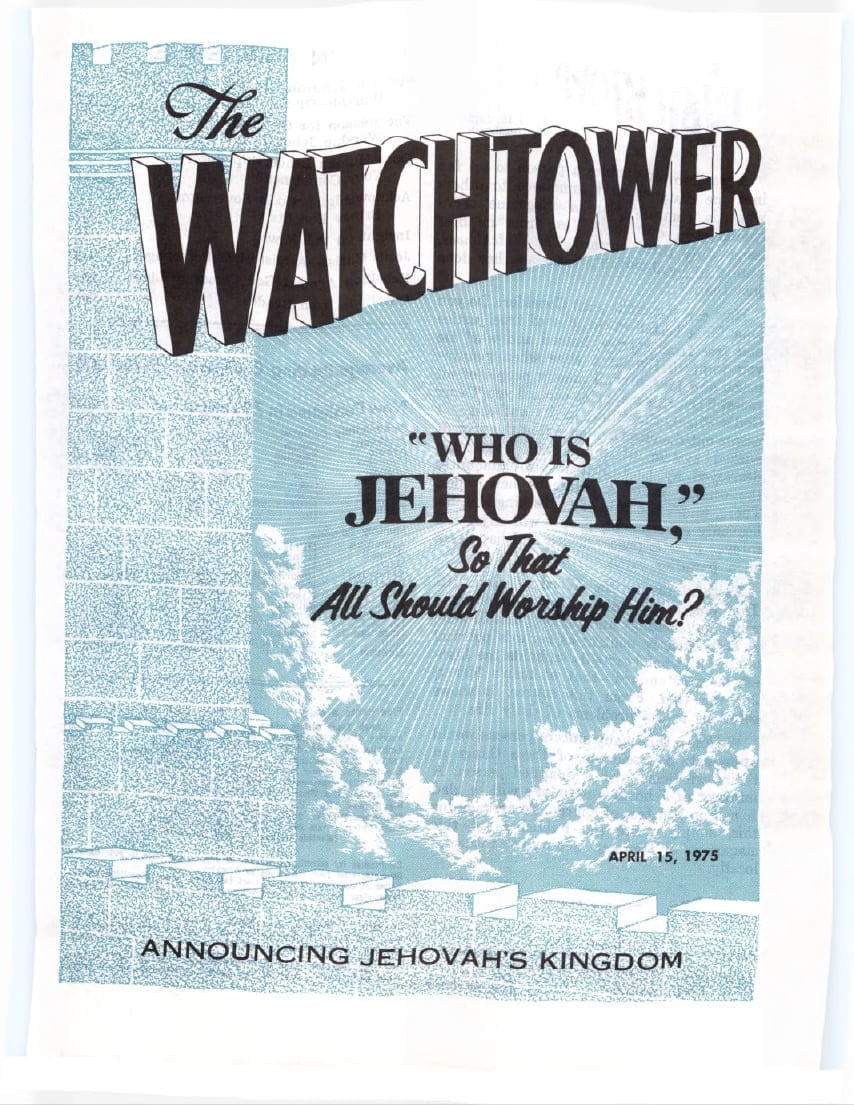
The Watchtower — April 15, 1975
Source: jw.org
Contents
“Who Is Jehovah,” So That All Should Worship Him?
The Reason for Choosing to Worship Jehovah
Does Human Leadership Deserve Your Confidence?
Acknowledging God’s Sovereignty Brings Benefits
Insight on the News
Jesus Christ—A Historical Personage
Rebellion Against God Comes to Light
Questions From Readers
What You Should Know About Drugs
“Who Is Jehovah,” So That All Should Worship Him?
“Who Is Jehovah,” So That All Should Worship Him?
1. What question about worship is a live and relevant one today, and why so?
FROM ancient time and until this twentieth century, heads of political states have been worshiped as gods. Persons familiar with human history know that. The royal Pharaohs of ancient Egypt were viewed as gods, each ruling Pharaoh being considered as the son of the Sun-god. Caesar Augustus, the first emperor of the Roman Empire, was deified after death; so were successors of his. Even during life, the emperors were addressed as “Your Divinity.” Almost two thousand years later, after the close of World War II in 1945, Emperor Hirohito of Japan publicly disclaimed being a god, the son of the sun-goddess Amaterasu. But some few diehards still hold onto emperor worship in that Land of the Rising Sun. In the face of all the gods and goddesses of nations ancient and modern, the question is a live and relevant one for even today, Who is the god worthy of being worshiped?
2. Since the beginning of the man-made political state, of what kind of worship have most people been guilty?
2 As time has gone on, one national god after another has been debunked. Not beyond our recollection is the recent case where Nikita Khrushchev of the Communist Party debunked the defunct dictator Joseph Stalin as the god of Soviet Russia. The debunking process becomes almost comic. But the worship of heads of political states has had serious consequences for the world of mankind. Untold numbers of people may think that they are now too intelligent, too modernized, to worship political gods. And yet, what about worship of the political State itself? Or of the worldwide political system of rulership? Since the beginning of man-made political states thousands of years ago, the vast majority of mankind has been guilty of such State worship. It is not stretching matters to say this.
3, 4. (a) How did the political State get started on earth, and why is there little left to argue against that fact? (b) How does John, in Revelation 13:1-8, picture the start of such state?
3 Nineteen centuries ago, a man who has gone down on the pages of history and whose writings have been read by hundreds of millions till now, used vivid symbols to show how worldwide worship of the human political system got started. It got started by someone whom this man, John the son of Zebedee, likened to a dragon, fiery red in color. John does not give to this dragon the meaning that the nation of China gives to its popular one-headed dragon. John uses the dragon as a symbol befitting a superhuman person, whom John identifies by the expression “the dragon, the original serpent, who is the Devil and Satan.” (Rev. 20:2; 12:3, 9) Is it sheer imagination, is it naïve to believe that the human system of politics originated with this one? When we consider how man-made political systems from times of old have governed and acted, there is little left to argue against the fact that the political system started with the dragonlike Satan the Devil. Let us note now how John pictures this:
4 Likening disturbed, discontented, self-seeking mankind in general to the restless sea, John proceeds to say: “And it [that is to say, the fiery-colored dragon] stood still upon the sand of the sea. And I saw a wild beast ascending out of the sea, with ten horns and seven heads, and upon its horns ten diadems, but upon its heads blasphemous names. Now the wild beast that I saw was like a leopard, but its feet were as those of a bear, and its mouth was as a lion’s mouth. And the dragon gave to the beast its power and its throne and great authority. And I saw one of its heads as though slaughtered to death, but its death-stroke got healed, and all the earth followed the wild beast with admiration. And they worshiped the dragon because it gave the authority to the wild beast, and they worshiped the wild beast with the words: ‘Who is like the wild beast, and who can do battle with it?’ . . . and authority was given it over every tribe and people and tongue and nation. And all those who dwell on the earth will worship it.”—Rev. 13:1-8.
5, 6. What does that oddly formed wild beast picture, in the light of Daniel’s dream of the wild beasts out of the sea?
5 People asked: “Who is like the wild beast?” So we ask: What does it picture? From John’s description of this symbolic wild beast and what happens to it, there can be no question about what it pictures.
6 The role that the wild beast plays in the book of Revelation shows what it pictures, the worldwide system of political rule over all mankind. The fact that the wild beast looked like a leopard but had bear’s feet and a lion’s mouth harmonizes well with the fact that the world system of politics has expressed itself through various forms of government at different times and places. Most likely John was led to think of what the ancient prophet Daniel saw in a prophetic dream: that first a lionlike beast came up out of the disturbed sea, and then a beast like a bear, and after it a beast like a leopard. Moreover, Daniel was plainly told that those beasts pictured political rulerships that would arise and control the earth like superpowers. (Dan. 7:1-18) So the oddly formed wild beast that John saw symbolized the worldwide political system that has expressed itself through a number of governmental kinds.
WORSHIP OF THE STATE AS A GOD
7, 8. (a) The worship of the symbolic wild beast was at the same time the worship of whom? (b) Why is worship of the State something for those people to think about who deny worshiping anything?
7 It is not necessary here to discuss all the details of what John saw in his inspired vision. The big thing upon which we here desire to focus our attention is that this “wild beast” out of the sea was worshiped by the whole world of people; it was treated as an unconquerable god. The worship of the political State as a god, which was thus pictured in John’s vision, was at the same time the worship of someone higher than the political State. Who was that? That one was the dragonlike Satan the Devil, for he is pictured as giving the authority, the power, the throne or seat of government to the political State.
8 It is no wonder, therefore, that the Master of whom John was a disciple spoke of Satan the Devil as “the ruler of this world.” (John 14:30; 16:11) And Paul, a fellow disciple of John, called Satan the Devil “the god of this system of things.” (2 Cor. 4:4) This is something for those many people to think about today who boast that they do not worship anything at all. Do they, like the atheistic Communists, worship the political State? They may deny doing so, but when a serious national issue arises, when international war breaks out or national sovereignty is threatened, what do they do then? Yes, what is it that they then worship as a god? Their course of action then discloses the truth and speaks so loud as to drown out what they say with their mouths.
9. What question on worship does each of us need to ask himself, and, at the time of decision, what defiant question might politicians ask?
9 Today nationalism is running rife throughout the earth. Regardless of whether a person professes to be religious or not, nobody can sidestep the personal question, Whom or what do I worship? The invisible power behind the worldwide political system of things, namely, the dragonlike Satan the Devil, wants, sneakily, to force every inhabitant of the earth to worship him through his protégé, the political State. However, it is not worth while worshiping him, for, some fine day soon, he himself will be debunked as a god. But it will be impossible to debunk the true God of the universe. Are we sincerely wanting to worship that One? The time for our decision on this cannot be delayed much longer. Especially the political elements of this world will have to make a final decision as to what they really want to do in this regard. It will be too bad for them if at that time, in a defiant manner, they raise the question, ‘Who is that One (the One mentioned to us by name), so that all, including us politicians, should worship Him?’
10, 11. When was a similar question raised by an ancient Pharaoh of Egypt, and why?
10 We have history to help us to make a right decision. The political rulers and their patriotic backers do well now to consider the historical case of the head of an ancient political state who raised just such a question. That individual was the royal Pharaoh of late in the sixteenth century before our Common Era. The occasion was when he was being confronted by two brothers, Moses and Aaron, and other elders of the enslaved people of Israel. The question of who the true God is was then being put to the test. Using Aaron as his spokesman, Moses said to Pharaoh: “This is what Jehovah the God of Israel has said, ‘Send my people away that they may celebrate a festival to me in the wilderness.’” If the Pharaoh here addressed considered himself like other Pharaohs, a god, he was not disposed to renounce his own godship in obedience to the God of those people whom Pharaoh was then unjustly exploiting as slaves of Egypt. So, back came Pharaoh’s challenging question and his own answer thereto:
11 “Who is Jehovah, so that I should obey his voice to send Israel away? I do not know Jehovah at all and, what is more, I am not going to send Israel away.”—Ex. 5:1, 2; 3:18, 19.
12, 13. (a) Here there was a confrontation between whom, and who turned out to be the winner? (b) What command concerning worship did the Deliverer of Israel have the right to give at the beginning of the Ten Commandments?
12 If anything, that situation meant a confrontation between the God of the enslaved people of Israel and the Egyptian Pharaoh, whose statue as of a god may have been placed among the statues of all the other many gods of Egypt, then the superpower of the inhabited earth. Who the winner was in this dramatic confrontation, reliable history shows. All the gods of ancient Egypt were debunked, and the victorious God of the Israelites led them out of Egypt’s house of slavery, across the Red Sea and to Mount Sinai in Arabia, where he gave them the Ten Commandments and hundreds of other laws for the government of them as a nation. At the beginning of those Ten Commandments the divine Deliverer of the Israelites had the full right to command his liberated people, saying:
13 “I am Jehovah your God, who have brought you out of the land of Egypt, out of the house of slaves. You must not have any other gods against my face. You must not make for yourself a carved image or a form like anything that is in the heavens above or that is on the earth underneath or that is in the waters under the earth. You must not bow down to them nor be induced to serve them, because I Jehovah your God am a God exacting exclusive devotion, bringing punishment for the error of fathers upon sons, upon the third generation and upon the fourth generation, in the case of those who hate me; but exercising loving-kindness toward the thousandth generation in the case of those who love me and keep my commandments.”—Ex. 20:1-6.
14. How does Jehovah God differ from the “god of this system of things” as to images, and why so?
14 Those first two of the Ten Commandments identify by name a God who is without equal, a God whose record is not matched by that of any so-called “god,” not even Satan the Devil, himself, “the god of this system of things.” Satan the Devil allows for idolatrous images to be made even of himself and of “gods” associated with him. But the God whose name is Jehovah strictly forbids the making of any image to represent him and forbids any other idolatrous image to be associated with the worship of Him. He cannot be compared to any created thing, to any man-made image. By another prophet who came after Moses, he said: “I am Jehovah. That is my name; and to no one else shall I give my own glory, neither my praise to graven images.”—Isa. 42:8.
15. Why may Jehovah be said to be “a Jealous God,” and so what question might holders of political power ask as to this?
15 This divine declaration calls for exclusive devotion toward Jehovah as God and bars the use of all man-made images to which a relative worship is given. Because of his invisibility men may think that He needs images to be made to help worshipers in directing their attention toward Him. But such images would only be a lie, unable to picture Him as he really is. They would be really distracting the worshiper and cheapening God in the estimation of the worshiper. The one living and true God can never be represented by a lifeless created image. He does not associate himself with any self-made gods and his true worshipers must have ‘no other gods against his face,’ as sharers with him in real godship. He demands the exclusive devotion of his worshipers, and because of this he may be said to be “a jealous God.” Like it or not, all his intelligent creatures will be required to render exclusive devotion to him if they want to live happily forever. For this reason, the holders of political power today may borrow from Pharaoh’s language and ask, “‘Who is Jehovah,’ so that all should worship him?”
MATERIALISM GIVEN WORSHIP AS A GOD
16, 17. (a) Besides the State, what other things are people worshiping today? (b) How do many make materialism a god to themselves?
16 Unaware of what it is really doing, the vast majority of mankind is worshiping the symbolic “wild beast,” the political State that, in one form or another, governs “every tribe and people and tongue and nation.” (Rev. 13:7) But there are other things that selfish, imperfect humans can elevate to the position of gods in their lives. Modern-day physical science has been made a “sacred cow” for worship in the lives of many who think that human scientists can do anything, solve all problems. Also, in this day of entertainment and amusements of so many kinds, there is an idolizing of theatrical “stars,” movie celebrities, radio and television acclaim-winning performers. Sexual immorality is constantly gaining more and more worshipers as earlier standards of morality and decency break down.
17 Also, in this time when the world of mankind was never so rich in the so-called “comforts of life,” laborsaving devices, means for rapid travel to distant places, and a wider variety of things to eat, a person might be lured to seek an abundance of these things. Or, the world’s inflation and its increasing economic problems may pressure a person into concerning himself most with gaining material things. In either case, he may become materialistic, to the extent of having no time or interest for spiritual things. Although he may not like to think so, materialism has become a god to him.
18. Is worship of Materialism wise, and why did Agur the son of Jakeh not want to become satisfied with material riches?
18 The worship of Materialism is not wise. It is bound to hurt one’s spirituality. Agur the son of Jakeh, a man of ancient times who wanted to avoid the disastrous worship of false gods, recognized the dangers of materialism. Addressing himself to the Creator of the earth, the wind and the rain, Agur said: “Two things I have asked of you. Do not withhold them from me before I die. Untruth and the lying word put far away from me. Give me neither poverty nor riches. Let me devour the food prescribed for me, that I may not become satisfied and I actually deny you and say: ‘Who is Jehovah?’ and that I may not come to poverty and I actually steal and assail the name of my God.”—Prov. 30:1, 7-9.
19. What attitude toward God does materialism produce in a greedy person, like that of the politicians, and why will the materialist not gain life from God?
19 In a world where both extreme wealth and dire poverty exist side by side, we are obliged to be like Agur the son of Jakeh and follow the safe course. We have to avoid the two opposites that can turn us against worshiping the true God. Material abundance for the satisfaction of greed can put us in the same position as the rulers of state who are greedy for political power, so that they take up the defiant words of ancient Pharaoh and say: “Who is Jehovah?” If that is the attitude that not only political power but also greed for material riches produces, then what is the seeker for overmuch earthly treasures doing but making Materialism, not Jehovah, his God? Since Jehovah is a jealous God, that is, a God who requires exclusive devotion of his worshipers, a person cannot serve both at the same time and win the prize of eternal life in happiness at the hands of the true God.
20. What did one wiser than Agur say about trying to slave for God and for Riches at the same time?
20 A man far wiser than Agur the son of Jakeh said: “No one can slave for two masters; for either he will hate the one and love the other, or he will stick to the one and despise the other. You cannot slave for God and for Riches [Mammon].”—Matt. 6:24, NW; King James Authorized Version.
21. Of what kind of worship are those who claim to believe in no personal god nevertheless guilty?
21 Today mankind in general is caught between the forces of nationalism and materialism. Many are falling to the worship of both nationalism and materialism. The others, although having no special personal interest in national politics, are yielding to the worship of materialism. What individual on earth today can say that he worships nothing? He may think that, because he boasts of believing in no intelligent personal God, he is not worshiping a god or gods. But if he honestly examines himself, he will find that he is making nationalism, materialism, sports, sex, his own belly, and other selfish things, his gods and is slaving for them. Furthermore, in worshiping these selfish things of the world, he is unwittingly worshiping the personification of selfishness, Satan the Devil, “the god of this system of things.” There is no sense in a person’s fooling himself. Let us all be honest with ourselves and admit the facts.
22. In view of what the worship of such gods has brought upon the people, how ought people to be reasoning regarding worship?
22 The worship of all these false gods has brought the world of mankind to the distressing state in which it finds itself today. The worship of all such gods has not worked for the peace, happiness and general well-being of the human race. Any reasoning person would think that it was about time for the people in their distress to question the advisability of further serving the gods that have brought upon them such perplexity and difficulties. They ought to reason out that there must be a true God, a God of real, lasting benefit to his worshipers. Who could that be?
23, 24. Who is the god that is opposed to all such false gods, and how is He the God of the Bible?
23 There is only one God that stands opposed to all those false and harmful gods. He is not unknown by name. His name has been proclaimed throughout the length and breadth of the land particularly since the end of World War I in the year 1918. His name is the most prominent name in the book that has had the greatest circulation among mankind of any book ever published, and in that book his name occurs around seven thousand times. That book is the one book inspired by the Bearer of that oft-mentioned name. For that reason the book is the most attacked book in all the world, with the result that it is the most disbelieved book of all. That book is called The Holy Bible, The Sacred Scriptures. The name of the One that the Bible sets forth from start to finish as God is Jehovah. So He is the God of the Bible. There is no use in disputing this fact, for in Psalm 83:18 the Bible says:
24 “That men may know that thou, whose name alone is JEHOVAH, art the most high over all the earth.”—King James Authorized Version.
25. Who are the ones that have particularly been confronted with the challenging question about worshiping Jehovah, and with what questions about Him do we now go to the Bible?
25 Particularly since the year 1919 C.E., his worshipers, known world wide as Jehovah’s Christian witnesses, have been the ones that have publicized and exalted his name throughout the earth in at least 207 lands and island groups down till this date. Quite logically, they are the particular ones that have been confronted with the challenging question, “‘Who is Jehovah,’ so that all should worship him?” That is a valid question. It deserves an answer that is authoritative. The authoritative answer that can carry the proper weight of conviction is drawn only from the Bible, Jehovah’s Book. In it, what does he have to say for himself? In it, what has he caused to be put on record about his works and his dealings with mankind? How is He better than all the other gods that men have worshiped throughout the ages? What will he do about the world’s present state of affairs? How will he prove that he alone deserves our worship of him as God? So, then, to the Holy Bible for the answers!
[Picture on page 228]
A powerful head of state once said in challenge: “Who is Jehovah, so that I should obey his voice?”
[Picture on page 229]
. . . He found out—too late—when his defiance of the true God led to calamity for himself and those who followed him
The Reason for Choosing to Worship Jehovah
The Reason for Choosing to Worship Jehovah
1, 2. (a) How do people apply “Seeing is believing” respecting God? (b) Of what Russian Communist astronaut do such people remind one?
“SEEING is believing!” That expresses the attitude that materialistic people today take toward God. Because they cannot see him with the naked human eye or with the aid of the most powerful telescope in use today, they do not believe that he exists; they cannot persuade themselves to believe that he is.
2 Such persons remind us of the second astronaut that the Russian Communists sent aloft in a rocket spaceship to orbit our earth. According to an Associated Press dispatch of May 6, 1962, this Russian major “proclaimed his disbelief in God today. He said he saw ‘no God or angels’ during his seventeen orbits of the earth. . . . ‘The rocket was made by our people. I do not believe in God. I believe in man, his strength, his possibilities and his reason.’”—New York Times of May 7, 1962.
3, 4. (a) How was Moses different from that Russian astronaut? (b) What did Moses want to see about God, and what was he told?
3 Not all people are like that. Take, for instance, a man who is more famous than those Communist astronauts and who did more good for mankind. That man was Moses the son of Amram the Hebrew. It is testified of this Moses that “he continued steadfast as seeing the One who is invisible.” (Heb. 11:27) He was not disappointed in this invisible God of his. He did not become ashamed of his belief in this God. After Moses led his people out of slavery in Egypt and miraculously through the Red Sea and to Mount Sinai in Arabia, and after he received the two tablets of the Ten Commandments amid an awe-inspiring spectacle at that mountain, Moses had no reason to disbelieve the existence of this invisible all-powerful God. What he wanted was to get better acquainted with him, to see the glory of this invisible God.
4 “Cause me to see, please, your glory,” was the request that Moses made through the angel of God. To this the divine reply was: “I myself shall cause all my goodness to pass before your face, and I will declare the name of Jehovah before you.” But why only this manifestation? Jehovah God explained to Moses: “You are not able to see my face, because no man may see me and yet live.”—Ex. 33:18-20.
5. What did God say about himself when declaring his name before Moses?
5 It matters not what man may say about this God of Moses; the thing that should matter with us is what kind of God he declared himself to be. What God said about himself we read in Moses’ account of the occasion, in these words: “And Jehovah proceeded to come down in the cloud and station himself with him there and declare the name of Jehovah. And Jehovah went passing by before his face and declaring: ‘Jehovah, Jehovah, a God merciful and gracious, slow to anger and abundant in loving-kindness and truth, preserving loving-kindness for thousands, pardoning error and transgression and sin. but by no means will he give exemption from punishment, bringing punishment for the error of fathers upon sons and upon grandsons, upon the third generation and upon the fourth generation.’”—Ex. 34:4-7.
6, 7. (a) Which of those divine qualities mentioned do we need to have exercised toward us in our condition? (b) What does His not granting exemption from punishment for wrongdoing assure us with respect to the reign of wickedness?
6 Is that not the kind of God we would want, the kind of God that we would choose to worship? He is a God “merciful and gracious, slow to anger and abundant in loving-kindness and truth.” Certainly we in our broken-down human condition today need such divine qualities to be exercised toward us. However, he does not let his human creatures get away with everything for all time without deserved punishment. He is a God “pardoning error and transgression and sin,” but he is not in sympathy with such wrong things and he does not fail to bring punishment upon those who willfully practice such things and delight in such things.
7 For that reason we can be sure of this one thing: Although he has been “slow to anger” and has permitted wickedness and wrongdoing to prevail among mankind for these past six thousand years, he will not let the reign of wickedness go on forever in the earth. He will not ‘grant exemption from punishment’ for all time to this wicked system of things of which the author of wickedness, Satan the Devil, is the god. Happily for us today, his long permission of wickedness is at its end!
8. God’s ability to bring a worldwide system of things to an end need not be doubted in the light of what event in Noah’s day?
8 His perfect ability to bring this entire worldwide system of things to an end in our own generation does not need to be doubted for a moment. More than eight centuries before he declared his name to the prophet Moses, he gave us a historical example of his full power to destroy a whole world of people. This was in the days of Moses’ forefather Noah. The year of that world destruction can be calculated as 2370 before our Common Era. The world of mankind today is not too big and not too widespread for him to include in his foretold destruction of this globe-encircling system of things. In the days of Noah the waters of the deluge swept the whole globe.
9. So, as away back there, what similar thing can God do today?
9 The entire earthly globe was then just as it was at the beginning of the first creative “day” when the Creator said: “Let light come to be.” The surface of all the earth was covered with water. (Gen. 1:1-3) Only, while the waters of the deluge prevailed over all the earth, there was the huge ark built by Noah and his family riding safely on the bosom of those waters. With the exception of Noah’s family in the ark all human life on the earth died. They were submerged, just as Pharaoh and his chariots and horsemen in pursuit of the departing Hebrews under Moses were submerged in the Red Sea. What the Almighty God Jehovah did at the time of the Deluge, he can do today: destroy a worldwide system of things that is “filled with violence.”—Gen. 6:11 through 7:23.
THE GOD OF THE NEW SYSTEM OF THINGS
10. Why will destruction of the present system of things not leave a vacancy on earth, and why, therefore, should we worship Jehovah?
10 The end of God’s permission of wickedness and his destroying this old system of things in an unparalleled world trouble will not leave a vacancy on our earth. He has something ideal with which to replace the former things. It is a new system of things, in which wickedness will not be permitted. The Creator of this righteous new system will also be the God of it. That is a sound reason why we should choose to worship Jehovah the Creator as God.
11. Why will Satan not be a god in that new system of things, and what will happen to his worshipers?
11 The god of the present wicked system of things, Satan the Devil, will then be gone, and all the other false gods that materialistic, faithless men have been worshiping till now. That “dragon, the original serpent, who is the Devil and Satan,” will prove no match for God the Almighty. He will be stripped of his power as a god and hurled into an abyss together with all his demon angels. (Rev. 20:1-3) Those who choose to worship him as their god will perish with this Devil-controlled system of things in the greatest of all troubles that now overhangs the world.
12. In contrast with what Satan gave mankind, what kind of global government will Jehovah give mankind, in the hands of whom?
12 Satan the Devil, the “god of this system of things,” gave the people a worldwide political government that was symbolized in the last book of the Bible as a seven-headed, ten-horned “wild beast.” Under Satanic influence it arose out of the “sea” of mankind estranged from God. (Rev. 13:1-8) In contrast with that, Jehovah as the God of the righteous new system of things will give mankind a global government superior to that of oppressive, self-seeking, imperfect men and women. It will be a heavenly government, in the hands of the Master who taught his disciples to pray: “Our Father in the heavens, let your name be sanctified. Let your kingdom come. Let your will take place, as in heaven, also upon earth.” (Matt. 6:9, 10; Luke 11:2) The Teacher of that prayer was Jesus Christ. He was the Son of God whom Jehovah sent into the earth nineteen hundred years ago to become a fleshly descendant of King David and thus become the permanent heir to the everlasting kingdom that was to remain in the royal line of David. In this way he became the promised Messiah.—John 1:40-49.
13. With what temptation was the anointed Jesus approached with an enticement into wrong worship and into the politics of this world?
13 As the anointed Heir to this Messianic kingdom, why should Jesus Christ entangle himself in the dirty politics of this world? He was not looking to the “god of this system of things” for a kingdom or a world empire. After he had been anointed with God’s spirit to be the King Designate of the Messianic government, he was approached by the “god of this system of things” to entice him into false worship and into the politics of this doomed world. Brazenly bringing up the issue of worship, the Tempter showed to Jesus “all the kingdoms of the inhabited earth in an instant of time” and said: “I will give you all this authority and the glory of them, because it has been delivered to me, and to whomever I wish I give it. You, therefore, if you do an act of worship before me, it will all be yours.” Whom, now, would Jesus choose to worship?
14, 15. To what government had Jesus been anointed as King Designate, and why would he not worship Satan for all the kingdoms of the world?
14 Jesus did not do like the seven-headed, ten-horned “wild beast” that arose out of the sea, namely, accept political power and a material throne and great authority from the fiery-colored dragon, Satan the Devil. (Rev. 13:1, 2) He had already been anointed to rulership of the Messianic kingdom because he worshiped Jehovah as God. As it was prophetically said to Jesus Christ: “You loved righteousness, and you hated lawlessness. That is why God, your God, anointed you with the oil of exultation more than your partners.” (Heb. 1:9; Ps. 45:7) Never would Jesus bow in worship to the “god of this system of things,” even for “all the kingdoms of the inhabited earth.” Being born as a man under the Law covenant that had been mediated by Moses at Mount Sinai, Jesus immediately quoted from the words of Moses in the book of Deuteronomy and said to Satan the Devil:
15 “It is written, ‘It is Jehovah your God you must worship, and it is to him alone you must render sacred service.’”—Luke 4:5-8; Deut. 6:13; 10:20.
16. Instead of campaigning for a political government on earth, what message did Jesus take up, and why?
16 Jesus Christ remained unwaveringly in favor of the God of the righteous new system of things. That meant for Jesus to stick faithfully to the Messianic kingdom that came from the hand of this God, the Sovereign Lord Jehovah. He did not, therefore, go campaigning for any political kingdom of the inhabited earth, but took up the message that his forerunner, John the Baptist, had proclaimed to all Israel: “Repent, you people, for the kingdom of the heavens has drawn near.” (Matt. 4:17) In order to become the heavenly Messiah, Jesus had to lay down his life in full devotion to that kingdom of the heavens, the kingdom of God.
17. How did Jesus witness to Pontius Pilate for God’s kingdom?
17 When asked by Pontius Pilate, the Roman governor of the Province of Judea, as to whether he was a king who posed a threat to the empire of the Caesars, Jesus replied: “My kingdom is no part of this world. If my kingdom were part of this world, my attendants would have fought that I should not be delivered up to the Jews. But, as it is, my kingdom is not from this source.” (John 18:36) So Jesus witnessed to Pilate for God’s kingdom.
IT IS HIGH TIME TO CHOOSE!
18. What role did Jesus play in human history, and how did he prove that he believed in God and worshiped him?
18 This Jesus Christ is a man of history. He cannot be brushed aside by unbelieving Jews and Gentiles as a mere legendary figure or myth. There is more evidence of his having existed here on earth nineteen centuries ago than there is of any other men mentioned on the pages of history. His coming marked the turning point in human history, not merely in the matter of religion but in the matter of world government for mankind, God’s kingdom. He came on the earthly scene at God’s marked time, the time indicated beforehand in the Holy Bible. For Jesus Christ there was no question as to whether God existed. He came from God. He had seen him, talked with him, worked with him. He was no liar when he called attention to these facts of his prehuman life in heaven. Although on earth as a man with only human vision he could not see Jehovah God, yet he continued to believe him and worship him. Jesus’ works on earth, attested to by many honest witnesses, proved that he believed in God and that God was with him.—Acts 10:38.
19. With regard to believing that there is a God, what question arises as to whose example we shall follow?
19 Jesus knew Jehovah God his Father better than the invisible spirit demons did. And yet the demons believe there is a God. Unbelieving men may smile sophisticatedly at this, but the earthly half brother of Jesus Christ named James said to those who professed to be Christ’s disciples: “You believe there is one God, do you? You are doing quite well. And yet the demons believe and shudder.” (Jas. 2:19) According to that, the superhuman demons are doing better than the vast majority of men and women who do not at all believe in Jehovah God. In this respect, whose example shall we be safe in following? That of unbelieving men and women? Or that of demons who do believe and yet do nothing more about it than shudder? Or that of Jesus Christ whose personal life on earth is testified to by the twenty-seven books of the inspired Christian Greek Scriptures?
20. Who fared best—those lacking faith in God and suitable works, or Jesus for believing and proving his belief? How?
20 Jesus Christ believed; but, more than that, he did things in proof of his belief. Did he fare worse than unbelieving men and women or than the demons? Whose life of belief and works has resulted in more good for mankind, even thus far only, in human history, not to speak of the future? The true-to-fact answer to those questions will have to name Jesus Christ as the one who fared best and did the most good. He is where he is today because of a life of faith and works on earth down to a martyr’s death for loyally upholding God’s kingdom. He today occupies the topmost position in all heaven and earth with the one exception of his heavenly Father, Jehovah God himself. (Phil. 2:5-11; 1 Pet. 3:21, 22) And he would not be in that highly exalted position today if there were no God and if Jehovah were not that God, the God able to resurrect the dead to heavenly life.—Eph. 1:19-22.
21. Whose, then, is the example to follow on the part of those longing for everlasting life?
21 Without room for successful contradiction, the life of faith and works resulted best for him, to the point of surpassing anything that any and all other creatures in the universe may hope to enjoy. His is the example for all sensible persons who long for everlasting life, in the fullness of happiness, to follow. Following his example is practical, not something merely idealistic. He made Jehovah his God and worshiped him, even in the face of temptation from Satan the ruler of the demons.
22. Who, then, is Jehovah, and what two highly important reasons are there for us to worship him?
22 In answer to the question, “‘Who is Jehovah,’ so that all should worship him?” we can factually reply: Jehovah is the God of the Lord Jesus Christ, and that fact in itself is a highly important reason why all should worship Jehovah as God. All those who desire eternal life in God’s righteous new system of things will have to follow the example of Jesus Christ, the Chief One in all of God’s creation. Also, the very fact that Jehovah has put the Messianic kingdom in the hands of Jesus Christ makes it urgent that all should worship Jehovah God.
23. Why can those who deny God’s existence not escape from responsibility to him, and how do these unbelievers act?
23 Men and women today think that they can escape responsibility to Jehovah by disbelieving and denying that he exists and is God. But their escaping responsibility to One whom they cannot see is sheer imagination on their part. King David, a forefather of Jesus Christ, said, in Psalm fourteen, verses one and two: “The senseless one has said in his heart: ‘There is no Jehovah.’ They have acted ruinously, they have acted detestably in their dealing. There is no one doing good. As for Jehovah, he has looked down from heaven itself upon the sons of men, to see whether there exists anyone having insight, anyone seeking Jehovah.” Even in his day, King David observed that those denying Jehovah’s existence acted ruinously. Jehovah God in heaven is observing them. He laughs at them, he well knowing that they are held captive within the realm of his laws and cannot escape from the outworking of those laws. Their ignoring and denying such laws will bring them only hurt.
24. Why is the paramount question today not about religion alone, and how does Pharaoh’s dealing with Moses reflect that of the politicians today?
24 The paramount question before all the universe today is not just religion. It is also government. We do well to remember that it was the leading politician of the day that hurled into the face of the prophet Moses: “Who is Jehovah, so that I should obey his voice?” (Ex. 5:2) In asking such a question the Pharaoh of Egypt was defying not only the God of pure religion, but also a Governor, the Sovereign Ruler of the universe. Also, Jehovah was then about to set up his kingship over the nation of Israel. Likewise with the politicians of today and their patriotic supporters. They are not dealing merely with the religious field in questioning the existence of Jehovah and his ability as God. They are also dealing with government. Today they are dealing with God’s sovereignty as represented by his Messianic government, the kingdom of God. It is a real government and is both higher and mightier than their own.
25. (a) By whom and since when has that Messianic government been preached to the nations? (b) Following such notification to the nations, what will that government be ordered to do, with what effect upon the politicians?
25 Particularly since the end of World War I in the year 1918, Jehovah’s Christian witnesses have been proclaiming that government, that heavenly kingdom of God in the hands of his Christ. So for these past fifty-six years that Messianic kingdom has, for the most part, only been preached. (Matt. 24:14; Mark 13:10) Soon, though, it will cease to be preached to all the political nations for a witness to them. But, following upon such advance notification to those nations, Jehovah’s Messianic kingdom will be ordered to take action. That action will prove that Jehovah is the God of true prophecy, the Inspirer of the Bible prophecies that are true and infallible. The Messianic kingdom will furnish that proof by fulfilling those prophecies. Then those defiant politicians will learn to know who Jehovah is and what happens to those who disdain worshiping Him. The Kingdom action will not convert them to the worship of Jehovah but will destroy them.—Dan. 2:44.
26. (a) Besides destroying the visible operators of this system of things, the Kingdom will do what about the system’s god? (b) The present-day earthly subjects of the Kingdom will be ushered into what, and how?
26 That Messianic kingdom will do more than destroy the visible operators of this wicked system of things. It will abyss the invisible, yet real, power behind this present system of things, namely, “the god of this system of things,” Satan the Devil, along with his demons. (Rev. 20:1-3) The Messianic kingdom will safely preserve through the unprecedented “great tribulation” that lies just ahead of mankind the last remaining members of the 144,000 joint heirs of Christ and also the “great crowd” of present-day earthly subjects of that heavenly kingdom. (2 Pet. 3:11-15; Rev. 7:9-17) These survivors on earth of that “great tribulation” the Kingdom will usher into the promised new system of things in which Jehovah will be God and the Universal Sovereign.
27. According to Revelation 21:3-5, what difference will that new system with its God make for earth’s inhabitants?
27 Will this make a difference for all the earthly inhabitants of a system with Jehovah as God? No better answer to this question could be given than that written down under inspiration in Revelation 21:3-5: “With that I [John the apostle] heard a loud voice from the throne say: ‘Look! The tent of God is with mankind, and he will reside with them, and they will be his peoples. And God himself will be with them. And he will wipe out every tear from their eyes, and death will be no more, neither will mourning nor outcry nor pain be anymore. The former things have passed away.’ And the One seated on the throne said: ‘Look! I am making all things new.’ Also, he says: ‘Write, because these words are faithful and true.’”
28. In answer to the question, “‘Who is Jehovah,’ so that all should worship him?” what shall we say?
28 So then, “‘Who is Jehovah,’ so that all should worship him?” Listen, you Pharaoh of ancient Egypt! Listen, you materialistic-minded person of today! Jehovah is the God who is “from time indefinite to time indefinite” and worthy of all adoration. (Ps. 90:2) He is the Sovereign Ruler of all the universe. He is our Maker, and the Source of the Messianic kingdom through which all the families of the earth, the living and the dead, will be blessed.—Gen. 12:3; 22:18.
29. If we really believe that, to what exhortation of the psalmist will we respond?
29 Do we believe that? Will we who answer Yes show our faith by suitable works? If so, then we will warmly respond to the exhortation of the inspired psalmist: “O come in, let us worship and bow down; let us kneel before Jehovah our Maker. For he is our God, and we are the people of his pasturage and the sheep of his hand.”—Ps. 95:6, 7.
[Blurb on page 234]
“‘Jehovah, Jehovah, a God merciful and gracious, slow to anger and abundant in loving-kindness and truth . . .’ Is that not the kind of God we would want?”
[Blurb on page 238]
“Jehovah is the God of the Lord Jesus Christ, and that fact in itself is a highly important reason why all should worship Jehovah as God.”
[Blurb on page 239]
‘In questioning the existence of Jehovah, the politicians of today and their supporters are dealing with the kingdom of God. It is a real government and is both higher and mightier than their own.’
[Picture on page 236, 237]
Jesus Christ refused to be a puppet of Satan the Devil by becoming a part of the world’s political system
[Picture on page 240]
Jehovah’s new system will make possible vibrant health and everlasting life for all the obedient inhabitants of the paradise earth
Does Human Leadership Deserve Your Confidence?
Does Human Leadership Deserve Your Confidence?
DURING the past calendar year dramatic governmental changes took place in a number of lands throughout the earth. News commentator Howard K. Smith, of the American Broadcasting Company, remarked that a “unique feature” of 1974 “was the epidemic . . . of fallen leaders.”
Among countries affected were Argentina, Ethiopia, France, Great Britain, Israel, Italy, Japan, Portugal, West Germany and the United States of America. A well-known newsmagazine observed: “At least some of the changes in national leadership reflected a restive search for figures capable of guiding the world into a future that looked like a darker, more dangerous business than it had in some years.”—Time, January 6, 1975.
In times past, it has not been uncommon for leaders to remain in power for years. Yet, in one year—1974—many leaders toppled from their positions of power. So, one might well ask, Does human leadership deserve my confidence?
WHAT OF HUMAN MOTIVATION?
Doubtless many men entering political life have had noble intentions. Often, however, human leaders have had ulterior motives. For instance, Adolf Hitler swindled German workers out of huge sums of money, according to William L. Shirer, who wrote in The Rise and Fall of the Third Reich:
“Every German, or at least every German workman, he said, should own an automobile, just as in the United States. . . . Hitler decreed that a car should be built for him to sell for only 990 marks—$396 at the official rate of exchange. . . .
“Since private industry could not turn out an automobile for $396, Hitler ordered the State to build it and placed the Labor Front in charge of the project. . . . The Labor Front advanced fifty million marks in capital. But that was not the main financing. Dr. [Robert] Ley’s ingenious plan was that the workers themselves should furnish the capital by means of what became known as a ‘pay-before-you-get-it’ installment plan—five marks a week, or if a worker thought he could afford it, ten or fifteen marks a week. When 750 marks had been paid in, the buyer received an order number entitling him to a car as soon as it could be turned out. Alas for the worker, not a single car was ever turned out for any customer during the Third Reich. Tens of millions of marks were paid in by the German wage earners, not a pfennig of which was ever to be refunded.” When World War II began, this newly constructed automobile plant “turned to the manufacture of goods more useful to the Army.”
A human leader may also turn against political associates and he may cause the people in general to suffer greatly. For instance, consider Joseph Stalin, dictator of the Soviet Union from 1929 to 1953. Says The World Book Encyclopedia: “Stalin ruled by terror during most of his years as dictator. He allowed no one to oppose his decisions. Stalin executed or jailed most of those who had helped him rise to power because he feared they might threaten his rule. He also was responsible for the deaths of millions of Soviet peasants who opposed his program of collective agriculture (government control of farms).” When Stalin transferred control of farms, agricultural equipment and livestock to the State, farmers tried to resist by destroying about half of the country’s livestock and a great deal of produce. “As punishment,” says this reference work, “Stalin sent about a million families into exile. The destruction of livestock and grain caused widespread starvation. The economy moved forward, but at the cost of millions of lives.”
Very truthfully, the Holy Scriptures state: “When the righteous are in power the people rejoice, but they groan when the wicked hold office.” (Prov. 29:2, The New English Bible) Indeed, a leader’s actions eventually may prove that he did not deserve the confidence of the people.
AN EVENTUALITY THAT FURTHER UNDERMINES CONFIDENCE
Some human leaders apparently have felt invincible. To illustrate: King Esarhaddon of ancient Assyria declared in an inscription: “I am powerful, I am all powerful. I am a hero, I am gigantic, I am colossal.” Nevertheless, that monarch was unable to escape one thing, death. “There is an eventuality as respects the sons of mankind and an eventuality as respects the beast, and they have the same eventuality,” say the Scriptures. “As the one dies, so the other dies . . . They have all come to be from the dust, and they are all returning to the dust.”—Eccl. 3:19, 20.
Unquestionably, all human leaders are dying creatures. None are able to save themselves, or anyone else, from the eventuality of death. Accordingly, the Bible soundly advises: “Do not put your trust in nobles, nor in the son of earthling man, to whom no salvation belongs. His spirit [life-force] goes out, he goes back to his ground; in that day his thoughts do perish.” (Ps. 146:3, 4) No human leader is immortal. His dead body ultimately disintegrates and returns to the ground, from which man originally was taken. (Gen. 2:7; 3:19) The eventuality of death undermines confidence in human leadership, if nothing else does.
WHY HUMAN LEADERSHIP MUST FAIL
There are basic reasons why human leadership must fail. For one thing, mankind’s Creator says: “It does not belong to man who is walking even to direct his step.” (Jer. 10:23) But human leaders have been trying to direct their steps while ignoring God and his Word, the Bible. World conditions, however, testify to the truthfulness of what the Creator said. Only the man whose “delight is in the law of Jehovah” has the Scriptural assurance that “everything he does will succeed.”—Ps. 1:1-3.
Jehovah God, who can see what is happening, not only on earth but also in the invisible realm, tells us why human rulers cannot succeed. His Word, the Bible, associates wicked spirit forces with world powers. For example, it says that “the prince of the royal realm of Persia” once stood in opposition to a righteous angel for twenty-one days. (Dan. 10:12-14, 20, 21) Not a puny human leader, but only a wicked spirit “prince,” a demon, could do such a thing. Under whose authority? That of Satan the Devil, “the ruler of the demons” and “the god of this system of things.”—Matt. 9:34; 2 Cor. 4:4; Eph. 6:11, 12.
Interestingly, the Bible book of Revelation mentions a symbolic “wild beast” and says that the “dragon,” who is Satan the Devil, “gave to the beast its power and its throne and great authority.” (Rev. 12:7-9; 13:1, 2) In Daniel’s prophecy, various animals, including very ferocious beasts, are used to signify political entities. (Dan. 7:1-28; 8:3-8, 20-22) Therefore, the symbolic “wild beast” to which the Dragon gave power, throne and authority is the Devil’s visible earthly political organization. No wonder that people find human governments unsatisfying.
WHERE TO PLACE YOUR CONFIDENCE
Does this leave us without hope? No, for the Holy Bible, which says, “Do not put your trust in nobles,” shows where to place our confidence. It declares: “Happy is the one who has the God of Jacob for his help, whose hope is in Jehovah his God, the Maker of heaven and earth, of the sea, and of all that is in them.” (Ps. 146:3-6) Yes, Jehovah is the One in whom to put confidence.
Millions have suffered because of the shortcomings of human leadership. Many have been victims of deceit, injustice, fraud. Orphans, widows, the hungry, and many others, need true hope. Well, Jehovah is “the God who gives hope.” The Bible identifies him as “the One keeping trueness to time indefinite, the One executing judgment for the defrauded ones, the One giving bread to the hungry ones. Jehovah is releasing those who are bound. Jehovah is opening the eyes of the blind ones; Jehovah is raising up the ones bowed down; Jehovah is loving the righteous ones. Jehovah is guarding the alien residents; the fatherless boy and the widow he relieves, but the way of the wicked ones he makes crooked. Jehovah will be king to time indefinite.”—Ps. 146:6-10; Rom. 15:13.
Can there be any doubt that Jehovah God is capable of accomplishing such good things? Consider: Whereas human leaders die, Jehovah is eternal. The Hebrew prophet Habakkuk stated: “O my God, my Holy One, you do not die.” (Hab. 1:12) Has God the power to do good? Well, who is responsible for the force of terrestrial gravitation? Who controls the sea, as demonstrated by the way the coastlines keep it within set limits? (Job 38:8-11; Jer. 5:22) Who created the sun, a gigantic furnace with an internal temperature of about 35,000,000 degrees Fahrenheit? Who concentrated tremendous energy in minute atoms? Surely no human leader. The incomparable Source of such dynamic power is Jehovah God. Moreover, as the Bible shows, he is “the One speaking in righteousness, the One abounding in power to save.”—Isa. 63:1.
You can expect only failure from human leaders. But Jehovah God’s power is irresistible and his works are righteous. His purposes do not fail, and they are for the good of humanity. Already Jehovah has taken decisive action for man’s benefit by establishing in heaven the kingdom of his immortal, glorified Son, Jesus Christ. Soon that kingdom will replace human leaders and governments. (Dan. 2:44; 1 Cor. 2:6; Rev. 11:15-18) Then mankind will know true freedom and happiness.
Confidence in divine rulership is not misplaced. Abundant blessings soon will flow from heaven to those who live under the beneficent rule of the King Jesus Christ. Act now as an advocate of divine rulership and you may be numbered among the happy subjects of this one whom Jehovah God has provided “as a leader and commander to the national groups.”—Isa. 55:1-4.
Acknowledging God’s Sovereignty Brings Benefits
Acknowledging God’s Sovereignty Brings Benefits
TODAY millions of persons in 207 lands and islands of the sea are learning about the true God, Jehovah, and are remolding their lives in acknowledgment of God’s sovereignty, conforming to His standard as to what is right and what is wrong. These include persons rich and poor, law-abiding citizens and former criminals, the very religious as well as those who had become disillusioned with religion. Truly, “all sorts of men.”—1 Tim. 2:4.
How does acknowledging God’s sovereignty affect people? Does it bring benefits? We would expect so, for the Scriptures speak of “the distinction between a righteous one and a wicked one, between one serving God and one who has not served him.” (Mal. 3:18) Can we see that distinction today?
In many cases the adjustments that people must make to submit their lives to God’s sovereignty may not seem to be extraordinary. At times, though, remarkable changes occur. Let us consider some recent experiences.
OVERCOMING SEVERE DEPRESSION
Serious sickness can make life miserable for people. What effect can knowledge of God have in such a situation? Note the experience of a woman from El Salvador, who suffered severely from schizophrenia:
“I used to search out lonely places like mountains and often would spend all day in my bedroom so as not to see other people. When alone I would throw myself down and roll on the ground in desperation. My family took me to clinics, hospitals and specialists, but to no avail. I felt that a dog had a better life than I did.
“Then one morning Jehovah’s witnesses called at my home and asked to speak to me. I agreed, but felt so ill at ease that I kept my face hidden.”
Soon this woman consented to a regular study of the Bible. “But each time the Witnesses arrived to conduct the study,” she notes, “my heart palpitated rapidly for fear of facing them. I even thought of discontinuing the study.” But she did not do that. Why not?
“When I realized that I was learning the truth, I determined to seek God’s help in prayer and to do my best at overcoming my tendency to isolate myself from other people. I began attending meetings at the Kingdom Hall, but this was very difficult at first. Sometimes I would get to the front door and turn around and go home. When I did go in, at first I would not lift my head to look at those who greeted me. But with prayer and loving help from fellow Christians, I progressed little by little.
“Now I am able to get up in front of a whole congregation to give brief Bible talks as a student in our Ministry School. I have dedicated my life to Jehovah and now enjoy calling from house to house to share with others the Bible truths that have so blessed my life.
“When my family noticed the powerful effect that God’s Word had on me, they, too, asked for someone to study the Scriptures with them. How happy I am that someone had sufficient love to call at my home to discuss Bible truth. I no longer cower away from people, but am happy and active in helping others. All thanks for this go to Jehovah God.”
Many persons today lack direction in their lives, and this often leads to depressing family problems. Can reliance on God, conforming to the requirements of his Word, help here, too? A woman from the United States relates:
“My situation in life had become very critical. I was confused and mentally depressed because of marital problems. My husband and I were in the process of getting a divorce.
“Previous to this I had sought counsel from the Catholic priest. But he said that he could not help me. I was so depressed that upon leaving him I wanted to run the car into a tree, but hesitated because of my baby lying next to me in the seat.”
Then something happened to change the depressed state of this woman. She continues: “My brother called me long-distance from California. He told me that he had been studying the Bible and that it foretold a new system of things soon to come in which people will gain eternal life on earth restored to paradise. But I didn’t pay attention at that time.”
Later, though, she got to see her brother in connection with his wedding at a Kingdom Hall of Jehovah’s witnesses. She was truly amazed at the peace and contentment that he, a former drug user, had achieved and at the friendliness and sincerity of others present. But she still had doubts about her brother’s newfound religion.
“What truly convinced me,” she adds, “was the wedding talk. I noticed that the minister read right from the Bible. The discourse mentioned the principle that wives must ‘be in subjection to their husbands.’ (Eph. 5:22) I wondered why I had not been told that at my own wedding.
“Upon returning home, I began to study the Bible and to apply to myself what I was learning. As a result my husband commented: ‘I am happy to see you settle down to be my wife and a mother to the children. Whatever they are doing to you at the Kingdom Hall, just keep right on going.’ All thanks for this go to Jehovah God.”
A TRULY “NEW PERSONALITY”
The Scriptures command all Christians: “Put away the old personality which conforms to your former course of conduct . . . [but] be made new in the force actuating your mind, and . . . put on the new personality which was created according to God’s will in true righteousness and loyalty.” (Eph. 4:22-24) The experience of Anthony, from the island of Cyprus, illustrates the power of God’s Word to effect such a change:
…