The Watchtower, November 15, 1974
Download: PDF — The Watchtower, November 15, 1974
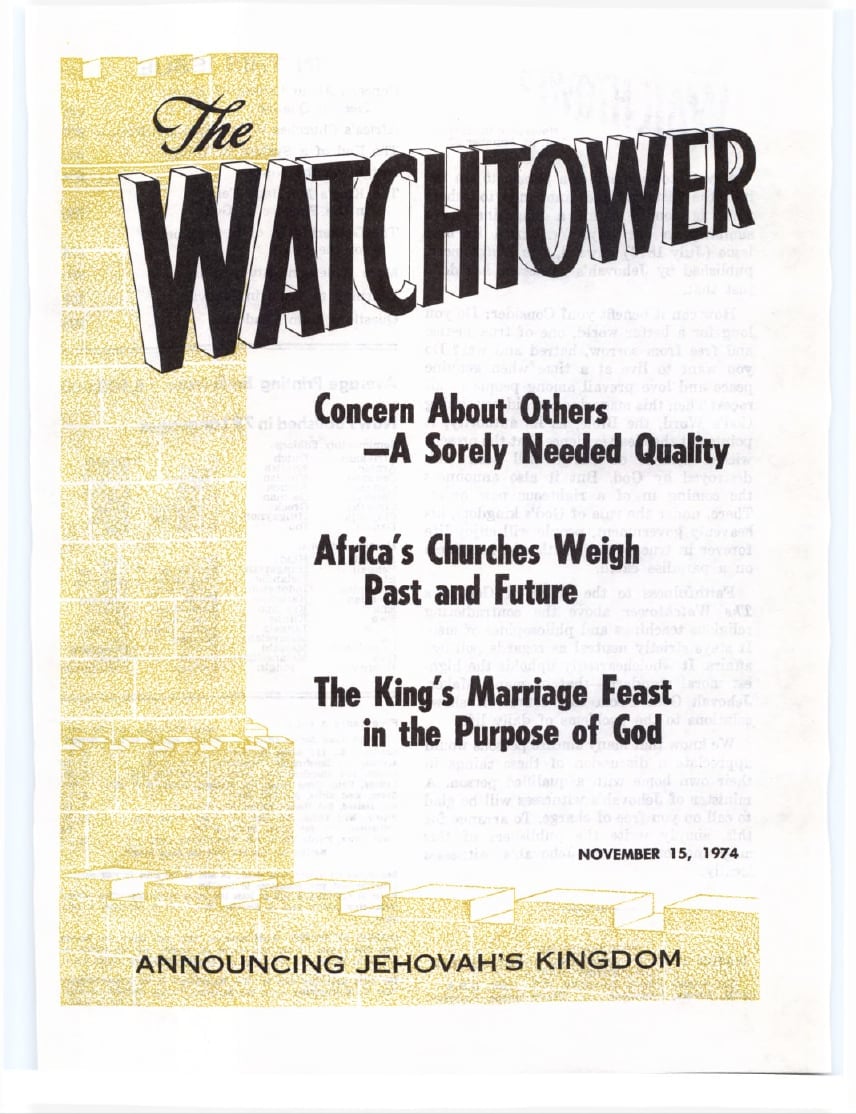
The Watchtower — November 15, 1974
Source: jw.org
Contents
Concern About Others—A Sorely Needed Quality
Africa’s Churches Weigh Past and Future
The End of a System of Things
Insight on the News
The King’s Marriage Feast in the Purpose of God
The Gathering In of Replacements for the Feast
More Bibles and Study Aids
Learning to Trust in Jehovah
Questions From Readers
A Bible Mystery Solved
Concern About Others—A Sorely Needed Quality
Concern About Others—A Sorely Needed Quality
SINCERE concern about the needs or well-being of others is becoming ever more rare these days. What accounts for this unhappy state of affairs?
Doubtless, some people have become less concerned about others because of the wrongs they themselves suffer. Others may once have tried to be helpful, only to have their efforts misunderstood. As a result, they now take the attitude, “What’s the use?” Further, not a few envy the success of greedy persons and so imitate their lack of concern. And no doubt the selfishness continually portrayed in movies, on TV, in newspapers and magazines tends to make people become less concerned about others.
This lack of concern commonly manifests itself right within the family circle. For example, women are known to be more often plagued with insomnia than are men. Yet who has not seen men who manifest little concern about this problem of their wives? Could it be that you, if a husband, come short in this or in some similar respect?
On the other hand, it must be admitted that many wives fall short in showing real concern for their husbands. If you are a wife, are you among those women who put their luxuries ahead of their husband’s necessities? Such lack of concern adds to a husband’s burdens and, in some cases, has caused him to have a heart attack.
And who has not observed parents betraying a lack of concern as to the habits their children are cultivating? Not that youths are wholly free from blame, but the problems all too often find their roots in parental indifference.
There are many other areas where concern for others is lacking. It shows up so often in bad manners. Women rudely push ahead in mad scrambles at department-store sales; younger folks push aside the elderly and the infirm. And what is widespread graffiti and vandalism but gross lack of concern for the property and interests of others?
Some persons are very choosy as to those for whom they show concern. They express it only when a close friend or one of their immediate family is involved. Others fence in their concern by boundaries of nationality, color or race. Thus many whites are quite unconcerned about the plight of blacks, even as many blacks evince unconcern as to what may be happening to a white person. And too often we read of an individual beaten by muggers right on a public street, with a crowd standing around without raising a voice or a hand in defense of the victim.
In fact, all such lack of concern for others goes back to the very first human family. Certainly Adam had little concern for his wife’s feelings when he referred to Eve as “the woman you gave me,” blaming her for his eating of the forbidden fruit. And who is not familiar with the expression “Am I my brother’s keeper?” That callous remark was made by Cain, the firstborn son of Adam, when God asked him about the whereabouts of his brother Abel, whom he had killed. True, few would think of committing murder, but what about harboring hatred? It is easy to do that if you have been treated unjustly by someone. But did you know that the Bible says that “everyone who hates his brother is a murderer”?—Gen. 3:12; 4:3-11; 1 John 3:15, New English Bible.
No doubt the ideal of showing concern for others in need is the “good Samaritan,” of one of Jesus’ parables. He stands in striking contrast to two smug religionists who had no pity nor empathy for a fellow human who had been beaten and robbed and left helpless by the roadside. The good Samaritan showed genuine concern. He treated the wounds of the victim, put him on his donkey, brought him to an inn and agreed to pay for the expenses involved.—Luke 10:29-37.
WHY SO VITAL?
Why is concern for others so vitally important? Because God commands that we love our neighbors as we love ourselves, even as the “good Samaritan” did. Surely we appreciate concern being shown to us when we are in need. Should we not, therefore, also show concern for others when they are in need?—Mark 12:31; Luke 6:31.
More than that, being concerned about others gives us a good conscience. It also gives us a sense of satisfaction of having done our duty. It is a form of giving, and giving brings with it great happiness.—Acts 20:35.
Showing concern in little things as well as in big things makes for good relations with others. We can help others in danger, or when illness or other tragedy strikes. But we can also show concern in our everyday relations. For example, when driving an auto, concern will make us careful to avoid accidents; it will keep us from being a “road hog”; and it will cause us to show consideration, as when we slow down so that a driver can enter into our main thoroughfare from a side street.
Are we living in an apartment? Then we can show concern for others by not playing our record player, radio or TV too loud; also by being careful that our parties do not get too noisy late at night. And in wintertime we can show concern by keeping our sidewalks free from ice and snow.
A fine example of concern for others was given by the German witnesses of Jehovah when released from concentration camps back in 1945. To mention but one instance: When 220 of them left the Sachsenhausen concentration camp under heavy guard, they faced a 120-mile trek. Circumstances were such that they traveled in a group. They managed to get a few small carts on which they placed the weakest of their members, and which the stronger ones pulled along. As a result, in a death march in which more than 10,000 inmates lost their lives, not one of the Witnesses died.—1974 Yearbook of Jehovah’s Witnesses.
It is because of their unselfish concern that Christian witnesses of Jehovah keep calling at the doors of their neighbors. They know that these are the “last days” and so they urge people to flee to a place of safety before it is too late. In this they are like ancient Lot, who warned his sons-in-law to flee with him from Sodom and Gomorrah. The record tells us that “in the eyes of his sons-in-law he seemed like a man who was joking.” But Lot was not joking and neither are the Christian witnesses of Jehovah joking today!—Gen. 19:12-29; Rev. 18:4
So we encourage you, not only to show concern for others, but also to benefit from the concern that these Witnesses manifest regarding your prospect for survival of the coming “great tribulation” to an opportunity for everlasting life.
Africa’s Churches Weigh Past and Future
Africa’s Churches Weigh Past and Future
“WE HAVE had people professing to be Christians—holding the Bible in one hand and a gun in the other. These are the people who have been responsible for the human suffering this continent has experienced since the days of the slave trade.”
This statement was made by Zambian president Dr. K. D. Kaunda in the opening address of the All-Africa Conference of Churches, held in Lusaka, Zambia, in the late spring of this year.
WHAT THE PAST REVEALS
History shows the background against which this expression was made. In the last quarter of the nineteenth century, so-called Christian nations of Europe began a scramble for territory in Africa, eventually resulting in their slicing up almost the entire continent into colonies.
By 1920 every square mile of the African continent—with the exception of the independent states of Ethiopia, Liberia and South Africa—was under colonial rule or dominance or was claimed by one or the other of the European colonial powers.
The pattern for opening up the African continent to colonization was similar to the earlier pattern in the western hemisphere. Religious missionaries often served as pioneers for the political state that followed.
Pointing this up is a review in the New York Times (August 15, 1974) of a recent book on the life of missionary and African explorer David Livingstone. It shows that Livingstone urged the establishing of white communities in Africa to ‘spread Christianity’ and to open up the country for trade. He lectured English merchants “on the opportunities for profit in Africa.” Though Livingstone opposed slavery, the book review sums up the result of this missionary’s nineteenth-century explorations, saying: “Instead of opening Africa for Christianity, he paved the way, at first, for the slavers who followed him into previously undiscovered territories. Also, ‘the introduction of God’s word was to presage the destruction of God’s creatures.’ After the Bible, came the gun.”
Colonization brought many serious problems, some of them having enduring effects for the peoples of Africa. As the 1974 Encyclopædia Britannica states:
“Christians of the West had often exploited the developing nations, looted their resources, enslaved or demeaned their populations. . . .” “Boundary lines between colonies were often drawn arbitrarily, with little or no attention to ethnic unity, regional economic ties, tribal migratory patterns, or even natural boundaries.” “[This] had long-lasting effects harmful to [African] unity and an even more inhibiting effect on African economic development.”
Although, particularly since the end of World War II, the European colonies have largely disappeared and there are now over forty independent states in Africa, many Africans retain a sense of distrust of the religions that helped to open the way for such colonization efforts and domination.
CONFERENCE STRESSES INDEPENDENCE
All of this may explain why there is such a large number of independent denominations within the All-Africa Conference of Churches. The total number of churches represented at the Lusaka meeting was 103, including major Protestant bodies, the Greek Orthodox and Coptic churches, and numerous other, smaller religions.
Religious independence was, in fact, encouraged at this Conference assembly, the first one organized entirely by African church leaders with no outside direction. Many speakers urged that an authentic African religion, one that could not be viewed as a “foreign importation” or a “white man’s religion,” was needed. A Nigerian member, Mr. Kofi Appiah-Kubi, said:
“If churches in Africa are to grow and develop as African churches and not as mere extensions of foreign churches, as many are today, then they must be allowed to take root in the soil of Africa where they are planted.”
In the same vein, a recent bulletin of the Conference states that “the people of Africa, particularly the people of the church, must break off the shackles of cultural domination, reach into the depths of mother Africa and awaken her creative genius. When this is done, Africa will be ready to assert herself to the world and contribute something new and different towards the salvation of humanity.”
Showing the extent to which some feel this Africanization process should go, one churchman in Zambia has suggested that in place of the bread and wine customarily used at the “Lord’s Evening Meal,” the use of nshima, a locally made maize-meal porridge, and munkoyo, a locally brewed beverage made from a root, should be substituted. Noteworthy, too, was the resolve by the Conference to urge its member churches to undertake a serious study of Islam, of African traditional religions and other ideologies, in their development of distinctive African worship.
What about financial dependence on foreign sources? The finance committee told the assembly that the Conference would have to look to outside sources for 80 percent of its 1975 budget. But there was also a call to break free from such dependence on foreign benefactors. An assembly statement declared that “the contribution of the African church cannot be adequately made in our world if the church is not liberated and truly national. To achieve this liberation, the church will have to bring a halt to the financial and manpower resources—the receiving of money and personnel—from its foreign relationships. Only then can the church firmly assert itself in its mission to Africa.”
The Zambia Daily Mail reported Cannon Burgess Carr of Liberia, the secretary-general of the Conference, as putting matters even more bluntly, saying: “Churches in Africa can do without the services of missionaries and expatriate church workers.”
‘UNEQUIVOCAL SUPPORT TO THE LIBERATION MOVEMENTS’
A major conference topic was the issue of ‘African liberation,’ including the support of revolutionary armies. These operate in parts of Africa that are under the rule of governments formed principally of whites (who usually are a minority group in the country). Secretary-General Carr, according to the Daily Mail, said that ‘the church must give its unequivocal support to the liberation movements because they had helped it to re-discover a new and radical appreciation of the cross.’ In the past four years the Conference has donated $125,000 to such liberation movements. The assembly made a formal statement, saying:
“We affirm our solidarity with the liberation movement in the oppressed countries and call upon Christians both within and outside our continent to end all political, economic, military and any other support or structure of oppression in these countries.”
The Roman Catholic Church, which has millions of members in Africa, is not a member of the All-Africa Conference of Churches. It came in for criticism as not being in harmony with the liberation movements espoused by the Conference. Interestingly, the National Council of Lay Apostolates (a Catholic organization) responded to this charge by publishing a statement to the effect that most of the liberation movements were financed by Catholics and that the Conference should understand that on such matters as social justice and national independence there was total agreement between the Catholic Church and the churches that are members of the Conference.—Times of Zambia, May 16, 1974.
SEARCH FOR UNITY
Church union and cooperation also received serious attention at the assembly. Although agreed on the need for a distinctively African church and on their support of liberation movements, the delegates gave little indication of any definite step toward actual religious unification among the more than 100 members of the Conference.
Dr. Phillip Potter, secretary-general of the World Council of Churches, addressed the Lusaka assembly, and the Times of Zambia reports him as saying that ‘much of Africa’s history has been bedeviled by tribalism and tribal wars—even up to today. Many allowed themselves to continue the unjust colonial system by pursuit of self-gain and power at the expense of the vast majority of the people.’ He added that ‘some churches were continuing the divisions brought to Africa,’ and that ‘it was common to hear a churchman saying to another of a different denomination: “You worship God in your way, but we worship in this way.”’
FINDING THE WAY TO TRUE FREEDOM AND UNITY
The Conference reflected concern over conditions that have developed especially since the nineteenth century. Actually, Christianity reached Africa long before the nineteenth century. Back in the first century, the Bible book of Acts shows, an Ethiopian official, evidently an educated and intelligent man, accepted Christianity while on his way back to Africa from Jerusalem. (Acts 8:26-38) There is nothing to show that this early introduction of genuine Christianity to Africa was used by the Christians of that time as a springboard for commercial or political exploitation.
Does the past history of Africa really call for the future development of a distinctive brand of Christianity, a special continental variety? Is true Christianity to be held responsible for the grave wrongs committed during the past one hundred years? Or are those wrongs really the by-product of a departure from genuine Christianity by organizations merely claiming to represent Christ? The theme of the Lusaka assembly of the All-Africa Conference of Churches was: “Living No Longer for Ourselves . . . but for Christ.” What, then, were Christ’s own example and teachings by which his true disciples should live?
Christ Jesus said that ‘his kingdom was no part of this world,’ and he nowhere authorized his disciples to serve as forerunners for the world’s political systems or their style of “civilization.” (John 18:36; 15:19) They were, instead, to point to God’s kingdom through Christ Jesus as the means by which all lovers of righteousness, of whatever family, tribe, nation or continent, “will be set free from enslavement to corruption and have the glorious freedom of the children of God.”—Rom. 8:21; Rev. 7:9, 10; 14:6.
Those true disciples thus pointed to a marvelous liberation, one that will not only free persons from human oppression and exploitation, but also free them from the enslavement to imperfection, sickness and death itself. (Rev. 21:4) In announcing and advocating God’s Messianic government of liberation, Christ’s true disciples would use, not carnal, but spiritual weapons, weapons that never harm the innocent nor ever bring brutal suffering and grief. (2 Cor. 10:4, 5; Eph. 6:10-17) As ‘fine soldiers of Christ Jesus’ they would not try to mix Christianity with commercialism, even as the inspired apostle Paul counseled his coworker and fellow missionary Timothy.—2 Tim. 2:3, 4.
Are there persons today in Africa and throughout the rest of this planet who live by these principles of true Christianity and who dwell in unity, with no barriers of tribalism, racism, nationalism or sectarianism?
Thousands of Africans of all tribes and of all parts of the continent today are associating with Jehovah’s Christian witnesses for the very reason that they see them putting these principles to work in their lives. By so doing they are not embracing the “foreign importation” of a “white man’s religion,” but are embracing the worship of the Creator of heaven and earth, Jehovah God, the One who makes no distinctions and “is not partial, but in every nation the man that fears him and works righteousness is acceptable to him.”—Acts 10:34, 35.
The End of a System of Things
The End of a System of Things
IT IS no small event for a system of things to be destroyed after lasting for 1,582 years. This is especially true when the system is one that God himself established. The system we speak of is that of the ancient Jewish nation. Why did it end, and what brought about that end in the way that it came?
It is common knowledge that God established the system of things under the Law covenant through the lawgiver Moses in 1513 B.C.E. This system included many features—its various sabbaths, its regulations for religious cleanness, its inheritance arrangements, the temple at Jerusalem with its priesthood and sacrifices and other things. All of this was completely destroyed in the year 70 of our Common Era. With it went the Jewish hope that a king of the line of David would sit on the throne again in Jerusalem and defeat oppressive Gentile forces.
The reasons for and the manner of Jerusalem’s destruction were explained in a prophetic statement by God’s greatest prophet, Jesus Christ, only a few days before he was put to death by the very power that later destroyed the Jewish system of things. But, paradoxically, it was the Jews who delivered him over to that power and who cried out for his execution.
A TERRIBLE END
Jesus’ prophecy was given as a result of a question posed by his apostles. They were showing Jesus the magnificence of the temple buildings. Viewing them, he replied: “Do you not behold all these things? Truly I say to you, By no means will a stone be left here upon a stone and not be thrown down.”—Matt. 24:1, 2.
Two days prior to this, Jesus had foretold the manner in which the city with its temple would be destroyed. He addressed Jerusalem, saying:
“The days will come upon you when your enemies will build around you a fortification with pointed stakes and will encircle you and distress you from every side, and they will dash you and your children within you to the ground, and they will not leave a stone upon a stone in you, because you did not discern the time of your being inspected.”—Luke 19:43, 44.
This was disturbing even to Christ’s apostles, who were circumcised Jews. They did not yet understand that Christ would reign, not from an earthly throne in Jerusalem, but from heaven. Jesus’ statement indicated that God would no longer deal with earthly Jerusalem, but they did not yet fully grasp it. (Acts 1:6) Also, Jesus’ words meant that the priests of the house of Aaron would be put out of their jobs. Why?
The reason why the end of all these things was drawing near was that Jehovah purposed to bring in better things through his Messiah. The animal sacrifices and the other features of the Law, with the prophecies, had pointed the faithful Israelites to Jesus Christ and served to provide unmistakable credentials and identification of him as the Messiah. But such sacrifices were not the things Jehovah really desired, because they could not remove sins. (Heb. 10:5-10) They had to come to an end. Christ’s sacrifice would make them obsolete.
That the end of the Jewish priesthood would come during the conclusion of the Jewish systems of things is further supported at Hebrews 9:26-28, which points out that Jesus did not have to make repeated sacrifices of himself, and says: “Otherwise, he would have to suffer often from the founding of the world. But now he has manifested himself once for all time at the conclusion of the systems of things to put sin away through the sacrifice of himself.”—Compare 1 Corinthians 10:11.
But why such a terrible end for Jerusalem? God’s purpose to end the Law with Christ did not require this drastic action. (Rom. 10:4) In fact, faithful Christians from Pentecost onward (after Christ’s sacrifice had been accepted by Jehovah in heaven) did not think it their duty to tear down the temple or the city of Jerusalem. They recognized the temple as an instrument of God that had fulfilled his purpose. They did not disrespect it. But they knew that Jesus Christ in heaven was their High Priest, because a new covenant had been instituted, and consequently there was a change of the priesthood. (Heb. 7:11-14) Even many of the Jewish priests accepted Christ as the real sacrifice for sins and realized that their job at the temple had fulfilled its purpose and was no longer operative in Jehovah’s eyes. (Acts 6:7) Why, then, such a violent destruction for the Jews’ city and temple?
Jesus had shown why when he said to Jerusalem, while in the temple:
“Here I am sending forth to you prophets and wise men and public instructors. Some of them you will kill and impale, and some of them you will scourge in your synagogues and persecute from city to city; that there may come upon you all the righteous blood spilled on earth, from the blood of righteous Abel to the blood of Zechariah son of Barachiah, whom you murdered between the sanctuary and the altar. Truly I say to you, All these things will come upon this generation. Jerusalem, Jerusalem, the killer of the prophets and stoner of those sent forth to her,—how often I wanted to gather your children together, the way a hen gathers her chicks together under her wings! But you people did not want it. Look! Your house is abandoned to you. For I say to you, You will by no means see me from henceforth until you say, ‘Blessed is he that comes in Jehovah’s name!’”—Matt. 23:34-39.
THINGS POINTING TO THE END
Naturally, this declaration by Jesus brought to the apostles’ minds the question: “When will these things be, and what will be the sign of your presence and of the conclusion of the system of things?” (Matt. 24:3) Jesus, in answer, described the events that would lead up to the destruction of Jerusalem:
“Look out that nobody misleads you; for many will come on the basis of my name, saying, ‘I am the Christ,’ and will mislead many. You are going to hear of wars and reports of wars; see that you are not terrified. For these things must take place, but the end is not yet.”—Matt. 24:4-6.
Jews would arise, not claiming to be Jesus returned in the flesh, but holding themselves forth as the promised Messiah or Christ. The Jewish revolt against the Romans in 66 C.E. was such a messianic effort. But none of these were evidences of the “presence” or parousia of Christ (which term is applied in the Greek Scriptures to his return in Kingdom power).
Also, there would be a number of wars during this period that would affect the Jewish nation. But Christ’s disciples were not to be terrified into taking premature action. Jesus went on to say of this period:
“For nation will rise against nation and kingdom against kingdom, and there will be food shortages and earthquakes in one place after another. All these things are a beginning of pangs of distress.”—Matt. 24:7, 8.
These things would be unmistakable indications to Christians that the end was getting near. Also, specific things would come upon his disciples because they announced the true Messiah and followed his example. Jesus continued:
“Then people will deliver you up to tribulation and will kill you, and you will be objects of hatred by all the nations on account of my name. Then, also, many will be stumbled and will betray one another and will hate one another. And many false prophets will arise and mislead many; and because of the increasing of lawlessness the love of the greater number will cool off. But he that has endured to the end is the one that will be saved. And this good news of the kingdom will be preached in all the inhabited earth for a witness to all the nations; and then the end will come.”—Matt. 24:9-14.
This was fulfilled as the general lawlessness and lack of love for God increased. The Jews, wherever they had been scattered, claimed to serve God when they persecuted Christ’s disciples. Nevertheless, the Christians preached the good news of the kingdom in all the inhabited earth, particularly in the nations to which the Jews had been dispersed.—Col. 1:6, 23.
THE EVIDENCE OF THE END’S IMMINENCE
Then Jesus specified the particular thing that would indicate the close nearness of the end of the Jewish system of things. He said:
“Therefore, when you catch sight of the disgusting thing that causes desolation, as spoken of through Daniel the prophet, standing in a holy place, (let the reader use discernment,) then let those in Judea begin fleeing to the mountains. . . . for then there will be great tribulation such as has not occurred since the world’s beginning until now, no, nor will occur again. In fact, unless those days were cut short, no flesh would be saved; but on account of the chosen ones those days will be cut short.”—Matt. 24:15-22.
This would be a sure warning for Christians to get out of Jerusalem and the province of Judea then, at top speed, with no unnecessary burdens, by direct route.
What was this “disgusting thing,” and how did it stand in a “holy place”? In reaction to the Jews’ revolt in October 66 C.E., the Roman general Gallus came down from Syria during the Jewish Festival of Booths and surrounded Jerusalem with “encamped armies.” After a fight, he brought his troops into the city of Jerusalem, in fact, he went so far as to undermine a section of the temple wall. This certainly was an attack on that which the Jews considered holy. But Gallus withdrew suddenly and unexpectedly. The Jews, coming out of the city, followed and harassed his army, capturing siege weapons and returning to Jerusalem even more confident of their security.
As soon as Gallus withdrew, the Christians in Jerusalem left the city for the mountainous region across the Jordan River in the province of Perea. They were saved from death when, four years later, General Titus captured Jerusalem.
SOME “FLESH” SAVED
In the interim period between 66 and 70 C.E., there was great turmoil in Jerusalem, several factions fighting to control the city. Then, in 70 C.E. General Titus, son of Emperor Vespasian, came up against the city, surrounded it with a fortification of pointed stakes, as Jesus had foretold, and brought the inhabitants to a pitiable state of starvation. It appeared that, if the siege lasted much longer, “no flesh” inside the city would survive. But, as Jesus had prophesied concerning this “great tribulation,” the greatest Jerusalem had ever experienced, “unless Jehovah had cut short the days, no flesh would be saved. But on account of the chosen ones whom he has chosen he has cut short the days.”—Mark 13:19, 20.
Providentially, the siege lasted only 142 days. But even then, plague, pestilence and the sword devoured 1,100,000, leaving 97,000 survivors to suffer being sold into slavery or into gladiatorship in the Roman arena. Thus, Jehovah’s “chosen ones” had fled from the doomed city. On that account Jehovah did not have to prolong the time of distress, but could execute vengeance in a short time, sparing 97,000 persons, thus saving some “flesh.”
In this manner the Jewish system of things came to its end. No longer did they have their temple. All their records were destroyed, so that no Jew today can prove a priestly lineage for himself, or that he is of the kingly tribe of Judah. Jesus Christ stands out as the only one who has his lineage proven to be from Judah through David. He alone is the rightful King. (Ezek. 21:27) He holds the office of High Priesthood for all humankind, not according to descent from Aaron, but “according to the manner of Melchizedek,” by direct appointment from his Father Jehovah God.—Heb. 7:15-17.
But the answer to the apostles’ question, “When will these things be, and what will be the sign of your presence and of the conclusion of the system of things?” required even further answer, because Jesus’ parousia, his “presence” in Kingdom power, did not occur at the time of Jerusalem’s destruction. Therefore, Jesus spoke about the end of a greater system of things, giving much more information as to the “sign.” This will be discussed in a subsequent issue.
Insight on the News
Insight on the News
YMCA Rooming—How Safe?
● The Young Men’s Christian Association, better known as the YMCA or the Y, began as a means for providing rooming and recreation amid “Christian” surroundings. A report in the “National Observer” (September 7, 1974), however, indicates that the YMCA faces a serious problem: homosexuality.
One prominent homosexual is quoted as saying: “Ys are ideal because there’s a largely male atmosphere, often younger men, . . . and often men who are open—and not merely receptive but willing—to seek sexual encounters.” One reader’s comment (in a later issue of the newspaper) indicates the problem is not new. A member of the YMCA for six years in the 1920’s, he writes that he gave up the membership “after I was robbed several times, assaulted twice, and propositioned many times.”
Though protesting any implication that the problem is major, one Executive Director of the YMCA wrote: “I, as well as all other YMCA professionals, recognize that we do have the problem of the homosexual in the ranks of the YMCA membership.” A New York director said: “We can’t make room checks every night. . . . Sometimes we gulp and admit those we might disapprove of, realizing that we can provide them not only with a bed but with a chance for counseling and other help.”
Counseling immoral persons is one thing, but inviting them to sleep in your midst while they carry on their immorality is another. Did the officials of the Y never read that the apostle Paul warned: “A little leaven ferments the whole lump”?—1 Cor. 5:6.
Weaning—At What Age?
● Scriptural evidence indicates that Abraham’s son Isaac was not weaned until the age of five.a Some find that hard to believe. Interesting, therefore, is a report in “Science” magazine (September 13, 1974) on the practice among nursing mothers of the !Kung people of southern Africa today. (The exclamation point represents a clicking sound in their language.) The report says that, being a nomadic people and having no soft food for their babies, !Kung mothers “nurse them for 3 or 4 years.” Accompanying the article is a picture of one mother nursing a child who is “nearly 5 years old.” Yes, even in minor details the Bible record is sound.
One Thing Leads to Another
● Decades ago, the transfusing of one person’s blood into another’s veins became a common practice. Then the transplanting of organs came into vogue. Where might this all lead? An article by the president of the Institute of Society, Ethics and the Life Sciences, entitled “Harvesting the Dead,” gives some idea.
According to the article, many “scientific and theological groups” favor a redefining of death. The new definition would label as “dead” anyone whose brain functions had fully ceased, producing a state of “irreversible coma.” What then? The suggestion is made that, although now legally “dead,” the bodies could still be kept breathing and functioning through respirators in special hospitals, if desired, for a period of years. This could open the way for “farms of cadavers which require feeding and maintenance, in order to be harvested.” These “neomorts”—legally “dead,” but actually living bodies—could then be used, the article says, for training medical students and interns, who could practice surgical procedures, including amputations. Major organs could be catalogued and computerized for ready availability in transplants. The ‘legally dead’ persons could be “drained periodically” to supply blood for transfusion.
Admittedly, the article presents these only as possibilities. However, interestingly, the author says that the initial precedent for all this is the “blood donation” and the “precedent in blood of commercialization.” In contrast, the Bible inculcates respect for people’s bodies, even for those actually dead (not just in an “irreversible coma”). (Gen. 23:1-6; 49:29; 50:24-26; 1 Sam. 31:8-13) But men today contemplate wholesale ‘cannibalizing’ of bodies. And even that seems too mild a term—for cannibals never maintained “farms” of human bodies to be “harvested.” This shows where things can lead once men begin to violate Bible standards, including its prohibition of taking the blood of another creature into one’s own body.—See Deuteronomy 12:23; Acts 15:28, 29.
[Footnotes]
See the book “Aid to Bible Understanding.”
The King’s Marriage Feast in the Purpose of God
The King’s Marriage Feast in the Purpose of God
“The kingdom of the heavens has become like a man, a king that made a marriage feast for his son. And he sent forth his slaves to call those invited to the marriage feast, but they were unwilling to come.”—Matt. 22:2, 3.
1. What has been preached to the nations for sixty years now, and what historic example shows whether their reaction to this will be of benefit?
THE whole world is in trouble. There is no reason to doubt that the system of things under which it lives is in the foretold “time of the end.” For the past sixty years the “kingdom of the heavens,” the “kingdom of God,” has been proclaimed in all quarters of the globe as the “only hope” for distressed mankind. But the vast majority of mankind does not believe in this divine remedy. The people in general do not want it. They are like a nation of people that, nineteen hundred years ago, did not want the “kingdom of the heavens,” when it was offered to them. Their turning down this valid offer did not result in good for their nation. In the light of their national experience, the turning away from the “kingdom of the heavens” today will be of no benefit to those who prefer human schemes and arrangements to this “only hope” for our troubled world.—Dan. 12:4; Matt. 3:1, 2; 4:17; Mark 1:14, 15; Luke 6:20.
2. When, where and to whom did the “kingdom of the heavens” begin to be preached, and to what nation was it to be given?
2 Long ago, the Roman Empire was only in its first century of rule over the Middle East when the “kingdom of the heavens,” the “kingdom of God,” began to be proclaimed there. The year 33 of our Common Era was the fourth year of its proclamation. This kingdom was the subject of heated discussion in the Jewish city of Jerusalem. Discussion of it reached even into the world-famous temple in that holy city. In the course of a discussion, the leading Proclaimer of the good news of the Kingdom said to his many listeners, who included the chief priests and men of the sect of the Pharisees: “The kingdom of God will be taken from you and be given to a nation producing its fruits.” (Matt. 21:43-46) According to those words, the kingdom of God was then soon to be taken away from their nation and be given over to a newly formed nation that would produce fruitage identifying it as being ruled by the kingdom of God. The speaker’s words came true, for to this day the once favored nation does not have the kingdom of God.
3. How did the speaker start off the illustration that bears upon his prophetic words?
3 What was the reason for this to come about? The speaker of those prophetic words went on to illustrate by telling another one of his meaning-packed parables. A man who heard it made a record of it for us, and he starts off this particular account by saying: “In further reply Jesus again spoke to them with illustrations, saying: ‘The kingdom of the heavens has become like a man, a king, that made a marriage feast for his son. And he sent forth his slaves to call those invited to the marriage feast, but they were unwilling to come.’”—Matt. 22:1-3.
4. What shows whom the “man, a king,” in Jesus’ illustration, pictured?
4 The chief figure in this illustration was the “man, a king.” Of whom, then, was he an illustration? He illustrated God himself, for the whole parabolic illustration started off by saying, “The kingdom of the heavens has become like a man, a king,” in taking certain action that met up with a certain reaction. The expression “the kingdom of the heavens” means the same as “the kingdom of God,” for God rules supreme in the invisible spirit heavens. For instance, the ancient ruler of Babylon was put through a humiliating experience for this stated purpose: “until you know that the Most High is Ruler in the kingdom of mankind, and that to the one whom he wants to he gives it . . . after you know that the heavens are ruling.” (Dan. 4:25, 26) Jesus was referring to God when he said concerning Jerusalem: “Do not swear . . . by Jerusalem, because it is the city of the great King.” To this heavenly King, Jesus taught his disciples to pray, saying: “Let your kingdom come. Let your will take place, as in heaven, also upon earth.”—Matt. 5:34, 35; 6:9, 10.
5. Who is the “son” for whom the heavenly King makes the “marriage feast,” and what is the proof of this?
5 The king in Jesus’ illustration is said to have a son. However, God the heavenly King has hundreds of millions of spirit sons, who are Scripturally called “sons of God.” (Job 38:7; Dan. 7:9, 10) Which of these many sons is the one meant in Jesus’ parable? It is the Son of sons in God’s heavenly family. It is for this foremost son that the heavenly King makes a “marriage feast,” and the Sacred Scriptures show that this son is the speaker of the parabolic illustration, Jesus Christ himself. John the Baptizer, who baptized Jesus, said with reference to the baptized Jesus: “I am not the Christ, but, I have been sent forth in advance of that one. He that has the bride is the bridegroom. However, the friend of the bridegroom, when he stands and hears him, has a great deal of joy on account of the voice of the bridegroom. Therefore this joy of mine has been made full.” (John 3:28, 29) In another illustration, Jesus meant himself, when he said: “Then the kingdom of the heavens will become like ten virgins that took their lamps and went out to meet the bridegroom.”—Matt. 25:1; 9:15.
6, 7. (a) Who is the “bride” of this Son of the heavenly King? (b) Ephesians 5:23-32 likens the relationship between Jesus Christ and his congregation to what?
6 Like any prospective bridegroom, Jesus must have had great pleasure when thinking and speaking about this “bride” whom the King, his heavenly Father, would give him. The “bride” is, of course, not an individual person, not an individual disciple of Jesus Christ. To the contrary, it is a composite or collective person, his whole body or congregation of faithful anointed disciples. This should not appear strange. In the prophecies of the Bible the ancient nation of Israel is likened to the wife of Jehovah God, because the nation was, as it were, married to Him by accepting the Law covenant that was mediated by the prophet Moses at Mount Sinai in Arabia. (Isa 54:5; Jer. 3:14; 31:31, 32) So the relationship between the Son of God and his anointed congregation is likened to that of a husband and wife; as we read:
7 “A husband is head of his wife as the Christ also is head of the congregation, he being a savior of this body. Husbands, continue loving your wives, just as the Christ also loved the congregation and delivered up himself for it. This sacred secret is great. Now I am speaking with respect to Christ and the congregation.”—Eph. 5:23, 25, 32.
8. Where and how will the marriage of the heavenly King’s Son and his “bride” be consummated?
8 The consummating of the marriage between the King’s Son and his figurative “bride” will be by the uniting of Jesus Christ and his faithful congregation in the spirit heavens in connection with the “kingdom of the heavens.” The members of this anointed congregation must be faithful, like an espoused virgin, to Jesus Christ down to their death. In reward for their virgin faithfulness till the end of their earthly course, they will be resurrected from the dead to be his heavenly “bride,” his Bridal congregation, forever in the house of the Heavenly Father and King.—2 Cor. 11:2, 3.
“THOSE INVITED TO THE MARRIAGE FEAST”
9. In Jesus’ illustration, what relationship did those invited to the “marriage feast” bear to the king, and what would their favorable action toward the invitation show?
9 An invitation to the marriage feast of his son was a great favor on the part of the king. Those whom he invited were persons over whom he was the king. They were his subjects. He knew them by name. He knew where they lived within his realm, and so he could send his slaves to their address to notify them at the time that the feast was ready, to which feast they had already been invited. Favorable action of these invited persons when they got notification of the readiness of the feast would display due respect for their king. Whom, then, did “those invited to the marriage feast” in Jesus’ illustration picture?
10. At the time of the illustration, Jehovah God was King over what people, and by what arrangement?
10 Well, since the king pictures Jehovah God, who, then, were the people over whom He was the king at that time? To whom was it that Jesus said, “The kingdom of God will be taken from you and be given to a nation producing its fruits”? It was the Jewish nation. In the year 1513 B.C.E. Jehovah God had brought them into a covenant with him through the mediatorship of his prophet Moses, at Mount Sinai. They willingly entered this covenant, to keep its Law code, the foundation laws of which were the famous Ten Commandments. (Ex. 19:1 through 24:8) Especially by this covenant arrangement, Jehovah became the heavenly King over this people, and this meant that they were now a “nation” subject to Him. (Deut. 33:5) The Israelites had already sung His praises as their King, after he had delivered them from death in the Red Sea, singing out: “Jehovah will rule as king to time indefinite, even forever.”—Ex. 15:18.
11, 12. (a) How had the nation of Israel become the Name people of God? (b) How was it that God could send an invitation to them by their national name?
11 This heavenly King has a name—Jehovah—and, by virtue of bringing the nation of Israel into a Law covenant with him as their God, they became his Name people. His name was called upon them. Said the mediator Moses to the covenant people of Israel: “Jehovah will establish you as a holy people to himself, just as he swore to you, because you continue to keep the commandments of Jehovah your God, and you have walked in his ways. And all the peoples of the earth will have to see that Jehovah’s name has been called upon you, and they will indeed be afraid of you.” (Deut. 28:9, 10) To this chosen nation, Jehovah said, by the mouth of his prophet Amos: “You people only have I known out of all the families of the ground.” (Amos 3:2) Not only was the nation identified by His name, but He knew the nation by name.
12 To it, He said, by the mouth of the prophet Isaiah: “And now this is what Jehovah has said, your Creator, O Jacob, and your Former, O Israel: ‘Do not be afraid, for I have repurchased you. I have called you by your name. You are mine.’” (Isa. 43:1) So, if He desired to send an invitation to them or give them a standing invitation, He could do so by the national name.
13. How did the heavenly King know the address of “those invited to the marriage feast,” and this fact was shown in the case of whose birth?
13 The king of Jesus’ illustration knew the addresses of those whom he had invited to the marriage feast. Likewise Jehovah knew the “address” of his chosen people, his invited people. He knew where they lived. It was the land that He had promised to their forefathers Abraham, Isaac and Jacob, and the land to which He had faithfully brought them. Even after their exile in the land of Babylon, Jehovah restored them to that same land. Under no misdirection, Jehovah the King sent his Son Jesus to that land. It was no mistake or accident that Jesus the Descendant of Abraham and of King David was born in the city of Bethlehem in the Province of Judea, in the autumn of the year 2 B.C.E. Centuries in advance, by His prophet Micah, Jehovah the King had foretold the address for this miraculous birth.—Mic. 5:2.
14. Was it first when the messengers of notification arrived that the initial invitation was given to “those invited,” or what relation did notification bear to invitation?
14 In fulfillment of Jesus’ illustration, Jehovah the King knew the addresses or locations of “those invited to the marriage feast.” Naturally, then, he knew where to send his messengers of notification at the time that the marriage feast, to which they had already been invited, was ready and it was the hour for them to come with keen appetites. The invitation to the feast was not first extended to them when the messengers of notification called at their homes to tell them the feast was now ready and they should come at once. Such a call was merely something supplementary, not the original invitation. Well, now, when and in what way had they already been “invited” or been given the initial call?
15. (a) In what year was the invitation to the “marriage feast” extended, and to whom? (b) On that occasion, the invitation was contained in what, and in what terms?
15 This was, in fact, in the year 1513 B.C.E., and the way in which it was done was by the action of God the King, by his bringing the people of Israel into the Law covenant through Moses as mediator. The initial call or “invitation” was extended to the Israelites as a nation, not as individuals, for the nation rather than the individual members was what would continue to exist until the King’s “wedding feast” was prepared and ready to be served. The initial call or “invitation” to the nation of Israel was included in God’s terms that set forth the benefit to the nation of Israel for entering and keeping the Law covenant with Jehovah God. When proposing the covenant to Israel at Mount Sinai, God told Moses to say: “And now if you will strictly obey my voice and will indeed keep my covenant, then you will certainly become my special property out of all other peoples, because the whole earth belongs to me. And you yourselves will become to me a kingdom of priests and a holy nation.”—Ex. 19:1-6.
16. (a) On what basis was the Law covenant concluded with the nation of Israel, and how? (b) To whom did both the obligations and the invitation contained in that covenant extend, till when?
16 Kingdom prospects were thus set before the nation of Israel, the opportunity, really the invitation, to become a “kingdom of priests.” Such a priestly kingdom would act as God’s servant for the benefit of all the rest of mankind. The people of Israel accepted this invitation from their heavenly King by accepting His proposals and saying: “All that Jehovah has spoken we are willing to do.” Accordingly, God the King concluded the Law covenant with the nation of Israel over sacrifices carried out by the mediator Moses. (Ex. 19:7, 8; 24:1-12) Not only the obligations of that Mosaic Law covenant, but also the invitation to become a “kingdom of priests” extended to the natural descendants of those covenant-making Israelites down to the first century of our Common Era. (Rom. 9:4, 5; Acts 3:25, 26) Because those natural descendants of the first century C.E. were an “invited” nation, God the King was acting in line with the terms of his covenant by raising up John the Baptist and sending him to preach to the nation of Israel: “Repent, for the kingdom of the heavens has drawn near.”—Matt. 3:1, 2.
17. (a) How does a “marriage feast” for the king’s son have a connection with a kingdom? (b) What further function will be served by those making up the “bride” of the Eternal Father?
17 What, though, does a “kingdom of priests” have to do with a king’s wedding feast for his son? That there is a connection between the two things Jesus Christ himself inferred by introducing his illustration with the words: “The kingdom of the heavens has become like a man, a king, that made a marriage feast for his son.” (Matt. 22:1, 2) Naturally the “bride” whom the king’s son married would become a princess and, ordinarily, a queen elect, a queen designate. Correspondingly, the “bride” whom God the King marries to his Son Jesus Christ is his anointed congregation of faithful disciples. In the heavens these faithful anointed disciples are to be more than a “bride” to Jesus Christ as the one who will become the “Eternal Father” to the redeemed race of mankind. They are also to be joint heirs with their heavenly Bridegroom in the Kingdom that God the King assigns to his Son Jesus Christ over all mankind.
18. How did Jesus keep the Kingdom hope before his disciples in his Sermon on the Mount and at his last Passover?
18 Jesus Christ constantly set this Kingdom hope before his true disciples. In his Sermon on the Mount, he said to them: “Happy are those conscious of their spiritual need, since the kingdom of the heavens belongs to them. Happy are those who have been persecuted for righteousness’ sake, since the kingdom of the heavens belongs to them. . . . For your heavenly Father knows you need all these things. Keep on, then, seeking first the kingdom and his righteousness, and all these other things will be added to you.” (Matt. 5:3, 10; 6:32, 33) And on the night of the last Passover with his faithful apostles and after Jesus had set up the Lord’s Supper, he said to them: “You are the ones that have stuck with me in my trials; and I make a covenant with you, just as my Father has made a covenant with me, for a kingdom, that you may eat and drink at my table in my kingdom, and sit on thrones to judge the twelve tribes of Israel.”—Luke 22:23-30.
19. How is it that the royal Son does not remain such without a kingdom, and how does the Bridal congregation share with him?
19 So the Bridal congregation of Jesus Christ is to share with him, they being his joint heirs in the heavenly kingdom and he being their Bridegroom head. He is to be a Ruler like the ancient Melchizedek, who was both the king of Salem and the priest of the Most High God and hence a king-priest. (Gen. 14:18-20; Ps. 110:1-4; Heb. 5:5, 6; 6:20 through 7:28) Jesus Christ serves as Jehovah’s High Priest, and the Bridal congregation of Christ provides the underpriests. In this way the true Christian congregation becomes a “kingdom of priests.” To this congregation, the apostle Peter wrote, saying: “You are ‘a chosen race, a royal priesthood, a holy nation, a people for special possession, that you should declare abroad the excellencies’ of the one that called you out of darkness into his wonderful light.” (1 Pet. 2:9) Thus Jesus Christ the Son of God does not remain a royal Son without a kingdom, but God the King assigns to the Son a special kingdom over all mankind, and his Bride class shares this Messianic kingdom with him.—Rom. 8:16, 17.
ATTITUDE OF “THOSE INVITED TO THE MARRIAGE FEAST”
20. (a) What about the generation came under question when informed that it was the one able to attend the marriage feast? (b) What question arises as to how many would respond favorably?
20 Through being taken into the Mosaic Law covenant the nation of Israel had a wonderful privilege and “invitation” offered to them. With respect to the “marriage feast” arranged for by their God, Jehovah the King, they were a nation of “invited” ones. But there were conditions attached to their becoming a “kingdom of priests.” The question therefore arises, What would be the attitude of the nation when notified that it was the generation favored with the opportunity of now acting on their King’s invitation and entering into the marriage festivities? Would as many individuals of the nation respond favorably as the number of the places or seats within the marriage feast chamber? There was an opportunity for many, because the illustration indicates that the king invited many and that there were many lounges provided for the invitees to recline at the festal table.
21. When was it that the heavenly King began to send out his “slaves” to notify the “invited” ones that the feast was ready?
21 When, in fulfillment of the parable, was it that God the King sent out his “slaves” to notify the “invited” ones that the time for the “marriage feast” had arrived and so they should come at once? This was after the water baptism of Jesus and the anointing of him with God’s holy spirit so as to become the Christ, the one anointed to be the Messianic King. When Jesus Christ returned from forty days spent in the Judean wilderness, John the Baptist pointed to him and said to listeners, “See, the Lamb of God that takes away the sin of the world!” John not only identified Jesus as the figurative Lamb that was to be sacrificed for rescuing the world of mankind from the penalty of sin but also testified that Jesus Christ was the Son of God. Shortly after this, the anointed Jesus began his teaching work with some who began to follow him as the Messiah. One of these, named Andrew, found his brother Simon and said to him: “‘We have found the Messiah’ (which means, when translated, Christ).” (John 1:26 through 2:2) Thus Jesus began forming a body of disciples.
22. How long did the first period of notification last, and who were then the ones notified?
22 Not only Jesus Christ taught and preached God’s Messianic kingdom but he also sent out his Jewish disciples to preach with him: “The kingdom of the heavens has drawn near.” (Matt. 10:1-7; Luke 9:1-6; 10:1-9) In this way the heavenly King, Jehovah God, sent out his “slaves” under the Law covenant to give the first notification. This went on from the fall of the year 29 C.E. to the spring of 33 C.E., or about three and a half years. These “slaves” were sent only to “those invited.” That is to say, the Jewish nation under the Mosaic Law covenant that afforded an opportunity to become a “kingdom of priests.” In recognition of “those invited,” Jesus said to the disciples whom he sent out to announce that the time had come: “Do not go off into the road of the nations, and do not enter into a Samaritan city; but, instead, go continually to the lost sheep of the house of Israel.” And with reference to himself, Jesus said: “I was not sent forth to any but to the lost sheep of the house of Israel.”—Matt. 10:5, 6; 15:24.
23. How did Jesus show that it was the right time for the first call, but how did his illustration indicate the attitude of the ones invited?
23 It was the right time for this initial notification work. Jesus reminded the “house of Israel” of this divine timing of things, when he said to the Jews: “The appointed time has been fulfilled, and the kingdom of God has drawn near. Be repentant, you people, and have faith in the good news.” (Mark 1:15) But did the nationwide preaching by the “slaves” of the heavenly King result in a national repentance and conversion and an acceptance of the King’s Son as the royal Messiah? It was almost at the end of the first call of notification that Jesus described how this initial call had been received. In his illustration he went on to say: “But they were unwilling.”
24. Just how stubborn was the unwillingness on the part of “those invited,” and with what event did the first call end?
24 Ah, yes, there had been no national conversion, no nationwide acceptance of the King’s Son Jesus Christ as the Messiah for whom a royal “marriage feast” was in store. Their unwillingness was so stubborn that they prevailed upon the Roman governor Pontius Pilate to put him to death on Passover day of 33 C.E. Thus Jesus died as “the Lamb of God that takes away the sin of the world.” (John 1:29, 36) His death as a perfect human sacrifice was to result in lasting benefit for those “invited” to the King’s real “marriage feast.” However, this sacrificial death ended direct, personal participation of Jesus Christ in the notification work. In this way, the first call to “those invited” ended.
25. (a) Why did God’s purpose for the marriage feast not then fail? (b) Why did God still give recognition to those originally “invited” according to the Law covenant?
25 What, then? Was the preparation of the King’s “marriage feast for his son” all in vain? Was it now doomed to failure? No, not according to the purpose of God the King. Almighty God raised his faithful Son Jesus Christ from the dead and exalted him to a royal seat at God’s right hand in the heavens. (Acts 2:32-36; Ps. 110:1, 2; Matt. 22:41-45) In God’s presence the resurrected Jesus presented the value of his human sacrifice as the Lamb of God, and this brought the Mosaic Law covenant with its subhuman animal sacrifices to an end. In spite of this canceling out of the Law covenant and the establishing of a new covenant with Jesus Christ as Mediator, Jehovah God the King still mercifully gave recognition to “those invited to the marriage feast” according to the Law covenant. He did this because they were the natural born “house of Israel” and the natural, fleshly offspring of the faithful patriarch Abraham, God’s friend.—Dan. 9:24, 27.
SECOND NOTIFICATION OF THE “INVITED ONES”
26. How did the resurrected Jesus indicate a second notification was to be given to the invitees to fill all places exclusively?
26 Jehovah God the King had cause for great indignation against the nation of “invited” ones, but he gave the nation a further opportunity of exclusively occupying all seats at the purposed “marriage feast for his son.” He sent them a second notification, but a final one. Jesus Christ indicated that extended mercy of God to the invitees, when he said to his disciples just before his ascension to heaven: “You will receive power when the holy spirit arrives upon you, and you will be witnesses of me both in Jerusalem and in all Judea and [first after that] Samaria and to the most distant part of the earth.”—Acts 1:8.
27. How did Jesus illustrate what the reaction of the invitees would be to the second notification?
27 What the reaction to this second notification on the part of the nation in general would be, Jesus foretold in his illustration, saying: “Again he [the king] sent forth other slaves, saying, ‘Tell those invited: “Look! I have prepared my dinner, my bulls and fattened animals are slaughtered, and all things are ready. Come to the marriage feast.”’ But unconcerned they went off, one to his own field, another to his commercial business; but the rest, laying hold of his slaves, treated them insolently and killed them.”—Matt. 22:4-6.
…