The Watchtower, October 1, 1974
Download: PDF — The Watchtower, October 1, 1974
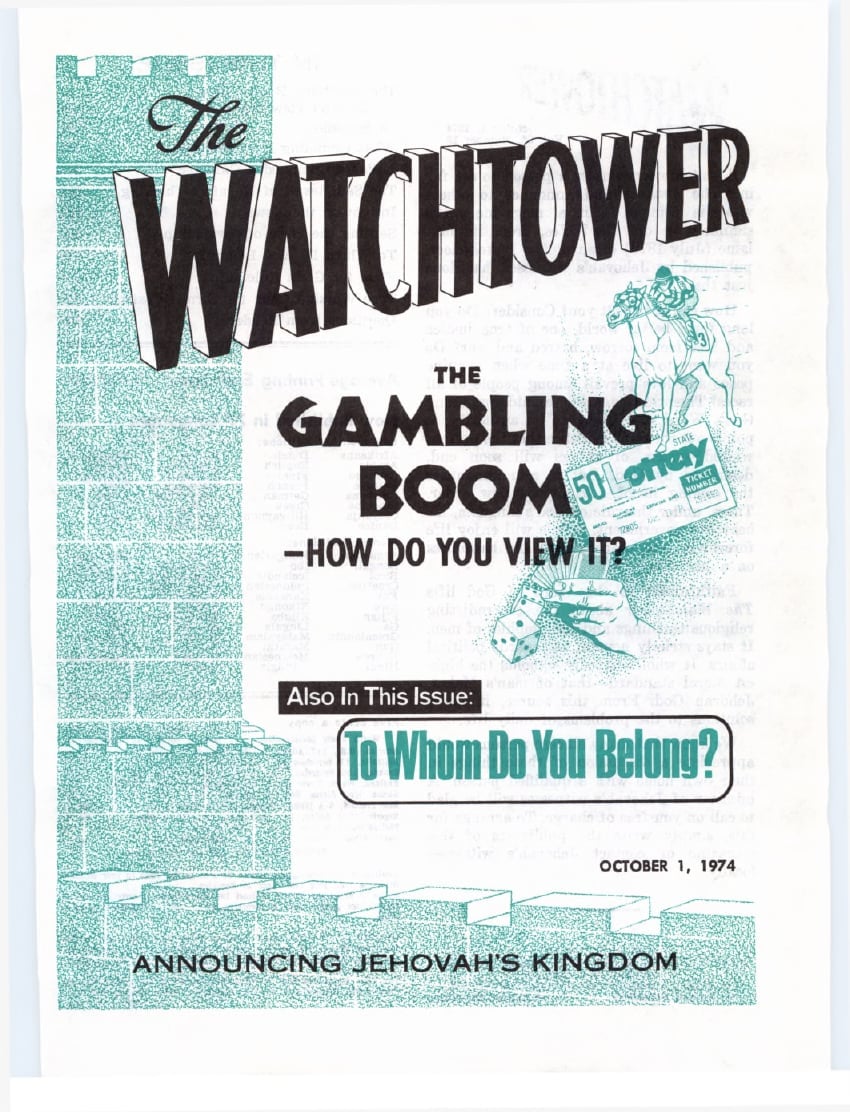
The Watchtower — October 1, 1974
Source: jw.org
Contents
The Gambling Boom—How Do You View It?
What Gambling Does to People
I Was a Compulsive Gambler
The Sad Result of Negative Thinking
Insight on the News
Settling the Issue of Ownership
To Whom Do You Belong?
Firm for God’s Rulership
True Worship Calls for Firm Decisions
Questions From Readers
A Paradise Was Lost—Learn How It Will Be Restored
The Gambling Boom—How Do You View It?
The Gambling Boom—How Do You View It?
THE upsurge in legalized gambling has been phenomenal world wide. More than seventy-five countries operate lotteries, and other forms of gambling also flourish.
A number of Asian countries have recently legalized casino gambling. Modern casinos are also big attractions in Africa’s Swaziland, Lesotho and Botswana.
Britain’s parliament in 1960 voted to legalize popular forms of gambling, including off-track betting and casinos. Australia has some 2,500 state-licensed bookmakers. The people bet more than $5.5 billion annually, which is more than the government spends on education, defense, housing, social services and welfare combined!
Some fifty million Americans gamble each year, betting anywhere from $30 billion to $100 billion, depending upon the estimate one chooses. The vast majority of this money is wagered illegally. Many states, however, are now stampeding to legalize lotteries, approve new racetracks and set up off-track betting.
By early 1974, eight states were operating lotteries, with at least four others about to open for business. New York city began legalized Off-Track Betting (OTB) in 1971, and many other places, too, may soon do so. Also, New Jersey, Maryland and Hawaii are said to be considering joining Nevada in legalizing casino gambling.
How is it that an activity, previously run almost exclusively illegally, is now being legalized?
WHY LEGALIZATION POSSIBLE
The change in public attitudes is largely responsible. A generation ago gambling even for “good” purposes was considered morally wrong. But that is not the way most people view it now. What about you?
Commenting on gambling’s growing acceptability, Newsweek observed: “The trend can be attributed partly to the general permissiveness of society; like alcohol, marijuana and sexual freedom, the institution of gambling is steadily losing its shock value and becoming accepted as a part of modern life.”
Some legislators have pushed hard for legalization. They argue that gambling is fun, and that governments, rather than criminals, should be receiving the money that people lose in payment for this fun. Major religions would apparently agree, as Episcopal priest William S. Van Meter notes: “Officially, the Episcopalians, Jews and Roman Catholics do not believe gambling is immoral.”
But what do you think? Is it really Christian, is it consistent with the Bible, to encourage an activity that has caused problems for so many persons? Some apparently feel that legalization is justified. They hope that, by legalizing gambling, illegal operations will be driven out of business.
Has this been occurring?
HURTING ILLEGAL GAMBLING?
Not long ago a National Science Foundation report noted: “State lotteries have had very limited impact on illegal gambling . . . The legal game is not sufficiently appealing to players of the illegal game to attract them away from it.”
Informed gamblers know that state lotteries pay back only a small return on every dollar bet compared to the return on the dollar bet illegally. Even New York’s OTB has taken very little important business from illegal bookies. Major bettors have stayed with them because of the advantages they offer. For example, winnings are tax free, bookies provide credit, and there are types of betting, such as parlays, numbers, and so forth, that legal operations do not offer.
Also, surprising perhaps to many, by far most illegal gambling is on football, basketball and other sports. And, there is no legal betting on these events. As a result, the legalizing of lotteries and OTB has had the effect of encouraging people to seek out such illegal gambling attractions. This was the finding of a recent New York Police Department study.
This study estimated that illegal gambling shot up by 62 percent in 1972. Chief Paul F. Delise explained: “A climate has been created to gamble. Because it now is possible to bet legally on horses, thousands of people who never in the world would have thought of betting on football or basketball or baseball are now betting with the bookies.”
A REAL BOOM
Some 200,000 persons now bet daily at New York city’s more than 120 new OTB parlors. About 23 percent of the city’s adults bet there. In 1973 they wagered some $691 million, with $800 million a projected estimate for this year. However, about twice this amount is bet in the city illegally! Some sportswriters estimate that more than half the football fans bet on the games.
“Betting has become so commonplace it’s the rule, not the exception,” laments Ruth Spirito of New York’s Northeast Bronx Community Council. It is similar in other countries where gambling has been legalized. “The level of gambling,” notes London’s Daily Mail, “is now so high it constitutes a social menace.”
Is gambling really a menace? What are its consequences?
[Box on page 580]
“A Swindle”
Inevitably gamblers, in time, lose. Irving Kristol, Henry Luce Professor of Urban Values at New York University, explains: “Gambling . . . is, technically, a swindle; the payoffs on bets must be less than fair, and the overwhelming majority of the ‘investors’ must eventually lose their money, if the gambling enterprise is to survive and prosper.”
[Picture on page 579]
More than 75 countries operate lotteries
What Gambling Does to People
What Gambling Does to People
A CERTAIN New York postal worker had never made a bet before. Then an Off-Track Betting parlor opened in his neighborhood. One bet led to another. Recently when his wife phoned Gamblers Anonymous the man owed $5,000, and had just run out to bet his last $16, leaving behind an empty refrigerator and two hungry children.
Experiences are often bizarre. An owner of a thriving apparel company consulted a psychiatrist because of his compulsion to gamble. To get an insight into the case, the psychiatrist accompanied the man to the track. In fascination he watched the man win money on seven of nine races. Intrigued, the psychiatrist decided to give it a try. Soon he, too, became a compulsive gambler and, in time, lost his practice.
“Unbelievable,” you say? “Typical,” replied a former gambler upon hearing this experience. “I’ve seen many cases like that.”
AN INSIDIOUS COMPULSION
This compulsion to gamble starts in a seemingly innocent way. “I see the women coming in,” explained a ticket seller at an OTB parlor. “At first they bet $2 or $4. Then it’s twenties and thirties. After a few months they’re betting $50 and $60 a race. How many have I seen like that? At my shop alone—at least 20.”
The number of people who become deeply involved in betting is astounding. “Half the [OTB] customers are betting six days a week,” a member of Gamblers Anonymous claims. Many have lost control of themselves, and are sorry they ever started. A Brooklyn housewife cried: “I wish I weren’t a regular bettor.” And a youngster lamented: “I’ve been losing so much lately . . . But I can’t stop, man, it’s in my blood.”
Many prominent businessmen, too, have become compulsive gamblers. In its article “The Hidden Executive Vice,” Dun’s Review concluded that gambling is “one of the U.S.’ most serious menaces—even above alcoholism and drug addiction.”
True, not everyone who starts becomes a compulsive gambler. In fact, many consider gambling ‘harmless fun.’ But is it really? To what does this “fun” so often lead? You may be surprised to know how many homes are affected by the sad consequences.
According to estimates by the National Institute of Mental Health, there are in the United States alone 10 million compulsive gamblers! These persons gamble to the point of serious financial and personal troubles, causing untold suffering to their families. Like drug addicts and alcoholics, these gamblers cannot seem to quit, no matter how many times they vow to do so. “There’s no question it’s addictive,” says an assistant district attorney familiar with gambling.
Nongamblers may find this addiction, or compulsion, hard to understand. Yet it is real. Dr. Robert Custer, chief of staff, Brecksville Division, Cleveland V.A. Hospital, has treated many such gamblers. “They are very desperate men when they come in,” he notes. “When the CG [compulsive gambler] asks for help, he is so frightened and confused that he’s near a state of panic. When he initially stops gambling, he’s so desperate that you would think his life was in danger.”
What causes persons to develop such a compulsion to gamble?
A DEMORALIZING DESIRE
A desire for easy money is apparently a major factor. Of course, no one wants to be poor; we all desire a sufficiency. But in gambling the prospect is held out of huge rewards without working—simply by chance or ‘good luck’ the possibility exists of becoming rich quickly. The prospect is alluring. And so often what ensnares a gambler is so-called “beginner’s luck.”
Thus in a typical experience a man in Ontario, Canada, had a remarkable winning streak at his first visit to a racetrack, turning about $4 into $1,000. “He should have stopped there,” said his wife. “But he couldn’t.” Why not?
Because gambling seemed such an easy way of making money. The win lured him on, inciting in him desire for more. The result? “He started to change,” his wife said. “It was like he was two different people.” In time he lost $60,000 gambling, and ruined his family life.
Once the desire takes root, a big winning rarely satisfies it. Like moths lured by a light bulb, gamblers are tantalized by the prospect of making an even bigger “killing.” Thus a teacher in his late thirties accumulated gambling debts to the amount of $20,000. But in an unusual four-day streak he won $25,000. Did he pay his debts? He admits: “I began thinking how easily I could double the $25,000. I began betting horses on Monday, and by the end of the week it was all gone.”
In an insidious way gambling can have this effect, eating away at the individual’s moral fiber. Almost invariably, compulsive gamblers, in time, become devious and unscrupulous. Recently a man picked four horses in what is known as a “superfecta” bet, and won $111,000 on a $3 bet. However, he refused to come to the office of Jerome T. Paul, an OTB official, to have his picture taken. Why? “He owed more than the $111,000,” Paul explained, “and he didn’t intend to pay.”
People of all walks of life are affected. An Orthodox rabbi, who had run up gambling debts totaling $100,000, explained: “I had no sense of responsibility to my family or my congregation. I’d schedule a funeral early, so I could get to the track. I made notes for my sermon between races.”
Yes, gambling does these things to people—it so often makes them greedy, dishonest and almost unbelievably inconsiderate of others. It also destroys self-control. So gambling clearly clashes with basic Bible precepts, which condemn “greedy persons,” and urge self-control and love of neighbor.—1 Cor. 6:9, 10; Gal. 5:22, 23; Matt. 22:39.
ANOTHER ADDICTIVE FACTOR
But more is apparently involved in causing compulsive gambling. Doctors who have investigated the problem find it complex, and admit that they do not really understand it. However, some believe that the gripping action and excitement involved in gambling contribute to the addiction.
Thus Dr. William H. Boyd, who has spent nine years studying the problem, concluded: “The ingredient in alcoholism is alcohol and the ingredient in drug addiction is drugs. But the ingredient in gambling is the excitement.” Dr. Robert Custer apparently agrees. “The ‘drug’ they seek,” he says, “is being in action.”
The action begins with the bet and continues until its outcome. There is joy over winning and anxiety over losing, and excitement during the whole procedure. Then, as Dr. Boyd notes, “The gambler has to go back and start over again for the thrill.” And it is a fact that the craving for the action is so great that one will hear gamblers say: “It’s not the money you owe that makes you desperate, but the idea of waking up and not having money to bet.”
True, it may be difficult to see how something without any tangible ingredient—such as the drug addict’s heroin—can cause addiction. But even in drug addiction there is more involved than just a physical addiction to some chemical. The mind is also affected somehow, bringing mental addiction. This is evident, since drug addiction continues even after the drug itself leaves the addict’s body. So, in discussing gambling, Dr. Custer draws this parallel: “Psychological demand is the essence of alcoholism and drug addiction, just as it is with compulsive gambling.”
But in whatever way it is that gambling works to demoralize people, whether by love of money or the excitement that accompanies gambling, the fact to remember is that it does insidiously get a hold on people. How wise, therefore, to avoid gambling! Do not be tempted to try it just because today’s permissive society has legalized it. Many persons started out gambling just a little—just for ‘the fun of it’—but soon became “hooked,” often with tragic results.
EFFORTS TO COPE WITH IT
Real efforts are now being made to help compulsive gamblers to quit. Gamblers Anonymous is a worldwide organization set up for that purpose, with some 200 chapters and 3,000 members in the United States alone. It endeavors to provide persons sufficient motivation to “kick” the habit. But it often fails. This is evidenced by the confessions of a cabdriver named Victor at a Gamblers Anonymous meeting in New York.
“I stood up and confessed that I couldn’t stop betting,” he said, “and I drove two shifts a day to support my habit. I told them I was so degenerate that as soon as I walked out of the meeting, I would probably drive four hours to Bowie in Maryland to play the horses. When I finished, three members were waiting for me. ‘Hey, Vic,’ they said, ‘you got room for us in the car?’”
Simply realizing one’s degeneracy, and even desiring to avoid the pain and consequences it brings, are often insufficient motivation to overcome compulsive gambling. But there is a way to “kick” the habit. Let one who had declined into the depths of compulsive gambling, but then recovered, tell about it.
I Was a Compulsive Gambler
I Was a Compulsive Gambler
The story of one man’s successful struggle to break free, after seventeen years as a compulsive gambler
I STILL feel the gambling urge sometimes, such as when walking past an Off-Track Betting parlor. Crowds may be spilling out onto the street, racing forms in hand. Before realizing it, I think to myself, “I wonder if I can still pick winners?” The thought seems just to pop into mind. I fight it off—looking the other way and quickening my pace.
For over seventeen years I was a compulsive gambler. Betting controlled my life. I just had to bet. It was more important to me than eating, drinking, sleeping, sex—everything!
WHAT LIFE WAS LIKE
During those years I stayed up nights “handicapping” horses—selecting ones on which to bet the next day. Or I worked nights in order to be free to spend days at the track. I begged, borrowed and stole money to gamble. Everything we had of value was in some hock shop.
After getting paid, I would go to the track. “I’ll bet $10 and see if I can increase it,” I would tell myself. The horse would lose, and I would say: “I’ve got to get my money back; I’ve got to get even.” Time and time again I lost my paycheck this way.
That meant there was no money for food, clothing or rent. Many times I went hungry, but so did my wife and two daughters. We had little to wear, and often we were evicted by landlords for not paying the rent. Or we moved to avoid shylocks.
Practically every gambler I knew was paying off a shylock—often several of them. Legitimate creditors will not lend to persons deeply in debt. But these underworld moneylenders will.
I used to go to a shylock and get maybe $25. For a $25 loan a person had to pay $30 back. The payments might be $6 a week for five weeks. If a person could not pay during a certain week, he would give what was called vigorish, about $2 on a $25 loan. But this $2 was not applicable to the principal. A person could pay $2 vigorish a week indefinitely, and still owe the remaining principal. Of course, $2 may not sound like anything now, but it was then in the 1920’s and 1930’s.
Those shylocks could be rough. They had their strong-arm men. I remember a friend of mine getting beaten up terribly because he was unable to pay. So I often lived in fear. When things got really desperate, I packed up and left. Fortunately, none of my family or I was ever hurt physically.
GAMBLING EVERYWHERE
It may be hard for you to believe how much gambling goes on. Wherever I worked, which usually was in restaurants and bars, all a person heard was “the horses.” But other gambling was done too.
There were elaborate underworld places all around New York. But one needed connections and “approval” to get in. They had roulette, poker playing, dice games—all kinds of gambling. I would visit these. But most of my betting was on horses.
I often went to the track, but did even more betting with local bookies. This was more exciting, for a person can get greater action. What I mean is that bookies offer all kinds of complicated horsebetting possibilities; playing horses at various tracks in parlays, back to back, round robin, numbers, and so forth. Legal operations do not offer these. This is one reason why they are not so attractive to sophisticated gamblers.
Numbers betting is an especially big attraction. I would bet them six days a week. The numbers for each day were composed of three digits, for example, 8-3-9. The first digit was obtained by taking the last dollar-digit from the total pari-mutuel payments after the day’s first three races. If the payment was $359.73 after those races, the first digit was 9. Then after the fifth and seventh races the total pari-mutuel payments were used in the same way to get the last two digits.
I would often place my bets with a middleman who worked for a bookie. For a long time my steady middleman for numbers was our milkman. Usually I bet fifty cents, each morning giving him the money and the numbers slip. I remember once hitting the entire number straight 8-3-9, for a payoff of $300—a lot of money for fifty cents!
THE KIND OF ASSOCIATES
We gamblers spoke the same language, having the same predominant interest, with its accompanying excitement and troubles. But genuine concern for one another was sadly lacking. Take that milkman for example.
I trusted him, since I had known him a long time and he always paid off on my winners. So after I won that $300 I was not suspicious when he invited me over to his house for a big dice game. It was not until I had lost most of my money that I realized the game was crooked. I had been “taken.” But there is not much a person can do—it is difficult to prove.
However, that was far from the only time that “friends” cheated me. Once I gave money and a list of horses on which to place bets to a fellow worker. He worked a split shift, and was going to see the bookie that afternoon. Later I heard the racing results and was astonished that I had picked four winners! Of course, when my “friend” came in that evening I was excited and wanted my winnings. But he made some excuse as to why he had not made the bets. I could not prove it, but I am sure he had pocketed the winnings.
Gamblers are really a crooked crowd! Many a small-time bookie ran off with money I had won. But the truth is, I was no better. I often borrowed and never paid back, and even stole money outright. When I think back on some of those experiences, it saddens me.
ALLURE AND EXCITEMENT
I realized that the things I was doing were wrong. But I was enslaved by the habit, especially being captivated by the allure of easy money. That is actually what got me started in the first place playing horses.
I had gambled before, playing dice as a youngster on the streets of Philadelphia, and, later, poker aboard ship when I ran away to sea at age seventeen. But it was not until 1928, the year I got married, that I became interested in horses.
At the time I was working at a drugstore lunch counter at 49th Street and Lexington Avenue in New York. I was fascinated by the elation of horseplayers over their winnings. I learned later that they never mention their losses. “I’d better get in on some of this easy money,” I figured.
I noted that gamblers got their horse information in the Daily Mirror. So one day I selected two horses from there and bet on them. I still remember their names, Buck Hero and Sunflower. With “beginner’s luck,” I won on both of them!
Now I had winners, and so could talk knowledgeably with the other horseplayers. “Too bad you didn’t have a parlay,” one said, “you really would have made a killing.” Soon I was trying all betting possibilities. I really studied the horses, and began my own handicapping.
On occasion I went to the track and won big. I would really feel excited and proud. I might pay off a few debts, but the next day I would be back at the track ‘to make a really big killing’—and usually lost everything.
And yet we would keep gambling, always figuring to hit that big payoff. I was reared in a Catholic orphanage where I learned about praying. So I would often pray for winners—in desperation on occasion even praying to the Devil.
Part of gambling’s fascinating allure, I believe, is in the tremendous anticipation of the outcome. To prolong the exciting suspense I would often have someone check the racing results in the paper, and then ask the person such questions as: “Did the winner in the second race have ten letters in his name? How much weight did he carry? How much did he pay? Who was the jockey?”
After the first or second question I would know by the answers when I was building up to a winner. Then finally I would ask if so-and-so—the horse I had bet on—had won. My elation was tremendous on hearing that he had.
EFFORTS TO PICK WINNERS
Handicapping horses was an involved procedure. Sometimes it would take hours to choose one good horse to bet on. Often I would decide that a race had no good betting possibility. But then what happened?
That night I would dream about a particular horse winning, and would bet on him the next day. Or I would go to the track, and notice that Straw Hat was running and that, unconsciously, I had put on a straw hat. So, of course, I bet on Straw Hat. I remember that once a can of pineapple fell off a shelf and hit my brother on the head. Checking the entries that day, he noticed a horse named Pineapple running; he bet on him and won! Gamblers are that way. They are very superstitious. And so rather than stick to their studied-out selections, they play hunches.
I am sure the Catholic Church realizes this characteristic of gamblers. For the nuns were always near the racetrack with their collection boxes. How could a Catholic, as many of us were, pass up a “sister” and expect to have any success playing the horses? So we would contribute. And if we won that day we would then be especially generous, hoping it would bring continued success.
You know why I played the number 839 so much—the one that came in and paid me $300? Because I was born in the 8th month, my oldest daughter in the 3rd month and my wife in the 9th month. It was just superstition. I considered that my lucky number—and it did pay off a few times.
But the fact is, I lost more than I won, and life was miserable, especially for my family. I wanted to quit. I would resolve: “I’m not going to do it. I’m just not going to play the horses anymore. I’m not even going to look at a horse sheet.” Then what happened?
I would go to work, and the fellow next to me would say, “Hey, you know that I had so-and-so yesterday, and he paid so much.” I would think to myself, “I used to play that horse.” And, the first thing, I was back playing again.
A TURNING POINT
It was in 1944 that something occurred, however, that was eventually to change my life. I had temporarily moved with my family from New York to work at Patterson Field, some miles outside of Dayton, Ohio. My daughter subscribed to the magazine Seventeen, and a bonus offered a current best seller or the Bible. I chose the Bible since I had always wanted one. Then, just a few days later, a man called at my door and placed with me the book “The Truth Shall Make You Free.”
Some weeks later, while alone one night, I picked up the book and began reading. It made more sense to me than anything I had ever heard concerning religion and the Bible. I was convinced that it was pointing me toward something more wonderful than I had ever heard about in all my thirty-eight years.
I was elated when the man returned, and so accepted his invitation to attend a meeting of Jehovah’s witnesses. But then I got sick. After a long stay in the hospital I returned to New York. However, the man in Ohio arranged for a Witness to call on me there.
Accepting an invitation to a meeting, I noted that the Witness who accompanied me did not smoke, so I asked him: “Do Jehovah’s witnesses smoke?” Upon getting a negative response, I remember thinking to myself: “Well, that leaves me out. Smoking and gambling are two habits that I’ll never be able to give up.” But I was wrong.
WHAT MADE THE CHANGE POSSIBLE
For the first time I began to appreciate what a grand Creator we have. Oh, I believed in God before. I knew he existed. How else could intelligent life, with all its complexities, have come about? But now God began to be real to me. I could see that he had purposes for the blessing of mankind.
Many times before I had prayed the prayer taught us in the orphanage: “Our Father who art in heaven, hallowed be thy name. Thy kingdom come. Thy will be done on earth as it is in heaven.” (Matt. 6:9, 10, Douay Version) But now I began to appreciate that God’s kingdom is a real government, and that we had finally reached the time in history when God had set that government in operation, with world-shaking consequences.
I was convinced that this system surely needs to be replaced. And it thrilled me to learn that Almighty God was really going to bring it about. The prophecy in the Bible book of Daniel especially became meaningful to me: “The God of heaven will set up a kingdom that will never be brought to ruin. And the kingdom itself will . . . crush and put an end to all these kingdoms, and it itself will stand to times indefinite.” (Dan. 2:44) The Bible promises of an earthly paradise, with freedom from even sickness and death, also had a powerful influence on my life.—Ps. 37:9-11; Rev. 21:3, 4.
I decided that if that is what God purposed for the blessing of mankind, I could show my appreciation by doing my best to obey His requirements. One requirement I learned was that a man “provide for those who are his own, and especially for those who are members of his household.” (1 Tim. 5:8) So I began doing this, which, of course, necessitated greatly curtailing my gambling. My family and others who knew me could not help but be impressed by the change.
A growing desire to please Almighty God is what made this change possible. But vital, too, was reading the wholesome literature of Jehovah’s witnesses and regularly associating with them. Whenever I went to their meetings, they were always friendly. Even people I never knew came up and said Hello. And I could see that their friendship was real; it was not hypocritical. When you are regularly with people like that you are influenced in a really beneficial way. I even stopped smoking.
BREAKING COMPLETELY FREE
But gambling had a much stronger hold on me. I was surprised, for I thought it would be easier to quit than smoking. However, the gambling urge was overwhelming, causing me to rationalize, “There’s no scripture in the Bible against gambling. And I’m taking care of my family.” So I would bet occasionally. In fact, at my first assembly of Jehovah’s witnesses in Cleveland, Ohio, in 1946, I attended most of the sessions, but one afternoon I skipped to go to the racetrack.
I did this type of thing for years. I just could not resist the urge. “I have a few extra dollars,” I would reason excusingly. “I can afford to have a little fun.” However, in time I began to gamble more than I ever intended. Also about this time I got into financial trouble to the point that my position in the Christian congregation was in jeopardy. It was a crisis in my life.
However, Christian brothers lovingly came to my assistance. They patiently gave me counsel and direction. And from reading articles in The Watchtower and Awake! I began more fully to appreciate gambling as the evil it really is. Especially did the 1964 Awake! article “Is Gambling Right for Christians?” have an effect on me. It helped me to appreciate that there really is a scripture against gambling.
I knew how superstitious gamblers are, always trying to win by wooing “Lady Luck.” They will cheat and do almost anything to win—winning becomes an idol and Lady Luck a goddess. So the scripture discussed in that article, at Isaiah 65:11, really hit me. It speaks of those leaving the true God and “setting in order a table for the god of Good Luck and those filling up mixed wine for the god of Destiny.”
When reading this I began to appreciate how closely gambling is connected with false worship. In fact, it made me think back to how we would often note that persons won their first bets—“beginner’s luck,” we would say. But now I am convinced that this is the Devil’s scheme to lure people to gamble, in some way manipulating matters so they win at first, thus ensnaring them into a degrading form of false worship in which they come to idolize money and Good Luck.
With this appreciation of matters, I began fighting the gambling urge as never before. I just would not give in to it! It has been years now since my last bet, and I still get the urge. But because I know that Almighty God does not approve of gambling I am determined never to place a bet again.
If you ever are tempted to gamble, remember its terrible fruitage—what it does to people, how it degrades them and even entraps them in false worship. And do not place that first bet! If you already are ensnared by the compulsion to gamble, be assured that you can overcome it. There is a way, and Jehovah’s witnesses will be glad to help you, even as they helped me.—Contributed.
The Sad Result of Negative Thinking
The Sad Result of Negative Thinking
IT IS a dangerous thing, generally, to have a negative viewpoint, and it is particularly dangerous when a person is negative toward the things of God. One who is negative can turn to bitter thinking and can actually become wicked.
Such a person is also usually sluggish, getting very little done. To avoid doing a thing the negative thinker, the sluggish individual, will make excuses to justify his course. “The lazy one has said: ‘There is a lion outside! In the midst of the public squares I shall be murdered!’”—Prov. 22:13.
Of such a person’s outcome, the Bible says: “I passed along by the field of the lazy individual and by the vineyard of the man in need of heart [or, good motive]. And, look! all of it produced weeds. Nettles covered its very surface, and its stone wall itself had been torn down. So I proceeded to behold, I myself; I began taking it to heart; I saw, I took the discipline: A little sleeping, a little slumbering, a little folding of the hands to lie down, and as a highwayman your poverty will certainly come and your neediness as an armed man.”—Prov. 24:30-34.
The Proverbs have a spiritual as well as a literal application. Persons such as the Proverbs describe may have started off with a right spirit and attitude, but then they develop a negative outlook toward righteous acts and works. So it calls for careful watchfulness on our part to avoid developing that deplorable spirit.—Prov. 4:23.
THE UNAPPRECIATIVE SLAVE
Such a spiritually negative person, or, rather, such a class of persons, is described in Jesus’ parable of the “talents.” In previous issues we have discussed the two faithful slaves mentioned in the parable, who received five talents and two talents, respectively. The third slave received one talent (a talent being a unit of silver money). But, since his master gave each “according to his own ability,” this third slave was under no handicap. The other slaves each made a 100-percent gain on the monies entrusted to them while their master was gone. The one-talent slave could have done likewise and thus have been pleasing to his lord; he did not have to gain five, or even as much as two talents.
But what did he do? The parable reads: “But the one that received just one went off, and dug in the ground and hid the silver money of his master.” (Matt. 25:18) His failure to make increase was his own fault; he did not exert himself as did his fellow slaves. When his master returned to settle accounts, what excuse did he give? He complained: “Master, I knew you to be an exacting man, reaping where you did not sow and gathering where you did not winnow. So I grew afraid and went off and hid your talent in the ground. Here you have what is yours.”—Matt. 25:24, 25.
In his negative thinking this slave tried to justify himself when the accounting was made. He tried to place wrongdoing on his lord. He charged his lord with getting crops, not only from his own land, but also from land he had not cultivated, and gathering grain that he had not winnowed of its chaff. His false reasoning was that the master had suffered no loss by his action—after all, he gave back the one talent. But this slave was unfaithful, because he accepted the money as a slave with the understanding that it should bring in profits. He no doubt accepted all the benefits that went with being a slave of his master, but he had no love for his master or consideration for his master’s belongings. Actually he caused his master a loss.
The slave’s master turned the tables on him, taking the slave’s own trumped-up excuse and using it to expose him: “In reply his master said to him, ‘Wicked and sluggish slave, you knew, did you, that I reaped where I did not sow and gathered where I did not winnow? Well, then, you ought to have deposited my silver monies with the bankers, and on my arrival I would be receiving what is mine with interest.’”—Matt. 25:26, 27.
MODERN-DAY SLUGGISH SLAVE
We have found in previous articles that the two faithful slaves represent, in the fulfillment, the faithful spirit-begotten brothers of the Lord Jesus Christ. The wicked slave, then, would represent those who likewise are spirit-begotten, anointed Christians, but who fail actually to care for the “belongings” entrusted to the “slaves” by their Master.
The sectarian church members of Christendom have falsely professed to be in the Lord’s service. But they showed no interest at all in the Lord’s “belongings” when World War I, in which they had participated, ended, and there was opportunity to preach the good news of the Kingdom world wide. What, instead, did they do? They supported the League of Nations, a man-made agency that the Federal Council of the Churches of Christ in America called “the political expression of the Kingdom of God on earth.” Now they direct people’s attention and support to the United Nations as the world’s hope for peace. They showed the Lord’s “belongings” had not been committed to them, for they have not cultivated the world field and brought forth real supporters of the established Messianic kingdom.—Isa. 9:6, 7.
However, among spirit-begotten ones associated with the “faithful slave” class, there was a class who sluggishly drew back. By 1931, when the name “Jehovah’s witnesses” was adopted by the remnant actually doing the work of proclaiming the established kingdom of God, these negative ones had formed themselves into various groups called by diverse names. They did not boldly proclaim the Kingdom and stand for the name of the Almighty God, Jehovah. Moreover, they actually opposed those doing this work. They did not share in the terrible sufferings that Jehovah’s witnesses experienced in the concentration camps, as well as the persecution in other parts of the earth. They fit the picture!
This unfaithful class does not have any proof that they have increased the Lord’s “belongings” by spreading the Kingdom message. They have not experienced the blessings of tremendous expansion. But in the years 1968-1972, there were 680,871 persons baptized, to join with Jehovah’s witnesses in proclaiming the Kingdom to others. The evidence is there as to whom Jehovah God is blessing. The faithful ones do not believe, as the wicked “slave” charged, that Jesus Christ is improperly reaping where he himself, when personally on earth, had not sown.
SETTLING ACCOUNTS
Note the punishment that the wicked and sluggish “slave” received at the hand of his master because of his negative thinking, his fearfulness and laziness, and his effort to justify a wrong course. His master said: “Therefore take away the talent from him and give it to him that has the ten talents. For to everyone that has, more will be given and he will have abundance; but as for him that does not have, even what he has will be taken away from him. And throw the good-for-nothing slave out into the darkness outside. There is where his weeping and the gnashing of his teeth will be.”—Matt. 25:28-30.
Evidently the master settled accounts with his slaves in the nighttime. Instead of entering into his master’s joy, the wicked slave was thrown outside. The master’s belongings entrusted to him, which he did not value and appreciate, were taken from him and given to the slave who had gained five talents, where these money values would be increased.
In the fulfillment, we can see that all Christ’s anointed “slaves” are provided a warning. Those of the wicked “slave” class do not enter into the joy of their enthroned Master, being retained in his further royal service here on earth as representatives of an already established Kingdom. This sluggish slave does not enjoy any further assignment to increase adherents to the Kingdom. When the death-dealing darkness of the “great tribulation” comes upon mankind those belonging to this class will weep and gnash their teeth with the religious hypocrites until they perish.—Matt. 24:21.
The faithful “slaves” have in themselves that which the wicked and sluggish “slave” does not. The committing of the valuable “belongings” of the reigning King and their opportunity to increase these “belongings” rouse in them a zeal and devotion to his kingdom. They believe in the heavenly Master’s worthiness to receive an increase in disciple-making. They demonstrate a loving, courageous motive in making disciples of people of all the nations, not merely the Jewish nation in which Christ worked when on earth.
DANGER TO ALL DEVELOPING NEGATIVE ATTITUDE
Even those of the “great crowd,” who have hope of living on earth with health and life under that Kingdom government, have the same attitude as the faithful anointed “slaves” of the Lord Jesus Christ, with whom they associate. They express loving-kindness, appreciation, courage and zeal by word and action as they become assistants to the faithful anointed class. They know that negative thinking, drawing back, becoming bitter and making excuses to justify themselves will put them in a position similar to that of the wicked and sluggish “slave.” This attitude would prevent them from surviving on earth through the “great tribulation.” Furthermore, any of them dying as unfaithful now would not be resurrected to live in the paradise that the Kingdom rule will bring to earth.—Rev. 7:9-17; Zeph. 2:3.
Thus we can see the danger of a negative approach to the Lord’s matters. In this time of judgment he will not let continue to associate with his faithful people any who are lazy or faultfinding. Their situation will prove to be like the one observed by the writer of Proverbs—broken down, weed-producing, so that their opportunity of work in the Lord’s congregations will be lost to them, their ‘poverty coming as a highwayman and their neediness as an armed man,’ suddenly. Happy are all who think positively, in faith and devotion to the commands of Jehovah through Christ today!
Insight on the News
Insight on the News
Can You Read This?
● If you can read this you are doing something that nearly one out of every four persons on earth cannot—even if this material were in their native language. In some lands a startling 99 percent of the population is illiterate.
A United Nations Educational, Scientific and Cultural Organization (UNESCO) report shows that—although educators seem to be winning the battle against illiteracy percentagewise—the total number of illiterates keeps getting bigger, due to the population explosion. From 1960 to 1970, illiterates increased from 735 million to 783 million, and now the figure nears 800 million.
Not only this, but in many nations enjoying a high literacy rate large numbers read very poorly, ineffectively. A Perth, Australia, newspaper reports an inquiry as showing that “312,000 Sydney adults are functionally illiterate.” A 1970 poll revealed this was also true of 18.5 million Americans 16 years of age or older.
Some blame television for part of the problem. But this cannot be a big factor in poorer lands. One factor often overlooked is religion. It is a historical fact that religions have often been guilty of suppressing education among the “common people” in order to keep them submissive and in awe of their priesthood. In complete contrast, the Bible clearly calls for all true worshipers to become literate, for in many Scriptural exhortations all those addressed are called on both to read and to write. (Deut. 6:6, 9; Hab. 2:2; Matt. 24:15) Historically, where respect for the Bible has been high, literacy has also been high.
Chagas’ Disease and Transfusions
● Chagas’ disease is a South American illness produced by a protozoan related to that which causes African sleeping sickness. The South American variety can produce convulsive seizures, at times ending in death or permanent mental or physical defects.
At the Third Congress of the Panamerican Federation for Voluntary Blood Donations held recently in Montevideo, Uruguay, Chagas’ disease came up for serious discussion. Why?
Because, like hepatitis, syphilis, malaria and other ailments, Chagas’ disease may be transmitted by blood transfusions. Studies carried out in Uruguay showed that in some sections of the country as many as 15 percent of the blood donors had positive reactions when tested for this disease. Estimates are that, in the Americas, some seven million persons are affected by it. The worst problem is that a person infected with the disease by a blood transfusion may not discover it until it is too late. Symptoms may appear several years later and may be followed by sudden death.
Clearly, those holding to God’s standards regarding the use of blood and who abstain from blood transfusions are protected from many dangers.—See Acts 15:28, 29.
Shifting Moral Standards
● Should Christian moral standards shift with the times, be molded by prevailing political attitudes or material prosperity? In the “National Catholic Reporter” (August 16, 1974), Catholic monsignor Paul Furfey sharply contrasts first-century Christians with those of later centuries.
Early Christians endured the world’s enmity and persecution. But, “all this changed with the Peace of Constantine [Roman emperor of the fourth century],” says the monsignor. “Christianity suddenly became respectable. The bishops crawled out of the underground and built themselves palaces. Christians began to become public officials, important military officers, wealthy merchants.”
Moving down to modern times, the author first refers to Jesus’ words about the rich man’s difficulty in entering God’s kingdom, and then says: “Yet . . . Catholic millionaires are not very worried. They know their bishops live in residences not inappropriately called palaces.”—Matt. 19:23, 24.
Why this dramatic change from the standards of early Christianity? The writer points to the cause in saying: “If it is really the case that moral theologians tend to follow the mores of the middle class instead of the unworldly doctrines of the New Testament, then that fact is unspeakably tragic.”
The shift is simply a repetition of the past. Jesus told money-loving, power-loving religious leaders of his day that they had ‘substituted men’s teachings and traditions for God’s Word.’—Matt. 15:1-9.
Settling the Issue of Ownership
Settling the Issue of Ownership
“Behold, to Jehovah your God belong the heavens, even the heavens of the heavens, the earth and all that is in it.”—Deut. 10:14.
1. What is the first evidence of God’s ownership of heaven and earth, and how does the Bible support this?
“IN THE beginning God created the heavens and the earth.” (Gen. 1:1) These opening words of the Holy Bible give direct evidence as to God’s ownership of the heavens and the earth. He created them, that is, he produced them and caused them to exist. He is their Maker. They were and are his possession, his property, and he has the exclusive and absolute right to their ownership. God holds the title to all this property, and the Holy Bible constitutes the legal evidence of this. It is his title deed. This is reiterated throughout God’s Word right down to its last book, Revelation.—Rev. 4:11; 10:6; 14:7.
2. How does the Bible give further evidence respecting God’s ownership?
2 The first chapter of Genesis continues to support the foregoing in unmistakable terms. In each and every step of creation it was God who gave the word as to what should be done. Time and again we read that God “proceeded to make” this and that, in heaven and on earth, animate and inanimate. He also named them. “God began calling the light Day, but the darkness he called Night.” Finally, “God saw everything he had made and, look! it was very good.” It had his stamp of approval. All things belonged to him, the only true God, “in the time of their being created, in the day that Jehovah God made earth and heaven.” (Gen. 1:5, 31; 2:4) Later, Moses was inspired to confirm this, when he said to Israel: “Behold, to Jehovah your God belong the heavens, even the heavens of the heavens, the earth and all that is in it. For Jehovah your God is the God of gods and the Lord of lords, the God great, mighty and fear-inspiring.”—Deut. 10:14, 17.
3. Regarding this, why does the creation of man call for special attention?
3 The creation of man was the crowning act of earthly creation, and this deserves our special attention. The telling of this at once indicates a development, a widening out of the subject of ownership. Different aspects are mentioned, such as subjection, indicating relative or limited ownership in varying degrees and responsibility thereto. Notice what is said in this connection.
4. (a) What do we learn from the expression: “Let us make man in our image”? (b) How does God’s Word identify the creative agent used?
4 For the first time in the record, someone is invited to cooperate in creation. “And God went on to say: ‘Let us make man in our image, according to our likeness, and let them have in subjection the fish of the sea and the flying creatures of the heavens and the domestic animals and all the earth and every moving animal that is moving upon the earth.’” Does this cooperation imply a relinquishing of ownership by God to any degree, or a joint ownership? No. The initiative, responsibility and control were entirely in God’s hands, as we next read: “And God proceeded to create the man in his image, in God’s image he created him; male and female he created them.” (Gen. 1:26, 27) From other scriptures we learn that it was the one now called Jesus Christ who, in his prehuman existence, was the one used by Jehovah as his special creative agent. He, like Wisdom personified, was “the earliest of his [Jehovah’s] achievements,” Jehovah’s “master worker.” He was “the Word,” through whom “all [other] things came into existence.” He “is the image of the invisible God, the firstborn of all creation,” hence appropriately involved at man’s creation, since man too was created in God’s image. True, Jesus Christ is spoken of as “our only Owner [or, Master] and Lord,” but, as we shall discuss later, this title was given to him by reason of a purchase that he made, not because of his role as God’s creative agent.—Prov. 8:22, 30; John 1:1-3; Col. 1:15, 16; Jude 4.
5. What scriptures might be quoted indicating a degree of ownership by man?
5 The question arises, however, as to whether man received a considerable degree of ownership when he was created and given the commission: “Be fruitful and become many and fill the earth and subdue it, and have in subjection the fish of the sea and the flying creatures of the heavens and every living creature that is moving upon the earth.” (Gen. 1:28) From this it might be argued that this was so. Did not man’s being created in God’s image include the ability to exercise ownership? Other scriptures might come to mind giving support to this. After the flood, regarding “every living creature,” God said to Noah: “Into your hand they are now given.” Then, too, we recall David’s words when he said to Jehovah: “You make him [mortal man] dominate over the works of your hands; everything you have put under his feet.” Again, the psalmist’s well-known expression will come to mind: “As regards the heavens, to Jehovah the heavens belong, but the earth he has given to the sons of men.”—Gen. 9:2; Ps. 8:6; 115:16.
6. Why is it important to consider the context of any particular scripture?
6 Yes, it is agreed that the foregoing scriptures speak of ownership, but at most it is to a relative or limited extent. This is evident when in each case we look at the context which is always important in seeking a proper understanding of God’s Word on any subject.
7. Regarding man’s position as owner, what do we learn from (a) Genesis 2:15-17, (b) Genesis 9:3-6, (c) Psalm 8, and (d) Psalm 115?
7 Regarding man’s original status, there is no doubt who was the real Owner when we read that “Jehovah God proceeded to take the man and settle him in the garden of Eden to cultivate it and to take care of it.” Next we read: “And Jehovah God also laid this command upon the man: ‘From every tree of the garden you may eat to satisfaction. But as for the tree of the knowledge of good and bad you must not eat from it, for in the day you eat from it you will positively die.’” (Gen. 2:15-17) Surely that man had no reason or excuse to forget to whom he belonged, when his very life depended on his obedience to his Creator and Owner. In a similar vein, when God gave all living creatures into Noah’s hand, we immediately read of the strict prohibition regarding the eating of blood and the shedding of man’s blood. Again this emphasizes who was the ultimate Owner of life as represented in the blood of all living creatures. (Gen. 9:3-6) Turning to Psalm 8, we observe that, rather than any suggestion of the ownership of the earth being handed over to man, the entire theme reflects to the credit and praise of the One who possesses and controls all things: “O Jehovah our Lord [Master, Owner], how majestic your name is in all the earth!” (Ps 8 Vss. 1, 9) We observe a similar theme when we look at Psalm 115. Notice especially the opening words: “To us belongs nothing, O Jehovah, to us belongs nothing, but to your name give glory according to your loving-kindness, according to your trueness.” This stresses that Jehovah is not only the Owner in fact, but a good and worthy Owner. There could be none better.
8. (a) In what position was man placed by his Creator? (b) Is this generally recognized, and what questions are raised?
8 From the scriptures already considered, we can appreciate that man was originally given a position of great trust and responsibility. Created in God’s image as a free moral agent, he had all the necessary ability to meet every requirement. Jehovah was the Landowner. Man was the tenant farmer, commissioned to become the global caretaker. He was given a sacred trust and stewardship. That is clear. But it is equally clear that man today, generally speaking, does not acknowledge any obligation in that regard. Quite the opposite in fact. How did this come about? How did the question of ownership become an issue, and how will it be settled? Further, as individuals, how are we involved, and with what consequences to ourselves? We are really interested in getting the right answers to these questions.
ISSUE RAISED OVER OWNERSHIP
9. What did the eating of the forbidden fruit imply?
9 When Satan the Devil tempted Eve to eat the forbidden fruit, no direct mention was made as to its ownership. But consider for a moment what happens when you eat something. When once in your hand or on your plate, you have taken possession of it, whether entitled to it or not. After having eaten it, however, you have actually made it a part of yourself. You have made it your own, no matter what you may say by way of excuse or confession. That is how it was with Eve. Though she had just repeated God’s command: “You must not eat from it, no, you must not touch it that you do not die,” we next read that “she began taking of its fruit and eating it. Afterward she gave some also to her husband when with her and he began eating it.” (Gen. 3:1-6) Satan’s argument that prompted their action was to the effect that the right to eat of that fruit belonged to them. Thus by deliberate and defiant action, that speaks louder than words, both Adam and Eve classified that forbidden tree as one and the same as all the other trees to which they had been given the right to eat. But immediately after both of them had eaten the forbidden fruit, did they feel justified in their judicial classification of trees? Their becoming conscience-stricken says No! True, they could not restore to the tree the pieces of fruit that they had eaten from it, but their having assimilated the eaten fruit into their bodies brought them no feeling of ownership of a just right to eat the forbidden fruit. The leaves with which they made loin coverings to hide their now realized nakedness were not taken from the forbidden tree, but were taken from the fig tree. The outcome of the whole matter was as if they had eaten sour grapes.—Ezek. 18:2.
10. How was the issue raised not limited to something material, and what further questions are raised?
10 Still, the issue was raised over God’s rightful ownership. Please note that the issue was by no means limited to something material, the fruit of a certain tree. What about man himself, not only his life, but also those fine moral qualities of loyalty and devotion and appreciation? Should not all these qualities be exercised at all times to the credit and praise of Jehovah, proved by a course of willing obedience and submission to him? Is not man completely dependent upon God for life and all its possibilities and blessings? Is not the constant acknowledgment of such dependence something that properly belongs to God as a rightful possession of his?
11. (a) How did Paul use similar reasoning when writing to the Corinthians? (b) What connection is thus shown between relationship and ownership?
11 Paul used reasoning similar to this when he wrote to the Christians at Corinth: “I am afraid that somehow, as the serpent seduced Eve by its cunning, your minds might be corrupted away from the sincerity and the chastity that are due the Christ.” Such a course of sincerity and chastity on the part of these Christians rightfully belonged to the Christ, because, as Paul explained, “I personally promised you in marriage to one husband that I might present you as a chaste virgin to the Christ.” A correct Scriptural understanding of the matter of relationship will help us to get a correct view of ownership, so that we avoid being seduced by cunning sophistry.—2 Cor. 11:2, 3.
12. What was God’s reaction to the rebellion in Eden?
12 Our first parents willfully chose a course of disobedience and independence, a course of corruption. In effect, they repudiated God’s ownership of them. They took the view that they belonged to themselves and to each other, but not to God. They severed their good relationship with him. What was God’s reaction to this challenge? Did he relinquish his ownership of them and their Edenic home? Not at all. He was their Lawgiver and Judge, and he now acted in this capacity. After pronouncing sentence, he protected his property by driving the man out of the garden of Eden and making any return thereto impossible, especially guarding “the way to the tree of life.”—Gen. 3:24.
13. For whose benefit was the prophecy given at Genesis 3:15, and what assurance did it provide?
13 Though we might say that God thereafter abandoned Adam and Eve entirely to their own resources, he did not deal that way with their offspring. When pronouncing sentence on the serpent, God prophetically told of a coming “seed” of the woman who would bruise the serpent in the head. (Gen. 3:15) No details were disclosed as to when and how this would be done, but it gave a definite promise that God would furnish a satisfactory answer to the challenge raised by man’s rebellion. Hence, it also pointed to God’s continued ownership of earth as well as heaven, including all their inhabitants, despite the temporary permission of evil and evildoers.
14. How did Abel, Enoch and Noah acknowledge God’s ownership of them?
14 In support of this, note what is said of three men of faith that Paul mentioned, Abel, Enoch and Noah. They “walked with the true God,” and Paul confirmed this at Hebrews 11:1-7. (Gen. 5:24; 6:9) They acknowledged God’s ownership of them, proving it by maintaining a course of faithful obedience in the spirit of loyal devotion and submission. In the face of strong adverse pressure they gave to God what was due to him in all sincerity and chastity.
15. (a) What course has been pursued by mankind in general, involving what issues? (b) What are Jehovah’s attitude and purpose regarding these issues? (c) How did Jesus set the example as to the right attitude?
15 Apart from the few already noted, most of the human family went their own way. The issue of ownership was far from being settled. The few, from Abel onward, exemplified by their life course the right principles involved, but, as the record shows, the great majority ignored, or resented and bitterly opposed, that good example. (Heb. 11:36-38) Even the flood of Noah’s day, a forceful reminder of who actually owned the earth and its inhabitants, brought only a temporary halt to man’s willful, selfish and rebellious course. This grieved the great Owner, Jehovah, but did not take him by surprise. Other closely related issues were involved: sovereignty or rulership, and worship. Challenging questions had been raised by Satan in connection with these issues, and Jehovah was working out his purpose, foreknown to him from the time the rebellion started. The full outworking of this purpose will demonstrate for all time, not only the fact of God’s supreme ownership, but also his absolute worthiness to hold that position and man’s obligation to recognize that. This recognition is and will be expressed right up to the final test by those maintaining the right relationship in the same way that Jesus replied to the final temptation in the wilderness: “It is Jehovah your God you must worship, and it is to him alone you must render sacred service.”—Matt. 4:10; Job 1:7-12; 2:2-5; Isa. 46:9-11; Rev. 20:7-9.
16. When and how was the issue of ownership raised to a national level, resulting in what?
…