The Watchtower, August 1, 1974
Download: PDF — The Watchtower, August 1, 1974
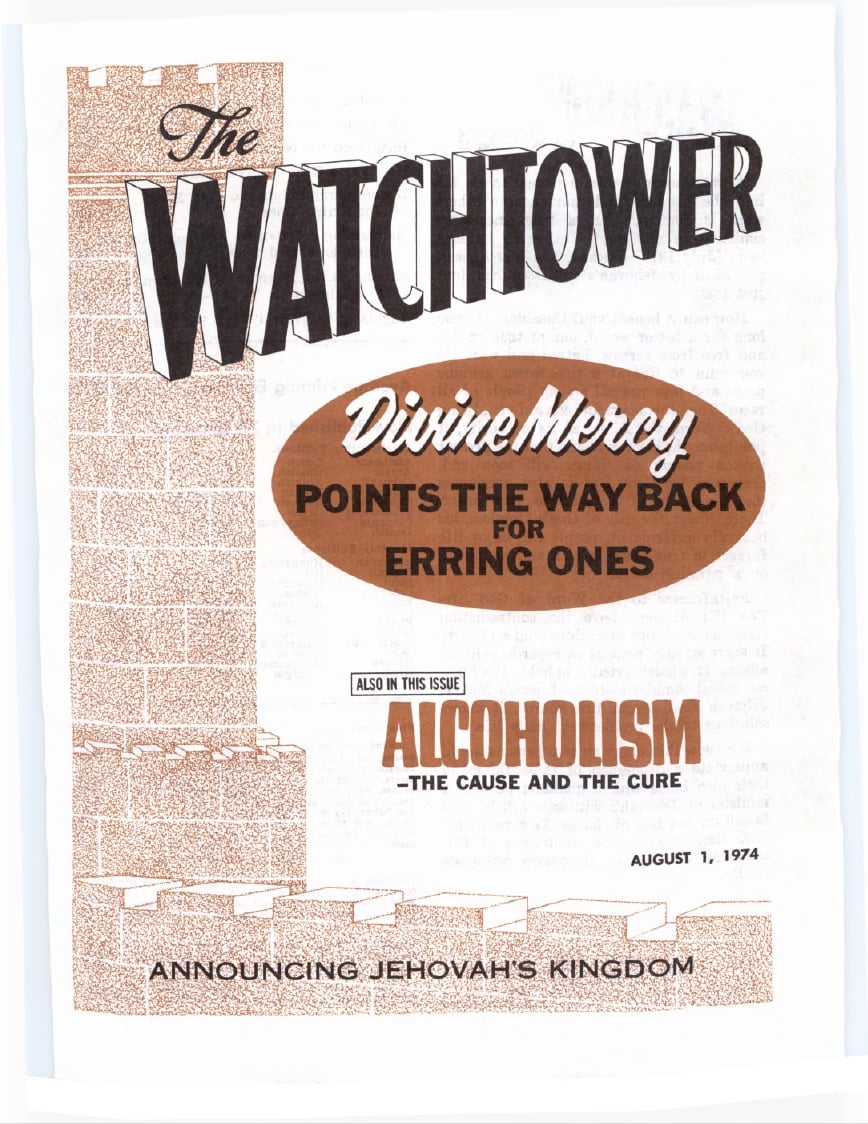
The Watchtower — August 1, 1974
Source: jw.org
Contents
A Problem That Rivals Drug Addiction
The Cause and the Cure of Alcoholism
Insight on the News
How False Gods Allured Ancient Israel
Divine Mercy Points the Way Back for Erring Ones
Maintaining a Balanced Viewpoint Toward Disfellowshiped Ones
Sharing in the Increase of Kingdom Proclaimers
‘Lights of the World’ for 1,900 Years
Many Now Living Will Never Die
A Problem That Rivals Drug Addiction
A Problem That Rivals Drug Addiction
WHAT is it that enslaves many millions more persons than heroin addiction?
What causes persons to be seven times as susceptible to accidental death as the rest of the population?
What ranks next to heart disease and cancer as a major health problem in the United States and many countries of Europe?
The answer: chronic alcohol abuse.
The use of alcoholic beverages goes back to the earliest times of man’s history. The abuse of these beverages is just about as old. Millions of people today enjoy wine, beer and other alcoholic beverages without any damage to their health, or to their mental effectiveness or personal safety. Yet, today, in the United States, about one out of every ten persons who drink is either a full-blown alcoholic or a “problem drinker,” that is, one whose drinking causes trouble for himself (or herself) and for those around him.
In France, where there is a café or bar for about every 250 persons, a poll indicated that nearly one out of every four men and one out of every twelve women has a problem with alcohol abuse. The toll of persons dying from alcohol-caused disease is estimated at 30,000 a year. Last year French Health Minister Michel Poniatowski said: “Let’s not beat about the bush—alcoholism is a national scourge.”
One of the saddest aspects of the rise of alcoholism is its invasion of the ranks of young people. A London Times report shows drunkenness rising sharply among British teen-agers, particularly among girls. A survey revealed some children slipping drinks from the family cabinet before heading for school; others were missing the school lunch to step out for a drink at a nearby pub.
In the United States, the director of the National Institute on Alcohol and Alcohol Abuse, Dr. Morris Chafetz, said: “It’s not uncommon to see severe alcoholism problems in kids 9, 10, 11, 12 years old. It’s a far more serious problem than we ever imagined.” The Alcoholics Anonymous organization has started “Junior AA” chapters for those ten to twenty years old. In New York city alone there are an estimated 66,000 youngsters twelve to eighteen years of age with serious drinking problems.
FAR-REACHING EFFECTS ON HUMAN LIVES
The Bible says that “wine itself makes life rejoice.” (Eccl. 10:19; compare Psalm 104:15; Ecclesiastes 9:7.) But it also warns that wine can be “a ridiculer, intoxicating liquor is boisterous, and everyone going astray by it is not wise.” (Prov. 20:1) Consider some of the ways that excess in the use of alcohol can make a mockery of human lives.
Some persons are able to drink surprisingly large quantities of alcoholic beverages and still not give the appearance of being “drunk.” A poll by the French paper Le Monde shows most alcoholics in France drinking from four to five quarts of wine a day, yet often showing little outward sign of intoxication. Nevertheless, as Proverbs 23:32 says of excessive drinking, “at its end it bites just like a serpent, and it secretes poison just like a viper.” An early sign of this poisoning may be the well-known “hangover” with its nausea, headache, restlessness, trembling, sweating, stomach upset and tremendous thirst (due to the shift of water from the cells to areas outside the cell walls).
The long-range effects, though less dramatic, are much more grave in their consequences. Alcoholic beverages are high in calories. But these are “empty” calories, lacking vitamins and minerals and amino acids in any quantity. The heavy drinker often neglects normal eating, and then nutritional deficiencies begin to develop. These play a large part in the diseases accompanying alcoholism. Particularly the liver, already heavily worked in metabolizing (“burning up” or oxidizing) the alcohol, suffers, and in time cirrhosis of the liver sets in, a prime source of death among long-term alcoholics.
Excessive amounts of alcohol irritate the tissues of the mouth, throat and stomach. Some French medical authorities believe that 90 percent of the cancer cases in that country involving the mouth, throat and larynx are due to alcoholism. In time, the drinker may develop delirium tremens—with its violent shaking, frightening hallucinations and forms of paralysis—and, though only lasting from three to ten days, this often proves fatal.
Even more serious—and more immediate—is the effect of alcohol abuse on personal conduct. This is because alcohol, when absorbed into the bloodstream, affects first of all the highest functions of the brain—thinking, learning, remembering and the vital making of decisions and judgments. A small amount of alcohol for most persons has little effect. But where one takes several drinks in a relatively short time, his ability to remember, to concentrate and to solve problems drops rapidly. The brain finds difficulty in processing more than one kind of incoming information at a time. (Ps. 107:27) Vision becomes impaired; the person has trouble in seeing things off to one side and may have the feeling of looking through unfocused binoculars. Yet, because of alcohol’s somewhat hypnotic effect, the one overindulging may feel he still has full command of his senses.—Isa. 28:7.
Since alertness and reflex responses, triggered by the brain, diminish with high alcohol concentrations, driving becomes extremely hazardous. Alcohol abuse is involved in at least half of the 55,000 deaths and one million major injuries occurring each year on United States highways. Where states have lowered the legal age for drinking to eighteen years, a dramatic rise in fatal road accidents caused by drunken teen-age drivers has occurred.
The greatest tragedy lies in alcoholism’s effect on family life. For the alcoholic’s mate and children, life can become a nightmare. Youthful lives may be blighted or permanently scarred. The separation or divorce rate for alcoholics in the United States is seven times as high as that of the rest of the population. In France, alcoholism figures in one fourth of all suicides and one half of all homicides. (Compare Proverbs 4:17.) Research has shown that chronically alcoholic mothers may produce defective children—children born with abnormally small heads, lopsided faces, having stunted growth ability and subnormal intelligence.
The chronic alcoholic is a poor employee; he cannot perform anywhere near what his normal capacities would allow. He has a far higher rate of absenteeism, takes twice as much sick leave as other employees, is involved in more work accidents. Besides his own inefficiency he generally impairs the efficiency of those whose work ties in with his. (Compare Proverbs 21:17; 23:20, 21.) Estimates place alcoholism’s cost to business and industry in the United States alone at $12,000,000,000 annually. Alcohol abuse leads to a breakdown in morality and the growth of crime. Surveys show it often is a stepping-stone to drug addiction.
Nations today are searching for remedies for this major problem. This means finding out why and how people become alcoholics, so as to know what protective measures can be taken or how a cure can be effected where the person is already a victim of alcoholism. What have the results in this regard shown and where does the real solution lie?
[Picture on page 452]
Many persons can eliminate 1/3 ounce of pure alcohol per hour. BEER 8 oz. WHISKEY 3/4 oz. WINE 2 3/4 oz.
When one drinks alcohol, it is quickly taken into the bloodstream, soon reaches the central nervous system, and starts to slow down brain activity.
Several drinks may be required before motor centers of the brain are affected, resulting in faltering steps. But be on guard! Before that, the barriers of self-control come down. As Hosea 4:11 says, “Wine and sweet wine are what take away good motive.”
A very small amount may affect you adversely; others may drink more, with no observable effect; do not conclude that you can drink freely because others do.
The Cause and the Cure of Alcoholism
The Cause and the Cure of Alcoholism
WHAT causes persons to become virtual slaves of alcohol, even to the point of ruining their lives and the lives of their families?
Alcohol itself is not the problem. Unlike tobacco or heroin, it is not inherently addictive. The difficulty lies with the users. The factors involved are multiple. Yet they all point to a basic lack or need, and this, in turn, points to the real remedy.
Research shows that children whose parents are heavy drinkers are far more likely to be drawn into the same habit. On the other hand, a report from the U.S. Department of Health, Education and Welfare shows that alcoholism is low where there is “early exposure to small, diluted quantities of alcoholic beverages within a strong family or religious group,” and where alcoholic beverages are considered mainly as foods and consumed with meals.
Many persons who did not have the benefit of sound parental training regarding alcoholic beverages may get into danger owing to lack of knowledge. They may not realize that different beverages have different strengths as to alcohol content. Beer, for example, contains about 5 percent alcohol, most table wines from 10 to 14 percent, while fortified wines such as sherry and port contain from 16 to 20 percent. Distilled drinks (such as rum, gin, whiskey) contain from 40 to 50 percent alcohol. Even if individuals know this they may not realize that they take just as much alcohol into their system by drinking a sixteen-ounce bottle of beer as if they drank one and a half ounces of whiskey.
A person’s body size also generally has its effect—the larger one is, the greater the quantity of blood and number of cells and hence the more diffused the alcohol is on absorption. Yet, even though of the same build, individuals may differ tremendously, one being made dizzy by only a small quantity of alcohol while another feels little effect with double the amount. An empty stomach will allow the alcohol to be absorbed into the blood rapidly, whereas food slows down the process. And, since the body is able to eliminate alcohol at the rate of only about one third of an ounce per hour, the time between drinks also is a vital factor.
Associations play a strong role. If heavy drinking is viewed as proof of being a “real man” or as “smart” and sophisticated, there is pressure to conform. Young men and women often are initiated into heavy drinking in this way and fall into a pattern of “telescoped” drinking—periodically getting “high” at parties or Saturday-night drinking bouts. Gradually the drinking may spread over into more and more days of the week. The process may be deceitfully slow. Studies show that the making of an alcoholic takes an average of sixteen years in men, only eight in women.
In later life, personal circumstances become a principal factor. Family problems, marital difficulties, heavy debts, illness, disappointments, failures and the resulting mental depression—these are often the things that initiate the dependence on alcohol. Men in executive positions, or other work that involves stress and pressure, may become reliant on alcohol for a measure of relief from tension. Persons involved in selling and buying often use it to “oil” the wheels of their business associations. Men with monotonous jobs may spend their free time in seeking the synthetic fellowship to be found with workmates in a bar.
The modern increase in alcoholism is especially strong among women. In the United States about half the women alcoholics have experienced broken marriages and a third are married to alcoholics. Some have well-paying jobs but have found life less than satisfying, lacking in meaning. Those who have the role of homemaker may experience boredom or find the responsibilities of caring for small children burdensome. A housewife’s greater privacy from public attention may enable her to develop and conceal a drinking habit for some time. Hormonal changes accompanying the menstrual cycle may be all that is needed to trigger a spell of very heavy drinking.
WHERE THE SOLUTION IS TO BE FOUND
All these things point in a principal direction: people who become compulsive drinkers (unable to control their drinking habits) rely on alcohol to supply an emotional need. True, in time the cells of their body may become so adjusted to high concentrations of alcohol that cessation of drinking produces a violent reaction, and thus there is also a physical enslavement. The physical-enslavement point, however, would doubtless never be reached if emotional dependence had not come first. Yet alcohol solves no emotional problems; it only creates more serious ones. It is a false source of comfort, courage, fellowship, or escape from life’s problems. Only if persons recognize this can they find the real solution to their dependence on alcohol.
This brings us to the most difficult problem in effecting a cure for alcoholism. What is that? Getting the person to recognize that he or she really does have the problem. Yes, strangely enough, the alcoholic is often the last one to face up to the fact of his or her dependence on alcohol. A man may take a small drink in the morning, two or three at noon, another during the afternoon, another on arriving at home, and two more during the evening and still tell himself he is not an alcoholic. Only if for some reason he is deprived of his drinks and then undergoes the terrible reaction associated with delirium tremens may he be jolted into a recognition of his true situation.
The first step, then, in solving the problem is for the person to recognize his or her enslavement to alcohol. The Bible associates truth with freedom, and lies with slavery. (John 8:32; 2 Pet. 2:18, 19) The clerk who keeps a bottle in the bottom drawer of his desk, and the housewife who secretly works her way through a series of drinks each day, and yet who deny they have a problem, will never find the way to become free.
Then, instead of using alcohol as a personality “crutch” or emotional medicine, the person must look to the right source for satisfying the emotional needs he or she has. Companionship and fellowship should be sought with those who have a healthful outlook on life and a right attitude toward drinking. True, previous associates may mock you when you “do not continue running with them in this course [of ‘excesses with wine’ and ‘drinking matches’] to the same low sink of debauchery,” but whatever unpleasantness that brings you is well worth it in the escape from degradation that you gain.—1 Pet. 4:3, 4; 1 Cor. 15:33.
To make the cure effective, you need to ‘make your mind over,’ developing new and right standards of conduct. (Rom. 12:2) It is not enough to know that most persons disapprove of alcoholism or that one’s mate, children or relatives disapprove. Knowing God’s viewpoint is what can make the difference and give the determination and endurance needed for lasting success and victory over the problem. His Word assures us that drunkards will have no share in his promised Kingdom and the life-giving benefits it will bring.—1 Cor. 6:10; Gal. 5:19-21.
Above all, one needs something genuine to put hope and faith in, a solid basis for confidence as to a happy solution to life’s problems. The Bible is the unique source that can supply these needs. Some circumstances in life are beyond our making any real change—certain cases of poor health, the general hardness of present world conditions and the daily pressures these bring—but the Bible shows that these things are not beyond God’s changing. That prophetic Word foretold the very things we now see and sets out the sure hope that “the creation itself also will be set free from enslavement to corruption and have the glorious freedom of the children of God.” This will come in a new order of God’s making that will bring this earth into a peaceful, healthful state for all those who love righteousness and truth.—Rom. 8:20-22.
Increasing numbers of persons have found wholesome companionship through association with Jehovah’s witnesses in their Kingdom Halls, have gained a solid hope for the future and learned sound principles for handling their day-to-day problems. Among them, there are many who have suffered from alcoholism and other equally severe problems, but who have now conquered these. All persons are encouraged to feel free and welcome to avail themselves of the Bible-based assistance they provide.
Insight on the News
Insight on the News
Rome—A Missionary Field?
● Among world shortages is one affecting the churches—a shortage of ministers and priests. A recently published Vatican report shows that in 1973 only 3,009 new priests were ordained world wide, while in that same year 4,025 priests died.
Rome itself is particularly hard hit. The Italian newspaper “Il Mondo” recently reported that, in that city of three million people, only six new priests were ordained in 1971. The newspaper warns that, if the trend continues, Rome could be a “missionary field” in another quarter century.
There are, of course, many thousands of priests in Rome, but most are occupied with office work or activity in the Vatican. So, “Il Mondo” says the Church has had to bring in foreign priests to care for regular parish activity. Three fifths of Rome’s churches are now assigned to such ‘emergency priests’ drawn from Spain, England, Germany, India and various African lands. Fifteen churches in Rome now have parish priests or assistant parish priests who are Chinese.
Strange situations, indeed, appear on the world stage today. Bible prophecy, however, gives discernment as to how they fit into an overall pattern. The problems now troubling the world’s religions are but forerunners of a coming devastation, prophetically pictured as the destruction of “Babylon the Great,” the world empire of all false religion.—Rev. 17:1, 16.
Disease or Personality Problem?
● In Russia alcoholism is a serious problem. The official publication “Literaturnaya Rossiya” recently urged that it be confronted directly as a “disease,” not just a ‘hangover from Czarist times.’
Labeling alcoholism as a “disease” is popular elsewhere, approved even by Alcoholics Anonymous and the American Medical Association. Such designation supposedly frees the alcoholic from considerable shame and causes others to show greater sympathy. In the United States, it lets organizations treating alcoholics obtain federal funds—allocated for disease, not personality problems. Not all doctors, however, go along with labeling alcoholism a “disease.”
In his newspaper column, Dr. Theodore R. Van Dellen agrees that anyone drinking in excess and damaging his liver, brain or heart is indeed “sick.” “However,” he says, “somewhere along the line, habit, personality, character, and responsibility enter.”
Similarly, Dr. David M. Gimlett, writing in the “American Medical News,” warns that, in calling alcoholism a disease, “one runs the real risk of implying to patients and the treating personnel that the individual has no responsibility for his condition and that therefore assuming individual responsibility is not a necessary part of the ‘treatment.’”
In the first century, a doctor named Luke quoted Christ Jesus as saying: “Pay attention to yourselves that your hearts never become weighed down with overeating and heavy drinking and anxieties of life, and suddenly that day [of Jehovah’s judgment] be instantly upon you as a snare.” (Luke 21:34, 35) Yes, the heart is the key to the problem, and where there is a true heart determination alcoholism can be overcome.
Courage for Principle
● In one East African country, a principal newspaper ran a front-page article relating that many of Jehovah’s witnesses were leaving tobacco farm employment, on account of their religious beliefs. A government official was quoted as saying that this was “apparently a deliberate attempt to cause dislocation in the [national] economy.”
A few days later, under the heading “Courage to stand by their principles,” the newspaper carried a letter from a person not associated with Jehovah’s witnesses in any respect. This reader pointed out that, after revelations linking tobacco with cancer, one internationally known digest magazine cut all tobacco advertisements. Yet no one questioned this as being a matter of honest principle. In conclusion, the reader said of Jehovah’s witnesses: “There are so few people who would be ready to stand by an inconvenient principle (and pulling up stakes and looking for a new home with new employment must be a fraction inconvenient) that those who have the courage to do so deserve some credit even though it may be so inconvenient to ourselves.”
How False Gods Allured Ancient Israel
How False Gods Allured Ancient Israel
CAN a degraded form of worship be alluring? What motives would cause a people to contaminate pure worship with false? The answer to these questions is seen in what happened to ancient Israel. The Israelites were warned beforehand that this would take place: “[The Canaanite] gods will serve as a lure to you.”—Judg. 2:3.
But why was this so? To find out, we must first examine the nature of Baalism, the religion of Canaan.
THE NATURE OF BAALISM
The most prominent of the Canaanite gods was Baal. Each locality in Canaan and in other lands where Baalism existed had its own Baal or, as the name “Baal” signifies, its own “lord,” “master” or “owner.” The local Baal was often given a name denoting his being attached to a specific locality. One example of this is the “Baal of Peor.” This deity took his name from Mount Peor. Although there were many of such local Baals, the Canaanites and neighboring peoples understood that the local Baals were all merely manifestations of the one god Baal.
Ancient texts discovered at Ras Shamra on the Syrian coast reveal that Baalism was a fertility cult centered around agriculture. Baal worshipers attributed the changes in the seasons and their effects to the warring of the deities. They believed that the end of the rainy season and the death of vegetation marked the god Mot’s triumph over Baal, forcing Baal to withdraw to the depths of the earth. But when the rainy season started, Baal worshipers took this to mean that Baal was again alive, his sister Anath having defeated Mot. They thought that Baal’s mating with his wife Ashtoreth at this time ensured fertility in crops, flocks and herds for the coming year.
Baal worshipers believed that their engaging in prescribed rituals at their religious festivals would serve to stimulate the gods to follow the same pattern. Hence, to celebrate Baal’s awakening to life, to be mated with Ashtoreth, they engaged in sexual orgies of unrestrained debauchery. This was a sort of sympathetic magic, carried out in the hope that the gods would imitate their worshipers and thereby guarantee a fertile and prosperous agricultural year.
Throughout Canaan could be found sanctuaries in honor of Baal, where male and female prostitutes served and priests officiated. Near the altars outside the sanctuaries there were stone pillars, sacred poles (representing the goddess Asherah) and incense stands. Both the sacred pillars and the sacred poles were sex symbols.
References in the Ras Shamra texts and archaeological discoveries show that Baalism was a most degrading form of worship. The goddesses Ashtoreth, Anath and Asherah symbolized both sexual lust and sadistic violence and warfare. Figurines of Ashtoreth found in the Middle East depict her as a nude woman with rudely exaggerated sex organs. In one of the Ras Shamra texts, when Anath’s father refuses a request of hers, Anath is portrayed as responding with the words: ‘I’ll truly smash your pate, make your gray hair flow with blood, the gray hair of your beard with gore.’ Of her lust for bloodshed, we read: ‘Much battle she does and beholds; her fighting contemplates Anath: Her liver swells with laughter, her heart fills up with joy, Anath’s liver exults; for she plunges knee-deep in knights’ blood, hip-deep in the gore of heroes.’ Indeed, a revolting picture!
Understandably Jehovah God, as a loving Father, wanted to protect his people, the Israelites, from abominable Baal worship. His Law given through Moses made idolatry an offense worthy of death. (Deut. 13:6-10) Jehovah God commanded the Israelites to destroy every appendage of false worship and to keep free from alliances with idolaters. (Deut. 7:2-5) He instructed the Israelites not even to “mention the name of other gods,” that is, not to mention them with worshipful regard or in such a way as to credit any existence to them.—Ex. 23:13.
But the Israelites disobeyed and were allured by the worship of Baal, Ashtoreth and Asherah. Why?
WHY ALLURING
Like all other forms of idolatry, Baalism was a work of the “flesh.” (Gal. 5:19-21) As such, it appealed to the sinful inclinations of imperfect humans. The Israelites were not immune to the allurements of idolatry and other works of the flesh associated therewith.
Once settled in the Promised Land, the Israelites may have observed that their Canaanite neighbors were having generally good success with the land, perhaps bringing in a fine harvest. Since the Israelites had not had much experience in cultivating the soil, it would not have been unusual for an Israelite to ask a Canaanite about agriculture. As far as the Canaanite was concerned, Baal had to be appeased in order to enjoy a prosperous agricultural year. If the Israelite was disturbed by the suggestion that he should also appease the local Baal, the Canaanite could have calmed his neighbor’s fears by saying that there was no objection to the Israelite’s continuing to worship Jehovah. It was merely a matter of acknowledging and pleasing the local Baal also.
Not recognizing that experience and knowledge of the land were the real reasons for whatever success the Canaanites had, an Israelite may have allowed his desire for material gain to become a snare to him. Wanting to get the best yield from his land, he may have justified erecting an altar to Baal in his field and placing a sacred pillar and a sacred pole alongside it. Why, he may have reasoned, ‘I’m still worshiping Jehovah.’
Another factor responsible for involvement with false gods was marriage to nonworshipers of Jehovah. Even wise King Solomon deviated from true worship because of marrying women who served false gods and goddesses. (1 Ki. 11:1-8) There is no indication that Solomon wholly abandoned the worship of Jehovah and the sacrifices at the temple on Mount Moriah. He apparently practiced a sort of interfaith to please his foreign wives, but this displeased Jehovah.
The unrestrained sexual indulgence associated with false worship ensnared still others. At Shittim, on the plains of Moab, thousands of Israelites yielded to this temptation and engaged in false worship. The Bible reports: “The people started to have immoral relations with the daughters of Moab. And the women came calling the people to the sacrifices of their gods, and the people began to eat and to bow down to their gods.”—Num. 25:1, 2.
Then, too, the religious festivals, with their extensive feasting and drinking, appealed to lovers of pleasure. At Amos 2:8 we read: “On garments seized as a pledge they stretch themselves out beside every altar; and the wine of those who have been fined they drink at the house of their gods.” Of a religious festival at Shechem, the Bible tells us: “They went out as usual into the field and engaged in gathering the grapes of their vineyards and in treading them and in carrying on a festal exultation, after which they went into the house of their god and ate and drank.”—Judg. 9:27.
Furthermore, uncertainty about the future (on account of a lack of faith or a guilty conscience toward Jehovah) prompted many to seek help through false religion, hoping that they might get some assurance that things would go well for them. A case in point is Israelite King Ahaziah, the son of Ahab and Jezebel. Injured in an accident, he sent messengers to inquire of Baal-zebub the god of Ekron, to find out whether he would recover.—2 Ki. 1:2, 3.
A LESSON TO BE HEEDED
When we consider what has happened in Christendom, Israel’s being ensnared by idolatry should come as no surprise. Today in Christendom educated people consult fortune-tellers, dabble in the occult, carry lucky charms and, in some parts of the world, even go to medicine men in the hope of gaining relief from sickness. At the same time, like the unfaithful Israelites of old, they claim to be serving the God of the Bible. Moreover, sexual immorality, heavy eating and drinking, dishonesty and other works of the flesh abound in Christendom.
This situation makes it certain that the lawless adherents of Christendom’s churches will not escape the execution of God’s judgment. Jehovah God did not spare unfaithful Israel and, as the unchangeable One, he again will “become a speedy witness against the sorcerers, and against the adulterers, and against those swearing falsely, and against those acting fraudulently with the wages of a wage worker, with the widow and with the fatherless boy, and those turning away the alien resident, while they have not feared [him].”—Mal. 3:5, 6.
It is urgent, therefore, that all seeking God’s approval avoid being ensnared by idolatry or any other work of the sinful flesh. If that is your desire, cultivate an intense hatred for what God condemns, not allowing your mind to dwell on fleshly desires. By so doing, you can escape the deadly lures of this world. As the apostle John wrote: “Do not be loving either the world or the things in the world. If anyone loves the world, the love of the Father is not in him; because everything in the world—the desire of the flesh and the desire of the eyes and the showy display of one’s means of life—does not originate with the Father, but originates with the world. Furthermore, the world is passing away and so is its desire, but he that does the will of God remains forever.”—1 John 2:15-17.
Divine Mercy Points the Way Back for Erring Ones
Divine Mercy Points the Way Back for Erring Ones
“There will be more joy in heaven over one sinner that repents than over ninety-nine righteous ones who have no need of repentance.”—Luke 15:7.
1, 2. How are Jehovah God’s qualities harmoniously balanced, and how is this seen in the disfellowshiping arrangement?
JEHOVAH is a God of love, a merciful God. All his arrangements and instructions are for the good of those loving righteousness; they never have a selfish or harmful purpose. (Ex. 34:6; 1 John 4:8) He is also a God of righteousness and justice; he does not condone or ‘wink at’ wrongdoing. (Ps. 33:4, 5; 50:16-21) There is, however, no disharmony among these divine qualities. Genuine love, in fact, requires a holding to, and insisting on, righteousness.
2 Thus, among the arrangements found in God’s Word is that of disfellowshiping, that is, removing or expelling from the congregation persons who, though claiming to be Christians, engage in serious wrongdoing and who fail to show a genuinely repentant attitude. Their being put out is for the good of the congregation to maintain its purity and to protect its members, loved by God, from contamination through such a ‘leavening’ influence as the wrongdoers represent.
3, 4. What instructions does the apostle Paul give as to disfellowshiping, and what questions need to be answered?
3 For this reason, the inspired apostle Paul instructed Christians in Corinth to “quit mixing in company with anyone called a brother that is a fornicator or a greedy person or an idolater or a reviler or a drunkard or an extortioner, not even eating with such a man. . . . ‘Remove the wicked man from among yourselves.’”—1 Cor. 5:6, 7, 11-13.
4 Does this, however, rule out thereafter the taking of any positive action toward such disfellowshiped ones, action that could contribute toward their repenting, turning around, returning and being restored as approved, clean members of the congregation? Must all positive action wait until such time as the individual formally expresses repentance to the congregation elders, making direct request for reinstatement? Would any giving whatsoever of exhortation to such a one to ‘turn around’ and seek restoration constitute a “mixing in company” with him and an engaging in spiritual fellowship with him? Let us see the answer the Bible indicates.
THE EXAMPLE OF THE CHIEF ELDER
5, 6. (a) What special relationship did the nation of Israel at one time enjoy with Jehovah God? (b) What course, however, did they take, and with what grave results?
5 Consider the example of Jehovah God’s dealings with those who were once his name people, Israel. They alone of all the peoples on earth were in a covenant relationship with him and they only had been given his word and law. (Ps. 147:19, 20; Rom. 3:1, 2) They frequently proved unfaithful to him, however, and eventually reached the state described in the prayer recorded at Daniel 9:4-19: “We have sinned and done wrong and acted wickedly and rebelled; and there has been a turning aside from your commandments and from your judicial decisions. And we have not listened to your servants the prophets, who have spoken in your name to our kings, our princes and our forefathers and to all the people of the land.”
6 Because of this turning aside and gross disobedience, Daniel says that Jehovah “poured out upon us the curse and the sworn oath that is written in the law of Moses the servant of the true God . . . bringing upon us great calamity, such as was not done under the whole heavens.” Yes, God took strong judicial action against them, casting first the northern tribes and then the southern tribes out of their land into exile, finally allowing the whole national structure to be overthrown by Babylon. Jehovah, in effect, ‘divorced’ himself from the national organization as if it were a “wife” of his and the “mother” of the individual members of the nation.—Compare Isaiah 50:1; 54:5, 6; Jeremiah 3:8.
7. After cutting Israel off from his favor, did Jehovah thereafter maintain a strictly negative attitude toward them? Give evidence.
7 Having taken this strong judicial action against them, did Jehovah thereafter refuse to do anything whatsoever that might contribute toward their being restored to his favor? No, but, instead, he directed words of reproof to them, exhorting them to abandon the wrong course that had led to their disaster. Through the prophet Jeremiah, God said, evidently to those of the rejected northern kingdom of Israel: “Do return, O renegade Israel, . . . I shall not stay resentful to time indefinite. Only take note of your error, for it is against Jehovah your God that you have transgressed. . . . Return, you renegade sons. I shall heal your renegade condition.”—Jer. 3:12, 13, 22; compare Lamentations 3:31-33; Isaiah 57:16-18.
8. How did Jehovah reveal his attitude toward erring ones by means of the prophet Ezekiel?
8 This expression harmonizes with Jehovah’s statement through the prophet Ezekiel, where he expresses his attitude toward those who still show possibility of repentance: “Do I take any delight at all in the death of someone wicked, . . . and not in that he should turn back from his ways and actually keep living? . . . Throw off from yourselves all your transgressions in which you have transgressed and make for yourselves a new heart and a new spirit, for why should you die, O house of Israel? For I do not take any delight in the death of someone dying . . . So cause a turning back and keep living, O you people.”—Ezek. 18:23, 30-32.
9. By such exhortation, was Jehovah God having spiritual fellowship with wrongdoers?
9 By exhorting these wrongdoers in this way, was Jehovah God having spiritual fellowship with them, a “sharing” of spiritual good things together as among friends? (Compare 1 John 1:3, 6, 7.) To the contrary, as Jehovah had earlier told them by the prophet Isaiah, if they wanted his friendship again they would have to change. He would not lower himself to walk in their wrong ways and adopt their wrong thoughts. He said: “Search for Jehovah, you people, . . . Let the wicked man leave his way, and the harmful man his thoughts; and let him return to Jehovah, who will have mercy upon him, and to our God, for he will forgive in a large way. ‘For the thoughts of you people are not my thoughts, nor are my ways your ways,’ is the utterance of Jehovah. ‘For as the heavens are higher than the earth, so my ways are higher than your ways, and my thoughts than your thoughts.’” (Isa. 55:6-9) To enjoy sweet fellowship with God again, they would have to raise their thoughts and ways back up to the righteous levels to which God adheres and which his Word teaches. Thus they would heed his urging to ‘come and let us set matters straight between us,’ so that their gross sins might be viewed by him as blotted out.—Isa. 1:18, 19.
10, 11. What qualities of Jehovah are exemplified by the parable of the prodigal son, and how?
10 The parable of the prodigal son provides further insight into Jehovah’s admirable attitude of mercy and considerateness. (Luke 15:11-32) The reaction of the father in the parable upon the return of his wayward son exemplifies in a very appealing way what the heavenly Father, Jehovah, is like. In the parable, the son had left home, gone far off and squandered his time and money in a debauched life, including keeping company with harlots. He came into poverty and hunger and, jolted to his senses, he decided to return to his father. Note, now, what the parable says: “While he was yet a long way off, his father caught sight of him and was moved with pity, and he ran and fell upon his neck and tenderly kissed him.”—Luke 15:20.
11 Thus, when catching sight of his son in the distance, the father did not say: ‘I am not going to move an inch or say one word until that sinner comes right to my feet and formally requests to be accepted back.’ No, but seeing his son heading toward him and, in effect, discerning what was in his son’s mind, the father went to meet him. It was—not before—but after this fatherly expression of pity that the son’s formal asking of forgiveness took place.
12. By what means does Jehovah draw repentant wrongdoers back? How does Hosea’s prophecy illustrate this?
12 This calls to mind the apostle Paul’s reference to “the kindly quality of God [that] is trying to lead you to repentance.” (Rom. 2:4) Yes, Jehovah God expresses righteous anger at wrongdoing. But he does not remain angry forever if the wrongdoing ceases. He knows that warm mercy has marvelous drawing qualities to bring repentant wrongdoers back to the point where they can be healed.—Hos. 6:1; 14:1, 2, 4.
13. (a) Why should we not imitate the elder brother in the parable of the prodigal son? (b) To whom should all those serving as elders, overseers and shepherds look as their example in dealing with erring ones? (c) What do the Psalms show as regards the example of this Chief Elder?
13 We today therefore do not want to be like the elder brother of the parable who at first was not at all happy with the way his errant brother was received back. (Luke 15:25-32) Rather, we will seek to ‘prove ourselves sons of our heavenly Father’ by imitating Jehovah’s compassionate example. (Matt. 5:44-48) He, as the God of eternity and the “Ancient of Days,” is the Chief Elder, the Great Shepherd and Overseer of our souls. (1 Pet. 2:25) His example is always the right one to follow. We will see later in our discussion how that example can guide us in many practical ways.—Ps. 77:7-9; 103:9, 10, 13.
ONE’S BEING VIEWED AS “A MAN OF THE NATIONS AND AS A TAX COLLECTOR”
14. What earlier basis did the apostle Paul have for his instructions on disfellowshiping?
14 Paul when writing his apostolic counsel to Corinth regarding disfellowshiping, had earlier inspired information on which to base his instructions. Christ Jesus himself had supplied this. Matthew 18:15-17 records his instructions for handling sins (clearly not just petty trespasses but sins of genuine gravity) committed against individuals. He set out the possibility of a disfellowshiping action where no repentance was manifested on the part of the sinning one. After describing progressive efforts made to ‘gain’ such a one through getting him to acknowledge his wrong and repent of it, Jesus said: “If he does not listen even to the congregation, let him be to you just as a man of the nations and as a tax collector.”
15. (a) To what “congregation” was Jesus referring at Matthew 18:17? (b) Why, then, are his words of concern to us in the Christian congregation?
15 At this time (32 C.E.) the Christian congregation had not been formed and so the “congregation” referred to by Jesus must relate to the Jewish arrangement then existing, with its bodies of elders, including those serving as judges and representing the congregation locally in such capacity. (Ezra 10:14; Luke 7:3) Nevertheless, Jesus’ instructions certainly provided a guiding principle that would aid the future Christian congregation. Of particular interest to us is knowing what the unrepentant sinner’s being viewed “as a man of the nations and as a tax collector” would imply. To find out we need to consider how such ones were properly viewed by the Jewish congregation. This will aid us to understand better the apostle’s instructions at 1 Corinthians 5:11-13 as to how Christians should view those disfellowshiped by the Christian congregation.
16. Why can we not rely implicitly on Jewish rabbinical writings as to the Jewish attitude toward Gentiles, and where do we find the needed information?
16 In considering the Jewish attitude toward those of the nations, we cannot be guided entirely by rabbinical writings that were composed after the time Jesus was on earth. Some of these writings display an extreme attitude, one of virtual hatred and contempt toward “Gentiles,” people of the nations. Some rabbinical writings held that a Jew should not come to the rescue of a Gentile even when such a one was in peril of death. (Maimonides, Rozeach. iv, 12; McClintock and Strong’s Cyclopædia, Vol. III, p. 789) Rather, we can find reliable information in God’s inspired Scriptures to guide us in ascertaining the attitude of first-century Jews.
17. What do the Scriptures show was the Jewish attitude toward ‘men of the nations’ in the first century, and why did this attitude prevail?
17 When sent to the home of the Gentile Cornelius in Caesarea, the apostle Peter said to those there gathered: “You well know how unlawful it is for a Jew to join himself to or approach a man of another race; and yet God has shown me I should call no man defiled or unclean.” (Acts 10:27, 28) When Peter later went to Jerusalem, supporters of circumcision in the Christian congregation there contended with him, “saying he had gone into the house of men that were not circumcised and had eaten with them.” (Acts 11:2, 3) Thus, the basic position of the Jews was that they were not to fraternize with the Gentiles, viewing them as spiritually unclean. They were such due to being “alienated from the state of Israel and strangers to the covenants of the promise,” hence having no real standing or approved relationship with Jehovah God. (Eph. 2:11, 12) To fraternize with them, entering their homes and eating with them, would bring spiritual defilement on the Jews.—Compare John 18:28; Galatians 2:11-14.
18. What evidence do we have that Jesus did not conform to the extreme view toward Gentiles expressed in some rabbinical writings?
18 Jesus Christ adhered to this basic rule of refraining from fraternizing with people of the nations. And he instructed his disciples that in their preaching activity they should “not go off into the road of the nations [Gentiles], and do not enter into a Samaritan city; but, instead, go continually to the lost sheep of the house of Israel.” (Matt. 10:5, 6) Yet, notwithstanding all of this, Jesus showed no approval of, or conformity to, the extreme view found in rabbinical writings that counted all Gentiles as enemies to be treated with virtual contempt—even as he did not let such attitudes control his dealings with Samaritans. (John 4:4-40) Far from this, Jesus cited his Father’s prophetic Word to show that people of the nations would accept the Messiah, that the temple was to be a house of prayer for all nations, and that the Messiah would prove to be a light to the nations. (Matt. 12:18, 21; Mark 11:17; compare Luke 2:27-32; Acts 13:47.) When a Gentile army officer, who had shown great kindness to the Jews, asked Jesus to heal a sick slave, Jesus did so. (Luke 7:2-10) So, while never going contrary to the admonition of the Mosaic law concerning fraternizing with those not of God’s congregation (Gentiles), Jesus did not become unbalanced, extreme or rigidly hard, adopting an antagonistic attitude toward these. He wisely discerned the principles contained in God’s instructions and was guided by them.
19. (a) How were tax collectors viewed by Jews generally? (b) How did Jesus manifest proper balance in his dealings with them?
19 So, too, with the tax collectors, usually not Gentiles but Jews. Because they were so often dishonest, tax collectors were generally viewed by their fellow Jews as persons of bad reputation, to be classed with known sinners and harlots. (Matt. 9:10, 11; 21:31, 32) While not condoning their wrong ways, Jesus did not hold back from helping such ones when they showed an inclination toward righteousness, as did such tax collectors as Matthew Levi and Zacchaeus. Because he aided such to make spiritual progress, Jesus was falsely accused of being a “friend of tax collectors and sinners.” There was a difference, however, between friendship and Jesus’ efforts to heal those who were spiritually sick and to direct them to repentance and into the path of righteousness.—Matt. 11:19; Luke 5:27-36; 19:2-10.
20. How does this information regarding the proper Jewish view toward ‘men of the nations and tax collectors’ aid us to understand better the apostle’s instructions on disfellowshiping, and to what conclusions does it lead?
20 Thus, Jesus’ own example protects us against adopting the extreme view of certain rabbinical writers in this matter of dealing with persons as “a man of the nations and as a tax collector.” We see, too, a close similarity between the treatment accorded these and the treatment set forth in the apostle Paul’s instructions regarding those disfellowshiped from the Christian congregation, namely, not “mixing in company” with such ones nor “even eating” with them. (1 Cor. 5:11) Clearly, treating an unrepentant sinner as “a man of the nations and as a tax collector” means there should be no fraternizing with such a one. But, as Jesus’ example shows, this does not require our treating such a one as an enemy or refusing to show common courtesy and consideration. Nor does it rule out the giving of help to those who want to correct a wrong course and gain or regain God’s favor.
GETTING THE SENSE OF 2 JOHN 9-11
21. What exhortation does the apostle John give in verses 9 to 11 of his second letter, and what questions does this raise?
21 In his second letter, the apostle John gives this exhortation: “Everyone that pushes ahead and does not remain in the teaching of the Christ does not have God [that is, is not in union with him, has no fellowship with him; compare 1 John 1:6]. He that does remain in this teaching is the one that has both the Father and the Son. If anyone comes to you and does not bring this teaching, never receive him into your homes or say a greeting to him. For he that says a greeting to him is a sharer in his wicked works.” (2 John 9-11) Do the apostle’s words here necessarily apply to all persons who are put out of the congregation for wrongdoing? Or do they necessarily rule out any speaking of words of reproof or exhortation to a disfellowshiped person designed to move him toward repenting, turning around and being restored to the congregation? By considering the context of those words of the apostle we can have a clearer understanding of the sense of his exhortation.
22. (a) According to the context, to what kind of persons was the apostle there referring? (b) Why would a greeting to such ones be inappropriate? (c) Is there a difference in the attitude recommended toward those described by John and the attitude commonly and properly shown toward ‘a man of the nations or a tax collector’?
22 Note that in 2 Jo verse seven the apostle John says that “many deceivers have gone forth into the world, persons not confessing Jesus Christ as coming in the flesh. This is the deceiver and the antichrist.” Then John gives the warning to be on guard and not to receive such ones into one’s home, for these are active propagandists of false teachings, deceitful advocates of wrong conduct. They should be given no foothold from which to make further infiltration. One should not even greet them, so as to avoid being a sharer in their wicked works. In this regard, we may note that the common greeting among Jews in apostolic times was an expression meaning “May you have peace.” The Christian certainly would not want to wish peace to the man who was a deceiver and an antichrist. There is, however, nothing to show that Jews with a balanced and Scriptural viewpoint would refuse to greet a “man of the nations” or a tax collector. Jesus’ counsel about greetings, in connection with his exhortation to imitate God in his undeserved kindness toward “wicked people and good,” would seem to rule against such a rigid stand.—Matt. 5:45-48.
23. To what extent or under what circumstances could 2 John 9-11 rightly be applied to a person who is disfellowshiped?
23 Are, then, all who have been disfellowshiped like the persons described in John’s second letter? At the time that they had to be disfellowshiped they were apparently following a course like such ones or at least manifesting a similar sentiment. As the publication Organization for Kingdom-preaching and Disciple-making says on page 172: “Any baptized person who deliberately pursues a course of immoral conduct is actually rejecting the teachings of the Bible, just as much so as one who teaches others contrary to what the Scriptures say about the identity of God, the provision of the ransom, the resurrection, and so forth. (Compare Titus 3:10, 11; 2 Timothy 2:16-19.)” And, if after being disfellowshiped a person tried to justify his immorality before others and sought to sway others to his perverted thinking, he certainly would fit the description given by the apostle John in his second letter.
24, 25. (a) What evidence is there that not all who undergo disfellowshiping fit the description given at 2 John 9-11? (b) What reaction should this produce in us, and what vital question will we go on to consider?
24 However, not all who are disfellowshiped thereafter follow the course of such ‘deceivers and antichrists.’ They do not all engage in actively promoting wrongdoing, opposing the truth and endeavoring to deceive others into following the wrong course that led to their disfellowshiping. This is seen by the number who repentantly seek and receive reinstatement as approved members of the congregation. Thus, in the United States (where there are now more than half a million Christian witnesses of Jehovah), during the ten-year period from 1963 to 1973, 36,671 persons had to be disfellowshiped for various kinds of serious wrongdoing. Yet, in that same period 14,508 persons were reinstated, accepted back into the congregations owing to their sincere repentance. This is nearly 40 percent of the total. Certainly we on earth should rejoice with Jehovah and his heavenly family over this fact.—Luke 15:7.
25 What, if anything, can be done to aid yet more of those who have been disfellowshiped—but who are not following the course of the ‘antichrists’ described by John—to be restored to the congregation? Let us see how the Scriptural principles considered apply in a practical way.
[Picture on page 462]
In Jesus’ parable of the prodigal son, the father warmly received his wayward but repentant son. This calls to mind God‘s warm mercy, and sets the example for us
Maintaining a Balanced Viewpoint Toward Disfellowshiped Ones
Maintaining a Balanced Viewpoint Toward Disfellowshiped Ones
1, 2. (a) Why does a Christian congregation rightly take action toward those exercising an immoral influence among them, and who bear a special responsibility in this regard? (b) What parallel dangers exist in handling such mattters?
A LITTLE leaven can ferment a whole lump of dough. So too can immoral influence infiltrate and corrupt a whole congregation. Rightly, any congregation should want to protect itself against such influence, and the elders of the congregation especially should be concerned with doing this.—1 Cor. 5:6; Acts 20:28-30.
2 There is real danger in being lax in this matter, as the congregation in Corinth was lax toward a wrongdoer in their midst, failing to take action to clear out such ‘leavening’ influence. But there is a parallel danger. What? That of going too far in the other direction, going from laxity to rigidity and hardness.
3, 4. What is the meaning of Paul’s words at 2 Corinthians 2:11?
3 We may note the warning given by the apostle Paul in his second letter to the Corinthians, evidently (according to the context) in connection with the sinner described in his first letter whom it had been necessary to ‘remove from among them.’ (1 Cor. 5:1-5, 13) In that case this wrongdoer apparently had repented. After speaking of the congregation’s forgiving this one for the sadness he had caused them congregationally, Paul went on to say, “that we may not be overreached by Satan, for we are not ignorant of his designs.” (2 Cor. 2:5-11) What did the apostle mean by this?
4 Satan’s “designs” are to devour any of God’s servants that he can, and he goes about “like a roaring lion” to accomplish that aim. (1 Pet. 5:8) The man who had been disfellowshiped in Corinth had been ‘handed over’ to Satan in the sense that he had been put out of the congregation and thus was thrust out into the world under Satan’s domain. (1 Cor. 5:5; Acts 26:18; 1 John 5:19) Like a “little leaven” in the “whole lump” of dough, this man had been “the flesh” or fleshly element inside the congregation; and by removing this incestuous man the spiritually minded congregation had destroyed the “flesh” from the midst of it. Now Satan’s design or aim would be to hold on to such prey until succeeding in completely swallowing up the man, destroying him spiritually. If the congregation, though in all good conscience, were to be overly cautious and reluctant about receiving the now truly repentant wrongdoer back, delaying unnecessarily his reinstatement, this would suit the Adversary’s purpose. (Compare 2 Corinthians 2:7.) So, other translations of 2 Corinthians 2:11 read: “For Satan must not be allowed to get the better of us; we know his wiles all too well.” (New English Bible) “And so we will not be outwitted by Satan—we know well enough what his intentions are [what he is after, Goodspeed].”—Jerusalem Bible.
5, 6. (a) As regards persons who have been disfellowshiped, what wrong attitude do Christian elders and congregation members need to avoid? (b) Illustrate this.
5 Congregational elders, as well as individual members of a congregation, therefore, ought to guard against developing an attitude approaching that which some Jewish rabbinical writers fomented toward Gentiles in viewing them as virtual enemies. It is right to hate the wrong committed by the disfellowshiped one, but it is not right to hate the person nor is it right to treat such ones in an inhumane way. As noted earlier, some rabbinical writings held that, even if in peril of death, no assistance should be extended to Gentiles. Suppose, then, a member of a Christian congregation boating on a lake were to see another boat containing a disfellowshiped person capsize, throwing the disfellowshiped one into the water where he struggled to stay afloat. Could the Christian ignore that one’s peril, row away and feel free from guilt before God—inasmuch as the one in danger of drowning was disfellowshiped, viewed as “a man of the nations”? Certainly not. That would be cruel and inhumane. We cannot imagine Christ Jesus doing so; nor would any other Jew of the first century who had a balanced viewpoint have reacted that way toward a Gentile or a tax collector in such a plight.
6 But consider a less extreme situation. What if a woman who had been disfellowshiped were to attend a congregational meeting and upon leaving the hall found that her car, parked nearby, had developed a flat tire? Should the male members of the congregation, seeing her plight, refuse to aid her, perhaps leaving it up to some worldly person to come along and do so? This too would be needlessly unkind and inhumane. Yet situations just like this have developed, perhaps in all good conscience, yet due to a lack of balance in viewpoint.
7. What can we learn from Jehovah God’s own example in this regard?
7 If we imitate our heavenly Father we will remember that he even showed certain considerateness toward the first human pair after their disfellowshiping in Eden, providing them with clothing. (Gen. 3:21) This was an undeserved kindness toward them. As Jesus reminded his disciples, Jehovah God “makes his sun rise upon wicked people and good and makes it rain upon righteous people and unrighteous.” (Matt. 5:45) The apostle Paul showed that, despite the independent course the Gentile nations took contrary to God’s way, Jehovah “did not leave himself without witness in that he did good, giving [them] rains from heaven and fruitful seasons, filling [their] hearts to the full with food and good cheer.” (Acts 14:16, 17) So, not “mixing in company” with a person, or treating such one as “a man of the nations,” does not prevent us from being decent, courteous, considerate and humane.
WHAT SPIRITUAL FELLOWSHIPING INVOLVES
8. (a) What does the Greek expression for “mixing in company with,” used by the apostle Paul at 1 Corinthians 5:9, 11, imply? (b) What does it mean to have “fellowship” with another? (c) Is it having fellowship with wrongdoers if we exhort them to repentance?
8 The Greek expression used by Paul for “mixing in company with” is the verb syn·a·na·miʹgny·mi, meaning “to mix or mingle together.” The basic verb involved (miʹgny·mi) is used at Matthew 27:34 to describe the mixing of wine with gall and at Luke 13:1 to describe Pilate’s mixing blood with sacrifices. So it involves a real merging or blending, a uniting into a combination or compound. For us to ‘mix in company’ with others would imply a fellowship existing among us. The English term “fellowship” has the sense of “comradeship; companionship; friendliness,” there being a “community [or, common and mutual sharing] of interest, sentiment, etc.” (The World Book Dictionary) So, to fellowship with another means accepting the other person as on an equal standing with oneself, being interested in and entertaining his views, sharing these with an open and favorable attitude. To have spiritual fellowship with another would be, in effect, to have a spiritual ‘good time’ together. But when we exhort a person to repentance we are not uniting ourselves with him in an amicable union; we are not sharing with him any improper attitude and sentiment he may have shown but, rather, are dealing with him as a person in need of correction.
9. (a) What would determine whether it would be proper for a congregation elder to speak words of exhortation to a disfellowshiped person with whom he meets up? (b) Why could the elder rightly exhort one who had been disfellowshiped but who was not following the course described at 2 John 7-11?
…