The Watchtower, December 15, 1972
Download: PDF — The Watchtower, December 15, 1972
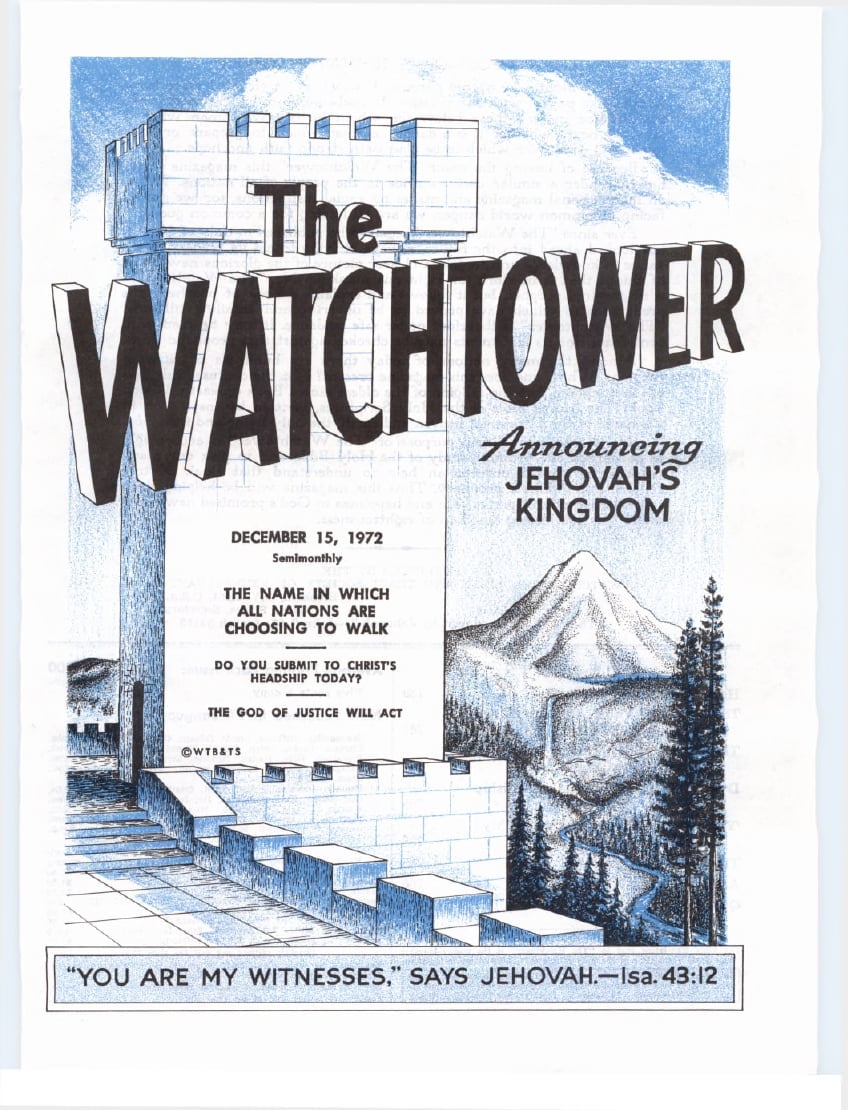
The Watchtower — December 15, 1972
Source: jw.org
Contents
How Deep Is Your Love?
The Name in Which All Nations Are Choosing to Walk
The Time to Decide in the Name of Which God to Walk
Do You Submit to Christ’s Headship Today?
‘You Are My Hope, O Jehovah, My Confidence from My Youth’
The God of Justice Will Act
A Fig-Shower
Questions From Readers
Why Do People Become Jehovah’s Witnesses?
How Deep Is Your Love?
How Deep Is Your Love?
“ONCE upon a time,” it is said, there was a young man who told the young lady he was courting: “I love you so much I’d be willing to die for you.” She smiled and then asked: “Honey, where were you last Wednesday evening? I missed you.” He replied, rather sheepishly: “Oh, well, you know; it was raining kind of hard.” He was willing to die for his lady love, but he was not willing to brave the rain to spend an evening with her.
Obviously his love was not very deep. It consisted of words, but his actions did not back up his words. Fittingly the Bible counsels against this kind of love: “Little children, let us love, neither in word nor with the tongue, but in deed and truth.”—1 John 3:18.
Another way that deep love manifests itself is by being loyal. When a friend is slandered, will we court unpopularity by speaking up in defense of our friend? This very matter applies to a Christian’s love for his God. Thus a number of Arkansas natives once were gathered around a campfire and in the course of the conversation one of them made a disparaging remark about God. Another in the group at once spoke up, saying: “Sorry, fellow, but I don’t like to hear you saying something like that. It’s not true. You see, God is my Father and I love him.” His loyalty gave him courage to speak up, giving proof that his love was deep.
How deep our love is can also be seen by how we react when a close friend or relative makes an embarrassing mistake in the company of others. Will we be mortified? Will we be critical? If our love is deep we will minimize or cover over the mistake. Not only that, but we will even cover over sins and shortcomings. How many? The apostle Peter answers: “Above all things, have intense love for one another, because love covers a multitude of sins.” A multitude is quite a few, is it not? And ancient wise King Solomon went even farther, for he said: “Love covers over even all transgressions.” No doubt about it, if your love is deep you will be forgiving, charitable, merciful, even if you are the victim. As another scripture expresses it: “Love . . . does not keep account of the injury.”—1 Pet. 4:8; Prov. 10:12; 1 Cor. 13:4, 5.
Still another proof of one’s love being deep is that of being willing to counsel someone you know well when he needs to be admonished or corrected. Many parents fail along this line, betraying that their love for their children is shallow. Thus a highly popular and successful American television entertainer and philanthropist admitted that his sons’ turning to drugs was because “we see what is happening but we don’t want to see it, we don’t want to believe it. . . . I excused it.” (New York Times, August 1, 1972) Ancient King David made the same mistake regarding one of his sons, for we read that he “did not hurt his feelings at any time by saying: ‘Why is this the way you have done?”’ And David also reaped waywardness from this son for his negligence in correcting him.—1 Ki. 1:6.
That parental discipline and reproof are evidence of love is clear from the way the heavenly Father deals with his children: “Whom Jehovah loves he disciplines.” That this principle applies to friendships the Bible also shows, for it says: “Faithful are the wounds of a friend.” Superficial friends will shrink from saying anything, but genuine friends with spiritual qualifications will seek to help you get readjusted.—Heb. 12:6; Prov. 27:6, Authorized Version; Gal. 6:1.
The converse is also true. If we have deep love for a friend we will not resent his endeavoring to help us to get readjusted. Rather, we will be like King David when he wrote: “Should the righteous one strike me, it would be a loving-kindness; and should he reprove me, it would be oil upon the head, which my head would not want to refuse.” (Ps. 141:5) All of this, it might be said, has particular force for Christians in their relationship with their God, Jehovah. If our love for him is deep we will not grow bitter because he permits us to suffer hardships and wrongs. Instead, we will react like the patriarch Job, who, in spite of all his losses and sufferings, did not “ascribe anything improper to God.” No, he “did not sin with his lips.” If we manifest such deep love we will be rewarded in due time, even as Job was.—Job 1:22; 2:10; Jas. 5:11.
What is the greatest or deepest love that one could have for another? Jesus said: “No one has love greater than this, that someone should surrender his soul in behalf of his friends.” (John 15:13) That, in fact, is the very kind of love he himself displayed and also the kind of love that Christian husbands are commanded to have for their wives. If you are a husband, do you have such love for your wife?
The Bible also gives a shining ancient example of one who had such a deep love for another, namely, Jonathan, the son of King Saul. After the shepherd lad David had slain the giant Goliath, Jonathan’s “very soul became bound up with the soul of David, and Jonathan began to love him as his own soul.” Jonathan’s love for David did not lessen even when it became apparent that David and not Jonathan would be the next king of Israel. Jonathan repeatedly aided David and even risked his life for David, his father Saul once throwing his spear to kill him because he kept taking David’s side.—1 Sam. 18:1; 20:24-34; 23:17.
The proverb is true: “A friend is a loving companion at all times,” even as was Jonathan. (Prov. 17:17, New English Bible) A friend may need protection from danger or may need material aid, but as often as not he may need encouragement and companionship. If our love is deep we will make sacrifices to supply that need.
How deep is your love—for your marriage mate, for your children, for your parents, for your close friend, for your fellow Christian? To the extent that your love is deep, you will be loyal, covering over mistakes and sins, giving or accepting correction and making sacrifices to express that love.
The Name in Which All Nations Are Choosing to Walk
The Name in Which All Nations Are Choosing to Walk
“All the peoples, for their part, will walk each one in the name of its god; but we, for our part, shall walk in the name of Jehovah our God to time indefinite, even forever.”—Mic. 4:5.
1. Though divided religiously, the people of a nation will idolize and worship what unifying god?
THE United Nations, as an organization for world peace and security, has as of now 132 member nations. There are other nations outside. Each one of the political nations has an ideal that holds its people together under one government. So it walks or goes in the name of that ideal; that is to say, it goes as an adherent or follower of that common ideal. Before long the people start idolizing that ideal. To them it becomes a god that they adore and consider to be above all private, personal interests. Thus the people may be divided religiously, and yet they will worship that national ideal as a unifying god.
2. How do millions of people who claim to be godless contradict themselves in reality?
2 Millions of people claim to be godless, atheistic, not committed to any god. But they contradict themselves by worshiping a national god. Since the American Revolution (1775-1783) we have heard much of “the goddess of Liberty.” Or, the god or goddess may be this thing called democracy, people rule. Or, it may be the bitter foe of democracy, namely, international Communism. People will adhere to these political principles with a tenacity that amounts to fanatical religious devotion. Besides, each of the nations guards jealously what it views as its “national sovereignty,” just as though it were a god that must not be violated or lost. In some nations many people idolize a strong military establishment that will give the nation a position of strength from which to deal with other nations. Concerning the modern-day “king of the north,” it was long ago foretold: “To the god of fortresses, in his position he will give glory.”—Dan. 11:38.
3. How does Micah 4:5 correctly size up the situation as to their walking, and how is Psalm 96:5 a proper estimate of the value of such popular gods?
3 The inspired writer of ancient times correctly sized up the course of modern nations in saying: “All the peoples, for their part, will walk each one in the name of its god.” (Mic. 4:5) Each of these gods is very popular in its own locality. That is why, if an individual who really knows what it is all about refuses to go along with the crowd, there is great offense taken toward that individual. Indignation is felt almost to the point of taking violent action toward the offender. But the question is, Of what value are those idolatrous “gods”? To what are they leading the peoples of the nations? To these questions the present world situation ought to give the most convincing answer, especially in view of the unchanging current of world affairs and conditions. We are obliged to agree that the ancient writer made a proper estimate of popular deities when he said: “All the gods of the peoples are valueless gods.”—Ps. 96:5.
4. The choice of individuals today is between what courses, and who today are making the choice that brings safety?
4 It is high time that the peoples woke up as regards the value of their popular gods. The “gods” that have got them into the present muddle are unable to get them out of it and cannot be depended on to get them out of it. If “the peoples” do not wake up, then, at least, individuals should do so, before the whirlpool of rapidly happening world events drags, sucks them down into destruction. Our being pulled out of this disastrous vortex to safety can result only from choosing the right God and walking in the name of that God. Either we continue to go in the name of some popular god, or we choose to go in another direction, walking in the name of a God better than all the popular gods of the peoples of the nations. The choice of this latter course, the right course, is yet possible for lovers of life and happiness. In recent years hundreds of thousands all around the globe have been awakened to the meaning of world events and have made the happy choice. It is not yet too late for others to do likewise.
5. Did sincerity alone have a part in their taking this courageous course, and why is it the correct course?
5 Courageous such a course? Yes, indeed! Taking such a courageous course must certainly call for sincerity. Their sincerity in taking this course is not questioned for a moment, but does the mere sincerity as evidenced in their taking of this course make it the right course? No! Hence, the courageous course is being adopted not in sincerity alone, but on the basis of reliable information, correct knowledge. And this under trustworthy guidance, better than the guidance of “valueless gods.” The correctness of the course is proved by the fact that it was foretold in a prophecy that has turned out to be no lie but the truth. All the features of this prophecy are true, because it comes from a God whom no one can accuse of having told a lie, for he does not lie. After more than four thousand years of his dealing with mankind it could still be written of Him: “It is impossible for God to lie.” (Heb. 6:18; Titus 1:2) This is the God in whose name more and more persons are choosing to walk today.
6. This prophecy comes from what kind of locality, and when was it delivered by the prophet?
6 So the prophecy that correctly foretold this striking event of our day came from no mythical place of origin. This place is historical—a land that is known world wide today, it being much in the news—Israel. The God-inspired speaker of the prophecy was a man named Micah, who identified himself with the town of Moresheth in the territory of the tribe of Judah and about twenty-two miles southwest of Jerusalem. He lived during the reign of three historical kings, namely, “Jotham, Ahaz, Hezekiah, kings of Judah.” (Mic. 1:1) That locates Micah in the eighth century before our Common Era, and so his prophesying must have ended before 716 B.C.E.
7. What about Micah strengthens our confidence in his prophecy, and what later prophet refers to this?
7 However, what should strengthen our confidence that Micah was a true prophet of a true, living God, is not just his historicalness, but also his courage to tell his message even though he risked his life by doing so. In his day kings had practically absolute power, power over the life or death of their subjects. (Prov. 16:14) This caliber of the prophet Micah is called to our attention on the later occasion of where the prophet Jeremiah in Jerusalem was threatened with death by Jewish leaders who took exception to speech that seemed unpatriotic and subversive to them. Let us read Jeremiah’s own account of this:
8. How does Jeremiah 25:16-19 bring in this reference to Micah’s courageous prophecy?
8 “Then the princes and all the people said to the priests and to the prophets: ‘There is no judgment of death belonging to this man, for it was in the name of Jehovah our God that he spoke to us.’ Furthermore, certain ones of the older men of the land rose up and began saying to all the congregation of the people: ‘Micah of Moresheth himself happened to be prophesying in the days of Hezekiah the king of Judah and went on to say to all the people of Judah, “This is what Jehovah of armies has said: ‘Zion herself will be plowed up as a mere field, and Jerusalem herself will become mere heaps of ruins, and the mountain of the House will be for high places of a forest.’” Did Hezekiah the king of Judah and all those of Judah by any means put him to death? Did he not fear Jehovah and proceed to soften the face of Jehovah, so that Jehovah got to feeling regret for the calamity that he had spoken against them? So we are working up a great calamity against our souls.’”—Jer. 26:16-19.
9. (a) How did Micah meet the three basic requirements of a true prophet? (b) What does the name Micah mean, and what does Isaiah 26:4 say is the proper way to react to that challenging question?
9 Without question, Micah proved to be a true prophet of the one true God, meeting the three basic requirements. That is to say: (1) He spoke in the name of the true God. (2) His prophecies came true. (3) His prophecies tended and worked to turn honest persons to the one true God. (Deut. 13:1-5; 18:20-22) Beyond all question of doubt, Micah walked in the name of his God. His very name is a challenge to all of us to compare his God with all the “valueless gods” that the peoples of the nations are worshiping, for his Hebrew name, Micah, means “Who Is Like Jah?” The proper way for us to react to that challenging question was advised by a prophet who was a contemporary of Micah, namely, Isaiah, when he wrote: “Trust in Jehovah, you people, for all times, for in Jah Jehovah is the Rock of times indefinite.”—Isa. 26:4; 12:2.
A TURNING POINT IN HISTORY
10. (a) Factually, what must be our answer to the question raised in Micah’s name? (b) What question comes up about our answering this way, and to what turning point in history did Micah refer for our guidance in this matter?
10 If we want to answer the challenging question set forth in Micah’s name, the facts would oblige us to answer: “There is no one like Jah Jehovah!” This being the case, the question that now confronts us is, What are we going to do about this? Our doing the right thing about it would mark a turning point in our life, even in the lives of many persons who claim to be Christians. This change would be in line with what the prophet Micah foretold. In his prophecies he pointed forward to the turning point in human history. No, we do not here mean Micah’s prophecy that the promised Messiah or Christ would be born as a man in the little town of Bethlehem in the land of Judah. (Mic. 5:2) The time of the fulfillment of that prophecy is used as the beginning of what Christendom calls “the Christian era,” even though she is not exactly sure of the precise date of Christ’s birth. (Matt. 2:1-6; Luke 2:4-17) That was not quite two thousand years ago. But the turning point in all human history to which we refer is the one that was reached within our own generation. The prophet Micah pointed forward to this!
11. By referring to what did Micah introduce this glorious prophecy, and why should we look to see its fulfillment in our own generation?
11 Micah foretold what would take place at this turn of events. Are we today seeing this take place? We should be seeing it, since we are in the right period of history. When Micah prophetically described what we can see taking place today, he introduced it by foretelling what proved to be a turning point in the history of his own nation. This prophecy had its fulfillment in the century after Micah, and so he did not live to see what he foretold come true. In that way he escaped a national calamity. But this calamity upon his own nation has had a parallel within our modern generation, for which reason it deserves our consideration. So let us read what Micah wrote and see how well it introduces a glorious prophecy that finds fulfillment in this very twentieth century:
12. In Micah 3:9–4:1, what bad religious condition did the prophet describe, and what changes did he foretell about “the mountain of the house of Jehovah”?
12 “Hear, please, this, you head ones of the house of Jacob and you commanders of the house of Israel, the ones detesting justice and the ones who make even everything that is straight crooked; building Zion with acts of bloodshed and Jerusalem with unrighteousness. Her own head ones judge merely for a bribe, and her own priests instruct just for a price, and her own prophets practice divination simply for money; yet upon Jehovah they keep supporting themselves, saying: ‘Is not Jehovah in the midst of us? There will come upon us no calamity.’ Therefore on account of you men Zion will be plowed up as a mere field, and Jerusalem herself will become mere heaps of ruins, and the mountain of the house will be as the high places of a forest. And it must occur in the final part of the days that the mountain of the house of Jehovah will become firmly established above the top of the mountains, and it will certainly be lifted up above the hills; and to it peoples must stream.”—Mic. 3:9 through 4:1.
13. When did that turn of events take place in ancient times?
13 Does that quotation from Micah sound like a sharp turn in the events of a nation? There can be no question of doubt that the grand final part of this prophecy must come true, for the words of prophecy introducing it most certainly came true. Recorded history is there to show it. In the year 607 B.C.E., near the beginning of what would be our month of October, the city over there in the Middle East that is poetically called “Zion” did lie like a mere field that had been plowed up. Yes, the national capital Jerusalem was left lying as mere heaps of ruins.
14. (a) What did “the mountain of the house of Jehovah” then begin to look like? (b) Because of what judicial and religious practices had Jehovah willed that this take place?
14 And what about the 2,500-foot-high mountain upon which Jehovah’s house of worship that had been built by King Solomon used to stand in awe-striking beauty? That sacred mountain began to look like “the high places of a forest.” It was deserted like a forested hilltop. Was that a disgrace for Jehovah God? Seemingly so. And yet he had willed it to be so, for he inspired his prophet Micah to be the first one to foretell such a religious calamity. He had all the reason in the world for doing so, especially since Jerusalem was being filled with unrighteousness and defiled by unjustified acts of bloodshed. What else could be expected for a city when her headmen let their eyes be blinded to justice by accepting bribes, when the temple priests carried on religious instruction for a fixed price and when imitation prophets carried on demonistic divination to make money off the gullible people? And yet those religious hypocrites felt that they were walking in the name of Jehovah, or that Jehovah would continue to be in their midst at his temple, to protect them against calamity! No wonder that Micah’s prophecy, although so shocking, came true.
15. (a) What means did Jehovah use to bring the foretold national calamity, and when? (b) What happened to governmental and religious things at Jerusalem, and what happened to Jehovah’s rating as a god?
15 Religion is no defense for hypocrites. The religious hypocrites were disappointed in what they wrongly expected of Jehovah, in spite of what Micah was used to foretell. By what means, then, did Jehovah bring a national calamity upon them in 607 B.C.E.? It was by means of the Babylonians under King Nebuchadnezzar. After about eighteen months of besieging Jerusalem, the Babylonian army broke into the city, plundered it and its temple, led off the miserable survivors captive, and burned down the holy city. The royal throne, “Jehovah’s throne,” as it was called, upon which the line of kings of the royal family of David sat, vanished, as well as Jehovah’s “ark of the covenant” that had been located in the innermost compartment, “the Most Holy,” of the temple. Thus the kingdom of David, then 463 years old at Jerusalem, was broken down. Also, the full-scale worship of Jehovah at his temple was interrupted. Jehovah’s rating as a god dropped sharply among the pagan nations. The worship of Him nosedived to a deep low in the estimation of the world nations. His holy name seemed profaned.
16. What were observing pagan nations led to believe about the rising of Jehovah’s worship again at Jerusalem, and why?
16 Would Jehovah’s worship ever rise again? That was doubtless the question in the minds of many interested pagans. If they had known and believed the prophecies of Micah and Isaiah and Jeremiah and other prophets of Jehovah they would have known the answer to be Yes! But the unbelieving pagans and those who despised the worship of the God of Abraham, Isaac and Jacob thought not. Year after year wore on, up to the seventieth year, and there was no restoration of Jehovah’s worship at the holy city. Jerusalem continued to be a heap of ruins; Zion continued to be like a mere field all roughed up as if by plowing. The temple mountain was like a deserted mound in a jungle. Instead of temple instrumental music and songs, the harsh, untuneful calls of birds and wild animals rose up therefrom. The observing pagans round about seemed to have reason to believe that, with Jehovah’s people in exile largely in Babylon, His worship would die out.
17. What turn of events happened regarding Babylon, and how did another branch of the human family assume world power?
17 Yet, never let anyone think that worship of the true God can be wiped out! Little did those who drew satisfaction from the calamitous decline in the worship of Jehovah realize that a turn of events was at hand. In a startling way it came. At the end of sixty-eight years of Jerusalem’s lying desolate without man or domestic beast, the mighty Third World Power of Bible history fell. As foretold by the prophets of the God who never lies, Jehovah, the empire of Babylon fell. Babylon by her terrifying armies had destroyed Jehovah’s temple at Jerusalem by his permission, but she did not get away unpunished with that presumptuous act of insult to the one living and true God. World power by Semitic rulers ceased. By a turn of events, world power by Aryan or Japhetic rulers began, to continue on down till our own day. The Persian conqueror, Cyrus the Great, became king of Babylon and of the Fourth World Power of Bible history. Babylonian religion now took a tumble. Her chief god, Merodach or Marduk, crashed in disgrace.
18. (a) What prophecy of Jeremiah regarding Babylon’s god and her land was then due to begin fulfillment? (b) How has Babylon’s desolation compared with that which she caused to Jerusalem?
18 It became the time for the prophet Jeremiah’s words to be carried out: “Tell it among the nations and publish it. And lift up a signal; publish it. Hide nothing, O men. Say, ‘Babylon has been captured. Bel [The Lord] has been put to shame. Merodach has become terrified. . . . For against her a nation has come up from the north. It is the one that makes her land an object of astonishment, so that there proves to be no one dwelling in her. Both man and domestic animal have taken flight. They have gone away.”’ (Jer. 50:2, 3) This prophecy has meaning for us today. Where, we can ask, is Babylon on the Euphrates River in what is today the land of Iraq? It is nothing but a desolate ruin, suffering a fate like that which she had inflicted upon ancient Jerusalem, only her desolation has continued for centuries more than a thousand years, whereas Jerusalem’s desolation lasted just seventy years.
JEHOVAH TAKES ASCENDANCY AS GOD
19. After Persia’s conquest of Babylon, which god took the ascendancy, and whom did this god use for the restoring of his temple?
19 At Babylon’s surprising comedown in 539 B.C.E., which god ascended to international importance? The national god of the victorious Persians or the god of the exiles in Babylon, Jehovah? The prophecy of Micah, together with prophecies of other men inspired of God, indicated that Jehovah would take the ascendancy. He did, in proof that his prophecies are infallible. Said Micah under inspiration: “And in the future days the mountain of Jehovah’s house shall be set at the head of the mountains, lifted above hills, and peoples shall stream to it.” (Mic. 4:1, Byington’s translation) In order to bring about a primary or typical fulfillment of that challenging prophecy, Jehovah God used as an instrument King Cyrus the Great, a worshiper of the chief god of victorious Persia. Jehovah, in His superiority, made the worshiper of a false god work for Him toward restoring Jerusalem’s temple.
20. In fulfillment of what prophecy concerning the Persian conquerer did this take place, and when and how?
20 How so? Well, Jehovah spoke of himself as “the One saying of Cyrus, ‘He is my shepherd, and all that I delight in he will completely carry out’; even in my saying of Jerusalem, ‘She will be rebuilt,’ and of the temple, ‘You will have your foundation laid.’” (Isa. 44:27, 28) King Cyrus did completely carry out the thing in which Jehovah delighted, though this was contrary to what the national god of Persia delighted to have done. In the year 537 B.C.E., the seventieth year of the desolation of Jerusalem and its temple, Jehovah stirred up the spirit of Cyrus to decree that the temple should be rebuilt at Jerusalem. To that end Cyrus decreed that the exiles in Babylon who would volunteer for this temple work should be released from Babylon and go back to “the mountain of the house of Jehovah.” (2 Chron. 36:20-23; Ezra 1:1-4) By the end of that seventieth year of Jerusalem’s desolation a faithful remnant of temple-work volunteers were back in the land of Judah, bringing to an end its desolation. In the spring of the next year (536 B.C.E.) the foundation of the second temple of Jerusalem was laid.—Ezra 3:8-12.
21. Despite what was Jehovah’s second temple completed, and when?
21 This was not to the liking of the pagan opposers of the worship of Jehovah. But their opposition could not win out over the Almighty God. So, after years of active opposition by these defiant pagans, Jehovah’s second temple at Jerusalem was completed by his faithful remnant in wintertime, on the third day of the lunar month of Adar in the year 515 B.C.E.—Ezra 6:15.
22. How was “the mountain of the house of Jehovah” “firmly established above the top of the mountains,” both as to the restored remnant and as to pagan nations and peoples?
22 In order to be used in doing this, the restored remnant had to elevate Jehovah’s worship above all other things in their lives, and put down the worship of the false gods that their forefathers had unfaithfully adopted. Jehovah’s worship, as represented by “the mountain of the house of Jehovah,” rose above the lofty elevation that pagan nations gave to their demon gods, these being worshiped in many cases on natural high places such as hilltops and mountaintops. In a figurative sense, the mountain of Jehovah’s house of worship was “firmly established above the top of the mountains” and was “lifted up above the hills.” Respect for Jehovah’s worship assumed the supreme position, not only among his chosen people but also among many individuals of pagan nations and peoples. Doubtless many of suchlike individuals came up to Jerusalem to worship the true God, just as those religious proselytes did in the days of the Christian apostles and just as that royal eunuch of Ethiopia did, whom the evangelizer Philip was delegated to convert to Christianity.—Acts 2:5-10; 8:26-39; John 12:20, 21.
23. (a) In whose name did those individuals from the nations and people begin walking? (b) What kind of fulfillment of the prophecy was that, and, since the Messiah’s coming, what question arises as to walking in the name?
23 Instead of walking in the name of their former gods, those individuals from all the various nations and peoples walked in the name of the God whose worship was most highly exalted, Jehovah. Truly that was a fulfillment of the prophecy of Micah. But only a partial fulfillment, a miniature or typical one. The full, complete fulfillment did not take place back there before Jehovah God sent his Messiah into the earth. The final, culminating fulfillment of Micah’s glorious prophecy was timed to come in our twentieth century. How is it occurring? Is it because we are living in the century when Christendom has grown to its greatest extent, or to an estimated nine hundred million members and more among nations all around the globe? And has this not caused a change to come about? Since the coming of the Messiah or Christ, is it not the right thing for us to walk in the name of the Messiah, Jesus, instead of in the name of Jehovah? Are the churches of Christendom the fulfillment of Micah’s prophecy? This deserves examination—here!
The Time to Decide in the Name of Which God to Walk
The Time to Decide in the Name of Which God to Walk
1. Did that second temple at Jerusalem prove to be the one to which nations and peoples would come to worship Jehovah forever, and why?
THE second temple that was built in Jerusalem, during the days of the prophet Zechariah, proved to be only typical and, as such, had a prophetic significance. It did not prove to be the permanent temple to which all the nations and peoples should come up to worship Jehovah God forever. In view of that fact, Jerusalem’s earthly temple was destroyed in the year 70 C.E., when Jerusalem was destroyed for the second time, this time by the armies of the Sixth World Power, the Roman Empire.
2. Who foretold that, and when did the times that he mentioned come to their end?
2 This had been foretold by Jesus Christ thirty-seven years previously, in 33 C.E., and he said that thereafter Jerusalem would continue to be trampled on until the “times of the Gentiles” (“the appointed times of the nations”) were fulfilled. (Luke 21:20-24) Those Gentile Times, seven in number, began at the first desolation of Jerusalem and the land of Judah by the Babylonians in the year 607 B.C.E. Jerusalem never again got a king of David’s royal family upon its throne, and correspondingly those Gentile Times continued on for 1,844 years after earthly Jerusalem’s second destruction. That means that those Gentile Times ended in the year 1914 C.E.
3. What question arises as to the building of a third temple to Jehovah at Jerusalem since the Gentile Times ended in 1914, and is the spread of Jehovah’s worship dependent on such a temple?
3 This did not mean that the end of the Gentile Times in 1914 marked the time for a third temple to Jehovah’s worship to be built in Jerusalem. No, even though the beginning of the Gentile Times, in early autumn of the year 607 B.C.E., saw Jehovah’s temple lying in ruins and desolate of worshipers amid a land desolate of man and domestic animal. An earthly material temple to Jehovah’s worship did not need to be built in Jerusalem, to take the place of the Mohammedan mosque, the Dome of the Rock, still standing there. Neither the start nor the spread of Jehovah’s worship in modern times depended on the erecting of such a temple there, for nations to stream to it there. The reason why not we shall soon see.
4. To what extent was Jehovah’s worship at a low ebb by 1914 C.E., and what did even Bible Students not then appreciate about his name?
4 On earth the worship of Jehovah as God was at a low ebb in the year 1914 C.E. Yes, even among those who professed to be Christians, not to speak of natural, circumcised Jews. World War I, which broke out in that year, brought Jehovah’s worship on earth to an even deeper low. The International Bible Students Association, which rejected the Trinity doctrine because of its being unscriptural, was still somewhat hampered in appreciation because of the use of generally authorized versions of the Bible (like the Authorized or King James Version) that rarely contained the name of Jehovah or that did not even contain it at all. Yet, through the columns of the magazine The Watch Tower they brought forth fittingly entitled articles such as “Jehovah’s Abiding Presence with His People” (10/1/14), “Jehovah Our God Is One” (8/15/15), “Jehovah Chastening the World” and “Jehovah’s Act—His Strange Act” (1/1/16), and “Jehovah an Accurate Time-Keeper” (3/15/19). However, those Bible Students did not then appreciate that the time was near for Jehovah God to make a name for himself.—Isa. 63:14.
5. What was the record of the larger body of those who professed to be Christian during World War I, and why does this remind one of what Micah 3:9, 10 says?
5 However, what was there to be said about the far larger body of those who professed to be Christians, namely, that worldwide religious organization called Christendom? It was an assassination within her borders that touched off World War I, which began on July 28, 1914. By the end of the Gentile Times about October 4, 1914, eight nations and empires of Christendom, along with Japan, were fighting one another. And by the end of that war on November 11, 1918, there were twenty-four nations of Christendom, together with four non-Christian countries, that were fighting one another. In contrast with the International Bible Students Association, the churches and religious organizations of Christendom, also Jewry and Mohammedanism, involved themselves with that war. The members of the churches who were taking the lead in this worldwide bloodspilling reminded one of the prophet Micah’s description of the head ones and commanders of Judah and Jerusalem in his day in “building Zion with acts of bloodshed and Jerusalem with unrighteousness.”—Mic. 3:9, 10.
6. How did the head ones and religious leaders of Christendom match the description given by Micah, and what outstanding example was there of Christendom’s ‘making everything that is straight crooked’?
6 During those four years three and a half months of intercontinental warfare, were judges in Christendom handing down judgments for bribes, were the religious priests commercializing religion by rendering their services for a price, were the religious prophets making their unscriptural predictions to please people for money? Yes, just as suchlike men were doing in Micah’s day among Jehovah’s chosen people. There was a detesting of true justice and a ‘making everything that is straight crooked.’ This became outstanding in Christendom’s dealings toward the International Bible Students, who refused to mix in with politics and who wanted no part in the warfare over political and commercial issues, warfare that was not theocratic. Persecutions, restrictive bans, imprisonments she heaped upon these conscientious Bible Students, and by early summer of 1918 she had the president of the International Bible Students Association and seven other associates in the Watch Tower Society behind bars in the Federal Penitentiary in Atlanta, Georgia, U.S.A., denied bail and appeal.
7, 8. (a) Thus Jehovah’s worship was being torn down by what religious organization? (b) How was the spiritual estate of Jehovah’s worshipers desolated, to compare with Micah 3:12?
7 Certainly that was a tearing down of the worship of Jehovah! By whom? By modern Babylon the Great, this world empire of false religion while being dominated over by its most populous and powerful part, namely, Christendom. Yes, Christendom, which has the complete Bible in which the name Jehovah occurs, was serving foremostly as the agent of Babylon the Great in desolating the worship of the Most High God Jehovah. Christendom was laying His worship waste within her own self. She was devastating it among the International Bible Students, who had been reviving the worship of Jehovah as the God and Father of our Lord Jesus Christ. As a result, by the close of World War I at mid-autumn of 1918, not only were many parts of the literal earth desolated by the ravages of war, but also the earthly spiritual estate of the worshipers of Jehovah was desolated, that is, as far as hopes of spiritual restoration and reoccupation were concerned. It compared with what Micah had foretold of his own land because of Babylon’s atrocities:
8 “Zion will be plowed up as a mere field, and Jerusalem herself will become mere heaps of ruins, and the mountain of the house will be as the high places of a forest.”—Mic. 3:12.
MIRACULOUS RESTORATION
9. (a) Why was it not necessary for the spiritual estate of Jehovah’s worshipers to lie desolate for seventy years? (b) After the end of the Gentile Times in 1914, what must become the center of Jehovah’s worship?
9 There was no need, however, for the spiritual estate of Jehovah’s worshipers to lie in such a dilapidated state for seventy years, as in the case of the land of Judah, which lay desolate without man or domestic animal for the first seventy years of the “times of the Gentiles.” (Luke 21:20-24; 2 Chron. 36:20, 21) The publicly exposed deathlike state of Jehovah’s witnesses had been foretold to be for only a short period, like three and a half days. (Rev. 11:3-12) The Gentile Times had already ended, back in 1914, when nation lifted up sword against nation and they began to learn war on a worldwide scale with total mobilization and mass human slaughter. At the end of those Gentile Times the time had closed for Jerusalem’s right to the Messianic kingdom to be trampled upon by the Gentile nations, and Jehovah’s Messianic kingdom in the hands of King David’s rightful successor, Jesus Christ, was born in the heavens, in the “heavenly Jerusalem.” For more than eleven centuries earthly Jerusalem had been the center of Jehovah’s worship. The “heavenly Jerusalem,” with its Messianic kingdom in power, must now promote that same worship.
10, 11. (a) So what did the “heavenly Jerusalem” properly act to bring about in the earth? (b) According to Micah 4:1, when was this to occur, and with what effect on peoples?
10 In harmony with this, the “heavenly Jerusalem,” the heavenly center of Jehovah’s worship, properly acted to bring about an early restoration of the worship of her God in the earth, and that to a scale never before experienced. The prophecy of Jehovah’s mouthpiece, Micah, had foretold this, and miraculous has been the fulfillment of this glorious prophecy. Proceeding to foretell the restoration, Micah was inspired to say: “And it must occur in the final part of the days.” That is to say, after the terrible desolation to Zion and Jerusalem and the “mountain of the house” that Micah had just foretold in the preceding verse. (Mic. 3:12; 4:1) What was to occur? An astounding reversal! Listen:
11 “And it must occur in the final part of the days that the mountain of the house of Jehovah will become firmly established above the top of the mountains, and it will certainly be lifted up above the hills; and to it peoples must stream.”—Mic. 4:1.
12. What was the miniature realization of that prophecy, and what compares with that in modern times?
12 A miniature realization of that prophecy began in 537 B.C.E. with the releasing of the faithful Jewish remnant from Babylon, under imperial orders to return to Jerusalem and rebuild Jehovah’s house of worship on the city’s mountaintop. Now that the Gentile Times ended in 1914 C.E., we are living in the “time of the end” of the Gentile nations, whose further domination of the earth has been challenged by the newborn Messianic kingdom of Jehovah God in the heavens. (Dan. 12:4; Matt. 24:3-14) Well timed, in the first postwar year, namely, in 1919, came the divine release of the worshipers of Jehovah who had faithfully survived the crushing experiences of World War I, this release being notably marked by the release from Federal Penitentiary of the governing body of the International Bible Students, who clearly recognized that the Gentile Times had ended and that Jehovah’s established Messianic kingdom must be proclaimed in all the inhabited earth to all the nations, for a witness.
13. To what extent has the modern-day remnant elevated the level of Jehovah’s worship?
13 Like that restored Jewish remnant who engaged in rebuilding Jehovah’s house on the mountaintop of Jerusalem, so this modern-day remnant of Jehovah’s worshipers engaged in promoting His pure worship, elevating it above all other interests of earthly life. This worthy worship of the only true God must be the most highly exalted thing in their lives. No other worship, regardless of how highly exalted by men, must be allowed to be higher than the worship of the Most High God, Jehovah. Its elevation must be established firmly above all other forms of human worship, no matter how highly extolled and boosted up by men and demons.
14. (a) Why did Jehovah not authorize the remnant of spiritual Israel to rebuild the temple at Jerusalem? (b) What temple is it that they must recognize, and why?
14 So this faithful remnant of spiritual Israelites did not engage in building a literal temple at earthly Jerusalem. The temple that Jehovah had decreed to be destroyed by the Romans in 70 C.E. he did not authorize the remnant of spiritual Israelites to rebuild there. He does not need such a man-made temple at that onetime holy place, for he has plainly told us that he does not dwell in temples made with human hands. He has his true, spiritual temple in which he personally dwells. It is the temple into the Most Holy compartment of which his High Priest Jesus Christ entered in the spring of 33 C.E., with the precious merit of his perfect human sacrifice in behalf of all sinful, dying mankind. (Heb. 9:24-26; Acts 17:24) It is this spiritual temple that we must recognize, and thereby give the Most High God his true dignity and holiness and grandeur. It is to this temple that we must draw near in the sincere spirit of worship, and this we can do anywhere on earth, for that is what Jesus Christ, Jehovah’s High Priest, himself said. (John 4:21-24) Earthly Jerusalem counts no more!
15, 16. (a) In 1925, what did the remnant begin to appreciate about God’s name, and why did they embrace a new designation for themselves in 1931? (b) How was this in fulfillment of Zechariah 10:9-12?
15 As the postwar years flowed on, the number of spiritual Israelites who were engaged in this figurative temple-building work increased. They were Christians, footstep followers of Jesus Christ, but the rank and file of church members of Christendom also claimed to be such. So in whose name did this temple-building remnant of spiritual Israelites choose to walk? It was an important decision for them to make. From the year 1925 onward they began to discern that the time had come for the Most High God to make a name for himself. They were determined not to denigrate that name along with the professed Christians of Christendom. So, after six years of intensively endeavoring to make the divine name known world wide, they embraced, in the summer of 1931, the Scripturally based name for themselves, Jehovah’s witnesses. This has come about in fulfillment of the prophecy uttered by Zechariah during the days of the temple rebuilding at Jerusalem in the sixth century B.C.E.:
16 “‘In the distant places they will remember me; and they must revive with their sons and return. . . . And I will make them superior in Jehovah, and in his name they will walk about,’ is the utterance of Jehovah.”—Zech. 10:9-12.
17, 18. (a) Since then, how have the peoples of the nations come to know about Jehovah God and his true temple for worship? (b) What did Micah 4:2 say about the peoples that would stream to the temple?
17 Consequently, since that historic decision in the year 1931 C.E., this temple-building remnant of spiritual Israelites have gone throughout the Gentile nations preaching the good news of God’s Messianic kingdom in the name of Jehovah, as his Christian witnesses. (Isa. 43:10-12; 44:8) As an inevitable result of this, have the peoples of the nations come to learn about Jehovah as God and about his spiritual temple at which to render pure worship? The information that pours in from all parts of the earth answers with a positive Yes! Take note of what the prophet Micah says about these peoples who are streaming to Jehovah’s temple:
18 “And many nations will certainly go and say: ‘Come, you people, and let us go up to the mountain of Jehovah and to the house of the God of Jacob; and he will instruct us about his ways, and we will walk in his paths.’ For out of Zion law will go forth, and the word of Jehovah out of Jerusalem.”—Mic. 4:2.
19. (a) How have the “law” and “word of Jehovah” gone forth from the heavenly Jerusalem to the peoples and nations? (b) Their saying, “We will walk in his paths,” signifies what on their part?
19 Through the preaching and teaching activities of the temple-building remnant of spiritual Israelites in all the earth the knowledge of the “law” and the “word of Jehovah” has gone forth from the heavenly Zion and heavenly Jerusalem, the seat of the newborn heavenly kingdom of the Messiah. Reports pile up from year to year to show that individuals of all the nations are streaming up to the exalted “house of Jehovah” to worship Him at his spiritual temple. What does it mean for these seekers of Jehovah to say: “And he will instruct us about his ways, and we will walk in his paths”? This means that these instructed persons of all nationalities make a dedication of themselves to Jehovah God, to do his will. They make a choice of their God.
20. What did Zechariah 2:10, 11 say to foretell this same thing?
20 This very thing was foretold also by the prophet Zechariah, when prophesying in the days of the rebuilding of the temple of Jehovah at Jerusalem. Addressing himself to the temple builders, he said: “Sing and rejoice, O daughter of Zion; for, lo, I come, and I will dwell in the midst of thee, saith Jehovah. And many nations shall join themselves to Jehovah in that day, and shall be my people.”—Zech. 2:10, 11, AS.
21, 22. How do these peoples of “many nations” do the very opposite of what the 24,000 Israelites did on the plains of Moab, according to Numbers 25:3-5 and Hosea 9:10?
21 These peoples of “many nations” do the very opposite of what twenty-four thousand Israelites did on the plains of Moab shortly before the nation of Israel crossed the Jordan River into the Promised Land. These twenty-four thousand forsook Jehovah; as it is written in Numbers 25:3-5: “So Israel attached itself to the Baal of Peor; and the anger of Jehovah began to blaze against Israel. . . . Then Moses said to the judges of Israel: ‘Each one of you kill his men who have an attachment with the Baal of Peor.’”
22 Concerning those renegade Israelites the prophecy of Hosea 9:10 says: “They themselves went in to Baal of Peor, and they proceeded to dedicate themselves to the shameful thing, and they came to be disgusting like the thing of their love.” In utter contrast with that, today, while the “daughter of Zion” is crying out joyfully and singing because Jehovah has taken up residence in her as the “city of the living God,” hundreds of thousands of persons out of “many nations” come and “join themselves,” dedicate themselves, to Jehovah and become his people.—Heb. 12:22.
INTERNATIONAL PEACE AMONG WORSHIPERS OF JEHOVAH
23. What attention does Micah 4:3, 4 say that they get from Jehovah, and how do they act toward one another?
23 Because these dedicated people of all nationalities accept the law that goes forth out of the heavenly Zion and the word of Jehovah that proceeds out of the heavenly Jerusalem, what attention do they get from Him and how do they act toward one another? Micah’s prophecy goes on to inform us, saying: “And he will certainly render judgment among many peoples, and set matters straight respecting mighty nations far away. And they will have to beat their swords into plowshares and their spears into pruning shears. They will not lift up sword, nation against nation, neither will they learn war anymore. And they will actually sit, each one under his vine and under his fig tree, and there will be no one making them tremble; for the very mouth of Jehovah of armies has spoken it.”—Mic. 4:3, 4.
24. (a) Did the United Nations fulfill that prophecy of Micah 4:3, 4? (b) Why does the “great crowd” that has streamed to the temple courtyards since 1935 not worship the United Nations as a god?
24 The man-made world organization for international peace and security, namely, the United Nations, has not brought about the fulfillment of this prophecy. That political organization still has its Disarmament Conference functioning regularly amidst a world that is more mightily armed than ever before in history. But not so with the “great crowd” from the “many nations” that stream into the earthly courtyards of Jehovah’s spiritual temple to worship Him unitedly. These know from the Bible prophecies that the United Nations will fail and that it is wrong to make a god out of it. (Rev. 13:14, 15; 7:9-17) They know that it will fail just as the previous League of Nations failed. Particularly from the spring of the year 1935 C.E., or four years before World War II broke out, these seekers of the one living and true God began to stream into his temple courtyards. Did they carry out Micah’s prophecy?
25. (a) Figuratively speaking, how have Jehovah’s worshipers beaten their swords into plowshares and their spears into pruning shears? (b) Accordingly, at Har–Magedon, to what divine rule will they stick in their conduct toward the nations?
25 Did this international “great crowd” of worshipers at Jehovah’s temple, figuratively speaking, beat their swords into plowshares and their spears into pruning shears? The facts of recorded history are at hand to prove that they did and are doing so down to this day. In November of 1939, amid World War II that had then been raging for two months, they backed up their nonparticipation in national politics by boldly declaring their stand for Christian neutrality toward all worldly armed conflicts. To this day, in spite of fanatical persecution over this issue, they have held fast to their declared neutrality. (See the article “Neutrality” in the November 1, 1939, issue of The Watchtower.) Even when the Har–Magedon situation is reached by the militarized nations and Jehovah God launches his theocratic “war of the great day of God the Almighty” against the hostile nations, these unarmed worshipers of Jehovah God will not lift up even a weaponless hand against those nations. They will stick to the divine rule: “The battle is not yours, but God’s.”—2 Chron. 20:15; Rev. 16:14, 16.
26. (a) What state of affairs do we find therefore in the spiritual estate of Jehovah’s worshipers on earth? (b) What will be their domestic state on earth after Har–Magedon?
26 What, then, do we today find with regard to the spiritual estate of Jehovah’s worshipers on earth? This: Despite their international and interracial extraction, there is godly peace among them. They do not resort to violent war to settle their differences. They keep first their peace with Jehovah God and then their peace with man. Borrowing the prophetic language of the picture of peace and security, they sit unafraid in their garden, each one under his grapevine and his fig tree, enjoying the spiritual, life-giving prosperity that the God whom they unitedly worship showers down upon them. In brotherly neighborliness, as foretold in Zechariah’s prophecy (Zec 3:10), they “call, each one to the other, while under the vine and while under the fig tree.” This is really a precious foretaste of the peace, security and prosperity after God the Almighty has destroyed all his remaining enemies at Har–Magedon and he then restores paradise to earth. Jehovah’s worshipers will sit literally under grapevines and fig trees alongside their happy homes.
PRE-HAR–MAGEDON TIME FOR DECISION!
27, 28. (a) Our enjoyment of such a future experience depends upon what choice now, and what variety exists toward which to make a choice today? (b) What evaluation does the Bible make of such worldly gods?
27 A most inviting prospect that! But a person’s future enjoyment of that Paradise experience all depends upon the choosing of the right God now. All around the earth the people are idolizing various things as gods. One of the most popular gods in each country is patriotic nationalism. To many persons a certain political ideology is a god. The political institution called The State also ranks as a god with many. Militarism has its worshipers in this nuclear space age. Materialistic science has its own devotees. And what about sports idols, theatrical and motion picture idols, musical idols? These have their idolizers among those who are “lovers of pleasures rather than lovers of God.” (2 Tim. 3:4) Unwittingly, many people worship demons, for the apostle Paul said: “The things which the nations sacrifice they sacrifice to demons, and not to God.” (1 Cor. 10:20) And all these gods have over them the one whom Paul called “the god of this system of things,” namely, Satan the Devil.—2 Cor. 4:4.
28 Truly the inspired psalmist correctly evaluated the gods of the nations by saying: “All the gods of the peoples are valueless gods.” (Ps. 96:5) Of what value will these gods be to mankind when Jehovah God removes them at Har–Magedon and at his binding and abyssing of Satan the Devil and his demons?—Rev. 16:16; 20:1-3.
29. (a) Why is there now no room for neutrality with respect to gods? (b) In harmony with Micah 4:5, what definite decision have those made who engage in building up true worship?
29 We are fast approaching that time, God’s time. No longer is a neutral position toward the gods possible. The world situation that is now shaping up is forcing upon us the making of a final decision. Whom shall we choose—the true God or the valueless gods to which the people of the nations are dedicated? Remember, the prophecy of Micah 4:1-4 is today undergoing fulfillment. It behooves us, therefore, to consider Micah’s words that immediately follow that prophecy. Micah’s words call for our defiance of all the false gods of this doomed world. Says Micah: “All the peoples, for their part, will walk each one in the name of its god; but we, for our part, shall walk in the name of Jehovah our God to time indefinite, even forever.” (Mic. 4:5) This is the unchangeable decision that all the remnant of spiritual Israelites who engage in building up the pure worship at the spiritual temple of Jehovah God have made. That is the decision that those of the international “great crowd” who are streaming up to the earthly courtyards of Jehovah’s spiritual temple are making. Is it the personal decision of each of us?
30. (a) How did Jesus himself show that this is the right decision to make? (b) Which one is the god whom we can worship “to time indefinite, even forever,” and what will this signify for us?
30 It is the only right decision. It is in favor of the one God whom Jesus Christ himself takes the front rank in worshiping with exclusive devotion. No one can be a true Christian unless he imitates Christ’s perfect example. (Ps. 69:9; John 2:13-17; 20:17; Rev. 3:12) All false gods will perish, and their worshipers along with them. Jehovah alone is the true God, who is imperishable, immortal, who lives “to time indefinite, even forever.” He is the one God whom we can worship “to time indefinite, even forever.” This choice of worship signifies eternal vindication to Him and endless blessings and joys to us in his peaceful new order.—1 Tim. 1:17; Ps. 90:2.
Do You Submit to Christ’s Headship Today?
Do You Submit to Christ’s Headship Today?
IN THE first century of our Common Era Jesus Christ gave the apostle John a divine revelation. In it he revealed his active headship over Christian congregations at that time. The revelation showed that Christ was personally carrying on inspection of conditions within the congregations. He was concerned as to their spiritual health, their Christian works and activity. But he was not only inspecting. He was prepared to take appropriate action according to what his inspection revealed concerning the response to his counsel.—Revelation chapters 1 to 3; see also The Watchtower of December 15, 1971, page 751.
Christ Jesus continues to exercise full headship of the true Christian congregation earth wide today. And, just as he did back then, he uses earthly agencies to express that headship. The first-century Christian congregation had a governing body composed of apostles and elders at Jerusalem. A similar body of anointed Christians functions now. This governing body is the administrative part of a “faithful and discreet slave” or “steward” class concerning which Jesus promised: “His master . . . will appoint him over all his belongings.” (Matt. 24:45-47; Luke 12:42-44) So, recognition of that governing body and its place in God’s theocratic arrangement of things is necessary for submission to the headship of God’s Son.
LOCAL BODIES OF ELDERS IN HARMONY
As was true in the first century, however, each congregation has its local body of elders. Of such men, the apostle Paul wrote Christians in his day: “Be obedient to those who are taking the lead among you and be submissive, for they are keeping watch over your souls as those who will render an account.” (Heb. 13:17) Or, rendering the Greek word used by the apostle more literally, they should be obeying the ones “governing” them. (See Kingdom Interlinear Translation.) Does this mean that each local body of elders formed a separate governing body operating independently of the governing body of the ‘faithful and discreet steward’ class?
No, that could not be. Why not? Because that would mean disconnecting themselves from the headship of Christ Jesus. The connection of all those composing the Christian congregation with their Head, Christ Jesus, is likened to the ways the members of a human body are joined to the head. Of Jesus, the apostle writes: “From him all the body, by being harmoniously joined together and being made to cooperate through every joint that gives what is needed, according to the functioning of each respective member in due measure, makes for the growth of the body for the building up of itself in love.” (Eph. 4:16) So, the Head, Christ Jesus, has various arrangements for ‘joining’ the individual members of the congregation to him, and these cannot be disregarded.
…