The Watchtower, October 1, 1972
Download: PDF — The Watchtower, October 1, 1972
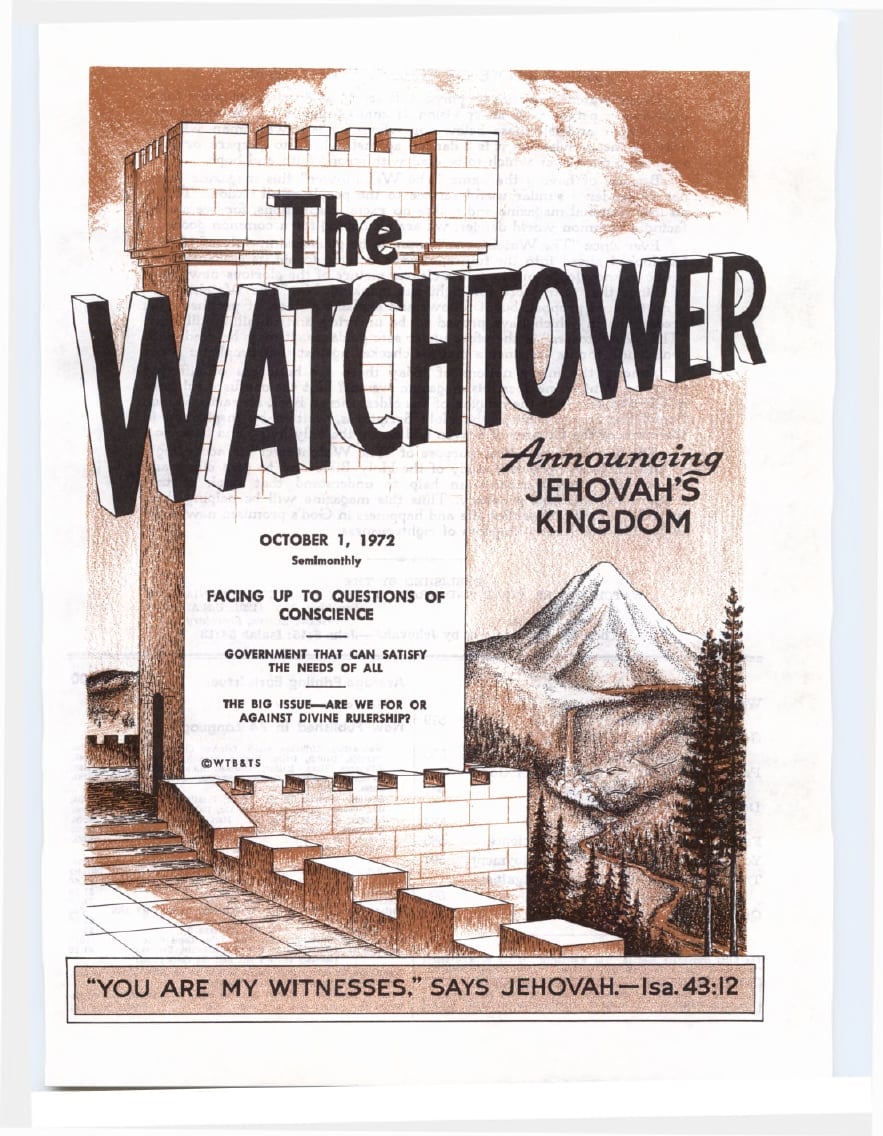
The Watchtower — October 1, 1972
Source: jw.org
Contents
Will the Needs of the Poor Ever Be Satisfied?
Government That Can Satisfy the Needs of All
Prosperity Under the Kingdom of God in Our Own Generation
Do You Look to Science for a Better World?
Facing Up to Questions of Conscience
Your Conscience and Your Employment
The Big Issue—Are We for or Against Divine Rulership?
Questions From Readers
Can You Read It in the Newspaper?
Will the Needs of the Poor Ever Be Satisfied?
Will the Needs of the Poor Ever Be Satisfied?
POVERTY is not new to the world. Nearly 3,500 years ago the Israelites were told: “Someone poor will never cease to be in the midst of the land.” (Deut. 15:11) Centuries later, when accepting an act of generosity, Jesus Christ acknowledged the same hard fact, saying: “You always have the poor with you, but you will not always have me.”—Matt. 26:11.
Sad it is that in this present imperfect system of things millions of men, women and children continue to live in poverty. Perhaps you yourself are among those millions.
Do you find that holding a steady job is a problem? Do you worry about how you are going to get enough food for your family? Does it trouble you that a lack of life’s necessities is robbing you and your family of good health? Do you feel that you are trapped in your present housing situation and have no means to get away from depressing surroundings? Have you ever asked yourself, Why must things be this way? Will the needs of the poor ever be satisfied?
Even if you do not number yourself among the poor of the earth’s inhabitants, you surely know poor people. Even in prosperous nations poverty exists. Of the United States of America, Senator Hubert H. Humphrey observed, in his book War on Poverty, that ‘one out of every five Americans lives in poverty, shame, misery, and degradation.’ Do you feel compassion for these?
Throughout the earth many poor people entertain hopes that somehow human governments will be able to help them. But they readily admit that they have been disappointed all too often.
Consider, for example, what happened in Colombia, South America. Back in 1962 when the late Guillermo León Valencia ran for the presidency, he often quoted from a line of his father’s poems: “A full cup for everyone.” He promised that his would be “the government of the poor.” But did it become such? His austere economic measures hurt the very ones he claimed to favor. From late in 1962 to early in 1964 the cost of living increased by 50 percent! Soon the Valencia government came to be referred to by the man in the street as “the government of the poor rich.”
Because of repeated disappointments, many people turn to Communism and Marxism in the hope that their situation might be improved. However, like lands controlled by other forms of human government, Communist countries have not been able to solve many of life’s big problems. Is it not true that they are plagued by unsettled political conditions, divisive nationalistic factions and family and moral breakdown, including the problem of alcoholism? Also, their subjects have lost a considerable degree of freedom.
The undeniable truth is that no human government has ever been able to provide complete relief for the afflicted inhabitants of the earth. Does this mean that the lot of poor people is hopeless? that poverty will never cease? Not at all. There is One higher than man who is both willing and able to remove poverty. This One is the Creator of man, Jehovah God. Of him, the Bible says: “You are opening your hand and satisfying the desire of every living thing.”—Ps. 145:16.
But how will Jehovah God satisfy the needs of the poor? For the answer to this question, we invite you to read the following article.
Government That Can Satisfy the Needs of All
Government That Can Satisfy the Needs of All
BY REASON of his Creatorship, Jehovah God is the rightful Sovereign of the universe. Even before human governments existed, yes, even before humans existed, he held that position. He has never given it up. However, due to the insurrection of our first parents, Adam and Eve, Jehovah God purposed to express his rulership over heaven and earth through a subsidiary government. By means of this government he will satisfy the needs of all. The governmental body itself is to be composed of persons taken from among earth’s inhabitants.
The Bible book of Daniel describes Jehovah’s deputy ruler as “someone like a son of man.” (Dan. 7:13) He appears in God’s heavenly courts and is given “rulership and dignity and kingdom, that the peoples, national groups and languages should all serve even him.” (Dan. 7:14) This “son of man” is later identified in the Holy Scriptures as Jesus Christ. (Matt. 12:40) The book of Daniel also speaks of the associate rulers of the “son of man” as “holy ones of the Supreme One.” (Dan. 7:27) In the last book of the Bible the number associated with Jesus Christ in rulership is shown to be 144,000.—Rev. 14:1-3.
Consider, now, the solid hope such a government offers to the world’s needy ones.
A KING WHO CARES ABOUT THE POOR
We can trust God’s deputy ruler, Jesus Christ, fully, as his most outstanding quality is that of unselfish, self-sacrificing love. In proof of this he left his home in the heavens, where he had everything. He “took a slave’s form and came to be in the likeness of men.” Then he let himself be “brought just like a sheep to the slaughtering,” that by his death he might make possible everlasting life for those exercising faith in him.—Phil. 2:6-8; Isa. 53:7.
Jesus Christ can deal sympathetically with the afflicted and needy, for he knows what it means to be poor. Regarding his own human circumstances, he once remarked: “Foxes have dens and birds of heaven have roosts, but the Son of man has nowhere to lay down his head.” (Matt. 8:20) Moreover, Jesus’ heart went out to distressed people of all kinds. “He felt pity for them,” and was ever willing to help them. (Matt. 14:14) On one occasion a leper said to him: “Lord, if you just want to, you can make me clean.” Jesus lovingly responded: “I want to. Be made clean.” (Matt. 8:2, 3) Would you not like someone so compassionate as your king? Does not Jesus’ past record give you confidence that the prophetic words respecting his rule will be fulfilled, “He will feel sorry for the lowly one and the poor one”?—Ps. 72:13.
Though now occupying an exalted position in the heavens, Jesus Christ is just as loving, compassionate and concerned about humans as he was when on earth. He is just as impartial, ‘loving righteousness and hating lawlessness.’ (Heb. 1:9) God’s Word tells us: “Jesus Christ is the same yesterday and today, and forever.” (Heb. 13:8) Surely one who was willing to sacrifice his most precious possession—his life—to fill man’s need for deliverance from sin and death deserves our trust and confidence!
A LOOK AT THE KING’S ASSOCIATE RULERS
Those selected to be associate rulers with God’s Son must manifest the same kind of love, being willing to surrender their life in behalf of others. (John 15:12, 13) Like Jesus Christ, they must be lovers of right and haters of bad. Concerning them the Bible says: “No falsehood was found in their mouths; they are without blemish.” (Rev. 14:5) So their subjects will be given no double-tongued, hypocritical promises.
In all respects Jesus Christ set the perfect standard for those who would rule with him. Showing how they must humbly care for and lovingly serve the needs of his subjects on earth, he told them: “You know that the rulers of the nations lord it over them and the great men wield authority over them. This is not the way among you; but whoever wants to become great among you must be your minister, and whoever wants to be first among you must be your slave. Just as the Son of man came, not to be ministered to, but to minister.” (Matt. 20:25-28) This assures us that their rule will have none of the undesirable qualities of imperfect human governments.
EARTHLY REPRESENTATIVES OF THE KING
At this point you may be wondering: Since God’s kingdom is a heavenly government, what kind of governmental operation will there be here on earth? Psalm 45:16 prophetically reveals that Jesus Christ will have princely administrators on earth. We read: “In place of your forefathers there will come to be your sons, whom you will appoint as princes in all the earth.” That means we may expect some of the faithful forefathers of Jesus, worthy men like Abraham, Isaac and Jacob, to be numbered among those who will occupy those princely positions. Additionally, some who will be princely representatives are even now serving in positions of responsibility in the true Christian congregation. Such men are neither ‘lovers of money’ nor “greedy of dishonest gain.” (1 Tim. 3:3; Titus 1:7) As spiritual shepherds they are “examples to the flock” and show loving concern for all within the congregation. (1 Pet. 5:2, 3) Their faithfulness now may mean being used in an even grander way in the earthly administration of God’s kingdom.
The subjects of God’s kingdom can be sure that their needs will be satisfied. Not only will Jehovah’s kingdom by Christ end poverty and hunger, but it will also bring good health and everlasting life to its devoted subjects. What Jehovah God will do by means of his kingdom is beautifully portrayed at Isaiah 25:6-8: “Jehovah of armies will certainly make for all the peoples . . . a banquet of well-oiled dishes, a banquet of wine kept on the dregs, of well-oiled dishes filled with marrow, of wine kept on the dregs, filtered. . . . He will actually swallow up death forever, and the Sovereign Lord Jehovah will certainly wipe the tears from all faces.” Would not these grand conditions satisfy your needs?
It is indeed encouraging to know that Jesus Christ, his heavenly associate rulers, as well as his princely representatives on earth, will never abuse their authority. Jehovah God, who can discern every motivation and inclination of the heart, knows this for a fact. We, therefore, have no reason to doubt that our needs will be cared for in a loving and compassionate way. So would not life under the administration of God’s kingdom be truly desirable? But when will all this come about?
Prosperity Under the Kingdom of God in Our Own Generation
Prosperity Under the Kingdom of God in Our Own Generation
THE world situation today is so critical that many informed persons doubt whether life will continue much longer. Said a special report to the Washington Post: “Influential men have sensed an impending danger unlike any in human experience. Futurologists call it the crisis of crises, the culmination of man’s timeless errors.”
Never has man been so bent on ruining the earth, polluting the air we breathe, the water we drink and the food we eat. Never have governments been confronted with such a mountain of national and international problems that they could not resolve. And never have those opposing God’s sovereignty made themselves so manifest. Millions deny that God exists. Even among those acknowledging his existence there are many who claim that he has no interest in mankind. So there is a great need for Jehovah God to show that he is King over all the earth.
The cheering news is that he will do so in our generation. His kingdom by Christ will soon smash to pieces all governments that stand in opposition to it and will itself administer man’s affairs without a rival. (Dan. 2:44) True prosperity will begin, and poverty, suffering and oppression will end. Why can we be so sure of this?
First of all, Bible chronology shows that since the autumn of 1914 C.E. we have been living in the “last days” of this system of things. Jesus Christ indicated that these “last days” would not extend beyond the life-span of the generation seeing their start. (Matt. 24:34) Hence, at least some people who witnessed the horrors of World War I will see the complete end of government by imperfect men and the bringing in of prosperity under the kingdom of God.
In verification of Bible chronology, we see the very conditions foretold in the Holy Scriptures as marking the “last days.” Note, for example, what 2 Timothy 3:1-5 tells us: “Know this, that in the last days critical times hard to deal with will be here. For men will be lovers of themselves, lovers of money, self-assuming, haughty, blasphemers, disobedient to parents, unthankful, disloyal, having no natural affection, not open to any agreement, slanderers, without self-control, fierce, without love of goodness, betrayers, headstrong, puffed up with pride, lovers of pleasures rather than lovers of God, having a form of godly devotion but proving false to its power.” Have you not seen these very conditions? Is it not true that they are in evidence among those professing to serve God, that is, members of Christendom’s churches?
The fact that the “last days” will terminate in the complete destruction of everyone and everything standing in opposition to God’s kingdom gives reason for serious thought. A person should ask himself, Am I in a fit position to be preserved as one of the loyal supporters of God’s kingdom?
For example, have you informed yourself as to God’s moral standards, which are set out in the Bible, and are you living in harmony with them? (1 Cor. 6:9-11) Also, are you making the best of your opportunities? Are you doing your best in keeping your home neat and clean? Are you an industrious worker, striving to do what you can do to the extent of your abilities? Do you make wise use of your strength and capabilities, not wasting resources and energies on filthy habits?
Even if you are not among the poor, are you living a life in harmony with God’s will? Are you compassionate, generous and loving? Does your heart stir you to take what positive action you can to help those who are in need through no fault of their own? Are you grieved about the terrible oppressions that millions have to endure?
These things are important, for Jehovah God does not want as his subjects people who are unclean in habits, conduct, person or home. Christians are reminded: “In accord with the Holy One who called you, do you also become holy yourselves in all your conduct, because it is written: ‘You must be holy, because I am holy.”’ (1 Pet. 1:15, 16) Moreover, Jehovah God does not approve of laziness. The inspired rule is: “If anyone does not want to work, neither let him eat.” (2 Thess. 3:10) On the other hand, those who are insensitive to the needs of oppressed and afflicted people are pronounced wicked. Says Proverbs 14:21: “The one despising his own fellowman is sinning, but happy is he who is showing favor to the afflicted ones.”
It is urgent that individuals take positive action to prove that they are lovers of right and haters of bad. One should be grateful that God has been patient with mankind, giving all people an opportunity to demonstrate whether they want to live in harmony with his ways or not.
If you are among those who love truth and righteousness and keenly desire to do God’s will, we urge you to accept the invitation of Jehovah’s Christian witnesses to study the Bible with them. Thus you, too, can share the comforting hope that God’s kingdom will soon satisfy the desire of every honest-hearted person. Prosperity under the kingdom of God will become a reality in our generation.
Do You Look to Science for a Better World?
Do You Look to Science for a Better World?
DO MEN look to science to save the world from annihilation and to make it a place where people would delight to live? Opinions may be divided, some answering Yes, some, No. But what we hear and read in industrial advertising and through channels of public communication usually points to what man is doing or can do as ‘the only hope.’ Or at least the conclusion is generally reached that ‘if there is a way to world peace and happiness, man’s intelligence will have to bring it about.’ God is, in effect, left in the background.
A sample of such thinking is an article in the Boston Herald Traveler on the subject “Can Man Run His World?” It called attention to man’s grave mistakes, but then concluded: “[Man] will stumble along, bloodied and bloodying, . . . until he either learns to master his wars or blows up his planet.”
In scientific journalism, science is credited with almost superhuman powers. Recently Science News, under the heading “Genetic engineering: Myth or reality?” said, in its heading-paragraphs:
“The code of life has been cracked and genetic engineering is on its way. . . .”
“Under the magic wand of biology man is now gradually becoming quite different from what he was. . . .”
Not content with attributing exaggerated accomplishments to the men involved, the article concludes, giving them a capitalized title and the main responsibility for humankind’s future:
“The New Biologists, contrary to their science fiction image, are deeply concerned about the power they hold to shape human destiny and are anxious to see that their achievements are not abused.”
Is it intelligent to attribute to modern science and its industrial material developments the ability to save mankind? Or is it good sense to look to human philosophy and political science, which have so much to do with man’s present distressing situation? But this a substantial, influential group in Christendom, including the modernist clergy, have done. They have turned from worshiping the God of the Holy Bible, Jehovah, to a substitute of their own choice. They even deny his existence. In place of looking to him as the source of enlightenment, they pay great respect to modern scientists and intellectuals, placing more faith in mere men than they do in Jehovah.
GOD’S VIEWPOINT
What is the attitude of the Almighty God, the Creator of man, who gave him reasoning powers and provided the things necessary for his welfare? What does He think of man’s turning to science as a savior?
Jehovah God has caused something to be recorded in his Word the Bible that shows us what he thinks, and what he will do about it. This is found in the prophet Ezekiel’s report of what was going on right among God’s professed people in Jerusalem only about five years before its destruction in 607 B.C.E. Recounting what he saw in vision, Ezekiel wrote:
“So [Jehovah] brought me to the inner courtyard of the house of Jehovah, and, look! at the entrance of the temple of Jehovah, between the porch and the altar, there were about twenty-five men with their backs to the temple of Jehovah and their faces to the east, and they were bowing down to the east, to the sun. And he went on to say to me: ‘Have you seen this, O son of man? Is it such a light thing to the house of Judah to do the detestable things that they have done here, that they have to fill the land with violence and that they should offend me again, and here they are thrusting out the shoot [twig] to my nose? And I myself also shall act in rage. My eye will not feel sorry, neither shall I feel compassion. And they will certainly call out in my ears with a loud voice, but I shall not hear them.”’—Ezek. 8:15-18; footnote reading.
There these Israelite men were, in the inner court of the temple dedicated to Jehovah. They were near the entrance of the temple itself, in the space between the porch and the altar of sacrifice at the center of the inner court. But, shockingly, they were not worshiping Jehovah at that place, nor were they bowing to his altar of sacrifice that was to the east of them. They should have been facing west, toward the temple. Why?
Well, there in the temple’s innermost compartment, the Most Holy, was the sacred Ark of the Covenant. Above it was the miraculous Shekinah light that symbolized the presence of Jehovah. But rather than look toward this symbolic dwelling place of God those twenty-five men turned their backs toward the Divine Presence and faced east. Ignoring the God they claimed to represent, they were bowing down in worship to the sun in the sky! This was in direct violation of God’s command at Deuteronomy 4:15-19.
Not satisfied with this flagrant disobedience, those men added insult, for, “here,” said Jehovah, “they are thrusting out the shoot [or, twig] to my nose.” (Ezek. 8:17) This shoot or twig was used in idolatrous worship and may have been carved to a certain shape to represent the human male organ. At least it must have been something very offensive or obscene to be held out to Jehovah’s nose, as if he would find pleasure in smelling it. Such idolatrous sun worship on the part of those twenty-five men was accompanied by their filling “the land with violence.”
MODERN-DAY INSULTERS OF GOD
Has Christendom really, actually, done things as bad as those Jewish men did? Is there a modern-day parallel? Yes.
Modern science has come to be treated like a “sacred cow,” that must be viewed with reverence and that must be considered ahead of the Bible and of God. The scientists’ supposedly “advanced” intellectuality, with all its theories, has been treated as the up-to-date form of enlightenment that has made the Bible “out-of-date,” “obsolete.” In reality their technology is able to delve into God’s laws only to a limited extent and can operate only within the framework and limitations of those laws. But news channels nearly always honor the technology rather than the God who made it possible. They speak as though man is great, ‘wresting nature’s secrets’ away and becoming master of the universe.
Is this attitude something new, this focusing of all attention upon the human creature, this giving of all credit to man whom God created? No, the tendency of humans to do this was described centuries ago by one of the apostles, who wrote: “Although asserting they were wise, they became foolish and turned the glory of the incorruptible God into something like the image of corruptible man and of birds and four-footed creatures and creeping things.” The difference and the extreme seriousness of the matter, however, is that now the time has arrived for the issue to come to a head and to be settled forever.—Rom. 1:22, 23.
Christendom’s infection with the worship of false gods, including the idolizing of modern science, betrays itself very slyly. For instance, on July 20, 1969, when for the first time a human astronaut set foot upon the moon, who was glorified thereby, according to the way that the scientific group responsible for it named things that were involved? Certainly not Jehovah, the Creator of the moon. It was the mythological sun-god that was honored. How so? Because the man-made spacecraft used on that occasion (as on successful moon landings since) was named “Apollo.” Out of all the possible sources of names, idolatrous Greek mythology was selected. Phoebus Apollo was the sun-god of the ancient Greeks and was the twin brother of Artemis (or, Diana), the moon goddess.
Why should intelligent men use the Creator’s laws to accomplish a feat and then advertise and make prominent the name of an ancient sun-god, who is actually no god at all? It is evident that the importance of men is being put ahead of God. Furthermore, Christendom’s general acceptance of the unproved theory of evolution is one of the evidences betraying her as a worshiper of the “sun” of scientists.
Has this tendency of science toward paganism, wherein science is looked upon as a “sun,” the principal source of human enlightenment, proved to bring mankind closer to a better world? Back in Ezekiel’s day a similar course brought violence to the land of Israel. In this day it has proved to be no better. The clergymen of Christendom have either been unwilling or unable to halt the application of modern-day science to the invention and use of the most fiendish weapons of war, culminating in the developing of biological and radiological and atomic-nuclear weapons. The fighting of World Wars I and II was heavily dependent upon activity of scientists. Violence that has filled the earth has not been limited to those two world wars that were fought mainly by Christendom. The much worshiped modern philosophy has robbed churchgoing people of a real fear of God, and violence is being employed widely, even in peacetime. The time period since 1914 C.E. has been officially termed an “Age of Violence.”
The technology of modern science has been applied to industry and commercialism. This has resulted in a growing pollution that is ruining man’s natural environment. Fears are expressed that this earth will become shortly a place unfit for human existence. And what about man’s moral environment?
A new morality has been adopted that views even fornication, adultery and homosexuality with indulgence and makes legal allowances for them. Christendom’s clergymen refrain from declaring what the Bible has to say against these things. In fact, many prominent clergymen have come out publicly in favor of legislation that relieves immoral persons of punishment for committing such unclean things. Venereal disease continues to increase as a result, in fact, has become an epidemic! If this is offensive to many God-fearing people today, what must it be to God himself? It is just as offensive as when those twenty-five worshipers in Jehovah’s temple in Jerusalem were obscenely “thrusting out the shoot” to His nose.
WHAT WILL GOD DO ABOUT IT?
Aside from showing Ezekiel the detestable things that were going on in Jehovah’s temple in Jerusalem, did He take any action as a consequence? Yes. As he said: “I myself also shall act in rage. My eye will not feel sorry, neither shall I feel compassion. And they will certainly call out in my ears with a loud voice, but I shall not hear them.”—Ezek. 8:18.
Did this actually occur? It did. When, only about three and a half years later, Nebuchadnezzar laid siege to Jerusalem, the people got to be in dire straits. Starvation prevailed. Mothers even ate their own children. Disease laid thousands low. Strife among the besieged Jews added to the distress. When Nebuchadnezzar’s soldiers entered the city, young and old were slaughtered in the streets. Princes were hung up by the hand. The captives were hauled off to slavery in Babylon. Even though God had put his name on the city and its temple, he did not act to spare them, so great was his rage at the Jews’ disgusting idolatry and obscene practices. (Lam. 2:21; 4:9, 10; 5:12) Are we to think God will act differently today?
Christendom has claimed to bear the name of God and of Christ and to direct the people in their ways. But, to the contrary, Christendom has brought the greatest reproach upon Jehovah God and his Son and upon His worship. It has been an instrument in the hand of God’s enemy Satan the Devil to turn as many as possible away from the true God.
As a consequence, rebellious, apostate Christendom, with her religious systems, will feel Jehovah’s rage without pity and without any heed to their cries. The Bible describes the fall of the world’s false religious empire, symbolic Babylon the Great, of which Christendom is the dominant part. Depicting her as a great harlot, God’s prophetic Word says: “In one day her plagues will come, death and mourning and famine, and she will be completely burned with fire, because Jehovah God, who judged her, is strong.”—Rev. 18:2, 8.
Then her turning away of world leaders to a worship of the “sun” of man-made science with its evolutionary theory will bear its full fruitage. The Bible reveals that the political and commercial systems will suffer defeat and annihilation at the hands of Jesus Christ in the battle of Har–Magedon, which immediately follows the destruction of false religion.—Rev. 16:14-16; 19:17-21.
God’s action, though severe, will work to the benefit of those who do not, stupidly and idolatrously, attribute honor and reverence to the sun, either the literal orb in the sky, or the man-made “sun” of so-called science. They are persons who have respect and reverence for the Creator of the universe. They look to him for life and the comforts of a better order, and they will not be disappointed.—Isa. 45:22.
Even those who have trusted in science, if they recognize that they have been committing idolatry, can receive forgiveness, if they turn to God. For “Jehovah is very tender in affection and merciful.” They can learn of his provisions through a study of the Bible and can look for the blessings he originally purposed for men—a really clean, righteous earth. Then they will experience the truth of which the psalmist long ago sang: “Jehovah God is a sun and a shield; favor and glory are what he gives. Jehovah himself will not hold back anything good from those walking in faultlessness.”—Jas. 5:11; Ps. 84:11.
Facing Up to Questions of Conscience
Facing Up to Questions of Conscience
“I am not conscious of anything against myself. Yet by this I am not proved righteous, but he that examines me is Jehovah.”—1 Cor. 4:4.
1. What still remains true of the moral sense of people generally?
DESPITE the flood of immorality, dishonesty and crime today, not all persons in the world of mankind are “past all moral sense.” (Eph. 4:19) As in Paul’s day, there are some today who, though not having accurate knowledge of God’s Word, still retain a measure of decency, a vestige of that inner moral sense we call conscience.
2, 3. How do Paul’s words at Romans 2:12-16 throw light on the matter, and what do they help us to understand as to human laws and decent conduct on the part of many individuals?
2 Paul said of the non-Israelite nations, those that were never under the Law covenant: “For whenever people of the nations that do not have law do by nature the things of the law, these people, although not having law [that is, a law code from God], are a law to themselves.” In what way? In that “they are the very ones who demonstrate the matter of the law to be written in their hearts, while their conscience is bearing witness with them and, between their own thoughts, they are being accused or even excused.” (Rom. 2:12-16) So this “law” that they are “to themselves” is not a law that they themselves make for themselves regardless of what others think.
3 This moral nature, inherited from God’s first human son, operates as a “law” or rule of conduct in people of all races and nationalities, now as in the past. This explains why the national or tribal laws of virtually all people have reflected at least some of God’s righteous standards, even though these peoples were without the Bible as their guide. It explains why individuals, though not true servants of Jehovah God or even professed Christians, may live generally “decent” lives, often manifesting adherence to certain good principles. At the same time it explains why God could justly hold not only his covenant people of Israel but the whole world of mankind ‘liable for punishment,’ and why, in the coming expression of his judgment, he can justly “render to each one according to his works.”—Rom. 2:6; 3:9, 19.
4, 5. (a) How can the Christian shame those who speak slightingly of his conduct? (b) Give examples.
4 Because of being separate from the world of mankind that is alienated from God, the Christian will suffer opposition. (John 15:18-20) But this does not exempt him from acting so as to appeal to whatever sense of decency, justice or morality that may still remain in persons of the world. People may misinterpret the motive for our separateness, calling us ‘haters of everyone,’ ‘antisocial,’ and accuse us of being inconsiderate, fanatical, unmerciful. The apostle Peter shows we can and should act so as to disarm our critics. “Hold a good conscience,” he exhorts, “so that in the particular in which you are spoken against they may get ashamed who are speaking slightingly of your good conduct in connection with Christ. For it is better to suffer because you are doing good, if the will of God wishes it, than because you are doing evil.”—1 Pet. 3:16, 17.
5 In modern times there are abundant examples where Christian kindness, helpfulness or generosity toward persons in the world has completely changed their attitude toward Jehovah’s Kingdom proclaimers and their work and message. Even when they are unjustly persecuted and put into prisons and concentration camps, their fine conscientious work and respectful way has caused Jehovah’s servants to gain the esteem of officials, and they have been placed in positions of trust and responsibility, just as was Joseph in ancient Egypt.—Gen. 39:21-23.
6. How does conscience affect the Christian’s relationship with worldly governments?
6 Jehovah God has allowed human governments to function on earth and he lets them serve as his “minister” to the extent of punishing much crime and wrongdoing. As long as God lets these governments stand, the Christian should not oppose them, should not act unlawfully. He cannot expect God’s protection if he commits wrong deeds and suffers for it at the hand of officials. But there is a greater reason than fear of governmental punishment that should move us to be law-abiding persons. Romans 13:5 tells us: “There is therefore compelling reason for you people to be in subjection, not only on account of that wrath [expressed in governmental punishment of crime] but also on account of your conscience.” The penalty’s being light or severe is not what governs the Christian’s attitude. His conscience moves him to do what is right, for he knows that, whether “Caesar” governments on earth take action or not, “we must all be made manifest before the judgment seat of the Christ.”—2 Cor. 5:10.
7. In ‘appealing to the consciences’ of others, can we safely let their consciences set the standard for our own?
7 Of course, we can never let the unenlightened or defiled and depraved consciences of others set the standard for our own consciences. Our conscience must be guided by God’s Word and spirit and so may at times testify exactly to the contrary of what certain officials want of us. Then we must conscientiously respond as did the apostles: “We must obey God as ruler rather than men.”—Acts 5:29-32.
8. Give examples of basic commands, prohibitions and principles found in God’s Word that should mold Christian conscience.
8 The Bible is very clear, for example, in showing the need for true Christians to free themselves from all association with “Babylon the Great,” the world empire of false religion. (Rev. 18:2-5; 2 Cor. 6:14-18) It shows that Christians are to be “no part of the world,” hence not sharing in its politics or striving for the success of its anti-Kingdom goals. (John 17:14; 18:36; Jas. 4:4) Unequivocally the Bible sets forth the sanctity of blood, of human life and also the standard for God’s people to ‘beat their swords into plowshares and not learn war anymore,’ since their fight is ‘not against flesh and blood’ but against demon powers. (Gen. 9:4-6; Isa. 2:2-4; Eph. 6:11, 12) God’s Word is also specific and definite in its denunciation of sexual immorality in all its forms (fornication, adultery and homosexuality), as well as of other misconduct such as drunkenness, dishonesty and theft.—1 Cor. 6:9, 10; John 8:44; Eph. 4:28.
DIFFICULT DECISIONS OF CONSCIENCE
9. (a) Inasmuch as the Christian is not without Scriptural laws and principles, why is it that questions of conscience still arise? (b) What generally determines how great a part individual conscience must play in deciding on the rightness or wrongness of a matter?
9 Thus there are many, many acts and practices that are specifically approved or condemned in the Bible. Many, many others are clearly in harmony with, or in violation of, principles contained therein. Yet, particularly in the modern, complex society that has developed in many parts of the earth, there remain situations and circumstances where personal decision, based on the individual conscience of the one involved, is required. So many things in life are a matter of degree. The difference between a gentle pat and a vicious blow is a matter of degree of force. The difference between simple respect—as, for example, respect to a ruler or a national emblem—and reverential worship is also a matter of degree. Where extremes are involved there is no real question. It is when the matter comes within what might be called a ‘gray area,’ approaching the borderline between what is clearly right and what is clearly wrong, that questions arise. The closer to such ‘borderline situation’ the matter comes, the greater the part the individual’s conscience must play in his decision. Faced with such circumstances, what should we do?
10, 11. (a) What does God expect of us when such questions of conscience arise? (b) When faced with such a personal matter of conscience, should we expect some ruling to be handed down telling us what to do, and who should bear the responsibility for our decision? (c) What do such decisions reveal about us to God?
10 Jehovah God expects us to use our faculties of intelligence, our knowledge, understanding and judgment, and to do conscientiously what our faith points us to do. God does not place us under the conscience of some other human in such matters. We must each make our own decision in harmony with conscience—conscience molded by God’s Word. We must also take the consequences of our own decisions, not expect someone else to make the decision and bear that responsibility for us.
11 It would therefore be wrong in such matters to try to extract from someone else, from a body of elders or from the governing body of the Christian congregation, some rule or regulation that ‘draws the line’ on matters. Where God’s Word does not itself ‘draw the line,’ no human has the right to add to that Word by doing so. God in his wisdom allows us to show what we are in the “secret person of the heart,” and the decisions we make in such personal cases may reveal this. True, we may err at times without wrong motive, and God, who reads our hearts, can discern this.
12. Does the fact that we are not conscious of any wrongdoing of itself guarantee our righteousness? For what reason?
12 But whatever our decisions, and even though these are made with a clear conscience, we must always realize that, in the final analysis, God will be the One to make manifest the rightness or wrongness of our course and that in his own due time and way. Recognizing this, the apostle Paul wrote: “For I am not conscious of anything against myself. Yet by this I am not proved righteous, but he that examines me is Jehovah. Hence do not judge anything before the due time, until the Lord comes, who will both bring the secret things of darkness to light and make the counsels of the hearts manifest, and then each one will have his praise come to him from God.”—1 Cor. 4:3-5.
13. (a) What does Romans 14:4, 10-12 show as to the right attitude to take toward the one who makes such personal decisions of conscience? (b) However, where do the consciences of those in positions of responsibility in the congregation also come into play with regard to such ones?
13 Where such ‘borderline’ cases arise, we should not place ourselves as judges of the individual who must make his own conscientious decision. Nor should we ourselves feel guilty of making a mistake by recognizing such individual as still an approved servant of God if his decision on a ‘borderline’ case is not precisely what ours would have been. God is his Judge. (Rom. 14:4, 10-12) On the other hand, those in responsible positions in the Christian congregation must also exercise their own consciences in their oversight of the congregation. Though they may feel that their decision would have been different from that of some brother in a particular matter, the protest of their consciences may be very mild, due to the Scriptures’ apparently leaving the matter within the realm of personal decision. If the individual gives evidence of having acted with a clean conscience, their consciences may allow them to assign him responsibility or recommend him for some position of responsibility. Nevertheless, it may be that their consciences will speak with sufficient strength in the matter so that they cannot conscientiously recommend him in this way. Again, God is their Judge and they are not to be condemned.
14. What questions now come up for discussion?
14 Many times these ‘borderline’ questions arise in the field of employment. Does the work you do allow you to have a clean conscience before God? Does it allow you to ‘recommend yourself to every human conscience’ as a genuine follower of Jesus Christ? These are important questions we will consider in the following article.
[Picture on page 590]
Should you write to the Society for a ruling on this matter? Where a personal decision, based on your conscience, is required, the decision is yours to make. Act so as to have a clean conscience before God
Your Conscience and Your Employment
Your Conscience and Your Employment
1. Why is a Christian’s employment a vital area for his conscience to be exercised?
MOST of our waking hours are spent in work. Certainly a Christian should want to have a clean conscience as to the work he performs, ‘doing all things for God’s glory.’ (1 Cor. 10:31) Does your work allow you to do that?
2, 3. (a) What employment is obviously wrong, and can the Christian taking up such employment escape responsibility? (b) How is it that certain kinds of work that in themselves are not wrong can, nevertheless, raise questions of conscience?
2 Obviously, any work that directly and principally requires one to perform acts that are either specifically condemned by God’s Word or are out of harmony with its principles is wrong. A Christian cannot simply place the responsibility on his employer for the wrong. But what if the labor in itself is not incompatible with God’s Word but is part of an operation that is pursuing ends incompatible with God’s Word? What then?
3 As a simple illustration, serving as a chauffeur and driving an automobile is in itself proper employment. But how could a person professing to be a Christian serve as chauffeur for a gang of bank robbers? Or how could a Christian let himself be identified with a house of prostitution by serving as its doorman or maid? But, on the other hand, suppose you had a milk route or a newspaper route; would your delivering bottles of milk or the newspaper to such house of ill repute make you a part of an immoral operation?
4. (a) Where a person or business engages in wrongdoing, does all service rendered to such person or business necessarily make the one rendering the service an accomplice in such wrongdoing? (b) What example does God himself give us as to providing certain services to wrongdoers without becoming party to their deeds?
4 Clearly there is a difference between being an accomplice to wrong deeds and simply being one who renders certain services such as are commonly rendered to all persons, without discrimination for or against anyone. We have an example in God himself as to providing service to personal needs without taking into account people’s righteousness or lack of righteousness. As Jesus pointed out to his disciples, Jehovah God “makes his sun rise upon wicked people and good and makes it rain upon righteous people and unrighteous.” (Matt. 5:45) Paul, too, says that God the Creator “gives to all persons [without discrimination] life and breath and all things.” (Acts 17:25) Since God permits rain to fall even upon the fields of wicked men, does this make him share in the guilt of their wrongdoing? When, for example, God clothed the sinners Adam and Eve, did he thereby lay himself open to the charge of condoning or supporting them in their wrongdoing? Rather, his act was simply one of undeserved kindness.—Gen. 3:21.
5, 6. (a) In what way could Christians evidently perform services in the household of Caesar and still maintain a good conscience? (b) How can similar circumstances prevail in modern times?
5 In his letter to Christians at Philippi, Paul sends greetings from their Christian brothers “of the household of Caesar.” (Phil. 4:22) Evidently these were domestic servants in the imperial quarters, whether slaves or freedmen the record does not indicate. They perhaps rendered human services there, such as cooking, cleaning and similar work, on behalf of the imperial family and staff. As we have seen, human governments do perform some legitimate functions in the eyes of God, though also being guilty of other condemnable practices. (Rom. 13:1-5) Whatever the particular work these Christians of Caesar’s household performed, they apparently could do it without feeling that they were participants in the politics, religion or military ventures and schemes of Nero.
6 So in modern times. There are many acts we may perform for others that are rendered to them simply as fellow humans, without concerning ourselves with their righteousness or unrighteousness. As in our simple illustration, the selling of milk to a prostitute would not logically cause one to be viewed as condoning her immorality, would it? Nor would one’s being employed by a politician to teach him music reasonably mark one as a supporter of the political activities of this employer.
7, 8. How does God’s Word manifest a reasonable and realistic viewpoint, and how should this guide us in our application of Bible principles in matters of conscience?
7 Though unshakably firm for righteousness, Jehovah God is also reasonable. (Jas. 3:17) He is completely realistic in his appraisal of matters and in his requirements of those who would please him. This is seen in the apostle Paul’s inspired words at 1 Corinthians 5:9, 10. After recalling his earlier instructions to Christians in Corinth to “quit mixing in company with fornicators,” Paul then said, “not meaning entirely with the fornicators of this world or the greedy persons and extortioners or idolaters. Otherwise, you would actually have to get out of the world.” While Christians seek to avoid ‘bad associations that spoil useful habits,’ they cannot become hermits, isolating themselves in caves, deserts or on islands. Why not? Their very commission to serve as the “light of the world” requires that they be ‘in the world though no part of the world.’ (1 Cor. 15:33; Matt. 5:14-16; John 15:19; 17:15-18) To require them to fulfill their commission and at the same time to maintain separateness to an absolute degree would be to require contradictory things of them. God does not do this. Neither should we be unreasonable in our application of the principles of God’s Word, trying to push every principle to its absolute limit and force applications to an extreme degree and then insist that all our brothers do so.—Phil. 4:5.
8 With these points in mind, let us consider certain types of activity to see whether these are ruled out as definitely unchristian by the Bible or are within areas where individual conscience must determine what the Christian will do, or to what extent conscience may enter into the matter.
GAMES OF CHANCE
9, 10. Does the Bible provide a specific command as regards gambling, and why may objections be raised against calling it a form of “extortion”?
9 Gambling is not mentioned specifically in the Bible. What, then, should be the Christian’s attitude toward it?
10 Some might link it to extortion, mentioned at 1 Corinthians 6:10. However, the objection may be raised that “to extort” (a word having the same source as the word “torture”) carries the basic idea of using force, threats or other pressure (as by the abuse of official authority) to obtain something from an unwilling person. While individuals who lose money in gambling are not pleased to lose it, they generally gamble willingly and with full recognition that they run the risk of losing money. So, then, if gambling is not extortion, on what basis would the Christian refuse to approve it?
11, 12. (a) What Scriptural principles provide the basis for the voice of conscience to speak up regarding gambling? (b) What does the effect gambling historically has had on people show?
11 There is more than one Scriptural reason for doing so. Gambling certainly merits being classified as a form of “greediness,” and greediness and covetousness are classed along with idolatry in God’s Word. (1 Cor. 6:9, 10; Col. 3:5) It clashes with the basic Scriptural precept that we should love our neighbor as ourselves, and that man should do honest, productive labor to obtain gain. What productivity results from gambling? Its history shows that it is almost inevitably contributory toward crime in one fashion or another. And why? Because it is unloving. It incites selfishness and fosters lack of concern for others. The gambler wants the money of others without giving them any genuine service in return. Though some may class gambling with entertainment, the evidence shows that as often as not it creates tension, anxiety, resentment and even murderous anger.
12 One woman who worked in a casino is quoted as saying: “Gambling hardens all who come in contact with it. After a year or so of work in the casino, the dealer is no longer moved by the spectacle of men and women, many of them mentally ill, gambling away the money that should be used to support themselves and their families. One of the world’s greatest and oldest tragedies—the wrecking of countless human lives because of man’s greed for easy money and his infatuation for the false goddess, Lady Luck—no longer affects [the dealer].”
13. What shows that the Scriptures’ linking covetousness and greediness with idolatry also holds true with regard to gambling?
13 Yes gambling also foments superstition, gamblers as a class being among the most superstitious people. Money becomes an idol and Lady Luck a goddess. At Isaiah 65:11 God’s Word speaks of those leaving Him and “setting in order a table for the god of Good Luck and those filling up mixed wine for the god of Destiny.”
14. In contrast with the covetous course of the gambler, what exhortation is made to Christians?
14 Certainly all this stands in direct contrast to the apostle’s exhortation to Christians at Thessalonica to “make it your aim to live quietly . . . and work with your hands,” so that they might be “walking decently as regards people outside and not be needing anything.” (1 Thess. 4:11, 12) Yes, there are still standards of decency in the world of mankind as to doing honest, productive labor, and the Christian will want to ‘recommend himself to every human conscience’ in this matter as in all others.—2 Cor. 4:2.
THE USE AND PRODUCTION OF HARMFUL ADDICTIVES
15-17. (a) What practice involving the use of betel nut exists in certain areas of the earth? (b) What effect does this have on the user, and how have authorities in some countries viewed the practice?
15 Another matter causing concern in many parts of the earth is the use and production of materials that result in harmful addiction. In India, the Philippines and the Malaysian areas, for example, an ancient and popular practice is the chewing of betel nut, also known as areca nut, the seed of a palm tree. Pieces of betel nut are rolled in a leaf smeared with quicklime and chewed. The betel nut colors the person’s saliva a blood-red color and blackens the teeth, generally causing their deterioration. Many habitual betel-nut chewers become toothless at as early an age as twenty-five. According to the Encyclopedia Americana (1956, Vol. 20, p. 573), betel-nut chewing produces “an effect similar to the chewing of tobacco.” In India, in fact, tobacco is sometimes included in the betel-nut “chew,” the admixture being known as pan.
16 The Bombay Evening News of April 4, 1972, tells us that Extra Pharmacopia, a publication of the Pharmaceutical Society of Great Britain, classifies betel nut as a “drug.” An Indian court therefore ruled that betel nut could not be classified as “food.”
17 Notably, many persons who have used both tobacco and betel nut say that, of the two, they found the betel-nut habit the more difficult to break. During the Japanese rule of Taiwan, an unsuccessful effort was made to stamp out the habit. Many Taiwanese doctors believe there is a link between the practice and the high incidence of mouth and face cancer in Taiwan.
18. What similar practice exists in Latin America, and what is its effect?
18 In some Latin-American countries a somewhat similar practice prevails, that of chewing coca plant leaves with lime. Since the leaves contain cocaine, this practice is addictive. While it keeps the users from feeling the pangs of hunger or the ache of tiredness, like other such narcotics it eventually has very damaging effects on their health as well as their mental powers.
19. What does modern-day evidence show regarding the use of tobacco in smoking and chewing?
19 The use of betel nut and coca leaves is somewhat regional. The use of tobacco, on the other hand, is virtually world wide. It, too, is addictive. Evidence of the power of its addiction may be seen from the fact that its production still runs around three and a half billion tons a year—despite medical warnings of the damage it brings to human health. In the United States, for example, some 576 billion cigarettes and 7 million cigars are manufactured annually. Yet a committee appointed by the Surgeon General of the United States found that the risk of lung cancer was ten times greater in moderate smokers, and twenty times greater in heavy smokers, than in nonsmokers. Dr. Charles Cameron of the American Cancer Society said: “Cancer of the lung is showing the most rapid increase ever ascribed to any noninfectious disease in medical history.” Smoking was also reported as being contributory to heart disease, chronic bronchitis and emphysema. As a result, various governments have passed laws restricting the public advertising of cigarettes.
APPLYING BIBLE PRINCIPLES TO THE PROBLEM
20. Since none of these practices are mentioned in the Bible, does this remove them from becoming questions of Christian conscience?
20 Again, the Bible does not mention the chewing of betel nuts, coca leaves or the chewing, snuffing or smoking of tobacco. Some persons have said: “Until you show me something in the Bible about the use of tobacco [or similar products], I will keep using it.” But might not one just as well say that, since the Bible does not specifically forbid throwing garbage into your neighbor’s backyard, there is nothing wrong in doing so?
21, 22. What Bible principles are clearly involved, and what questions must the Christian conscientiously ask himself as to engaging in such practices?
21 The Bible certainly does provide us with principles to guide us in this matter. The inspired apostle wrote at 2 Corinthians 7:1: “Since we have these promises [of being accepted by God as his approved children and servants], beloved ones, let us cleanse ourselves of every defilement of flesh and spirit, perfecting holiness in God’s fear.”
22 “Holiness” means the quality of being clean, bright, untarnished and devoted to sacred uses. Can the use of betel nut and its befouling effect on the user’s mouth and teeth, or the defiling effect that coca leaves and tobacco are recognized as inflicting on the user’s body, be harmonized with this Scriptural injunction? The greatest commandment is to ‘love God with all our heart, soul, mind and strength.’ Can one say one is serving God with one’s ‘whole strength’ while using products denounced even by national governments as seriously damaging to one’s health? Or, if one becomes addicted to coca leaves, can one say one is serving Jehovah with one’s ‘whole mind’? Really, is not the using of such things an acting ‘contrary to nature,’ subjecting the body to abuse it was never designed to take?—Mark 12:29, 30; Rom. 1:26.
LET YOUR CONSCIENCE SPEAK
23, 24. (a) Is it only the personal use of harmful addictives that raises questions of Christian conscience? (b) Does the fact that these plant products result from God’s creation remove all objections regarding their commercial production and distribution today? Illustrate.
23 What, then, of the person who farms, prepares or sells such things as his means of livelihood? Certainly the matter of conscience is involved here. What principles should guide us?
24 Some may argue that these things are all part of God’s creation placed here on earth, and that hence there is no reason to object to anyone’s growing them. True, they are God’s creation, but things that are correct in themselves may be put to bad uses. Mushrooms are part of God’s plant creation but only some are edible. If we make a mistake and eat one of the poisonous types this could cause our death. Jehovah provided minerals and metals, too, but when men convert iron into destructive weapons for political warfare, is this a good use of God’s provisions?
25, 26. (a) Is it only the seller of harmful addictives who bears responsibility for the damage they cause to humans? (b) What questions will the Christian conscientiously consider in this regard?
25 Consider the matter of hard drugs, such as opium and heroin. People addicted to these do not simply pick them up from the earth. There are many steps involved. Poppies must be grown, the juice extracted and refined into opium powder. To obtain morphine or heroin, further distilling must be done. Then there is the marketing and sale of these addictive drugs. Where along the line does responsibility for the immense harm and crime involved in drug addiction begin or stop?
26 Though tobacco, betel nut and coca leaves may be slower in their destructive effects than these hard drugs, the same question may be asked as to their production and sale. These plant products may have legitimate uses—tobacco nicotine, for example, is used as the base for an insecticide—yet the fact remains that the legitimate usage forms a very minimal portion of the total usage. We can never forget that the second-greatest commandment is that we love our neighbor as ourselves. If we willingly and knowingly contribute toward serious damage to his health for the sake of gain, are we doing this?—Matt. 22:39.
27, 28. Can the use of certain popular beverages reasonably be classed with the harmful addictives described, thereby forming the basis for the same objections to their production and sale? If not, what difference exists?
27 Some may object that even such things as tea, coffee and, more particularly, alcoholic drinks, are also accused of being harmful to health. Yet, with regard to alcoholic beverages the Bible clearly and specifically allows for their use in moderation. (Deut. 14:26; John 2:1-10; Prov. 23:29-31; 1 Tim. 3:3, 8; 5:23) But no such approval can be found in favor of tobacco, betel nut, coca leaves, or, for that matter, marijuana, opium and similar products.
28 As to such beverages as tea and coffee, it might be asked: After all the centuries of their use, what clear evidence of their being consistently dangerous has been produced, or where have governments been moved to issue health warnings against them? True, to the person with health problems, such as ulcers, any of these beverages could be dangerous and, in such case, he should avoid them. To the diabetic sugar is dangerous; but it is not to other people. For an overweight person even bread and potatoes or rice can be dangerous. (Compare Proverbs 25:27.) We should be reasonable, then, in our consideration of matters. Are we seeking to suppress the voice of conscience by trying to rationalize away the facts about substances that have been demonstrated to be fundamentally harmful and dangerous?
‘BE WALKING DECENTLY AS REGARDS THOSE OUTSIDE’
29. In harmony with Galatians 6:7 what serious questions should one ask about employment that, in its end results, primarily brings detriment to mankind?
29 These are just a few areas in which questions of conscience may arise as to one’s employment. In all such matters, however, the Christian does well to recognize that ‘what one sows one reaps’—in more ways than one. (Gal. 6:7) What if one’s work is such that, rather than benefit, it produces detriment or harm to others? Though not specifically condemned in the Bible, will such work not have an adverse, perhaps even degrading, effect on the heart and mind of the worker? And may it not also have a weakening effect on his conscience, perhaps allowing him to excuse himself for engaging in practices that are specifically condemned in God’s Word?—1 Thess. 4:12.
…