The Watchtower, December 15, 1971
Download: PDF — The Watchtower, December 15, 1971
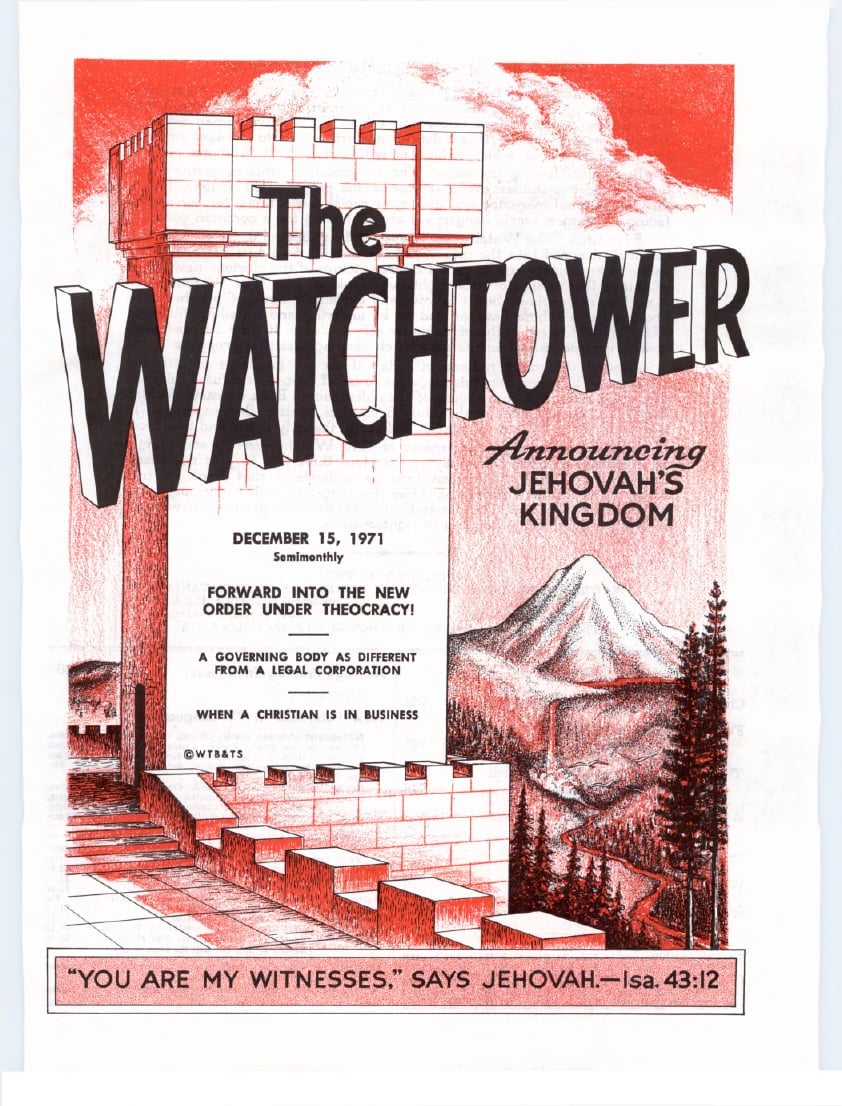
The Watchtower — December 15, 1971
Source: jw.org
Contents
Changing Attitudes Toward the Churches
Forward into the New Order Under Theocracy!
Theocratic Organization with Which to Move Forward Now
A Governing Body as Different from a Legal Corporation
Changed Thinking About Race
When a Christian is in Business
Questions From Readers
Can People of All Nationalities Speak in Agreement?
Changing Attitudes Toward the Churches
Changing Attitudes Toward the Churches
A FEW years ago the churches were generally held in esteem. Have you observed a change in this attitude? Do you note an increasingly critical tone in what you read or hear about the churches these days?
It is amazing today with what frequency news sources, if not directly expressing criticism, are quick to describe troubles of the churches. Consider some recent reports.
MAGAZINES FEATURE CHURCH DECLINE
The October 4 “Newsweek” in large white letters on a red cover asked: HAS THE CHURCH LOST ITS SOUL? Focusing on Christendom’s largest religion, the article inside said: “‘The Catholic Church is in one god-dam mess,’ complains a liberal monsignor who puts much of the blame on the bishops for whom he works. And in their own restrained manner, some members of the hierarchy agree. ‘The church is in disarray,’” admitted Bishop Joseph Bernardin.
The October 19 issue of “Look” advertised on its cover, THE DECLINING POWER OF THE VATICAN. Inside, the bold title declared, THE POWER AND THE GLORY ARE PASSING. The article’s final paragraph said: “The Roman Catholic Church has three classes of members—the hierarchy, the clergy and the laity, in whom the devastation is enormous.”
Also, “U.S. News & World Report” of November 1, beneath its article heading NEW VS. OLD—THE STRUGGLE AMONG CATHOLICS, said in boldface type: “Everywhere, troubles mount for Christianity’s largest church.” A study by a Jesuit, the article said, shows that in the United States “ordination of diocesan priests had declined from 1,694 in 1965 to 1,226 in 1970—and that dropouts, in that period, had risen from 166 to 1,578.”
CHURCH LEADERS VOICE CONCERN
During October, newspapers almost daily carried ominous reports from the meeting of Catholic leaders in Rome. Beneath the heading SEMINARY PERIL TOLD TO SYNOD, the Boston “Herald Traveler” of October 2 reported: “Cardinal Gabriel Marie Garrone of France warned the third international synod of Roman Catholic bishops yesterday that the seminary system is in danger of collapse because of doubts sweeping through the priesthood. . . .
“‘Seminaries are in danger of disappearing,’ the French cardinal said. ‘They are in slow and progressive decline.’”
Under the heading, TROUBLED TIMES FOR THE PRIESTLY CALLING, the New York “Times” of October 10 said: “Synod fathers . . . are only one week into their discussions, but one fact is already indisputable: The church faces a serious international crisis in the priesthood, and the bishops know it. . . .
“Surveys from virtually every country represented here tell a story of fewer seminarians and substantial defections among those already ordained.”
The next day, October 11, the Los Angeles “Herald-Examiner” reported: “‘Let us ordain married men now,’ said the archbishop from the Central African Republic. ‘Otherwise, within 10 years I will have to go back to planting onions.’
“Ndayen was voicing a fear that the priesthood might dry up and the Catholic church itself wither.
“Many of his fellow 209 delegates at the Third International Synod of Bishops agreed.”
Reports also show other churches to be in decline. “The Alabama Baptist” said: “Denominational leaders are alarmed at the rapid exodus of some of their best trained clergymen, with some estimates as high as 10,000 pastors and priests leaving churches of American denominations each year, the chief of chaplains at Georgia Baptist Hospital, Atlanta, said.”
Beneath the heading SYNAGOGUES FACING CRISIS, RABBI TELLS CONGREGATION, the Los Angeles “Times” reported: “‘This year has seen a flood of articles and statements by Jewish intellectuals, laymen, young people and rabbis on the emptiness of synagogue life,’ said Rabbi Lewis M. Barth.”
HOSTILITY TOWARD CHURCHES
Some reports express strong criticism of the churches, even to the point that some persons may be stirred to hostility toward them. An example is the October “Reader’s Digest” article, MUST OUR CHURCHES FINANCE REVOLUTION? It claims: “The World Council of Churches is using church power and church funds to back insurrection in the United States and Africa.”
The Roman Catholic Church, too, has approved revolution if it is for the purpose of overthrowing “tyranny.” Thus quite a few of the clergy now are revolutionaries. Their activities are more and more bringing the churches under fire.
Reporting on the new military government of Colonel Banzer, the British paper “The Guardian” this fall carried the headline: BOLIVIA MOVES AGAINST CHURCH. It reported: “The new Banzer regime’s predictable move against the so called progressive church in Bolivia appears to have begun. First hints have been the death of Father Maurice Lefevre . . . More priests are still in hiding and claim that orders have been given for them to be shot on sight.”
Similar action is under way in other countries. The Miami “Herald” of October 15 reported: “Several Roman Catholic priests are under investigation for alleged anti-government activities in Panama.”
A report from Brazil carried in the San Antonio “Express/News” tells of “this past week’s conviction of four Dominican clerics on charges of subversion.”
Beneath its headline SOUTH AFRICA RAIDS HOMES OF CLERICS AND TEACHERS, the New York “Times” of October 26 explained: “South Africa’s security police raided the homes of churchmen . . . as a nationwide drive against subversion.”
The Baltimore “Sun” of October 4 reported “the arrest and three-day detention last week of 47 priests” in Argentina. The paper noted that this is the latest expression of “the government’s willingness to repress forcibly what it considers revolutionary activity by radicals in cassocks.”
Although this has not generally been the case in other lands, Communist governments have long taken repressive measures against the churches. As one spokesman noted: “Communist regimes have conducted an anti-religious policy in the different countries where they have been in power.”
Regarding the Soviet Union’s attitude toward churches, the November “Reader’s Digest” observes: “Evidence abounds of wholesale closing of churches, of thousands of Christians harassed or sent to labor camps for nothing more than having Bibles.” China, the largest Communist country, is perhaps even more hostile to the churches. The 1970 “World Book Encyclopedia” explains: “The government prohibits missionary work and formal religious teaching in churches, homes, or schools.”
Already Communism controls a third of the world’s population, and its influence is increasing. This was again evidenced on October 25 when, by an overwhelming majority vote, Communist China was admitted to that international organization the United Nations. Thus China joins the Soviet Union as a permanent member of the United Nations’ powerful Security Council. Of significance, too, is the fact that in France, Great Britain and the United States, the Security Council’s other permanent-member nations, the churches are in steep decline.
What does this mean? To what is this trend of hostility toward the churches throughout the world leading? Evidently a great change in the social order is at hand. Could it be that religion that has failed to adhere to the Bible is due to disappear off the scene? It would be worth your while to investigate.
Forward into the New Order Under Theocracy!
Forward into the New Order Under Theocracy!
“Say among the nations: ‘Jehovah himself has become king.’”—Ps. 96:10.
1. For man’s preservation in a Paradise earth what kind of government is necessary?
FOR the everlasting preservation of the human race on a healthful Paradise earth a stable government is necessary. That means a permanent government of righteousness is necessary. Such a government is bound to come! It is even foretold to come—on the best of authority.
2. (a) If a democracy were offered as the necessary government, what assurance would there be for its stability? (b) What about World Federalists and a one-man government world wide?
2 What kind of government will it be? That all depends upon the power, individual or collective, that sets it up. Will it be the people collectively that will establish it and determine its form? If things worked out in that way, then a democracy would result. Would such a prospect make the future look bright for us? Not according to the showing that democracies have made in history down to date. Today, in spite of the military might of some of these democracies or people’s republics, even their stableness is very much in question. The survival of them in the darkening future is no more assured than that of other types of government. Those persons who call themselves World Federalists have their theories but are unable to produce a satisfactory world government. And nobody wants a one-man government world wide, a world dictatorship with an imperfect human individual as the absolute ruler.
3, 4. (a) With whom does the right lie to decide and order how earth shall be ruled? (b) Of what two questions asked by Isaiah does the argument of evolutionists remind us, and what is the answer thereto?
3 Well, then, what about a government set up by the Maker of the earth? Yes, by the Creator of man Himself? Has anyone a better right to decide and order how this earth and its inhabitants shall be governed than He has? The answer to this question is self-evident.
4 O the evolutionists may sarcastically say that there is no personal intelligent Maker of the earth and of man; but those evolutionists have been unable to produce a satisfactory government, even after the millions of years that they claim that man has been evolving on earth before reaching this much-vaunted Brain Age of man. Those evolutionists are made of just common clay like all the rest of us, and they remind us of a couple of questions that were asked two thousand seven hundred years before these brainy evolutionists came along: “Should the thing made say respecting its maker: ‘He did not make me’? And does the very thing formed actually say respecting its former: ‘He showed no understanding’?” (Isa. 29:16) No one can successfully deny that earth’s Maker and man’s Former showed understanding. And a government that He understands how to set up over man would be a theocracy.
5, 6. (a) Which was first on earth, democracy or theocracy, and what does the Bible show on this? (b) The first human couple could have lived to what point of fulfillment of God’s command to them?
5 Reliable historic records prove that theocracy was ahead of democracy on the earth. Even scientists are forced to admit that our human race descended from a first human married couple. That first man and first woman had to be under a theocracy or rule of God, for God was their Maker and likewise their Ruler, their Lawgiver, their Commander. They were not caveman and cavewoman. They were Paradise persons, for God created them in an earthly Paradise. (Gen. 2:7-25) Like with the fishes, birds and land animals, God had implanted in this perfect human couple the power to have offspring; and what finer purpose in life could he set before them than that which was set out in this theocratic command: “Be fruitful and become many and fill the earth and subdue it, and have in subjection the fish of the sea and the flying creatures of the heavens and every living creature that is moving upon the earth”?—Gen. 1:26-28.
6 With God’s blessing this flawlessly made human couple could live to see this divine command completely carried out—the whole earth subdued to a global paradise, comfortably filled with their children and children’s children in perfection.
7. (a) Why and how could they have lived to see earth filled with their descendants? (b) Why were we, their descendants, born under condemnation to death?
7 Even if it took a thousand years of living, that first married couple could have survived to see the full number of their offspring that were meant to inhabit the global paradise forever, for they did not need to die. By living loyal to the Theocracy, God’s invisible rule, and teaching all their offspring to live loyal to it, they could have been alive today and with the prospect ahead of them of living happily in Paradise with all their offspring to endless time. It was when our first parents rejected Theocracy and chose people’s rule, or democracy, that they came under the sentence of death. Because we were born to them after they made that choice and were driven out of the Paradise of Eden to die, we inherited sin and the condemnation to death from them. (Gen. 2:16, 17; 3:1 to 4:2; Rom. 5:12) From this we can see that democracy holds no promise of eternal life. Theocracy does.
8. (a) When and where did democracy come into existence, and how? (b) What about theocracy at that time?
8 All trace of that lost Paradise was wiped out by the global flood in the days of Noah, the tenth man in the line of descent from the first man, Adam. About sixteen centuries after that, or in the eighth century before our Common Era, Greece is reported to be in existence. It is said to be the birthplace of democracy. First about the year 700 B.C.E. was there a tendency toward democratic government in the Grecian city-states. This resulted in people’s forms of government as time went on and the people gained power, especially when the high-ranking cavalry of the nobles was eliminated and the forming of the phalanx of common foot soldiers came about.a But more than eight hundred years before that, a theocracy has been established on earth by the heavenly Theocrat. Where?
9, 10. (a) Where was this theocracy established, and with what form of worship? (b) How did Moses, in his farewell speech, point out that Israel had a royal theocratic government?
9 In the Sinaitic Peninsula. There, at Mount Horeb, He announced the Ten Commandments. In the first of those Ten Commandments he said: “I am Jehovah your God, who have brought you out of the land of Egypt, out of the house of slaves. You must not have any other gods against my face.” (Ex. 20:1-3) That first commandment showed that he was speaking and acting as a Theocrat or Divine Ruler and was speaking to the people whom he had liberated and over whom he was establishing a Theocracy. That was back in the spring of the year 1513 B.C.E. By the use of the prophet Moses as his mediator, Jehovah established not only the form of government but also the form of religious worship for his liberated people as an organized nation. So it had a theocratic government and a theocratic worship. About forty years later the aged Moses gave his farewell speech to the theocratic nation. Speaking of it as Jeshurun, meaning “Upright One,” Moses said:
10 “Jehovah—from Sinai he came, . . . And he came to be king in Jeshurun, when the heads of the people gathered themselves, the entire number of the tribes of Israel.”—Deut. 33:1-5.
11, 12. (a) In what land was Theocracy finally established, and how? (b) How did Judge Gideon prove loyal to the Theocracy, and in his day what local governing body did Succoth have?
11 In the spring following Moses’ death, in 1473 B.C.E., Jehovah their King brought his theocratic nation across the Jordan River and into the Promised Land. After years of conquest over the pagan, untheocratic inhabitants of the land, the Theocracy was established over most of the Promised Land. There were many temptations for the Israelites to depart from the theocratic rule.
12 In one instance, in order to restore His wayward people to theocratic order, Jehovah raised up Judge Gideon as a deliverer. After the driving out of the oppressive enemies, the Israelites wanted to make Gideon their visible king, the head of a dynasty of kings. But Gideon was loyal to the Theocracy. So he said to the would-be king-makers: “I myself shall not rule over you, nor will my son rule over you. Jehovah is the one who will rule over you.” (Judg. 8:22, 23) Under that theocratic rule the cities continued to have a number of elders as a local governing body. In Gideon’s day the city of Succoth had seventy-seven elders, including the local princes. (Judg. 8:6, 14-16) As official older men they represented Succoth.
FROM JEWISH THEOCRACY TO MESSIANIC THEOCRACY
13, 14. (a) What alteration in the government took place in the days of the prophet Samuel, and how? (b) How did David become king of all Israel, and on whose throne was he said to sit?
13 In the year 1117 B.C.E. the Theocracy in the Promised Land underwent an alteration, took on an added feature. The official older men of the people asked Jehovah’s prophet Samuel to install a visible human king over the nation. Jehovah was displeased and said to Samuel: “It is I whom they have rejected from being king over them.” (1 Sam. 8:4-7) Yet Jehovah authorized Samuel to anoint Saul the son of Kish of the tribe of Benjamin to be king over all Israel. Being anointed as king by Jehovah’s prophet, Saul became “the anointed of Jehovah.”—1 Sam. 12:3, 5; 24:6, 10.
14 Because of King Saul’s repeated disobedience, Jehovah had Samuel anoint the shepherd boy David of Bethlehem to become the future king of Israel. So after Saul’s death and the death of his son and successor, what took place? We read: “So all the older men of Israel came to the king at Hebron, and King David concluded a covenant with them in Hebron before Jehovah; after which they anointed David as king over Israel.” (2 Sam. 5:1-3) Thus David became “the anointed [Messiah] of Jehovah,” and he was said to sit on “Jehovah’s throne” as the visible representative of the great Theocrat.—1 Chron. 29:23.
15. Whose kingship over Israel did David acknowledge, and as respects this what did he say when the Ark was transferred to Jerusalem?
15 King David recognized the great Theocrat, saying: “Yours is the kingdom, O Jehovah, the One also lifting yourself up as head over all.” (1 Chron. 29:10, 11) At the time that David had the sacred Ark of the Covenant transferred to a tent near his palace in Jerusalem, David composed a memorial psalm in which he said: “Let them say among the nations, ‘Jehovah himself has become king!’” (1 Chron. 16:31; Ps. 96:10) That was about 1070 B.C.E.
16. (a) When Jerusalem and its temple were destroyed and the land became desolate for seventy years, what happened to the Theocracy? (b) What would restoration of the Messianic kingdom bring in, and till then in what condition were Jehovah’s people to continue?
16 Four hundred and sixty-three years afterward Jehovah’s temple of worship in Jerusalem was destroyed by the Babylonians, and Jerusalem and the land of Judah became desolated for seventy years as the deported inhabitants were exiles in the land of Babylon. Did that mean that Jehovah’s theocracy over his chosen people had ceased to exist? No! For he is the One who later brought about their restoration to their God-given land. What had ceased to exist was the kingdom in the royal line of David, and thus the Messianic kingdom of God in a miniature or small-scale way had gone out of operation. In due time the Messianic kingdom of God was to be restored. The restoration of it would lead to the bringing in of a righteous new order. (Ezek. 21:25-27; Acts 3:20, 21; 2 Pet. 3:13) In the meantime Jehovah’s people for His name would continue in relative subjection to the Gentile nations and their kingdoms.—Neh. 9:36, 37; Luke 21:24; Rom. 13:1.
17. (a) According to Isaiah 52:7, when Jehovah restored his people to their land, what was Jehovah apparently resuming? (b) How did Jehovah declare his kingship through Malachi?
17 Accordingly, when Jehovah brought back his people to their homeland in 537 B.C.E., it was as if Jehovah was resuming his reign over them. As it were, Jehovah sent ahead his messenger to his desolated earthly organization, in fulfillment of Isaiah 52:7, which reads: “How comely upon the mountains are the feet of the one bringing good news, the one publishing peace, the one bringing good news of something better, the one publishing salvation, the one saying to Zion: ‘Your God has become king!’” In evidence of this the temple was rebuilt at Jerusalem. Some decades later, when Jehovah raised up his prophet Malachi and explained why the Israelites should render him proper worship at his temple, he said: “‘For I am a great King,’ Jehovah of armies has said, ‘and my name will be fear-inspiring among the nations.’”—Mal. 1:14.
18. (a) In his Sermon on the Mount how did Jesus acknowledge Jehovah’s kingship over Israel? (b) How did he indicate that it would cease?
18 Even in the first century of our Common Era, when the true Messiah, Jesus Christ, was on our earth, he recognized the kingship of Jehovah over Israel, for, in his Sermon on the Mount, he told his disciples: “Do not swear at all, neither by heaven, because it is God’s throne; nor by earth, because it is the footstool of his feet; nor by Jerusalem, because it is the city of the great King.” (Matt. 5:34, 35) However, in the year 33 C.E., he indicated that Jehovah’s theocracy over Israel was about to cease. This was at Jerusalem, when he said to that city concerning her temple: “Look! Your house is abandoned to you.” Then, shortly thereafter, he foretold the destruction of that house of worship.—Matt. 23:37 to 24:22.
19. Were the Jews still under Theocratic Law at that time, and what shows whether?
19 At that time those Israelites to whom Jesus Christ preached the kingdom of God were still under the Theocratic Law covenant that the prophet Moses had mediated for their forefathers at Mount Sinai. On the following Passover day, which was celebrated at Jerusalem under that Theocratic Law, Jesus Christ was put to death as the antitypical Passover Lamb and was buried. But, because he was no false Christ, but was the true Messiah, he was raised from the dead on the third day to heavenly life. On the fortieth day from then, when Jesus Christ materialized and appeared to his disciples for the last time, they asked him: “Lord, are you restoring the kingdom to Israel at this time?” (Acts 1:1-6) As Jesus Christ had not then appeared in God’s heavenly presence in behalf of any new covenant, the natural circumcised Israelites were still under the Theocratic Law covenant that had been inaugurated at Mount Sinai. This was true even though those Israelites were not then under the Messianic kingdom in the royal line of David. However, Jehovah’s theocracy over them was about to cease.
20. When did the proof come that a new covenant had been established, and how and toward whom?
20 Ten days later the Israelites were gathered in Jerusalem to celebrate the feast of Pentecost according to the Theocratic Law Covenant of Mount Sinai. Then, shortly before nine o’clock of that morning of Sivan 6, Jewish calendar, the visible, audible proof came that Jesus Christ had appeared in the presence of Jehovah God in the heavens and had applied the value of his perfect human sacrifice in behalf of a new covenant. This was the “new covenant” that was promised in Jeremiah 31:31-34 and that Jesus Christ had mentioned when he started the celebration of the Lord’s Supper on the preceding Passover night. (1 Cor. 11:23-26; Luke 22:14-20) The proof of this was the pouring out of God’s holy spirit from heaven. Upon whom? Not upon the Israelites celebrating the Pentecostal feast at Jerusalem’s temple, but upon the faithful disciples of the Messiah, Jesus Christ, about one hundred and twenty of them, gathered in an upper room in Jerusalem. Thus upon these disciples the prophecy of Joel 2:28, 29 was fulfilled.
21, 22. (a) With what nation was the new covenant established? (b) What did this mean about Jehovah’s Theocracy, and in harmony with this fact what did Peter say to thousands of Jews on Pentecost day?
21 This meant that these disciples were now in the “new covenant” through a Mediator greater than Moses, namely, Jesus Christ. By being begotten through God’s spirit to be his spiritual children, they had become spiritual Israelites. This meant, too, that Jehovah’s Theocracy had been transferred from the nation of natural circumcised Israel to this new “holy nation” of spiritual Israel, “the Israel of God.” (1 Pet. 2:9; Rom. 2:28, 29; 8:15-17; Gal. 6:16) So the old Law Covenant with natural Israel was abolished, went out of force. (Eph. 2:15, 16; Col. 2:13, 14; Rom. 7:4-6) In harmony with Jehovah’s Theocracy now over the disciples of Jesus Christ, the apostle Peter said to the thousands of Jews that were attracted by the miraculous outpouring of God’s holy spirit through Jesus Christ:
22 “David did not ascend to the heavens, but he himself says, ‘Jehovah said to my Lord: “Sit at my right hand, until I place your enemies as a stool for your feet.”’ Therefore let all the house of Israel know for a certainty that God made him both Lord and Christ, this Jesus whom you impaled.”—Acts 2:34-36.
THEOCRATIC CONGREGATION
23, 24. (a) Whom did Jesus, while on earth, recognize as Jehovah’s congregation? And how did he show this? (b) When did Jesus establish the Messianic congregation, and what does Acts 5:11 say of it?
23 Like King David of old, Jesus Christ on earth recognized the nation of natural circumcised Israelites as the congregation of Jehovah God. (Ps. 22:22, 23; Heb. 2:12; Matt. 18:17) Therefore, while Jesus was on earth and under the Theocratic Law covenant, he did not establish any rival congregation, church or ecclesia. But he did have in mind the setting up of a Messianic congregation after the foretold “new covenant” was put in force by the presentation of his sacrificial merit to Jehovah God in heaven. That was why Jesus, less than a year before his sacrificial death and resurrection, said in response to the apostle Peter’s confession, “You are the Christ, the Son of the living God,” these words: “You are Peter, and on this rock-mass I will build my congregation, and the gates of Hádes will not overpower it.”—Matt. 16:16-18.
24 The following year Jesus Christ did establish this congregation on the day of Pentecost (Sivan 6, 33 C.E.) by acting as Jehovah’s Chief Agent in pouring out the holy spirit upon his disciples. (Acts 2:32, 33) After that we read about the Messianic or Christian congregation. For example, at Acts 5:11, we read about the Jerusalem congregation: “Great fear came over the whole congregation and over all those hearing about these things.”—Acts 8:1.
25. (a) What kind of organization did the Christian congregation have to be? (b) To whom did ancient Israel belong, and why, and to whom the Christian congregation, and why?
25 Just as the ancient congregation of natural Israel was a theocratic organization, so the congregation of spiritual Israel should be and must be a theocratic organization. That means that God, whose name is Jehovah, is the Supreme Ruler of it. That explains why the things that happened to the ancient congregation of Israel could be said to have happened typically or “as examples” to Jehovah’s Christian congregation. (1 Cor. 10:6, 11) Jehovah delivered ancient Israel from slavery and death in Egypt on the basis of the blood of the Passover lamb and then from death in the Red Sea during their escape from the pursuing Egyptian armies. He could say to ancient Israel: “You are mine.” (Isa. 43:1) In like manner, the Christian congregation became His by the shed blood of the antitypical Passover Lamb, Jesus Christ, “Christ our passover.” (John 1:29, 36; 1 Cor. 5:7) Correctly the Christian apostle Paul spoke of it as “the congregation of God, which he purchased with the blood of his own Son.”—Acts 20:28.
26. (a) Because of being whose possession the “holy nation” had what kind of ruler over them, and how did Isaiah prophetically point this out? (b) What kind of covenant was the new covenant, and why?
26 Since the congregation is a “holy nation, a people for special possession,” it is Jehovah’s property and he is the undisputable Ruler over it. He is the God Ruler, the Theocrat. (1 Pet. 2:9; Ex. 19:5, 6) The theocratic position of Jehovah God toward the congregation is foretold in the prophet Isaiah’s words with reference to ancient Israel: “Jehovah is our Judge, Jehovah is our Statute-giver, Jehovah is our King; he himself will save us.” (Isa. 33:22) Acting in all these capacities, he established the Law covenant with ancient Israel through the prophet Moses as mediator. Through a Mediator greater than Moses, namely, through Jesus Christ, Jehovah has established the new covenant with the Christian congregation of spiritual Israelites. (1 Tim. 2:5, 6) As the Theocratic Ruler, Jehovah states in that new covenant: “I will put my law within them, and in their heart I shall write it. And I will become their God, and they themselves will become my people.” (Jer. 31:33; Heb. 8:7-10) So it was a theocratic new covenant.
27. How did Jehovah show his theocratic power and right toward the Christian congregation, and what responsibility did the headship thereof carry with it?
27 Calling attention to the theocratic power and right of Jehovah to make all appointments of persons within his organization, the apostle Paul writes: “He [that is, Jehovah] also subjected all things under his feet [that is, Christ’s feet], and made him head over all things to the congregation, which is his body.” “Christ also is head of the congregation, he being a savior of this body.” “The congregation is in subjection to the Christ.” (Eph. 1:22, 23; 5:23, 24) Consequently, Jesus Christ has the responsibility under God to make choices and appointments in the congregation.
28. How did Jesus discharge that responsibility with regard to the founding of the congregation, and how did it grow miraculously on the day of its founding?
28 Looking forward to the founding of the congregation of spiritual Israelites, Jesus spent a night in prayer to God and then chose twelve apostles. (Luke 6:12-16; Mark 3:13-19) He said to his faithful apostles: “You did not choose me, but I chose you, and I appointed you to go on and keep bearing fruit and that your fruit should remain.” (John 15:16) Jesus knew that ancient Israel, composed of twelve tribes, was made up of the descendants of the twelve sons of Jacob, who was surnamed Israel. (Gen. 49:28, 33; Acts 7:8) Corresponding with that prophetic picture, after the death of Jesus Christ and his resurrection and his ascension to heaven, the congregation of spiritual Israel started out on the day of Pentecost with twelve visible, tangible foundations, namely, the twelve apostles. (Acts 1:13, 24-26; 2:1, 37) On that day the congregation began with about one hundred and twenty members and miraculously grew to about three thousand.—Acts 1:15; 2:37-41.
29. (a) How did the congregation show recognition of the twelve apostles as being foundation members? (b) What vision did John see of the relationship of the apostles to the whole congregation?
29 All those members of the congregation, the original ones and the newly added ones, recognized the twelve apostles as being foundation members of spiritual Israel. This is manifest from the fact that we read, in Acts 2:42, 43: “And they continued devoting themselves to the teaching of the apostles and . . . Indeed, fear began to fall upon every soul, and many portents and signs began to occur through the apostles.” The relationship of these apostles to the whole congregation of spiritual Israelites is pictured in the apostle John’s vision of Christ’s “bride,” the New Jerusalem, concerning which we read: “It had a great and lofty wall and had twelve gates, and at the gates twelve angels, and names were inscribed which are those of the twelve tribes of the sons of Israel. . . . The wall of the city also had twelve foundation stones, and on them the twelve names of the twelve apostles of the Lamb.”—Rev. 21:1, 2, 12-14.
[Footnotes]
See pages 90, 91 of On the Road to Civilization, published in 1937, by Heckel and Sigman.
[Picture on page 743]
When the men of Israel wanted to make Gideon king, he remained loyal to theocracy, saying: “Jehovah is the one who will rule over you”
Theocratic Organization with Which to Move Forward Now
Theocratic Organization with Which to Move Forward Now
1. (a) According to Psalm 68:18, what were those twelve apostles? (b) As a group, how did they act together, and so what were they authorized to do?
THOSE “twelve apostles of the Lamb” were gifts from the great Theocrat Jehovah through Jesus Christ to the congregation. The psalm of David (Ps 68:18) had foretold such gifts, and the apostle Paul matches the psalm to its fulfillment and says: “Wherefore he says [in Psalm 68:18]: ‘When he ascended on high he carried away captives; he gave gifts in men.’ . . . And he gave some as apostles, some as prophets, some as evangelizers, some as shepherds and teachers, with a view to the readjustment of the holy ones, for ministerial work, for the building up of the body of the Christ.” (Eph. 4:8-12) At the beginning those twelve apostles, because of their position, served as a governing body for the whole congregation of believers. So they made appointments of qualified men in the congregation to assist them in less vital matters. As an illustration of this, when the Jerusalem congregation had increased to five thousand members and a disturbing difficulty arose, here is what happened:
2. How did the apostles take care of the difficulty over food distribution, and so what happened regarding the word of God?
2 “So the twelve called the multitude of the disciples to them and said: ‘It is not pleasing for us to leave the word of God to distribute food to tables. So, brothers, search out for yourselves seven certified men from among you, full of spirit and wisdom, that we may appoint them over this necessary business; but we shall devote ourselves to prayer and to the ministry of the word.’ And the thing spoken was pleasing to the whole multitude, and they selected . . . and they placed them before the apostles, and, after having prayed, these laid their hands upon them. Consequently the word of God went on growing, and the number of the disciples kept multiplying in Jerusalem very much.”—Acts 6:1-7.
3. (a) Why were those appointments of the seven assistants theocratic? (b) Were additions made to the governing body, and what does the account of the settling of the circumcision issue show?
3 As those seven assistants were appointed by the apostolic governing body, who extended their hands in approval of such assistants, those appointments were theocratic, not congregational or democratic. Later on, official “older men” or “elders” (presbyters) were theocratically appointed and added to the governing body at Jerusalem. So, about the year 49 C.E., when Paul and Barnabas came to Jerusalem and submitted the question raised about circumcising non-Jewish believers, the governing body that handled and settled the issue was made up of “the apostles and the older men,” under the guidance of God’s holy spirit.—Acts 15:1-29; 16:4.
4, 5. (a) What shows whether the first-century congregation was a legal corporation regulated by worldly authority or not? (b) The whole congregation was what, in a composite way, and how do the words of Isaiah 43:10 indicate this?
4 That first-century congregation was not some legal corporation that was registered and chartered by the Jewish government at Jerusalem or by the Senate of the Roman Empire, with officers to be appointed according to Caesar’s specifications. No, but it was a theocratic organization with officers and assistants that were theocratically appointed by the governing body and Jesus Christ, the “head of the congregation.” The “gifts in men” that had been given to it were, not from the Roman Emperor Caesar, but from the great Theocrat, Jehovah God, through Jesus Christ. For what purpose? “With a view to the readjustment of the holy ones, for ministerial work.” (Eph. 4:11, 12) The whole congregation was a service body, all members rendering sacred service to the great Theocrat Jehovah. They were one composite “servant” of their Divine Ruler, whose witnesses they were. They were bearing witness that He had sent the promised Messiah in the person of Jesus Christ his Son. To them as spiritual Israelites the words applied:
5 “‘You are my witnesses,’ is the utterance of Jehovah, ‘even my servant whom I have chosen.’”—Isa. 43:10.
6. Who, then, is that “steward” and “slave” mentioned by Jesus in Luke 12:42-44?
6 Thus the many witnesses form one “servant,” whom Jehovah calls “my servant whom I have chosen.” This composite “servant” is the one whom Jesus Christ had in mind when he spoke of his going away and his returning, saying: “Who really is the faithful steward, the discreet one, whom his master will appoint over his body of attendants to keep giving them their measure of food supplies at the proper time? Happy is that slave, if his master on arriving finds him doing so! I tell you truthfully, He will appoint him over all his belongings.”—Luke 12:42-44.
7. How did Jesus refer to this same class in his prophecy on the conclusion of the system of things?
7 Notice that Jesus calls this “steward” also a “slave” to his master. In the prophecy on the conclusion of the system of things Jesus speaks of this same “slave” class, saying: “Who really is the faithful and discreet slave whom his master appointed over his domestics, to give them their food at the proper time? Happy is that slave if his master on arriving finds him doing so. Truly I say to you, He will appoint him over all his belongings.”—Matt. 24:45-47.
8. When and how did Jesus appoint this “steward” or “slave” class, and what did it proceed to do?
8 Before Jesus Christ the Lord left by ascending to heaven, he gathered together his faithful disciples, including his loyal apostles. On the day of Pentecost following his ascension back to his heavenly Father, Jesus received and poured out the holy spirit on his disciples gathered together at Jerusalem, and thereby he appointed this “slave” class, this “steward” class, to give to his “domestics,” his “body of attendants,” spiritual food, “their measure of food supplies at the proper time.” The slave class proceeded to do so.
INSPECTION, APPOINTMENT, “GIFTS IN MEN”
9. When did the Lord Jesus Christ undertake an inspection of the “slave” class, and what did he find about it?
9 In the year 1914 C.E., at the close of the “appointed times of the nations,” the Lord Jesus Christ was installed in the heavenly Messianic kingdom. Thereafter he undertook an inspection of the “slave” or “steward” class on earth. (Matt. 25:14-30; Luke 19:11-27) He did find dedicated, baptized, anointed disciples on earth who, in spite of World War I and persecutions and other difficulties, were striving to serve the interests of Jehovah’s Messianic kingdom. They were endeavoring to feed in a spiritual way the faithful “domestics” or “body of attendants” of the now reigning Lord and Master, Jesus Christ.
10. What appointment did he make respecting that faithful “slave” class in 1919, and what name did it embrace in 1931?
10 The facts of modern history show that in the year 1919 he revived these much afflicted disciples and gathered them together in a united body. Then he appointed them as his “slave” class “over all his belongings,” that is, over all his royal interests at the earth. (Rev. 11:7-12) It was this active body of dedicated, anointed Christians who, in the summer of 1931, embraced a name to distinguish them from Christendom’s sects, namely, Jehovah’s witnesses.—Isa. 43:10-12; 44:8.
11. What must be said about the governing body for this “faithful and discreet slave” class?
11 This “faithful and discreet slave” class of today has a visible governing body, just as the same class had a governing body back in the first century, from Pentecost of 33 C.E. forward.
12, 13. (a) What spiritual services as rendered by the “gifts in men” did the twelve apostles render after the outpouring of the spirit? (b) What account proves that they did evangelizing?
12 As we have already observed, the “faithful and discreet slave” class back there was favored with gifts in men, or gifts in the form of men. These were provided by Jehovah God through Jesus Christ. According to Ephesians 4:7-11, not all of these gifts were apostles. Some were prophets, others evangelizers, others shepherds, still others teachers. Of course, the apostles were at the same time prophets, evangelizers, shepherds (pastors) and teachers. On the day of Pentecost, under the force of the outpoured holy spirit, the twelve apostles prophesied, in fulfillment of Joel 2:28, 29. (Acts 2:16-18, 21) They evangelized also, or declared good news, for, after the twelve apostles were arrested, jailed, haled into court, flogged and released, what did they do? Acts 5:42 tells us:
13 “Every day in the temple and from house to house they continued without letup teaching and declaring the good news, [evangelízein, Greek] about the Christ, Jesus.”
14. Since the congregation is called the “flock of God,” this laid what obligation upon the twelve apostles, and did they fulfill it?
14 That account proves that they were not only evangelizers but also teachers. Were those apostles also shepherds or pastors? Yes. Remember how, at the Sea of Galilee, the resurrected Jesus told Peter to prove his love and affection by obeying the command: “Feed my lambs. . . . Shepherd my little sheep. . . . Feed my little sheep.” (John 21:15-17) All the other apostles also became and acted as spiritual shepherds in the congregation. The very fact that the congregation is called the “flock of God” laid on these apostles the obligation to be shepherds of that flock.
15. How does the record show whether the apostles monopolized the ministry of prophesying?
15 However, although the twelve apostles and the apostle Paul were capable of serving and did serve as prophets, evangelizers, shepherds and teachers, they did not monopolize those forms of the Christian ministry. There were other dedicated, baptized men who specialized or were prominent in those varieties of ministries. (1 Cor. 12:4, 5) For instance, when the apostle Paul, at Ephesus, baptized those men, about twelve of them, “in the name of the Lord Jesus” and then laid his hands upon them, “the holy spirit came upon them, and they began speaking with tongues and prophesying.” (Acts 19:1-7) The gift of miraculous prophecy was imparted by the holy spirit to many other dedicated, baptized Christians in the days of the apostles. (1 Cor. 12:7-10, 27-29; 14:29-32; Acts 13:1; 21:10) So not only the apostles prophesied.
16. How did Paul at Miletus show that others besides the apostles were to fulfill the ministry of spiritual shepherds?
16 What about the gift of spiritual “shepherds”? There is historical evidence that they were not lacking. About the year 56 C.E., when on his way to Jerusalem, Paul the “apostle to the nations” stopped at the seaport of Miletus and sent for the official elders of the nearby Ephesus congregation to come to him before his ship left. In the course of his farewell remarks Paul reminded these elders or presbyters of the spiritual work that they were appointed to render, saying: “Pay attention to yourselves and to all the flock, among which the holy spirit has appointed you overseers, to shepherd the congregation of God, which he purchased with the blood of his own Son. I know that after my going away oppressive wolves will enter in among you and will not treat the flock with tenderness.” (Acts 20:28, 29) So those elders were both overseers and spiritual shepherds.
17. Whom did the starlike “angels” of Revelation 1:20; 2:1 picture, and hence what was the responsibility of these?
17 Doubtless, not one individual elder, presbyter, overseer or shepherd, but the entire “body of elders” was what the glorified Lord, Jesus Christ, called the “angel” that was symbolized by a heavenly star. Thus, about the year 96 C.E., he told the aged apostle John on the Isle of Patmos to write, saying: “To the angel of the congregation in Ephesus write: These are the things that he says who holds the seven stars in his right hand, he who walks in the midst of the seven golden lampstands.” (Rev. 2:1; 1:20) The “body of elders” (or presbytery) there at Ephesus was to act like a star in shedding heavenly, spiritual light upon the congregation over which the holy spirit had made them shepherds. By such light these spiritual shepherds would guide them aright.—1 Tim. 4:14, margin.
18. How does 1 Peter 5:1-4 show that Peter recognized that the gift of shepherds included others besides the apostles?
18 Further, with respect to the gift of shepherds to the first-century congregation, the apostle Peter wrote, about the years 62-64 C.E. Putting himself on a level with the “elders” of the congregations in Asia Minor, Peter wrote: “Therefore, to the elders among you I give this exhortation, for I too am a fellow elder and a witness of the sufferings of the Christ, a sharer even of the glory that is to be revealed: Shepherd the flock of God in your care, . . . becoming examples to the flock. And when the chief shepherd has been made manifest, you will receive the unfadable crown of glory.” (1 Pet. 5:1-4, margin) So Peter recognized that the gift of shepherds included others besides the apostles.
19. As indicated by Paul in Titus 1:5-9, who were the “teachers” that are included among the “gifts in men”?
19 “Teachers” were also given as “gifts in men.” By these are meant, not parents who teach their children in family gatherings or ordinary congregation members who teach interested persons the Bible truths in their private homes, but men who are specially gifted with the art of teaching and who are therefore appointed to be teachers inside the congregation in its regular Bible studies. For instance, after his release from his first imprisonment in Rome, the apostle Paul wrote to Titus, whom he had left in Crete to appoint official elders for the congregations in city after city. When setting out the qualifications of such elders, who should also be overseers, Paul wrote: “An overseer must be . . . holding firmly to the faithful word as respects his art of teaching, that he may be able both to exhort by the teaching that is healthful and to reprove those who contradict.”—Titus 1:5-9.
20. How did Paul indicate to Timothy that the official “elders” of congregations are “gifts” in the form of “teachers”?
20 About the same time the apostle Paul wrote Timothy, who had been given authority to make appointments. When telling him the basis on which overseers were to be appointed over a congregation, Paul lists sixteen qualifications. Among all these we note the seventh requirement to be: “qualified to teach.” (1 Tim. 3:1-7) As an overseer had to be more than a “newly converted man,” he must be officially an “elder.” That the nonapostolic “elders” were among the “gifts” in the form of teachers, the apostle Paul indicated to Timothy by going on to tell him: “Let the elders who preside in a fine way be reckoned worthy of double honor, especially those who work hard in speaking and teaching.” (1 Tim. 5:17, margin) Accordingly, today Jehovah’s witnesses endeavor to have official “elders” to preside over the midweek Bible studies that are conducted in locations convenient for the members of the congregation who are living in that neighborhood. Only if enough elders are not available for all such weekly Bible studies, are “ministerial servants” used to conduct such local Bible studies.—1 Tim. 3:8, 9, 12, 13.
EVANGELIZING
21, 22. (a) Whom did Paul list third among the “gifts in men,” and did Jesus appoint only the apostles to be such? (b) What man was personally called an “evangelizer,” and to what extent did he act as such?
21 Third among the “gifts in men” the apostle Paul names “evangelizers.” (Eph. 4:8, 11) During his days in the flesh on earth the Lord Jesus Christ sent out more than just the twelve apostles to do evangelizing work. (Luke 9:1-6; 10:1-11) So too when he ascended to heaven and poured out the holy spirit upon his waiting disciples on the day of Pentecost, he gave others besides the twelve apostles to be evangelizers.
22 Philip of Caesarea, whom the apostles appointed with six others to look after the distribution of food to needy disciples in Jerusalem, did not remain long at that work that a ministerial servant of a congregation might perform. After his fellow worker, Stephen, was martyred, persecution broke out against the Christians at the instigation of Saul of Tarsus, and the disciples, except the apostles, were scattered from Jerusalem. Among these scattered disciples was Philip, and he went down to Samaria and did productive evangelizing work there. After that he presented the good news to an official eunuch of Queen Candace who was returning to Ethiopia, and then he did evangelizing work along the Mediterranean seacoast from Ashdod up to Caesarea. (Acts 8:1-40) More than twenty years later Philip was still busy at his evangelizing work, for, when Paul and his missionary companions visited with Philip at Caesarea, he was still called “Philip the evangelizer.” (Acts 21:8) As one of the “gifts in men” he proved to be of great value.
23. Whom did Paul, by letter, tell to continue working as an evangelizer?
23 Timothy, a missionary companion of the apostle Paul, was another of the “gifts” in the capacity of an evangelizer. Shortly before his death, about 65 C.E., Paul wrote a second letter to Timothy and said: “Do the work of an evangelizer, fully accomplish your ministry [di·a·ko·niʹa, Greek].”—2 Tim. 4:5; 1 Thess. 1:1, 5; 2:2, 4, 8, 9; 3:2, 6.
AND WHAT ABOUT TODAY?
24. Who today are doing evangelizing work, and under whose guidance?
24 Today the Christian witnesses of Jehovah are heeding those words addressed to Timothy nineteen centuries ago. The official elders who are qualified to give public lectures from a speaker’s platform are not the only ones who are doing evangelizing work. All the dedicated baptized members of the more than 27,150 congregations around the earth are doing so. In Revelation 14:6 we have the assurance that this is being done under angelic guidance, for that verse foretold an angel flying in midheaven who “had everlasting good news to declare as glad tidings to those who dwell on the earth, and to every nation and tribe and tongue and people.”
25. In 1919 to whom was encouragement given to do evangelizing work in a more direct manner, and what did The Watchtower say?
25 In the first postwar year of 1919 there came the revival of our public Christian activity. Encouragement was then given to all those making up each congregation to take part in preaching God’s kingdom—to the official elders and deacons or ministerial servants and to all others, dedicated men and women alike. Let them do this, not just by distributing four-page tracts, but also by going to the doors just as the then “colporteurs” did and offering to the householders directly books and booklets as Bible study helps. The article “Announcing the Kingdom” in the Watch Tower magazine said:
The door of opportunity is opening before you. Enter it quickly. Remember as you go forth in this work you are not soliciting merely as the agent of a magazine, but you are an ambassador of the King of kings and Lord of lords, announcing to the people in this dignified manner the incoming of the Golden Age, the glorious kingdom of our Lord and Master, for which true Christians have hoped and prayed for many centuries. You are an angel of peace, bearing to a war-torn, sin-sick, sorrowing and broken-hearted world the glad message of salvation. How wonderful is our privilege!—The Watch Tower as of September 15, 1919, page 281, paragraph 6.
26. In what momentous time are we living, according to the available proof, and what must go and what must come in?
26 Now, after all the intervening years, we have the proof more than ever before that Jehovah God enthroned his Son Jesus Christ in the Messianic kingdom in the heavens at the close of the Gentile Times in the year 1914. We know that we are in the “time of the end” as regards the political nations of this world and that the destruction of them in the approaching “great tribulation” upon the whole world is ominously near. (Dan. 12:1-4; Matt. 24:21, 22; Rev. 7:14) We, for our part, are approaching the portals of the righteous new order earth wide as promised by Jehovah God, which order will completely replace the tottering wicked system of things. The old order of these past thousands of years must go amid the fiery trouble ahead. The new order under Jehovah’s theocratic government must come in!
27, 28. (a) What, then, is this information, and what must be done with it? (b) What has Jehovah provided for getting that work done, and what is its attitude toward that work?
27 This is the only good news on earth today. It is the Gospel. It is the Evangel. With it we can do glorious evangelizing work! In his prophecy of Matthew 24:14 and Mark 13:10 Jesus said that “this good news of the kingdom” must be preached internationally before the end of this system of things comes. Jehovah the great Theocrat has now provided us the theocratic organization for getting this good news preached to its completion.
28 Is that visible earthly organization eager to do that grand work? Look! The appointed elders and overseers of the congregations are actively working in that behalf. The ministerial servants of the congregations are cooperating in that behalf. The rank and file of the congregations, the dedicated men and women and their children, are taking part in the work, both from house to house and publicly. The governing body over all these theocratic congregations is whole-souled behind this evangelizing work and is making every arrangement for getting the work done within the time divinely allowed. The “faithful and discreet slave” class of today has been appointed over all the Kingdom interests belonging to the Lord Jesus Christ, and, as a faithful steward of his interests, it serves out spiritual food through the evangelizing work.
29. (a) According to what is this organization patterned, and so what kind of organization is it? (b) How long will it be available as a divine instrument?
29 This worldwide evangelizing organization is not tailored according to any present-day legal corporation that may be required under the laws of man-made political governments that now face destruction in the “war of the great day of God the Almighty” at Har–Magedon. (Rev. 16:14-16) No legal corporation of earth shapes the evangelizing organization or governs it. Rather, it governs such corporations as mere temporary instruments useful in the work of the great Theocrat. Hence it is patterned according to His design for it. It is a theocratic organization, ruled from the divine Top down, and not from the rank and file up. The dedicated, baptized members of it are under Theocracy! Earthly legal corporations will cease when the man-made governments that chartered them perish shortly. But the theocratic organization will live on, serving its Supreme Theocratic Ruler. Under his protection it will enter into his righteous new order. It will be right there on hand, as soon as the “great tribulation” is over, and be instantly ready to serve as His instrument in his new order.
30. Why have we excellent reason to move forward unitedly into God’s new order?
30 Forward, then, under Theocracy into the new order! Our Leader, the reigning heavenly King, Jesus Christ, moves at the head of our advancing column. Let us not break our ranks, nor run in fear and disorderly panic. We have nothing to fear at the massing of our many enemies. On our side is God the Almighty, the great Theocrat whom we obey as ruler rather than men. He is over us. It is his work that we are doing at his command through Jesus Christ. We are his “men of goodwill,” and He takes delight in us. His spirit it is that pervades the whole organization, and this holy spirit is the active force that unites us unbreakably.
31. How are we highly privileged in connection with God’s Word, and what should we make known to everybody?
31 Our life-giving message, the Evangel that we preach and teach, is from Him and is drawn from his revealed Word, the Holy Bible. Our message is true, and soon it must come to heart-gladdening fulfillment! Highly honored are we to be favored with the privilege of proclaiming and teaching it to all mankind. Immediately before us is the glorious reward for our living up to this marvelous privilege. Forward, then, unitedly into the new order under Theocracy! Make known to everybody just how fully we appreciate that Jehovah is now reigning as God King.—Ps. 96:10.
[Chart on page 749]
(For fully formatted text, see publication)
Modern-Day Theocratic Organization of Jehovah’s Christian Witnesses
JEHOVAH GOD
Jesus Christ
Head of the Christian Congregation
“Faithful and Discreet Slave” Class,
whom Jesus has ‘appointed over all his belongings.’
—Matt. 24:45-47.
GOVERNING BODY
ELDERS ELDERS ELDERS ELDERS ELDERS
in the Cong. in the Cong. in the Cong. in the Cong. in the Cong.
MINISTERIAL MINISTERIAL MINISTERIAL MINISTERIAL
SERVANTS SERVANTS SERVANTS SERVANTS
A Governing Body as Different from a Legal Corporation
A Governing Body as Different from a Legal Corporation
ON Friday morning, October 1, 1971, the legal corporation known as Watch Tower Bible and Tract Society of Pennsylvania held its annual corporation meeting, this time in the Assembly Hall of Jehovah’s witnesses at Buckingham, Pennsylvania. All seven members of the Board of Directors of said Society attended and had a part in the program presented. The membership of this Society is limited to five hundred at the most, there being at present four hundred and fifty such members throughout the earth. Many of these members attended this annual corporation meeting in person, still more by means of proxy. All together, 2,076 attended this corporation meeting, doubtless all of them being interested Christian witnesses of Jehovah.
At this meeting a question came up and was discussed from the platform. It was as to what the relationship is between the Board of Directors of the Society as a legal corporation and the Governing Body of Jehovah’s Christian witnesses. Are they the same, identical, or are they different? Such questions were due to the fact that it has been published in print that the Governing Body of Jehovah’s witnesses at headquarters is associated with the Board of Directors of the said Society. How did this come about, and does this make the Board of Directors the same as the Governing Body of Jehovah’s witnesses all the earth around?
The official magazine of Jehovah’s Christian witnesses is The Watchtower Announcing Jehovah’s Kingdom. In the year 1944 the Watchtower magazine began to speak about the governing body of the Christian congregation. The true Christian congregation was established on the festival day of Pentecost of the year 33 C.E. at Jerusalem in the Roman province of Judea. On that notable day this congregation of dedicated Christians, consisting then of about 120 members, was anointed with holy spirit, which Jehovah God poured out upon them through the glorified Jesus Christ. This anointed body of dedicated, baptized Christians was then given a special assignment of service. According to the prophetic words of Jesus Christ at Matthew 24:45-47, it was given the appointment as the “faithful and discreet slave.” The now heavenly Jesus Christ was the Master and Lord of this anointed “slave” class.
The Bible book, Acts of Apostles, discloses that this anointed Christian congregation as a “slave” class had a visible, earthly governing body. On that day of Pentecost it was composed of twelve men, namely, the twelve apostles of the Lord Jesus Christ. Years later, about the year 49 C.E., this governing body was reported to include the then surviving apostles of Christ and the spiritual elders of the Jerusalem congregation. (Acts, chapter 15) This Christian governing body did not use as an administrative agency any legal corporation recognized, authorized and chartered by Caesar or any province of the Roman Empire. The decree issued was written up and carried by personal messengers to the Christian congregations that were concerned because of the non-Jewish or Gentile converts among them. The Christian apostle John, who wrote the last books of the Holy Bible toward the close of the first century C.E., was apparently the last surviving member of the original governing body appointed by Jesus Christ.
…