The Watchtower, November 1, 1971
Download: PDF — The Watchtower, November 1, 1971
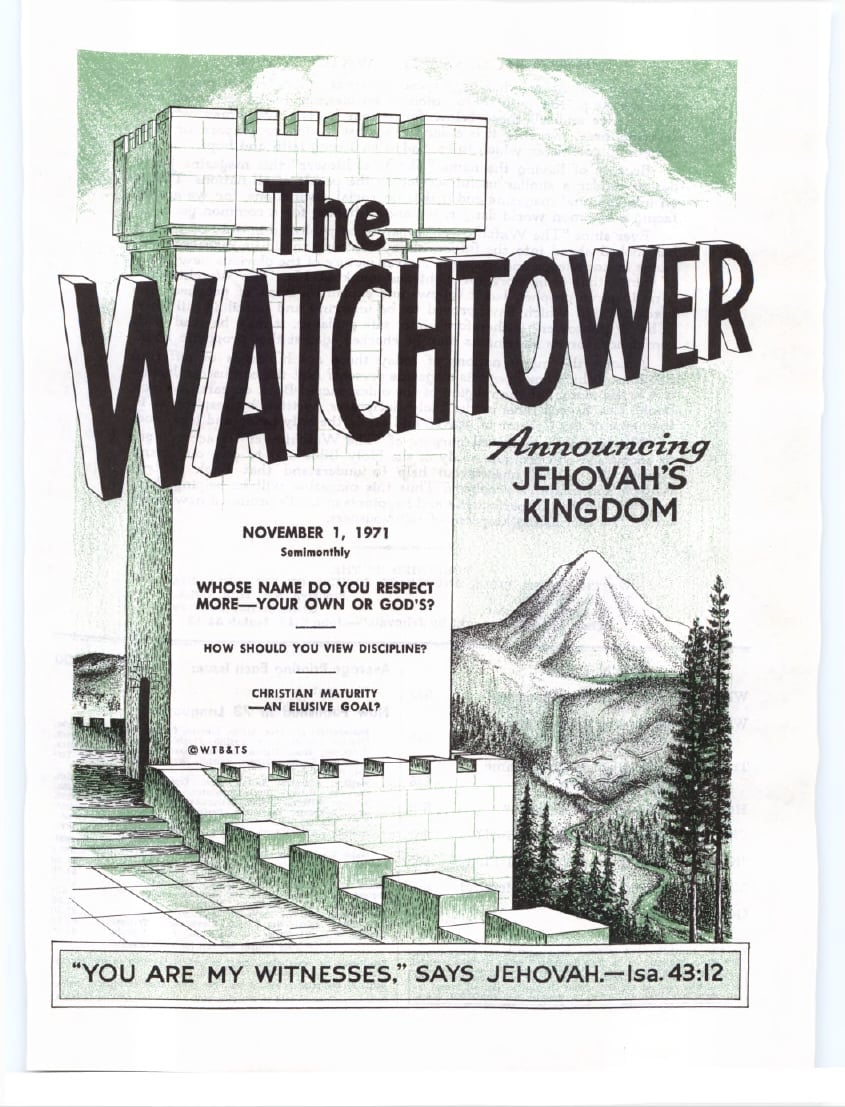
The Watchtower — November 1, 1971
Source: jw.org
Contents
What Is Going On in the Churches?
Whose Name Do You Respect More—Your Own or God’s?
The People Who Respect God’s Name More Than Their Own
How Should You View Discipline?
Christian Maturity—an Elusive Goal?
“Keep On Seeking, and You Will Find”
Missionaries Told to Be Loyal, Merciful
Questions From Readers
Christendom’s End Foretold
What Is Going On in the Churches?
What Is Going On in the Churches?
THE recent fighting between Catholics and Protestants in Ireland is just one facet of life in which the churches are in the limelight. In the news, too, is the apparent surge of interest of youths in religion—many of them caught up in what is called “The Jesus Revolution.”
The way the churches and their leaders are reacting to such happenings is often reflected in news reports.
CHURCH SERMONS
The titles of sermons at times mirror the world’s distress. For instance, subjects of church sermons recently advertised in the Boston “Globe” include: “Deliver Me from the Hand of My Brother,” and “A Liberal Religion for a Confused Age.”
Often sermon titles seem deliberately vague, causing one to wonder what they are about. In the Washington, D.C., area some subjects were: “The Persistent Cipher Is Incredible,” and “Stripped Bare.” What would you expect to hear in those sermons?
Other titles imply shortcomings of God, or even question the rightness of his dealings. A Washington, D.C., United Presbyterian church advertised: “God’s Great Nevertheless.” And a United Church of Christ in Cleveland, Ohio, announced in front of its place of meeting: “Lord, We Have Considerable Doubts About the Way You’re Running the Universe.”
CHURCH SERVICES
Despite talk of a decline in religious interest, some churches report large attendances. But is this necessarily evidence of spiritual strength? Consider the following news items:
In a syndicated column, AP religion writer George W. Cornell reported: “At the Clen-Moore United Presbyterian church in New Castle, Pa., the pastor, the Rev. Jack Heinsohn, sometimes puts on clown’s makeup and goes through acrobatics on a trampoline to get across points to younger members.”—“The Express,” Easton, Pa., July 10, 1971.
Equally strange are the goings-on in certain Baptist churches. People are invited to see ten inches of concrete broken “with Hand and Head.” Besides the use of karate, Baptist evangelist Mike Crain performs feats with samurai swords. “The News,” Frederick, Maryland, reports: “Rev. Crain demonstrated the full extent of his skills Sunday evening at People’s Baptist Church when he placed a watermelon on the stomach of David Gilbert, a congregation member, and, blindfolded, sliced the melon into two sections.”
Reporter Daryl Lembke notes that in San Francisco “there’s never a dull moment Sundays at Glide Memorial Methodist Church.” He explains that the church has sponsored various unorthodox events but that it “didn’t really achieve standing-room-only status until the summer of 1969. That’s when the paid choir and organist were let go and replaced by Meridian West [a jazz group]. About the same time, the chancel was cleared by removing the altar and the pulpit. Room had to be made for the band and the crowd that gyrates with it.”—Atlanta “Journal,” May 26, 1971.
These activities are not confined to Protestant groups. A heading in the Miami “Herald,” August 6, 1971, says: “PRAYER TO ROCK BEAT REACHES JEWISH FAITH.”
And the Chicago “Tribune” of August 1, 1971, observes: “Folk masses, like the one at St. Thomas the Apostle Church in Hyde Park, were unique not long ago. Today, because of the realization that survival means accommodating the young, they are a common occurrence.” The conservative Catholic paper “The Defender’s Trumpet” complains that the Mass “has been turned into a three-ring circus.”
Although such tactics may attract more people to church, the question may be asked: Is this really a sign of genuine spiritual strength?
CLERGY IN THE MILITARY
Especially reflected in the churches is the world’s division and disagreement on the issue of war. On one hand, thousands of Catholic, Protestant and Jewish clergy serve in the armed forces as chaplains, being endorsed by their various denominations. The United States currently has 1,704 chaplains in the Army, 1,129 in the Air Force and 994 in the Navy, and these also serve the Marine Corps. In all, there are some 30,000 active and inactive American chaplains, about 3,000 having thus far served in Vietnam.
Chaplains have the military rank of officer. And to illustrate that chaplains share much of their fellow officers’ support for the war efforts, the New York “Times,” June 22, 1971, observed:
“A convention in Washington last month of the Military Chaplains Association appeared at times to turn into a rally in support of the United States’ effort in Vietnam and against anti-war demonstrators and hippies.”
On the other hand, some clergymen are bitterly opposed to United States’ war efforts, and do all they can to disrupt them. For instance, recently three clergymen were captured when they tried to steal or destroy FBI documents and federal draft records in Camden, New Jersey. “Time” magazine, September 6, 1971, reported: “Among those apprehended were two Roman Catholic priests . . . [also] a Lutheran minister.”
POLITICAL INVOLVEMENT
The growing involvement of churches in political and social reform movements is a distinctive feature of today’s news.
The Los Angeles “Herald-Examiner,” July 24, 1971, said: “The Rev. Neil McLaughlin, a Baltimore priest indicted on charges that he plotted with others to kidnap presidential adviser Henry A. Kissinger as a tactic to support peace in Vietnam, says: ‘Priests and nuns must become more involved.’
“The Rev. Carl Lezak, a Chicago priest active in precinct politics, says: ‘You will see more priests in politics.’”
But in view of the serious problems within churches and the conflicting opinions of clergymen, one may well wonder why greater clergy involvement in politics should be expected to improve the workings of governments.
NEW ROLE OF WOMEN
In keeping with the Scriptural injunction not to “permit a woman to teach, or to exercise authority over a man,” women traditionally have not held positions of oversight in churches. (1 Tim. 2:12) But in more and more religious areas there is an abandoning of this position. As religion writer Richard Dalrymple observes:
“Altar boys in one Roman Catholic Church are now being replaced with girls . . . Lutherans have a woman minister . . . and next year a woman rabbi is expected to be ordained.
“Last month, Seattle peace activist Mrs. Marcus Rohlfs was elected president of the American Baptist Convention. When Mrs. Lois Stair was voted into the highest office of the United Presbyterian Church, Presbyterian moderator, she became the first woman to hold that post.”—Los Angeles “Herald-Examiner,” June 12, 1971.
There is no doubt that unusual things are going on in the churches. The real question, of course, is, What does God think about these attitudes and practices? Do they harmonize with his standards and so meet his approval? Have you read the Bible enough to know his mind on these matters? It would be worth your while to investigate.
Whose Name Do You Respect More—Your Own or God’s?
Whose Name Do You Respect More—Your Own or God’s?
“A name is to be chosen rather than abundant riches; favor is better than even silver and gold.”—Prov. 22:1.
1. With what proverb on a name are we asked regarding our agreement?
DO YOU agree with ancient King Solomon when he said that “a name is to be chosen rather than abundant riches”? Of course, he meant a favorable name, for in the parallel line of this proverb Solomon added: “Favor is better than even silver and gold.” (Prov. 22:1) Silver and gold are riches.
2. (a) How did King Solomon come to have both name and riches? (b) As to a choice between name and riches, what do we agree to be the wise choice, and why?
2 Many men try to gain abundant riches regardless of how it affects their name. Others try to protect their name by hiding the underhanded methods and crooked means by which they got their “abundant riches.” However, King Solomon had both name and riches, and that with honor. The God whom Solomon worshiped made him rich with silver and gold and other material possessions, just as his God promised to do, saying: “Also what you have not requested I will give you, both riches and glory, so that there will not have happened to be any among the kings like you, all your days.” (1 Ki. 3:13) When it comes to making a choice between a favorable name and abundant riches, the wise choice would be that of a favorable name. Human experience proves that to be so. Even we will agree that that is so, for the reason that we are self-respecting.
3, 4. (a) As regards our attitude toward our name, how do we image God, and why? (b) How did Solomon’s people learn the truth of what that Third Commandment says, and what does this prove to us?
3 Like almost everybody else, you respect your name. You should do so, for your name means you. Your Maker made you that way, with that quality of self-respect. In this regard we image Him, for he too has self-respect. He respects his own name. We have reason to appreciate this fact, for we remember the Ten Commandments that he gave to the people of King Solomon. In the Third Commandment thereof he said: “You must not take up the name of Jehovah your God in a worthless way, for Jehovah will not leave the one unpunished who takes up his name in a worthless way.”—Ex. 20:7.
4 It was in the year 1513 before our Common Era, in the days of the prophet Moses, that the God of King Solomon said that; and during their long history after they got that commandment, Solomon’s people learned in a hard way that God meant what he said. Their history proves that it does not do anyone good to take up God’s name “in a worthless way,” in a way that serves no good use, in a misuse of His name, in making a wrong use of His name.
5. How do we show that we respect our own name more than God’s, and why is it advisable for us to consider now the personal question about this matter of respect?
5 If we make wrong use of God’s name, using it as if it were something worthless, we make it plain that we do not respect the divine name. Then it must be that we respect our own personal name more than we respect that of God. Will our doing so work out in good for us? Will we go unpunished for this? Not according to what God stated in the Third Commandment. Although most people do not realize it, God’s name is involved with world affairs today. It is advisable for us to consider the question directed to each one of us, Do you respect your own name more than God’s? It is very urgent upon us to study over this question, for very soon now the world will pay the penalty for its disrespect toward God’s name. We would hardly want to suffer that penalty with the world.
6. (a) How did Solomon compare perfumed oil on a person and a good name? (b) How did Jacob feel about his name because of the massacre committed by Simeon and Levi?
6 When you are absent and your name is mentioned in the presence of someone else, what impression is the one using your name trying to create about you, or what image of you comes up in the mind of the hearer? You would like it to be favorable, would you not? You would not want your very name to stink, as if you were an offensive person. In ancient times perfumed oil on a person made his physical presence agreeable, sweet-smelling. Is the effect of the mention of your name like that? King Solomon thought so, for he said under inspiration from God: “A name is better than good oil.” (Eccl. 7:1) King Solomon’s ancestor, the thirteenth back, Jacob (Israel), felt that way about it. When his two sons, Simeon and Levi, carried out a massacre at the town of Shechem, Jacob rebuked them and said: “You have brought ostracism upon me in making me a stench to the inhabitants of the land.” (Gen. 34:25-30; compare 2 Samuel 10:6.) Jacob, whom the inhabitants of the land associated with his God, Jehovah, did not like to have his own name be made foul-smelling.
7. What odor have the clergy of Christendom made God’s name have, and why have they made no alteration about this?
7 No less would we like to have our name made foul-smelling among people by the way others spoke about us or acted toward us. We can realize, therefore, what God’s feelings are with regard to his own name. It has so happened that those who claim to be his closest friends on earth have brought the greatest reproach upon his name. The religious clergy of Christendom have made God’s name stink to the high heavens throughout the whole earth. They know, or should know by reason of their theological education, that the Holy Bible sets forth God’s name as being Jehovah. Over the centuries these clergymen have taught that this God of the Bible is a God who delights in eternal torture of his own creatures, that He prepared a place called “hell” filled with fire burning forever with brimstone (or sulphur), and that there he keeps alive sinful human souls after death to be tormented forever, without any relief. The clergy twist the meaning of things said in the Bible in order to teach this, and to this day they have never erased this teaching from their church creeds, thus declaring it to be absolutely false and a God-dishonoring, demon-inspired teaching. They do not want to admit to teaching lies.
8. For the sake of whose name do they let lies stand, and on the names of whom have they brought reproach?
8 For the sake of their own name the clergy prefer to let their lies against God stand. They not only bring God under reproach, but also bring reproach upon the Chief One of God’s family, his Son Jesus Christ, for they claim that Jesus Christ taught such lies in his heavenly Father’s name.
9. In what warfare do Christendom’s clergy implicate God, and how?
9 The clergy also connect up this God of the Bible with all their spilling of blood in violent wars. How? By praying to him to grant victory to their own nation as against the other nation, even putting on the belts of the soldier boys the words “God with us.” They have prayed the warriors of their nation into heaven by claiming that the soldiers dying on the battlefield for their political rulers have an immediate passport into heaven to be with God and Jesus Christ. It does not matter to the clergy whether their soldier boys prove to have fought for the losing side, and apparently the wrong side; they still go to heavenly bliss for having died under the blessing of their religious clergy who pray for them. Thus they picture Jehovah as a God that has backed up all this war and bloodshed committed by Christendom for the past sixteen centuries.
10. (a) Among whom have the clergy made God’s name to be foul-smelling, and has this been without concern on God’s part? (b) What did Jesus teach us to pray about that name, and how does violation thereof affect him?
10 No wonder that God’s name stinks in the nostrils of those who bitterly declare that “religion is the opium of the people,” yes, even in the nostrils of those hundreds of millions of people whom Christendom calls heathen or pagans in non-Christian lands! And then, are we to think that God takes no account of this, that he is dead and indifferent to this, that he has no feelings at all about this? How unrealistic for us to think so! How could so-called Christian people think so, who go to church and join with the clergyman and the congregation in the prayer that Jesus Christ taught, saying: “Our Father which art in heaven, Hallowed be thy name”? (Matt. 6:9, Authorized Version) Jesus Christ taught his followers to pray for the hallowing or sanctifying of his heavenly Father’s name, and not for the making of that holy name a universal stench. So, when people who profess to be his followers violate that prayer and pollute the name of his heavenly Father, are we to think that Jesus Christ has no feelings about the matter, that he has so little respect for his Father’s name as not to care? Not at all! For Jesus Christ respects his Father’s name above his own name.
THE QUESTION FOR PEOPLE WITH RELIGIOUS CONNECTIONS
11. What question should we respecters of God’s name ask about any religious denomination to which we may belong, and to escape community responsibility, what action must be taken?
11 We personally may not desire to show disrespect for God’s name, but, if we have any religious connection, the question for us to ask ourselves is: Do I belong to a religious denomination that disrespects and defames God’s name in these and other ways? Suppose that any of us do. Well, then, we should know the course for us to take if we respect God’s name. What? This, namely, to disengage ourselves from sharing in the community responsibility of such a religious denomination before the Bible God, who is jealous for his name.—Ezek. 39:25, AV.
12, 13. (a) Why are we and our personal name of little importance? (b) What does Psalm 148:11-13 tell all classes of people to do?
12 When we come to think about it, the personal name of each one of us human creatures is of comparatively little importance. We live imperfect lives for some few years, then we die and are soon forgotten by those who survive us. Or our name, even if it is preserved in memory by some means, finally fades in importance and potency. But is that the case with God’s name? Far from it! For, in Psalm one hundred and forty-eight, Ps 148 verses eleven through thirteen, the inspired songwriter addresses himself to “you kings of the earth and all you national groups, you princes and all you judges of the earth, you young men and also you virgins, you old men together with boys,” and then says:
13 “Let them praise the name of Jehovah, for his name alone is unreachably high. His dignity is above earth and heaven.”
14. (a) How have men tried to rival Jehovah in name and why with failure? (b) In whose days was a start made of calling on Jehovah’s name, and what world event reveals the true nature of that?
14 The dignity of this Bible God, Jehovah, his worthiness, his respectability, his importance—all these things tower heaven-high above the earth. Not a single human creature on earth, no matter how famous he has made himself in human history, has elevated his name and fame above that of this God or even as high as God’s name. No creature in heaven and earth can exalt his name as high as that of Jehovah, for “his name alone is unreachably high.” Yes, “his name only is supreme.” (Ps. 148:13, New World Translation; Moffatt) It is true that men have disrespectfully striven to put their name on a level with Jehovah or even above that name. For instance, just some two hundred and thirty-five years after the first man was created, his sinful descendants began to misuse the divine name. One of Adam’s grandsons was named Enosh, and concerning his days the record in Genesis 4:26 says: “At that time a start was made of calling on the name of Jehovah.” This was in a hypocritical or sacrilegious way. That was why, 1,656 years after man’s creation, the global deluge came, in Noah’s day, and destroyed them all.
15, 16. (a) How did Nimrod elevate his rank among his admirers and followers, and what about God’s viewpoint of him? (b) How did a late successor of Nimrod on Babylon’s throne express his ambitions against Jehovah?
15 Then, too, there was the thirteenth man in line of descent from Adam. This man was named Nimrod. He made himself so prominent that he was ranked as someone with whom to be compared. Genesis 10:8-10 says of this great-grandson of Noah: “He began to be a mighty one in the earth. He was a mighty hunter before Jehovah: wherefore it is said, Like Nimrod a mighty hunter before Jehovah. And the beginning of his kingdom was Babel [Babylon].” (American Standard Version) Does that mean that he was a “mighty hunter” from Jehovah’s standpoint and in Jehovah’s favor? No! For his hunting was directed also against human prey and so extended itself to military campaigning that results in shedding human blood. The New World Translation of the Holy Scriptures presents the matter in the right, Scriptural light, by rendering the account: “Just like Nimrod a mighty hunter in opposition to Jehovah.” Nimrod showed no respect for the name of the only living and true God; Nimrod’s name bedimmed the name of Jehovah in the minds of his admirers and followers. Fifteen centuries later a successor of Nimrod on Babylon’s throne said:
16 “To the heavens shall go up. Above the stars of God I shall lift up my throne, and I shall sit down upon the mountain of meeting, in the remotest parts of the north. I shall go up above the high places of the clouds; I shall make myself resemble the Most High.”—Isa. 14:4, 13, 14.
17, 18. (a) How did Jehovah’s name prove to be unreachably high for Nimrod and his royal successors? (b) How does Psalm 126:1-3, show how a favorable impression concerning Jehovah’s name was made among the nations?
17 However, the name of Jehovah proved to be unreachably high for the hunter-king of Babylon, Nimrod, and his successors. In the year 539 before our Common Era the line of Nimrod’s successors was overthrown when the imperial city of Babylon fell to the Medes and Persians. Less than two years later, in 537 B.C.E., the name of Jehovah went up when His spirit moved the Persian conqueror, Cyrus the Great, to issue the famous decree authorizing the exiled people of Jehovah to return to their homeland and rebuild the temple of Jehovah at Jerusalem. (2 Chron. 36:19-23; Ezra 1:1-11) Almost too good to be true, this seemed like a dream to the exiled Jews or Israelites, but it made an impression upon the Gentile nations that was favorable to Jehovah. Psalm 126:1-3 beautifully sets this forth, saying:
18 “When Jehovah gathered back the captive ones of Zion, we became like those who were dreaming. At that time our mouth came to be filled with laughter, and our tongue with a joyful cry. At that time they proceeded to say among the nations: ‘Jehovah has done a great thing in what he has done with them.’ Jehovah has done a great thing in what he has done with us. We have become joyful.”
19. By their trinity doctrine, how do the clergy not give glory to Jehovah as God, but, rather, downgrade his name?
19 Today the clergy of Christendom do not give glory to Jehovah as God. They have shoved his name into a corner. By their teaching of a trinity composed of a God the Father and God the Son and God the Holy Ghost, they have made Jehovah’s Son Jesus Christ equal with Him the Father, and also the “Holy Ghost” equal with Jehovah who pours out this holy spirit. To suit their religious purposes the clergy have put the designation Jesus Christ to the fore. Look into your copy of the King James Version of the Bible and see how many times you can find the divine name, Jehovah. Look into the Revised Standard Version of the Holy Bible, of the year 1952, and see whether you can find the name Jehovah at all. Look into The New American Bible, published by Roman Catholics in 1970, as well as into the Douay Version Bible of 1610, and see whether you can find the name Jehovah (or even Yahweh) in the Bible text. The claim is made that when the New Testament writers called Jesus Christ Lord or the Lord, this meant that he was Jehovah or Yahweh himself. Certainly all this is a downgrading of God’s name.
20. What does the apostle Paul say about the Son of God in Philippians 2:5-11?
20 What, though, does the Christian apostle Paul say? He describes the humbling of the Son of God and then the glorification of his faithful Son, saying, according to The New English Bible, of 1970: “Let your bearing towards one another arise out of your life in Christ Jesus. For the divine nature was his from the first; yet he did not think to snatch at equality with God, but made himself nothing, assuming the nature of a slave. Bearing the human likeness, revealed in human shape, he humbled himself, and in obedience accepted even death—death on a cross. Therefore God raised him to the heights and bestowed on him the name above all names, that at the name of Jesus every knee should bow—in heaven, on earth, and in the depths—and every tongue confess, ‘Jesus Christ is Lord’, to the glory of God the Father.”—Phil. 2:5-11.
21. (a) How does that statement show that Jehovah’s name remains unreachably high? (b) To what extent do we Christians show respect toward Jehovah’s name?
21 From this inspired statement we see that God the Father rewarded his Son Jesus Christ with a name above that of all other sons of God or creatures of God. Hence all other creatures must recognize that exalted name and bow at it. But to whose glory must they do this? To the glory of the highly exalted Jesus Christ? No! But, as the apostle Paul says, “To the glory of God the Father.” The highly exalted Jesus Christ is called “Lord,” but he is not called God nor is he called Father, for always he remains the Son of God. The rank and title of “God the Father” always remain with Jehovah. He did not give his heavenly Son a name higher than His own nor a name even equal to His own. His name remains supreme, unreachably high. Jesus Christ in heaven recognizes it as such. So in the name of the Lord Jesus Christ we Christians still pray to Jehovah God: “Our Father which art in heaven, Hallowed be thy name.” (Matt. 6:9, AV) We do not misuse that name but respect it as the highest name in all existence. We separate ourselves from all religions that defame God’s name.
WHEN HE WENT TO MAKE A NAME FOR HIMSELF
22, 23. (a) Should the divine name go out of respectful use, and why should we never take Pharaoh’s attitude toward it? (b) How did God specially claim the name when first appearing to Moses?
22 The original divine name has not passed out of fashion and it should not pass out of use in a respectful way. We should never let ourselves get like the ruler Pharaoh of ancient Egypt and oppose that name and get stubborn toward it as when he said: “Who is Jehovah, that I should hearken unto his voice to let Israel go? I know not Jehovah, and moreover I will not let Israel go.” (Ex. 5:1, 2, AS) Refusal to recognize Jehovah got Pharaoh nowhere—except into destruction in the Red Sea. The Most High God specially claimed the name when he sent his prophet Moses to appear before Pharaoh and demand that the enslaved people of Israel be let go that they might take possession of the Promised Land. By the use of an angel God manifested himself to Moses the Israelite at the foot of Mount Horeb (or Sinai) in the Arabian Peninsula. On being told to go back to Egypt, Moses inquired as to what he should announce as the name of the God who was sending him. From The New English Bible, of 1970, we now read the answer:
23 “God answered, ‘I AM; that is who I am. Tell them that I AM has sent you to them.’ And God said further, ‘You must tell the Israelites this, that it is JEHOVAH the God of their forefathers, the God of Abraham, the God of Isaac, the God of Jacob, who has sent you to them. This is my name for ever; this is my title in every generation. Go and assemble the elders of Israel and tell them that JEHOVAH the God of their forefathers, the God of Abraham, Isaac and Jacob, has appeared to you.’”—Ex. 3:13-16.
24. (a) Why, then, have Christians no right to change matters respecting God’s name? (b) What action was appropriate as taken by dedicated, baptized Christians met in general convention in 1931?
24 Since he said that Jehovah is his name forever and is his title in every generation, it is his name and title today, in our generation. We, even as Christians, have no right to change that. “Jehovah” is his Memorial name, according to the American Standard Version Bible, which does not use the word “title” but says: “This is my name for ever, and this is my memorial unto all generations.” (Ex. 3:15, AS) It was his memorial in the very first generation of mankind, for in the second chapter of the Holy Bible and in the fourth verse we read these words: “These are the generations of the heavens and of the earth when they were created, in the day that Jehovah God made earth and heaven.” (Gen. 2:4, AS) As a memorial it is his name by which to be remembered forever, in all generations. Was it out of order, therefore, when thousands of dedicated, baptized Christians, when met together in general convention in Columbus, Ohio, on Sunday, July 26, 1931, embraced the Scriptural name, Jehovah’s witnesses? No; it was most fitting.
25. (a) In 1925 these Christians began to perceive that the time had come for what action on God’s part? (b) Appropriate to this, what did the January 1, 1926, issue of The Watch Tower say in its leading article?
25 Already, back in the year 1925, the Christians embracing that designation for themselves had begun to perceive that the time had come for the one true and living God to “make him a name.” (2 Sam. 7:23, AV) Quite appropriately, then, in the Watch Tower issue of January 1, 1926, the leading article was entitled “Who Will Honor Jehovah?” On page 7, under the subheading entitled “Himself a Name,” paragraphs 37 and 38 said:
“The natural descendants of faithful Abraham were domiciled in Egypt. The name of God was then ignored, and was not in the thoughts of the people of that nation nor of any other nation of the world. David records the fact that God went down to Egypt to deliver his people and to make a name for himself. (2 Samuel 7:23) Now a like condition exists. Those who are of the faith of Abraham are domiciled in this wicked world, all the organizations of which have forsaken God and have defamed his holy name.
“The time approaches when God will make for himself a name. God will have somebody to be his witnesses in the earth. And who could we expect would have the privilege of filling that place? Surely none other than Zion, God’s organization, some members of which are on earth. To such Jehovah says: ‘Ye are my witnesses, saith the Lord, and my servant whom I have chosen; that ye may know and believe me, and understand that I am he: before me there was no God formed, neither shall there be after me. I, even I, am the Lord; and beside me there is no saviour. I have declared, and have saved, and I have shewed, when there was no strange god among you: therefore ye are my witnesses, saith the Lord, that I am God.’—Isaiah 43:10-12.” [Authorized Version]
26, 27. The prophet Isaiah foresaw the need for what repeat performance, and so what did he write in Isaiah 63:11-14?
26 In addition to what King David of Jerusalem said regarding God’s making a name for himself at the time that he delivered his chosen people of Israel from slavery in ancient Egypt, the later prophet Isaiah foresaw the time for Jehovah to repeat this performance by delivering his chosen people from their dire straits. The same God is to be looked for in behalf of this deliverance, and so the prophet Isaiah goes on to say (in Isaiah 63:11-14):
27 “And one began to remember the days of long ago, Moses his servant: ‘Where is the One that brought them up out of the sea with the shepherds of his flock? Where is the One that put within him His own holy spirit? The One making His beautiful arm go at the right hand of Moses; the One splitting the waters from before them in order to make an indefinitely lasting name for his own self; the One making them walk through the surging waters so that, like a horse in the wilderness, they did not stumble? Just as when a beast itself goes down into the valley plain, the very spirit of Jehovah proceeded to make them rest.’ Thus you led your people in order to make a beautiful name for your own self.”
28. At the time of Israel’s deliverance, who in Egypt came to fear the divine name, and what action did they take, with what experiences resulting to them?
28 At the time of Israel’s deliverance from Egypt, so many of the non-Israelite people in that land came to fear the divine name, that they took appropriate action. How? Well, when the Israelites marched out of Egypt after celebrating their first Passover, then, as the record in Exodus 12:38 says, “a vast mixed company also went up with them.” When God parted the waters of the Red Sea, this mixed company marched through with the Israelites. And when God brought the seawaters back upon the pursuing horses, chariots and horsemen of Pharaoh, and drowned these bloodthirsty pursuers, this mixed company heard the Israelites sing in safety on the shore of the Sinai Peninsula: “Jehovah is a manly person of war. Jehovah is his name. . . . Jehovah will rule as king to time indefinite, even forever.”—Ex. 14:31–15:18.
29. What has happened to the effect of the impact that Jehovah’s miracle made upon the nations then, and what did the Israelites come under the obligation to be and to do?
29 The terrific impact that that stupendous miracle made upon the nations back there in that year 1513 before our Common Era has since lost its stunning effect. The name that Jehovah made for himself back there, so long ago, has little appeal for the nations today, even for the so-called Christian nations of Christendom. They neither fear it nor respect it. Christendom has lapsed into a condition like that of ancient Egypt, the oppressor of the people of Jehovah. (Rev. 11:8) Those natural Israelites away back there were actually eyewitnesses of what Jehovah did and they were made to know and appreciate his name as their faithful forefathers never had done. (Ex. 6:2, 3) By force of circumstances they were witnesses of Jehovah, and they were therefore obligated to bear witness to future generations about Jehovah’s name and deeds. Through the prophet Isaiah Jehovah plainly told them that they were his witnesses. They should have respected the name that Jehovah made for himself and should have lived up to their obligations to be witnesses of Him as the only living and true God. A similar status holds true for Christendom today.
30. Why is Christendom today under obligation to be witnesses for the same God of ancient natural Israel?
30 Today, as well as for centuries past, Christendom claims to be a spiritual Israel, a Christian Israel. Inescapably, then, her God must be the God of ancient natural Israel. So, just as much as natural Israel of old, Christendom is under obligation to be witnesses of that same God of ancient Israel, who is at the same time the God of the Messiah, Jesus, the Son of God. Being a witness for Jesus the Messiah or Christ does not excuse one from being also a witness for Jehovah, and that primarily.—Acts 1:8; 5:27-32.
31. According to what Christendom and her churches do and say today, the time has come for God to do what, and this will bespeak what for modern-day peoples and nations?
31 But look at the nations of Christendom and their churches. Listen to what they are saying. In the light of the Holy Bible, examine what they are doing. Where do the facts show that these nations and churches of Christendom are witnesses of Jehovah? The bald facts plainly indicate that, once again, the time has come for Jehovah to make a name for himself before all nations and peoples who proudly and stubbornly refuse to acknowledge, respect and fear his divine name. The historic example of Pharaoh and his military forces at the Red Sea bespeaks disaster for such modern-day nations and peoples when Jehovah again makes a name for himself in the coming “war of the great day of God the Almighty” at Har–Magedon!—Rev. 16:14-16; 19:11-21.
32. Do all the nations of today have good reason not to know of all this, and what is it that the antagonistic disputants in Christendom cannot wipe out regarding Jehovah’s Christian witnesses?
32 By now, in this year 1971, do all the nations have good reason not to know of all this? Due to the failure of Christendom with her more than nine hundred million enrolled church members, has Jehovah failed to have his faithful, outspoken witnesses in this twentieth century, in our very own generation? Absolutely No! The church-bound peoples of Christendom may dispute that those internationally known as Jehovah’s Christian witnesses today are really witnesses of the Most High God. They may say that these have no right to that name and are false prophets. They may accordingly oppose, misrepresent and persecute them so as to force them to stop doing the witness work all around the globe. But those antagonistic peoples of Christendom as well as those of so-called heathendom can never wipe out the record that these Christian witnesses of Jehovah of this twentieth century have made in more than two hundred lands and in some one hundred and sixty languages.
33. So what are the opposing peoples of all Christendom obliged to admit respecting the work of Jehovah’s witnesses, and why has this been so?
33 They can never disprove that God’s name as set out thousands of times in the real text of the Holy Bible has been made known to the people world wide and that hundreds of thousands of persons of all races, nationalities, tribes and social groups have been helped to know and fear and serve Jehovah, the God and Father of the Lord Jesus Christ. This is something that false prophets could never accomplish. (Deut. 18:15-22) Yes, those opposing peoples of all Christendom are obliged to admit that they have failed to stop the worldwide preaching and teaching on the part of these Christian witnesses of Jehovah till now. Why is this? It is because they have refused to heed the legal counsel that the religious lawyer Gamaliel gave to the first-century opposers of Jehovah’s Christian witnesses back there, when he said: “I say to you, Do not meddle with these men, but let them alone; (because, if this scheme or this work is from men, it will be overthrown; but if it is from God, you will not be able to overthrow them;) otherwise, you may perhaps be found fighters actually against God.”—Acts 5:34-39.
“PEOPLE FOR HIS NAME”
34. In that first century C.E., what happened to those meddlers with apostolic Christianity, and why has that raised a question as to the existence of Jehovah?
34 What became of those who meddled with those first-century Christian apostles and fellow believers? In the year 70 of our Common Era, instead of having overthrown apostolic Christianity, their own religious system was overthrown when old walled Jerusalem and her temple were destroyed, never to be rebuilt by Jewish hands. Their priesthood ceased to exist or maintain its identity. Let the facts speak as to whether those intolerant religious meddlers were “fighters actually against God.” That tragic event of the year 70 C.E. by no means meant that Jehovah ceased to exist, as if he were a God of the Israelites only, a national God that existed only as long as his historic nation existed. The immortal Jehovah, who is God without beginning and without end, has lived on, and still lives, despite the denials of all atheists. But, because of what happened in the year 70, has he since been without a nation?
35. Why was the ancient nation of Israel a “people for his name,” and why is there a problem as to their being Jehovah’s “people for his name” today?
35 It is a fact that, in the year 1473 B.C.E., when the prophet Moses was giving his farewell instructions to the nation of Israel before they crossed the Jordan River into the Promised Land, he said to them: “Jehovah will establish you as a holy people to himself, just as he swore to you, because you continue to keep the commandments of Jehovah your God, and you have walked in his ways. And all the peoples of the earth will have to see that Jehovah’s name has been called upon you, and they will indeed be afraid of you.” (Deut. 28:9, 10) As Jehovah said to them, they had “become my special property out of all other peoples.” (Ex. 19:3-5) Through having His name called upon them, they were a “people for his name.” (Jer. 14:9; Dan. 9:19) But have the people of Israel continued to be a “people for his name” to this day? Has the setting up of the independent, untheocratic Republic of Israel in 1948 C.E. confirmed them as the “people for his name,” even though they do not keep the law of Moses and have no temple at Jerusalem that is called by the name of Jehovah? It is important for us to know.
36. Was Jesus a member of Jehovah’s “people for his name,” and how did Jehovah show his decision as to whether His name should be transferred from natural Israel?
36 The first century of our Common Era was the critical time for determining this question. Certainly Jesus Christ, born in Bethlehem-Judah in the family line of King David, was by birth a member of the “people for [Jehovah’s] name.” His very name Jesus includes the divine name, for it means “Jehovah Is Salvation.” But Jesus’ own nation disowned him. As for his followers, who were a small remnant of the Israelites, they became separated from the nation of Israel, and they became a spiritual nation. Under this situation, did the nation of natural, circumcised Israel continue to be the “people for his name” (Jehovah’s name), or was Jehovah’s name transferred and called upon the spiritual nation of Jesus’ followers? God himself decided the answer to this problem. On the day of Pentecost of the year 33 C.E. he poured out his holy spirit in fulfillment of His prophecy in Joel 2:28-32. Upon whom? Not upon the non-Christian Jews at the then-standing temple in Jerusalem, but upon the twelve apostles and other disciples of Jesus. Filled with spirit, they proclaimed God’s name.—Acts 2:1-36.
37, 38. (a) How many Jews became a part of Jehovah’s new “people for his name”? (b) When did Jehovah open the door for non-Jews to be added to this “people for his name”?
37 There, more than nineteen centuries ago, Jehovah began taking out a new people upon whom his name should be called or who are called by his name. (1 Pet. 2:9) Thousands of natural, circumcised Jews accepted Jesus as Messiah and became part of this “people for [Jehovah’s] name.” Not quite three and a half years later, Jehovah. God opened up the opportunity to the non-Jewish or Gentile nations. He sent the apostle Peter to enter a Gentile home in Caesarea and to proclaim the good news about Jesus the Messiah to Cornelius and his friends. Because of their belief, Jehovah poured out his holy spirit upon them. Thereby he made these believing Gentiles a part of the “people for his name.” Thereafter membership in this spiritual “people for his name” was open to all non-Israelite or Gentile nations. (Acts 10:1 to 11:18) This is true, not because we say so, but because the inspired disciple James, the half brother of Jesus Christ, said so. This was about thirteen years after the conversion of Gentile Cornelius and his friends. Speaking before a conference in Jerusalem, James said:
38 “Symeon [Peter] has related thoroughly how God for the first time turned his attention to the nations to take out of them a people for his name. And with this the words of the Prophets agree, just as it is written, ‘After these things I shall return and rebuild the booth of David . . . in order that those who remain of the men may earnestly seek Jehovah, together with people of all the nations, people who are called by my name, says Jehovah, who is doing these things.’”—Acts 15:12-18; Amos 9:12.
39. (a) Why has Jehovah not ceased to have a “people for his name” since Jerusalem’s destruction in 70 C.E.? (b) What is Jehovah completing today that he began nineteen centuries ago, and what proof thereof do we have?
39 Consequently, Jehovah did not cease to have a “people for his name” after the destruction of old walled Jerusalem and its temple in the year 70 C.E. and the dispersion of the natural circumcised Jews. He had the newly formed Christian “people for his name.” What Jehovah began back there in the first century, he is finishing up today in this twentieth century. Now, before the outbreak of the greatest tribulation of all human history upon this system of things, he is completing this spiritual “people for his name,” and today there is still a remnant of them on earth. If this is not so, then how can we account for what is now taking place on all inhabited continents and the islands of the seven seas? What? The name Jehovah is being made known and exalted on a scale never before realized since tremendous reproach was brought upon the divine name by the destruction of Jerusalem and its famous temple in the year 70 C.E. Let there be no mistake about it: Jehovah has his “people for his name” on earth today, and they are proving themselves to be just that, even if they are only a remnant.
[Picture on page 648]
Do the teachings and practices of your church glorify the name of God? Does it teach hellfire, the Trinity? Has it ever shared in blessing the wars of your nation?
[Picture on page 651]
Showing respect for the Divine Name, thousands of Christians at this assembly in Columbus, Ohio, July 1931, embraced the name “Jehovah’s Witnesses”
[Picture on page 653]
Just as Jehovah made a great name for himself at the Red Sea, he will again make a name for himself at the coming war of Armageddon
The People Who Respect God’s Name More Than Their Own
The People Who Respect God’s Name More Than Their Own
1, 2. (a) This is a day of religious liberation from what? (b) What does Isaiah 12:3-5 declare, and who take those words to heart so as to carry them out?
WHAT is to be expected, what should we expect, of a “people for his name”? Why, this: That they would consider it an honor to bear that name, they would not be ashamed of that name, they would sound forth the praises of that name in all the earth, both inside of Christendom and outside of Christendom. In these “last days” of this world system, when religious liberation is being gained from Christendom and all the rest of the world empire of false religion, the liberated remnant take to heart their obligation to carry out the prophetic words of Isaiah 12:3-5:
2 “With exultation you people will be certain to draw water out of the springs of salvation. And in that day you will certainly say: ‘Give thanks to Jehovah, you people! Call upon his name. Make known among the peoples his dealings. Make mention that his name is put on high. Make melody to Jehovah, for he has done surpassingly. This is made known in all the earth.’”
3, 4. (a) Since the anointed remnant began taking part in the fulfillment of that prophecy, how has Jehovah done? (b) How has the result been just like what David mentioned as the reason for his lauding Jehovah, in Psalm 138:1, 2?
3 Since the anointed remnant of Christian witnesses of Jehovah have put themselves to work to have a part in the fulfillment of that prophecy, Jehovah has “done surpassingly,” he has done splendidly, he has triumphed! Over his own name he caused his word of promise, his prophetic word, to be written down. With his name he backs up the Holy Scriptures. With his own name he guarantees the Sacred Bible. Either the Bible is true, or his name means nothing! But his word of promise and of prophecy stands proved true, stands vindicated! The faithful carrying out of his word proves that he has lived up to his name, to the glory of his name. Furthermore, in his actually carrying out his word he has surpassed what his name, which was attached to his word, has led us to expect. The result has been just like what King David of Jerusalem mentioned as a reason for his lauding Jehovah, saying:
4 “I shall laud you with all my heart. In front of other gods I shall make melody to you. I shall bow down toward your holy temple, and I shall laud your name, because of your loving-kindness and because of your trueness. For you have magnified your saying [your spoken word] even above all your name.”—Ps. 138:1, 2.
5, 6. (a) How does Jehovah magnify his saying above all his name? (b) How can we illustrate this in the case of prophecy and in the case of providing the Messiah?
5 What is this that David is saying? Is God’s spoken word or saying greater than his name? No! Well, how, then, does he magnify his saying above all his name? In this way: His meaningful name, because of being attached to his “saying” or word of promise and of prophecy, caused us to look for much in the way of fulfillment. But actually he carries out his “saying” in a magnified way, in a way that is grander than what the guarantee of his name leads us to expect. He did not need to do so much in order to prove to us that his name is reliable as a guarantee of fulfillment.
6 So he magnifies his “saying” by making the carrying out of it produce more than we anticipated. He does surpassingly! For example, in many vital cases his prophetic “saying” has proved to have, not just a primary literal fulfillment, but also a miniature spiritual fulfillment and even a major, complete spiritual fulfillment. Note, too, that he gave his “saying” or word of promise to bring forth the Messiah in King David’s line of descent. But actually he magnified that promissory “saying.” How? By giving more than a mere human Messiah in David’s royal family. Jehovah brought forth a spiritual Messiah, one begotten by Jehovah’s spirit, raised from the dead and exalted to immortal life and royal glory in heaven at God’s right hand. As Jehovah delivered David from his enemies, so he delivered Jesus Christ from his earthly enemies, who had put him to death, by resurrecting him from the dead to heavenly glory.—Ps. 138:3-7.
7. How did Jehovah complete that which was in David’s behalf, and how does He do this respecting David’s descendant, Jesus?
7 Jehovah left nothing more for David to expect as respects the carrying out of the divine word of promise. Right well David could confidently say, in the same psalm: “Jehovah himself will complete what is in my behalf.” (Ps. 138:8) No less so, Jesus Christ the Messianic descendant of King David can say the same for himself. Jehovah will fully accomplish his purpose for Jesus the Messiah. He will leave nothing of his word of promise and of prophecy respecting him undone. No wonder that David was moved to say to his heavenly Deliverer, Jehovah: “In front of other gods I shall make melody to you. . . . For you have magnified your saying even above all your name.”—Ps. 138:1, 2.
MAGNIFYING HIS “SAYING” ABOUT THE “GREAT CROWD”
8. How is the anointed remnant moved to laud Jehovah for the same reason as stated by David, because of what has happened since 1914 C.E.?
8 Are we today moved to say anything like this to the only living and true God? The anointed remnant of Jehovah’s Christian witnesses are moved to do so, as a “people for his name.” By his very dealings with them and by the marvelous fulfillments of Bible prophecy in world events since 1914 C.E., they see Jehovah’s saying his word of promise and of prophecy, coming true in a way that they had never expected to experience. They see the evidences multiplying to prove that, at the close of the Gentile Times in 1914 C.E., this God of loving-kindness and trueness fulfilled his “saying” and established the heavenly kingdom of the Son of David, Jesus Christ. They see how this Messianic kingdom is moving irresistibly forward to the vindication of Jehovah’s universal sovereignty and holy name in the approaching “war of the great day of God the Almighty.” Much persecution, yes, many threats against their very existence as a “people for his name” they have had to endure since 1914 C.E., but, because Jehovah has delivered and preserved them till now, they make known his name everywhere.
9. As depicted in Revelation, chapter fifteen, what song are the anointed remnant singing, with what words?
9 As depicted in the last book of God’s Holy Word, this anointed remnant are singing the “song of Moses the slave of God and the song of the Lamb [Jesus Christ]” and saying: “Great and wonderful are your works, Jehovah God, the Almighty. Righteous and true are your ways, King of eternity. Who will not really fear you, Jehovah, and glorify your name, because you alone are loyal? For all the nations will come and worship before you, because your righteous decrees have been made manifest.”—Rev. 15:2-4.
10. Who among the countless hearers of that song are responding affirmatively to the question as to fearing Jehovah and glorifying his name, and with what determination?
10 Countless numbers of people today are hearing the remnant of the “people for his name” singing those words: “Who will not really fear you, Jehovah, and glorify your name?” Hundreds of thousands who are hearing that challenging question are showing that they feel about it as the anointed remnant do, namely, that Jehovah is worthy of being feared and his name worthy of being glorified. Openly, before all the false gods of this world, they are saying: The majority of mankind may not today fear Jehovah and glorify his name; but, as for us, we will fear Jehovah as the one living and true God, and we will respect his name more than our own and will glorify his name. How are they doing this?
11. How are such ones doing that?
11 They are doing this by accepting the Holy Bible, not as the word of fallible men, but, just as it actually is, the word of God. They believe that its prophecies concerning the Messianic kingdom are now reaching the climax of their glorious fulfillment. They are approaching God through his sacrificed Lamb Jesus Christ and are dedicating themselves entirely to him. In imitation of Jesus Christ they are being baptized in water “in the name of the Father and of the Son and of the holy spirit,” and thus becoming full disciples of Jesus Christ. (Matt. 28:19, 20) Recognizing that Jehovah has a “people for his name” today in the earth, they loyally associate themselves with this people, even though it is a small remnant. They share with these in making known to everybody Jehovah’s name and in glorifying it. By thus witnessing to Him, they prove that they are not ashamed to be Christian witnesses of Jehovah.
12. (a) Hence, what portion of the words of the “song” do the anointed remnant already see undergoing fulfillment? (b) What kind of person will yet take his place among the “great crowd,” and in what hope may he share?
12 From all nations this “great crowd” of God-fearing persons has come. (Rev. 7:9, 10) In these the anointed remnant of singers see already undergoing fulfillment the words of their prophetic song: “All the nations will come and worship before you, because your righteous decrees have been made manifest.” (Rev. 15:4) The gathering of all of this numberless “great crowd” is not yet over. The question is, Who will yet be taking his place among this “great crowd” before Jehovah fully manifests his righteous decrees by destroying all the godless in the coming “great tribulation,” the like of which has never taken place before? Everyone who does so will be a person that respects God’s name more than his own. He will be one that gladly does as Psalm 96:8 says: “Ascribe to Jehovah the glory belonging to his name.” He may share with the “great crowd” in the hope of surviving the “great tribulation” and entering into the righteous new system of things where “every breathing thing” will praise Jehovah.—Rev. 7:13-15; Ps. 150:6; 29:2.
How Should You View Discipline?
How Should You View Discipline?
YOU probably have known someone—maybe a fellow student, a neighbor, or even a teacher—who never wanted to admit to making a mistake or being wrong. How do you feel personally about someone like that? Would your opinion of him go up or down if one day he came right out and said, “I’m sorry; I see I was wrong”?
Really, we all make mistakes, do we not? That is because none of us are perfect, or faultless, in the full sense of the word. The Bible tells us that. It shows that, due to our first parent Adam’s disobedience, all men are born with an inheritance of imperfection, sin.—Rom. 5:12.
Not all mistakes come from just ‘not knowing.’ Many mistakes are because of not caring. For example, on an airplane flight over water a passenger might pay no attention when the stewardess explains the proper use of life jackets or the plane’s oxygen supplies. If, during a sudden emergency, the passenger failed to use these provisions and lost his life, it would not be simply because he did not know. It would be because he did not care to know.
So not all wrongs a person commits can be chalked up to simple error. Willful ignorance is often the cause. Worse, a person may do what he knows is wrong—excusing himself for some reason or other that looks good to him at the time.
All this shows our need for discipline, which involves correction. We all need correction, no matter whether we are young or old. In fact, if there were no discipline or correction there could be no progress—in any field of human living. People would keep on making the same mistakes, believing the same wrong ideas, never advancing in knowledge or ability.
Discipline means more than just instruction. It is training that corrects, molds, strengthens, or perfects. So, it often involves reproof; it can include punishment or chastisement, though this does not have to be the case. But it is never punishment just for the sake of punishment—it is always done with a view to correction and improvement for the future.
WHY HARD TO TAKE
But if discipline is so beneficial, why do most persons find it so hard to take? The same cause that makes us need discipline, namely, imperfection, also makes it hard for us to accept it.
Discipline can cause us to feel embarrassed, hurt or discouraged. The Bible recognizes that discipline does bring some unpleasantness. The apostle Paul writes: “True, no discipline seems for the present to be joyous, but grievous; yet afterward to those who have been trained by it it yields peaceable fruit, namely, righteousness.”—Heb. 12:11.
Humility takes most of the sting out of discipline. Many persons, however, let pride and stubbornness cause them to resist discipline. But when the correction or reproof is well founded, and others can see that it is, the person who stubbornly rejects it simply makes himself look foolish in the eyes of those observing. Some politicians are like this, trying to “weasel out” of responsibility for false or rash statements made, or wrong deeds committed. But who wants to have a reputation like theirs? God’s Word says: Wisdom and discipline are what mere fools have despised.”—Prov. 1:7.
By contrast, we read: “Give a reproof to a wise person and he will love you.” Why? Because he knows that through correction “he will become still wiser.” Yes, “a wise person will listen and take in more instruction, and a man of understanding is the one who acquires skillful direction.”—Prov. 9:8, 9; 1:5.
HOW WILL YOU REACT?
The real question, then, is: What do you want to do with your life? Do you just want to drift along, doing only what you feel like doing? Or are you willing to work toward a worthwhile future? God’s Word advises: “Listen to counsel and accept discipline, in order that you may become wise in your future.”—Prov. 19:20.
We can find discipline more pleasant if we always remember that it is God’s arrangement. That is why Psalm 50:17 says that anyone who hates discipline is, in effect, ‘throwing God’s words behind him.’ Discipline rightly comes from an authorized source. God has assigned that job to parents, for they are responsible for their children’s lives. (Prov. 1:8, 9; Eph. 6:4) And, within the Christian congregation, God has provided spiritually “older men” who are “able both to exhort by the teaching that is healthful and to reprove those who contradict.”—Titus 1:5-9.
Remember, too, that those disciplining us are not trying to “hobble” us so that we are cramped in walking life’s highway. Rather, they are trying to help us make fast and pleasant progress. Discipline protects against harmful accidents, keeps us free from the things that will tie us up with disagreeable problems, making our way difficult or even sidetracking us on a dead-end road. (Prov. 5:11-13, 22, 23) If we accept correction, the Bible promises: “When you walk, your pace will not be cramped; and if you run, you will not stumble. Take hold on discipline; do not let go. Safeguard it, for it itself is your life.”—Prov. 4:10-13.
…