The Watchtower, September 1, 1971
Download: PDF — The Watchtower, September 1, 1971
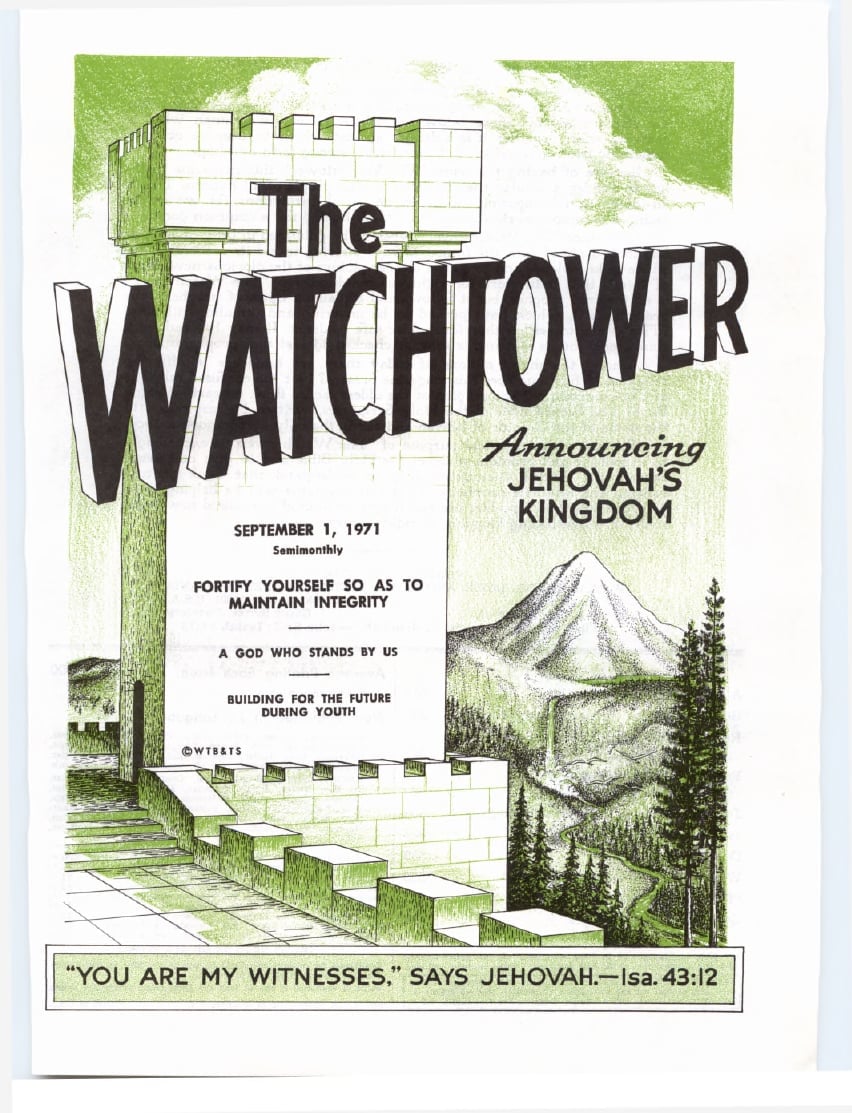
The Watchtower — September 1, 1971
Source: jw.org
Contents
A God Who Stands by Us
Building for the Future During Youth
Remembering the Creator in the Days of My Youth
Fortify Yourself So as to Maintain Integrity
Joyous Results of Maintained Integrity
Is Fasting for Christians?
Do You Remember?
Where Was the Garden of Eden?
“For the Purpose of a Witness”
Annual Meeting, October 1, 1971
Questions From Readers
Give Your Children Moral Guidance
A God Who Stands by Us
A God Who Stands by Us
ABOVE all persons, God the Creator and Source of life knows the value of life. It was a loving-kindness on his part to create others so that they could enjoy life also. His desire is for us to live, not just a few short years, but forever. To this end he stands by all mankind, but especially those who sincerely look to him and follow his Word. “I am loyal,” says Jehovah, and the faithful worshipers who have observed his dealings with mankind declare: “You alone are loyal.”—Jer. 3:12; Rev. 15:4.
Of the intensity of God’s loyalty toward humankind, the apostle Paul writes: “For hardly will anyone die for a righteous man; indeed, for the good man, perhaps, someone even dares to die. But God recommends his own love to us in that, while we were yet sinners, Christ died for us.” (Rom. 5:7, 8) Accordingly, through the worst of circumstances, he will stand by those who respond to his love. He comfortingly assures them: “I will by no means leave you nor by any means forsake you.”—Heb. 13:5; Ps. 94:14.
The apostle Paul was one who appreciated God’s loyalty, and he said to an Athenian audience: “In fact, [God] is not far off from each one of us.” (Acts 17:27) Surely, Paul himself was greatly loved by God because he not only expressed faith in God’s arrangement for life, but also did all he could to help others to get life. In doing so Paul underwent trials far beyond what most persons have faced. To the congregation at Corinth he recounted these trials, including imprisonments, beatings, stoning, shipwreck, hunger, cold and constant danger from enemies. But he said: “Out of them all the Lord delivered me.”—2 Tim. 3:11; 4:16, 17; 2 Cor. 11:23-27.
We must keep in mind that, while we want to live as long as possible, whether we live or die during this present system of things is really not the main issue. But keeping integrity to God is the important thing, for he requires loyalty in those who have come to know his loyalty. Such ones can be absolutely confident that Jehovah and his loyal Son Jesus Christ will stand by them in sickness, family problems, discouragement, pressures and tensions, even the severest persecutions.
Jehovah stood by faithful Job in his terrible sickness. Of him the Christian writer James says: “You have heard of the endurance of Job and have seen the outcome Jehovah gave, that Jehovah is very tender in affection and merciful.” (Jas. 5:11) The prophet Jeremiah’s enemies sought a way to kill him but, as Jeremiah reported, “Jehovah was with me like a terrible mighty one.” (Jer. 20:11; 1:8) Elijah was hunted by wicked King Ahab and his wife Jezebel, but God provided Elijah ample food supplies, furnished by ravens, and by a hospitable woman whom Jehovah helped.—1 Ki. 17:2-16.
Likewise in modern times, many are the accounts of God’s standing loyally by the person who serves him under conditions of hardship, opposition and persecution. It has proved true, as the psalmist declared: “Although he may fall, he will not be hurled down, for Jehovah is supporting his hand. A young man I used to be, I have also grown old, and yet I have not seen anyone righteous left entirely, nor his offspring looking for bread.” (Ps. 37:24, 25) Of himself and his companions, the apostle wrote: “We are pressed in every way, but not cramped beyond movement; we are perplexed, but not absolutely with no way out; we are persecuted, but not left in the lurch; we are thrown down, but not destroyed.” (2 Cor. 4:8, 9) True, some have died (as did Paul himself) under persecution and hardship, but they were upheld in integrity to God, with a resurrection assured.—Matt. 10:28.
Do you appreciate the loyalty of Jehovah God and his Son, in standing by us, to see that we get life? Then, how is your own loyalty? If a husband, do you stand loyally by your wife at all times, speaking well of her, standing by her to help and comfort her in her times of depression? (Col. 3:19) If a wife, do you likewise stand by your husband at all times, speaking well of him, honoring him, respecting his headship, not revealing intimate family matters to others?—Prov. 31:26; Col. 3:18.
Family members, do you show love to all in your family, including the sick or older ones, who could be looked upon as a burden? For example, it sometimes happens that an older member may suffer from senility. In this state he or she may even begin to accuse others of stealing possessions, may turn against the loved one who is nearest, and may be generally unmanageable. This constitutes a test on the family’s loyalty. Will they forget the love the person, perhaps a father or mother, has expressed throughout past years? Though such a situation is trialsome, one medical work says of persons suffering from this malady: “The family should be made to understand that the patient’s behavior is not directed consciously at angering them.” Would you keep this in mind and loyally stand by the sick person? To one of Jehovah’s witnesses whose husband suffered from presenile dementia, a neurologist wrote: “May I say that you are an extraordinarily fine person. The sacrifice that you are making in taking care of your husband who is a totally helpless individual is unusual. Many people would have had their irresponsible relative in an institution a long time ago.”
If you are a Christian, do you stand by your Christian brothers? What do you do when one is sick? or in need of material assistance? or needs encouragement? And are you standing by your brothers in association, particularly at meetings where God’s Word is discussed? Are you “with one soul striving side by side for the faith of the good news”? (Phil. 1:27; Matt. 25:34-36; 1 Thess. 5:14) Do you extend love and hospitality to your neighbors who are not of your religion? (Luke 10:30-37) If you show this loyalty and love to others, you may express the conviction, as did Paul, that “neither death nor life nor angels nor governments . . . nor powers . . . nor any other creation will be able to separate us from God’s love that is in Christ Jesus our Lord.”—Rom. 8:38, 39.
Building for the Future During Youth
Building for the Future During Youth
Helpful facts that young people want to know
ARE you young, perhaps under twenty? Then you are going through a very important, a very crucial, part of your life. How so?
Because you are laying the groundwork for the kind of man or woman you will be in the future. You already know from experience that what you do today affects your life tomorrow. If you quarrel with a friend today, tomorrow either you make up or else the split between you widens. If you study well today, school tomorrow is easier.
But the things you think, say and do affect more than what your life is like tomorrow. They affect next week and next month, even years and tens of years later. They can leave scars almost beyond erasing. Or they can contribute toward building a strong foundation for a happy, productive, satisfying life. Is that what you want?
Some young persons are already crippled or are blind or deaf because they took foolish risks that brought serious accidents. Some get ‘hooked’ on drugs, and from then on their life is a wearying struggle to support a costly habit. Some contract venereal disease, and before it can be stopped damage beyond reversing has weakened some part of their body. Girls may become pregnant and find themselves with the burden of an illegitimate child in their early youth. Granted, these are not pleasant things to think about. But they are happening, as you know. Will any of them happen to you? That depends on how wisely you build for the future.
But some say, “Who cares about what comes afterward? Youth is the only time that really counts; after that nothing matters.” Is that true?
No, it is not. Instead of being the high point in your life, youth is just a transition period. Your body, for example, does not reach complete physical maturity until somewhere between the ages of twenty and twenty-three. Emotional maturity may take even longer. So since you are still in an “in-between” period undergoing preparation for the future, why look on youth as if it were the “end of the road”?
True, you are no longer a child. But you are not yet an adult. Many changes are taking place in you—physically, mentally and emotionally. Some of these changes can make you feel confused, upset or unsure of yourself. You feel new pressures inside you and you may feel perplexed as to how to control them wisely. But if you understand these changes and pressures, you can adjust to them, learn to cope with them and find satisfaction in doing so. This is all part of becoming an individual, a distinct person: You.
So, youth is a time of real challenge. The way you meet that challenge will greatly affect the kind of person you will become. And remember, once lived, youth is gone forever. Why waste the opportunities it offers to build for the future?
Young people today are usually allowed to spend much of their time equipping themselves with knowledge, perhaps even learning trades or skills. But they can also observe and think about what older persons have done, and are now doing, before they themselves become involved in similar occupations and pursuits. Yes, in youth you can begin to get insight into what life is all about. You can consider what different courses have resulted in so as to avoid the foolish mistakes of many as well as benefit from the wisdom of others. You can set your own goal in life.
Can you do all this on your own? Would it make sense to try? Before you answer, consider this:
Would you, if a boy, attempt to build a car engine by yourself without first trying to learn about mechanics from others, from persons with experience in that field? Or would you, if a girl, try to make an evening gown without a pattern, without ever having read anything on sewing or even having seen anyone sew? No? Then, remember that human living is a lot more complicated than a car engine or an evening gown.
We all build on the knowledge and experience of others. This is a simple fact of life. But to do this we need to communicate. If there is no communication, there is no drawing on such knowledge and experience of others. Do you communicate? With whom? With those who have knowledge and experience? With your parents?
Perhaps you look at the world around you and you feel disgusted. You see crime, injustice, war, greed, lying, cheating and hypocrisy. You may say, “Why should I talk with older persons when they have made such a mess of things? What could I learn from them?” True, many older persons bear guilt for these things—either because they do these things or because they support and approve the systems that are responsible for them.
But did you ever stop to think that many older persons are just as disgusted with the badness they see as you are? Realize, too, that all the world’s troubles did not begin just with your parents’ generation. Things have rapidly been getting worse for over half a century now, especially since 1914—and people who are old now were then just youths about your own age.
So, then, why not try to learn all you can from your parents? After all, why have you lived as long as you have? Because of your parents’ love and interest in you they fed, clothed and kept you clean, cared for you in sickness. It would be hard to calculate how much of their time, money and effort you represent. Besides this, from whom did you learn about the dangers of fire, boiling water, sharp objects, electric sockets, poisonous things, the dangers of city traffic? If you had not learned these things from your parents, would you be here in as good a shape as you are today? So why start doubting their sincere interest in you and your happiness now?
Of course, you can see that age and experience alone do not bring all the answers to life’s problems. Otherwise things everywhere would be getting better instead of worse. So, is there a higher source of information and guidance to which you can turn? Yes, there is. That Source is your Creator, Jehovah God. He has given mankind his Word the Bible to answer their questions and guide them in wisdom. And the Bible does not direct your hopes toward the present failing systems that have filled the earth with so many dangers and problems. It points you to new systems that offer something far superior.—2 Pet. 3:13; Rev. 21:1-4.
Maybe you have never read the Bible. You may wonder if the information in it can really solve your problems, answer your questions. You will never know unless you look into it. More than that, even though the Bible contains the finest counsel, this will not benefit you in the least if you do not work at applying it in your life.
The publishers of this magazine you are reading appreciate the challenge that youth faces today. Because of this, during the months to come this magazine will carry articles especially directed to young people. It will seek to answer many of the questions young persons are asking, questions others may have not answered for them. These articles will not appear in every issue, though it is our hope to have at least one each month. Look for them. Read them. See how God’s Word the Bible can help you to meet the challenge you face and to build for a happy and worthwhile future.
Remembering the Creator in the Days of My Youth
Remembering the Creator in the Days of My Youth
As told by Aleck Bangle
WHEN I received an application for the full-time pioneer ministry under the direction of the Watch Tower Society, I noted a question that made me pause. It asked whether I had anyone dependent upon me. Before answering this question, I asked my mother, since I was partly supporting her. With a happy heart and smiling face she said:
“Son, you were the first child born after I came to know God’s truth, and I feel much like Samuel’s mother, who dedicated her son to Jehovah. So, go, son, and give Jehovah your time, strength and energy, and I’m happy you are doing it now in your youth. Jehovah will take care of me.”
Those words of encouragement from a faithful, hardworking mother were enough for me. It made tears drop from my eyes, seeing the great faith and confidence my mother had in Jehovah. I did not delay but at once answered the question and sent in my application, which was accepted.
So I gave up my secular job, and in June 1940, at the age of twenty-one, went to New York city to start my career as a pioneer minister or full-time proclaimer of God’s kingdom. As for my mother, she was well cared for to the day of her death in 1965.
EXAMPLES OF OLDER ONES HELPED ME
My mother and father had learned God’s truth between the years 1917 and 1918. And their example was a big help in my remembering the Creator from the days of my youth. When I saw father and mother always praying before each meal and before going to bed, it impressed me. And I would do the same in my humble way.
We lived in Pittston, Pennsylvania, and when my father retired in 1931, due to ill health, he spent the remaining five years of his life preaching the good news of God’s kingdom full time. In this way he set a good example for me as to how to remember my Creator as a youth.
The time came when I wanted to show my appreciation to the Creator for the things I learned about him. So I dedicated my life to him and symbolized it by water baptism in 1938.
I will never forget the first big convention I attended. This was at Madison Square Garden in New York city in 1939. The Watch Tower Society’s then president, J. F. Rutherford, was delivering the public talk “Government and Peace” to an audience of over 18,000. After about twenty minutes, a crowd of Fascist-minded followers of the Roman Catholic priest Charles Coughlin tried to break up the meeting. They began to boo, shout and howl, some wildly crying out “Heil Hitler!” The Society’s president did not become afraid but courageously said: “The Nazis and Catholics would like to break up this meeting, but by God’s grace they cannot do it.” The speech was delivered in its entirety. When I saw the courage and confidence that my older Christian brothers displayed, it impressed on my young mind that to be a servant of Jehovah God one needs to be courageous.
TESTED REGARDING COURAGE
Shortly after beginning my full-time pioneer ministry, I moved to California to preach the good news with another young Witness. Our assignment was in central California, a vast area with only three or four isolated families of Witnesses. A few months later I went to Red Bluff, California, working with a small congregation. When war was declared after the attack on Pearl Harbor, the people of Red Bluff became more nationalistic, and there was opposition to our preaching God’s kingdom. One night opposers broke all the windows in the Kingdom Hall, smashed some benches and left the place in disarray.
When going out in the field ministry in those days, I did not know whether I would be arrested, beaten or opposed in other ways. When we were offering The Watchtower on the streets of Corning, California, the American Legion had youths bring flags on the street and try to force us to salute them. Because of our Bible-based stand, some of the Witnesses were kicked, punched and told to get out of town.
Later, while I was engaged in the field ministry with three of my Christian sisters in that same town, a member of the American Legion whom I approached at the door said: ‘What are you doing here, you . . . ? You are a young man and should be in the army like my son.’ He then came out of his house and began kicking me all the way out of his yard and half way down the block. He said: ‘If you go on the street corner today, I’ll beat you up.’
I went to the chief of police and informed him of this man’s actions and threats. His response was: ‘Since you’re not wanted in this town, why don’t you leave?’ That did not make us cancel our arrangements to do street magazine work that day. About a half hour later the man that kicked me drove up to me in his car, got out and tried to beat me. Being a much younger man than he, I was able to prevent him from getting too close. Soon a crowd of seventy-five to one hundred persons gathered. Some began to shout, ‘Let’s tar and feather this Witness as a lesson to the others.’ Thanks to Jehovah, I was calm and unafraid. I just stood and looked at them. The chief of police finally arrived and took the man away. We left for Red Bluff to continue our work.
It seems that Jehovah supplied me with an extra amount of his spirit during that hour of stress, but when it was over it became a test as to whether I was going to continue to remember my Creator or whether I would get frightened and stop. I knew it was a test of my faith, so I prayed to God to help me to overcome any fears. Besides prayer, Bible study and regular association with God’s people helped to build up my courage to continue remembering my Creator in that assignment until the Society assigned me as a special pioneer in South Pasadena, California.
FACING MOB VIOLENCE
I preached God’s truths in South Pasadena for about a year and a half. In 1942, while working there, I attended a convention of Jehovah’s people in Klamath Falls, Oregon, about 700 miles north. Fifty-one other cities were tied in by wire from Cleveland, Ohio, the key city. Klamath Falls was another very patriotic town. We heard rumors that this assembly was going to be mobbed. However, everything went smoothly until Sunday, when the public talk, “Peace—Can It Last?” was coming over the telephone wire from the key city. Peace did not last long in Klamath Falls, because a mob of over one thousand adults and youths broke into the Witnesses’ cars, smashed them, put crowbars through the radiators, got all the literature and other equipment and piled them up in the middle of the street.
Then they broke into the hall, took Bibles, books and whatever they could from the literature department. They put all of it together in the street and lit a bonfire.
The mobsters tried to push their way into the main building, but the Witnesses closed off all entrances and guarded them. The mob did succeed, however, in cutting the telephone wire, so the rest of the talk being given by the Society’s president had to be delivered by a local Witness, who was prepared to give the talk from a manuscript, if necessary. This angered the crowd more, and they began throwing stones through the windows. We had to put benches against the windows so that the stones would not hit the people in the auditorium. Despite this, some were hurt.
This mob action continued throughout the rest of the afternoon program, and eventually the police succeeded in pushing the mob down the road. The police advised us to get out of the building and not to continue the evening program because they said it would not be possible for them to control the mob when it got dark. The assembly was brought to an end, and we had to work our way through the crowd to get to our hotel rooms. Outside the building, it looked as if a hurricane had struck. Although I was young, I knew that Jehovah can protect his people, and that was proved to me right there. Following my experiences at that assembly, I went back to my assignment and remained there until Jehovah’s organization saw fit to send me elsewhere.
GILEAD AND ASSIGNMENT TO JAMAICA
Then I received an application for going to the Society’s missionary school of Gilead. I filled it out, and a few weeks later I was invited to the second class of Gilead, beginning September 1943. It was at Gilead that I got deeper appreciation for the Creator and his organization. Those five months of helpful training passed by so quickly that, before we knew it, we were given our assignments and graduated in January 1944.
Four of us were sent to Montgomery, Alabama, to work with a congregation. I remained in Alabama till April 1945. Then I was asked to come to the Society’s headquarters in Brooklyn in May 1945.
I remained in Brooklyn for three months and was then sent to Oklahoma state to serve some congregations as a “servant to the brethren,” known today as a circuit servant or supervisor. I was just a youth compared to many of my Christian brothers whom I served. Yet the Witnesses did not look down on me as a youth, but readily accepted the suggestions given from God’s Word and organization.
In February 1946 I received notice of a new assignment, to a foreign country, Jamaica, West Indies. One of the graduates of my class was going with me as my partner.
We arrived in Jamaica on March 10, 1946. Two days later I was in the field ministry, working in the block near the branch office. Four days later Brothers Knorr and Franz, the Society’s president and vice-president, came to Jamaica, and a two-day assembly was held in the Ward Theater in Kingston, with 1,270 persons attending. The Society’s president also arranged for the one congregation of two hundred Witnesses in Kingston, the capital, to be divided into three congregations. This was really the beginning of expansion in Jamaica. Since then it has been a source of joy for me to see those three congregations grow into fifteen congregations with over 1,500 proclaimers of the good news.
During the years 1946-1950 I was assigned as part-time circuit supervisor for one of four circuits here on the island, and part-time worker in the branch office. In those days transportation, especially in the rural areas, was not very good. So one presiding minister of a congregation came to the railway station to meet me with two donkeys, one to carry my luggage and the other to carry me. Up the hills we went for five miles or more, and it caused quite a stir. People would stop what they were doing to see a white man riding a donkey.
At other congregations my luggage would be put on a donkey, and a Witness would be sent with me to bring the donkey back, after we walked from five to twelve miles to the next congregation. Naturally youth was in my favor, and how happy I am that I did remember the Creator then. It was a joy to serve my Christian brothers.
Another opportunity to expend some of my youthful vigor came in 1950 when the Society arranged for another missionary and myself to visit the island of Grand Cayman, about two hundred miles from Jamaica. We traveled by boat. There were no witnesses of Jehovah on the island but there was a population of about seven thousand people. We covered every nook and corner of the island on bicycles, over hard and rough roads, and we placed over 1,200 pieces of Bible literature in the hands of the people within six weeks. Shortly after our visit the Society sent other missionaries there, and today there are fourteen proclaimers of God’s kingdom on the island.
Not long after I returned from Grand Cayman, the Society suggested that I work at the branch office full time. So from 1951 to January 1962 I remained in the branch office in Kingston. During this time I also served as presiding minister in three different congregations. It was a blessing to work with many young ones in those congregations and to help them remember their Creator.
RETURN TO GILEAD AND MORE BLESSINGS
In the latter part of 1961 a test came regarding my faith. I received an application from the Society for attending a special ten-month course at Gilead School. The application stated: “If you fill out this application and are accepted you might not return to the country you are now serving, so if you do not want to leave, it would be better not to fill out the application.” It was not easy to decide what to do.
I had come to love my Christian brothers here so much and really felt at home with them. I was now forty-two years of age and not a youth anymore, but I could look back twenty-one years to the time when I started in the full-time pioneer ministry. I could see that Jehovah took care of me for all those years. So I made my decision to agree to go to Gilead again. Not long afterward a letter came requesting that I come to Brooklyn to attend the ten-month course beginning in February 1962. When leaving Jamaica, I will never forget the crowd of over two hundred that came to the airport to see me off. I bade them good-bye with mixed feelings.
I enjoyed that course even more than the one I took back in 1943. So I promised the Creator that I would make use of what I learned to show him that it was appreciated, no matter where I was sent.
When the Society’s president gave us our assignments a few weeks before graduation, my heart began beating extra fast. He started alphabetically, and I was happy my last name began with the letter “B.” Quickly he came to the “B’s,” and when he said, “Brother Bangle will be going back to Jamaica,” I felt like jumping for joy. My heart must have skipped a couple of beats. It was really a happy day for me.
Soon came graduation, and I was informed that I would take up work as a district supervisor in Jamaica. I arrived back in Jamaica in December 1962, and took up the district work in March 1963, and am happy to say that I am still serving in this most joyous work up to the present.
As I travel around the island it is a pleasure to show the Watch Tower Society’s films to thousands of people. People here love to see the films.
Since I came to this assignment over twenty-five years ago, I have been privileged to see the growth of the Kingdom work here in Jamaica from about 1,000 Witnesses in 1946 to over 5,500 today.
As I look back over the thirty-one years since I entered the full-time pioneer ministry, I have found the psalmist’s words to be true: “A young man I used to be, I have also grown old[er], and yet I have not seen anyone righteous left entirely, nor his offspring looking for bread.” (Ps. 37:25) I am not yet an old man, and if it is Jehovah’s will, I look forward to spending my later years as I spent the years of my youth—remembering my Creator.
Fortify Yourself So as to Maintain Integrity
Fortify Yourself So as to Maintain Integrity
“As for me, in my integrity I shall walk.”—Ps. 26:11.
1. What are some of the thoughts involved in the word “integrity”?
“I MYSELF have walked in my own integrity,” said David, king of the nation of Israel. Would you like to be able to say that about your life course? Would you like to be able to describe your life course as one of moral soundness, honesty, free from corrupting practices? These are some of the thoughts involved in the word “integrity” and that David doubtless had in mind when he made that statement. These are the qualities that should come to our minds too when we think of integrity.
2. (a) How do we know that David was speaking about a godly quality? (b) What should we be able to ask Jehovah conscientiously?
2 This integrity that David was speaking about was a godly quality, for he prefaced his comment, “I myself have walked in my own integrity,” with the words, “Judge me, O Jehovah.” Yes, David was concerned about his uprightness in the eyes of God. Are you? Do you want to be able conscientiously to ask Jehovah to judge you, to examine you, to put you to the test, feeling that God will find you are a person of integrity? How wonderful it would be to be in such a position.—Ps. 26:1, 2.
NEED FOR INTEGRITY
3. (a) Why is this quality of integrity needed? (b) Describe the world today as far as integrity is concerned. (c) How do we know what course God wants us to take in such a world?
3 But why is this quality needed? To gain Jehovah’s approval; it is as simple as that. Note the qualities that the apostle Paul said would mark the last days of this wicked system of things: “Men will be lovers of themselves, lovers of money, self-assuming, haughty, blasphemers, disobedient to parents, unthankful, disloyal, having no natural affection, not open to any agreement, slanderers, without self-control, fierce, without love of goodness, betrayers, headstrong, puffed up with pride, lovers of pleasures rather than lovers of God, having a form of godly devotion but proving false to its power.” (2 Tim. 3:1-5) The world today is marked by qualities that are opposite to integrity. But after listing these morally unsound, dishonest, corrupt characteristics, Paul went on to say, “And from these turn away.” So God’s inspired Word, the Bible, tells us to avoid such people. God does not want us to be like them. He wants people to maintain integrity, to be wholly loyal to him.
4. Cite examples of lack of integrity in (a) secular work and (b) everyday family life.
4 We all live in a world that is full of such bad qualities, however. We see these manifest constantly. We hear workmen talking. “I overslept this morning, but I’m telling the boss my car had a flat tire on my way to work,” says one. The other counters with, “But that would be lying. Why don’t you just tell the truth?” The late sleeper retorts, “Oh, no. I can’t do that. If I tell the boss something like that I’ll get fired. I was tired and decided to sleep awhile longer when my alarm clock rang this morning. But he doesn’t have to know that.” Is this individual a man of integrity? Is he honest? Would it not have been better for him to get up when he was supposed to and get to work on time? He would have had no fear of losing his job, and he would not have had to explain his lateness. (Prov. 30:8; 14:5) Or what about the teenage boy who threatens his parents that he will leave home if they make him work in the garden instead of allowing him to play ball? Is this not like extortion, a dishonest practice? And what about his parents who, in order to keep him from carrying out his threat, promise to buy him some expensive gift? Are they encouraging uprightness, integrity, by succumbing to his wishes, letting him have his way? Are they not in fact rewarding his rebellious course, giving him a present for such? Are they not bribing him? (Prov. 17:23; Mic. 3:11) In secular work and in everyday family life, we see little or no manifestation of integrity.
5. (a) In what fields in this wicked system is integrity lacking? (b) Why does integrity-keeping need our attention?
5 Even among political leaders and governments of the world we regularly hear of lying and fraudulent practices being carried on. In the commercial world, claims are made in advertising that are deceiving, misleading and often untrue. Then, of course, there are the leaders of false religion who preach from the Bible at times and yet live contrary to its teachings or come forth with philosophies such as “God is dead” or that the virgin birth of Jesus is a myth or that the creation account in Genesis is a fairy tale. From the leaders on down, a lack of integrity is the norm in this wicked system. (John 8:44; 1 John 5:19) And while Christians are to be no part of this wicked system, we must continue living in it until Jehovah brings its end. (John 17:15, 16) So, then, this matter of keeping integrity needs our attention, does it not?
INTEGRITY WEAKENED OR STRENGTHENED?
6. What attitude of worldly youths has rubbed off on some young Christians? Cite an example.
6 It is sad to say, but there are examples of individuals who have followed a Christian course up to a point but who weaken their integrity by giving in to the ways of Satan’s system. Rebellious youths are found throughout the world, even in countries where juvenile delinquency was practically unheard of in times past. And this rebellious attitude of schoolmates rubs off on youngsters who may know the Bible truth but who associate with such individuals. Running away from home is viewed by many of the young worldlings as a way to solve problems. But is it wise for a Christian youth to follow such a course? Is it showing appreciation for Jehovah’s arrangement for parental care to run away from home? (Eph. 6:1-3) Is it showing a desire to maintain integrity? There was the case of a young girl, just entering her teens, who ran away from home because her parents had discovered she was skipping classes in school. She was afraid to talk to them about problems she was having in school and so left home and was later found after dark in a bad neighborhood some distance from home. Fortunately it was a respectable individual who found her and got her to talk, and no harm came to her. But she could have been accosted by someone immoral. Would she have had any excuse before Jehovah if harm had come to her? Was she acting in harmony with the words of the model prayer Jesus taught, “Do not bring us into temptation”?—Matt. 6:13.
7. (a) What wrong course did a boy follow, and to what did it lead? (b) What Scriptural principle did he fail to keep in mind?
7 Or what about the boy who was invited to take an afternoon off from school to go to a party in a classmate’s home because the classmate’s parents were away? At first he was against the idea, but instead of definitely refusing the invitation and sticking to his integrity, he asked questions about what was going to happen. He weakened and decided to go to the party. What happened to this young man can serve as a warning to others. While the party was going on, the police arrived and found marijuana hidden in the house. All the youngsters there were picked up, and the young person’s name is now registered with the police. It may be true, he probably did not even know the marijuana was there, but he neglected to follow the wise counsel of Proverbs 13:20, where it says, “He that is walking with wise persons will become wise, but he that is having dealings with the stupid ones will fare badly.” Now, with his bad record, he has a harder fight than ever to maintain integrity. Everytime something goes wrong in his neighborhood he is subject to questioning by the police.
8. What can result from failing to heed counsel against “dating” at an early age?
8 Then there are the young teen-agers who think they must “date” and “go steady,” as many children of today do. Contrary to the advice of the organization of Jehovah’s witnesses, the appointed servants in the Christian congregation and even their parents, some youngsters will at an early age get romantically involved with one of the opposite sex. The physical attraction keeps on growing. They are too young to get married, but they want to satisfy the desires that are building up inside them. So they begin toying with immorality, some even going so far as to commit fornication. Such ones fail to show they are wise because they do not “listen and take in more instruction,” as Proverbs 1:5 says wise ones do. Further, they fail to heed the counsel of Pr 1 verse 8 of the same chapter which says, “Listen, my son, to the discipline of your father, and do not forsake the law of your mother.” They do not listen to their parents and they do not listen to their heavenly Father, Jehovah, and their “mother,” Jehovah’s wifelike organization. And because of this they fail to maintain integrity, they fail to stay loyally within the moral bounds that God’s Word sets out for them.
9. (a) How should we view borrowing money to acquire luxuries? (b) How should we view lending money to someone for such a purpose?
9 Grown-ups too sometimes fail to follow an integrity-keeping course. Romans 13:8 says that we should not be owing anyone anything except love. But what about the situation where a brother has bills to care for and who has previously borrowed some money from another individual to purchase some items he wanted. Is he following a practical course if he takes out an additional loan to purchase some luxury he wants? Is it absolutely necessary that he have such? Was it necessary that he go in debt to purchase perhaps a stereo, a dishwasher, a piano? In taking on so many financial obligations, is he considering the Scriptural thought: “The wicked one is borrowing and does not pay back”? (Ps. 37:21) For that matter, would it even aid such an individual in a course of integrity to loan him money for such unnecessary luxuries? Proverbs 22:7 says, “The borrower is servant to the man doing the lending.” Do we want to be someone’s servant by borrowing or have someone like this become our servant by lending? Would it not be better to avoid such and be servants to just one master, God?—Luke 16:13.
10. (a) How can integrity be weakened by a wrong attitude toward those whom Jehovah is using to direct his work on earth? (b) What should be our attitude toward the servants in the Christian congregation?
10 We can fail to maintain integrity by becoming critical of those whom Jehovah God is blessing. Some start looking at the human imperfections of those charged with oversight in the congregations of God’s people. Sometimes when the older men give wise, practical, Bible-based counsel, others mentally and even sometimes vocally go against such because of their dwelling on imperfections or mistakes that may have been made in years past by the same individuals but who now have changed and put on a new personality. Hebrews 13:17 expresses the proper attitude all of us should manifest in our Christian course: “Be obedient to those who are taking the lead among you and be submissive, for they are keeping watch over your souls as those who will render an account; that they may do this with joy and not with sighing, for this would be damaging to you.”
11. (a) What can we ask about those who have weakened their integrity? (b) What points have we learned thus far to aid us to maintain integrity?
11 By the course of action that the individuals whom we have been discussing took, can we say they were strengthening their integrity? No, rather, the opposite was true. They were weakening it and even trying to weaken the integrity of others. What will happen when persecution or severe opposition comes upon them? Are these people then going to be able to stand? Will they stay loyal to God, close to their Christian brothers? What about us? Can we profit from considering their examples? Youths, can you not see the need to submit to God’s arrangement for you to be under the direction of your parents? Can you not see the need to avoid bad companionship, to avoid playing “hooky” or “cutting” classes? Do you appreciate the importance of listening to the wise counsel of Jehovah’s Word with regard to morals? And as for adults, can we not see the practicality of avoiding getting into debt unnecessarily, taking on financial obligations that may end up by our being classified as “wicked” by Jehovah? Are we cognizant too of not being critical of our brothers, of not failing to appreciate that Jehovah’s organizational arrangement is for our welfare and protection? Really, we have to work at fortifying ourselves so as to maintain integrity. (Prov. 11:3) But how?
HOW TO FORTIFY YOURSELF
12. What should we seek as far as integrity is concerned?
12 As was mentioned at the outset, King David of Israel sought Jehovah’s judgment as to his integrity. We too should do so. To get Jehovah’s view on the matter of how to fortify our integrity, we can examine Psalm 26, wherein David speaks of this subject in prayer to Jehovah.
13. How is personal study involved with integrity?
13 In Ps 26 verse 3 David says to God: “For your loving-kindness is in front of my eyes, and I have walked in your truth.” For this to be true of us, we need to be acquainted with Jehovah and his truth. That means we should be students of the Bible. So, then, one way to fortify ourselves is by personal study. Daily Bible reading is a fine practice in this connection. Then, too, we have the written material provided through Jehovah’s organization from which we can derive benefit. Many say they have more to read than they possibly can. But do we fail to read the publications of the Society because we really have no time? Or is it because we spend considerable time reading newspapers, worldly magazines and novels? Do these publications encourage us to pursue a course of faithfulness to Jehovah God? Why, even the advertising in newspapers and magazines nowadays can arouse immoral thoughts and desires. How much better it is to spend any time we can to reading information that will serve to strengthen us, build us up spiritually. (1 Cor. 15:58) By our personal study, including preparation for the congregation meetings, we will be able to derive more benefits from the gatherings of Jehovah’s people and to give more for the assistance of others attending with us.
14. (a) What kind of associations are to be avoided? (b) What helps us to avoid bad company? Cite an example.
14 “For I have not sat with men of untruth; and with those who hide what they are I do not come in. I have hated the congregation of evildoers, and with the wicked ones I do not sit,” continued David in Ps 26 verses 4 and 5, pointing out another aspect of fortifying ourselves, that is, avoiding bad associations. The type of individuals David was talking about he mentions further in Ps 26 verses 9 and 10, where he refers to them as “bloodguilty men, in whose hands there is loose conduct, and whose right hand is full of bribery.” For us to stay loyal to Jehovah we must avoid being friends with people such as these, avoid associating with such ones unnecessarily, apart, of course, from preaching the good news of God’s kingdom to them. In fact, preaching to these often assists in avoiding their bad association. To illustrate this point, consider the following: One individual who was studying the Bible for just a few months, and who had been living the life of a “hippie” for some years prior to this study, said: “Sometimes people that we used to be friendly with look us up or write. They are generally very surprised at us, since we very quickly begin to tell them the good news [of the Kingdom]. Needless to say, it’s not good news to them, and surprise turns to dislike and they make hasty exits from our trailer and we don’t hear from them again. But sometimes, too, seeds fall on good soil and there is some interest generated.” Yes, faithfully speaking about our God and his kingdom helps us to avoid bad company.
15. (a) Why do we say that meeting attendance fortifies us? (b) What occurred to individuals who were late for a meeting in Africa?
15 Attending meetings with others who are anxious to do God’s will is another step in the fortification program of which David speaks. He says: “I shall wash my hands in innocency itself, and I will march around your altar, O Jehovah . . . Jehovah, I have loved the dwelling of your house and the place of the residing of your glory.” (Ps 26 Verses 6 and 8) We too should love Jehovah’s house. Today we could look upon Jehovah’s house as the place where knowledge of him is given. Meetings with Christians of like precious faith “incite to love and fine works,” and this will help us to maintain integrity. (Heb. 10:24) We will be built up by the good association and by the fine spiritual discussions we hear and can take part in. Getting to these meetings on time too is important to get the full benefit of the program. In this connection an experience reported from an African country is of interest: A riot occurred between two tribal groups just after the brothers began their meeting. Two brothers who were late saw the fighting in town and returned to their homes. One stood in the doorway of his home with a spear in his hand for protection, as he was afraid the fighting would reach his house. When the soldiers came upon him, they mistook him for one of those engaged in the fighting and refused to release him. In fact, they said: “He is not one of Jehovah’s witnesses; all of Jehovah’s witnesses were at their meeting studying the Bible, but he was not there.” And the other brother who was late? He was kidnapped and killed.
16. What should we not let interfere with out meeting attendance?
16 We cannot afford to let things interfere unnecessarily with our meeting attendance. Why take on secular work to earn extra money for luxuries when the working hours will keep you from the meetings or when the extra work will make you too tired to leave your home to get to the meetings? Or why arrange to have relatives visit you or arrange to visit them at times when the Christian congregation is assembling together? We do not want to miss any of these God-given opportunities to fortify ourselves so as to maintain integrity.—Heb. 10:25.
17. What work reinforces our integrity?
17 Reinforcing our integrity is also done by sharing in the proclamation of God’s purposes to others, the preaching of the good news of the Kingdom. David, in Ps 26 verse 7, said he wanted “to cause thanksgiving to be heard aloud, and to declare all your wonderful works.” We should feel the same way. We should take every opportunity we can to share what we know about Jehovah and his purposes with others, preaching the message of truth and then returning to teach those who are interested in learning more, endeavoring to make them disciples of Jesus Christ.—Matt. 24:14; 28:19, 20.
18. (a) About what should we pray, and how often? (b) If prayer is a habit, what will we do when any problems come up, and what will result?
18 Still another aspect of fortifying ourselves is prayer. David was very conscious of this. While all of Psalm 26 is in fact a prayer, note Ps 26 verse 11: “As for me, in my integrity I shall walk. O redeem me and show me favor.” We too should promise Jehovah that we will walk in integrity, take advantage of the arrangement he has made for our redemption, and show our appreciation for this by thanking Jehovah and by our course of action, showing him our appreciation by our works. We should keep the lines of communication with Jehovah open. We should talk to him regularly, many times each day, telling him about our love for him and our desire to do his will, talking to him about our problems and desires, seeking his guidance in all aspects of our lives. The more that prayer becomes a habit the easier it will be for us to maintain integrity. When some temptation or wrong course is presented to us, we will automatically take Jehovah into consideration. (Prov. 2:7) In fact, we will often find that in the process of talking to Jehovah in prayer about a matter or a decision we must make, Scriptural passages will come to mind that bear on the subject, thus helping us to understand Jehovah’s view on the matter.
19. To sum up the matter of maintaining integrity, what five things can we do to fortify ourselves?
19 To sum up matters, what are some things that we can do to fortify ourselves so as to maintain integrity? We should personally read and study the Bible and the Bible study aids that Jehovah provides through his organization. We should avoid bad associations. We should attend meetings of those interested in Jehovah’s will and purposes. We should share in the preaching and teaching work foretold for these evil times in which we live. And we should pray regularly to Jehovah to maintain a close relationship with him and dependence on him. But what results from keeping integrity? We will leave the answer to the succeeding article.
[Picture on page 526]
Is it wise for teenagers, too young to marry, to get romantically involved? Physical attraction may cause them to indulge in loose conduct
[Picture on page 528]
If a Christian is too busy to fortify himself by reading Bible literature, is it because he is spending too much time watching TV, reading newspapers and worldly publications?
Joyous Results of Maintained Integrity
Joyous Results of Maintained Integrity
1. What Scriptural support is there for the thought that David was a man of integrity?
“SO David, with a sling and a stone, proved stronger than the Philistine and struck the Philistine down and put him to death; and there was no sword in David’s hand.” (1 Sam. 17:50) What great joy this must have brought David, to realize that he had gained the victory over the Philistine giant Goliath because of David’s integrity, his whole-souled devotion to Jehovah. Sometime after his encounter with Goliath, David prayed to Jehovah, “Let integrity and uprightness themselves safeguard me.” (Ps. 25:21) The inspired writer Asaph speaks of David and the “integrity of his heart.” (Ps. 78:72) In 1 Kings 9:4, Jehovah encouraged Solomon to follow the course of his father by saying: “Walk before me, just as David your father walked, with integrity of heart and with uprightness by doing according to all that I have commanded you.” So, although he was imperfect and did make mistakes, David many times throughout his life proved he was an integrity-keeper.
2. (a) Why was Jesus willing to die as he did? (b) According to Philippians 2:5-11, how was Jesus’ course of integrity rewarded?
2 In due time a greater-than-David appeared on earth, the man Jesus. Jesus was perfect and faithfully maintained his integrity to Jehovah throughout his human life, setting a fine example for us to follow. (1 Pet. 2:21-23) Can we say that his loyalty to Jehovah brought him happiness? Let God’s Word answer that for us: “For the joy that was set before him [Jesus] he endured a torture stake, despising shame, and has sat down at the right hand of the throne of God.” (Heb. 12:2) Yes, Jesus was willing to go through the ignominious death he faced because he maintained his integrity and had a joyous reward awaiting him. In Philippians 2:5-11 more is told us about this: “Keep this mental attitude in you that was also in Christ Jesus, who, although he was existing in God’s form, gave no consideration to a seizure, namely, that he should be equal to God. No, but he emptied himself and took a slave’s form and came to be in the likeness of men. More than that, when he found himself in fashion as a man, he humbled himself and became obedient as far as death, yes, death on a torture stake. For this very reason also God exalted him to a superior position and kindly gave him the name that is above every other name, so that in the name of Jesus every knee should bend of those in heaven and those on earth and those under the ground, and every tongue should openly acknowledge that Jesus Christ is Lord to the glory of God the Father.”
3. What have many in modern times done as well?
3 In this twentieth century there are many integrity-keepers throughout the world, individuals who day after day show their honesty, their desire to be upright in Jehovah’s eyes by their course of action even in little matters. And, of course, there are many too who have faced big issues, proving their integrity.
MODERN-DAY INTEGRITY-KEEPERS
4. (a) What course did one sixteen-year-old follow in his efforts to maintain integrity? (b) What did his teacher finally do?
4 In one country where the church and state work hand in hand, a Christian boy of about sixteen was told that he would be expelled from school if he did not make the sign of the cross and attend the church Mass. He was so near to graduating, but he would lose all his credits if he did not conform. The instructor told him just to go through the motions without believing in what he was doing, but the boy stood firm. The instructor admired the boy’s faith so much that he arranged to have him stand at the rear of the room at prayer time so it would not be noticed that he was not making the sign of the cross. (The teacher was afraid he would get in trouble and that his job would be in jeopardy if he were openly to permit the boy to refrain from this religious practice.) The teacher also assigned him jobs during church Mass so he would have an excuse to be busy and away from the church service. Can we not say, then, that the boy’s integrity-keeping course was rewarded?
5. Why did a youth in school suffer physical abuse?
5 There are those who, in obeying the counsel found in God’s Word, have been physically abused. On one Pacific island two youngsters refused to engage in a patriotic ceremony that involved an idolatrous act. The teacher, not appreciating freedom of religion as allowed for in that land, went so far as to break the hand of one youngster. The matter was discussed with the teacher and taken up with his superior, and the teacher was soundly reprimanded. Since that time the teacher has been most cooperative. It is true that the one youngster suffered considerably, but he stayed faithful and in doing so proved that he truly is loyal to Jehovah.
6. (a) Why was the matter of blood transfusions brought up to one thirteen-year-old girl? (b) How did she and her mother keep integrity to Jehovah’s laws?
6 Another case of integrity-keeping was manifested in recent years when a thirteen-year-old girl in Berlin was found to have leukemia. The doctor explained that transfusions of blood would make the girl more comfortable and stave off the progress of the disease. The mother, being a God-fearing Christian, knew what the Bible says about not eating blood. (Gen. 9:4; Acts 15:28, 29) So she refused to permit transfusions to be given. The girl also refused to permit this, saying, “I would rather die faithful to Jehovah God than to violate his command in order to live a little while longer.” (Matt. 10:39) This girl did die, but she left a letter for her mother to read. The letter was to all the ones the girl knew and it asked that they not find fault with her mother for not permitting transfusions. She said: “It is just as much my firm will to be true and obedient to God’s Word rather than to be a lawbreaker. . . . If the great Life-giver Jehovah considers me worthy he will give me a resurrection—in honest-to-goodness flesh and blood as a human on a cleansed paradise earth in delight and happiness. So you see, that is why it wasn’t hard for me to die. Can you understand that?”
7. (a) Faith in what makes one able to face death? (b) How do individuals get such faith?
7 But why was it not hard for her to die? Because she had faith just as did Abraham of old, who “reckoned that God was able to raise him [his son Isaac] up even from the dead.” (Heb. 11:19) Yes, she had full faith in God’s promised new system of things and the resurrection of those ransomed by the sacrifice of God’s Son. (John 5:28) But where would someone so young get such faith that would aid her to keep integrity, even in the face of death? It was from a study of God’s Word, the Bible. Another young girl, who is now a full-time minister of Jehovah’s witnesses, in commenting on some material she heard about parents training their children, said: “It made me glad all over again that my mother had bothered with a family study. I sure do wish I could shake some of these children who ignore their parents and their counsel.”
8. (a) Why is neutrality involved in keeping integrity? (b) How were a mother and son tested on the neutrality issue, and what was the outcome?
8 In John 18:36 Jesus is quoted as saying, “My kingdom is no part of this world.” Our keeping integrity involves our being loyal to that kingdom and maintaining a course of strict neutrality toward the affairs of this wicked system of things. In one island country, a Witness learned that her son had been threatened with dismissal from school because of his conscientious refusal to participate in military exercises. So she appealed to the school officials on her son’s behalf. One official suggested she claim that her son was physically disabled so that he could be excused, but the mother, knowing God’s viewpoint of lying, told them that this was not the truth. (Rev. 21:8) Then they suggested that the boy just wear the uniform and do nothing more than call the roll and hand out the wooden rifles. Again the mother explained that this would identify her boy as part of the exercises. Becoming irritated, the officials angrily dismissed the mother, saying that her religion is unreasonably strict. She left quietly, but before she could go far she was hastily called back by the officials. They apologized for what they had said earlier and told her that, in fact, they really admired her firm religious convictions. How thankful she was to Jehovah when they told her that the boy would be given work to do in the principal’s office while others did military exercises! Certainly she and her son were rewarded for their efforts to maintain their integrity as far as the issue of Christian neutrality is concerned.
9. Why did an actress and her husband make changes in their lives, and what resulted from this?
9 Even individuals newly associated with the true religion and the pure worship of Jehovah have the opportunity to show their loyalty to God, their integrity. People from all walks of life come to an accurate knowledge of the truth. A married woman who was an actress in the Middle East began studying the Bible and readily accepted the truth. Quickly she saw the need to avoid parts in television and on the stage that violated Christian principles. (1 Pet. 4:3, 4) Her husband, an actor, had more difficulty in making changes in his life because worldly associations were hindering his progress. Through encouragement from Jehovah’s witnesses and some self-examination on his part, he soon took a position pleasing to God. Then he began inviting all his friends and neighbors to study the Bible. They asked what changed him, and he replied, “You will know the truth, and the truth will set you free.” (John 8:32) By this couple’s endeavoring to conform their lives loyally to Jehovah’s Word and the principles therein, they had the joyous result of seeing the change in themselves and being able to share their newfound religion effectively with others.
10. How did one newly interested person face up to family opposition, and how was she rewarded?
10 Maintaining integrity often brings opposition from relatives who do not appreciate the true religion, but did not Jesus foretell that “a man’s enemies will be persons of his own household”? (Matt. 10:36) A woman in the southern part of Africa began studying the Bible and immediately quit her church because of its false teachings. Her husband and mother fiercely opposed her, but the one studying the Bible with her pointed out Matthew 10:37, where Jesus said: “He that has greater affection for father or mother than for me is not worthy of me.” She was encouraged by this to continue studying, and she was also comforted with the knowledge that those hated because of the good news of God’s kingdom are really blessed. (Matt. 5:10, 11) She became all the more determined to put into practice what she learned from her studies. Her steadfastness brought results, however, for sometime later she was astounded to find her mother also giving a witness of the good news to her friends, even expressing regret that she previously had been wasting her time. The mother then began encouraging her daughter not to give up. Certainly the young woman’s integrity-keeping course has been richly rewarded as she and her once opposed mother work together serving Jehovah.
…